Approaches
to
Ruthenium(II)/Cobalt(III)
Hypoxia-Selective Cytotoxins
BY ALEXANDER THOMAS PUTTICK
Project Plan and Aims
1. To successfully design, synthesise and characterise through appropriate rationale an alkyl
bridged dinuclear ruthenium(II)/cobalt(III) Nitrogen mustard cytotoxin that exhibits selectivity
towards hypoxic cells over healthy cells
2. To utilise an efficient method to convert a non-toxic cobalt(III) precursor into its cytotoxic
cobalt(III) mustard and apply this principle into the synthesis of our ruthenium(II)/cobalt(III)
complex as late as possible.
3. To synthesise a novel bis-bidentate polypyridyl ligand that is bridged by a variable alkyl chain
using newly discovered ‘click chemistry’.
Cancer and Hypoxia
•Distinguishing between cancerous cells and healthy cells
•Tumours are an abnormal growth with no purpose
•Rapid growth causes regions of low oxygen (hypoxia) and
no oxygen (necrotic)
•Tumour hypoxia resistant to both radiotherapy and
chemotherapy.
•Resistance to chemotherapy as hypoxic regions reside in
a pharmacological sanctuary.
Cobalt(III) Nitrogen mustard Complexes
•Transition metal complexes have the potential to be used as
Hypoxia-Selective cytotoxins but none have reached clinical
trials.
•Denny et al looked at a series of nitrogen mustard containing
Cobalt(III) complexs. 30 fold cytotoxicity towards hypoxic EMT6
cell line.
•Nitrogen mustards are molecules that alkylate DNA ultimately
causing apoptosis. Bi-functional mustards can cause DNA
crosslinks.
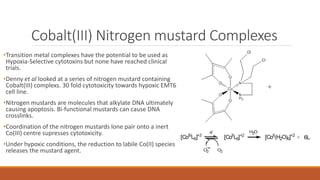
•Coordination of the nitrogen mustards lone pair onto a inert
Co(III) centre supresses cytotoxicity.
•Under hypoxic conditions, the reduction to labile Co(II) species
releases the mustard agent.
Polypyridyl Ruthenium Complexes
•Platinum based drugs are the gold standard
for anticancer treatment but often have low
solubility, side effects and resistance.
•Ruthenium complexes provide a promising
alternative to anticancer treatment.
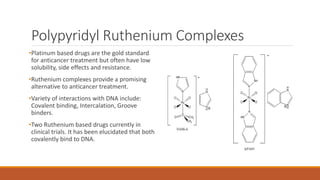
•Variety of interactions with DNA include:
Covalent binding, Intercalation, Groove
binders.
•Two Ruthenium based drugs currently in
clinical trials. It has been elucidated that both
covalently bind to DNA.
Richard Keene’s Work
Click Chelators
•Major aspect to this project was to design a bridging bis
polypyridyl ligand bridged by an alkyl chain.
•Synthesis to functionalised 2,2’bipyridine ligands are often
low yielding and require multiple purification/separation
steps.
•The Copper(I) catalysed ‘Click’ CuAAC reaction provides a
simple reaction pathway to 1,4 functionalised-1,2,3-
triazole ligands which act as surrogates to bipyridine
ligands.
•These ligands have the ability to chelate to a variety of
metals and therefore can be used as linker moiety.
Chapter 2: Synthesis of Cobalt(III)
mustard complex
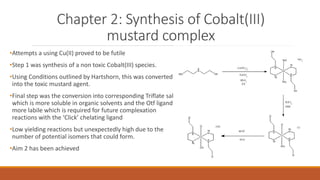
•Attempts a using Cu(II) proved to be futile
•Step 1 was synthesis of a non toxic Cobalt(III) species.
•Using Conditions outlined by Hartshorn, this was converted
into the toxic mustard agent.
•Final step was the conversion into corresponding Triflate salt
which is more soluble in organic solvents and the Otf ligand is
more labile which is required for future complexation
reactions with the ‘Click’ chelating ligand
•Low yielding reactions but unexpectedly high due to the
number of potential isomers that could form.
•Aim 2 has been achieved
Chapter 3: Synthesis of Polypyridyl
Ruthenium(II) precursor
•To synthesise a Polypyridyl Ruthenium(II) precursor that will
cooordinate to a 2-pyridyl-1,2,3-triazole ligand.
•DNA binding analogous to Richard Keene’s work on dinuclear
Ru(II) systems.
•Lipophilicity should also aid cellular uptake.
•Addition of a luminescent Ru(II) centre allows for cellular
localisation studies through confocal microscopy and wide-field
fluorescence microscopy.
•Using reported literature, cis-[Ru(phen)2Cl2] was succesfully
synthesised, albeit in the presence of by-products
Chapter 4: Synthesis of an alkyl-linked
‘Click’ Ligand
•To generate a ligand containing two metal binding sites bridged
by an variable alkyl chain to aid cellular uptake. Compound 10
was chosen as the halide precursor was commercially available
•Can be achieved using a One-step or Two step synthesis route.
•Synthesis of 10 using One step route resulted in low yielding
reaction (17 %).
•Consequently, a Two step method form literature methods
provided pure product 10 in a much better yield (51.6 %)
•Further improvements to catalytic Copper(I) system and using a
halide spacer with a better leaving group (1,12-diiodododecane)
resulted in a further improvements to yield of 10 (83.3 %)
•Third Aim of the project had been met.
Chapter 5: Attempts at Heterodinuclear
Ruthenium(II)-Cobalt(III) Complexes
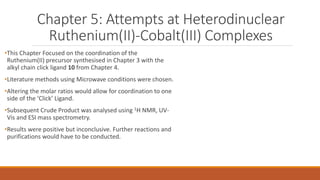
•This Chapter Focused on the coordination of the
Ruthenium(II) precursor synthesised in Chapter 3 with the
alkyl chain click ligand 10 from Chapter 4.
•Literature methods using Microwave conditions were chosen.
•Altering the molar ratios would allow for coordination to one
side of the ‘Click’ Ligand.
•Subsequent Crude Product was analysed using 1H NMR, UV-
Vis and ESI mass spectrometry.
•Results were positive but inconclusive. Further reactions and
purifications would have to be conducted.
Chapter 5: Attempts at Heterodinuclear
Ruthenium(II)-Cobalt(III) Complexes
•According to the literature, no previous complexation reactions between
a Cobalt(III) metal and a 2-pyridyl-1,2,3-triazole ligand have been
reported.
•A literature method from Hartshorn’s research was chosen.
•Alkyl chained ligand 10 and Cobalt(III) triflate salt were stirred in
(CHCl3/Butanol, 1:1) for 3 hours at 40oC
•Crude solid was analysed using 1H NMR and ESI- mass spectrometry.
•Results showed a clear mixture of products, with evidence suggesting the
presence of Cobalt(II) ions.
•It was concluded that the Cobalt(III) triflate ligand had dissociated and
therefore complexation was unsuccessful.
Chapter 6: Future Work
•Uncompleted experimentation
•Lipophilicity
•Reduction potentials
•Understanding cellular uptake and cell death mechanisms
•Controlling the stereochemistry
•Developing a series of more stable Cobalt(III) cytotoxins
•Exploring Pyridyl 1,2,3 Triazole Ruthenium(II) systems
Chapter 7: Conclusion
•Although the primary aim of this project was not met, a
synthesis route to a Ruthenium(II)/Cobalt(III) cytotoxin has
been outlined.
•A library of cytotoxins can be synthesised by through the
intrinsic variability of these complexes.
•A novel ‘Click’ ligand has been synthesised which has
promising outlets beyond this project.
•Further work on synthesising a more stable Cobalt(III)
cytotoxin must be conducted.

Viva presentation

  • 1.
  • 2.
    Project Plan andAims 1. To successfully design, synthesise and characterise through appropriate rationale an alkyl bridged dinuclear ruthenium(II)/cobalt(III) Nitrogen mustard cytotoxin that exhibits selectivity towards hypoxic cells over healthy cells 2. To utilise an efficient method to convert a non-toxic cobalt(III) precursor into its cytotoxic cobalt(III) mustard and apply this principle into the synthesis of our ruthenium(II)/cobalt(III) complex as late as possible. 3. To synthesise a novel bis-bidentate polypyridyl ligand that is bridged by a variable alkyl chain using newly discovered ‘click chemistry’.
  • 3.
    Cancer and Hypoxia •Distinguishingbetween cancerous cells and healthy cells •Tumours are an abnormal growth with no purpose •Rapid growth causes regions of low oxygen (hypoxia) and no oxygen (necrotic) •Tumour hypoxia resistant to both radiotherapy and chemotherapy. •Resistance to chemotherapy as hypoxic regions reside in a pharmacological sanctuary.
  • 4.
    Cobalt(III) Nitrogen mustardComplexes •Transition metal complexes have the potential to be used as Hypoxia-Selective cytotoxins but none have reached clinical trials. •Denny et al looked at a series of nitrogen mustard containing Cobalt(III) complexs. 30 fold cytotoxicity towards hypoxic EMT6 cell line. •Nitrogen mustards are molecules that alkylate DNA ultimately causing apoptosis. Bi-functional mustards can cause DNA crosslinks. •Coordination of the nitrogen mustards lone pair onto a inert Co(III) centre supresses cytotoxicity. •Under hypoxic conditions, the reduction to labile Co(II) species releases the mustard agent.
  • 5.
    Polypyridyl Ruthenium Complexes •Platinumbased drugs are the gold standard for anticancer treatment but often have low solubility, side effects and resistance. •Ruthenium complexes provide a promising alternative to anticancer treatment. •Variety of interactions with DNA include: Covalent binding, Intercalation, Groove binders. •Two Ruthenium based drugs currently in clinical trials. It has been elucidated that both covalently bind to DNA.
  • 6.
  • 7.
    Click Chelators •Major aspectto this project was to design a bridging bis polypyridyl ligand bridged by an alkyl chain. •Synthesis to functionalised 2,2’bipyridine ligands are often low yielding and require multiple purification/separation steps. •The Copper(I) catalysed ‘Click’ CuAAC reaction provides a simple reaction pathway to 1,4 functionalised-1,2,3- triazole ligands which act as surrogates to bipyridine ligands. •These ligands have the ability to chelate to a variety of metals and therefore can be used as linker moiety.
  • 9.
    Chapter 2: Synthesisof Cobalt(III) mustard complex •Attempts a using Cu(II) proved to be futile •Step 1 was synthesis of a non toxic Cobalt(III) species. •Using Conditions outlined by Hartshorn, this was converted into the toxic mustard agent. •Final step was the conversion into corresponding Triflate salt which is more soluble in organic solvents and the Otf ligand is more labile which is required for future complexation reactions with the ‘Click’ chelating ligand •Low yielding reactions but unexpectedly high due to the number of potential isomers that could form. •Aim 2 has been achieved
  • 10.
    Chapter 3: Synthesisof Polypyridyl Ruthenium(II) precursor •To synthesise a Polypyridyl Ruthenium(II) precursor that will cooordinate to a 2-pyridyl-1,2,3-triazole ligand. •DNA binding analogous to Richard Keene’s work on dinuclear Ru(II) systems. •Lipophilicity should also aid cellular uptake. •Addition of a luminescent Ru(II) centre allows for cellular localisation studies through confocal microscopy and wide-field fluorescence microscopy. •Using reported literature, cis-[Ru(phen)2Cl2] was succesfully synthesised, albeit in the presence of by-products
  • 11.
    Chapter 4: Synthesisof an alkyl-linked ‘Click’ Ligand •To generate a ligand containing two metal binding sites bridged by an variable alkyl chain to aid cellular uptake. Compound 10 was chosen as the halide precursor was commercially available •Can be achieved using a One-step or Two step synthesis route. •Synthesis of 10 using One step route resulted in low yielding reaction (17 %). •Consequently, a Two step method form literature methods provided pure product 10 in a much better yield (51.6 %) •Further improvements to catalytic Copper(I) system and using a halide spacer with a better leaving group (1,12-diiodododecane) resulted in a further improvements to yield of 10 (83.3 %) •Third Aim of the project had been met.
  • 12.
    Chapter 5: Attemptsat Heterodinuclear Ruthenium(II)-Cobalt(III) Complexes •This Chapter Focused on the coordination of the Ruthenium(II) precursor synthesised in Chapter 3 with the alkyl chain click ligand 10 from Chapter 4. •Literature methods using Microwave conditions were chosen. •Altering the molar ratios would allow for coordination to one side of the ‘Click’ Ligand. •Subsequent Crude Product was analysed using 1H NMR, UV- Vis and ESI mass spectrometry. •Results were positive but inconclusive. Further reactions and purifications would have to be conducted.
  • 13.
    Chapter 5: Attemptsat Heterodinuclear Ruthenium(II)-Cobalt(III) Complexes •According to the literature, no previous complexation reactions between a Cobalt(III) metal and a 2-pyridyl-1,2,3-triazole ligand have been reported. •A literature method from Hartshorn’s research was chosen. •Alkyl chained ligand 10 and Cobalt(III) triflate salt were stirred in (CHCl3/Butanol, 1:1) for 3 hours at 40oC •Crude solid was analysed using 1H NMR and ESI- mass spectrometry. •Results showed a clear mixture of products, with evidence suggesting the presence of Cobalt(II) ions. •It was concluded that the Cobalt(III) triflate ligand had dissociated and therefore complexation was unsuccessful.
  • 14.
    Chapter 6: FutureWork •Uncompleted experimentation •Lipophilicity •Reduction potentials •Understanding cellular uptake and cell death mechanisms •Controlling the stereochemistry •Developing a series of more stable Cobalt(III) cytotoxins •Exploring Pyridyl 1,2,3 Triazole Ruthenium(II) systems
  • 15.
    Chapter 7: Conclusion •Althoughthe primary aim of this project was not met, a synthesis route to a Ruthenium(II)/Cobalt(III) cytotoxin has been outlined. •A library of cytotoxins can be synthesised by through the intrinsic variability of these complexes. •A novel ‘Click’ ligand has been synthesised which has promising outlets beyond this project. •Further work on synthesising a more stable Cobalt(III) cytotoxin must be conducted.