Silicon Dioxide filled Polymethyl
methacrylate / 50% epoxidized natural
rubber with propylene carbonate
electrolyte
NAME
MUHAMMAD HAKIM BIN HALIM
NAME OF SUPERVISOR
SHARIL FADLI MOHAMAD ZAMRI
INTRODUCTION
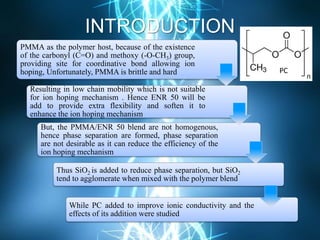
PMMA as the polymer host, because of the existence
of the carbonyl (C=O) and methoxy (-O-CH3) group,
providing site for coordinative bond allowing ion
hoping, Unfortunately, PMMA is brittle and hard
Resulting in low chain mobility which is not suitable
for ion hoping mechanism . Hence ENR 50 will be
add to provide extra flexibility and soften it to
enhance the ion hoping mechanism
But, the PMMA/ENR 50 blend are not homogenous,
hence phase separation are formed, phase separation
are not desirable as it can reduce the efficiency of the
ion hoping mechanism
Thus SiO2 is added to reduce phase separation, but SiO2
tend to agglomerate when mixed with the polymer blend
While PC added to improve ionic conductivity and the
effects of its addition were studied
PC
Problem Statement
1.PMMA/ENR 50/SiO2 electrolyte system
is agglomerated
2.Ionic conductivity of PMMA/ENR
50/SiO2+ is low
Significance of Study
1. To investigate the effect of PC on the agglomeration in
PMMA/ENR 50/ SiO2 electrolyte system
2. To improved the ionic conductivity of PMMA/ENR 50/ SiO2
electrolyte system with the addition of PC
Objective of Study
Contribute to new knowledge on preparation of polymer
electrolytes with improved physical and electrochemical
properties.
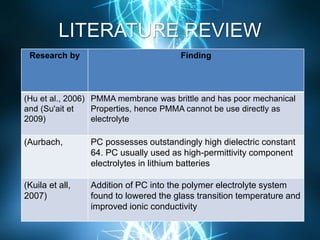
LITERATURE REVIEW
Research by Finding
(Hu et al., 2006)
and (Su'ait et
2009)
PMMA membrane was brittle and has poor mechanical
Properties, hence PMMA cannot be use directly as
electrolyte
(Aurbach, PC possesses outstandingly high dielectric constant
64. PC usually used as high-permittivity component
electrolytes in lithium batteries
(Kuila et all,
2007)
Addition of PC into the polymer electrolyte system
found to lowered the glass transition temperature and
improved ionic conductivity
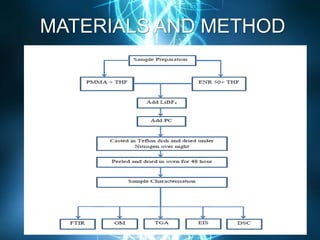
MATERIALS AND METHOD
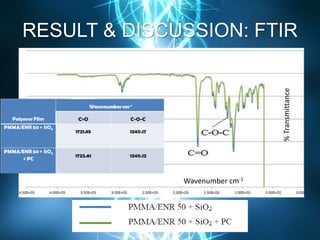
RESULT & DISCUSSION: FTIR
%Transmittance
Wavenumber cm-1
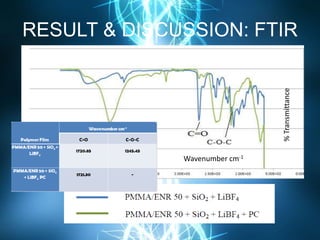
RESULT & DISCUSSION: FTIR
%Transmittance
Wavenumber cm-1
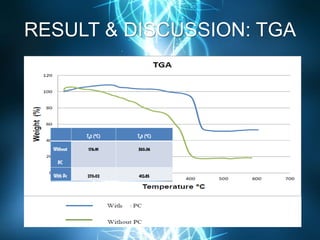
RESULT & DISCUSSION: TGA
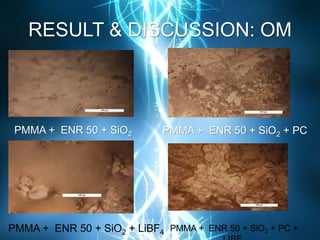
RESULT & DISCUSSION: OM
PMMA + ENR 50 + SiO2 + PC
PMMA + ENR 50 + SiO2 + PC +PMMA + ENR 50 + SiO2 + LiBF4
PMMA + ENR 50 + SiO2
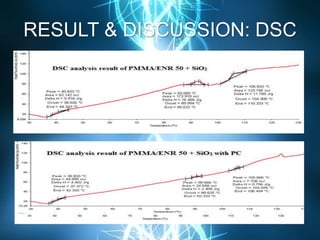
RESULT & DISCUSSION: DSC
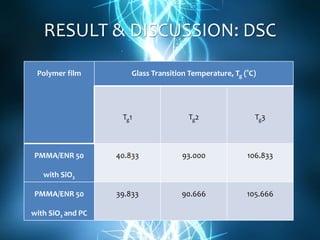
Polymer film Glass Transition Temperature, Tg (°C)
Tg1 Tg2 Tg3
PMMA/ENR 50
with SiO2
40.833 93.000 106.833
PMMA/ENR 50
with SiO2 and PC
39.833 90.666 105.666
RESULT & DISCUSSION: DSC
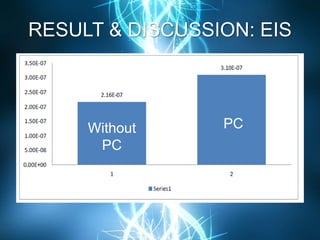
RESULT & DISCUSSION: EIS
PCWithout
PC
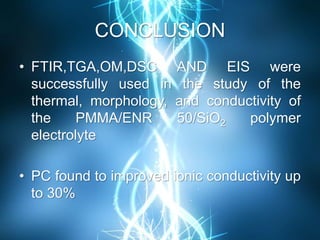
CONCLUSION
• FTIR,TGA,OM,DSC AND EIS were
successfully used in the study of the
thermal, morphology, and conductivity of
the PMMA/ENR 50/SiO2 polymer
electrolyte
• PC found to improved ionic conductivity up
to 30%
RECOMMENDATION
• Based on this study, it can be interesting
to see how different amount of PC added
will affect the ionic conductivity of the
polymer electrolyte, whether the more is
better or there is a limited amount of PC
can be used to improve ionic conductivity
of the polymer electrolyte
REFERENCES
• Latif, F., Aziz, M., Katun, N., Ali, A. M. M., & Yahya, M. Z. (2006). The role and impact of rubber in
poly(methyl methacrylate)/lithium triflate electrolyte. Journal of Power Sources, 159(2), 1401-
1404. doi: 10.1016/j.jpowsour.2005.12.007
• Rajendran, S., Sivakumar, M., & Subadevi, R. (2004). Investigations on the effect of various
plasticizers in PVA–PMMA solid polymer blend electrolytes. Materials Letters
• S.F. Mohammad, N. Z., S. Ibrahim and N.S. Mohamed. (2013). Conductivity Enhancement of
(Epoxidized Natural Rubber 50)/Poly(Ethyl Methacrylate)–Ionic Liquid-Ammonium Triflate. Int. J.
Electrochem. Sci, 8(6145 – 6153
• Su'ait M. S., A. A., Hamzah H., Rahman M. Y. A. (2009). Preparation and characterization of
PMMA–MG49–LiClO4solid polymeric electrolyte. Journal of Physics D: Applied
• Manuel Stephan, A. (2006). Review on gel polymer electrolytes for lithium batteries. European
Polymer Journal, 42(1), 21-42. doi: 10.1016/j.eurpolymj.2005.09.017
• S.F. Mohammad, N. Z., S. Ibrahim and N.S. Mohamed. (2013). Conductivity Enhancement of
(Epoxidized Natural Rubber 50)/Poly(Ethyl Methacrylate)–Ionic Liquid-Ammonium Triflate. Int. J.
Electrochem. Sci, 8(6145 – 6153
• Wright, P. V. (1975). Electrical conductivity in ionic complexes of poly(ethylene oxide). British
Polymer Journal, 7(5), 319–327. doi: 10.1002/pi.4980070505
• Xu, T., Jia, Z., Luo, Y., Jia, D., & Peng, Z. (2015). Interfacial interaction between the epoxidized
natural rubber and silica in natural rubber/silica composites. Applied Surface Science, 328, 306-
313. doi: 10.1016/j.apsusc.2014.12.029
• Zhu, N., Liu, W., Xue, M., Xie, Z., Zhao, D., Zhang, M., . . . Cao, T. (2010). Graphene as a
conductive additive to enhance the high-rate capabilities of electrospun Li4Ti5O12 for lithium-ion
batteries. Electrochimica Acta, 55(20), 5813-5818. doi: 10.1016/j.electacta.2010.05.029
• Bensaude-Vincent, B., & Armand, M. . (2001). Polymer Electrolytes

viva Hakim FINAL

  • 1.
    Silicon Dioxide filledPolymethyl methacrylate / 50% epoxidized natural rubber with propylene carbonate electrolyte NAME MUHAMMAD HAKIM BIN HALIM NAME OF SUPERVISOR SHARIL FADLI MOHAMAD ZAMRI
  • 2.
    INTRODUCTION PMMA as thepolymer host, because of the existence of the carbonyl (C=O) and methoxy (-O-CH3) group, providing site for coordinative bond allowing ion hoping, Unfortunately, PMMA is brittle and hard Resulting in low chain mobility which is not suitable for ion hoping mechanism . Hence ENR 50 will be add to provide extra flexibility and soften it to enhance the ion hoping mechanism But, the PMMA/ENR 50 blend are not homogenous, hence phase separation are formed, phase separation are not desirable as it can reduce the efficiency of the ion hoping mechanism Thus SiO2 is added to reduce phase separation, but SiO2 tend to agglomerate when mixed with the polymer blend While PC added to improve ionic conductivity and the effects of its addition were studied PC
  • 3.
    Problem Statement 1.PMMA/ENR 50/SiO2electrolyte system is agglomerated 2.Ionic conductivity of PMMA/ENR 50/SiO2+ is low
  • 4.
    Significance of Study 1.To investigate the effect of PC on the agglomeration in PMMA/ENR 50/ SiO2 electrolyte system 2. To improved the ionic conductivity of PMMA/ENR 50/ SiO2 electrolyte system with the addition of PC Objective of Study Contribute to new knowledge on preparation of polymer electrolytes with improved physical and electrochemical properties.
  • 5.
    LITERATURE REVIEW Research byFinding (Hu et al., 2006) and (Su'ait et 2009) PMMA membrane was brittle and has poor mechanical Properties, hence PMMA cannot be use directly as electrolyte (Aurbach, PC possesses outstandingly high dielectric constant 64. PC usually used as high-permittivity component electrolytes in lithium batteries (Kuila et all, 2007) Addition of PC into the polymer electrolyte system found to lowered the glass transition temperature and improved ionic conductivity
  • 6.
  • 7.
    RESULT & DISCUSSION:FTIR %Transmittance Wavenumber cm-1
  • 8.
    RESULT & DISCUSSION:FTIR %Transmittance Wavenumber cm-1
  • 9.
  • 10.
    RESULT & DISCUSSION:OM PMMA + ENR 50 + SiO2 + PC PMMA + ENR 50 + SiO2 + PC +PMMA + ENR 50 + SiO2 + LiBF4 PMMA + ENR 50 + SiO2
  • 11.
  • 12.
    Polymer film GlassTransition Temperature, Tg (°C) Tg1 Tg2 Tg3 PMMA/ENR 50 with SiO2 40.833 93.000 106.833 PMMA/ENR 50 with SiO2 and PC 39.833 90.666 105.666 RESULT & DISCUSSION: DSC
  • 13.
    RESULT & DISCUSSION:EIS PCWithout PC
  • 14.
    CONCLUSION • FTIR,TGA,OM,DSC ANDEIS were successfully used in the study of the thermal, morphology, and conductivity of the PMMA/ENR 50/SiO2 polymer electrolyte • PC found to improved ionic conductivity up to 30%
  • 15.
    RECOMMENDATION • Based onthis study, it can be interesting to see how different amount of PC added will affect the ionic conductivity of the polymer electrolyte, whether the more is better or there is a limited amount of PC can be used to improve ionic conductivity of the polymer electrolyte
  • 16.
    REFERENCES • Latif, F.,Aziz, M., Katun, N., Ali, A. M. M., & Yahya, M. Z. (2006). The role and impact of rubber in poly(methyl methacrylate)/lithium triflate electrolyte. Journal of Power Sources, 159(2), 1401- 1404. doi: 10.1016/j.jpowsour.2005.12.007 • Rajendran, S., Sivakumar, M., & Subadevi, R. (2004). Investigations on the effect of various plasticizers in PVA–PMMA solid polymer blend electrolytes. Materials Letters • S.F. Mohammad, N. Z., S. Ibrahim and N.S. Mohamed. (2013). Conductivity Enhancement of (Epoxidized Natural Rubber 50)/Poly(Ethyl Methacrylate)–Ionic Liquid-Ammonium Triflate. Int. J. Electrochem. Sci, 8(6145 – 6153 • Su'ait M. S., A. A., Hamzah H., Rahman M. Y. A. (2009). Preparation and characterization of PMMA–MG49–LiClO4solid polymeric electrolyte. Journal of Physics D: Applied • Manuel Stephan, A. (2006). Review on gel polymer electrolytes for lithium batteries. European Polymer Journal, 42(1), 21-42. doi: 10.1016/j.eurpolymj.2005.09.017 • S.F. Mohammad, N. Z., S. Ibrahim and N.S. Mohamed. (2013). Conductivity Enhancement of (Epoxidized Natural Rubber 50)/Poly(Ethyl Methacrylate)–Ionic Liquid-Ammonium Triflate. Int. J. Electrochem. Sci, 8(6145 – 6153 • Wright, P. V. (1975). Electrical conductivity in ionic complexes of poly(ethylene oxide). British Polymer Journal, 7(5), 319–327. doi: 10.1002/pi.4980070505 • Xu, T., Jia, Z., Luo, Y., Jia, D., & Peng, Z. (2015). Interfacial interaction between the epoxidized natural rubber and silica in natural rubber/silica composites. Applied Surface Science, 328, 306- 313. doi: 10.1016/j.apsusc.2014.12.029 • Zhu, N., Liu, W., Xue, M., Xie, Z., Zhao, D., Zhang, M., . . . Cao, T. (2010). Graphene as a conductive additive to enhance the high-rate capabilities of electrospun Li4Ti5O12 for lithium-ion batteries. Electrochimica Acta, 55(20), 5813-5818. doi: 10.1016/j.electacta.2010.05.029 • Bensaude-Vincent, B., & Armand, M. . (2001). Polymer Electrolytes