


Society for Post-Acute and Long-
Term Care Medicine Annual
Conference
Wednesday, March 16, 2016
Chronic Care Management
in a Post-Acute Care World
A Post-Acute Care World
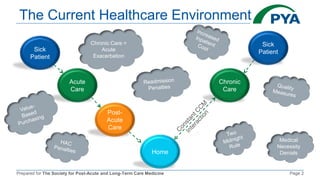
The Current Healthcare Environment
Prepared for The Society for Post-Acute and Long-Term Care Medicine Page 2
The Current Healthcare Environment
Sick
Patient
Acute
Care
Post-
Acute
Care
Sick
Patient
Chronic
Care
Home
Chronic Care =
Acute
Exacerbation
Medical
Necessity
Denials
Prepared for The Society for Post-Acute and Long-Term Care Medicine Page 3
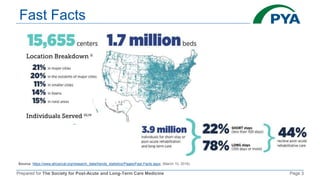
Fast Facts
Source: https://www.ahcancal.org/research_data/trends_statistics/Pages/Fast-Facts.aspx, (March 10, 2016).
Prepared for The Society for Post-Acute and Long-Term Care Medicine Page 4
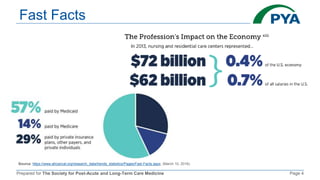
Fast Facts
Source: https://www.ahcancal.org/research_data/trends_statistics/Pages/Fast-Facts.aspx, (March 10, 2016).
Prepared for The Society for Post-Acute and Long-Term Care Medicine Page 5
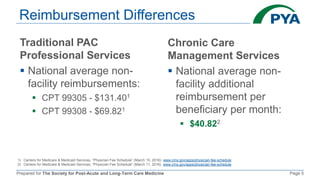
Reimbursement Differences
Traditional PAC
Professional Services
 National average non-
facility reimbursements:
 CPT 99305 - $131.401
 CPT 99308 - $69.821
Chronic Care
Management Services
 National average non-
facility additional
reimbursement per
beneficiary per month:
 $40.822
1) Centers for Medicare & Medicaid Services, “Physician Fee Schedule” (March 10, 2016). www.cms.gov/apps/physician-fee-schedule
2) Centers for Medicare & Medicaid Services, “Physician Fee Schedule” (March 11, 2016). www.cms.gov/apps/physician-fee-schedule
Prepared for The Society for Post-Acute and Long-Term Care Medicine Page 6
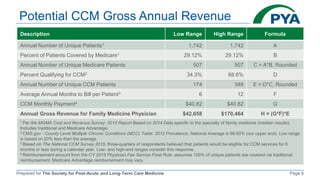
Potential CCM Gross Annual Revenue
Description Low Range High Range Formula
Annual Number of Unique Patients1 1,742 1,742 A
Percent of Patients Covered by Medicare1 29.12% 29.12% B
Annual Number of Unique Medicare Patients 507 507 C = A*B, Rounded
Percent Qualifying for CCM2 34.3% 68.6% D
Annual Number of Unique CCM Patients 174 348 E = D*C, Rounded
Average Annual Months to Bill per Patient3 6 12 F
CCM Monthly Payment4 $40.82 $40.82 G
Annual Gross Revenue for Family Medicine Physician $42,658 $170,464 H = (G*F)*E
1 Per the MGMA Cost and Revenue Survey: 2015 Report Based on 2014 Data specific to the specialty of family medicine (median results).
Includes traditional and Medicare Advantage.
2 CMS.gov - County Level Multiple Chronic Conditions (MCC) Table: 2012 Prevalence, National Average is 68.60% (our upper end). Low range
is based on 20% less than the average.
3 Based on The National CCM Survey 2015, three-quarters of respondents believed that patients would be eligible for CCM services for 6
months or less during a calendar year. Low- and high-end ranges consider this response.
4 Reimbursement amount from the CY 2015 Physician Fee Service Final Rule; assumes 100% of unique patients are covered via traditional
reimbursement. Medicare Advantage reimbursement may vary.
What Is Chronic Care Management?
A Working Definition
Prepared for The Society for Post-Acute and Long-Term Care Medicine Page 8
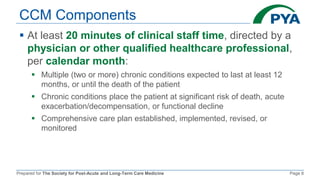
CCM Components
 At least 20 minutes of clinical staff time, directed by a
physician or other qualified healthcare professional,
per calendar month:
 Multiple (two or more) chronic conditions expected to last at least 12
months, or until the death of the patient
 Chronic conditions place the patient at significant risk of death, acute
exacerbation/decompensation, or functional decline
 Comprehensive care plan established, implemented, revised, or
monitored
Prepared for The Society for Post-Acute and Long-Term Care Medicine Page 9
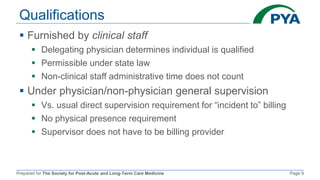
Qualifications
 Furnished by clinical staff
 Delegating physician determines individual is qualified
 Permissible under state law
 Non-clinical staff administrative time does not count
 Under physician/non-physician general supervision
 Vs. usual direct supervision requirement for “incident to” billing
 No physical presence requirement
 Supervisor does not have to be billing provider
Prepared for The Society for Post-Acute and Long-Term Care Medicine Page 10
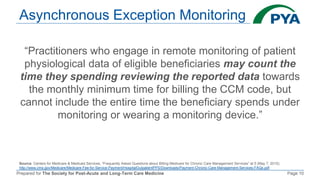
Asynchronous Exception Monitoring
“Practitioners who engage in remote monitoring of patient
physiological data of eligible beneficiaries may count the
time they spending reviewing the reported data towards
the monthly minimum time for billing the CCM code, but
cannot include the entire time the beneficiary spends under
monitoring or wearing a monitoring device.”
Source: Centers for Medicare & Medicaid Services, “Frequently Asked Questions about Billing Medicare for Chronic Care Management Services” at 5 (May 7, 2015).
http://www.cms.gov/Medicare/Medicare-Fee-for-Service-Payment/HospitalOutpatientPPS/Downloads/Payment-Chronic-Care-Management-Services-FAQs.pdf.
Prepared for The Society for Post-Acute and Long-Term Care Medicine Page 11
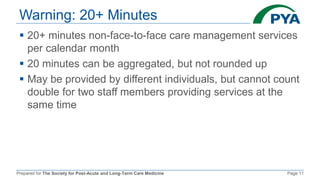
Warning: 20+ Minutes
 20+ minutes non-face-to-face care management services
per calendar month
 20 minutes can be aggregated, but not rounded up
 May be provided by different individuals, but cannot count
double for two staff members providing services at the
same time
Prepared for The Society for Post-Acute and Long-Term Care Medicine Page 12
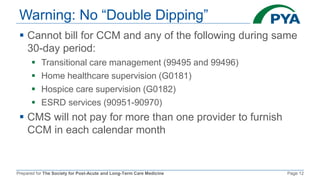
Warning: No “Double Dipping”
 Cannot bill for CCM and any of the following during same
30-day period:
 Transitional care management (99495 and 99496)
 Home healthcare supervision (G0181)
 Hospice care supervision (G0182)
 ESRD services (90951-90970)
 CMS will not pay for more than one provider to furnish
CCM in each calendar month
Prepared for The Society for Post-Acute and Long-Term Care Medicine Page 13
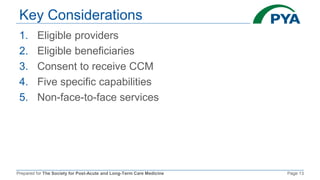
Key Considerations
1. Eligible providers
2. Eligible beneficiaries
3. Consent to receive CCM
4. Five specific capabilities
5. Non-face-to-face services
Prepared for The Society for Post-Acute and Long-Term Care Medicine Page 14
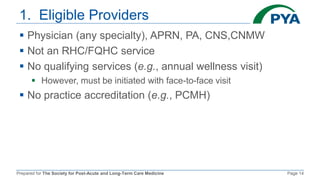
1. Eligible Providers
 Physician (any specialty), APRN, PA, CNS,CNMW
 Not an RHC/FQHC service
 No qualifying services (e.g., annual wellness visit)
 However, must be initiated with face-to-face visit
 No practice accreditation (e.g., PCMH)
Prepared for The Society for Post-Acute and Long-Term Care Medicine Page 15
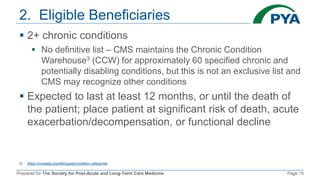
2. Eligible Beneficiaries
 2+ chronic conditions
 No definitive list – CMS maintains the Chronic Condition
Warehouse3 (CCW) for approximately 60 specified chronic and
potentially disabling conditions, but this is not an exclusive list and
CMS may recognize other conditions
 Expected to last at least 12 months, or until the death of
the patient; place patient at significant risk of death, acute
exacerbation/decompensation, or functional decline
3) https://ccwdata.org/web/guest/condition-categories
Prepared for The Society for Post-Acute and Long-Term Care Medicine Page 16
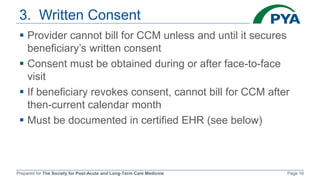
3. Written Consent
 Provider cannot bill for CCM unless and until it secures
beneficiary’s written consent
 Consent must be obtained during or after face-to-face
visit
 If beneficiary revokes consent, cannot bill for CCM after
then-current calendar month
 Must be documented in certified EHR (see below)
Prepared for The Society for Post-Acute and Long-Term Care Medicine Page 17
4. Five Specified Capabilities
 Provider must demonstrate following capabilities:
A. Use of certified EHR for specified purposes
B. Electronic care plan
C. Beneficiary access to care
D. Transitions of care
E. Coordination of care
 Submission of claim = attestation of capabilities
Prepared for The Society for Post-Acute and Long-Term Care Medicine Page 18
A. Use of Certified EHR
 Must utilize “CCM-certified technology” for specified
purposes in providing CCM
 the edition(s) of the meaningful use certification criteria in use as
of 12/31 of preceding year
 Not required to be meaningful user of certified EHR
technology
Prepared for The Society for Post-Acute and Long-Term Care Medicine Page 19
B. Electronic Care Plan
 Maintain regularly updated electronic care plan for
beneficiary
 Based on physical, mental, cognitive, psychosocial, functional,
and environmental (re)assessment of beneficiary’s needs
 Inventory of resources and supports
 Addresses all health issues (not just chronic conditions)
 Congruent with beneficiary’s choices and values
 Preparation and updating of care plan is not a component
of CCM; may bill as separate E&M code if requirements
satisfied (e.g., AWV)
Prepared for The Society for Post-Acute and Long-Term Care Medicine Page 20
Access to Electronic Care Plan
1. Electronically accessible 24/7 to all care team members
furnishing CCM services billed by the practice
 E.g., remote access to EHR, web-based access to care
management application, web-based access to HIE – not
facsimile
2. “Must electronically share care plan information as
appropriate with other providers” caring for patient
 E.g., secure messaging, participation in HIE – not facsimile
3. Provide paper or electronic copy to beneficiary
 Must be documented in certified EHR
Prepared for The Society for Post-Acute and Long-Term Care Medicine Page 21
C. Beneficiary Access to Care
1. Means for beneficiary to access provider in the practice* on
24/7 basis to address acute/urgent needs in timely manner
2. Beneficiary’s ability to get successive routine appointments
with designated practitioner or member of care team
3. Enhanced opportunities for beneficiary-provider (or
caregiver-provider) communication by telephone +
asynchronous consultation methods (e.g., secure
messaging, internet)
*person whose time is counted in 20 minutes of non-face-
to-face care management services per month
Prepared for The Society for Post-Acute and Long-Term Care Medicine Page 22
D. Transitions of Care
 Capability and capacity to do the following:
 Follow up after ER visit
 Provide transitional care management
 Coordinate referrals to other clinicians
 Share information electronically with other clinicians as
appropriate
 Summary care record and electronic care plan
 No specific manner of transmission required
Prepared for The Society for Post-Acute and Long-Term Care Medicine Page 23
E. Coordination of Care
 Coordinate with home- and community-based clinical
service providers to meet beneficiary’s psychosocial
needs and functional deficits
 Home health and hospice
 Outpatient therapies
 DME suppliers
 Transportation services
 Nutrition services
 Communications with these providers must be
documented in certified EHR
Prepared for The Society for Post-Acute and Long-Term Care Medicine Page 24
5. Non-Face-to-Face Services
 Types of service (non-exclusive)
 Performing medication reconciliation, oversight of beneficiary self-
management of medications
 Ensuring receipt of all recommended preventive services
 Monitoring beneficiary’s condition (physical, mental, social)
 Documentation
 Date and time (start/stop?)
 Person furnishing services (with credentials)
 Brief description of services
Prepared for The Society for Post-Acute and Long-Term Care Medicine Page 25
Billing Rules
 Date of service = day on which meet 20 minute
requirement (or any day thereafter thru end of month)
 May bill after date of patient’s death, but only if met 20-minute
requirement prior to that date
 Site of service = location at which billing practitioner
normally would see patient for face-to-face visit
Adding Chronic Care Management
Chronic Care Management Options
Prepared for The Society for Post-Acute and Long-Term Care Medicine Page 27
Creation and Operations
 Opportunities for partnership (physicians, health systems)
 Impact on relationship with referring physicians
 Legal structure
 Regulatory compliance issues
 Billing
 Marketing implications
 Operationalizing impacts
 Hiring vs. contracting supervising MD, impact on
relationships with current physicians and staff
Prepared for The Society for Post-Acute and Long-Term Care Medicine Page 28
Option 1 for Delivering CCM
 HHA/SNF-employed Qualified Provider (QP) performs QP-required
elements of service with HHA/SNF staff performing other elements:
 HHA/SNF must have Part B billing number (HHA/SNF = Part A)
 QP may be part-time employment limited to CCM services
 QP reassigns billing rights to HHA/SNF; HHA/SNF submits claim to Part
B; HHA/SNF responsible for maintaining documentation
 Structure arrangement to satisfy Stark Law except, Anti-Kickback Statute
safe harbor
 Not permitted in states prohibiting corporate practice of medicine
Prepared for The Society for Post-Acute and Long-Term Care Medicine Page 29
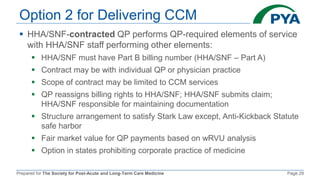
Option 2 for Delivering CCM
 HHA/SNF-contracted QP performs QP-required elements of service
with HHA/SNF staff performing other elements:
 HHA/SNF must have Part B billing number (HHA/SNF – Part A)
 Contract may be with individual QP or physician practice
 Scope of contract may be limited to CCM services
 QP reassigns billing rights to HHA/SNF; HHA/SNF submits claim;
HHA/SNF responsible for maintaining documentation
 Structure arrangement to satisfy Stark Law except, Anti-Kickback Statute
safe harbor
 Fair market value for QP payments based on wRVU analysis
 Option in states prohibiting corporate practice of medicine
Prepared for The Society for Post-Acute and Long-Term Care Medicine Page 30
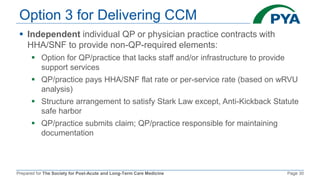
Option 3 for Delivering CCM
 Independent individual QP or physician practice contracts with
HHA/SNF to provide non-QP-required elements:
 Option for QP/practice that lacks staff and/or infrastructure to provide
support services
 QP/practice pays HHA/SNF flat rate or per-service rate (based on wRVU
analysis)
 Structure arrangement to satisfy Stark Law except, Anti-Kickback Statute
safe harbor
 QP/practice submits claim; QP/practice responsible for maintaining
documentation
Prepared for The Society for Post-Acute and Long-Term Care Medicine Page 31
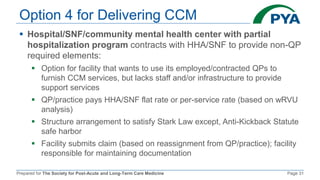
Option 4 for Delivering CCM
 Hospital/SNF/community mental health center with partial
hospitalization program contracts with HHA/SNF to provide non-QP
required elements:
 Option for facility that wants to use its employed/contracted QPs to
furnish CCM services, but lacks staff and/or infrastructure to provide
support services
 QP/practice pays HHA/SNF flat rate or per-service rate (based on wRVU
analysis)
 Structure arrangement to satisfy Stark Law except, Anti-Kickback Statute
safe harbor
 Facility submits claim (based on reassignment from QP/practice); facility
responsible for maintaining documentation
Prepared for The Society for Post-Acute and Long-Term Care Medicine Page 32
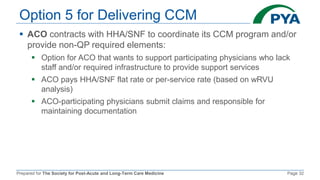
Option 5 for Delivering CCM
 ACO contracts with HHA/SNF to coordinate its CCM program and/or
provide non-QP required elements:
 Option for ACO that wants to support participating physicians who lack
staff and/or required infrastructure to provide support services
 ACO pays HHA/SNF flat rate or per-service rate (based on wRVU
analysis)
 ACO-participating physicians submit claims and responsible for
maintaining documentation
Prepared for The Society for Post-Acute and Long-Term Care Medicine Page 33
Questions
PERSHING YOAKLEY & ASSOCIATES, P.C.
800.270.9629 | www.pyapc.com
Denise Hall
Principal
dhall@pyapc.com
Lori Baker
Manager
lbaker@pyapc.com

Chronic Care Management in Post-Acute/LTC Setting

  • 1.
    Society for Post-Acuteand Long- Term Care Medicine Annual Conference Wednesday, March 16, 2016 Chronic Care Management in a Post-Acute Care World
  • 2.
    A Post-Acute CareWorld The Current Healthcare Environment
  • 3.
    Prepared for TheSociety for Post-Acute and Long-Term Care Medicine Page 2 The Current Healthcare Environment Sick Patient Acute Care Post- Acute Care Sick Patient Chronic Care Home Chronic Care = Acute Exacerbation Medical Necessity Denials
  • 4.
    Prepared for TheSociety for Post-Acute and Long-Term Care Medicine Page 3 Fast Facts Source: https://www.ahcancal.org/research_data/trends_statistics/Pages/Fast-Facts.aspx, (March 10, 2016).
  • 5.
    Prepared for TheSociety for Post-Acute and Long-Term Care Medicine Page 4 Fast Facts Source: https://www.ahcancal.org/research_data/trends_statistics/Pages/Fast-Facts.aspx, (March 10, 2016).
  • 6.
    Prepared for TheSociety for Post-Acute and Long-Term Care Medicine Page 5 Reimbursement Differences Traditional PAC Professional Services  National average non- facility reimbursements:  CPT 99305 - $131.401  CPT 99308 - $69.821 Chronic Care Management Services  National average non- facility additional reimbursement per beneficiary per month:  $40.822 1) Centers for Medicare & Medicaid Services, “Physician Fee Schedule” (March 10, 2016). www.cms.gov/apps/physician-fee-schedule 2) Centers for Medicare & Medicaid Services, “Physician Fee Schedule” (March 11, 2016). www.cms.gov/apps/physician-fee-schedule
  • 7.
    Prepared for TheSociety for Post-Acute and Long-Term Care Medicine Page 6 Potential CCM Gross Annual Revenue Description Low Range High Range Formula Annual Number of Unique Patients1 1,742 1,742 A Percent of Patients Covered by Medicare1 29.12% 29.12% B Annual Number of Unique Medicare Patients 507 507 C = A*B, Rounded Percent Qualifying for CCM2 34.3% 68.6% D Annual Number of Unique CCM Patients 174 348 E = D*C, Rounded Average Annual Months to Bill per Patient3 6 12 F CCM Monthly Payment4 $40.82 $40.82 G Annual Gross Revenue for Family Medicine Physician $42,658 $170,464 H = (G*F)*E 1 Per the MGMA Cost and Revenue Survey: 2015 Report Based on 2014 Data specific to the specialty of family medicine (median results). Includes traditional and Medicare Advantage. 2 CMS.gov - County Level Multiple Chronic Conditions (MCC) Table: 2012 Prevalence, National Average is 68.60% (our upper end). Low range is based on 20% less than the average. 3 Based on The National CCM Survey 2015, three-quarters of respondents believed that patients would be eligible for CCM services for 6 months or less during a calendar year. Low- and high-end ranges consider this response. 4 Reimbursement amount from the CY 2015 Physician Fee Service Final Rule; assumes 100% of unique patients are covered via traditional reimbursement. Medicare Advantage reimbursement may vary.
  • 8.
    What Is ChronicCare Management? A Working Definition
  • 9.
    Prepared for TheSociety for Post-Acute and Long-Term Care Medicine Page 8 CCM Components  At least 20 minutes of clinical staff time, directed by a physician or other qualified healthcare professional, per calendar month:  Multiple (two or more) chronic conditions expected to last at least 12 months, or until the death of the patient  Chronic conditions place the patient at significant risk of death, acute exacerbation/decompensation, or functional decline  Comprehensive care plan established, implemented, revised, or monitored
  • 10.
    Prepared for TheSociety for Post-Acute and Long-Term Care Medicine Page 9 Qualifications  Furnished by clinical staff  Delegating physician determines individual is qualified  Permissible under state law  Non-clinical staff administrative time does not count  Under physician/non-physician general supervision  Vs. usual direct supervision requirement for “incident to” billing  No physical presence requirement  Supervisor does not have to be billing provider
  • 11.
    Prepared for TheSociety for Post-Acute and Long-Term Care Medicine Page 10 Asynchronous Exception Monitoring “Practitioners who engage in remote monitoring of patient physiological data of eligible beneficiaries may count the time they spending reviewing the reported data towards the monthly minimum time for billing the CCM code, but cannot include the entire time the beneficiary spends under monitoring or wearing a monitoring device.” Source: Centers for Medicare & Medicaid Services, “Frequently Asked Questions about Billing Medicare for Chronic Care Management Services” at 5 (May 7, 2015). http://www.cms.gov/Medicare/Medicare-Fee-for-Service-Payment/HospitalOutpatientPPS/Downloads/Payment-Chronic-Care-Management-Services-FAQs.pdf.
  • 12.
    Prepared for TheSociety for Post-Acute and Long-Term Care Medicine Page 11 Warning: 20+ Minutes  20+ minutes non-face-to-face care management services per calendar month  20 minutes can be aggregated, but not rounded up  May be provided by different individuals, but cannot count double for two staff members providing services at the same time
  • 13.
    Prepared for TheSociety for Post-Acute and Long-Term Care Medicine Page 12 Warning: No “Double Dipping”  Cannot bill for CCM and any of the following during same 30-day period:  Transitional care management (99495 and 99496)  Home healthcare supervision (G0181)  Hospice care supervision (G0182)  ESRD services (90951-90970)  CMS will not pay for more than one provider to furnish CCM in each calendar month
  • 14.
    Prepared for TheSociety for Post-Acute and Long-Term Care Medicine Page 13 Key Considerations 1. Eligible providers 2. Eligible beneficiaries 3. Consent to receive CCM 4. Five specific capabilities 5. Non-face-to-face services
  • 15.
    Prepared for TheSociety for Post-Acute and Long-Term Care Medicine Page 14 1. Eligible Providers  Physician (any specialty), APRN, PA, CNS,CNMW  Not an RHC/FQHC service  No qualifying services (e.g., annual wellness visit)  However, must be initiated with face-to-face visit  No practice accreditation (e.g., PCMH)
  • 16.
    Prepared for TheSociety for Post-Acute and Long-Term Care Medicine Page 15 2. Eligible Beneficiaries  2+ chronic conditions  No definitive list – CMS maintains the Chronic Condition Warehouse3 (CCW) for approximately 60 specified chronic and potentially disabling conditions, but this is not an exclusive list and CMS may recognize other conditions  Expected to last at least 12 months, or until the death of the patient; place patient at significant risk of death, acute exacerbation/decompensation, or functional decline 3) https://ccwdata.org/web/guest/condition-categories
  • 17.
    Prepared for TheSociety for Post-Acute and Long-Term Care Medicine Page 16 3. Written Consent  Provider cannot bill for CCM unless and until it secures beneficiary’s written consent  Consent must be obtained during or after face-to-face visit  If beneficiary revokes consent, cannot bill for CCM after then-current calendar month  Must be documented in certified EHR (see below)
  • 18.
    Prepared for TheSociety for Post-Acute and Long-Term Care Medicine Page 17 4. Five Specified Capabilities  Provider must demonstrate following capabilities: A. Use of certified EHR for specified purposes B. Electronic care plan C. Beneficiary access to care D. Transitions of care E. Coordination of care  Submission of claim = attestation of capabilities
  • 19.
    Prepared for TheSociety for Post-Acute and Long-Term Care Medicine Page 18 A. Use of Certified EHR  Must utilize “CCM-certified technology” for specified purposes in providing CCM  the edition(s) of the meaningful use certification criteria in use as of 12/31 of preceding year  Not required to be meaningful user of certified EHR technology
  • 20.
    Prepared for TheSociety for Post-Acute and Long-Term Care Medicine Page 19 B. Electronic Care Plan  Maintain regularly updated electronic care plan for beneficiary  Based on physical, mental, cognitive, psychosocial, functional, and environmental (re)assessment of beneficiary’s needs  Inventory of resources and supports  Addresses all health issues (not just chronic conditions)  Congruent with beneficiary’s choices and values  Preparation and updating of care plan is not a component of CCM; may bill as separate E&M code if requirements satisfied (e.g., AWV)
  • 21.
    Prepared for TheSociety for Post-Acute and Long-Term Care Medicine Page 20 Access to Electronic Care Plan 1. Electronically accessible 24/7 to all care team members furnishing CCM services billed by the practice  E.g., remote access to EHR, web-based access to care management application, web-based access to HIE – not facsimile 2. “Must electronically share care plan information as appropriate with other providers” caring for patient  E.g., secure messaging, participation in HIE – not facsimile 3. Provide paper or electronic copy to beneficiary  Must be documented in certified EHR
  • 22.
    Prepared for TheSociety for Post-Acute and Long-Term Care Medicine Page 21 C. Beneficiary Access to Care 1. Means for beneficiary to access provider in the practice* on 24/7 basis to address acute/urgent needs in timely manner 2. Beneficiary’s ability to get successive routine appointments with designated practitioner or member of care team 3. Enhanced opportunities for beneficiary-provider (or caregiver-provider) communication by telephone + asynchronous consultation methods (e.g., secure messaging, internet) *person whose time is counted in 20 minutes of non-face- to-face care management services per month
  • 23.
    Prepared for TheSociety for Post-Acute and Long-Term Care Medicine Page 22 D. Transitions of Care  Capability and capacity to do the following:  Follow up after ER visit  Provide transitional care management  Coordinate referrals to other clinicians  Share information electronically with other clinicians as appropriate  Summary care record and electronic care plan  No specific manner of transmission required
  • 24.
    Prepared for TheSociety for Post-Acute and Long-Term Care Medicine Page 23 E. Coordination of Care  Coordinate with home- and community-based clinical service providers to meet beneficiary’s psychosocial needs and functional deficits  Home health and hospice  Outpatient therapies  DME suppliers  Transportation services  Nutrition services  Communications with these providers must be documented in certified EHR
  • 25.
    Prepared for TheSociety for Post-Acute and Long-Term Care Medicine Page 24 5. Non-Face-to-Face Services  Types of service (non-exclusive)  Performing medication reconciliation, oversight of beneficiary self- management of medications  Ensuring receipt of all recommended preventive services  Monitoring beneficiary’s condition (physical, mental, social)  Documentation  Date and time (start/stop?)  Person furnishing services (with credentials)  Brief description of services
  • 26.
    Prepared for TheSociety for Post-Acute and Long-Term Care Medicine Page 25 Billing Rules  Date of service = day on which meet 20 minute requirement (or any day thereafter thru end of month)  May bill after date of patient’s death, but only if met 20-minute requirement prior to that date  Site of service = location at which billing practitioner normally would see patient for face-to-face visit
  • 27.
    Adding Chronic CareManagement Chronic Care Management Options
  • 28.
    Prepared for TheSociety for Post-Acute and Long-Term Care Medicine Page 27 Creation and Operations  Opportunities for partnership (physicians, health systems)  Impact on relationship with referring physicians  Legal structure  Regulatory compliance issues  Billing  Marketing implications  Operationalizing impacts  Hiring vs. contracting supervising MD, impact on relationships with current physicians and staff
  • 29.
    Prepared for TheSociety for Post-Acute and Long-Term Care Medicine Page 28 Option 1 for Delivering CCM  HHA/SNF-employed Qualified Provider (QP) performs QP-required elements of service with HHA/SNF staff performing other elements:  HHA/SNF must have Part B billing number (HHA/SNF = Part A)  QP may be part-time employment limited to CCM services  QP reassigns billing rights to HHA/SNF; HHA/SNF submits claim to Part B; HHA/SNF responsible for maintaining documentation  Structure arrangement to satisfy Stark Law except, Anti-Kickback Statute safe harbor  Not permitted in states prohibiting corporate practice of medicine
  • 30.
    Prepared for TheSociety for Post-Acute and Long-Term Care Medicine Page 29 Option 2 for Delivering CCM  HHA/SNF-contracted QP performs QP-required elements of service with HHA/SNF staff performing other elements:  HHA/SNF must have Part B billing number (HHA/SNF – Part A)  Contract may be with individual QP or physician practice  Scope of contract may be limited to CCM services  QP reassigns billing rights to HHA/SNF; HHA/SNF submits claim; HHA/SNF responsible for maintaining documentation  Structure arrangement to satisfy Stark Law except, Anti-Kickback Statute safe harbor  Fair market value for QP payments based on wRVU analysis  Option in states prohibiting corporate practice of medicine
  • 31.
    Prepared for TheSociety for Post-Acute and Long-Term Care Medicine Page 30 Option 3 for Delivering CCM  Independent individual QP or physician practice contracts with HHA/SNF to provide non-QP-required elements:  Option for QP/practice that lacks staff and/or infrastructure to provide support services  QP/practice pays HHA/SNF flat rate or per-service rate (based on wRVU analysis)  Structure arrangement to satisfy Stark Law except, Anti-Kickback Statute safe harbor  QP/practice submits claim; QP/practice responsible for maintaining documentation
  • 32.
    Prepared for TheSociety for Post-Acute and Long-Term Care Medicine Page 31 Option 4 for Delivering CCM  Hospital/SNF/community mental health center with partial hospitalization program contracts with HHA/SNF to provide non-QP required elements:  Option for facility that wants to use its employed/contracted QPs to furnish CCM services, but lacks staff and/or infrastructure to provide support services  QP/practice pays HHA/SNF flat rate or per-service rate (based on wRVU analysis)  Structure arrangement to satisfy Stark Law except, Anti-Kickback Statute safe harbor  Facility submits claim (based on reassignment from QP/practice); facility responsible for maintaining documentation
  • 33.
    Prepared for TheSociety for Post-Acute and Long-Term Care Medicine Page 32 Option 5 for Delivering CCM  ACO contracts with HHA/SNF to coordinate its CCM program and/or provide non-QP required elements:  Option for ACO that wants to support participating physicians who lack staff and/or required infrastructure to provide support services  ACO pays HHA/SNF flat rate or per-service rate (based on wRVU analysis)  ACO-participating physicians submit claims and responsible for maintaining documentation
  • 34.
    Prepared for TheSociety for Post-Acute and Long-Term Care Medicine Page 33 Questions
  • 35.
    PERSHING YOAKLEY &ASSOCIATES, P.C. 800.270.9629 | www.pyapc.com Denise Hall Principal dhall@pyapc.com Lori Baker Manager lbaker@pyapc.com

Editor's Notes

  • #10 LOri
  • #14 Lori
  • #16 Lori
  • #18 Beneficiary must acknowledge provider has explained: Nature of CCM services and how they are accessed Only one provider at a time can furnish CCM Beneficiary’s PHI will be shared with other providers for care coordination purposes Beneficiary may stop CCM services at any time by revoking consent, effective at end of then-current calendar month Beneficiary responsible for co-payment/deductible
  • #20 Structured recording of the following consistent with 45 CFR 170.314(a)(3)-(7) Patient demographic information Problem list Medications and medication allergies Creation of structured summary care record consistent with 45 CFR 170-314(e)(2) Not required to use specific tool or service to transmit summary care record for care coordination purposes “whenever a scope of service element references a health or medical record, CCM certified technology must be used to fulfill that . . . requirement . . . .” The following must be documented in beneficiary’s record using CCM certified technology: Beneficiary consent Provision of care plan to beneficiary Communication to and from home- and community-based providers regarding beneficiary’s psychosocial needs and functional deficits (care coordination)
  • #21 Typical Items Included in Care Plan Problem list; expected outcome and prognosis; measurable treatment goals Symptom management and planned interventions (including all recommended preventive care services) Community/social services to be accessed Plan for care coordination with other providers Medication management (including list of current meds and allergies; reconciliation with review of adherence and potential interactions; oversight of patient self-management) Responsible individual for each intervention Requirements for periodic review/revision Use of Electronic Technology Tool “must electronically capture care plan information” “use some form of electronic technology tool or services in fulfilling the care plan element” “certified EHR technology is limited in its ability to support electronic care planning at this time” “practitioners must have flexibility to use a wide range of tools and services beyond EHR technology now available in the market to support electronic care planning”