Vitamin A and Vitamin C
Theresa Camardo
Intro
 Both Vitamin A and Vitamin C are necessary
for proper immune system function.
Vitamin A
 Fat-soluble
 “Vitamin A” is actually a term that refers to a
group of substances that include retinol
(preformed Vitamin A), retinal, retinoic acid,
retinyl esters.
 “Vitamin A” can also refer to precursor
compounds known as carotenoids.
 Absorbed in the small intestine (70-90%);
more than 90% located in liver
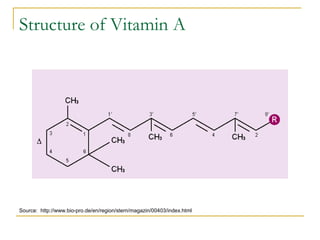
Structure of Vitamin A
Source: http://www.bio-pro.de/en/region/stern/magazin/00403/index.html
Vitamin A: Functions
 Growth (production of HGH, normal functioning of osteoblasts
and osteoclasts)
 Reproduction
 Embryonic development (retinoic acid influences cell
differentiation)
 Vision (eye uses retinal to transduce light into neural signals and
retinoic acid to maintain cornea/conjuctival membrane
differentiation which prevents xerophthalmia)
 Gene expression (retinioic acid regulates expression of encoding
genes for structural proteins, enzymes, extracellular matrix
proteins, and retinol binding proteins and receptors)
 Immune function (retinol regulates lymphocyte physiology)
 Glycoprotein synthesis
Carotenoids
 Plant pigments – deep colors
 alpha-carotene, beta-carotene, lycopene,
lutein, xeaxanthin, beta-cryptoxanthin
 alpha-carotene, beta-carotene, and beta-
cryptoxanthin can be converted in Vitamin A
(provitamin A)
 Fat-soluble
 Absorbed in the intestine and stored in
tissues
Vitamin A: Food Sources
 Preformed Vitamin A (retinol) is found in
animal-based foods such as liver, dairy, and
fish.
 Also prevalent in fortified grains
 Carotenoids as provitamin A are found in
darkly pigmented plant products such as
spinach, broccoli, cantaloupe, carrots, and
vegetable-beef/chicken soup.
 All are also found in supplement form
Vitamin A: Biochemical Indicators
 Serum retinol and serum binding protein
Vitamin A Deficiency:
Causes
 Absorption is enhanced by fat, and
diminished by diarrhea, intestinal infections,
and infestations.
 Deficiency is rare in developed nations, but
common in developing countries
Vitamin A Deficiency:
Consequences
 Most common condition is xerophthalmia
(irreversible drying of conjunctiva and cornea)
 Affects 3-10 million children/year
 Starts with night blindness, then continues into
conjuntival xerosis, Bitot’s spots, corneal xerosis,
corneal ulceration, and scarring)
 Decreased immune function/increased risk of
infectious morbidity/mortality
 No known deficiency effects from
underconsumption of carotenoids.
Vitamin A Toxicity:
Causes
 >=30,000 mcg/day for months-years is
chronic toxicity
 >= 150,000 mcg in single or short-term doses
is acute toxicity (less in children)
 Excludes beta-carotene
Vitamin A Toxicity:
Consequences
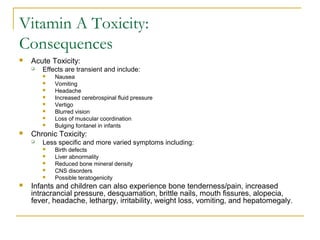
 Acute Toxicity:
 Effects are transient and include:
 Nausea
 Vomiting
 Headache
 Increased cerebrospinal fluid pressure
 Vertigo
 Blurred vision
 Loss of muscular coordination
 Bulging fontanel in infants
 Chronic Toxicity:
 Less specific and more varied symptoms including:
 Birth defects
 Liver abnormality
 Reduced bone mineral density
 CNS disorders
 Possible teratogenicity
 Infants and children can also experience bone tenderness/pain, increased
intracrancial pressure, desquamation, brittle nails, mouth fissures, alopecia,
fever, headache, lethargy, irritability, weight loss, vomiting, and hepatomegaly.
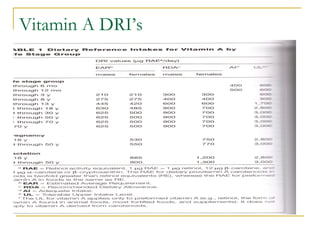
Vitamin A DRI’s
Vitamin A DRI’s
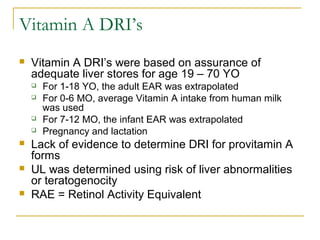
 Vitamin A DRI’s were based on assurance of
adequate liver stores for age 19 – 70 YO
 For 1-18 YO, the adult EAR was extrapolated
 For 0-6 MO, average Vitamin A intake from human milk
was used
 For 7-12 MO, the infant EAR was extrapolated
 Pregnancy and lactation
 Lack of evidence to determine DRI for provitamin A
forms
 UL was determined using risk of liver abnormalities
or teratogenocity
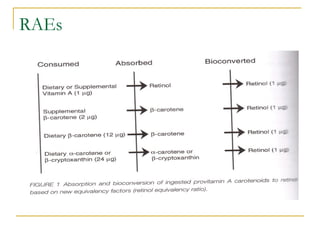
 RAE = Retinol Activity Equivalent
RAEs
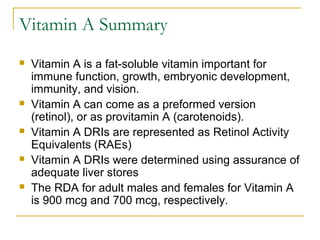
Vitamin A Summary
 Vitamin A is a fat-soluble vitamin important for
immune function, growth, embryonic development,
immunity, and vision.
 Vitamin A can come as a preformed version
(retinol), or as provitamin A (carotenoids).
 Vitamin A DRIs are represented as Retinol Activity
Equivalents (RAEs)
 Vitamin A DRIs were determined using assurance of
adequate liver stores
 The RDA for adult males and females for Vitamin A
is 900 mcg and 700 mcg, respectively.
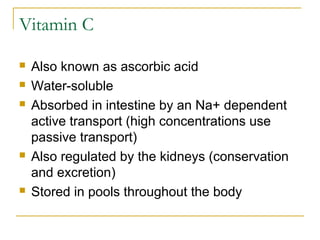
Vitamin C
 Also known as ascorbic acid
 Water-soluble
 Absorbed in intestine by an Na+ dependent
active transport (high concentrations use
passive transport)
 Also regulated by the kidneys (conservation
and excretion)
 Stored in pools throughout the body
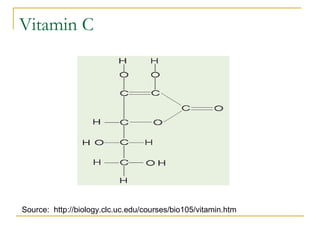
Vitamin C
Source: http://biology.clc.uc.edu/courses/bio105/vitamin.htm
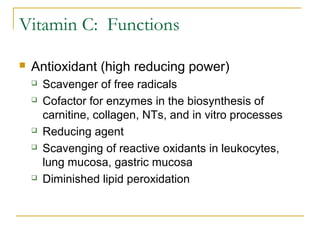
Vitamin C: Functions
 Antioxidant (high reducing power)
 Scavenger of free radicals
 Cofactor for enzymes in the biosynthesis of
carnitine, collagen, NTs, and in vitro processes
 Reducing agent
 Scavenging of reactive oxidants in leukocytes,
lung mucosa, gastric mucosa
 Diminished lipid peroxidation
Vitamin C: Sources
 Fruits and Vegetables such as citrus fruits,
tomatoes, tomato juice, potatoes, brussel
sprouts, cauliflower, strawberries, cabbage,
spinach
 Fortification
 Supplements
 70-90% bioavailability (50% at high intakes)
Vitamin C: Biochemical Indicators
 Plasma and leukocyte ascorbic acid levels
Vitamin C Deficiency:
Causes
 Rare in developed countries, although is
seen in diets that lack fruits and vegetables,
older men, and lower socioeconomic status
Vitamin C Deficiency:
Consequences
 Scurvy, which includes symptoms such as
follicular hyperkeratosis, petechiae,
ecchymoses, coiled hairs, inflamed and
bleeding gums, perifollicular hemorrhages,
join effusions, arthralgia, impaired wound
healing, dyspnea, edema, dry eyes and
mouth, weakness, fatigue, depression
 Infantile scurvy includes bone abnormalities,
hemorrhagic symptoms, and anemia
Vitamin C Toxicity
 Large doses (> 3,000 mg/day)
 Diarrhea and other GI disturbances
 No other adverse effects
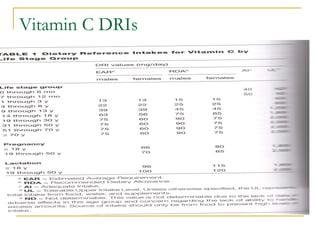
Vitamin C DRIs
Vitamin C DRIs
 DRIs were determined by estimates of body
pool or tissue Vitamin C levels that were
considered adequate for antioxidant
protection and minimal urinary loss
 Women have higher blood levels
 Smokers have a higher requirement
 UL determined by occurrence of osmotic
diarrhea and GI disturbances
Vitamin C Summary
 Vitamin C is an important antioxidant.
 Vitamin C is water-soluble.
 Vitamin C is found in many fruits and vegetables,
especially citrus fruits.
 Vitamin C deficiency results in scurvy and its
associated symptoms.
 Extremely high amounts of more than 3,000 mg/day
of Vitamin C can result in diarrhea and GI
disturbances
 The RDA for adult males and females for Vitamin C
is 90 mg/day and 75 mg/day, respectively.

Vitamin a and vitamin c presentation

  • 1.
    Vitamin A andVitamin C Theresa Camardo
  • 2.
    Intro  Both VitaminA and Vitamin C are necessary for proper immune system function.
  • 3.
    Vitamin A  Fat-soluble “Vitamin A” is actually a term that refers to a group of substances that include retinol (preformed Vitamin A), retinal, retinoic acid, retinyl esters.  “Vitamin A” can also refer to precursor compounds known as carotenoids.  Absorbed in the small intestine (70-90%); more than 90% located in liver
  • 4.
    Structure of VitaminA Source: http://www.bio-pro.de/en/region/stern/magazin/00403/index.html
  • 5.
    Vitamin A: Functions Growth (production of HGH, normal functioning of osteoblasts and osteoclasts)  Reproduction  Embryonic development (retinoic acid influences cell differentiation)  Vision (eye uses retinal to transduce light into neural signals and retinoic acid to maintain cornea/conjuctival membrane differentiation which prevents xerophthalmia)  Gene expression (retinioic acid regulates expression of encoding genes for structural proteins, enzymes, extracellular matrix proteins, and retinol binding proteins and receptors)  Immune function (retinol regulates lymphocyte physiology)  Glycoprotein synthesis
  • 6.
    Carotenoids  Plant pigments– deep colors  alpha-carotene, beta-carotene, lycopene, lutein, xeaxanthin, beta-cryptoxanthin  alpha-carotene, beta-carotene, and beta- cryptoxanthin can be converted in Vitamin A (provitamin A)  Fat-soluble  Absorbed in the intestine and stored in tissues
  • 7.
    Vitamin A: FoodSources  Preformed Vitamin A (retinol) is found in animal-based foods such as liver, dairy, and fish.  Also prevalent in fortified grains  Carotenoids as provitamin A are found in darkly pigmented plant products such as spinach, broccoli, cantaloupe, carrots, and vegetable-beef/chicken soup.  All are also found in supplement form
  • 8.
    Vitamin A: BiochemicalIndicators  Serum retinol and serum binding protein
  • 9.
    Vitamin A Deficiency: Causes Absorption is enhanced by fat, and diminished by diarrhea, intestinal infections, and infestations.  Deficiency is rare in developed nations, but common in developing countries
  • 10.
    Vitamin A Deficiency: Consequences Most common condition is xerophthalmia (irreversible drying of conjunctiva and cornea)  Affects 3-10 million children/year  Starts with night blindness, then continues into conjuntival xerosis, Bitot’s spots, corneal xerosis, corneal ulceration, and scarring)  Decreased immune function/increased risk of infectious morbidity/mortality  No known deficiency effects from underconsumption of carotenoids.
  • 11.
    Vitamin A Toxicity: Causes >=30,000 mcg/day for months-years is chronic toxicity  >= 150,000 mcg in single or short-term doses is acute toxicity (less in children)  Excludes beta-carotene
  • 12.
    Vitamin A Toxicity: Consequences Acute Toxicity:  Effects are transient and include:  Nausea  Vomiting  Headache  Increased cerebrospinal fluid pressure  Vertigo  Blurred vision  Loss of muscular coordination  Bulging fontanel in infants  Chronic Toxicity:  Less specific and more varied symptoms including:  Birth defects  Liver abnormality  Reduced bone mineral density  CNS disorders  Possible teratogenicity  Infants and children can also experience bone tenderness/pain, increased intracrancial pressure, desquamation, brittle nails, mouth fissures, alopecia, fever, headache, lethargy, irritability, weight loss, vomiting, and hepatomegaly.
  • 13.
  • 14.
    Vitamin A DRI’s Vitamin A DRI’s were based on assurance of adequate liver stores for age 19 – 70 YO  For 1-18 YO, the adult EAR was extrapolated  For 0-6 MO, average Vitamin A intake from human milk was used  For 7-12 MO, the infant EAR was extrapolated  Pregnancy and lactation  Lack of evidence to determine DRI for provitamin A forms  UL was determined using risk of liver abnormalities or teratogenocity  RAE = Retinol Activity Equivalent
  • 15.
  • 16.
    Vitamin A Summary Vitamin A is a fat-soluble vitamin important for immune function, growth, embryonic development, immunity, and vision.  Vitamin A can come as a preformed version (retinol), or as provitamin A (carotenoids).  Vitamin A DRIs are represented as Retinol Activity Equivalents (RAEs)  Vitamin A DRIs were determined using assurance of adequate liver stores  The RDA for adult males and females for Vitamin A is 900 mcg and 700 mcg, respectively.
  • 17.
    Vitamin C  Alsoknown as ascorbic acid  Water-soluble  Absorbed in intestine by an Na+ dependent active transport (high concentrations use passive transport)  Also regulated by the kidneys (conservation and excretion)  Stored in pools throughout the body
  • 18.
  • 19.
    Vitamin C: Functions Antioxidant (high reducing power)  Scavenger of free radicals  Cofactor for enzymes in the biosynthesis of carnitine, collagen, NTs, and in vitro processes  Reducing agent  Scavenging of reactive oxidants in leukocytes, lung mucosa, gastric mucosa  Diminished lipid peroxidation
  • 20.
    Vitamin C: Sources Fruits and Vegetables such as citrus fruits, tomatoes, tomato juice, potatoes, brussel sprouts, cauliflower, strawberries, cabbage, spinach  Fortification  Supplements  70-90% bioavailability (50% at high intakes)
  • 21.
    Vitamin C: BiochemicalIndicators  Plasma and leukocyte ascorbic acid levels
  • 22.
    Vitamin C Deficiency: Causes Rare in developed countries, although is seen in diets that lack fruits and vegetables, older men, and lower socioeconomic status
  • 23.
    Vitamin C Deficiency: Consequences Scurvy, which includes symptoms such as follicular hyperkeratosis, petechiae, ecchymoses, coiled hairs, inflamed and bleeding gums, perifollicular hemorrhages, join effusions, arthralgia, impaired wound healing, dyspnea, edema, dry eyes and mouth, weakness, fatigue, depression  Infantile scurvy includes bone abnormalities, hemorrhagic symptoms, and anemia
  • 24.
    Vitamin C Toxicity Large doses (> 3,000 mg/day)  Diarrhea and other GI disturbances  No other adverse effects
  • 25.
  • 26.
    Vitamin C DRIs DRIs were determined by estimates of body pool or tissue Vitamin C levels that were considered adequate for antioxidant protection and minimal urinary loss  Women have higher blood levels  Smokers have a higher requirement  UL determined by occurrence of osmotic diarrhea and GI disturbances
  • 27.
    Vitamin C Summary Vitamin C is an important antioxidant.  Vitamin C is water-soluble.  Vitamin C is found in many fruits and vegetables, especially citrus fruits.  Vitamin C deficiency results in scurvy and its associated symptoms.  Extremely high amounts of more than 3,000 mg/day of Vitamin C can result in diarrhea and GI disturbances  The RDA for adult males and females for Vitamin C is 90 mg/day and 75 mg/day, respectively.