VISUAL
PERCEPTION
 THE WAY WE SEE
LOOKING AND SEEING
         SEEING IS MORE THAN LOOKING

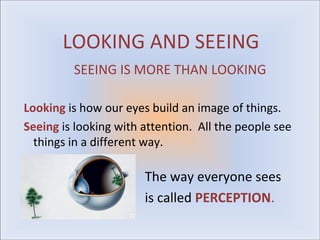
Looking is how our eyes build an image of things.
Seeing is looking with attention. All the people see
  things in a different way.

                       The way everyone sees
                       is called PERCEPTION.
What’s PERCEPTION?
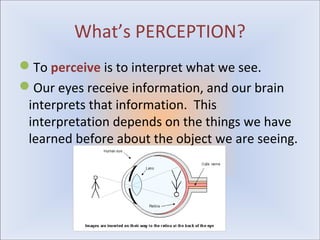
To perceive is to interpret what we see.
Our eyes receive information, and our brain
 interprets that information. This
 interpretation depends on the things we have
 learned before about the object we are seeing.
What’s PERCEPTION?
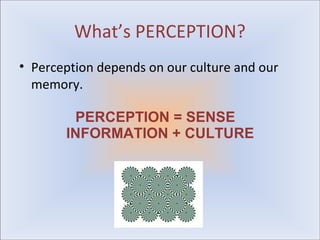
• Perception depends on our culture and our
  memory.

        PERCEPTION = SENSE
       INFORMATION + CULTURE
PERCEPTION
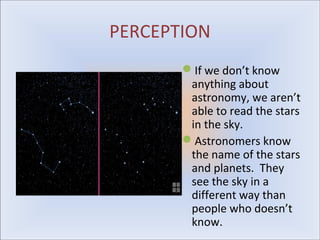
       If we don’t know
        anything about
        astronomy, we aren’t
        able to read the stars
        in the sky.
       Astronomers know
        the name of the stars
        and planets. They
        see the sky in a
        different way than
        people who doesn’t
        know.
CULTURE AND PERCEPTION
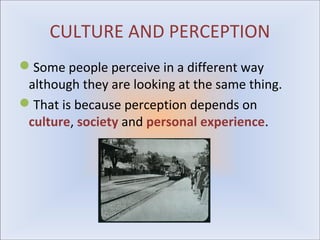
Some people perceive in a different way
 although they are looking at the same thing.
That is because perception depends on
 culture, society and personal experience.
CULTURE AND PERCEPTION
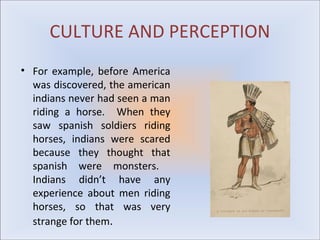
• For example, before America
  was discovered, the american
  indians never had seen a man
  riding a horse. When they
  saw spanish soldiers riding
  horses, indians were scared
  because they thought that
  spanish were monsters.
  Indians didn’t have any
  experience about men riding
  horses, so that was very
  strange for them.
SENSE AND PERCEPTION
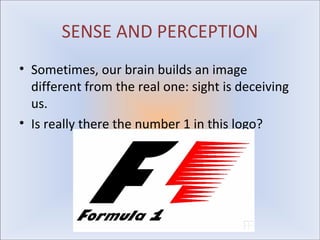
• Sometimes, our brain builds an image
  different from the real one: sight is deceiving
  us.
• Is really there the number 1 in this logo?
OPTICAL ILLUSIONS

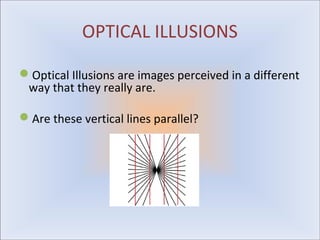
Optical Illusions are images perceived in a different
 way that they really are.

Are these vertical lines parallel?
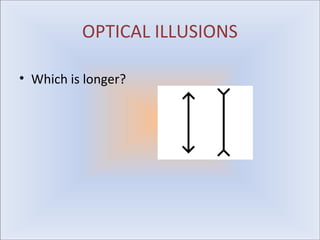
OPTICAL ILLUSIONS

• Which is longer?
OPTICAL ILLUSIONS

• Which of the internal circles is bigger?
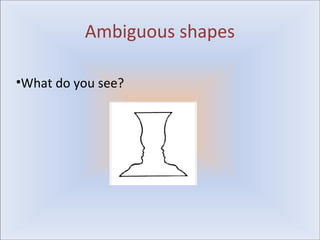
Ambiguous shapes

•What do you see?
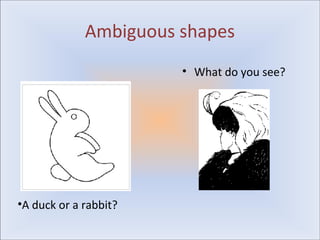
Ambiguous shapes
                       • What do you see?


•A duck or a rabbit?
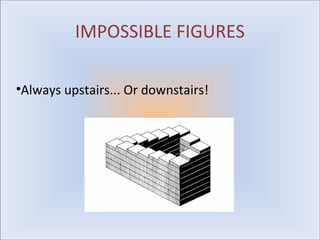
IMPOSSIBLE FIGURES

•Always upstairs... Or downstairs!
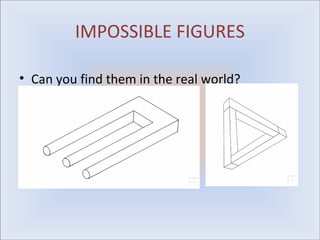
IMPOSSIBLE FIGURES

• Can you find them in the real world?
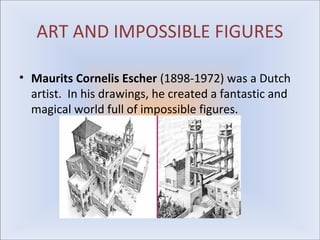
ART AND IMPOSSIBLE FIGURES

• Maurits Cornelis Escher (1898-1972) was a Dutch
  artist. In his drawings, he created a fantastic and
  magical world full of impossible figures.
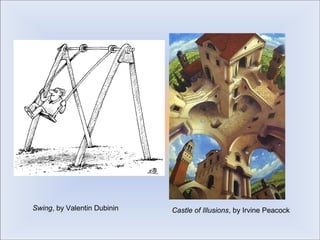
Swing, by Valentin Dubinin   Castle of Illusions, by Irvine Peacock
ACTIVITY

1. Pay attention to the picture. You must
   observe it during 5 minutes.
2. Draw the picture by memory in a sheet of
   paper.
3. Colour it using your crayons.
4. We will collect all the drawings and compare
   them with the original picture.

Visualperception

  • 1.
  • 2.
    LOOKING AND SEEING SEEING IS MORE THAN LOOKING Looking is how our eyes build an image of things. Seeing is looking with attention. All the people see things in a different way. The way everyone sees is called PERCEPTION.
  • 3.
    What’s PERCEPTION? To perceiveis to interpret what we see. Our eyes receive information, and our brain interprets that information. This interpretation depends on the things we have learned before about the object we are seeing.
  • 4.
    What’s PERCEPTION? • Perceptiondepends on our culture and our memory. PERCEPTION = SENSE INFORMATION + CULTURE
  • 5.
    PERCEPTION If we don’t know anything about astronomy, we aren’t able to read the stars in the sky. Astronomers know the name of the stars and planets. They see the sky in a different way than people who doesn’t know.
  • 6.
    CULTURE AND PERCEPTION Somepeople perceive in a different way although they are looking at the same thing. That is because perception depends on culture, society and personal experience.
  • 7.
    CULTURE AND PERCEPTION •For example, before America was discovered, the american indians never had seen a man riding a horse. When they saw spanish soldiers riding horses, indians were scared because they thought that spanish were monsters. Indians didn’t have any experience about men riding horses, so that was very strange for them.
  • 8.
    SENSE AND PERCEPTION •Sometimes, our brain builds an image different from the real one: sight is deceiving us. • Is really there the number 1 in this logo?
  • 9.
    OPTICAL ILLUSIONS Optical Illusionsare images perceived in a different way that they really are. Are these vertical lines parallel?
  • 10.
  • 11.
    OPTICAL ILLUSIONS • Whichof the internal circles is bigger?
  • 12.
  • 13.
    Ambiguous shapes • What do you see? •A duck or a rabbit?
  • 14.
  • 15.
    IMPOSSIBLE FIGURES • Canyou find them in the real world?
  • 16.
    ART AND IMPOSSIBLEFIGURES • Maurits Cornelis Escher (1898-1972) was a Dutch artist. In his drawings, he created a fantastic and magical world full of impossible figures.
  • 17.
    Swing, by ValentinDubinin Castle of Illusions, by Irvine Peacock
  • 18.
    ACTIVITY 1. Pay attentionto the picture. You must observe it during 5 minutes. 2. Draw the picture by memory in a sheet of paper. 3. Colour it using your crayons. 4. We will collect all the drawings and compare them with the original picture.