Visualizing
personal network
data
Examples from a study on
EDs websites

Antonio Casilli
Telecom ParisTech, Paris

Paola Tubaro
University of Greenwich, London
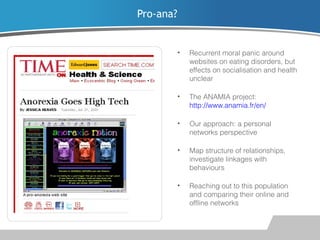
Pro-ana?

•

Recurrent moral panic around
websites on eating disorders, but
effects on socialisation and health
unclear

•

The ANAMIA project:
http://www.anamia.fr/en/

•

Our approach: a personal
networks perspective

•

Map structure of relationships,
investigate linkages with
behaviours

•

Reaching out to this population
and comparing their online and
offline networks
Mixed methods, mixed data…

• Web data, quantitative survey, qualitative interviews
• 3 personal network datasets per respondent (face-to-face, online,
support)
• Multiple methods employed in the analysis – SNA, regression,
agent-based computer simulation, textual analysis
• Dataviz as more general support
Defining datavisualization

•

“The desire to take what normally falls
outside of the scale of human senses
and to make visible and manageable”
[Manovich 2002]

•

Common tropes emerge: maps,
natural metaphors (trees…),
timelines, graphs…

•

“Sensory expression -- most often
visual, sometimes sonic or tactile -- is
the only means to perceive many
contemporary data sets” [Diamond
2010]

 Grant access to information in
an aesthetically informed,
sensorly appealing manner
Simple vulgarization tool?

«Pourquoi la censure et le filtrage ne marchent pas?», Le Monde, 16 Nov. 2012

http://internetactu.blog.lemonde.fr/2012/11/16/pourquoi-la-censure-et-le-filtrage-ne-marchent-pa
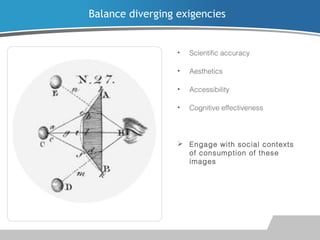
Balance diverging exigencies

•

Scientific accuracy

•

Aesthetics

•

Accessibility

•

Cognitive effectiveness

 Engage with social contexts
of consumption of these
images
The role of end-users

•

The page-based paradigm of the
web has been interrupted by
database incursions[Liu, 2004].

•

Personal, everyday experience of
data immersion and navigation shape
individual “data-subjectivity”
[Manovich 2002]
1st tool: Visualization for data collection

ANAMIA EGOCENTER (2010-11) http://www.youtube.com/watch?v=AAlSaDdAaC0
1st tool: Visualization for data collection

Face-to-face egocentered networks
1st tool: Visualization for data collection

Online egocentered networks
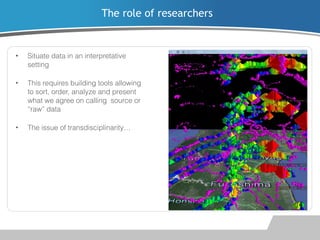
The role of researchers

•

Situate data in an interpretative
setting

•

This requires building tools allowing
to sort, order, analyze and present
what we agree on calling source or
“raw” data

•

The issue of transdisciplinarity…
2nd tool: Visualization for data analysis

ANAMIA CORPUS (2012-13) http://www.youtube.com/watch?v=BIxqG6j0Izs
The politics of data visualization

•

Take into account the politics of
quantified data representation
(reminiscent of the debates about
“who controls what’s on traditional
media”)

•

Establishing priorities, selecting
methods and procedures

•

Not sticking to tight scientific
“realism”, but making sense of the
data by building “heuristic narratives”
which resound with (but are not
limited to) empirical data.

•

“Telling stories with data”
3nd tool: Datavisualization for “heuristic narrative”

ANAMIA PERSONAL (2013) http://www.youtube.com/watch?v=E-eR0SnFI2M
Thank you!

E-mail:
coordination@anamia.fr
Web:
http://www.anamia.fr
Twitter:
@anamia

Visualizing personal network data. Examples from a study on EDs websites

  • 1.
    Visualizing personal network data Examples froma study on EDs websites Antonio Casilli Telecom ParisTech, Paris Paola Tubaro University of Greenwich, London
  • 2.
    Pro-ana? • Recurrent moral panicaround websites on eating disorders, but effects on socialisation and health unclear • The ANAMIA project: http://www.anamia.fr/en/ • Our approach: a personal networks perspective • Map structure of relationships, investigate linkages with behaviours • Reaching out to this population and comparing their online and offline networks
  • 3.
    Mixed methods, mixeddata… • Web data, quantitative survey, qualitative interviews • 3 personal network datasets per respondent (face-to-face, online, support) • Multiple methods employed in the analysis – SNA, regression, agent-based computer simulation, textual analysis • Dataviz as more general support
  • 4.
    Defining datavisualization • “The desireto take what normally falls outside of the scale of human senses and to make visible and manageable” [Manovich 2002] • Common tropes emerge: maps, natural metaphors (trees…), timelines, graphs… • “Sensory expression -- most often visual, sometimes sonic or tactile -- is the only means to perceive many contemporary data sets” [Diamond 2010]  Grant access to information in an aesthetically informed, sensorly appealing manner
  • 5.
    Simple vulgarization tool? «Pourquoila censure et le filtrage ne marchent pas?», Le Monde, 16 Nov. 2012 http://internetactu.blog.lemonde.fr/2012/11/16/pourquoi-la-censure-et-le-filtrage-ne-marchent-pa
  • 6.
    Balance diverging exigencies • Scientificaccuracy • Aesthetics • Accessibility • Cognitive effectiveness  Engage with social contexts of consumption of these images
  • 7.
    The role ofend-users • The page-based paradigm of the web has been interrupted by database incursions[Liu, 2004]. • Personal, everyday experience of data immersion and navigation shape individual “data-subjectivity” [Manovich 2002]
  • 8.
    1st tool: Visualizationfor data collection ANAMIA EGOCENTER (2010-11) http://www.youtube.com/watch?v=AAlSaDdAaC0
  • 9.
    1st tool: Visualizationfor data collection Face-to-face egocentered networks
  • 10.
    1st tool: Visualizationfor data collection Online egocentered networks
  • 11.
    The role ofresearchers • Situate data in an interpretative setting • This requires building tools allowing to sort, order, analyze and present what we agree on calling source or “raw” data • The issue of transdisciplinarity…
  • 12.
    2nd tool: Visualizationfor data analysis ANAMIA CORPUS (2012-13) http://www.youtube.com/watch?v=BIxqG6j0Izs
  • 13.
    The politics ofdata visualization • Take into account the politics of quantified data representation (reminiscent of the debates about “who controls what’s on traditional media”) • Establishing priorities, selecting methods and procedures • Not sticking to tight scientific “realism”, but making sense of the data by building “heuristic narratives” which resound with (but are not limited to) empirical data. • “Telling stories with data”
  • 14.
    3nd tool: Datavisualizationfor “heuristic narrative” ANAMIA PERSONAL (2013) http://www.youtube.com/watch?v=E-eR0SnFI2M
  • 15.