Visual-Intensive Teaching & LearningLearning objectives
Teaching techniques
Assignment design
Assessment strategies written  spoken visual  technological“Up until 20 or 30 years ago, writing carried all the communicational load of a message. . . . Now there is specialization which allows each of the modes to carry that part of the message for which it is best equipped.”~Gunther Kress
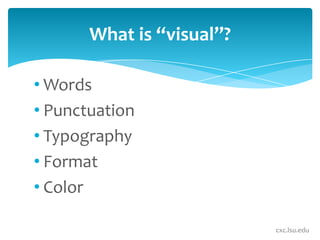
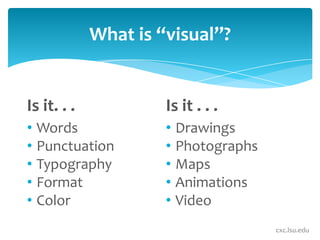
WordsPunctuationTypographyFormatColorWhat is “visual”?
Document designDear John:I want a man who knows what love is all about. You are generous, kind, thoughtful. People who are not like you admit to being useless and inferior. You have ruined me for other men. I yearn for you. I have no feelings whatsoever when we're apart. I can be forever happy--will you let me be yours?JaneDear John:I want a man who knows what love is.  All about you are generous, kind, thoughtful people, who are not like you. Admit to being useless and inferior. You have ruined me. For  other men, I yearn. For you, I have no feelings whatsoever. When we're apart, I can be forever happy. Will you let me be?Yours,Jane
What is “visual”?Is it. . . WordsPunctuationTypographyFormatColorIs it . . . DrawingsPhotographsMapsAnimationsVideo
Visual Literacy Table
Visually literate individualsunderstand the nature of images and multimedia  comprehend how visual representations are created, produced, manipulated, and shared“The Silent Transformation” Adobe Education White Pages
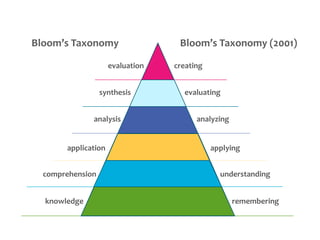
Bloom’s TaxonomyBloom’s Taxonomy (2001)evaluationcreatingsynthesisevaluatinganalysisanalyzingapplicationapplyingcomprehensionunderstandingknowledgeremembering
Requirements for C-I Course, Visual Emphasisat least one graded, meaningful visual analysis a minimum of one graded, substantive visual project instruction on the conventions of discipline-specific  visuals, including directions for the assignment and gradingfeedback during the creation process
Formal Rubric for Visual Projects
Hans Rosling
Plan communication before choosing visualsConsider the relationship between text/speech and visualsLimit elements on a pageTest the visual with an audience to check clarity in message and imageConsider contrast, color, size, position, movementTips for communicating visually

Visual-Intensive Teaching

  • 1.
    Visual-Intensive Teaching &LearningLearning objectives
  • 2.
  • 3.
  • 4.
    Assessment strategies written spoken visual  technological“Up until 20 or 30 years ago, writing carried all the communicational load of a message. . . . Now there is specialization which allows each of the modes to carry that part of the message for which it is best equipped.”~Gunther Kress
  • 5.
  • 7.
    Document designDear John:Iwant a man who knows what love is all about. You are generous, kind, thoughtful. People who are not like you admit to being useless and inferior. You have ruined me for other men. I yearn for you. I have no feelings whatsoever when we're apart. I can be forever happy--will you let me be yours?JaneDear John:I want a man who knows what love is. All about you are generous, kind, thoughtful people, who are not like you. Admit to being useless and inferior. You have ruined me. For other men, I yearn. For you, I have no feelings whatsoever. When we're apart, I can be forever happy. Will you let me be?Yours,Jane
  • 8.
    What is “visual”?Isit. . . WordsPunctuationTypographyFormatColorIs it . . . DrawingsPhotographsMapsAnimationsVideo
  • 9.
  • 10.
    Visually literate individualsunderstandthe nature of images and multimedia comprehend how visual representations are created, produced, manipulated, and shared“The Silent Transformation” Adobe Education White Pages
  • 11.
    Bloom’s TaxonomyBloom’s Taxonomy(2001)evaluationcreatingsynthesisevaluatinganalysisanalyzingapplicationapplyingcomprehensionunderstandingknowledgeremembering
  • 12.
    Requirements for C-ICourse, Visual Emphasisat least one graded, meaningful visual analysis a minimum of one graded, substantive visual project instruction on the conventions of discipline-specific visuals, including directions for the assignment and gradingfeedback during the creation process
  • 13.
    Formal Rubric forVisual Projects
  • 14.
  • 15.
    Plan communication beforechoosing visualsConsider the relationship between text/speech and visualsLimit elements on a pageTest the visual with an audience to check clarity in message and imageConsider contrast, color, size, position, movementTips for communicating visually

Editor's Notes

  • #3 What mode of communication dominates your discipline? When do you use written, spoken, visual, or technological means to communicate? Which communications are single mode and which ones are multimodal?What determines whether data should be represented by words or by visuals? What do we mean by visual?
  • #4 Writing itself is a visual means of communication.
  • #5 The Book of Kells (800 a.d.) and other illuminated manuscripts shows us that the visual component of writing has long been recognized.
  • #6 And let’s consider for a moment the importance of punctuation, a kind of visual symbol we often take for granted, font and color(Have two different participants read each letter.)
  • #7 More often we think of visual communication in familiar means.But technology has vastly increased our abilities create and share visual communications.
  • #8 Take a minute to study this visual of visuals. Note the meaning of color and symbols. What kinds of critical thinking are required to interpret visuals?What visual literacy skills do students in your discipline need and where how and when do you teach them?5 minutes
  • #10 http://www.odu.edu/educ/llschult/blooms_taxonomy.htm
  • #11 Students participate in at least one graded, meaningful visual analysis experience that integrates the course content and teaches them about good visual communication (e.g., poster reviews, video analyses, document critique, art review).Course involves a minimum of one graded, substantive visual project in which all students contribute to the visual components and demonstrate ability to visually communicate to pose inquiries, analyze, inform, entertain, or persuade.Students receive ample instruction on the conventions of discipline-specific visuals, including detailed directions for the assignment itself and grading descriptions or formal rubrics for assessment.Instructors provide feedback during the creation process (graded or ungraded).