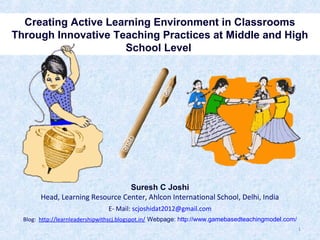
Creating Active Learning Environment in Classrooms
Through Innovative Teaching Practices at Middle and High
School Level

Suresh C Joshi
Head, Learning Resource Center, Ahlcon International School, Delhi, India
E- Mail: scjoshidat2012@gmail.com
Blog: http://learnleadershipwithscj.blogspot.in/ Webpage: http://www.gamebasedteachingmodel.com/
1
Open
your minds
for
enjoyable
learning
experience

Surrender
yourself

Introduction and
expectations !!

Are u ready ??
2
Research Questions:
1.How to overcome with traditional teaching methods (pure
lecturing, chalk-talk, etc.)?
2.How to draw student’s attention in the class?
3.How to convert initial ‘thrust’ into ‘ample engagement’
strengthening active learning?
4.Which assessment method to be used to check actual
learning level or average gain in conceptual understanding?
3
Participant’s
Participant’s
involvement!!
involvement!!

Suggest solutions!!

One possible solution
may be…………..
4
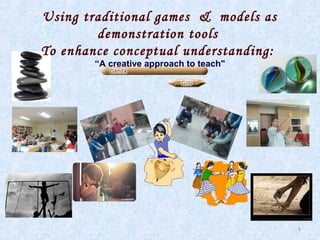
Using traditional games & models as
demonstration tools
To enhance conceptual understanding:
“A creative approach to teach"

5
Let us
not
confuse
ourselves
!

We will narrow down our discussion
and understand it by one

demonstration of Science (Physics)
6
Purpose and Objectives:
Arresting declining interest of young learners towards study.
Connecting classroom teaching with real life experiences
through activity based learning.
Removing the misunderstanding that ‘Physics (Your Subject)
is only for the brains of outstanding capability (different
skill)”
To make student think logically and independently,
Developing skills: Concentration, aiming, creative thinking, inquiry based
scientific temperament, strengthening teacher student bond, cooperation –
coordination, working as a team, strategy making, problem solving, building
and designing, more…
7
Purpose and Objectives Contd…..
Value based learning: knowing about the culture and
traditions.
Nurturing inquiry – based scientific temperament.
Promoting students to pursue physics at higher level.
Designing and developing certain models incorporating the
rich experiences of large community of educators in the
world.
8
Specific Objective:
To make students familiar about:
1.tradition and culture (small)
2.Physics terms we are to be used further
3.To understand concepts of physics used/to be used

9
Articles/Readings!!
1.D.R. Sokoloff and R.K. Thornton: Using ILD’s to create an active learning environment;
Phys. Teach. 35 (1997)340.
2.N.
Balasubramanian
and
Brent
G.
Wilson:
Games
and
http://www.autzones.com/din6000/textes/semaine10/Bala+Wilson(2005).pdf

Simulations;

3.Manjula D. Sharma et. al.: Use of ILD’s: A ten year study; Physical Review Special Topics –
Physics education research; 6, 020119(2010).
4.R.K. Thornton and D.R. Sokoloff , Tools for scientific thinking – Motion and force
curriculum and teachers’ Guide, 2nd ed. (Vernier Software, Portland, 1992).
5.ILD’s: Active learning in introductory physics; D.R. Sokoloff and R.K. Thornton (WILEY
Publication) Thanks to Dr. Edwards F. Redish for proving the book
6.Teaching
Physics
With
the
Physics
http://www2.physics.umd.edu/~redish/Book/

Suite:

Edward

F.

Redish

+ 44 Other Research Papers
10
This session:
1. A Comparative study
2. Know about the activity to be performed
3. Your participation
4. My direction towards science principles involved
5. Brainstorming activity
6. Helps in skill development
7. Your understanding about the Demonstration
8. More Interactive Lecture Demonstrations

9. Future goals !!!!

And Magic !!!!

11
Existing ILD’s / this method; A Comparative study:S. No.
1.

Existing ILD’s
Students are bounded to learn the decided topic.
There is no scope of brainstorming / independent thinking
on terms to be involved.

This method
Students are not bounded to learn the topic already
decided.
Enough scope of brainstorming / thinking independently.

No possibility of evolving new terms because ILD’s are topic Topic /topics will be evolved through demo. Students are
confined.
given choice over which topics I expect them to learn
through thinking about that particular game.
2.

More theory (reading) is involved. As such no activity is to Less theory [observation (demo) based]. Understanding
be performed by the students; David Sokoloff and Ronald takes place by student’s involvement in the activity.
Thornton; The Physics Teacher, Vol.35, Sept. (1997).
Less writing work, Interesting MCQ’s / rubric worksheets.

3.

Limited stimulation/motivation (for high school and Enough stimulation/motivation (since a game is involved
Introductory Physics students) to study a particular topic
with it)
Close to real life experiences.
The gains are not spectacular; A ten years study: Manjula D. Results are noticeable:
Sharma et. al., Phy. Rev. phys. Ed. 6, 020119(2012).
1. Increase in interest – More Involvement of students
2. Students are motivated to participate in developing and
designing new models; nurturing building capacity and
scientific temperament
3. Encouraging responses from educators in the same field
from different countries (In process)

4.

5.

Hi-tech machines are required to record observations[Not In everyone’s reach
true for many (not all) of the UMD ILDs on Redish’s web (Can use the games / toys of your country)
site]; David Sokoloff and Ronald Thornton: The physics
Suite(John Wiley & Sons, 2004)
12
Implementation Idea; Steps:–

There are 8 Steps
http://www.gamebasedteachingmodel.com/

13
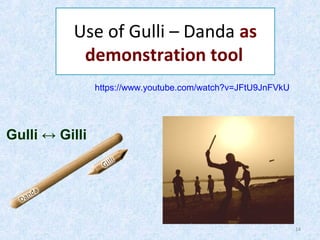
Use of Gulli – Danda as
demonstration tool
https://www.youtube.com/watch?v=JFtU9JnFVkU

Gulli ↔ Gilli

14
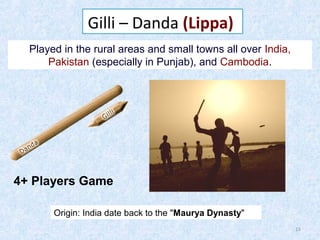
Gilli – Danda (Lippa)
Played in the rural areas and small towns all over India,
Pakistan (especially in Punjab), and Cambodia.

4+ Players Game
Origin: India date back to the "Maurya Dynasty"
15
Gilli – Danda (Lippa)
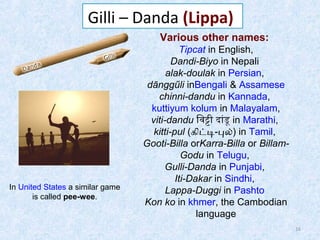
Various other names:

In United States a similar game
is called pee-wee.

Tipcat in English,
Dandi-Biyo in Nepali
alak-doulak in Persian,
dānggűli inBengali & Assamese
chinni-dandu in Kannada,
kuttiyum kolum in Malayalam,
viti-dandu िवटी दांडू in Marathi,
kitti-pul (கிடட-பல்) in Tamil,
Gooti-Billa orKarra-Billa or BillamGodu in Telugu,
Gulli-Danda in Punjabi,
Iti-Dakar in Sindhi,
Lappa-Duggi in Pashto
Kon ko in khmer, the Cambodian
language
16
Participant’s
Participant’s
involvement!!
involvement!!

Which Science (Physics) terms…….any
term…… are/is involved with
The motion ????
(evolving terms)
17
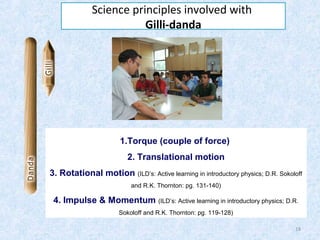
Science principles involved with
Gilli-danda

1.Torque (couple of force)
2. Translational motion
3. Rotational motion (ILD’s: Active learning in introductory physics; D.R. Sokoloff
and R.K. Thornton: pg. 131-140)

4. Impulse & Momentum (ILD’s: Active learning in introductory physics; D.R.
Sokoloff and R.K. Thornton: pg. 119-128)
18
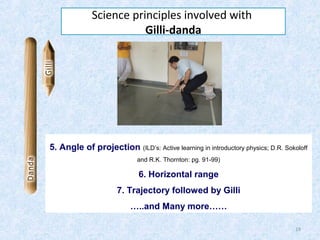
Science principles involved with
Gilli-danda

5. Angle of projection (ILD’s: Active learning in introductory physics; D.R. Sokoloff
and R.K. Thornton: pg. 91-99)

6. Horizontal range
7. Trajectory followed by Gilli
…..and Many more……
19
Gulli – Danda (Lippa)
Participant’s
Participant’s
involvement!!
involvement!!

Have you got the idea
how to play ??
Here is the Activity !!

Prepare at least FIVE questions based on
the demonstration !!
(5 – 6 minutes)
Discussio
n
allowed

20
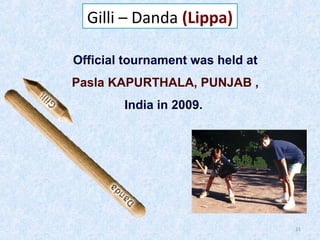
Gilli – Danda (Lippa)
Official tournament was held at
Pasla KAPURTHALA, PUNJAB ,
India in 2009.

21
Gilli – Danda (Lippa)
A domestic sports tournament was held on April 17’
2009 in South Africa
Reported in a blog by Rajesh Shiza

http://blogs.rediff.com/rajeshshiza/2009/04/17/gulli-danda-in-south-africa/

22
Let us have Discussion through Gilli Danda
Translation motion
Pure rotational motion ?
Turning effect of a force?
Good projection (angle?)
Horizontal range
Time to move up (to the maximum height) and come down ??
path followed ??
Why handles at the maximum possible distance from the
hinges?
(15 – 20 minutes)

23
Gilli – Danda (Lippa)
Participant’s
Participant’s
involvement!!
involvement!!

Your understanding about
the Demonstration
????

(Questionnaire is
based on introductory
level of
understanding)
24
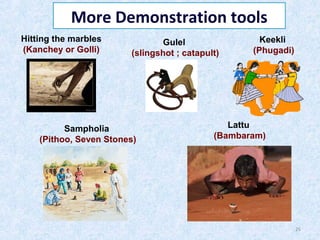
More Demonstration tools
Hitting the marbles
(Kanchey or Golli)

Gulel
(slingshot ; catapult)

Sampholia
(Pithoo, Seven Stones)

Keekli
(Phugadi)

Lattu
(Bambaram)

25
Future Goals:
1.Using demonstrations in daily classroom practices
2.Including Higher Order Thinking level Questions
3.Developing Lecture Demonstrations based on individual
topics (evolved through games) with detailed explanations
4.Publishing the work in Journals of repute

26
Some examples
based on
self developed tricks!!
27
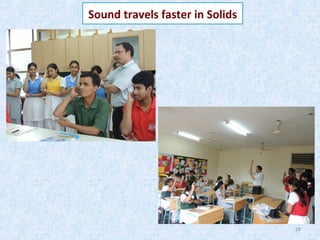
Sound travels faster in Solids

28
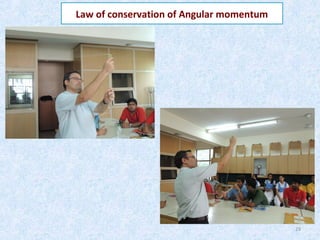
Law of conservation of Angular momentum

29
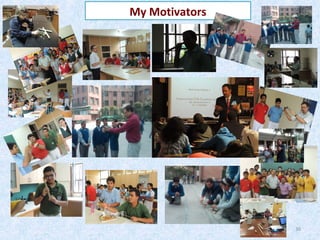
My Motivators

30
Resources / References
1. http://en.wikipedia.org/wiki/Gilli-danda
2. http://www.usief.org.in/
3. http://www.ahlconinternational.com/
4. http://www.flickr.com/photos/diham/4042344574/
5. http://www.dicts.info/picture-dictionary.php?w=slingshot
6. http://en.wikipedia.org/wiki/Slingshot
7. http://games.mob.org/game/gulel_lagano_nishana.html
8. http://www.indiavilas.com/kidscorner/kidsindia.asp?K=Phugadi
%20(Keekli)&t=ff
9. http://www.indiavilas.com/kidscorner/kidsindia.asp?K=Lattu&t=ff
10. http://www.4to40.com/photo_gallery/index.asp?
keywords=Lattu_Street_Game
11. http://flickrhivemind.net/Tags/lattu/Interesting
12. http://www.udaipurtimes.com/8-most-popular-childhood-games-youstopped-playing/
31
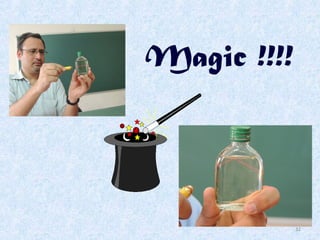
Magic !!!!

32
for viewing……….

33

Innovative teaching practices at middle and high school level

  • 1.
    Creating Active LearningEnvironment in Classrooms Through Innovative Teaching Practices at Middle and High School Level Suresh C Joshi Head, Learning Resource Center, Ahlcon International School, Delhi, India E- Mail: scjoshidat2012@gmail.com Blog: http://learnleadershipwithscj.blogspot.in/ Webpage: http://www.gamebasedteachingmodel.com/ 1
  • 2.
  • 3.
    Research Questions: 1.How toovercome with traditional teaching methods (pure lecturing, chalk-talk, etc.)? 2.How to draw student’s attention in the class? 3.How to convert initial ‘thrust’ into ‘ample engagement’ strengthening active learning? 4.Which assessment method to be used to check actual learning level or average gain in conceptual understanding? 3
  • 4.
  • 5.
    Using traditional games& models as demonstration tools To enhance conceptual understanding: “A creative approach to teach" 5
  • 6.
    Let us not confuse ourselves ! We willnarrow down our discussion and understand it by one demonstration of Science (Physics) 6
  • 7.
    Purpose and Objectives: Arrestingdeclining interest of young learners towards study. Connecting classroom teaching with real life experiences through activity based learning. Removing the misunderstanding that ‘Physics (Your Subject) is only for the brains of outstanding capability (different skill)” To make student think logically and independently, Developing skills: Concentration, aiming, creative thinking, inquiry based scientific temperament, strengthening teacher student bond, cooperation – coordination, working as a team, strategy making, problem solving, building and designing, more… 7
  • 8.
    Purpose and ObjectivesContd….. Value based learning: knowing about the culture and traditions. Nurturing inquiry – based scientific temperament. Promoting students to pursue physics at higher level. Designing and developing certain models incorporating the rich experiences of large community of educators in the world. 8
  • 9.
    Specific Objective: To makestudents familiar about: 1.tradition and culture (small) 2.Physics terms we are to be used further 3.To understand concepts of physics used/to be used 9
  • 10.
    Articles/Readings!! 1.D.R. Sokoloff andR.K. Thornton: Using ILD’s to create an active learning environment; Phys. Teach. 35 (1997)340. 2.N. Balasubramanian and Brent G. Wilson: Games and http://www.autzones.com/din6000/textes/semaine10/Bala+Wilson(2005).pdf Simulations; 3.Manjula D. Sharma et. al.: Use of ILD’s: A ten year study; Physical Review Special Topics – Physics education research; 6, 020119(2010). 4.R.K. Thornton and D.R. Sokoloff , Tools for scientific thinking – Motion and force curriculum and teachers’ Guide, 2nd ed. (Vernier Software, Portland, 1992). 5.ILD’s: Active learning in introductory physics; D.R. Sokoloff and R.K. Thornton (WILEY Publication) Thanks to Dr. Edwards F. Redish for proving the book 6.Teaching Physics With the Physics http://www2.physics.umd.edu/~redish/Book/ Suite: Edward F. Redish + 44 Other Research Papers 10
  • 11.
    This session: 1. AComparative study 2. Know about the activity to be performed 3. Your participation 4. My direction towards science principles involved 5. Brainstorming activity 6. Helps in skill development 7. Your understanding about the Demonstration 8. More Interactive Lecture Demonstrations 9. Future goals !!!! And Magic !!!! 11
  • 12.
    Existing ILD’s /this method; A Comparative study:S. No. 1. Existing ILD’s Students are bounded to learn the decided topic. There is no scope of brainstorming / independent thinking on terms to be involved. This method Students are not bounded to learn the topic already decided. Enough scope of brainstorming / thinking independently. No possibility of evolving new terms because ILD’s are topic Topic /topics will be evolved through demo. Students are confined. given choice over which topics I expect them to learn through thinking about that particular game. 2. More theory (reading) is involved. As such no activity is to Less theory [observation (demo) based]. Understanding be performed by the students; David Sokoloff and Ronald takes place by student’s involvement in the activity. Thornton; The Physics Teacher, Vol.35, Sept. (1997). Less writing work, Interesting MCQ’s / rubric worksheets. 3. Limited stimulation/motivation (for high school and Enough stimulation/motivation (since a game is involved Introductory Physics students) to study a particular topic with it) Close to real life experiences. The gains are not spectacular; A ten years study: Manjula D. Results are noticeable: Sharma et. al., Phy. Rev. phys. Ed. 6, 020119(2012). 1. Increase in interest – More Involvement of students 2. Students are motivated to participate in developing and designing new models; nurturing building capacity and scientific temperament 3. Encouraging responses from educators in the same field from different countries (In process) 4. 5. Hi-tech machines are required to record observations[Not In everyone’s reach true for many (not all) of the UMD ILDs on Redish’s web (Can use the games / toys of your country) site]; David Sokoloff and Ronald Thornton: The physics Suite(John Wiley & Sons, 2004) 12
  • 13.
    Implementation Idea; Steps:– Thereare 8 Steps http://www.gamebasedteachingmodel.com/ 13
  • 14.
    Use of Gulli– Danda as demonstration tool https://www.youtube.com/watch?v=JFtU9JnFVkU Gulli ↔ Gilli 14
  • 15.
    Gilli – Danda(Lippa) Played in the rural areas and small towns all over India, Pakistan (especially in Punjab), and Cambodia. 4+ Players Game Origin: India date back to the "Maurya Dynasty" 15
  • 16.
    Gilli – Danda(Lippa) Various other names: In United States a similar game is called pee-wee. Tipcat in English, Dandi-Biyo in Nepali alak-doulak in Persian, dānggűli inBengali & Assamese chinni-dandu in Kannada, kuttiyum kolum in Malayalam, viti-dandu िवटी दांडू in Marathi, kitti-pul (கிடட-பல்) in Tamil, Gooti-Billa orKarra-Billa or BillamGodu in Telugu, Gulli-Danda in Punjabi, Iti-Dakar in Sindhi, Lappa-Duggi in Pashto Kon ko in khmer, the Cambodian language 16
  • 17.
    Participant’s Participant’s involvement!! involvement!! Which Science (Physics)terms…….any term…… are/is involved with The motion ???? (evolving terms) 17
  • 18.
    Science principles involvedwith Gilli-danda 1.Torque (couple of force) 2. Translational motion 3. Rotational motion (ILD’s: Active learning in introductory physics; D.R. Sokoloff and R.K. Thornton: pg. 131-140) 4. Impulse & Momentum (ILD’s: Active learning in introductory physics; D.R. Sokoloff and R.K. Thornton: pg. 119-128) 18
  • 19.
    Science principles involvedwith Gilli-danda 5. Angle of projection (ILD’s: Active learning in introductory physics; D.R. Sokoloff and R.K. Thornton: pg. 91-99) 6. Horizontal range 7. Trajectory followed by Gilli …..and Many more…… 19
  • 20.
    Gulli – Danda(Lippa) Participant’s Participant’s involvement!! involvement!! Have you got the idea how to play ?? Here is the Activity !! Prepare at least FIVE questions based on the demonstration !! (5 – 6 minutes) Discussio n allowed 20
  • 21.
    Gilli – Danda(Lippa) Official tournament was held at Pasla KAPURTHALA, PUNJAB , India in 2009. 21
  • 22.
    Gilli – Danda(Lippa) A domestic sports tournament was held on April 17’ 2009 in South Africa Reported in a blog by Rajesh Shiza http://blogs.rediff.com/rajeshshiza/2009/04/17/gulli-danda-in-south-africa/ 22
  • 23.
    Let us haveDiscussion through Gilli Danda Translation motion Pure rotational motion ? Turning effect of a force? Good projection (angle?) Horizontal range Time to move up (to the maximum height) and come down ?? path followed ?? Why handles at the maximum possible distance from the hinges? (15 – 20 minutes) 23
  • 24.
    Gilli – Danda(Lippa) Participant’s Participant’s involvement!! involvement!! Your understanding about the Demonstration ???? (Questionnaire is based on introductory level of understanding) 24
  • 25.
    More Demonstration tools Hittingthe marbles (Kanchey or Golli) Gulel (slingshot ; catapult) Sampholia (Pithoo, Seven Stones) Keekli (Phugadi) Lattu (Bambaram) 25
  • 26.
    Future Goals: 1.Using demonstrationsin daily classroom practices 2.Including Higher Order Thinking level Questions 3.Developing Lecture Demonstrations based on individual topics (evolved through games) with detailed explanations 4.Publishing the work in Journals of repute 26
  • 27.
    Some examples based on selfdeveloped tricks!! 27
  • 28.
  • 29.
    Law of conservationof Angular momentum 29
  • 30.
  • 31.
    Resources / References 1.http://en.wikipedia.org/wiki/Gilli-danda 2. http://www.usief.org.in/ 3. http://www.ahlconinternational.com/ 4. http://www.flickr.com/photos/diham/4042344574/ 5. http://www.dicts.info/picture-dictionary.php?w=slingshot 6. http://en.wikipedia.org/wiki/Slingshot 7. http://games.mob.org/game/gulel_lagano_nishana.html 8. http://www.indiavilas.com/kidscorner/kidsindia.asp?K=Phugadi %20(Keekli)&t=ff 9. http://www.indiavilas.com/kidscorner/kidsindia.asp?K=Lattu&t=ff 10. http://www.4to40.com/photo_gallery/index.asp? keywords=Lattu_Street_Game 11. http://flickrhivemind.net/Tags/lattu/Interesting 12. http://www.udaipurtimes.com/8-most-popular-childhood-games-youstopped-playing/ 31
  • 32.
  • 33.