Visual Frameworks
    and Models

                Paul Goode
#VizThink
                 VizThink Dallas
String together frameworks or models to sell a big
idea... or simply persuade others to open up.
James Macanufo
Visual Frameworks
http://www.viznotes.com/


                  45 Examples
Visual frameworks are for exploring,
organizing and communicating
information.

Processes, progressions, sequences
Nodes connected in flows of varying complexity.
Meaning is derived from order.
Groupings
Affinities, categories, comparisons
Nodes and other nodes - Nodes without explicit connections, order or sequence. Meaning derived from
their individual properties and spatial relationship to each other.


Structures
Networks, hierarchies, systems.
Nodes with explicit connections and relationships, where flow is absent, secondary or implied. Meaning is
derived from connections.


Flows
Processes, progressions, sequences
Nodes connected in flows of varying complexity. Meaning is derived from order.


Metaphors
Common visual archetypes
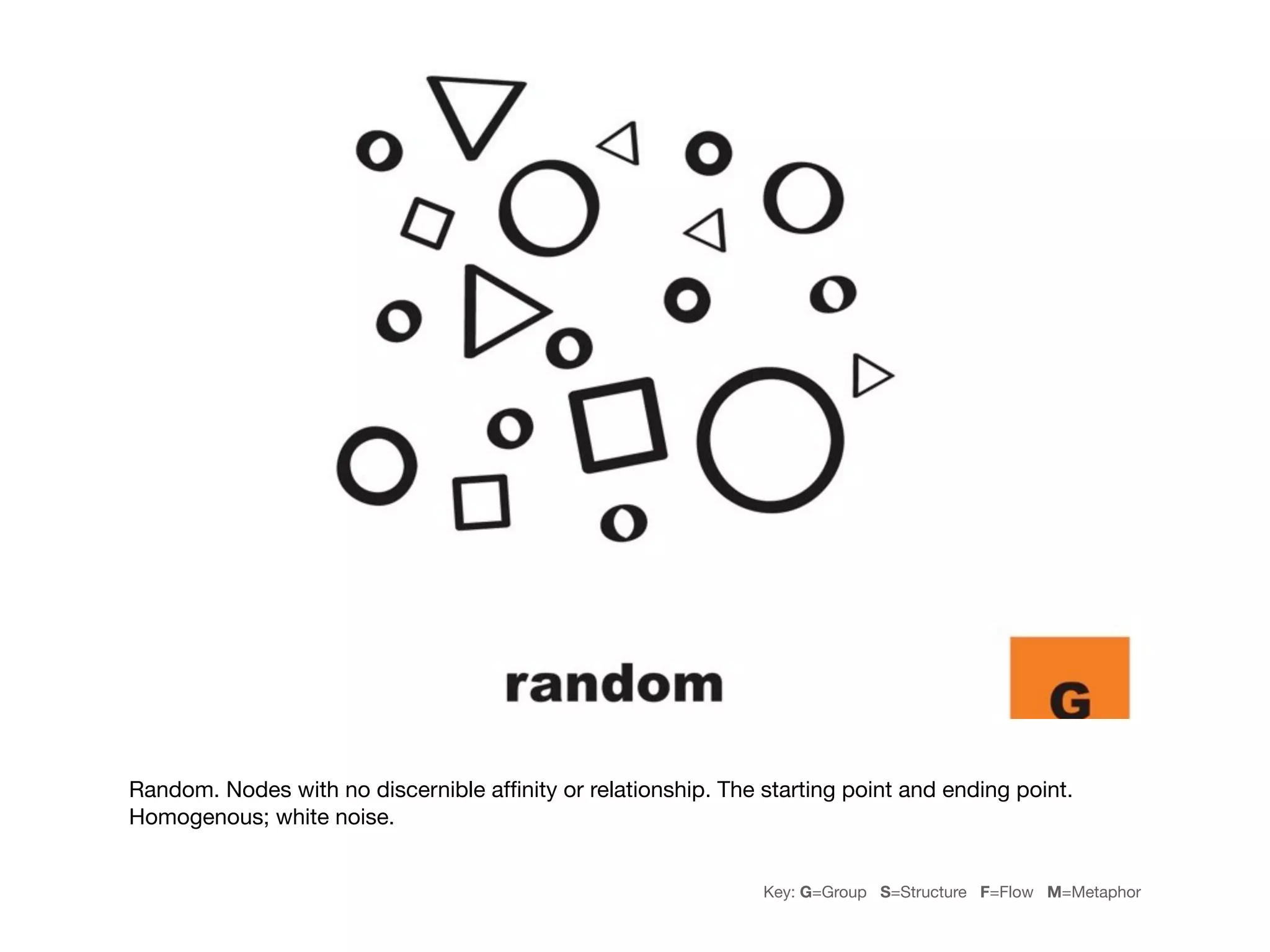
Random. Nodes with no discernible affinity or relationship. The starting point and ending point.
Homogenous; white noise.


                                                               Key: G=Group S=Structure F=Flow M=Metaphor
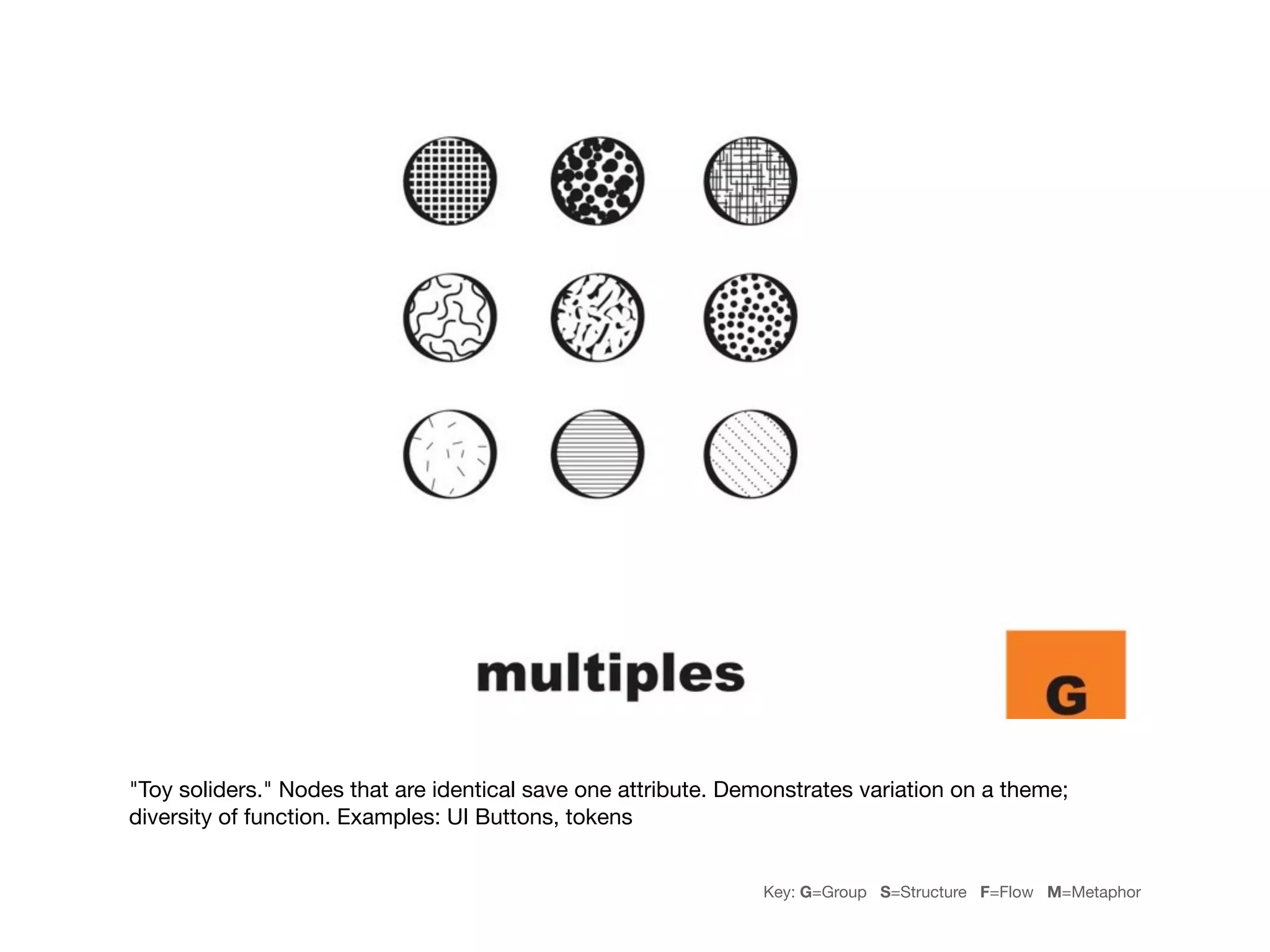
"Toy soliders." Nodes that are identical save one attribute. Demonstrates variation on a theme;
diversity of function. Examples: UI Buttons, tokens


                                                                Key: G=Group S=Structure F=Flow M=Metaphor
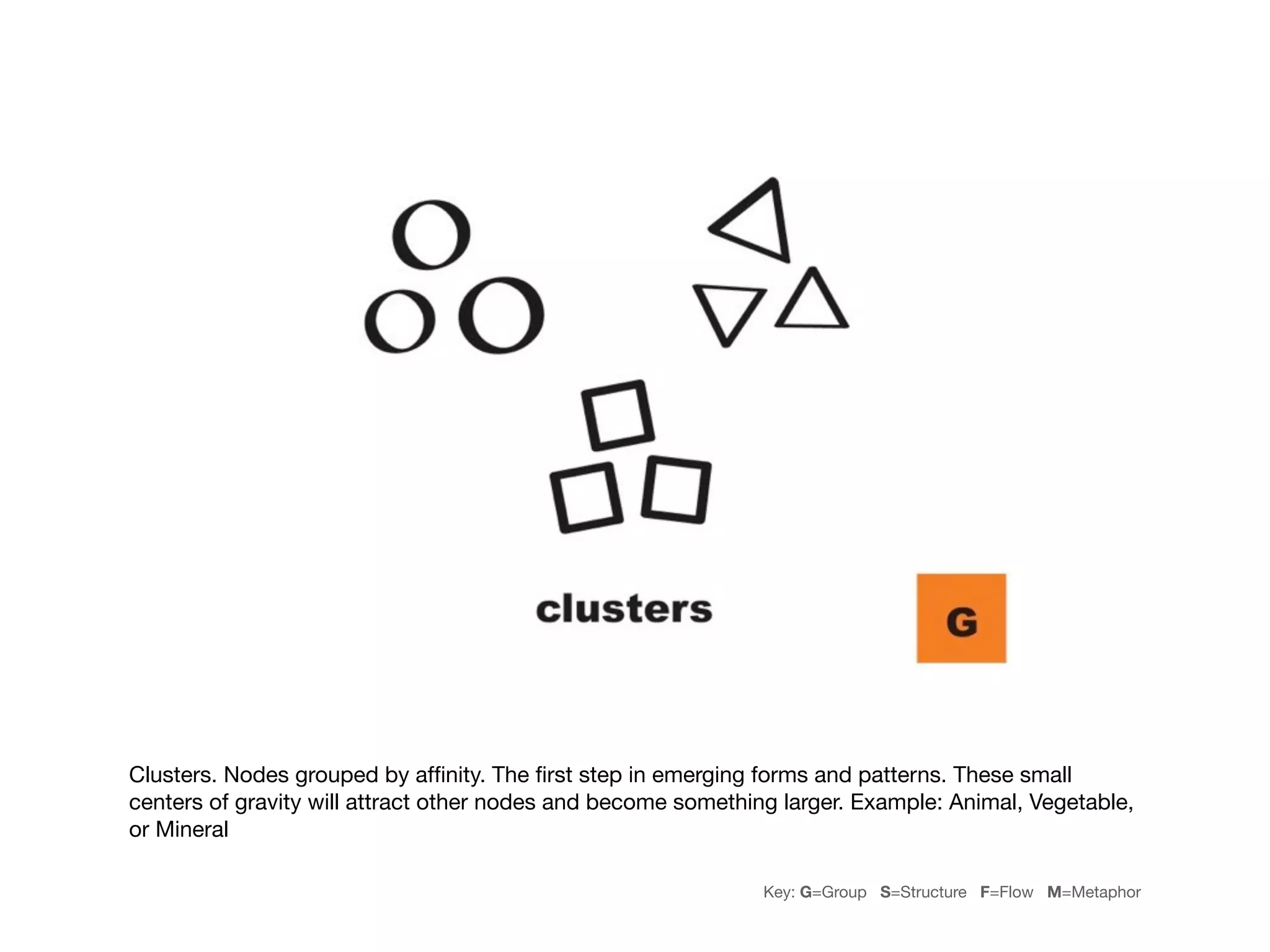
Clusters. Nodes grouped by affinity. The first step in emerging forms and patterns. These small
centers of gravity will attract other nodes and become something larger. Example: Animal, Vegetable,
or Mineral

                                                               Key: G=Group S=Structure F=Flow M=Metaphor
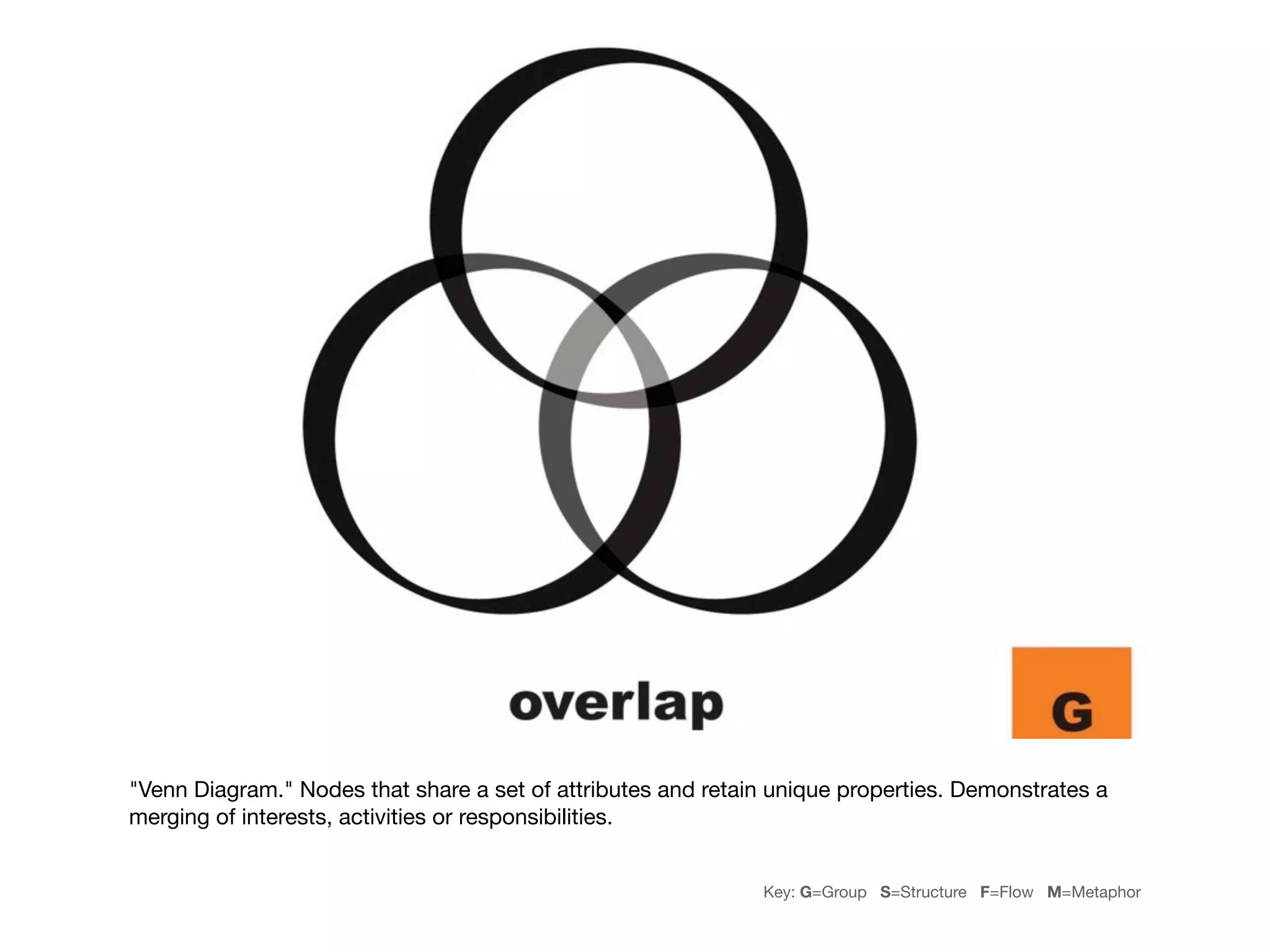
"Venn Diagram." Nodes that share a set of attributes and retain unique properties. Demonstrates a
merging of interests, activities or responsibilities.


                                                              Key: G=Group S=Structure F=Flow M=Metaphor
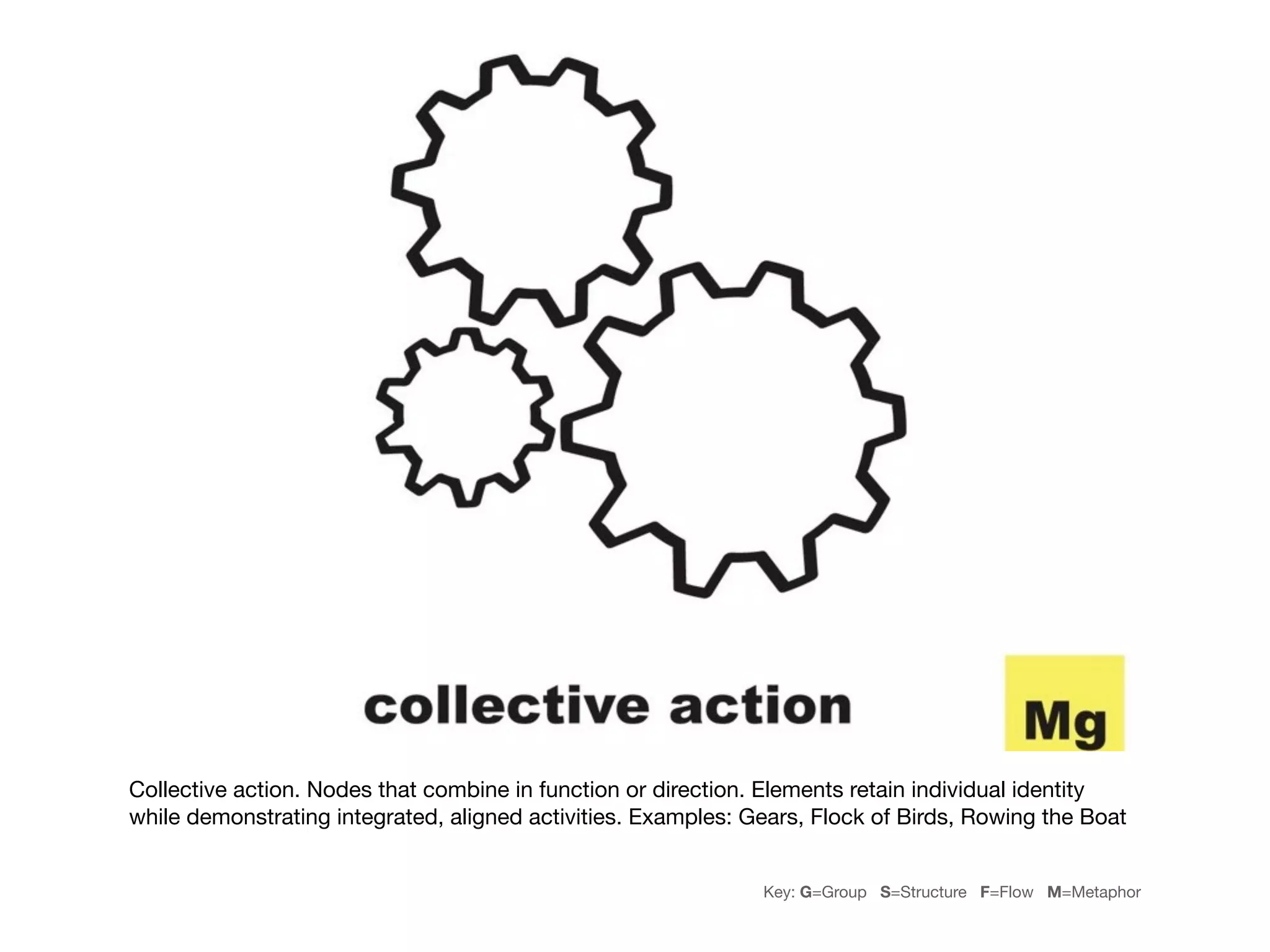
Collective action. Nodes that combine in function or direction. Elements retain individual identity
while demonstrating integrated, aligned activities. Examples: Gears, Flock of Birds, Rowing the Boat


                                                               Key: G=Group S=Structure F=Flow M=Metaphor
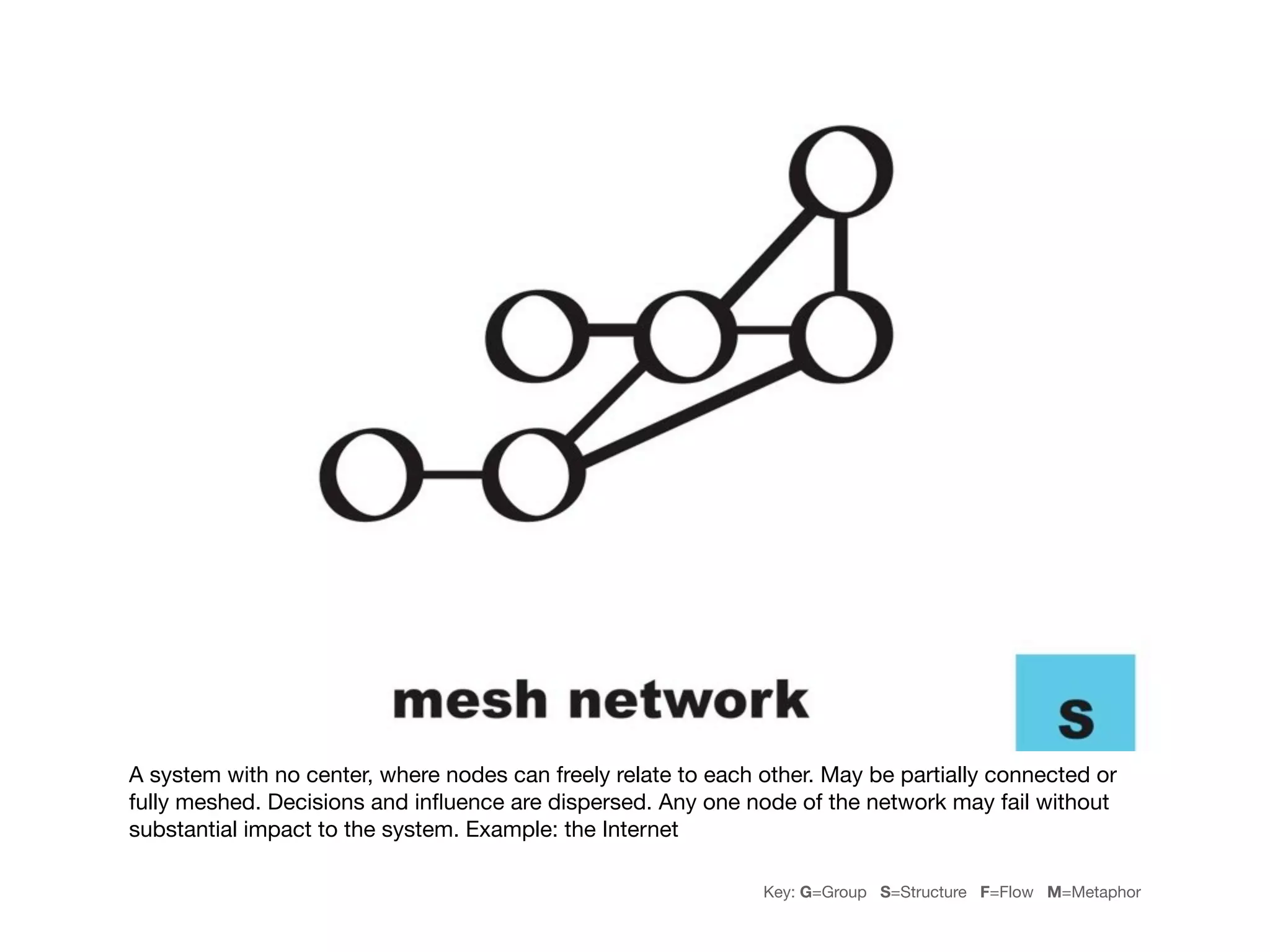
A system with no center, where nodes can freely relate to each other. May be partially connected or
fully meshed. Decisions and influence are dispersed. Any one node of the network may fail without
substantial impact to the system. Example: the Internet

                                                               Key: G=Group S=Structure F=Flow M=Metaphor
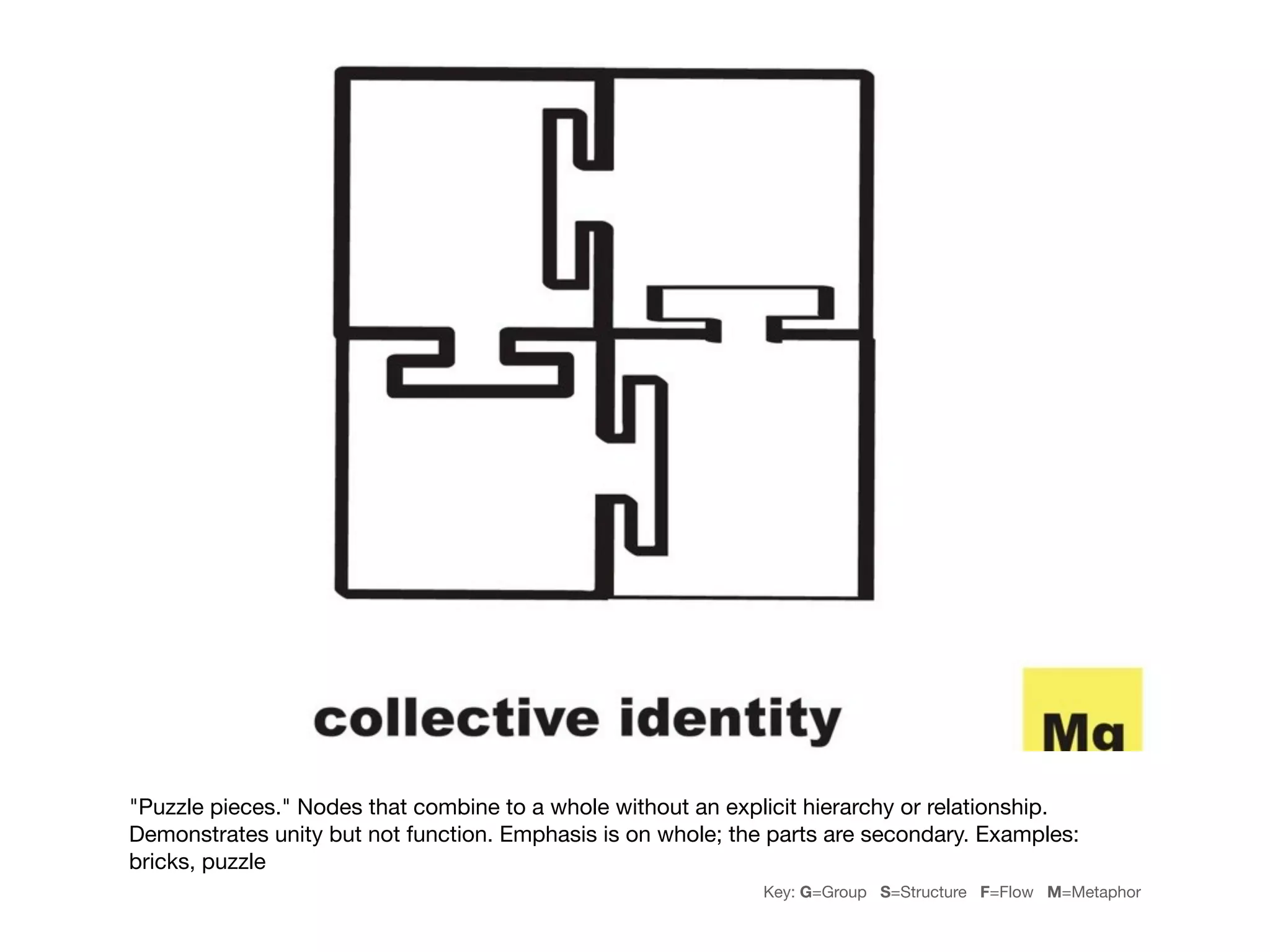
"Puzzle pieces." Nodes that combine to a whole without an explicit hierarchy or relationship.
Demonstrates unity but not function. Emphasis is on whole; the parts are secondary. Examples:
bricks, puzzle
                                                              Key: G=Group S=Structure F=Flow M=Metaphor
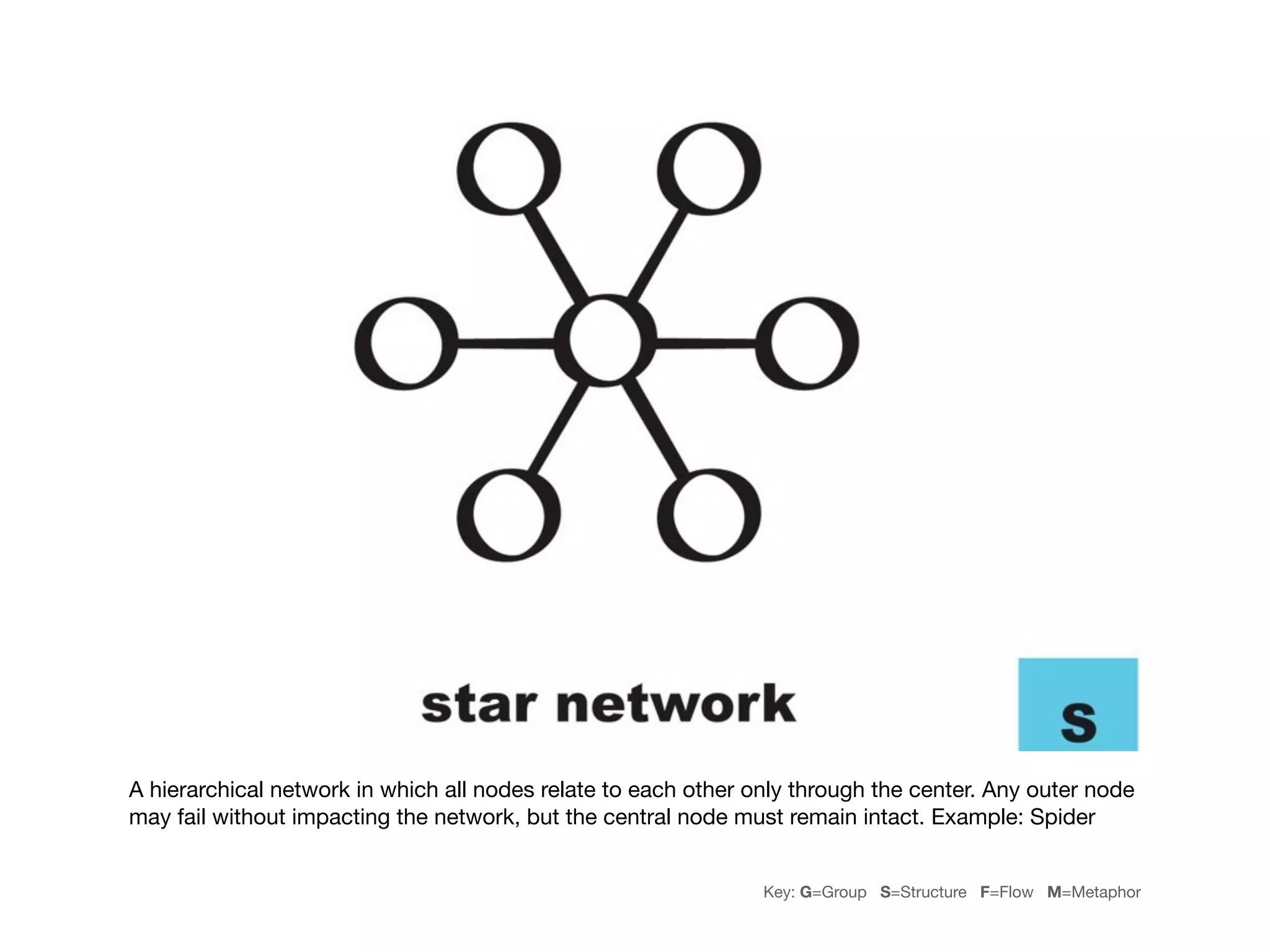
A hierarchical network in which all nodes relate to each other only through the center. Any outer node
may fail without impacting the network, but the central node must remain intact. Example: Spider


                                                                Key: G=Group S=Structure F=Flow M=Metaphor
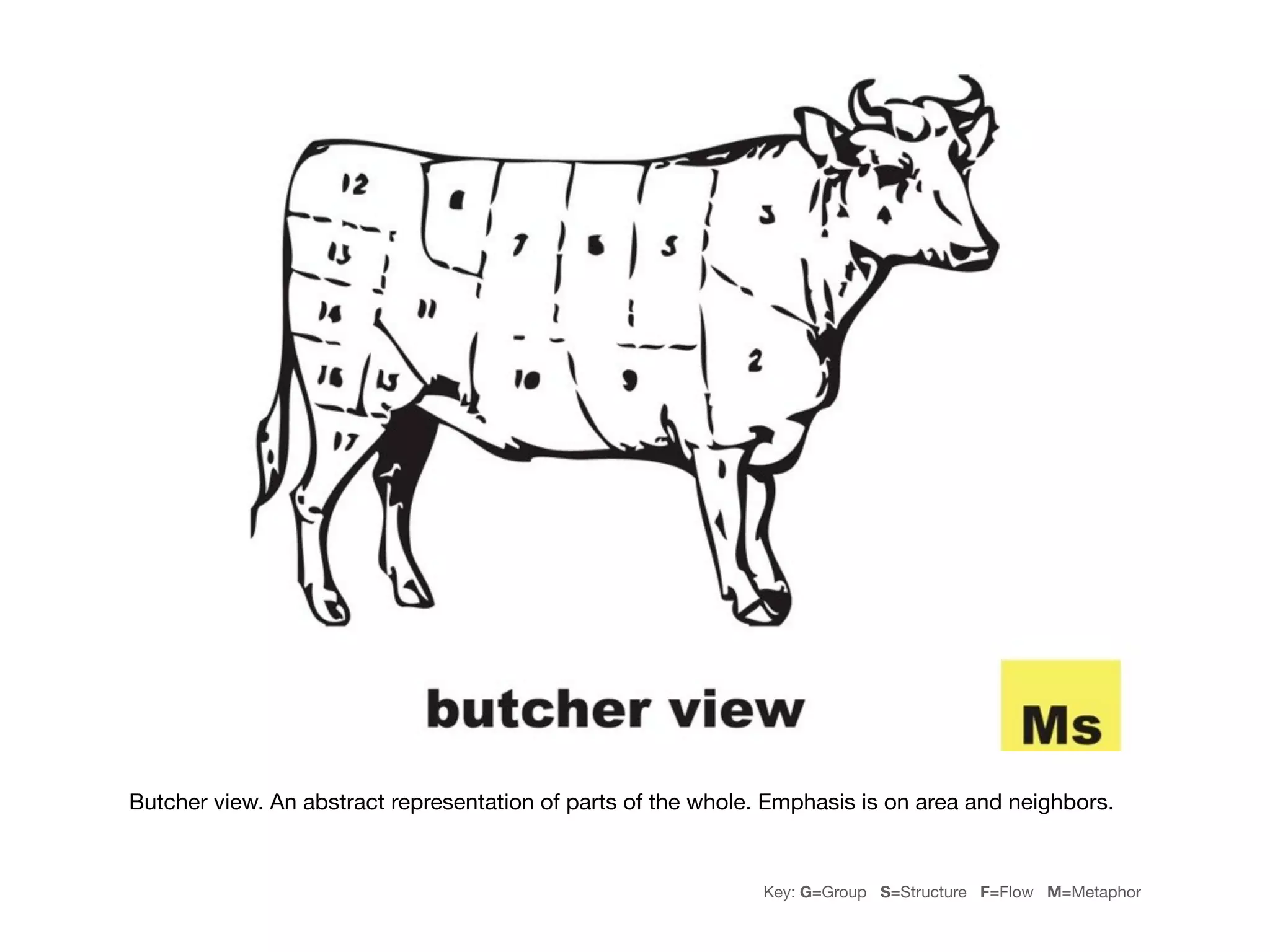
Butcher view. An abstract representation of parts of the whole. Emphasis is on area and neighbors.


                                                               Key: G=Group S=Structure F=Flow M=Metaphor
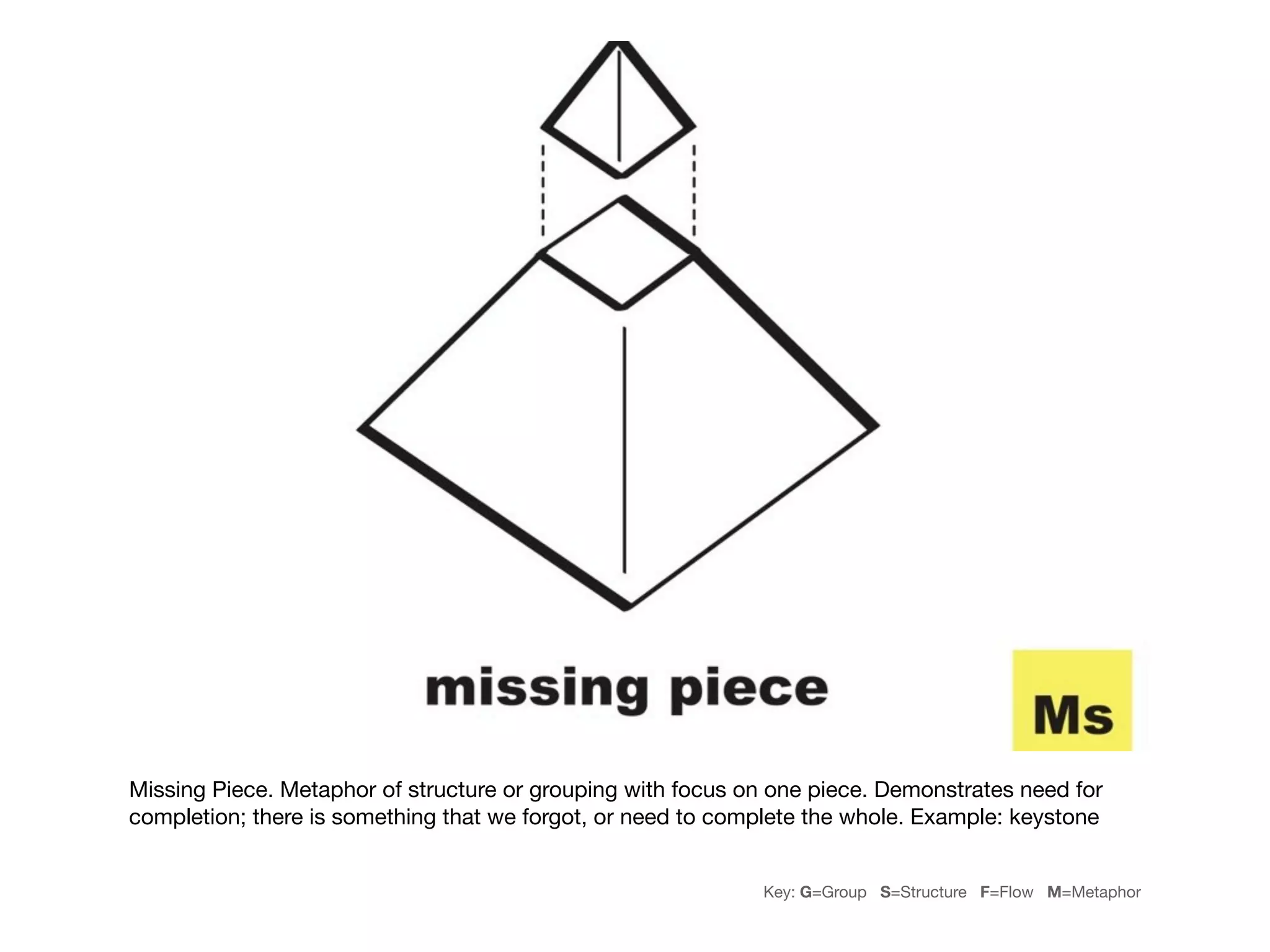
Missing Piece. Metaphor of structure or grouping with focus on one piece. Demonstrates need for
completion; there is something that we forgot, or need to complete the whole. Example: keystone


                                                             Key: G=Group S=Structure F=Flow M=Metaphor
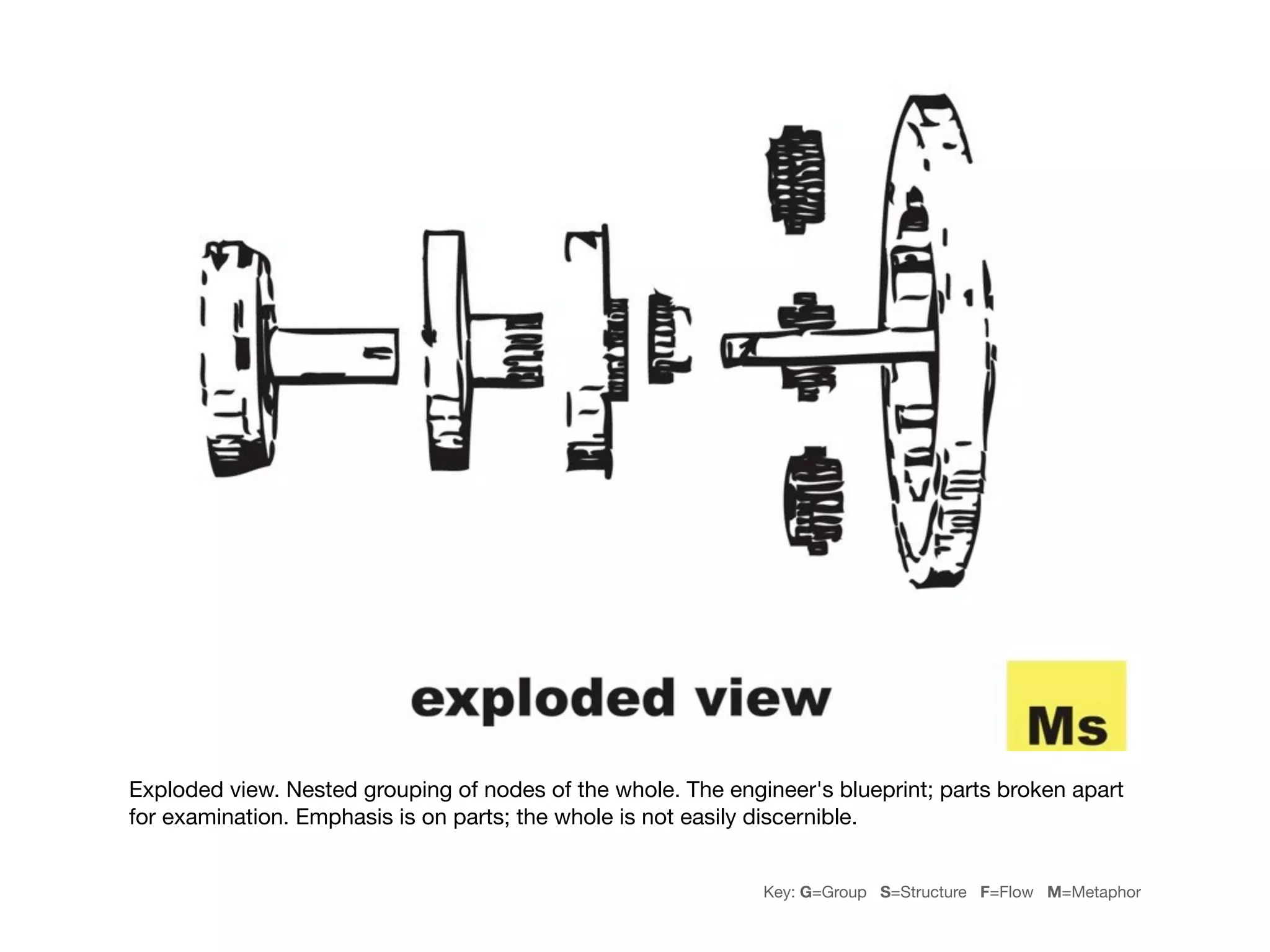
Exploded view. Nested grouping of nodes of the whole. The engineer's blueprint; parts broken apart
for examination. Emphasis is on parts; the whole is not easily discernible.


                                                              Key: G=Group S=Structure F=Flow M=Metaphor
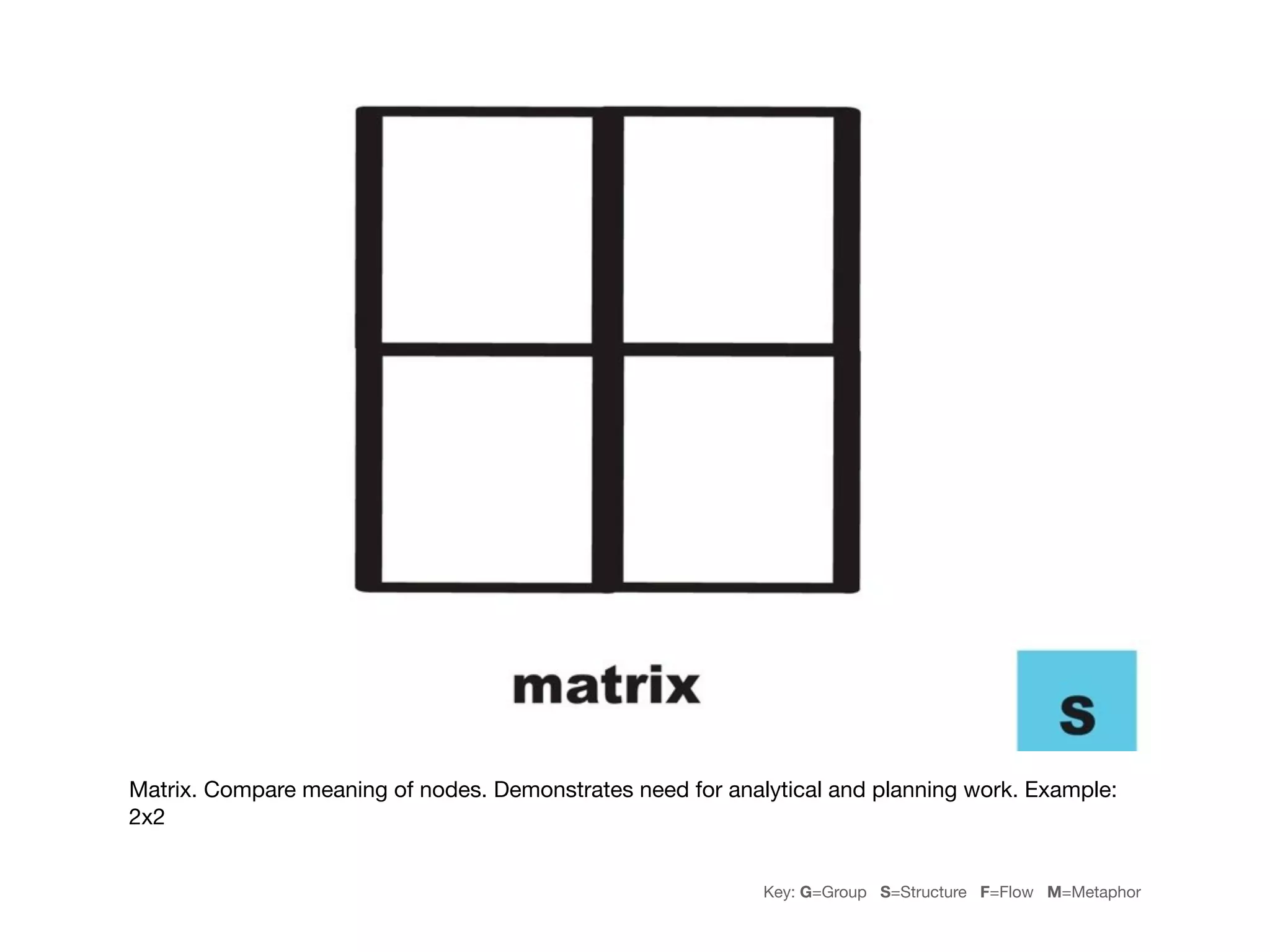
Matrix. Compare meaning of nodes. Demonstrates need for analytical and planning work. Example:
2x2


                                                            Key: G=Group S=Structure F=Flow M=Metaphor
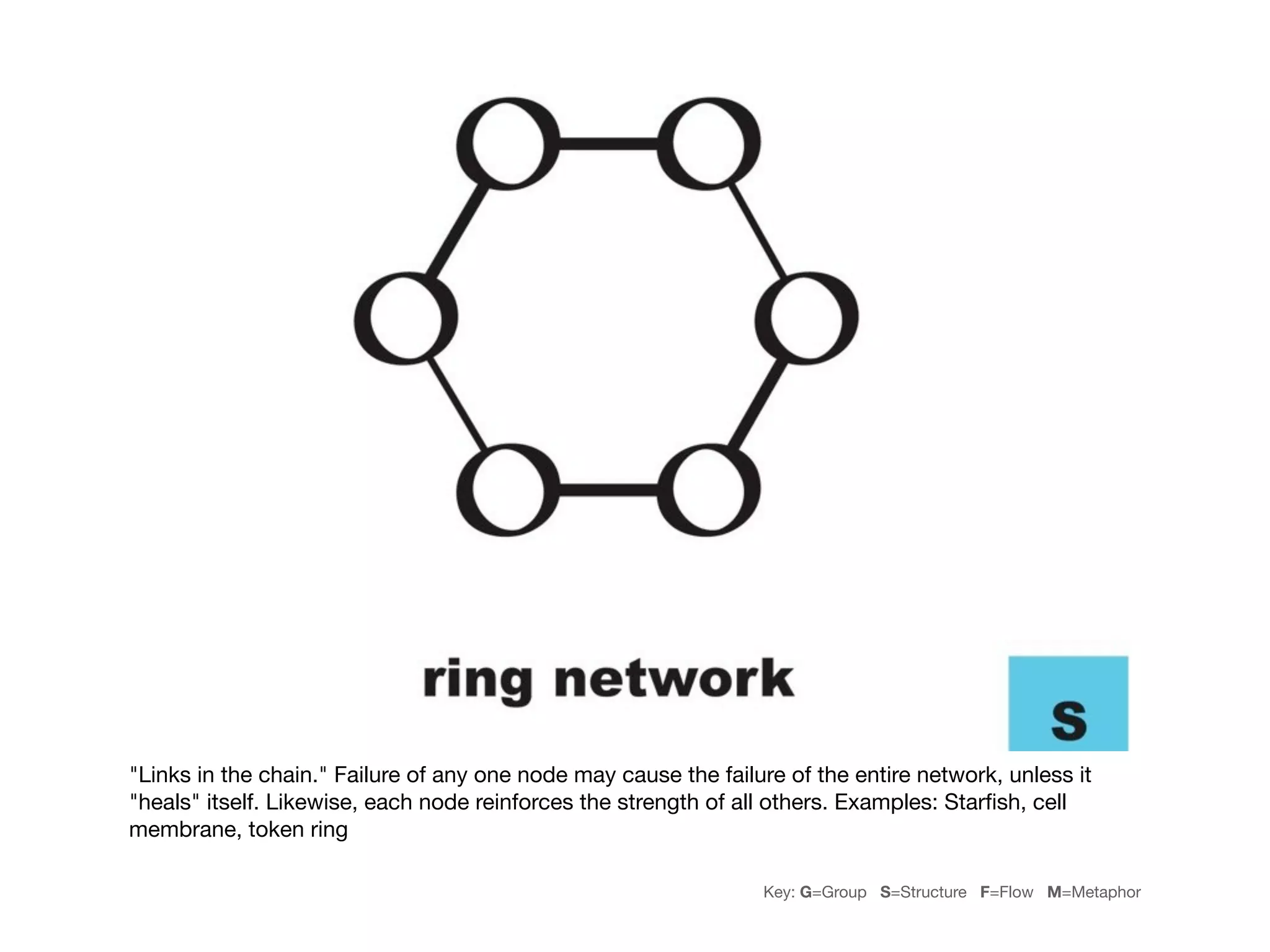
"Links in the chain." Failure of any one node may cause the failure of the entire network, unless it
"heals" itself. Likewise, each node reinforces the strength of all others. Examples: Starfish, cell
membrane, token ring

                                                                 Key: G=Group S=Structure F=Flow M=Metaphor
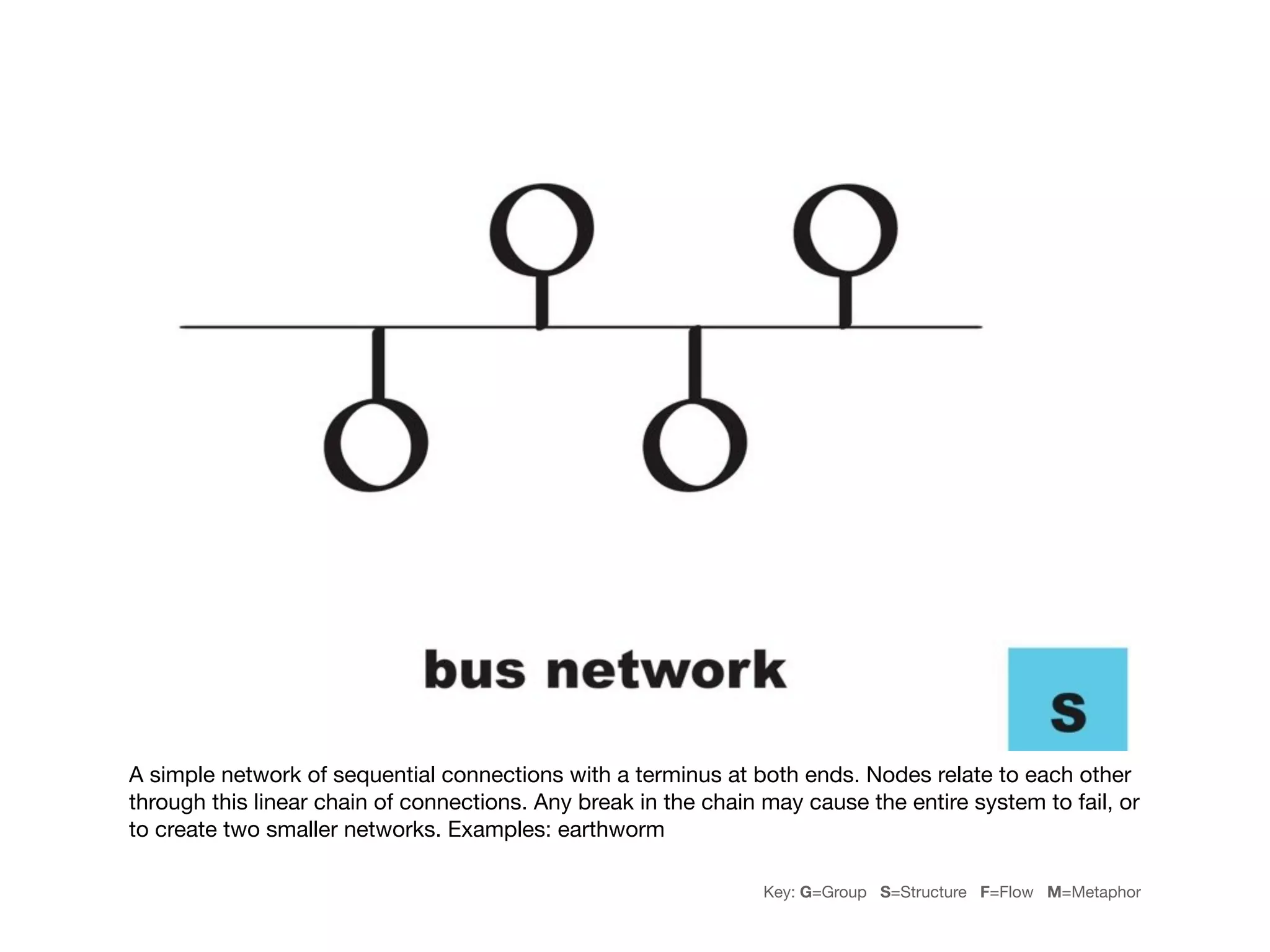
A simple network of sequential connections with a terminus at both ends. Nodes relate to each other
through this linear chain of connections. Any break in the chain may cause the entire system to fail, or
to create two smaller networks. Examples: earthworm

                                                                 Key: G=Group S=Structure F=Flow M=Metaphor
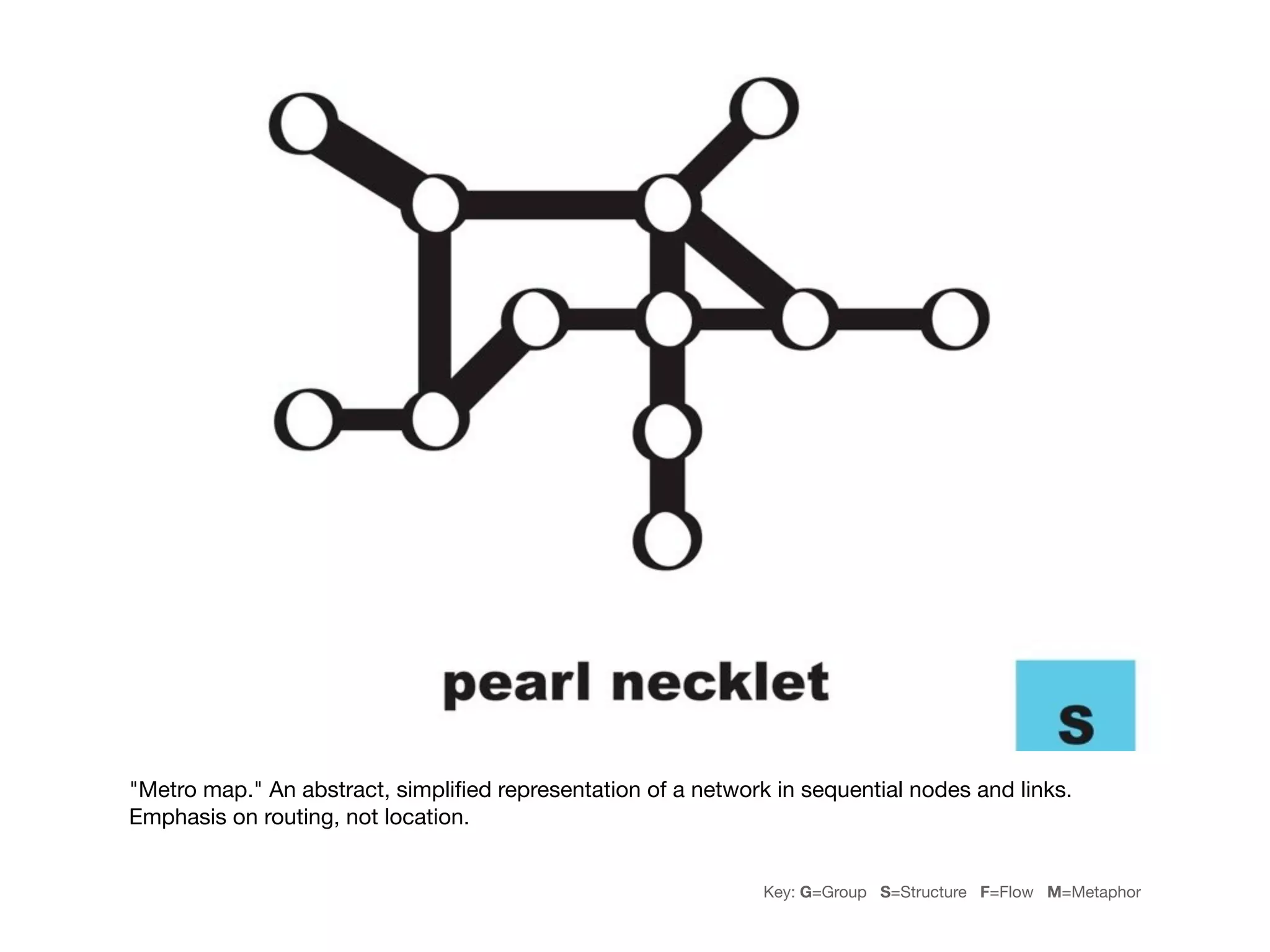
"Metro map." An abstract, simplified representation of a network in sequential nodes and links.
Emphasis on routing, not location.


                                                               Key: G=Group S=Structure F=Flow M=Metaphor
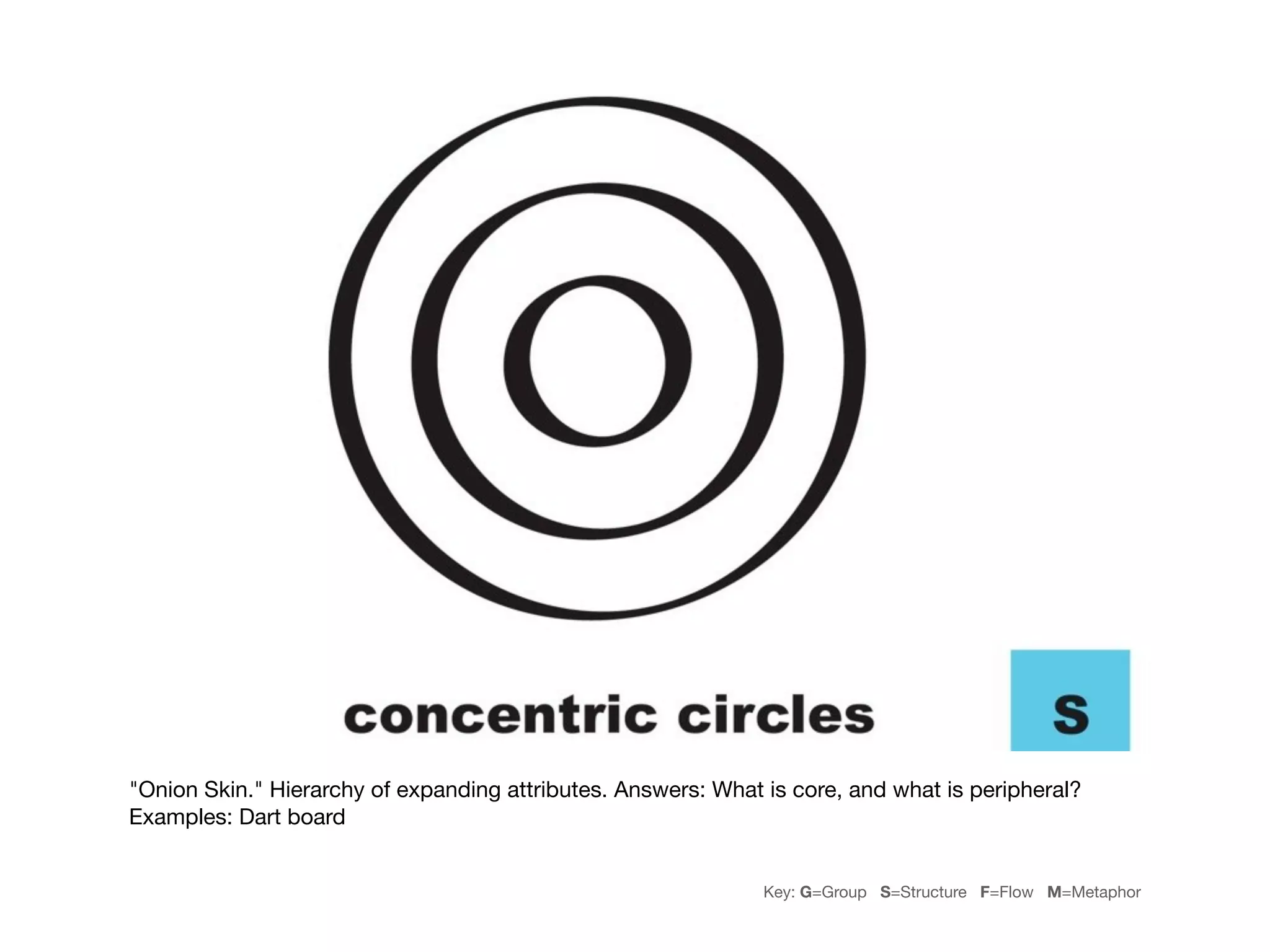
"Onion Skin." Hierarchy of expanding attributes. Answers: What is core, and what is peripheral?
Examples: Dart board


                                                               Key: G=Group S=Structure F=Flow M=Metaphor
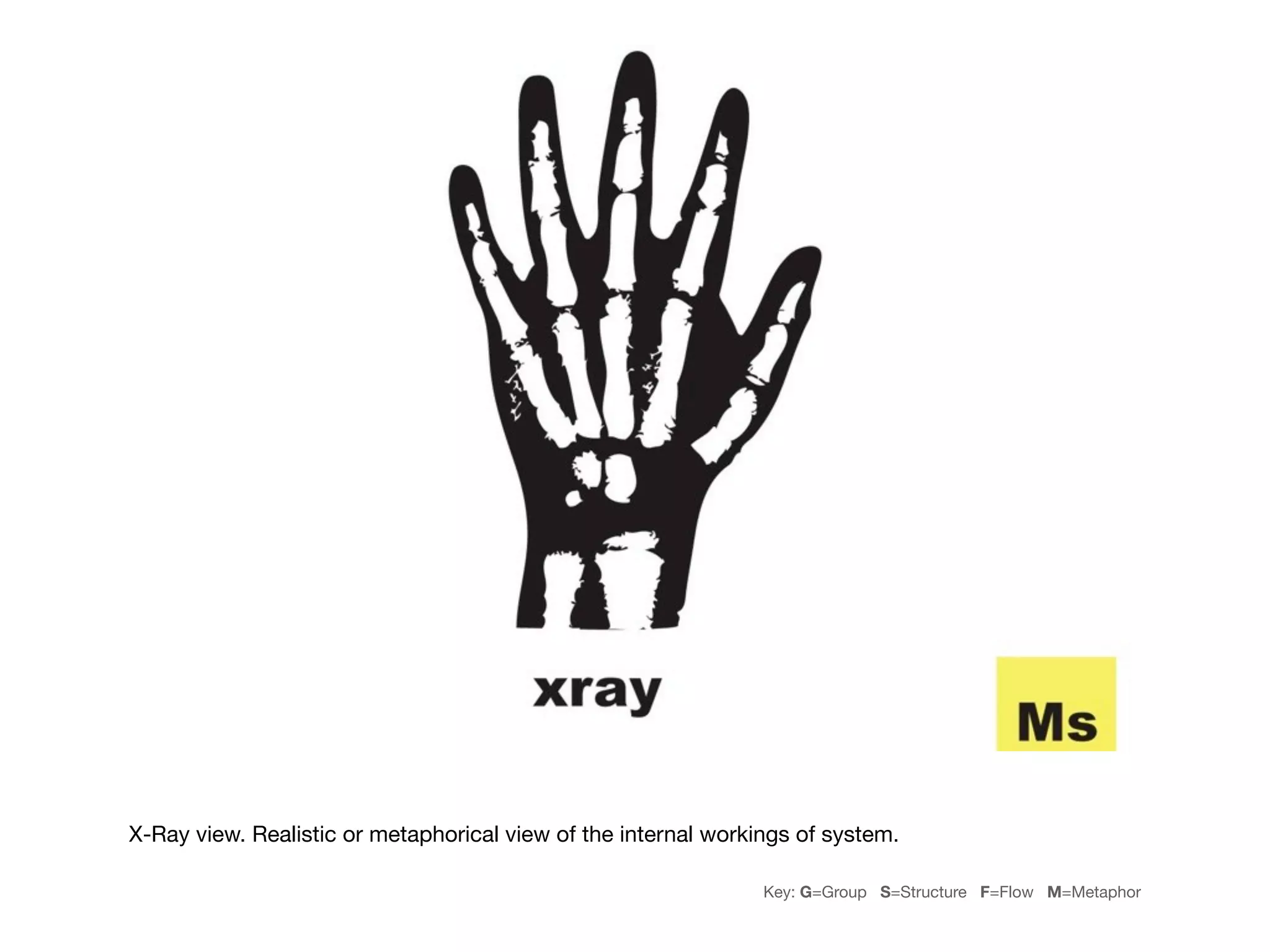
X-Ray view. Realistic or metaphorical view of the internal workings of system.

                                                                Key: G=Group S=Structure F=Flow M=Metaphor
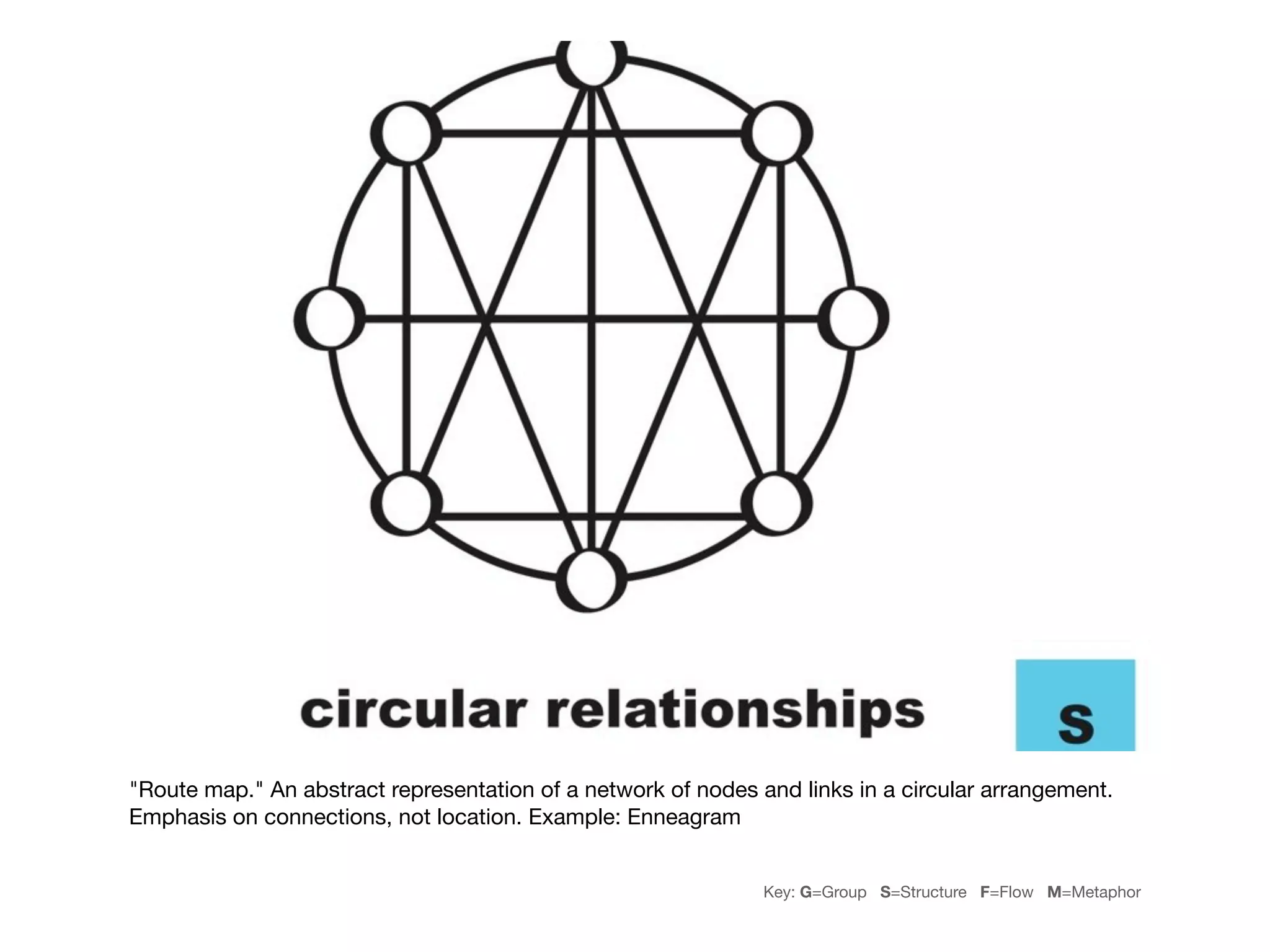
"Route map." An abstract representation of a network of nodes and links in a circular arrangement.
Emphasis on connections, not location. Example: Enneagram


                                                               Key: G=Group S=Structure F=Flow M=Metaphor
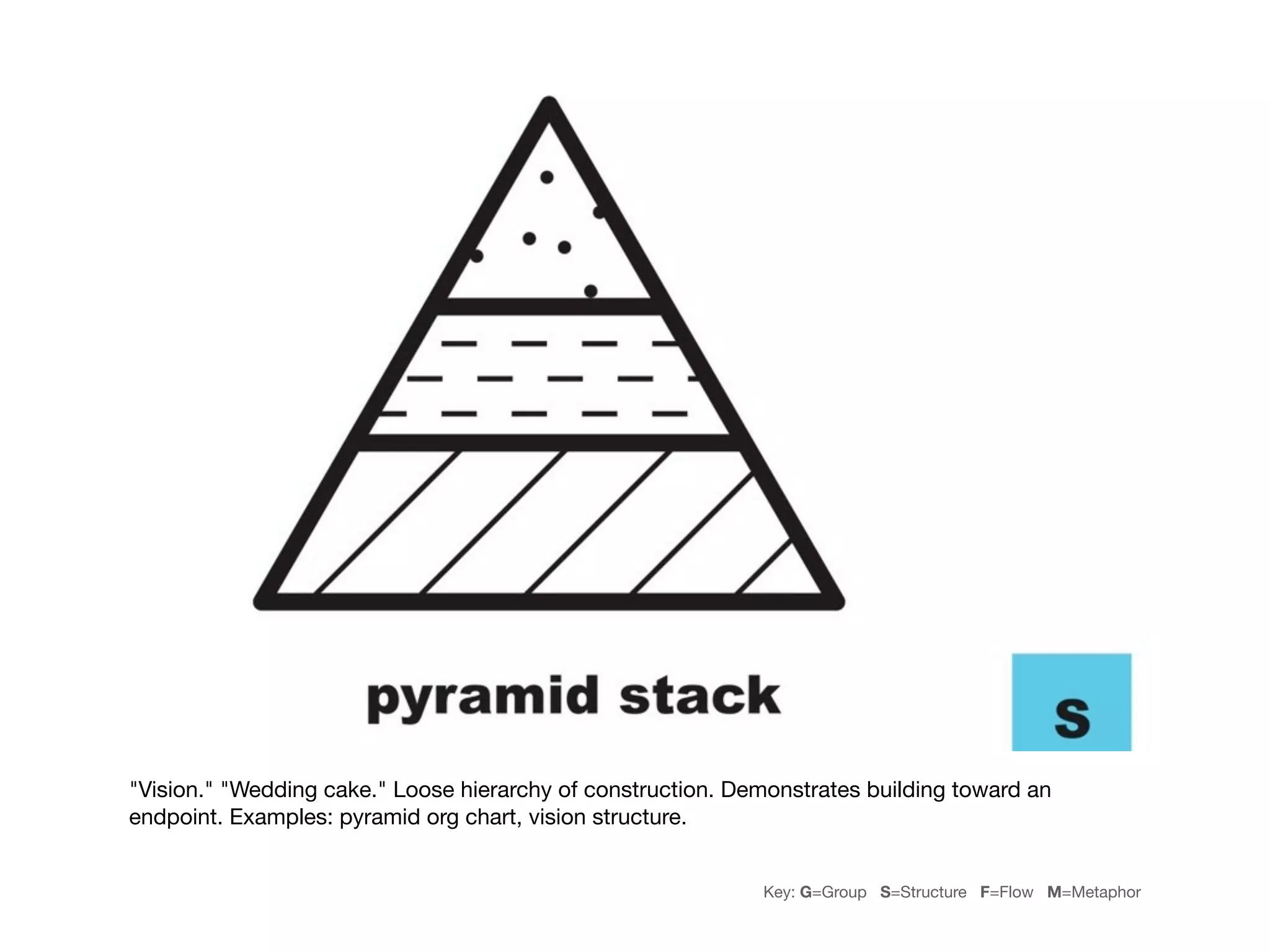
"Vision." "Wedding cake." Loose hierarchy of construction. Demonstrates building toward an
endpoint. Examples: pyramid org chart, vision structure.


                                                             Key: G=Group S=Structure F=Flow M=Metaphor
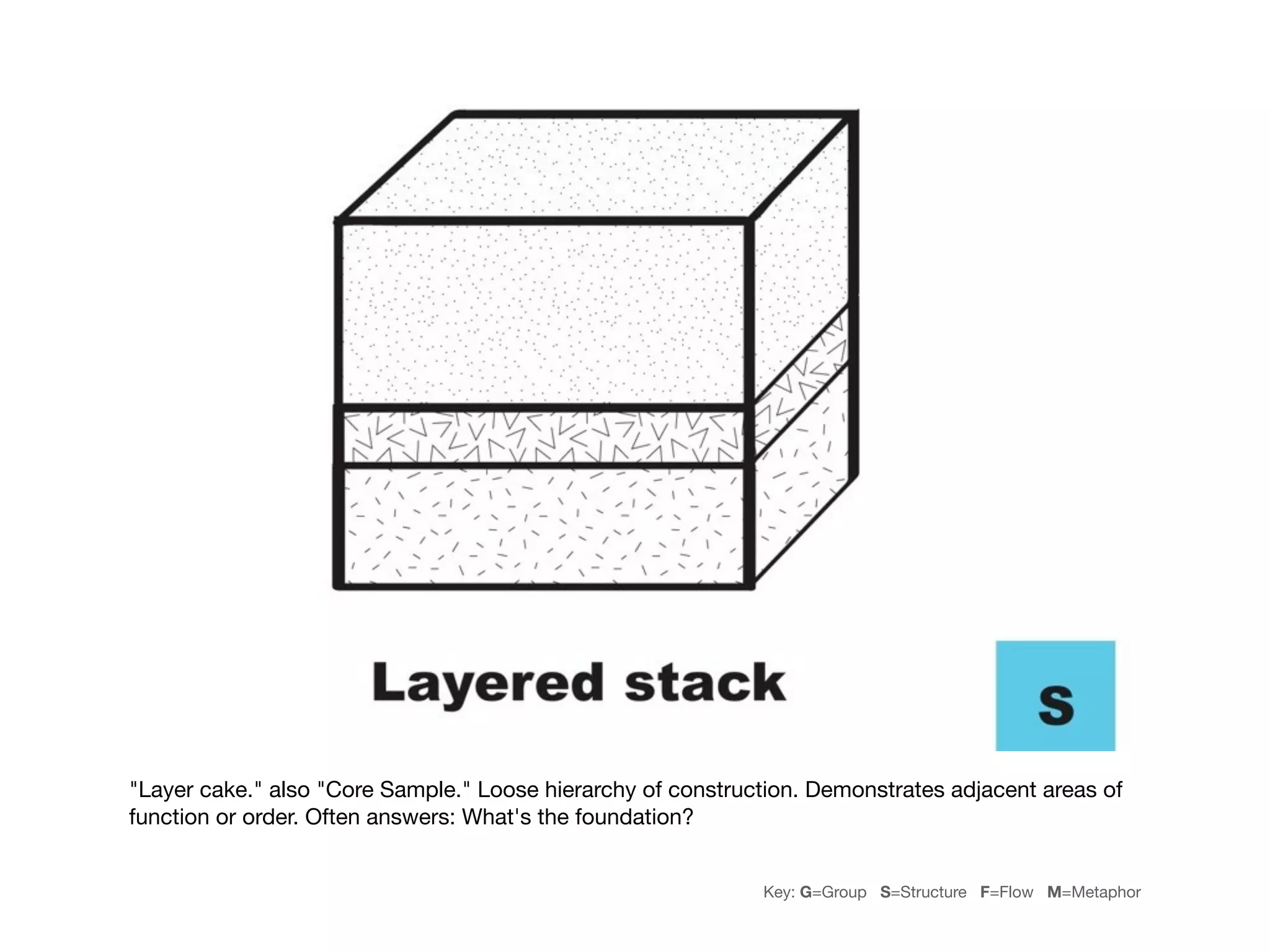
"Layer cake." also "Core Sample." Loose hierarchy of construction. Demonstrates adjacent areas of
function or order. Often answers: What's the foundation?


                                                             Key: G=Group S=Structure F=Flow M=Metaphor
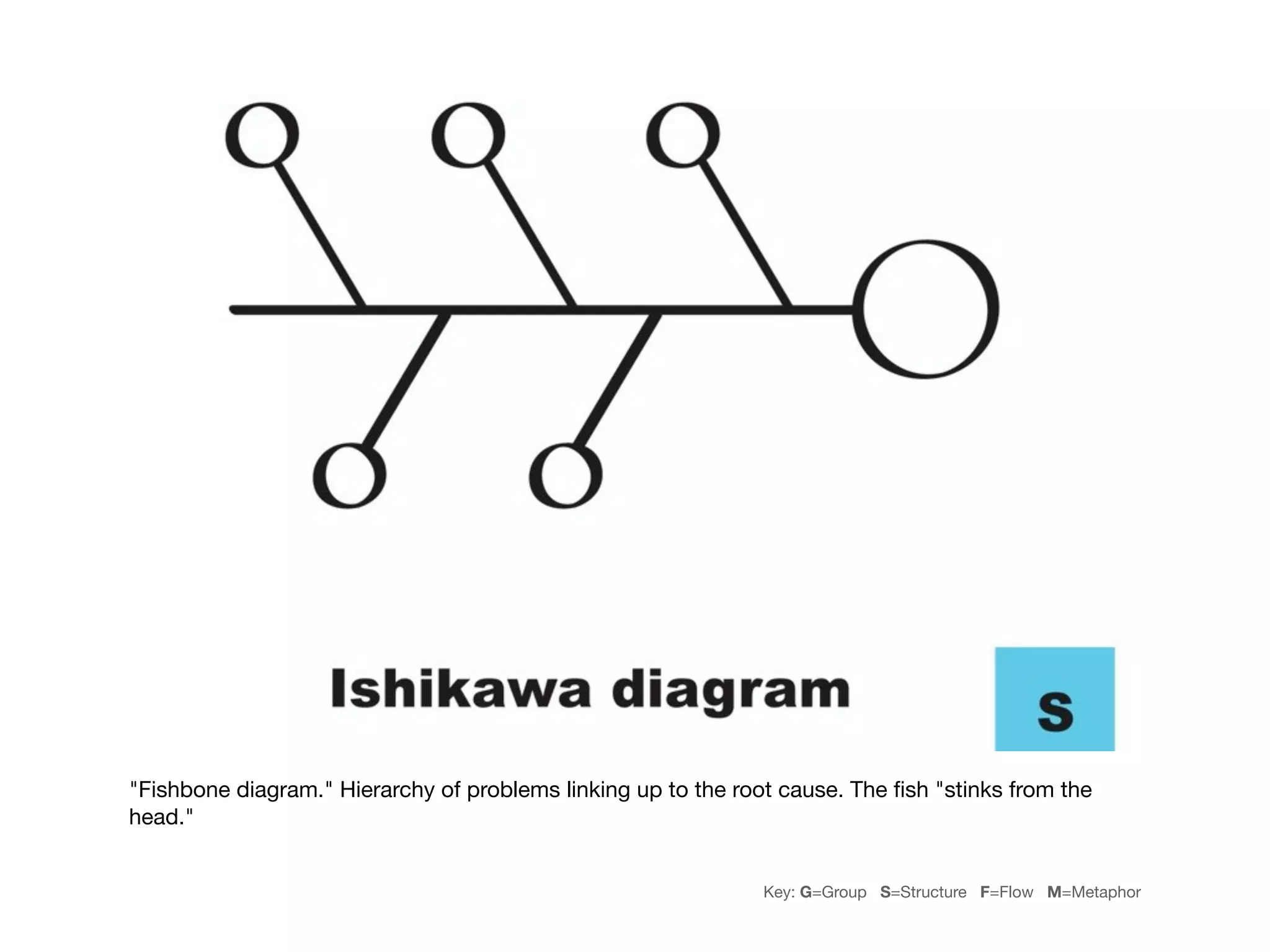
"Fishbone diagram." Hierarchy of problems linking up to the root cause. The fish "stinks from the
head."


                                                               Key: G=Group S=Structure F=Flow M=Metaphor
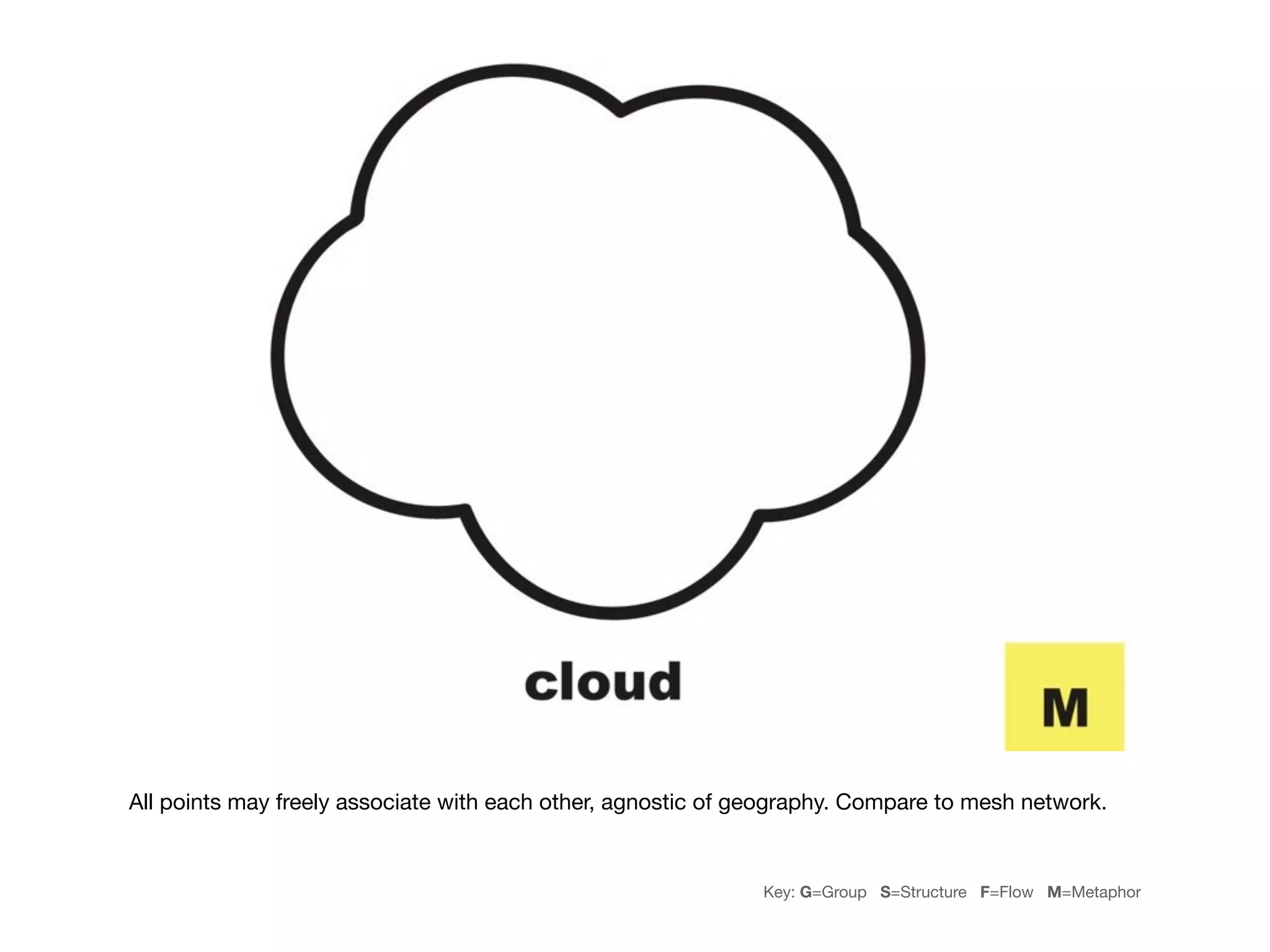
All points may freely associate with each other, agnostic of geography. Compare to mesh network.


                                                              Key: G=Group S=Structure F=Flow M=Metaphor
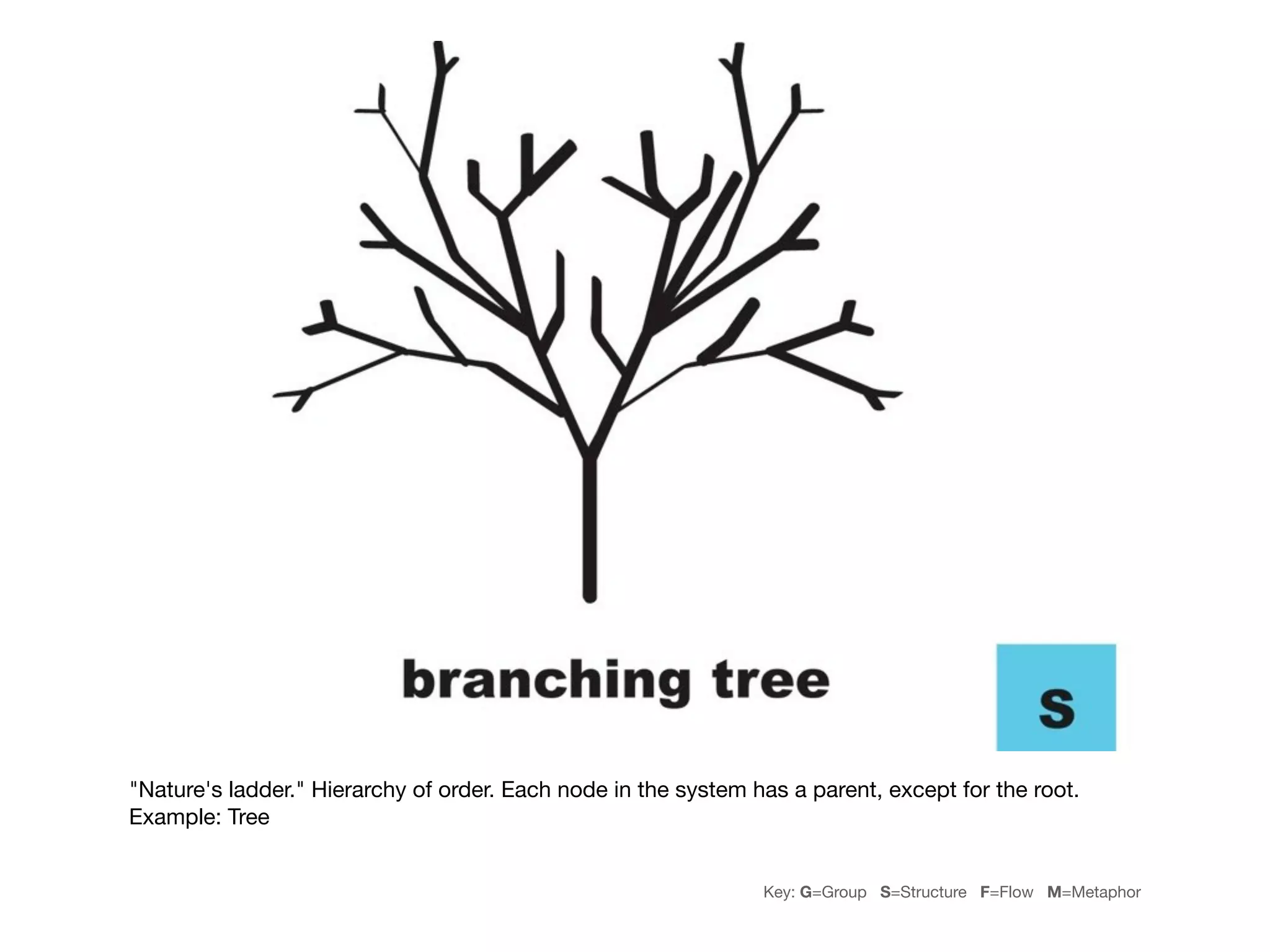
"Nature's ladder." Hierarchy of order. Each node in the system has a parent, except for the root.
Example: Tree


                                                                Key: G=Group S=Structure F=Flow M=Metaphor
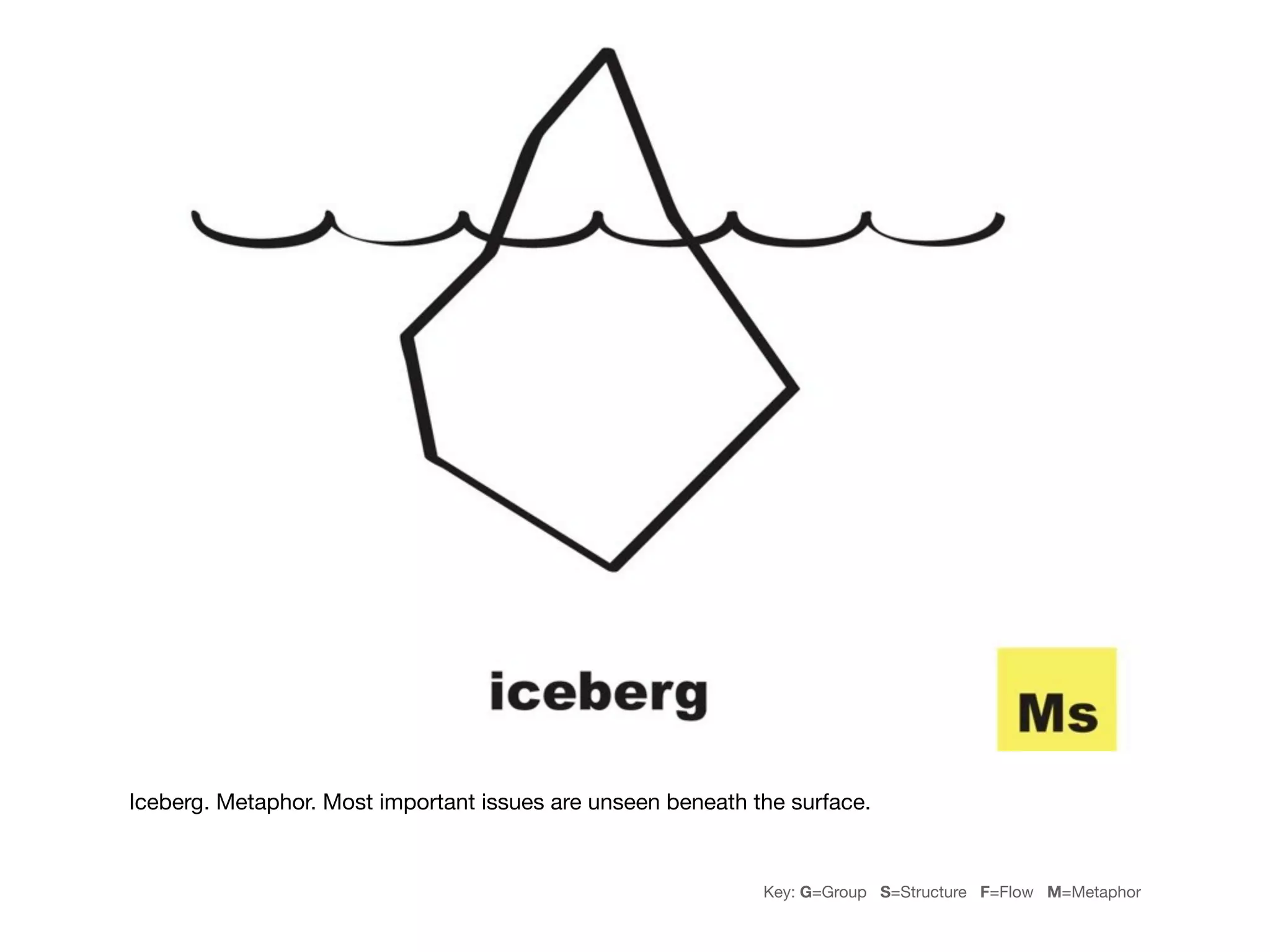
Iceberg. Metaphor. Most important issues are unseen beneath the surface.


                                                             Key: G=Group S=Structure F=Flow M=Metaphor
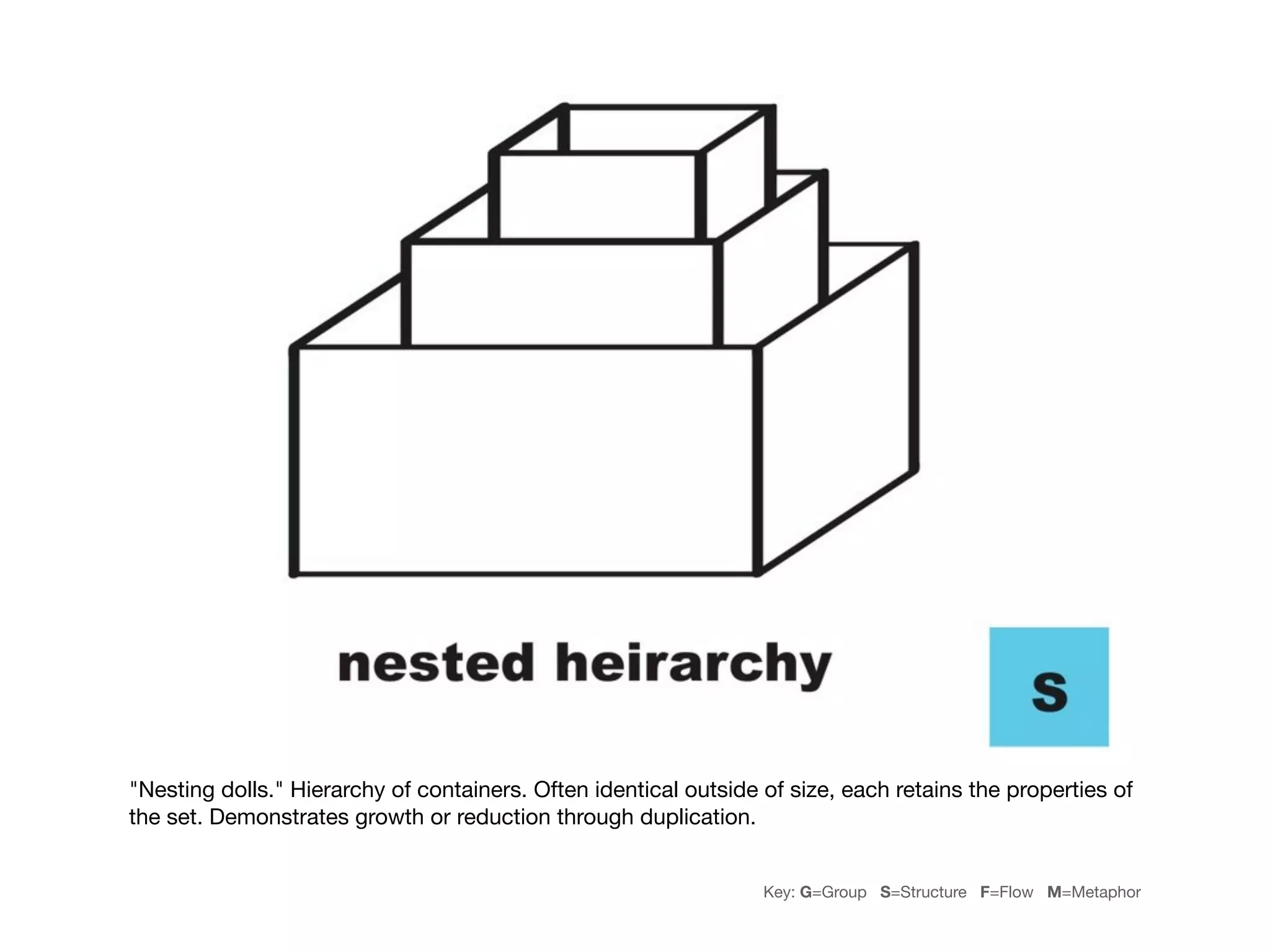
"Nesting dolls." Hierarchy of containers. Often identical outside of size, each retains the properties of
the set. Demonstrates growth or reduction through duplication.


                                                                  Key: G=Group S=Structure F=Flow M=Metaphor
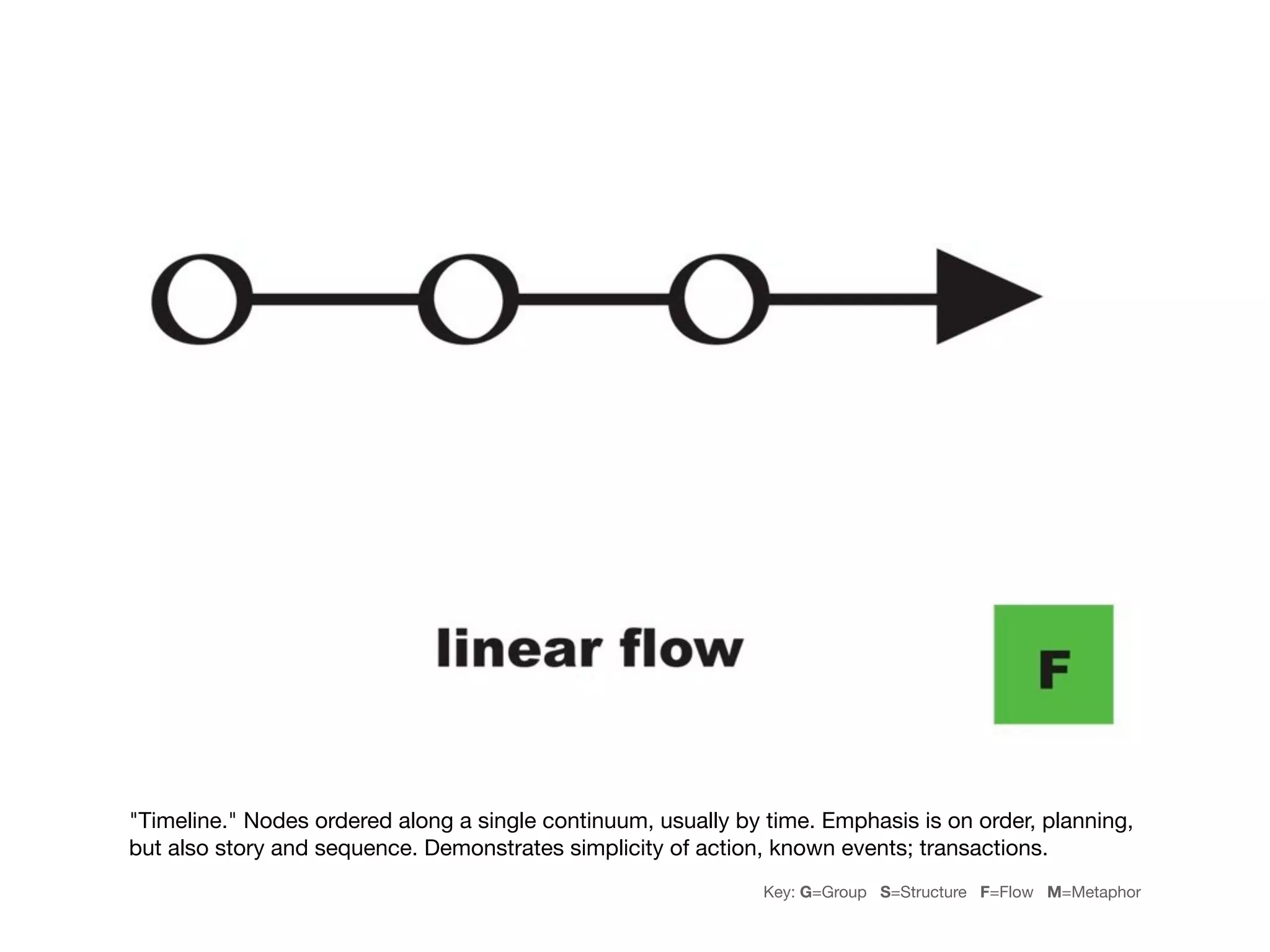
"Timeline." Nodes ordered along a single continuum, usually by time. Emphasis is on order, planning,
but also story and sequence. Demonstrates simplicity of action, known events; transactions.
                                                               Key: G=Group S=Structure F=Flow M=Metaphor
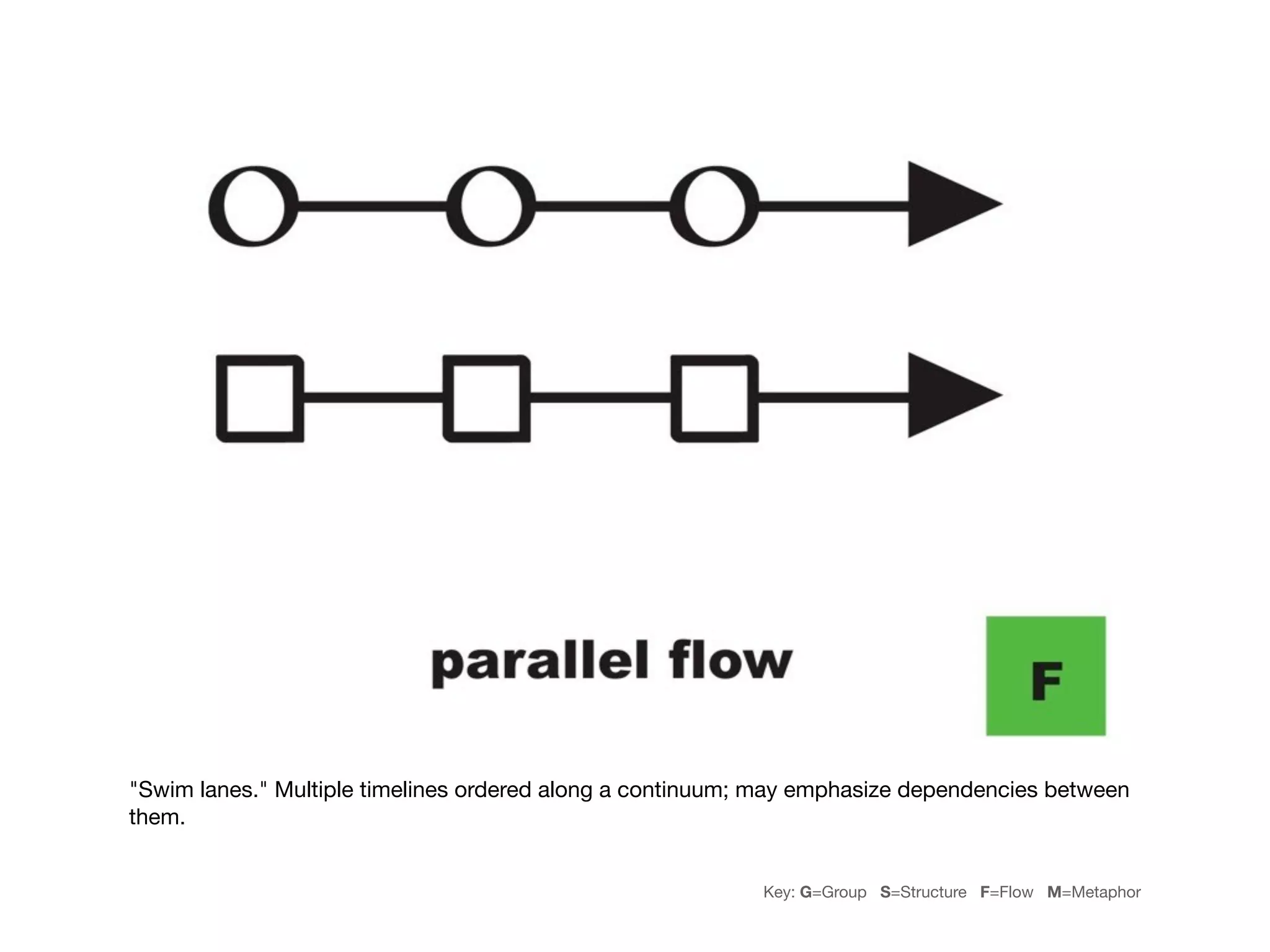
"Swim lanes." Multiple timelines ordered along a continuum; may emphasize dependencies between
them.


                                                           Key: G=Group S=Structure F=Flow M=Metaphor
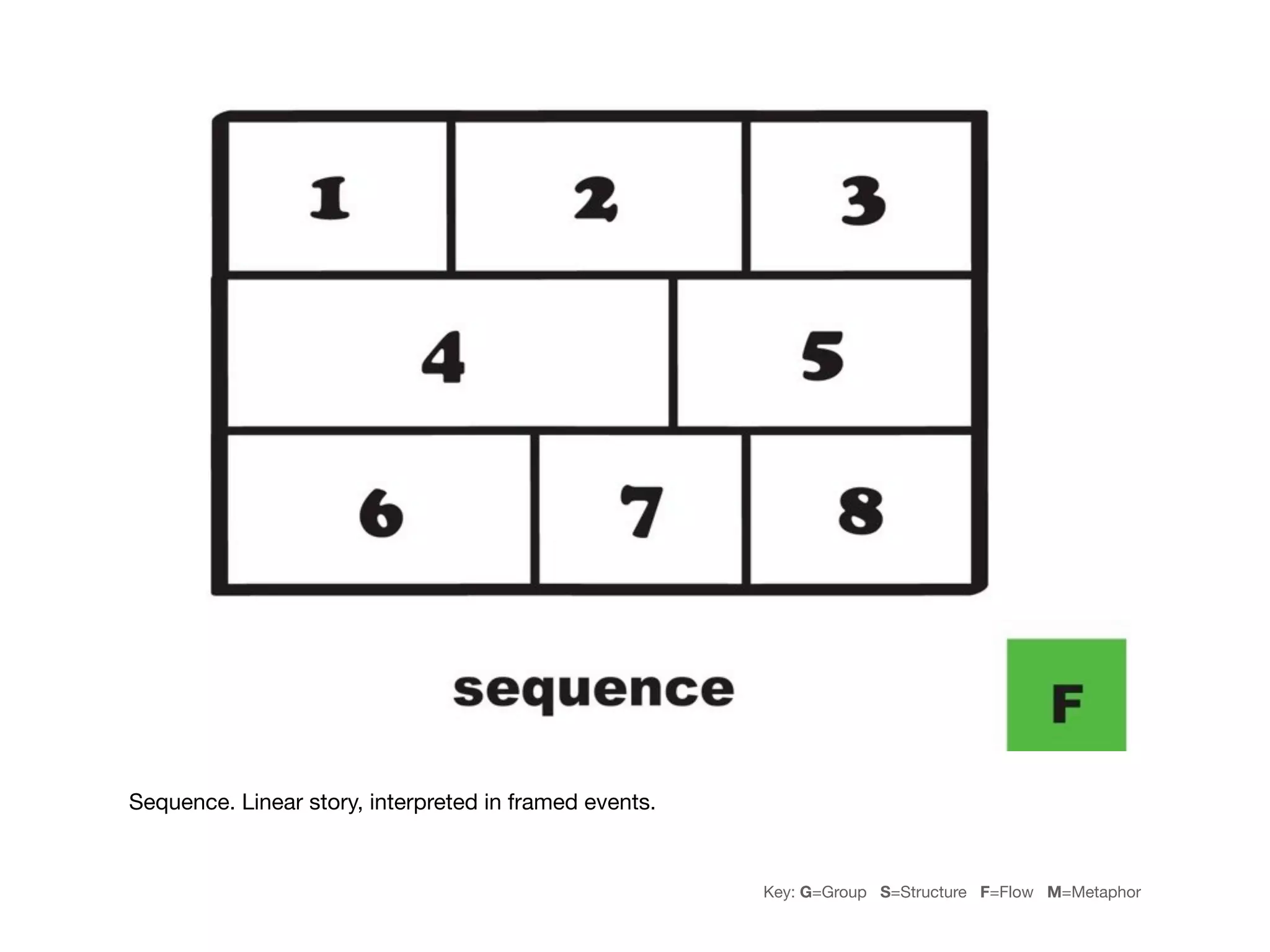
Sequence. Linear story, interpreted in framed events.


                                                        Key: G=Group S=Structure F=Flow M=Metaphor
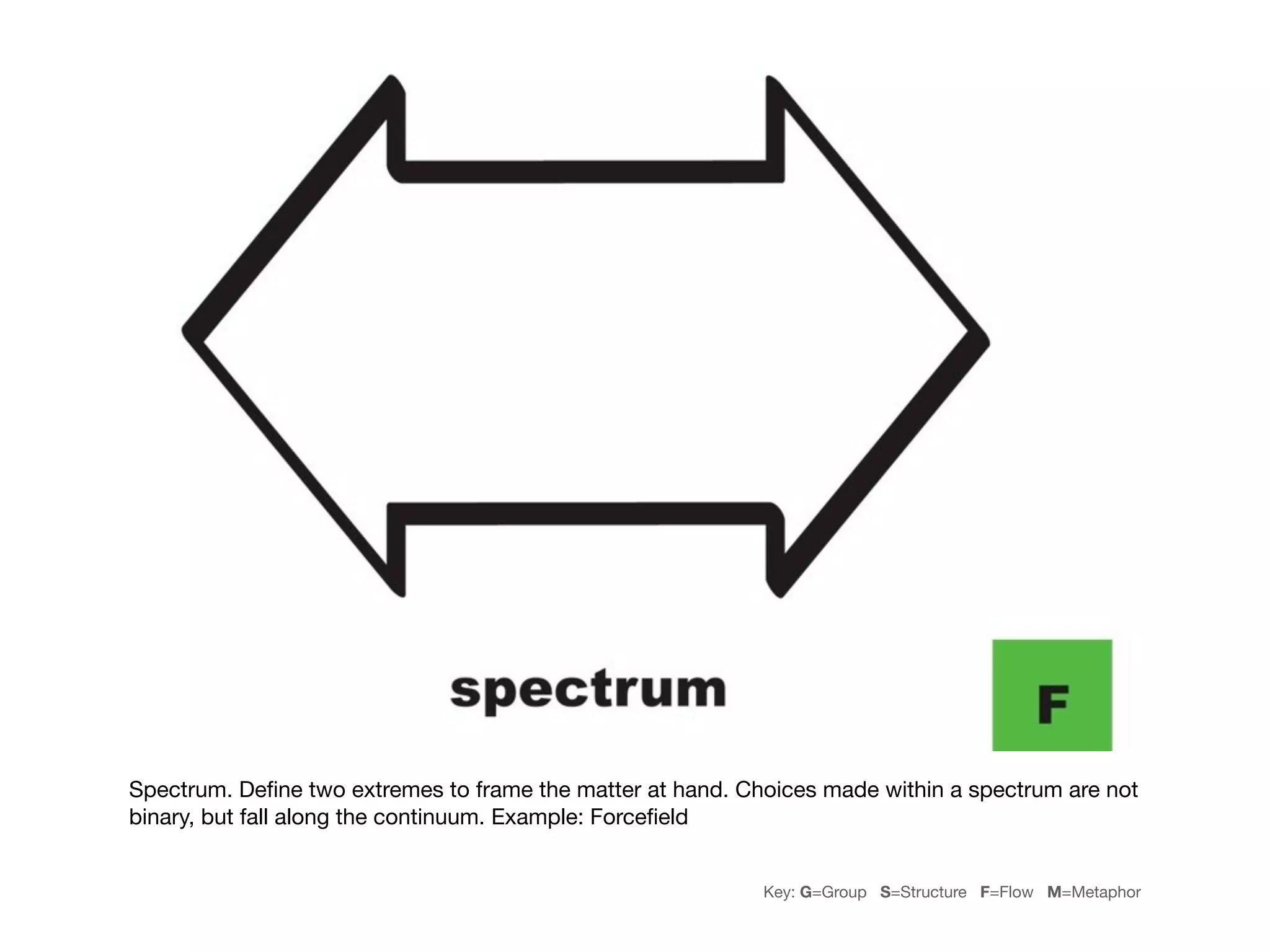
Spectrum. Define two extremes to frame the matter at hand. Choices made within a spectrum are not
binary, but fall along the continuum. Example: Forcefield


                                                            Key: G=Group S=Structure F=Flow M=Metaphor
Steps. Incremental improvement or progress. Laborious but well defined effort.


                                                              Key: G=Group S=Structure F=Flow M=Metaphor
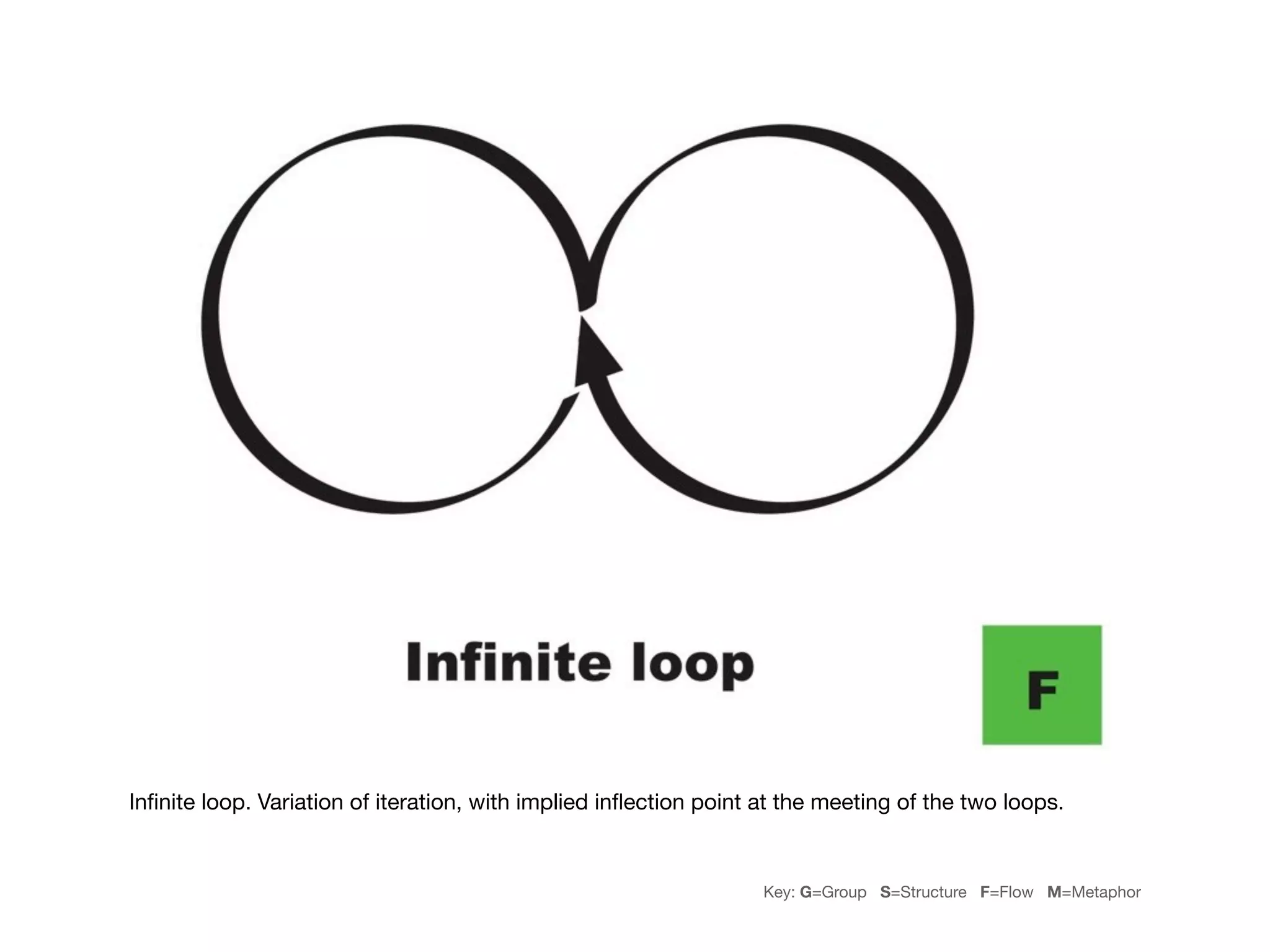
Infinite loop. Variation of iteration, with implied inflection point at the meeting of the two loops.


                                                                   Key: G=Group S=Structure F=Flow M=Metaphor
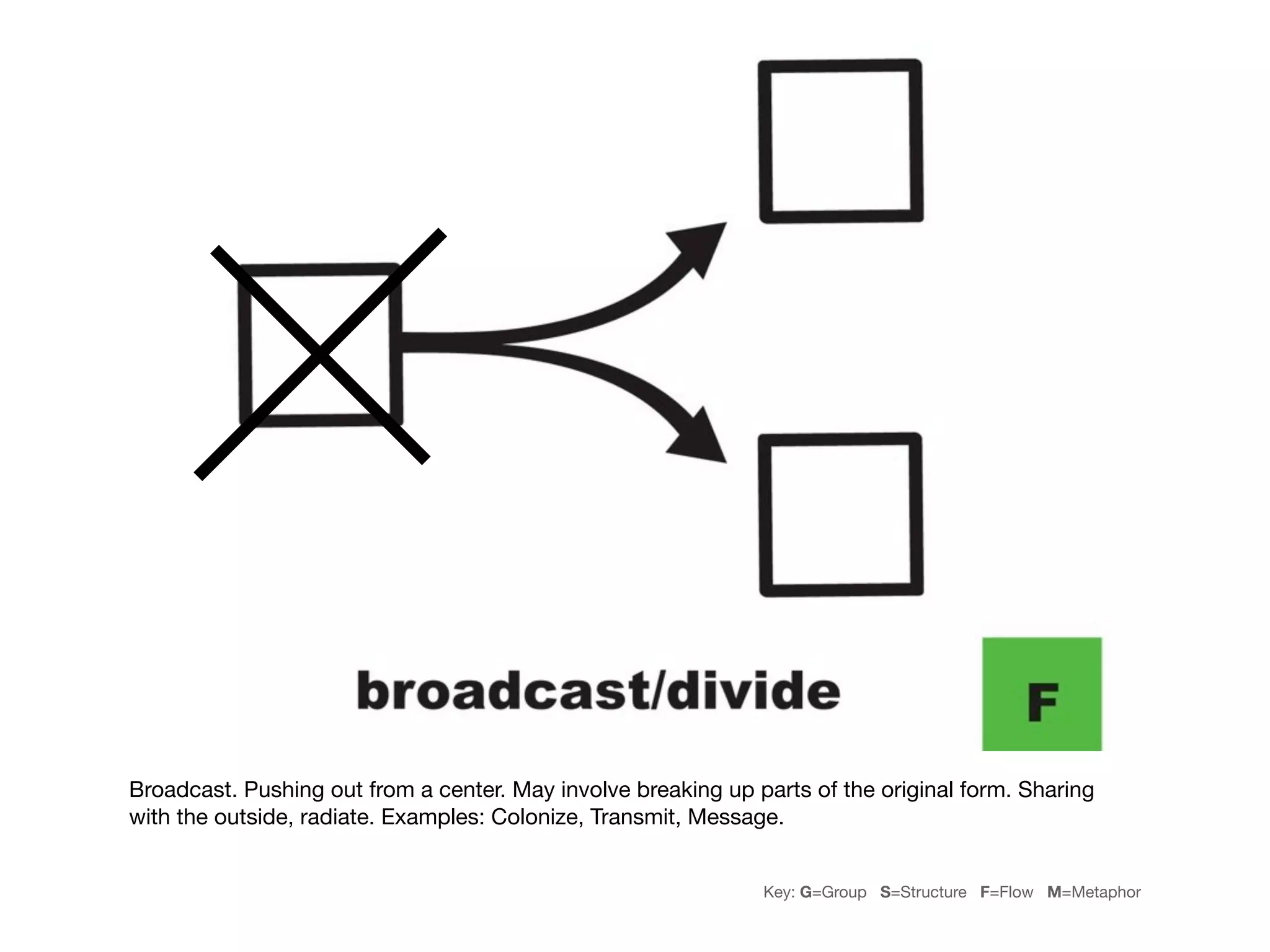
Broadcast. Pushing out from a center. May involve breaking up parts of the original form. Sharing
with the outside, radiate. Examples: Colonize, Transmit, Message.


                                                               Key: G=Group S=Structure F=Flow M=Metaphor
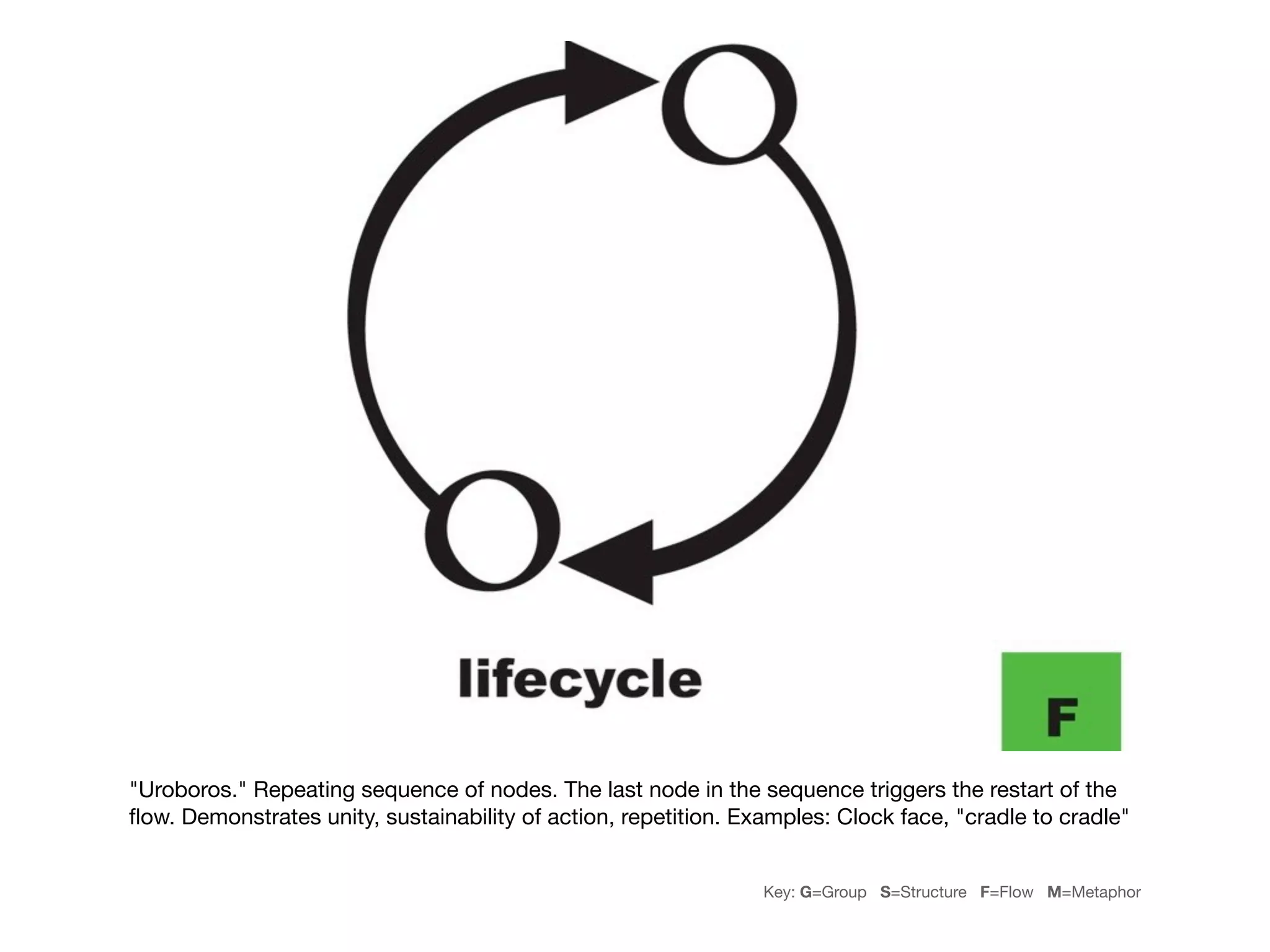
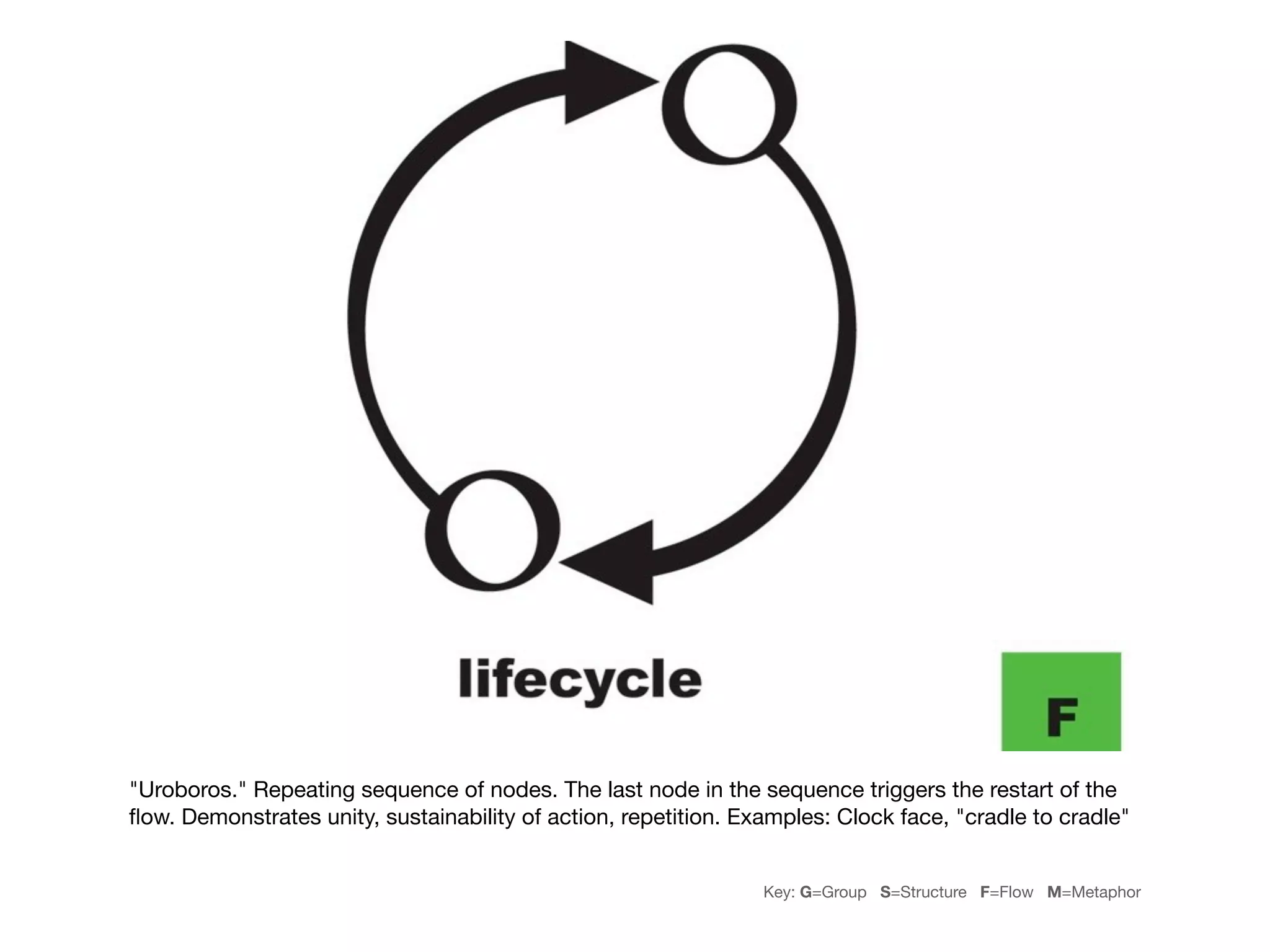
"Uroboros." Repeating sequence of nodes. The last node in the sequence triggers the restart of the
flow. Demonstrates unity, sustainability of action, repetition. Examples: Clock face, "cradle to cradle"


                                                                 Key: G=Group S=Structure F=Flow M=Metaphor
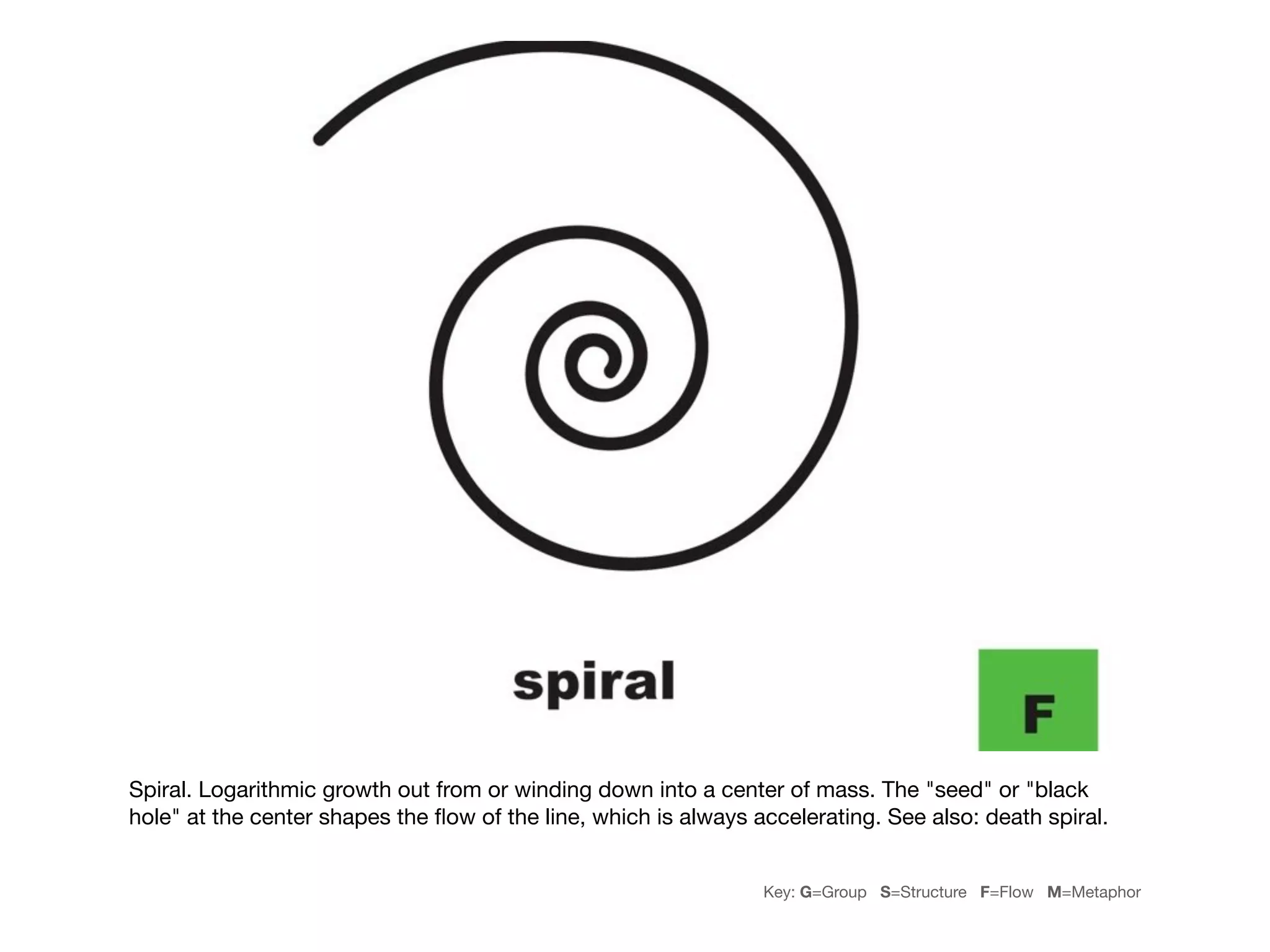
Spiral. Logarithmic growth out from or winding down into a center of mass. The "seed" or "black
hole" at the center shapes the flow of the line, which is always accelerating. See also: death spiral.


                                                                 Key: G=Group S=Structure F=Flow M=Metaphor
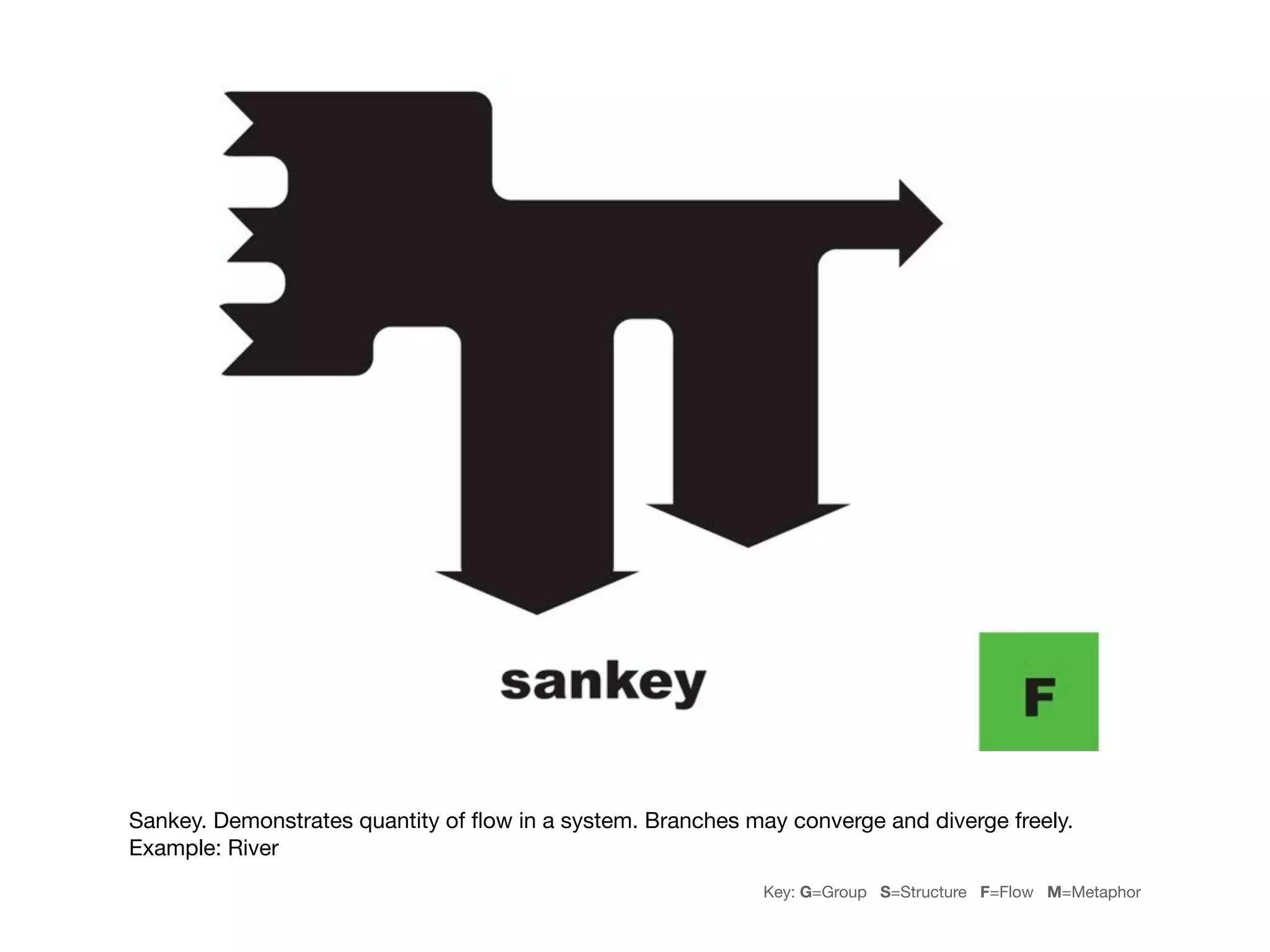
Sankey. Demonstrates quantity of flow in a system. Branches may converge and diverge freely.
Example: River
                                                             Key: G=Group S=Structure F=Flow M=Metaphor
"Uroboros." Repeating sequence of nodes. The last node in the sequence triggers the restart of the
flow. Demonstrates unity, sustainability of action, repetition. Examples: Clock face, "cradle to cradle"


                                                                 Key: G=Group S=Structure F=Flow M=Metaphor
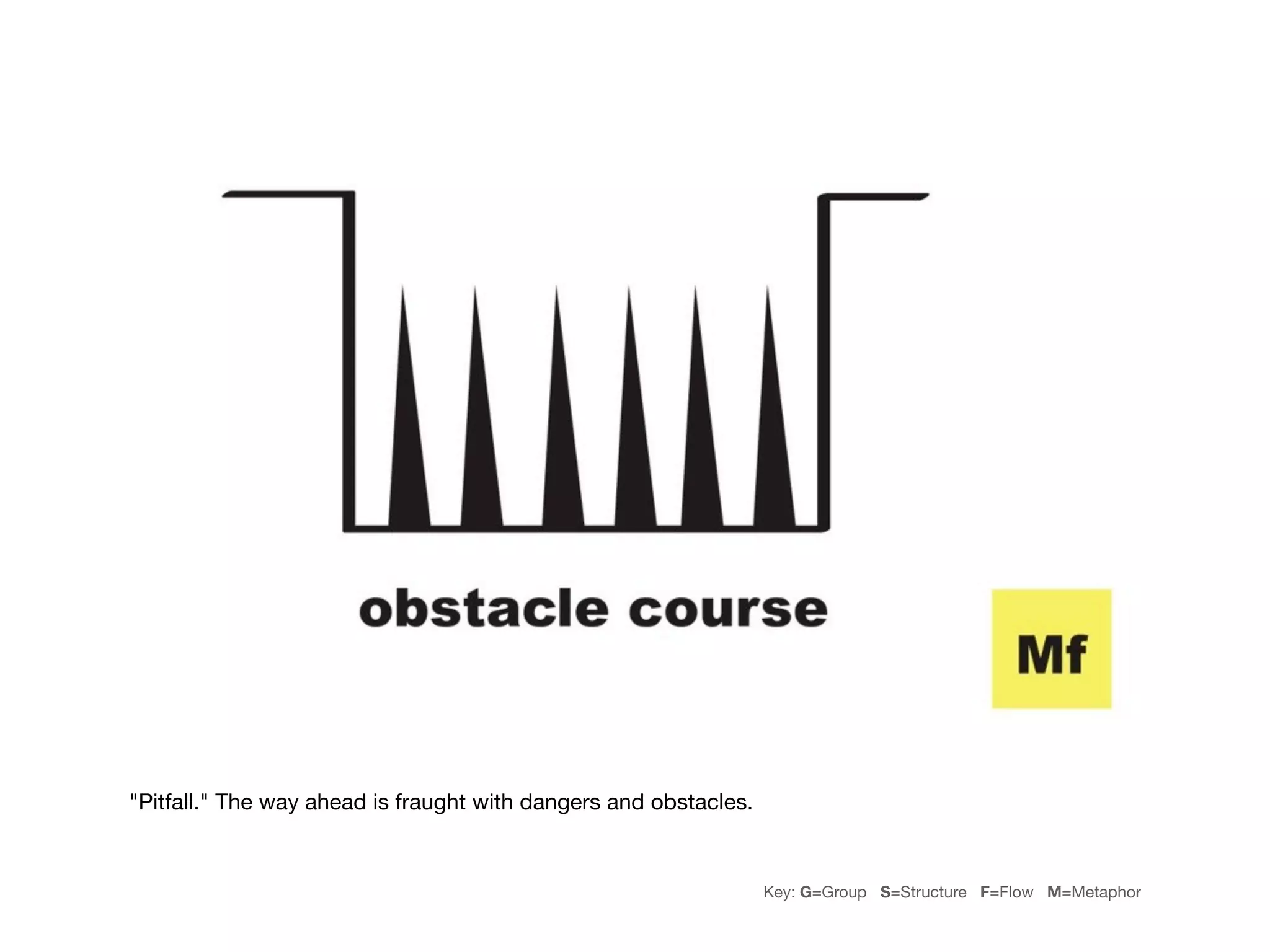
"Pitfall." The way ahead is fraught with dangers and obstacles.


                                                                  Key: G=Group S=Structure F=Flow M=Metaphor
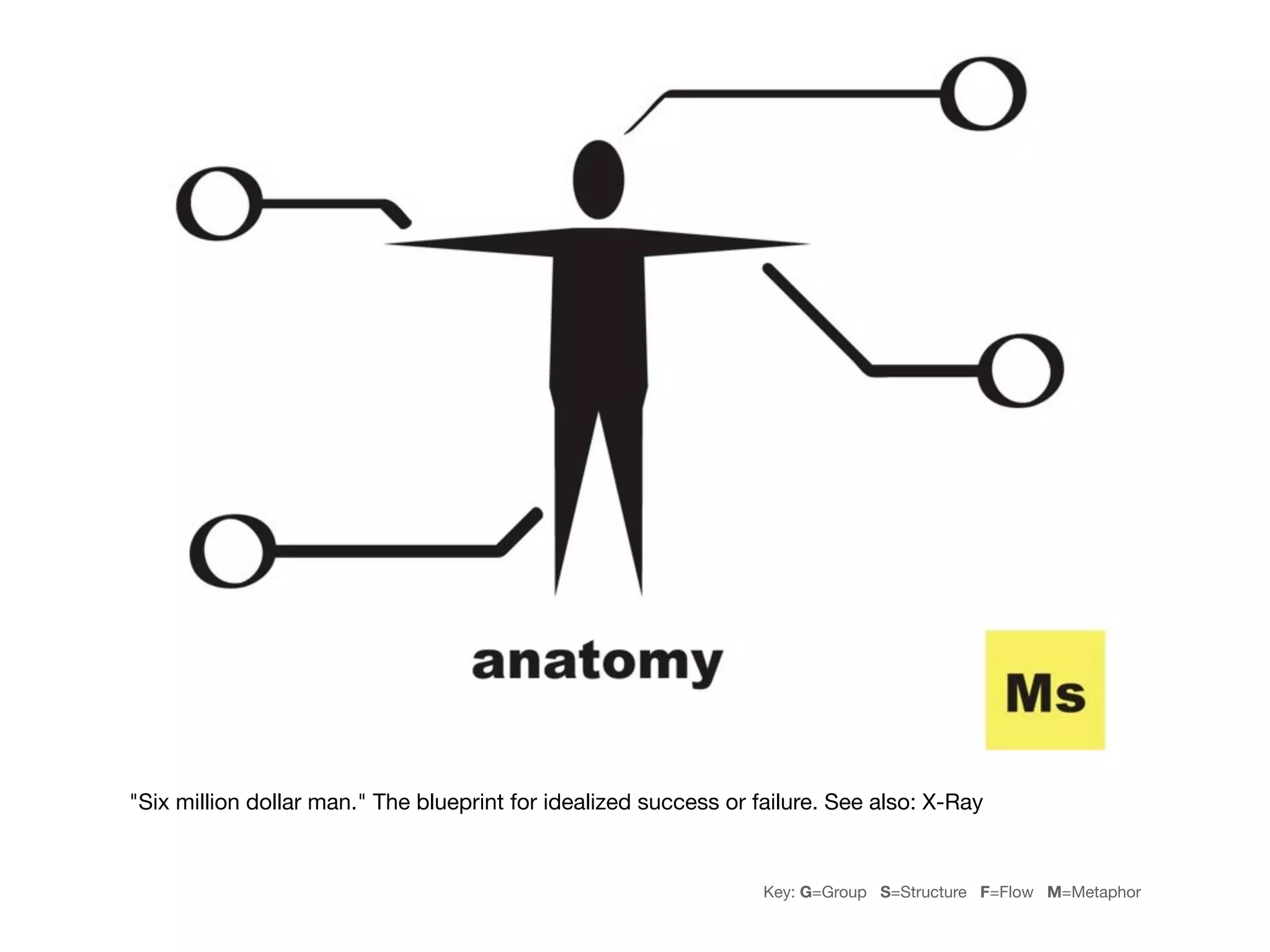
"Six million dollar man." The blueprint for idealized success or failure. See also: X-Ray


                                                                  Key: G=Group S=Structure F=Flow M=Metaphor
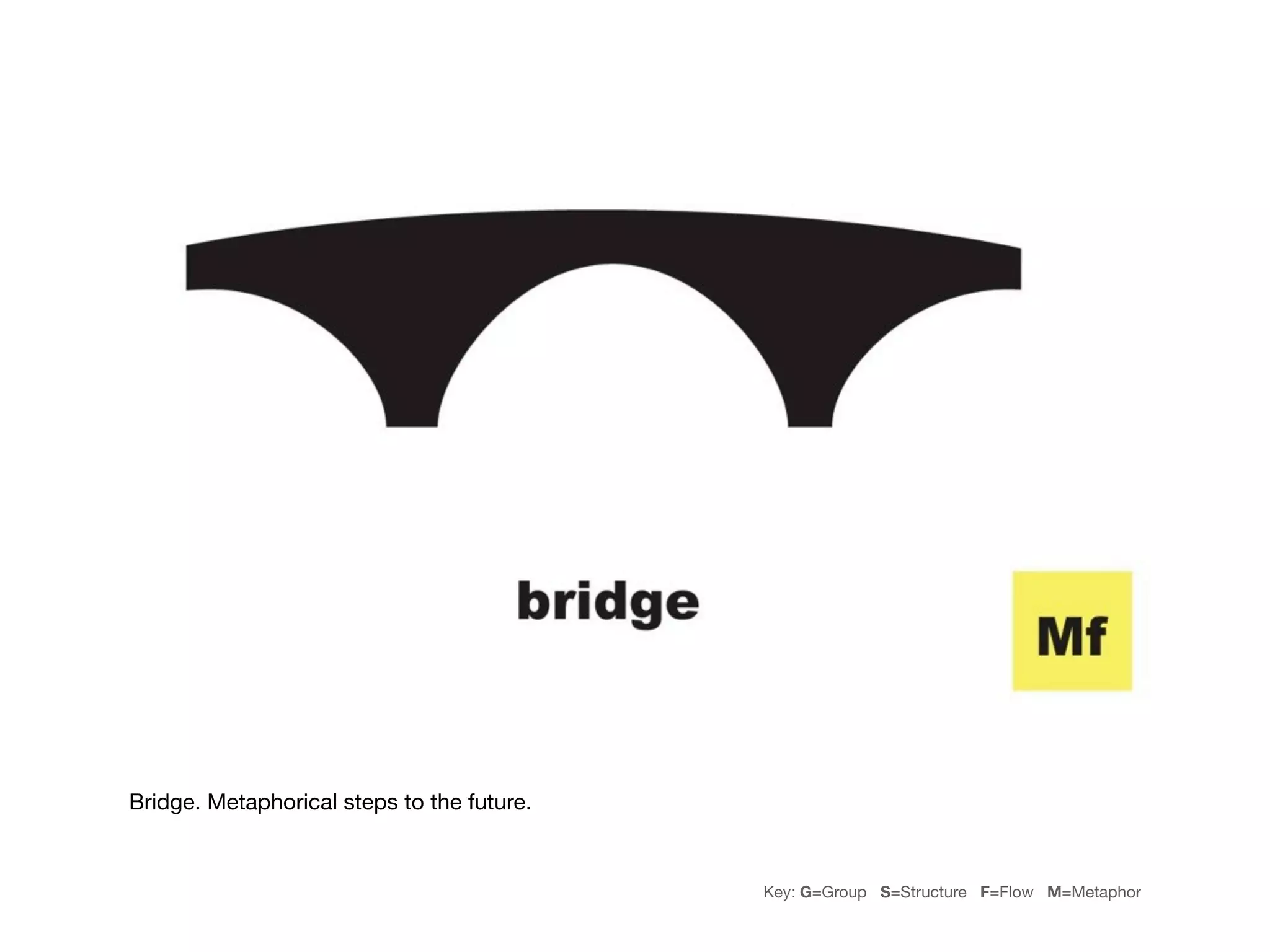
Bridge. Metaphorical steps to the future.


                                            Key: G=Group S=Structure F=Flow M=Metaphor
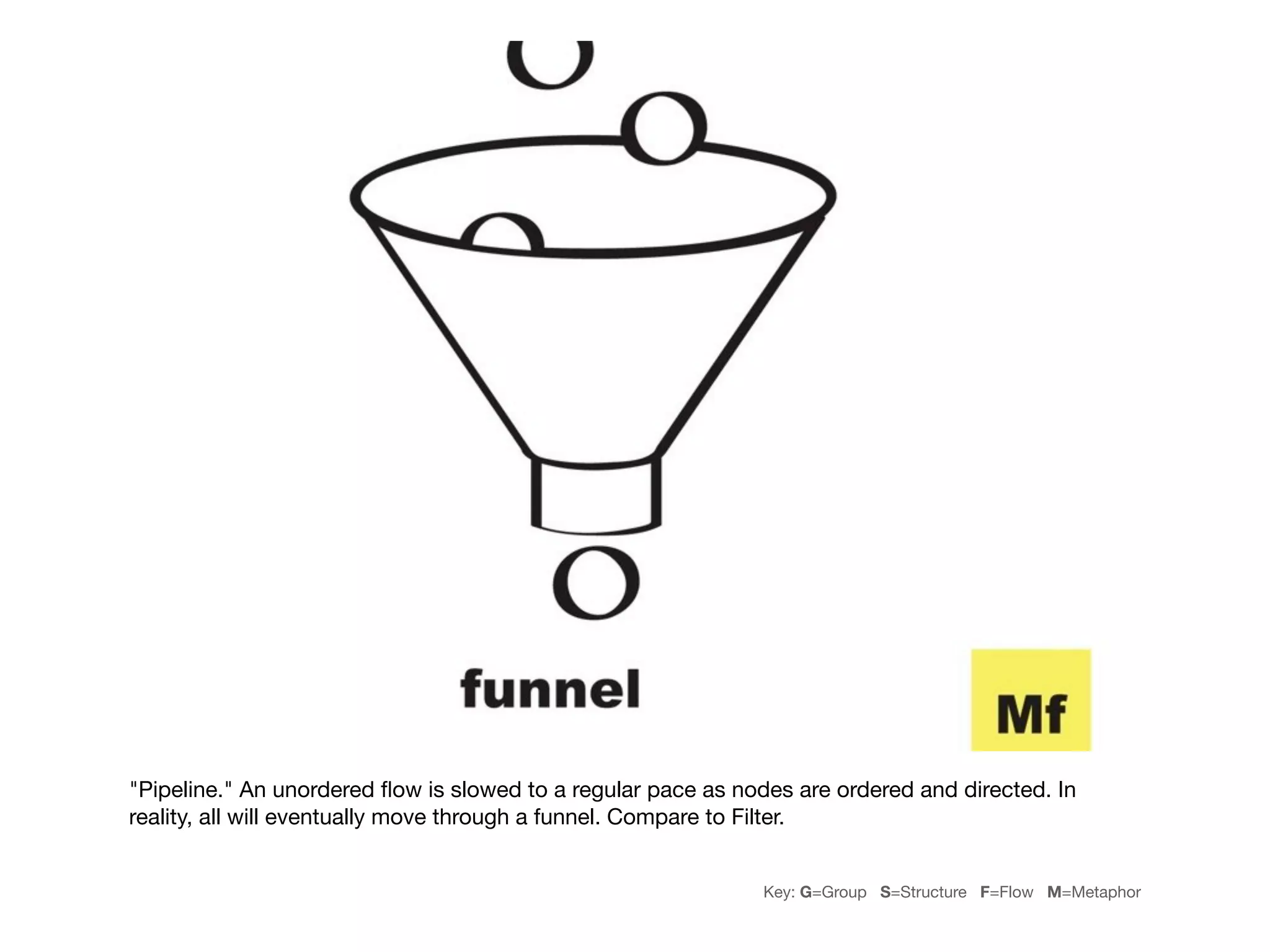
"Pipeline." An unordered flow is slowed to a regular pace as nodes are ordered and directed. In
reality, all will eventually move through a funnel. Compare to Filter.


                                                              Key: G=Group S=Structure F=Flow M=Metaphor
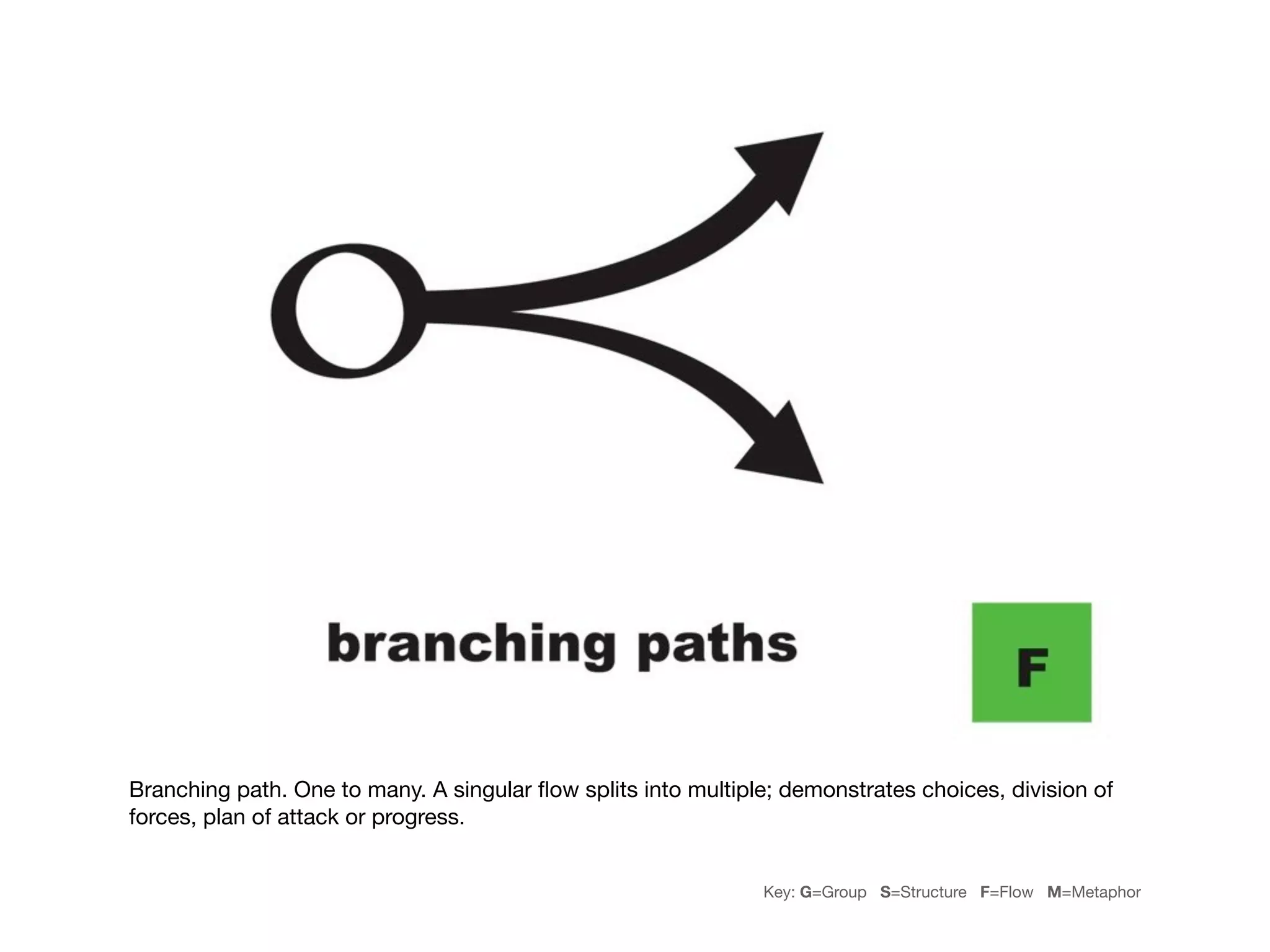
Branching path. One to many. A singular flow splits into multiple; demonstrates choices, division of
forces, plan of attack or progress.


                                                               Key: G=Group S=Structure F=Flow M=Metaphor
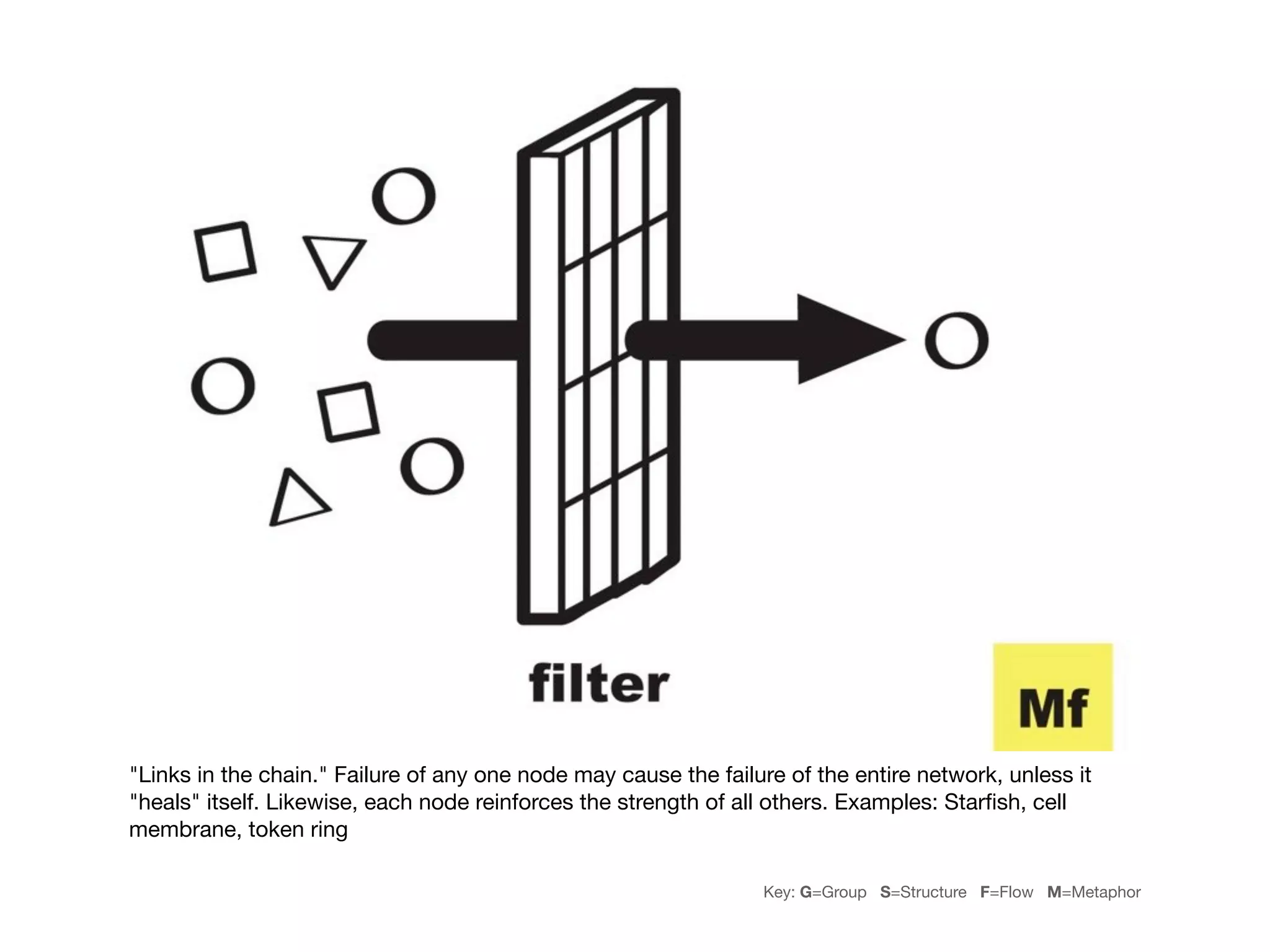
"Links in the chain." Failure of any one node may cause the failure of the entire network, unless it
"heals" itself. Likewise, each node reinforces the strength of all others. Examples: Starfish, cell
membrane, token ring

                                                                 Key: G=Group S=Structure F=Flow M=Metaphor
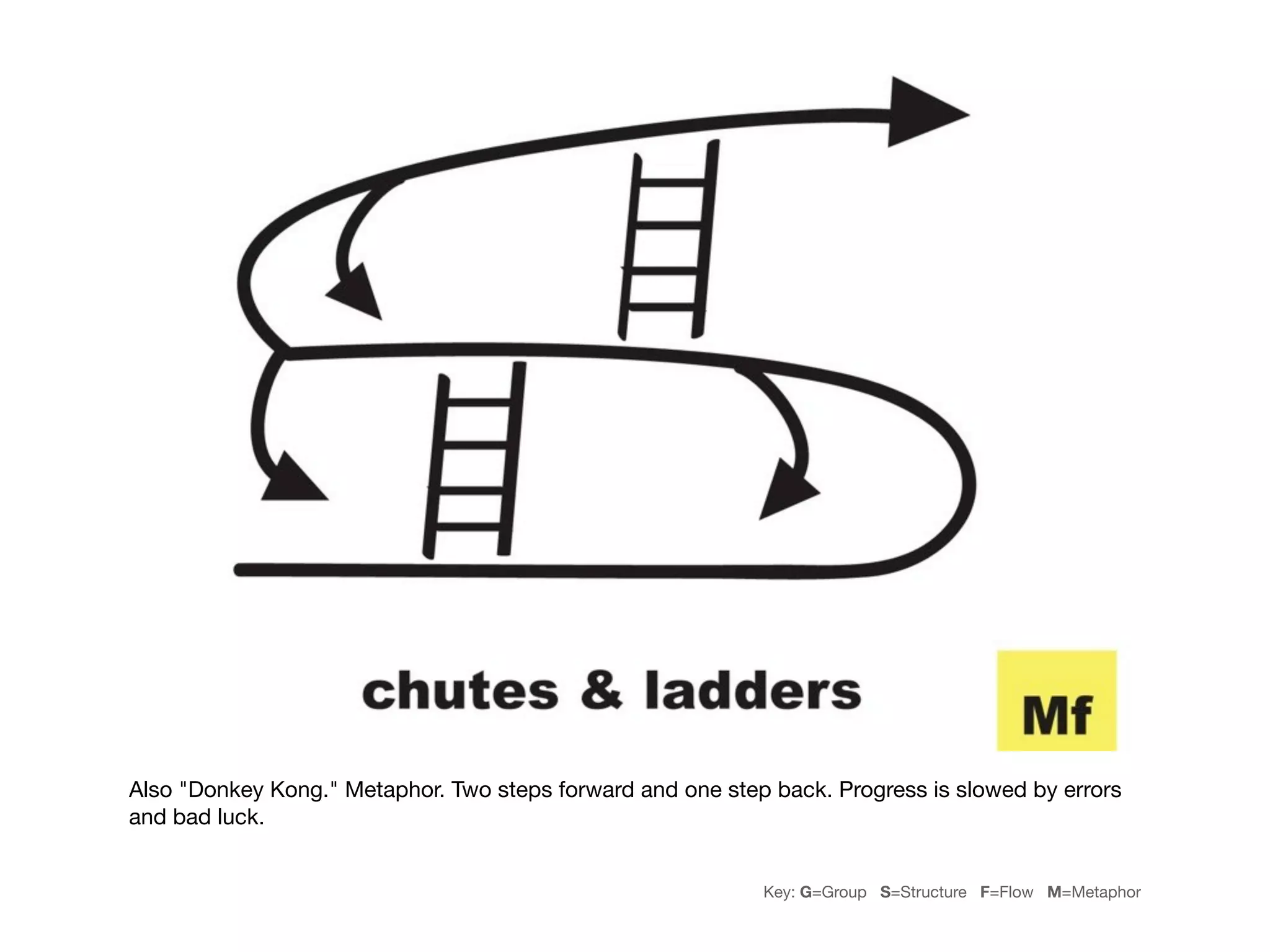
Also "Donkey Kong." Metaphor. Two steps forward and one step back. Progress is slowed by errors
and bad luck.


                                                            Key: G=Group S=Structure F=Flow M=Metaphor
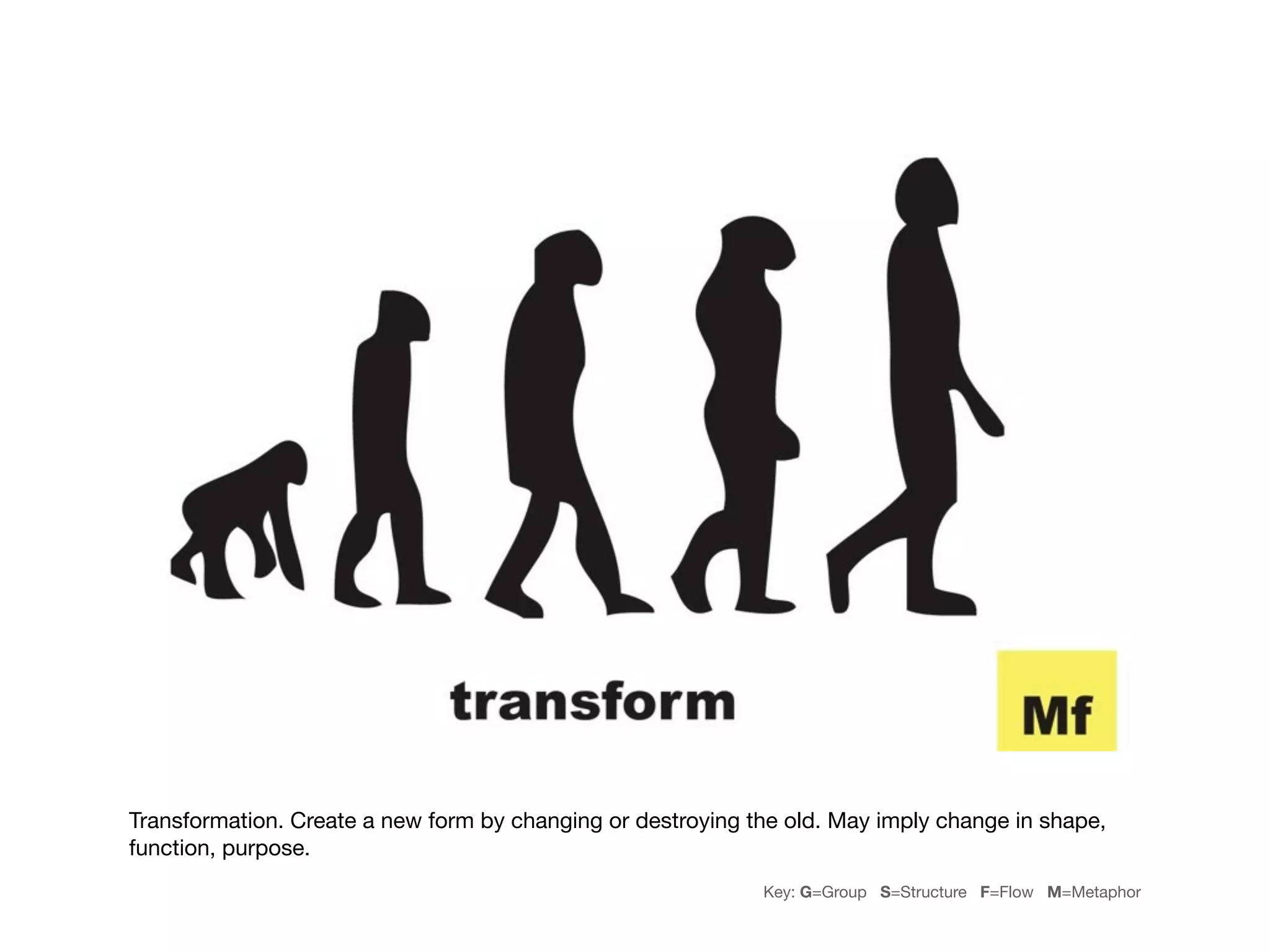
Transformation. Create a new form by changing or destroying the old. May imply change in shape,
function, purpose.
                                                             Key: G=Group S=Structure F=Flow M=Metaphor
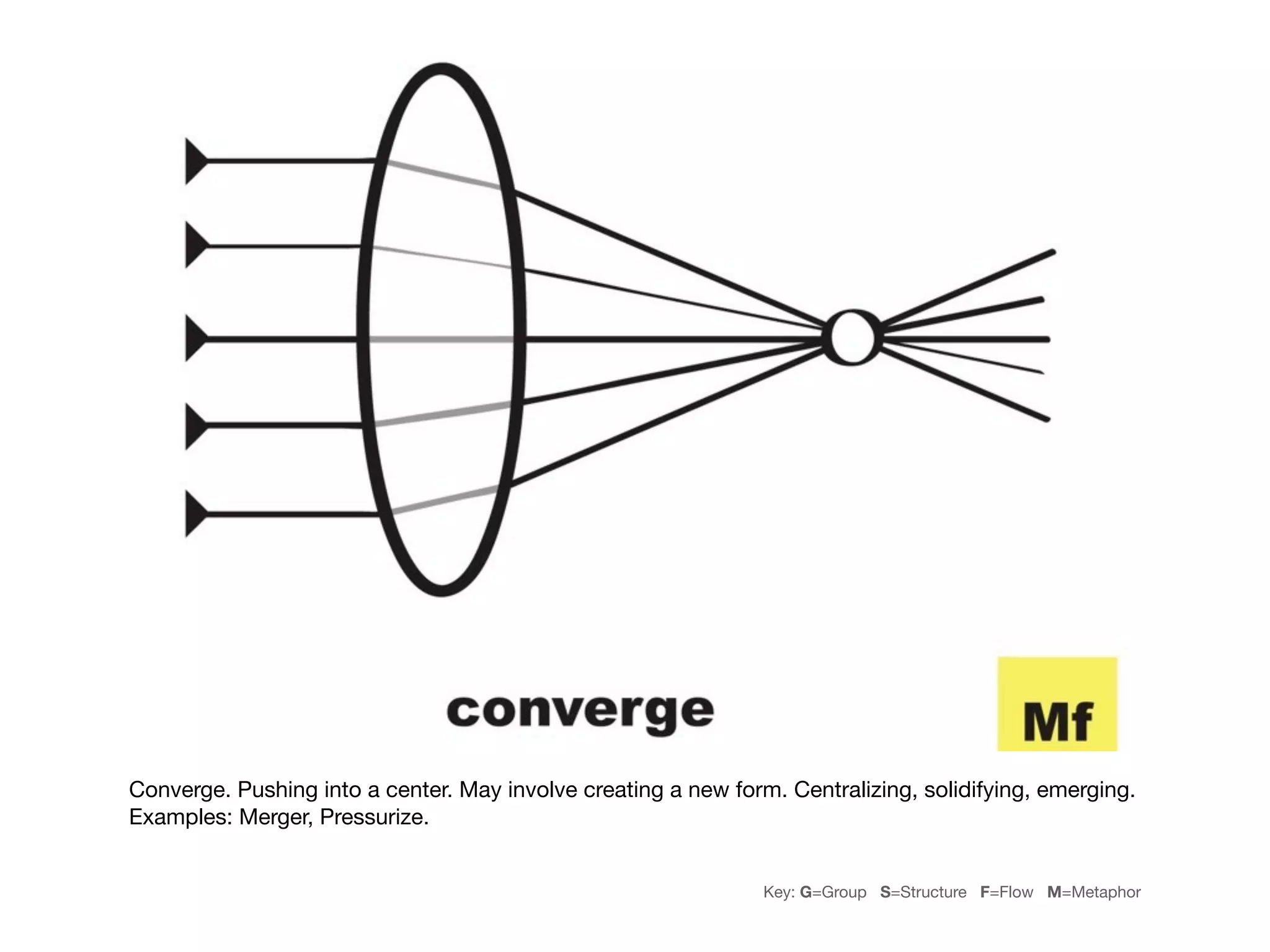
Converge. Pushing into a center. May involve creating a new form. Centralizing, solidifying, emerging.
Examples: Merger, Pressurize.


                                                                Key: G=Group S=Structure F=Flow M=Metaphor
In the most general sense, a model is
anything used in any way to represent
anything else.

Some models are physical objects, for instance, a toy
model which may be assembled, and may even be
made to work like the object it represents. They are
used to help us know and understand the subject
matter they represent.
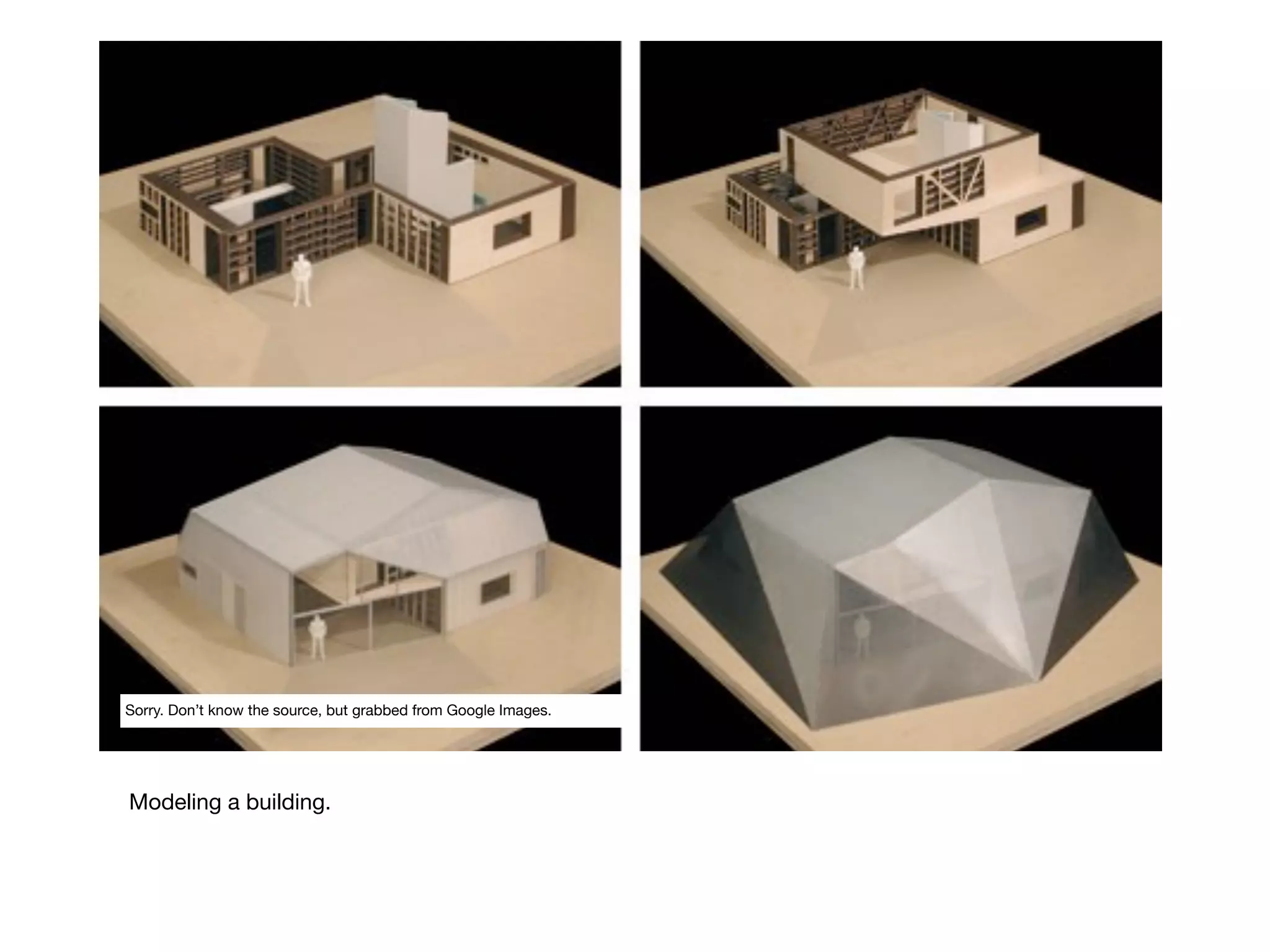
Sorry. Don’t know the source, but grabbed from Google Images.


Modeling a building.
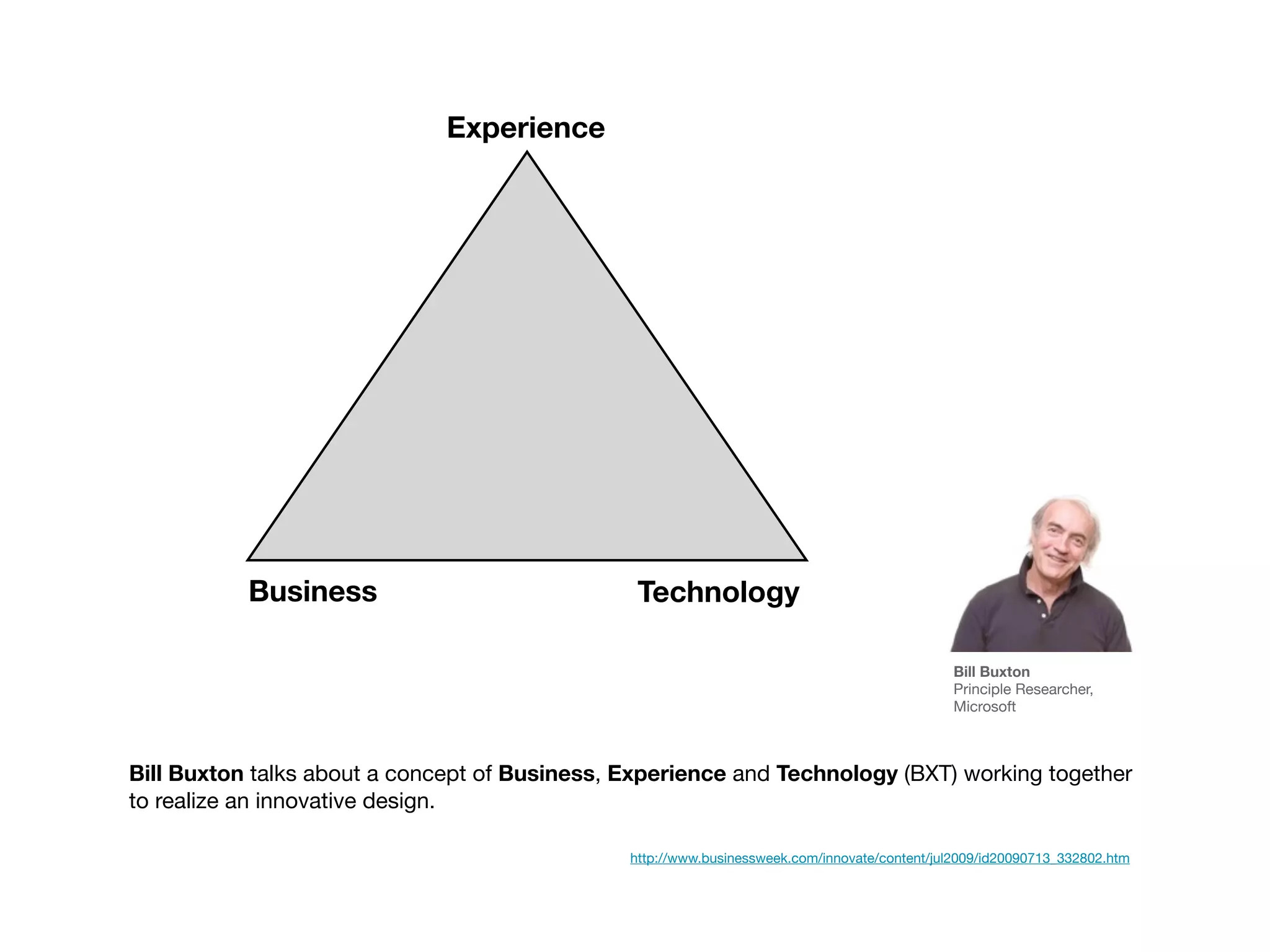
Experience


           Business                             Technology

                                                                                              Bill Buxton
                                                                                              Principle Researcher,
                                                                                              Microsoft


Bill Buxton talks about a concept of Business, Experience and Technology (BXT) working together
to realize an innovative design.

                                               http://www.businessweek.com/innovate/content/jul2009/id20090713_332802.htm
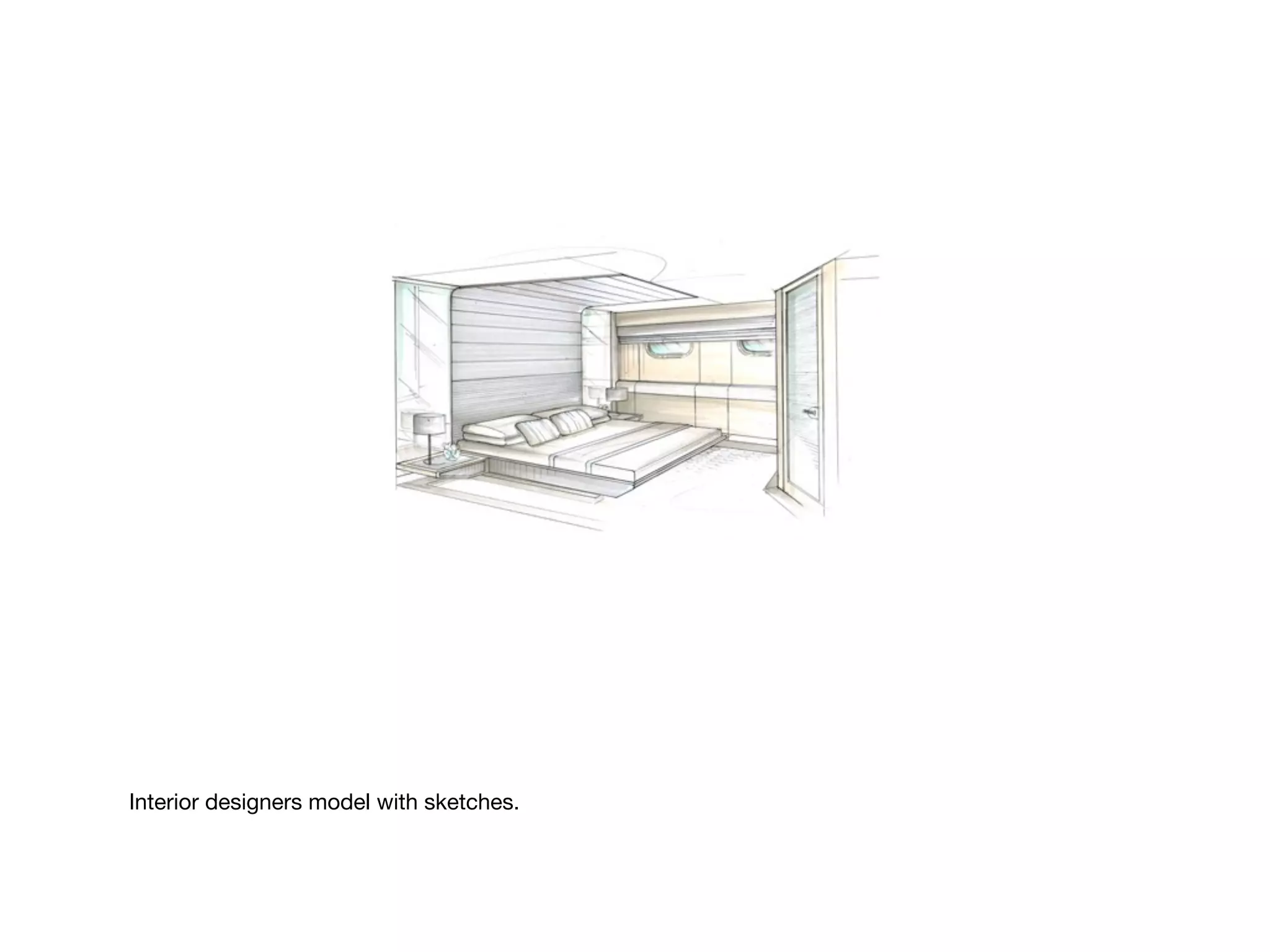
Interior designers model with sketches.
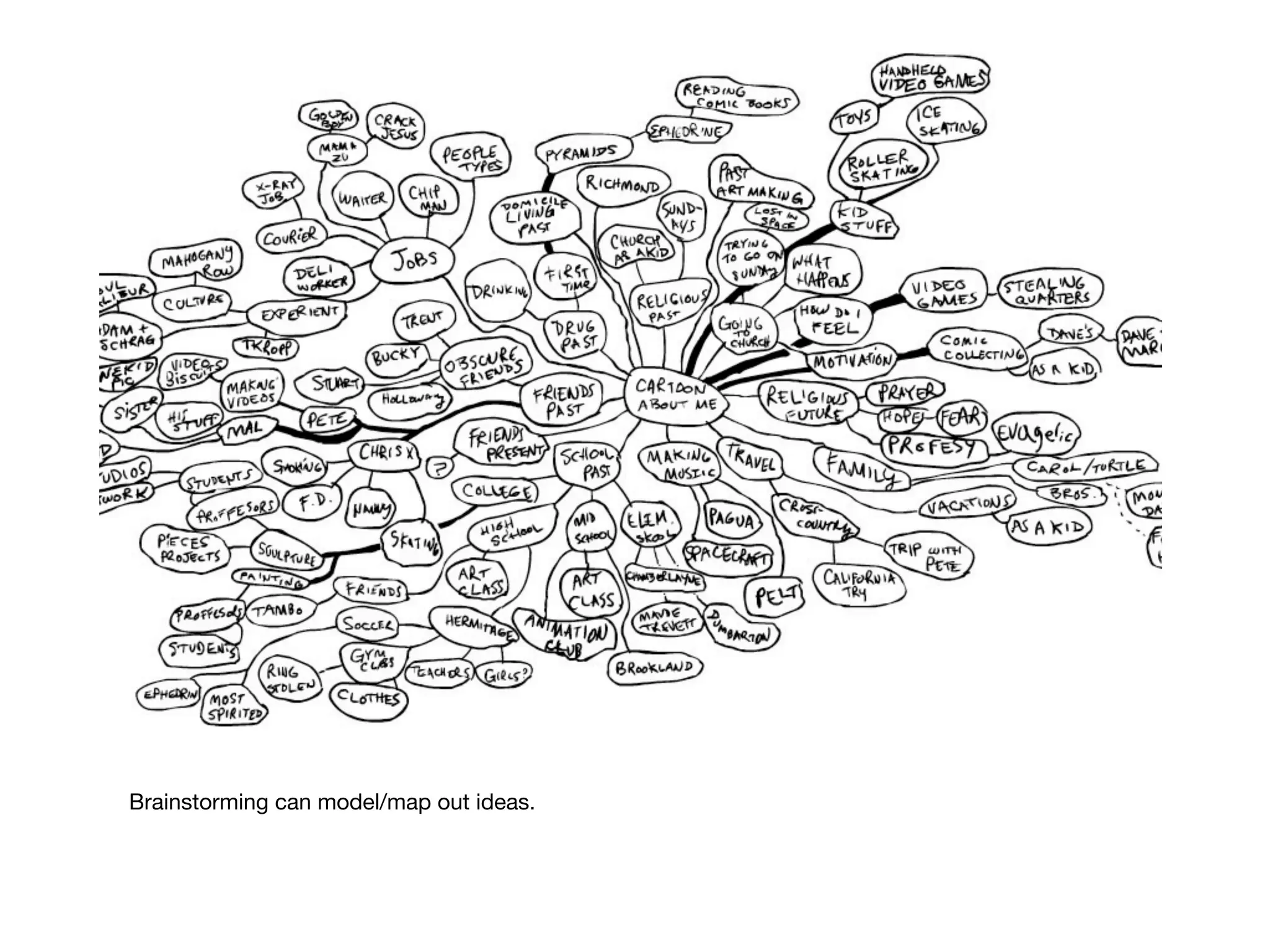
Brainstorming can model/map out ideas.
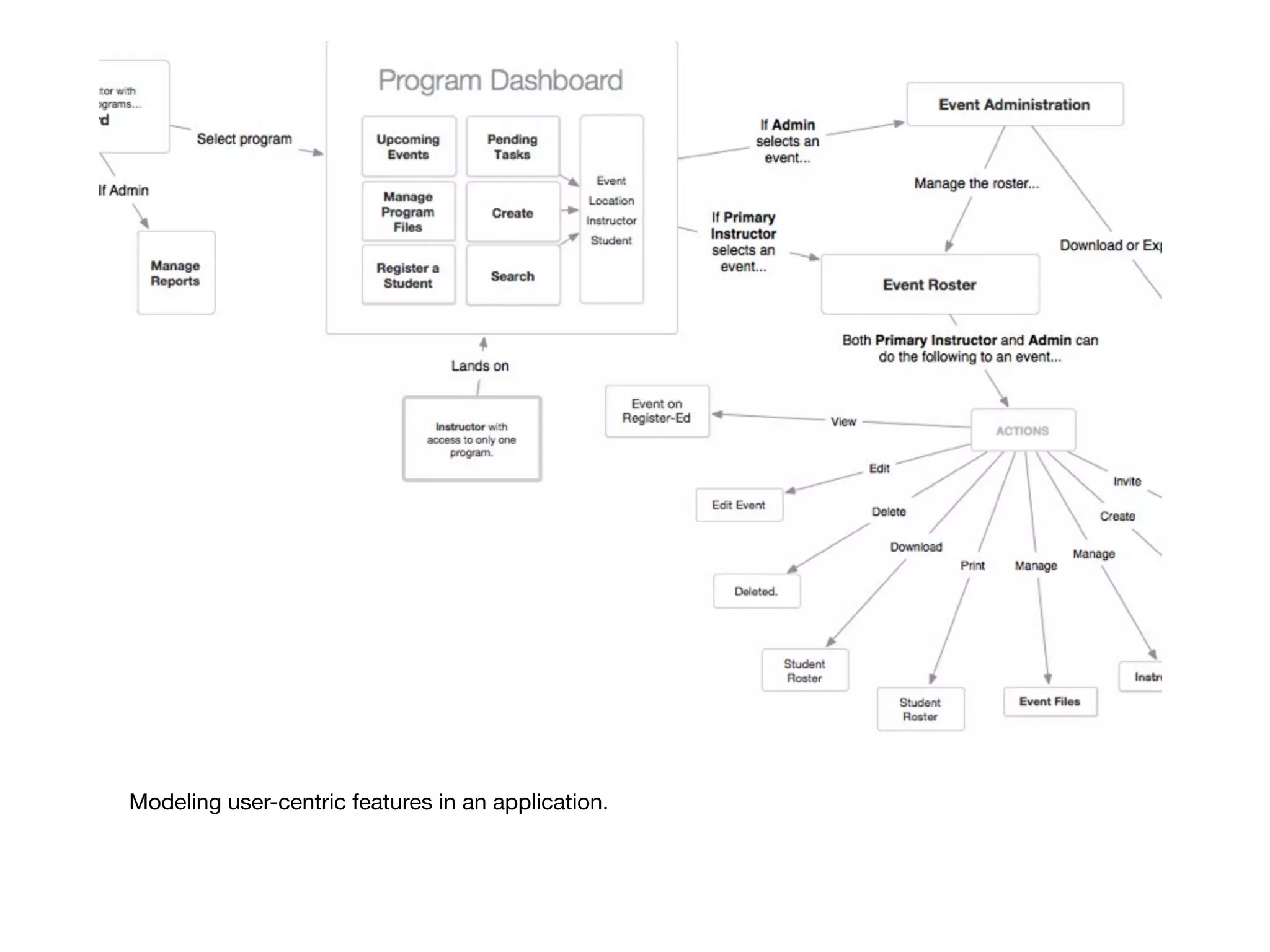
Modeling user-centric features in an application.
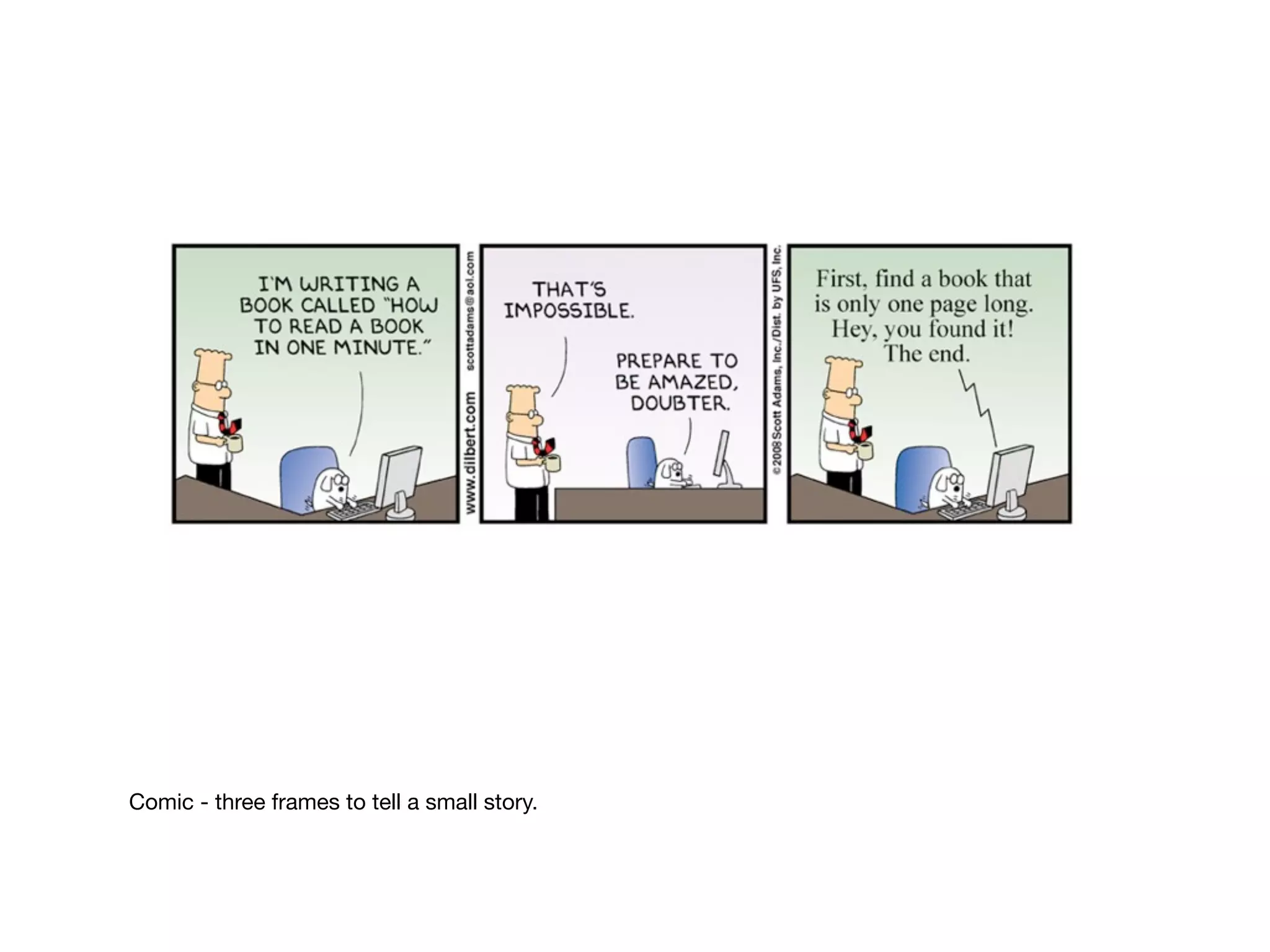
Comic - three frames to tell a small story.
Dave Gray
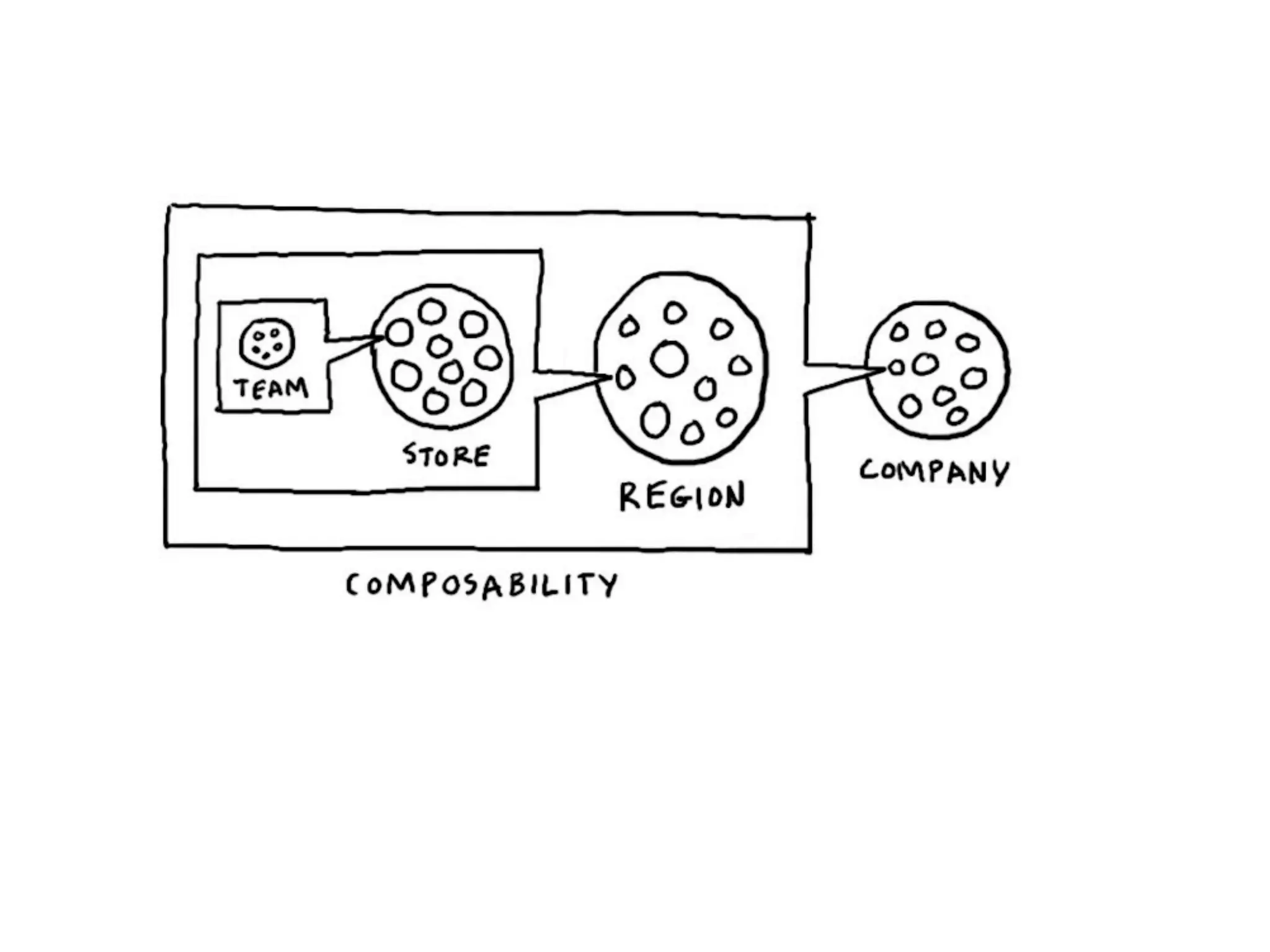
Connected Company
http://connectedco.com/
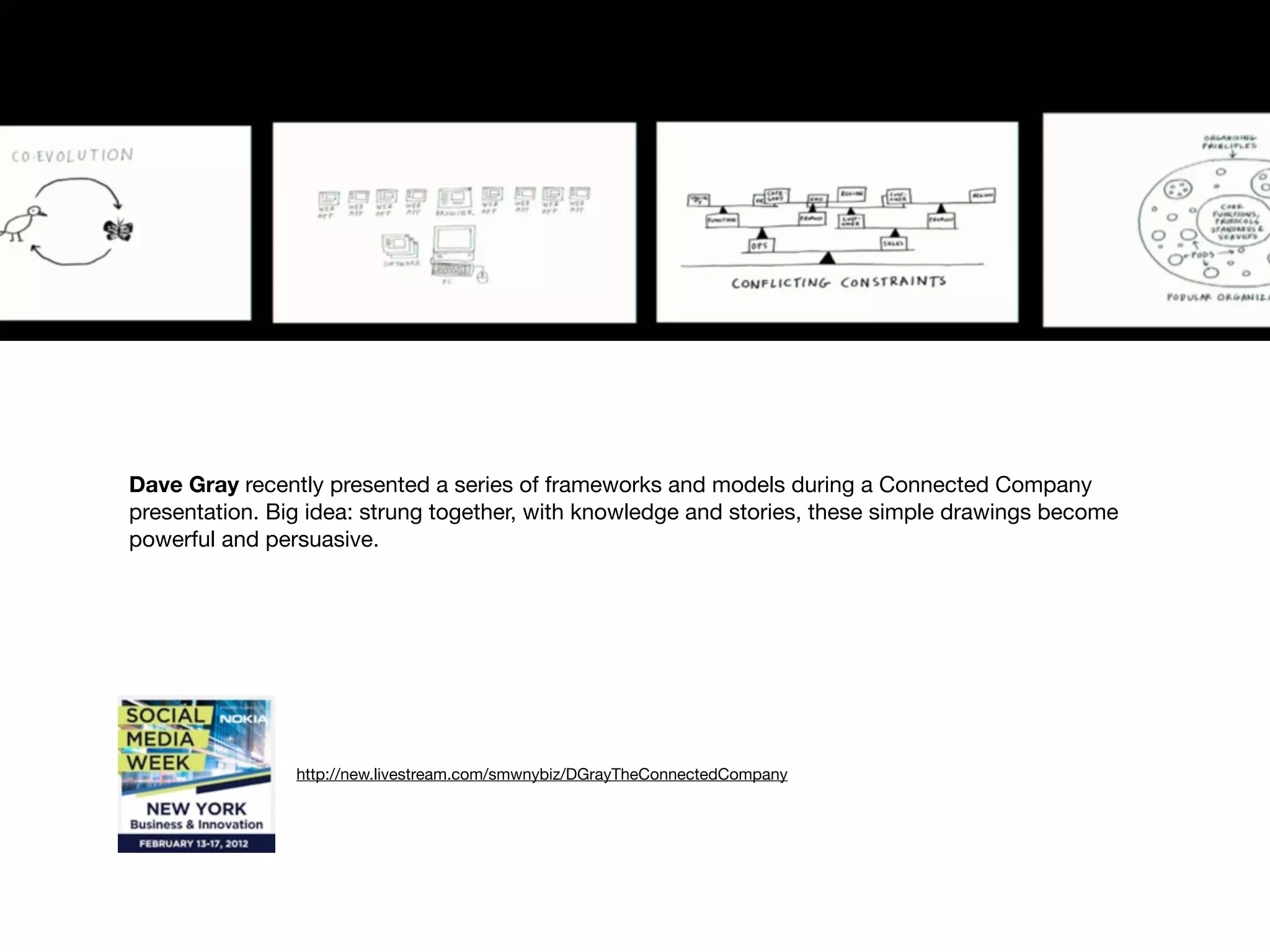
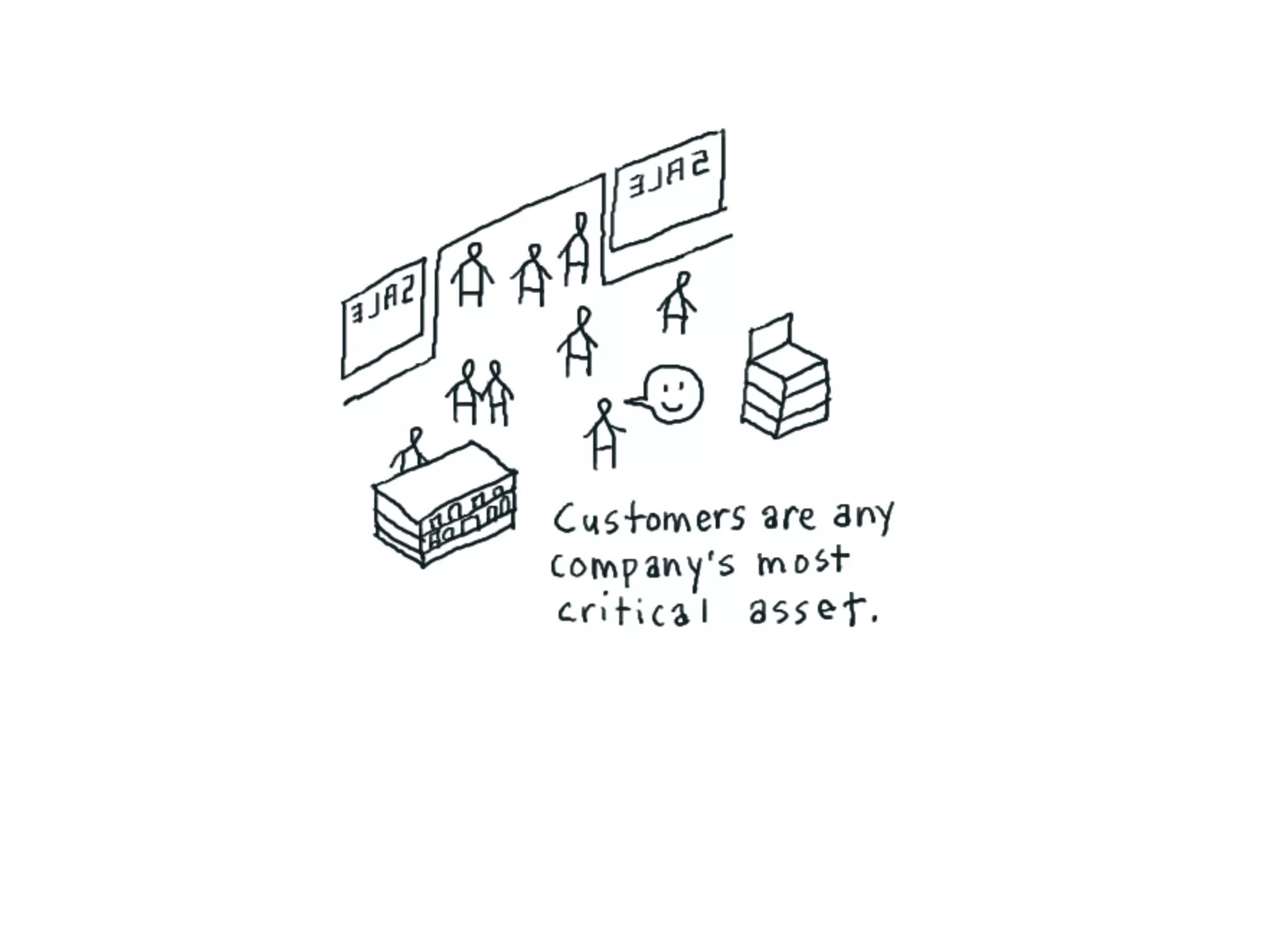
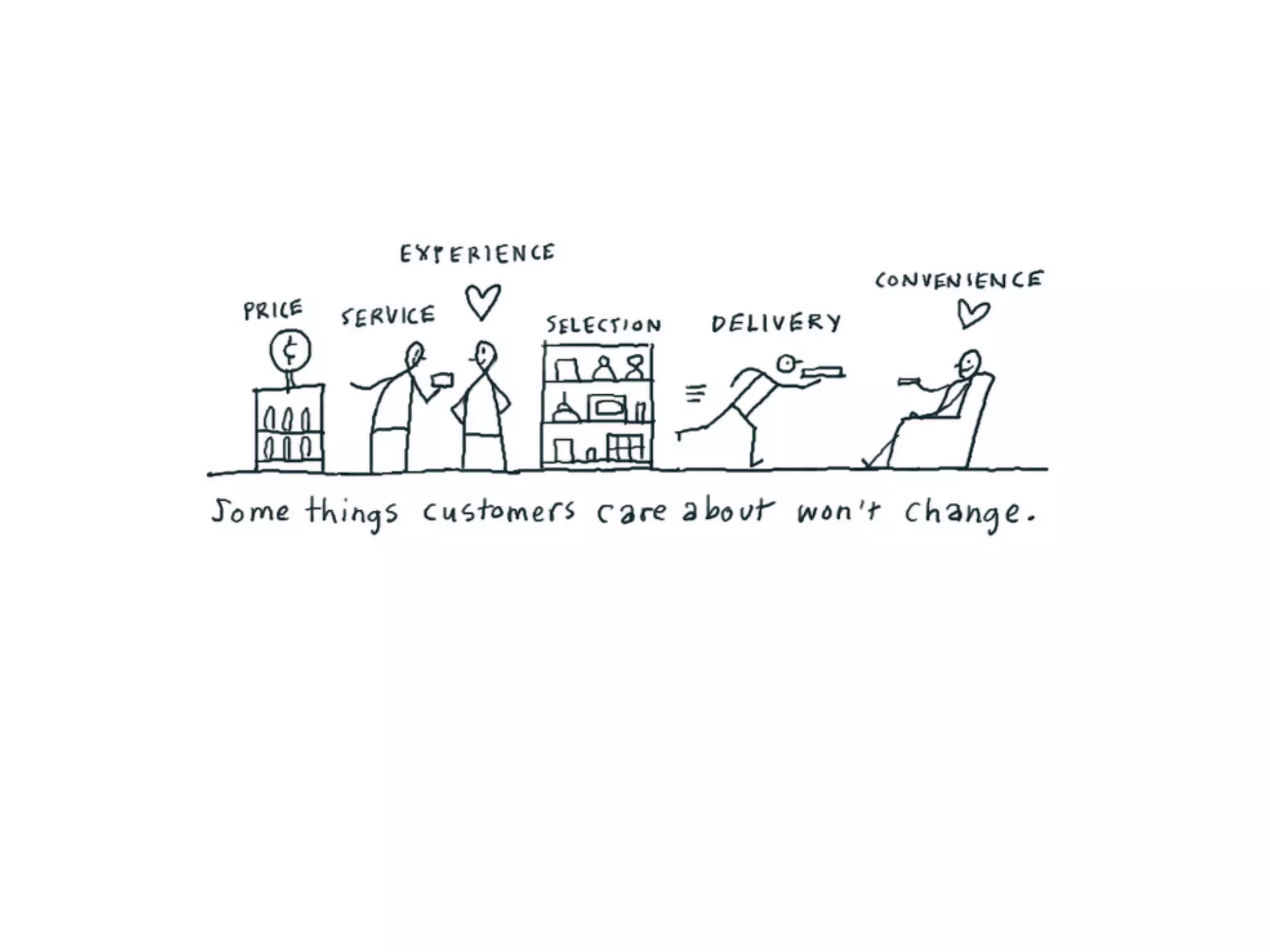
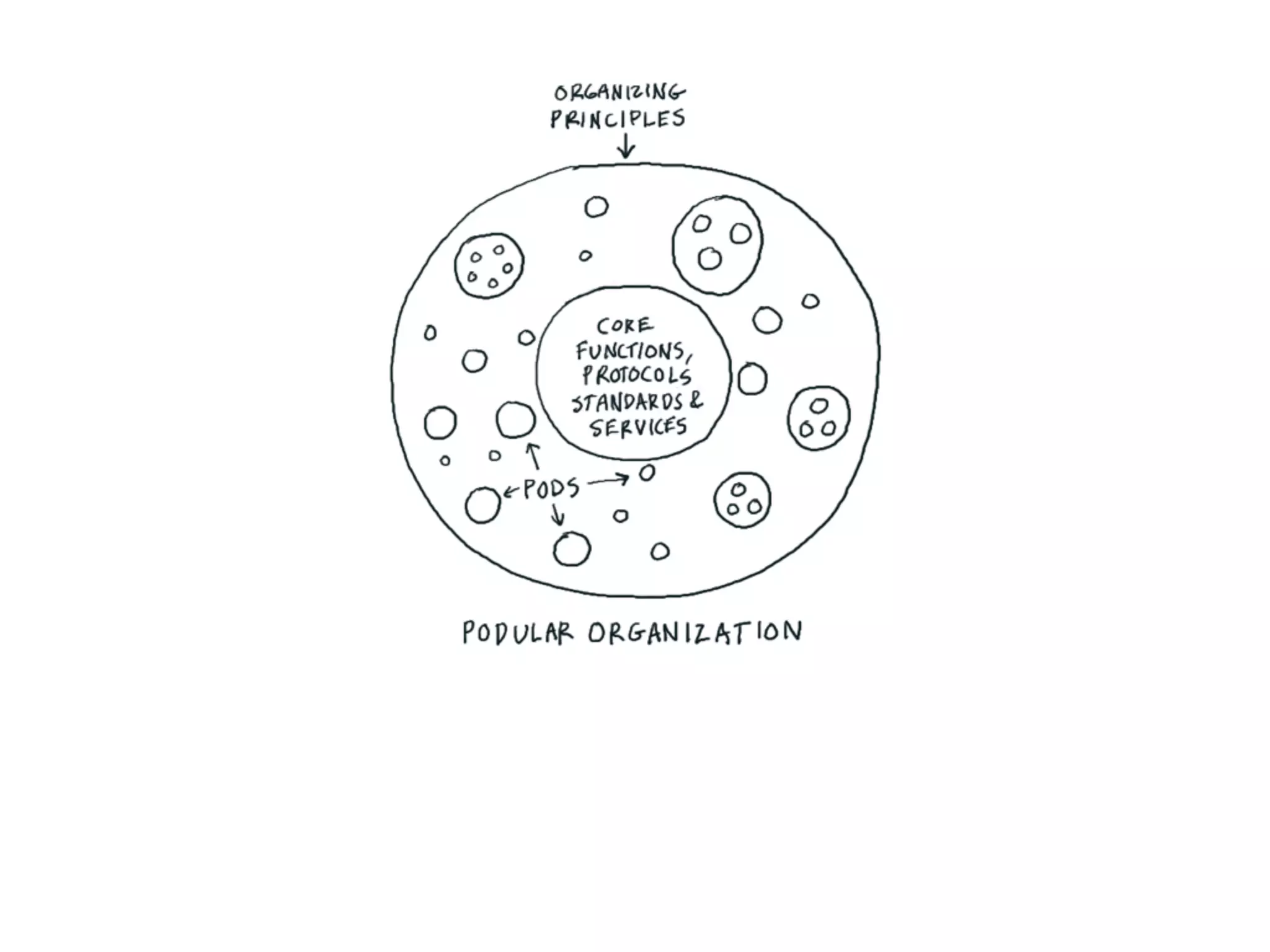
Dave Gray recently presented a series of frameworks and models during a Connected Company
presentation. Big idea: strung together, with knowledge and stories, these simple drawings become
powerful and persuasive.


                http://new.livestream.com/smwnybiz/DGrayTheConnectedCompany
String together frameworks or models to sell a big
idea... or simply persuade others to open up.
References

James Macanufo
Visual Frameworks


Dave Gray
Connected Company


Everything politely stolen from these fellows. Go check out their work.

Visual Frameworks and Models

  • 1.
    Visual Frameworks and Models Paul Goode #VizThink VizThink Dallas
  • 2.
    String together frameworksor models to sell a big idea... or simply persuade others to open up.
  • 3.
  • 4.
    Visual frameworks arefor exploring, organizing and communicating information. Processes, progressions, sequences Nodes connected in flows of varying complexity. Meaning is derived from order.
  • 5.
    Groupings Affinities, categories, comparisons Nodesand other nodes - Nodes without explicit connections, order or sequence. Meaning derived from their individual properties and spatial relationship to each other. Structures Networks, hierarchies, systems. Nodes with explicit connections and relationships, where flow is absent, secondary or implied. Meaning is derived from connections. Flows Processes, progressions, sequences Nodes connected in flows of varying complexity. Meaning is derived from order. Metaphors Common visual archetypes
  • 6.
    Random. Nodes withno discernible affinity or relationship. The starting point and ending point. Homogenous; white noise. Key: G=Group S=Structure F=Flow M=Metaphor
  • 7.
    "Toy soliders." Nodesthat are identical save one attribute. Demonstrates variation on a theme; diversity of function. Examples: UI Buttons, tokens Key: G=Group S=Structure F=Flow M=Metaphor
  • 8.
    Clusters. Nodes groupedby affinity. The first step in emerging forms and patterns. These small centers of gravity will attract other nodes and become something larger. Example: Animal, Vegetable, or Mineral Key: G=Group S=Structure F=Flow M=Metaphor
  • 9.
    "Venn Diagram." Nodesthat share a set of attributes and retain unique properties. Demonstrates a merging of interests, activities or responsibilities. Key: G=Group S=Structure F=Flow M=Metaphor
  • 10.
    Collective action. Nodesthat combine in function or direction. Elements retain individual identity while demonstrating integrated, aligned activities. Examples: Gears, Flock of Birds, Rowing the Boat Key: G=Group S=Structure F=Flow M=Metaphor
  • 11.
    A system withno center, where nodes can freely relate to each other. May be partially connected or fully meshed. Decisions and influence are dispersed. Any one node of the network may fail without substantial impact to the system. Example: the Internet Key: G=Group S=Structure F=Flow M=Metaphor
  • 12.
    "Puzzle pieces." Nodesthat combine to a whole without an explicit hierarchy or relationship. Demonstrates unity but not function. Emphasis is on whole; the parts are secondary. Examples: bricks, puzzle Key: G=Group S=Structure F=Flow M=Metaphor
  • 13.
    A hierarchical networkin which all nodes relate to each other only through the center. Any outer node may fail without impacting the network, but the central node must remain intact. Example: Spider Key: G=Group S=Structure F=Flow M=Metaphor
  • 14.
    Butcher view. Anabstract representation of parts of the whole. Emphasis is on area and neighbors. Key: G=Group S=Structure F=Flow M=Metaphor
  • 15.
    Missing Piece. Metaphorof structure or grouping with focus on one piece. Demonstrates need for completion; there is something that we forgot, or need to complete the whole. Example: keystone Key: G=Group S=Structure F=Flow M=Metaphor
  • 16.
    Exploded view. Nestedgrouping of nodes of the whole. The engineer's blueprint; parts broken apart for examination. Emphasis is on parts; the whole is not easily discernible. Key: G=Group S=Structure F=Flow M=Metaphor
  • 17.
    Matrix. Compare meaningof nodes. Demonstrates need for analytical and planning work. Example: 2x2 Key: G=Group S=Structure F=Flow M=Metaphor
  • 18.
    "Links in thechain." Failure of any one node may cause the failure of the entire network, unless it "heals" itself. Likewise, each node reinforces the strength of all others. Examples: Starfish, cell membrane, token ring Key: G=Group S=Structure F=Flow M=Metaphor
  • 19.
    A simple networkof sequential connections with a terminus at both ends. Nodes relate to each other through this linear chain of connections. Any break in the chain may cause the entire system to fail, or to create two smaller networks. Examples: earthworm Key: G=Group S=Structure F=Flow M=Metaphor
  • 20.
    "Metro map." Anabstract, simplified representation of a network in sequential nodes and links. Emphasis on routing, not location. Key: G=Group S=Structure F=Flow M=Metaphor
  • 21.
    "Onion Skin." Hierarchyof expanding attributes. Answers: What is core, and what is peripheral? Examples: Dart board Key: G=Group S=Structure F=Flow M=Metaphor
  • 22.
    X-Ray view. Realisticor metaphorical view of the internal workings of system. Key: G=Group S=Structure F=Flow M=Metaphor
  • 23.
    "Route map." Anabstract representation of a network of nodes and links in a circular arrangement. Emphasis on connections, not location. Example: Enneagram Key: G=Group S=Structure F=Flow M=Metaphor
  • 24.
    "Vision." "Wedding cake."Loose hierarchy of construction. Demonstrates building toward an endpoint. Examples: pyramid org chart, vision structure. Key: G=Group S=Structure F=Flow M=Metaphor
  • 25.
    "Layer cake." also"Core Sample." Loose hierarchy of construction. Demonstrates adjacent areas of function or order. Often answers: What's the foundation? Key: G=Group S=Structure F=Flow M=Metaphor
  • 26.
    "Fishbone diagram." Hierarchyof problems linking up to the root cause. The fish "stinks from the head." Key: G=Group S=Structure F=Flow M=Metaphor
  • 27.
    All points mayfreely associate with each other, agnostic of geography. Compare to mesh network. Key: G=Group S=Structure F=Flow M=Metaphor
  • 28.
    "Nature's ladder." Hierarchyof order. Each node in the system has a parent, except for the root. Example: Tree Key: G=Group S=Structure F=Flow M=Metaphor
  • 29.
    Iceberg. Metaphor. Mostimportant issues are unseen beneath the surface. Key: G=Group S=Structure F=Flow M=Metaphor
  • 30.
    "Nesting dolls." Hierarchyof containers. Often identical outside of size, each retains the properties of the set. Demonstrates growth or reduction through duplication. Key: G=Group S=Structure F=Flow M=Metaphor
  • 31.
    "Timeline." Nodes orderedalong a single continuum, usually by time. Emphasis is on order, planning, but also story and sequence. Demonstrates simplicity of action, known events; transactions. Key: G=Group S=Structure F=Flow M=Metaphor
  • 32.
    "Swim lanes." Multipletimelines ordered along a continuum; may emphasize dependencies between them. Key: G=Group S=Structure F=Flow M=Metaphor
  • 33.
    Sequence. Linear story,interpreted in framed events. Key: G=Group S=Structure F=Flow M=Metaphor
  • 34.
    Spectrum. Define twoextremes to frame the matter at hand. Choices made within a spectrum are not binary, but fall along the continuum. Example: Forcefield Key: G=Group S=Structure F=Flow M=Metaphor
  • 35.
    Steps. Incremental improvementor progress. Laborious but well defined effort. Key: G=Group S=Structure F=Flow M=Metaphor
  • 36.
    Infinite loop. Variationof iteration, with implied inflection point at the meeting of the two loops. Key: G=Group S=Structure F=Flow M=Metaphor
  • 37.
    Broadcast. Pushing outfrom a center. May involve breaking up parts of the original form. Sharing with the outside, radiate. Examples: Colonize, Transmit, Message. Key: G=Group S=Structure F=Flow M=Metaphor
  • 38.
    "Uroboros." Repeating sequenceof nodes. The last node in the sequence triggers the restart of the flow. Demonstrates unity, sustainability of action, repetition. Examples: Clock face, "cradle to cradle" Key: G=Group S=Structure F=Flow M=Metaphor
  • 39.
    Spiral. Logarithmic growthout from or winding down into a center of mass. The "seed" or "black hole" at the center shapes the flow of the line, which is always accelerating. See also: death spiral. Key: G=Group S=Structure F=Flow M=Metaphor
  • 40.
    Sankey. Demonstrates quantityof flow in a system. Branches may converge and diverge freely. Example: River Key: G=Group S=Structure F=Flow M=Metaphor
  • 41.
    "Uroboros." Repeating sequenceof nodes. The last node in the sequence triggers the restart of the flow. Demonstrates unity, sustainability of action, repetition. Examples: Clock face, "cradle to cradle" Key: G=Group S=Structure F=Flow M=Metaphor
  • 42.
    "Pitfall." The wayahead is fraught with dangers and obstacles. Key: G=Group S=Structure F=Flow M=Metaphor
  • 43.
    "Six million dollarman." The blueprint for idealized success or failure. See also: X-Ray Key: G=Group S=Structure F=Flow M=Metaphor
  • 44.
    Bridge. Metaphorical stepsto the future. Key: G=Group S=Structure F=Flow M=Metaphor
  • 45.
    "Pipeline." An unorderedflow is slowed to a regular pace as nodes are ordered and directed. In reality, all will eventually move through a funnel. Compare to Filter. Key: G=Group S=Structure F=Flow M=Metaphor
  • 46.
    Branching path. Oneto many. A singular flow splits into multiple; demonstrates choices, division of forces, plan of attack or progress. Key: G=Group S=Structure F=Flow M=Metaphor
  • 47.
    "Links in thechain." Failure of any one node may cause the failure of the entire network, unless it "heals" itself. Likewise, each node reinforces the strength of all others. Examples: Starfish, cell membrane, token ring Key: G=Group S=Structure F=Flow M=Metaphor
  • 48.
    Also "Donkey Kong."Metaphor. Two steps forward and one step back. Progress is slowed by errors and bad luck. Key: G=Group S=Structure F=Flow M=Metaphor
  • 49.
    Transformation. Create anew form by changing or destroying the old. May imply change in shape, function, purpose. Key: G=Group S=Structure F=Flow M=Metaphor
  • 50.
    Converge. Pushing intoa center. May involve creating a new form. Centralizing, solidifying, emerging. Examples: Merger, Pressurize. Key: G=Group S=Structure F=Flow M=Metaphor
  • 51.
    In the mostgeneral sense, a model is anything used in any way to represent anything else. Some models are physical objects, for instance, a toy model which may be assembled, and may even be made to work like the object it represents. They are used to help us know and understand the subject matter they represent.
  • 52.
    Sorry. Don’t knowthe source, but grabbed from Google Images. Modeling a building.
  • 53.
    Experience Business Technology Bill Buxton Principle Researcher, Microsoft Bill Buxton talks about a concept of Business, Experience and Technology (BXT) working together to realize an innovative design. http://www.businessweek.com/innovate/content/jul2009/id20090713_332802.htm
  • 54.
  • 55.
  • 56.
  • 57.
    Comic - threeframes to tell a small story.
  • 58.
  • 59.
    Dave Gray recentlypresented a series of frameworks and models during a Connected Company presentation. Big idea: strung together, with knowledge and stories, these simple drawings become powerful and persuasive. http://new.livestream.com/smwnybiz/DGrayTheConnectedCompany
  • 64.
    String together frameworksor models to sell a big idea... or simply persuade others to open up.
  • 65.
    References James Macanufo Visual Frameworks DaveGray Connected Company Everything politely stolen from these fellows. Go check out their work.