THE MOST BASICPATTERN OF DEVELOPMENT
describes how, when, and where an event or
occurrence
usually happened
used to tell a story or focus on a set of
related events
NARRATION
ACTIONS
Logical Actions
are consideredthe very movements within the plot
or the narrative that drives
the characters forward, be it during the dialogue or the scene .
LOGICAL
5.
WAYS OF
NARRATION
• refersto how the writer presents story
• includes the pace by which scenes are given out
• having natural progression of time to the events
of the story makes a good writing.
6.
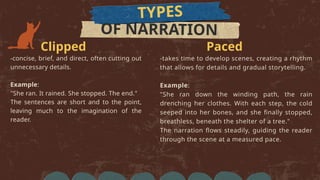
TYPES
OF NARRATION
Clipped
-concise, brief,and direct, often cutting out
unnecessary details.
Example:
"She ran. It rained. She stopped. The end."
The sentences are short and to the point,
leaving much to the imagination of the
reader.
Paced
-takes time to develop scenes, creating a rhythm
that allows for details and gradual storytelling.
Example:
"She ran down the winding path, the rain
drenching her clothes. With each step, the cold
seeped into her bones, and she finally stopped,
breathless, beneath the shelter of a tree."
The narration flows steadily, guiding the reader
through the scene at a measured pace.
7.
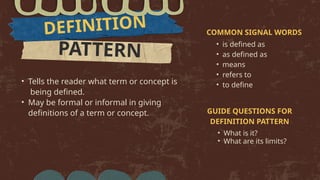
PATTERN
DEFINITION
• Tells thereader what term or concept is
being defined.
• May be formal or informal in giving
definitions of a term or concept.
COMMON SIGNAL WORDS
• is defined as
• as defined as
• means
• refers to
• to define
GUIDE QUESTIONS FOR
DEFINITION PATTERN
• What is it?
• What are its limits?
8.
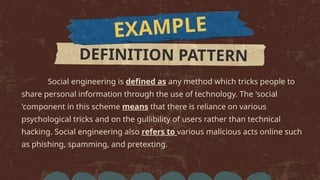
DEFINITION PATTERN
EXAMPLE
Social engineeringis defined as any method which tricks people to
share personal information through the use of technology. The 'social
'component in this scheme means that there is reliance on various
psychological tricks and on the gullibility of users rather than technical
hacking. Social engineering also refers to various malicious acts online such
as phishing, spamming, and pretexting.
9.
TERMINOLOGY
• places theemphasis on the fact that concepts are critical to the
narration.
Note: writers must choose how to address terms and which ones
they want to use in order to create an appropriate setting
10.
• Words thatidentify things, places, and events that can be
measured or observed.
• Terms that have physical manifestation in our world
Examples:
spoon, dog, house
CONCRETE
TERMS
11.
ABSTRACT
• Refer toideas or concepts that are intangible.
Examples: love, freedom, feminism
TERMS
SPECIFIC
• Refers toan individual component of the group.
Examples: cabinets, desks, chairs
TERMS
14.
Pattern of developmentwhich goes into
details about a specific object, person, place
or location in order to firmly set it's
appearance
DESCRIPTION
-What does it look like?
-What are it's characteristics?
PATTERN OF DEVELOPMENT
• looks intofactual and scientific characteristics of what is
being described as objectively as possible.
• the writer stays away from emotional impressions or
responses and instead, describes the scene as it is.
OBJECTIVE DESCRIPTION
18.
The Acer Barbatumis a small to medium-size deciduous tree ussualy
ranging from 15 to 25 m. It's bark is light gray and smooth on younger
trees, and it becomes ridged and furrowed with age. Leaves are opposite
and shallowly to deeply palmately lobed, with a few blunt teeth but no
serrations. The leaf sinuses are rounded, unlike those of red maple (Acer
rubrum) which are sharply V-shaped. Also, the sides of terminal leaf lobes
are more or less parallel, while those of red maple are widest at the base,
tapering to the tip.
EXAMPLE
19.
• a sortof description that the author would normally use to
"paint a picture" of how he sees a character, or how he wants
the reader to see a character
• also used in a literary discourse when there is stereotyped
image that can be attributed to a person, place, or an event.
SUBJECTIVE DESCRIPTION
20.
My mother hadhair so dark that it looked like a
waterfall of ink. She always kept it in a braid that fell
to her slim waist, and always tied with a plain black
band. The braid of black slung over her shoulder, the
plaits shining like scales.
EXAMPLE
- explains notjust what something means or is,
but also what something does, what something
is used for, what something looks like, etc.
DEFINITION
23.
VARIETIES
OF DEFINITION
- definesconcepts in the most factual way,
which is often used in scientific, proper, or
real world facts.
SCIENTIFIC DEFINITION
24.
VARIETIES
OF DEFINITION
• definesthe objects in a more personal way
• usually derived from the author's own experiences and opinion
• often used by a writer to state something from the point of view
of the characters or in relation to the setting
SUBJECTIVE DEFINITION
25.
CHRONOLOGY
Signal words:
• organizesideas or events according to time
• explains how something happened, how it works or how it is made.
• can be in the form of narration or process
• narration sequences events in the order in which they occurred in
time, while a process organizes details based on stages or steps
first, second, finally, then, soon, eventually, next, after, in the
meantime, afterwards
26.
EXAMPLE
OF CHRONOLOGY
Narration
Last night,I was walking on my way home
when it suddenly rained. I forgot to bring my
umbrella, so I ran to avoid getting completely
soaked in the rain. Not seeing where I was
going, I fell into a paddle of water. Then a guy
helped me stand up. When I looked up, I
recognized him. Momentarily, I forgot that I
was soaking wet and that I was very cold. He
offered to walk me home, and I just nodded.
The next day, he and I saw each other at
school. At last, we talked like old friends.
Process
First, put some uncook rice in a pot. Second,
rinse off the rice. Swish the rice gently with
your finger and rub lightly. Next, pour out the
starchy water. You can repeat it for one or two
times, depending on how starchy the rice is.
After pouring out the water for the last time,
add clean water to the pot. You can add 1 1/2 to
2 cups of water for one cup rice. Then, cover
the pot and bring to a boil. Lower down the
heat after it boils. Lastly, let the rice to simmer
for 15 minutes.
a method ofclassifying informations into a
categories or groups based on shared
characteristics.
DEFINITION OF CLASSIFICATION
29.
Some of thesignal words used in
classification are another, another kind,
classified as, final type, one kind, the first
category, the part, the last group, the
next part.
SIGNAL WORDS
30.
Social media platformscan be classified into three types. Social
networking sites, like Facebook and LinkedIn, focus on
connections. Media-sharing platforms, such as Instagram and
YouTube, allow users to share photos and videos. Microblogging
sites, like Twitter, enable short updates and discussions.
EXAMPLE
31.
provides examples andillustrations in order
to further clarify or explain the concept or
subject matter; it also presents the general
statement and then provides specific and
concrete examples to expound on the main
idea.
EXEMPLIFICATION
32.
There few signalwords in exemplification:
For example
For instance
Such as
To illustrate
Namely
In particular
Including
Specifically
SIGNAL WORDS
33.
Good study habitsare essential for academic
success. For example, taking organized
notes, creating a study schedule, and
practicing active recall techniques can
significantly improve a student's
performance.
EXAMPLE
34.
The patterns ofdevelopment provide a
structured way to present ideas, making
communication clear and effective. These
methods guide us in organizing information
logically, helping us connect with our
audience and achieve our purpose.
CONCLUSION
#2 Wow, that was fun, wasn’t it? Just like in the game where we guessed different representations of 'patterns,' we’re surrounded by patterns in our everyday lives—whether it’s in nature, behavior, or even the way we communicate. These patterns also play a crucial role in how we develop ideas and express them clearly.
Today, we’re diving into patterns of development—the different ways we organize and structure our thoughts to make them easier to understand. Think of them as roadmaps that guide us in presenting our ideas, whether we’re narrating a story, describing a scene, comparing two things, or persuading someone. So, let’s unravel these patterns and see how they shape the way
#35 The patterns of development are essential tools for organizing ideas effectively, whether through narration, description, comparison, or argumentation. By mastering these structures, we can communicate more clearly and purposefully, ensuring our messages are well-understood by any audience.