Debugging Tools
Debug Macros:-
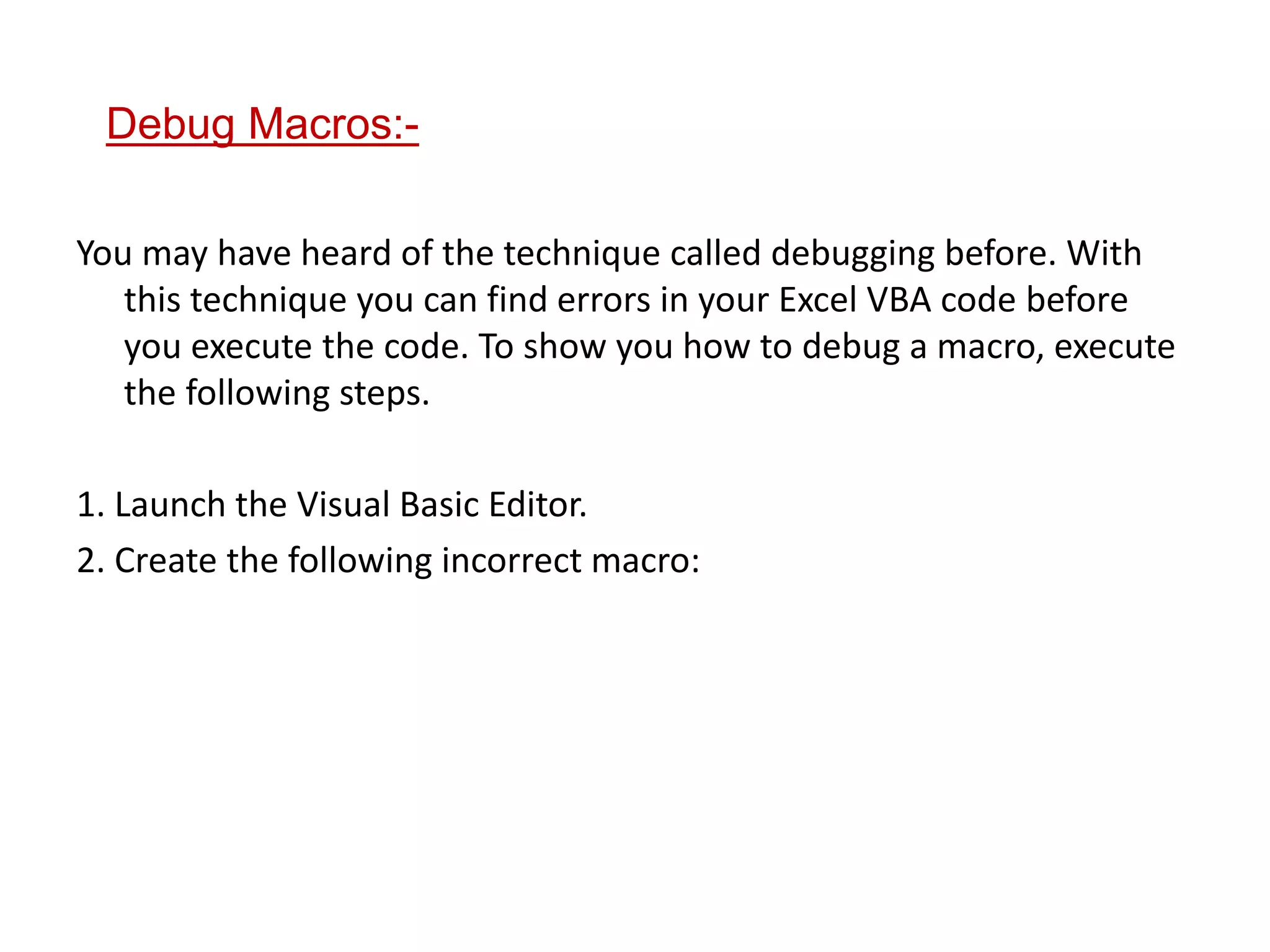
You may have heard of the technique called debugging before. With
this technique you can find errors in your Excel VBA code before
you execute the code. To show you how to debug a macro, execute
the following steps.
1. Launch the Visual Basic Editor.
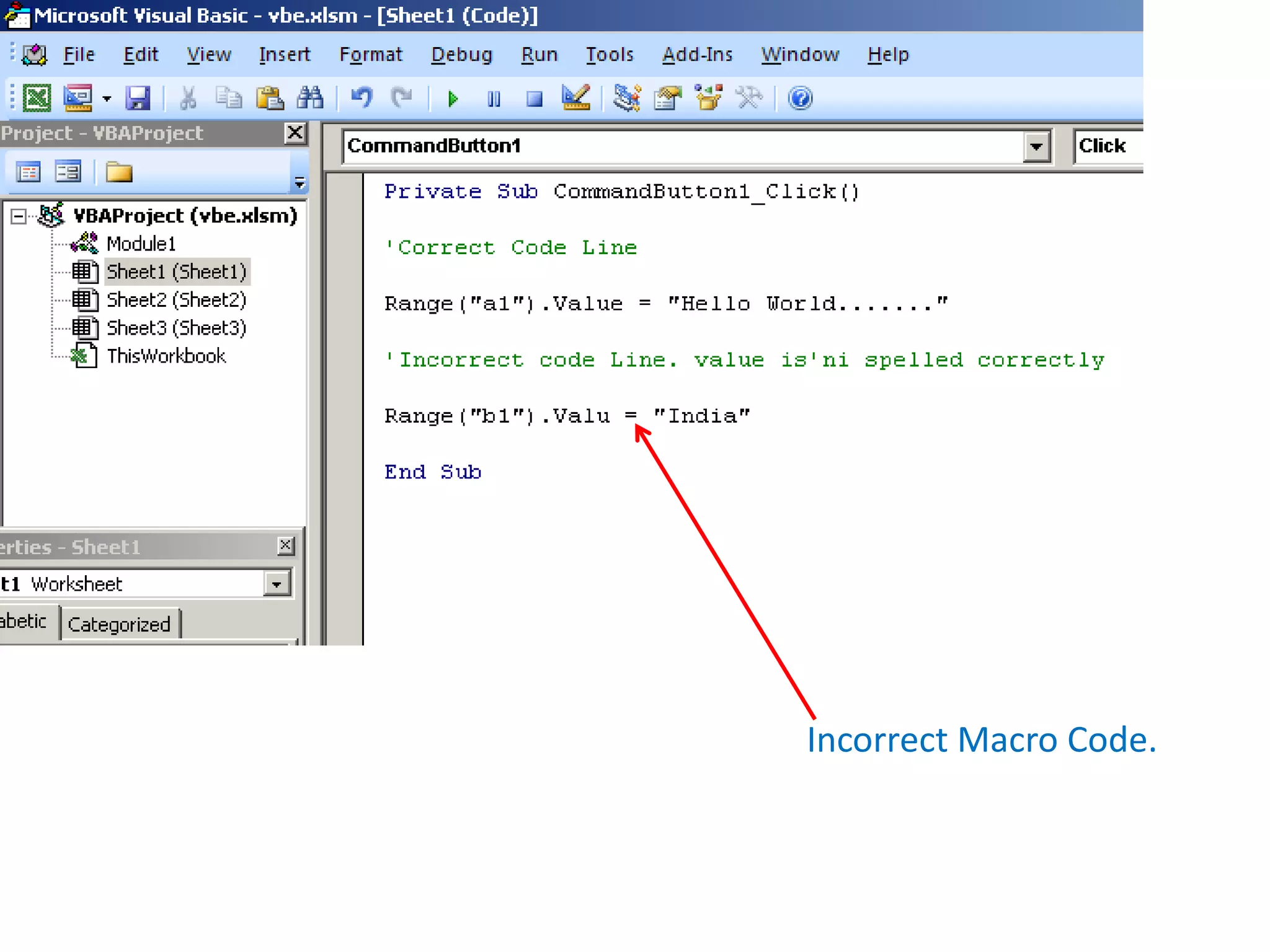
2. Create the following incorrect macro:
Incorrect Macro Code.
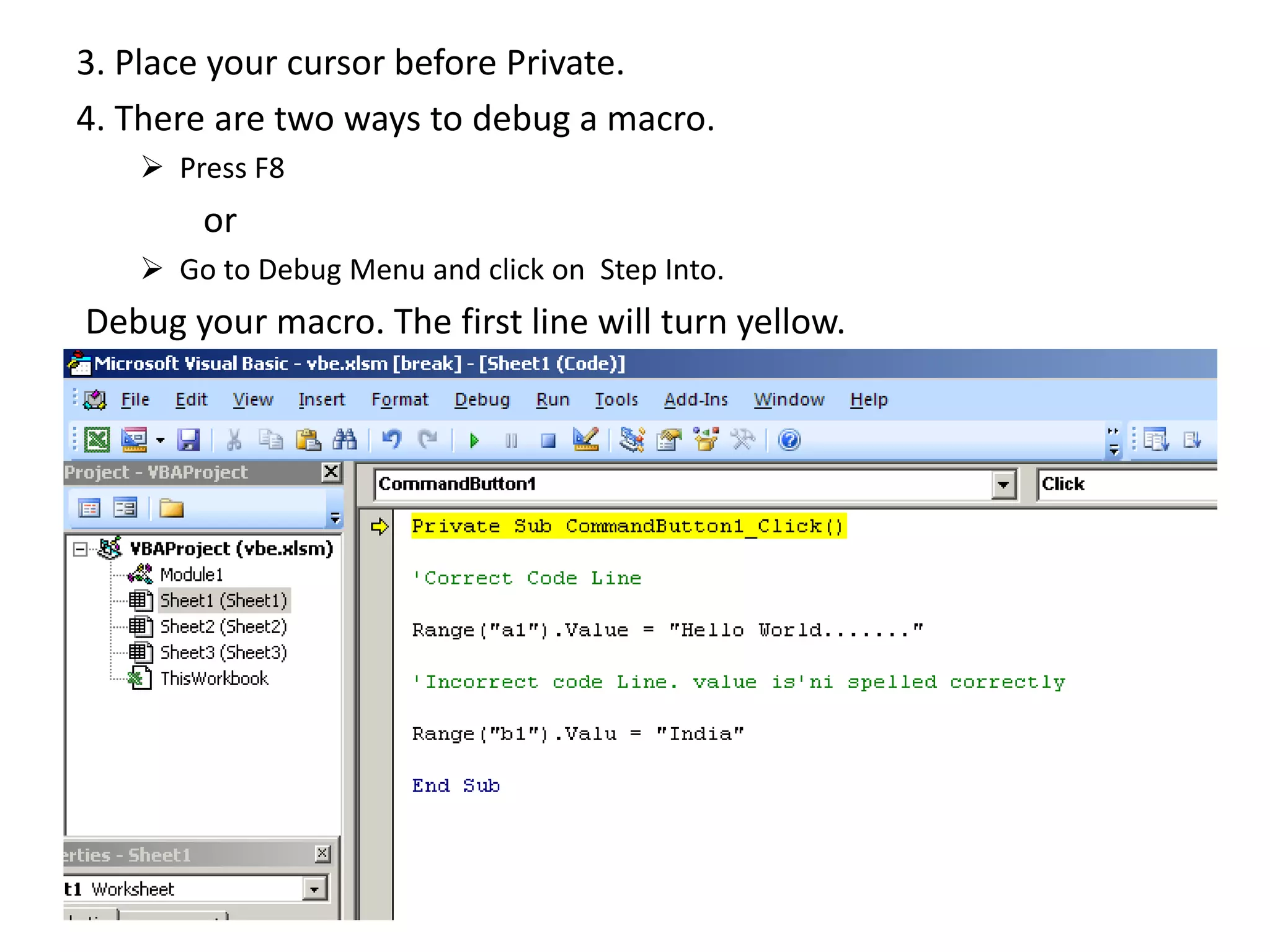
3. Place your cursor before Private.
4. There are two ways to debug a macro.
 Press F8
or
 Go to Debug Menu and click on Step Into.
Debug your macro. The first line will turn yellow.
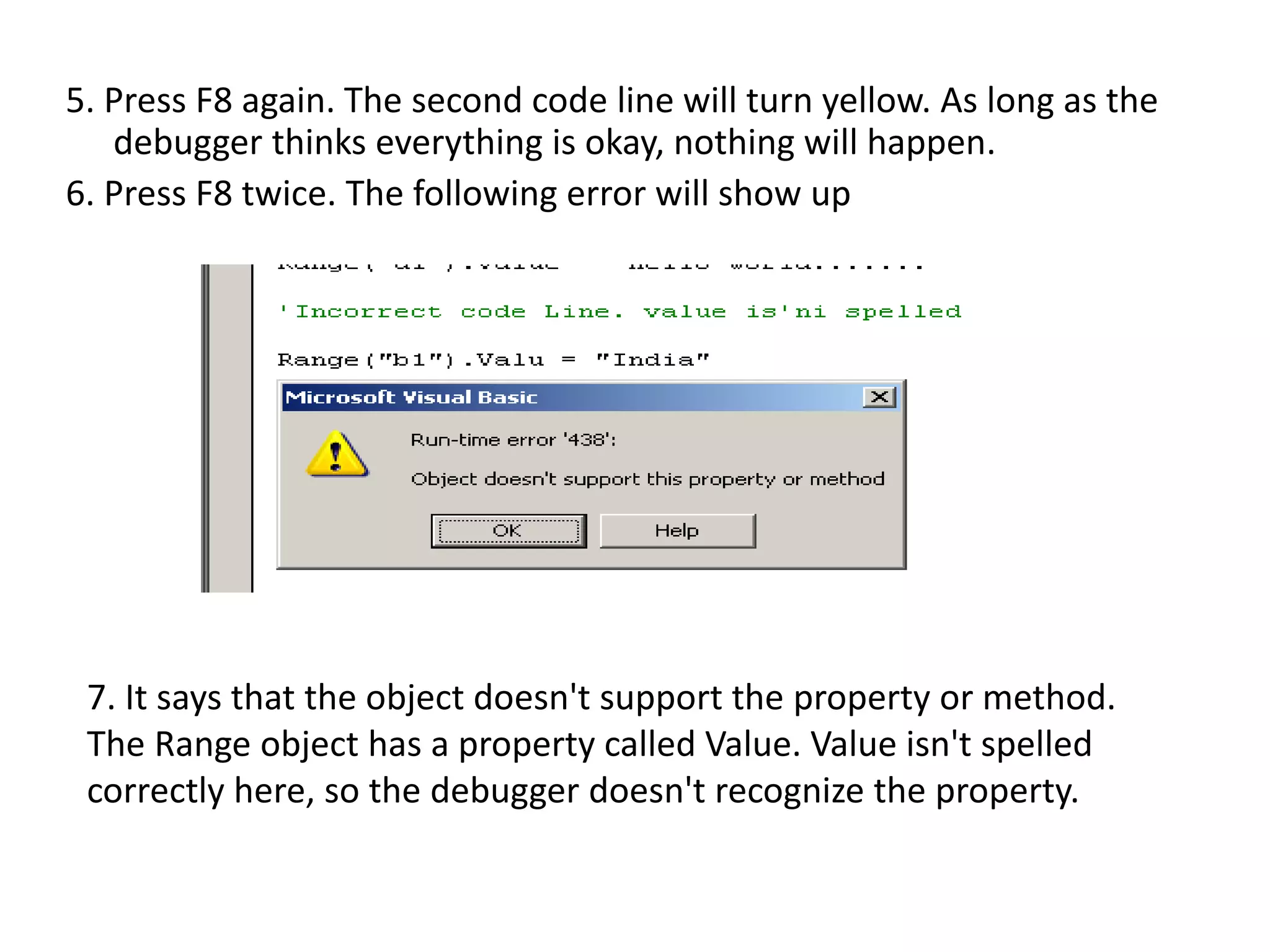
5. Press F8 again. The second code line will turn yellow. As long as the
debugger thinks everything is okay, nothing will happen.
6. Press F8 twice. The following error will show up
7. It says that the object doesn't support the property or method.
The Range object has a property called Value. Value isn't spelled
correctly here, so the debugger doesn't recognize the property.
The various debugging resources
available in the VBA Editor
• The Immediate Window is a window in the VBE in which you can enter
commands and view and change the contents of variables while you code
is in Break mode or when no macro code is executing.
• To display the Immediate Window:
– Press CTRL+G
Or
– Choose it from the View menu.
• In the Immediate Window, you can display the value of a variable by using
the “? “command.
Simply type ? followed by the variable name and press Enter.
VBA will display the contents of the variable in the Immediate Window.
Immediate Window
For example:-
?ActiveCell.Address
$A$10
You can also execute VBA commands in the Immediate Window by omitting
the question mark and entering the command followed by the Enter key:
Application.EnableEvents=True
or
Range("A1").Value = 1234
• The Immediate Window won't let you enter VBA code snippets and
execute them together because the Immediate Windows executes what
you enter when you press the Enter key.
• However, you can combine several "logical" lines of code in to a single
"physical" line of code using the ':' character, and execute this entire
command.
Example:-
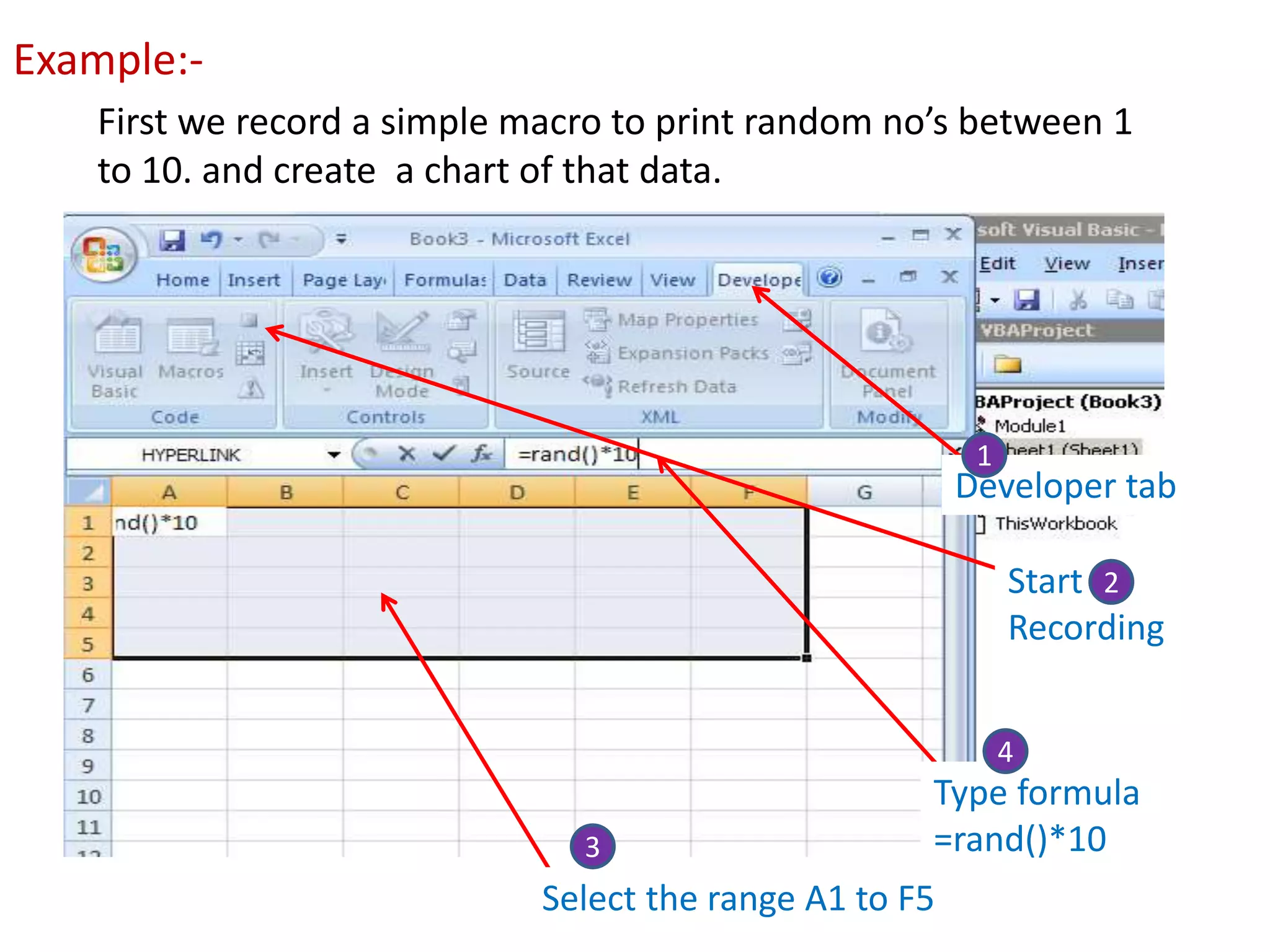
First we record a simple macro to print random no’s between 1
to 10. and create a chart of that data.
Developer tab
Start
Recording
Select the range A1 to F5
Type formula
=rand()*10
1
2
3
4
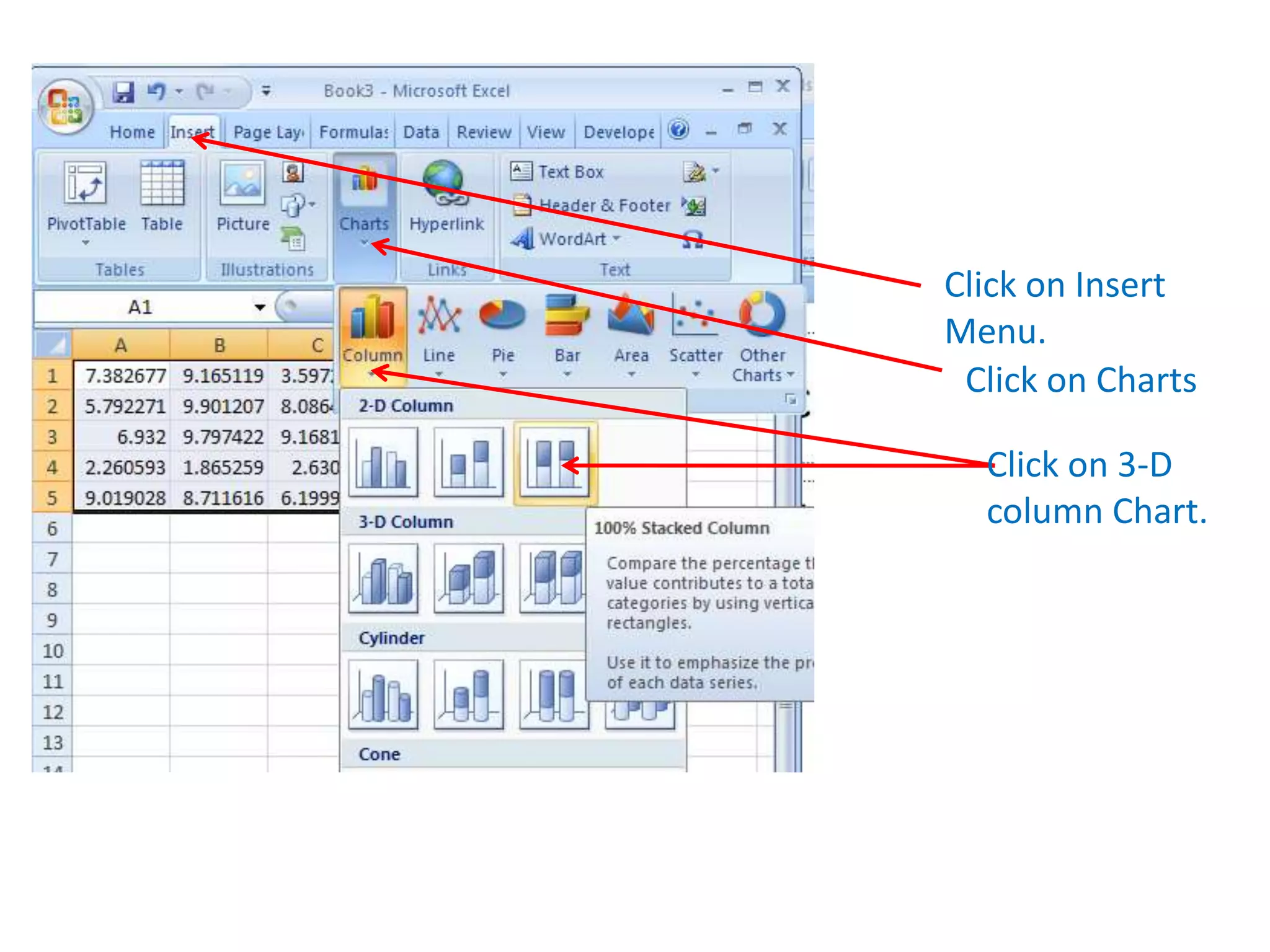
Click on Insert
Menu.
Click on Charts
Click on 3-D
column Chart.
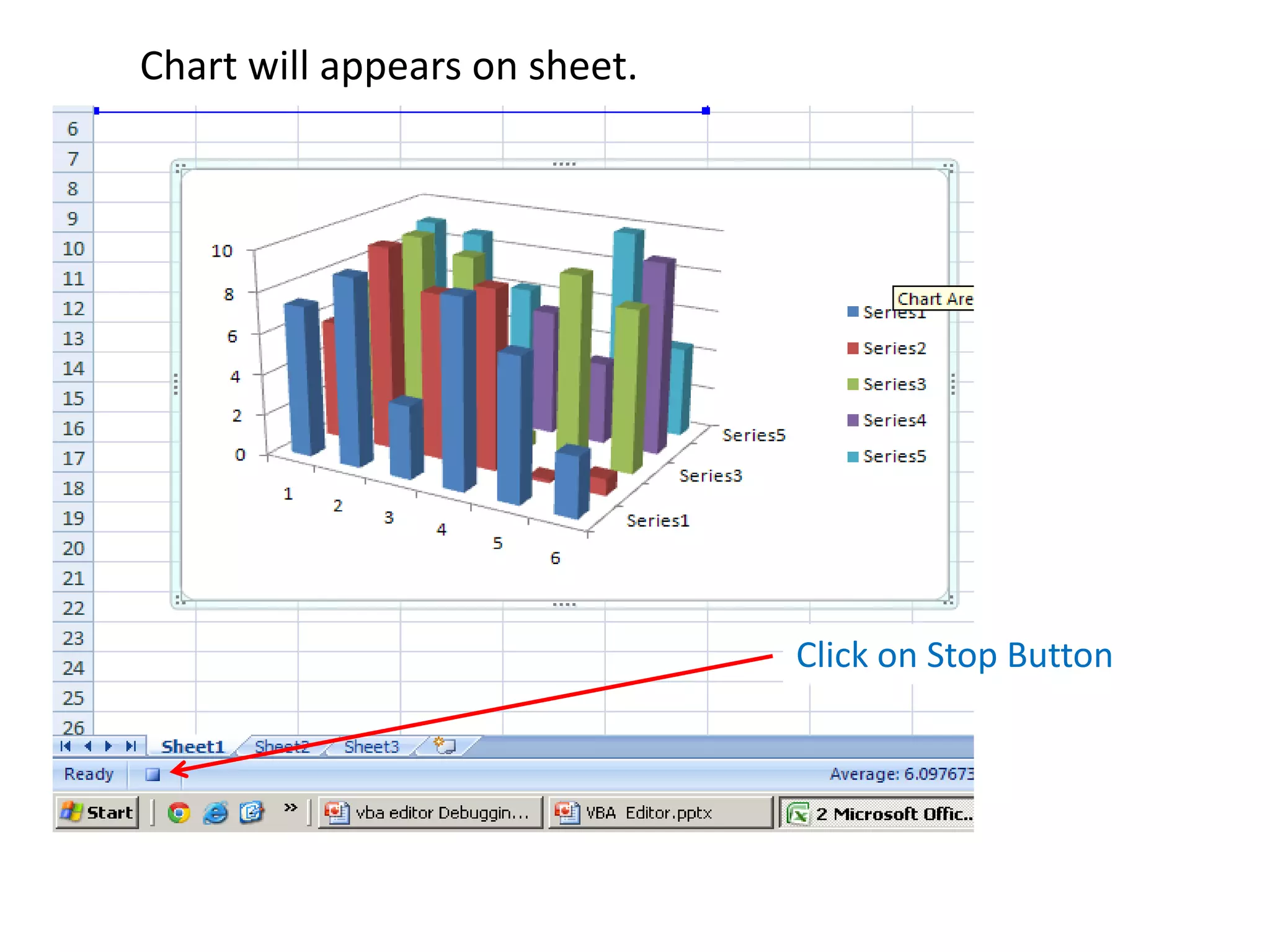
Chart will appears on sheet.
Click on Stop Button
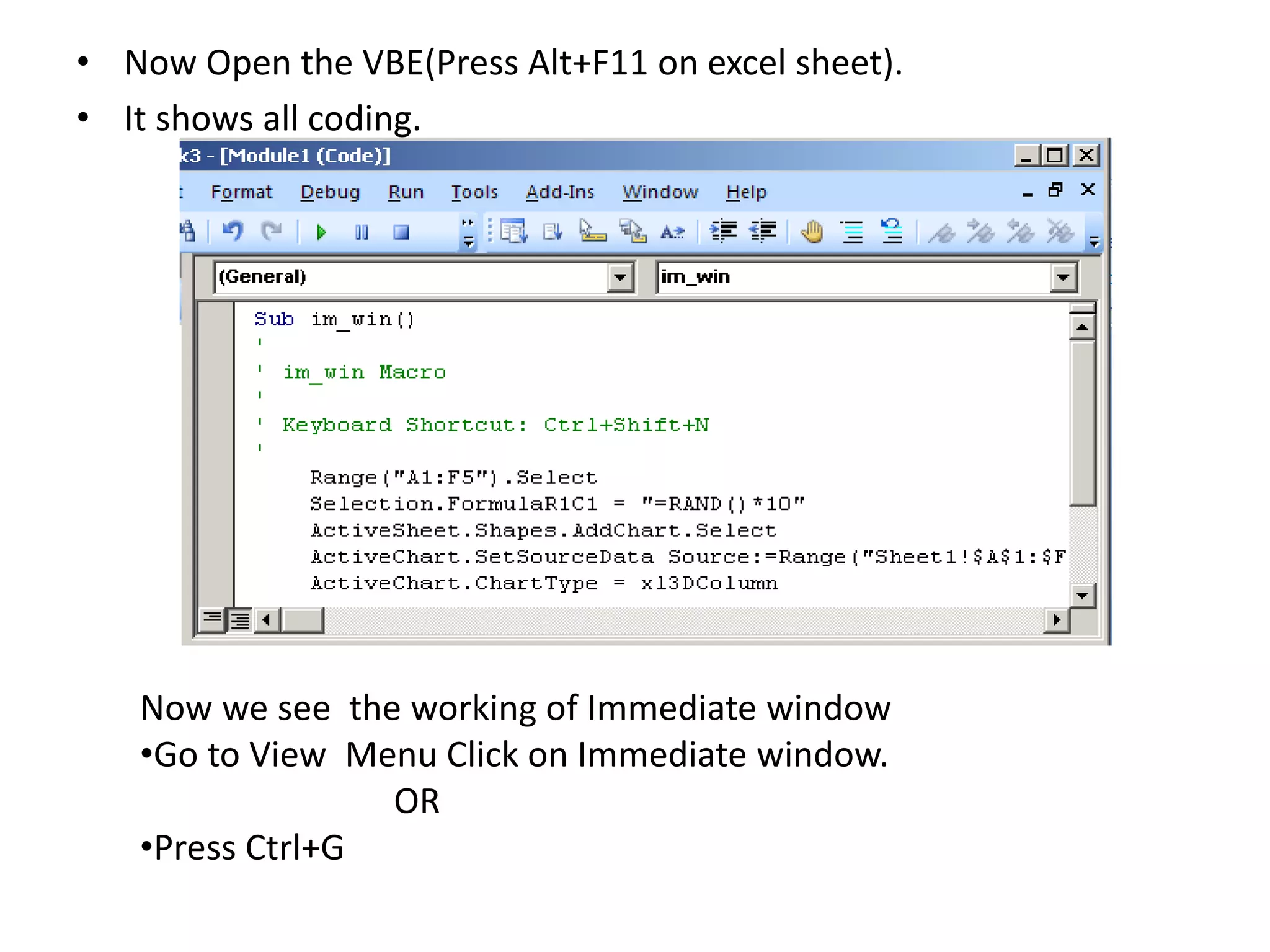
• Now Open the VBE(Press Alt+F11 on excel sheet).
• It shows all coding.
Now we see the working of Immediate window
•Go to View Menu Click on Immediate window.
OR
•Press Ctrl+G
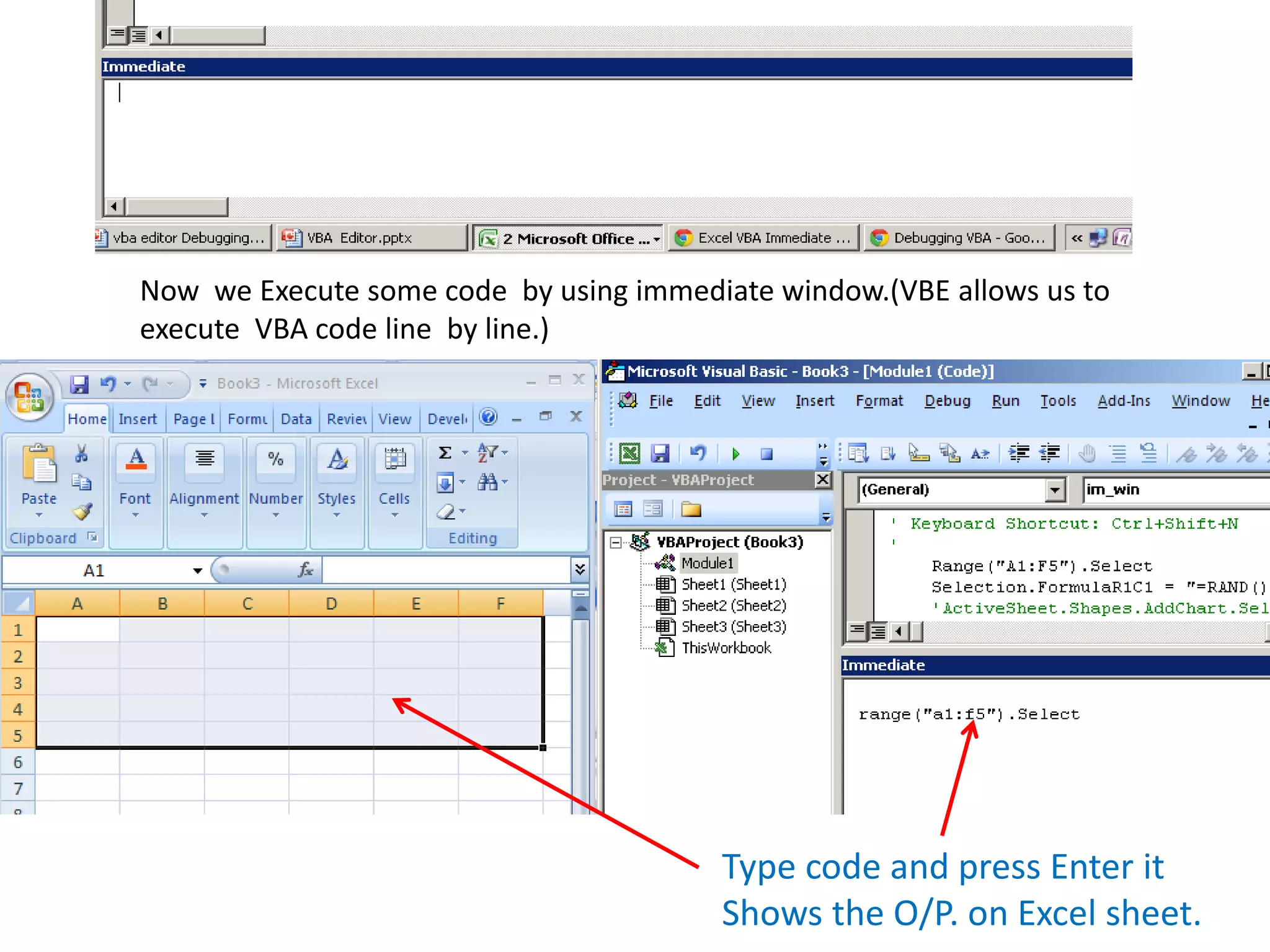
Now we Execute some code by using immediate window.(VBE allows us to
execute VBA code line by line.)
Type code and press Enter it
Shows the O/P. on Excel sheet.
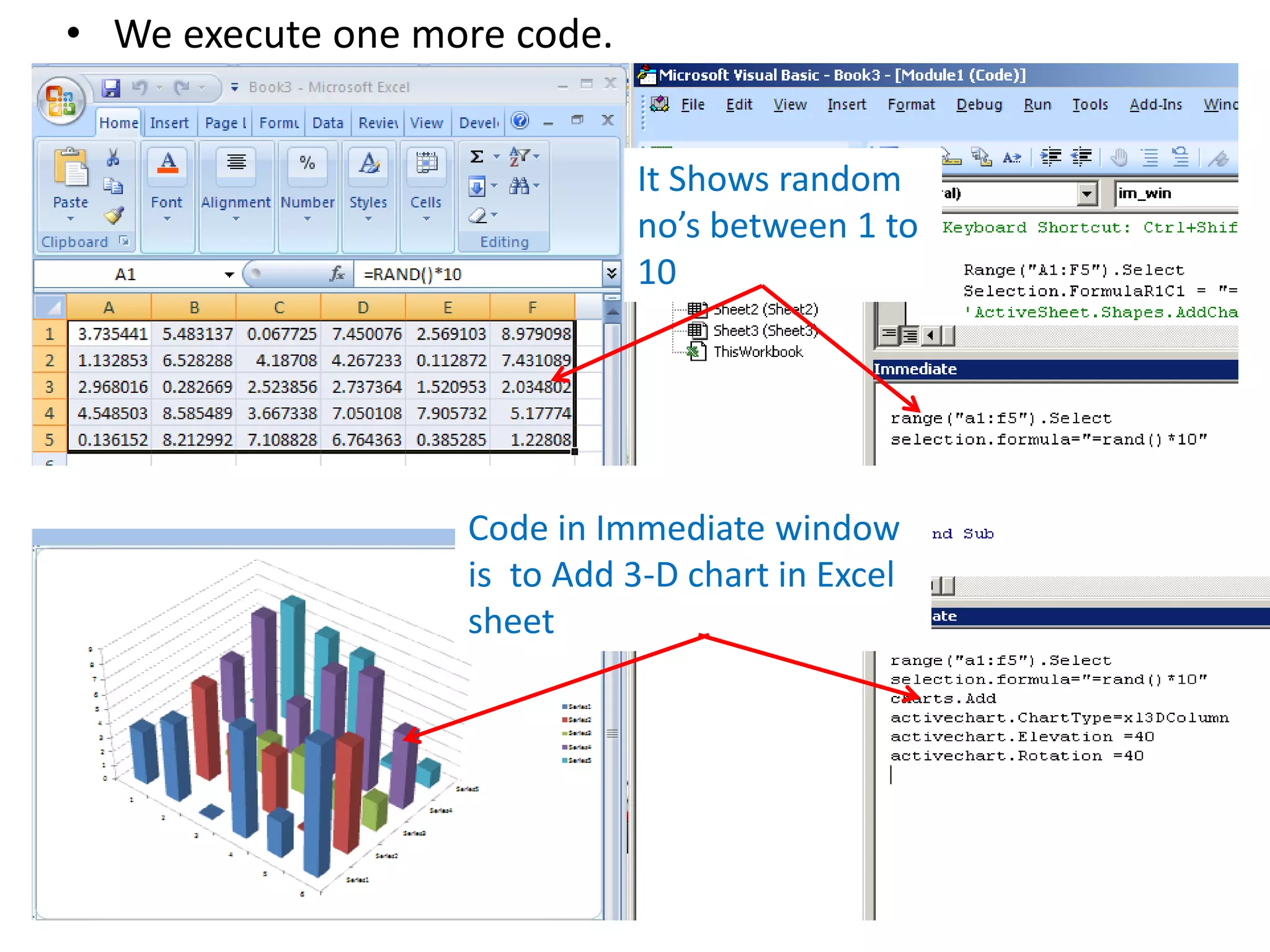
• We execute one more code.
Code in Immediate window
is to Add 3-D chart in Excel
sheet
It Shows random
no’s between 1 to
10
Break Points:-
• A break point is a setting on a line of code that tells VBA to pause
execution immediately before that line of code is executed. Code
execution is placed in what is called break mode.
When VBA is in break mode, you can enter commands in to the
Immediate Window to display or change the values of variables.
To put a break point on a line of code:-
Place the cursor on that line and press F9
or
Choose "Toggle Breakpoint" from the Debug menu.
To remove a break point:-
Place the cursor on that line and press F9
or
Choose "Toggle Breakpoint" from the Debug menu.
When a line contains a break point, it is displayed with a brick
colored background. Immediately before this line of code is
executed, it will appear with a yellow background. Remember, when
a break point is encountered, code execution is paused but that line
of code has not yet executed.
You cannot place break points on blank lines, comment lines, or
variable declaration lines (lines with Dimstatements).
After a break point is encountered, you can resume normal code
execution by pressing F5 or choosing "Continue" from the Run
menu.
**Note that break points are not saved in the workbook file. If you
close the file, all break points are removed. Breakpoints are
preserved as long as the file is open.
Stepping Through Code:-
Normally, your code runs unattended. It executes until its logical
end. However, when you are testing code, it is often useful to step
through the code line by line, watching each line of code take effect.
This makes it easy to determine exactly what line is causing incorrect
behavior.
You can step through code line by line:-
Press F8 key to start the procedure in which the cursor is, or
when VBA is paused at a break point.
 Pressing F8 causes VBA to execute each line one at a time.
 Highlighting the next line of code in yellow.
Note, the highlighted line is the line of code that will execute when
you press F8. It has not yet been executed.
• If your procedure calls another procedure, pressing F8 will cause
VBA to step inside that procedure and execute it line by line.
• You can use SHIFT+F8 to "Step Over" the procedure call. This
means that the entire called procedure is executed as one line of
code. This can make debugging simpler if you are confident that
the problem does not lie within a called procedure.
• When you are in a called procedure, you can use CTRL+SHIFT+F8 to
"Step Out" of the current procedure. This causes VBA to execute
until the end of the procedure is reached (an End Sub or Exit
Sub statement) and then stop at the line of code immediately
following the line which called the procedure.
Watch Window:-
• The Watch Window allows you to "watch" a specific variable or
expression and cause code execution to pause and enter break
mode when the value of that variable or expression is True (non-
zero) or whenever that variable is changed.
• To display the Watch Window,
– Choose it from the View menu.
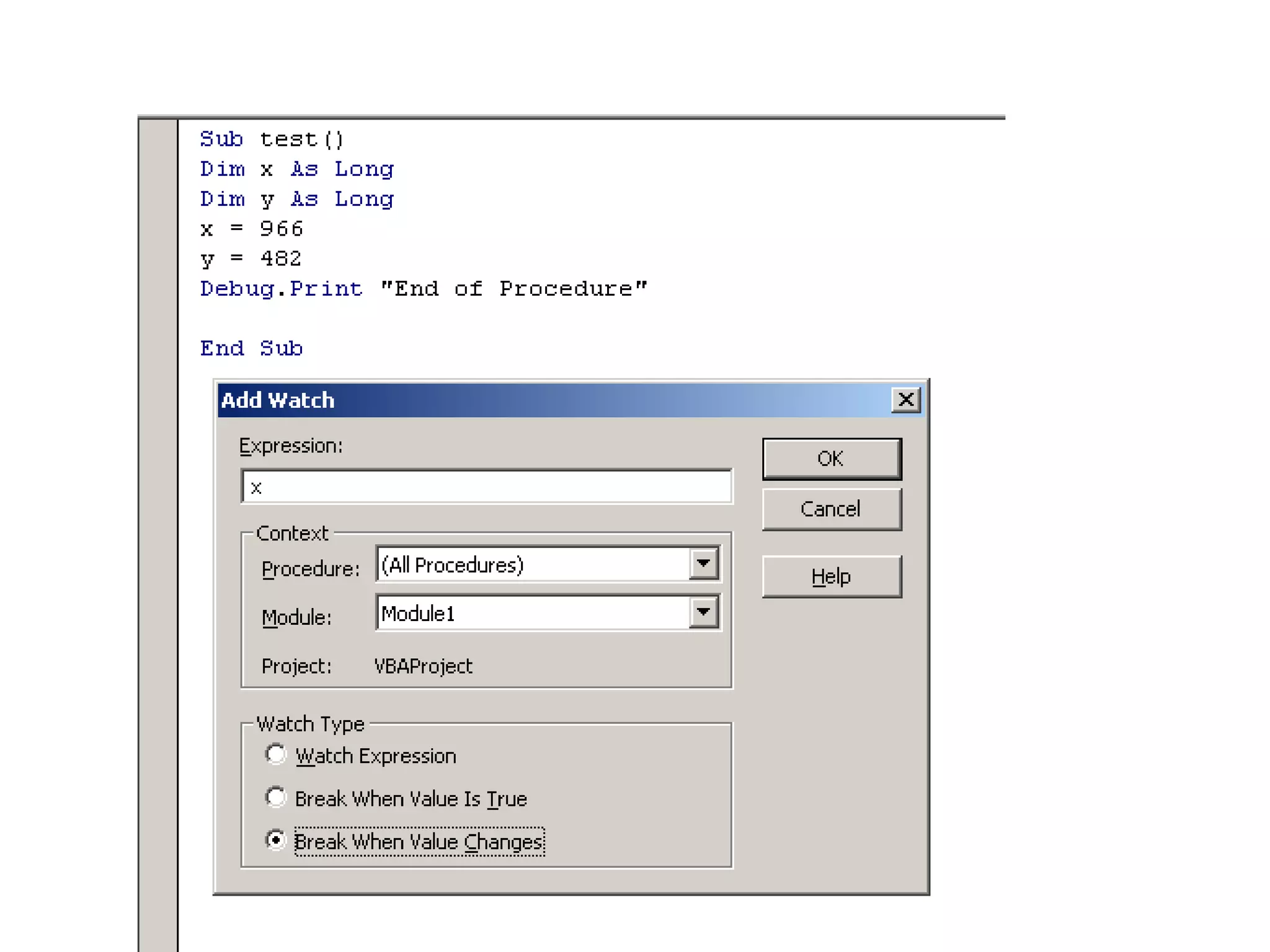
• To create a new watch,
– Choose Add Watch from the Debug menu.
This will display the Add Watch window, shown below.
VISUAL

VISUAL

  • 1.
  • 2.
    Debug Macros:- You mayhave heard of the technique called debugging before. With this technique you can find errors in your Excel VBA code before you execute the code. To show you how to debug a macro, execute the following steps. 1. Launch the Visual Basic Editor. 2. Create the following incorrect macro:
  • 3.
  • 4.
    3. Place yourcursor before Private. 4. There are two ways to debug a macro.  Press F8 or  Go to Debug Menu and click on Step Into. Debug your macro. The first line will turn yellow.
  • 5.
    5. Press F8again. The second code line will turn yellow. As long as the debugger thinks everything is okay, nothing will happen. 6. Press F8 twice. The following error will show up 7. It says that the object doesn't support the property or method. The Range object has a property called Value. Value isn't spelled correctly here, so the debugger doesn't recognize the property.
  • 6.
    The various debuggingresources available in the VBA Editor
  • 7.
    • The ImmediateWindow is a window in the VBE in which you can enter commands and view and change the contents of variables while you code is in Break mode or when no macro code is executing. • To display the Immediate Window: – Press CTRL+G Or – Choose it from the View menu. • In the Immediate Window, you can display the value of a variable by using the “? “command. Simply type ? followed by the variable name and press Enter. VBA will display the contents of the variable in the Immediate Window. Immediate Window
  • 8.
    For example:- ?ActiveCell.Address $A$10 You canalso execute VBA commands in the Immediate Window by omitting the question mark and entering the command followed by the Enter key: Application.EnableEvents=True or Range("A1").Value = 1234 • The Immediate Window won't let you enter VBA code snippets and execute them together because the Immediate Windows executes what you enter when you press the Enter key. • However, you can combine several "logical" lines of code in to a single "physical" line of code using the ':' character, and execute this entire command.
  • 9.
    Example:- First we recorda simple macro to print random no’s between 1 to 10. and create a chart of that data. Developer tab Start Recording Select the range A1 to F5 Type formula =rand()*10 1 2 3 4
  • 10.
    Click on Insert Menu. Clickon Charts Click on 3-D column Chart.
  • 11.
    Chart will appearson sheet. Click on Stop Button
  • 12.
    • Now Openthe VBE(Press Alt+F11 on excel sheet). • It shows all coding. Now we see the working of Immediate window •Go to View Menu Click on Immediate window. OR •Press Ctrl+G
  • 13.
    Now we Executesome code by using immediate window.(VBE allows us to execute VBA code line by line.) Type code and press Enter it Shows the O/P. on Excel sheet.
  • 14.
    • We executeone more code. Code in Immediate window is to Add 3-D chart in Excel sheet It Shows random no’s between 1 to 10
  • 15.
    Break Points:- • Abreak point is a setting on a line of code that tells VBA to pause execution immediately before that line of code is executed. Code execution is placed in what is called break mode. When VBA is in break mode, you can enter commands in to the Immediate Window to display or change the values of variables. To put a break point on a line of code:- Place the cursor on that line and press F9 or Choose "Toggle Breakpoint" from the Debug menu. To remove a break point:- Place the cursor on that line and press F9 or Choose "Toggle Breakpoint" from the Debug menu.
  • 16.
    When a linecontains a break point, it is displayed with a brick colored background. Immediately before this line of code is executed, it will appear with a yellow background. Remember, when a break point is encountered, code execution is paused but that line of code has not yet executed. You cannot place break points on blank lines, comment lines, or variable declaration lines (lines with Dimstatements). After a break point is encountered, you can resume normal code execution by pressing F5 or choosing "Continue" from the Run menu. **Note that break points are not saved in the workbook file. If you close the file, all break points are removed. Breakpoints are preserved as long as the file is open.
  • 17.
    Stepping Through Code:- Normally,your code runs unattended. It executes until its logical end. However, when you are testing code, it is often useful to step through the code line by line, watching each line of code take effect. This makes it easy to determine exactly what line is causing incorrect behavior. You can step through code line by line:- Press F8 key to start the procedure in which the cursor is, or when VBA is paused at a break point.  Pressing F8 causes VBA to execute each line one at a time.  Highlighting the next line of code in yellow. Note, the highlighted line is the line of code that will execute when you press F8. It has not yet been executed.
  • 18.
    • If yourprocedure calls another procedure, pressing F8 will cause VBA to step inside that procedure and execute it line by line. • You can use SHIFT+F8 to "Step Over" the procedure call. This means that the entire called procedure is executed as one line of code. This can make debugging simpler if you are confident that the problem does not lie within a called procedure. • When you are in a called procedure, you can use CTRL+SHIFT+F8 to "Step Out" of the current procedure. This causes VBA to execute until the end of the procedure is reached (an End Sub or Exit Sub statement) and then stop at the line of code immediately following the line which called the procedure.
  • 19.
    Watch Window:- • TheWatch Window allows you to "watch" a specific variable or expression and cause code execution to pause and enter break mode when the value of that variable or expression is True (non- zero) or whenever that variable is changed. • To display the Watch Window, – Choose it from the View menu. • To create a new watch, – Choose Add Watch from the Debug menu. This will display the Add Watch window, shown below.