Prepared by:
Gozon, Ma. Crystal Angelika O.
2PSED1
Light
• One small part of a spectrum of
electromagnetic energy that
surrounds us
Did you know?
Light consists a set
of electromagnetic
waves which travel
at a speed of
around 186,000
miles per second.
Electromagnetic Energy
All forms move in waves
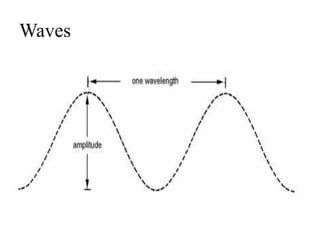
Waves
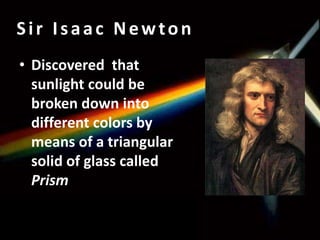
Sir Isaac Newton
• Discovered that
sunlight could be
broken down into
different colors by
means of a triangular
solid of glass called
Prism
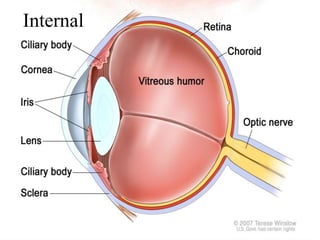
THE E Y E
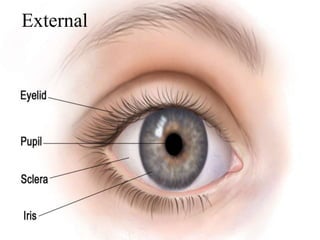
External
Internal
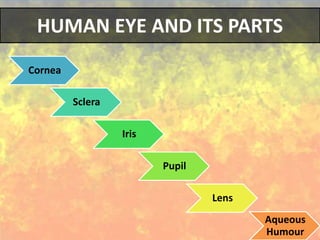
Cornea
Sclera
Iris
Pupil
Lens
Aqueous
Humour
HUMAN EYE AND ITS PARTS
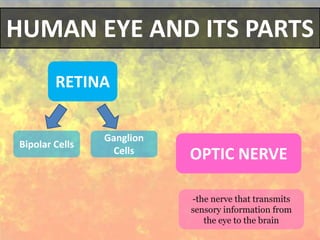
RETINA
Bipolar Cells
Ganglion
Cells
OPTIC NERVE
-the nerve that transmits
sensory information from
the eye to the brain
HUMAN EYE AND ITS PARTS
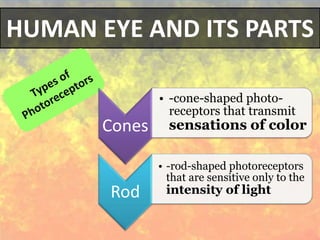
Cones
• -cone-shaped photo-
receptors that transmit
sensations of color
Rod
• -rod-shaped photoreceptors
that are sensitive only to the
intensity of light
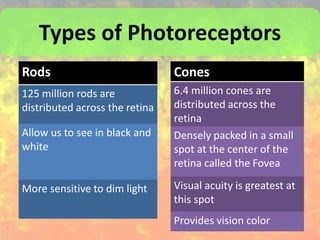
Types of Photoreceptors
Rods
125 million rods are
distributed across the retina
Allow us to see in black and
white
More sensitive to dim light
Cones
6.4 million cones are
distributed across the
retina
Densely packed in a small
spot at the center of the
retina called the Fovea
Visual acuity is greatest at
this spot
Provides vision color
HUMAN EYE AND ITS PARTS
Visual Acuity – sharpness of vision
Nearsighted/Myopia
• a vision condition in which close objects are seen clearly, but objects
farther away appear
Farsighted/Hyperopia
• a vision condition in which distant objects are usually seen clearly,
but close ones do not come into proper focus
Blind Spot
• the area of the retina where axons from ganglion cells meet from the
optic nerve
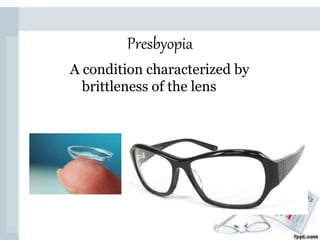
Presbyopia
A condition characterized by
brittleness of the lens
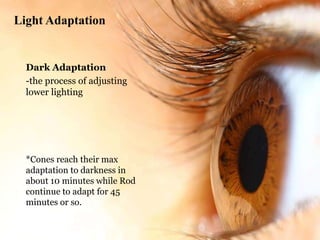
Light Adaptation
Dark Adaptation
-the process of adjusting
lower lighting
*Cones reach their max
adaptation to darkness in
about 10 minutes while Rod
continue to adapt for 45
minutes or so.
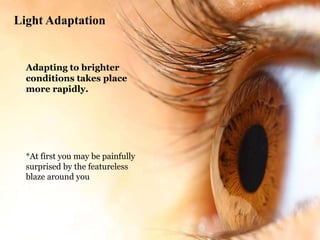
Light Adaptation
Adapting to brighter
conditions takes place
more rapidly.
*At first you may be painfully
surprised by the featureless
blaze around you
Color Vision
• is the ability of an
organism to
distinguish objects
based on the
wavelengths of the
light they reflect,
emit, or transmit.
Perceptual Dimensions of Color
Hue
Value
Saturation
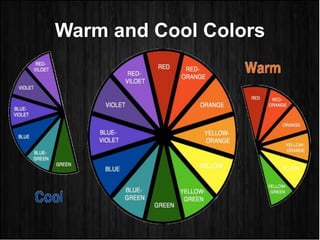
Warm and Cool Colors
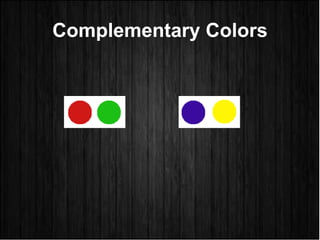
Complementary Colors
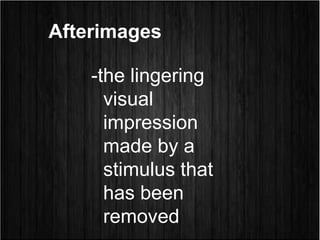
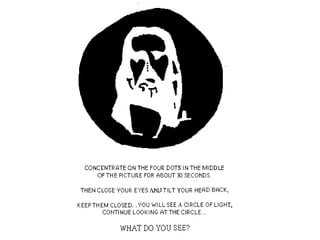
Afterimages
-the lingering
visual
impression
made by a
stimulus that
has been
removed
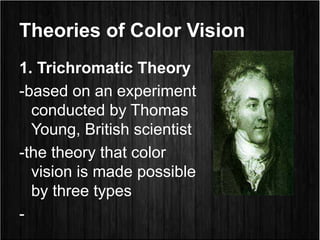
Theories of Color Vision
1. Trichromatic Theory
-based on an experiment
conducted by Thomas
Young, British scientist
-the theory that color
vision is made possible
by three types
-
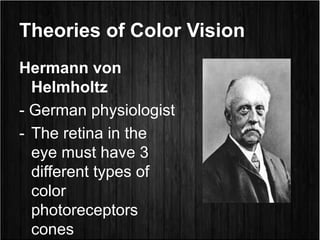
Theories of Color Vision
Hermann von
Helmholtz
- German physiologist
- The retina in the
eye must have 3
different types of
color
photoreceptors
cones
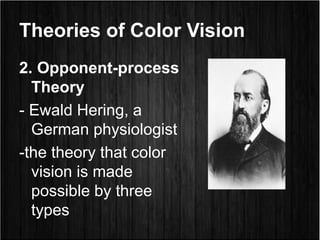
Theories of Color Vision
2. Opponent-process
Theory
- Ewald Hering, a
German physiologist
-the theory that color
vision is made
possible by three
types
Perceptual Dimensions of Color
Hue
Value
Saturation
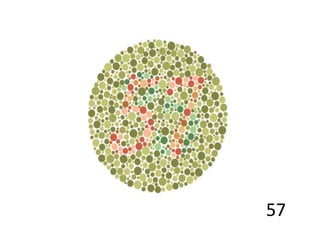
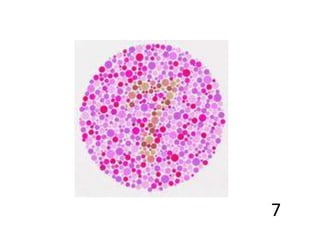
Color Blindness
Trichromat
- A person with normal color vision
Monochromat
-A person who is sensitive to black and white only and
hence color-blind
Dichromats
- A person who is sensitive to black-white and either red-
green or blue-yellow and hence partially color blind.
57
7
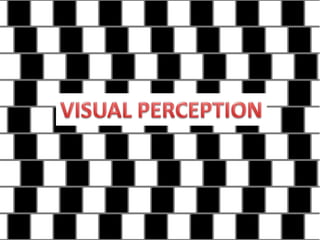
It is the process by which we organize
or make sense of the sensory
impressions caused by the light that
strikes our eyes.
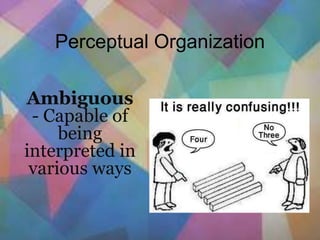
Perceptual Organization
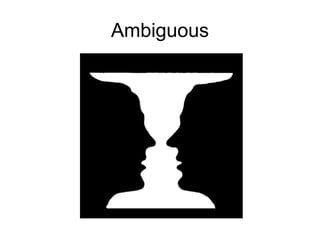
Ambiguous
- Capable of
being
interpreted in
various ways
Ambiguous
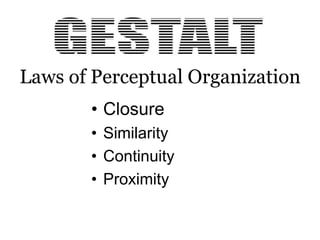
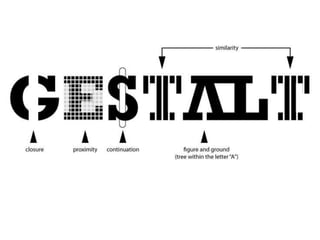
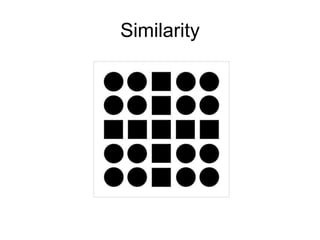
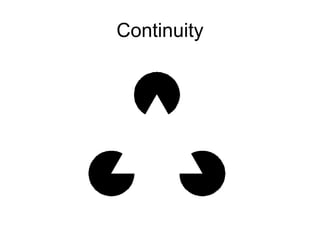
Laws of Perceptual Organization
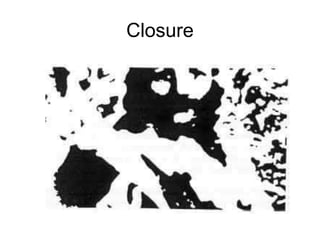
• Closure
• Similarity
• Continuity
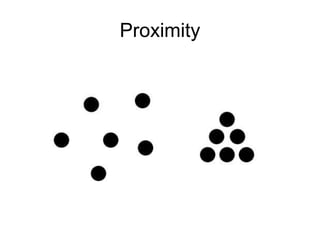
• Proximity
Closure
Similarity
Continuity
Proximity
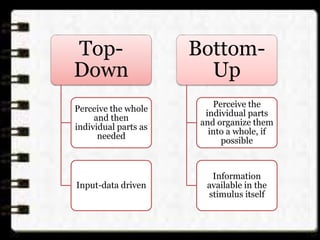
Top-
Down
Perceive the whole
and then
individual parts as
needed
Input-data driven
Bottom-
Up
Perceive the
individual parts
and organize them
into a whole, if
possible
Information
available in the
stimulus itself
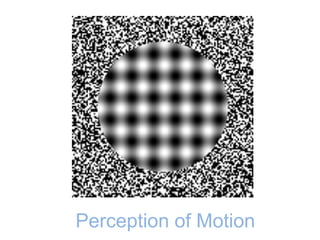
Perception of Motion
Sensations that give rise
to misperceptions
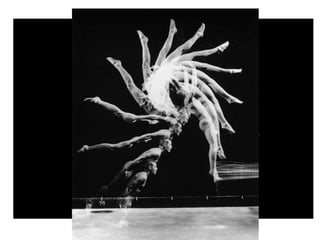
Stroboscopic Motion
• A series of stationary images that are
presented in rapid success
PERCEPTION
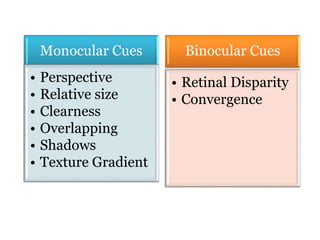
Monocular Cues
• Perspective
• Relative size
• Clearness
• Overlapping
• Shadows
• Texture Gradient
Binocular Cues
• Retinal Disparity
• Convergence
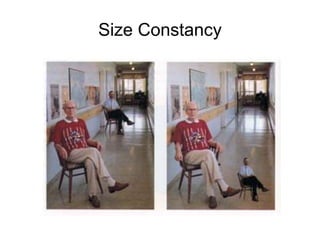
Size Constancy
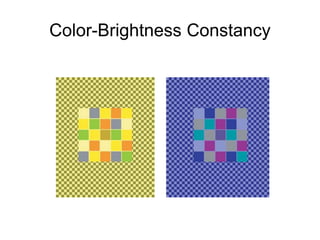
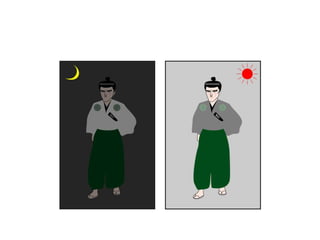
Color-Brightness Constancy
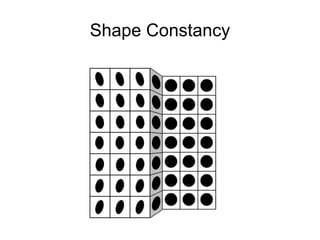
Shape Constancy
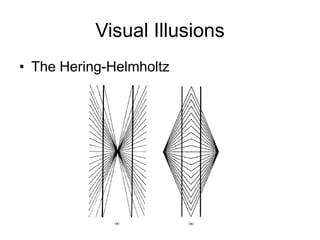
Visual Illusions
• The Hering-Helmholtz
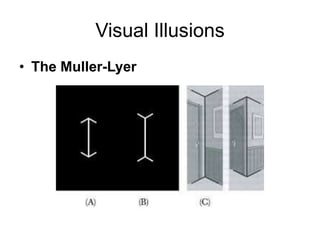
Visual Illusions
• The Muller-Lyer
Vision

Vision

Editor's Notes

  • #12 Retina -the area of the inner surface of the eye that contains rods and cones -contains: Bipolar Cells – neurons that conduct neural impulses from rods and cones to ganglion cells Ganglion Cells – neurons whose axons form the optic nerve Optic Nerve -the nerve that transmits sensory information from the eye to the brain
  • #13 Types of Photoreceptors Cones -cone-shaped photo-receptors that transmit sensations of color Rod -rod-shaped photoreceptors that are sensitive only to the intensity of light
  • #15 Visual Acuity sharpness of vision, shape of the eye Blind Spot -the area of the retina where axons from ganglion cells meet from the optic nerve Nearsighted/Myopia -a vision condition in which close objects are seen clearly, but objects farther away appear Farsighted/Hyperopia -a vision condition in which distant objects are usually seen clearly, but close ones do not come into proper focus. Presbyopia A condition characterized by brittleness of the lens
  • #16 Picture ng resbyopia Eyeglass\