Natural Law
and the Ten
Commandments
The Natural Law
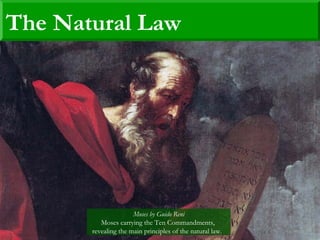
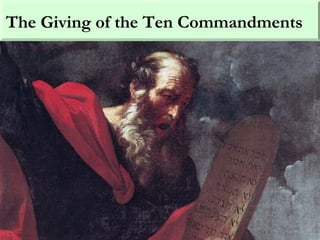
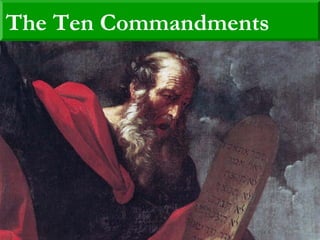
Moses by Guido Reni
Moses carrying the Ten Commandments,
revealing the main principles of the natural law.
The Natural Law
The natural law,
known by reason, is
the universal moral
law of human nature
for living well.
KEY DEFINITION
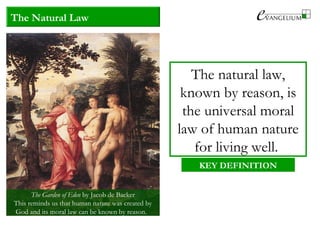
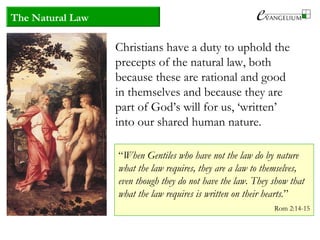
The Garden of Eden by Jacob de Backer
This reminds us that human nature was created by
God and its moral law can be known by reason.
The Natural Law
The natural law is ‘natural’ because it is
founded on what is good for human
nature and because we can know it by
our natural faculty of reason.
The natural law is valid for all people in
all societies. Its principles can be
understood by reason, even without
faith. For example, dishonouring
parents, murder, theft, adultery and
lying are recognised by practically all
human societies as being contrary to
what is good for human life.
The Natural Law
Christians have a duty to uphold the
precepts of the natural law, both
because these are rational and good
in themselves and because they are
part of God’s will for us, ‘written’
into our shared human nature.
“When Gentiles who have not the law do by nature
what the law requires, they are a law to themselves,
even though they do not have the law. They show that
what the law requires is written on their hearts.”
Rom 2:14-15
Natural and civil law
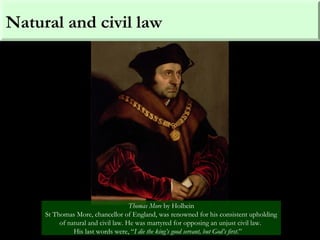
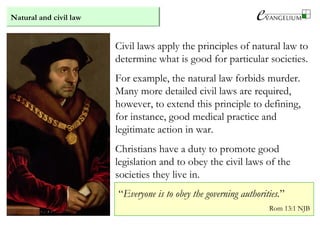
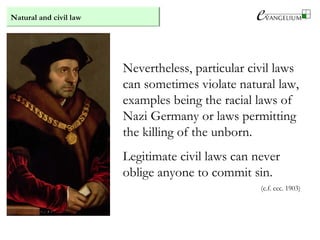
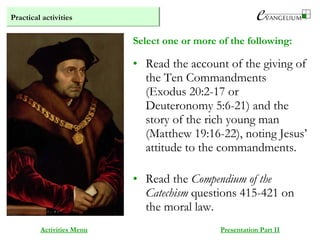
Thomas More by Holbein
St Thomas More, chancellor of England, was renowned for his consistent upholding
of natural and civil law. He was martyred for opposing an unjust civil law.
His last words were, “I die the king’s good servant, but God’s first.”
Natural and civil law
Civil laws apply the principles of natural law to
determine what is good for particular societies.
For example, the natural law forbids murder.
Many more detailed civil laws are required,
however, to extend this principle to defining,
for instance, good medical practice and
legitimate action in war.
Christians have a duty to promote good
legislation and to obey the civil laws of the
societies they live in.
“Everyone is to obey the governing authorities.”
Rom 13:1 NJB
Natural and civil law
Nevertheless, particular civil laws
can sometimes violate natural law,
examples being the racial laws of
Nazi Germany or laws permitting
the killing of the unborn.
Legitimate civil laws can never
oblige anyone to commit sin.
(c.f. ccc. 1903)
The Giving of the Ten Commandments
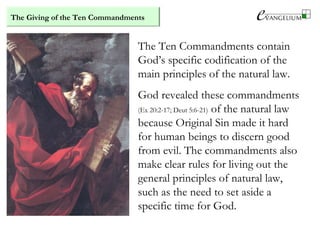
The Ten Commandments contain
God’s specific codification of the
main principles of the natural law.
God revealed these commandments
(Ex 20:2-17; Deut 5:6-21) of the natural law
because Original Sin made it hard
for human beings to discern good
from evil. The commandments also
make clear rules for living out the
general principles of natural law,
such as the need to set aside a
specific time for God.
Jesus Christ said that he had not come
to abolish the law, but to fulfil it (Mt 5:17).
In particular, he confirmed the
necessity of the Ten Commandments.
Someone came to him and said, “Teacher, what
good deed must I do to have eternal life?”
And he said to him … “If you wish to enter
into life, keep the commandments.”
Mt 19:16-17
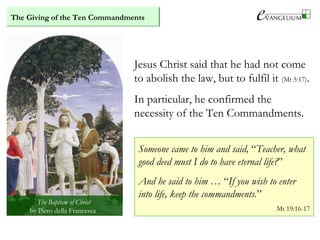
The Baptism of Christ
by Piero della Francesca
The Giving of the Ten Commandments
The natural law and the law of grace
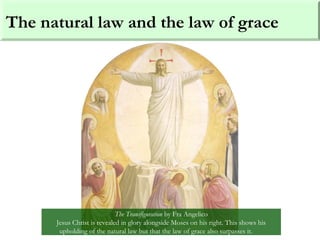
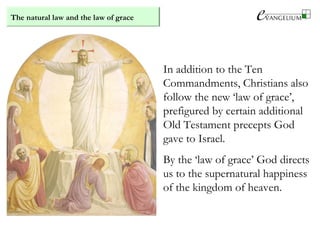
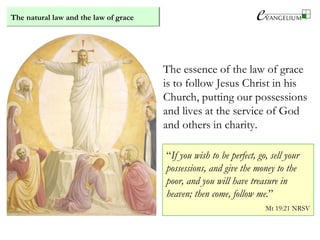
The Transfiguration by Fra Angelico
Jesus Christ is revealed in glory alongside Moses on his right. This shows his
upholding of the natural law but that the law of grace also surpasses it.
The natural law and the law of grace
In addition to the Ten
Commandments, Christians also
follow the new ‘law of grace’,
prefigured by certain additional
Old Testament precepts God
gave to Israel.
By the ‘law of grace’ God directs
us to the supernatural happiness
of the kingdom of heaven.
The natural law and the law of grace
The essence of the law of grace
is to follow Jesus Christ in his
Church, putting our possessions
and lives at the service of God
and others in charity.
“If you wish to be perfect, go, sell your
possessions, and give the money to the
poor, and you will have treasure in
heaven; then come, follow me.”
Mt 19:21 NRSV
Summary
Questions
to reinforce
key points
Discussion
questions
Practical
activities
Presentation Part II
Summary Activities I
Please select an activity or go immediately
to part II of the presentation
Summary
Activities Menu Presentation Part II
• The natural law, known by reason, is the
universal moral law of human nature for
living well. The Ten Commandments
contain God’s specific codification of
the main principles of the natural law.
• Civil laws apply the principles of natural
law to determine what is good for
particular societies. Legitimate civil laws
can never oblige anyone to commit sin.
• Christians also follow the new law of
grace, the essence of which is to follow
Jesus Christ in his Church.
Questions to reinforce key points
It is founded on what is good for human nature
It is known by the natural faculty of reason
Why is natural law called ‘natural’?
Activities Menu Presentation Part II
1
2
Click on a box to reveal one
of the answers
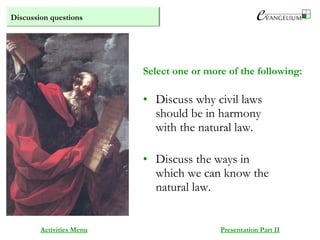
Discussion questions
Activities Menu Presentation Part II
• Discuss why civil laws
should be in harmony
with the natural law.
• Discuss the ways in
which we can know the
natural law.
Select one or more of the following:
Practical activities
Activities Menu Presentation Part II
• Read the account of the giving of
the Ten Commandments
(Exodus 20:2-17 or
Deuteronomy 5:6-21) and the
story of the rich young man
(Matthew 19:16-22), noting Jesus’
attitude to the commandments.
• Read the Compendium of the
Catechism questions 415-421 on
the moral law.
Select one or more of the following:
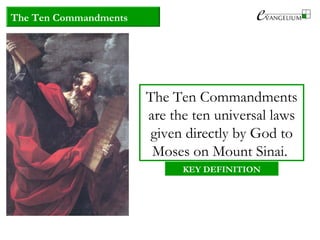
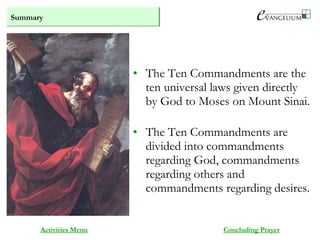
The Ten Commandments
are the ten universal laws
given directly by God to
Moses on Mount Sinai.
KEY DEFINITION
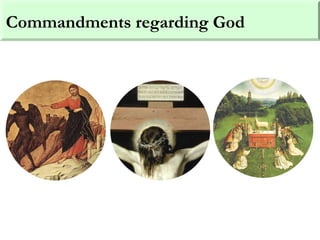
Commandments regarding God
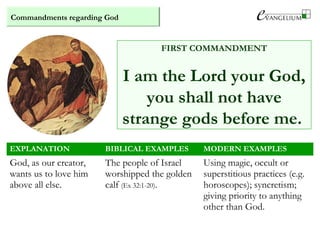
EXPLANATION BIBLICAL EXAMPLES MODERN EXAMPLES
God, as our creator,
wants us to love him
above all else.
The people of Israel
worshipped the golden
calf (Ex 32:1-20).
Using magic, occult or
superstitious practices (e.g.
horoscopes); syncretism;
giving priority to anything
other than God.
FIRST COMMANDMENT
I am the Lord your God,
you shall not have
strange gods before me.
Commandments regarding God
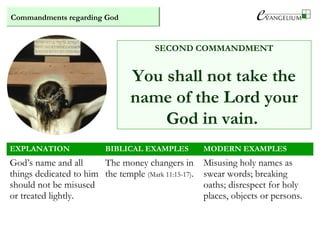
SECOND COMMANDMENT
You shall not take the
name of the Lord your
God in vain.
EXPLANATION BIBLICAL EXAMPLES MODERN EXAMPLES
God’s name and all
things dedicated to him
should not be misused
or treated lightly.
The money changers in
the temple (Mark 11:15-17).
Misusing holy names as
swear words; breaking
oaths; disrespect for holy
places, objects or persons.
Commandments regarding God
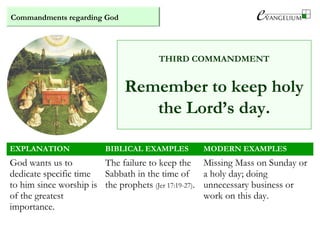
THIRD COMMANDMENT
Remember to keep holy
the Lord’s day.
EXPLANATION BIBLICAL EXAMPLES MODERN EXAMPLES
God wants us to
dedicate specific time
to him since worship is
of the greatest
importance.
The failure to keep the
Sabbath in the time of
the prophets (Jer 17:19-27).
Missing Mass on Sunday or
a holy day; doing
unnecessary business or
work on this day.
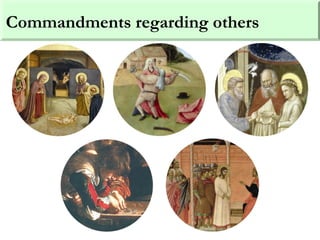
Commandments regarding others
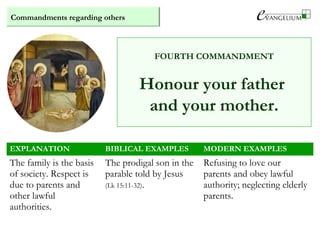
FOURTH COMMANDMENT
Honour your father
and your mother.
EXPLANATION BIBLICAL EXAMPLES MODERN EXAMPLES
The family is the basis
of society. Respect is
due to parents and
other lawful
authorities.
The prodigal son in the
parable told by Jesus
(Lk 15:11-32).
Refusing to love our
parents and obey lawful
authority; neglecting elderly
parents.
Commandments regarding others
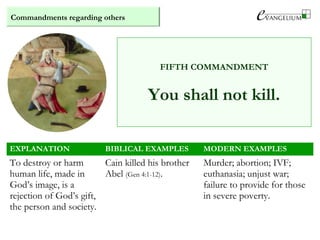
FIFTH COMMANDMENT
You shall not kill.
EXPLANATION BIBLICAL EXAMPLES MODERN EXAMPLES
To destroy or harm
human life, made in
God’s image, is a
rejection of God’s gift,
the person and society.
Cain killed his brother
Abel (Gen 4:1-12).
Murder; abortion; IVF;
euthanasia; unjust war;
failure to provide for those
in severe poverty.
Commandments regarding others
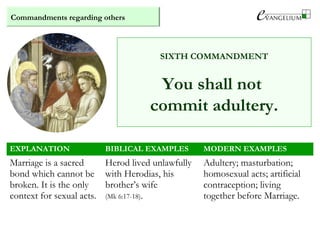
SIXTH COMMANDMENT
You shall not
commit adultery.
EXPLANATION BIBLICAL EXAMPLES MODERN EXAMPLES
Marriage is a sacred
bond which cannot be
broken. It is the only
context for sexual acts.
Herod lived unlawfully
with Herodias, his
brother’s wife
(Mk 6:17-18).
Adultery; masturbation;
homosexual acts; artificial
contraception; living
together before Marriage.
Commandments regarding others
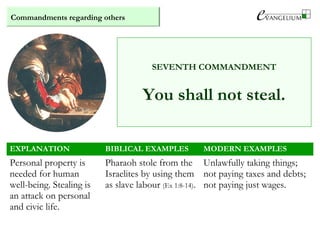
SEVENTH COMMANDMENT
You shall not steal.
EXPLANATION BIBLICAL EXAMPLES MODERN EXAMPLES
Personal property is
needed for human
well-being. Stealing is
an attack on personal
and civic life.
Pharaoh stole from the
Israelites by using them
as slave labour (Ex 1:8-14).
Unlawfully taking things;
not paying taxes and debts;
not paying just wages.
Commandments regarding others
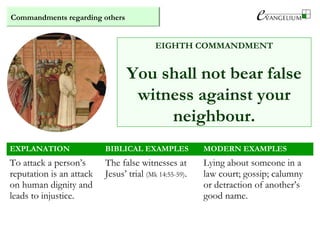
EIGHTH COMMANDMENT
You shall not bear false
witness against your
neighbour.
EXPLANATION BIBLICAL EXAMPLES MODERN EXAMPLES
To attack a person’s
reputation is an attack
on human dignity and
leads to injustice.
The false witnesses at
Jesus’ trial (Mk 14:55-59).
Lying about someone in a
law court; gossip; calumny
or detraction of another’s
good name.
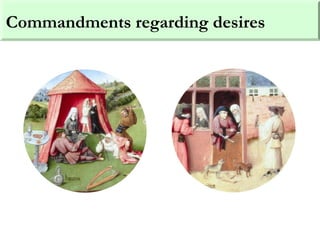
Commandments regarding desires
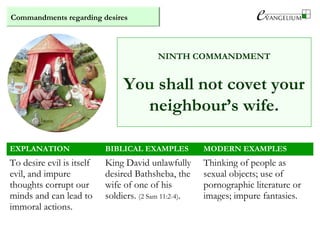
NINTH COMMANDMENT
You shall not covet your
neighbour’s wife.
EXPLANATION BIBLICAL EXAMPLES MODERN EXAMPLES
To desire evil is itself
evil, and impure
thoughts corrupt our
minds and can lead to
immoral actions.
King David unlawfully
desired Bathsheba, the
wife of one of his
soldiers. (2 Sam 11:2-4).
Thinking of people as
sexual objects; use of
pornographic literature or
images; impure fantasies.
Commandments regarding desires
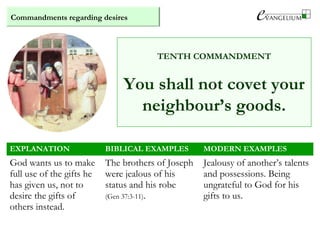
TENTH COMMANDMENT
You shall not covet your
neighbour’s goods.
EXPLANATION BIBLICAL EXAMPLES MODERN EXAMPLES
God wants us to make
full use of the gifts he
has given us, not to
desire the gifts of
others instead.
The brothers of Joseph
were jealous of his
status and his robe
(Gen 37:3-11).
Jealousy of another’s talents
and possessions. Being
ungrateful to God for his
gifts to us.
Summary
Questions
to reinforce
key points
Discussion
questions
Practical
activities
Summary Activities II
Please select an activity or go immediately
to the concluding prayer
Concluding Prayer
Summary
Activities Menu
• The Ten Commandments are the
ten universal laws given directly
by God to Moses on Mount Sinai.
• The Ten Commandments are
divided into commandments
regarding God, commandments
regarding others and
commandments regarding desires.
Concluding Prayer
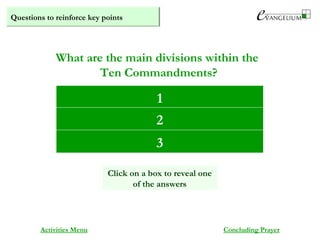
Questions to reinforce key points
Commandments regarding God (1-3)
Commandments regarding others (4-8)
Commandments regarding desires (9, 10)
What are the main divisions within the
Ten Commandments?
Activities Menu Concluding Prayer
1
2
Click on a box to reveal one
of the answers
3
Discussion questions
Activities Menu
• Discuss some of the ways in which the
Ten Commandments are broken in the
world today.
• Discuss why the Ten Commandments
include commandments about
thoughts as well as actions.
Concluding Prayer
Select one or more of the following:
Practical activities
Activities Menu
• Read some articles from recent
newspapers and magazines. Note any
instances in which the Ten
Commandments are being broken.
• Read the Compendium of the Catechism
questions 434-441 on the Decalogue.
Select one or more of the following:
Concluding Prayer
Final Prayer
A Prayer of St Alphonus Liguori
I love you Jesus my love above all things. I repent
with my whole heart for having offended you. Never
permit me to separate myself from you again. Grant
that I may love you always and then do with me
what you will.
Amen.

natural law and the ten commandments

  • 1.
    Natural Law and theTen Commandments
  • 2.
    The Natural Law Mosesby Guido Reni Moses carrying the Ten Commandments, revealing the main principles of the natural law.
  • 3.
    The Natural Law Thenatural law, known by reason, is the universal moral law of human nature for living well. KEY DEFINITION The Garden of Eden by Jacob de Backer This reminds us that human nature was created by God and its moral law can be known by reason.
  • 4.
    The Natural Law Thenatural law is ‘natural’ because it is founded on what is good for human nature and because we can know it by our natural faculty of reason. The natural law is valid for all people in all societies. Its principles can be understood by reason, even without faith. For example, dishonouring parents, murder, theft, adultery and lying are recognised by practically all human societies as being contrary to what is good for human life.
  • 5.
    The Natural Law Christianshave a duty to uphold the precepts of the natural law, both because these are rational and good in themselves and because they are part of God’s will for us, ‘written’ into our shared human nature. “When Gentiles who have not the law do by nature what the law requires, they are a law to themselves, even though they do not have the law. They show that what the law requires is written on their hearts.” Rom 2:14-15
  • 6.
    Natural and civillaw Thomas More by Holbein St Thomas More, chancellor of England, was renowned for his consistent upholding of natural and civil law. He was martyred for opposing an unjust civil law. His last words were, “I die the king’s good servant, but God’s first.”
  • 7.
    Natural and civillaw Civil laws apply the principles of natural law to determine what is good for particular societies. For example, the natural law forbids murder. Many more detailed civil laws are required, however, to extend this principle to defining, for instance, good medical practice and legitimate action in war. Christians have a duty to promote good legislation and to obey the civil laws of the societies they live in. “Everyone is to obey the governing authorities.” Rom 13:1 NJB
  • 8.
    Natural and civillaw Nevertheless, particular civil laws can sometimes violate natural law, examples being the racial laws of Nazi Germany or laws permitting the killing of the unborn. Legitimate civil laws can never oblige anyone to commit sin. (c.f. ccc. 1903)
  • 9.
    The Giving ofthe Ten Commandments
  • 10.
    The Giving ofthe Ten Commandments The Ten Commandments contain God’s specific codification of the main principles of the natural law. God revealed these commandments (Ex 20:2-17; Deut 5:6-21) of the natural law because Original Sin made it hard for human beings to discern good from evil. The commandments also make clear rules for living out the general principles of natural law, such as the need to set aside a specific time for God.
  • 11.
    Jesus Christ saidthat he had not come to abolish the law, but to fulfil it (Mt 5:17). In particular, he confirmed the necessity of the Ten Commandments. Someone came to him and said, “Teacher, what good deed must I do to have eternal life?” And he said to him … “If you wish to enter into life, keep the commandments.” Mt 19:16-17 The Baptism of Christ by Piero della Francesca The Giving of the Ten Commandments
  • 12.
    The natural lawand the law of grace The Transfiguration by Fra Angelico Jesus Christ is revealed in glory alongside Moses on his right. This shows his upholding of the natural law but that the law of grace also surpasses it.
  • 13.
    The natural lawand the law of grace In addition to the Ten Commandments, Christians also follow the new ‘law of grace’, prefigured by certain additional Old Testament precepts God gave to Israel. By the ‘law of grace’ God directs us to the supernatural happiness of the kingdom of heaven.
  • 14.
    The natural lawand the law of grace The essence of the law of grace is to follow Jesus Christ in his Church, putting our possessions and lives at the service of God and others in charity. “If you wish to be perfect, go, sell your possessions, and give the money to the poor, and you will have treasure in heaven; then come, follow me.” Mt 19:21 NRSV
  • 15.
    Summary Questions to reinforce key points Discussion questions Practical activities PresentationPart II Summary Activities I Please select an activity or go immediately to part II of the presentation
  • 16.
    Summary Activities Menu PresentationPart II • The natural law, known by reason, is the universal moral law of human nature for living well. The Ten Commandments contain God’s specific codification of the main principles of the natural law. • Civil laws apply the principles of natural law to determine what is good for particular societies. Legitimate civil laws can never oblige anyone to commit sin. • Christians also follow the new law of grace, the essence of which is to follow Jesus Christ in his Church.
  • 17.
    Questions to reinforcekey points It is founded on what is good for human nature It is known by the natural faculty of reason Why is natural law called ‘natural’? Activities Menu Presentation Part II 1 2 Click on a box to reveal one of the answers
  • 18.
    Discussion questions Activities MenuPresentation Part II • Discuss why civil laws should be in harmony with the natural law. • Discuss the ways in which we can know the natural law. Select one or more of the following:
  • 19.
    Practical activities Activities MenuPresentation Part II • Read the account of the giving of the Ten Commandments (Exodus 20:2-17 or Deuteronomy 5:6-21) and the story of the rich young man (Matthew 19:16-22), noting Jesus’ attitude to the commandments. • Read the Compendium of the Catechism questions 415-421 on the moral law. Select one or more of the following:
  • 20.
  • 21.
    The Ten Commandments TheTen Commandments are the ten universal laws given directly by God to Moses on Mount Sinai. KEY DEFINITION
  • 22.
  • 23.
    Commandments regarding God EXPLANATIONBIBLICAL EXAMPLES MODERN EXAMPLES God, as our creator, wants us to love him above all else. The people of Israel worshipped the golden calf (Ex 32:1-20). Using magic, occult or superstitious practices (e.g. horoscopes); syncretism; giving priority to anything other than God. FIRST COMMANDMENT I am the Lord your God, you shall not have strange gods before me.
  • 24.
    Commandments regarding God SECONDCOMMANDMENT You shall not take the name of the Lord your God in vain. EXPLANATION BIBLICAL EXAMPLES MODERN EXAMPLES God’s name and all things dedicated to him should not be misused or treated lightly. The money changers in the temple (Mark 11:15-17). Misusing holy names as swear words; breaking oaths; disrespect for holy places, objects or persons.
  • 25.
    Commandments regarding God THIRDCOMMANDMENT Remember to keep holy the Lord’s day. EXPLANATION BIBLICAL EXAMPLES MODERN EXAMPLES God wants us to dedicate specific time to him since worship is of the greatest importance. The failure to keep the Sabbath in the time of the prophets (Jer 17:19-27). Missing Mass on Sunday or a holy day; doing unnecessary business or work on this day.
  • 26.
  • 27.
    Commandments regarding others FOURTHCOMMANDMENT Honour your father and your mother. EXPLANATION BIBLICAL EXAMPLES MODERN EXAMPLES The family is the basis of society. Respect is due to parents and other lawful authorities. The prodigal son in the parable told by Jesus (Lk 15:11-32). Refusing to love our parents and obey lawful authority; neglecting elderly parents.
  • 28.
    Commandments regarding others FIFTHCOMMANDMENT You shall not kill. EXPLANATION BIBLICAL EXAMPLES MODERN EXAMPLES To destroy or harm human life, made in God’s image, is a rejection of God’s gift, the person and society. Cain killed his brother Abel (Gen 4:1-12). Murder; abortion; IVF; euthanasia; unjust war; failure to provide for those in severe poverty.
  • 29.
    Commandments regarding others SIXTHCOMMANDMENT You shall not commit adultery. EXPLANATION BIBLICAL EXAMPLES MODERN EXAMPLES Marriage is a sacred bond which cannot be broken. It is the only context for sexual acts. Herod lived unlawfully with Herodias, his brother’s wife (Mk 6:17-18). Adultery; masturbation; homosexual acts; artificial contraception; living together before Marriage.
  • 30.
    Commandments regarding others SEVENTHCOMMANDMENT You shall not steal. EXPLANATION BIBLICAL EXAMPLES MODERN EXAMPLES Personal property is needed for human well-being. Stealing is an attack on personal and civic life. Pharaoh stole from the Israelites by using them as slave labour (Ex 1:8-14). Unlawfully taking things; not paying taxes and debts; not paying just wages.
  • 31.
    Commandments regarding others EIGHTHCOMMANDMENT You shall not bear false witness against your neighbour. EXPLANATION BIBLICAL EXAMPLES MODERN EXAMPLES To attack a person’s reputation is an attack on human dignity and leads to injustice. The false witnesses at Jesus’ trial (Mk 14:55-59). Lying about someone in a law court; gossip; calumny or detraction of another’s good name.
  • 32.
  • 33.
    Commandments regarding desires NINTHCOMMANDMENT You shall not covet your neighbour’s wife. EXPLANATION BIBLICAL EXAMPLES MODERN EXAMPLES To desire evil is itself evil, and impure thoughts corrupt our minds and can lead to immoral actions. King David unlawfully desired Bathsheba, the wife of one of his soldiers. (2 Sam 11:2-4). Thinking of people as sexual objects; use of pornographic literature or images; impure fantasies.
  • 34.
    Commandments regarding desires TENTHCOMMANDMENT You shall not covet your neighbour’s goods. EXPLANATION BIBLICAL EXAMPLES MODERN EXAMPLES God wants us to make full use of the gifts he has given us, not to desire the gifts of others instead. The brothers of Joseph were jealous of his status and his robe (Gen 37:3-11). Jealousy of another’s talents and possessions. Being ungrateful to God for his gifts to us.
  • 35.
    Summary Questions to reinforce key points Discussion questions Practical activities SummaryActivities II Please select an activity or go immediately to the concluding prayer Concluding Prayer
  • 36.
    Summary Activities Menu • TheTen Commandments are the ten universal laws given directly by God to Moses on Mount Sinai. • The Ten Commandments are divided into commandments regarding God, commandments regarding others and commandments regarding desires. Concluding Prayer
  • 37.
    Questions to reinforcekey points Commandments regarding God (1-3) Commandments regarding others (4-8) Commandments regarding desires (9, 10) What are the main divisions within the Ten Commandments? Activities Menu Concluding Prayer 1 2 Click on a box to reveal one of the answers 3
  • 38.
    Discussion questions Activities Menu •Discuss some of the ways in which the Ten Commandments are broken in the world today. • Discuss why the Ten Commandments include commandments about thoughts as well as actions. Concluding Prayer Select one or more of the following:
  • 39.
    Practical activities Activities Menu •Read some articles from recent newspapers and magazines. Note any instances in which the Ten Commandments are being broken. • Read the Compendium of the Catechism questions 434-441 on the Decalogue. Select one or more of the following: Concluding Prayer
  • 40.
    Final Prayer A Prayerof St Alphonus Liguori I love you Jesus my love above all things. I repent with my whole heart for having offended you. Never permit me to separate myself from you again. Grant that I may love you always and then do with me what you will. Amen.