

Grace and
the Beatitudes
What is Grace?
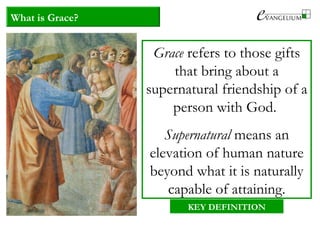
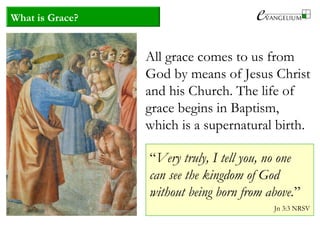
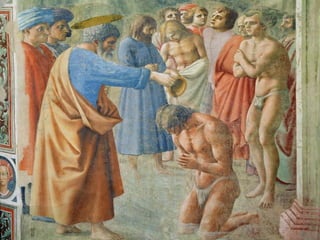
The Baptism of the Neophytes
by Masaccio
What is Grace?
Grace refers to those gifts
that bring about a
supernatural friendship of a
person with God.
Supernatural means an
elevation of human nature
beyond what it is naturally
capable of attaining.
KEY DEFINITION
What is Grace?
All grace comes to us from
God by means of Jesus Christ
and his Church. The life of
grace begins in Baptism,
which is a supernatural birth.
“Very truly, I tell you, no one
can see the kingdom of God
without being born from above.”
Jn 3:3 NRSV
What is Grace?
By means of this
extraordinary gift, God
allows us to share his own
divine life, as his adopted
children, and makes us heirs
to the kingdom of heaven.
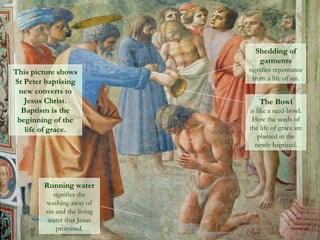
Shedding of
garments
signifies repentance
from a life of sin.
This picture shows
St Peter baptising
new converts to
Jesus Christ.
Baptism is the
beginning of the
life of grace.
The Bowl
is like a seed-bowl.
Here the seeds of
the life of grace are
planted in the
newly baptised.
Running water
signifies the
washing away of
sin and the living
water that Jesus
promised.
Traditional terms for the supernatural life
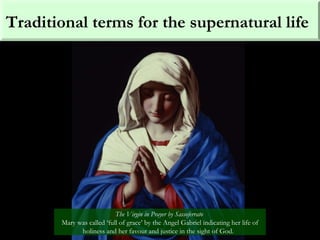
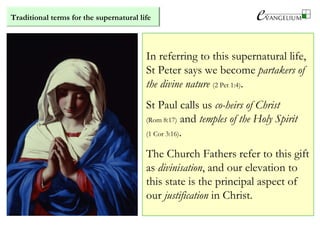
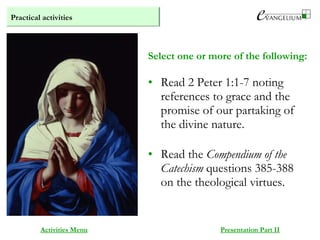
The Virgin in Prayer by Sassoferrato
Mary was called ‘full of grace’ by the Angel Gabriel indicating her life of
holiness and her favour and justice in the sight of God.
Traditional terms for the supernatural life
In referring to this supernatural life,
St Peter says we become partakers of
the divine nature (2 Pet 1:4).
St Paul calls us co-heirs of Christ
(Rom 8:17) and temples of the Holy Spirit
(1 Cor 3:16).
The Church Fathers refer to this gift
as divinisation, and our elevation to
this state is the principal aspect of
our justification in Christ.
The life of grace
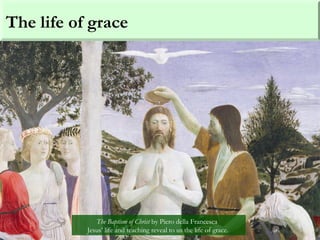
The Baptism of Christ by Piero della Francesca
Jesus’ life and teaching reveal to us the life of grace.
The life of grace
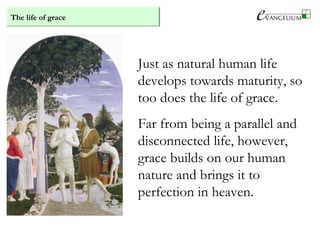
Just as natural human life
develops towards maturity, so
too does the life of grace.
Far from being a parallel and
disconnected life, however,
grace builds on our human
nature and brings it to
perfection in heaven.
The life of grace
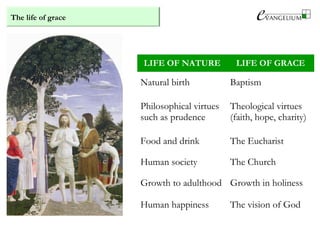
LIFE OF NATURE LIFE OF GRACE
Natural birth Baptism
Philosophical virtues
such as prudence
Theological virtues
(faith, hope, charity)
Food and drink The Eucharist
Human society The Church
Growth to adulthood Growth in holiness
Human happiness The vision of God
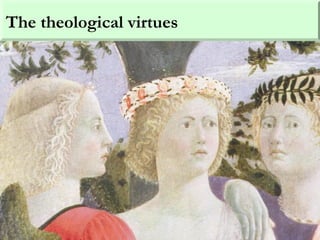
The theological virtues
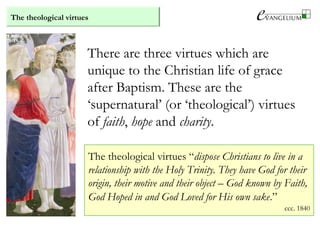
There are three virtues which are
unique to the Christian life of grace
after Baptism. These are the
‘supernatural’ (or ‘theological’) virtues
of faith, hope and charity.
The theological virtues “dispose Christians to live in a
relationship with the Holy Trinity. They have God for their
origin, their motive and their object – God known by Faith,
God Hoped in and God Loved for His own sake.”
ccc. 1840
Mistakes regarding grace
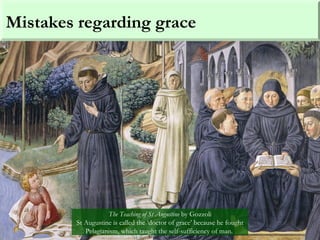
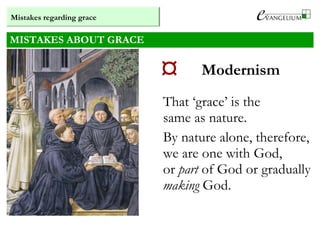
The Teaching of St Augustine by Gozzoli
St Augustine is called the ‘doctor of grace’ because he fought
Pelagianism, which taught the self-sufficiency of man.
MISTAKES ABOUT GRACE
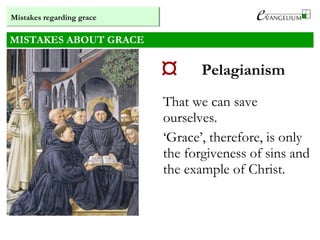
 Pelagianism
That we can save
ourselves.
‘Grace’, therefore, is only
the forgiveness of sins and
the example of Christ.
Mistakes regarding grace
MISTAKES ABOUT GRACE
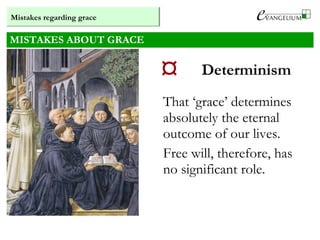
 Determinism
That ‘grace’ determines
absolutely the eternal
outcome of our lives.
Free will, therefore, has
no significant role.
Mistakes regarding grace
MISTAKES ABOUT GRACE
 Modernism
That ‘grace’ is the
same as nature.
By nature alone, therefore,
we are one with God,
or part of God or gradually
making God.
Mistakes regarding grace
Summary
Questions
to reinforce
key points
Discussion
questions
Practical
activities
Presentation Part II
Summary Activities I
Please select an activity or go immediately
to part II of the presentation
Summary
Activities Menu Presentation Part II
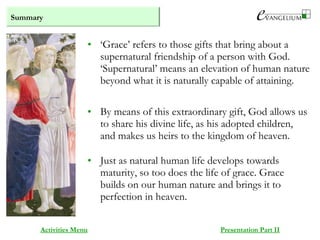
• ‘Grace’ refers to those gifts that bring about a
supernatural friendship of a person with God.
‘Supernatural’ means an elevation of human nature
beyond what it is naturally capable of attaining.
• By means of this extraordinary gift, God allows us
to share his divine life, as his adopted children,
and makes us heirs to the kingdom of heaven.
• Just as natural human life develops towards
maturity, so too does the life of grace. Grace
builds on our human nature and brings it to
perfection in heaven.
Questions to reinforce key points
Partaking of the divine nature
Being co-heirs with Christ
Being temples of the Holy Spirit
Divinisation
What are the different ways that
we describe the life of grace?
Activities Menu Presentation Part II
1
2
3
Click on a box to reveal one
of the answers
4
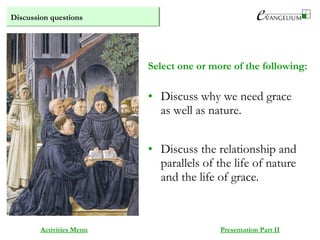
Discussion questions
Activities Menu Presentation Part II
• Discuss why we need grace
as well as nature.
• Discuss the relationship and
parallels of the life of nature
and the life of grace.
Select one or more of the following:
Practical activities
Activities Menu Presentation Part II
• Read 2 Peter 1:1-7 noting
references to grace and the
promise of our partaking of
the divine nature.
• Read the Compendium of the
Catechism questions 385-388
on the theological virtues.
Select one or more of the following:
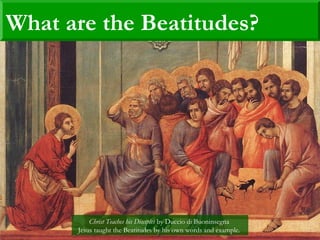
What are the Beatitudes?
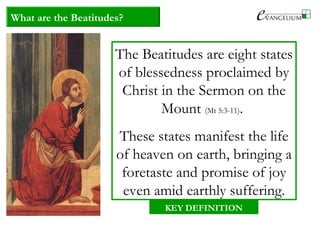
Christ Teaches his Disciples by Duccio di Buoninsegna
Jesus taught the Beatitudes by his own words and example.
What are the Beatitudes?
The Beatitudes are eight states
of blessedness proclaimed by
Christ in the Sermon on the
Mount (Mt 5:3-11).
These states manifest the life
of heaven on earth, bringing a
foretaste and promise of joy
even amid earthly suffering.
KEY DEFINITION
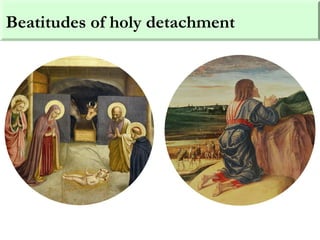
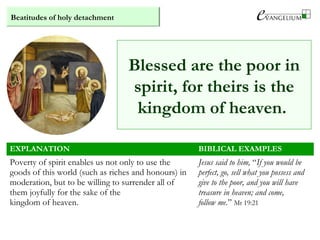
Beatitudes of holy detachment
Blessed are the poor in
spirit, for theirs is the
kingdom of heaven.
EXPLANATION BIBLICAL EXAMPLES
Poverty of spirit enables us not only to use the
goods of this world (such as riches and honours) in
moderation, but to be willing to surrender all of
them joyfully for the sake of the
kingdom of heaven.
Jesus said to him, “If you would be
perfect, go, sell what you possess and
give to the poor, and you will have
treasure in heaven; and come,
follow me.” Mt 19:21
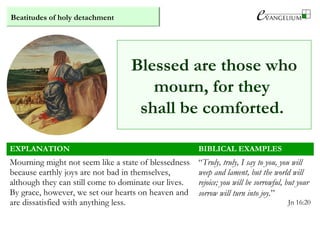
Beatitudes of holy detachment
EXPLANATION BIBLICAL EXAMPLES
Mourning might not seem like a state of blessedness
because earthly joys are not bad in themselves,
although they can still come to dominate our lives.
By grace, however, we set our hearts on heaven and
are dissatisfied with anything less.
“Truly, truly, I say to you, you will
weep and lament, but the world will
rejoice; you will be sorrowful, but your
sorrow will turn into joy.”
Jn 16:20
Blessed are those who
mourn, for they
shall be comforted.
Beatitudes of holy action and desire
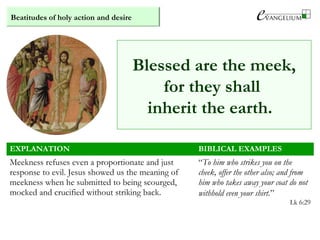
EXPLANATION BIBLICAL EXAMPLES
Meekness refuses even a proportionate and just
response to evil. Jesus showed us the meaning of
meekness when he submitted to being scourged,
mocked and crucified without striking back.
“To him who strikes you on the
cheek, offer the other also; and from
him who takes away your coat do not
withhold even your shirt.”
Lk 6:29
Blessed are the meek,
for they shall
inherit the earth.
Beatitudes of holy action and desire
EXPLANATION BIBLICAL EXAMPLES
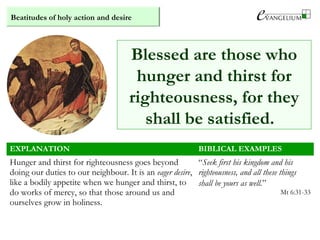
Hunger and thirst for righteousness goes beyond
doing our duties to our neighbour. It is an eager desire,
like a bodily appetite when we hunger and thirst, to
do works of mercy, so that those around us and
ourselves grow in holiness.
“Seek first his kingdom and his
righteousness, and all these things
shall be yours as well.”
Mt 6:31-33
Blessed are those who
hunger and thirst for
righteousness, for they
shall be satisfied.
Beatitudes of holy action and desire
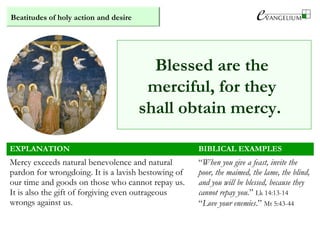
Blessed are the
merciful, for they
shall obtain mercy.
EXPLANATION BIBLICAL EXAMPLES
Mercy exceeds natural benevolence and natural
pardon for wrongdoing. It is a lavish bestowing of
our time and goods on those who cannot repay us.
It is also the gift of forgiving even outrageous
wrongs against us.
“When you give a feast, invite the
poor, the maimed, the lame, the blind,
and you will be blessed, because they
cannot repay you.” Lk 14:13-14
“Love your enemies.” Mt 5:43-44
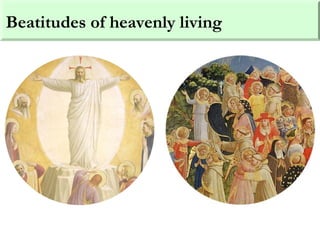
Beatitudes of heavenly living
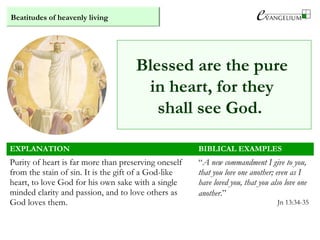
Blessed are the pure
in heart, for they
shall see God.
EXPLANATION BIBLICAL EXAMPLES
Purity of heart is far more than preserving oneself
from the stain of sin. It is the gift of a God-like
heart, to love God for his own sake with a single
minded clarity and passion, and to love others as
God loves them.
“A new commandment I give to you,
that you love one another; even as I
have loved you, that you also love one
another.”
Jn 13:34-35
Beatitudes of heavenly living
EXPLANATION BIBLICAL EXAMPLES
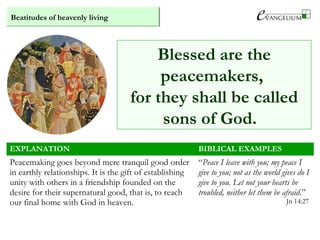
Peacemaking goes beyond mere tranquil good order
in earthly relationships. It is the gift of establishing
unity with others in a friendship founded on the
desire for their supernatural good, that is, to reach
our final home with God in heaven.
“Peace I leave with you; my peace I
give to you; not as the world gives do I
give to you. Let not your hearts be
troubled, neither let them be afraid.”
Jn 14:27
Blessed are the
peacemakers,
for they shall be called
sons of God.
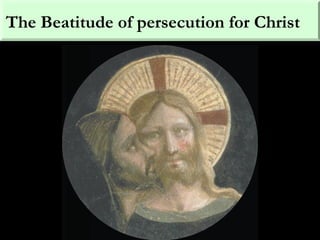
The Beatitude of persecution for Christ
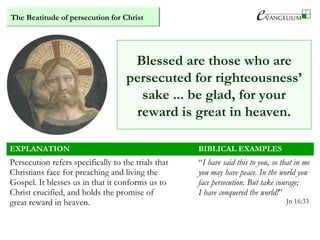
Blessed are those who are
persecuted for righteousness’
sake ... be glad, for your
reward is great in heaven.
EXPLANATION BIBLICAL EXAMPLES
Persecution refers specifically to the trials that
Christians face for preaching and living the
Gospel. It blesses us in that it conforms us to
Christ crucified, and holds the promise of
great reward in heaven.
“I have said this to you, so that in me
you may have peace. In the world you
face persecution. But take courage;
I have conquered the world!”
Jn 16:33
Summary
Questions
to reinforce
key points
Discussion
questions
Practical
activities
Summary Activities II
Please select an activity or go immediately
to the concluding prayer
Concluding Prayer
Summary
Activities Menu
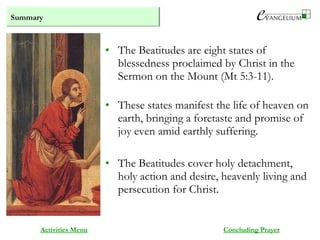
• The Beatitudes are eight states of
blessedness proclaimed by Christ in the
Sermon on the Mount (Mt 5:3-11).
• These states manifest the life of heaven on
earth, bringing a foretaste and promise of
joy even amid earthly suffering.
• The Beatitudes cover holy detachment,
holy action and desire, heavenly living and
persecution for Christ.
Concluding Prayer
Questions to reinforce key points
The poor in spirit
The mourners
The meek
Those hungry and thirsty for righteousness
The merciful
The pure in heart
The peacemakers
Those persecuted for righteousness’ sake
What eight groups of people are
addressed by the Beatitudes?
Activities Menu Concluding Prayer
1
Click on a box to reveal one
of the answers
2
3
4
5
6
7
8
Discussion questions
Activities Menu
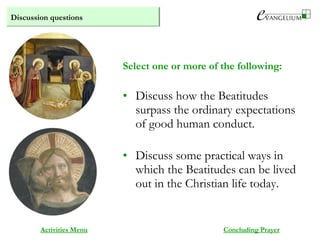
• Discuss how the Beatitudes
surpass the ordinary expectations
of good human conduct.
• Discuss some practical ways in
which the Beatitudes can be lived
out in the Christian life today.
Select one or more of the following:
Concluding Prayer
Practical activities
Activities Menu
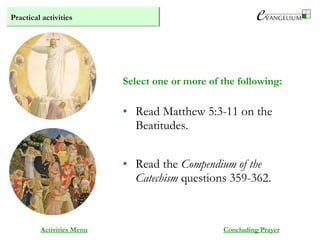
• Read Matthew 5:3-11 on the
Beatitudes.
• Read the Compendium of the
Catechism questions 359-362.
Select one or more of the following:
Concluding Prayer
Final Prayer
A Prayer and Act of Charity
O my God, I love you above all things with my whole
heart and soul because you are all good and worthy of
all my love. I love my neighbour as myself for the love
of you. I forgive all who have injured me and ask
pardon of all whom I have injured.
Amen.

grace and the beatitudes

  • 1.
  • 2.
    What is Grace? TheBaptism of the Neophytes by Masaccio
  • 3.
    What is Grace? Gracerefers to those gifts that bring about a supernatural friendship of a person with God. Supernatural means an elevation of human nature beyond what it is naturally capable of attaining. KEY DEFINITION
  • 4.
    What is Grace? Allgrace comes to us from God by means of Jesus Christ and his Church. The life of grace begins in Baptism, which is a supernatural birth. “Very truly, I tell you, no one can see the kingdom of God without being born from above.” Jn 3:3 NRSV
  • 5.
    What is Grace? Bymeans of this extraordinary gift, God allows us to share his own divine life, as his adopted children, and makes us heirs to the kingdom of heaven.
  • 7.
    Shedding of garments signifies repentance froma life of sin. This picture shows St Peter baptising new converts to Jesus Christ. Baptism is the beginning of the life of grace. The Bowl is like a seed-bowl. Here the seeds of the life of grace are planted in the newly baptised. Running water signifies the washing away of sin and the living water that Jesus promised.
  • 8.
    Traditional terms forthe supernatural life The Virgin in Prayer by Sassoferrato Mary was called ‘full of grace’ by the Angel Gabriel indicating her life of holiness and her favour and justice in the sight of God.
  • 9.
    Traditional terms forthe supernatural life In referring to this supernatural life, St Peter says we become partakers of the divine nature (2 Pet 1:4). St Paul calls us co-heirs of Christ (Rom 8:17) and temples of the Holy Spirit (1 Cor 3:16). The Church Fathers refer to this gift as divinisation, and our elevation to this state is the principal aspect of our justification in Christ.
  • 10.
    The life ofgrace The Baptism of Christ by Piero della Francesca Jesus’ life and teaching reveal to us the life of grace.
  • 11.
    The life ofgrace Just as natural human life develops towards maturity, so too does the life of grace. Far from being a parallel and disconnected life, however, grace builds on our human nature and brings it to perfection in heaven.
  • 12.
    The life ofgrace LIFE OF NATURE LIFE OF GRACE Natural birth Baptism Philosophical virtues such as prudence Theological virtues (faith, hope, charity) Food and drink The Eucharist Human society The Church Growth to adulthood Growth in holiness Human happiness The vision of God
  • 13.
  • 14.
    The theological virtues Thereare three virtues which are unique to the Christian life of grace after Baptism. These are the ‘supernatural’ (or ‘theological’) virtues of faith, hope and charity. The theological virtues “dispose Christians to live in a relationship with the Holy Trinity. They have God for their origin, their motive and their object – God known by Faith, God Hoped in and God Loved for His own sake.” ccc. 1840
  • 15.
    Mistakes regarding grace TheTeaching of St Augustine by Gozzoli St Augustine is called the ‘doctor of grace’ because he fought Pelagianism, which taught the self-sufficiency of man.
  • 16.
    MISTAKES ABOUT GRACE Pelagianism That we can save ourselves. ‘Grace’, therefore, is only the forgiveness of sins and the example of Christ. Mistakes regarding grace
  • 17.
    MISTAKES ABOUT GRACE Determinism That ‘grace’ determines absolutely the eternal outcome of our lives. Free will, therefore, has no significant role. Mistakes regarding grace
  • 18.
    MISTAKES ABOUT GRACE Modernism That ‘grace’ is the same as nature. By nature alone, therefore, we are one with God, or part of God or gradually making God. Mistakes regarding grace
  • 19.
    Summary Questions to reinforce key points Discussion questions Practical activities PresentationPart II Summary Activities I Please select an activity or go immediately to part II of the presentation
  • 20.
    Summary Activities Menu PresentationPart II • ‘Grace’ refers to those gifts that bring about a supernatural friendship of a person with God. ‘Supernatural’ means an elevation of human nature beyond what it is naturally capable of attaining. • By means of this extraordinary gift, God allows us to share his divine life, as his adopted children, and makes us heirs to the kingdom of heaven. • Just as natural human life develops towards maturity, so too does the life of grace. Grace builds on our human nature and brings it to perfection in heaven.
  • 21.
    Questions to reinforcekey points Partaking of the divine nature Being co-heirs with Christ Being temples of the Holy Spirit Divinisation What are the different ways that we describe the life of grace? Activities Menu Presentation Part II 1 2 3 Click on a box to reveal one of the answers 4
  • 22.
    Discussion questions Activities MenuPresentation Part II • Discuss why we need grace as well as nature. • Discuss the relationship and parallels of the life of nature and the life of grace. Select one or more of the following:
  • 23.
    Practical activities Activities MenuPresentation Part II • Read 2 Peter 1:1-7 noting references to grace and the promise of our partaking of the divine nature. • Read the Compendium of the Catechism questions 385-388 on the theological virtues. Select one or more of the following:
  • 24.
    What are theBeatitudes? Christ Teaches his Disciples by Duccio di Buoninsegna Jesus taught the Beatitudes by his own words and example.
  • 25.
    What are theBeatitudes? The Beatitudes are eight states of blessedness proclaimed by Christ in the Sermon on the Mount (Mt 5:3-11). These states manifest the life of heaven on earth, bringing a foretaste and promise of joy even amid earthly suffering. KEY DEFINITION
  • 26.
  • 27.
    Beatitudes of holydetachment Blessed are the poor in spirit, for theirs is the kingdom of heaven. EXPLANATION BIBLICAL EXAMPLES Poverty of spirit enables us not only to use the goods of this world (such as riches and honours) in moderation, but to be willing to surrender all of them joyfully for the sake of the kingdom of heaven. Jesus said to him, “If you would be perfect, go, sell what you possess and give to the poor, and you will have treasure in heaven; and come, follow me.” Mt 19:21
  • 28.
    Beatitudes of holydetachment EXPLANATION BIBLICAL EXAMPLES Mourning might not seem like a state of blessedness because earthly joys are not bad in themselves, although they can still come to dominate our lives. By grace, however, we set our hearts on heaven and are dissatisfied with anything less. “Truly, truly, I say to you, you will weep and lament, but the world will rejoice; you will be sorrowful, but your sorrow will turn into joy.” Jn 16:20 Blessed are those who mourn, for they shall be comforted.
  • 29.
    Beatitudes of holyaction and desire
  • 30.
    Beatitudes of holyaction and desire EXPLANATION BIBLICAL EXAMPLES Meekness refuses even a proportionate and just response to evil. Jesus showed us the meaning of meekness when he submitted to being scourged, mocked and crucified without striking back. “To him who strikes you on the cheek, offer the other also; and from him who takes away your coat do not withhold even your shirt.” Lk 6:29 Blessed are the meek, for they shall inherit the earth.
  • 31.
    Beatitudes of holyaction and desire EXPLANATION BIBLICAL EXAMPLES Hunger and thirst for righteousness goes beyond doing our duties to our neighbour. It is an eager desire, like a bodily appetite when we hunger and thirst, to do works of mercy, so that those around us and ourselves grow in holiness. “Seek first his kingdom and his righteousness, and all these things shall be yours as well.” Mt 6:31-33 Blessed are those who hunger and thirst for righteousness, for they shall be satisfied.
  • 32.
    Beatitudes of holyaction and desire Blessed are the merciful, for they shall obtain mercy. EXPLANATION BIBLICAL EXAMPLES Mercy exceeds natural benevolence and natural pardon for wrongdoing. It is a lavish bestowing of our time and goods on those who cannot repay us. It is also the gift of forgiving even outrageous wrongs against us. “When you give a feast, invite the poor, the maimed, the lame, the blind, and you will be blessed, because they cannot repay you.” Lk 14:13-14 “Love your enemies.” Mt 5:43-44
  • 33.
  • 34.
    Beatitudes of heavenlyliving Blessed are the pure in heart, for they shall see God. EXPLANATION BIBLICAL EXAMPLES Purity of heart is far more than preserving oneself from the stain of sin. It is the gift of a God-like heart, to love God for his own sake with a single minded clarity and passion, and to love others as God loves them. “A new commandment I give to you, that you love one another; even as I have loved you, that you also love one another.” Jn 13:34-35
  • 35.
    Beatitudes of heavenlyliving EXPLANATION BIBLICAL EXAMPLES Peacemaking goes beyond mere tranquil good order in earthly relationships. It is the gift of establishing unity with others in a friendship founded on the desire for their supernatural good, that is, to reach our final home with God in heaven. “Peace I leave with you; my peace I give to you; not as the world gives do I give to you. Let not your hearts be troubled, neither let them be afraid.” Jn 14:27 Blessed are the peacemakers, for they shall be called sons of God.
  • 36.
    The Beatitude ofpersecution for Christ
  • 37.
    The Beatitude ofpersecution for Christ Blessed are those who are persecuted for righteousness’ sake ... be glad, for your reward is great in heaven. EXPLANATION BIBLICAL EXAMPLES Persecution refers specifically to the trials that Christians face for preaching and living the Gospel. It blesses us in that it conforms us to Christ crucified, and holds the promise of great reward in heaven. “I have said this to you, so that in me you may have peace. In the world you face persecution. But take courage; I have conquered the world!” Jn 16:33
  • 38.
    Summary Questions to reinforce key points Discussion questions Practical activities SummaryActivities II Please select an activity or go immediately to the concluding prayer Concluding Prayer
  • 39.
    Summary Activities Menu • TheBeatitudes are eight states of blessedness proclaimed by Christ in the Sermon on the Mount (Mt 5:3-11). • These states manifest the life of heaven on earth, bringing a foretaste and promise of joy even amid earthly suffering. • The Beatitudes cover holy detachment, holy action and desire, heavenly living and persecution for Christ. Concluding Prayer
  • 40.
    Questions to reinforcekey points The poor in spirit The mourners The meek Those hungry and thirsty for righteousness The merciful The pure in heart The peacemakers Those persecuted for righteousness’ sake What eight groups of people are addressed by the Beatitudes? Activities Menu Concluding Prayer 1 Click on a box to reveal one of the answers 2 3 4 5 6 7 8
  • 41.
    Discussion questions Activities Menu •Discuss how the Beatitudes surpass the ordinary expectations of good human conduct. • Discuss some practical ways in which the Beatitudes can be lived out in the Christian life today. Select one or more of the following: Concluding Prayer
  • 42.
    Practical activities Activities Menu •Read Matthew 5:3-11 on the Beatitudes. • Read the Compendium of the Catechism questions 359-362. Select one or more of the following: Concluding Prayer
  • 43.
    Final Prayer A Prayerand Act of Charity O my God, I love you above all things with my whole heart and soul because you are all good and worthy of all my love. I love my neighbour as myself for the love of you. I forgive all who have injured me and ask pardon of all whom I have injured. Amen.