Confession
and
Anointing
What is Confession?
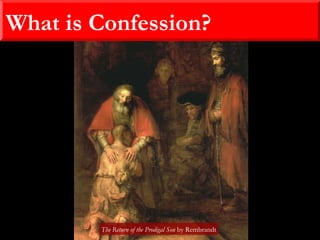
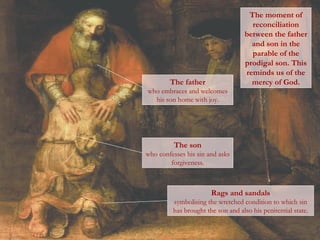
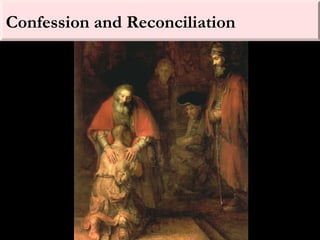
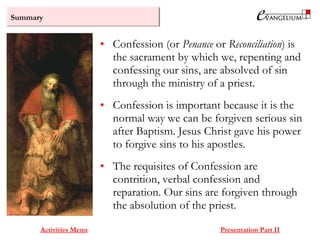
The Return of the Prodigal Son by Rembrandt
What is Confession?
Confession (or Penance or
Reconciliation) is the sacrament
by which we, repenting and
confessing our sins, are
absolved of sin through the
ministry of a priest.
KEY DEFINITION
The moment of
reconciliation
between the father
and son in the
parable of the
prodigal son. This
reminds us of the
mercy of God.
The son
who confesses his sin and asks
forgiveness.
The father
who embraces and welcomes
his son home with joy.
Rags and sandals
symbolising the wretched condition to which sin
has brought the son and also his penitential state.
Why is Confession important?
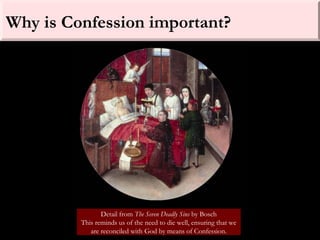
Detail from The Seven Deadly Sins by Bosch
This reminds us of the need to die well, ensuring that we
are reconciled with God by means of Confession.
Why is Confession important?
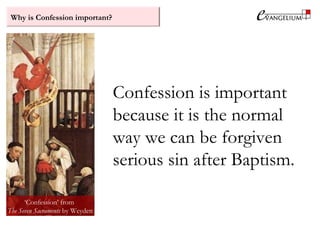
‘Confession’ from
The Seven Sacraments by Weyden
Confession is important
because it is the normal
way we can be forgiven
serious sin after Baptism.
Why is Confession important?
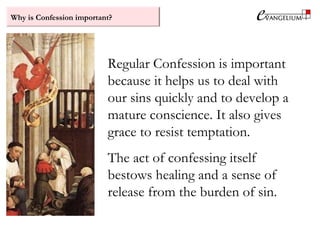
Regular Confession is important
because it helps us to deal with
our sins quickly and to develop a
mature conscience. It also gives
grace to resist temptation.
The act of confessing itself
bestows healing and a sense of
release from the burden of sin.
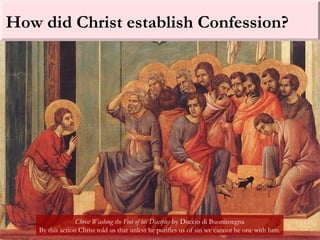
How did Christ establish Confession?
Christ Washing the Feet of his Disciples by Duccio di Buoninsegna
By this action Christ told us that unless he purifies us of sin we cannot be one with him.
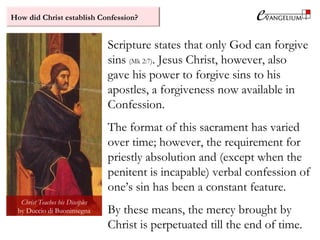
How did Christ establish Confession?
Christ Teaches his Disciples
by Duccio di Buoninsegna
Scripture states that only God can forgive
sins (Mk 2:7). Jesus Christ, however, also
gave his power to forgive sins to his
apostles, a forgiveness now available in
Confession.
The format of this sacrament has varied
over time; however, the requirement for
priestly absolution and (except when the
penitent is incapable) verbal confession of
one’s sin has been a constant feature.
By these means, the mercy brought by
Christ is perpetuated till the end of time.
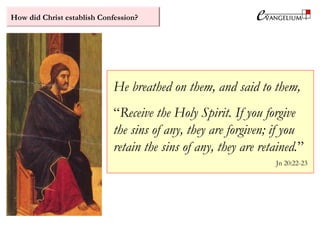
How did Christ establish Confession?
He breathed on them, and said to them,
“Receive the Holy Spirit. If you forgive
the sins of any, they are forgiven; if you
retain the sins of any, they are retained.”
Jn 20:22-23
Confession and Reconciliation
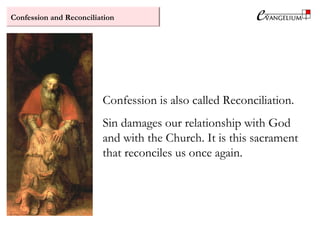
Confession is also called Reconciliation.
Sin damages our relationship with God
and with the Church. It is this sacrament
that reconciles us once again.
Confession and Reconciliation
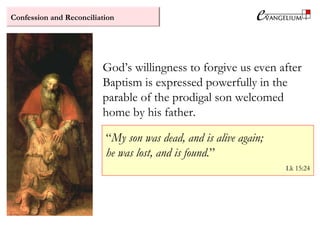
God’s willingness to forgive us even after
Baptism is expressed powerfully in the
parable of the prodigal son welcomed
home by his father.
“My son was dead, and is alive again;
he was lost, and is found.”
Lk 15:24
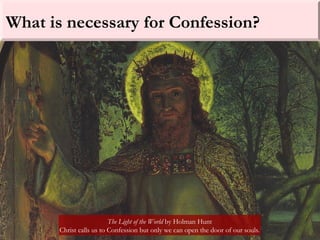
What is necessary for Confession?
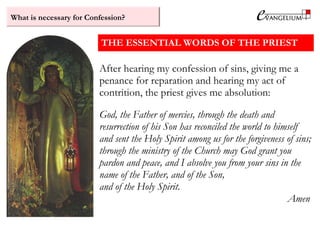
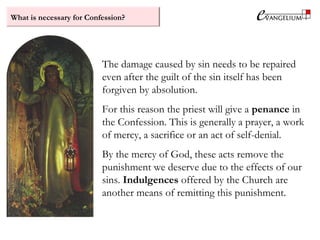
The Light of the World by Holman Hunt
Christ calls us to Confession but only we can open the door of our souls.
What is necessary for Confession?
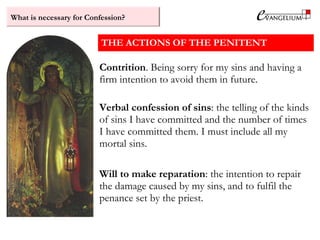
THE ACTIONS OF THE PENITENT
Contrition. Being sorry for my sins and having a
firm intention to avoid them in future.
Verbal confession of sins: the telling of the kinds
of sins I have committed and the number of times
I have committed them. I must include all my
mortal sins.
Will to make reparation: the intention to repair
the damage caused by my sins, and to fulfil the
penance set by the priest.
What is necessary for Confession?
THE ESSENTIAL WORDS OF THE PRIEST
After hearing my confession of sins, giving me a
penance for reparation and hearing my act of
contrition, the priest gives me absolution:
God, the Father of mercies, through the death and
resurrection of his Son has reconciled the world to himself
and sent the Holy Spirit among us for the forgiveness of sins;
through the ministry of the Church may God grant you
pardon and peace, and I absolve you from your sins in the
name of the Father, and of the Son,
and of the Holy Spirit.
Amen
What is necessary for Confession?
The damage caused by sin needs to be repaired
even after the guilt of the sin itself has been
forgiven by absolution.
For this reason the priest will give a penance in
the Confession. This is generally a prayer, a work
of mercy, a sacrifice or an act of self-denial.
By the mercy of God, these acts remove the
punishment we deserve due to the effects of our
sins. Indulgences offered by the Church are
another means of remitting this punishment.
Summary
Questions
to reinforce
key points
Discussion
questions
Practical
activities
Presentation Part II
Summary Activities I
Please select an activity or go immediately
to part II of the presentation
Summary
Activities Menu Presentation Part II
• Confession (or Penance or Reconciliation) is
the sacrament by which we, repenting and
confessing our sins, are absolved of sin
through the ministry of a priest.
• Confession is important because it is the
normal way we can be forgiven serious sin
after Baptism. Jesus Christ gave his power
to forgive sins to his apostles.
• The requisites of Confession are
contrition, verbal confession and
reparation. Our sins are forgiven through
the absolution of the priest.
Questions to reinforce key points
Contrition
Verbal confession of sins
Will to make reparation
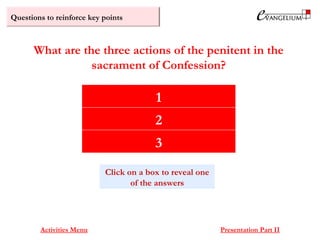
What are the three actions of the penitent in the
sacrament of Confession?
Activities Menu Presentation Part II
1
2
3
Click on a box to reveal one
of the answers
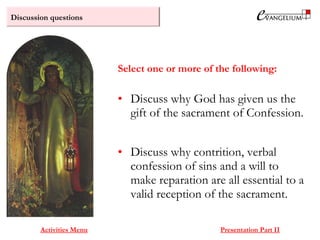
Discussion questions
Activities Menu Presentation Part II
• Discuss why God has given us the
gift of the sacrament of Confession.
• Discuss why contrition, verbal
confession of sins and a will to
make reparation are all essential to a
valid reception of the sacrament.
Select one or more of the following:
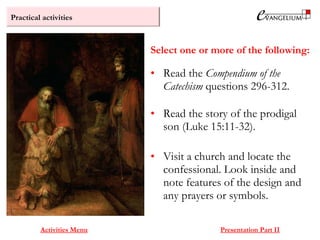
Practical activities
Activities Menu Presentation Part II
• Read the Compendium of the
Catechism questions 296-312.
• Read the story of the prodigal
son (Luke 15:11-32).
• Visit a church and locate the
confessional. Look inside and
note features of the design and
any prayers or symbols.
Select one or more of the following:
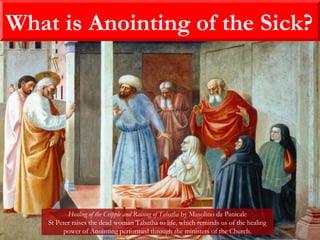
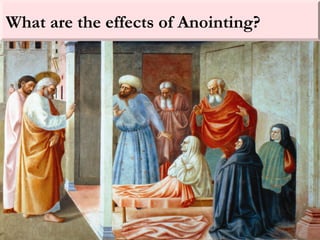
What is Anointing of the Sick?
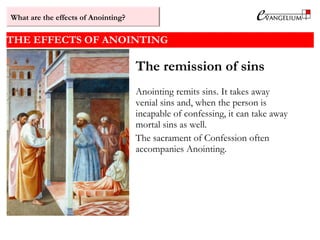
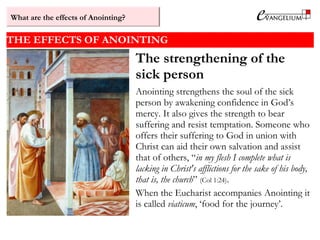
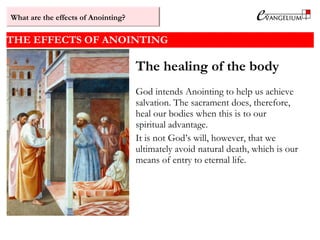
Healing of the Cripple and Raising of Tabatha by Masolino da Panicale
St Peter raises the dead woman Tabatha to life, which reminds us of the healing
power of Anointing performed through the ministers of the Church.
What is Anointing of the Sick?
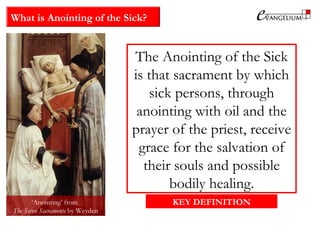
The Anointing of the Sick
is that sacrament by which
sick persons, through
anointing with oil and the
prayer of the priest, receive
grace for the salvation of
their souls and possible
bodily healing.
KEY DEFINITION‘Anointing’ from
The Seven Sacraments by Weyden
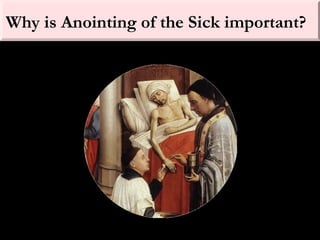
Why is Anointing of the Sick important?
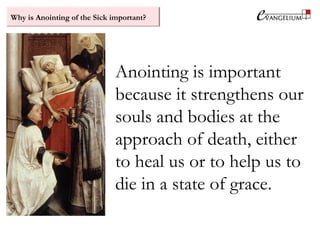
Anointing is important
because it strengthens our
souls and bodies at the
approach of death, either
to heal us or to help us to
die in a state of grace.
Why is Anointing of the Sick important?
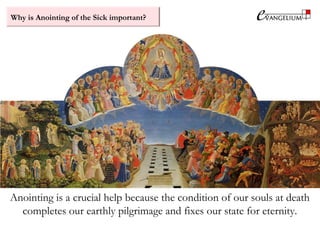
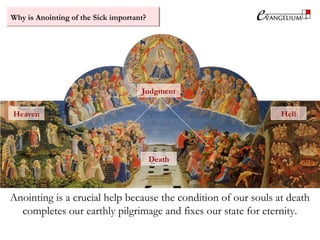
Anointing is a crucial help because the condition of our souls at death
completes our earthly pilgrimage and fixes our state for eternity.
Heaven Hell
Death
Judgment
Why is Anointing of the Sick important?
Anointing is a crucial help because the condition of our souls at death
completes our earthly pilgrimage and fixes our state for eternity.
How did Christ establish Anointing?
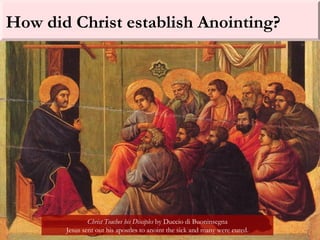
Christ Teaches his Disciples by Duccio di Buoninsegna
Jesus sent out his apostles to anoint the sick and many were cured.
How did Christ establish Anointing?
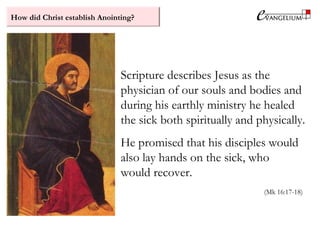
Scripture describes Jesus as the
physician of our souls and bodies and
during his earthly ministry he healed
the sick both spiritually and physically.
He promised that his disciples would
also lay hands on the sick, who
would recover.
(Mk 16:17-18)
How did Christ establish Anointing?
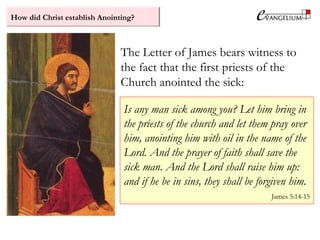
The Letter of James bears witness to
the fact that the first priests of the
Church anointed the sick:
Is any man sick among you? Let him bring in
the priests of the church and let them pray over
him, anointing him with oil in the name of the
Lord. And the prayer of faith shall save the
sick man. And the Lord shall raise him up:
and if he be in sins, they shall be forgiven him.
James 5:14-15
What are the effects of Anointing?
THE EFFECTS OF ANOINTING
The strengthening of the
sick person
Anointing strengthens the soul of the sick
person by awakening confidence in God’s
mercy. It also gives the strength to bear
suffering and resist temptation. Someone who
offers their suffering to God in union with
Christ can aid their own salvation and assist
that of others, “in my flesh I complete what is
lacking in Christ's afflictions for the sake of his body,
that is, the church” (Col 1:24).
When the Eucharist accompanies Anointing it
is called viaticum, ‘food for the journey’.
What are the effects of Anointing?
THE EFFECTS OF ANOINTING
The remission of sins
Anointing remits sins. It takes away
venial sins and, when the person is
incapable of confessing, it can take away
mortal sins as well.
The sacrament of Confession often
accompanies Anointing.
What are the effects of Anointing?
THE EFFECTS OF ANOINTING
The healing of the body
God intends Anointing to help us achieve
salvation. The sacrament does, therefore,
heal our bodies when this is to our
spiritual advantage.
It is not God’s will, however, that we
ultimately avoid natural death, which is our
means of entry to eternal life.
What are the effects of Anointing?
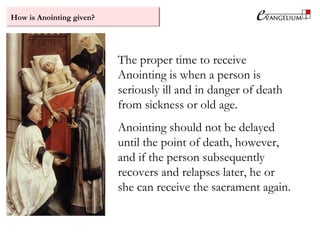
How is Anointing given?
The proper time to receive
Anointing is when a person is
seriously ill and in danger of death
from sickness or old age.
Anointing should not be delayed
until the point of death, however,
and if the person subsequently
recovers and relapses later, he or
she can receive the sacrament again.
How is Anointing given?
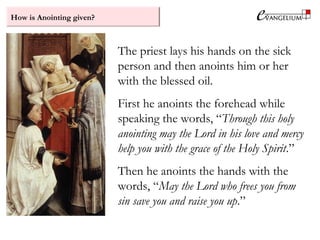
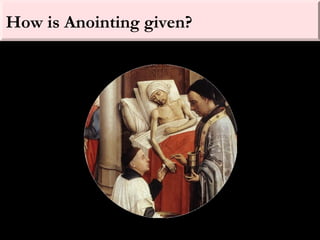
The priest lays his hands on the sick
person and then anoints him or her
with the blessed oil.
First he anoints the forehead while
speaking the words, “Through this holy
anointing may the Lord in his love and mercy
help you with the grace of the Holy Spirit.”
Then he anoints the hands with the
words, “May the Lord who frees you from
sin save you and raise you up.”
Summary
Questions
to reinforce
key points
Discussion
questions
Practical
activities
Summary Activities II
Please select an activity or go immediately
to the concluding prayer
Concluding Prayer
Summary
Activities Menu
• The Anointing of the Sick is that sacrament
by which sick persons, through anointing
with oil and the prayer of the priest, receive
grace for the salvation of their souls and
possible bodily healing.
• Anointing is important because it
strengthens our souls and bodies at the
approach of death, either to heal us or to
help us to die in a state of grace.
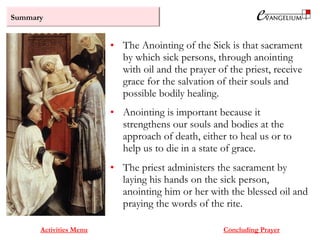
• The priest administers the sacrament by
laying his hands on the sick person,
anointing him or her with the blessed oil and
praying the words of the rite.
Concluding Prayer
Questions to reinforce key points
Strengthening of the sick person
Remission of sins
Healing of the body according to God’s will
What are the effects of the Anointing of the Sick?
Activities Menu Concluding Prayer
1
2
3
Click on a box to reveal one
of the answers
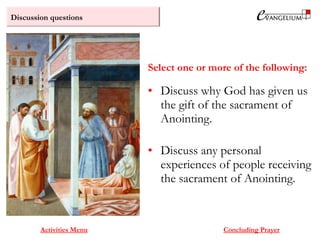
Discussion questions
Activities Menu
• Discuss why God has given us
the gift of the sacrament of
Anointing.
• Discuss any personal
experiences of people receiving
the sacrament of Anointing.
Select one or more of the following:
Concluding Prayer
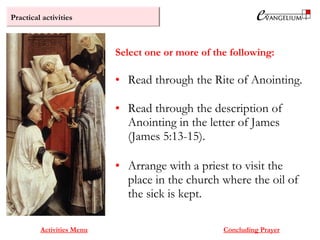
Practical activities
Activities Menu
• Read through the Rite of Anointing.
• Read through the description of
Anointing in the letter of James
(James 5:13-15).
• Arrange with a priest to visit the
place in the church where the oil of
the sick is kept.
Select one or more of the following:
Concluding Prayer
Final Prayer
The ‘Confiteor’
I confess to almighty God, and to you, my brothers and
sisters, that I have sinned through my own fault in my
thoughts and in my words, in what I have done and in
what I have failed to do; and I ask blessed Mary, ever
Virgin, all the angels and saints, and you, my brothers
and sisters, to pray for me to the Lord our God.
Amen.

confession and anointing

  • 1.
  • 2.
    What is Confession? TheReturn of the Prodigal Son by Rembrandt
  • 3.
    What is Confession? Confession(or Penance or Reconciliation) is the sacrament by which we, repenting and confessing our sins, are absolved of sin through the ministry of a priest. KEY DEFINITION
  • 5.
    The moment of reconciliation betweenthe father and son in the parable of the prodigal son. This reminds us of the mercy of God. The son who confesses his sin and asks forgiveness. The father who embraces and welcomes his son home with joy. Rags and sandals symbolising the wretched condition to which sin has brought the son and also his penitential state.
  • 6.
    Why is Confessionimportant? Detail from The Seven Deadly Sins by Bosch This reminds us of the need to die well, ensuring that we are reconciled with God by means of Confession.
  • 7.
    Why is Confessionimportant? ‘Confession’ from The Seven Sacraments by Weyden Confession is important because it is the normal way we can be forgiven serious sin after Baptism.
  • 8.
    Why is Confessionimportant? Regular Confession is important because it helps us to deal with our sins quickly and to develop a mature conscience. It also gives grace to resist temptation. The act of confessing itself bestows healing and a sense of release from the burden of sin.
  • 9.
    How did Christestablish Confession? Christ Washing the Feet of his Disciples by Duccio di Buoninsegna By this action Christ told us that unless he purifies us of sin we cannot be one with him.
  • 10.
    How did Christestablish Confession? Christ Teaches his Disciples by Duccio di Buoninsegna Scripture states that only God can forgive sins (Mk 2:7). Jesus Christ, however, also gave his power to forgive sins to his apostles, a forgiveness now available in Confession. The format of this sacrament has varied over time; however, the requirement for priestly absolution and (except when the penitent is incapable) verbal confession of one’s sin has been a constant feature. By these means, the mercy brought by Christ is perpetuated till the end of time.
  • 11.
    How did Christestablish Confession? He breathed on them, and said to them, “Receive the Holy Spirit. If you forgive the sins of any, they are forgiven; if you retain the sins of any, they are retained.” Jn 20:22-23
  • 12.
  • 13.
    Confession and Reconciliation Confessionis also called Reconciliation. Sin damages our relationship with God and with the Church. It is this sacrament that reconciles us once again.
  • 14.
    Confession and Reconciliation God’swillingness to forgive us even after Baptism is expressed powerfully in the parable of the prodigal son welcomed home by his father. “My son was dead, and is alive again; he was lost, and is found.” Lk 15:24
  • 15.
    What is necessaryfor Confession? The Light of the World by Holman Hunt Christ calls us to Confession but only we can open the door of our souls.
  • 16.
    What is necessaryfor Confession? THE ACTIONS OF THE PENITENT Contrition. Being sorry for my sins and having a firm intention to avoid them in future. Verbal confession of sins: the telling of the kinds of sins I have committed and the number of times I have committed them. I must include all my mortal sins. Will to make reparation: the intention to repair the damage caused by my sins, and to fulfil the penance set by the priest.
  • 17.
    What is necessaryfor Confession? THE ESSENTIAL WORDS OF THE PRIEST After hearing my confession of sins, giving me a penance for reparation and hearing my act of contrition, the priest gives me absolution: God, the Father of mercies, through the death and resurrection of his Son has reconciled the world to himself and sent the Holy Spirit among us for the forgiveness of sins; through the ministry of the Church may God grant you pardon and peace, and I absolve you from your sins in the name of the Father, and of the Son, and of the Holy Spirit. Amen
  • 18.
    What is necessaryfor Confession? The damage caused by sin needs to be repaired even after the guilt of the sin itself has been forgiven by absolution. For this reason the priest will give a penance in the Confession. This is generally a prayer, a work of mercy, a sacrifice or an act of self-denial. By the mercy of God, these acts remove the punishment we deserve due to the effects of our sins. Indulgences offered by the Church are another means of remitting this punishment.
  • 19.
    Summary Questions to reinforce key points Discussion questions Practical activities PresentationPart II Summary Activities I Please select an activity or go immediately to part II of the presentation
  • 20.
    Summary Activities Menu PresentationPart II • Confession (or Penance or Reconciliation) is the sacrament by which we, repenting and confessing our sins, are absolved of sin through the ministry of a priest. • Confession is important because it is the normal way we can be forgiven serious sin after Baptism. Jesus Christ gave his power to forgive sins to his apostles. • The requisites of Confession are contrition, verbal confession and reparation. Our sins are forgiven through the absolution of the priest.
  • 21.
    Questions to reinforcekey points Contrition Verbal confession of sins Will to make reparation What are the three actions of the penitent in the sacrament of Confession? Activities Menu Presentation Part II 1 2 3 Click on a box to reveal one of the answers
  • 22.
    Discussion questions Activities MenuPresentation Part II • Discuss why God has given us the gift of the sacrament of Confession. • Discuss why contrition, verbal confession of sins and a will to make reparation are all essential to a valid reception of the sacrament. Select one or more of the following:
  • 23.
    Practical activities Activities MenuPresentation Part II • Read the Compendium of the Catechism questions 296-312. • Read the story of the prodigal son (Luke 15:11-32). • Visit a church and locate the confessional. Look inside and note features of the design and any prayers or symbols. Select one or more of the following:
  • 24.
    What is Anointingof the Sick? Healing of the Cripple and Raising of Tabatha by Masolino da Panicale St Peter raises the dead woman Tabatha to life, which reminds us of the healing power of Anointing performed through the ministers of the Church.
  • 25.
    What is Anointingof the Sick? The Anointing of the Sick is that sacrament by which sick persons, through anointing with oil and the prayer of the priest, receive grace for the salvation of their souls and possible bodily healing. KEY DEFINITION‘Anointing’ from The Seven Sacraments by Weyden
  • 26.
    Why is Anointingof the Sick important?
  • 27.
    Why is Anointingof the Sick important? Anointing is important because it strengthens our souls and bodies at the approach of death, either to heal us or to help us to die in a state of grace.
  • 28.
    Why is Anointingof the Sick important? Anointing is a crucial help because the condition of our souls at death completes our earthly pilgrimage and fixes our state for eternity.
  • 29.
    Heaven Hell Death Judgment Why isAnointing of the Sick important? Anointing is a crucial help because the condition of our souls at death completes our earthly pilgrimage and fixes our state for eternity.
  • 30.
    How did Christestablish Anointing? Christ Teaches his Disciples by Duccio di Buoninsegna Jesus sent out his apostles to anoint the sick and many were cured.
  • 31.
    How did Christestablish Anointing? Scripture describes Jesus as the physician of our souls and bodies and during his earthly ministry he healed the sick both spiritually and physically. He promised that his disciples would also lay hands on the sick, who would recover. (Mk 16:17-18)
  • 32.
    How did Christestablish Anointing? The Letter of James bears witness to the fact that the first priests of the Church anointed the sick: Is any man sick among you? Let him bring in the priests of the church and let them pray over him, anointing him with oil in the name of the Lord. And the prayer of faith shall save the sick man. And the Lord shall raise him up: and if he be in sins, they shall be forgiven him. James 5:14-15
  • 33.
    What are theeffects of Anointing?
  • 34.
    THE EFFECTS OFANOINTING The strengthening of the sick person Anointing strengthens the soul of the sick person by awakening confidence in God’s mercy. It also gives the strength to bear suffering and resist temptation. Someone who offers their suffering to God in union with Christ can aid their own salvation and assist that of others, “in my flesh I complete what is lacking in Christ's afflictions for the sake of his body, that is, the church” (Col 1:24). When the Eucharist accompanies Anointing it is called viaticum, ‘food for the journey’. What are the effects of Anointing?
  • 35.
    THE EFFECTS OFANOINTING The remission of sins Anointing remits sins. It takes away venial sins and, when the person is incapable of confessing, it can take away mortal sins as well. The sacrament of Confession often accompanies Anointing. What are the effects of Anointing?
  • 36.
    THE EFFECTS OFANOINTING The healing of the body God intends Anointing to help us achieve salvation. The sacrament does, therefore, heal our bodies when this is to our spiritual advantage. It is not God’s will, however, that we ultimately avoid natural death, which is our means of entry to eternal life. What are the effects of Anointing?
  • 37.
  • 38.
    How is Anointinggiven? The proper time to receive Anointing is when a person is seriously ill and in danger of death from sickness or old age. Anointing should not be delayed until the point of death, however, and if the person subsequently recovers and relapses later, he or she can receive the sacrament again.
  • 39.
    How is Anointinggiven? The priest lays his hands on the sick person and then anoints him or her with the blessed oil. First he anoints the forehead while speaking the words, “Through this holy anointing may the Lord in his love and mercy help you with the grace of the Holy Spirit.” Then he anoints the hands with the words, “May the Lord who frees you from sin save you and raise you up.”
  • 40.
    Summary Questions to reinforce key points Discussion questions Practical activities SummaryActivities II Please select an activity or go immediately to the concluding prayer Concluding Prayer
  • 41.
    Summary Activities Menu • TheAnointing of the Sick is that sacrament by which sick persons, through anointing with oil and the prayer of the priest, receive grace for the salvation of their souls and possible bodily healing. • Anointing is important because it strengthens our souls and bodies at the approach of death, either to heal us or to help us to die in a state of grace. • The priest administers the sacrament by laying his hands on the sick person, anointing him or her with the blessed oil and praying the words of the rite. Concluding Prayer
  • 42.
    Questions to reinforcekey points Strengthening of the sick person Remission of sins Healing of the body according to God’s will What are the effects of the Anointing of the Sick? Activities Menu Concluding Prayer 1 2 3 Click on a box to reveal one of the answers
  • 43.
    Discussion questions Activities Menu •Discuss why God has given us the gift of the sacrament of Anointing. • Discuss any personal experiences of people receiving the sacrament of Anointing. Select one or more of the following: Concluding Prayer
  • 44.
    Practical activities Activities Menu •Read through the Rite of Anointing. • Read through the description of Anointing in the letter of James (James 5:13-15). • Arrange with a priest to visit the place in the church where the oil of the sick is kept. Select one or more of the following: Concluding Prayer
  • 45.
    Final Prayer The ‘Confiteor’ Iconfess to almighty God, and to you, my brothers and sisters, that I have sinned through my own fault in my thoughts and in my words, in what I have done and in what I have failed to do; and I ask blessed Mary, ever Virgin, all the angels and saints, and you, my brothers and sisters, to pray for me to the Lord our God. Amen.