Presented to: Mrs. Richa Arora
Presented By: GAURAV
What is virtual reality ?
– Virtual reality is a computer generated world with which the user can interact
– Interaction can ve vary from looking around to interactively modifying the
world.
How it works
– Our brain is the real virtual world and VR headset like things only plays with our
sense by making us visualize that as a part of the virtual environment.
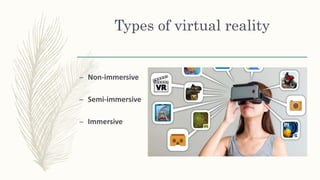
Types of virtual reality
– Non-immersive
– Semi-immersive
– Immersive
VR Headsets
The most important
piece of virtual reality
is the headset, a
device like a pair of
goggles that goes over
your eyes.
Popular VR Headsets
Sony PS VRHTC Vive
Oculus Rift Samsung Gear VR
Applications of virtual reality
– TRAVEL INDUSTRY:
Soon we might have full body VR
suits that simulate temperature,
wind and a variety of other
sensations from the environment
we are transported to.
Virtual reality in Gaming
– VR is considered to be the
future of video gaming.
Market players are
increasingly focusing on
introducing innovative
products to provide users
with rich experience.
Education and Training
– VR is used in various
education and training
institutes to teach the
students more effectively
by providing virtual
enviroment.
Advantages of Virtual Reality:
1) Virtual reality creates a realistic world
2) It enables user to explore places.
3) Through Virtual Reality user can experiment with an artificial environment.
4) Virtual Reality make the education more easily and comfort.
Disadvantages of Virtual Reality
1) The equipments used in virtual reality are very expensive.
2) In virtual reality environment we cant move by our own
like in the real world.
Refrences
– https://en.wikipedia.org/wiki/Virtual_reality
– https://www.vrs.org.uk/virtual-reality/what-is-virtual-reality.html
MCQ
Which of these is not a VR Headset ?
– A. HTC Vive
– B. HTC Dezire
– C. Oculus Rift
– D.Sony PS VR
MCQ
HMD stands for ?
– A. High Media Display
– B. Head Mounted Display
– C. Higher Monitor Display
– D.Head mapped Display
MCQ
VR stands for.......
– A. Virtual Reality
– B. Vast Reality
– C. Vital Reality
– D.Virtual Research
MCQ
AR stands for.......
– A.Artificial Reality
– B. Augmented Reality
– C. Artificial Recognition
– D.Artificial esearch
THANK YOU

Virtual reality - simulated enviroment

  • 1.
    Presented to: Mrs.Richa Arora Presented By: GAURAV
  • 2.
    What is virtualreality ? – Virtual reality is a computer generated world with which the user can interact – Interaction can ve vary from looking around to interactively modifying the world.
  • 3.
    How it works –Our brain is the real virtual world and VR headset like things only plays with our sense by making us visualize that as a part of the virtual environment.
  • 4.
    Types of virtualreality – Non-immersive – Semi-immersive – Immersive
  • 5.
    VR Headsets The mostimportant piece of virtual reality is the headset, a device like a pair of goggles that goes over your eyes.
  • 6.
    Popular VR Headsets SonyPS VRHTC Vive Oculus Rift Samsung Gear VR
  • 7.
    Applications of virtualreality – TRAVEL INDUSTRY: Soon we might have full body VR suits that simulate temperature, wind and a variety of other sensations from the environment we are transported to.
  • 8.
    Virtual reality inGaming – VR is considered to be the future of video gaming. Market players are increasingly focusing on introducing innovative products to provide users with rich experience.
  • 9.
    Education and Training –VR is used in various education and training institutes to teach the students more effectively by providing virtual enviroment.
  • 10.
    Advantages of VirtualReality: 1) Virtual reality creates a realistic world 2) It enables user to explore places. 3) Through Virtual Reality user can experiment with an artificial environment. 4) Virtual Reality make the education more easily and comfort.
  • 11.
    Disadvantages of VirtualReality 1) The equipments used in virtual reality are very expensive. 2) In virtual reality environment we cant move by our own like in the real world.
  • 13.
  • 14.
    MCQ Which of theseis not a VR Headset ? – A. HTC Vive – B. HTC Dezire – C. Oculus Rift – D.Sony PS VR
  • 15.
    MCQ HMD stands for? – A. High Media Display – B. Head Mounted Display – C. Higher Monitor Display – D.Head mapped Display
  • 16.
    MCQ VR stands for....... –A. Virtual Reality – B. Vast Reality – C. Vital Reality – D.Virtual Research
  • 17.
    MCQ AR stands for....... –A.Artificial Reality – B. Augmented Reality – C. Artificial Recognition – D.Artificial esearch
  • 18.

Editor's Notes

  • #4 The virtual environment built in such a way that it succeeds to convince our brain that you are the part of the virtual environment and make you feel like you're transported to genuine like virtual environment
  • #5 Types of Virtual Reality: Non-immersive simulations are the least immersive implementation of virtual reality technology. In a non-immersive simulation, only a subset of the user's senses are stimulated, allowing for peripheral awareness of the reality outside the virtual reality simulation. Users enter into these three-dimensional virtual environments through a portal or window by utilising standard high resolution monitors powered by processing power typically found on conventional desktop workstations. Semi-immersive simulations provide a more immersive experience, in which the user is partly but not fully immersed in a virtual environment. Semi-immersive simulations closely resemble and utilize many of the same technologies found in flight simulation. Semi-immersive simulations are powered by high performance graphical computing systems, which are often then coupled with large screen projector systems or multiple television projection systems to properly stimulate the user's visuals. Fully-immersive simulations provide the most immersive implementation of virtual reality technology. In a fully-immersive simulation, hardware such as head-mounted displays and motion detecting devices are used to stimulate all of a user's senses. Fully immersive simulations are able to provide very realistic user experiences by delivering a wide field of view, high resolutions, increased update rates (also called refresh rate), and high levels of contrast into a user's head-mounted display (HMD).
  • #6 The more expensive, higher quality headsets need to be connected to a computer to run apps and games, while some cheaper ones use a mobile placed at the front of the headset. Headsets work best when combined with a pair of headphones, and there are other optional accessories such as hand controllers, to enhance your simulated experience of being in another world.
  • #8 Non-immersive - Augmented reality or VR which affects only 1 of 4 sensory systems (e.g. hearing, vision, scent, touch) Semi-immersive -Affects 2–3 sensory systems Immersive - Affects ALL sensory systems which gives you the ability to immerse fully into the virtual reality game/application. For example, in the U.S. even now they use fully-immersive virtual reality systems during mental diseases treatment, generally in medicine Instead of flying around the world, you could enter the world of Virtual Reality. With VR headsets advancing so rapidly we are left to think “What’s the next thing?”.
  • #10  Virtual Reality provides ways to use 3D visualizations with which the user can interact
  • #13 The technology has been improving rapidly over the last few years and will continue to do so. However, due to the complexity involved in creating high quality VR content, there isn’t too much of it around. This will change as headset sales increase and the customer market size increases, giving greater incentive for content creators to produce engaging experiences. We can expect to see many more innovative uses for the technology in the future as we prepare for a whole new virtual world of entertainment, information and communication, as engineers, developers, games designers and film-makers explore the medium and its new creative potential. Virtual Reality is a virtual environment or world in which users can interact, and can fools our senses into believing what we hear, touch, and of course see. By using cutting edge software and hardware, Virtual Reality will definitely impact a wide range of industries, and undoubtedly most notably - the entertainment industry.