VIRTUAL REALITY (VR)
PRESENTED BY-
MANOJ KUMAR MAHANTA
+3 , 3RD YEAR (CS)
BS-17-159
OVERVIEW-
WHAT IS VIRTUAL REALITY?
HISTORY OF VIRTUAL REALITY.
TYPES OF VIRTUAL REALITY.
VIRTUAL REALITY HARDWARE.
APPLICATIONS OF VIRTUAL REALITY.
FUTURE OF VIRTUAL REALITY.
INTRODUCTION :
WHAT IS VIRTUAL REALITY(VR)?
VIRTUAL REALITY REFERS TO A HIGH-END
USER INTERFACE THAT INVOLVES REAL-TIME
SIMULATION AND INTERACTIONS THROUGH
MULTIPLE SENSORIAL CHANNELS.
IN OTHER WORDS,
VIRTUAL REALITY IS A COMPUTER
GENERATED WORLD WITH WHICH THE USER
CAN INTERACT WITH THE COMPUTER
GRNRRATED VIRTUAL WORLD.
The must difficult things in the virtual reality is to produce the interaction
between the virtual world and the human but not the production of virtual world .
The human is completely isolated from the out side world and he is placed an
entirely computer generated world .
HISTORY OF VR :
• In 1962 visionary cinematographer Morton H Eilig built a single user
console called Sensorama . This enabled the user watch television in
three dimensional ways.
• The first actual VR head-mounted display (HMD) was created in
1968 by computer scientist Ivan Sutherland. Sutherland was
one of the most important figures in the history of computer
graphics, having developed the revolutionary “Sketchpad”
software that paves the way for tools like Computer-Aided
Design (CAD).
TYPES OF VR SYSTEM -
Immersive Virtual Reality
Augmented Virtual Reality
Desktop (Window on a World) Virtual Reality
Video Mapping Virtual Reality
IMMERSIVE VR -
It is basically a feeling of involvement of the user in the virtual
world .
The user has no visual contact with the physical word.
Often equipped with a Head Mounted Display (HMD).
This unique combinations where the user can immerse as well
interact with the simulations is known as Telepresence
AUGMENTED VR -
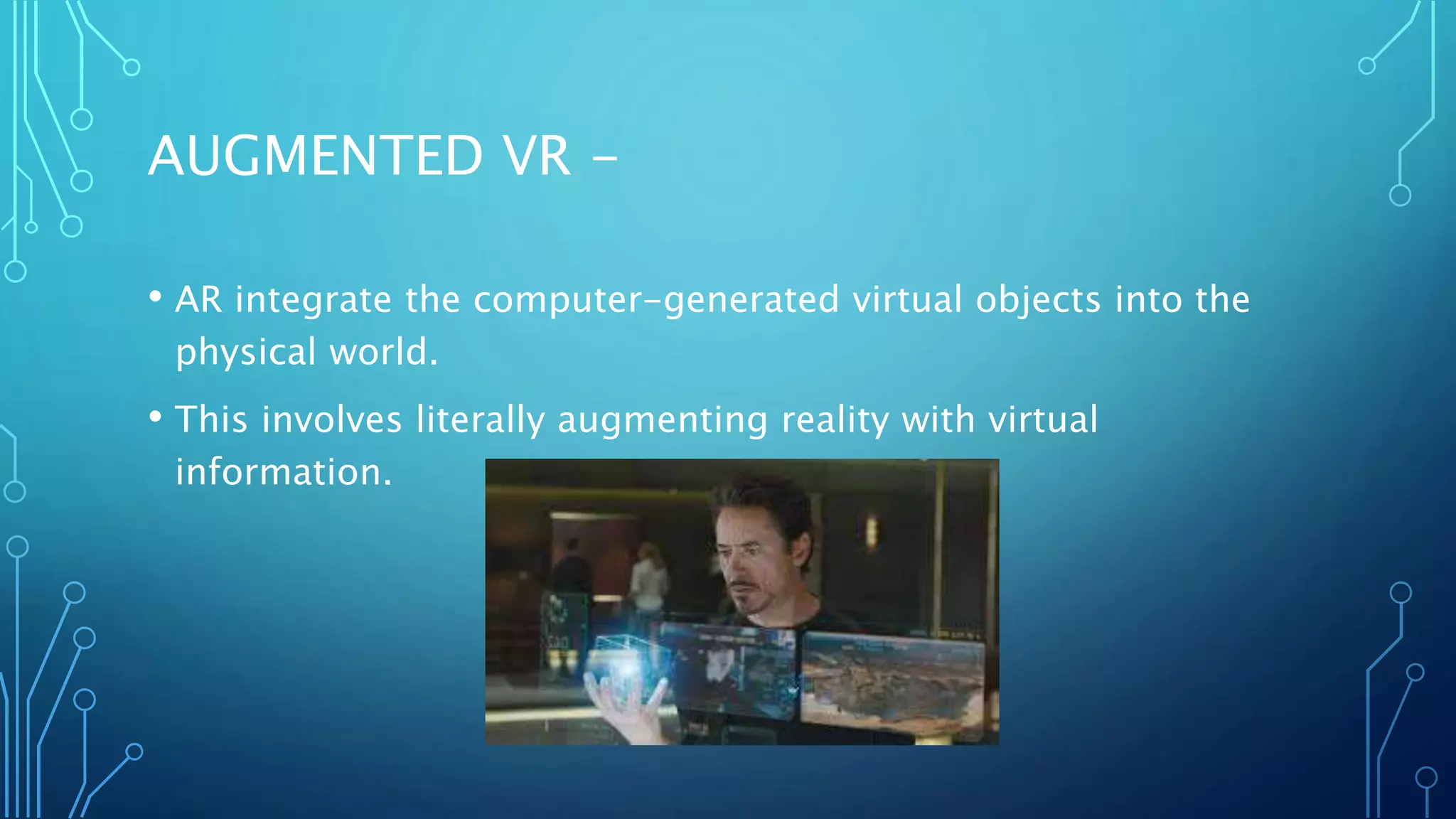
• AR integrate the computer-generated virtual objects into the
physical world.
• This involves literally augmenting reality with virtual
information.
DESKTOP VR -
• Desktop-based virtual reality involves displaying a 3-
dimensional virtual world on a regular desktop display without
use of any specialized movement-tracking equipment.
• Modern computer games can be used as an example
VIDEO MAPPING VR -
• This is technique used to map the motion of a human using
special electronic devices like camera and sensors
• Here the input to the computer is the motion of the human
and the out put is the 2D graphical image of the human .
VR-HARDWARE :
HMD’S –
A head-mounted display (HMD) is a display device, worn on the
head or as part of a helmet , that has a small display optic in
front of one (monocular HMD) or each eye (binocular HMD). A
HMD has many uses, including in gaming, aviation, engineering,
and medicine lift. A head-mounted display is the primary
component of virtual reality headsets.
U.S. Air Force flight
equipment technician
testing a
Scorpion helmet mounted
integrated targeting
system.
CAVE -
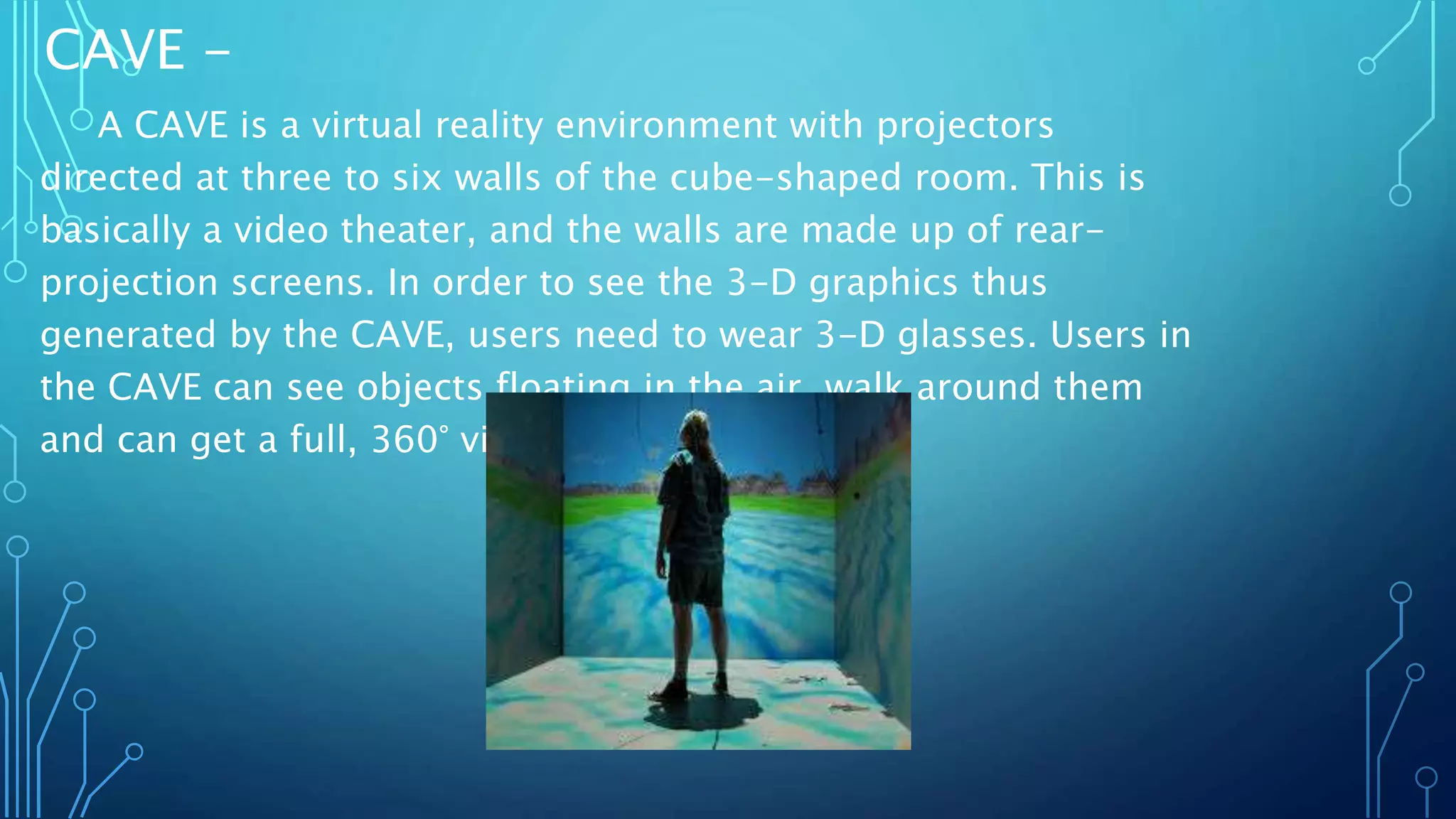
A CAVE is a virtual reality environment with projectors
directed at three to six walls of the cube-shaped room. This is
basically a video theater, and the walls are made up of rear-
projection screens. In order to see the 3-D graphics thus
generated by the CAVE, users need to wear 3-D glasses. Users in
the CAVE can see objects floating in the air, walk around them
and can get a full, 360° view.
PROGRAMMING -
• We can develop virtual world by using the programming
language also.
• VRML (virtual reality modelling language)
VRML v 2.0
APPLICATIONS OF VR :
• E-Commerce And Business:
Virtual reality is being used in a number of ways by the business
community which include
Virtual tours of a business environment.
Training of new employees.
A 360 view of a product.
TRAINING:
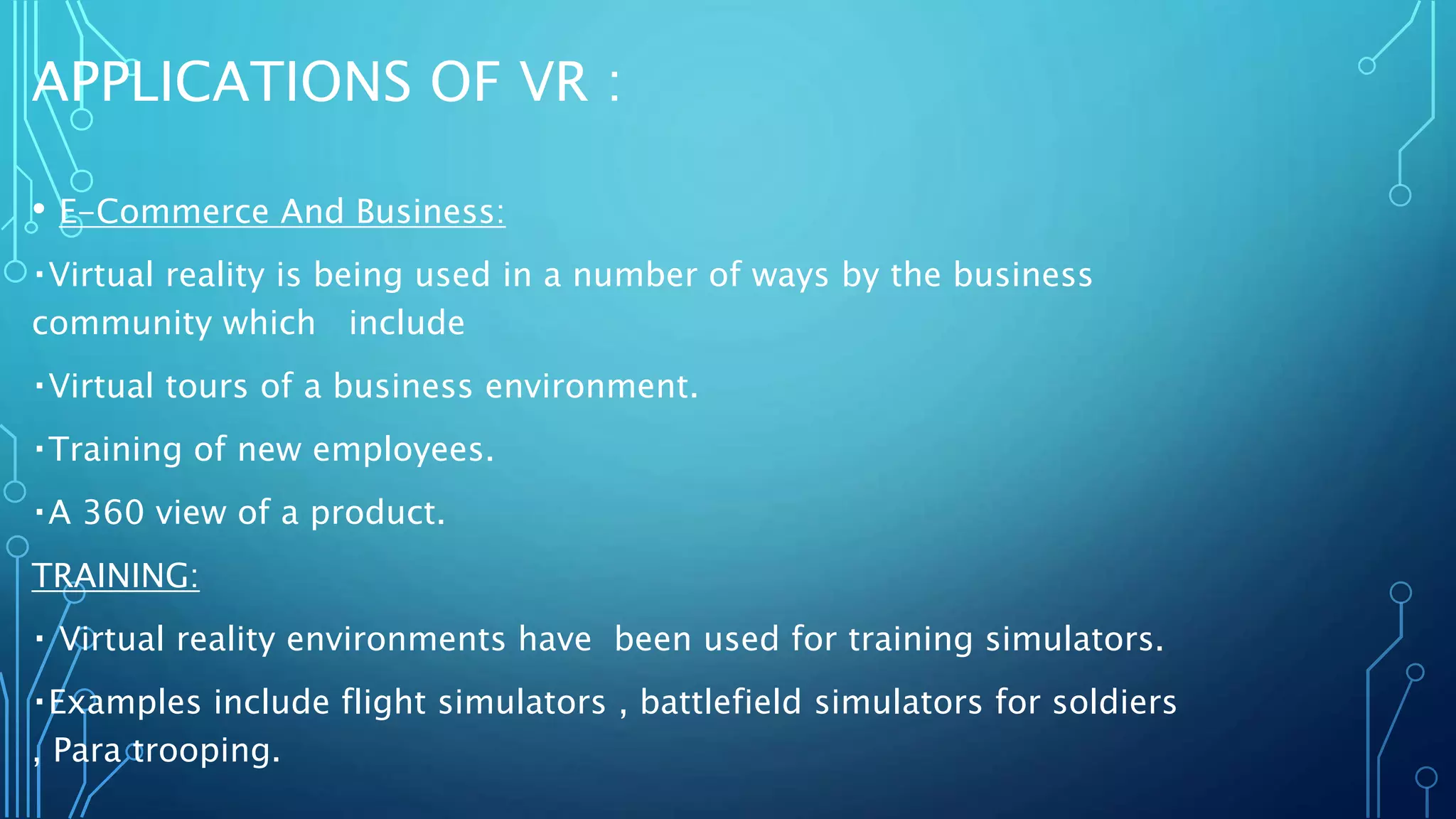
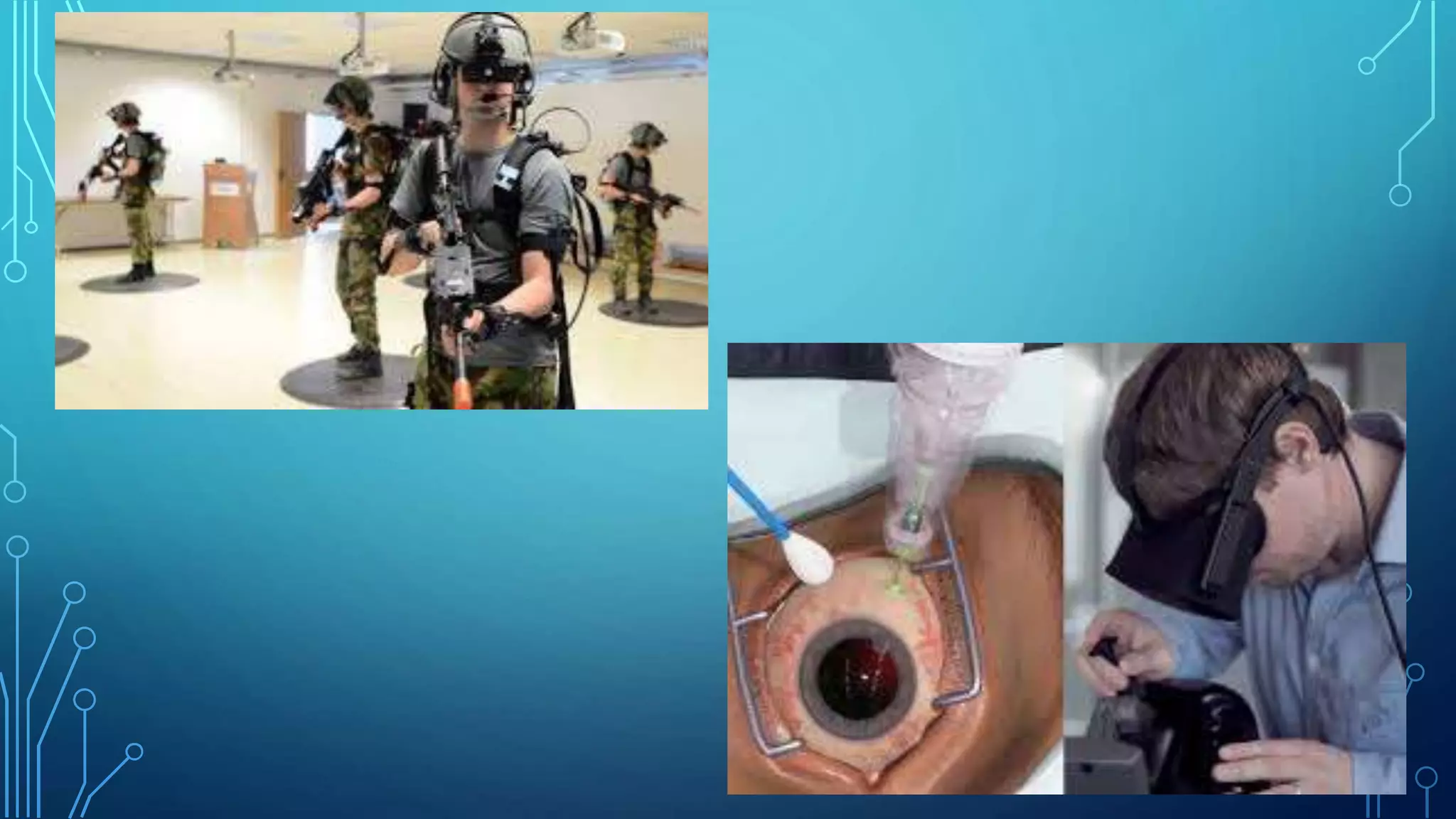
Virtual reality environments have been used for training simulators.
Examples include flight simulators , battlefield simulators for soldiers
, Para trooping.
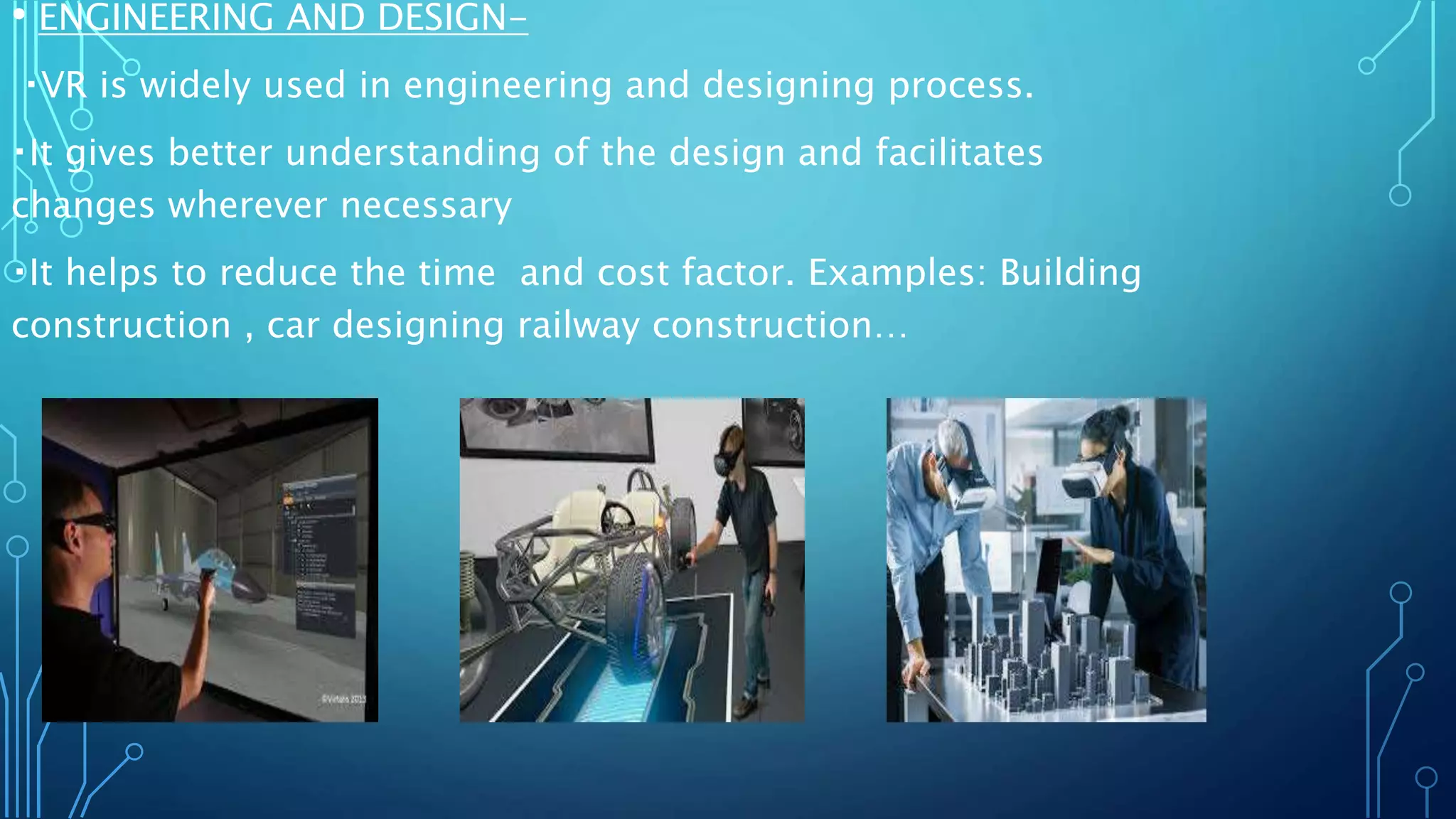
• ENGINEERING AND DESIGN-
VR is widely used in engineering and designing process.
It gives better understanding of the design and facilitates
changes wherever necessary
It helps to reduce the time and cost factor. Examples: Building
construction , car designing railway construction…
• ENTERTENMENT –
The entertainment industry is one of the most enthusiastic
advocates of virtual reality, most noticeably in games and virtual
worlds.
Virtual Museum, e.g. interactive exhibitions
Gaming
Film and theaters
Virtual theme parks
MEDICAL –
Nano surgery .
medical and nursing student.
CONCLUSION -
• Virtual Reality is a growing industry
• The theories behind its design and operation of VR are still
being written. There are 61,400 international commercial
companies producing VR. There are approximately 3,600
educational institutions which use VR.
THANK YOU

Virtual reality (vr)

  • 1.
    VIRTUAL REALITY (VR) PRESENTEDBY- MANOJ KUMAR MAHANTA +3 , 3RD YEAR (CS) BS-17-159
  • 2.
    OVERVIEW- WHAT IS VIRTUALREALITY? HISTORY OF VIRTUAL REALITY. TYPES OF VIRTUAL REALITY. VIRTUAL REALITY HARDWARE. APPLICATIONS OF VIRTUAL REALITY. FUTURE OF VIRTUAL REALITY.
  • 3.
    INTRODUCTION : WHAT ISVIRTUAL REALITY(VR)? VIRTUAL REALITY REFERS TO A HIGH-END USER INTERFACE THAT INVOLVES REAL-TIME SIMULATION AND INTERACTIONS THROUGH MULTIPLE SENSORIAL CHANNELS. IN OTHER WORDS, VIRTUAL REALITY IS A COMPUTER GENERATED WORLD WITH WHICH THE USER CAN INTERACT WITH THE COMPUTER GRNRRATED VIRTUAL WORLD.
  • 4.
    The must difficultthings in the virtual reality is to produce the interaction between the virtual world and the human but not the production of virtual world . The human is completely isolated from the out side world and he is placed an entirely computer generated world .
  • 5.
    HISTORY OF VR: • In 1962 visionary cinematographer Morton H Eilig built a single user console called Sensorama . This enabled the user watch television in three dimensional ways.
  • 6.
    • The firstactual VR head-mounted display (HMD) was created in 1968 by computer scientist Ivan Sutherland. Sutherland was one of the most important figures in the history of computer graphics, having developed the revolutionary “Sketchpad” software that paves the way for tools like Computer-Aided Design (CAD).
  • 7.
    TYPES OF VRSYSTEM - Immersive Virtual Reality Augmented Virtual Reality Desktop (Window on a World) Virtual Reality Video Mapping Virtual Reality
  • 8.
    IMMERSIVE VR - Itis basically a feeling of involvement of the user in the virtual world . The user has no visual contact with the physical word. Often equipped with a Head Mounted Display (HMD). This unique combinations where the user can immerse as well interact with the simulations is known as Telepresence
  • 9.
    AUGMENTED VR - •AR integrate the computer-generated virtual objects into the physical world. • This involves literally augmenting reality with virtual information.
  • 10.
    DESKTOP VR - •Desktop-based virtual reality involves displaying a 3- dimensional virtual world on a regular desktop display without use of any specialized movement-tracking equipment. • Modern computer games can be used as an example
  • 11.
    VIDEO MAPPING VR- • This is technique used to map the motion of a human using special electronic devices like camera and sensors • Here the input to the computer is the motion of the human and the out put is the 2D graphical image of the human .
  • 12.
    VR-HARDWARE : HMD’S – Ahead-mounted display (HMD) is a display device, worn on the head or as part of a helmet , that has a small display optic in front of one (monocular HMD) or each eye (binocular HMD). A HMD has many uses, including in gaming, aviation, engineering, and medicine lift. A head-mounted display is the primary component of virtual reality headsets. U.S. Air Force flight equipment technician testing a Scorpion helmet mounted integrated targeting system.
  • 13.
    CAVE - A CAVEis a virtual reality environment with projectors directed at three to six walls of the cube-shaped room. This is basically a video theater, and the walls are made up of rear- projection screens. In order to see the 3-D graphics thus generated by the CAVE, users need to wear 3-D glasses. Users in the CAVE can see objects floating in the air, walk around them and can get a full, 360° view.
  • 14.
    PROGRAMMING - • Wecan develop virtual world by using the programming language also. • VRML (virtual reality modelling language) VRML v 2.0
  • 15.
    APPLICATIONS OF VR: • E-Commerce And Business: Virtual reality is being used in a number of ways by the business community which include Virtual tours of a business environment. Training of new employees. A 360 view of a product. TRAINING: Virtual reality environments have been used for training simulators. Examples include flight simulators , battlefield simulators for soldiers , Para trooping.
  • 17.
    • ENGINEERING ANDDESIGN- VR is widely used in engineering and designing process. It gives better understanding of the design and facilitates changes wherever necessary It helps to reduce the time and cost factor. Examples: Building construction , car designing railway construction…
  • 18.
    • ENTERTENMENT – Theentertainment industry is one of the most enthusiastic advocates of virtual reality, most noticeably in games and virtual worlds. Virtual Museum, e.g. interactive exhibitions Gaming Film and theaters Virtual theme parks MEDICAL – Nano surgery . medical and nursing student.
  • 19.
    CONCLUSION - • VirtualReality is a growing industry • The theories behind its design and operation of VR are still being written. There are 61,400 international commercial companies producing VR. There are approximately 3,600 educational institutions which use VR.
  • 20.