KIET GROUP OF INSTITUTION
Welcome
To
SUBMITTED BY SUBMITTED TO
ANMOL GOYAL MISS. NEELAM RAWAT MAM
Presentation on
Virtual Reality
VIRTUAL REALITY
CONTENTS
❖What is Virtual Reality
❖History
❖Types of Virtual Reality
❖Hardware Devices
❖ Difference between VR and AR
❖Application of Virtual Reality
❖Advantages and Disadvantages of
Virtual Reality
❖Future of Virtual reality
❖References
WHAT IS VIRTUAL
REALITY?
Virtual Reality means feelings the imaginary(virtual) world,
rather than the real one.
• The imaginary world is a simulation running in a computer.
• The definition of ‘Virtual’ is near and ‘reality’ is what we have
experience as human being.
• It generates 3D environment
HISTORY OF VIRTUAL
REALITY
• More than one person has been involved in the
development of this technological system.
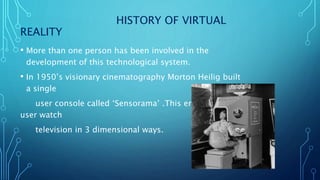
• In 1950’s visionary cinematography Morton Heilig built
a single
user console called ‘Sensorama’ .This enabled the
user watch
television in 3 dimensional ways.
FULL-IMMERSIVE VIRTUAL
REALITY
• Fully-immersive simulations give users
the most realistic simulation experience,
complete with sight and sound.
To experience and interact with fully-immersive
virtual reality, the user needs the proper
VR glasses or a head mount display
(HMD).
• This type of VR has been commonly
adapted for gaming and
other entertainment purposes.
SEMI-IMMERSIVE
VIRTUAL REALITY
• A semi-immersive virtual reality is something
in between non-immersive and fully immersive
virtual reality.
• Using a computer screen or VR glasses, you can move around in a
virtual environment but other than your visual experience
you will have no physical sensations to enhance the experience.
NON-
IMMERSIVE VIRTUAL REALITY
• Large display, but doesn’t surround the user.
• Non-immersive virtual reality is a type of virtual reality in which you
interact with a virtual environment usually through a computer
where you can control some characters or activities within the
experience, but the virtual environment is not directly interacting
with you.
HARDWARE DEVICES
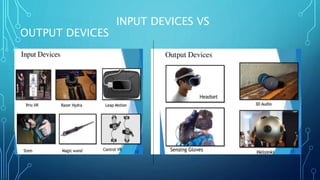
• Input Devices
• Output Devices
INPUT DEVICES VS
OUTPUT DEVICES
VR(VIRTUAL
REALITY)
VS
AR(AUGMENTED
REALITY)
• VR is immersive virtual environment.
• VR users are controlled by the system.
• VR can be accessed with a smartphone.
• VR only enhances a fictional reality.
• VR bandwidth is less
• AR uses a real-world setting.
• AR users can control their presence in the
real world.
• VR requires a headset device.
• AR enhances both the virtual and real
world.
• AR bandwidth is more
VR APPLICATIONS
• Virtual Reality in the Military
• Virtual Reality in Healthcare
• Virtual Reality and Education
• Virtual Reality and Scientific Visualization
• Virtual Reality in Entertainment
VR Applications
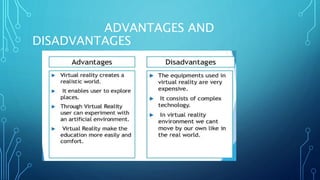
ADVANTAGES AND
DISADVANTAGES
FUTURE OF VIRTUAL REALITY
• Virtual Reality is growing industry
• Revolution in gaming industries
• Maybe 3D user interface will replace the windows based ones?
REFERENCES
• https://www.slideshare.net/saishanesarikar/virtual-reality-
ppt-80531390
• https://youtu.be/qhhyagPK8C0
• https://youtu.be/P-uGD3MUibI
Thank You

Virtual Reality ppt

  • 1.
    KIET GROUP OFINSTITUTION Welcome To
  • 2.
    SUBMITTED BY SUBMITTEDTO ANMOL GOYAL MISS. NEELAM RAWAT MAM Presentation on Virtual Reality
  • 3.
  • 4.
    CONTENTS ❖What is VirtualReality ❖History ❖Types of Virtual Reality ❖Hardware Devices ❖ Difference between VR and AR ❖Application of Virtual Reality ❖Advantages and Disadvantages of Virtual Reality ❖Future of Virtual reality ❖References
  • 5.
    WHAT IS VIRTUAL REALITY? VirtualReality means feelings the imaginary(virtual) world, rather than the real one. • The imaginary world is a simulation running in a computer. • The definition of ‘Virtual’ is near and ‘reality’ is what we have experience as human being. • It generates 3D environment
  • 6.
    HISTORY OF VIRTUAL REALITY •More than one person has been involved in the development of this technological system. • In 1950’s visionary cinematography Morton Heilig built a single user console called ‘Sensorama’ .This enabled the user watch television in 3 dimensional ways.
  • 9.
    FULL-IMMERSIVE VIRTUAL REALITY • Fully-immersivesimulations give users the most realistic simulation experience, complete with sight and sound. To experience and interact with fully-immersive virtual reality, the user needs the proper VR glasses or a head mount display (HMD). • This type of VR has been commonly adapted for gaming and other entertainment purposes.
  • 10.
    SEMI-IMMERSIVE VIRTUAL REALITY • Asemi-immersive virtual reality is something in between non-immersive and fully immersive virtual reality. • Using a computer screen or VR glasses, you can move around in a virtual environment but other than your visual experience you will have no physical sensations to enhance the experience.
  • 11.
    NON- IMMERSIVE VIRTUAL REALITY •Large display, but doesn’t surround the user. • Non-immersive virtual reality is a type of virtual reality in which you interact with a virtual environment usually through a computer where you can control some characters or activities within the experience, but the virtual environment is not directly interacting with you.
  • 12.
    HARDWARE DEVICES • InputDevices • Output Devices
  • 13.
  • 14.
    VR(VIRTUAL REALITY) VS AR(AUGMENTED REALITY) • VR isimmersive virtual environment. • VR users are controlled by the system. • VR can be accessed with a smartphone. • VR only enhances a fictional reality. • VR bandwidth is less • AR uses a real-world setting. • AR users can control their presence in the real world. • VR requires a headset device. • AR enhances both the virtual and real world. • AR bandwidth is more
  • 16.
    VR APPLICATIONS • VirtualReality in the Military • Virtual Reality in Healthcare • Virtual Reality and Education • Virtual Reality and Scientific Visualization • Virtual Reality in Entertainment
  • 17.
  • 18.
  • 19.
    FUTURE OF VIRTUALREALITY • Virtual Reality is growing industry • Revolution in gaming industries • Maybe 3D user interface will replace the windows based ones?
  • 20.
  • 21.