

Hepatitis A-E Viruses
By
Dr. Mohammad Abas Reshi
M.B.B.S
SKIMS Srinagar
What is Viral Hepatitis?
● Viral Hepatitis is an infection that causes
inflammation of the liver. The inflammatory process
can be self limiting, or can progress to fibrosis
(scarring), cirrhosis or liver cancer. We have 5 main
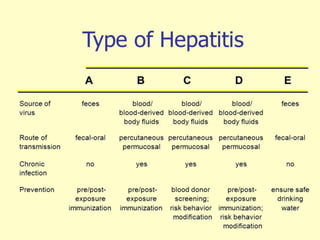
types of viral hepatitis: A, B, C, D, and E.
● Hepatitis viruses are the most common cause of
hepatitis in the world.
● But other infections, toxic substances (eg, alcohol and
certain drugs), and autoimmune diseases can also
cause hepatitis.
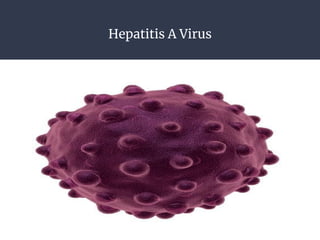
Hepatitis A Virus
Hepatitis A Virus
■ Nonenveloped RNA virus, replicates
in cytoplasm.
■ Related to enteroviruses classified in
Picornaviruses
■ One serotype
■ Incubation period: Average 30 days
Range 15-50 days
■ Jaundice by
age group: children are most
commonly infected
■ Complications: Fulminant hepatitis
(Fulminant hepatitis is a rare syndrome of rapid
(usually within days or weeks), massive necrosis of
liver parenchyma and a decrease in liver size (acute
yellow atrophy))
Hepatitis A Virus - Clinical
Features
■ Close personal contact
(e.g., household contact, child day care centers)
■ Contaminated food, water via feaco-oral route
(e.g., infected food handlers)
■ Blood exposure (rare)
(e.g., injecting drug use, transfusion)
Hepatitis A Virus Transmission
Hepatitis A Virus
■ After entering the blood, the virus infects
hepatocytes, and viral antigens are displayed
on surface of cells.
■ CD8 (Cytotoxic T cells) cells mediate an
immune attack against the viral antigens,
and inflammation and necrosis occur.
Hepatitis A Virus
Clinical Findings
■ Most infections are asymptomatic
■ Fever, anorexia, nausea, vomiting and jaundice, Dark
urine, pale feces
■ Elevated serum transaminase levels (Normal<35 IU)
■ Most cases resolve spontaneously within 2-4 weeks
■ No chronic hepatitis, no chronic carrier state and no
predisposition to HCC ( Hepato Cellular Carcinoma)
Laboratory Diagnosis
■ Acute infection is diagnosed by the detection of
HAV-IgM in serum by EIA (enzyme
immunoassay).
■ Past Infection i.e. immunity is determined by the
detection of HAV-IgG by EIA.
■ Cell culture –difficult and takes up to 4 weeks, not
routinely performed
■ Direct Detection –EM (electron microscopy),
RT-PCR of feces. Can detect illness earlier than
serology but rarely performed.
■ Many cases occur in community-wide
outbreaks
■ highest attack rates in 2-18 year olds
■ children serve as reservoir of infection
■ Persons at increased risk of infection
■ travelers
Hepatitis A Vaccination Strategies
Epidemiologic Considerations
■ Pre-exposure
Vaccine containing inactivated HAV
Travelers to areas of HAV-endemic regions within 4
weeks along with passive immunization, to children
2-18 yrs , (inactivated virus) 0 dose, at 6-12 months
Hepatitis A …Prevention
Hepatitis A Prevention - Immune
Globulin
■ Post-exposure (within 14 days)
▪ Immune serum globulins
Selected situations
■ institutions (e.g., day care centers)
■ common source exposure (e.g., food prepared
by infected food handler)
■ Even active immunization can also protect if
given within 2 weeks of exposure
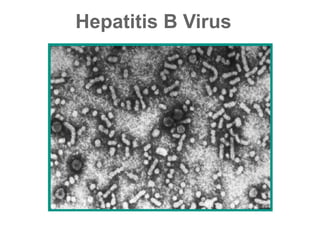
Hepatitis B Virus
Hepatitis B Virus - Virology
■ Partially double stranded DNA virus.
■ Replication involves a reverse transcriptase.
■ At least 4 phenotypes of HBsAg (Hep. B surface
antigen )are recognized;
adw, adr, ayw and ayr.
Hepatitis B Virus - Virology
Within core
■ 4 genes
■ S……….surface antigen
■ C……….core antigen and e antigen
■ P……….polymerase
■ X……….x protein (HBx)
▪ Parentral – Via blood, IV Drug Abusers, Health
Workers are at increased risk.
▪ Sexual - sex workers and homosexuals are
particular at risk.
▪ Perinatal -Mother to fetus transmission. Perinatal
transmission is the main means of transmission
in high prevalence populations.
Hepatitis B Virus
Modes of Transmission
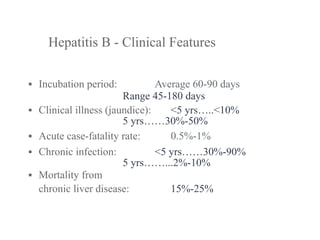
▪ Incubation period: Average 60-90 days
Range 45-180 days
▪ Clinical illness (jaundice): <5 yrs…..<10%
5 yrs……30%-50%
▪ Acute case-fatality rate: 0.5%-1%
▪ Chronic infection: <5 yrs……30%-90%
5 yrs……...2%-10%
▪ Mortality from
chronic liver disease: 15%-25%
Hepatitis B - Clinical Features
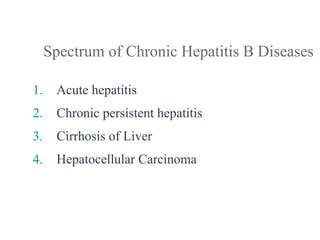
Spectrum of Chronic Hepatitis B Diseases
1. Acute hepatitis
2. Chronic persistent hepatitis
3. Cirrhosis of Liver
4. Hepatocellular Carcinoma
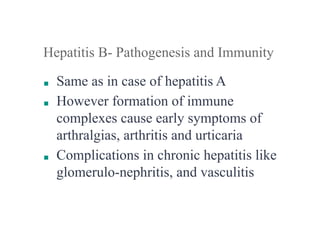
Hepatitis B- Pathogenesis and Immunity
■ Same as in case of hepatitis A
■ However formation of immune
complexes cause early symptoms of
arthralgias, arthritis and urticaria
■ Complications in chronic hepatitis like
glomerulo-nephritis, and vasculitis
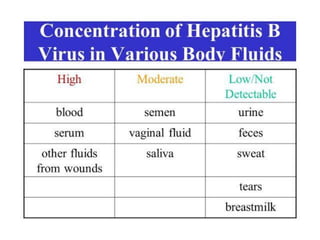
High
Moderate
Low/Not
Detectable
blood semen urine
serum vaginal fluid feces
wound exudates saliva sweat
tears
breastmilk
Concentration of Hepatitis B
Virus in Various Body Fluids
Diagnosis
■ HBsAg - used as a general marker of infection.
■ HBsAb- used to document recovery and/or immunity
to HBV infection.
■ anti-HBc IgM - marker of acute infection.
■ anti-HBc IgG - past or chronic infection.
■ HBeAg - indicates active replication of virus and
therefore transmissilbility.
■ Serum transaminase levels are raised
Treatment
■ Interferon -
■ alpha-interferon 2b (original)
■ alpha-interferon 2a (newer, claims to be more efficacious and efficient)
■ Lamivudine
■ Adefovir – Entecavir
■
Prevention
■ Vaccination - Recombinant vaccines (recombivax)
are now available.
■ Hepatitis B Immunoglobulin - HBIG may be used to
protect persons who are exposed to hepatitis B. It is
particularly efficacious within 48 hours of the
incident.
■ Other measures - screening of blood donors, blood
and body fluid precautions.
Hepatitis C Virus
Hepatitis C Virus
< RNA genome of around 10,000 bases
< HCV has been classified into a total of six genotypes (type
1 to 6) on the basis of phylogenetic analysis
< Genotype 1 and 4 has a poorer prognosis and response to
interferon therapy
< Most commonest blood borne pathogen
▪ Injection drug use
▪ Birth to HCV-infected mother
▪ Transfusion or transplant from infected donor
▪ Hemodialysis (yrs on treatment)
▪ Accidental injuries with needles/sharps
▪ Sexual/household exposure to anti-HCV-positive
contact is uncommon
▪ Multiple sex partners
Risk Factors Associated with
Transmission of HCV
Incubation period: Average 6-7 wks
Range 2-26 wks
Clinical illness (jaundice): 30-40% (20-30%)
Chronic hepatitis: 70-75%
Immunity: No protective
antibody
response identified
Hepatitis C - Clinical Features
Chronic Hepatitis C Infection
■ All the manifestations of chronic hepatitis B
infection may be seen, albeit with a lower
frequency i.e. chronic persistent hepatitis,
chronic active hepatitis, cirrhosis, and
hepatocellular carcinoma.
Laboratory Diagnosis
■ HCV antibody - generally used to diagnose hepatitis C
infection. Not useful in the acute phase as it takes at least 4
weeks after infection before antibody appears. Does not
distinguish between IgM or IgG
■ HCV-RNA - various techniques are available e.g. PCR. May
be used to diagnose HCV infection in the acute phase.
However, its main use is in monitoring the response to
antiviral therapy.
■ HCV-antigen - an EIA (Enzyme immunoassay)for HCV
antigen is available. It is used in the same capacity as
HCV-RNA tests but is much easier to carry out.
Prognostic Tests
■ Genotyping – genotype 1 and 4 have a worse prognosis
overall and respond poorly to interferon therapy. A number
of commercial and in-house assays are available.
■ Viral Load – patients with high viral load are thought to
have a poorer prognosis. Viral load is also used for
monitoring response to IFN therapy.
Treatment
■ Interferon - may be considered for patients with chronic active
hepatitis. The response rate is around 50% but 50% of responders
will relapse upon withdrawal of treatment.
■ Ribavirin - there is less experience with ribavirin than interferon.
However, recent studies suggest that a combination of interferon
and ribavirin is more effective than interferon alone.
■ Protease Inhibitor
▪ Screening of blood, organ, tissue donors
▪ High-risk behavior modification
▪ Blood and body fluid precautions
Prevention of Hepatitis C
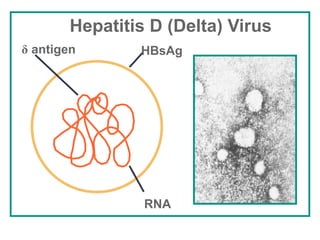
HBsAg
RNA
δ antigen
Hepatitis D (Delta) Virus
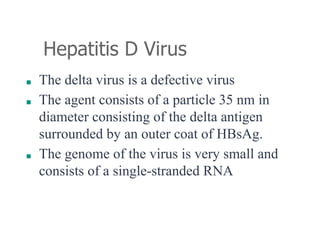
Hepatitis D Virus
■ The delta virus is a defective virus
■ The agent consists of a particle 35 nm in
diameter consisting of the delta antigen
surrounded by an outer coat of HBsAg.
■ The genome of the virus is very small and
consists of a single-stranded RNA
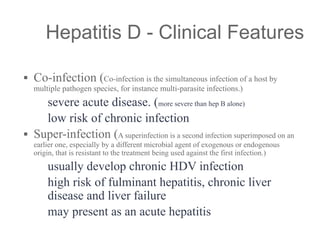
▪ Co-infection (Co-infection is the simultaneous infection of a host by
multiple pathogen species, for instance multi-parasite infections.)
– severe acute disease. (more severe than hep B alone)
– low risk of chronic infection
▪ Super-infection (A superinfection is a second infection superimposed on an
earlier one, especially by a different microbial agent of exogenous or endogenous
origin, that is resistant to the treatment being used against the first infection.)
– usually develop chronic HDV infection
– high risk of fulminant hepatitis, chronic liver
disease and liver failure
– may present as an acute hepatitis
Hepatitis D - Clinical Features
▪ Percutanous exposures
▪ injection drug use
▪ Permucosal exposures
▪ sex contact
Hepatitis D Virus Modes of
Transmission
■ HBV-HDV Coinfection
Pre or postexposure prophylaxis to prevent HBV
infection.
■ HBV-HDV Superinfection
Education to reduce risk behaviors among persons
with chronic HBV infection.
Hepatitis D - Prevention
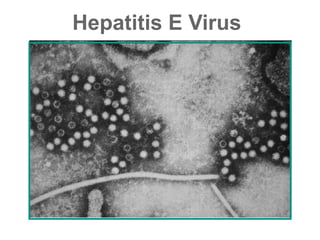
Hepatitis E Virus
■ Incubation period: Average 40 days
Range 15-60 days
■ Case-fatality rate: Overall, 1%-3%
Pregnant women,
15%-25%
■ Illness severity: Increased with age
Chronicity:- Rare
Hepatitis E - Clinical Features
■ Avoid drinking water (and beverages with ice) of
unknown purity
■ uncooked shellfish
■ uncooked fruit/vegetables not peeled.
Prevention and Control Measures for
Travelers to HEV-Endemic Regions
Thank You

Viral hepatitis by dr abas Reshi.ppt.pdf

  • 1.
    Hepatitis A-E Viruses By Dr.Mohammad Abas Reshi M.B.B.S SKIMS Srinagar
  • 2.
    What is ViralHepatitis? ● Viral Hepatitis is an infection that causes inflammation of the liver. The inflammatory process can be self limiting, or can progress to fibrosis (scarring), cirrhosis or liver cancer. We have 5 main types of viral hepatitis: A, B, C, D, and E. ● Hepatitis viruses are the most common cause of hepatitis in the world. ● But other infections, toxic substances (eg, alcohol and certain drugs), and autoimmune diseases can also cause hepatitis.
  • 4.
  • 5.
    Hepatitis A Virus ■Nonenveloped RNA virus, replicates in cytoplasm. ■ Related to enteroviruses classified in Picornaviruses ■ One serotype
  • 6.
    ■ Incubation period:Average 30 days Range 15-50 days ■ Jaundice by age group: children are most commonly infected ■ Complications: Fulminant hepatitis (Fulminant hepatitis is a rare syndrome of rapid (usually within days or weeks), massive necrosis of liver parenchyma and a decrease in liver size (acute yellow atrophy)) Hepatitis A Virus - Clinical Features
  • 7.
    ■ Close personalcontact (e.g., household contact, child day care centers) ■ Contaminated food, water via feaco-oral route (e.g., infected food handlers) ■ Blood exposure (rare) (e.g., injecting drug use, transfusion) Hepatitis A Virus Transmission
  • 8.
    Hepatitis A Virus ■After entering the blood, the virus infects hepatocytes, and viral antigens are displayed on surface of cells. ■ CD8 (Cytotoxic T cells) cells mediate an immune attack against the viral antigens, and inflammation and necrosis occur.
  • 9.
    Hepatitis A Virus ClinicalFindings ■ Most infections are asymptomatic ■ Fever, anorexia, nausea, vomiting and jaundice, Dark urine, pale feces ■ Elevated serum transaminase levels (Normal<35 IU) ■ Most cases resolve spontaneously within 2-4 weeks ■ No chronic hepatitis, no chronic carrier state and no predisposition to HCC ( Hepato Cellular Carcinoma)
  • 10.
    Laboratory Diagnosis ■ Acuteinfection is diagnosed by the detection of HAV-IgM in serum by EIA (enzyme immunoassay). ■ Past Infection i.e. immunity is determined by the detection of HAV-IgG by EIA. ■ Cell culture –difficult and takes up to 4 weeks, not routinely performed ■ Direct Detection –EM (electron microscopy), RT-PCR of feces. Can detect illness earlier than serology but rarely performed.
  • 11.
    ■ Many casesoccur in community-wide outbreaks ■ highest attack rates in 2-18 year olds ■ children serve as reservoir of infection ■ Persons at increased risk of infection ■ travelers Hepatitis A Vaccination Strategies Epidemiologic Considerations
  • 12.
    ■ Pre-exposure Vaccine containinginactivated HAV Travelers to areas of HAV-endemic regions within 4 weeks along with passive immunization, to children 2-18 yrs , (inactivated virus) 0 dose, at 6-12 months Hepatitis A …Prevention
  • 13.
    Hepatitis A Prevention- Immune Globulin ■ Post-exposure (within 14 days) ▪ Immune serum globulins Selected situations ■ institutions (e.g., day care centers) ■ common source exposure (e.g., food prepared by infected food handler) ■ Even active immunization can also protect if given within 2 weeks of exposure
  • 14.
  • 15.
    Hepatitis B Virus- Virology ■ Partially double stranded DNA virus. ■ Replication involves a reverse transcriptase. ■ At least 4 phenotypes of HBsAg (Hep. B surface antigen )are recognized; adw, adr, ayw and ayr.
  • 16.
    Hepatitis B Virus- Virology Within core ■ 4 genes ■ S……….surface antigen ■ C……….core antigen and e antigen ■ P……….polymerase ■ X……….x protein (HBx)
  • 17.
    ▪ Parentral –Via blood, IV Drug Abusers, Health Workers are at increased risk. ▪ Sexual - sex workers and homosexuals are particular at risk. ▪ Perinatal -Mother to fetus transmission. Perinatal transmission is the main means of transmission in high prevalence populations. Hepatitis B Virus Modes of Transmission
  • 18.
    ▪ Incubation period:Average 60-90 days Range 45-180 days ▪ Clinical illness (jaundice): <5 yrs…..<10% 5 yrs……30%-50% ▪ Acute case-fatality rate: 0.5%-1% ▪ Chronic infection: <5 yrs……30%-90% 5 yrs……...2%-10% ▪ Mortality from chronic liver disease: 15%-25% Hepatitis B - Clinical Features
  • 19.
    Spectrum of ChronicHepatitis B Diseases 1. Acute hepatitis 2. Chronic persistent hepatitis 3. Cirrhosis of Liver 4. Hepatocellular Carcinoma
  • 20.
    Hepatitis B- Pathogenesisand Immunity ■ Same as in case of hepatitis A ■ However formation of immune complexes cause early symptoms of arthralgias, arthritis and urticaria ■ Complications in chronic hepatitis like glomerulo-nephritis, and vasculitis
  • 21.
    High Moderate Low/Not Detectable blood semen urine serumvaginal fluid feces wound exudates saliva sweat tears breastmilk Concentration of Hepatitis B Virus in Various Body Fluids
  • 22.
    Diagnosis ■ HBsAg -used as a general marker of infection. ■ HBsAb- used to document recovery and/or immunity to HBV infection. ■ anti-HBc IgM - marker of acute infection. ■ anti-HBc IgG - past or chronic infection. ■ HBeAg - indicates active replication of virus and therefore transmissilbility. ■ Serum transaminase levels are raised
  • 23.
    Treatment ■ Interferon - ■alpha-interferon 2b (original) ■ alpha-interferon 2a (newer, claims to be more efficacious and efficient) ■ Lamivudine ■ Adefovir – Entecavir ■
  • 24.
    Prevention ■ Vaccination -Recombinant vaccines (recombivax) are now available. ■ Hepatitis B Immunoglobulin - HBIG may be used to protect persons who are exposed to hepatitis B. It is particularly efficacious within 48 hours of the incident. ■ Other measures - screening of blood donors, blood and body fluid precautions.
  • 25.
  • 26.
    Hepatitis C Virus <RNA genome of around 10,000 bases < HCV has been classified into a total of six genotypes (type 1 to 6) on the basis of phylogenetic analysis < Genotype 1 and 4 has a poorer prognosis and response to interferon therapy < Most commonest blood borne pathogen
  • 27.
    ▪ Injection druguse ▪ Birth to HCV-infected mother ▪ Transfusion or transplant from infected donor ▪ Hemodialysis (yrs on treatment) ▪ Accidental injuries with needles/sharps ▪ Sexual/household exposure to anti-HCV-positive contact is uncommon ▪ Multiple sex partners Risk Factors Associated with Transmission of HCV
  • 28.
    Incubation period: Average6-7 wks Range 2-26 wks Clinical illness (jaundice): 30-40% (20-30%) Chronic hepatitis: 70-75% Immunity: No protective antibody response identified Hepatitis C - Clinical Features
  • 29.
    Chronic Hepatitis CInfection ■ All the manifestations of chronic hepatitis B infection may be seen, albeit with a lower frequency i.e. chronic persistent hepatitis, chronic active hepatitis, cirrhosis, and hepatocellular carcinoma.
  • 30.
    Laboratory Diagnosis ■ HCVantibody - generally used to diagnose hepatitis C infection. Not useful in the acute phase as it takes at least 4 weeks after infection before antibody appears. Does not distinguish between IgM or IgG ■ HCV-RNA - various techniques are available e.g. PCR. May be used to diagnose HCV infection in the acute phase. However, its main use is in monitoring the response to antiviral therapy. ■ HCV-antigen - an EIA (Enzyme immunoassay)for HCV antigen is available. It is used in the same capacity as HCV-RNA tests but is much easier to carry out.
  • 31.
    Prognostic Tests ■ Genotyping– genotype 1 and 4 have a worse prognosis overall and respond poorly to interferon therapy. A number of commercial and in-house assays are available. ■ Viral Load – patients with high viral load are thought to have a poorer prognosis. Viral load is also used for monitoring response to IFN therapy.
  • 32.
    Treatment ■ Interferon -may be considered for patients with chronic active hepatitis. The response rate is around 50% but 50% of responders will relapse upon withdrawal of treatment. ■ Ribavirin - there is less experience with ribavirin than interferon. However, recent studies suggest that a combination of interferon and ribavirin is more effective than interferon alone. ■ Protease Inhibitor
  • 33.
    ▪ Screening ofblood, organ, tissue donors ▪ High-risk behavior modification ▪ Blood and body fluid precautions Prevention of Hepatitis C
  • 34.
  • 35.
    Hepatitis D Virus ■The delta virus is a defective virus ■ The agent consists of a particle 35 nm in diameter consisting of the delta antigen surrounded by an outer coat of HBsAg. ■ The genome of the virus is very small and consists of a single-stranded RNA
  • 36.
    ▪ Co-infection (Co-infectionis the simultaneous infection of a host by multiple pathogen species, for instance multi-parasite infections.) – severe acute disease. (more severe than hep B alone) – low risk of chronic infection ▪ Super-infection (A superinfection is a second infection superimposed on an earlier one, especially by a different microbial agent of exogenous or endogenous origin, that is resistant to the treatment being used against the first infection.) – usually develop chronic HDV infection – high risk of fulminant hepatitis, chronic liver disease and liver failure – may present as an acute hepatitis Hepatitis D - Clinical Features
  • 37.
    ▪ Percutanous exposures ▪injection drug use ▪ Permucosal exposures ▪ sex contact Hepatitis D Virus Modes of Transmission
  • 38.
    ■ HBV-HDV Coinfection Preor postexposure prophylaxis to prevent HBV infection. ■ HBV-HDV Superinfection Education to reduce risk behaviors among persons with chronic HBV infection. Hepatitis D - Prevention
  • 39.
  • 40.
    ■ Incubation period:Average 40 days Range 15-60 days ■ Case-fatality rate: Overall, 1%-3% Pregnant women, 15%-25% ■ Illness severity: Increased with age Chronicity:- Rare Hepatitis E - Clinical Features
  • 41.
    ■ Avoid drinkingwater (and beverages with ice) of unknown purity ■ uncooked shellfish ■ uncooked fruit/vegetables not peeled. Prevention and Control Measures for Travelers to HEV-Endemic Regions
  • 42.