Revised National Tuberculosis Control
Programme
Objectives
● describe Revised National Tuberculosis
Control Programme
● explain organization
● describe laboratory network
● list new initiatives
● explain National strategic plan (2012-2017
Introduction
● TB is one of the most ancient diseases.
● It has been referred in the Vedas and
Ayurvedic Samhitas.
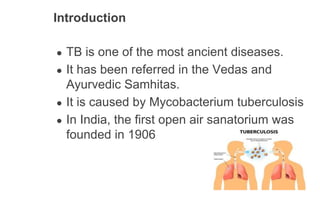
● It is caused by Mycobacterium tuberculosis
● In India, the first open air sanatorium was
founded in 1906
● TB surveys -(1939) and Introduction of
BCG vaccination (1948)
● Under Dr Frimodt Moller
● First TB dispensary established in Bombay
in 1917
● India became a member of the International
Union Against Tuberculosis (IUAT) in 1929.
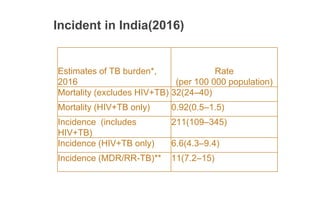
Incident in India(2016)
Estimates of TB burden*,
2016
Rate
(per 100 000 population)
Mortality (excludes HIV+TB) 32(24–40)
Mortality (HIV+TB only) 0.92(0.5–1.5)
Incidence (includes
HIV+TB)
211(109–345)
Incidence (HIV+TB only) 6.6(4.3–9.4)
Incidence (MDR/RR-TB)** 11(7.2–15)
National Tuberculosis Programme (NTP)
● National Tuberculosis Programme (NTP)
has been in operation since 1962.
● However, the treatment success rates were
unacceptably low and the death and default
rates remained high.
● Spread of multidrug resistant TB was
threatening to further worsen the situation.
● In view of this, 1992 GOI along with WHO
and SIDA reviewed the TB situation in the
country and came up with following
conclusion:
● -NTP, though technically sound, suffered
from managerial weakness.
● - Inadequate funding
● - Over-reliance on X- Ray for diagnosis
● - Frequent interrupted supplies of drugs
● - Low rates of treatment completion
● In 1993, in order to overcome these,
RNTCP started with the assistance from
international agencies.
● adopted the internationally recommend
Directly Observed Short-Course(DOTS)
strategy
Objectives
● Achievement of at least 85 % cure rate of
infectious cases of TB, through DOTS
involving peripheral health functionaries;
and
● Augmentation of case finding activities
through quality sputum microscopy to
detect at least 70% of estimated cases.
● The revised strategy was introduced in the
country in a phased manner as Pilot phase
I, Pilot phase II and pilot phase III.
DOTS strategy: Components
● Political will and administrative commitment
● Diagnosis by quality assured sputum smear
microscopy
● Adequate supply of quality assured short course
chemotherapy drugs.
● Directly Observed treatment
● Systematic monitoring and accountability
The Stop TB Strategy 2006
● Vision: A TB-FREE WORLD
● Goal: To dramatically reduce the global
burden of TB by 2015 in line with the
Millennium Development Goals and the
Stop TB Partnership targets
Objectives
● Achieve universal access to high-quality care
for all people with TB
● Reduce the human suffering and
socioeconomic burden associated with TB
● Protect vulnerable populations from TB, TB/HIV
and multidrug-resistant TB
● Support development of new tools and
enable their timely and effective use
● Protect and promote human rights in TB
prevention, care and control
Targets
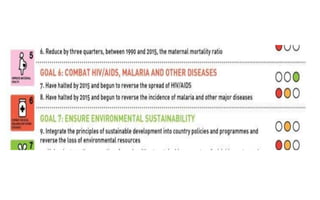
● MDG 6, Target 8: Halt and begin to reverse the
incidence of TB by 2015
● Targets linked to the MDGs and endorsed by the
Stop TB Partnership:
– by 2015: reduce prevalence and deaths due to
TB by 50% compared with a baseline of 1990
– by 2050: eliminate TB as a public health
problem
Stratergy
● 1. Pursue high-quality DOTS expansion
and enhancement
● Secure political commitment, with adequate
and sustained financing
● Ensure early case detection, and diagnosis
through quality-assured bacteriology
● Provide standardized treatment with
supervision, and patient support
● 2. Address TB-HIV, MDR-TB, and the
needs of poor and vulnerable populations
● Scale-up collaborative TB/HIV activities
● Scale-up prevention and management of
multidrug-resistant TB (MDR-TB)
● Address the needs of TB contacts, and of
poor and vulnerable populations
● 3. Contribute to health system
strengthening based on primary health
care
● Help improve health policies, human resource
development, financing, supplies, service
delivery and information
● Strengthen infection control in health
services, other congregate settings and
households
● Upgrade laboratory networks, and implement
the Practical Approach to Lung Health (PAL)
● 4. Engage all care providers
● Involve all public, voluntary, corporate and
private providers through Public-Private Mix
(PPM) approaches
● Promote use of the International Standards
for Tuberculosis Care (ISTC)
● 5. Empower people with TB, and
communities through partnership
● Pursue advocacy, communication and social
mobilization
● Foster community participation in TB care,
prevention and health promotion
● Promote use of the Patients' Charter for
Tuberculosis Care
● 6. Enable and promote research
● Conduct programme-based operational
research
● Advocate for and participate in research to
develop new diagnostics, drugs and
vaccines
The End TB Strategy 2014
● Vision
● A world free of TB. Zero deaths, disease and
suffering due to TB.
● Goal
● End the global tuberculosis epidemic.
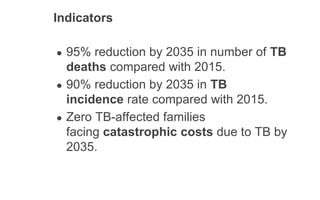
Indicators
● 95% reduction by 2035 in number of TB
deaths compared with 2015.
● 90% reduction by 2035 in TB
incidence rate compared with 2015.
● Zero TB-affected families
facing catastrophic costs due to TB by
2035.
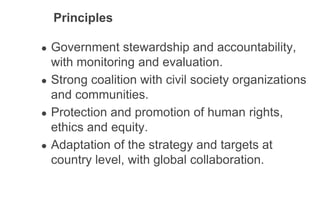
Principles
● Government stewardship and accountability,
with monitoring and evaluation.
● Strong coalition with civil society organizations
and communities.
● Protection and promotion of human rights,
ethics and equity.
● Adaptation of the strategy and targets at
country level, with global collaboration.
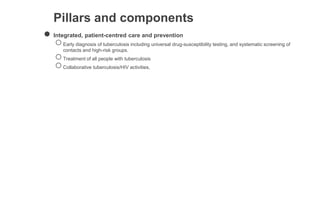
Pillars and components
● Integrated, patient-centred care and prevention
○Early diagnosis of tuberculosis including universal drug-susceptibility testing, and systematic screening of
contacts and high-risk groups.
○Treatment of all people with tuberculosis
○Collaborative tuberculosis/HIV activities,
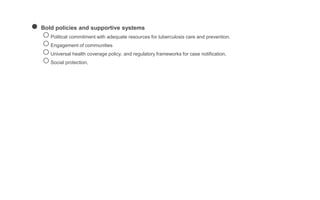
● Bold policies and supportive systems
○Political commitment with adequate resources for tuberculosis care and prevention.
○Engagement of communities
○Universal health coverage policy, and regulatory frameworks for case notification,
○Social protection,
● Intensified research and innovation
○Discovery, development and rapid uptake of new tools, interventions and strategies.
○Research to optimize implementation and impact, and promote innovations.
● Ending the TB epidemic
● Ending the global TB epidemic is feasible with
dramatic decline in TB deaths and cases, and
elimination of economic and social burden of
TB. Failure to do so will carry serious
individual and global public health
consequences.
Organization
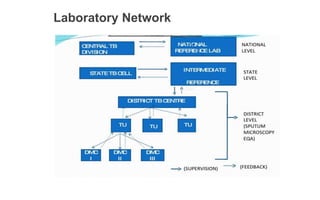
Laboratory Network
National reference laboratories
● NRLs works closely with IRLs, monitor and
supervise the IRL staff in EQA, culture and
DST, LPA and CBNAAT activities.
● Three microbiologist
● four laboratory technicians
● The NRL microbiologist and laboratory
supervisor/ technician
● Quality improvement workshop
Immediate reference laboratory
● The functions of IRL are supervision and
monitoring of EQA activities, mycobacterial
culture and DST and also drug resistance
surveillance in selected states.
● Technical training to laboratory technicians
and senior TB laboratory supervisor.
● The ILR undertake on site evaluation (district
in the state)
Designated microscopy Centres (DMC):
● DMC which serves a population of around
100000
● The quality assurance activities include:
● - onsite evaluation
● -panel testing
● -Random blinded rechecking
● Culture and DST laboratory
● In addition to IRLs,
● Microbiology department of medical colleges
● 64 C and DST laboratories
● Solid culture certifications: 45.
● Liquid culture certifications: 28 laboratories.
● Line probe assay: Rapid diagnosis of MDR-
TB by LPA.
● Second line DST: 25 laboratory
● Expanding CBNAAT service: The time to
diagnosis of TB and drug resistant TB has
been significantly reduced with the availability
of CBNAAT, which is a rapid molecular assay
that detects M. Tuberculosis and Rifampicin
resistance. The test is fully automated and
provides results in two hours. Currently there
are 121 machines.
TB diagnostic
● Smear microscopy for acid fast bacilli.
● - sputum smear stained with ZN staining
● - Fluorescence stains and examined under
direct or indirect microscopy with or without
LED.
● 2. Culture
● - solid media
● -liquid media
● 3. Rapid diagnostic molecular test.
● - Conventional PCR based line probe assay
for MTB complex
● -Real-time PCR based nucleic acid
amplification test NAAT for MTB complex.
● 4. Radiography
● 5. Tuberculin skin test
TB diagnostic algorithm
● Adult
● Paediatric
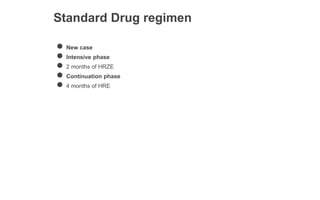
Standard Drug regimen
● New case
● Intensive phase
● 2 months of HRZE
● Continuation phase
● 4 months of HRE
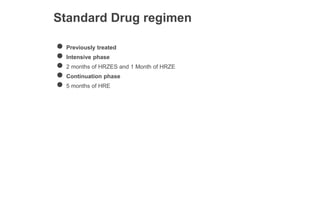
Standard Drug regimen
● Previously treated
● Intensive phase
● 2 months of HRZES and 1 Month of HRZE
● Continuation phase
● 5 months of HRE
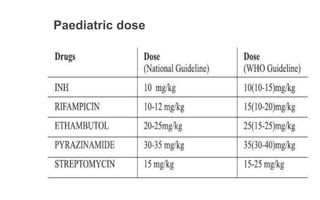
Paediatric dose
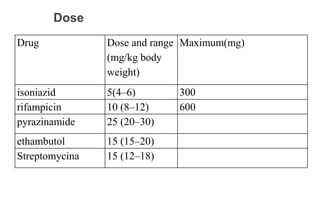
Dose
Drug Dose and range
(mg/kg body
weight)
Maximum(mg)
isoniazid 5(4–6) 300
rifampicin 10 (8–12) 600
pyrazinamide 25 (20–30)
ethambutol 15 (15–20)
Streptomycina 15 (12–18)
New initiatives
1. Nikshay
● TB surveillance
using case based
web IT system.
● Central TB division in
collaboration with
National informatics
centre
● launched in May
2012
● TB patient registration and details of
diagnosis, DOT provider, HIV status, follow
up, contact tracing, outcomes.
● Details of solid and liquid culture and DST,
LPA, CBNAAT details.
● DR-TB patient registration
● Referral and transfer of patients.
● Private health facility registration and TB
notification
● Mobile application for TB notification
● SMS alert to patients on registration
● SMS alerts to Programme officers.
● Automated period report
● - case finding
● -sputum conservation
● -treatment outcome.
2. TB notification
● According to the government of India
notification dated 7th May 2012, it is now
mandatory for all healthcare providers to
notify every TB cases to local authorities.
● 3. Ban on TB serology
● The serology tests are based on antibody
response, which is highly variable in TB and
may reflect remote infection rather than active
disease.
Newer initiatives
● 1. Daily regimen for pediatric TB
● 2. Daily regimen for all forms of TB in five
States.
● 3. Daily regimen for all TB/ HIV co-infected
patients across the country.
● 4. Pilots for universal access to TB cases.
● 5. Bedaquilline conditional access program.
● Drug resistance surveillance under RNTCP
TB-HIV coordination
● dedicated human resources, integration of
surveillance, joint monitoring and evaluation,
capacity building and operational research.
● Activities as follows
● Intensified TB case finding has been
extended to all ART centres.
● HIV testing of TB patients is now routine
through provider initiated testing and
counseling,
● free HIV care at (ART) centre.
● Policy decisions has been taken by National
technical working group on TB/HIV
collaborative activities to expand coverage of
whole blood finger prick HIV screening test at
all DMC without a stand alone.
● Provider initiated HIV testing and counseling
among presumptive TB cases is now a policy
● . Intensified case finding activities to be
specifically monitored among HIV infected
pregnant women and children living with
HIV infected pregnant women and children
with HIV.
● 7. The national aids control programme and
RNTCP have taken the policy decision to
adopt isoniazid prophylaxis therapy as a
strategy for prevention of TB among
PLHIV. The implementation will be in a
phased manner.
●
● ,8. The RNTCP has prioritized presumptive
TB cases among people living with HIV for
diagnosis of TB and Rifampicin resistance
with rapid diagnostic tools having high
sensitivity.
National strategic plan (2012-2017
● Target : universal access to TB care.
● Strategic vision to move towards universal access
● Vision: TB free India
Areas:
● Strengthening and improving the quality of
basic DOTS service.
● Further strengthen and align with health
system under NRHM
● Deploying improved rapid diagnosis at the
field level.
● Exapand efforts to engage all care
providers
● Strengthen urban TB control
● Expand diagnosis and treatment of drug resistant TB
● Improve communication and outreach
● Promote research for development and implementation of improved tools and strategy.
Objective: are
● Early detection and treatment of at least 90
% estimated all type of TB cases in
community including drug resistant and HIV
associated TB.
● Successful treatment of at least 90% of new
TB patients, and at least 85% of previously-
treated TB patients.
● Reduction in default rate of new TB cases to
less than 5% and re-treatment TB cases to
less than 10%.
● Initial screening of all re-treatment smear
positive till 2015, and all smear positive TB
patients by year 2017 for drug resistance
TB and provision of treatment services for
MDR-TB patients
● Offering counseling
● Expand RNTCP service to private sector.
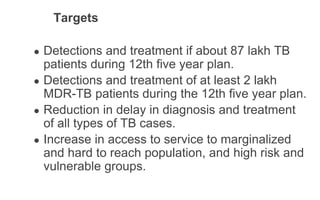
Targets
● Detections and treatment if about 87 lakh TB
patients during 12th five year plan.
● Detections and treatment of at least 2 lakh
MDR-TB patients during the 12th five year plan.
● Reduction in delay in diagnosis and treatment
of all types of TB cases.
● Increase in access to service to marginalized
and hard to reach population, and high risk and
vulnerable groups.
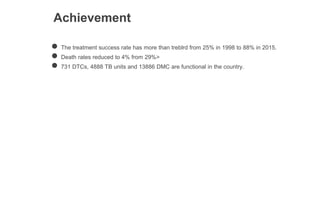
Achievement
● The treatment success rate has more than treblrd from 25% in 1998 to 88% in 2015.
● Death rates reduced to 4% from 29%>
● 731 DTCs, 4888 TB units and 13886 DMC are functional in the country.
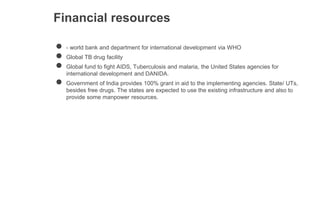
Financial resources
● - world bank and department for international development via WHO
● Global TB drug facility
● Global fund to fight AIDS, Tuberculosis and malaria, the United States agencies for
international development and DANIDA.
● Government of India provides 100% grant in aid to the implementing agencies. State/ UTs,
besides free drugs. The states are expected to use the existing infrastructure and also to
provide some manpower resources.
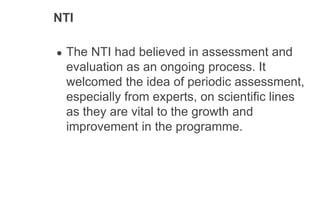
NTI
● The NTI had believed in assessment and
evaluation as an ongoing process. It
welcomed the idea of periodic assessment,
especially from experts, on scientific lines
as they are vital to the growth and
improvement in the programme.
Active case finding
● This is initiated to identify the TB cases in the community by conducting survey. Health care
professionals gathers the history, and assess for the signs and symptom of TB among the
general population.
Conclusion
REFERENCES
● Park, K. (2015). Park's textbook of preventive and social medicine (23rd ed.). Jabalpur: M/S Banarsidas
Bhanot.
● Lal, S., A., & P. (2014). Textbook of community medicine: preventive and social medicine (3rd ed.). New
Delhi: CBS & Distributors Pvt. Ltd.
● Ministry of Health & Family Welfare-Government of India. (n.d.). About us. Retrieved November 09, 2017,
from https://tbcindia.gov.in/index4.php?lang=1&level=0&linkid=399&lid=2768
● Soyam, V., & Boro, P. (2015). Newer initiatives in revised national tuberculosis control programme and its
current implementation status. Asian Journal of Medical Sciences, 6(5). doi:10.3126/ajms.v6i5.11945

Revised national tuberculosis elimination program pro.pptx

  • 1.
  • 2.
    Objectives ● describe RevisedNational Tuberculosis Control Programme ● explain organization ● describe laboratory network ● list new initiatives ● explain National strategic plan (2012-2017
  • 3.
    Introduction ● TB isone of the most ancient diseases. ● It has been referred in the Vedas and Ayurvedic Samhitas. ● It is caused by Mycobacterium tuberculosis ● In India, the first open air sanatorium was founded in 1906
  • 4.
    ● TB surveys-(1939) and Introduction of BCG vaccination (1948) ● Under Dr Frimodt Moller ● First TB dispensary established in Bombay in 1917 ● India became a member of the International Union Against Tuberculosis (IUAT) in 1929.
  • 5.
    Incident in India(2016) Estimatesof TB burden*, 2016 Rate (per 100 000 population) Mortality (excludes HIV+TB) 32(24–40) Mortality (HIV+TB only) 0.92(0.5–1.5) Incidence (includes HIV+TB) 211(109–345) Incidence (HIV+TB only) 6.6(4.3–9.4) Incidence (MDR/RR-TB)** 11(7.2–15)
  • 6.
    National Tuberculosis Programme(NTP) ● National Tuberculosis Programme (NTP) has been in operation since 1962. ● However, the treatment success rates were unacceptably low and the death and default rates remained high. ● Spread of multidrug resistant TB was threatening to further worsen the situation.
  • 7.
    ● In viewof this, 1992 GOI along with WHO and SIDA reviewed the TB situation in the country and came up with following conclusion: ● -NTP, though technically sound, suffered from managerial weakness. ● - Inadequate funding ● - Over-reliance on X- Ray for diagnosis ● - Frequent interrupted supplies of drugs ● - Low rates of treatment completion
  • 8.
    ● In 1993,in order to overcome these, RNTCP started with the assistance from international agencies. ● adopted the internationally recommend Directly Observed Short-Course(DOTS) strategy
  • 9.
    Objectives ● Achievement ofat least 85 % cure rate of infectious cases of TB, through DOTS involving peripheral health functionaries; and ● Augmentation of case finding activities through quality sputum microscopy to detect at least 70% of estimated cases.
  • 10.
    ● The revisedstrategy was introduced in the country in a phased manner as Pilot phase I, Pilot phase II and pilot phase III.
  • 11.
    DOTS strategy: Components ●Political will and administrative commitment ● Diagnosis by quality assured sputum smear microscopy ● Adequate supply of quality assured short course chemotherapy drugs. ● Directly Observed treatment ● Systematic monitoring and accountability
  • 12.
    The Stop TBStrategy 2006 ● Vision: A TB-FREE WORLD ● Goal: To dramatically reduce the global burden of TB by 2015 in line with the Millennium Development Goals and the Stop TB Partnership targets
  • 13.
    Objectives ● Achieve universalaccess to high-quality care for all people with TB ● Reduce the human suffering and socioeconomic burden associated with TB ● Protect vulnerable populations from TB, TB/HIV and multidrug-resistant TB
  • 14.
    ● Support developmentof new tools and enable their timely and effective use ● Protect and promote human rights in TB prevention, care and control
  • 15.
    Targets ● MDG 6,Target 8: Halt and begin to reverse the incidence of TB by 2015 ● Targets linked to the MDGs and endorsed by the Stop TB Partnership: – by 2015: reduce prevalence and deaths due to TB by 50% compared with a baseline of 1990 – by 2050: eliminate TB as a public health problem
  • 16.
    Stratergy ● 1. Pursuehigh-quality DOTS expansion and enhancement ● Secure political commitment, with adequate and sustained financing ● Ensure early case detection, and diagnosis through quality-assured bacteriology ● Provide standardized treatment with supervision, and patient support
  • 17.
    ● 2. AddressTB-HIV, MDR-TB, and the needs of poor and vulnerable populations ● Scale-up collaborative TB/HIV activities ● Scale-up prevention and management of multidrug-resistant TB (MDR-TB) ● Address the needs of TB contacts, and of poor and vulnerable populations
  • 18.
    ● 3. Contributeto health system strengthening based on primary health care ● Help improve health policies, human resource development, financing, supplies, service delivery and information ● Strengthen infection control in health services, other congregate settings and households ● Upgrade laboratory networks, and implement the Practical Approach to Lung Health (PAL)
  • 19.
    ● 4. Engageall care providers ● Involve all public, voluntary, corporate and private providers through Public-Private Mix (PPM) approaches ● Promote use of the International Standards for Tuberculosis Care (ISTC)
  • 20.
    ● 5. Empowerpeople with TB, and communities through partnership ● Pursue advocacy, communication and social mobilization ● Foster community participation in TB care, prevention and health promotion ● Promote use of the Patients' Charter for Tuberculosis Care
  • 21.
    ● 6. Enableand promote research ● Conduct programme-based operational research ● Advocate for and participate in research to develop new diagnostics, drugs and vaccines
  • 23.
    The End TBStrategy 2014 ● Vision ● A world free of TB. Zero deaths, disease and suffering due to TB. ● Goal ● End the global tuberculosis epidemic.
  • 24.
    Indicators ● 95% reductionby 2035 in number of TB deaths compared with 2015. ● 90% reduction by 2035 in TB incidence rate compared with 2015. ● Zero TB-affected families facing catastrophic costs due to TB by 2035.
  • 25.
    Principles ● Government stewardshipand accountability, with monitoring and evaluation. ● Strong coalition with civil society organizations and communities. ● Protection and promotion of human rights, ethics and equity. ● Adaptation of the strategy and targets at country level, with global collaboration.
  • 26.
    Pillars and components ●Integrated, patient-centred care and prevention ○Early diagnosis of tuberculosis including universal drug-susceptibility testing, and systematic screening of contacts and high-risk groups. ○Treatment of all people with tuberculosis ○Collaborative tuberculosis/HIV activities,
  • 27.
    ● Bold policiesand supportive systems ○Political commitment with adequate resources for tuberculosis care and prevention. ○Engagement of communities ○Universal health coverage policy, and regulatory frameworks for case notification, ○Social protection,
  • 28.
    ● Intensified researchand innovation ○Discovery, development and rapid uptake of new tools, interventions and strategies. ○Research to optimize implementation and impact, and promote innovations.
  • 29.
    ● Ending theTB epidemic ● Ending the global TB epidemic is feasible with dramatic decline in TB deaths and cases, and elimination of economic and social burden of TB. Failure to do so will carry serious individual and global public health consequences.
  • 30.
  • 31.
  • 32.
    National reference laboratories ●NRLs works closely with IRLs, monitor and supervise the IRL staff in EQA, culture and DST, LPA and CBNAAT activities. ● Three microbiologist ● four laboratory technicians ● The NRL microbiologist and laboratory supervisor/ technician ● Quality improvement workshop
  • 33.
    Immediate reference laboratory ●The functions of IRL are supervision and monitoring of EQA activities, mycobacterial culture and DST and also drug resistance surveillance in selected states. ● Technical training to laboratory technicians and senior TB laboratory supervisor. ● The ILR undertake on site evaluation (district in the state)
  • 34.
    Designated microscopy Centres(DMC): ● DMC which serves a population of around 100000 ● The quality assurance activities include: ● - onsite evaluation ● -panel testing ● -Random blinded rechecking ● Culture and DST laboratory
  • 35.
    ● In additionto IRLs, ● Microbiology department of medical colleges ● 64 C and DST laboratories ● Solid culture certifications: 45. ● Liquid culture certifications: 28 laboratories.
  • 36.
    ● Line probeassay: Rapid diagnosis of MDR- TB by LPA. ● Second line DST: 25 laboratory ● Expanding CBNAAT service: The time to diagnosis of TB and drug resistant TB has been significantly reduced with the availability of CBNAAT, which is a rapid molecular assay that detects M. Tuberculosis and Rifampicin resistance. The test is fully automated and provides results in two hours. Currently there are 121 machines.
  • 37.
    TB diagnostic ● Smearmicroscopy for acid fast bacilli. ● - sputum smear stained with ZN staining ● - Fluorescence stains and examined under direct or indirect microscopy with or without LED. ● 2. Culture ● - solid media ● -liquid media
  • 38.
    ● 3. Rapiddiagnostic molecular test. ● - Conventional PCR based line probe assay for MTB complex ● -Real-time PCR based nucleic acid amplification test NAAT for MTB complex. ● 4. Radiography ● 5. Tuberculin skin test
  • 39.
    TB diagnostic algorithm ●Adult ● Paediatric
  • 40.
    Standard Drug regimen ●New case ● Intensive phase ● 2 months of HRZE ● Continuation phase ● 4 months of HRE
  • 41.
    Standard Drug regimen ●Previously treated ● Intensive phase ● 2 months of HRZES and 1 Month of HRZE ● Continuation phase ● 5 months of HRE
  • 42.
  • 43.
    Dose Drug Dose andrange (mg/kg body weight) Maximum(mg) isoniazid 5(4–6) 300 rifampicin 10 (8–12) 600 pyrazinamide 25 (20–30) ethambutol 15 (15–20) Streptomycina 15 (12–18)
  • 44.
  • 45.
    1. Nikshay ● TBsurveillance using case based web IT system. ● Central TB division in collaboration with National informatics centre ● launched in May 2012
  • 46.
    ● TB patientregistration and details of diagnosis, DOT provider, HIV status, follow up, contact tracing, outcomes. ● Details of solid and liquid culture and DST, LPA, CBNAAT details. ● DR-TB patient registration ● Referral and transfer of patients. ● Private health facility registration and TB notification
  • 47.
    ● Mobile applicationfor TB notification ● SMS alert to patients on registration ● SMS alerts to Programme officers. ● Automated period report ● - case finding ● -sputum conservation ● -treatment outcome.
  • 48.
    2. TB notification ●According to the government of India notification dated 7th May 2012, it is now mandatory for all healthcare providers to notify every TB cases to local authorities. ● 3. Ban on TB serology ● The serology tests are based on antibody response, which is highly variable in TB and may reflect remote infection rather than active disease.
  • 49.
    Newer initiatives ● 1.Daily regimen for pediatric TB ● 2. Daily regimen for all forms of TB in five States. ● 3. Daily regimen for all TB/ HIV co-infected patients across the country. ● 4. Pilots for universal access to TB cases. ● 5. Bedaquilline conditional access program. ● Drug resistance surveillance under RNTCP
  • 50.
    TB-HIV coordination ● dedicatedhuman resources, integration of surveillance, joint monitoring and evaluation, capacity building and operational research. ● Activities as follows ● Intensified TB case finding has been extended to all ART centres. ● HIV testing of TB patients is now routine through provider initiated testing and counseling,
  • 51.
    ● free HIVcare at (ART) centre. ● Policy decisions has been taken by National technical working group on TB/HIV collaborative activities to expand coverage of whole blood finger prick HIV screening test at all DMC without a stand alone. ● Provider initiated HIV testing and counseling among presumptive TB cases is now a policy
  • 52.
    ● . Intensifiedcase finding activities to be specifically monitored among HIV infected pregnant women and children living with HIV infected pregnant women and children with HIV.
  • 53.
    ● 7. Thenational aids control programme and RNTCP have taken the policy decision to adopt isoniazid prophylaxis therapy as a strategy for prevention of TB among PLHIV. The implementation will be in a phased manner. ●
  • 54.
    ● ,8. TheRNTCP has prioritized presumptive TB cases among people living with HIV for diagnosis of TB and Rifampicin resistance with rapid diagnostic tools having high sensitivity.
  • 55.
    National strategic plan(2012-2017 ● Target : universal access to TB care. ● Strategic vision to move towards universal access ● Vision: TB free India
  • 56.
    Areas: ● Strengthening andimproving the quality of basic DOTS service. ● Further strengthen and align with health system under NRHM ● Deploying improved rapid diagnosis at the field level. ● Exapand efforts to engage all care providers
  • 57.
    ● Strengthen urbanTB control ● Expand diagnosis and treatment of drug resistant TB ● Improve communication and outreach ● Promote research for development and implementation of improved tools and strategy.
  • 58.
    Objective: are ● Earlydetection and treatment of at least 90 % estimated all type of TB cases in community including drug resistant and HIV associated TB. ● Successful treatment of at least 90% of new TB patients, and at least 85% of previously- treated TB patients. ● Reduction in default rate of new TB cases to less than 5% and re-treatment TB cases to less than 10%.
  • 59.
    ● Initial screeningof all re-treatment smear positive till 2015, and all smear positive TB patients by year 2017 for drug resistance TB and provision of treatment services for MDR-TB patients ● Offering counseling ● Expand RNTCP service to private sector.
  • 60.
    Targets ● Detections andtreatment if about 87 lakh TB patients during 12th five year plan. ● Detections and treatment of at least 2 lakh MDR-TB patients during the 12th five year plan. ● Reduction in delay in diagnosis and treatment of all types of TB cases. ● Increase in access to service to marginalized and hard to reach population, and high risk and vulnerable groups.
  • 61.
    Achievement ● The treatmentsuccess rate has more than treblrd from 25% in 1998 to 88% in 2015. ● Death rates reduced to 4% from 29%> ● 731 DTCs, 4888 TB units and 13886 DMC are functional in the country.
  • 62.
    Financial resources ● -world bank and department for international development via WHO ● Global TB drug facility ● Global fund to fight AIDS, Tuberculosis and malaria, the United States agencies for international development and DANIDA. ● Government of India provides 100% grant in aid to the implementing agencies. State/ UTs, besides free drugs. The states are expected to use the existing infrastructure and also to provide some manpower resources.
  • 63.
    NTI ● The NTIhad believed in assessment and evaluation as an ongoing process. It welcomed the idea of periodic assessment, especially from experts, on scientific lines as they are vital to the growth and improvement in the programme.
  • 64.
    Active case finding ●This is initiated to identify the TB cases in the community by conducting survey. Health care professionals gathers the history, and assess for the signs and symptom of TB among the general population.
  • 65.
  • 66.
    REFERENCES ● Park, K.(2015). Park's textbook of preventive and social medicine (23rd ed.). Jabalpur: M/S Banarsidas Bhanot. ● Lal, S., A., & P. (2014). Textbook of community medicine: preventive and social medicine (3rd ed.). New Delhi: CBS & Distributors Pvt. Ltd. ● Ministry of Health & Family Welfare-Government of India. (n.d.). About us. Retrieved November 09, 2017, from https://tbcindia.gov.in/index4.php?lang=1&level=0&linkid=399&lid=2768 ● Soyam, V., & Boro, P. (2015). Newer initiatives in revised national tuberculosis control programme and its current implementation status. Asian Journal of Medical Sciences, 6(5). doi:10.3126/ajms.v6i5.11945