Academic Centre of Excellence in Cyber Security Research
AI for Cybersecurity Innovation
Prof. Pete Burnap
The cyber security landscape
“Our vision for 2021 is that the UK is secure and resilient to cyber
threats…”
“commercialise our world leading science base”
“build on our areas of competitive advantage, and help new sectors to flourish…” –
Artificial Intelligence Core Theme à
“Helping to make the UK the safest place to live and do business online”
Active Cyber Defence
(at Cardiff we use AI for Threat Intel & Situational Awareness)
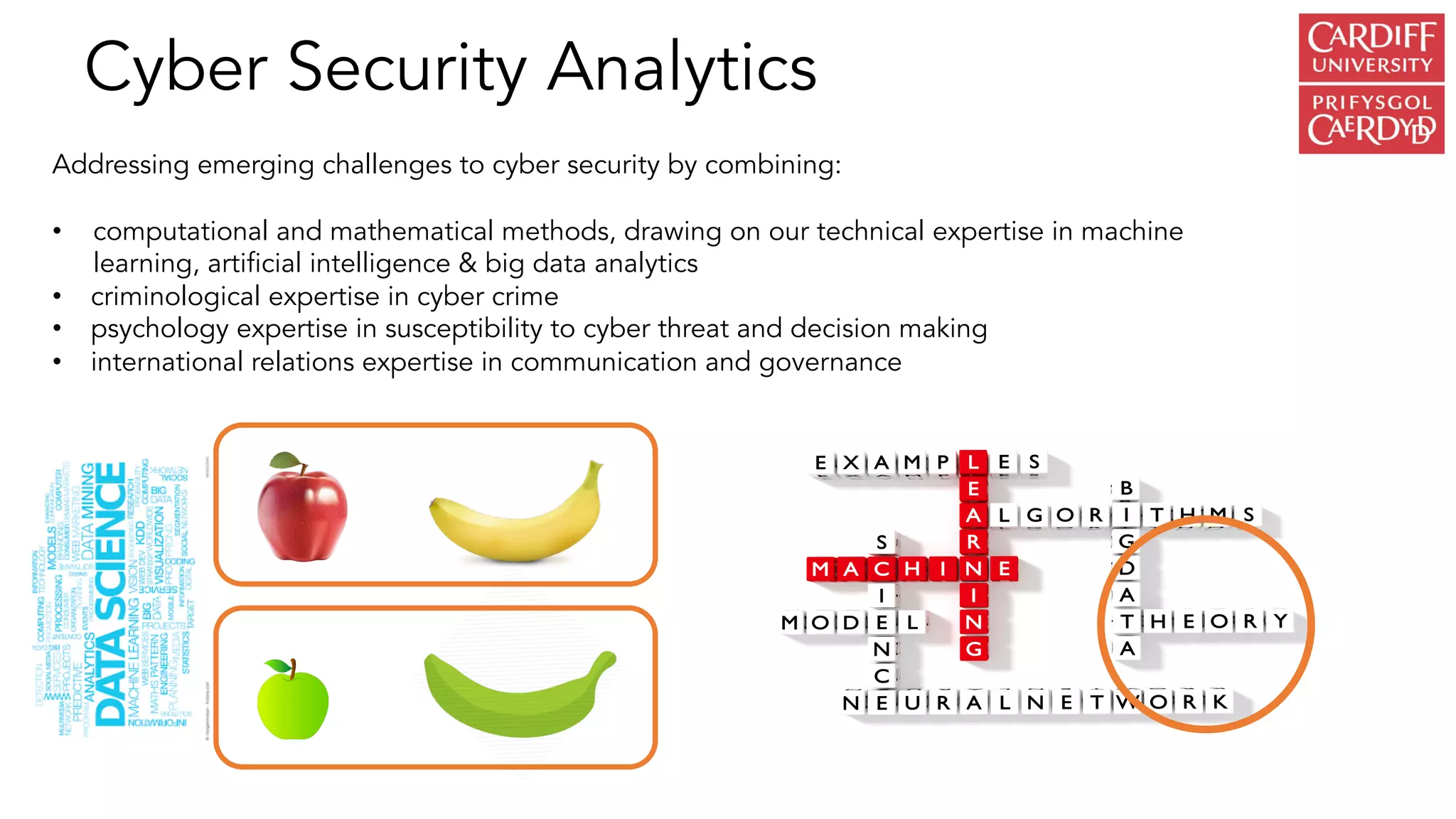
Cyber Security Analytics
Addressing emerging challenges to cyber security by combining:
• computational and mathematical methods, drawing on our technical expertise in machine
learning, artificial intelligence & big data analytics
• criminological expertise in cyber crime
• psychology expertise in susceptibility to cyber threat and decision making
• international relations expertise in communication and governance
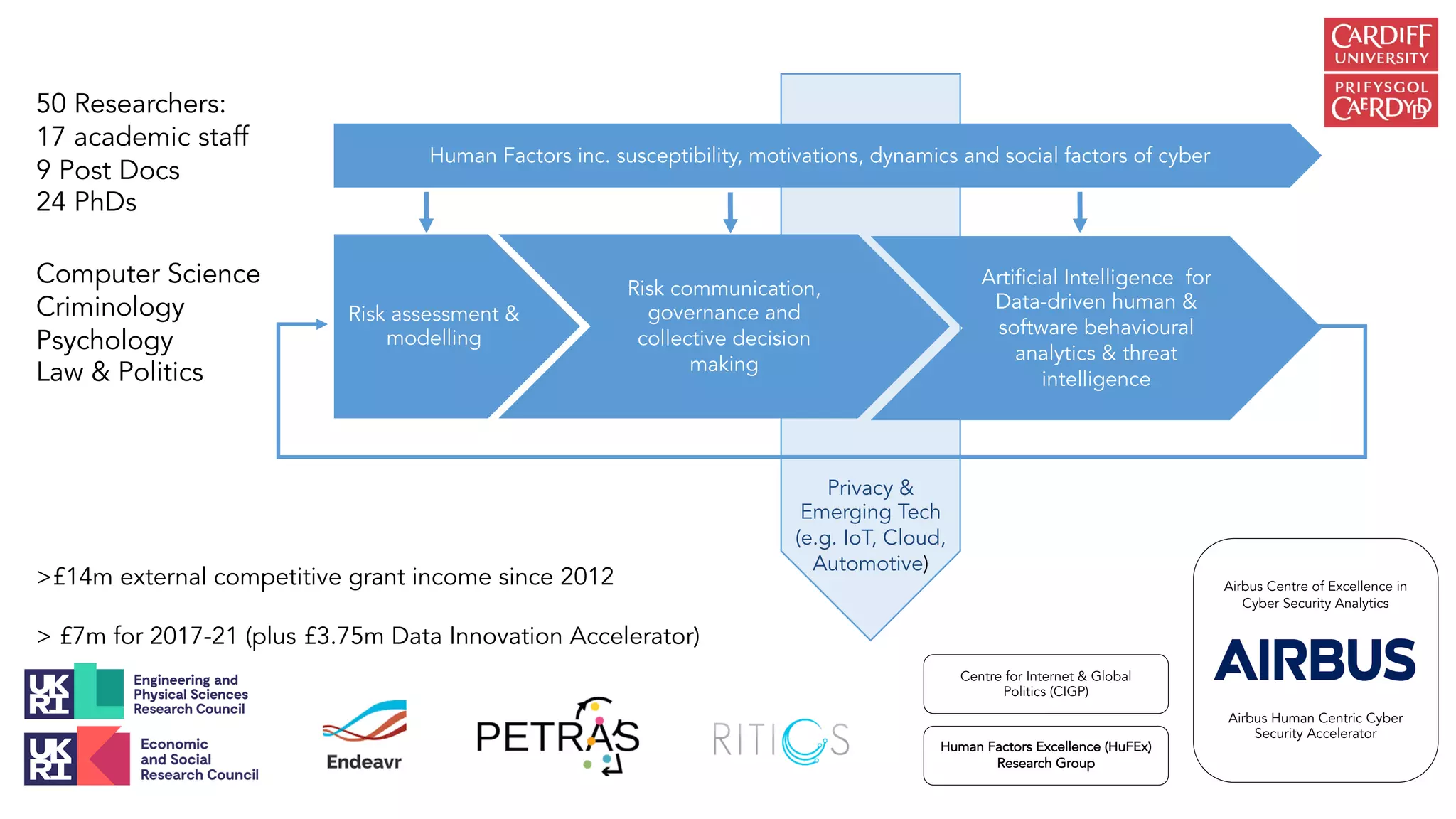
Computer Science
Criminology
Psychology
Law & Politics
50 Researchers:
17 academic staff
9 Post Docs
24 PhDs
>£14m external competitive grant income since 2012
> £7m for 2017-21 (plus £3.75m Data Innovation Accelerator)
Airbus Centre of Excellence in
Cyber Security Analytics
Airbus Human Centric Cyber
Security Accelerator
Human Factors Excellence (HuFEx)
Research Group
Centre for Internet & Global
Politics (CIGP)
Privacy &
Emerging Tech
(e.g. IoT, Cloud,
Automotive)
Risk assessment &
modelling
Risk communication,
governance and
collective decision
making
Artificial Intelligence for
Data-driven human &
software behavioural
analytics & threat
intelligence
Human Factors inc. susceptibility, motivations, dynamics and social factors of cyber
AI & Cybersecurity
Case Study: Advanced Security Operations Centre (SOC) @ Airbus
The Problem
Network Intrusion Detection Systems =
fine-grained network data & protocol-level
inspection
Anti-virus tools = attempt to match code
signatures to a list of known malicious code
bases
However…Attackers are developing
increasingly sophisticated methods to
avoid detection
APTs are becoming more sophisticated and able to obfuscate
much of their identifiable features through encryption, custom
code bases and in-memory execution…
print(here is some fake code)
for i in list <0,f,g,h,6,a> {
element * next_element
return another_element
}
if a + b != 7:
MV AX+1_068373
wh4T El - se _0_IS There “to_
take on this machine”
p_word = “PASSWORD”
u_name = “ADMIN”
.EXE
Security Operations Centres (SOC) are the front line
detection and analysis environments for many corporate
and safety-critical systems
Commonly use off-the-shelf anti-virus or high-end
behaviour analysis tools…most of which are vulnerable to
obfuscation
So how do we enabling the SOC to ‘learn’ what is
malicious in this context?
What does next-generation
SOC look like?
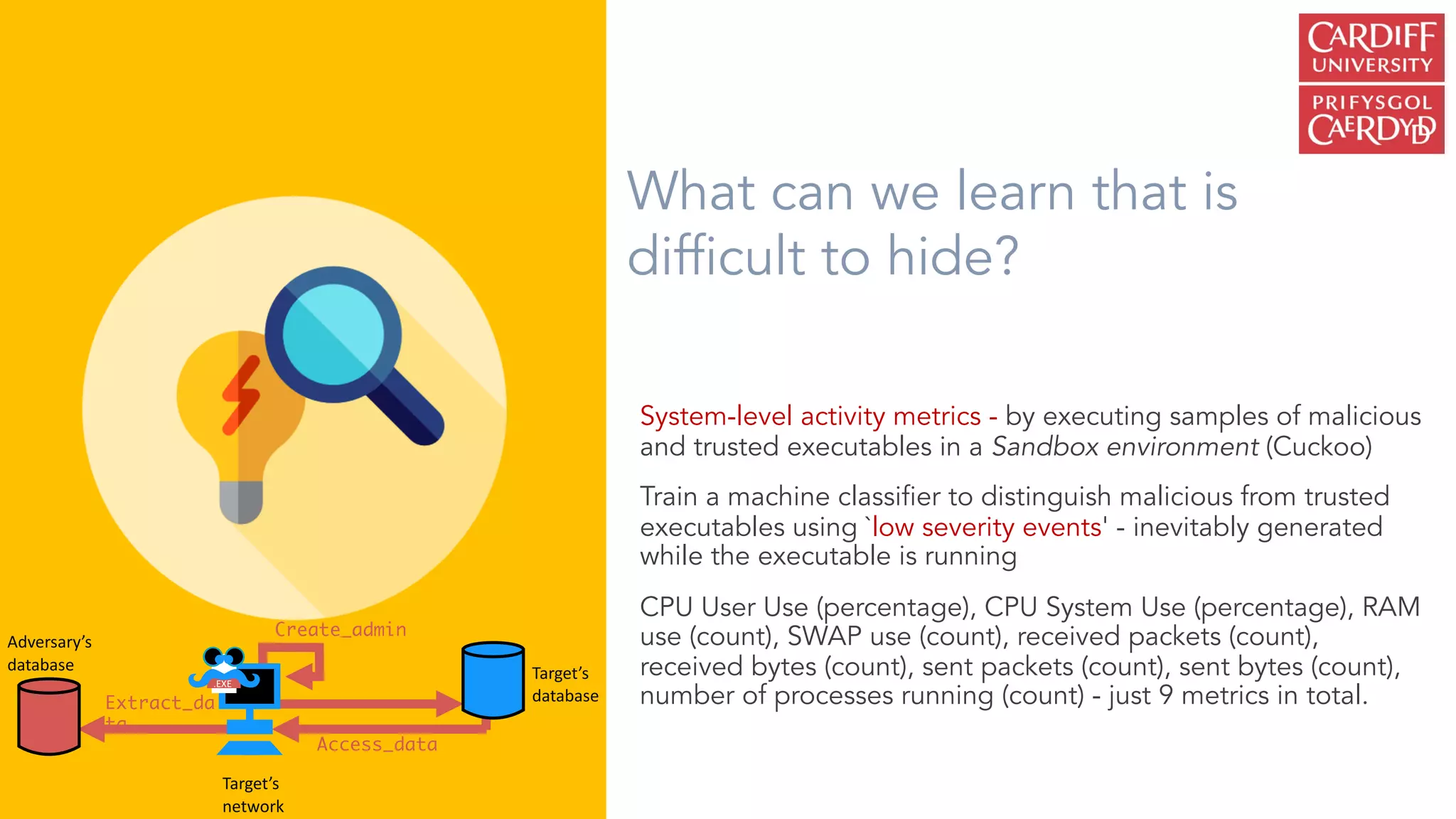
System-level activity metrics - by executing samples of malicious
and trusted executables in a Sandbox environment (Cuckoo)
Train a machine classifier to distinguish malicious from trusted
executables using `low severity events' - inevitably generated
while the executable is running
CPU User Use (percentage), CPU System Use (percentage), RAM
use (count), SWAP use (count), received packets (count),
received bytes (count), sent packets (count), sent bytes (count),
number of processes running (count) - just 9 metrics in total.
What can we learn that is
difficult to hide?
Create_admin
Extract_da
ta
Access_data
Target’s
database
Adversary’s
database
Target’s
network
.EXE
Attacks vary in their execution but theoretically exhibit
similar behaviour overall
Supposing we can capture a range of malicious behaviour,
can we represent these in such a way that we can identify
‘similar’ activity?
Think of DNA…parent/child similarity can be identified by
putting a bunch of characteristic ‘features’ together and
overlaying them…
How does this help?
Create_admin
Extract_da
ta
Access_data
Target’s
database
Adversary’s
database
Target’s
network
.EXE
APTs are becoming more sophisticated and able to obfuscate
much of their identifiable features through encryption, custom code
bases and in-memory execution…
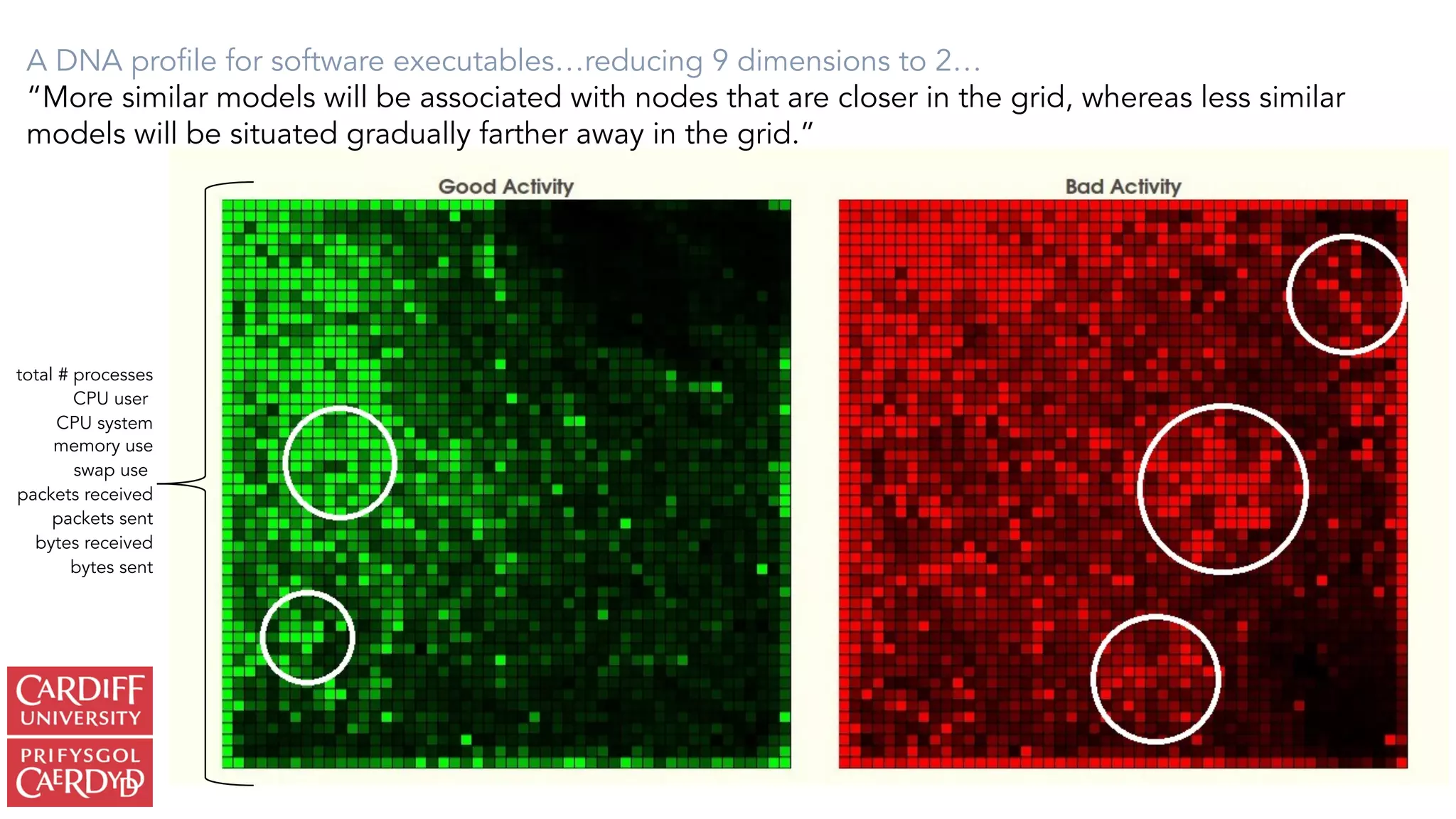
A DNA profile for software executables…reducing 9 dimensions to 2…
“More similar models will be associated with nodes that are closer in the grid, whereas less similar
models will be situated gradually farther away in the grid.”
total # processes
CPU user
CPU system
memory use
swap use
packets received
packets sent
bytes received
bytes sent
APTs are becoming more sophisticated and able to obfuscate
much of their identifiable features through encryption, custom code
bases and in-memory execution…time (s)
time
total # processes
max process ID
CPU user
CPU system
memory use
swap use
packets received
packets sent
bytes received
bytes sent
Looking at the system interactions instead of the code we can detect malware
even if code/API call/network traffic obfuscation is being used to evade
detection
Machine activity data for one piece of malware over 5 minutes
Self organising feature maps tranform the training sample data (system
interaction) into a 2D space and uses a competitive learning algorithm
to re-organise this space so that similar behaviours are close to one
another
x ‘000s =
APTs are becoming more sophisticated and able to obfuscate
much of their identifiable features through encryption, custom code
bases and in-memory execution…
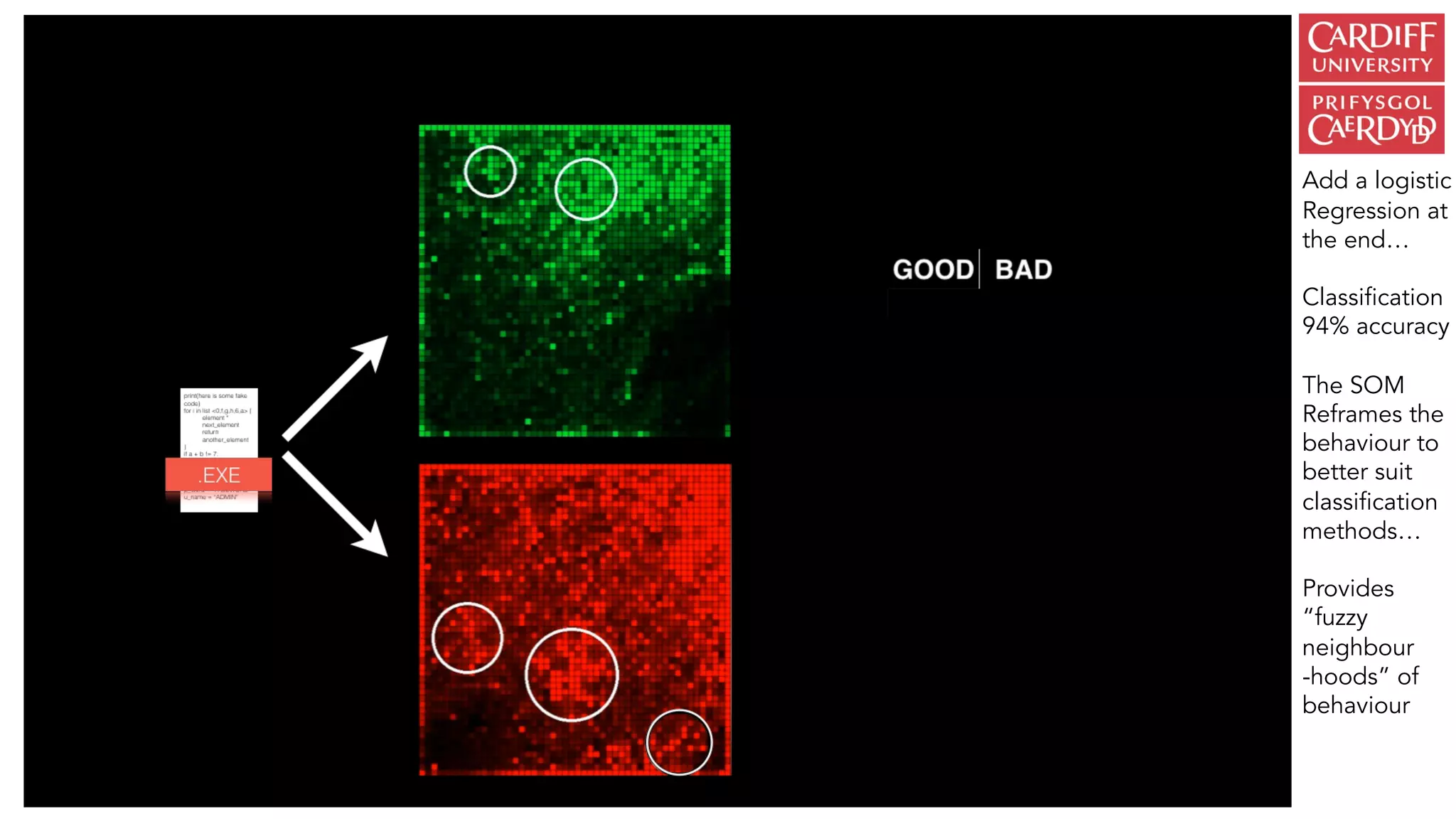
Add a logistic
Regression at
the end…
Classification
94% accuracy
The SOM
Reframes the
behaviour to
better suit
classification
methods…
Provides
“fuzzy
neighbour
-hoods” of
behaviour
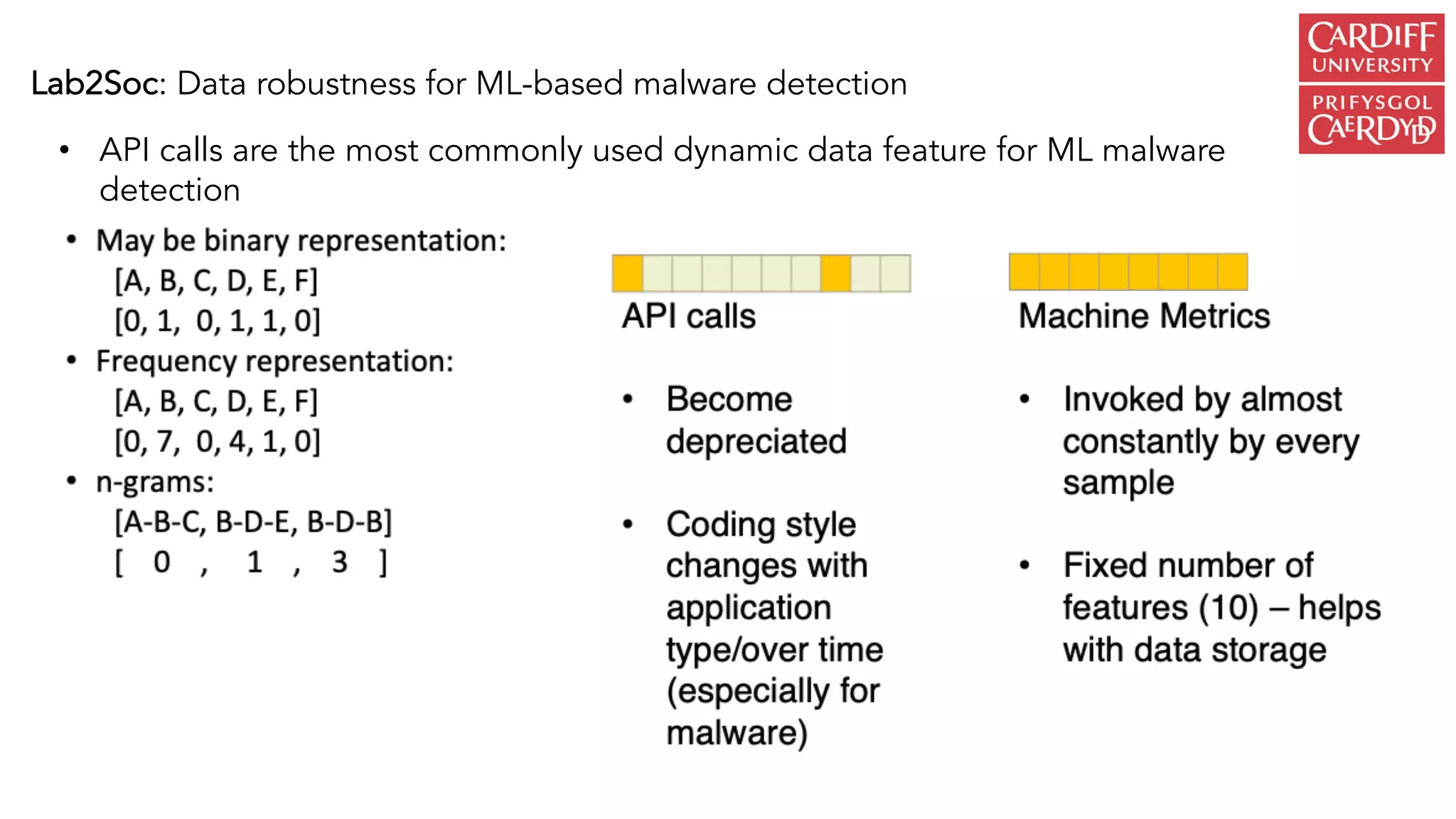
Lab2Soc: Data robustness for ML-based malware detection
• API calls are the most commonly used dynamic data feature for ML malware
detection
Lab2Soc: Data robsutness for ML-based malware detection
• API calls are the most commonly used dynamic data feature for ML malware
detection
• Different ways they can be represented
• Machine activity metrics show better consistency for detection accuracy
acrosss datasets from different sources
APTs are becoming more sophisticated and able to obfuscate
much of their identifiable features through encryption, custom code
bass and in-memory execution…
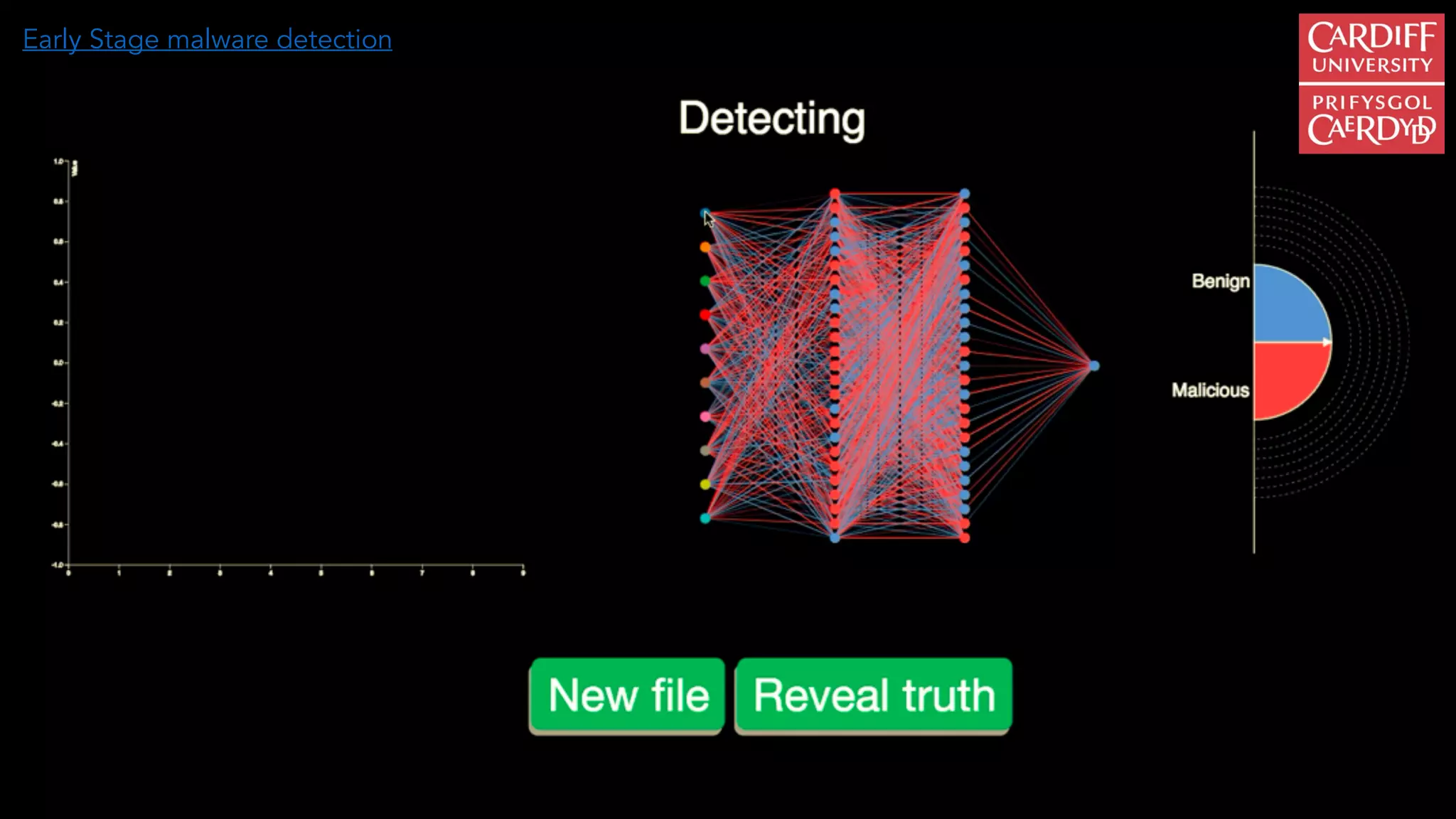
Early Stage malware detection
5 minutes: 98% accuracy
20 seconds: 98% accuracy
5 seconds: 94% accuracy
99% ransomware detected within 1 second of execution
Q: So post attack classification is good, but can we do this is ‘real-time’ and ‘predict’ an attack?
A: Yup, prediction accuracy 94% @ 4sec…using recurrent neural nets to learn sequences of activity
Detecting malicious processes
and automatically killing them
What does this mean for a user?
Preliminary results:
• 50% fewer files encrypted by
fast-acting (starts encryption
within first 5 seconds of
launching)
• 90% ransomware samples
detected
Goal oriented
models…
• Identifying dependencies within
complex systems is challenging
• Quantifying the risks associated with
system components, and determining
all attack paths is prone to error
(Unknown Unknowns).
• Typical risk assessments are failure-
oriented (fault tree, attack path etc.)
• System owners (arguably) tend to
know more about what they depend
on for success within their own system
• Can we capture that and use cyber
analytics to support impact analysis?
Impact of attack
Attack on
IoT Device
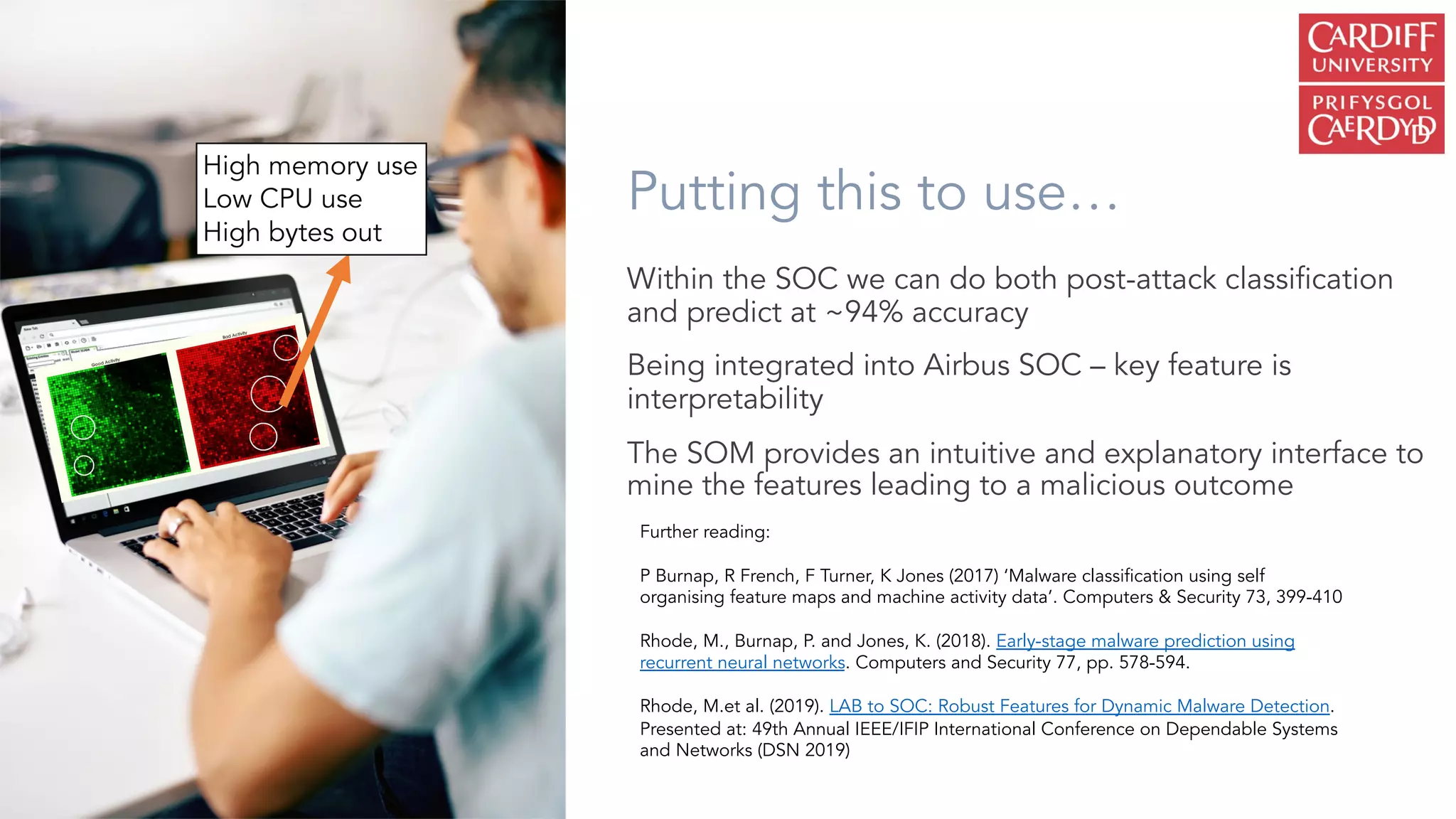
Putting this to use…
Within the SOC we can do both post-attack classification
and predict at ~94% accuracy
Being integrated into Airbus SOC – key feature is
interpretability
The SOM provides an intuitive and explanatory interface to
mine the features leading to a malicious outcome
Further reading:
P Burnap, R French, F Turner, K Jones (2017) ‘Malware classification using self
organising feature maps and machine activity data’. Computers & Security 73, 399-410
Rhode, M., Burnap, P. and Jones, K. (2018). Early-stage malware prediction using
recurrent neural networks. Computers and Security 77, pp. 578-594.
Rhode, M.et al. (2019). LAB to SOC: Robust Features for Dynamic Malware Detection.
Presented at: 49th Annual IEEE/IFIP International Conference on Dependable Systems
and Networks (DSN 2019)
High memory use
Low CPU use
High bytes out
Thanks.
burnapp@cardiff.ac.uk

AI for Cybersecurity Innovation

  • 1.
    Academic Centre ofExcellence in Cyber Security Research AI for Cybersecurity Innovation Prof. Pete Burnap
  • 2.
    The cyber securitylandscape “Our vision for 2021 is that the UK is secure and resilient to cyber threats…” “commercialise our world leading science base” “build on our areas of competitive advantage, and help new sectors to flourish…” – Artificial Intelligence Core Theme à “Helping to make the UK the safest place to live and do business online” Active Cyber Defence (at Cardiff we use AI for Threat Intel & Situational Awareness)
  • 3.
    Cyber Security Analytics Addressingemerging challenges to cyber security by combining: • computational and mathematical methods, drawing on our technical expertise in machine learning, artificial intelligence & big data analytics • criminological expertise in cyber crime • psychology expertise in susceptibility to cyber threat and decision making • international relations expertise in communication and governance
  • 4.
    Computer Science Criminology Psychology Law &Politics 50 Researchers: 17 academic staff 9 Post Docs 24 PhDs >£14m external competitive grant income since 2012 > £7m for 2017-21 (plus £3.75m Data Innovation Accelerator) Airbus Centre of Excellence in Cyber Security Analytics Airbus Human Centric Cyber Security Accelerator Human Factors Excellence (HuFEx) Research Group Centre for Internet & Global Politics (CIGP) Privacy & Emerging Tech (e.g. IoT, Cloud, Automotive) Risk assessment & modelling Risk communication, governance and collective decision making Artificial Intelligence for Data-driven human & software behavioural analytics & threat intelligence Human Factors inc. susceptibility, motivations, dynamics and social factors of cyber
  • 5.
    AI & Cybersecurity CaseStudy: Advanced Security Operations Centre (SOC) @ Airbus
  • 6.
    The Problem Network IntrusionDetection Systems = fine-grained network data & protocol-level inspection Anti-virus tools = attempt to match code signatures to a list of known malicious code bases However…Attackers are developing increasingly sophisticated methods to avoid detection
  • 7.
    APTs are becomingmore sophisticated and able to obfuscate much of their identifiable features through encryption, custom code bases and in-memory execution… print(here is some fake code) for i in list <0,f,g,h,6,a> { element * next_element return another_element } if a + b != 7: MV AX+1_068373 wh4T El - se _0_IS There “to_ take on this machine” p_word = “PASSWORD” u_name = “ADMIN” .EXE
  • 8.
    Security Operations Centres(SOC) are the front line detection and analysis environments for many corporate and safety-critical systems Commonly use off-the-shelf anti-virus or high-end behaviour analysis tools…most of which are vulnerable to obfuscation So how do we enabling the SOC to ‘learn’ what is malicious in this context? What does next-generation SOC look like?
  • 9.
    System-level activity metrics- by executing samples of malicious and trusted executables in a Sandbox environment (Cuckoo) Train a machine classifier to distinguish malicious from trusted executables using `low severity events' - inevitably generated while the executable is running CPU User Use (percentage), CPU System Use (percentage), RAM use (count), SWAP use (count), received packets (count), received bytes (count), sent packets (count), sent bytes (count), number of processes running (count) - just 9 metrics in total. What can we learn that is difficult to hide? Create_admin Extract_da ta Access_data Target’s database Adversary’s database Target’s network .EXE
  • 10.
    Attacks vary intheir execution but theoretically exhibit similar behaviour overall Supposing we can capture a range of malicious behaviour, can we represent these in such a way that we can identify ‘similar’ activity? Think of DNA…parent/child similarity can be identified by putting a bunch of characteristic ‘features’ together and overlaying them… How does this help? Create_admin Extract_da ta Access_data Target’s database Adversary’s database Target’s network .EXE
  • 11.
    APTs are becomingmore sophisticated and able to obfuscate much of their identifiable features through encryption, custom code bases and in-memory execution… A DNA profile for software executables…reducing 9 dimensions to 2… “More similar models will be associated with nodes that are closer in the grid, whereas less similar models will be situated gradually farther away in the grid.” total # processes CPU user CPU system memory use swap use packets received packets sent bytes received bytes sent
  • 12.
    APTs are becomingmore sophisticated and able to obfuscate much of their identifiable features through encryption, custom code bases and in-memory execution…time (s) time total # processes max process ID CPU user CPU system memory use swap use packets received packets sent bytes received bytes sent Looking at the system interactions instead of the code we can detect malware even if code/API call/network traffic obfuscation is being used to evade detection Machine activity data for one piece of malware over 5 minutes Self organising feature maps tranform the training sample data (system interaction) into a 2D space and uses a competitive learning algorithm to re-organise this space so that similar behaviours are close to one another x ‘000s =
  • 13.
    APTs are becomingmore sophisticated and able to obfuscate much of their identifiable features through encryption, custom code bases and in-memory execution… Add a logistic Regression at the end… Classification 94% accuracy The SOM Reframes the behaviour to better suit classification methods… Provides “fuzzy neighbour -hoods” of behaviour
  • 14.
    Lab2Soc: Data robustnessfor ML-based malware detection • API calls are the most commonly used dynamic data feature for ML malware detection
  • 15.
    Lab2Soc: Data robsutnessfor ML-based malware detection • API calls are the most commonly used dynamic data feature for ML malware detection • Different ways they can be represented • Machine activity metrics show better consistency for detection accuracy acrosss datasets from different sources
  • 16.
    APTs are becomingmore sophisticated and able to obfuscate much of their identifiable features through encryption, custom code bass and in-memory execution… Early Stage malware detection
  • 17.
    5 minutes: 98%accuracy 20 seconds: 98% accuracy 5 seconds: 94% accuracy 99% ransomware detected within 1 second of execution Q: So post attack classification is good, but can we do this is ‘real-time’ and ‘predict’ an attack? A: Yup, prediction accuracy 94% @ 4sec…using recurrent neural nets to learn sequences of activity
  • 18.
    Detecting malicious processes andautomatically killing them What does this mean for a user? Preliminary results: • 50% fewer files encrypted by fast-acting (starts encryption within first 5 seconds of launching) • 90% ransomware samples detected
  • 19.
    Goal oriented models… • Identifyingdependencies within complex systems is challenging • Quantifying the risks associated with system components, and determining all attack paths is prone to error (Unknown Unknowns). • Typical risk assessments are failure- oriented (fault tree, attack path etc.) • System owners (arguably) tend to know more about what they depend on for success within their own system • Can we capture that and use cyber analytics to support impact analysis?
  • 20.
  • 21.
    Putting this touse… Within the SOC we can do both post-attack classification and predict at ~94% accuracy Being integrated into Airbus SOC – key feature is interpretability The SOM provides an intuitive and explanatory interface to mine the features leading to a malicious outcome Further reading: P Burnap, R French, F Turner, K Jones (2017) ‘Malware classification using self organising feature maps and machine activity data’. Computers & Security 73, 399-410 Rhode, M., Burnap, P. and Jones, K. (2018). Early-stage malware prediction using recurrent neural networks. Computers and Security 77, pp. 578-594. Rhode, M.et al. (2019). LAB to SOC: Robust Features for Dynamic Malware Detection. Presented at: 49th Annual IEEE/IFIP International Conference on Dependable Systems and Networks (DSN 2019) High memory use Low CPU use High bytes out
  • 22.