THE BASICS OF
VIDEOGRAPHY
A B E G I N N E R ' S G U I D E T O M I R R O R L E S S A N D D S L R V I D E O M A K I N G .
S K I L L A S C H O O L 2 0 2 1
MANUAL FOCUS?
Y E A H , B A B Y !
Practice learning to focus manually. You
can't trust autofocus 100% of the time
(and focus on the landing point, not the
starting point of your subject).
ISO & F-STOP
ANYONE?
The ideal ISO is 200.
A good average aperture
setting is F/5.6.
SHUTTER SPEED
The ideal shutter speed for
video is 1/50th second.
S K I L L A S C H O O L 2 0 2 1
AUTO EXPOSURE IS
VOLATILE
Because exposures can change as you
pan the camera, you should use
manual exposure settings.
...and Neutral
Density Filters
are your friend
when shooting
outside in
daylight.
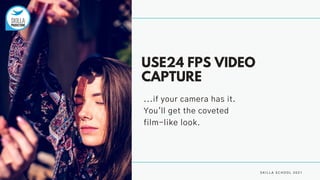
USE24 FPS VIDEO
CAPTURE
S K I L L A S C H O O L 2 0 2 1
...if your camera has it.
You'll get the coveted
film-like look.
S K I L L A S C H O O L 2 0 2 1
Because white balance changes
based on light sources, you
should stick with a chosen white
balance mode and avoid the
auto mode.
BEFRIEND WHITE
BALANCE
S K I L L A S C H O O L 2 0 2 1
F O R E X C E L L E N T O U T C O M E S
GOOD REMINDERS
Shoot at least 15 seconds per take, and not too much longer if
the motion doesn't change.
15 Seconds Rule
High-performance memory cards are a good investment for
dependable performance.
Inve$t in Memory Cards
S K I L L A S C H O O L 2 0 2 1
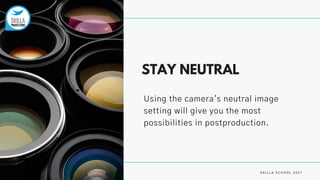
STAY NEUTRAL
Using the camera's neutral image
setting will give you the most
possibilities in postproduction.
An add-on
microphone is a
MUST.

Videography 101: Master the Basics

  • 1.
    THE BASICS OF VIDEOGRAPHY AB E G I N N E R ' S G U I D E T O M I R R O R L E S S A N D D S L R V I D E O M A K I N G .
  • 2.
    S K IL L A S C H O O L 2 0 2 1 MANUAL FOCUS? Y E A H , B A B Y ! Practice learning to focus manually. You can't trust autofocus 100% of the time (and focus on the landing point, not the starting point of your subject).
  • 3.
    ISO & F-STOP ANYONE? Theideal ISO is 200. A good average aperture setting is F/5.6. SHUTTER SPEED The ideal shutter speed for video is 1/50th second.
  • 4.
    S K IL L A S C H O O L 2 0 2 1 AUTO EXPOSURE IS VOLATILE Because exposures can change as you pan the camera, you should use manual exposure settings. ...and Neutral Density Filters are your friend when shooting outside in daylight.
  • 5.
    USE24 FPS VIDEO CAPTURE SK I L L A S C H O O L 2 0 2 1 ...if your camera has it. You'll get the coveted film-like look.
  • 6.
    S K IL L A S C H O O L 2 0 2 1 Because white balance changes based on light sources, you should stick with a chosen white balance mode and avoid the auto mode. BEFRIEND WHITE BALANCE
  • 7.
    S K IL L A S C H O O L 2 0 2 1 F O R E X C E L L E N T O U T C O M E S GOOD REMINDERS Shoot at least 15 seconds per take, and not too much longer if the motion doesn't change. 15 Seconds Rule High-performance memory cards are a good investment for dependable performance. Inve$t in Memory Cards
  • 8.
    S K IL L A S C H O O L 2 0 2 1 STAY NEUTRAL Using the camera's neutral image setting will give you the most possibilities in postproduction.
  • 9.