| Vibrating Element Technology | 7-12-18 |
© Yokogawa Corporation of America
1
For Gas Density, Specific Gravity,
and Hydrogen Purity
Vibrating Element
Technology
Jared Hybart
Product Manager
Yokogawa Corporation of America
| Vibrating Element Technology | 7-12-18 |
© Yokogawa Corporation of America
2
Host
Kristina Neahr
Marketing Specialist, Yokogawa
Kristina.neahr@us.yokogawa.com
678-423-2611
| Vibrating Element Technology | 7-12-18 |
© Yokogawa Corporation of America
3
Housekeeping Items
n Connect to Audio: 1 877 668 4490
uMeeting Number: 715 581 383
n Questions/Technical Issues
uChat with Kristina Neahr
n Recorded Presentation
uLink to recording & presentation provided
| Vibrating Element Technology | 7-12-18 |
© Yokogawa Corporation of America
4
Presenter
Jared Hybart
Product Manager, Process Gas Analyzers
Jared.hybart@us.yokogawa.com
770-254-0400 Ext. 5326
| Vibrating Element Technology | 7-12-18 |
© Yokogawa Corporation of America
5
Agenda
• Vibrating Element System and how density is measured
• How % concentration is inferred from a density
measurement
• Specific Gravity and % concentration in refinery
applications
• Measuring BTU
• Other methods of measuring gas density and specific
gravity
• Q&A
| Vibrating Element Technology | 7-12-18 |
© Yokogawa Corporation of America
6
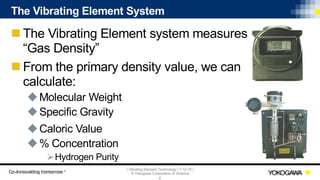
The Vibrating Element System
n The Vibrating Element system measures
“Gas Density”
n From the primary density value, we can
calculate:
uMolecular Weight
uSpecific Gravity
uCaloric Value
u% Concentration
ØHydrogen Purity
| Vibrating Element Technology | 7-12-18 |
© Yokogawa Corporation of America
7
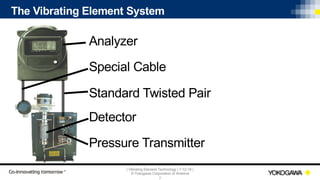
The Vibrating Element System
Analyzer
Special Cable
Standard Twisted Pair
Detector
Pressure Transmitter
| Vibrating Element Technology | 7-12-18 |
© Yokogawa Corporation of America
8
Measuring Density
| Vibrating Element Technology | 7-12-18 |
© Yokogawa Corporation of America
9
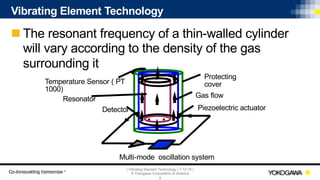
Vibrating Element Technology
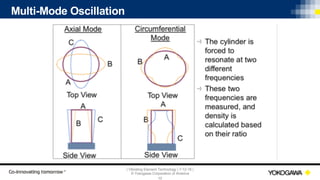
n The resonant frequency of a thin-walled cylinder
will vary according to the density of the gas
surrounding it
Protecting
cover
Gas flow
Multi-mode oscillation system
Piezoelectric actuatorDetector
Temperature Sensor ( PT
1000)
Resonator
| Vibrating Element Technology | 7-12-18 |
© Yokogawa Corporation of America
10
Multi-Mode Oscillation
| Vibrating Element Technology | 7-12-18 |
© Yokogawa Corporation of America
11
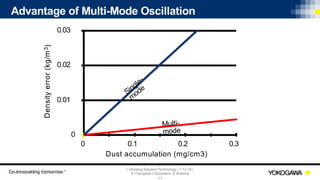
Advantage of Multi-Mode Oscillation
0
0.01
0.02
0.03
0 0.1 0.2 0.3
Dust accumulation (mg/cm3)
Densityerror(kg/m3)
Single-
m
ode
Multi-
mode
| Vibrating Element Technology | 7-12-18 |
© Yokogawa Corporation of America
12
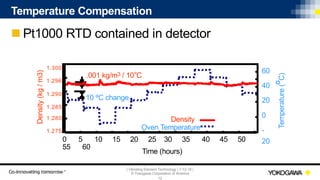
Temperature Compensation
n Pt1000 RTD contained in detector
Time (hours)
Density(kg/m3)
Temperature(ºC)
Density
Oven Temperature
60
40
20
0
-
20
1.300
1.296
1.290
1.285
1.280
1.275
10 ºC change
0 5 10 15 20 25 30 35 40 45 50
55 60
.001 kg/m3 / 10 C
| Vibrating Element Technology | 7-12-18 |
© Yokogawa Corporation of America
13
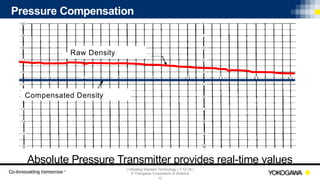
Pressure Compensation
Raw Density
Compensated Density
Absolute Pressure Transmitter provides real-time values
| Vibrating Element Technology | 7-12-18 |
© Yokogawa Corporation of America
14
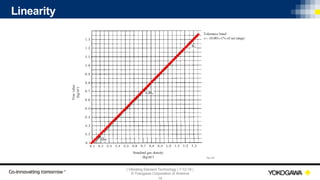
Linearity
| Vibrating Element Technology | 7-12-18 |
© Yokogawa Corporation of America
15
Calculating % Concentration
Power Plant Application
| Vibrating Element Technology | 7-12-18 |
© Yokogawa Corporation of America
16
Why is Hydrogen used to cool generators?
n Very efficient at conducting heat (absorbs heat
from equipment readily)
n Very low viscosity = low windage (friction) for
rotating equipment = efficiency
n Abundance = low cost
n Why measure Hydrogen purity?
uSafety; Explosive range of H2 = 4%-75% in Air
uEfficiency; High Purity = Low Windage
| Vibrating Element Technology | 7-12-18 |
© Yokogawa Corporation of America
17
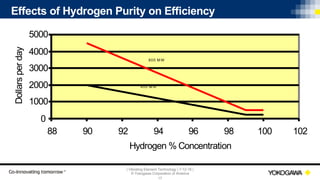
Effects of Hydrogen Purity on Efficiency
0
1000
2000
3000
4000
5000
88 90 92 94 96 98 100 102
Hydrogen % Concentration
Dollarsperday
800 M W
400 M W
| Vibrating Element Technology | 7-12-18 |
© Yokogawa Corporation of America
18
Calculating Percent Concentration
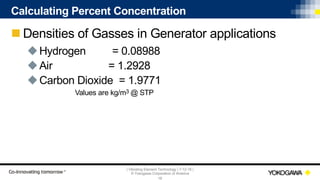
n Densities of Gasses in Generator applications
uHydrogen = 0.08988
uAir = 1.2928
uCarbon Dioxide = 1.9771
Values are kg/m3 @ STP
| Vibrating Element Technology | 7-12-18 |
© Yokogawa Corporation of America
19
Calculating Percent Concentration
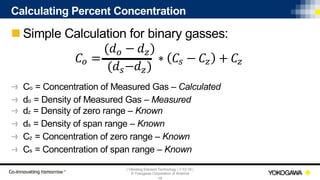
n Simple Calculation for binary gasses:
!" =
(%" − %')
(%)−%')
∗ !) − !' + !'
Co = Concentration of Measured Gas – Calculated
do = Density of Measured Gas – Measured
dz = Density of zero range – Known
ds = Density of span range – Known
Cz = Concentration of zero range – Known
Cs = Concentration of span range – Known
| Vibrating Element Technology | 7-12-18 |
© Yokogawa Corporation of America
20
Calculating Percent Concentration
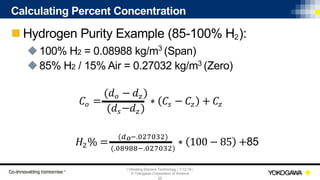
n Hydrogen Purity Example (85-100% H2):
u100% H2 = 0.08988 kg/m3
(Span)
u85% H2 / 15% Air = 0.27032 kg/m3 (Zero)
!" =
(%" − %')
(%)−%')
∗ !) − !' + !'
,-% =
(/01.3-435-)
(.367661.3-435-)
∗ 100 − 85 +85
| Vibrating Element Technology | 7-12-18 |
© Yokogawa Corporation of America
21
Tri-Gas Analyzer
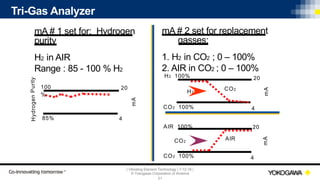
mA # 1 set for: Hydrogen
purity
H2 in AIR
Range : 85 - 100 % H2
mA # 2 set for replacement
gasses:
1. H2 in CO2 ; 0 – 100%
2. AIR in CO2 ; 0 – 100%
100
%
85%
HydrogenPurity
mA
4
20
CO2 100%
CO2
AIR
AIR 100%
H2 100%
CO2 100%
H2
CO2
mA
4
20
mA
4
20
| Vibrating Element Technology | 7-12-18 |
© Yokogawa Corporation of America
22
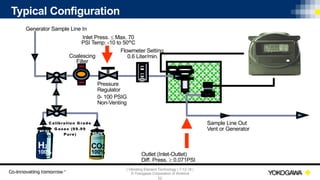
Typical Configuration
Inlet Press. £ Max. 70
PSI Temp: -10 to 50 C
CO2
100% Outlet (Inlet-Outlet)
Diff. Press. ³ 0.071PSI
Sample Line Out
Vent or Generator
Flowmeter Setting
0.6 Liter/min.
H2
100%
C alibration G rade
G ases (99.99
Pure)
Generator Sample Line In
Pressure
Regulator
0- 100 PSIG
Non-Venting
Coalescing
Filter
| Vibrating Element Technology | 7-12-18 |
© Yokogawa Corporation of America
23
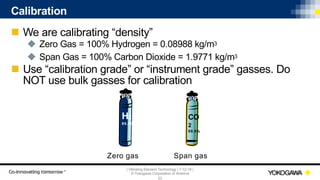
Calibration
n We are calibrating “density”
u Zero Gas = 100% Hydrogen = 0.08988 kg/m3
u Span Gas = 100% Carbon Dioxide = 1.9771 kg/m3
n Use “calibration grade” or “instrument grade” gasses. Do
NOT use bulk gasses for calibration
H2
99.9%
CO
2
99.9%
Zero gas Span gas
| Vibrating Element Technology | 7-12-18 |
© Yokogawa Corporation of America
24
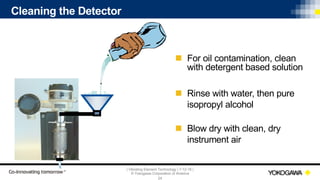
Cleaning the Detector
n For oil contamination, clean
with detergent based solution
n Rinse with water, then pure
isopropyl alcohol
n Blow dry with clean, dry
instrument air
| Vibrating Element Technology | 7-12-18 |
© Yokogawa Corporation of America
25
Refinery Applications
Specific Gravity / Hydrogen Purity
| Vibrating Element Technology | 7-12-18 |
© Yokogawa Corporation of America
26
Hydrotreaters
| Vibrating Element Technology | 7-12-18 |
© Yokogawa Corporation of America
27
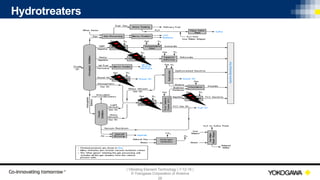
Hydrotreaters
n Hydrotreaters or HDS (Hydrodesulfurization) units
remove sulfur from products of distillation like
Naphtha, Diesel, and Gas Oils
n This “sweetening” process protects the catalysts
used in down-stream units (Reformers) and
reduces SO2 emissions when the final product is
burned
| Vibrating Element Technology | 7-12-18 |
© Yokogawa Corporation of America
28
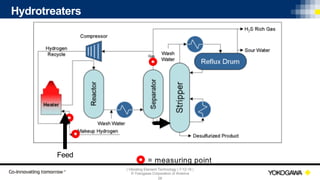
Hydrotreaters
Liquid
Gas
= measuring point
Feed
| Vibrating Element Technology | 7-12-18 |
© Yokogawa Corporation of America
29
Catalytic Reformers
| Vibrating Element Technology | 7-12-18 |
© Yokogawa Corporation of America
30
Catalytic Reformers
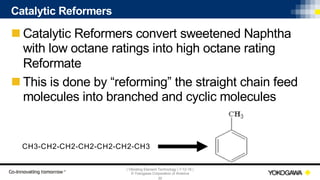
n Catalytic Reformers convert sweetened Naphtha
with low octane ratings into high octane rating
Reformate
n This is done by “reforming” the straight chain feed
molecules into branched and cyclic molecules
CH3-CH2-CH2-CH2-CH2-CH2-CH3
| Vibrating Element Technology | 7-12-18 |
© Yokogawa Corporation of America
31
Catalytic Reformers
n The process…
uThe feedstock is mixed with Hydrogen, then pressurized
and heated.
uThis mixture is sent to a series of reactors containing a
catalyst (usually platinum), where the reforming takes
place.
uThe products of this process is high-octane Reformate
and Hydrogen-rich gas (due to dehydrogenation of
straight-chain molecules).
| Vibrating Element Technology | 7-12-18 |
© Yokogawa Corporation of America
32
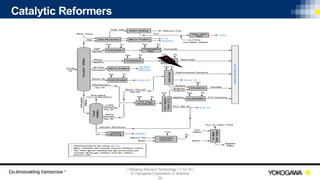
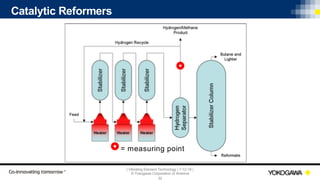
Catalytic Reformers
= measuring point
| Vibrating Element Technology | 7-12-18 |
© Yokogawa Corporation of America
33
Hydrocrackers
| Vibrating Element Technology | 7-12-18 |
© Yokogawa Corporation of America
34
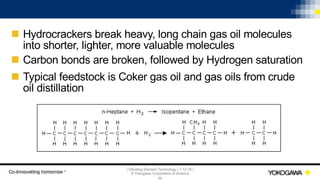
n Hydrocrackers break heavy, long chain gas oil molecules
into shorter, lighter, more valuable molecules
n Carbon bonds are broken, followed by Hydrogen saturation
n Typical feedstock is Coker gas oil and gas oils from crude
oil distillation
| Vibrating Element Technology | 7-12-18 |
© Yokogawa Corporation of America
35
Hydrocrackers
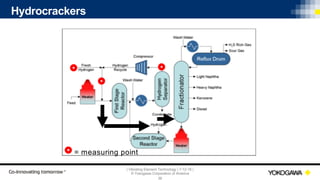
n The process…
uFeed stock is mixed with Hydrogen, pressurized (2000
psi), and heated (425 C)
uThis mixture is sent to a reactor containing a catalyst
(typically platinum) where the cracking takes place
uThe hydrogen rich gas is then separated from the
cracked product, which is further fractionated
| Vibrating Element Technology | 7-12-18 |
© Yokogawa Corporation of America
36
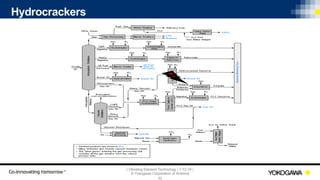
Hydrocrackers
= measuring point
| Vibrating Element Technology | 7-12-18 |
© Yokogawa Corporation of America
37
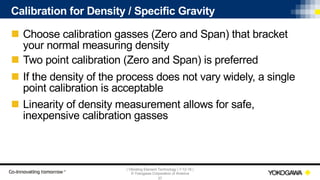
Calibration for Density / Specific Gravity
n Choose calibration gasses (Zero and Span) that bracket
your normal measuring density
n Two point calibration (Zero and Span) is preferred
n If the density of the process does not vary widely, a single
point calibration is acceptable
n Linearity of density measurement allows for safe,
inexpensive calibration gasses
| Vibrating Element Technology | 7-12-18 |
© Yokogawa Corporation of America
38
Calculating Caloric Value
BTU
| Vibrating Element Technology | 7-12-18 |
© Yokogawa Corporation of America
39
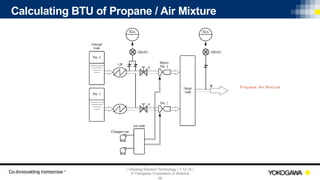
Calculating BTU of Propane / Air Mixture
Propane /Air M ixture
| Vibrating Element Technology | 7-12-18 |
© Yokogawa Corporation of America
40
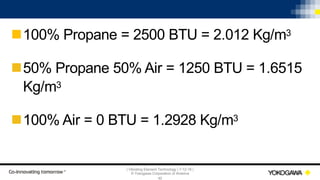
n100% Propane = 2500 BTU = 2.012 Kg/m3
n50% Propane 50% Air = 1250 BTU = 1.6515
Kg/m3
n100% Air = 0 BTU = 1.2928 Kg/m3
| Vibrating Element Technology | 7-12-18 |
© Yokogawa Corporation of America
41
Other Methods
Specific Gravity / Hydrogen Purity
| Vibrating Element Technology | 7-12-18 |
© Yokogawa Corporation of America
42
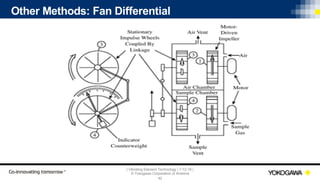
Other Methods: Fan Differential
| Vibrating Element Technology | 7-12-18 |
© Yokogawa Corporation of America
43
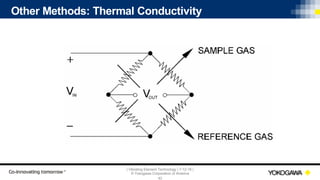
Other Methods: Thermal Conductivity
| Vibrating Element Technology | 7-12-18 |
© Yokogawa Corporation of America
44
Vibrating Element Technology- Summarized
n Reliable, stable, accurate measurement
n Linear over wide range
n No warm-up time; no isothermal oven
n No reference gas required
n Calibration in a few minutes
n Standard calibration gasses (not custom)
n Withstands dust and oil in sample gas
n Virtually maintenance free
n Easily cleaned on site
n Tri-Gas analyzer (one unit for H2, Air, CO2)
| Vibrating Element Technology | 7-12-18 |
© Yokogawa Corporation of America
45
Questions?
| Vibrating Element Technology | 7-12-18 |
© Yokogawa Corporation of America
46Co-innovatingtomorrowis aregisteredtrademark of YokogawaElectric Corporation.
Thank you!

Vibrating Element Technology for Gas Density, Specific Gravity, and Hydrogen Purity

  • 1.
    | Vibrating ElementTechnology | 7-12-18 | © Yokogawa Corporation of America 1 For Gas Density, Specific Gravity, and Hydrogen Purity Vibrating Element Technology Jared Hybart Product Manager Yokogawa Corporation of America
  • 2.
    | Vibrating ElementTechnology | 7-12-18 | © Yokogawa Corporation of America 2 Host Kristina Neahr Marketing Specialist, Yokogawa Kristina.neahr@us.yokogawa.com 678-423-2611
  • 3.
    | Vibrating ElementTechnology | 7-12-18 | © Yokogawa Corporation of America 3 Housekeeping Items n Connect to Audio: 1 877 668 4490 uMeeting Number: 715 581 383 n Questions/Technical Issues uChat with Kristina Neahr n Recorded Presentation uLink to recording & presentation provided
  • 4.
    | Vibrating ElementTechnology | 7-12-18 | © Yokogawa Corporation of America 4 Presenter Jared Hybart Product Manager, Process Gas Analyzers Jared.hybart@us.yokogawa.com 770-254-0400 Ext. 5326
  • 5.
    | Vibrating ElementTechnology | 7-12-18 | © Yokogawa Corporation of America 5 Agenda • Vibrating Element System and how density is measured • How % concentration is inferred from a density measurement • Specific Gravity and % concentration in refinery applications • Measuring BTU • Other methods of measuring gas density and specific gravity • Q&A
  • 6.
    | Vibrating ElementTechnology | 7-12-18 | © Yokogawa Corporation of America 6 The Vibrating Element System n The Vibrating Element system measures “Gas Density” n From the primary density value, we can calculate: uMolecular Weight uSpecific Gravity uCaloric Value u% Concentration ØHydrogen Purity
  • 7.
    | Vibrating ElementTechnology | 7-12-18 | © Yokogawa Corporation of America 7 The Vibrating Element System Analyzer Special Cable Standard Twisted Pair Detector Pressure Transmitter
  • 8.
    | Vibrating ElementTechnology | 7-12-18 | © Yokogawa Corporation of America 8 Measuring Density
  • 9.
    | Vibrating ElementTechnology | 7-12-18 | © Yokogawa Corporation of America 9 Vibrating Element Technology n The resonant frequency of a thin-walled cylinder will vary according to the density of the gas surrounding it Protecting cover Gas flow Multi-mode oscillation system Piezoelectric actuatorDetector Temperature Sensor ( PT 1000) Resonator
  • 10.
    | Vibrating ElementTechnology | 7-12-18 | © Yokogawa Corporation of America 10 Multi-Mode Oscillation
  • 11.
    | Vibrating ElementTechnology | 7-12-18 | © Yokogawa Corporation of America 11 Advantage of Multi-Mode Oscillation 0 0.01 0.02 0.03 0 0.1 0.2 0.3 Dust accumulation (mg/cm3) Densityerror(kg/m3) Single- m ode Multi- mode
  • 12.
    | Vibrating ElementTechnology | 7-12-18 | © Yokogawa Corporation of America 12 Temperature Compensation n Pt1000 RTD contained in detector Time (hours) Density(kg/m3) Temperature(ºC) Density Oven Temperature 60 40 20 0 - 20 1.300 1.296 1.290 1.285 1.280 1.275 10 ºC change 0 5 10 15 20 25 30 35 40 45 50 55 60 .001 kg/m3 / 10 C
  • 13.
    | Vibrating ElementTechnology | 7-12-18 | © Yokogawa Corporation of America 13 Pressure Compensation Raw Density Compensated Density Absolute Pressure Transmitter provides real-time values
  • 14.
    | Vibrating ElementTechnology | 7-12-18 | © Yokogawa Corporation of America 14 Linearity
  • 15.
    | Vibrating ElementTechnology | 7-12-18 | © Yokogawa Corporation of America 15 Calculating % Concentration Power Plant Application
  • 16.
    | Vibrating ElementTechnology | 7-12-18 | © Yokogawa Corporation of America 16 Why is Hydrogen used to cool generators? n Very efficient at conducting heat (absorbs heat from equipment readily) n Very low viscosity = low windage (friction) for rotating equipment = efficiency n Abundance = low cost n Why measure Hydrogen purity? uSafety; Explosive range of H2 = 4%-75% in Air uEfficiency; High Purity = Low Windage
  • 17.
    | Vibrating ElementTechnology | 7-12-18 | © Yokogawa Corporation of America 17 Effects of Hydrogen Purity on Efficiency 0 1000 2000 3000 4000 5000 88 90 92 94 96 98 100 102 Hydrogen % Concentration Dollarsperday 800 M W 400 M W
  • 18.
    | Vibrating ElementTechnology | 7-12-18 | © Yokogawa Corporation of America 18 Calculating Percent Concentration n Densities of Gasses in Generator applications uHydrogen = 0.08988 uAir = 1.2928 uCarbon Dioxide = 1.9771 Values are kg/m3 @ STP
  • 19.
    | Vibrating ElementTechnology | 7-12-18 | © Yokogawa Corporation of America 19 Calculating Percent Concentration n Simple Calculation for binary gasses: !" = (%" − %') (%)−%') ∗ !) − !' + !' Co = Concentration of Measured Gas – Calculated do = Density of Measured Gas – Measured dz = Density of zero range – Known ds = Density of span range – Known Cz = Concentration of zero range – Known Cs = Concentration of span range – Known
  • 20.
    | Vibrating ElementTechnology | 7-12-18 | © Yokogawa Corporation of America 20 Calculating Percent Concentration n Hydrogen Purity Example (85-100% H2): u100% H2 = 0.08988 kg/m3 (Span) u85% H2 / 15% Air = 0.27032 kg/m3 (Zero) !" = (%" − %') (%)−%') ∗ !) − !' + !' ,-% = (/01.3-435-) (.367661.3-435-) ∗ 100 − 85 +85
  • 21.
    | Vibrating ElementTechnology | 7-12-18 | © Yokogawa Corporation of America 21 Tri-Gas Analyzer mA # 1 set for: Hydrogen purity H2 in AIR Range : 85 - 100 % H2 mA # 2 set for replacement gasses: 1. H2 in CO2 ; 0 – 100% 2. AIR in CO2 ; 0 – 100% 100 % 85% HydrogenPurity mA 4 20 CO2 100% CO2 AIR AIR 100% H2 100% CO2 100% H2 CO2 mA 4 20 mA 4 20
  • 22.
    | Vibrating ElementTechnology | 7-12-18 | © Yokogawa Corporation of America 22 Typical Configuration Inlet Press. £ Max. 70 PSI Temp: -10 to 50 C CO2 100% Outlet (Inlet-Outlet) Diff. Press. ³ 0.071PSI Sample Line Out Vent or Generator Flowmeter Setting 0.6 Liter/min. H2 100% C alibration G rade G ases (99.99 Pure) Generator Sample Line In Pressure Regulator 0- 100 PSIG Non-Venting Coalescing Filter
  • 23.
    | Vibrating ElementTechnology | 7-12-18 | © Yokogawa Corporation of America 23 Calibration n We are calibrating “density” u Zero Gas = 100% Hydrogen = 0.08988 kg/m3 u Span Gas = 100% Carbon Dioxide = 1.9771 kg/m3 n Use “calibration grade” or “instrument grade” gasses. Do NOT use bulk gasses for calibration H2 99.9% CO 2 99.9% Zero gas Span gas
  • 24.
    | Vibrating ElementTechnology | 7-12-18 | © Yokogawa Corporation of America 24 Cleaning the Detector n For oil contamination, clean with detergent based solution n Rinse with water, then pure isopropyl alcohol n Blow dry with clean, dry instrument air
  • 25.
    | Vibrating ElementTechnology | 7-12-18 | © Yokogawa Corporation of America 25 Refinery Applications Specific Gravity / Hydrogen Purity
  • 26.
    | Vibrating ElementTechnology | 7-12-18 | © Yokogawa Corporation of America 26 Hydrotreaters
  • 27.
    | Vibrating ElementTechnology | 7-12-18 | © Yokogawa Corporation of America 27 Hydrotreaters n Hydrotreaters or HDS (Hydrodesulfurization) units remove sulfur from products of distillation like Naphtha, Diesel, and Gas Oils n This “sweetening” process protects the catalysts used in down-stream units (Reformers) and reduces SO2 emissions when the final product is burned
  • 28.
    | Vibrating ElementTechnology | 7-12-18 | © Yokogawa Corporation of America 28 Hydrotreaters Liquid Gas = measuring point Feed
  • 29.
    | Vibrating ElementTechnology | 7-12-18 | © Yokogawa Corporation of America 29 Catalytic Reformers
  • 30.
    | Vibrating ElementTechnology | 7-12-18 | © Yokogawa Corporation of America 30 Catalytic Reformers n Catalytic Reformers convert sweetened Naphtha with low octane ratings into high octane rating Reformate n This is done by “reforming” the straight chain feed molecules into branched and cyclic molecules CH3-CH2-CH2-CH2-CH2-CH2-CH3
  • 31.
    | Vibrating ElementTechnology | 7-12-18 | © Yokogawa Corporation of America 31 Catalytic Reformers n The process… uThe feedstock is mixed with Hydrogen, then pressurized and heated. uThis mixture is sent to a series of reactors containing a catalyst (usually platinum), where the reforming takes place. uThe products of this process is high-octane Reformate and Hydrogen-rich gas (due to dehydrogenation of straight-chain molecules).
  • 32.
    | Vibrating ElementTechnology | 7-12-18 | © Yokogawa Corporation of America 32 Catalytic Reformers = measuring point
  • 33.
    | Vibrating ElementTechnology | 7-12-18 | © Yokogawa Corporation of America 33 Hydrocrackers
  • 34.
    | Vibrating ElementTechnology | 7-12-18 | © Yokogawa Corporation of America 34 n Hydrocrackers break heavy, long chain gas oil molecules into shorter, lighter, more valuable molecules n Carbon bonds are broken, followed by Hydrogen saturation n Typical feedstock is Coker gas oil and gas oils from crude oil distillation
  • 35.
    | Vibrating ElementTechnology | 7-12-18 | © Yokogawa Corporation of America 35 Hydrocrackers n The process… uFeed stock is mixed with Hydrogen, pressurized (2000 psi), and heated (425 C) uThis mixture is sent to a reactor containing a catalyst (typically platinum) where the cracking takes place uThe hydrogen rich gas is then separated from the cracked product, which is further fractionated
  • 36.
    | Vibrating ElementTechnology | 7-12-18 | © Yokogawa Corporation of America 36 Hydrocrackers = measuring point
  • 37.
    | Vibrating ElementTechnology | 7-12-18 | © Yokogawa Corporation of America 37 Calibration for Density / Specific Gravity n Choose calibration gasses (Zero and Span) that bracket your normal measuring density n Two point calibration (Zero and Span) is preferred n If the density of the process does not vary widely, a single point calibration is acceptable n Linearity of density measurement allows for safe, inexpensive calibration gasses
  • 38.
    | Vibrating ElementTechnology | 7-12-18 | © Yokogawa Corporation of America 38 Calculating Caloric Value BTU
  • 39.
    | Vibrating ElementTechnology | 7-12-18 | © Yokogawa Corporation of America 39 Calculating BTU of Propane / Air Mixture Propane /Air M ixture
  • 40.
    | Vibrating ElementTechnology | 7-12-18 | © Yokogawa Corporation of America 40 n100% Propane = 2500 BTU = 2.012 Kg/m3 n50% Propane 50% Air = 1250 BTU = 1.6515 Kg/m3 n100% Air = 0 BTU = 1.2928 Kg/m3
  • 41.
    | Vibrating ElementTechnology | 7-12-18 | © Yokogawa Corporation of America 41 Other Methods Specific Gravity / Hydrogen Purity
  • 42.
    | Vibrating ElementTechnology | 7-12-18 | © Yokogawa Corporation of America 42 Other Methods: Fan Differential
  • 43.
    | Vibrating ElementTechnology | 7-12-18 | © Yokogawa Corporation of America 43 Other Methods: Thermal Conductivity
  • 44.
    | Vibrating ElementTechnology | 7-12-18 | © Yokogawa Corporation of America 44 Vibrating Element Technology- Summarized n Reliable, stable, accurate measurement n Linear over wide range n No warm-up time; no isothermal oven n No reference gas required n Calibration in a few minutes n Standard calibration gasses (not custom) n Withstands dust and oil in sample gas n Virtually maintenance free n Easily cleaned on site n Tri-Gas analyzer (one unit for H2, Air, CO2)
  • 45.
    | Vibrating ElementTechnology | 7-12-18 | © Yokogawa Corporation of America 45 Questions?
  • 46.
    | Vibrating ElementTechnology | 7-12-18 | © Yokogawa Corporation of America 46Co-innovatingtomorrowis aregisteredtrademark of YokogawaElectric Corporation. Thank you!