| July 30, 2020 |
© Yokogawa Electric Corporation
Pulp Mill Applications that
keep you up at night
0
Pulp & Paper Webinar
September 24, 2020
| July 30, 2020 |
© Yokogawa Electric Corporation
1
Presenters
Host
Cherlyn Marlow
Product Marketing Manager
Presenters
Host
Chris Costlow
Product Marketing Manager
Michael Zoghby Jr - Southeast Sales Manager – BBP
Michael has 15 years of experience selling in Industrial
Markets with a strong presence in Pulp & Paper.
Dennis Crosby – Southeast Analytical Sales Manager – Yokogawa
Dennis has 40 years of experience in Analytical instrumentation in
Liquid, Gas and Advanced Analytical (GC and TDLS) analyzers; selling
primarily to the Pulp and Paper and Power markets.
Paul Warburton- Southeast Field Instruments Sales Manager – Yokogawa
Paul has 28 years of industry experience with the last 24 years working at
Yokogawa. Previously held positions include flow meter product
management and technical support team leader for field instruments.
Wesley Chappell - Account Manager – BBP
Specializing in Pulp and Paper in South Alabama, South Georgia, and the
Panhandle
| July 30, 2020 |
© Yokogawa Electric Corporation
Agenda
2
1. Plant Overview
2. Cooking (Digester) Process
 Why Liner Selection is important
 What is Total Insight and what does that mean for
me?
3. Washing & Bleaching
 Why are accurate pH readings critical
 Why is pH so maintenance intensive?
 So I am stuck with pH…..
What can I do to make it more manageable?
4. Summary
| July 30, 2020 |
© Yokogawa Electric Corporation
3
Plant Overview
| July 30, 2020 |
© Yokogawa Electric Corporation
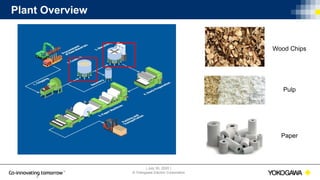
Plant Overview
4
Wood Chips
Pulp
Paper
| July 30, 2020 |
© Yokogawa Electric Corporation
5
Cooking (Digester)
| July 30, 2020 |
© Yokogawa Electric Corporation
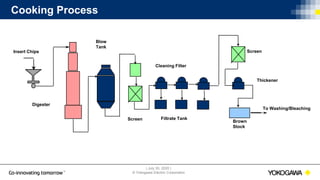
Cooking Process
Top
Digester
Blow
Tank
Screen
Screen
Thickener
Filtrate Tank
Cleaning Filter
To Washing/Bleaching
Insert Chips
Brown
Stock
| July 30, 2020 |
© Yokogawa Electric Corporation
Cooking (Digester) Process
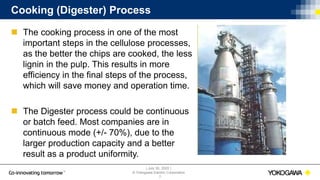
 The cooking process in one of the most
important steps in the cellulose processes,
as the better the chips are cooked, the less
lignin in the pulp. This results in more
efficiency in the final steps of the process,
which will save money and operation time.
 The Digester process could be continuous
or batch feed. Most companies are in
continuous mode (+/- 70%), due to the
larger production capacity and a better
result as a product uniformity.
7
| July 30, 2020 |
© Yokogawa Electric Corporation
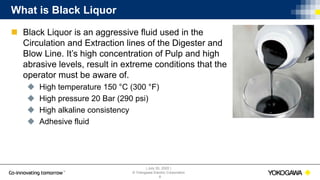
What is Black Liquor
 Black Liquor is an aggressive fluid used in the
Circulation and Extraction lines of the Digester and
Blow Line. It’s high concentration of Pulp and high
abrasive levels, result in extreme conditions that the
operator must be aware of.
 High temperature 150 °C (300 °F)
 High pressure 20 Bar (290 psi)
 High alkaline consistency
 Adhesive fluid
8
| July 30, 2020 |
© Yokogawa Electric Corporation
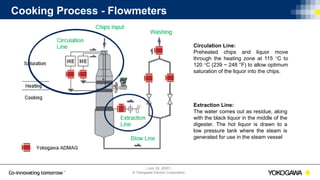
Cooking Process - Flowmeters
Circulation Line:
Preheated chips and liquor move
through the heating zone at 115 °C to
120 °C (239 ~ 248 °F) to allow optimum
saturation of the liquor into the chips.
Extraction Line:
The water comes out as residue, along
with the black liquor in the middle of the
digester. The hot liquor is drawn to a
low pressure tank where the steam is
generated for use in the steam vessel
| July 30, 2020 |
© Yokogawa Electric Corporation
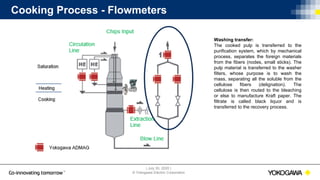
Cooking Process - Flowmeters
Washing transfer:
The cooked pulp is transferred to the
purification system, which by mechanical
process, separates the foreign materials
from the fibers (nodes, small sticks). The
pulp material is transferred to the washer
filters, whose purpose is to wash the
mass, separating all the soluble from the
cellulose fibers (delignation). The
cellulose is then routed to the bleaching
or else to manufacture Kraft paper. The
filtrate is called black liquor and is
transferred to the recovery process.
| July 30, 2020 |
© Yokogawa Electric Corporation
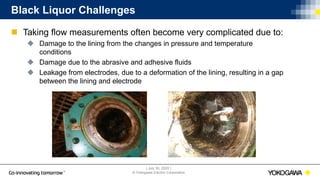
Black Liquor Challenges
 Taking flow measurements often become very complicated due to:
 Damage to the lining from the changes in pressure and temperature
conditions
 Damage due to the abrasive and adhesive fluids
 Leakage from electrodes, due to a deformation of the lining, resulting in a gap
between the lining and electrode
| July 30, 2020 |
© Yokogawa Electric Corporation
Why liner selection is
important
12
| July 30, 2020 |
© Yokogawa Electric Corporation
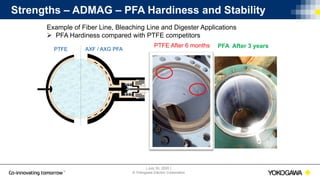
Example of Fiber Line, Bleaching Line and Digester Applications
 PFA Hardiness compared with PTFE competitors
Strengths – ADMAG – PFA Hardiness and Stability
AXF / AXG PFAPTFE
PTFE After 6 months PFA After 3 years
| July 30, 2020 |
© Yokogawa Electric Corporation
14
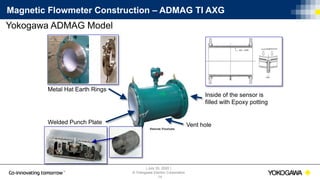
Yokogawa ADMAG Model
Metal Hat Earth Rings
Welded Punch Plate
Inside of the sensor is
filled with Epoxy potting
Vent hole
Magnetic Flowmeter Construction – ADMAG TI AXG
| July 30, 2020 |
© Yokogawa Electric Corporation
15
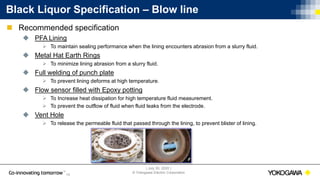
 Recommended specification
 PFA Lining
 To maintain sealing performance when the lining encounters abrasion from a slurry fluid.
 Metal Hat Earth Rings
 To minimize lining abrasion from a slurry fluid.
 Full welding of punch plate
 To prevent lining deforms at high temperature.
 Flow sensor filled with Epoxy potting
 To Increase heat dissipation for high temperature fluid measurement.
 To prevent the outflow of fluid when fluid leaks from the electrode.
 Vent Hole
 To release the permeable fluid that passed through the lining, to prevent blister of lining.
Black Liquor Specification – Blow line
| July 30, 2020 |
© Yokogawa Electric Corporation
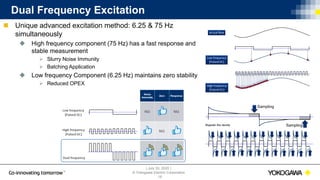
Dual Frequency Excitation
16
 Unique advanced excitation method: 6.25 & 75 Hz
simultaneously
 High frequency component (75 Hz) has a fast response and
stable measurement
 Slurry Noise Immunity
 Batching Application
 Low frequency Component (6.25 Hz) maintains zero stability
 Reduced OPEX
| July 30, 2020 |
© Yokogawa Electric Corporation
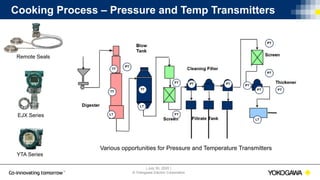
Cooking Process – Pressure and Temp Transmitters
Various opportunities for Pressure and Temperature Transmitters
EJX Series
YTA Series
Remote Seals
| July 30, 2020 |
© Yokogawa Electric Corporation
What is Total Insight and what
does that mean for me?
18
| July 30, 2020 |
© Yokogawa Electric Corporation
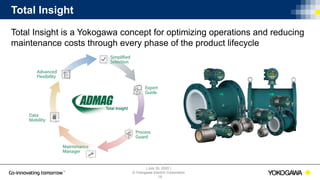
Total Insight
Total Insight is a Yokogawa concept for optimizing operations and reducing
maintenance costs through every phase of the product lifecycle
19
| July 30, 2020 |
© Yokogawa Electric Corporation
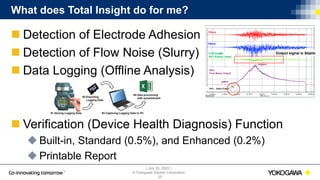
What does Total Insight do for me?
 Detection of Electrode Adhesion
 Detection of Flow Noise (Slurry)
 Data Logging (Offline Analysis)
 Verification (Device Health Diagnosis) Function
 Built-in, Standard (0.5%), and Enhanced (0.2%)
 Printable Report
20
| July 30, 2020 |
© Yokogawa Electric Corporation
21
Washing & Bleaching
| July 30, 2020 |
© Yokogawa Electric Corporation
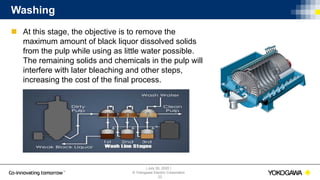
Washing
 At this stage, the objective is to remove the
maximum amount of black liquor dissolved solids
from the pulp while using as little water possible.
The remaining solids and chemicals in the pulp will
interfere with later bleaching and other steps,
increasing the cost of the final process.
22
| July 30, 2020 |
© Yokogawa Electric Corporation
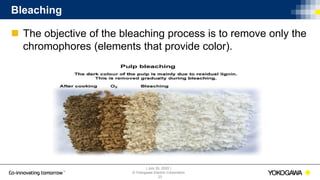
Bleaching
 The objective of the bleaching process is to remove only the
chromophores (elements that provide color).
23
| July 30, 2020 |
© Yokogawa Electric Corporation
24
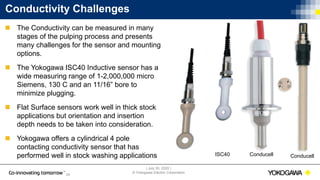
 The Conductivity can be measured in many
stages of the pulping process and presents
many challenges for the sensor and mounting
options.
 The Yokogawa ISC40 Inductive sensor has a
wide measuring range of 1-2,000,000 micro
Siemens, 130 C and an 11/16” bore to
minimize plugging.
 Flat Surface sensors work well in thick stock
applications but orientation and insertion
depth needs to be taken into consideration.
 Yokogawa offers a cylindrical 4 pole
contacting conductivity sensor that has
performed well in stock washing applications
Conductivity Challenges
Conducell ConducellISC40
| July 30, 2020 |
© Yokogawa Electric Corporation
Why are accurate pH readings
critical
25
| July 30, 2020 |
© Yokogawa Electric Corporation
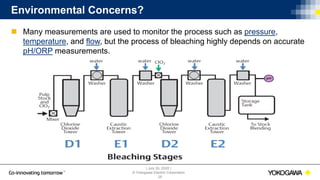
Environmental Concerns?
 Many measurements are used to monitor the process such as pressure,
temperature, and flow, but the process of bleaching highly depends on accurate
pH/ORP measurements.
26
| July 30, 2020 |
© Yokogawa Electric Corporation
pH Challenges
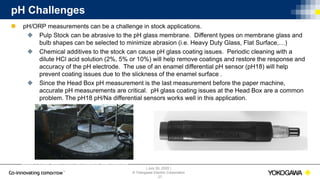
 pH/ORP measurements can be a challenge in stock applications.
 Pulp Stock can be abrasive to the pH glass membrane. Different types on membrane glass and
bulb shapes can be selected to minimize abrasion (i.e. Heavy Duty Glass, Flat Surface,…)
 Chemical additives to the stock can cause pH glass coating issues. Periodic cleaning with a
dilute HCl acid solution (2%, 5% or 10%) will help remove coatings and restore the response and
accuracy of the pH electrode. The use of an enamel differential pH sensor (pH18) will help
prevent coating issues due to the slickness of the enamel surface .
 Since the Head Box pH measurement is the last measurement before the paper machine,
accurate pH measurements are critical. pH glass coating issues at the Head Box are a common
problem. The pH18 pH/Na differential sensors works well in this application.
27
Image Source: https://www.shutterstock.com/video/clip-
2971600-paper-pulp-rotates-machine---medium-shot
| July 30, 2020 |
© Yokogawa Electric Corporation
pH Challenges – continued
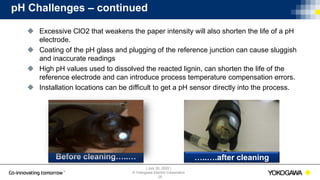
 Excessive ClO2 that weakens the paper intensity will also shorten the life of a pH
electrode.
 Coating of the pH glass and plugging of the reference junction can cause sluggish
and inaccurate readings
 High pH values used to dissolved the reacted lignin, can shorten the life of the
reference electrode and can introduce process temperature compensation errors.
 Installation locations can be difficult to get a pH sensor directly into the process.
28
Before cleaning…..… …..….after cleaning
| July 30, 2020 |
© Yokogawa Electric Corporation
29
Why does pH have to be so
maintenance intensive?
| July 30, 2020 |
© Yokogawa Electric Corporation
30
Copyright © Yokogawa Corporation of America
pH – Acid or Base?
NEUTRAL
ACID
BASE
1.0
0.1
0.01
0.001
0.0001
0.00001
0.000001
0.0000001
0.00000001
0.000000001
0.0000000001
0.00000000001
0.000000000001
0.0000000000001
0.00000000000001
[H+ ]
.00000000000001
.0000000000001
.000000000001
.00000000001
.0000000001
.000000001
.00000001
.0000001
.000001
.00001
.0001
.001
.01
0.1
1.0
[OH- ]
0
1
2
3
4
5
6
7
8
9
10
11
12
13
14
pH
pH = -log [H+](Hydrogen Ion Concentration)
Moles/Liter
| July 30, 2020 |
© Yokogawa Electric Corporation
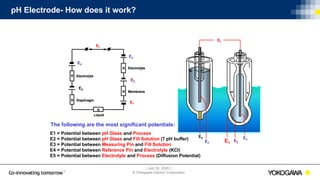
pH Electrode- How does it work?
The following are the most significant potentials:
R
R
R
R
R
Et
E1
E4
E3
E2
E5
Electrolyte
Diaphragm
Membrane
Electrolyte
Liquid
E1E4
E3
E2
E5
Et
E1 = Potential between pH Glass and Process
E2 = Potential between pH Glass and Fill Solution (7 pH buffer)
E3 = Potential between Measuring Pin and Fill Solution
E4 = Potential between Reference Pin and Electrolyte (KCl)
E5 = Potential between Electrolyte and Process (Diffusion Potential)
| July 30, 2020 |
© Yokogawa Electric Corporation
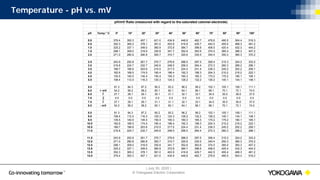
Temperature - pH vs. mV
pH/mV Ratio (measured with regard to the saturated calomel electrode)
pH Temp.° C 0° 10° 20° 30° 40° 50° 60° 70° 80° 90° 100°
0.0 379.4 393.3 407.1 421.0 434.9 448.8 462.7 476.6 490.5 504.4 518.3
0.5 352.3 365.2 378.1 391.0 403.9 416.8 429.7 442.5 455.5 468.3 481.2
1.0 325.2 337.1 349.0 360.9 372.8 384.7 396.6 408.5 420.4 432.3 444.2
1.5 298.1 309.0 319.9 330.8 341.7 352.6 363.6 374.5 385.4 396.3 407.2
2.0 271.0 280.9 290.8 300.7 310.7 320.6 330.5 340.4 350.3 360.3 370.2
2.5 243.9 252.8 261.7 270.7 279.6 288.5 297.5 306.4 315.3 324.2 333.2
3.0 216.8 224.7 232.7 240.6 248.5 256.5 264.4 272.3 280.3 288.2 296.1
3.5 189.7 196.6 203.6 210.5 217.5 224.4 231.4 238.3 245.2 252.2 259.1
4.0 162.6 168.5 174.5 180.4 186.4 192.3 198.3 204.3 210.2 216.2 222.1
4.5 135.5 140.5 145.4 150.4 155.3 160.3 165.3 170.2 175.2 180.1 185.1
5.0 108.4 112.4 116.3 120.3 124.3 128.2 132.2 136.2 140.1 144.1 148.1
5.5 81.3 84.3 87.2 90.2 93.2 96.2 99.2 102.1 105.1 108.1 111.1
6.0 + mV 54.2 56.2 58.2 60.1 62.1 64.1 66.1 68.1 70.1 72.1 74.0
6.5 ⇑ 27.1 28.1 29.1 30.1 31.1 32.1 33.1 34.0 35.0 36.0 37.0
7.0 ╟ 0.0 0.0 0.0 0.0 0.0 0.0 0.0 0.0 0.0 0.0 0.0
7.5 ⇓ 27.1 28.1 29.1 31.1 31.1 32.1 33.1 34.0 35.0 36.0 37.0
8.0 - mV 54.2 56.2 58.2 60.1 62.1 64.1 66.1 68.1 70.1 72.1 74.0
8.5 81.3 84.3 87.2 90.2 93.2 96.2 99.2 102.1 105.1 108.1 111.1
9.0 108.4 112.4 116.3 120.3 124.3 128.2 132.2 136.2 140.1 144.1 148.1
9.5 135.5 140.5 145.4 150.4 155.3 160.3 165.3 170.2 175.2 180.1 185.1
10.0 162.6 168.5 174.5 180.4 186.4 192.3 198.3 204.3 210.2 216.2 222.1
10.5 189.7 196.6 203.6 210.5 217.5 224.4 231.4 238.3 245.2 252.2 259.1
11.0 216.8 224.7 232.7 240.6 248.5 256.5 264.4 272.3 280.3 288.2 296.1
11.5 243.9 252.8 261.7 270.7 279.6 288.5 297.5 306.4 315.3 324.2 333.2
12.0 271.0 280.8 290.8 300.7 310.7 320.6 330.5 340.4 250.3 360.3 370.2
12.5 298.1 309.0 319.9 330.8 341.7 352.6 363.6 374.5 385.4 393.3 407.2
13.0 325.2 337.1 349.0 360.9 372.8 384.7 396.6 408.5 420.4 432.3 444.2
13.5 352.3 365.2 378.1 391.0 403.9 416.8 429.7 442.5 455.4 468.3 481.2
14.0 379.4 393.3 407.1 421.0 434.9 448.8 462.7 276.6 490.5 504.4 518.2
| July 30, 2020 |
© Yokogawa Electric Corporation
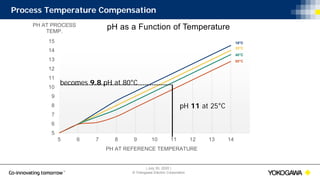
Process Temperature Compensation
5
6
7
8
9
10
11
12
13
14
15
5 6 7 8 9 10 11 12 13 14
PH AT PROCESS
TEMP.
PH AT REFERENCE TEMPERATURE
pH as a Function of Temperature
10°C
25°C
40°C
80°C
pH 11 at 25°C
becomes 9.8 pH at 80°C
| July 30, 2020 |
© Yokogawa Electric Corporation
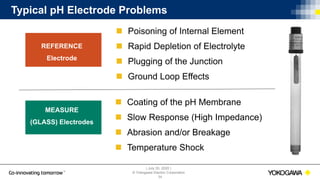
Typical pH Electrode Problems
34
 Poisoning of Internal Element
 Rapid Depletion of Electrolyte
 Plugging of the Junction
 Ground Loop Effects
MEASURE
(GLASS) Electrodes
 Coating of the pH Membrane
 Slow Response (High Impedance)
 Abrasion and/or Breakage
 Temperature Shock
REFERENCE
Electrode
| July 30, 2020 |
© Yokogawa Electric Corporation
35
Copyright © Yokogawa Corporation of America
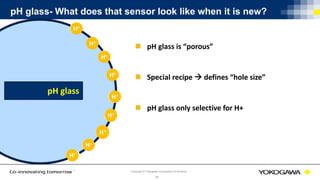
pH glass- What does that sensor look like when it is new?
H+
H+
H+
H+
H+
H+
H+
H+
 pH glass is “porous”
 Special recipe  defines “hole size”
 pH glass only selective for H+
pH glass
H+
H+
| July 30, 2020 |
© Yokogawa Electric Corporation
36
Copyright © Yokogawa Corporation of America
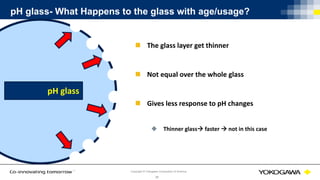
pH glass- What Happens to the glass with age/usage?
 The glass layer get thinner
 Not equal over the whole glass
 Gives less response to pH changes
 Thinner glass faster  not in this case
pH glass
| July 30, 2020 |
© Yokogawa Electric Corporation
So I am stuck with pH…..
What can I do to make it more
manageable?
| July 30, 2020 |
© Yokogawa Electric Corporation
Solution Options
 Unfortunately in pH measurements one size fits
all usually doesn’t work very well.
 Completing an Application Data Sheet helps to
ensure all the process information is known.
 Then we have to ask the other 20 questions to make
sure we understand what you are trying to
accomplish. Some of which could be accuracy, low
or no maintenance, long sensor life, retractable or
fixed entry, sensor or housing materials, ……
38
| July 30, 2020 |
© Yokogawa Electric Corporation
Solution Options - continued
39
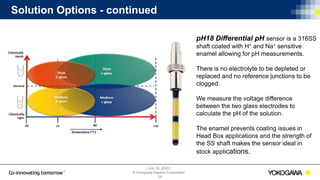
pH18 Differential pH sensor is a 316SS
shaft coated with H+ and Na+ sensitive
enamel allowing for pH measurements.
There is no electrolyte to be depleted or
replaced and no reference junctions to be
clogged.
We measure the voltage difference
between the two glass electrodes to
calculate the pH of the solution.
The enamel prevents coating issues in
Head Box applications and the strength of
the SS shaft makes the sensor ideal in
stock applications.
| July 30, 2020 |
© Yokogawa Electric Corporation
Sensor Selection – Differential pH Electrodes
40
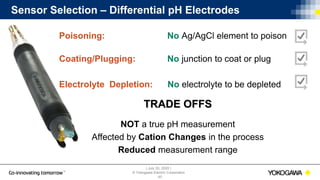
Poisoning: No Ag/AgCl element to poison
Coating/Plugging: No junction to coat or plug
Electrolyte Depletion: No electrolyte to be depleted
TRADE OFFS
NOT a true pH measurement
Affected by Cation Changes in the process
Reduced measurement range
| July 30, 2020 |
© Yokogawa Electric Corporation
pH Sensors…. Which is BEST for YOUR installation
41
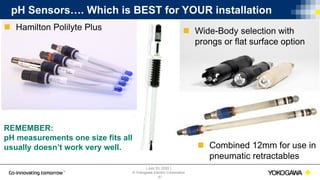
 Wide-Body selection with
prongs or flat surface option
 Combined 12mm for use in
pneumatic retractables
 Hamilton Polilyte Plus
REMEMBER:
pH measurements one size fits all
usually doesn’t work very well.
| July 30, 2020 |
© Yokogawa Electric Corporation
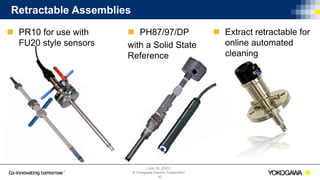
Retractable Assemblies
 PH87/97/DP
with a Solid State
Reference
42
 PR10 for use with
FU20 style sensors
 Extract retractable for
online automated
cleaning
| July 30, 2020 |
© Yokogawa Electric Corporation
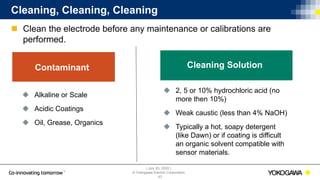
Cleaning, Cleaning, Cleaning
 Clean the electrode before any maintenance or calibrations are
performed.
43
 Alkaline or Scale
 Acidic Coatings
 Oil, Grease, Organics
Cleaning SolutionContaminant
 2, 5 or 10% hydrochloric acid (no
more then 10%)
 Weak caustic (less than 4% NaOH)
 Typically a hot, soapy detergent
(like Dawn) or if coating is difficult
an organic solvent compatible with
sensor materials.
| July 30, 2020 |
© Yokogawa Electric Corporation
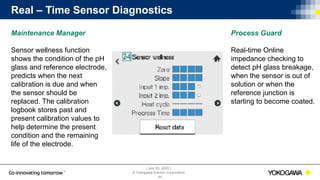
Real – Time Sensor Diagnostics
44
Process Guard
Real-time Online
impedance checking to
detect pH glass breakage,
when the sensor is out of
solution or when the
reference junction is
starting to become coated.
Maintenance Manager
Sensor wellness function
shows the condition of the pH
glass and reference electrode,
predicts when the next
calibration is due and when
the sensor should be
replaced. The calibration
logbook stores past and
present calibration values to
help determine the present
condition and the remaining
life of the electrode.
| May 21, 2020 |
© Yokogawa Electric Corporation
45
Conclusion and Wrap-up
| May 21, 2020 |
© Yokogawa Electric Corporation
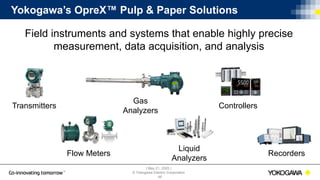
Yokogawa’s OpreX™ Pulp & Paper Solutions
Field instruments and systems that enable highly precise
measurement, data acquisition, and analysis
46
Transmitters
Flow Meters
Liquid
Analyzers
Controllers
Recorders
Gas
Analyzers
| June 18, 2020 |
© Yokogawa Electric Corporation
Fully Stocked | Fully Staffed | Fully Safe
Yokogawa factories and warehouses are ready to ship!
Need it now?
Call us at (800) 888-6400
 Actively Shipping with
Standard 10 day Lead Times
 Get 2 day shipping with North
America Quick Ship Program
 Transmitters
 Flow Meters
 Gas Analyzers
 Liquid Analyzers
 Data Acquisition Recorders
 Controllers
 Most process instruments are
assembled in the United
States.
| June 18, 2020 |
© Yokogawa Electric Corporation
Future Webinar Topics
48
LIVE WEBINAR
Pulp Mill Applications
That Keep You Up at Night
Part 2: The Clean Up
NOVEMBER 5th 2020 – 11AM EST
| July 30, 2020 |
© Yokogawa Electric Corporation
49
Q&A
Select and send all questions to “Panelist” now so that
we can address these
Questions
If you have any questions for this Webinar topic, please
send them to webinars@us.yokogawa.com
| July 30, 2020 |
© Yokogawa Electric Corporation
The names of corporations, organizations, products and logos herein are either registered trademarks or
trademarks of Yokogawa Electric Corporation and their respective holders.
Thank You For Your Attendance
50

Pulp mill applications

  • 1.
    | July 30,2020 | © Yokogawa Electric Corporation Pulp Mill Applications that keep you up at night 0 Pulp & Paper Webinar September 24, 2020
  • 2.
    | July 30,2020 | © Yokogawa Electric Corporation 1 Presenters Host Cherlyn Marlow Product Marketing Manager Presenters Host Chris Costlow Product Marketing Manager Michael Zoghby Jr - Southeast Sales Manager – BBP Michael has 15 years of experience selling in Industrial Markets with a strong presence in Pulp & Paper. Dennis Crosby – Southeast Analytical Sales Manager – Yokogawa Dennis has 40 years of experience in Analytical instrumentation in Liquid, Gas and Advanced Analytical (GC and TDLS) analyzers; selling primarily to the Pulp and Paper and Power markets. Paul Warburton- Southeast Field Instruments Sales Manager – Yokogawa Paul has 28 years of industry experience with the last 24 years working at Yokogawa. Previously held positions include flow meter product management and technical support team leader for field instruments. Wesley Chappell - Account Manager – BBP Specializing in Pulp and Paper in South Alabama, South Georgia, and the Panhandle
  • 3.
    | July 30,2020 | © Yokogawa Electric Corporation Agenda 2 1. Plant Overview 2. Cooking (Digester) Process  Why Liner Selection is important  What is Total Insight and what does that mean for me? 3. Washing & Bleaching  Why are accurate pH readings critical  Why is pH so maintenance intensive?  So I am stuck with pH….. What can I do to make it more manageable? 4. Summary
  • 4.
    | July 30,2020 | © Yokogawa Electric Corporation 3 Plant Overview
  • 5.
    | July 30,2020 | © Yokogawa Electric Corporation Plant Overview 4 Wood Chips Pulp Paper
  • 6.
    | July 30,2020 | © Yokogawa Electric Corporation 5 Cooking (Digester)
  • 7.
    | July 30,2020 | © Yokogawa Electric Corporation Cooking Process Top Digester Blow Tank Screen Screen Thickener Filtrate Tank Cleaning Filter To Washing/Bleaching Insert Chips Brown Stock
  • 8.
    | July 30,2020 | © Yokogawa Electric Corporation Cooking (Digester) Process  The cooking process in one of the most important steps in the cellulose processes, as the better the chips are cooked, the less lignin in the pulp. This results in more efficiency in the final steps of the process, which will save money and operation time.  The Digester process could be continuous or batch feed. Most companies are in continuous mode (+/- 70%), due to the larger production capacity and a better result as a product uniformity. 7
  • 9.
    | July 30,2020 | © Yokogawa Electric Corporation What is Black Liquor  Black Liquor is an aggressive fluid used in the Circulation and Extraction lines of the Digester and Blow Line. It’s high concentration of Pulp and high abrasive levels, result in extreme conditions that the operator must be aware of.  High temperature 150 °C (300 °F)  High pressure 20 Bar (290 psi)  High alkaline consistency  Adhesive fluid 8
  • 10.
    | July 30,2020 | © Yokogawa Electric Corporation Cooking Process - Flowmeters Circulation Line: Preheated chips and liquor move through the heating zone at 115 °C to 120 °C (239 ~ 248 °F) to allow optimum saturation of the liquor into the chips. Extraction Line: The water comes out as residue, along with the black liquor in the middle of the digester. The hot liquor is drawn to a low pressure tank where the steam is generated for use in the steam vessel
  • 11.
    | July 30,2020 | © Yokogawa Electric Corporation Cooking Process - Flowmeters Washing transfer: The cooked pulp is transferred to the purification system, which by mechanical process, separates the foreign materials from the fibers (nodes, small sticks). The pulp material is transferred to the washer filters, whose purpose is to wash the mass, separating all the soluble from the cellulose fibers (delignation). The cellulose is then routed to the bleaching or else to manufacture Kraft paper. The filtrate is called black liquor and is transferred to the recovery process.
  • 12.
    | July 30,2020 | © Yokogawa Electric Corporation Black Liquor Challenges  Taking flow measurements often become very complicated due to:  Damage to the lining from the changes in pressure and temperature conditions  Damage due to the abrasive and adhesive fluids  Leakage from electrodes, due to a deformation of the lining, resulting in a gap between the lining and electrode
  • 13.
    | July 30,2020 | © Yokogawa Electric Corporation Why liner selection is important 12
  • 14.
    | July 30,2020 | © Yokogawa Electric Corporation Example of Fiber Line, Bleaching Line and Digester Applications  PFA Hardiness compared with PTFE competitors Strengths – ADMAG – PFA Hardiness and Stability AXF / AXG PFAPTFE PTFE After 6 months PFA After 3 years
  • 15.
    | July 30,2020 | © Yokogawa Electric Corporation 14 Yokogawa ADMAG Model Metal Hat Earth Rings Welded Punch Plate Inside of the sensor is filled with Epoxy potting Vent hole Magnetic Flowmeter Construction – ADMAG TI AXG
  • 16.
    | July 30,2020 | © Yokogawa Electric Corporation 15  Recommended specification  PFA Lining  To maintain sealing performance when the lining encounters abrasion from a slurry fluid.  Metal Hat Earth Rings  To minimize lining abrasion from a slurry fluid.  Full welding of punch plate  To prevent lining deforms at high temperature.  Flow sensor filled with Epoxy potting  To Increase heat dissipation for high temperature fluid measurement.  To prevent the outflow of fluid when fluid leaks from the electrode.  Vent Hole  To release the permeable fluid that passed through the lining, to prevent blister of lining. Black Liquor Specification – Blow line
  • 17.
    | July 30,2020 | © Yokogawa Electric Corporation Dual Frequency Excitation 16  Unique advanced excitation method: 6.25 & 75 Hz simultaneously  High frequency component (75 Hz) has a fast response and stable measurement  Slurry Noise Immunity  Batching Application  Low frequency Component (6.25 Hz) maintains zero stability  Reduced OPEX
  • 18.
    | July 30,2020 | © Yokogawa Electric Corporation Cooking Process – Pressure and Temp Transmitters Various opportunities for Pressure and Temperature Transmitters EJX Series YTA Series Remote Seals
  • 19.
    | July 30,2020 | © Yokogawa Electric Corporation What is Total Insight and what does that mean for me? 18
  • 20.
    | July 30,2020 | © Yokogawa Electric Corporation Total Insight Total Insight is a Yokogawa concept for optimizing operations and reducing maintenance costs through every phase of the product lifecycle 19
  • 21.
    | July 30,2020 | © Yokogawa Electric Corporation What does Total Insight do for me?  Detection of Electrode Adhesion  Detection of Flow Noise (Slurry)  Data Logging (Offline Analysis)  Verification (Device Health Diagnosis) Function  Built-in, Standard (0.5%), and Enhanced (0.2%)  Printable Report 20
  • 22.
    | July 30,2020 | © Yokogawa Electric Corporation 21 Washing & Bleaching
  • 23.
    | July 30,2020 | © Yokogawa Electric Corporation Washing  At this stage, the objective is to remove the maximum amount of black liquor dissolved solids from the pulp while using as little water possible. The remaining solids and chemicals in the pulp will interfere with later bleaching and other steps, increasing the cost of the final process. 22
  • 24.
    | July 30,2020 | © Yokogawa Electric Corporation Bleaching  The objective of the bleaching process is to remove only the chromophores (elements that provide color). 23
  • 25.
    | July 30,2020 | © Yokogawa Electric Corporation 24  The Conductivity can be measured in many stages of the pulping process and presents many challenges for the sensor and mounting options.  The Yokogawa ISC40 Inductive sensor has a wide measuring range of 1-2,000,000 micro Siemens, 130 C and an 11/16” bore to minimize plugging.  Flat Surface sensors work well in thick stock applications but orientation and insertion depth needs to be taken into consideration.  Yokogawa offers a cylindrical 4 pole contacting conductivity sensor that has performed well in stock washing applications Conductivity Challenges Conducell ConducellISC40
  • 26.
    | July 30,2020 | © Yokogawa Electric Corporation Why are accurate pH readings critical 25
  • 27.
    | July 30,2020 | © Yokogawa Electric Corporation Environmental Concerns?  Many measurements are used to monitor the process such as pressure, temperature, and flow, but the process of bleaching highly depends on accurate pH/ORP measurements. 26
  • 28.
    | July 30,2020 | © Yokogawa Electric Corporation pH Challenges  pH/ORP measurements can be a challenge in stock applications.  Pulp Stock can be abrasive to the pH glass membrane. Different types on membrane glass and bulb shapes can be selected to minimize abrasion (i.e. Heavy Duty Glass, Flat Surface,…)  Chemical additives to the stock can cause pH glass coating issues. Periodic cleaning with a dilute HCl acid solution (2%, 5% or 10%) will help remove coatings and restore the response and accuracy of the pH electrode. The use of an enamel differential pH sensor (pH18) will help prevent coating issues due to the slickness of the enamel surface .  Since the Head Box pH measurement is the last measurement before the paper machine, accurate pH measurements are critical. pH glass coating issues at the Head Box are a common problem. The pH18 pH/Na differential sensors works well in this application. 27 Image Source: https://www.shutterstock.com/video/clip- 2971600-paper-pulp-rotates-machine---medium-shot
  • 29.
    | July 30,2020 | © Yokogawa Electric Corporation pH Challenges – continued  Excessive ClO2 that weakens the paper intensity will also shorten the life of a pH electrode.  Coating of the pH glass and plugging of the reference junction can cause sluggish and inaccurate readings  High pH values used to dissolved the reacted lignin, can shorten the life of the reference electrode and can introduce process temperature compensation errors.  Installation locations can be difficult to get a pH sensor directly into the process. 28 Before cleaning…..… …..….after cleaning
  • 30.
    | July 30,2020 | © Yokogawa Electric Corporation 29 Why does pH have to be so maintenance intensive?
  • 31.
    | July 30,2020 | © Yokogawa Electric Corporation 30 Copyright © Yokogawa Corporation of America pH – Acid or Base? NEUTRAL ACID BASE 1.0 0.1 0.01 0.001 0.0001 0.00001 0.000001 0.0000001 0.00000001 0.000000001 0.0000000001 0.00000000001 0.000000000001 0.0000000000001 0.00000000000001 [H+ ] .00000000000001 .0000000000001 .000000000001 .00000000001 .0000000001 .000000001 .00000001 .0000001 .000001 .00001 .0001 .001 .01 0.1 1.0 [OH- ] 0 1 2 3 4 5 6 7 8 9 10 11 12 13 14 pH pH = -log [H+](Hydrogen Ion Concentration) Moles/Liter
  • 32.
    | July 30,2020 | © Yokogawa Electric Corporation pH Electrode- How does it work? The following are the most significant potentials: R R R R R Et E1 E4 E3 E2 E5 Electrolyte Diaphragm Membrane Electrolyte Liquid E1E4 E3 E2 E5 Et E1 = Potential between pH Glass and Process E2 = Potential between pH Glass and Fill Solution (7 pH buffer) E3 = Potential between Measuring Pin and Fill Solution E4 = Potential between Reference Pin and Electrolyte (KCl) E5 = Potential between Electrolyte and Process (Diffusion Potential)
  • 33.
    | July 30,2020 | © Yokogawa Electric Corporation Temperature - pH vs. mV pH/mV Ratio (measured with regard to the saturated calomel electrode) pH Temp.° C 0° 10° 20° 30° 40° 50° 60° 70° 80° 90° 100° 0.0 379.4 393.3 407.1 421.0 434.9 448.8 462.7 476.6 490.5 504.4 518.3 0.5 352.3 365.2 378.1 391.0 403.9 416.8 429.7 442.5 455.5 468.3 481.2 1.0 325.2 337.1 349.0 360.9 372.8 384.7 396.6 408.5 420.4 432.3 444.2 1.5 298.1 309.0 319.9 330.8 341.7 352.6 363.6 374.5 385.4 396.3 407.2 2.0 271.0 280.9 290.8 300.7 310.7 320.6 330.5 340.4 350.3 360.3 370.2 2.5 243.9 252.8 261.7 270.7 279.6 288.5 297.5 306.4 315.3 324.2 333.2 3.0 216.8 224.7 232.7 240.6 248.5 256.5 264.4 272.3 280.3 288.2 296.1 3.5 189.7 196.6 203.6 210.5 217.5 224.4 231.4 238.3 245.2 252.2 259.1 4.0 162.6 168.5 174.5 180.4 186.4 192.3 198.3 204.3 210.2 216.2 222.1 4.5 135.5 140.5 145.4 150.4 155.3 160.3 165.3 170.2 175.2 180.1 185.1 5.0 108.4 112.4 116.3 120.3 124.3 128.2 132.2 136.2 140.1 144.1 148.1 5.5 81.3 84.3 87.2 90.2 93.2 96.2 99.2 102.1 105.1 108.1 111.1 6.0 + mV 54.2 56.2 58.2 60.1 62.1 64.1 66.1 68.1 70.1 72.1 74.0 6.5 ⇑ 27.1 28.1 29.1 30.1 31.1 32.1 33.1 34.0 35.0 36.0 37.0 7.0 ╟ 0.0 0.0 0.0 0.0 0.0 0.0 0.0 0.0 0.0 0.0 0.0 7.5 ⇓ 27.1 28.1 29.1 31.1 31.1 32.1 33.1 34.0 35.0 36.0 37.0 8.0 - mV 54.2 56.2 58.2 60.1 62.1 64.1 66.1 68.1 70.1 72.1 74.0 8.5 81.3 84.3 87.2 90.2 93.2 96.2 99.2 102.1 105.1 108.1 111.1 9.0 108.4 112.4 116.3 120.3 124.3 128.2 132.2 136.2 140.1 144.1 148.1 9.5 135.5 140.5 145.4 150.4 155.3 160.3 165.3 170.2 175.2 180.1 185.1 10.0 162.6 168.5 174.5 180.4 186.4 192.3 198.3 204.3 210.2 216.2 222.1 10.5 189.7 196.6 203.6 210.5 217.5 224.4 231.4 238.3 245.2 252.2 259.1 11.0 216.8 224.7 232.7 240.6 248.5 256.5 264.4 272.3 280.3 288.2 296.1 11.5 243.9 252.8 261.7 270.7 279.6 288.5 297.5 306.4 315.3 324.2 333.2 12.0 271.0 280.8 290.8 300.7 310.7 320.6 330.5 340.4 250.3 360.3 370.2 12.5 298.1 309.0 319.9 330.8 341.7 352.6 363.6 374.5 385.4 393.3 407.2 13.0 325.2 337.1 349.0 360.9 372.8 384.7 396.6 408.5 420.4 432.3 444.2 13.5 352.3 365.2 378.1 391.0 403.9 416.8 429.7 442.5 455.4 468.3 481.2 14.0 379.4 393.3 407.1 421.0 434.9 448.8 462.7 276.6 490.5 504.4 518.2
  • 34.
    | July 30,2020 | © Yokogawa Electric Corporation Process Temperature Compensation 5 6 7 8 9 10 11 12 13 14 15 5 6 7 8 9 10 11 12 13 14 PH AT PROCESS TEMP. PH AT REFERENCE TEMPERATURE pH as a Function of Temperature 10°C 25°C 40°C 80°C pH 11 at 25°C becomes 9.8 pH at 80°C
  • 35.
    | July 30,2020 | © Yokogawa Electric Corporation Typical pH Electrode Problems 34  Poisoning of Internal Element  Rapid Depletion of Electrolyte  Plugging of the Junction  Ground Loop Effects MEASURE (GLASS) Electrodes  Coating of the pH Membrane  Slow Response (High Impedance)  Abrasion and/or Breakage  Temperature Shock REFERENCE Electrode
  • 36.
    | July 30,2020 | © Yokogawa Electric Corporation 35 Copyright © Yokogawa Corporation of America pH glass- What does that sensor look like when it is new? H+ H+ H+ H+ H+ H+ H+ H+  pH glass is “porous”  Special recipe  defines “hole size”  pH glass only selective for H+ pH glass H+ H+
  • 37.
    | July 30,2020 | © Yokogawa Electric Corporation 36 Copyright © Yokogawa Corporation of America pH glass- What Happens to the glass with age/usage?  The glass layer get thinner  Not equal over the whole glass  Gives less response to pH changes  Thinner glass faster  not in this case pH glass
  • 38.
    | July 30,2020 | © Yokogawa Electric Corporation So I am stuck with pH….. What can I do to make it more manageable?
  • 39.
    | July 30,2020 | © Yokogawa Electric Corporation Solution Options  Unfortunately in pH measurements one size fits all usually doesn’t work very well.  Completing an Application Data Sheet helps to ensure all the process information is known.  Then we have to ask the other 20 questions to make sure we understand what you are trying to accomplish. Some of which could be accuracy, low or no maintenance, long sensor life, retractable or fixed entry, sensor or housing materials, …… 38
  • 40.
    | July 30,2020 | © Yokogawa Electric Corporation Solution Options - continued 39 pH18 Differential pH sensor is a 316SS shaft coated with H+ and Na+ sensitive enamel allowing for pH measurements. There is no electrolyte to be depleted or replaced and no reference junctions to be clogged. We measure the voltage difference between the two glass electrodes to calculate the pH of the solution. The enamel prevents coating issues in Head Box applications and the strength of the SS shaft makes the sensor ideal in stock applications.
  • 41.
    | July 30,2020 | © Yokogawa Electric Corporation Sensor Selection – Differential pH Electrodes 40 Poisoning: No Ag/AgCl element to poison Coating/Plugging: No junction to coat or plug Electrolyte Depletion: No electrolyte to be depleted TRADE OFFS NOT a true pH measurement Affected by Cation Changes in the process Reduced measurement range
  • 42.
    | July 30,2020 | © Yokogawa Electric Corporation pH Sensors…. Which is BEST for YOUR installation 41  Wide-Body selection with prongs or flat surface option  Combined 12mm for use in pneumatic retractables  Hamilton Polilyte Plus REMEMBER: pH measurements one size fits all usually doesn’t work very well.
  • 43.
    | July 30,2020 | © Yokogawa Electric Corporation Retractable Assemblies  PH87/97/DP with a Solid State Reference 42  PR10 for use with FU20 style sensors  Extract retractable for online automated cleaning
  • 44.
    | July 30,2020 | © Yokogawa Electric Corporation Cleaning, Cleaning, Cleaning  Clean the electrode before any maintenance or calibrations are performed. 43  Alkaline or Scale  Acidic Coatings  Oil, Grease, Organics Cleaning SolutionContaminant  2, 5 or 10% hydrochloric acid (no more then 10%)  Weak caustic (less than 4% NaOH)  Typically a hot, soapy detergent (like Dawn) or if coating is difficult an organic solvent compatible with sensor materials.
  • 45.
    | July 30,2020 | © Yokogawa Electric Corporation Real – Time Sensor Diagnostics 44 Process Guard Real-time Online impedance checking to detect pH glass breakage, when the sensor is out of solution or when the reference junction is starting to become coated. Maintenance Manager Sensor wellness function shows the condition of the pH glass and reference electrode, predicts when the next calibration is due and when the sensor should be replaced. The calibration logbook stores past and present calibration values to help determine the present condition and the remaining life of the electrode.
  • 46.
    | May 21,2020 | © Yokogawa Electric Corporation 45 Conclusion and Wrap-up
  • 47.
    | May 21,2020 | © Yokogawa Electric Corporation Yokogawa’s OpreX™ Pulp & Paper Solutions Field instruments and systems that enable highly precise measurement, data acquisition, and analysis 46 Transmitters Flow Meters Liquid Analyzers Controllers Recorders Gas Analyzers
  • 48.
    | June 18,2020 | © Yokogawa Electric Corporation Fully Stocked | Fully Staffed | Fully Safe Yokogawa factories and warehouses are ready to ship! Need it now? Call us at (800) 888-6400  Actively Shipping with Standard 10 day Lead Times  Get 2 day shipping with North America Quick Ship Program  Transmitters  Flow Meters  Gas Analyzers  Liquid Analyzers  Data Acquisition Recorders  Controllers  Most process instruments are assembled in the United States.
  • 49.
    | June 18,2020 | © Yokogawa Electric Corporation Future Webinar Topics 48 LIVE WEBINAR Pulp Mill Applications That Keep You Up at Night Part 2: The Clean Up NOVEMBER 5th 2020 – 11AM EST
  • 50.
    | July 30,2020 | © Yokogawa Electric Corporation 49 Q&A Select and send all questions to “Panelist” now so that we can address these Questions If you have any questions for this Webinar topic, please send them to webinars@us.yokogawa.com
  • 51.
    | July 30,2020 | © Yokogawa Electric Corporation The names of corporations, organizations, products and logos herein are either registered trademarks or trademarks of Yokogawa Electric Corporation and their respective holders. Thank You For Your Attendance 50