VeryLarge-ScaleDistributed
DeepLearningon BigDL
JasonDai,DingDing
Overview of BigDL
3
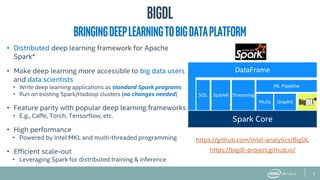
BigDL
BringingDeepLearningToBigDataPlatform
• Distributed deep learning framework for Apache
Spark*
• Make deep learning more accessible to big data users
and data scientists
• Write deep learning applications as standard Spark programs
• Run on existing Spark/Hadoop clusters (no changes needed)
• Feature parity with popular deep learning frameworks
• E.g., Caffe, Torch, Tensorflow, etc.
• High performance
• Powered by Intel MKL and multi-threaded programming
• Efficient scale-out
• Leveraging Spark for distributed training & inference
https://github.com/intel-analytics/BigDL
https://bigdl-project.github.io/
Spark Core
SQL SparkR Streaming
MLlib GraphX
ML Pipeline
DataFrame
4
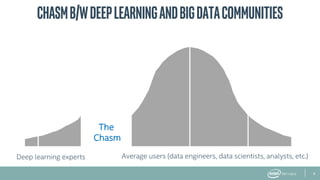
Chasmb/wDeepLearningandBigDataCommunities
Average users (data engineers, data scientists, analysts, etc.)Deep learning experts
The
Chasm
5
BigDLAnsweringTheNeeds
Make deep learning more accessible to big data and data science communities
• Continue the use of familiar SW tools and HW infrastructure to build deep learning
applications
• Analyze “big data” using deep learning on the same Hadoop/Spark cluster where the data
are stored
• Add deep learning functionalities to the Big Data (Spark) programs and/or workflow
• Leverage existing Hadoop/Spark clusters to run deep learning applications
• Shared with other workloads (e.g., ETL, data warehouse, feature engineering, statistic machine
learning, graph analytics, etc.) in a dynamic and elastic fashion
6
FraudDetectionforUnionPay
Train one model
all features selected features
model
candidate model
sampled
partition
Training Data
…
normal
fraud
Train one model
Train one model
sampled
partition
sampled
partition
Post
Processing
Pre-
Processing
model
model
Spark Pipeline
Test Data
Predictions
Test
Spark DataFrameHive Table
Pre-processing
Feature
Engineering
Feature
Engineering
Feature
Selection
Model
Ensemble
SparkPipeline
Neural Network Model Using BigDL
Feature
Selection*
Model
Training
Model
Evaluation
& Fine Tune
https://mp.weixin.qq.com/s?__biz=MzI3NDAwNDUwNg==&mid=2648307335&idx=1&sn=8eb9f63eaf2e40e24a90601b9cc03d1f
DistributedTraining onBigDL
8
DistributedTrainingonBigDL
Training
for (i <- 1 to N) {
batch = next_batch()
output = model.forward(batch.input)
loss = criterion.forward(output, batch.target)
error = criterion.backward(output, batch.target)
model.backward(input, error)
optimMethod.optimize(model.weight, model.gradient)
}
Iterative Data parallel
Synchronous SGD
Mini-batch
9
RunasstandardSparkProgram
Spark
Program
DL App on Driver
Spark
Executor
(JVM)
Spark
Task
BigDL lib
Worker
Intel MKL
Standard
Spark jobs
Worker
Worker Worker
Worker
Spark
Executor
(JVM)
Spark
Task
BigDL lib
Worker
Intel MKL
BigDL
library
Spark
jobs
BigDL Program
Standard Spark jobs
• No changes to the Spark or Hadoop clusters needed
Iterative
• Each iteration of the training runs as a Spark job
Data parallel
• Each Spark task runs the same model on a subset of the data (batch)
10
TechniquesforLarge-ScaleDistributedTraining
• Optimizing parameter synchronization and aggregation
• Optimizing task scheduling
• Scaling batch size
11
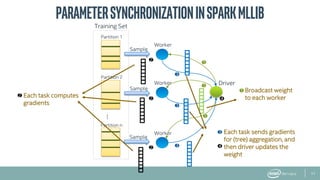
ParameterSynchronizationinSparkMLlib
…
Partition 1
Partition 2
Partition n
Training Set
Sample
Sample
Sample
Worker
Worker
Worker
Driver
2
2
2
1
1
1
3
3
3
4
1
2
3
4
Broadcast weight
to each workerEach task computes
gradients
Each task sends gradients
for (tree) aggregation, and
then driver updates the
weight
12
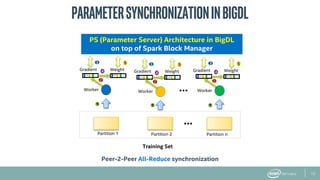
ParameterSynchronizationinBigDL
…
Training Set
PS (Parameter Server) Architecture in BigDL
on top of Spark Block Manager
Partition 1 Partition 2 Partition n
Worker
Gradient
1
2
Weight
3
4
5
Worker
Gradient
1
2
Weight
3
4
5
Worker
Gradient
1
2
Weight
3
4
5
…
… …
… … … …
Peer-2-Peer All-Reduce synchronization
13
ParameterSynchronizationinBigDL
Parameter synchronization time as a fraction of
average compute time for Inception v1 training
For more complete information about performance and benchmark results, visit www.intel.com/benchmarks.
14
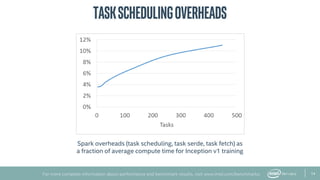
TaskSchedulingOverheads
Spark overheads (task scheduling, task serde, task fetch) as
a fraction of average compute time for Inception v1 training
For more complete information about performance and benchmark results, visit www.intel.com/benchmarks.
15
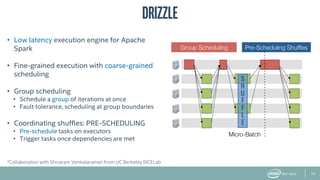
Drizzle
*Collaboration with Shivaram Venkataraman from UC Berkeley RICELab
• Low latency execution engine for Apache
Spark
• Fine-grained execution with coarse-grained
scheduling
• Group scheduling
• Schedule a group of iterations at once
• Fault tolerance, scheduling at group boundaries
• Coordinating shuffles: PRE-SCHEDULING
• Pre-schedule tasks on executors
• Trigger tasks once dependencies are met
16
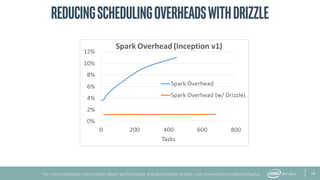
ReducingSchedulingOverheadswithDrizzle
For more complete information about performance and benchmark results, visit www.intel.com/benchmarks.
17
IncreasedMini-BatchSize
• Distributed synchronous mini-batch SGD
• Increased mini-batch size
total_batch_size = batch_size_per_worker * num_of_workers
• Can lead to loss in test accuracy
• State-of-art method for scaling mini-batch size*
• Linear scaling rule
• Warm-up strategy
• Layer-wise adaptive rate scaling
• Adding batch normalization
* “Accurate, Large Minibatch SGD: Training ImageNet in 1 Hour”
* “Scaling SGD Batch Size to 32K for ImageNet Training”
18
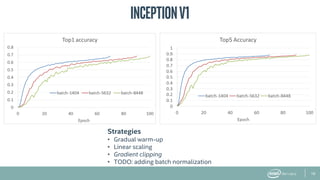
Inceptionv1
Strategies
• Gradual warm-up
• Linear scaling
• Gradient clipping
• TODO: adding batch normalization
19
SSD(SingleShotMulti-boxDetector)
Strategies
• Warm-up w/ Adam
• Linear scaling
• Gradient clipping
Distributed Inference on BigDL
21
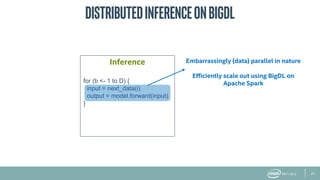
DistributedInferenceonBigDL
Inference
for (b <- 1 to D) {
input = next_data(i)
output = model.forward(input)
}
Embarrassingly (data) parallel in nature
Efficiently scale out using BigDL on
Apache Spark
22
ImageDetection&ExtractionPipeline
(usingSSD+DeepBitModels)
23
ChallengesofLarge-ScaleProcessinginGPUSolutions
• Reading images out takes a very long time
• Image pre-processing on HBase is very complex
• No existing software frameworks can be leveraged
• E.g., resource management, distributed data processing, fault tolerance, etc.
• Very challenging to scale out to massive amount of pictures
• Due to SW and HW infrastructure constraints
24
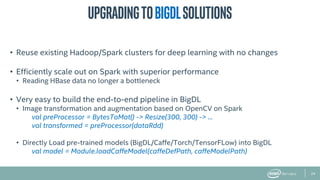
UpgradingtoBigDLSolutions
• Reuse existing Hadoop/Spark clusters for deep learning with no changes
• Efficiently scale out on Spark with superior performance
• Reading HBase data no longer a bottleneck
• Very easy to build the end-to-end pipeline in BigDL
• Image transformation and augmentation based on OpenCV on Spark
val preProcessor = BytesToMat() -> Resize(300, 300) -> …
val transformed = preProcessor(dataRdd)
• Directly Load pre-trained models (BigDL/Caffe/Torch/TensorFLow) into BigDL
val model = Module.loadCaffeModel(caffeDefPath, caffeModelPath)
25
ModelQuantizationforEfficientInferenceinBigDL
• Local quantization scheme converting floats to intergers
• Faster compute and smaller models
• Take advantage of SSE and AVX instructions on Xeon servers
• Supports pre-trained models (BigDL/Caffe/Torch/TensorFLow)
val model = Module.loadCaffeModel(caffeDefPath, caffeModelPath)
val quantizedModel = model.quantize()
• Quantized SSD model
• ~4x model size reduction
• >2x inference speedup
• ~0.001 mAP (mean average precision) loss
For more complete information about performance and benchmark results, visit www.intel.com/benchmarks.
26
TryBigDLOut
Running BigDL, Deep Learning
for Apache Spark, on AWS*
(Amazon* Web Service)
https://aws.amazon.com/blogs/ai/running-
bigdl-deep-learning-for-apache-spark-on-aws/
Use BigDL on Microsoft*
Azure* HDInsight*
https://azure.microsoft.com/en-
us/blog/use-bigdl-on-hdinsight-spark-for-
distributed-deep-learning/
Intel’s BigDL on Databricks*
https://databricks.com/blog/2017/02/09/in
tels-bigdl-databricks.html
BigDL on Alibaba* Cloud
E-MapReduce*
https://yq.aliyun.com/articles/73347
BigDL on CDH* and Cloudera*
Data Science Workbench*
http://blog.cloudera.com/blog/2017/04/bigdl-
on-cdh-and-cloudera-data-science-workbench/
BigDL Distribution in Cray
Urika-XC Analytics Suite
http://www.cray.com/products/analytics/uri
ka-xc
27
PartnerWithUs
https://github.com/intel-analytics/BigDL http://software.intel.com/ai
Stay connected
28
@intelnervana
@intelAI
#intelAI
intelnervana.com
30
LegalNotices&disclaimers
This document contains information on products, services and/or processes in development. All information provided here is subject to change without notice. Contact your Intel
representative to obtain the latest forecast, schedule, specifications and roadmaps.
Intel technologies’ features and benefits depend on system configuration and may require enabled hardware, software or service activation. Learn more at intel.com, or from the
OEM or retailer. No computer system can be absolutely secure.
Tests document performance of components on a particular test, in specific systems. Differences in hardware, software, or configuration will affect actual performance. Consult
other sources of information to evaluate performance as you consider your purchase. For more complete information about performance and benchmark results, visit
http://www.intel.com/performance.
Cost reduction scenarios described are intended as examples of how a given Intel-based product, in the specified circumstances and configurations, may affect future costs and
provide cost savings. Circumstances will vary. Intel does not guarantee any costs or cost reduction.
Statements in this document that refer to Intel’s plans and expectations for the quarter, the year, and the future, are forward-looking statements that involve a number of risks and
uncertainties. A detailed discussion of the factors that could affect Intel’s results and plans is included in Intel’s SEC filings, including the annual report on Form 10-K.
The products described may contain design defects or errors known as errata which may cause the product to deviate from published specifications. Current characterized errata
are available on request.
No license (express or implied, by estoppel or otherwise) to any intellectual property rights is granted by this document.
Intel does not control or audit third-party benchmark data or the web sites referenced in this document. You should visit the referenced web site and confirm whether referenced
data are accurate.
Intel, the Intel logo, Pentium, Celeron, Atom, Core, Xeon and others are trademarks of Intel Corporation in the U.S. and/or other countries.
*Other names and brands may be claimed as the property of others.
© 2016 Intel Corporation.
Intel Confidential

Very large scale distributed deep learning on BigDL

  • 1.
  • 2.
  • 3.
    3 BigDL BringingDeepLearningToBigDataPlatform • Distributed deeplearning framework for Apache Spark* • Make deep learning more accessible to big data users and data scientists • Write deep learning applications as standard Spark programs • Run on existing Spark/Hadoop clusters (no changes needed) • Feature parity with popular deep learning frameworks • E.g., Caffe, Torch, Tensorflow, etc. • High performance • Powered by Intel MKL and multi-threaded programming • Efficient scale-out • Leveraging Spark for distributed training & inference https://github.com/intel-analytics/BigDL https://bigdl-project.github.io/ Spark Core SQL SparkR Streaming MLlib GraphX ML Pipeline DataFrame
  • 4.
    4 Chasmb/wDeepLearningandBigDataCommunities Average users (dataengineers, data scientists, analysts, etc.)Deep learning experts The Chasm
  • 5.
    5 BigDLAnsweringTheNeeds Make deep learningmore accessible to big data and data science communities • Continue the use of familiar SW tools and HW infrastructure to build deep learning applications • Analyze “big data” using deep learning on the same Hadoop/Spark cluster where the data are stored • Add deep learning functionalities to the Big Data (Spark) programs and/or workflow • Leverage existing Hadoop/Spark clusters to run deep learning applications • Shared with other workloads (e.g., ETL, data warehouse, feature engineering, statistic machine learning, graph analytics, etc.) in a dynamic and elastic fashion
  • 6.
    6 FraudDetectionforUnionPay Train one model allfeatures selected features model candidate model sampled partition Training Data … normal fraud Train one model Train one model sampled partition sampled partition Post Processing Pre- Processing model model Spark Pipeline Test Data Predictions Test Spark DataFrameHive Table Pre-processing Feature Engineering Feature Engineering Feature Selection Model Ensemble SparkPipeline Neural Network Model Using BigDL Feature Selection* Model Training Model Evaluation & Fine Tune https://mp.weixin.qq.com/s?__biz=MzI3NDAwNDUwNg==&mid=2648307335&idx=1&sn=8eb9f63eaf2e40e24a90601b9cc03d1f
  • 7.
  • 8.
    8 DistributedTrainingonBigDL Training for (i <-1 to N) { batch = next_batch() output = model.forward(batch.input) loss = criterion.forward(output, batch.target) error = criterion.backward(output, batch.target) model.backward(input, error) optimMethod.optimize(model.weight, model.gradient) } Iterative Data parallel Synchronous SGD Mini-batch
  • 9.
    9 RunasstandardSparkProgram Spark Program DL App onDriver Spark Executor (JVM) Spark Task BigDL lib Worker Intel MKL Standard Spark jobs Worker Worker Worker Worker Spark Executor (JVM) Spark Task BigDL lib Worker Intel MKL BigDL library Spark jobs BigDL Program Standard Spark jobs • No changes to the Spark or Hadoop clusters needed Iterative • Each iteration of the training runs as a Spark job Data parallel • Each Spark task runs the same model on a subset of the data (batch)
  • 10.
    10 TechniquesforLarge-ScaleDistributedTraining • Optimizing parametersynchronization and aggregation • Optimizing task scheduling • Scaling batch size
  • 11.
    11 ParameterSynchronizationinSparkMLlib … Partition 1 Partition 2 Partitionn Training Set Sample Sample Sample Worker Worker Worker Driver 2 2 2 1 1 1 3 3 3 4 1 2 3 4 Broadcast weight to each workerEach task computes gradients Each task sends gradients for (tree) aggregation, and then driver updates the weight
  • 12.
    12 ParameterSynchronizationinBigDL … Training Set PS (ParameterServer) Architecture in BigDL on top of Spark Block Manager Partition 1 Partition 2 Partition n Worker Gradient 1 2 Weight 3 4 5 Worker Gradient 1 2 Weight 3 4 5 Worker Gradient 1 2 Weight 3 4 5 … … … … … … … Peer-2-Peer All-Reduce synchronization
  • 13.
    13 ParameterSynchronizationinBigDL Parameter synchronization timeas a fraction of average compute time for Inception v1 training For more complete information about performance and benchmark results, visit www.intel.com/benchmarks.
  • 14.
    14 TaskSchedulingOverheads Spark overheads (taskscheduling, task serde, task fetch) as a fraction of average compute time for Inception v1 training For more complete information about performance and benchmark results, visit www.intel.com/benchmarks.
  • 15.
    15 Drizzle *Collaboration with ShivaramVenkataraman from UC Berkeley RICELab • Low latency execution engine for Apache Spark • Fine-grained execution with coarse-grained scheduling • Group scheduling • Schedule a group of iterations at once • Fault tolerance, scheduling at group boundaries • Coordinating shuffles: PRE-SCHEDULING • Pre-schedule tasks on executors • Trigger tasks once dependencies are met
  • 16.
    16 ReducingSchedulingOverheadswithDrizzle For more completeinformation about performance and benchmark results, visit www.intel.com/benchmarks.
  • 17.
    17 IncreasedMini-BatchSize • Distributed synchronousmini-batch SGD • Increased mini-batch size total_batch_size = batch_size_per_worker * num_of_workers • Can lead to loss in test accuracy • State-of-art method for scaling mini-batch size* • Linear scaling rule • Warm-up strategy • Layer-wise adaptive rate scaling • Adding batch normalization * “Accurate, Large Minibatch SGD: Training ImageNet in 1 Hour” * “Scaling SGD Batch Size to 32K for ImageNet Training”
  • 18.
    18 Inceptionv1 Strategies • Gradual warm-up •Linear scaling • Gradient clipping • TODO: adding batch normalization
  • 19.
    19 SSD(SingleShotMulti-boxDetector) Strategies • Warm-up w/Adam • Linear scaling • Gradient clipping
  • 20.
  • 21.
    21 DistributedInferenceonBigDL Inference for (b <-1 to D) { input = next_data(i) output = model.forward(input) } Embarrassingly (data) parallel in nature Efficiently scale out using BigDL on Apache Spark
  • 22.
  • 23.
    23 ChallengesofLarge-ScaleProcessinginGPUSolutions • Reading imagesout takes a very long time • Image pre-processing on HBase is very complex • No existing software frameworks can be leveraged • E.g., resource management, distributed data processing, fault tolerance, etc. • Very challenging to scale out to massive amount of pictures • Due to SW and HW infrastructure constraints
  • 24.
    24 UpgradingtoBigDLSolutions • Reuse existingHadoop/Spark clusters for deep learning with no changes • Efficiently scale out on Spark with superior performance • Reading HBase data no longer a bottleneck • Very easy to build the end-to-end pipeline in BigDL • Image transformation and augmentation based on OpenCV on Spark val preProcessor = BytesToMat() -> Resize(300, 300) -> … val transformed = preProcessor(dataRdd) • Directly Load pre-trained models (BigDL/Caffe/Torch/TensorFLow) into BigDL val model = Module.loadCaffeModel(caffeDefPath, caffeModelPath)
  • 25.
    25 ModelQuantizationforEfficientInferenceinBigDL • Local quantizationscheme converting floats to intergers • Faster compute and smaller models • Take advantage of SSE and AVX instructions on Xeon servers • Supports pre-trained models (BigDL/Caffe/Torch/TensorFLow) val model = Module.loadCaffeModel(caffeDefPath, caffeModelPath) val quantizedModel = model.quantize() • Quantized SSD model • ~4x model size reduction • >2x inference speedup • ~0.001 mAP (mean average precision) loss For more complete information about performance and benchmark results, visit www.intel.com/benchmarks.
  • 26.
    26 TryBigDLOut Running BigDL, DeepLearning for Apache Spark, on AWS* (Amazon* Web Service) https://aws.amazon.com/blogs/ai/running- bigdl-deep-learning-for-apache-spark-on-aws/ Use BigDL on Microsoft* Azure* HDInsight* https://azure.microsoft.com/en- us/blog/use-bigdl-on-hdinsight-spark-for- distributed-deep-learning/ Intel’s BigDL on Databricks* https://databricks.com/blog/2017/02/09/in tels-bigdl-databricks.html BigDL on Alibaba* Cloud E-MapReduce* https://yq.aliyun.com/articles/73347 BigDL on CDH* and Cloudera* Data Science Workbench* http://blog.cloudera.com/blog/2017/04/bigdl- on-cdh-and-cloudera-data-science-workbench/ BigDL Distribution in Cray Urika-XC Analytics Suite http://www.cray.com/products/analytics/uri ka-xc
  • 27.
  • 28.
  • 30.
    30 LegalNotices&disclaimers This document containsinformation on products, services and/or processes in development. All information provided here is subject to change without notice. Contact your Intel representative to obtain the latest forecast, schedule, specifications and roadmaps. Intel technologies’ features and benefits depend on system configuration and may require enabled hardware, software or service activation. Learn more at intel.com, or from the OEM or retailer. No computer system can be absolutely secure. Tests document performance of components on a particular test, in specific systems. Differences in hardware, software, or configuration will affect actual performance. Consult other sources of information to evaluate performance as you consider your purchase. For more complete information about performance and benchmark results, visit http://www.intel.com/performance. Cost reduction scenarios described are intended as examples of how a given Intel-based product, in the specified circumstances and configurations, may affect future costs and provide cost savings. Circumstances will vary. Intel does not guarantee any costs or cost reduction. Statements in this document that refer to Intel’s plans and expectations for the quarter, the year, and the future, are forward-looking statements that involve a number of risks and uncertainties. A detailed discussion of the factors that could affect Intel’s results and plans is included in Intel’s SEC filings, including the annual report on Form 10-K. The products described may contain design defects or errors known as errata which may cause the product to deviate from published specifications. Current characterized errata are available on request. No license (express or implied, by estoppel or otherwise) to any intellectual property rights is granted by this document. Intel does not control or audit third-party benchmark data or the web sites referenced in this document. You should visit the referenced web site and confirm whether referenced data are accurate. Intel, the Intel logo, Pentium, Celeron, Atom, Core, Xeon and others are trademarks of Intel Corporation in the U.S. and/or other countries. *Other names and brands may be claimed as the property of others. © 2016 Intel Corporation. Intel Confidential