Vertical
Federated Learning
- Presented by Afsana Khan
Federated Learning
“Federated learning is a machine learning setting where multiple entities (clients) collaborate in solving a
machine learning problem, under the coordination of a central server or service provider. Each client’s
raw data is stored locally and not exchanged or transferred; instead focused updates intended for
immediate aggregation are used to achieve the learning objective.”
Kairouz et al., Advances and open problems in federated learning, 2019
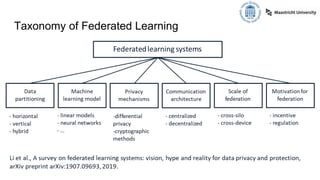
Taxonomy of Federated Learning
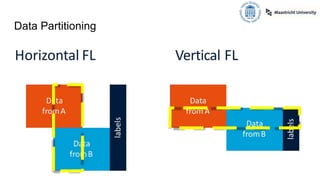
Data Partitioning
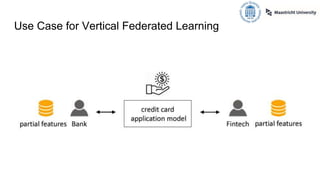
Use Case for Vertical Federated Learning
Steps in VFL
● Secure Data Alignment
● Secure Model Training
● Secure Evaluation
Step 1 - Secure Data Alignment
Monica Scannapieco, et al., 2007. Privacy Preserving Schema and Data Matching. https://doi.org/10.1145/1247480.1247553
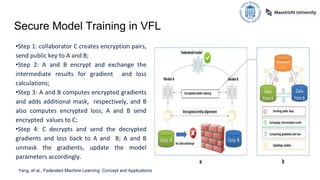
Secure Model Training in VFL
Yang, et al., Federated Machine Learning: Concept and Applications
•Step 1: collaborator C creates encryption pairs,
send public key to A and B;
•Step 2: A and B encrypt and exchange the
intermediate results for gradient and loss
calculations;
•Step 3: A and B computes encrypted gradients
and adds additional mask, respectively, and B
also computes encrypted loss; A and B send
encrypted values to C;
•Step 4: C decrypts and send the decrypted
gradients and loss back to A and B; A and B
unmask the gradients, update the model
parameters accordingly.
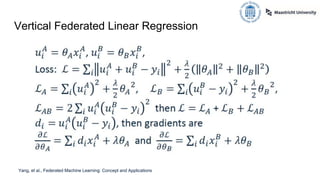
Vertical Federated Linear Regression
Yang, et al., Federated Machine Learning: Concept and Applications
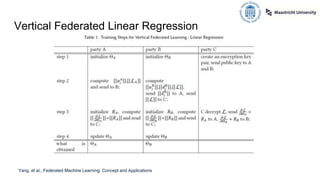
Vertical Federated Linear Regression
Yang, et al., Federated Machine Learning: Concept and Applications
Secure Evaluation in VFL
Yang, et al., Federated Machine Learning: Concept and Applications
Is the evaluation secure enough? Can C infer raw
data of A and B?
Possible Solution!!!
Secure Multiparty Computation (SMC)
Do we really need a coordinator?
(Yang et al., Parallel Distributed Logistic Regression for Vertical Federated Learning without Third-Party Coordinator,
Existing Vertically Federated Learning Algorithms
•Linear regression
(Gascon, et al., Privacy-preserving distributed linear regression on high-dimensional data. Proceedings on Privacy Enhancing
Technologies, 2017(4):345-364,2017)
•Association rule-mining
(Vaidya, Clifton, Privacy preserving association rule mining in vertically partitioned data. In Proceedings of the eighth ACM
SIGKDD international conference on Knowledge discovery and data mining, pages 639-644. ACM, 2002.)
•K-means clustering
(Vaidya, Clifton. Privacy-preserving k-means clustering over vertically partitioned data. In Proceedings of the ninth ACM SIGKDD
international conference on Knowledge discovery and data mining, pages 206-215, 2003.)
•Logistic regression
(Hardy et al., Private federated learning on vertically partitioned data via entity resolution and additively homomorphic
encryption, arXiv:1711.10677, 2017.)
•Random forest
(Liu, et al., Federated forest. arXiv:1905.10053, 2019.)
•XGBoost
(Cheng, et al., Secureboost: A lossless federated learning framework. arXiv:1901.08755, 2019.)
Vertical Federated Algorithms
(Liu, et al., A Communication-Efficient Collaborative Learning Framework for Distributed Features, arXiv:1912.11187)
Structured Literature Review on VFL
Structured Literature Review on VFL (Results)
A Khan, et al., Vertical Federated Learning: A Structured Literature Review
Categorization of Vertical Federated Learning Literature
A Khan, et al., Vertical Federated Learning: A Structured Literature Review
Improving Communication Overhead in VFL
A Khan, et al., Vertical Federated Learning: A Structured Literature Review
Improving Communication Overhead in VFL
A Khan, et al., Communication-Efficient Vertical Federated Learning
Improving Communication Overhead in VFL
A Khan, et al., Communication-Efficient Vertical Federated Learning
Improving Communication Overhead in VFL
A Khan, et al., Communication-Efficient Vertical Federated Learning
Feature Extraction Methods Datasets
● Principal Component Analysis
● Undercomplete Autoencoder
Evaluation Metrics
● Accuracy
● F1-Score
Improving Communication Overhead in VFL
A Khan, et al., Communication-Efficient Vertical Federated Learning
Feature Extraction Methods Datasets
● Principal Component Analysis
● Undercomplete Autoencoder
Evaluation Metrics
● Accuracy
● F1-Score
Improving Communication Overhead in VFL
A Khan, et al., Communication-Efficient Vertical Federated Learning
Undercomplete Autoencoder
Improving Communication Overhead in VFL
A Khan, et al., Communication-Efficient Vertical Federated Learning
Improving Communication Overhead in VFL
A Khan, et al., Communication-Efficient Vertical Federated Learning
Improving Communication Overhead in VFL
A Khan, et al., Communication-Efficient Vertical Federated Learning
Business Aspect of VFL
Motivation??
Incentive/Reward Allocation to Parties in VFL
● What is the contribution of the parties?
● What do they bring to the table?
● How to reward parties with incentive fairly?
● How to explain the allocated incentives to the parties?
Existing Approaches in FL for Incentive Allocation
Game Theory Auction Theory Contract Theory
Incentive Allocation in FL
Shapley Value
Stackelberg
Game
Only Shapley values have been explored so far for VFL settings!!
Designing Pipeline for Fair Incentive Allocation in VFL
Client Selection
Contribution
Measurement
Incentive Allocation Explanation
Open Challenges in VFL
● Communication Overhead
● Asynchronism
● Data Scarcity
● Data Redundancy
● Defense Mechanisms for Backdoor Attacks
● High Dimensions
● Fairness: Model Fairness, Collaborative Fairness
● Explainability
DEMO
Vanila VFL
EXPERIMENT WITH SYNTHETIC DATASET
Y = 2.0*x1 + 5*x2 + 3.0*x3 + 4.0*x4 + 1.0*x5 + 6.0*x6
Independent Variables (Features) : x1, x2, x3, x4, x5, x6
Dependent Variable (Target): Y
Linear Regression Model
Features, X = {x1….x6}
Number of training Samples = 7000
Number of testing samples: 3000
Learning Rate : 0.01
Epochs: 50
R2_Score: 0.99
Centralized Linear Regression
Target: Y
Number of training samples: 7000
Number of features: 2
X = (x1,x2)
Number of training samples: 7000
Number of features: 2
X = (x3,x4)
Number of training samples: 7000
Number of features: 2
X = (x5,x6)
Client1 Client2 Client3
Features, X = {x1….x6}
Number of training Samples = 7000
Number of testing samples: 3000
Vertical Partitioning of the Dataset
R2_Score: 0.3054
Linear Regression Model Linear Regression Model Linear Regression Model
Conventional Machine Learning
Target: Y
Number of training samples: 7000
Number of testing samples: 3000
Number of features: 2
X = (x1,x2)
Number of training samples: 7000
Number of testing samples: 3000
Number of features: 2
X = (x3,x4)
Number of training samples: 7000
Number of testing samples: 3000
Number of features: 2
X = (x5,x6)
Client1 Client2 Client3
Vertical Federated Linear Regression
Guest Party
(Client with Labels)
Host Party
Complete a forward propagation using
local data
Receive forward output or intermediate
results from Host Party
Calculate loss from loss function
Send loss to the host party
Compute gradients
Update local model
Complete a forward propagation using
local data
Send intermediate results to Guest Party
Receive loss computed from Guest Party
Compute gradients
Update local model
Comparison of Weights After Convergence
w1 w2 w3 w4 w5 w6
Actual
Weights
2.0 5.0 3.0 4.0 1.0 6.0
Weights after
convergence
(Centralized
Learning)
2.01 4.91 3.006 3.996 1.03 5.897
Weights after
convergence
(Vertical
Federated
Learning)
1.95 4.87 2.90 3.88 1.06 5.91
Logistic Regression Model
Contains Labels: Y
Number of training samples: 7000
Number of testing samples: 3000
Number of features: 2
X = (x1,x2)
Logistic Regression Model
Does not contain Labels
Number of training samples: 7000
Number of testing samples: 3000
Number of features: 2
X = (x3…x5)
Logistic Regression Model
Does not contain Labels
Number of training samples: 7000
Number of testing samples: 3000
Number of features: 2
X = (x6)
Client1: Guest Client2: Host Client3: Host
R2_SCORE: 0.99
Evaluation of model in VFL
Client1 Output Client2 Output Client3 Output
+ +
Frameworks
Thank You!!

Vertical Federated Learning.pptx

  • 1.
  • 2.
    Federated Learning “Federated learningis a machine learning setting where multiple entities (clients) collaborate in solving a machine learning problem, under the coordination of a central server or service provider. Each client’s raw data is stored locally and not exchanged or transferred; instead focused updates intended for immediate aggregation are used to achieve the learning objective.” Kairouz et al., Advances and open problems in federated learning, 2019
  • 3.
  • 4.
  • 5.
    Use Case forVertical Federated Learning
  • 6.
    Steps in VFL ●Secure Data Alignment ● Secure Model Training ● Secure Evaluation
  • 7.
    Step 1 -Secure Data Alignment
  • 8.
    Step 1 -Secure Data Alignment Monica Scannapieco, et al., 2007. Privacy Preserving Schema and Data Matching. https://doi.org/10.1145/1247480.1247553
  • 9.
    Secure Model Trainingin VFL Yang, et al., Federated Machine Learning: Concept and Applications •Step 1: collaborator C creates encryption pairs, send public key to A and B; •Step 2: A and B encrypt and exchange the intermediate results for gradient and loss calculations; •Step 3: A and B computes encrypted gradients and adds additional mask, respectively, and B also computes encrypted loss; A and B send encrypted values to C; •Step 4: C decrypts and send the decrypted gradients and loss back to A and B; A and B unmask the gradients, update the model parameters accordingly.
  • 10.
    Vertical Federated LinearRegression Yang, et al., Federated Machine Learning: Concept and Applications
  • 11.
    Vertical Federated LinearRegression Yang, et al., Federated Machine Learning: Concept and Applications
  • 12.
    Secure Evaluation inVFL Yang, et al., Federated Machine Learning: Concept and Applications Is the evaluation secure enough? Can C infer raw data of A and B? Possible Solution!!! Secure Multiparty Computation (SMC)
  • 13.
    Do we reallyneed a coordinator? (Yang et al., Parallel Distributed Logistic Regression for Vertical Federated Learning without Third-Party Coordinator,
  • 14.
    Existing Vertically FederatedLearning Algorithms •Linear regression (Gascon, et al., Privacy-preserving distributed linear regression on high-dimensional data. Proceedings on Privacy Enhancing Technologies, 2017(4):345-364,2017) •Association rule-mining (Vaidya, Clifton, Privacy preserving association rule mining in vertically partitioned data. In Proceedings of the eighth ACM SIGKDD international conference on Knowledge discovery and data mining, pages 639-644. ACM, 2002.) •K-means clustering (Vaidya, Clifton. Privacy-preserving k-means clustering over vertically partitioned data. In Proceedings of the ninth ACM SIGKDD international conference on Knowledge discovery and data mining, pages 206-215, 2003.) •Logistic regression (Hardy et al., Private federated learning on vertically partitioned data via entity resolution and additively homomorphic encryption, arXiv:1711.10677, 2017.) •Random forest (Liu, et al., Federated forest. arXiv:1905.10053, 2019.) •XGBoost (Cheng, et al., Secureboost: A lossless federated learning framework. arXiv:1901.08755, 2019.)
  • 15.
  • 16.
    Vertical Federated Algorithms (Liu,et al., A Communication-Efficient Collaborative Learning Framework for Distributed Features, arXiv:1912.11187)
  • 17.
  • 18.
    Structured Literature Reviewon VFL (Results) A Khan, et al., Vertical Federated Learning: A Structured Literature Review
  • 19.
    Categorization of VerticalFederated Learning Literature A Khan, et al., Vertical Federated Learning: A Structured Literature Review
  • 20.
    Improving Communication Overheadin VFL A Khan, et al., Vertical Federated Learning: A Structured Literature Review
  • 21.
    Improving Communication Overheadin VFL A Khan, et al., Communication-Efficient Vertical Federated Learning
  • 22.
    Improving Communication Overheadin VFL A Khan, et al., Communication-Efficient Vertical Federated Learning
  • 23.
    Improving Communication Overheadin VFL A Khan, et al., Communication-Efficient Vertical Federated Learning Feature Extraction Methods Datasets ● Principal Component Analysis ● Undercomplete Autoencoder Evaluation Metrics ● Accuracy ● F1-Score
  • 24.
    Improving Communication Overheadin VFL A Khan, et al., Communication-Efficient Vertical Federated Learning Feature Extraction Methods Datasets ● Principal Component Analysis ● Undercomplete Autoencoder Evaluation Metrics ● Accuracy ● F1-Score
  • 25.
    Improving Communication Overheadin VFL A Khan, et al., Communication-Efficient Vertical Federated Learning Undercomplete Autoencoder
  • 26.
    Improving Communication Overheadin VFL A Khan, et al., Communication-Efficient Vertical Federated Learning
  • 27.
    Improving Communication Overheadin VFL A Khan, et al., Communication-Efficient Vertical Federated Learning
  • 28.
    Improving Communication Overheadin VFL A Khan, et al., Communication-Efficient Vertical Federated Learning
  • 29.
    Business Aspect ofVFL Motivation??
  • 30.
    Incentive/Reward Allocation toParties in VFL ● What is the contribution of the parties? ● What do they bring to the table? ● How to reward parties with incentive fairly? ● How to explain the allocated incentives to the parties?
  • 31.
    Existing Approaches inFL for Incentive Allocation Game Theory Auction Theory Contract Theory Incentive Allocation in FL Shapley Value Stackelberg Game Only Shapley values have been explored so far for VFL settings!!
  • 32.
    Designing Pipeline forFair Incentive Allocation in VFL Client Selection Contribution Measurement Incentive Allocation Explanation
  • 33.
    Open Challenges inVFL ● Communication Overhead ● Asynchronism ● Data Scarcity ● Data Redundancy ● Defense Mechanisms for Backdoor Attacks ● High Dimensions ● Fairness: Model Fairness, Collaborative Fairness ● Explainability
  • 34.
  • 35.
    EXPERIMENT WITH SYNTHETICDATASET Y = 2.0*x1 + 5*x2 + 3.0*x3 + 4.0*x4 + 1.0*x5 + 6.0*x6 Independent Variables (Features) : x1, x2, x3, x4, x5, x6 Dependent Variable (Target): Y
  • 36.
    Linear Regression Model Features,X = {x1….x6} Number of training Samples = 7000 Number of testing samples: 3000 Learning Rate : 0.01 Epochs: 50 R2_Score: 0.99 Centralized Linear Regression
  • 37.
    Target: Y Number oftraining samples: 7000 Number of features: 2 X = (x1,x2) Number of training samples: 7000 Number of features: 2 X = (x3,x4) Number of training samples: 7000 Number of features: 2 X = (x5,x6) Client1 Client2 Client3 Features, X = {x1….x6} Number of training Samples = 7000 Number of testing samples: 3000 Vertical Partitioning of the Dataset
  • 38.
    R2_Score: 0.3054 Linear RegressionModel Linear Regression Model Linear Regression Model Conventional Machine Learning Target: Y Number of training samples: 7000 Number of testing samples: 3000 Number of features: 2 X = (x1,x2) Number of training samples: 7000 Number of testing samples: 3000 Number of features: 2 X = (x3,x4) Number of training samples: 7000 Number of testing samples: 3000 Number of features: 2 X = (x5,x6) Client1 Client2 Client3
  • 39.
    Vertical Federated LinearRegression Guest Party (Client with Labels) Host Party Complete a forward propagation using local data Receive forward output or intermediate results from Host Party Calculate loss from loss function Send loss to the host party Compute gradients Update local model Complete a forward propagation using local data Send intermediate results to Guest Party Receive loss computed from Guest Party Compute gradients Update local model
  • 40.
    Comparison of WeightsAfter Convergence w1 w2 w3 w4 w5 w6 Actual Weights 2.0 5.0 3.0 4.0 1.0 6.0 Weights after convergence (Centralized Learning) 2.01 4.91 3.006 3.996 1.03 5.897 Weights after convergence (Vertical Federated Learning) 1.95 4.87 2.90 3.88 1.06 5.91
  • 41.
    Logistic Regression Model ContainsLabels: Y Number of training samples: 7000 Number of testing samples: 3000 Number of features: 2 X = (x1,x2) Logistic Regression Model Does not contain Labels Number of training samples: 7000 Number of testing samples: 3000 Number of features: 2 X = (x3…x5) Logistic Regression Model Does not contain Labels Number of training samples: 7000 Number of testing samples: 3000 Number of features: 2 X = (x6) Client1: Guest Client2: Host Client3: Host R2_SCORE: 0.99 Evaluation of model in VFL Client1 Output Client2 Output Client3 Output + +
  • 42.
  • 43.