PES Institute of Technology and Management, Shivamogga
Department of Master of Computer Applications
Seminar On
“FEDERATED LEARNING BASED ON DEEP LEARNING”
Presented by
NITHIKSHA PATEL G S 4PM23MC028
RAKSHITHA G 4PM23MC032
SAGARIKA K G 4PM23MC035
Under the Guidance of
Mr.MUSHEER AHMED
Asst.Professor
Dept.of MCA
PESITM, Shivamogga
TABLE OF CONTENT
 Introduction.
 Scope and objectives.
 Existing system and limitations.
 Aim of project.
 Proposing system along with advantages.
 Future Enhancement.
 Software requirement specification.
 Algorithm.
 Flowchart.
 Screenshots.
 Conclusion.
 Reference.
INTRODUCTION
Federated learning is a machine learning approach that allows multiple devices
or systems to collaboratively train a machine learning model without need
to share their raw data with each other. In traditional centralized machine
learning approaches, data is collected and aggregated into a central location
before a model is trained.
Federated learning is a training the model on client devices using the deep
learning algorithm is shown to perform better than server based training using
iterative algorithm. The algorithm is used on the server to combine updates from
the clients and produce a new global model.
SCOPE AND OBJECTIVES
SCOPE
Access to heterogeneous data: Federated learning guarantees access to data spread across
multiple devices, locations and organizations.
Diverse: Federated learning’s applications are spread over a number of industries including
defense, telecommunications, IOT and pharmaceutics.
OBJECTIVES
Decentralized learning model: Implement’s secure decentralized learning model using
neural networks and develop globally shared model,where data is and having train models for
each users.
Privacy and security: We explore the machine learning techniques to propose a
AIM OF PROJECT
Federated learning aims at training a machine learning algorithm , for
instance deep neural networks , on multiple local datasets contained in
local nodes without explicitly exchanging data samples.
EXISTING SYSTEM
Federated learning has been proposed to allow collaborative learning of deep
learning model among multiple parties where each party can keep its data
private.
Limitations
The next generation of artificial intelligence is built upon the core idea
revolving around data privacy.
Traditional master worker type of distributed learning assumes a trusted central
server and focuses on the privacy issues of the linear learning models.
PROPOSED SYSTEM
We develop differential privacy based schemes to protect each party’s rate of
privacy and integrity and propose an nearest algorithm to protect the system
from potential attacks.
Advantages
• Overcome the communication overhead
• Privacy preservation and data protection
• Security and robustness
FUTURE ENHANCEMENT
• Using deep learning framework to develop a serverless private deep learning
models.
• Design a system with mixed approach of deep learning and secret sharing.
• Scaling and designing of the distributed systems for a large number of clients.
SOFTWARE REQUIREMENT SPECIFICATION
Software Requirements
• Python: version 2.1 or above (recommended 3.3 and stable)
• tmux : allows multiple terminal sessions to be accessed
simultaneously in a single window.
• OS: Microsoft Windows 8/10, Mac pr Ubuntu 18 or higher.
Hardware Requirements
• Intel i5 7th
generation or higher
• Memory: minimum 8GB of ram and 500GB Disk space
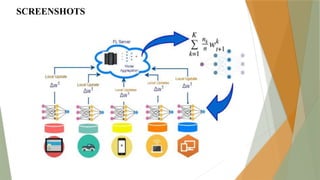
ALGORITHM Whenever the user enters some information, the following step
takes place:
• Step 1: The particular device will download the current
model.
• Step 2: The model would make improvements from the new
data that we got from the device.
• Step 3: The model changes are summarized as an update and
communicated to the cloud. This communication is
encrypted.
• Step 4: On the cloud, there are many updates coming in from
multiple users. These all updates are aggregated and the final
model is built.
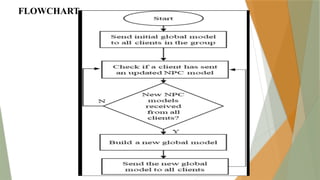
FLOWCHART
SCREENSHOTS
CONCLUSION
In conclusion federated learning represents a transformative approach to machine
learning that prioritizes privacy and decentralized model training.
Machine learning programs are typically less resource-intensive and can run on
conventional computers. Deep learning models require more computational power due to
the complexity of artificial neural network and the large volume of data they process
REFERENCES
[1] Akihito Taya ,Takayuki Nishio , Masahiro Morikura , koji Yamamoto
“Decentralized and Model- Free Federated Learning: Consensus - Based
Distillation Function in Function space proceedings of the IEEE, vol, 86,, no.
11,pp,2278-2324,January 2020.
[2] Runhua Xu, Nathalie Baracaldo, Yi Zhou, Ali Anwar, James Joshi, Heilo
Ludwig, “FedV : Privacy- Preserving Federated Learning over Vertically
Partitioned Data “, IEEE, March 2921
[3] https//:ai.googleblog.com/2017/04//federated-learning-collaborative.html
THANK YOU

NithikshaPatelGSAndSagarikaKgGowdaddd.ppt

  • 1.
    PES Institute ofTechnology and Management, Shivamogga Department of Master of Computer Applications Seminar On “FEDERATED LEARNING BASED ON DEEP LEARNING” Presented by NITHIKSHA PATEL G S 4PM23MC028 RAKSHITHA G 4PM23MC032 SAGARIKA K G 4PM23MC035 Under the Guidance of Mr.MUSHEER AHMED Asst.Professor Dept.of MCA PESITM, Shivamogga
  • 2.
    TABLE OF CONTENT Introduction.  Scope and objectives.  Existing system and limitations.  Aim of project.  Proposing system along with advantages.  Future Enhancement.  Software requirement specification.  Algorithm.  Flowchart.  Screenshots.  Conclusion.  Reference.
  • 3.
    INTRODUCTION Federated learning isa machine learning approach that allows multiple devices or systems to collaboratively train a machine learning model without need to share their raw data with each other. In traditional centralized machine learning approaches, data is collected and aggregated into a central location before a model is trained. Federated learning is a training the model on client devices using the deep learning algorithm is shown to perform better than server based training using iterative algorithm. The algorithm is used on the server to combine updates from the clients and produce a new global model.
  • 4.
    SCOPE AND OBJECTIVES SCOPE Accessto heterogeneous data: Federated learning guarantees access to data spread across multiple devices, locations and organizations. Diverse: Federated learning’s applications are spread over a number of industries including defense, telecommunications, IOT and pharmaceutics. OBJECTIVES Decentralized learning model: Implement’s secure decentralized learning model using neural networks and develop globally shared model,where data is and having train models for each users. Privacy and security: We explore the machine learning techniques to propose a
  • 5.
    AIM OF PROJECT Federatedlearning aims at training a machine learning algorithm , for instance deep neural networks , on multiple local datasets contained in local nodes without explicitly exchanging data samples.
  • 6.
    EXISTING SYSTEM Federated learninghas been proposed to allow collaborative learning of deep learning model among multiple parties where each party can keep its data private. Limitations The next generation of artificial intelligence is built upon the core idea revolving around data privacy. Traditional master worker type of distributed learning assumes a trusted central server and focuses on the privacy issues of the linear learning models.
  • 7.
    PROPOSED SYSTEM We developdifferential privacy based schemes to protect each party’s rate of privacy and integrity and propose an nearest algorithm to protect the system from potential attacks. Advantages • Overcome the communication overhead • Privacy preservation and data protection • Security and robustness
  • 8.
    FUTURE ENHANCEMENT • Usingdeep learning framework to develop a serverless private deep learning models. • Design a system with mixed approach of deep learning and secret sharing. • Scaling and designing of the distributed systems for a large number of clients.
  • 9.
    SOFTWARE REQUIREMENT SPECIFICATION SoftwareRequirements • Python: version 2.1 or above (recommended 3.3 and stable) • tmux : allows multiple terminal sessions to be accessed simultaneously in a single window. • OS: Microsoft Windows 8/10, Mac pr Ubuntu 18 or higher. Hardware Requirements • Intel i5 7th generation or higher • Memory: minimum 8GB of ram and 500GB Disk space
  • 10.
    ALGORITHM Whenever theuser enters some information, the following step takes place: • Step 1: The particular device will download the current model. • Step 2: The model would make improvements from the new data that we got from the device. • Step 3: The model changes are summarized as an update and communicated to the cloud. This communication is encrypted. • Step 4: On the cloud, there are many updates coming in from multiple users. These all updates are aggregated and the final model is built.
  • 11.
  • 12.
  • 13.
    CONCLUSION In conclusion federatedlearning represents a transformative approach to machine learning that prioritizes privacy and decentralized model training. Machine learning programs are typically less resource-intensive and can run on conventional computers. Deep learning models require more computational power due to the complexity of artificial neural network and the large volume of data they process
  • 14.
    REFERENCES [1] Akihito Taya,Takayuki Nishio , Masahiro Morikura , koji Yamamoto “Decentralized and Model- Free Federated Learning: Consensus - Based Distillation Function in Function space proceedings of the IEEE, vol, 86,, no. 11,pp,2278-2324,January 2020. [2] Runhua Xu, Nathalie Baracaldo, Yi Zhou, Ali Anwar, James Joshi, Heilo Ludwig, “FedV : Privacy- Preserving Federated Learning over Vertically Partitioned Data “, IEEE, March 2921 [3] https//:ai.googleblog.com/2017/04//federated-learning-collaborative.html
  • 15.