
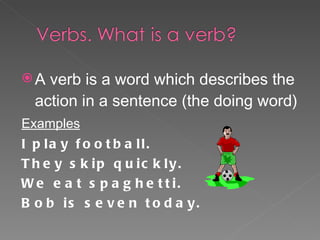

















A verb is a word which describes the action in a sentence (the doing word) Examples I play football. They skip quickly. We eat spaghetti. Bob is seven today.
Verb tenses describe WHEN the action is happening. PRESENT  (it’s happening NOW.) PAST  (it’s ALREADY happened.) FUTURE  (it’s ABOUT to happen.)
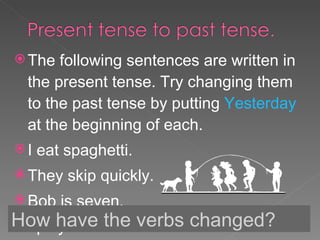
The following sentences are written in the present tense. Try changing them to the past tense by putting  Yesterday  at the beginning of each. I eat spaghetti. They skip quickly. Bob is seven. I play football. How have the verbs changed?
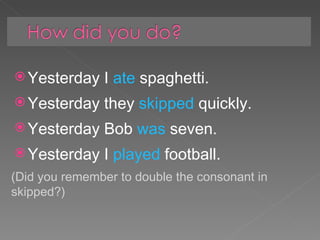
Yesterday I  ate  spaghetti. Yesterday they  skipped  quickly. Yesterday Bob  was  seven. Yesterday I  played  football. (Did you remember to double the consonant in skipped?)
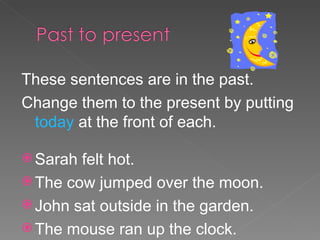
These sentences are in the past.  Change them to the present by putting  today  at the front of each. Sarah felt hot. The cow jumped over the moon. John sat outside in the garden. The mouse ran up the clock.
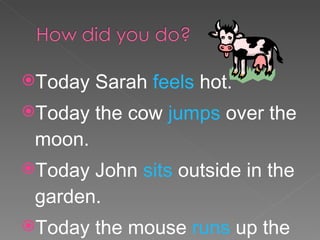
Today Sarah  feels  hot. Today the cow  jumps  over the moon. Today John  sits  outside in the garden. Today the mouse  runs  up the clock.
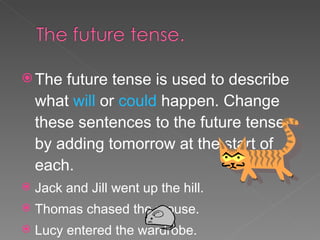
The future tense is used to describe what  will  or  could  happen. Change these sentences to the future tense by adding tomorrow at the start of each. Jack and Jill went up the hill. Thomas chased the mouse. Lucy entered the wardrobe. Bo Peep lost her sheep.
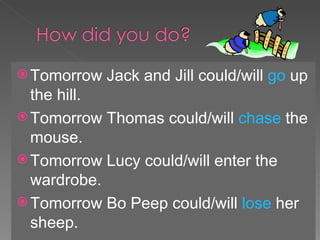
Tomorrow Jack and Jill could/will  go  up the hill. Tomorrow Thomas could/will  chase  the mouse. Tomorrow Lucy could/will enter the wardrobe. Tomorrow Bo Peep could/will  lose  her sheep.


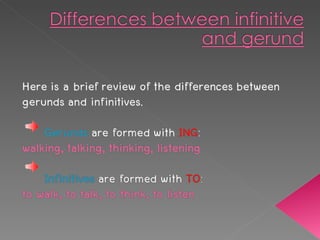
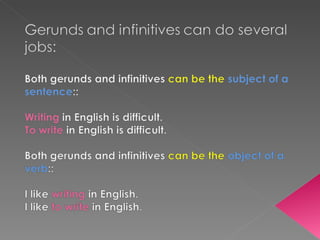
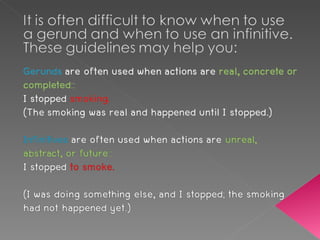
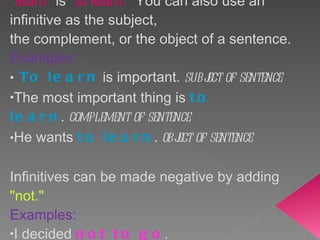
2. Infinitives are the  "to"  form of the verb. The infinitive form of  "learn"  is  "to learn."  You can also use an infinitive as the subject,  the complement, or the object of a sentence. Examples: To learn  is important.  subject of sentence The most important thing is  to learn .  complement of sentence He wants  to learn .  object of sentence Infinitives can be made negative by adding  "not." Examples: I decided  not to go . The most important thing is  not to give up .


Verbs

  • 1.
  • 2.
    A verb isa word which describes the action in a sentence (the doing word) Examples I play football. They skip quickly. We eat spaghetti. Bob is seven today.
  • 3.
    Verb tenses describeWHEN the action is happening. PRESENT (it’s happening NOW.) PAST (it’s ALREADY happened.) FUTURE (it’s ABOUT to happen.)
  • 4.
    The following sentencesare written in the present tense. Try changing them to the past tense by putting Yesterday at the beginning of each. I eat spaghetti. They skip quickly. Bob is seven. I play football. How have the verbs changed?
  • 5.
    Yesterday I ate spaghetti. Yesterday they skipped quickly. Yesterday Bob was seven. Yesterday I played football. (Did you remember to double the consonant in skipped?)
  • 6.
    These sentences arein the past. Change them to the present by putting today at the front of each. Sarah felt hot. The cow jumped over the moon. John sat outside in the garden. The mouse ran up the clock.
  • 7.
    Today Sarah feels hot. Today the cow jumps over the moon. Today John sits outside in the garden. Today the mouse runs up the clock.
  • 8.
    The future tenseis used to describe what will or could happen. Change these sentences to the future tense by adding tomorrow at the start of each. Jack and Jill went up the hill. Thomas chased the mouse. Lucy entered the wardrobe. Bo Peep lost her sheep.
  • 9.
    Tomorrow Jack andJill could/will go up the hill. Tomorrow Thomas could/will chase the mouse. Tomorrow Lucy could/will enter the wardrobe. Tomorrow Bo Peep could/will lose her sheep.
  • 10.
  • 11.
  • 12.
  • 13.
  • 14.
  • 15.
    2. Infinitives arethe "to" form of the verb. The infinitive form of "learn" is "to learn." You can also use an infinitive as the subject, the complement, or the object of a sentence. Examples: To learn  is important.  subject of sentence The most important thing is  to learn .  complement of sentence He wants  to learn .  object of sentence Infinitives can be made negative by adding "not." Examples: I decided  not to go . The most important thing is  not to give up .
  • 16.
  • 17.
  • 18.
  • 19.
  • 20.
  • 21.
  • 22.
  • 23.
  • 24.
  • 25.
  • 26.
  • 27.
  • 28.
  • 29.
  • 30.
  • 31.