I
1
Stylistics
Presented by:
Hamid Ali Shah
Your Company Name
I
2
Verb Phrase
Introduction:
• Verb Phrase consist of an obligatory main verb and at times is aided by
an auxiliary verb, negative particle or an adverb.
VP= Obligatory [main Verb] + Optional [Auxiliary verb +negative particle+ Adverb]
Examples:
• He writes a letter.
VP= Main verb [writes]
• She does not really believe her own claims .
VP= Auxiliary verb [does] + Negative particle [not] + Adverb [really]
+ Main Verb [believe]
3
Your Company Name 4
Types of
Verb Phrases
There are two types of verb phrases.
1. Finite Verb Phrases
2. Non-finite Verb Phrases
Your Company Name 5
Finite Verb Phrases
• A finite verb shows two important
aspects.
1. Number
2. Tense
• Finite verbs often comes along with
auxiliary verb. For example, is going,
are going, have done etc.
• A finite verb phrase is a type of verb
phrase that shows agreement with a
subject and show present tense or past
tense.
• Finite verbs can be easily identified if
they are the only verb within a sentence
or are the central element to the main
clause.
Your Company Name 6
Non-Finite Verb Phrase
• Non-finite verb phrases does not indicate
number antense.
• Non-finite phrases are used to omit time
and tense.
• They are used to put emphasis on action
rather than indicating time.
• A nonfinite verb phrase may include the
subject or complements (or both) of the
finite verb from which it is derived, but
it is not a clause.
For example:
• Accepting a position as a law clerk
pleased her grandmother
Accepting is a non finite verb phrase
Pleased is a finite verb phrase.
Your Company Name 7
Non-Finite Verb Phrases
• Nonfinite Verb Phrases DO NOT occur as part of a main verb phrase and can function nominally,
adjectivally, or adverbially.
• A non-finite verb is a verb without tense. It can adopt one of the three construction
1. Infinitive Phrase
2. Participle Phrase
3. Gerund Phrase
• Because infinitives, participles, and gerunds are verbs, they can have the same subjects and predicates
(objects, complements, and modifiers).
• Examples:
1. He likes to drive. (nominal infinitive phrase)
2. a drinking fountain (adjectival present participle phrase)
3. Drinking and driving do not mix. (nominal gerund phrases)
Your Company Name
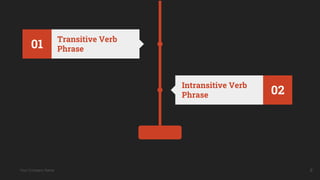
01
Transitive Verb
Phrase
02
Intransitive Verb
Phrase
8
Your Company Name 9
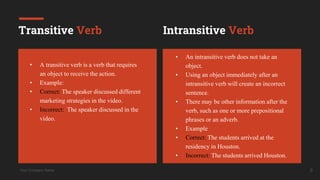
Transitive Verb
• An intransitive verb does not take an
object.
• Using an object immediately after an
intransitive verb will create an incorrect
sentence.
• There may be other information after the
verb, such as one or more prepositional
phrases or an adverb.
• Example
• Correct: The students arrived at the
residency in Houston.
• Incorrect: The students arrived Houston.
• A transitive verb is a verb that requires
an object to receive the action.
• Example:
• Correct: The speaker discussed different
marketing strategies in the video.
• Incorrect: The speaker discussed in the
video.
Intransitive Verb
Your Company Name
01 Story Time
02
Narrative Time
10
Time
Your Company Name 11
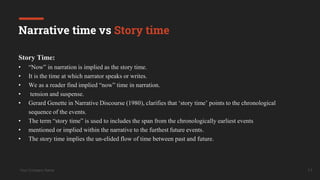
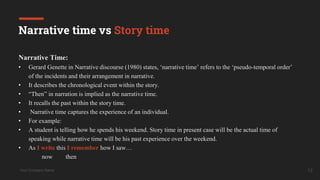
Narrative time vs Story time
Story Time:
• “Now” in narration is implied as the story time.
• It is the time at which narrator speaks or writes.
• We as a reader find implied “now” time in narration.
• tension and suspense.
• Gerard Genette in Narrative Discourse (1980), clarifies that ‘story time’ points to the chronological
sequence of the events.
• The term “story time” is used to includes the span from the chronologically earliest events
• mentioned or implied within the narrative to the furthest future events.
• The story time implies the un-elided flow of time between past and future.
Your Company Name 12
Narrative time vs Story time
Narrative Time:
• Gerard Genette in Narrative discourse (1980) states, ‘narrative time’ refers to the ‘pseudo-temporal order’
of the incidents and their arrangement in narrative.
• It describes the chronological event within the story.
• “Then” in narration is implied as the narrative time.
• It recalls the past within the story time.
• Narrative time captures the experience of an individual.
• For example:
• A student is telling how he spends his weekend. Story time in present case will be the actual time of
speaking while narrative time will be his past experience over the weekend.
• As I write this I remember how I saw…
now then
Your Company Name 13
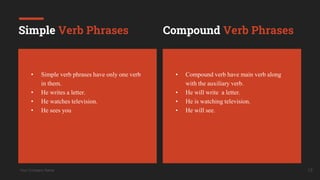
Simple Verb Phrases
• Compound verb have main verb along
with the auxiliary verb.
• He will write a letter.
• He is watching television.
• He will see.
• Simple verb phrases have only one verb
in them.
• He writes a letter.
• He watches television.
• He sees you
Compound Verb Phrases
Your Company Name 14
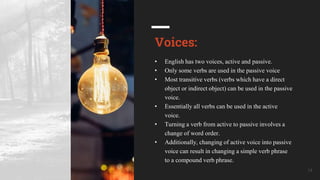
Voices:
• English has two voices, active and passive.
• Only some verbs are used in the passive voice
• Most transitive verbs (verbs which have a direct
object or indirect object) can be used in the passive
voice.
• Essentially all verbs can be used in the active
voice.
• Turning a verb from active to passive involves a
change of word order.
• Additionally, changing of active voice into passive
voice can result in changing a simple verb phrase
to a compound verb phrase.
Your Company Name 15
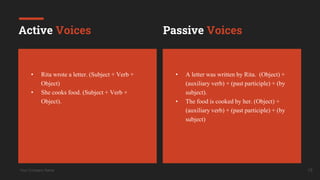
Active Voices
• A letter was written by Rita. (Object) +
(auxiliary verb) + (past participle) + (by
subject).
• The food is cooked by her. (Object) +
(auxiliary verb) + (past participle) + (by
subject)
• Rita wrote a letter. (Subject + Verb +
Object)
• She cooks food. (Subject + Verb +
Object).
Passive Voices
Your Company Name 16
Note:
• Intransitive verb do not require an object.
• Their passive voices can not be constructed.
• For example,
He laughs.
She sleeps.
They run.
All the verb used here are intransitive verb thus their
passive construction is impossible in English, while in
some other language it might be possible.
Your Company Name 17
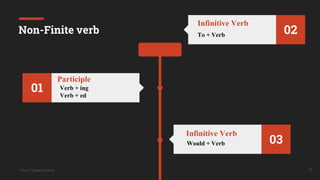
Non-Finite verb
01 Verb + ing
Verb + ed
Participle
03
Would + Verb
02
Infinitive Verb
To + Verb
Infinitive Verb
Your Company Name 18
Thank You !!!

Verb Phrase in Stylistics.pptx

  • 1.
  • 2.
  • 3.
    Introduction: • Verb Phraseconsist of an obligatory main verb and at times is aided by an auxiliary verb, negative particle or an adverb. VP= Obligatory [main Verb] + Optional [Auxiliary verb +negative particle+ Adverb] Examples: • He writes a letter. VP= Main verb [writes] • She does not really believe her own claims . VP= Auxiliary verb [does] + Negative particle [not] + Adverb [really] + Main Verb [believe] 3
  • 4.
    Your Company Name4 Types of Verb Phrases There are two types of verb phrases. 1. Finite Verb Phrases 2. Non-finite Verb Phrases
  • 5.
    Your Company Name5 Finite Verb Phrases • A finite verb shows two important aspects. 1. Number 2. Tense • Finite verbs often comes along with auxiliary verb. For example, is going, are going, have done etc. • A finite verb phrase is a type of verb phrase that shows agreement with a subject and show present tense or past tense. • Finite verbs can be easily identified if they are the only verb within a sentence or are the central element to the main clause.
  • 6.
    Your Company Name6 Non-Finite Verb Phrase • Non-finite verb phrases does not indicate number antense. • Non-finite phrases are used to omit time and tense. • They are used to put emphasis on action rather than indicating time. • A nonfinite verb phrase may include the subject or complements (or both) of the finite verb from which it is derived, but it is not a clause. For example: • Accepting a position as a law clerk pleased her grandmother Accepting is a non finite verb phrase Pleased is a finite verb phrase.
  • 7.
    Your Company Name7 Non-Finite Verb Phrases • Nonfinite Verb Phrases DO NOT occur as part of a main verb phrase and can function nominally, adjectivally, or adverbially. • A non-finite verb is a verb without tense. It can adopt one of the three construction 1. Infinitive Phrase 2. Participle Phrase 3. Gerund Phrase • Because infinitives, participles, and gerunds are verbs, they can have the same subjects and predicates (objects, complements, and modifiers). • Examples: 1. He likes to drive. (nominal infinitive phrase) 2. a drinking fountain (adjectival present participle phrase) 3. Drinking and driving do not mix. (nominal gerund phrases)
  • 8.
    Your Company Name 01 TransitiveVerb Phrase 02 Intransitive Verb Phrase 8
  • 9.
    Your Company Name9 Transitive Verb • An intransitive verb does not take an object. • Using an object immediately after an intransitive verb will create an incorrect sentence. • There may be other information after the verb, such as one or more prepositional phrases or an adverb. • Example • Correct: The students arrived at the residency in Houston. • Incorrect: The students arrived Houston. • A transitive verb is a verb that requires an object to receive the action. • Example: • Correct: The speaker discussed different marketing strategies in the video. • Incorrect: The speaker discussed in the video. Intransitive Verb
  • 10.
    Your Company Name 01Story Time 02 Narrative Time 10 Time
  • 11.
    Your Company Name11 Narrative time vs Story time Story Time: • “Now” in narration is implied as the story time. • It is the time at which narrator speaks or writes. • We as a reader find implied “now” time in narration. • tension and suspense. • Gerard Genette in Narrative Discourse (1980), clarifies that ‘story time’ points to the chronological sequence of the events. • The term “story time” is used to includes the span from the chronologically earliest events • mentioned or implied within the narrative to the furthest future events. • The story time implies the un-elided flow of time between past and future.
  • 12.
    Your Company Name12 Narrative time vs Story time Narrative Time: • Gerard Genette in Narrative discourse (1980) states, ‘narrative time’ refers to the ‘pseudo-temporal order’ of the incidents and their arrangement in narrative. • It describes the chronological event within the story. • “Then” in narration is implied as the narrative time. • It recalls the past within the story time. • Narrative time captures the experience of an individual. • For example: • A student is telling how he spends his weekend. Story time in present case will be the actual time of speaking while narrative time will be his past experience over the weekend. • As I write this I remember how I saw… now then
  • 13.
    Your Company Name13 Simple Verb Phrases • Compound verb have main verb along with the auxiliary verb. • He will write a letter. • He is watching television. • He will see. • Simple verb phrases have only one verb in them. • He writes a letter. • He watches television. • He sees you Compound Verb Phrases
  • 14.
    Your Company Name14 Voices: • English has two voices, active and passive. • Only some verbs are used in the passive voice • Most transitive verbs (verbs which have a direct object or indirect object) can be used in the passive voice. • Essentially all verbs can be used in the active voice. • Turning a verb from active to passive involves a change of word order. • Additionally, changing of active voice into passive voice can result in changing a simple verb phrase to a compound verb phrase.
  • 15.
    Your Company Name15 Active Voices • A letter was written by Rita. (Object) + (auxiliary verb) + (past participle) + (by subject). • The food is cooked by her. (Object) + (auxiliary verb) + (past participle) + (by subject) • Rita wrote a letter. (Subject + Verb + Object) • She cooks food. (Subject + Verb + Object). Passive Voices
  • 16.
    Your Company Name16 Note: • Intransitive verb do not require an object. • Their passive voices can not be constructed. • For example, He laughs. She sleeps. They run. All the verb used here are intransitive verb thus their passive construction is impossible in English, while in some other language it might be possible.
  • 17.
    Your Company Name17 Non-Finite verb 01 Verb + ing Verb + ed Participle 03 Would + Verb 02 Infinitive Verb To + Verb Infinitive Verb
  • 18.
    Your Company Name18 Thank You !!!

Editor's Notes

  • #7 https://pixabay.com/en/entrepreneur-startup-start-up-man-593358/
  • #8 https://pixabay.com/en/entrepreneur-startup-start-up-man-593358/
  • #12 https://pixabay.com/en/entrepreneur-startup-start-up-man-593358/
  • #13 https://pixabay.com/en/entrepreneur-startup-start-up-man-593358/