UWF WRITING LAB
RULES OF THUMB FOR VERB
       FORMS AND TENSES
    From Real Good Grammar, Too
           by Mamie Webb Hixon


           Created by April Turner
USE PRESENT TENSE
 In universally true statements not limited to
  a particular time:
      The sun is ninety million miles from Earth.
 In   definitions:
      Hardware is the physical system of a
       computer.
 In  statements about the content of
  literature and other published works:
      Hamlet is extremely indecisive.
USE PAST TENSE

 For
    historical or
 past information:
     Malcolm X said, “If
      you don’t stand for
      something, you’ll fall
      for anything.”
USE PRESENT PERFECT TENSE
 (the  present form of
  have (have or has) with
  a past participle verb
  form)
 For an action that began
  in the past but continues
  into the future:
     I have lived in Pensacola
      all my life.
USE PAST PERFECT TENSE
 (the past form of have
  (had) with a past
  participle verb form)
 For an earlier action that
  is mentioned after a
  later action:
      Marvin bought the car
       that he had seen
       advertised in the paper.
       (First, he saw it; then he
       bought it.)
USE FUTURE PERFECT TENSE
 (the auxiliary will have or
  shall have with a past
  participle verb form)
 For an action that will
  have been completed at a
  specific future time:
     By 2010, I shall have
      graduated.
USE A PRESENT PARTICIPLE VERBAL

 (-ing verb form used as
  an adjective)
 For an action that occurs
  at the same time as the
  verb:
     Speeding down the
      interstate, I saw a police
      officer.
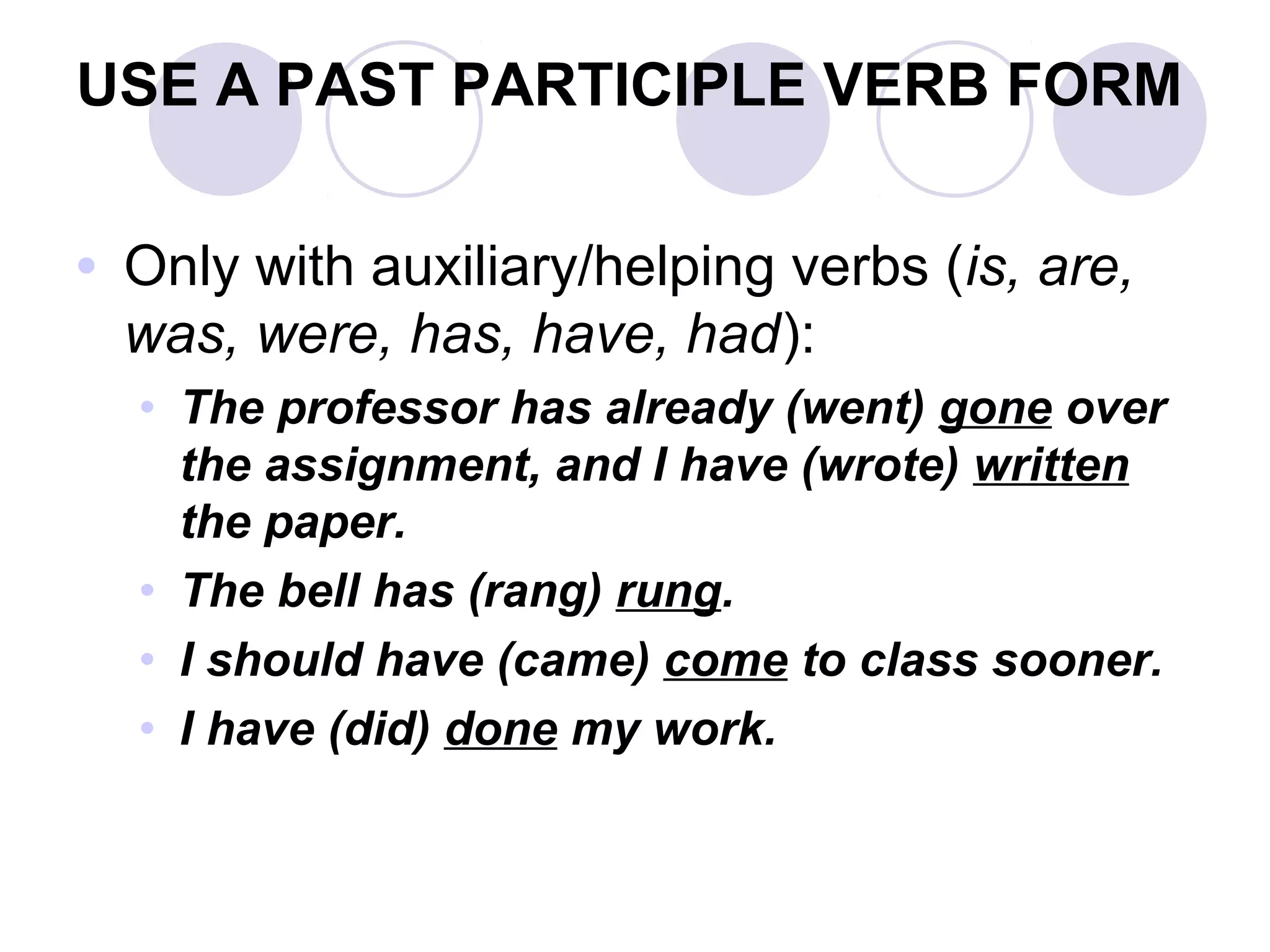
USE A PAST PARTICIPLE VERB FORM

•   Only with auxiliary/helping verbs (is, are,
    was, were, has, have, had):
    •   The professor has already (went) gone over
        the assignment, and I have (wrote) written
        the paper.
    •   The bell has (rang) rung.
    •   I should have (came) come to class sooner.
    •   I have (did) done my work.
USE SUBJUNCTIVE MOOD
 Toexpress a condition contrary to fact or
 a wish:
   If   I were President, I'd lower taxes.
 Toexpress insistence, importance,
 necessity, or urgency after the word that:
   Itis important that you be on time.
   We demand that the company do something
    about its toxic waste.
   The syllabus requires that each student
    write a research paper.
Let’s Practice!!!
I  have already (spoken, spoke) to the optician
  about my new pair of contact lenses.
                       SPOKEN
 In college, I hope (to study, to have studied)
  subjects which will be useful to me later.
                      TO STUDY
 We were told at the service station that it (is,
  was) at least fifty miles from Plattsburg to
  Saranac Lake.
                           IS
More Practice!!!
 It is necessary that our signatures (are,
  be) witnessed by a notary.
                      BE
 Have you ever (flew, flown) coast to coast
  using Eastern Airlines’ excursion rates?
                    FLOWN
 If Ted (had apologized, would have
  apologized) I would have forgiven him.
             HAD APOLOGIZED

Verb forms and tenses

  • 1.
    UWF WRITING LAB RULESOF THUMB FOR VERB FORMS AND TENSES From Real Good Grammar, Too by Mamie Webb Hixon Created by April Turner
  • 2.
    USE PRESENT TENSE In universally true statements not limited to a particular time:  The sun is ninety million miles from Earth.  In definitions:  Hardware is the physical system of a computer.  In statements about the content of literature and other published works:  Hamlet is extremely indecisive.
  • 3.
    USE PAST TENSE For historical or past information:  Malcolm X said, “If you don’t stand for something, you’ll fall for anything.”
  • 4.
    USE PRESENT PERFECTTENSE  (the present form of have (have or has) with a past participle verb form)  For an action that began in the past but continues into the future:  I have lived in Pensacola all my life.
  • 5.
    USE PAST PERFECTTENSE  (the past form of have (had) with a past participle verb form)  For an earlier action that is mentioned after a later action:  Marvin bought the car that he had seen advertised in the paper. (First, he saw it; then he bought it.)
  • 6.
    USE FUTURE PERFECTTENSE  (the auxiliary will have or shall have with a past participle verb form)  For an action that will have been completed at a specific future time:  By 2010, I shall have graduated.
  • 7.
    USE A PRESENTPARTICIPLE VERBAL  (-ing verb form used as an adjective)  For an action that occurs at the same time as the verb:  Speeding down the interstate, I saw a police officer.
  • 8.
    USE A PASTPARTICIPLE VERB FORM • Only with auxiliary/helping verbs (is, are, was, were, has, have, had): • The professor has already (went) gone over the assignment, and I have (wrote) written the paper. • The bell has (rang) rung. • I should have (came) come to class sooner. • I have (did) done my work.
  • 9.
    USE SUBJUNCTIVE MOOD Toexpress a condition contrary to fact or a wish:  If I were President, I'd lower taxes.  Toexpress insistence, importance, necessity, or urgency after the word that:  Itis important that you be on time.  We demand that the company do something about its toxic waste.  The syllabus requires that each student write a research paper.
  • 10.
    Let’s Practice!!! I have already (spoken, spoke) to the optician about my new pair of contact lenses.  SPOKEN  In college, I hope (to study, to have studied) subjects which will be useful to me later.  TO STUDY  We were told at the service station that it (is, was) at least fifty miles from Plattsburg to Saranac Lake.  IS
  • 11.
    More Practice!!!  Itis necessary that our signatures (are, be) witnessed by a notary.  BE  Have you ever (flew, flown) coast to coast using Eastern Airlines’ excursion rates?  FLOWN  If Ted (had apologized, would have apologized) I would have forgiven him.  HAD APOLOGIZED