Ventriculo
Arterial
Coupling
Dr. Kaveh Kazemian
Pharm-D
Board Certified of Clinical Pharmacy
Fellowship in Critical Care Medicine
Dr. Kaveh Kazemian. Pharm-D. Board Certified of Clinical Pharmacy. Pharmacotherapy Fellowship in Critical Care Medicine assistant
 Hemodynamic instability
 Ventriculo-arterial coupling is a primary determinant of
cardiovascular function
 LV stroke volume is both limited by and defines arterial pressure.
 Ventriculo-arterial coupling represents the efficiency of the heart and
vascular system to create the necessary flow under pressure
2
Dr. Kaveh Kazemian. Pharm-D. Board Certified of Clinical Pharmacy. Pharmacotherapy Fellowship in Critical Care Medicine assistant
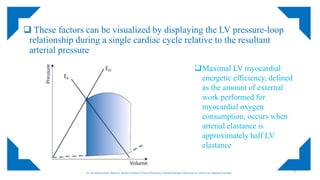
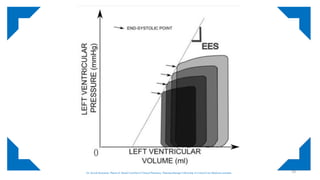
 These factors can be visualized by displaying the LV pressure-loop
relationship during a single cardiac cycle relative to the resultant
arterial pressure
3
Maximal LV myocardial
energetic efficiency, defined
as the amount of external
work performed for
myocardial oxygen
consumption, occurs when
arterial elastance is
approximately half LV
elastance
Dr. Kaveh Kazemian. Pharm-D. Board Certified of Clinical Pharmacy. Pharmacotherapy Fellowship in Critical Care Medicine assistant
 Right ventriculo-arterial coupling has been used to assess RV
function in patients with pulmonary hypertension
 Impaired coupling is the best predictor of death or the need for lung
transplantation in patients with pulmonary hypertension, independent
of pulmonary arterial pressure measures
4
Dr. Kaveh Kazemian. Pharm-D. Board Certified of Clinical Pharmacy. Pharmacotherapy Fellowship in Critical Care Medicine assistant
 RV dysfunction is universally present to some degree in all critically
ill patients with acute respiratory failure requiring positive-pressure
ventilation
 The Right Ventricle
RV ejection fraction (RVEF)
Pulmonary artery occlusion pressure (PAOP)
Tricuspid annual plane systolic excursion (TAPSE)
5
Dr. Kaveh Kazemian. Pharm-D. Board Certified of Clinical Pharmacy. Pharmacotherapy Fellowship in Critical Care Medicine assistant
 Right ventriculo-arterial mismatch can occur as a result of RV failure
(decrease in RV elastance), pulmonary arterial hypertension (increase
in pulmonary artery elastance) or both
 Right ventriculo-arterial uncoupling, will be a reduction in the
energetic efficiency between the right heart and the pulmonary circuit,
ultimately leading to right heart failure and potentially the need for
inotropic support, use of selective pulmonary vasodilators or
mechanical assistance
6
Dr. Kaveh Kazemian. Pharm-D. Board Certified of Clinical Pharmacy. Pharmacotherapy Fellowship in Critical Care Medicine assistant
Causes of Decreased Right Ventricular Elastance
7
Dr. Kaveh Kazemian. Pharm-D. Board Certified of Clinical Pharmacy. Pharmacotherapy Fellowship in Critical Care Medicine assistant
 Primary Left Heart Failure
• The left heart has thicker walls dispersing wall stress unlike Right
heart
• If coupled with increased volume may rapidly spiral into acute cor
pulmonale and cardiac standstill, a common terminal event in patients
with massive pulmonary emboli.
8
Dr. Kaveh Kazemian. Pharm-D. Board Certified of Clinical Pharmacy. Pharmacotherapy Fellowship in Critical Care Medicine assistant
• Pathologies involving the left heart, especially if they occur suddenly,
often result in a passive increase in the pulmonary artery pressure,
leading, subsequently, to right ventriculo-arterial uncoupling
9
Dr. Kaveh Kazemian. Pharm-D. Board Certified of Clinical Pharmacy. Pharmacotherapy Fellowship in Critical Care Medicine assistant
 Primary Right Heart Failure
• Primary right heart failure can occur if the supply of oxygenated blood to
the right heart is stopped
• Routine EKG analysis is often insufficient to identify an ST-T mismatch
• RV myocardial blood flow primarily occurs in systole, unlike LV
myocardial perfusion
• RV myocardial ischemia
10
Dr. Kaveh Kazemian. Pharm-D. Board Certified of Clinical Pharmacy. Pharmacotherapy Fellowship in Critical Care Medicine assistant
Causes of Increases in Pulmonary Arterial Elastance
11
Dr. Kaveh Kazemian. Pharm-D. Board Certified of Clinical Pharmacy. Pharmacotherapy Fellowship in Critical Care Medicine assistant
• A pulmonary arterial embolism
• Pulmonary Hypertension
• The Ventilated Patient
12
Dr. Kaveh Kazemian. Pharm-D. Board Certified of Clinical Pharmacy. Pharmacotherapy Fellowship in Critical Care Medicine assistant 13
Dr. Kaveh Kazemian. Pharm-D. Board Certified of Clinical Pharmacy. Pharmacotherapy Fellowship in Critical Care Medicine assistant 14
Dr. Kaveh Kazemian. Pharm-D. Board Certified of Clinical Pharmacy. Pharmacotherapy Fellowship in Critical Care Medicine assistant 15
Dr. Kaveh Kazemian. Pharm-D. Board Certified of Clinical Pharmacy. Pharmacotherapy Fellowship in Critical Care Medicine assistant
 The best way to assess arterial afterload would be aortic input impedance
 Aortic input impedance is described in the frequency domain, whereas
measures of LV contractility are best described in the time domain
 Normal invasively determined EEA and EES values in resting subjects
are 2.2 ± 0.8 mmHg/ml and 2.3 ± 1.0 mmHg/ml, respectively
 EA/EES ratio equal to 1.0, LV and arterial system are optimally coupled
16
Dr. Kaveh Kazemian. Pharm-D. Board Certified of Clinical Pharmacy. Pharmacotherapy Fellowship in Critical Care Medicine assistant
 EA/EES ratio >1.0, the stroke work significantly falls and the LV becomes
progressively less efficient
 EES indicates how much the LV end-systolic volume increases and stroke
volume decreases in response to an elevation of end-systolic pressure
 An increase in heart rate will further increase EA, worsening the coupling
 Vasodilator therapy Vs inotropic therapy
17
Dr. Kaveh Kazemian. Pharm-D. Board Certified of Clinical Pharmacy. Pharmacotherapy Fellowship in Critical Care Medicine assistant 18
End-systolic
pressure can be
estimated as 0.9
times the peak
brachial systolic
pressure
Dr. Kaveh Kazemian. Pharm-D. Board Certified of Clinical Pharmacy. Pharmacotherapy Fellowship in Critical Care Medicine assistant 19
Dr. Kaveh Kazemian. Pharm-D. Board Certified of Clinical Pharmacy. Pharmacotherapy Fellowship in Critical Care Medicine assistant
EA = ESP/SV, EES = ESP/ESV
EA/EES = ESV/SV
EA = (SBP × 0.9)/SV
( The problem with this simplified approach is that the ESV/SV ratio is related in mathematical terms
to the ejection fraction (1/EF - 1) and therefore it does not add substantial information to the
traditional ejection fraction measurement )
 The significant advantage of a correctly measured EA/EES ratio
20
Dr. Kaveh Kazemian. Pharm-D. Board Certified of Clinical Pharmacy. Pharmacotherapy Fellowship in Critical Care Medicine assistant
tNd is the ratio of preejection period / total systolic period.
21
Dr. Kaveh Kazemian. Pharm-D. Board Certified of Clinical Pharmacy. Pharmacotherapy Fellowship in Critical Care Medicine assistant 22
Dr. Kaveh Kazemian. Pharm-D. Board Certified of Clinical Pharmacy. Pharmacotherapy Fellowship in Critical Care Medicine assistant
 Pathophysiology of hypertension as a determinant of heart failure
 After antihypertensive therapy a reduction of EA/EES ratio was found
 These results were blunted in women and in obese individuals
 Prognostic role of the ventricular-arterial coupling
 EA/EES ratio of 1.47, BNP cutoff of 250 pg/ml
23
CLINICALAPPLICATIONS
Dr. Kaveh Kazemian. Pharm-D. Board Certified of Clinical Pharmacy. Pharmacotherapy Fellowship in Critical Care Medicine assistant
 Management of candidates for cardiac resynchronization therapy
 Systolic Heart Failure Treatment With the If Inhibitor Ivabradine Trial
 Valvular heart disease
 Aortic valve stenosis :
Valvular-arterial impedance (( SBP+mean transvalvular pressure)/SV)
24
Dr. Kaveh Kazemian. Pharm-D. Board Certified of Clinical Pharmacy. Pharmacotherapy Fellowship in Critical Care Medicine assistant
Ventriculo-arterial decoupling in Physiological conditions
During exercise Ees increases more than Ea
Ea increases in elderly people as a consequence of the structural changes in
the arterial properties
Cardiovascular diseases which have an impact on V-A coupling, frequently
occur in elderly patients
25
Dr. Kaveh Kazemian. Pharm-D. Board Certified of Clinical Pharmacy. Pharmacotherapy Fellowship in Critical Care Medicine assistant
 Cardiovascular system is generally uncoupled in acute heart failure,
and Ea/Ees increases up to three or four fold
 Management of acute heart failure is based on inotropic agents aimed
to improve myocardial contractility and to restore organ perfusion
 Levosimendan
26
Dr. Kaveh Kazemian. Pharm-D. Board Certified of Clinical Pharmacy. Pharmacotherapy Fellowship in Critical Care Medicine assistant
The assessment of cardiovascular function by evaluation of the Ea/Ees
ratio can offer an adjunctive perspective for understanding the
pathophysiology of altered hemodynamic profiles, and for guiding
therapeutic strategies and testing the effectiveness of treatments
27
Dr. Kaveh Kazemian. Pharm-D. Board Certified of Clinical Pharmacy. Pharmacotherapy Fellowship in Critical Care Medicine assistant 28
Thanks
Thanks

Ventriculo arterial coupling

  • 1.
    Ventriculo Arterial Coupling Dr. Kaveh Kazemian Pharm-D BoardCertified of Clinical Pharmacy Fellowship in Critical Care Medicine
  • 2.
    Dr. Kaveh Kazemian.Pharm-D. Board Certified of Clinical Pharmacy. Pharmacotherapy Fellowship in Critical Care Medicine assistant  Hemodynamic instability  Ventriculo-arterial coupling is a primary determinant of cardiovascular function  LV stroke volume is both limited by and defines arterial pressure.  Ventriculo-arterial coupling represents the efficiency of the heart and vascular system to create the necessary flow under pressure 2
  • 3.
    Dr. Kaveh Kazemian.Pharm-D. Board Certified of Clinical Pharmacy. Pharmacotherapy Fellowship in Critical Care Medicine assistant  These factors can be visualized by displaying the LV pressure-loop relationship during a single cardiac cycle relative to the resultant arterial pressure 3 Maximal LV myocardial energetic efficiency, defined as the amount of external work performed for myocardial oxygen consumption, occurs when arterial elastance is approximately half LV elastance
  • 4.
    Dr. Kaveh Kazemian.Pharm-D. Board Certified of Clinical Pharmacy. Pharmacotherapy Fellowship in Critical Care Medicine assistant  Right ventriculo-arterial coupling has been used to assess RV function in patients with pulmonary hypertension  Impaired coupling is the best predictor of death or the need for lung transplantation in patients with pulmonary hypertension, independent of pulmonary arterial pressure measures 4
  • 5.
    Dr. Kaveh Kazemian.Pharm-D. Board Certified of Clinical Pharmacy. Pharmacotherapy Fellowship in Critical Care Medicine assistant  RV dysfunction is universally present to some degree in all critically ill patients with acute respiratory failure requiring positive-pressure ventilation  The Right Ventricle RV ejection fraction (RVEF) Pulmonary artery occlusion pressure (PAOP) Tricuspid annual plane systolic excursion (TAPSE) 5
  • 6.
    Dr. Kaveh Kazemian.Pharm-D. Board Certified of Clinical Pharmacy. Pharmacotherapy Fellowship in Critical Care Medicine assistant  Right ventriculo-arterial mismatch can occur as a result of RV failure (decrease in RV elastance), pulmonary arterial hypertension (increase in pulmonary artery elastance) or both  Right ventriculo-arterial uncoupling, will be a reduction in the energetic efficiency between the right heart and the pulmonary circuit, ultimately leading to right heart failure and potentially the need for inotropic support, use of selective pulmonary vasodilators or mechanical assistance 6
  • 7.
    Dr. Kaveh Kazemian.Pharm-D. Board Certified of Clinical Pharmacy. Pharmacotherapy Fellowship in Critical Care Medicine assistant Causes of Decreased Right Ventricular Elastance 7
  • 8.
    Dr. Kaveh Kazemian.Pharm-D. Board Certified of Clinical Pharmacy. Pharmacotherapy Fellowship in Critical Care Medicine assistant  Primary Left Heart Failure • The left heart has thicker walls dispersing wall stress unlike Right heart • If coupled with increased volume may rapidly spiral into acute cor pulmonale and cardiac standstill, a common terminal event in patients with massive pulmonary emboli. 8
  • 9.
    Dr. Kaveh Kazemian.Pharm-D. Board Certified of Clinical Pharmacy. Pharmacotherapy Fellowship in Critical Care Medicine assistant • Pathologies involving the left heart, especially if they occur suddenly, often result in a passive increase in the pulmonary artery pressure, leading, subsequently, to right ventriculo-arterial uncoupling 9
  • 10.
    Dr. Kaveh Kazemian.Pharm-D. Board Certified of Clinical Pharmacy. Pharmacotherapy Fellowship in Critical Care Medicine assistant  Primary Right Heart Failure • Primary right heart failure can occur if the supply of oxygenated blood to the right heart is stopped • Routine EKG analysis is often insufficient to identify an ST-T mismatch • RV myocardial blood flow primarily occurs in systole, unlike LV myocardial perfusion • RV myocardial ischemia 10
  • 11.
    Dr. Kaveh Kazemian.Pharm-D. Board Certified of Clinical Pharmacy. Pharmacotherapy Fellowship in Critical Care Medicine assistant Causes of Increases in Pulmonary Arterial Elastance 11
  • 12.
    Dr. Kaveh Kazemian.Pharm-D. Board Certified of Clinical Pharmacy. Pharmacotherapy Fellowship in Critical Care Medicine assistant • A pulmonary arterial embolism • Pulmonary Hypertension • The Ventilated Patient 12
  • 13.
    Dr. Kaveh Kazemian.Pharm-D. Board Certified of Clinical Pharmacy. Pharmacotherapy Fellowship in Critical Care Medicine assistant 13
  • 14.
    Dr. Kaveh Kazemian.Pharm-D. Board Certified of Clinical Pharmacy. Pharmacotherapy Fellowship in Critical Care Medicine assistant 14
  • 15.
    Dr. Kaveh Kazemian.Pharm-D. Board Certified of Clinical Pharmacy. Pharmacotherapy Fellowship in Critical Care Medicine assistant 15
  • 16.
    Dr. Kaveh Kazemian.Pharm-D. Board Certified of Clinical Pharmacy. Pharmacotherapy Fellowship in Critical Care Medicine assistant  The best way to assess arterial afterload would be aortic input impedance  Aortic input impedance is described in the frequency domain, whereas measures of LV contractility are best described in the time domain  Normal invasively determined EEA and EES values in resting subjects are 2.2 ± 0.8 mmHg/ml and 2.3 ± 1.0 mmHg/ml, respectively  EA/EES ratio equal to 1.0, LV and arterial system are optimally coupled 16
  • 17.
    Dr. Kaveh Kazemian.Pharm-D. Board Certified of Clinical Pharmacy. Pharmacotherapy Fellowship in Critical Care Medicine assistant  EA/EES ratio >1.0, the stroke work significantly falls and the LV becomes progressively less efficient  EES indicates how much the LV end-systolic volume increases and stroke volume decreases in response to an elevation of end-systolic pressure  An increase in heart rate will further increase EA, worsening the coupling  Vasodilator therapy Vs inotropic therapy 17
  • 18.
    Dr. Kaveh Kazemian.Pharm-D. Board Certified of Clinical Pharmacy. Pharmacotherapy Fellowship in Critical Care Medicine assistant 18 End-systolic pressure can be estimated as 0.9 times the peak brachial systolic pressure
  • 19.
    Dr. Kaveh Kazemian.Pharm-D. Board Certified of Clinical Pharmacy. Pharmacotherapy Fellowship in Critical Care Medicine assistant 19
  • 20.
    Dr. Kaveh Kazemian.Pharm-D. Board Certified of Clinical Pharmacy. Pharmacotherapy Fellowship in Critical Care Medicine assistant EA = ESP/SV, EES = ESP/ESV EA/EES = ESV/SV EA = (SBP × 0.9)/SV ( The problem with this simplified approach is that the ESV/SV ratio is related in mathematical terms to the ejection fraction (1/EF - 1) and therefore it does not add substantial information to the traditional ejection fraction measurement )  The significant advantage of a correctly measured EA/EES ratio 20
  • 21.
    Dr. Kaveh Kazemian.Pharm-D. Board Certified of Clinical Pharmacy. Pharmacotherapy Fellowship in Critical Care Medicine assistant tNd is the ratio of preejection period / total systolic period. 21
  • 22.
    Dr. Kaveh Kazemian.Pharm-D. Board Certified of Clinical Pharmacy. Pharmacotherapy Fellowship in Critical Care Medicine assistant 22
  • 23.
    Dr. Kaveh Kazemian.Pharm-D. Board Certified of Clinical Pharmacy. Pharmacotherapy Fellowship in Critical Care Medicine assistant  Pathophysiology of hypertension as a determinant of heart failure  After antihypertensive therapy a reduction of EA/EES ratio was found  These results were blunted in women and in obese individuals  Prognostic role of the ventricular-arterial coupling  EA/EES ratio of 1.47, BNP cutoff of 250 pg/ml 23 CLINICALAPPLICATIONS
  • 24.
    Dr. Kaveh Kazemian.Pharm-D. Board Certified of Clinical Pharmacy. Pharmacotherapy Fellowship in Critical Care Medicine assistant  Management of candidates for cardiac resynchronization therapy  Systolic Heart Failure Treatment With the If Inhibitor Ivabradine Trial  Valvular heart disease  Aortic valve stenosis : Valvular-arterial impedance (( SBP+mean transvalvular pressure)/SV) 24
  • 25.
    Dr. Kaveh Kazemian.Pharm-D. Board Certified of Clinical Pharmacy. Pharmacotherapy Fellowship in Critical Care Medicine assistant Ventriculo-arterial decoupling in Physiological conditions During exercise Ees increases more than Ea Ea increases in elderly people as a consequence of the structural changes in the arterial properties Cardiovascular diseases which have an impact on V-A coupling, frequently occur in elderly patients 25
  • 26.
    Dr. Kaveh Kazemian.Pharm-D. Board Certified of Clinical Pharmacy. Pharmacotherapy Fellowship in Critical Care Medicine assistant  Cardiovascular system is generally uncoupled in acute heart failure, and Ea/Ees increases up to three or four fold  Management of acute heart failure is based on inotropic agents aimed to improve myocardial contractility and to restore organ perfusion  Levosimendan 26
  • 27.
    Dr. Kaveh Kazemian.Pharm-D. Board Certified of Clinical Pharmacy. Pharmacotherapy Fellowship in Critical Care Medicine assistant The assessment of cardiovascular function by evaluation of the Ea/Ees ratio can offer an adjunctive perspective for understanding the pathophysiology of altered hemodynamic profiles, and for guiding therapeutic strategies and testing the effectiveness of treatments 27
  • 28.
    Dr. Kaveh Kazemian.Pharm-D. Board Certified of Clinical Pharmacy. Pharmacotherapy Fellowship in Critical Care Medicine assistant 28 Thanks Thanks