MOTOR VEHICLE
VALUATION
By VIGNESH.S
INTRODUCTION
 You cannot talk about transportation of
persons, Goods and service without talking
about motor vehicle
 Motor vehicle is one of the asset that abound
every were in the world, second only to real
estate
 Therefore valuation of vehicle is more important
that a valuer should know, because there is
hardly any valuation assignment that motor
vehicle is not involved
 It is therefore expedient for a valuer to know
the principal of motors vehicle valuation
WE ARE GOING TO DISCUSS
 What is motor vehicle valuation?
 The purpose for which motor vehicle
valuation can be carried out;
 The factor affecting the motor value of
motor vehicles
 The principal of motor vehicle valuation;
and
 The modern ways of computer aided
valuation
WHAT IS MOTOR VEHICLE
VALUATION?
 The process of estimating the worth of a
motor vehicle.
 The act of estimating or setting the value
of motor vehicle.
 Engineering valuation/appraisal of a
motor vehicle is an art of estimating the
value of a motor vehicle where
professional engineering knowledge and
judgements are used.
WHAT IS THE PURPOSE OF
MOTOR VEHICLE VALUATION???
FACTORS AFFECTING THE
VALUE OF MOTOR
VEHICLES????
Age
Length of usage
Mileage
Condition of engine and
transmission train
Body Condition
Tyre condition
Maintenance History
Functionalities of accessories
AGE/USEFUL LIFE OF A VEHICLE
The useful life of the vehicle is
depends on many factors. It
differs from country to country
and use of the vehicle.
The average vehicle of the
commercial vehicle in India is 20
years.
 Age of a vehicle has been established to have great
influence on the value of motor vehicle.
 The value of a vehicle drops rapidly during the first 10 years.
 At the end of 10 years, the vehicle is worth only 20% of its
original value and at the end of 20 years it is worth only 10%
of this original value
MILEAGE/EXTENT OF USAGE
 Most vehicles can be driven about 250,000
km before major repairs have to be
made.
 As a vehicle is driven, mechanical parts of
the car slowly wear out.
 The most expensive mechanical parts of
a vehicle are the engine and the
transmission train. The combine average
life of these components is 250,000 km.
 Mileage also depreciates the vehicles’
monetary value, thus making its resale
value decrease with every kilometre you
drive.
 Vehicle depreciates a small amount during the
first 10,000 Miles and then drops rapidly
during the next 50,000 Miles to about 75%
value of original cost. This is because the rate
at which car depreciates is not same from year
to year.
 It has been established that mileage never
takes the value of a vehicle below 50% of its
original value.
ENGINE AND TRANSMISSION
CONDITION
 As earlier said engine and transmission
train are major factors in determining the
value of a vehicle.
 The engine condition can be:
 cracked or broken engine block,
knocked, resurfaced crank shaft to 02 or
04, smoking exhaust, leaking engine oil,
malfunction of gear box, malfunction of
brake systems, etc
BODY CONDITION
The body condition of a vehicle
have great effect on the monetary
value of the vehicle.
The body condition could be:
faded paint, body having scratches,
Accidental body at the boot, body
or bonnet, rusted body, roof or floor
etc.
STATE OF TYRES
 Tires, even though they can easily be
changed, its state at the time of valuation
will be a factor and can also tell a story.
 Tires are usually classified either as new,
fair or warn out.
MAINTENANCE HISTORY
 If a vehicle is maintained according to the
manufacturer’s specification, it will prolong
its life and enhance its value, if not it will
shorten its useful life.
FUNCTIONALITIES OF
ACCESSORIES
 The functionalities of the accessories in a
vehicle is an indication of its age and an
indication of how well it is maintained too.
 The value of vehicle is enhanced if the
accessories are functioning well.
COMPUTATION OF VALUATION FACTOR
USING WEIGHT METHOD
 The principles work on seven weighted headings
with total weight of 50 units.
 Each heading is graded into 1 to 10. The best situation
is graded 10 units, while the worst situation is graded
1 unit.
 The product of the weigh and the grade obtained is
then summed up and divided by 500 being the
product of the weigh and the best grade for each
heading.
 The result of the above is the valuation factor which
is a fraction of a unit.
 The product of the valuation factor and current
market price give the value of the motor vehicle
TABLE OF WEIGHT
S.NO DESCRIPTION WEIGHT
1 Condition of engine and
transmission train
25
2 Age/length of usage 7
3 Mileage/Extent of use 5
4 The condition of the
body
5
5 Functionality of
facilities in the vehicle
5
6 Maintenance history 2
7 Condition of tires 1
Total 50
GRADING OF VEHICLE
COMPONENTS
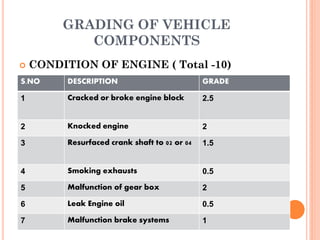
 CONDITION OF ENGINE ( Total -10)
S.NO DESCRIPTION GRADE
1 Cracked or broke engine block 2.5
2 Knocked engine 2
3 Resurfaced crank shaft to 02 or 04 1.5
4 Smoking exhausts 0.5
5 Malfunction of gear box 2
6 Leak Engine oil 0.5
7 Malfunction brake systems 1
AGE/LENGTH OF USAGE
 The average useful life of a commercial
vehicle is 15 or 20 years. It is graded thus;
 1 year has 10 units while 10 years have
1 unit.
 Depending on the number of years of usage,
the units can be calculated.
MILEAGE/EXTENT OF USEAGE
 The maximum mileage expected of a vehicle
is 250,000 km.
 It is graded in such a way that 250,000 km is
1 unit and 1 km is 10 units
 Assume each 25000 km reduced a unit
 If the current mileage is obtained, the
remaining mileage will be calculated and
the units obtained.
CONDITION OF THE BODY
 Faded paint 1.0
 Scratched body 1.5
 Accidental body at boot, body or bonnet 4.5
 Rusted body, roof or floor 3.0
STATE OF TIRES
 When the tire is new, it is graded 10 units,
but when it is completely warn out it is
graded 1 unit.
 The tires are graded either new, fair or
worn‐out.
 Depending on the physical assessment, the
applicable units will be determined.
MAINTENANCE
 If the maintenance manual is being
observed religiously, it will be graded 10
units.
 When the vehicle is not being maintained at
all, it is graded 1 unit.
 Depending on the maintenance record and
history, the appropriate units will be
determined
FUNCTIONALITY OF ACCESSORIES
 If all the facilities in the car are functioning
perfectly, it is graded 10 units.
 If all the facilities are not functioning, it is
graded 1 unit.
 Depending on the state of the facilities in
the vehicle, the appropriate units will be
determined.
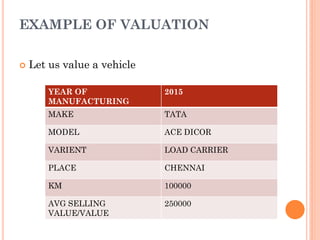
EXAMPLE OF VALUATION
 Let us value a vehicle
YEAR OF
MANUFACTURING
2015
MAKE TATA
MODEL ACE DICOR
VARIENT LOAD CARRIER
PLACE CHENNAI
KM 100000
AVG SELLING
VALUE/VALUE
250000
S.N
O
DESCRIPTIO
N
WEIGHT (W) GRADE (G)/10 W*G
1 Condition of
engine and
transmission
train
25 8 200
2 Age/length of
usage
7 8 56
3 Mileage/Exte
nt of use
5 6 30
4 The condition
of the body
5 6 30
5 Functionality
of facilities in
the vehicle
5 7 35
6 Maintenance
history
2 5 10
7 Condition of
tires
1 8 16
Total 50 467
 Valuation factor ;Vf =W*G/500
=467/500 =0.934
 Value = vf Current Market price
 =0.934 2,50,000
 =2,33,500
VALUATION OF VEHICLE ALSO
CONSIDER BASED ON
 BRAND
 YEAR OF
MANUFACTURING
 ENGINE &TRANSMISSION
CONDITION
 BODY
 PLACE OF REGISTRATION
 TYPE OF LOAD CARRYING
 NO OF OWNERS
 DRC
 SERVICE
 SPARE PARTS
AVAILABILITY
Vehicle valuation

Vehicle valuation

  • 1.
  • 2.
    INTRODUCTION  You cannottalk about transportation of persons, Goods and service without talking about motor vehicle  Motor vehicle is one of the asset that abound every were in the world, second only to real estate  Therefore valuation of vehicle is more important that a valuer should know, because there is hardly any valuation assignment that motor vehicle is not involved  It is therefore expedient for a valuer to know the principal of motors vehicle valuation
  • 3.
    WE ARE GOINGTO DISCUSS  What is motor vehicle valuation?  The purpose for which motor vehicle valuation can be carried out;  The factor affecting the motor value of motor vehicles  The principal of motor vehicle valuation; and  The modern ways of computer aided valuation
  • 4.
    WHAT IS MOTORVEHICLE VALUATION?  The process of estimating the worth of a motor vehicle.  The act of estimating or setting the value of motor vehicle.  Engineering valuation/appraisal of a motor vehicle is an art of estimating the value of a motor vehicle where professional engineering knowledge and judgements are used.
  • 5.
    WHAT IS THEPURPOSE OF MOTOR VEHICLE VALUATION???
  • 6.
    FACTORS AFFECTING THE VALUEOF MOTOR VEHICLES????
  • 7.
    Age Length of usage Mileage Conditionof engine and transmission train Body Condition Tyre condition Maintenance History Functionalities of accessories
  • 8.
    AGE/USEFUL LIFE OFA VEHICLE The useful life of the vehicle is depends on many factors. It differs from country to country and use of the vehicle. The average vehicle of the commercial vehicle in India is 20 years.
  • 9.
     Age ofa vehicle has been established to have great influence on the value of motor vehicle.  The value of a vehicle drops rapidly during the first 10 years.  At the end of 10 years, the vehicle is worth only 20% of its original value and at the end of 20 years it is worth only 10% of this original value
  • 10.
    MILEAGE/EXTENT OF USAGE Most vehicles can be driven about 250,000 km before major repairs have to be made.  As a vehicle is driven, mechanical parts of the car slowly wear out.  The most expensive mechanical parts of a vehicle are the engine and the transmission train. The combine average life of these components is 250,000 km.  Mileage also depreciates the vehicles’ monetary value, thus making its resale value decrease with every kilometre you drive.
  • 11.
     Vehicle depreciatesa small amount during the first 10,000 Miles and then drops rapidly during the next 50,000 Miles to about 75% value of original cost. This is because the rate at which car depreciates is not same from year to year.  It has been established that mileage never takes the value of a vehicle below 50% of its original value.
  • 12.
    ENGINE AND TRANSMISSION CONDITION As earlier said engine and transmission train are major factors in determining the value of a vehicle.  The engine condition can be:  cracked or broken engine block, knocked, resurfaced crank shaft to 02 or 04, smoking exhaust, leaking engine oil, malfunction of gear box, malfunction of brake systems, etc
  • 13.
    BODY CONDITION The bodycondition of a vehicle have great effect on the monetary value of the vehicle. The body condition could be: faded paint, body having scratches, Accidental body at the boot, body or bonnet, rusted body, roof or floor etc.
  • 14.
    STATE OF TYRES Tires, even though they can easily be changed, its state at the time of valuation will be a factor and can also tell a story.  Tires are usually classified either as new, fair or warn out.
  • 15.
    MAINTENANCE HISTORY  Ifa vehicle is maintained according to the manufacturer’s specification, it will prolong its life and enhance its value, if not it will shorten its useful life.
  • 16.
    FUNCTIONALITIES OF ACCESSORIES  Thefunctionalities of the accessories in a vehicle is an indication of its age and an indication of how well it is maintained too.  The value of vehicle is enhanced if the accessories are functioning well.
  • 17.
    COMPUTATION OF VALUATIONFACTOR USING WEIGHT METHOD  The principles work on seven weighted headings with total weight of 50 units.  Each heading is graded into 1 to 10. The best situation is graded 10 units, while the worst situation is graded 1 unit.  The product of the weigh and the grade obtained is then summed up and divided by 500 being the product of the weigh and the best grade for each heading.  The result of the above is the valuation factor which is a fraction of a unit.  The product of the valuation factor and current market price give the value of the motor vehicle
  • 18.
    TABLE OF WEIGHT S.NODESCRIPTION WEIGHT 1 Condition of engine and transmission train 25 2 Age/length of usage 7 3 Mileage/Extent of use 5 4 The condition of the body 5 5 Functionality of facilities in the vehicle 5 6 Maintenance history 2 7 Condition of tires 1 Total 50
  • 19.
    GRADING OF VEHICLE COMPONENTS CONDITION OF ENGINE ( Total -10) S.NO DESCRIPTION GRADE 1 Cracked or broke engine block 2.5 2 Knocked engine 2 3 Resurfaced crank shaft to 02 or 04 1.5 4 Smoking exhausts 0.5 5 Malfunction of gear box 2 6 Leak Engine oil 0.5 7 Malfunction brake systems 1
  • 20.
    AGE/LENGTH OF USAGE The average useful life of a commercial vehicle is 15 or 20 years. It is graded thus;  1 year has 10 units while 10 years have 1 unit.  Depending on the number of years of usage, the units can be calculated.
  • 21.
    MILEAGE/EXTENT OF USEAGE The maximum mileage expected of a vehicle is 250,000 km.  It is graded in such a way that 250,000 km is 1 unit and 1 km is 10 units  Assume each 25000 km reduced a unit  If the current mileage is obtained, the remaining mileage will be calculated and the units obtained.
  • 22.
    CONDITION OF THEBODY  Faded paint 1.0  Scratched body 1.5  Accidental body at boot, body or bonnet 4.5  Rusted body, roof or floor 3.0
  • 23.
    STATE OF TIRES When the tire is new, it is graded 10 units, but when it is completely warn out it is graded 1 unit.  The tires are graded either new, fair or worn‐out.  Depending on the physical assessment, the applicable units will be determined.
  • 24.
    MAINTENANCE  If themaintenance manual is being observed religiously, it will be graded 10 units.  When the vehicle is not being maintained at all, it is graded 1 unit.  Depending on the maintenance record and history, the appropriate units will be determined
  • 25.
    FUNCTIONALITY OF ACCESSORIES If all the facilities in the car are functioning perfectly, it is graded 10 units.  If all the facilities are not functioning, it is graded 1 unit.  Depending on the state of the facilities in the vehicle, the appropriate units will be determined.
  • 26.
    EXAMPLE OF VALUATION Let us value a vehicle YEAR OF MANUFACTURING 2015 MAKE TATA MODEL ACE DICOR VARIENT LOAD CARRIER PLACE CHENNAI KM 100000 AVG SELLING VALUE/VALUE 250000
  • 27.
    S.N O DESCRIPTIO N WEIGHT (W) GRADE(G)/10 W*G 1 Condition of engine and transmission train 25 8 200 2 Age/length of usage 7 8 56 3 Mileage/Exte nt of use 5 6 30 4 The condition of the body 5 6 30 5 Functionality of facilities in the vehicle 5 7 35 6 Maintenance history 2 5 10 7 Condition of tires 1 8 16 Total 50 467
  • 28.
     Valuation factor;Vf =W*G/500 =467/500 =0.934  Value = vf Current Market price  =0.934 2,50,000  =2,33,500
  • 29.
    VALUATION OF VEHICLEALSO CONSIDER BASED ON  BRAND  YEAR OF MANUFACTURING  ENGINE &TRANSMISSION CONDITION  BODY  PLACE OF REGISTRATION  TYPE OF LOAD CARRYING  NO OF OWNERS  DRC  SERVICE  SPARE PARTS AVAILABILITY