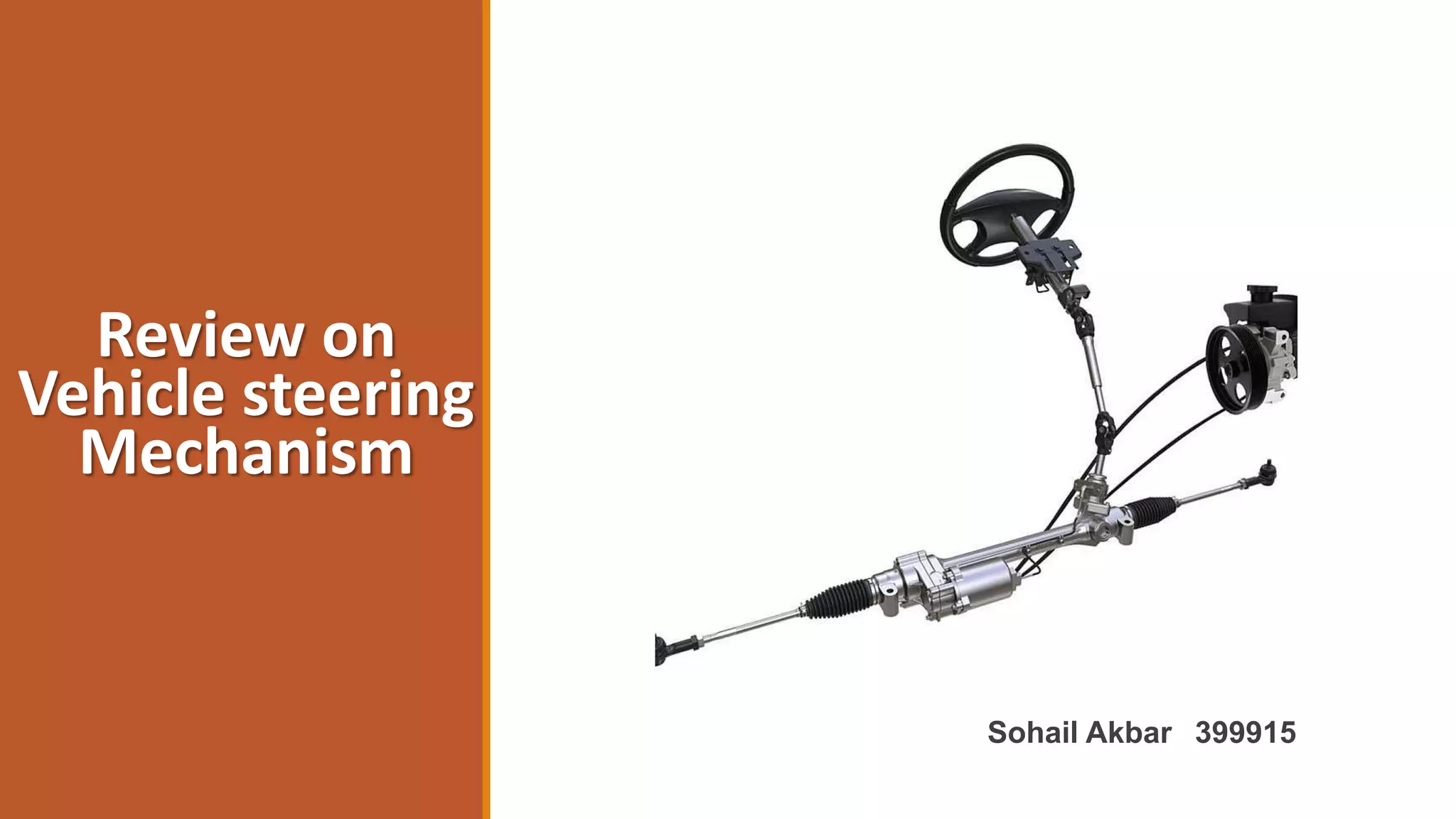
Review on
Vehicle steering
Mechanism
Sohail Akbar 399915
Outline
Purpose
Background
Introduction
Objectives
Types of Steering system
Types of Steering Mechanism
Applications
Advantages
Activity Chart
Expected Outcomes
Estimate Budget
Conclusion
References
Purpose
The primary purpose of a vehicle steering
system is to control the direction of the
vehicle's movement. It allows the driver to turn
the vehicle left or right, thereby enabling it to
follow a desired path. The steering system
also provides feedback to the driver, allowing
them to sense the vehicle's handling
characteristics, such as stability and response
to driver inputs.
Background
The concept of steering a vehicle can be traced back
to the invention of the wheel itself. The first wheeled
vehicles were simple carts, which were steered by
dragging them in the desired direction. As technology
evolved, steering systems became more sophisticated.
Introduction
Steering is a crucial component of any vehicle as it
enables the driver to navigate the vehicle through different
road conditions and environments. Over time, the steering
system has evolved to become more efficient and reliable, with
modern systems featuring advanced technologies such as
electric power steering and adaptive steering.
To control the direction of the vehicle's movement.
To provide stability to the vehicle.
To ensure the safety of the passengers and other road users.
To allow for precise and responsive steering inputs.
To provide ease of handling and comfort to the driver.
To enhance the overall driving experience.
To enable autonomous driving capabilities.
Objectives
Types of Steering system
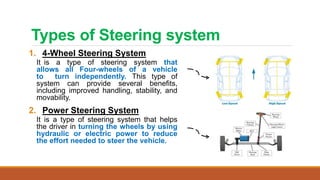
1. 4-Wheel Steering System
It is a type of steering system that
allows all Four-wheels of a vehicle
to turn independently. This type of
system can provide several benefits,
including improved handling, stability, and
movability.
2. Power Steering System
It is a type of steering system that helps
the driver in turning the wheels by using
hydraulic or electric power to reduce
the effort needed to steer the vehicle.
Types of Steering Mechanism
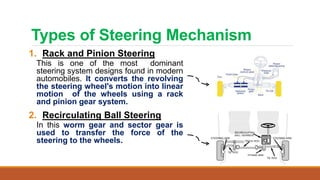
1. Rack and Pinion Steering
This is one of the most dominant
steering system designs found in modern
automobiles. It converts the revolving
the steering wheel's motion into linear
motion of the wheels using a rack
and pinion gear system.
2. Recirculating Ball Steering
In this worm gear and sector gear is
used to transfer the force of the
steering to the wheels.
Applications
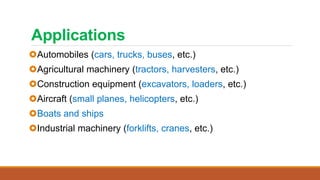
Automobiles (cars, trucks, buses, etc.)
Agricultural machinery (tractors, harvesters, etc.)
Construction equipment (excavators, loaders, etc.)
Aircraft (small planes, helicopters, etc.)
Boats and ships
Industrial machinery (forklifts, cranes, etc.)
Advantages
Allows the driver to easily control the direction of the vehicle.
Enables the vehicle to smoothly and accurately navigate turns.
Enhances the overall safety and stability of the vehicle.
Provides better handling and maneuverability in different driving
conditions.
Improves the comfort and ease of driving experience.
Activity Chart
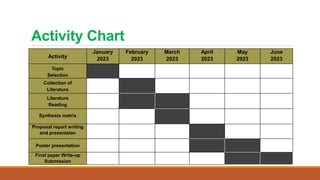
Activity
January
2023
February
2023
March
2023
April
2023
May
2023
June
2023
Topic
Selection
Collection of
Literature
Literature
Reading
Synthesis matrix
Proposal report writing
and presentaion
Poster presentation
Final paper Write-up
Submission
Expected Outcomes
Improved steering response and handling of the vehicle
Enhanced safety and stability during driving
Increased driver comfort and reduced fatigue
Reduction in accidents caused by steering failure or
malfunction
Development of advanced autonomous steering systems for
self-driving vehicles
Estimate Budget
Cost-effective on modeling and Fabrication (if Required) on
this project. Started from 50 thousand to 1 lac maybe for this
research work.
Conclusion
In conclusion, the research on vehicle steering
mechanism has contributed to the development
of more advanced and efficient steering
systems, enhancing the safety and performance
of vehicles. Further research is necessary to
improve the reliability and robustness of these
systems.
References
1) R. Jazar, "Vehicle Dynamics: Theory and Applications," Springer, 2017.
2) "A Review of Four-Wheel Steering Studies from the Viewpoint of Vehicle Dynamics
and Control" by Yoshimi FURUKAWA et al.
3) "Development and Testing of a Novel Electric Power-Assisted Steering System for
Autonomous Vehicles" by Xiaohu Lu et al.
4) "Parallel Learning-Based Steering Control for Autonomous Driving" by Fangyin Tian
et al.
5) "ROBUST CONTROL FOR FOUR-WHEEL-INDEPENDENT-STEERING ELECTRIC
VEHICLE WITH STEER-BY-WIRE SYSTEM" by Peng Hang et al.
6) "Evaluation of Alternative Steering Devices with Adjustable Haptic Feedback for
Semi-Autonomous and Autonomous Vehicles" by Chengshi Wang et al.
Thank You

Vehicle steering Mechanism.pptx

  • 1.
  • 2.
    Outline Purpose Background Introduction Objectives Types of Steeringsystem Types of Steering Mechanism Applications Advantages Activity Chart Expected Outcomes Estimate Budget Conclusion References
  • 3.
    Purpose The primary purposeof a vehicle steering system is to control the direction of the vehicle's movement. It allows the driver to turn the vehicle left or right, thereby enabling it to follow a desired path. The steering system also provides feedback to the driver, allowing them to sense the vehicle's handling characteristics, such as stability and response to driver inputs.
  • 4.
    Background The concept ofsteering a vehicle can be traced back to the invention of the wheel itself. The first wheeled vehicles were simple carts, which were steered by dragging them in the desired direction. As technology evolved, steering systems became more sophisticated.
  • 5.
    Introduction Steering is acrucial component of any vehicle as it enables the driver to navigate the vehicle through different road conditions and environments. Over time, the steering system has evolved to become more efficient and reliable, with modern systems featuring advanced technologies such as electric power steering and adaptive steering.
  • 6.
    To control thedirection of the vehicle's movement. To provide stability to the vehicle. To ensure the safety of the passengers and other road users. To allow for precise and responsive steering inputs. To provide ease of handling and comfort to the driver. To enhance the overall driving experience. To enable autonomous driving capabilities. Objectives
  • 7.
    Types of Steeringsystem 1. 4-Wheel Steering System It is a type of steering system that allows all Four-wheels of a vehicle to turn independently. This type of system can provide several benefits, including improved handling, stability, and movability. 2. Power Steering System It is a type of steering system that helps the driver in turning the wheels by using hydraulic or electric power to reduce the effort needed to steer the vehicle.
  • 8.
    Types of SteeringMechanism 1. Rack and Pinion Steering This is one of the most dominant steering system designs found in modern automobiles. It converts the revolving the steering wheel's motion into linear motion of the wheels using a rack and pinion gear system. 2. Recirculating Ball Steering In this worm gear and sector gear is used to transfer the force of the steering to the wheels.
  • 9.
    Applications Automobiles (cars, trucks,buses, etc.) Agricultural machinery (tractors, harvesters, etc.) Construction equipment (excavators, loaders, etc.) Aircraft (small planes, helicopters, etc.) Boats and ships Industrial machinery (forklifts, cranes, etc.)
  • 10.
    Advantages Allows the driverto easily control the direction of the vehicle. Enables the vehicle to smoothly and accurately navigate turns. Enhances the overall safety and stability of the vehicle. Provides better handling and maneuverability in different driving conditions. Improves the comfort and ease of driving experience.
  • 11.
  • 12.
    Expected Outcomes Improved steeringresponse and handling of the vehicle Enhanced safety and stability during driving Increased driver comfort and reduced fatigue Reduction in accidents caused by steering failure or malfunction Development of advanced autonomous steering systems for self-driving vehicles
  • 13.
    Estimate Budget Cost-effective onmodeling and Fabrication (if Required) on this project. Started from 50 thousand to 1 lac maybe for this research work.
  • 14.
    Conclusion In conclusion, theresearch on vehicle steering mechanism has contributed to the development of more advanced and efficient steering systems, enhancing the safety and performance of vehicles. Further research is necessary to improve the reliability and robustness of these systems.
  • 15.
    References 1) R. Jazar,"Vehicle Dynamics: Theory and Applications," Springer, 2017. 2) "A Review of Four-Wheel Steering Studies from the Viewpoint of Vehicle Dynamics and Control" by Yoshimi FURUKAWA et al. 3) "Development and Testing of a Novel Electric Power-Assisted Steering System for Autonomous Vehicles" by Xiaohu Lu et al. 4) "Parallel Learning-Based Steering Control for Autonomous Driving" by Fangyin Tian et al. 5) "ROBUST CONTROL FOR FOUR-WHEEL-INDEPENDENT-STEERING ELECTRIC VEHICLE WITH STEER-BY-WIRE SYSTEM" by Peng Hang et al. 6) "Evaluation of Alternative Steering Devices with Adjustable Haptic Feedback for Semi-Autonomous and Autonomous Vehicles" by Chengshi Wang et al.
  • 16.