
By: Benedict Gombocz
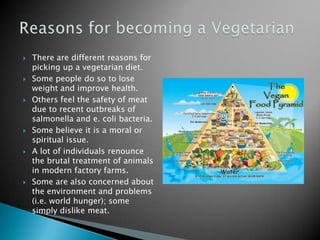
   There are different reasons for
    picking up a vegetarian diet.
   Some people do so to lose
    weight and improve health.
   Others feel the safety of meat
    due to recent outbreaks of
    salmonella and e. coli bacteria.
   Some believe it is a moral or
    spiritual issue.
   A lot of individuals renounce
    the brutal treatment of animals
    in modern factory farms.
   Some are also concerned about
    the environment and problems
    (i.e. world hunger); some
    simply dislike meat.
   Vegan – Stays away from all foods made from animal
    origin
   Ovo-Vegetarian – Omits all animal flesh and milk but
    consumes eggs
   Lacto-Vegetarian - Omits all animal flesh and eggs but
    consumes milk
   Lacto-Ovo Vegetarian – Stays away from all animal flesh
    but consumes eggs and milk
   Pesco-Vegetarian – Stays away from red meat and fowl
    but consumes fish and seafood
   Semi or Partial-Vegetarian – Does use some milk
    products, eggs, poultry, and fish, but consumes mainly
    plant based foods
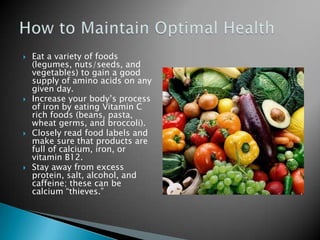
   Eat a variety of foods
    (legumes, nuts/seeds, and
    vegetables) to gain a good
    supply of amino acids on any
    given day.
   Increase your body’s process
    of iron by eating Vitamin C
    rich foods (beans, pasta,
    wheat germs, and broccoli).
   Closely read food labels and
    make sure that products are
    full of calcium, iron, or
    vitamin B12.
   Stay away from excess
    protein, salt, alcohol, and
    caffeine; these can be
    calcium “thieves.”
   Vegetarian diets are low in saturated fats, cholesterol, and
    animal protein and high in folate, anti-oxidant vitamins
    including C and E, carotenoids, and phytochemicals.
   For the most part, vegetarians have strongly smaller risks for
    obesity, heart disease, high blood pressure, diabetes mellitus,
    osteoporosis, hypertension, and a few kinds of cancer – in
    particular lung and colon cancer.
   Vegetarian diets that are not high in saturated fats have
    successfully been used to reverse severe coronary artery
    disease.
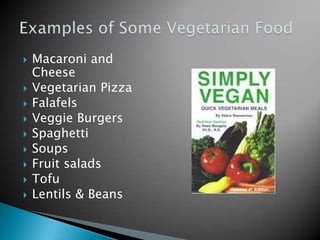
   Macaroni and
    Cheese
   Vegetarian Pizza
   Falafels
   Veggie Burgers
   Spaghetti
   Soups
   Fruit salads
   Tofu
   Lentils & Beans
   To be a healthy vegetarian requires more than only
    omitting foods from animal origin.
   When appropriately planned, vegetarian diets are
    healthy and nutritious.
   Like an omnivorous diet, a balance vegetarian diet
    needs to have a big variety of foods such as grains,
    cereals, breads, legumes, fresh fruits, and
    vegetables.
   A person who omits all foods from animal origins
    needs to pay special attention to five nutrients:
    protein, iron, vitamin B12, calcium, and vitamin D.
   Depends on the person.
   Some people simply choose to do it and never look back.
   Others slowly change their diets.
   They may start this by having one or two meatless meals a
    day to try it out.
   Some people put aside one or two days every week to go
    veggie, or even at least one day every week to eat meat.
   Some people start by omitting red meat and go on from
    there.
   Others just cut back on the meat in their diets and choose to
    use it as a condiment rather than the main course.
   http://www.edu.pe.ca/sourishigh/Pages/C
    mp6-03/Beth/Homepage/Veginfo.htm

Vegetarianism

  • 1.
  • 2.
    There are different reasons for picking up a vegetarian diet.  Some people do so to lose weight and improve health.  Others feel the safety of meat due to recent outbreaks of salmonella and e. coli bacteria.  Some believe it is a moral or spiritual issue.  A lot of individuals renounce the brutal treatment of animals in modern factory farms.  Some are also concerned about the environment and problems (i.e. world hunger); some simply dislike meat.
  • 3.
    Vegan – Stays away from all foods made from animal origin  Ovo-Vegetarian – Omits all animal flesh and milk but consumes eggs  Lacto-Vegetarian - Omits all animal flesh and eggs but consumes milk  Lacto-Ovo Vegetarian – Stays away from all animal flesh but consumes eggs and milk  Pesco-Vegetarian – Stays away from red meat and fowl but consumes fish and seafood  Semi or Partial-Vegetarian – Does use some milk products, eggs, poultry, and fish, but consumes mainly plant based foods
  • 4.
    Eat a variety of foods (legumes, nuts/seeds, and vegetables) to gain a good supply of amino acids on any given day.  Increase your body’s process of iron by eating Vitamin C rich foods (beans, pasta, wheat germs, and broccoli).  Closely read food labels and make sure that products are full of calcium, iron, or vitamin B12.  Stay away from excess protein, salt, alcohol, and caffeine; these can be calcium “thieves.”
  • 5.
    Vegetarian diets are low in saturated fats, cholesterol, and animal protein and high in folate, anti-oxidant vitamins including C and E, carotenoids, and phytochemicals.  For the most part, vegetarians have strongly smaller risks for obesity, heart disease, high blood pressure, diabetes mellitus, osteoporosis, hypertension, and a few kinds of cancer – in particular lung and colon cancer.  Vegetarian diets that are not high in saturated fats have successfully been used to reverse severe coronary artery disease.
  • 6.
    Macaroni and Cheese  Vegetarian Pizza  Falafels  Veggie Burgers  Spaghetti  Soups  Fruit salads  Tofu  Lentils & Beans
  • 7.
    To be a healthy vegetarian requires more than only omitting foods from animal origin.  When appropriately planned, vegetarian diets are healthy and nutritious.  Like an omnivorous diet, a balance vegetarian diet needs to have a big variety of foods such as grains, cereals, breads, legumes, fresh fruits, and vegetables.  A person who omits all foods from animal origins needs to pay special attention to five nutrients: protein, iron, vitamin B12, calcium, and vitamin D.
  • 8.
    Depends on the person.  Some people simply choose to do it and never look back.  Others slowly change their diets.  They may start this by having one or two meatless meals a day to try it out.  Some people put aside one or two days every week to go veggie, or even at least one day every week to eat meat.  Some people start by omitting red meat and go on from there.  Others just cut back on the meat in their diets and choose to use it as a condiment rather than the main course.
  • 9.
    http://www.edu.pe.ca/sourishigh/Pages/C mp6-03/Beth/Homepage/Veginfo.htm