Veganism Research
Primary Research
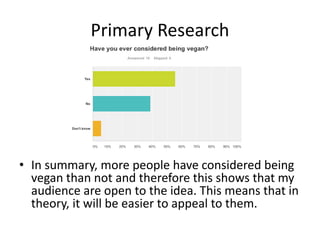
• In summary, more people have considered being
vegan than not and therefore this shows that my
audience are open to the idea. This means that in
theory, it will be easier to appeal to them.
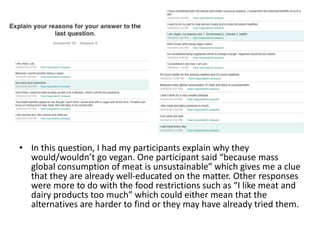
• In this question, I had my participants explain why they
would/wouldn’t go vegan. One participant said “because mass
global consumption of meat is unsustainable” which gives me a clue
that they are already well-educated on the matter. Other responses
were more to do with the food restrictions such as “I like meat and
dairy products too much” which could either mean that the
alternatives are harder to find or they may have already tried them.
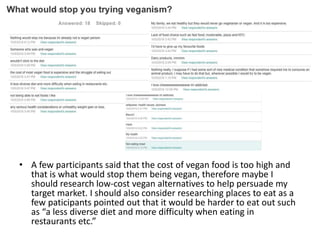
• A few participants said that the cost of vegan food is too high and
that is what would stop them being vegan, therefore maybe I
should research low-cost vegan alternatives to help persuade my
target market. I should also consider researching places to eat as a
few paticipants pointed out that it would be harder to eat out such
as “a less diverse diet and more difficulty when eating in
restaurants etc.”
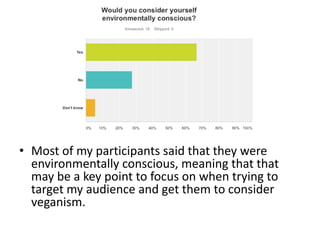
• Most of my participants said that they were
environmentally conscious, meaning that that
may be a key point to focus on when trying to
target my audience and get them to consider
veganism.
Secondary research
http://www.yourdailyvegan.com/environment/#references
Your Daily Vegan
Summary;
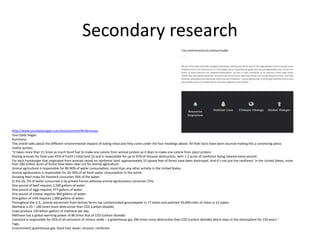
This article talks about the different environmental impacts of eating meat and they come under the four headings above. All their facts have been sourced making this a convincing piece.
Useful quotes;
“it takes more than 11 times as much fossil fuel to make one calorie from animal protein as it does to make one calorie from plant protein
Raising animals for food uses 45% of Earth’s total land (2) and is responsible for up to 91% of Amazon destruction, with 1-2 acres of rainforest being cleared every second.
For each hamburger that originated from animals raised on rainforest land, approximately 55 square feet of forest have been destroyed. And it’s not just the rainforest. In the United States, more
than 260 million acres of forest have been clear-cut for animal agriculture.
Animal agriculture is responsible for 80-90% of water consumption, more than any other activity in the United States.
Animal agribusiness is responsible for 20-30% of all fresh water consumption in the world.
Growing feed crops for livestock consumes 56% of the water.
In the US, 5% of water consumed is by private homes whereas animal agribusiness consumes 55%.
One pound of beef requires 2,500 gallons of water.
One pound of eggs requires 477 gallons of water.
One pound of cheese requires 900 gallons of water.
One gallon of milk requires 1,000 gallons of water.
Throughout the U.S., animal excrement from factory farms has contaminated groundwater in 17 states and polluted 35,000 miles of rivers in 22 states.
Methane is 25 – 100 times more destructive than CO2 (carbon dioxide)
Cows produce 150 billion gallons of methane per day.
Methane has a global warming power of 86 times that of CO2 (carbon dioxide)
Livestock is responsible for 65% of all emissions of nitrous oxide – a greenhouse gas 296 times more destructive than CO2 (carbon dioxide) which stays in the atmosphere for 150 years.”
Tags;
Environment, greenhouse gas, fossil fuel, water, amazon, rainforest
http://www.nursingdegree.net/blog/19/57-health-
benefits-of-going-vegan/
Summary;
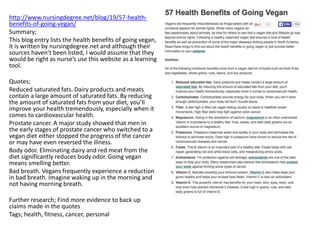
This blog entry lists the health benefits of going vegan,
it is written by nursingdegree.net and although their
sources haven’t been listed, I would assume that they
would be right as nurse’s use this website as a learning
tool.
Quotes;
Reduced saturated fats. Dairy products and meats
contain a large amount of saturated fats. By reducing
the amount of saturated fats from your diet, you’ll
improve your health tremendously, especially when it
comes to cardiovascular health.
Prostate cancer. A major study showed that men in
the early stages of prostate cancer who switched to a
vegan diet either stopped the progress of the cancer
or may have even reversed the illness.
Body odor. Eliminating dairy and red meat from the
diet significantly reduces body odor. Going vegan
means smelling better.
Bad breath. Vegans frequently experience a reduction
in bad breath. Imagine waking up in the morning and
not having morning breath.
Further research; Find more evidence to back up
claims made in the quotes
Tags; health, fitness, cancer, personal
https://veganuary.com/why/animals/chickens/
Summary;
This article is about the harmful methods used in chicken farming to create the
most amount of profitable produce possible, ranging from their living
conditions, to de-beaking, to how they are transported etc. This website is a
well-established vegan organization and their sources have been stated at the
bottom of the page, making it a trustworthy source.
Quotes;
In the wild a hen would lay around 60 eggs a year. In today’s egg production
industry, hens are bred and reared to produce more than 300 eggs a year. [ii]
This excessive production drains the chicken’s body of calcium and causes her
to develop brittle bones disease.
‘Free-Range’ systems are often advertised as being cruelty-
free. Unfortunately, these hens are still predominately confined in barns with
a stocking density of up to four hens per square metre. [iii] Due to inadequate
pop-holes for outside access and the protection of these exits by dominant
hens, less than 10 per cent (on average) of the chickens are outside at any
given time, and many never go outside at all. [iv] Once again, this
overcrowding leads to similar welfare problems of aggression and feather-
pecking.
The chick’s head is restrained on a carousel while a high intensity infrared
beam is used to penetrate up to a third of their beak. Within five weeks, the
penetrated area of the beak tissue will die and drop off.
• Animal Natural lifespan (on average) Age at which they are
typically killed
• Broiler chicken 7 years 40-50 days old
• Male chicks 7 years 1 day old
• Layer hens7 years 18 months old
• The chickens are hung upside down by their legs on metal
shackles along a moving conveyor belt. This can cause more stress and
injury to the birds as they are often left hanging like this for several
minutes.
• They move along the production line to a stunning water
bath. When the bird’s head makes contact with the water, an electrical
circuit between the water bath and the shackle is completed, which
stuns the bird. This process is not always effective and in some instances,
when the bath water is too low or insufficient voltage has been used, the
chickens will not be paralysed when their necks are cut.
• The conveyor belt then moves the birds to a mechanical neck
cutter that cuts the major blood vessels in the neck. [vi] This automatic
cutter may only administer a single cut that will leave the chicken to
bleed out for several minutes before dying.
Tags: Veganuary, animals, cows, pigs, chickens.
http://www.peta.org/features/rape
-milk-pork-turkey/
Summary;
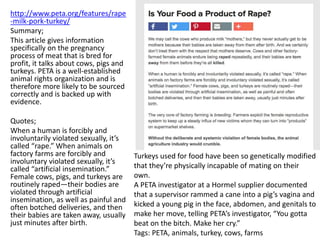
This article gives information
specifically on the pregnancy
process of meat that is bred for
profit, it talks about cows, pigs and
turkeys. PETA is a well-established
animal rights organization and is
therefore more likely to be sourced
correctly and is backed up with
evidence.
Quotes;
When a human is forcibly and
involuntarily violated sexually, it’s
called “rape.” When animals on
factory farms are forcibly and
involuntary violated sexually, it’s
called “artificial insemination.”
Female cows, pigs, and turkeys are
routinely raped—their bodies are
violated through artificial
insemination, as well as painful and
often botched deliveries, and then
their babies are taken away, usually
just minutes after birth.
Turkeys used for food have been so genetically modified
that they’re physically incapable of mating on their
own.
A PETA investigator at a Hormel supplier documented
that a supervisor rammed a cane into a pig’s vagina and
kicked a young pig in the face, abdomen, and genitals to
make her move, telling PETA’s investigator, “You gotta
beat on the bitch. Make her cry.”
Tags: PETA, animals, turkey, cows, farms
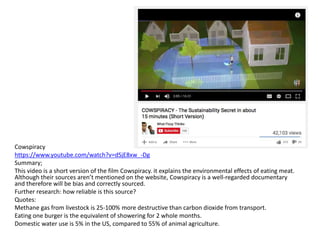
Cowspiracy
https://www.youtube.com/watch?v=dSjE8xw_-Dg
Summary;
This video is a short version of the film Cowspiracy. it explains the environmental effects of eating meat.
Although their sources aren’t mentioned on the website, Cowspiracy is a well-regarded documentary
and therefore will be bias and correctly sourced.
Further research: how reliable is this source?
Quotes:
Methane gas from livestock is 25-100% more destructive than carbon dioxide from transport.
Eating one burger is the equivalent of showering for 2 whole months.
Domestic water use is 5% in the US, compared to 55% of animal agriculture.
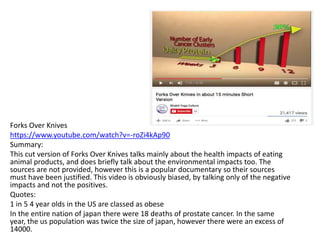
Forks Over Knives
https://www.youtube.com/watch?v=-roZi4kAp90
Summary:
This cut version of Forks Over Knives talks mainly about the health impacts of eating
animal products, and does briefly talk about the environmental impacts too. The
sources are not provided, however this is a popular documentary so their sources
must have been justified. This video is obviously biased, by talking only of the negative
impacts and not the positives.
Quotes:
1 in 5 4 year olds in the US are classed as obese
In the entire nation of japan there were 18 deaths of prostate cancer. In the same
year, the us population was twice the size of japan, however there were an excess of
14000.
Cowspiracy is Bull
https://www.youtube.com/watch?v=KpmTiHjUEBU
Summary:
This video is analyzing the statistics of Cowspiracy, and giving evidence to either agree or disagree
with the statistic. The sources are given, with screenshots featuring in the video. This is a biased
video as although he is just giving the sources of the statistics, the general feel of this video is it is
promoting veganism.
Quotes:
18-51% of greenhouse gases are from animal agriculture.
Chickens are being fed 1300-1500 calories per pound.
We have 0 nutritional needs from animal products.
Rainforest Deforestation: up to 91% is caused by animal agriculture
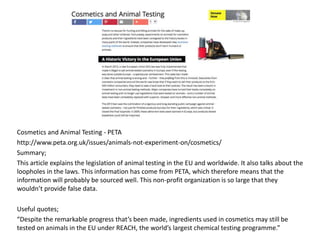
Cosmetics and Animal Testing - PETA
http://www.peta.org.uk/issues/animals-not-experiment-on/cosmetics/
Summary;
This article explains the legislation of animal testing in the EU and worldwide. It also talks about the
loopholes in the laws. This information has come from PETA, which therefore means that the
information will probably be sourced well. This non-profit organization is so large that they
wouldn’t provide false data.
Useful quotes;
“Despite the remarkable progress that’s been made, ingredients used in cosmetics may still be
tested on animals in the EU under REACH, the world’s largest chemical testing programme.”
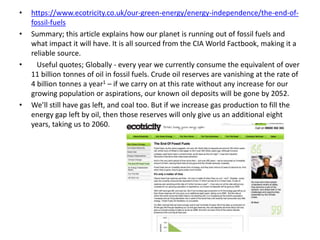
• https://www.ecotricity.co.uk/our-green-energy/energy-independence/the-end-of-
fossil-fuels
• Summary; this article explains how our planet is running out of fossil fuels and
what impact it will have. It is all sourced from the CIA World Factbook, making it a
reliable source.
• Useful quotes; Globally - every year we currently consume the equivalent of over
11 billion tonnes of oil in fossil fuels. Crude oil reserves are vanishing at the rate of
4 billion tonnes a year1 – if we carry on at this rate without any increase for our
growing population or aspirations, our known oil deposits will be gone by 2052.
• We’ll still have gas left, and coal too. But if we increase gas production to fill the
energy gap left by oil, then those reserves will only give us an additional eight
years, taking us to 2060.
• http://www.forksoverknives.com/7-ways-milk-and-dairy-products-are-
making-you-sick/
• Pediatricians have expressed concern regarding childhood exposure to
the exogenous estrogens in commercial milk, given studies showing that
early sexual maturation in prepubescent children can be caused by the
“ordinary intake of cow milk.”[6] other studies have found that soy food
consumption is even protective against breast cancer.
• even milk products labeled “organic” or “no hormones added” usually
contain high levels of these problematic hormones, which are naturally
produced by cows (even if those cows have not been given any
additional hormones for purposes of the product label).
• https://veganuary.com/myths/but-surely-one-person-going-vegan-wont-make-a-
difference/
• ‘Suppose someone stops buying chicken breasts, instead choosing vegetarian
options, in order to reduce the amount of animal suffering on factory farms. Does
that person make a difference? You might think not. If one person decides against
buying chicken breast one day but the rest of the meat-eaters on the planet
continue to buy chicken, how could that possibly affect how many chickens are
killed for human consumption? When a supermarket decides how much chicken to
buy, they don’t care that one fewer breast was purchased on a given day. However,
if thousands or millions of people stopped buying chicken breasts, the number of
chickens raised for food would decrease – supply would fall to meet demand.
We’re then left with a paradox: individuals alone can’t make a difference; millions
of them acting together can; but the actions of millions is simply the combined
actions of many individuals. Moreover, an iron law of economics is that, in a well-
functioning market, if demand for a product decreases, the quantity of the product
that’s supplied decreases. How then can we reconcile these thoughts?

Veganism research

  • 1.
  • 2.
    Primary Research • Insummary, more people have considered being vegan than not and therefore this shows that my audience are open to the idea. This means that in theory, it will be easier to appeal to them.
  • 3.
    • In thisquestion, I had my participants explain why they would/wouldn’t go vegan. One participant said “because mass global consumption of meat is unsustainable” which gives me a clue that they are already well-educated on the matter. Other responses were more to do with the food restrictions such as “I like meat and dairy products too much” which could either mean that the alternatives are harder to find or they may have already tried them.
  • 4.
    • A fewparticipants said that the cost of vegan food is too high and that is what would stop them being vegan, therefore maybe I should research low-cost vegan alternatives to help persuade my target market. I should also consider researching places to eat as a few paticipants pointed out that it would be harder to eat out such as “a less diverse diet and more difficulty when eating in restaurants etc.”
  • 5.
    • Most ofmy participants said that they were environmentally conscious, meaning that that may be a key point to focus on when trying to target my audience and get them to consider veganism.
  • 6.
    Secondary research http://www.yourdailyvegan.com/environment/#references Your DailyVegan Summary; This article talks about the different environmental impacts of eating meat and they come under the four headings above. All their facts have been sourced making this a convincing piece. Useful quotes; “it takes more than 11 times as much fossil fuel to make one calorie from animal protein as it does to make one calorie from plant protein Raising animals for food uses 45% of Earth’s total land (2) and is responsible for up to 91% of Amazon destruction, with 1-2 acres of rainforest being cleared every second. For each hamburger that originated from animals raised on rainforest land, approximately 55 square feet of forest have been destroyed. And it’s not just the rainforest. In the United States, more than 260 million acres of forest have been clear-cut for animal agriculture. Animal agriculture is responsible for 80-90% of water consumption, more than any other activity in the United States. Animal agribusiness is responsible for 20-30% of all fresh water consumption in the world. Growing feed crops for livestock consumes 56% of the water. In the US, 5% of water consumed is by private homes whereas animal agribusiness consumes 55%. One pound of beef requires 2,500 gallons of water. One pound of eggs requires 477 gallons of water. One pound of cheese requires 900 gallons of water. One gallon of milk requires 1,000 gallons of water. Throughout the U.S., animal excrement from factory farms has contaminated groundwater in 17 states and polluted 35,000 miles of rivers in 22 states. Methane is 25 – 100 times more destructive than CO2 (carbon dioxide) Cows produce 150 billion gallons of methane per day. Methane has a global warming power of 86 times that of CO2 (carbon dioxide) Livestock is responsible for 65% of all emissions of nitrous oxide – a greenhouse gas 296 times more destructive than CO2 (carbon dioxide) which stays in the atmosphere for 150 years.” Tags; Environment, greenhouse gas, fossil fuel, water, amazon, rainforest
  • 7.
    http://www.nursingdegree.net/blog/19/57-health- benefits-of-going-vegan/ Summary; This blog entrylists the health benefits of going vegan, it is written by nursingdegree.net and although their sources haven’t been listed, I would assume that they would be right as nurse’s use this website as a learning tool. Quotes; Reduced saturated fats. Dairy products and meats contain a large amount of saturated fats. By reducing the amount of saturated fats from your diet, you’ll improve your health tremendously, especially when it comes to cardiovascular health. Prostate cancer. A major study showed that men in the early stages of prostate cancer who switched to a vegan diet either stopped the progress of the cancer or may have even reversed the illness. Body odor. Eliminating dairy and red meat from the diet significantly reduces body odor. Going vegan means smelling better. Bad breath. Vegans frequently experience a reduction in bad breath. Imagine waking up in the morning and not having morning breath. Further research; Find more evidence to back up claims made in the quotes Tags; health, fitness, cancer, personal
  • 8.
    https://veganuary.com/why/animals/chickens/ Summary; This article isabout the harmful methods used in chicken farming to create the most amount of profitable produce possible, ranging from their living conditions, to de-beaking, to how they are transported etc. This website is a well-established vegan organization and their sources have been stated at the bottom of the page, making it a trustworthy source. Quotes; In the wild a hen would lay around 60 eggs a year. In today’s egg production industry, hens are bred and reared to produce more than 300 eggs a year. [ii] This excessive production drains the chicken’s body of calcium and causes her to develop brittle bones disease. ‘Free-Range’ systems are often advertised as being cruelty- free. Unfortunately, these hens are still predominately confined in barns with a stocking density of up to four hens per square metre. [iii] Due to inadequate pop-holes for outside access and the protection of these exits by dominant hens, less than 10 per cent (on average) of the chickens are outside at any given time, and many never go outside at all. [iv] Once again, this overcrowding leads to similar welfare problems of aggression and feather- pecking. The chick’s head is restrained on a carousel while a high intensity infrared beam is used to penetrate up to a third of their beak. Within five weeks, the penetrated area of the beak tissue will die and drop off. • Animal Natural lifespan (on average) Age at which they are typically killed • Broiler chicken 7 years 40-50 days old • Male chicks 7 years 1 day old • Layer hens7 years 18 months old • The chickens are hung upside down by their legs on metal shackles along a moving conveyor belt. This can cause more stress and injury to the birds as they are often left hanging like this for several minutes. • They move along the production line to a stunning water bath. When the bird’s head makes contact with the water, an electrical circuit between the water bath and the shackle is completed, which stuns the bird. This process is not always effective and in some instances, when the bath water is too low or insufficient voltage has been used, the chickens will not be paralysed when their necks are cut. • The conveyor belt then moves the birds to a mechanical neck cutter that cuts the major blood vessels in the neck. [vi] This automatic cutter may only administer a single cut that will leave the chicken to bleed out for several minutes before dying. Tags: Veganuary, animals, cows, pigs, chickens.
  • 9.
    http://www.peta.org/features/rape -milk-pork-turkey/ Summary; This article givesinformation specifically on the pregnancy process of meat that is bred for profit, it talks about cows, pigs and turkeys. PETA is a well-established animal rights organization and is therefore more likely to be sourced correctly and is backed up with evidence. Quotes; When a human is forcibly and involuntarily violated sexually, it’s called “rape.” When animals on factory farms are forcibly and involuntary violated sexually, it’s called “artificial insemination.” Female cows, pigs, and turkeys are routinely raped—their bodies are violated through artificial insemination, as well as painful and often botched deliveries, and then their babies are taken away, usually just minutes after birth. Turkeys used for food have been so genetically modified that they’re physically incapable of mating on their own. A PETA investigator at a Hormel supplier documented that a supervisor rammed a cane into a pig’s vagina and kicked a young pig in the face, abdomen, and genitals to make her move, telling PETA’s investigator, “You gotta beat on the bitch. Make her cry.” Tags: PETA, animals, turkey, cows, farms
  • 10.
    Cowspiracy https://www.youtube.com/watch?v=dSjE8xw_-Dg Summary; This video isa short version of the film Cowspiracy. it explains the environmental effects of eating meat. Although their sources aren’t mentioned on the website, Cowspiracy is a well-regarded documentary and therefore will be bias and correctly sourced. Further research: how reliable is this source? Quotes: Methane gas from livestock is 25-100% more destructive than carbon dioxide from transport. Eating one burger is the equivalent of showering for 2 whole months. Domestic water use is 5% in the US, compared to 55% of animal agriculture.
  • 11.
    Forks Over Knives https://www.youtube.com/watch?v=-roZi4kAp90 Summary: Thiscut version of Forks Over Knives talks mainly about the health impacts of eating animal products, and does briefly talk about the environmental impacts too. The sources are not provided, however this is a popular documentary so their sources must have been justified. This video is obviously biased, by talking only of the negative impacts and not the positives. Quotes: 1 in 5 4 year olds in the US are classed as obese In the entire nation of japan there were 18 deaths of prostate cancer. In the same year, the us population was twice the size of japan, however there were an excess of 14000.
  • 12.
    Cowspiracy is Bull https://www.youtube.com/watch?v=KpmTiHjUEBU Summary: Thisvideo is analyzing the statistics of Cowspiracy, and giving evidence to either agree or disagree with the statistic. The sources are given, with screenshots featuring in the video. This is a biased video as although he is just giving the sources of the statistics, the general feel of this video is it is promoting veganism. Quotes: 18-51% of greenhouse gases are from animal agriculture. Chickens are being fed 1300-1500 calories per pound. We have 0 nutritional needs from animal products. Rainforest Deforestation: up to 91% is caused by animal agriculture
  • 13.
    Cosmetics and AnimalTesting - PETA http://www.peta.org.uk/issues/animals-not-experiment-on/cosmetics/ Summary; This article explains the legislation of animal testing in the EU and worldwide. It also talks about the loopholes in the laws. This information has come from PETA, which therefore means that the information will probably be sourced well. This non-profit organization is so large that they wouldn’t provide false data. Useful quotes; “Despite the remarkable progress that’s been made, ingredients used in cosmetics may still be tested on animals in the EU under REACH, the world’s largest chemical testing programme.”
  • 14.
    • https://www.ecotricity.co.uk/our-green-energy/energy-independence/the-end-of- fossil-fuels • Summary;this article explains how our planet is running out of fossil fuels and what impact it will have. It is all sourced from the CIA World Factbook, making it a reliable source. • Useful quotes; Globally - every year we currently consume the equivalent of over 11 billion tonnes of oil in fossil fuels. Crude oil reserves are vanishing at the rate of 4 billion tonnes a year1 – if we carry on at this rate without any increase for our growing population or aspirations, our known oil deposits will be gone by 2052. • We’ll still have gas left, and coal too. But if we increase gas production to fill the energy gap left by oil, then those reserves will only give us an additional eight years, taking us to 2060.
  • 15.
    • http://www.forksoverknives.com/7-ways-milk-and-dairy-products-are- making-you-sick/ • Pediatricianshave expressed concern regarding childhood exposure to the exogenous estrogens in commercial milk, given studies showing that early sexual maturation in prepubescent children can be caused by the “ordinary intake of cow milk.”[6] other studies have found that soy food consumption is even protective against breast cancer. • even milk products labeled “organic” or “no hormones added” usually contain high levels of these problematic hormones, which are naturally produced by cows (even if those cows have not been given any additional hormones for purposes of the product label).
  • 16.
    • https://veganuary.com/myths/but-surely-one-person-going-vegan-wont-make-a- difference/ • ‘Supposesomeone stops buying chicken breasts, instead choosing vegetarian options, in order to reduce the amount of animal suffering on factory farms. Does that person make a difference? You might think not. If one person decides against buying chicken breast one day but the rest of the meat-eaters on the planet continue to buy chicken, how could that possibly affect how many chickens are killed for human consumption? When a supermarket decides how much chicken to buy, they don’t care that one fewer breast was purchased on a given day. However, if thousands or millions of people stopped buying chicken breasts, the number of chickens raised for food would decrease – supply would fall to meet demand. We’re then left with a paradox: individuals alone can’t make a difference; millions of them acting together can; but the actions of millions is simply the combined actions of many individuals. Moreover, an iron law of economics is that, in a well- functioning market, if demand for a product decreases, the quantity of the product that’s supplied decreases. How then can we reconcile these thoughts?