MAKING A DIFFERENCE 
FOR ANIMALS 
ONE BITE AT A TIME 
Sharon Warner Methvin, PhD 
•smethvin@gmail.com 
•Downloadable PdF: www.nwveg.org
Vegetarian Stereotype Debunked 
 Say the word, “vegetarian” and many people will 
immediately picture the stereotype of granola-munching, 
Birkenstocks and tie-dye wearing, 
dreadlock hippies in a PETA tee. 
 Fact: 12,000,000 in US are vegetarian (4.2% of pop) 
 Male: 30% Female: 70% Over 40 Years Old: 55% 
 College Education: 30% Income above 35,000: 44% 
 Married: 48% Occupation White Collar: 37% 
 With Children under 18: 37% 
 Vegetarian Nutrition, Joan Sabate’ ed.
Reasons Cited 
 Health: 46% 
 Animal Suffering: 15% or Ethics: 5% 
 Environmental Concerns: 4% 
 Influence of others: 12% No reason given: 
18%
Tripod of Vegetarianism 
Tripod on Which Vegetarianism 
Rests 
 Health 
 Environmental Issues 
 Animal Suffering/Ethics
Leg One: Health 
 Fact: Unless you eat only organic, free range 
animal products, almost all your dairy 
products, eggs, and meat, including poultry, 
pigs and cattle are raised on government 
subsidized corn thereby increasing the amount 
of saturated fat and toxins you consume.
Health 
 Quote: According to the American Dietetic 
Association, “Vegetarians have a reduced risk 
of heart disease, obesity, colon cancer, adult-onset 
diabetes, osteoporosis, gout, gallstones, 
kidney stones, lung cancer, and breast 
cancer.”
Health 
 Quote: John Robbins, Diet for a New America 
 Risk of death by heart attack for the average 
American vegetarian man: 15% A non-vegetarian 
man: 50% 
 Amount you reduce your risk of heart attack by 
reducing your consumption of meat, dairy and 
eggs by 100%: 90% 
 Quote: T. Collin Cambell, China Study 
 No one in the Framington study with a blood 
cholesterol level of 150mg/dl or below had a heart 
attack or stroke.
Leg Two: Environment 
 Fact: Every second, one football field of 
rainforest is destroyed to produce 257 
hamburgers.
Environment 
 Quote: According to the Union of Concerned 
Scientists, “Eliminating beef is one of two 
lifestyle changes that most directly help the 
environment-the other is to drive a fuel 
efficient car.” 
 Quote: Body and Soul, If 10,000 people 
replaced a beef meal with a vegetarian option 
just once a week for a year, we’d save enough 
water to fill roughly 605 Olympic size 
swimming pools.”
Leg Three: Animal Suffering 
 Fact: On profit driven factory farms, animals 
are reduced to nothing more than a machine 
for greater profits.
Animal Suffering 
 Quote: According to Senator Byrd in a speech to 
the US Senate, “Cows, calves, pigs, chickens, 
turkeys, ducks, geese, rabbits and other animals 
are kept in small cages or stalls where they are 
often unable to turn around. They are deprived of 
exercise so that all their energy goes toward 
producing flesh, eggs, or milk for human 
consumption. They are fed drugs that fatten them 
more quickly, and they are genetically 
manipulated to grow faster or produce much more 
milk or eggs than they would naturally.”
Animal Suffering 
Quote: John Robbins, Diet for a New 
America 
 The suffering these animals undergo is so 
extreme that to partake of food from these 
creatures is to partake unknowingly of the 
abject misery that has been their lives. 
 We are ingesting nightmares for breakfast, 
lunch and dinner. 
 It’s not the killing of the animals that is the 
chief issue here, but rather the unspeakable 
quality of the lives they are forced to live.
U.S. Per Person Meat 
Consumption each Year 
Chicken…87 lb (15 lives) 
Turkey… 18 lb (2 lives) 
Veal…1lb 
Lamb…1 lb 
Beef…66 lb (1 life) 
Pork…51 lb (1 life) 
Fish…16.6 lb (80 lives) 
Shell/other fishes 8.8 lb (200 lives) 
Eggs…259 (259 lives suffer) 
Total…20 warm blooded animals + 
259 eggs + 500 cold blooded lives
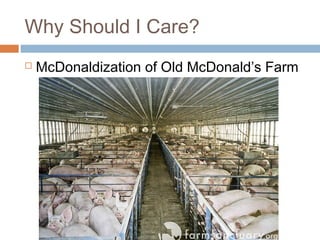
Why should I Care? 
 Sheer compassion demands that we care. 
 We must not turn away with our eyes from that 
which they cannot turn away with their bodies. 
 Because suffering is suffering.
The Story Book Farm is Hard to 
Find
Why Should I Care? 
 McDonaldization of Old McDonald’s Farm
Pigs 
 Pigs are one of the most intelligent animals on 
the planet. 
 They spend their entire life in a crate. 
 Sows are strapped down for constant nursing 
and can never do all the fun pig things that are 
part of their normal behavior. 
 Instead, they must endure what is called a 
rape crate.
Real Farm Life
When pregnant sows are ready to give 
birth, they are moved from a gestation 
crate to a farrowing crate. One worker 
describes the process: "They beat the 
shit out of [the mother pigs] to get them 
inside the crates because they don't 
want to go. This is their only chance to 
walk around, get a little exercise, and 
they don't want to go [back into a 
crate]." The tiny farrowing crate leaves 
no room for the mother to walk or turn 
around and only provides a small 
additional space for her piglets. Her 
babies are taken from her when they 
are only a few weeks old, and the sow 
is put back into the gestation crate and 
impregnated again. This process 
continues for three or four years until 
her body is exhausted, and she is sent 
to slaughter.
Why Should I Care? 
 Quote: Carr in Joan Sabate’ ed., Vegetarian Nutrition 
 “Life on a Factory Farm is Really Nothing 
More than an Extended Death.”
Chickens 
 Egg laying chickens are kept their entire lives 5 or 6 
in a cage about the size of a folded newspaper so 
they never have the chance to stretch or scratch like 
normal chickens. 
 Their beaks are cut off so they cannot peck each 
other to death out of frustration in the crowded cages. 
 They are deprived of food and water in what is called 
“forced molting” so they will lay eggs. 
 Male chicks are worthless to the egg industry because 
they don’t lay eggs so they are tossed into trash bags 
to suffocate or are thrown—while still alive—into 
grinders. (Male dairy calves are also worthless and 
become victims of the veal industry.)
Making a Difference 
 Quote: Jane Goodall, Harvest for Hope 
 “Remember that every food purchase is a vote. We might 
be tempted as individuals to think that our small 
actions don’t really don’t matter, that one meal can’t 
make a difference. But our food purchases, our food 
choices as votes, will determine the way ahead for our 
planet. There is a delicious and powerful food revolution 
occurring where people have adopted a lifestyle of 
health and sustainability and are willing to take actions 
that support their beliefs.”
Making a Difference 
 The Difference One Person can make. 
 Hurricane Katrina changed my life forever. 
 I will never again say what difference can one 
person or one day make. After Hurricane 
Katrina I spent one month feeding and 
searching for animals that needed help. I 
learned even one hour, one day, every choice 
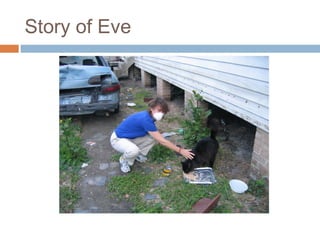
we make can have an impact. 
 I’d like to conclude with the story of Eve.
Hurricane Katrina 
 “My real Christmas gift was a cat named Eve. I 
needed a good ending after a couple of days of 
frustration. And Eve gave that. Volunteers had found 
her living at a house when they were feeding at 
stations. She followed them around, rubbing on their 
legs and purring. They had to leave her behind. I 
came back to the spot and heard the meow, the 
sweetest sound I have heard since arriving and 
one that I so often strain to hear in the houses and 
streets, and rarely hear. She hopped up out of an 
abandoned car in the driveway and came to eat two 
cans of food. I scooped her up and she road first class 
back to Celebration Station.“
Story of Eve
The Sand Dollar 
 An old man was strolling along a beach one day. In the distance he 
saw a young boy and girl reach down, pick something up and throw 
it back into the sea. Drawing nearer, he saw that the sand was 
littered with thousands of small stranded sand dollars. The children 
were patiently picking them up, one at a time, and returning them to 
safety below the water. "What are you doing?" he asked. "Saving 
sand dollars," replied the children as they continued about the job at 
hand. "But the beach is littered with dying sand dollars. What 
possible difference can you make by doing this?”The young girl 
bent over, picked up another, and threw it back in the water with all 
her might. Then, turning to the old man, she said with all the 
wisdom of a child: 
"I made a difference for that one."
The Difference You Can Make 
 The average vegetarian spares the lives of over 
50 animals each year. That adds up to many 
animals who will not endure unimaginable 
suffering. 
 What difference will one person choosing a 
plant based diet make one bite at a time? 
 A huge difference. The average UK meat eater 
consumes, in the course of their lifetime, 5 cattle, 
20 pigs, 29 sheep and lambs, 780 chickens, 46 
turkeys, 18 ducks, 7 rabbits, 1 geese and half-a-ton 
of fishes.
The Power of One 
 “One way in which we can truly make a difference 
is to think about what we eat. Each decision we 
make-what we choose to buy, choose to eat, will 
have an impact on the environment, on animal 
welfare-and importantly, on human health.” 
 Jane Goodall, Harvest for Hope 
 For more info: 
 www.farmsanctuary.org; www.goveg.com 
 www.nwveg.org

Making a difference for animalsfn

  • 1.
    MAKING A DIFFERENCE FOR ANIMALS ONE BITE AT A TIME Sharon Warner Methvin, PhD •smethvin@gmail.com •Downloadable PdF: www.nwveg.org
  • 2.
    Vegetarian Stereotype Debunked  Say the word, “vegetarian” and many people will immediately picture the stereotype of granola-munching, Birkenstocks and tie-dye wearing, dreadlock hippies in a PETA tee.  Fact: 12,000,000 in US are vegetarian (4.2% of pop)  Male: 30% Female: 70% Over 40 Years Old: 55%  College Education: 30% Income above 35,000: 44%  Married: 48% Occupation White Collar: 37%  With Children under 18: 37%  Vegetarian Nutrition, Joan Sabate’ ed.
  • 3.
    Reasons Cited Health: 46%  Animal Suffering: 15% or Ethics: 5%  Environmental Concerns: 4%  Influence of others: 12% No reason given: 18%
  • 4.
    Tripod of Vegetarianism Tripod on Which Vegetarianism Rests  Health  Environmental Issues  Animal Suffering/Ethics
  • 5.
    Leg One: Health  Fact: Unless you eat only organic, free range animal products, almost all your dairy products, eggs, and meat, including poultry, pigs and cattle are raised on government subsidized corn thereby increasing the amount of saturated fat and toxins you consume.
  • 6.
    Health  Quote:According to the American Dietetic Association, “Vegetarians have a reduced risk of heart disease, obesity, colon cancer, adult-onset diabetes, osteoporosis, gout, gallstones, kidney stones, lung cancer, and breast cancer.”
  • 7.
    Health  Quote:John Robbins, Diet for a New America  Risk of death by heart attack for the average American vegetarian man: 15% A non-vegetarian man: 50%  Amount you reduce your risk of heart attack by reducing your consumption of meat, dairy and eggs by 100%: 90%  Quote: T. Collin Cambell, China Study  No one in the Framington study with a blood cholesterol level of 150mg/dl or below had a heart attack or stroke.
  • 8.
    Leg Two: Environment  Fact: Every second, one football field of rainforest is destroyed to produce 257 hamburgers.
  • 9.
    Environment  Quote:According to the Union of Concerned Scientists, “Eliminating beef is one of two lifestyle changes that most directly help the environment-the other is to drive a fuel efficient car.”  Quote: Body and Soul, If 10,000 people replaced a beef meal with a vegetarian option just once a week for a year, we’d save enough water to fill roughly 605 Olympic size swimming pools.”
  • 10.
    Leg Three: AnimalSuffering  Fact: On profit driven factory farms, animals are reduced to nothing more than a machine for greater profits.
  • 11.
    Animal Suffering Quote: According to Senator Byrd in a speech to the US Senate, “Cows, calves, pigs, chickens, turkeys, ducks, geese, rabbits and other animals are kept in small cages or stalls where they are often unable to turn around. They are deprived of exercise so that all their energy goes toward producing flesh, eggs, or milk for human consumption. They are fed drugs that fatten them more quickly, and they are genetically manipulated to grow faster or produce much more milk or eggs than they would naturally.”
  • 12.
    Animal Suffering Quote:John Robbins, Diet for a New America  The suffering these animals undergo is so extreme that to partake of food from these creatures is to partake unknowingly of the abject misery that has been their lives.  We are ingesting nightmares for breakfast, lunch and dinner.  It’s not the killing of the animals that is the chief issue here, but rather the unspeakable quality of the lives they are forced to live.
  • 13.
    U.S. Per PersonMeat Consumption each Year Chicken…87 lb (15 lives) Turkey… 18 lb (2 lives) Veal…1lb Lamb…1 lb Beef…66 lb (1 life) Pork…51 lb (1 life) Fish…16.6 lb (80 lives) Shell/other fishes 8.8 lb (200 lives) Eggs…259 (259 lives suffer) Total…20 warm blooded animals + 259 eggs + 500 cold blooded lives
  • 14.
    Why should ICare?  Sheer compassion demands that we care.  We must not turn away with our eyes from that which they cannot turn away with their bodies.  Because suffering is suffering.
  • 15.
    The Story BookFarm is Hard to Find
  • 16.
    Why Should ICare?  McDonaldization of Old McDonald’s Farm
  • 17.
    Pigs  Pigsare one of the most intelligent animals on the planet.  They spend their entire life in a crate.  Sows are strapped down for constant nursing and can never do all the fun pig things that are part of their normal behavior.  Instead, they must endure what is called a rape crate.
  • 18.
  • 21.
    When pregnant sowsare ready to give birth, they are moved from a gestation crate to a farrowing crate. One worker describes the process: "They beat the shit out of [the mother pigs] to get them inside the crates because they don't want to go. This is their only chance to walk around, get a little exercise, and they don't want to go [back into a crate]." The tiny farrowing crate leaves no room for the mother to walk or turn around and only provides a small additional space for her piglets. Her babies are taken from her when they are only a few weeks old, and the sow is put back into the gestation crate and impregnated again. This process continues for three or four years until her body is exhausted, and she is sent to slaughter.
  • 22.
    Why Should ICare?  Quote: Carr in Joan Sabate’ ed., Vegetarian Nutrition  “Life on a Factory Farm is Really Nothing More than an Extended Death.”
  • 23.
    Chickens  Egglaying chickens are kept their entire lives 5 or 6 in a cage about the size of a folded newspaper so they never have the chance to stretch or scratch like normal chickens.  Their beaks are cut off so they cannot peck each other to death out of frustration in the crowded cages.  They are deprived of food and water in what is called “forced molting” so they will lay eggs.  Male chicks are worthless to the egg industry because they don’t lay eggs so they are tossed into trash bags to suffocate or are thrown—while still alive—into grinders. (Male dairy calves are also worthless and become victims of the veal industry.)
  • 28.
    Making a Difference  Quote: Jane Goodall, Harvest for Hope  “Remember that every food purchase is a vote. We might be tempted as individuals to think that our small actions don’t really don’t matter, that one meal can’t make a difference. But our food purchases, our food choices as votes, will determine the way ahead for our planet. There is a delicious and powerful food revolution occurring where people have adopted a lifestyle of health and sustainability and are willing to take actions that support their beliefs.”
  • 29.
    Making a Difference  The Difference One Person can make.  Hurricane Katrina changed my life forever.  I will never again say what difference can one person or one day make. After Hurricane Katrina I spent one month feeding and searching for animals that needed help. I learned even one hour, one day, every choice we make can have an impact.  I’d like to conclude with the story of Eve.
  • 30.
    Hurricane Katrina “My real Christmas gift was a cat named Eve. I needed a good ending after a couple of days of frustration. And Eve gave that. Volunteers had found her living at a house when they were feeding at stations. She followed them around, rubbing on their legs and purring. They had to leave her behind. I came back to the spot and heard the meow, the sweetest sound I have heard since arriving and one that I so often strain to hear in the houses and streets, and rarely hear. She hopped up out of an abandoned car in the driveway and came to eat two cans of food. I scooped her up and she road first class back to Celebration Station.“
  • 31.
  • 32.
    The Sand Dollar  An old man was strolling along a beach one day. In the distance he saw a young boy and girl reach down, pick something up and throw it back into the sea. Drawing nearer, he saw that the sand was littered with thousands of small stranded sand dollars. The children were patiently picking them up, one at a time, and returning them to safety below the water. "What are you doing?" he asked. "Saving sand dollars," replied the children as they continued about the job at hand. "But the beach is littered with dying sand dollars. What possible difference can you make by doing this?”The young girl bent over, picked up another, and threw it back in the water with all her might. Then, turning to the old man, she said with all the wisdom of a child: "I made a difference for that one."
  • 33.
    The Difference YouCan Make  The average vegetarian spares the lives of over 50 animals each year. That adds up to many animals who will not endure unimaginable suffering.  What difference will one person choosing a plant based diet make one bite at a time?  A huge difference. The average UK meat eater consumes, in the course of their lifetime, 5 cattle, 20 pigs, 29 sheep and lambs, 780 chickens, 46 turkeys, 18 ducks, 7 rabbits, 1 geese and half-a-ton of fishes.
  • 34.
    The Power ofOne  “One way in which we can truly make a difference is to think about what we eat. Each decision we make-what we choose to buy, choose to eat, will have an impact on the environment, on animal welfare-and importantly, on human health.”  Jane Goodall, Harvest for Hope  For more info:  www.farmsanctuary.org; www.goveg.com  www.nwveg.org