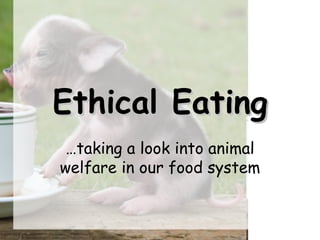
Ethical Eating … taking a look into animal welfare in our food system
What are we talking about? Conventional Animal Production Ethical treatment Questions about human health Environmental Impact Vegetarianism and Veganism What’s available for you on campus? Questions?
Some definitions Feedlot     where cows go to get fattened up before slaughter Castration     removal of testicles CAFO     confined animal feed operation
Slaughter     the killing of animals mostly for human consumption Livestock     all animals raised for intent of food production Free range     not defined by law, but used by the industry to say that poultry, pigs lived outside of cages/crates Pasture-raised     most sustainable way of producing animals for human consumption; animals are able to roam around freely, and do all things naturally
Do Animals Feel Pain? All birds, mammals, fish have a central nervous system… All birds, mammals and fish can feel pain. Is there emotional pain associated with physical harm? The jury is out on that…
Conventional Animal Production Chickens, poultry Pigs Cattle Fish
Chickens Broiler chickens    meat consumption Layer hens    egg consumption, meat consumption
Broilers Bred to grow muscles 2x as fast as in 1940’s Muscle growth does not match bone growth Deformities Can’t walk Crowded pens on concrete/slatted floors De-beaking Disease vector    administer antibiotics Unnatural diets
Layers 98% live in crowded cages - 48 sq. in. each – vertical integration De-beaking Disease vector    administer antibiotics Forced molting through starvation to increase egg production Unnatural diets Butchered after 2 egg-laying seasons By slaughter, 29% suffer broken bones due to neglect and maltreatment
Health Risks and Human Concerns Hormones  – increase growth; illegal in US Antibiotics  – promote growth; treat disease Arsenic  – antimicrobial dug; promotes growth Disease vector  – E. coli, bird flu, salmonella Environmental pollution
What happens at slaughter? Transported by truck to slaughter No legal requirement for chickens to be anesthetized for slaughter… they are awake Throats cut Dipped into tanks of scalding hot water to loosen feathers Plucked of feathers by hand or machine
Facts  and figures There is no federal law that regulates humane treatment of chickens Over 9 billion chickens were slaughtered in the US for their flesh 245 million hens are raised for eggs 99% of all chickens raised for food spend their entire lives in confinement Due to genetic manipulation (selective breeding) 90% of broiler chickens have trouble walking 100 million male chicks are ground up alive or suffocated each year 71% of the farmers who work under contract for Tyson earn below-poverty wages
Poultry’s environmental impact Soy-based high protein feed diet  Ammonia emissions and water contamination Manure lagoons  Nitrates and phosphates contaminate waterways Nitrates    algae blooms    fish kills Blue baby syndrome    result of drinking nitrogen-contaminated water
The Industry… “ Is it more profitable to grow the biggest bird and have increased mortality due to heart attacks, ascites, and leg problems, or should birds be grown smaller so that birds are smaller, but have fewer heart, lung, and skeletal problems? A large portion of grower’s pay is based on the pound of saleable meat produced, so simple calculations suggest that  it is better to get the weight and ignore the mortality …”
Free Range Poultry Guaranteed for all egg laying hens and broilers – Prop 2 by 2012 What does free range mean? Is it really free range? “ Most free-range birds are still fenced in corrals, though people like to imagine the birds are out roaming the range. They are not out exercising. These birds are raised much like the regular poultry.” –  Ralph Ernst, UC Davis Poultry Specialist
Turkeys Killed when they are 5-6 mo. old 300 million slaughtered ea. year No federal legal protection Beaks, toes seared off Crammed in tight quarters with thousands of other birds Slaughtered like chickens Too obese to reproduce    artificially inseminated
Turkey treatment Mortalities from organ failure or heart attack before reaching 6 mo. old Become to obese to walk Transportation to slaughterhouse results in the death of millions of turkeys each year due to heat exhaustion, freezing, transport accidents
Free range turkey? “Consumers can really be fooled. Some farms can qualify for free range, but they raise turkeys in the same conditions as industrial farms” –  Mary Pitman from Mary’s Free-Range Turkeys
Pigs Over 100million pigs are killed ea. year for consumption 97% of the pigs consumed today are raised on factory farms Baby pigs have some of their teeth removed, are castrated (males), and have their tails cut off and ears notched Gestation crates Transport to slaughterhouse results in the death of 1 million pigs ea. year
Treatment of pigs Farrowing crates Piglets placed in “battery cages”    similar to vertical integration for layer hens Pigs are crammed into small pens with many other pigs until slaughter Rampant disease Pigs live up to 6 mo. in factory farms… in nature pigs live up to 15 years
Pig Illnesses Genetic manipulation to grow too big too fast Arthritis Joint problems Mange Pneumonia – 70% have it before slaughtered
Slaughter of Pigs Transported to slaughterhouses in trucks 170,000 pigs  die each year in transport 420,000 pigs  are crippled during transport ea. year Typical slaughterhouse kills up to  1,100 pigs every hour Pigs stunned with stun guns, or bolt guns Improper firing of stun guns/bolt guns result in  live slaughter Throats slit to bleed out Scalding water bath to remove hair
Health Risks and Human Concerns Antiobiotics in pigs Trichinosis  – parasites; raw and undercooked pork Linked to when pigs were fed garbage 1997-2001, average of 12 cases per year
Environmental Impact Feral Pigs in North and South America, New Zealand, Australia, Hawaii Invasive species – extensive environmental damage Pollution from waste
Cows Beef cows Dairy cows
Beef Cattle Bread specifically for meat production First year spent grazing Iron-branding Castration Horns removed After first year    auctioned off Shipped to feedlot Many arrive at feedlot crippled or dead
Life at the Feedlot Unnatural diet of mostly  corn and antibiotics Acidification  and bloating of the stomach Ulceration and  rupturing of the intestines Manure overload  and manure lagoons Respiratory problems  due to chromic inhalation of the ammonia, methane, and noxious chemicals created by confined environment
 
Dairy Cows Repeatedly impregnated in order to  induce lactation Calves taken away from them rBGH and rBST –  growth hormones  used to increase milk production Unnatural diet  high in fat  and protein-rich grains to increase milk production and replace energy lost by producing such large quantities of milk Antibiotics  administered to keep cows healthy
Slaughter When to slaughter - b eef cattle is an “acceptable size”; dairy cows stop producing at an “acceptable” rate Fast and messy     the faster they slaughter, the more meat they can produce, and for  cheaper 400 cows slaughtered per day  in ea. slaughter house Cows are stunned, sometimes  not completely Throats slit, bleed out Slaughtered  – specific cuts or ground beef
What’s in the Beef? GROSS Fecal contamination E. coli 0157:H7 Mad Cow Disease Saturated Fat GOOD Protein Vitamin B12 Iron (heme form)
What is in the milk? GROSS Pus Hormones Antibiotics Saturated Fat Cholesterol Pesticide residues Dioxins Antibiotics GOOD Calcium Protein Vitamin B12 Added Vitamin D
Got Osteoporosis? A study published in the  American Journal of Clinical Nutrition  (2000) looked at all aspects of diet and bone health and found that  high consumption of fruits and vegetables  positively affected bone health and that  dairy consumption did not .  Such findings do not surprise nutritional researchers: The  calcium absorption rate from milk is approximately 30 percent , while figures for broccoli, Brussels sprouts, mustard greens, turnip greens, kale, and some other  green leafy vegetables range from 40 percent to 64 percent .
Something’s Fishy Overfishing – 90% of large fish populations have been  exterminated  in the past 50 years Contamination  of our waterways Factory Farmed Fish  (aquaculture) – it takes 5lbs of wild fish to produce 1lb of farmed fish  Destruction  of ocean’s ecosystems Bycatch
Health Concerns and Fish Seafood is the #1 cause of  food poisoning  in the US E. coli Biomagnification Heavy metals : cadmium, mercury, lead, chromium, arsenic Kidney damage, nervous system issues, cancer, etc.
What do we do?
“ Sustainable” Proteins Mary’s Turkey – free range Mary’s Chicken – free range Petaluma Poultry/Rosie’s Chicken – free range
Food Alliance Certified “Animal Welfare Approved” Grass Fed Beef – Fulton Beef Pure Country Pork
Healthy, humane animal treatment “ Food Alliance certified producers raise livestock with the  greatest respect for their needs and comfort . Food Alliance  producers provide  proper nutrition  for excellent animal health  and  fitness ,  without excess fat . Living conditions and space  allowances provide  physical and thermal comfort ,  afford  access to natural lighting and vegetated pasture  (where  appropriate), and  enhance natural behavior  (including social contact  among animals). Food Alliance  producers are trained and  competent  handlers ,  minimizing animal fear and  stress during handling, transportation  and slaughter . Use of  hormone  treatments is prohibited . Antibiotic use  is restricted to treatment of occasional  illness, and not as a substitute for healthy  living conditions.”
Monterey Bay Seafood Watch
Milk and dairy products Horizon Organic    organic, but humane? Berkeley Farm    rBST free Butter    Sysco brand Creamers Cheeses    Sysco brand
Other options… Vegetarian  entrees Vegan  entrees Vegan corner Soy milk Vegan desserts
Opportunities for the future… Glaum Eggs –  cage free  – possibly for the Fall of 2009… may be too expensive  Continue to purchase  Food Alliance Certified  products as they become available Vegan ice cream
What is the barrier? Student demand Cost Availability
QUESTIONS? ?

Ethical Eating

  • 1.
    Ethical Eating …taking a look into animal welfare in our food system
  • 2.
    What are wetalking about? Conventional Animal Production Ethical treatment Questions about human health Environmental Impact Vegetarianism and Veganism What’s available for you on campus? Questions?
  • 3.
    Some definitions Feedlot  where cows go to get fattened up before slaughter Castration  removal of testicles CAFO  confined animal feed operation
  • 4.
    Slaughter  the killing of animals mostly for human consumption Livestock  all animals raised for intent of food production Free range  not defined by law, but used by the industry to say that poultry, pigs lived outside of cages/crates Pasture-raised  most sustainable way of producing animals for human consumption; animals are able to roam around freely, and do all things naturally
  • 5.
    Do Animals FeelPain? All birds, mammals, fish have a central nervous system… All birds, mammals and fish can feel pain. Is there emotional pain associated with physical harm? The jury is out on that…
  • 6.
    Conventional Animal ProductionChickens, poultry Pigs Cattle Fish
  • 7.
    Chickens Broiler chickens  meat consumption Layer hens  egg consumption, meat consumption
  • 8.
    Broilers Bred togrow muscles 2x as fast as in 1940’s Muscle growth does not match bone growth Deformities Can’t walk Crowded pens on concrete/slatted floors De-beaking Disease vector  administer antibiotics Unnatural diets
  • 9.
    Layers 98% livein crowded cages - 48 sq. in. each – vertical integration De-beaking Disease vector  administer antibiotics Forced molting through starvation to increase egg production Unnatural diets Butchered after 2 egg-laying seasons By slaughter, 29% suffer broken bones due to neglect and maltreatment
  • 10.
    Health Risks andHuman Concerns Hormones – increase growth; illegal in US Antibiotics – promote growth; treat disease Arsenic – antimicrobial dug; promotes growth Disease vector – E. coli, bird flu, salmonella Environmental pollution
  • 11.
    What happens atslaughter? Transported by truck to slaughter No legal requirement for chickens to be anesthetized for slaughter… they are awake Throats cut Dipped into tanks of scalding hot water to loosen feathers Plucked of feathers by hand or machine
  • 12.
    Facts andfigures There is no federal law that regulates humane treatment of chickens Over 9 billion chickens were slaughtered in the US for their flesh 245 million hens are raised for eggs 99% of all chickens raised for food spend their entire lives in confinement Due to genetic manipulation (selective breeding) 90% of broiler chickens have trouble walking 100 million male chicks are ground up alive or suffocated each year 71% of the farmers who work under contract for Tyson earn below-poverty wages
  • 13.
    Poultry’s environmental impactSoy-based high protein feed diet Ammonia emissions and water contamination Manure lagoons Nitrates and phosphates contaminate waterways Nitrates  algae blooms  fish kills Blue baby syndrome  result of drinking nitrogen-contaminated water
  • 14.
    The Industry… “Is it more profitable to grow the biggest bird and have increased mortality due to heart attacks, ascites, and leg problems, or should birds be grown smaller so that birds are smaller, but have fewer heart, lung, and skeletal problems? A large portion of grower’s pay is based on the pound of saleable meat produced, so simple calculations suggest that it is better to get the weight and ignore the mortality …”
  • 15.
    Free Range PoultryGuaranteed for all egg laying hens and broilers – Prop 2 by 2012 What does free range mean? Is it really free range? “ Most free-range birds are still fenced in corrals, though people like to imagine the birds are out roaming the range. They are not out exercising. These birds are raised much like the regular poultry.” – Ralph Ernst, UC Davis Poultry Specialist
  • 16.
    Turkeys Killed whenthey are 5-6 mo. old 300 million slaughtered ea. year No federal legal protection Beaks, toes seared off Crammed in tight quarters with thousands of other birds Slaughtered like chickens Too obese to reproduce  artificially inseminated
  • 17.
    Turkey treatment Mortalitiesfrom organ failure or heart attack before reaching 6 mo. old Become to obese to walk Transportation to slaughterhouse results in the death of millions of turkeys each year due to heat exhaustion, freezing, transport accidents
  • 18.
    Free range turkey?“Consumers can really be fooled. Some farms can qualify for free range, but they raise turkeys in the same conditions as industrial farms” – Mary Pitman from Mary’s Free-Range Turkeys
  • 19.
    Pigs Over 100millionpigs are killed ea. year for consumption 97% of the pigs consumed today are raised on factory farms Baby pigs have some of their teeth removed, are castrated (males), and have their tails cut off and ears notched Gestation crates Transport to slaughterhouse results in the death of 1 million pigs ea. year
  • 20.
    Treatment of pigsFarrowing crates Piglets placed in “battery cages”  similar to vertical integration for layer hens Pigs are crammed into small pens with many other pigs until slaughter Rampant disease Pigs live up to 6 mo. in factory farms… in nature pigs live up to 15 years
  • 21.
    Pig Illnesses Geneticmanipulation to grow too big too fast Arthritis Joint problems Mange Pneumonia – 70% have it before slaughtered
  • 22.
    Slaughter of PigsTransported to slaughterhouses in trucks 170,000 pigs die each year in transport 420,000 pigs are crippled during transport ea. year Typical slaughterhouse kills up to 1,100 pigs every hour Pigs stunned with stun guns, or bolt guns Improper firing of stun guns/bolt guns result in live slaughter Throats slit to bleed out Scalding water bath to remove hair
  • 23.
    Health Risks andHuman Concerns Antiobiotics in pigs Trichinosis – parasites; raw and undercooked pork Linked to when pigs were fed garbage 1997-2001, average of 12 cases per year
  • 24.
    Environmental Impact FeralPigs in North and South America, New Zealand, Australia, Hawaii Invasive species – extensive environmental damage Pollution from waste
  • 25.
    Cows Beef cowsDairy cows
  • 26.
    Beef Cattle Breadspecifically for meat production First year spent grazing Iron-branding Castration Horns removed After first year  auctioned off Shipped to feedlot Many arrive at feedlot crippled or dead
  • 27.
    Life at theFeedlot Unnatural diet of mostly corn and antibiotics Acidification and bloating of the stomach Ulceration and rupturing of the intestines Manure overload and manure lagoons Respiratory problems due to chromic inhalation of the ammonia, methane, and noxious chemicals created by confined environment
  • 28.
  • 29.
    Dairy Cows Repeatedlyimpregnated in order to induce lactation Calves taken away from them rBGH and rBST – growth hormones used to increase milk production Unnatural diet high in fat and protein-rich grains to increase milk production and replace energy lost by producing such large quantities of milk Antibiotics administered to keep cows healthy
  • 30.
    Slaughter When toslaughter - b eef cattle is an “acceptable size”; dairy cows stop producing at an “acceptable” rate Fast and messy  the faster they slaughter, the more meat they can produce, and for cheaper 400 cows slaughtered per day in ea. slaughter house Cows are stunned, sometimes not completely Throats slit, bleed out Slaughtered – specific cuts or ground beef
  • 31.
    What’s in theBeef? GROSS Fecal contamination E. coli 0157:H7 Mad Cow Disease Saturated Fat GOOD Protein Vitamin B12 Iron (heme form)
  • 32.
    What is inthe milk? GROSS Pus Hormones Antibiotics Saturated Fat Cholesterol Pesticide residues Dioxins Antibiotics GOOD Calcium Protein Vitamin B12 Added Vitamin D
  • 33.
    Got Osteoporosis? Astudy published in the American Journal of Clinical Nutrition (2000) looked at all aspects of diet and bone health and found that high consumption of fruits and vegetables positively affected bone health and that dairy consumption did not . Such findings do not surprise nutritional researchers: The calcium absorption rate from milk is approximately 30 percent , while figures for broccoli, Brussels sprouts, mustard greens, turnip greens, kale, and some other green leafy vegetables range from 40 percent to 64 percent .
  • 34.
    Something’s Fishy Overfishing– 90% of large fish populations have been exterminated in the past 50 years Contamination of our waterways Factory Farmed Fish (aquaculture) – it takes 5lbs of wild fish to produce 1lb of farmed fish Destruction of ocean’s ecosystems Bycatch
  • 35.
    Health Concerns andFish Seafood is the #1 cause of food poisoning in the US E. coli Biomagnification Heavy metals : cadmium, mercury, lead, chromium, arsenic Kidney damage, nervous system issues, cancer, etc.
  • 36.
  • 37.
    “ Sustainable” ProteinsMary’s Turkey – free range Mary’s Chicken – free range Petaluma Poultry/Rosie’s Chicken – free range
  • 38.
    Food Alliance Certified“Animal Welfare Approved” Grass Fed Beef – Fulton Beef Pure Country Pork
  • 39.
    Healthy, humane animaltreatment “ Food Alliance certified producers raise livestock with the greatest respect for their needs and comfort . Food Alliance producers provide proper nutrition for excellent animal health and fitness , without excess fat . Living conditions and space allowances provide physical and thermal comfort , afford access to natural lighting and vegetated pasture (where appropriate), and enhance natural behavior (including social contact among animals). Food Alliance producers are trained and competent handlers , minimizing animal fear and stress during handling, transportation and slaughter . Use of hormone treatments is prohibited . Antibiotic use is restricted to treatment of occasional illness, and not as a substitute for healthy living conditions.”
  • 40.
  • 41.
    Milk and dairyproducts Horizon Organic  organic, but humane? Berkeley Farm  rBST free Butter  Sysco brand Creamers Cheeses  Sysco brand
  • 42.
    Other options… Vegetarian entrees Vegan entrees Vegan corner Soy milk Vegan desserts
  • 43.
    Opportunities for thefuture… Glaum Eggs – cage free – possibly for the Fall of 2009… may be too expensive Continue to purchase Food Alliance Certified products as they become available Vegan ice cream
  • 44.
    What is thebarrier? Student demand Cost Availability
  • 45.