VEGANISM AND VEGETARIANISM: WHAT THEY
MEAN FOR THE ENVIRONMENT AND SOCIETY
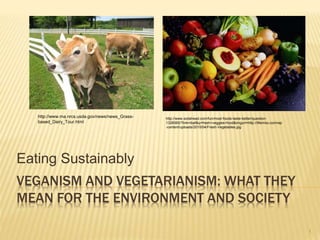
Eating Sustainably
http://www.ma.nrcs.usda.gov/news/news_Grass-
based_Dairy_Tour.html
http://www.sodahead.com/fun/most-foods-taste-better/question-
1326065/?link=ibaf&q=fresh+veggies+food&imgurl=http://lifemixx.com/wp
-content/uploads/2010/04/Fresh-Vegetables.jpg
1
 “We will find that the mass consumption of animals is a primary reason
why humans are hungry, fat, or sick and is a leading cause of the
depletion and pollution of waterways, the degradation and deforestation
of the land, the extinction of species, and the warming of the planet.”-
Brian G. Henning, author of Standing in Livestock’s ‘Long Shadow’: The
Ethics of Eating Meat on a Small Planet
2
"I have no doubt that it is part of the destiny of the human race, in its
gradual improvement, to leave off eating animals"
-Henry David Thoreau
Ethics, Health, and the Environment
CURRENT HEALTHY EATING GUIDELINES:
3
http://www.hsph.harvard.edu/n
utritionsource/what-should-
you-eat/pyramid-full-
story/index.html#Dietary-
Guidelines-in-the-21st-Century
COMPARE AND CONTRAST:
4
USDA Guidelines Harvard School of Public Health Guidelines
IT’S ALL ABOUT THE MONEY:
5http://ncronline.org/news/justice/subsidizing-poor-eating-habits & The Physicians Committee for Responsible Medicine
CORN: FRIEND OR FOE?
 According to the National
Catholic Reporter, “In addition to
encouraging unhealthy fast food
consumption, cheap corn also
contributes to overuse of
chemical fertilizer and antibiotics,
as well as food poisoning.
Environmentalists have branded
corn as an icon of unsustainable
agriculture. It requires large
amounts of fertilizer and
pesticides, both of which require
large amounts of fossil fuel to
manufacture.”
6
CORN: IT’S WHAT SHOULDN’T BE FOR DINNER
 Also according to NRC, “…corn is fed to livestock who didn’t evolve to
subsist entirely on such a diet. In cattle, eating corn increases flatulence
and emissions of methane -- a potent greenhouse gas -- and creates an
intestinal environment rich in E. coli, an intestinal bacterium that is a
common cause of food poisoning. That necessitates mixing cow feed
with antibiotics, in turn producing antibiotic-resistant disease strains.”
7
VITAL STATISTICS:
8
Human Pop. Of the U.S.: 243,000,000
Number of human beings who could be fed by the grain and soybeans eaten by U.S. livestock:
1,300,000,000
Percentage of corn grown in the U.S. eaten by human beings: 20%
Percentage of corn grown in the U.S. eaten by livestock: 80%
Percentage of protein wasted by cycling grain through livestock: 90%
Percentage of U.S. agricultural land used to produce beef: 56%
Pounds of grain and soybeans needed to produce 1 lb. of feedlot beef: 16
Number of pure vegetarians who can be fed on the amount of land needed to feed one person
eating a meat-based diet: 20 people
Number of people who will starve to death this year: 60,000,000
Number of people who could be adequately fed by the grains saved if Americans decreased
their intake of meat by 10%: 60,000,000.
WHY NOT EAT MEAT?
 "The greatness of a nation and its moral progress can be judged
by the way its animals are treated.“ -M. Gandhi
9
http://www.green-blog.org/2010/07/22/the-cruel-life-inside-a-factory-farm/
THIS IS WHY.
 Prior to being hung up by their back legs and bled to death, cattle are supposed
to be rendered unconscious, as stipulated by the federal Humane Slaughter Act.
This 'stunning' is usually done by a mechanical blow to the head. However, the
procedure is terribly imprecise, and inadequate stunning is inevitable.
This is detailed in an April 2001 Washington Post article, which describes typical
slaughter plant conditions:
“The cattle were supposed to be dead before they got to Moreno. But too often they
weren't.
They blink. They make noises, he said softly. The head moves, the eyes are wide
and looking around. Still Moreno would cut. On bad days, he says, dozens of
animals reached his station clearly alive and conscious. Some would survive as far
as the tail cutter, the belly ripper, the hide puller. They die, said Moreno, piece by
piece...”
10
http://www.farmsanctuary.org/issues/factoryfarming/beef/
“HUMAN DISENGAGEMENT”
 Here is an excerpt from “The Humanity of What We Eat: Conceptions of
human uniqueness among vegetarians and omnivores.” By: Bilewicz, Michal;
et. al.…
 In the present research, it was hypothesized that the conception of human
uniqueness (denying animals certain psychological characteristics) might be
a strategy of meat-eaters' moral disengagement. Three studies compared
the extent to which vegetarians and omnivores attribute psychological
characteristics to humans versus animals. In Study 1, vegetarian participants
ascribed more secondary (uniquely human) emotions to animals than did the
omnivores; however, there were no differences in primary (animalistic)
emotions. Study 2 showed that omnivores distinguish human characteristics
from animalistic ones more sharply than vegetarians do, while both groups
do not differ in distinguishing human characteristics from mechanistic ones.
Study 3 confirmed the results by showing that omnivores ascribed less
secondary emotions to traditionally edible animals than to the non-edible
species, while vegetarians did not differentiate these animals. These results
support the claim that the lay conceptions of 'human uniqueness' are
strategies of moral disengagement.
11
WHAT’S THE ALTERNATIVE?
 According to the Physicians
Committee for Responsible
Medicine, “These four food
groups provide the good
nutrition you need. There is
no need for animal-derived
products in the diet, and
you're better off without
them. Be sure to include a
reliable source of vitamin
B12, such as any common
multiple vitamin or fortified
foods.”
12
http://www.pcrm.org/health//d
iets/pplate/power-plate
http://www.pcrm.org/images/health/pplate/EveryMe
alPowerPlate.pdf
THE VEGAN DIET:
 Stock your pantry with
these basics:
 Fruits
Bananas
Apples
Berries (fresh or frozen)
Raisins
 Vegetables
Broccoli (fresh or frozen)
Spinach (fresh or frozen)
Lettuce
Carrots
Cucumbers
Canned tomatoes
Marinara sauce
13
Grains
Rolled oats
Loaf of bread (high-fiber or pumpernickel)
Brown rice
Quinoa
Whole wheat pasta
Legumes
Soy, rice, almond, or plant-milk of choice
Black beans (canned or dried)
Garbanzo beans (canned or dried)
Dried red lentils
Frozen edamame
Condiments
Apple butter
Balsamic vinegar
Cinnamon
Mustard
Soy sauce
http://www.pcrm.org/health/diets/pplate
/resources
SOME RESOURCES FOR MAKING THE SWITCH:
 http://www.nutritionmd.org/makeover/index.html
http://www.pcrm.org/images/health/pplate/EveryMealPowerPlate.pdf
14
http://action.petaasiapacific.com/ea-
campaign/clientcampaign.do?ea.client.id=110&ea
.campaign.id=2604
http://www.pcrm.org/health/diets/pplate/power-
plate-meals-across-the-globe
http://finance.yahoo.com/news/Occupy-
Your-Diet-A-Discussion-xfoftp-
2323402398.html
On Ethics:
On Nutrition
http://www.vegetariantimes.com/recipes/
Recipes

Vegetarianism Power Point Project

  • 1.
    VEGANISM AND VEGETARIANISM:WHAT THEY MEAN FOR THE ENVIRONMENT AND SOCIETY Eating Sustainably http://www.ma.nrcs.usda.gov/news/news_Grass- based_Dairy_Tour.html http://www.sodahead.com/fun/most-foods-taste-better/question- 1326065/?link=ibaf&q=fresh+veggies+food&imgurl=http://lifemixx.com/wp -content/uploads/2010/04/Fresh-Vegetables.jpg 1
  • 2.
     “We willfind that the mass consumption of animals is a primary reason why humans are hungry, fat, or sick and is a leading cause of the depletion and pollution of waterways, the degradation and deforestation of the land, the extinction of species, and the warming of the planet.”- Brian G. Henning, author of Standing in Livestock’s ‘Long Shadow’: The Ethics of Eating Meat on a Small Planet 2 "I have no doubt that it is part of the destiny of the human race, in its gradual improvement, to leave off eating animals" -Henry David Thoreau Ethics, Health, and the Environment
  • 3.
    CURRENT HEALTHY EATINGGUIDELINES: 3 http://www.hsph.harvard.edu/n utritionsource/what-should- you-eat/pyramid-full- story/index.html#Dietary- Guidelines-in-the-21st-Century
  • 4.
    COMPARE AND CONTRAST: 4 USDAGuidelines Harvard School of Public Health Guidelines
  • 5.
    IT’S ALL ABOUTTHE MONEY: 5http://ncronline.org/news/justice/subsidizing-poor-eating-habits & The Physicians Committee for Responsible Medicine
  • 6.
    CORN: FRIEND ORFOE?  According to the National Catholic Reporter, “In addition to encouraging unhealthy fast food consumption, cheap corn also contributes to overuse of chemical fertilizer and antibiotics, as well as food poisoning. Environmentalists have branded corn as an icon of unsustainable agriculture. It requires large amounts of fertilizer and pesticides, both of which require large amounts of fossil fuel to manufacture.” 6
  • 7.
    CORN: IT’S WHATSHOULDN’T BE FOR DINNER  Also according to NRC, “…corn is fed to livestock who didn’t evolve to subsist entirely on such a diet. In cattle, eating corn increases flatulence and emissions of methane -- a potent greenhouse gas -- and creates an intestinal environment rich in E. coli, an intestinal bacterium that is a common cause of food poisoning. That necessitates mixing cow feed with antibiotics, in turn producing antibiotic-resistant disease strains.” 7
  • 8.
    VITAL STATISTICS: 8 Human Pop.Of the U.S.: 243,000,000 Number of human beings who could be fed by the grain and soybeans eaten by U.S. livestock: 1,300,000,000 Percentage of corn grown in the U.S. eaten by human beings: 20% Percentage of corn grown in the U.S. eaten by livestock: 80% Percentage of protein wasted by cycling grain through livestock: 90% Percentage of U.S. agricultural land used to produce beef: 56% Pounds of grain and soybeans needed to produce 1 lb. of feedlot beef: 16 Number of pure vegetarians who can be fed on the amount of land needed to feed one person eating a meat-based diet: 20 people Number of people who will starve to death this year: 60,000,000 Number of people who could be adequately fed by the grains saved if Americans decreased their intake of meat by 10%: 60,000,000.
  • 9.
    WHY NOT EATMEAT?  "The greatness of a nation and its moral progress can be judged by the way its animals are treated.“ -M. Gandhi 9 http://www.green-blog.org/2010/07/22/the-cruel-life-inside-a-factory-farm/
  • 10.
    THIS IS WHY. Prior to being hung up by their back legs and bled to death, cattle are supposed to be rendered unconscious, as stipulated by the federal Humane Slaughter Act. This 'stunning' is usually done by a mechanical blow to the head. However, the procedure is terribly imprecise, and inadequate stunning is inevitable. This is detailed in an April 2001 Washington Post article, which describes typical slaughter plant conditions: “The cattle were supposed to be dead before they got to Moreno. But too often they weren't. They blink. They make noises, he said softly. The head moves, the eyes are wide and looking around. Still Moreno would cut. On bad days, he says, dozens of animals reached his station clearly alive and conscious. Some would survive as far as the tail cutter, the belly ripper, the hide puller. They die, said Moreno, piece by piece...” 10 http://www.farmsanctuary.org/issues/factoryfarming/beef/
  • 11.
    “HUMAN DISENGAGEMENT”  Hereis an excerpt from “The Humanity of What We Eat: Conceptions of human uniqueness among vegetarians and omnivores.” By: Bilewicz, Michal; et. al.…  In the present research, it was hypothesized that the conception of human uniqueness (denying animals certain psychological characteristics) might be a strategy of meat-eaters' moral disengagement. Three studies compared the extent to which vegetarians and omnivores attribute psychological characteristics to humans versus animals. In Study 1, vegetarian participants ascribed more secondary (uniquely human) emotions to animals than did the omnivores; however, there were no differences in primary (animalistic) emotions. Study 2 showed that omnivores distinguish human characteristics from animalistic ones more sharply than vegetarians do, while both groups do not differ in distinguishing human characteristics from mechanistic ones. Study 3 confirmed the results by showing that omnivores ascribed less secondary emotions to traditionally edible animals than to the non-edible species, while vegetarians did not differentiate these animals. These results support the claim that the lay conceptions of 'human uniqueness' are strategies of moral disengagement. 11
  • 12.
    WHAT’S THE ALTERNATIVE? According to the Physicians Committee for Responsible Medicine, “These four food groups provide the good nutrition you need. There is no need for animal-derived products in the diet, and you're better off without them. Be sure to include a reliable source of vitamin B12, such as any common multiple vitamin or fortified foods.” 12 http://www.pcrm.org/health//d iets/pplate/power-plate http://www.pcrm.org/images/health/pplate/EveryMe alPowerPlate.pdf
  • 13.
    THE VEGAN DIET: Stock your pantry with these basics:  Fruits Bananas Apples Berries (fresh or frozen) Raisins  Vegetables Broccoli (fresh or frozen) Spinach (fresh or frozen) Lettuce Carrots Cucumbers Canned tomatoes Marinara sauce 13 Grains Rolled oats Loaf of bread (high-fiber or pumpernickel) Brown rice Quinoa Whole wheat pasta Legumes Soy, rice, almond, or plant-milk of choice Black beans (canned or dried) Garbanzo beans (canned or dried) Dried red lentils Frozen edamame Condiments Apple butter Balsamic vinegar Cinnamon Mustard Soy sauce http://www.pcrm.org/health/diets/pplate /resources
  • 14.
    SOME RESOURCES FORMAKING THE SWITCH:  http://www.nutritionmd.org/makeover/index.html http://www.pcrm.org/images/health/pplate/EveryMealPowerPlate.pdf 14 http://action.petaasiapacific.com/ea- campaign/clientcampaign.do?ea.client.id=110&ea .campaign.id=2604 http://www.pcrm.org/health/diets/pplate/power- plate-meals-across-the-globe http://finance.yahoo.com/news/Occupy- Your-Diet-A-Discussion-xfoftp- 2323402398.html On Ethics: On Nutrition http://www.vegetariantimes.com/recipes/ Recipes

Editor's Notes

  • #4 Lets begin by looking at the current guidelines for healthy eating: Developed in 2005 by the Harvard School of Public Health, these guidelines were updated to this current version in 2008. Note the emphasis on legumes and nuts as protein sources, and even the mention of tofu, which is making it’s food pyramid debut here.
  • #5 Notice how the USDA guidelines emphasize dairy, but make no mention of water or healthy oils, where as the Harvard guidelines emphasize both water and healthy oil, as well as mentioning that dairy intake should be limited to 1-2 servings per day. The USDA guidelines also don’t give any actual written guidelines to their food guide, leaving the consumer in the dark as to servings and what to avoid or what exact food items to eat.
  • #6 So why the difference in guidelines between USDA’s version of the Food Guidelines for America, and the Harvard School of Public Health’s? It’s all about subsidies. The Farm Bill, which is passed every year, is packed with subsidies for meat and dairy, as well as corn, which is used to feed the livestock that is subsidized.
  • #7 Corn is also used, or rather over-used, in human consumption. From candy to cereal to beverages, corn is in a large percentage of what we eat.
  • #10 So you may say to yourself: well I will only eat grass-fed and free range meat to avoid the health hazards of corn-fed meat. Well that only helps one of the problems. There is still the blatant disregard to animal welfare to consider.
  • #12 It’s true, not all meat is produced this way, but one still has to kill the animal to get their flesh, which is a dirty and cruel business no matter how you do it. If we have laws to protect our house animals from being abused and killed, where’s the law to do the same for the animals we keep in the barn? What’s the difference between these animals? The truth is, nothing.
  • #13 So why eat meat when there is a clear, healthy alternative? There’s really no reason to. Here is the Power Plate, developed by the Physicians Committee for Responsible Medicine. Note the four groups: Fruits, Grains, Vegetables, and Legumes. The link on the left shows how these four food groups give you all the nutrition you need.