4
4.5
© 2012 Pearson Education, Inc.
Vector Spaces
THE DIMENSION OF A
VECTOR SPACE
Slide 4.5- 2
© 2012 Pearson Education, Inc.
DIMENSION OF A VECTOR SPACE
 Theorem 9: If a vector space V has a basis
B , then any set in V containing more
than n vectors must be linearly dependent.
 Proof: Let {u1, …, up} be a set in V with more than
n vectors.
 The coordinate vectors [u1]B, …, [up]B form a
linearly dependent set in , because there are
more vectors (p) than entries (n) in each vector.
1
{b ,...,b }
n

n
Slide 4.5- 3
© 2012 Pearson Education, Inc.
DIMENSION OF A VECTOR SPACE
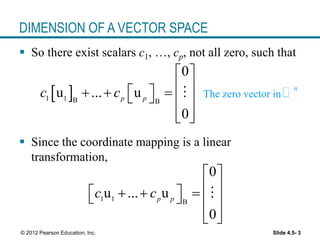
 So there exist scalars c1, …, cp, not all zero, such that
 Since the coordinate mapping is a linear
transformation,
 
1 1
0
u ... u
0
p p
c c
 
 
 
  
   
 
 
B B
The zero vector in
n
1 1
0
u ... u
0
p p
c c
 
 
 
  
   
 
 
B
Slide 4.5- 4
© 2012 Pearson Education, Inc.
DIMENSION OF A VECTOR SPACE
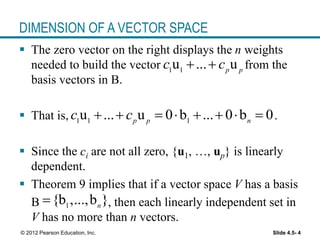
 The zero vector on the right displays the n weights
needed to build the vector from the
basis vectors in B.
 That is, .
 Since the ci are not all zero, {u1, …, up} is linearly
dependent.
 Theorem 9 implies that if a vector space V has a basis
B , then each linearly independent set in
V has no more than n vectors.
1 1
u ... u
p p
c c
 
1 1 1
u ... u 0 b ... 0 b 0
p p n
c c
       
1
{b ,...,b }
n

Slide 4.5- 5
© 2012 Pearson Education, Inc.
DIMENSION OF A VECTOR SPACE
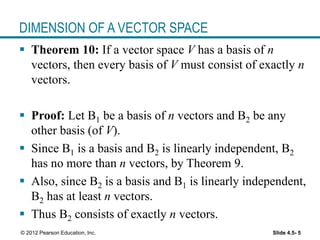
 Theorem 10: If a vector space V has a basis of n
vectors, then every basis of V must consist of exactly n
vectors.
 Proof: Let B1 be a basis of n vectors and B2 be any
other basis (of V).
 Since B1 is a basis and B2 is linearly independent, B2
has no more than n vectors, by Theorem 9.
 Also, since B2 is a basis and B1 is linearly independent,
B2 has at least n vectors.
 Thus B2 consists of exactly n vectors.
Slide 4.5- 6
© 2012 Pearson Education, Inc.
DIMENSION OF A VECTOR SPACE
 Definition: If V is spanned by a finite set, then V is
said to be finite-dimensional, and the dimension of
V, written as dim V, is the number of vectors in a
basis for V. The dimension of the zero vector space
{0} is defined to be zero. If V is not spanned by a
finite set, then V is said to be infinite-dimensional.
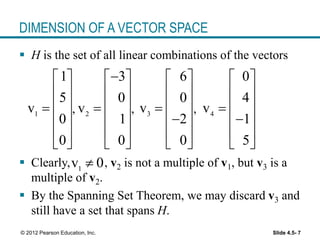
 Example 1: Find the dimension of the subspace
3 6
5 4
: , , , in
2
5
a b c
a d
H a b c d
b c d
d
 
 
 
 
 

 
 
  
 
 
 
 
 
 
 
Slide 4.5- 7
© 2012 Pearson Education, Inc.
DIMENSION OF A VECTOR SPACE
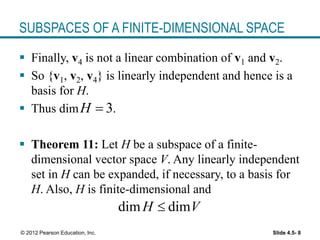
 H is the set of all linear combinations of the vectors
, , ,
 Clearly, , v2 is not a multiple of v1, but v3 is a
multiple of v2.
 By the Spanning Set Theorem, we may discard v3 and
still have a set that spans H.
1
1
5
v
0
0
 
 
 

 
 
 
2
3
0
v
1
0

 
 
 

 
 
 
3
6
0
v
2
0
 
 
 


 
 
 
4
0
4
v
1
5
 
 
 


 
 
 
1
v 0

Slide 4.5- 8
© 2012 Pearson Education, Inc.
SUBSPACES OF A FINITE-DIMENSIONAL SPACE
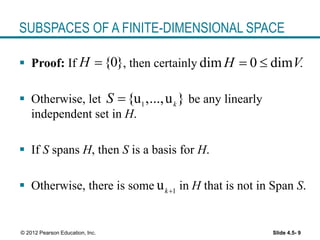
 Finally, v4 is not a linear combination of v1 and v2.
 So {v1, v2, v4} is linearly independent and hence is a
basis for H.
 Thus dim .
 Theorem 11: Let H be a subspace of a finite-
dimensional vector space V. Any linearly independent
set in H can be expanded, if necessary, to a basis for
H. Also, H is finite-dimensional and
3
H 
dim dim
H V

Slide 4.5- 9
© 2012 Pearson Education, Inc.
SUBSPACES OF A FINITE-DIMENSIONAL SPACE
 Proof: If , then certainly .
 Otherwise, let be any linearly
independent set in H.
 If S spans H, then S is a basis for H.
 Otherwise, there is some in H that is not in Span S.
{0}
H  dim 0 dim
H V
 
1
{u ,...,u }
k
S 
1
uk
Slide 4.5- 10
© 2012 Pearson Education, Inc.
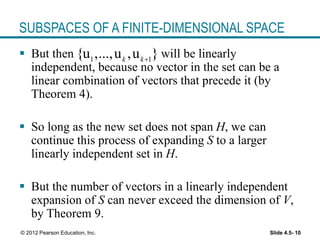
SUBSPACES OF A FINITE-DIMENSIONAL SPACE
 But then will be linearly
independent, because no vector in the set can be a
linear combination of vectors that precede it (by
Theorem 4).
 So long as the new set does not span H, we can
continue this process of expanding S to a larger
linearly independent set in H.
 But the number of vectors in a linearly independent
expansion of S can never exceed the dimension of V,
by Theorem 9.
1 1
{u ,...,u ,u }
k k
Slide 4.5- 11
© 2012 Pearson Education, Inc.
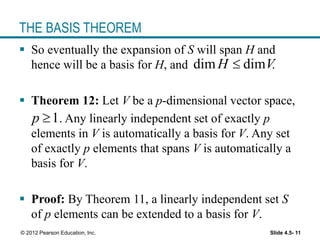
THE BASIS THEOREM
 So eventually the expansion of S will span H and
hence will be a basis for H, and .
 Theorem 12: Let V be a p-dimensional vector space,
. Any linearly independent set of exactly p
elements in V is automatically a basis for V. Any set
of exactly p elements that spans V is automatically a
basis for V.
 Proof: By Theorem 11, a linearly independent set S
of p elements can be extended to a basis for V.
dim dim
H V

1
p 
Slide 4.5- 12
© 2012 Pearson Education, Inc.
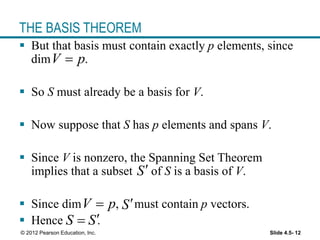
THE BASIS THEOREM
 But that basis must contain exactly p elements, since
dim .
 So S must already be a basis for V.
 Now suppose that S has p elements and spans V.
 Since V is nonzero, the Spanning Set Theorem
implies that a subset of S is a basis of V.
 Since dim , must contain p vectors.
 Hence .
V p

S
V p

S
S S

Slide 4.5- 13
© 2012 Pearson Education, Inc.
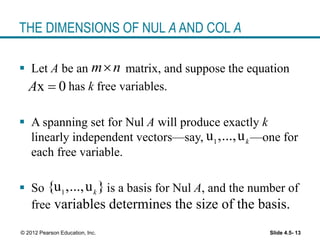
THE DIMENSIONS OF NUL A AND COL A
 Let A be an matrix, and suppose the equation
has k free variables.
 A spanning set for Nul A will produce exactly k
linearly independent vectors—say, —one for
each free variable.
 So is a basis for Nul A, and the number of
free variables determines the size of the basis.
m n

x 0
A 
1
u ,...,uk
1
{u ,...,u }
k
Slide 4.5- 14
© 2012 Pearson Education, Inc.
DIMENSIONS OF NUL A AND COL A
 Thus, the dimension of Nul A is the number of free
variables in the equation , and the dimension
of Col A is the number of pivot columns in A.
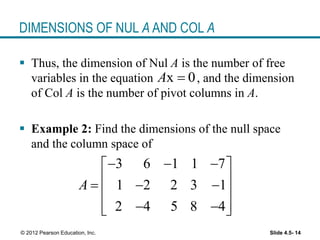
 Example 2: Find the dimensions of the null space
and the column space of
x 0
A 
3 6 1 1 7
1 2 2 3 1
2 4 5 8 4
A
  
 
 
  
 
 
 
 
Slide 4.5- 15
© 2012 Pearson Education, Inc.
DIMENSIONS OF NUL A AND COL A
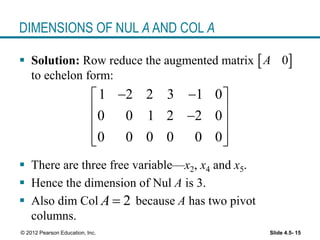
 Solution: Row reduce the augmented matrix
to echelon form:
 There are three free variable—x2, x4 and x5.
 Hence the dimension of Nul A is 3.
 Also dim Col because A has two pivot
columns.
 
0
A
1 2 2 3 1 0
0 0 1 2 2 0
0 0 0 0 0 0
 
 
 

 
 
 
2
A 

MTH285-CH4.5-lecture vector spaces and .ppt

  • 1.
    4 4.5 © 2012 PearsonEducation, Inc. Vector Spaces THE DIMENSION OF A VECTOR SPACE
  • 2.
    Slide 4.5- 2 ©2012 Pearson Education, Inc. DIMENSION OF A VECTOR SPACE  Theorem 9: If a vector space V has a basis B , then any set in V containing more than n vectors must be linearly dependent.  Proof: Let {u1, …, up} be a set in V with more than n vectors.  The coordinate vectors [u1]B, …, [up]B form a linearly dependent set in , because there are more vectors (p) than entries (n) in each vector. 1 {b ,...,b } n  n
  • 3.
    Slide 4.5- 3 ©2012 Pearson Education, Inc. DIMENSION OF A VECTOR SPACE  So there exist scalars c1, …, cp, not all zero, such that  Since the coordinate mapping is a linear transformation,   1 1 0 u ... u 0 p p c c                  B B The zero vector in n 1 1 0 u ... u 0 p p c c                  B
  • 4.
    Slide 4.5- 4 ©2012 Pearson Education, Inc. DIMENSION OF A VECTOR SPACE  The zero vector on the right displays the n weights needed to build the vector from the basis vectors in B.  That is, .  Since the ci are not all zero, {u1, …, up} is linearly dependent.  Theorem 9 implies that if a vector space V has a basis B , then each linearly independent set in V has no more than n vectors. 1 1 u ... u p p c c   1 1 1 u ... u 0 b ... 0 b 0 p p n c c         1 {b ,...,b } n 
  • 5.
    Slide 4.5- 5 ©2012 Pearson Education, Inc. DIMENSION OF A VECTOR SPACE  Theorem 10: If a vector space V has a basis of n vectors, then every basis of V must consist of exactly n vectors.  Proof: Let B1 be a basis of n vectors and B2 be any other basis (of V).  Since B1 is a basis and B2 is linearly independent, B2 has no more than n vectors, by Theorem 9.  Also, since B2 is a basis and B1 is linearly independent, B2 has at least n vectors.  Thus B2 consists of exactly n vectors.
  • 6.
    Slide 4.5- 6 ©2012 Pearson Education, Inc. DIMENSION OF A VECTOR SPACE  Definition: If V is spanned by a finite set, then V is said to be finite-dimensional, and the dimension of V, written as dim V, is the number of vectors in a basis for V. The dimension of the zero vector space {0} is defined to be zero. If V is not spanned by a finite set, then V is said to be infinite-dimensional.  Example 1: Find the dimension of the subspace 3 6 5 4 : , , , in 2 5 a b c a d H a b c d b c d d                                
  • 7.
    Slide 4.5- 7 ©2012 Pearson Education, Inc. DIMENSION OF A VECTOR SPACE  H is the set of all linear combinations of the vectors , , ,  Clearly, , v2 is not a multiple of v1, but v3 is a multiple of v2.  By the Spanning Set Theorem, we may discard v3 and still have a set that spans H. 1 1 5 v 0 0              2 3 0 v 1 0               3 6 0 v 2 0               4 0 4 v 1 5               1 v 0 
  • 8.
    Slide 4.5- 8 ©2012 Pearson Education, Inc. SUBSPACES OF A FINITE-DIMENSIONAL SPACE  Finally, v4 is not a linear combination of v1 and v2.  So {v1, v2, v4} is linearly independent and hence is a basis for H.  Thus dim .  Theorem 11: Let H be a subspace of a finite- dimensional vector space V. Any linearly independent set in H can be expanded, if necessary, to a basis for H. Also, H is finite-dimensional and 3 H  dim dim H V 
  • 9.
    Slide 4.5- 9 ©2012 Pearson Education, Inc. SUBSPACES OF A FINITE-DIMENSIONAL SPACE  Proof: If , then certainly .  Otherwise, let be any linearly independent set in H.  If S spans H, then S is a basis for H.  Otherwise, there is some in H that is not in Span S. {0} H  dim 0 dim H V   1 {u ,...,u } k S  1 uk
  • 10.
    Slide 4.5- 10 ©2012 Pearson Education, Inc. SUBSPACES OF A FINITE-DIMENSIONAL SPACE  But then will be linearly independent, because no vector in the set can be a linear combination of vectors that precede it (by Theorem 4).  So long as the new set does not span H, we can continue this process of expanding S to a larger linearly independent set in H.  But the number of vectors in a linearly independent expansion of S can never exceed the dimension of V, by Theorem 9. 1 1 {u ,...,u ,u } k k
  • 11.
    Slide 4.5- 11 ©2012 Pearson Education, Inc. THE BASIS THEOREM  So eventually the expansion of S will span H and hence will be a basis for H, and .  Theorem 12: Let V be a p-dimensional vector space, . Any linearly independent set of exactly p elements in V is automatically a basis for V. Any set of exactly p elements that spans V is automatically a basis for V.  Proof: By Theorem 11, a linearly independent set S of p elements can be extended to a basis for V. dim dim H V  1 p 
  • 12.
    Slide 4.5- 12 ©2012 Pearson Education, Inc. THE BASIS THEOREM  But that basis must contain exactly p elements, since dim .  So S must already be a basis for V.  Now suppose that S has p elements and spans V.  Since V is nonzero, the Spanning Set Theorem implies that a subset of S is a basis of V.  Since dim , must contain p vectors.  Hence . V p  S V p  S S S 
  • 13.
    Slide 4.5- 13 ©2012 Pearson Education, Inc. THE DIMENSIONS OF NUL A AND COL A  Let A be an matrix, and suppose the equation has k free variables.  A spanning set for Nul A will produce exactly k linearly independent vectors—say, —one for each free variable.  So is a basis for Nul A, and the number of free variables determines the size of the basis. m n  x 0 A  1 u ,...,uk 1 {u ,...,u } k
  • 14.
    Slide 4.5- 14 ©2012 Pearson Education, Inc. DIMENSIONS OF NUL A AND COL A  Thus, the dimension of Nul A is the number of free variables in the equation , and the dimension of Col A is the number of pivot columns in A.  Example 2: Find the dimensions of the null space and the column space of x 0 A  3 6 1 1 7 1 2 2 3 1 2 4 5 8 4 A                  
  • 15.
    Slide 4.5- 15 ©2012 Pearson Education, Inc. DIMENSIONS OF NUL A AND COL A  Solution: Row reduce the augmented matrix to echelon form:  There are three free variable—x2, x4 and x5.  Hence the dimension of Nul A is 3.  Also dim Col because A has two pivot columns.   0 A 1 2 2 3 1 0 0 0 1 2 2 0 0 0 0 0 0 0              2 A 