Vector Graphics2.01 Investigate graphic image design.
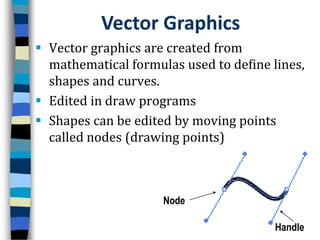
NodeHandleVector GraphicsVector graphics are created from  mathematical formulas used to define lines, shapes and curves. Edited in draw programs Shapes can be edited by moving points called nodes (drawing points)
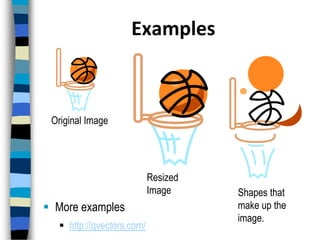
Shapes that make up the image.Original ImageResized ImageExamplesMore exampleshttp://qvectors.com/
Uses of Vector GraphicsGraphics that will be scaled (or resized) Architectural drawings and CAD programsFlow chartsLogos that will be scaled (resized)Cartoons and clip artGraphics on websitesBecause they have very small file sizes.This allows them to load quickly.Fonts and specialized text effects
Advantages of VectorsResolution IndependentRegardless of how much the image is enlarged or reduced, the image definition and quality remain the same.Small File SizesEasily transferred over the Internet.
Disadvantages of VectorsLower color quality than raster images.They do not support as many colors.Not good for photographic images.Click to see an example.
Popular Vector Graphic SoftwareXara XtremeAdobe IllustratorCorelDrawInkscape – open source software similar to Adobe Illustrator.
Common Vector File FormatsAI – Adobe Illustrator Industry standard used by developers of vector graphics.Used to create, save, and archive original artwork.EPS – Encapsulated Postscript Meta GraphicGraphics developers generally save a copy of the AI file in EPS format because it can be opened by computers running different operating systems.Preferred format for vendors/clients  who use the graphics in publications due to its portability.
Meta GraphicsCan contain vector and raster data.Shapes in vector graphics can be filled with textures and patterns that are raster graphics.Useful when layering text on top of raster graphics.ExamplesWMF – Windows MetafileEPS – Encapsulated Postscript
More Vector Formats SVG – Scalable Vector Graphics Standard format created by W3C Versatile, all-purpose vector formatPLT – Hewlett Packard Graphics Language Plot FileCDR – Corel DrawDXF – AutoCADWMF – Windows Metafile

Vector graphics

  • 1.
    Vector Graphics2.01 Investigategraphic image design.
  • 2.
    NodeHandleVector GraphicsVector graphicsare created from mathematical formulas used to define lines, shapes and curves. Edited in draw programs Shapes can be edited by moving points called nodes (drawing points)
  • 3.
    Shapes that makeup the image.Original ImageResized ImageExamplesMore exampleshttp://qvectors.com/
  • 4.
    Uses of VectorGraphicsGraphics that will be scaled (or resized) Architectural drawings and CAD programsFlow chartsLogos that will be scaled (resized)Cartoons and clip artGraphics on websitesBecause they have very small file sizes.This allows them to load quickly.Fonts and specialized text effects
  • 5.
    Advantages of VectorsResolutionIndependentRegardless of how much the image is enlarged or reduced, the image definition and quality remain the same.Small File SizesEasily transferred over the Internet.
  • 6.
    Disadvantages of VectorsLowercolor quality than raster images.They do not support as many colors.Not good for photographic images.Click to see an example.
  • 7.
    Popular Vector GraphicSoftwareXara XtremeAdobe IllustratorCorelDrawInkscape – open source software similar to Adobe Illustrator.
  • 8.
    Common Vector FileFormatsAI – Adobe Illustrator Industry standard used by developers of vector graphics.Used to create, save, and archive original artwork.EPS – Encapsulated Postscript Meta GraphicGraphics developers generally save a copy of the AI file in EPS format because it can be opened by computers running different operating systems.Preferred format for vendors/clients who use the graphics in publications due to its portability.
  • 9.
    Meta GraphicsCan containvector and raster data.Shapes in vector graphics can be filled with textures and patterns that are raster graphics.Useful when layering text on top of raster graphics.ExamplesWMF – Windows MetafileEPS – Encapsulated Postscript
  • 10.
    More Vector FormatsSVG – Scalable Vector Graphics Standard format created by W3C Versatile, all-purpose vector formatPLT – Hewlett Packard Graphics Language Plot FileCDR – Corel DrawDXF – AutoCADWMF – Windows Metafile

Editor's Notes

  • #4 Teacher Note: This is a vector graphic (WMF) from the clipart files in Microsoft PowerPoint. Notice that the image does not become pixelated when it is resized, it retains the original quality.To break the image down into its individual parts:Click on the image.On the Draw toolbar, click on Ungroup.Click Yes in the Dialog box.Click Draw, Ungroup again.Now the individual shapes can be moved and manipulated. For a fun activity, allow students to experiment with ungrouping an image and re-coloring it. Be sure they Regroup it before trying to move it, though. If they don’t regroup, they will only move pieces of the image instead of the entire image.
  • #7 Teacher Note: Emphasize to the students the much better quality of the raster graphic because it is made up of pixels which can show much more detail than lines.Hyperlink opens this URL: http://alabamamaps.ua.edu/tutorial/example1.html