

VCE
Environmental
Science
Teachers PD November 2013
Britt Gow
Agenda
9.00am Welcome & housekeeping - Sarah
9.15am Resources – Teacher‟s handbook Launch
9.30am

Introductions – on the Padlet Walll

10.00am

Exploring Units 1 to 4 - Study design

10.30am

Morning tea

11.00am

Continue exploring Units 1 to 4 - Outcomes

12.00pm

Developing a schedule and SACs for Units 1 & 3

1.00pm

Lunch

1.30pm
2.55pm

Exam , laboratory experiments, fieldwork and
excursions
Reflections & Farewell
An update from VAEE
 USB resources

 Trial exams and support for 2014
- VCE ES Conference
- Preparing for Unit 2 & 4
- Revision lecture

 Launch of “Issues of Sustainability”
Teacher Resource Book
More Resources….
 VAEE website and teacher‟s email
network (freelist)

 FUSE Ebookboxes
 VCE Environmental Science blog
 “Envirostudy” app for mobile devices
(IOS and android)
Introductions….
 Go to the VCE Environmental Science blog at
http://vceenviroscience.edublogs.org

 Access the Padlet wall and introduce yourself
 Name and school, Units 1/2 or 3/4 or both?
 Experience teaching Environmental Science
 What do you hope to get out of today?
Exploring Units 1-4
 Assessment

 Case Studies
 An overview of the outcomes
 Course outline - School
Assessed Coursework (where,
when, how?)
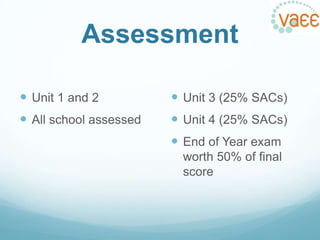
Assessment
 Unit 1 and 2

 Unit 3 (25% SACs)

 All school assessed

 Unit 4 (25% SACs)

 End of Year exam
worth 50% of final
score
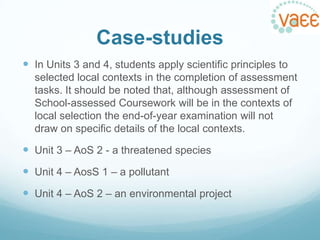
Case-studies
 In Units 3 and 4, students apply scientific principles to
selected local contexts in the completion of assessment
tasks. It should be noted that, although assessment of
School-assessed Coursework will be in the contexts of
local selection the end-of-year examination will not
draw on specific details of the local contexts.

 Unit 3 – AoS 2 - a threatened species
 Unit 4 – AosS 1 – a pollutant
 Unit 4 – AoS 2 – an environmental project
Unit 1 – The Environment
AOS 1 – Ecological components &
interactions
Outcome 1
“On completion of this unit the student should be able to
identify and describe the components and natural
processes within the environment.”
Unit 1 – The Environment
AOS 2 – Environmental Change
Outcome 2
“On completion of this unit the student should be able to
analyse one human-induced environmental change and
options for remediation.”
Unit 1 – The Environment
AOS 3 – Ecosystems
Outcome 3
“On completion of this unit the student should be able
explain the flow of energy, nutrient exchange and
environmental changes in ecosystems.”
Unit 2 – Monitoring the
environment
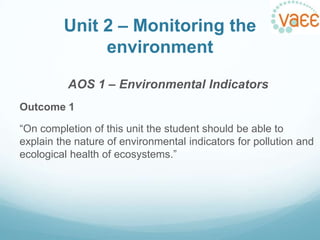
AOS 1 – Environmental Indicators
Outcome 1
“On completion of this unit the student should be able to
explain the nature of environmental indicators for pollution and
ecological health of ecosystems.”
Unit 2 – Monitoring the
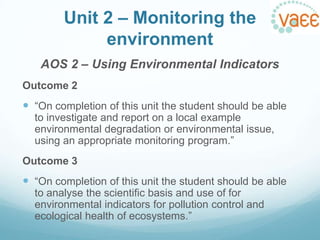
environment
AOS 2 – Using Environmental Indicators
Outcome 2

 “On completion of this unit the student should be able
to investigate and report on a local example
environmental degradation or environmental issue,
using an appropriate monitoring program.”
Outcome 3

 “On completion of this unit the student should be able
to analyse the scientific basis and use of for
environmental indicators for pollution control and
ecological health of ecosystems.”
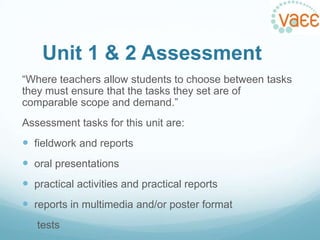
Unit 1 & 2 Assessment
“Where teachers allow students to choose between tasks
they must ensure that the tasks they set are of
comparable scope and demand.”

Assessment tasks for this unit are:

 fieldwork and reports
 oral presentations

 practical activities and practical reports
 reports in multimedia and/or poster format
 tests
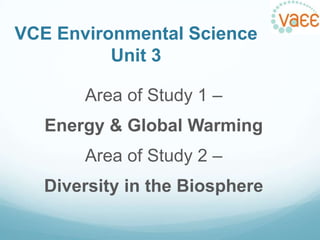
VCE Environmental Science
Unit 3
Area of Study 1 –

Energy & Global Warming
Area of Study 2 –

Diversity in the Biosphere
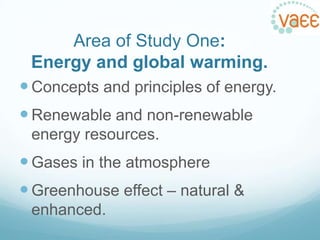
Area of Study One:
Energy and global warming.
 Concepts and principles of energy.
 Renewable and non-renewable
energy resources.

 Gases in the atmosphere

 Greenhouse effect – natural &
enhanced.
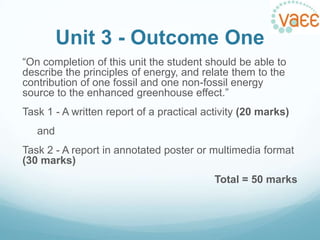
Unit 3 - Outcome One
“On completion of this unit the student should be able to
describe the principles of energy, and relate them to the
contribution of one fossil and one non-fossil energy
source to the enhanced greenhouse effect.”
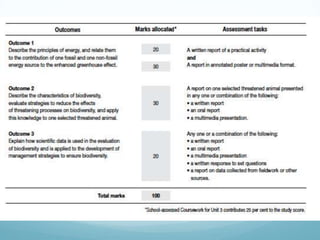
Task 1 - A written report of a practical activity (20 marks)
and
Task 2 - A report in annotated poster or multimedia format
(30 marks)
Total = 50 marks
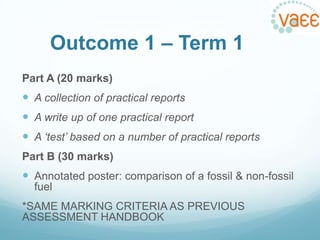
Outcome 1 – Term 1
Part A (20 marks)

 A collection of practical reports
 A write up of one practical report
 A ‘test’ based on a number of practical reports
Part B (30 marks)

 Annotated poster: comparison of a fossil & non-fossil
fuel
*SAME MARKING CRITERIA AS PREVIOUS
ASSESSMENT HANDBOOK
Unit 3 - Energy resources
You must be able to compare your non-renewable energy
resource with your renewable energy resource:

 accessibility and provision to meet energy needs
 energy conversions required
 efficiency of energy conversions
 environmental impact of extraction, conversion,
distribution and use on the environment and society
How can both resources meet the energy needs of a town
with reference to specific geographic location?
Q2 (c) Describe how the fossil energy source named in part b. is used
to meet the need of a specific geographic location, city or region. You
should include advantages and disadvantages of this energy source
for the particular application. (4 marks)
•
•

•
•

Melbourne is the capital city of Victoria with an estimated population
of 3 million people (1m).
Melbourne‟s energy needs are very demanding especially during
peak loads when energy demands are at their highest. Industry,
lighting, heating and transport are the main energy requirements
needed for Melbourne. Coal already does supply and cope with both
the base and peak loads in Melbourne (1m).
An advantage associated with coal is that it is accessible, cheap to
use and is widely available within Australia (1m)
A disadvantage associated with coal use is that is produces large
amounts of carbon dioxide emissions hence contributing to the
enhanced greenhouse effect (1m).
Typical exam question for Unit 3 – Area of Study 1
Q2 (d) Describe how the non-fossil energy source named in part b. is used
to meet the need of a specific geographic location, city or region. You
should include advantages and disadvantages of this energy source for the
particular application.
(4 marks)
Toora is located approximately 150km east of Melbourne in Gippsland.
(1m) Due to a small population the energy needs of the town are
relatively small. The general needs for energy are for heating, lighting,
farming and transport. The Toora wind farm currently supplies 6,600
homes with energy so could meet the supply needs of Toora and
surrounding Gippsland towns with energy. (1m) Wind farming is
associated with many advantages however, the biggest would be the
fact no greenhouse gas emissions are produced (1m). One main
disadvantage is the fact that wind farming relies on a constant supply of
wind and this is not always the case (1m).
Area of Study Two:
Diversity in the Biosphere
 Biodiversity
 Biodiversity management
Unit 3 - Area of Study Two:
Diversity in the Biosphere
 Types of…
 Value of...

 Conservation categories….
 Assessment of…

 Threats to…
Unit 3 – AoS 2 - Outcome 2
“On completion of this unit the student should be able to
describe the characteristics of biodiversity, evaluate strategies
to reduce the effects of threatening processes on biodiversity,
and apply this knowledge to one selected threatened animal.”
Task worth 30 marks:

 A report on one selected threatened animal presented in
any one or combination of the following:

 a written report
 an oral report
 a multimedia presentation.
Unit 3 – AoS 2 - Outcome 3
“Explain how scientific data is used in the evaluation of biodiversity
and is applied to the development of management strategies to
ensure biodiversity.”
Task/s worth 20 marks Any one or a combination of the following:

 a written or oral report
 a multimedia presentation
 a written response to set questions
 a report on data collected from fieldwork or other sources.
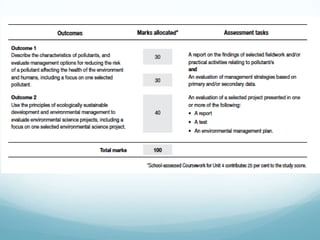
Unit 4 AoS 1: Pollution and health
Outcome 1: Describe the characteristics of pollutants, and
evaluate management options for reducing the risk of a
pollutant affecting the health of the environment and humans.
Task 1: A report on the findings of selected fieldwork and/or
practical activities relating to pollutant/s (30 marks)
Task 2: An evaluation of management strategies [of the
selected pollutant] based on primary and/or secondary data.
(30 marks)

Total = 60 marks
Useful Websites
• National Pollutants Inventory http://www.npi.gov.au/data/index.html

• Environmental Protection Authority –
http://www.epa.vic.gov.au/

• Urban Air Quality –
http://www.enviroliteracy.org/article.php/1283.html

• Water Quality http://www.enviroliteracy.org/subcategory.php/43.html

• Environmental Health http://www.enviroliteracy.org/subcategory.php/170.html
SACs for Unit 4 - AoS 2:
Applied environmental science
Outcome 2
Use the principles of ecologically sustainable development and
environmental management to evaluate environmental science
projects, including a focus on one selected environmental
science project.
Task 1 (20 marks) - A report or a test

and

Task 2 (20 marks) –
A report or an environmental management plan.
Total = 40 marks
Unit 4 - AoS 2 - Outcome 2
 Sewerage treatment plant upgrade
 Freeway development
 Energy efficiency improvements in a factory
 Co-generation plant
 Mining rehabilitation

 Waste minimisation and management
 Water treatment plant
Unit 3/4 Possible Timeline…
 Term 1 – Unit 3 Area of Study 1
- Energy principles (4 weeks) and Greenhouse Effect (4weeks)
- Introduce AoS 2 last week of term

 Term 2 – Unit 3 Area of Study 2
- Biodiversity (4 weeks) and management (4 weeks)
- Introduce Unit 4 AoS 1 (pollution & health) last 2 weeks of term

• Term 3 – Unit 4 Area of study 1 and 2
- Pollution & health (5 weeks)
- Applied Environmental Science (5 weeks)
• Term 4 – Finish Area of study two/ revision
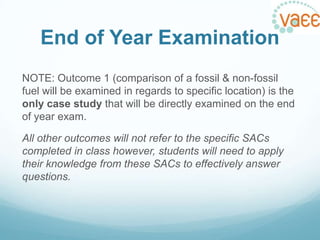
End of Year Examination
NOTE: Outcome 1 (comparison of a fossil & non-fossil
fuel will be examined in regards to specific location) is the
only case study that will be directly examined on the end
of year exam.
All other outcomes will not refer to the specific SACs
completed in class however, students will need to apply
their knowledge from these SACs to effectively answer
questions.
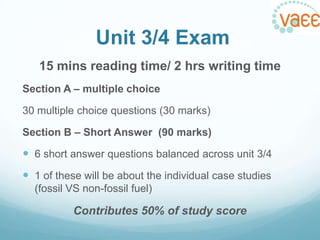
Unit 3/4 Exam
15 mins reading time/ 2 hrs writing time
Section A – multiple choice
30 multiple choice questions (30 marks)
Section B – Short Answer (90 marks)

 6 short answer questions balanced across unit 3/4
 1 of these will be about the individual case studies
(fossil VS non-fossil fuel)

Contributes 50% of study score
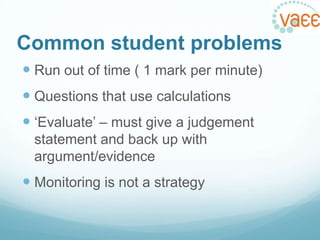
Common student problems
 Run out of time ( 1 mark per minute)
 Questions that use calculations
 „Evaluate‟ – must give a judgement
statement and back up with
argument/evidence

 Monitoring is not a strategy
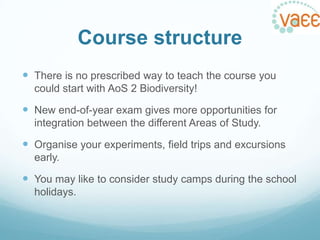
Course structure
 There is no prescribed way to teach the course you
could start with AoS 2 Biodiversity!

 New end-of-year exam gives more opportunities for
integration between the different Areas of Study.

 Organise your experiments, field trips and excursions
early.

 You may like to consider study camps during the school
holidays.
Laboratory Experiments
 Exothermic and endothermic

 Student Power
 Energy in candle wax
 Insulation investigation
 Effects of Sulphur dioxide
Excursions and Field Work
 Ecolinc

 Melbourne Water, Local Water Authority
 Melbourne, Healesville and Werribee Zoos
 Royal Botanic Gardens
 Toolangi
 Mt Rothwell Sanctuary
Good luck &
Use the VAEE VCE teachers
network for support!

brittgow@gmail.com

Introduction to VCE Environmental Science - Teacher's PD

  • 1.
  • 2.
    Agenda 9.00am Welcome &housekeeping - Sarah 9.15am Resources – Teacher‟s handbook Launch 9.30am Introductions – on the Padlet Walll 10.00am Exploring Units 1 to 4 - Study design 10.30am Morning tea 11.00am Continue exploring Units 1 to 4 - Outcomes 12.00pm Developing a schedule and SACs for Units 1 & 3 1.00pm Lunch 1.30pm 2.55pm Exam , laboratory experiments, fieldwork and excursions Reflections & Farewell
  • 3.
    An update fromVAEE  USB resources  Trial exams and support for 2014 - VCE ES Conference - Preparing for Unit 2 & 4 - Revision lecture  Launch of “Issues of Sustainability” Teacher Resource Book
  • 4.
    More Resources….  VAEEwebsite and teacher‟s email network (freelist)  FUSE Ebookboxes  VCE Environmental Science blog  “Envirostudy” app for mobile devices (IOS and android)
  • 5.
    Introductions….  Go tothe VCE Environmental Science blog at http://vceenviroscience.edublogs.org  Access the Padlet wall and introduce yourself  Name and school, Units 1/2 or 3/4 or both?  Experience teaching Environmental Science  What do you hope to get out of today?
  • 7.
    Exploring Units 1-4 Assessment  Case Studies  An overview of the outcomes  Course outline - School Assessed Coursework (where, when, how?)
  • 8.
    Assessment  Unit 1and 2  Unit 3 (25% SACs)  All school assessed  Unit 4 (25% SACs)  End of Year exam worth 50% of final score
  • 9.
    Case-studies  In Units3 and 4, students apply scientific principles to selected local contexts in the completion of assessment tasks. It should be noted that, although assessment of School-assessed Coursework will be in the contexts of local selection the end-of-year examination will not draw on specific details of the local contexts.  Unit 3 – AoS 2 - a threatened species  Unit 4 – AosS 1 – a pollutant  Unit 4 – AoS 2 – an environmental project
  • 10.
    Unit 1 –The Environment AOS 1 – Ecological components & interactions Outcome 1 “On completion of this unit the student should be able to identify and describe the components and natural processes within the environment.”
  • 11.
    Unit 1 –The Environment AOS 2 – Environmental Change Outcome 2 “On completion of this unit the student should be able to analyse one human-induced environmental change and options for remediation.”
  • 12.
    Unit 1 –The Environment AOS 3 – Ecosystems Outcome 3 “On completion of this unit the student should be able explain the flow of energy, nutrient exchange and environmental changes in ecosystems.”
  • 13.
    Unit 2 –Monitoring the environment AOS 1 – Environmental Indicators Outcome 1 “On completion of this unit the student should be able to explain the nature of environmental indicators for pollution and ecological health of ecosystems.”
  • 14.
    Unit 2 –Monitoring the environment AOS 2 – Using Environmental Indicators Outcome 2  “On completion of this unit the student should be able to investigate and report on a local example environmental degradation or environmental issue, using an appropriate monitoring program.” Outcome 3  “On completion of this unit the student should be able to analyse the scientific basis and use of for environmental indicators for pollution control and ecological health of ecosystems.”
  • 15.
    Unit 1 &2 Assessment “Where teachers allow students to choose between tasks they must ensure that the tasks they set are of comparable scope and demand.” Assessment tasks for this unit are:  fieldwork and reports  oral presentations  practical activities and practical reports  reports in multimedia and/or poster format  tests
  • 16.
    VCE Environmental Science Unit3 Area of Study 1 – Energy & Global Warming Area of Study 2 – Diversity in the Biosphere
  • 17.
    Area of StudyOne: Energy and global warming.  Concepts and principles of energy.  Renewable and non-renewable energy resources.  Gases in the atmosphere  Greenhouse effect – natural & enhanced.
  • 18.
    Unit 3 -Outcome One “On completion of this unit the student should be able to describe the principles of energy, and relate them to the contribution of one fossil and one non-fossil energy source to the enhanced greenhouse effect.” Task 1 - A written report of a practical activity (20 marks) and Task 2 - A report in annotated poster or multimedia format (30 marks) Total = 50 marks
  • 19.
    Outcome 1 –Term 1 Part A (20 marks)  A collection of practical reports  A write up of one practical report  A ‘test’ based on a number of practical reports Part B (30 marks)  Annotated poster: comparison of a fossil & non-fossil fuel *SAME MARKING CRITERIA AS PREVIOUS ASSESSMENT HANDBOOK
  • 22.
    Unit 3 -Energy resources You must be able to compare your non-renewable energy resource with your renewable energy resource:  accessibility and provision to meet energy needs  energy conversions required  efficiency of energy conversions  environmental impact of extraction, conversion, distribution and use on the environment and society How can both resources meet the energy needs of a town with reference to specific geographic location?
  • 23.
    Q2 (c) Describehow the fossil energy source named in part b. is used to meet the need of a specific geographic location, city or region. You should include advantages and disadvantages of this energy source for the particular application. (4 marks) • • • • Melbourne is the capital city of Victoria with an estimated population of 3 million people (1m). Melbourne‟s energy needs are very demanding especially during peak loads when energy demands are at their highest. Industry, lighting, heating and transport are the main energy requirements needed for Melbourne. Coal already does supply and cope with both the base and peak loads in Melbourne (1m). An advantage associated with coal is that it is accessible, cheap to use and is widely available within Australia (1m) A disadvantage associated with coal use is that is produces large amounts of carbon dioxide emissions hence contributing to the enhanced greenhouse effect (1m).
  • 24.
    Typical exam questionfor Unit 3 – Area of Study 1 Q2 (d) Describe how the non-fossil energy source named in part b. is used to meet the need of a specific geographic location, city or region. You should include advantages and disadvantages of this energy source for the particular application. (4 marks) Toora is located approximately 150km east of Melbourne in Gippsland. (1m) Due to a small population the energy needs of the town are relatively small. The general needs for energy are for heating, lighting, farming and transport. The Toora wind farm currently supplies 6,600 homes with energy so could meet the supply needs of Toora and surrounding Gippsland towns with energy. (1m) Wind farming is associated with many advantages however, the biggest would be the fact no greenhouse gas emissions are produced (1m). One main disadvantage is the fact that wind farming relies on a constant supply of wind and this is not always the case (1m).
  • 25.
    Area of StudyTwo: Diversity in the Biosphere  Biodiversity  Biodiversity management
  • 26.
    Unit 3 -Area of Study Two: Diversity in the Biosphere  Types of…  Value of...  Conservation categories….  Assessment of…  Threats to…
  • 27.
    Unit 3 –AoS 2 - Outcome 2 “On completion of this unit the student should be able to describe the characteristics of biodiversity, evaluate strategies to reduce the effects of threatening processes on biodiversity, and apply this knowledge to one selected threatened animal.” Task worth 30 marks:  A report on one selected threatened animal presented in any one or combination of the following:  a written report  an oral report  a multimedia presentation.
  • 28.
    Unit 3 –AoS 2 - Outcome 3 “Explain how scientific data is used in the evaluation of biodiversity and is applied to the development of management strategies to ensure biodiversity.” Task/s worth 20 marks Any one or a combination of the following:  a written or oral report  a multimedia presentation  a written response to set questions  a report on data collected from fieldwork or other sources.
  • 29.
    Unit 4 AoS1: Pollution and health Outcome 1: Describe the characteristics of pollutants, and evaluate management options for reducing the risk of a pollutant affecting the health of the environment and humans. Task 1: A report on the findings of selected fieldwork and/or practical activities relating to pollutant/s (30 marks) Task 2: An evaluation of management strategies [of the selected pollutant] based on primary and/or secondary data. (30 marks) Total = 60 marks
  • 30.
    Useful Websites • NationalPollutants Inventory http://www.npi.gov.au/data/index.html • Environmental Protection Authority – http://www.epa.vic.gov.au/ • Urban Air Quality – http://www.enviroliteracy.org/article.php/1283.html • Water Quality http://www.enviroliteracy.org/subcategory.php/43.html • Environmental Health http://www.enviroliteracy.org/subcategory.php/170.html
  • 31.
    SACs for Unit4 - AoS 2: Applied environmental science Outcome 2 Use the principles of ecologically sustainable development and environmental management to evaluate environmental science projects, including a focus on one selected environmental science project. Task 1 (20 marks) - A report or a test and Task 2 (20 marks) – A report or an environmental management plan. Total = 40 marks
  • 32.
    Unit 4 -AoS 2 - Outcome 2  Sewerage treatment plant upgrade  Freeway development  Energy efficiency improvements in a factory  Co-generation plant  Mining rehabilitation  Waste minimisation and management  Water treatment plant
  • 33.
    Unit 3/4 PossibleTimeline…  Term 1 – Unit 3 Area of Study 1 - Energy principles (4 weeks) and Greenhouse Effect (4weeks) - Introduce AoS 2 last week of term  Term 2 – Unit 3 Area of Study 2 - Biodiversity (4 weeks) and management (4 weeks) - Introduce Unit 4 AoS 1 (pollution & health) last 2 weeks of term • Term 3 – Unit 4 Area of study 1 and 2 - Pollution & health (5 weeks) - Applied Environmental Science (5 weeks) • Term 4 – Finish Area of study two/ revision
  • 35.
    End of YearExamination NOTE: Outcome 1 (comparison of a fossil & non-fossil fuel will be examined in regards to specific location) is the only case study that will be directly examined on the end of year exam. All other outcomes will not refer to the specific SACs completed in class however, students will need to apply their knowledge from these SACs to effectively answer questions.
  • 36.
    Unit 3/4 Exam 15mins reading time/ 2 hrs writing time Section A – multiple choice 30 multiple choice questions (30 marks) Section B – Short Answer (90 marks)  6 short answer questions balanced across unit 3/4  1 of these will be about the individual case studies (fossil VS non-fossil fuel) Contributes 50% of study score
  • 37.
    Common student problems Run out of time ( 1 mark per minute)  Questions that use calculations  „Evaluate‟ – must give a judgement statement and back up with argument/evidence  Monitoring is not a strategy
  • 38.
    Course structure  Thereis no prescribed way to teach the course you could start with AoS 2 Biodiversity!  New end-of-year exam gives more opportunities for integration between the different Areas of Study.  Organise your experiments, field trips and excursions early.  You may like to consider study camps during the school holidays.
  • 39.
    Laboratory Experiments  Exothermicand endothermic  Student Power  Energy in candle wax  Insulation investigation  Effects of Sulphur dioxide
  • 40.
    Excursions and FieldWork  Ecolinc  Melbourne Water, Local Water Authority  Melbourne, Healesville and Werribee Zoos  Royal Botanic Gardens  Toolangi  Mt Rothwell Sanctuary
  • 41.
    Good luck & Usethe VAEE VCE teachers network for support! brittgow@gmail.com