第2部 応用編①
WMI による Windows Server の 監視
                       マ゗クロソフト株式会社
                            エバンジェリスト
                                   安納 順一
          http://blogs.technet.com/junichia/

                                               1
本日の目的
 WMIを使用して
     Windows Server を監視する方法を学びます

 ※今回は VBScript を使用します

   WMIとは何か?
   WMIを使用したスクリプト作成の基礎
   WMIを使用した゗ベントの待ち合わせ
   WMIを使用した永続的監視の実装
  スクリプトの奥深さに感動していただけるはずです


                                   2
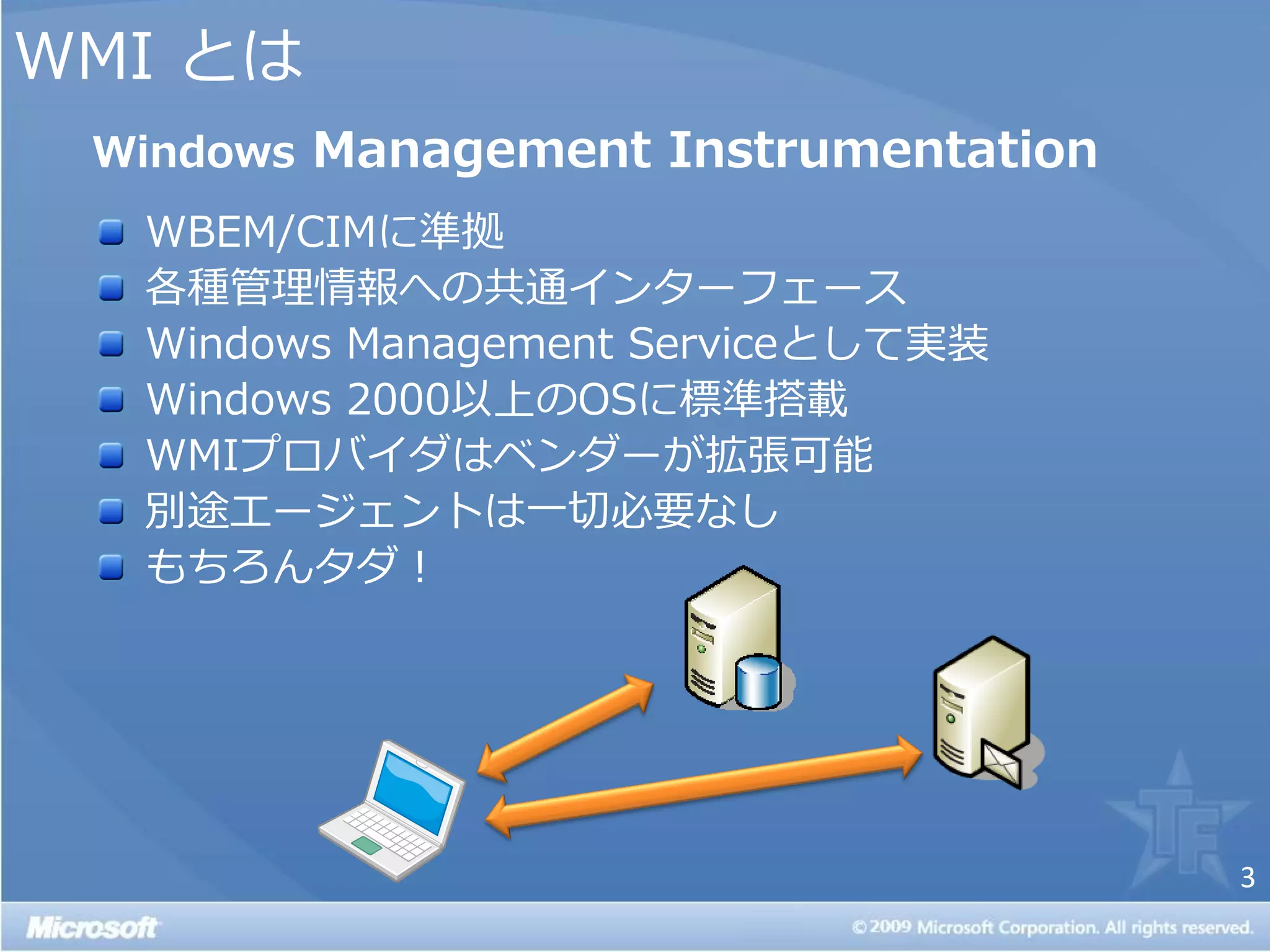
WMI とは
 Windows Management Instrumentation
  WBEM/CIMに準拠
  各種管理情報への共通゗ンターフェース
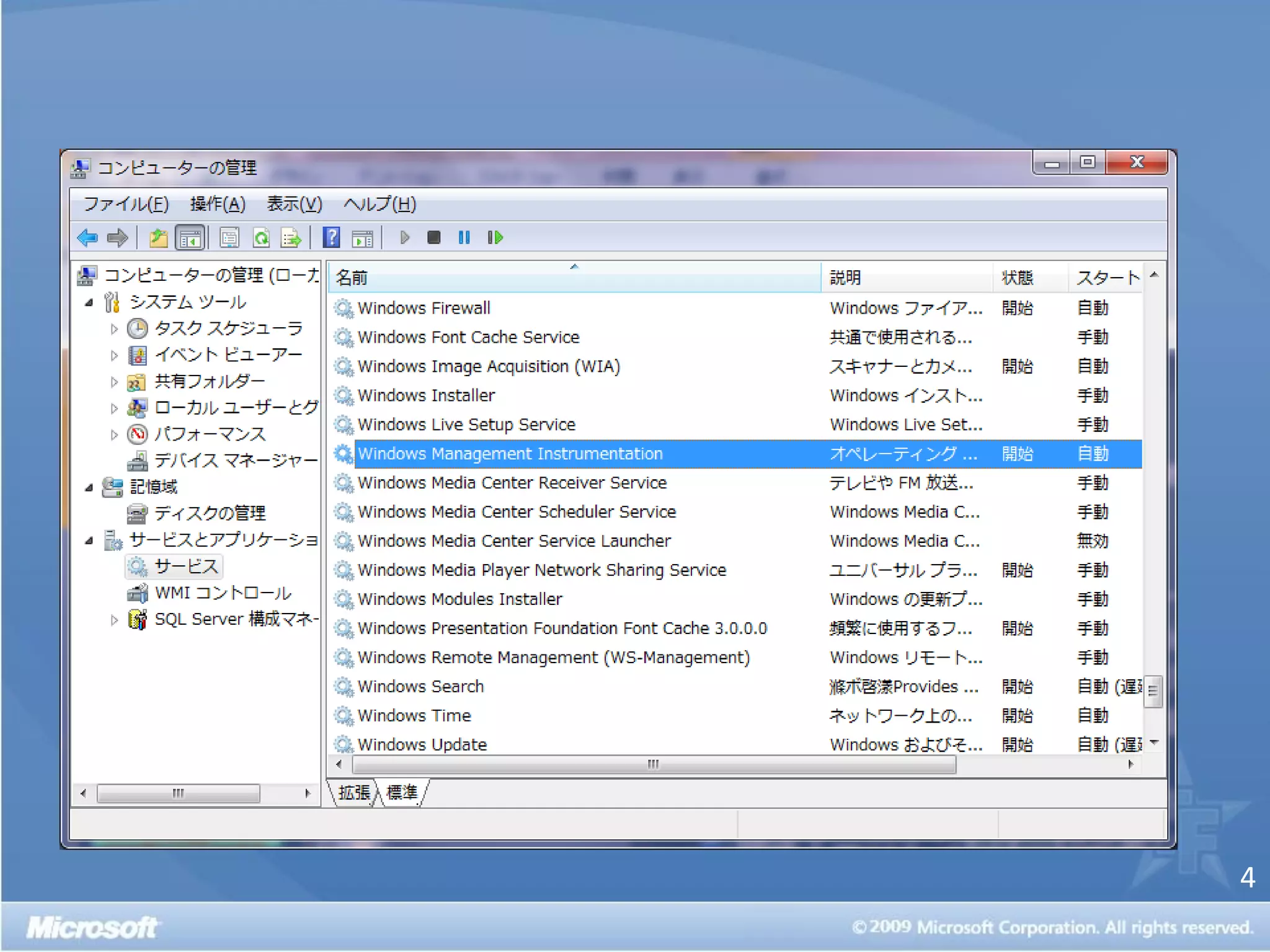
  Windows Management Serviceとして実装
  Windows 2000以上のOSに標準搭載
  WMIプロバ゗ダはベンダーが拡張可能
  別途エージェントは一切必要なし
  もちろんタダ!


                                      3
4
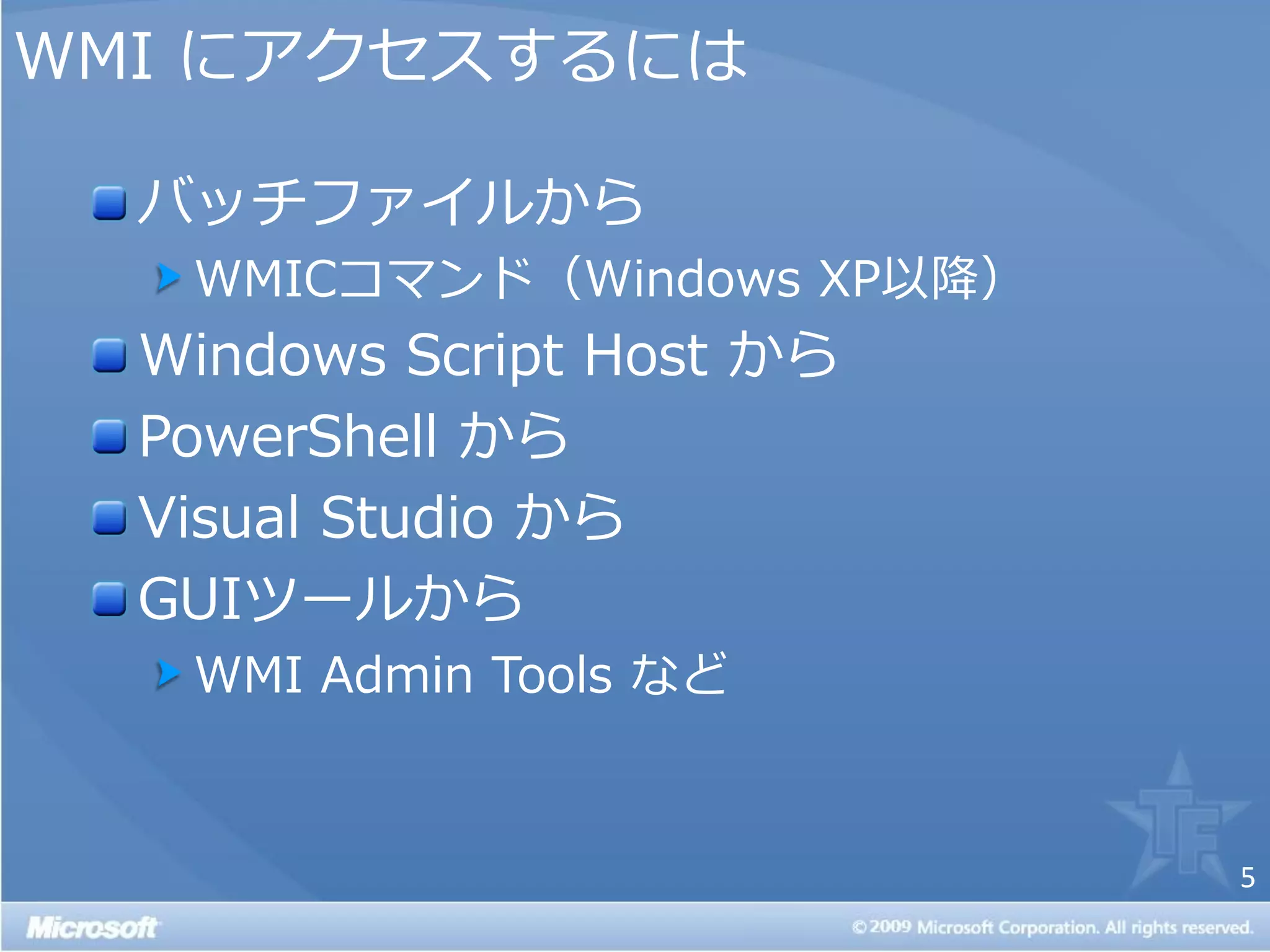
WMI にゕクセスするには

  バッチフゔ゗ルから
   WMICコマンド(Windows XP以降)
  Windows Script Host から
  PowerShell から
  Visual Studio から
  GUIツールから
   WMI Admin Tools など


                            5
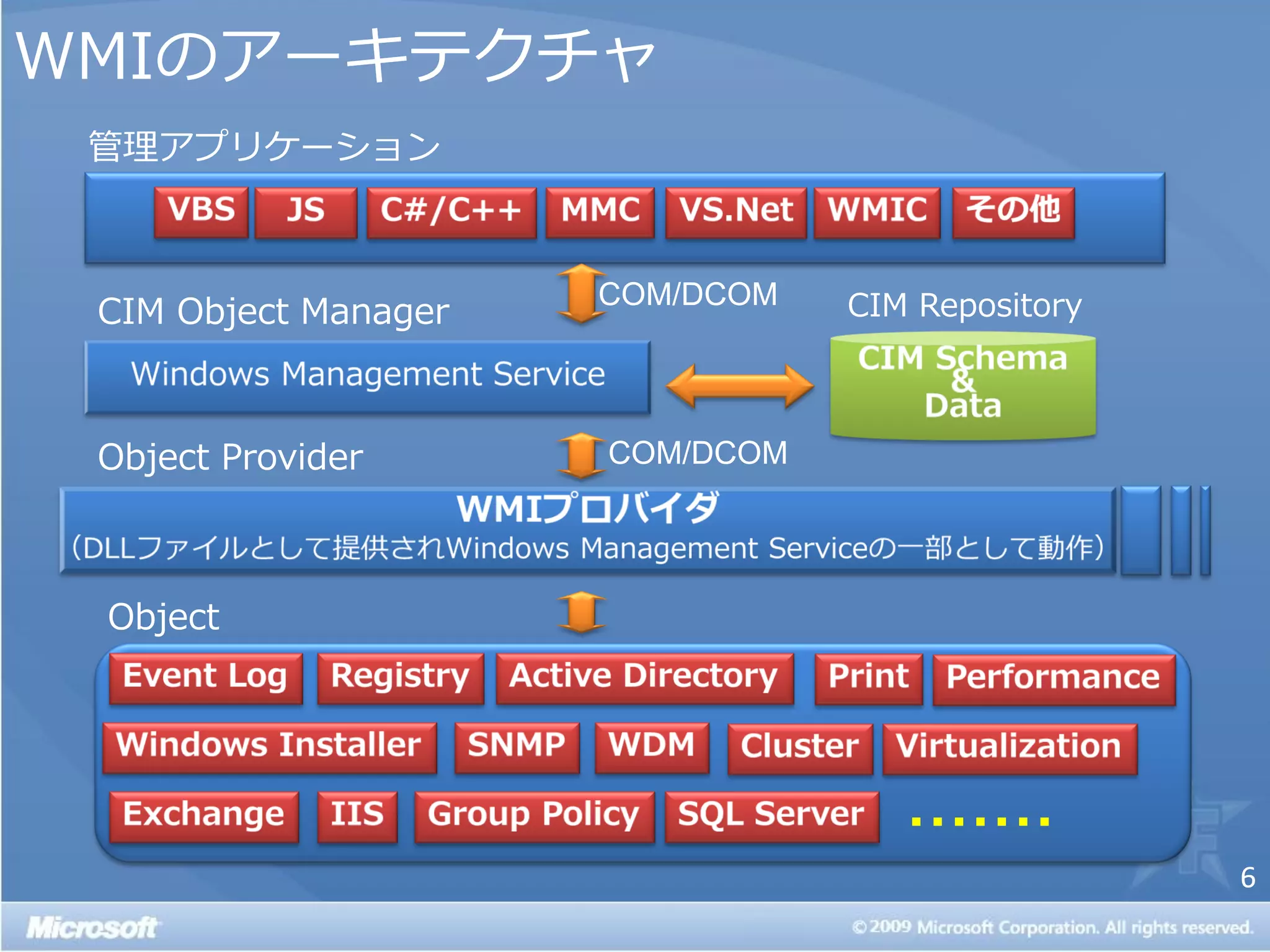
WMIのゕーキテクチャ
 管理ゕプリケーション


                      COM/DCOM   CIM Repository
 CIM Object Manager


 Object Provider      COM/DCOM


 Object


                                    ・・・・・・・
                                                  6
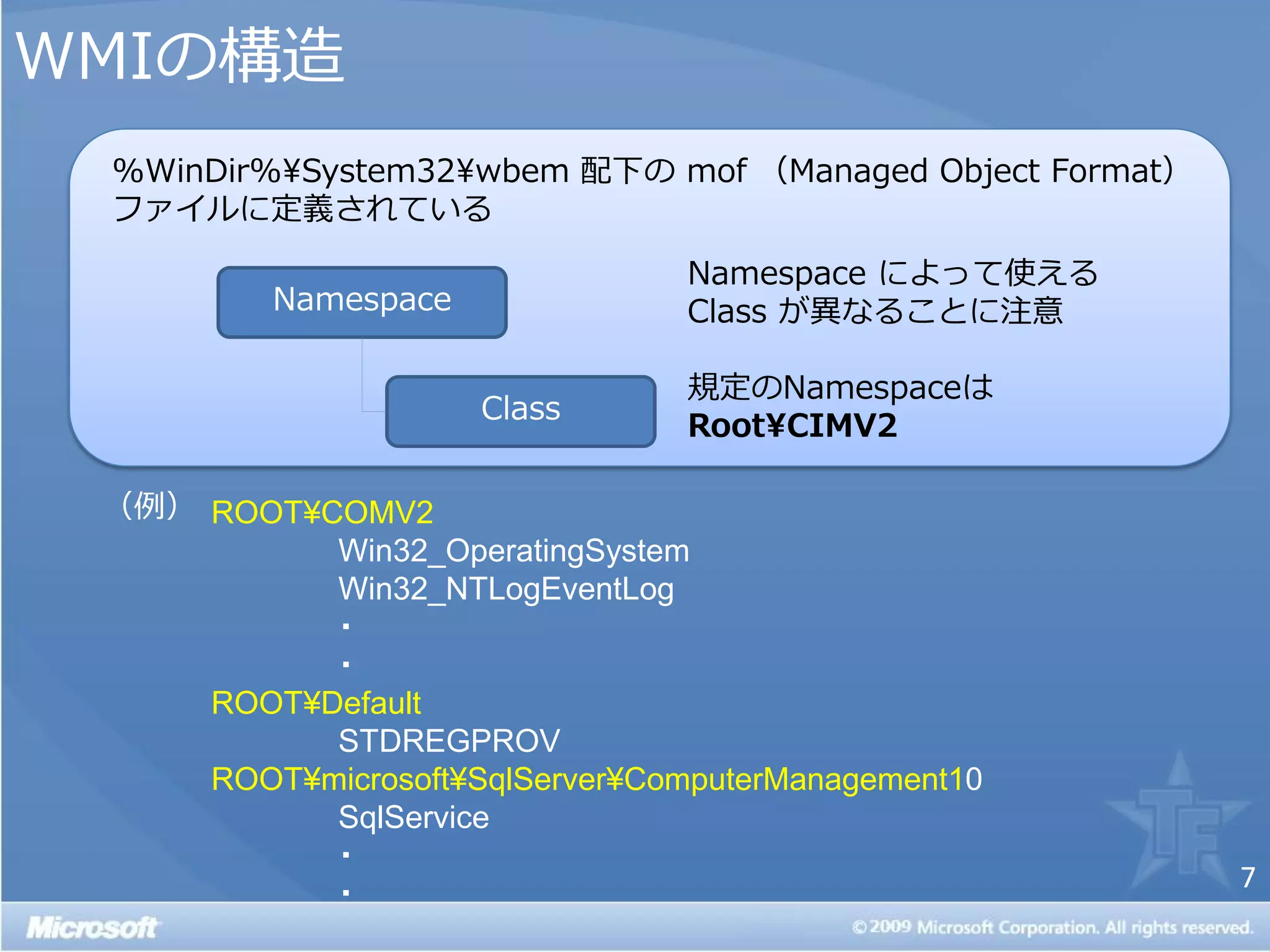
WMIの構造
 %WinDir%¥System32¥wbem 配下の mof (Managed Object Format)
 フゔ゗ルに定義されている

                                 Namespace によって使える
          Namespace              Class が異なることに注意

                                 規定のNamespaceは
                      Class
                                 Root¥CIMV2

 (例) ROOT¥COMV2
           Win32_OperatingSystem
           Win32_NTLogEventLog
           ・
           ・
     ROOT¥Default
           STDREGPROV
     ROOT¥microsoft¥SqlServer¥ComputerManagement10
           SqlService
           ・
                                                          7
           ・
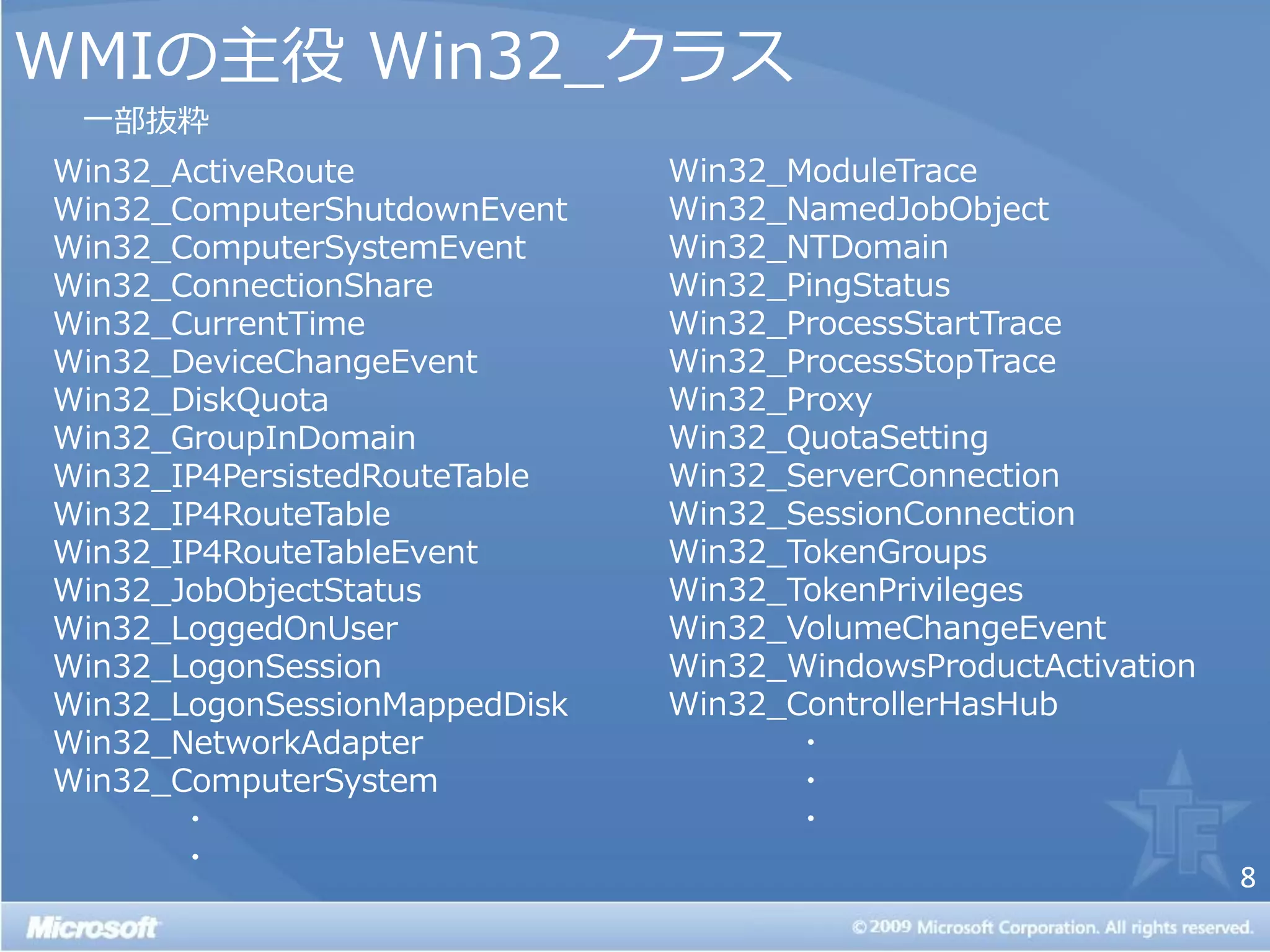
WMIの主役 Win32_クラス
 一部抜粋
Win32_ActiveRoute              Win32_ModuleTrace
Win32_ComputerShutdownEvent    Win32_NamedJobObject
Win32_ComputerSystemEvent      Win32_NTDomain
Win32_ConnectionShare          Win32_PingStatus
Win32_CurrentTime              Win32_ProcessStartTrace
Win32_DeviceChangeEvent        Win32_ProcessStopTrace
Win32_DiskQuota                Win32_Proxy
Win32_GroupInDomain            Win32_QuotaSetting
Win32_IP4PersistedRouteTable   Win32_ServerConnection
Win32_IP4RouteTable            Win32_SessionConnection
Win32_IP4RouteTableEvent       Win32_TokenGroups
Win32_JobObjectStatus          Win32_TokenPrivileges
Win32_LoggedOnUser             Win32_VolumeChangeEvent
Win32_LogonSession             Win32_WindowsProductActivation
Win32_LogonSessionMappedDisk   Win32_ControllerHasHub
Win32_NetworkAdapter                  ・
Win32_ComputerSystem                  ・
       ・                              ・
       ・
                                                                8
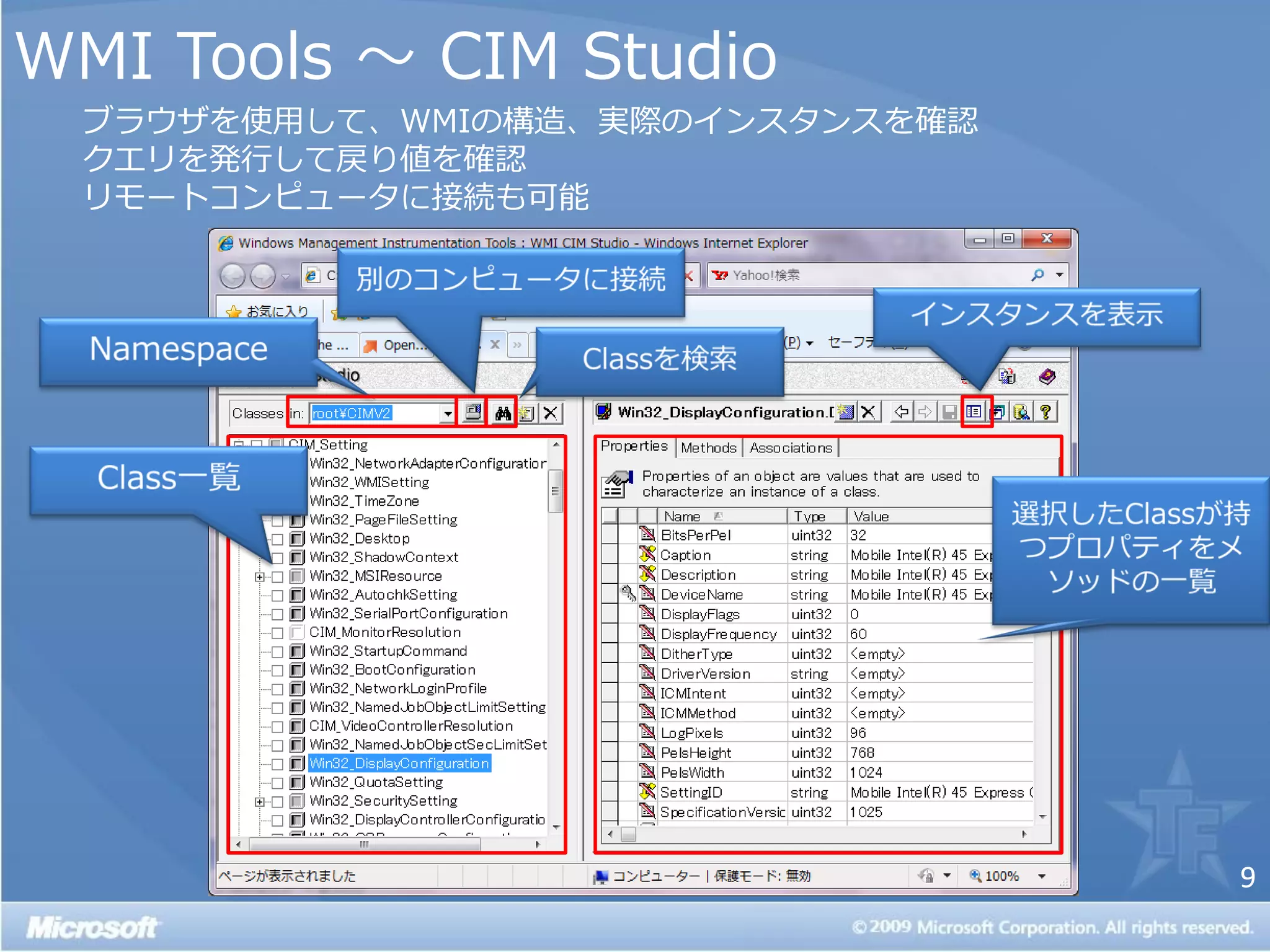
WMI Tools ~ CIM Studio
 ブラウザを使用して、WMIの構造、実際の゗ンスタンスを確認
 クエリを発行して戻り値を確認
 リモートコンピュータに接続も可能


                                 9
WMIにVBScriptから接続


                   10
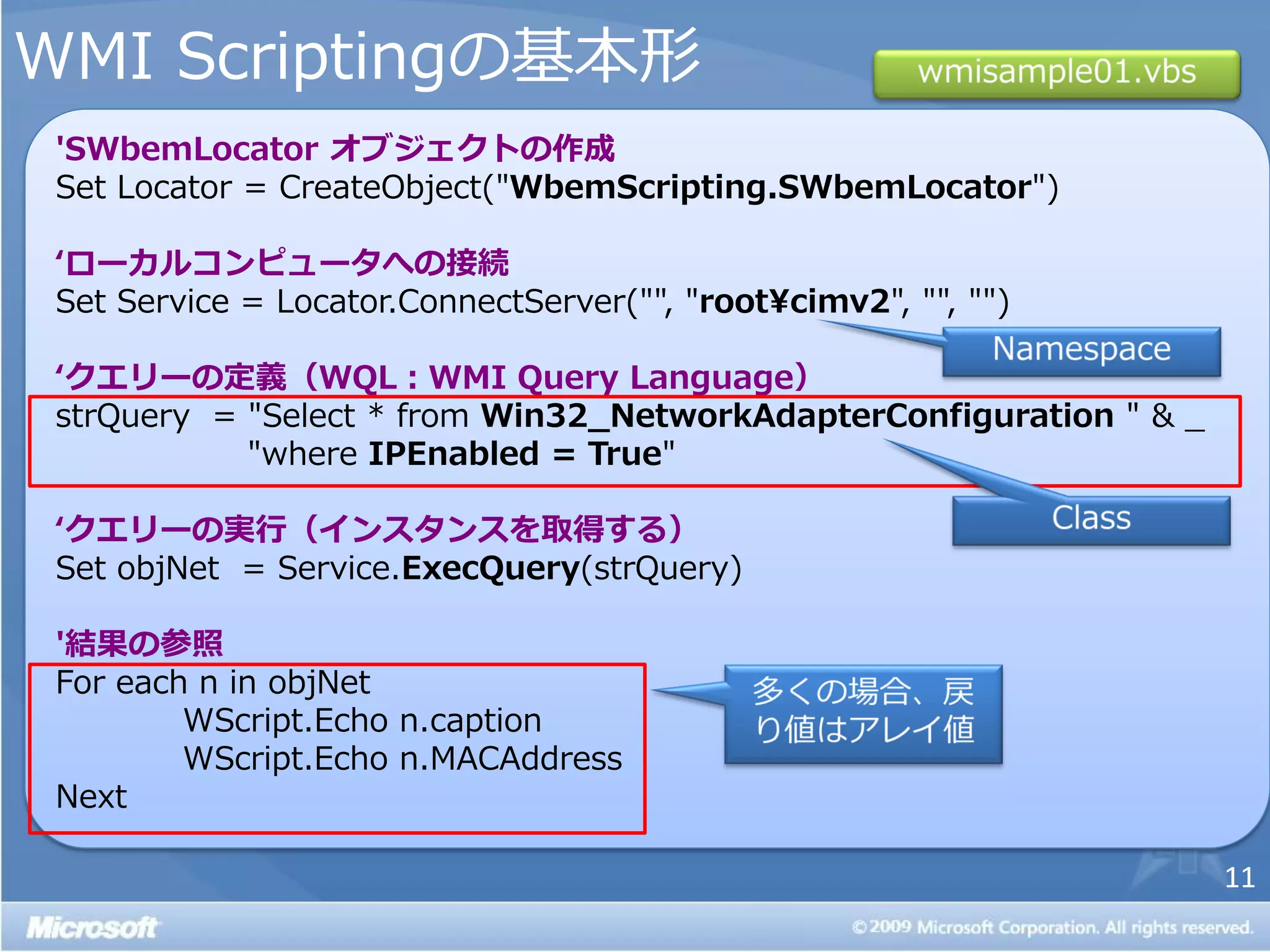
WMI Scriptingの基本形
 'SWbemLocator オブジェクトの作成
 Set Locator = CreateObject("WbemScripting.SWbemLocator")

 ‘ローカルコンピュータへの接続
 Set Service = Locator.ConnectServer("", "root¥cimv2", "", "")

 ‘クエリーの定義(WQL:WMI Query Language)
 strQuery = "Select * from Win32_NetworkAdapterConfiguration " & _
            "where IPEnabled = True"

 ‘クエリーの実行(インスタンスを取得する)
 Set objNet = Service.ExecQuery(strQuery)

 '結果の参照
 For each n in objNet
         WScript.Echo n.caption
         WScript.Echo n.MACAddress
 Next

                                                                     11
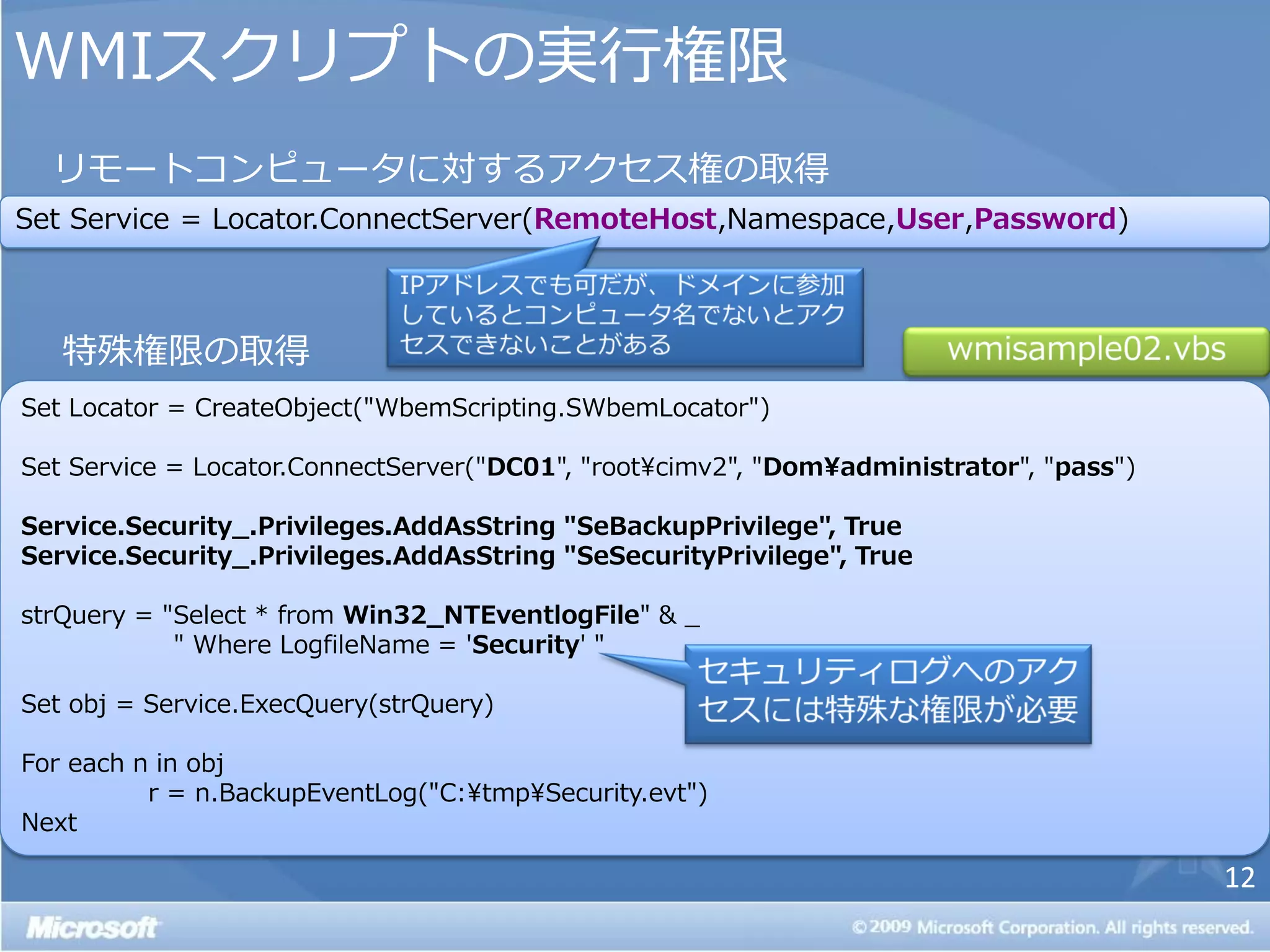
WMIスクリプトの実行権限
  リモートコンピュータに対するゕクセス権の取得
Set Service = Locator.ConnectServer(RemoteHost,Namespace,User,Password)


   特殊権限の取得
Set Locator = CreateObject("WbemScripting.SWbemLocator")

Set Service = Locator.ConnectServer("DC01", "root¥cimv2", "Dom¥administrator", "pass")

Service.Security_.Privileges.AddAsString "SeBackupPrivilege", True
Service.Security_.Privileges.AddAsString "SeSecurityPrivilege", True

strQuery = "Select * from Win32_NTEventlogFile" & _
            " Where LogfileName = 'Security' "

Set obj = Service.ExecQuery(strQuery)

For each n in obj
          r = n.BackupEventLog("C:¥tmp¥Security.evt")
Next

                                                                                         12
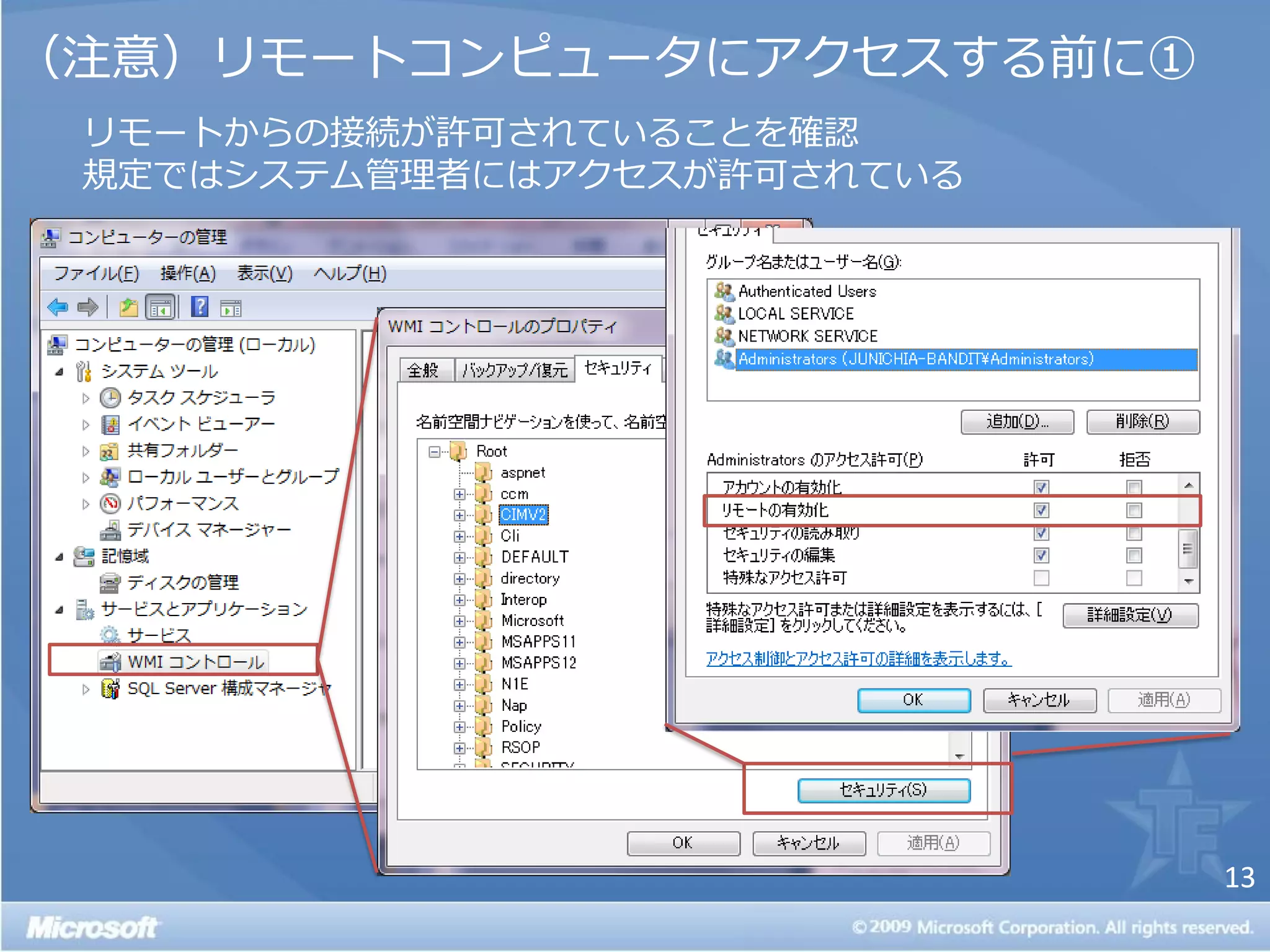
(注意)リモートコンピュータにゕクセスする前に①
 リモートからの接続が許可されていることを確認
 規定ではシステム管理者にはゕクセスが許可されている


                             13
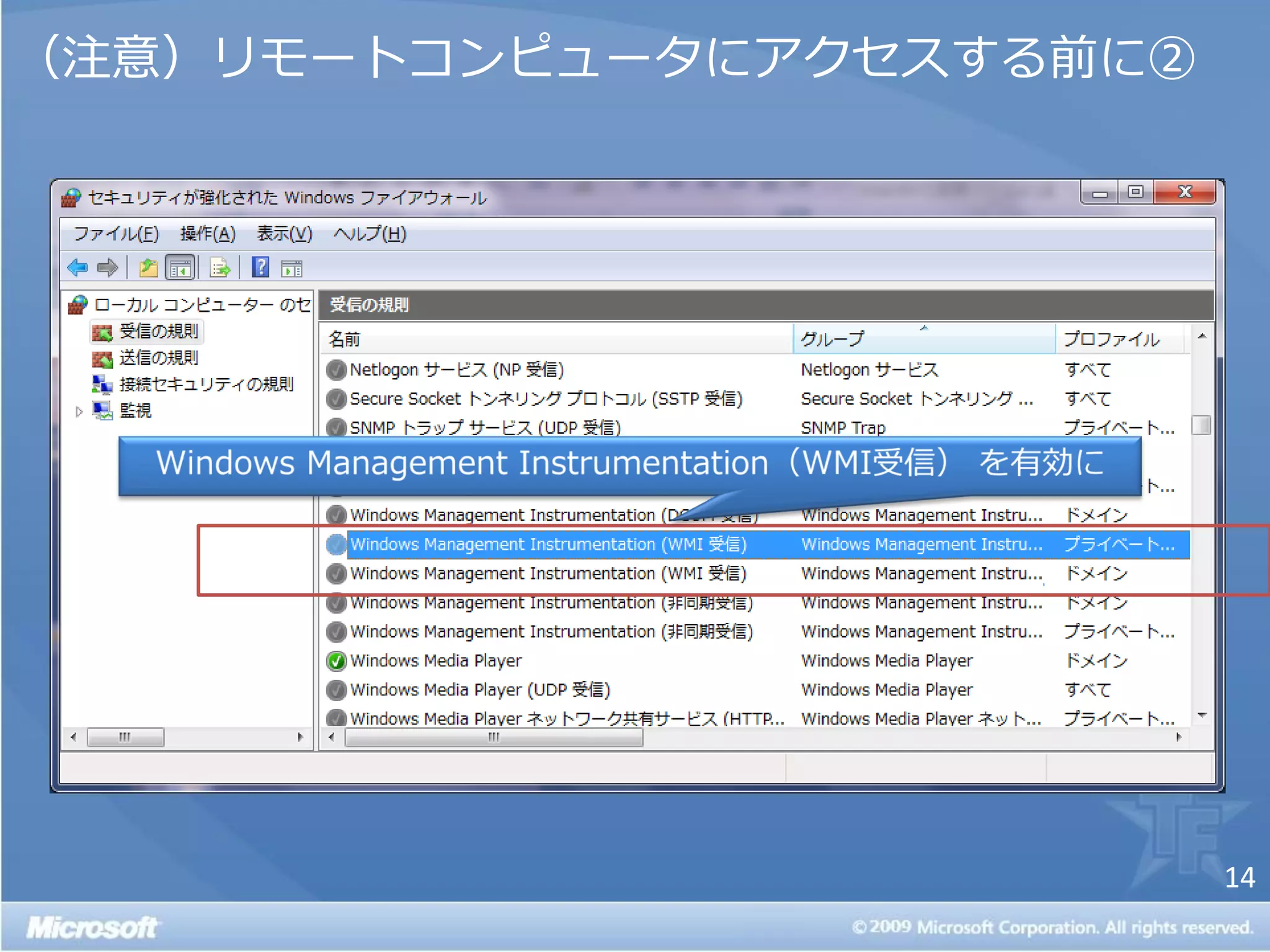
(注意)リモートコンピュータにゕクセスする前に②


                           14
サーバーを監視する


            15
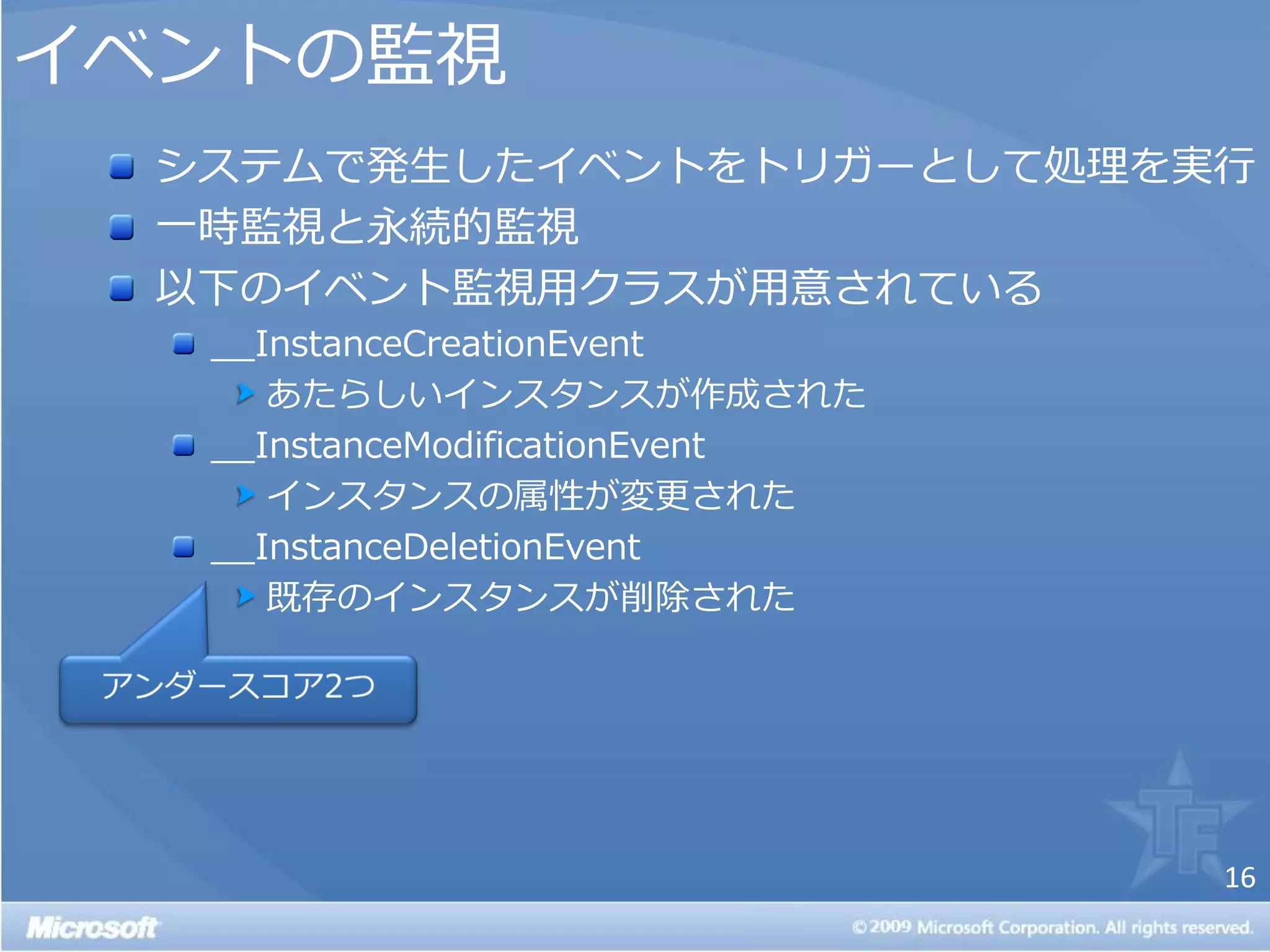
゗ベントの監視
  システムで発生した゗ベントをトリガーとして処理を実行
  一時監視と永続的監視
  以下の゗ベント監視用クラスが用意されている
   __InstanceCreationEvent
      あたらしい゗ンスタンスが作成された
   __InstanceModificationEvent
      ゗ンスタンスの属性が変更された
   __InstanceDeletionEvent
      既存の゗ンスタンスが削除された


                                 16
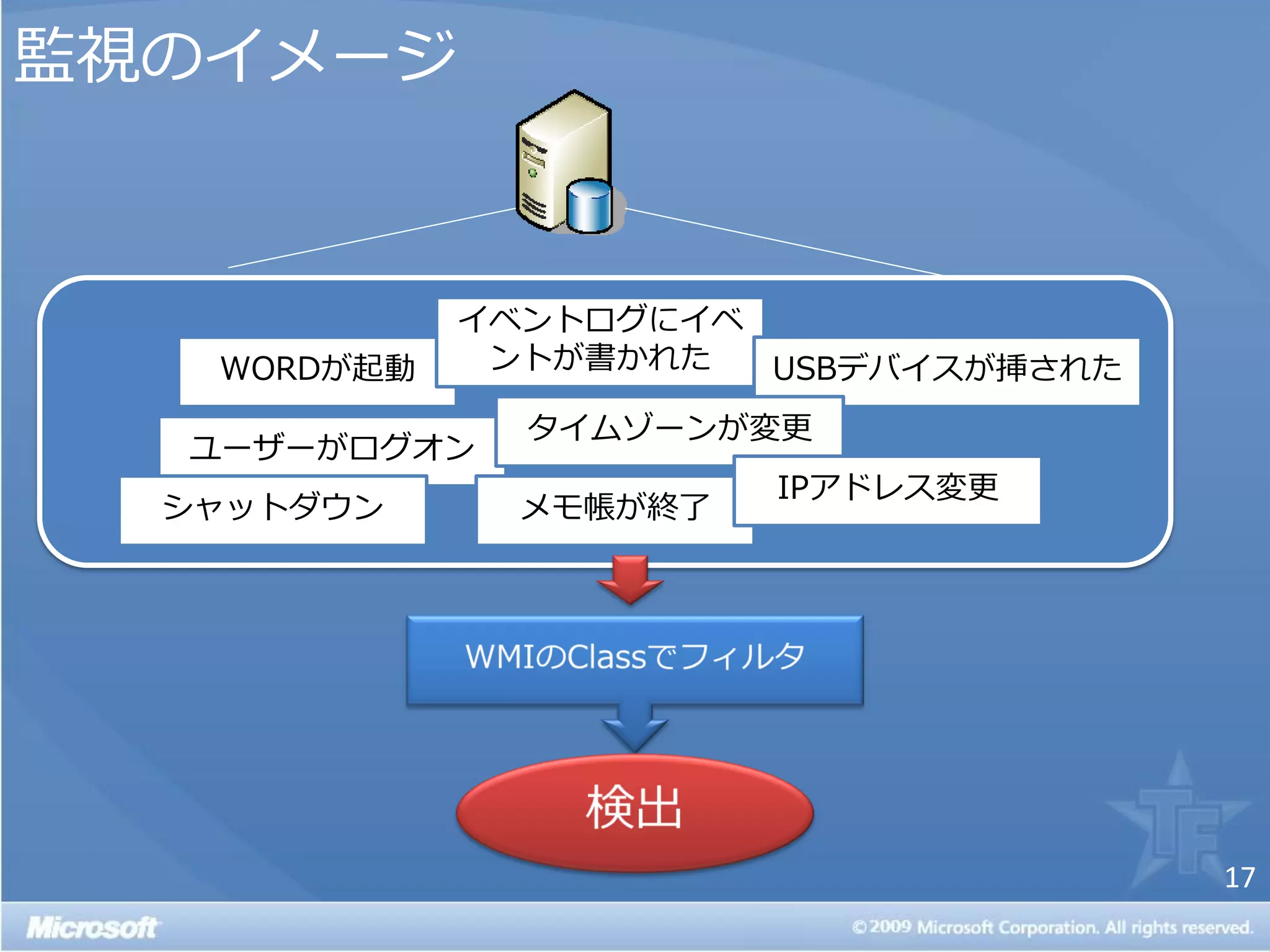
監視の゗メージ


             ゗ベントログに゗ベ
   WORDが起動    ントが書かれた  USBデバ゗スが挿された
               タ゗ムゾーンが変更
  ユーザーがログオン
                        IPゕドレス変更
  シャットダウン      メモ帳が終了


                                      17
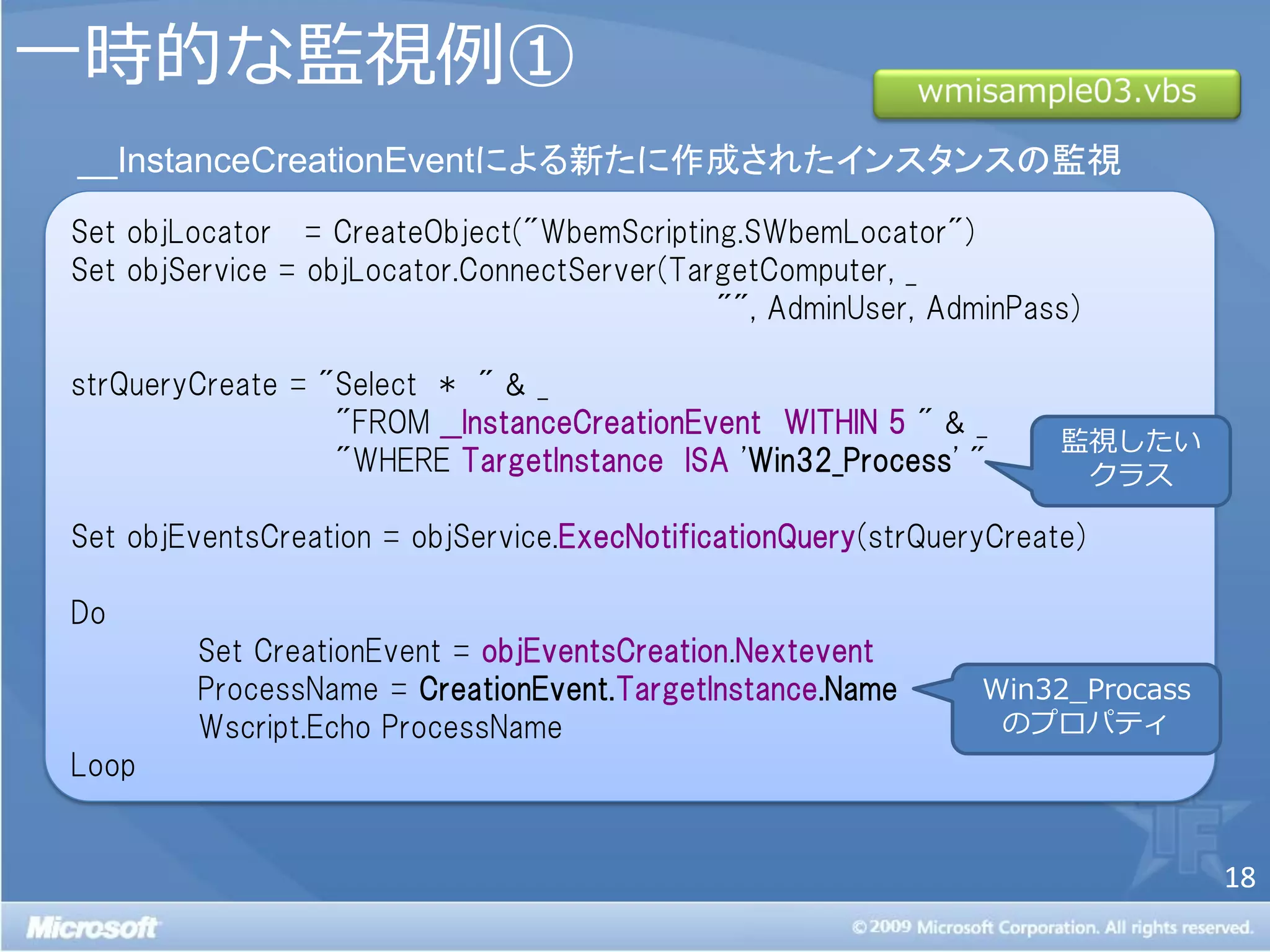
一時的な監視例①
__InstanceCreationEventによる新たに作成されたインスタンスの監視

Set objLocator = CreateObject("WbemScripting.SWbemLocator")
Set objService = objLocator.ConnectServer(TargetComputer, _
                                             "", AdminUser, AdminPass)

strQueryCreate = "Select * " & _
                  "FROM __InstanceCreationEvent WITHIN 5 " & _
                                                                      監視したい
                  "WHERE TargetInstance ISA 'Win32_Process' "          クラス

Set objEventsCreation = objService.ExecNotificationQuery(strQueryCreate)

Do
         Set CreationEvent = objEventsCreation.Nextevent
         ProcessName = CreationEvent.TargetInstance.Name        Win32_Procass
         Wscript.Echo ProcessName                                のプロパテゖ
Loop


                                                                                18
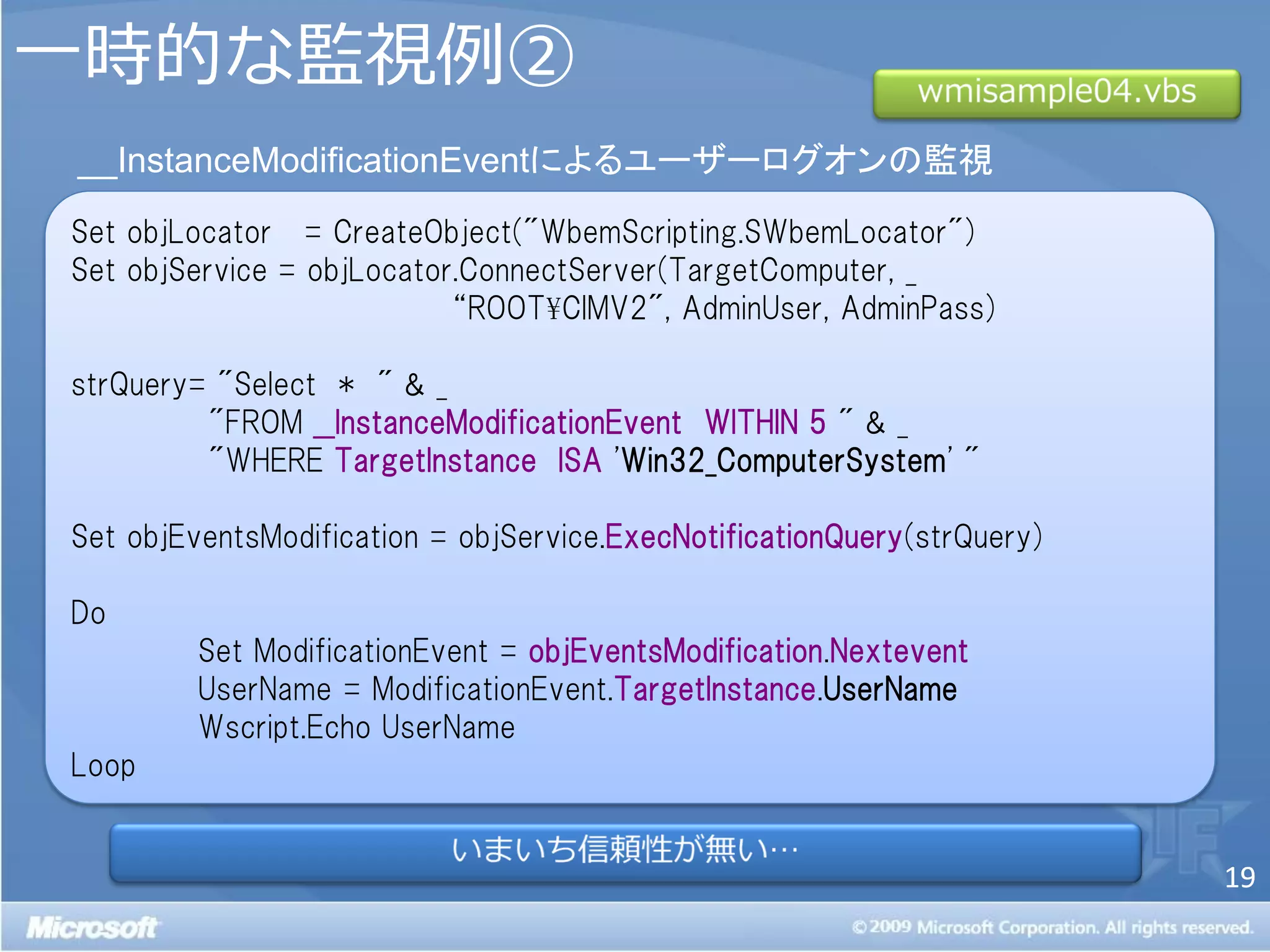
一時的な監視例②
__InstanceModificationEventによるユーザーログオンの監視

Set objLocator = CreateObject("WbemScripting.SWbemLocator")
Set objService = objLocator.ConnectServer(TargetComputer, _
                           ‚ROOT¥CIMV2", AdminUser, AdminPass)

strQuery= "Select * " & _
         "FROM __InstanceModificationEvent WITHIN 5 " & _
         "WHERE TargetInstance ISA 'Win32_ComputerSystem' "

Set objEventsModification = objService.ExecNotificationQuery(strQuery)

Do
         Set ModificationEvent = objEventsModification.Nextevent
         UserName = ModificationEvent.TargetInstance.UserName
         Wscript.Echo UserName
Loop


                                                                         19
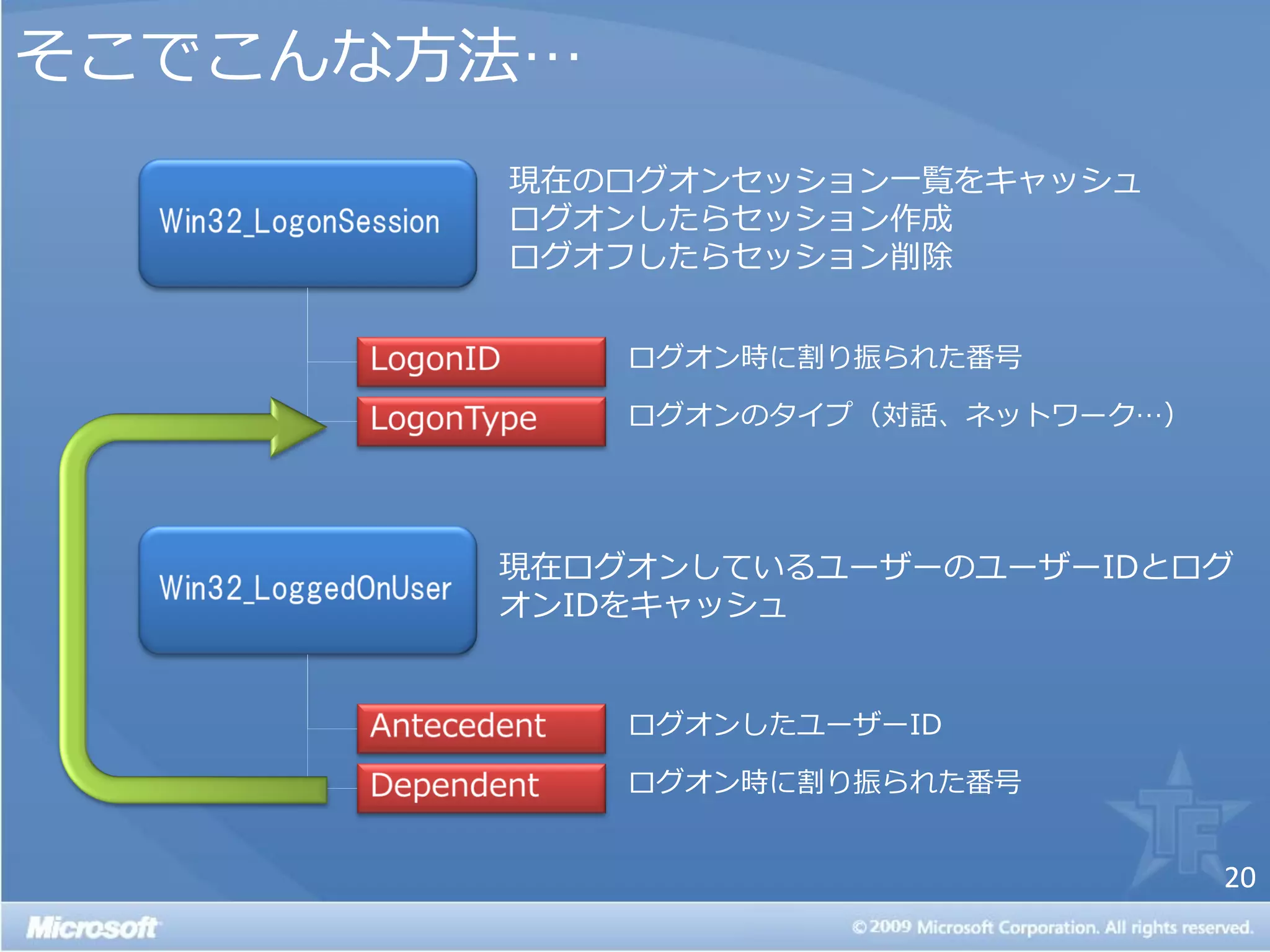
そこでこんな方法…
       現在のログオンセッション一覧をキャッシュ
       ログオンしたらセッション作成
       ログオフしたらセッション削除


            ログオン時に割り振られた番号

            ログオンのタ゗プ(対話、ネットワーク…)


       現在ログオンしているユーザーのユーザーIDとログ
       オンIDをキャッシュ


            ログオンしたユーザーID

            ログオン時に割り振られた番号


                                   20
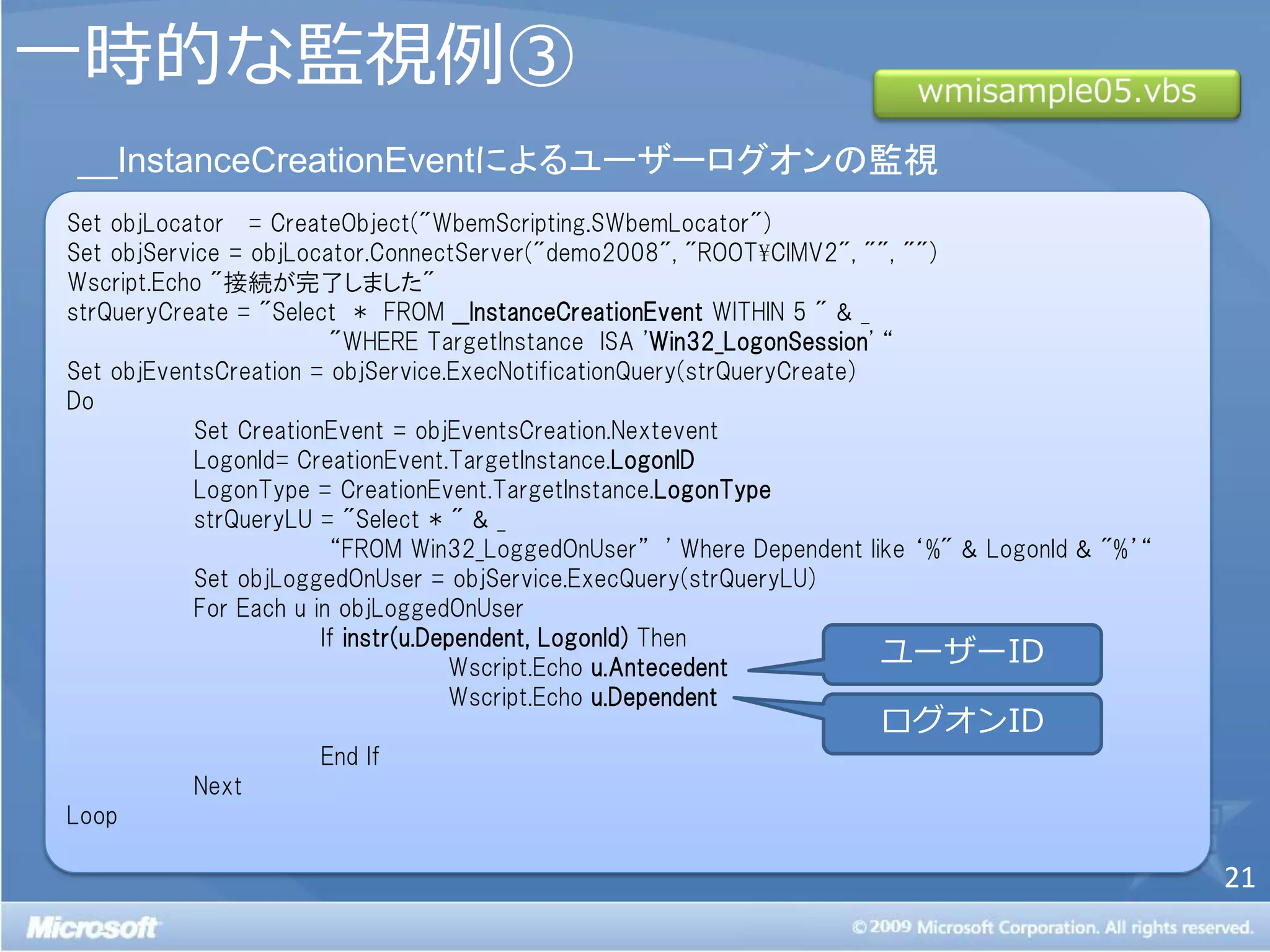
一時的な監視例③
__InstanceCreationEventによるユーザーログオンの監視
Set objLocator = CreateObject("WbemScripting.SWbemLocator")
Set objService = objLocator.ConnectServer("demo2008", "ROOT¥CIMV2", "", "")
Wscript.Echo "接続が完了しました"
strQueryCreate = "Select * FROM __InstanceCreationEvent WITHIN 5 " & _
                         "WHERE TargetInstance ISA 'Win32_LogonSession' ‚
Set objEventsCreation = objService.ExecNotificationQuery(strQueryCreate)
Do
            Set CreationEvent = objEventsCreation.Nextevent
            LogonId= CreationEvent.TargetInstance.LogonID
            LogonType = CreationEvent.TargetInstance.LogonType
            strQueryLU = "Select * " & _
                         ‚FROM Win32_LoggedOnUser‛ ' Where Dependent like ‘%" & LogonId & "%’‚
            Set objLoggedOnUser = objService.ExecQuery(strQueryLU)
            For Each u in objLoggedOnUser
                        If instr(u.Dependent, LogonId) Then
                                     Wscript.Echo u.Antecedent
                                                                         ユーザーID
                                     Wscript.Echo u.Dependent
                                                                      ログオンID
                     End If
          Next
Loop

                                                                                                 21
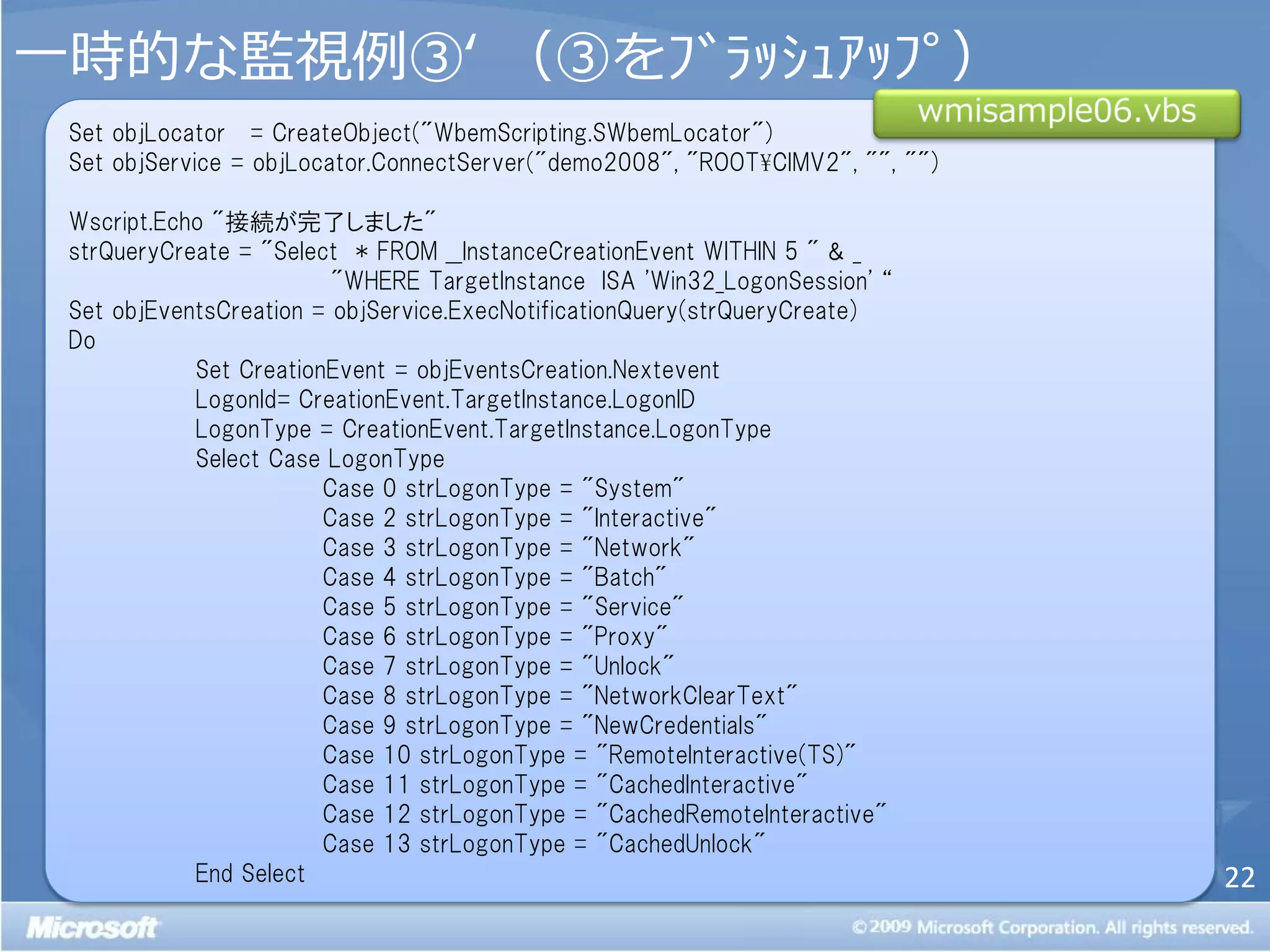
一時的な監視例③‘ (③をブラッシュアップ)
 Set objLocator = CreateObject("WbemScripting.SWbemLocator")
 Set objService = objLocator.ConnectServer("demo2008", "ROOT¥CIMV2", "", "")

 Wscript.Echo "接続が完了しました"
 strQueryCreate = "Select * FROM __InstanceCreationEvent WITHIN 5 " & _
                         "WHERE TargetInstance ISA 'Win32_LogonSession' ‚
 Set objEventsCreation = objService.ExecNotificationQuery(strQueryCreate)
 Do
            Set CreationEvent = objEventsCreation.Nextevent
            LogonId= CreationEvent.TargetInstance.LogonID
            LogonType = CreationEvent.TargetInstance.LogonType
            Select Case LogonType
                        Case 0 strLogonType = "System"
                        Case 2 strLogonType = "Interactive"
                        Case 3 strLogonType = "Network"
                        Case 4 strLogonType = "Batch"
                        Case 5 strLogonType = "Service"
                        Case 6 strLogonType = "Proxy"
                        Case 7 strLogonType = "Unlock"
                        Case 8 strLogonType = "NetworkClearText"
                        Case 9 strLogonType = "NewCredentials"
                        Case 10 strLogonType = "RemoteInteractive(TS)"
                        Case 11 strLogonType = "CachedInteractive"
                        Case 12 strLogonType = "CachedRemoteInteractive"
                        Case 13 strLogonType = "CachedUnlock"
            End Select                                                         22
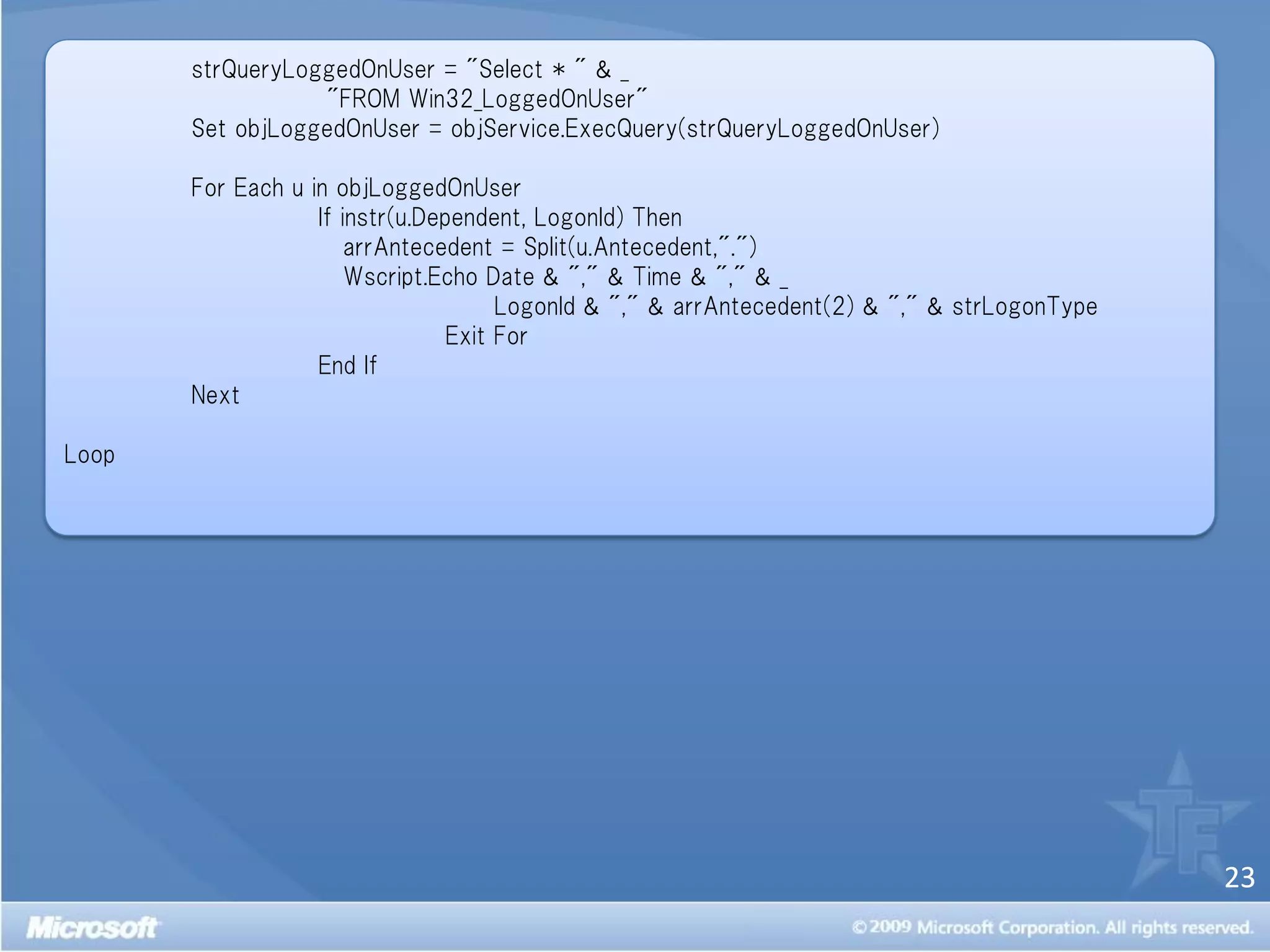
strQueryLoggedOnUser = "Select * " & _
                  "FROM Win32_LoggedOnUser"
       Set objLoggedOnUser = objService.ExecQuery(strQueryLoggedOnUser)

       For Each u in objLoggedOnUser
                   If instr(u.Dependent, LogonId) Then
                       arrAntecedent = Split(u.Antecedent,".")
                       Wscript.Echo Date & "," & Time & "," & _
                                      LogonId & "," & arrAntecedent(2) & "," & strLogonType
                                 Exit For
                   End If
       Next

Loop


                                                                                              23
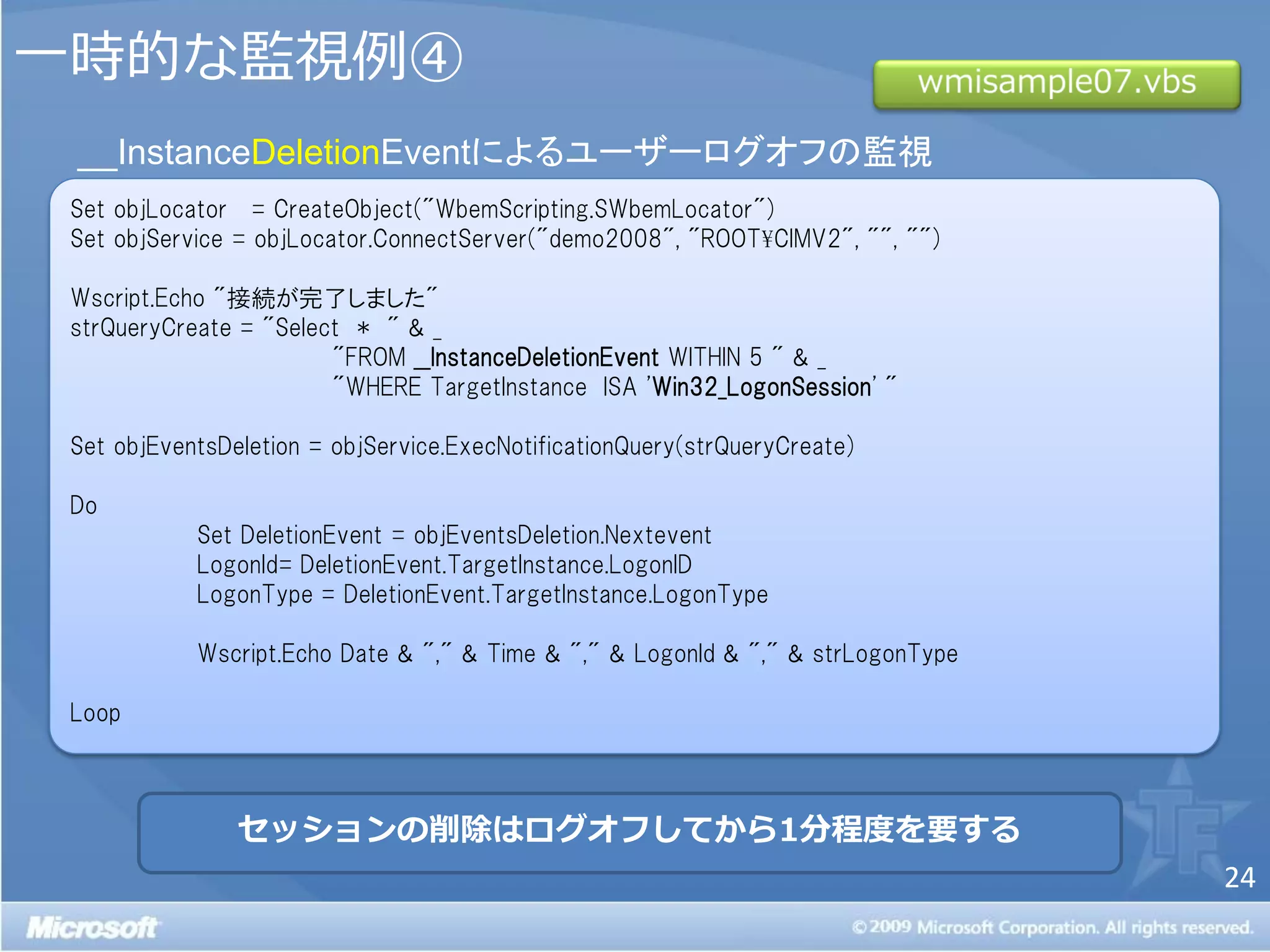
一時的な監視例④
 __InstanceDeletionEventによるユーザーログオフの監視
 Set objLocator = CreateObject("WbemScripting.SWbemLocator")
 Set objService = objLocator.ConnectServer("demo2008", "ROOT¥CIMV2", "", "")

 Wscript.Echo "接続が完了しました"
 strQueryCreate = "Select * " & _
                        "FROM __InstanceDeletionEvent WITHIN 5 " & _
                        "WHERE TargetInstance ISA 'Win32_LogonSession' "

 Set objEventsDeletion = objService.ExecNotificationQuery(strQueryCreate)

 Do
            Set DeletionEvent = objEventsDeletion.Nextevent
            LogonId= DeletionEvent.TargetInstance.LogonID
            LogonType = DeletionEvent.TargetInstance.LogonType

            Wscript.Echo Date & "," & Time & "," & LogonId & "," & strLogonType

 Loop


                セッションの削除はログオフしてから1分程度を要する
                                                                                  24
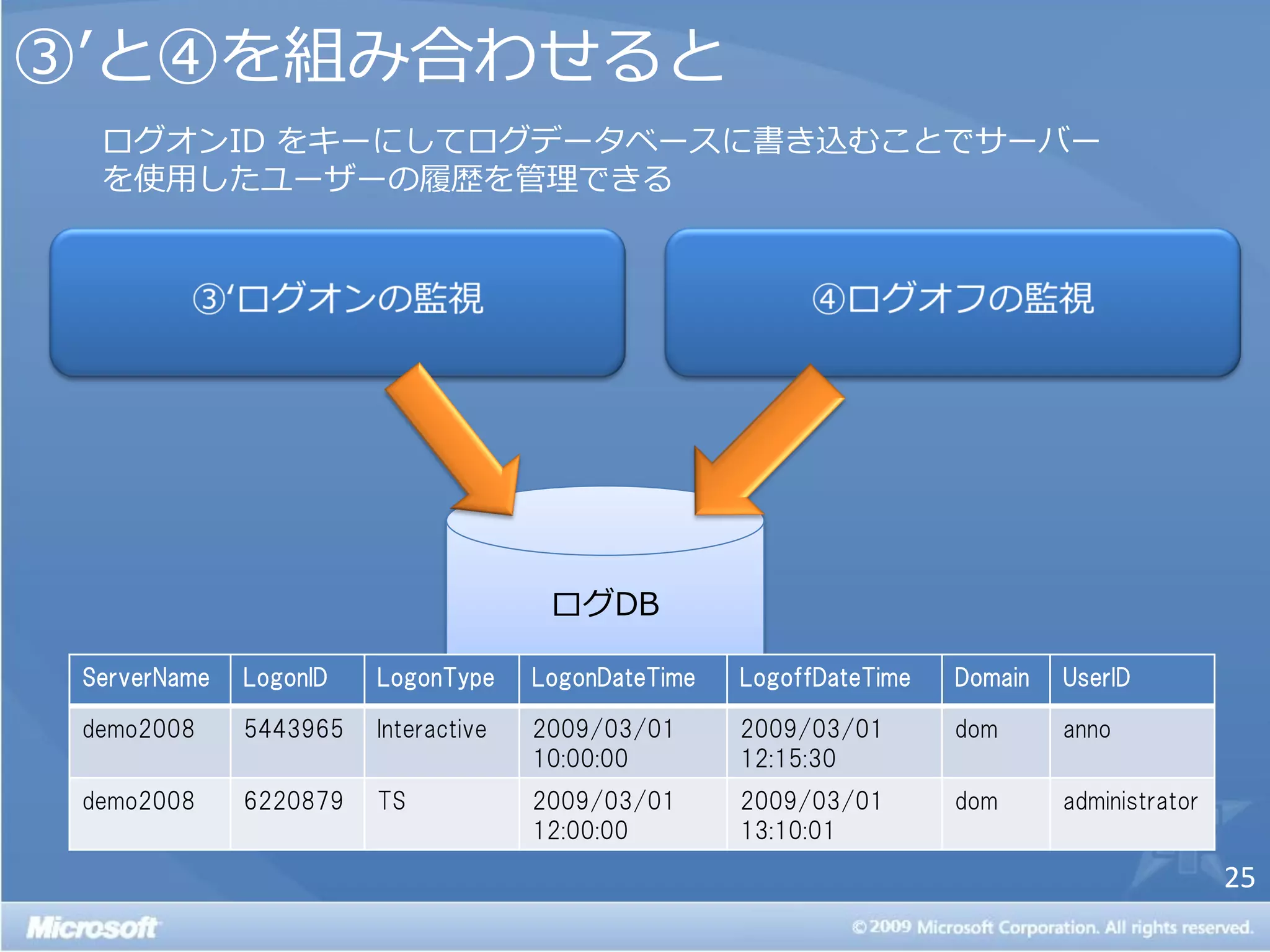
③’と④を組み合わせると
  ログオンID をキーにしてログデータベースに書き込むことでサーバー
  を使用したユーザーの履歴を管理できる


                                       ログDB

 ServerName   LogonID   LogonType     LogonDateTime   LogoffDateTime   Domain   UserID

 demo2008     5443965   Interactive   2009/03/01      2009/03/01       dom      anno
                                      10:00:00        12:15:30
 demo2008     6220879   TS            2009/03/01      2009/03/01       dom      administrator
                                      12:00:00        13:10:01
                                                                                                25
スクリプトをサービス化


              26
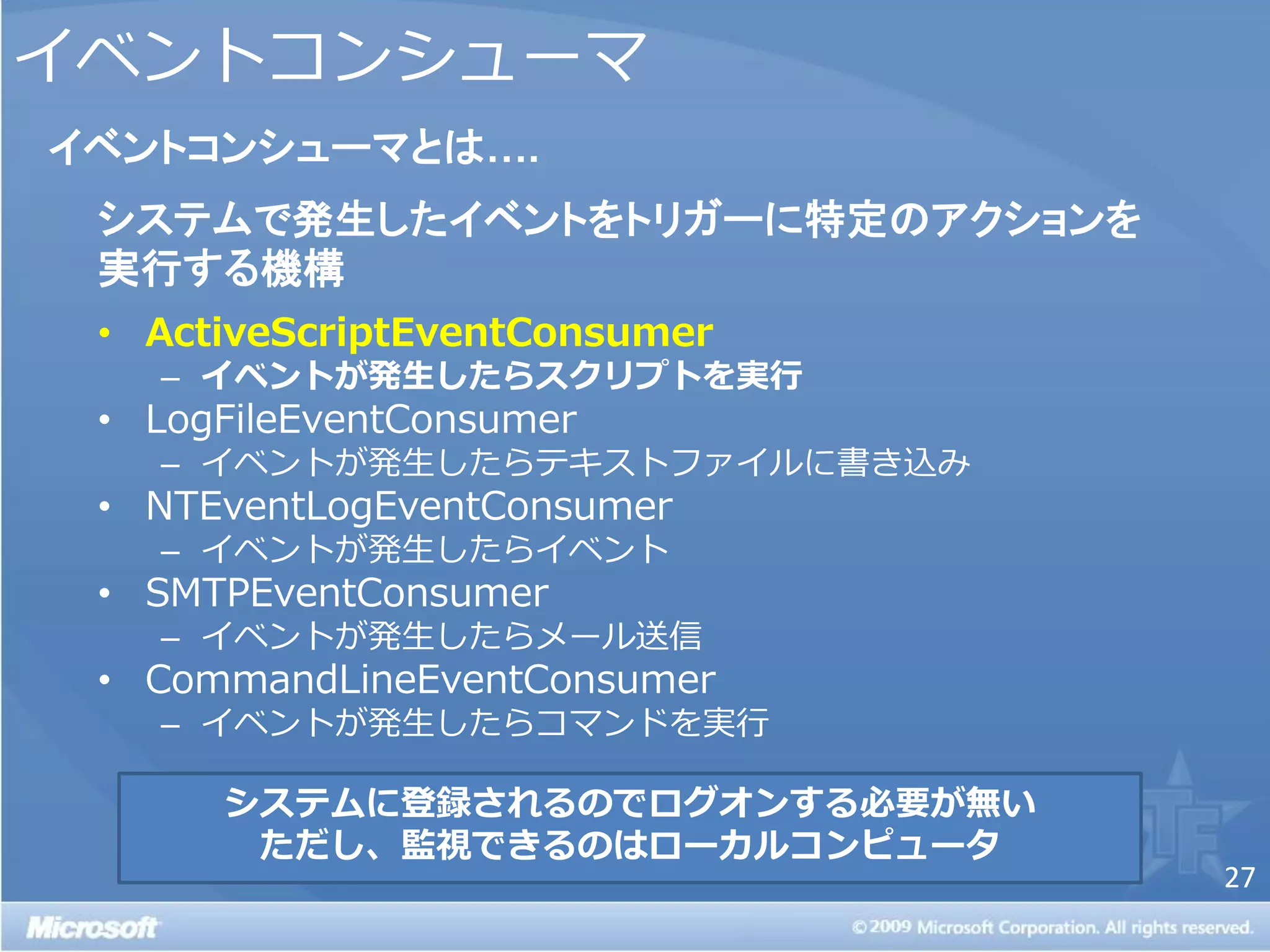
゗ベントコンシューマ
イベントコンシューマとは….
 システムで発生したイベントをトリガーに特定のアクションを
 実行する機構
 • ActiveScriptEventConsumer
   – イベントが発生したらスクリプトを実行
 • LogFileEventConsumer
   – ゗ベントが発生したらテキストフゔ゗ルに書き込み
 • NTEventLogEventConsumer
   – ゗ベントが発生したら゗ベント
 • SMTPEventConsumer
   – ゗ベントが発生したらメール送信
 • CommandLineEventConsumer
   – ゗ベントが発生したらコマンドを実行

      システムに登録されるのでログオンする必要が無い
       ただし、監視できるのはローカルコンピュータ
                                27
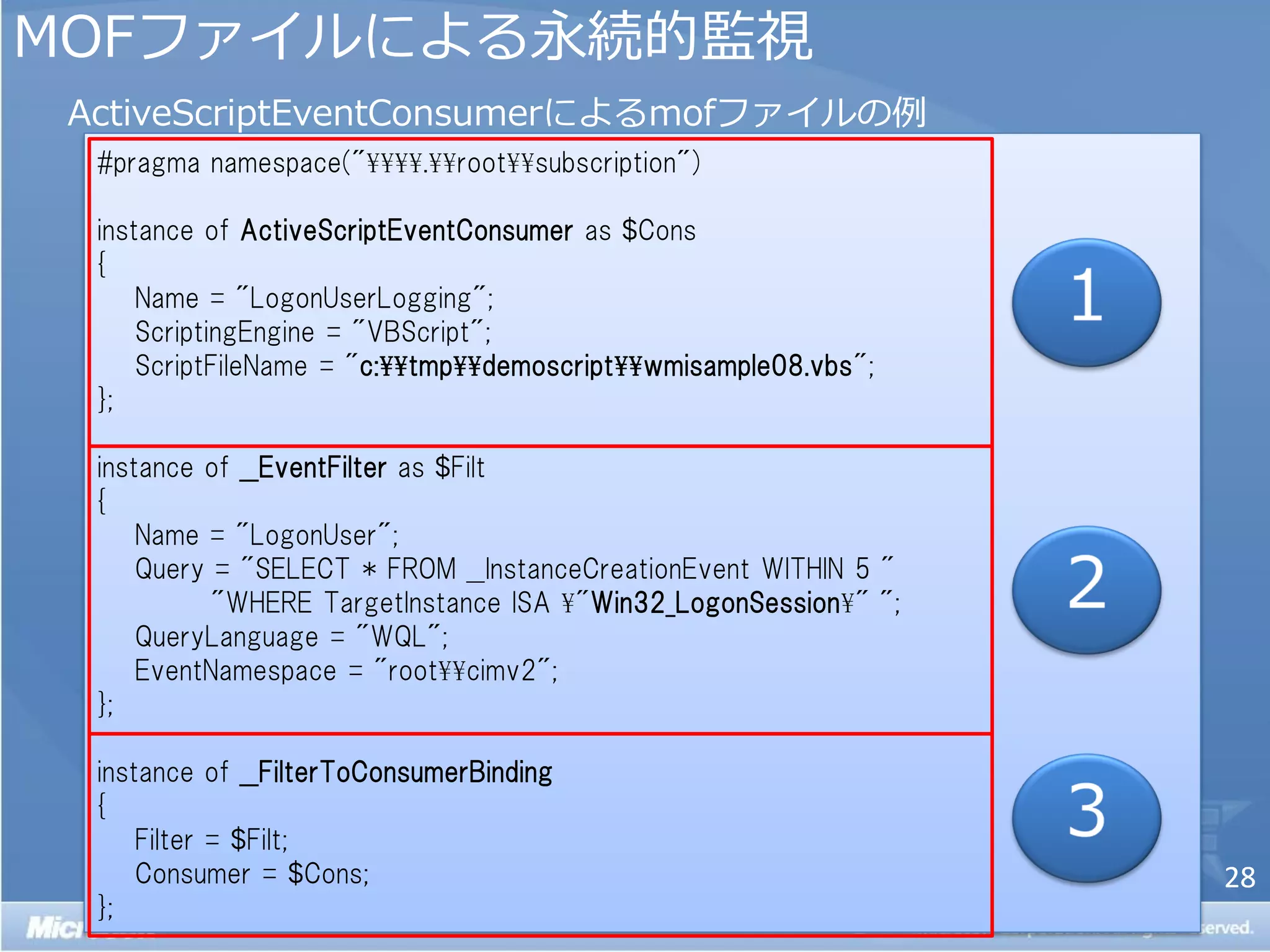
MOFフゔ゗ルによる永続的監視
 ActiveScriptEventConsumerによるmofフゔ゗ルの例
  #pragma namespace("¥¥¥¥.¥¥root¥¥subscription")

  instance of ActiveScriptEventConsumer as $Cons
  {
      Name = "LogonUserLogging";
      ScriptingEngine = "VBScript";
      ScriptFileName = "c:¥¥tmp¥¥demoscript¥¥wmisample08.vbs";
  };

  instance of __EventFilter as $Filt
  {
      Name = "LogonUser";
      Query = "SELECT * FROM __InstanceCreationEvent WITHIN 5 "
            "WHERE TargetInstance ISA ¥"Win32_LogonSession¥" ";
      QueryLanguage = "WQL";
      EventNamespace = "root¥¥cimv2";
  };

  instance of __FilterToConsumerBinding
  {
      Filter = $Filt;
      Consumer = $Cons;                                           28
  };
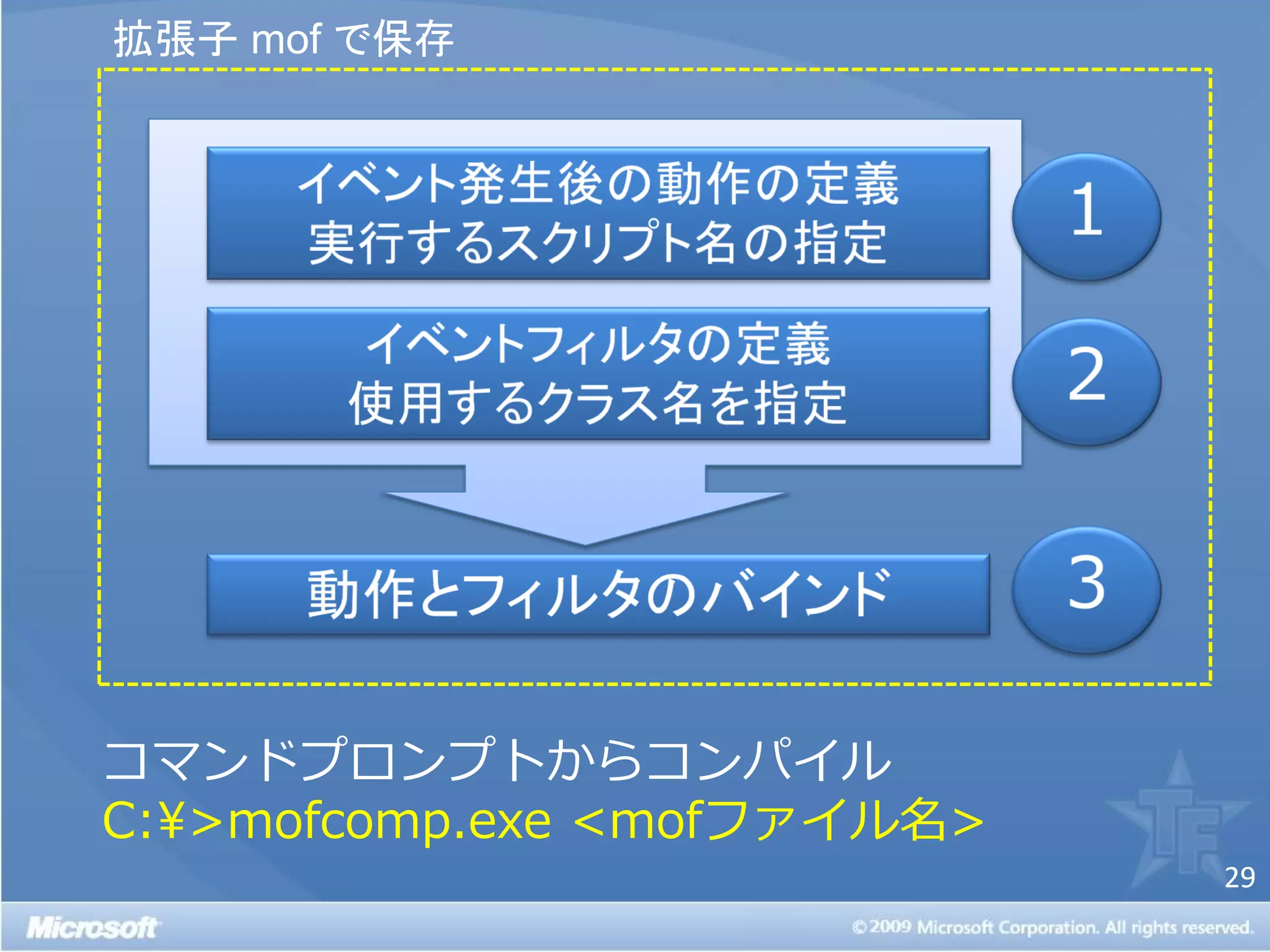
拡張子 mof で保存


コマンドプロンプトからコンパ゗ル
C:¥>mofcomp.exe <mofフゔ゗ル名>
                             29
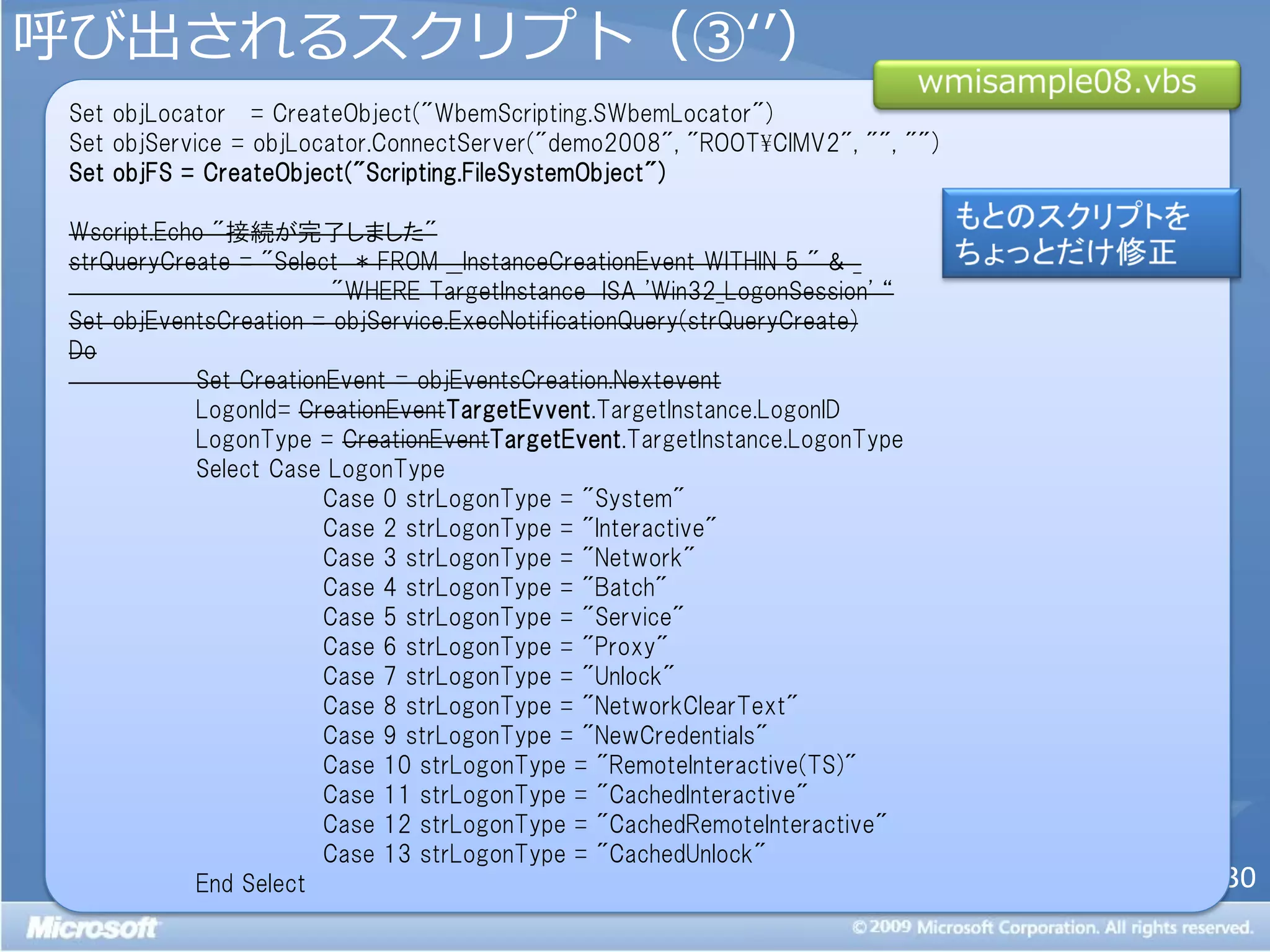
呼び出されるスクリプト(③‘’)
 Set objLocator = CreateObject("WbemScripting.SWbemLocator")
 Set objService = objLocator.ConnectServer("demo2008", "ROOT¥CIMV2", "", "")
 Set objFS = CreateObject("Scripting.FileSystemObject")

 Wscript.Echo "接続が完了しました"
 strQueryCreate = "Select * FROM __InstanceCreationEvent WITHIN 5 " & _
                         "WHERE TargetInstance ISA 'Win32_LogonSession' ‚
 Set objEventsCreation = objService.ExecNotificationQuery(strQueryCreate)
 Do
            Set CreationEvent = objEventsCreation.Nextevent
            LogonId= CreationEventTargetEvvent.TargetInstance.LogonID
            LogonType = CreationEventTargetEvent.TargetInstance.LogonType
            Select Case LogonType
                        Case 0 strLogonType = "System"
                        Case 2 strLogonType = "Interactive"
                        Case 3 strLogonType = "Network"
                        Case 4 strLogonType = "Batch"
                        Case 5 strLogonType = "Service"
                        Case 6 strLogonType = "Proxy"
                        Case 7 strLogonType = "Unlock"
                        Case 8 strLogonType = "NetworkClearText"
                        Case 9 strLogonType = "NewCredentials"
                        Case 10 strLogonType = "RemoteInteractive(TS)"
                        Case 11 strLogonType = "CachedInteractive"
                        Case 12 strLogonType = "CachedRemoteInteractive"
                        Case 13 strLogonType = "CachedUnlock"
            End Select                                                         30
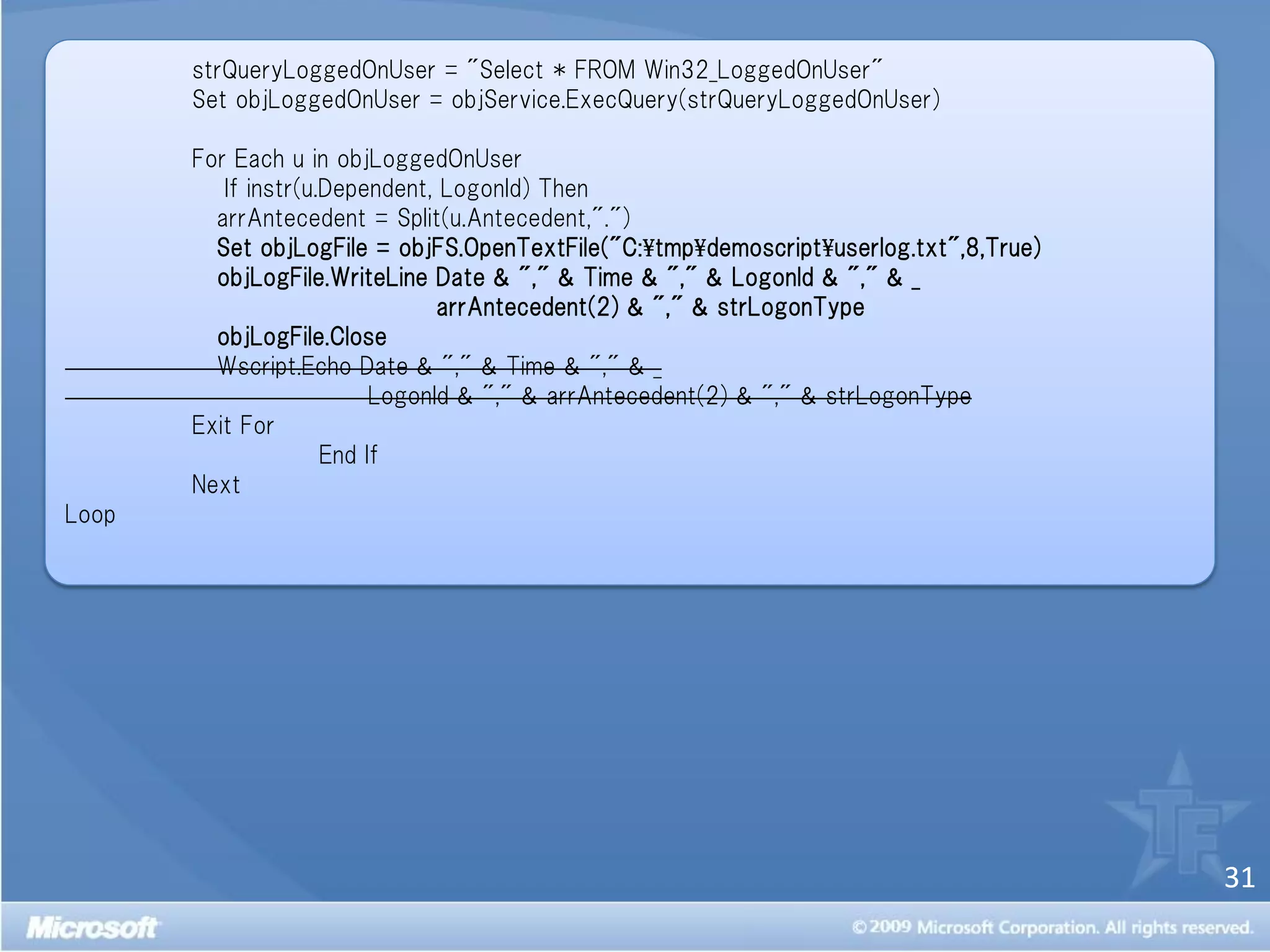
strQueryLoggedOnUser = "Select * FROM Win32_LoggedOnUser"
       Set objLoggedOnUser = objService.ExecQuery(strQueryLoggedOnUser)

       For Each u in objLoggedOnUser
          If instr(u.Dependent, LogonId) Then
         arrAntecedent = Split(u.Antecedent,".")
         Set objLogFile = objFS.OpenTextFile("C:¥tmp¥demoscript¥userlog.txt",8,True)
         objLogFile.WriteLine Date & "," & Time & "," & LogonId & "," & _
                                arrAntecedent(2) & "," & strLogonType
         objLogFile.Close
         Wscript.Echo Date & "," & Time & "," & _
                          LogonId & "," & arrAntecedent(2) & "," & strLogonType
       Exit For
                     End If
       Next
Loop


                                                                                       31
まとめ

WMIはパターンを覚えれば簡単です

あたらしい使い方で作業が劇的に変化します!


          Yes, we can !


                          32
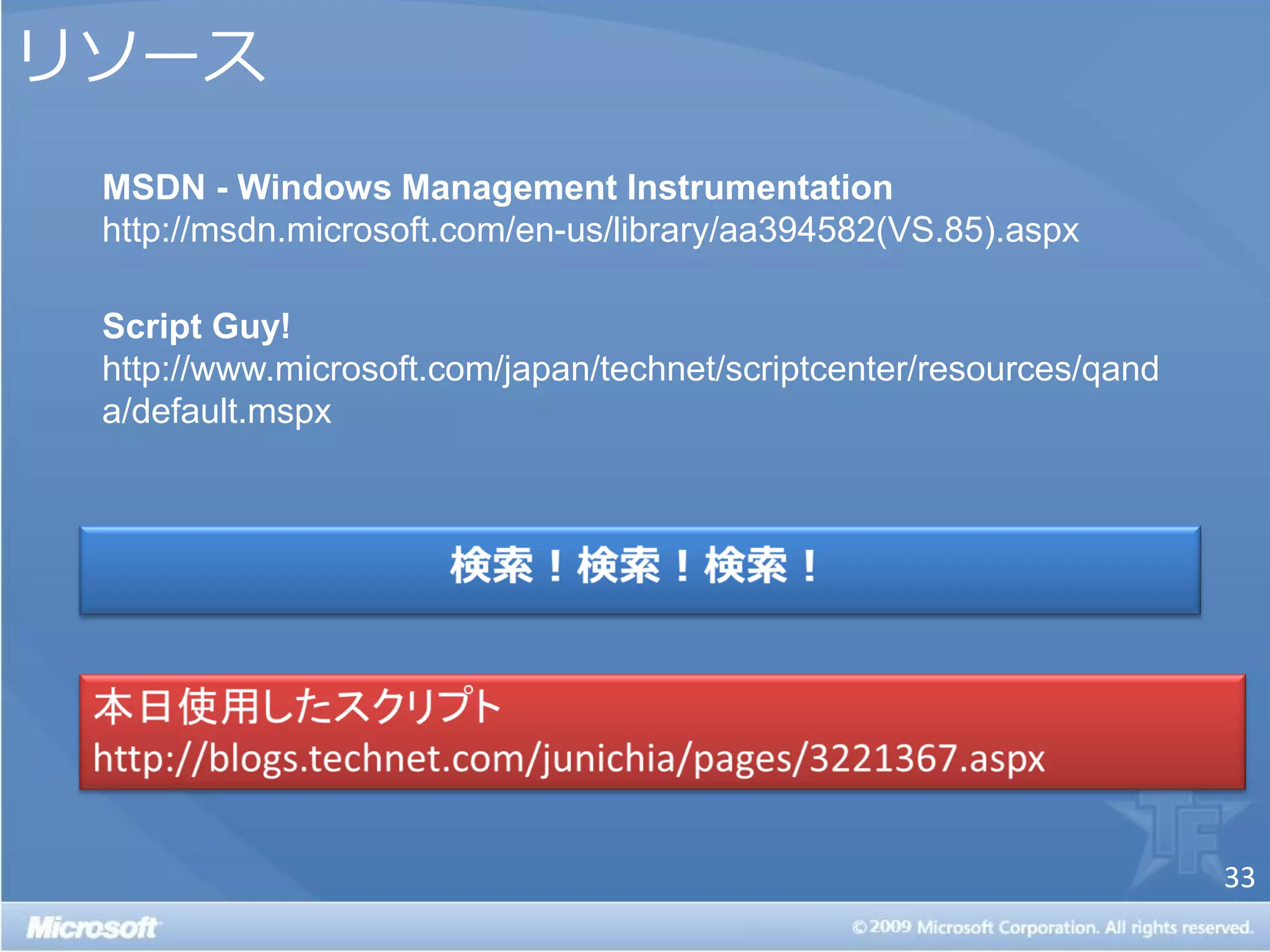
リソース
 MSDN - Windows Management Instrumentation
 http://msdn.microsoft.com/en-us/library/aa394582(VS.85).aspx

 Script Guy!
 http://www.microsoft.com/japan/technet/scriptcenter/resources/qand
 a/default.mspx


                                                                      33
34

Windows スクリプトセミナー WMI編 VBScript&WMI

  • 1.
    第2部 応用編① WMI によるWindows Server の 監視 マ゗クロソフト株式会社 エバンジェリスト 安納 順一 http://blogs.technet.com/junichia/ 1
  • 2.
    本日の目的 WMIを使用して Windows Server を監視する方法を学びます ※今回は VBScript を使用します WMIとは何か? WMIを使用したスクリプト作成の基礎 WMIを使用した゗ベントの待ち合わせ WMIを使用した永続的監視の実装 スクリプトの奥深さに感動していただけるはずです 2
  • 3.
    WMI とは WindowsManagement Instrumentation WBEM/CIMに準拠 各種管理情報への共通゗ンターフェース Windows Management Serviceとして実装 Windows 2000以上のOSに標準搭載 WMIプロバ゗ダはベンダーが拡張可能 別途エージェントは一切必要なし もちろんタダ! 3
  • 4.
  • 5.
    WMI にゕクセスするには バッチフゔ゗ルから WMICコマンド(Windows XP以降) Windows Script Host から PowerShell から Visual Studio から GUIツールから WMI Admin Tools など 5
  • 6.
    WMIのゕーキテクチャ 管理ゕプリケーション COM/DCOM CIM Repository CIM Object Manager Object Provider COM/DCOM Object ・・・・・・・ 6
  • 7.
    WMIの構造 %WinDir%¥System32¥wbem 配下のmof (Managed Object Format) フゔ゗ルに定義されている Namespace によって使える Namespace Class が異なることに注意 規定のNamespaceは Class Root¥CIMV2 (例) ROOT¥COMV2 Win32_OperatingSystem Win32_NTLogEventLog ・ ・ ROOT¥Default STDREGPROV ROOT¥microsoft¥SqlServer¥ComputerManagement10 SqlService ・ 7 ・
  • 8.
    WMIの主役 Win32_クラス 一部抜粋 Win32_ActiveRoute Win32_ModuleTrace Win32_ComputerShutdownEvent Win32_NamedJobObject Win32_ComputerSystemEvent Win32_NTDomain Win32_ConnectionShare Win32_PingStatus Win32_CurrentTime Win32_ProcessStartTrace Win32_DeviceChangeEvent Win32_ProcessStopTrace Win32_DiskQuota Win32_Proxy Win32_GroupInDomain Win32_QuotaSetting Win32_IP4PersistedRouteTable Win32_ServerConnection Win32_IP4RouteTable Win32_SessionConnection Win32_IP4RouteTableEvent Win32_TokenGroups Win32_JobObjectStatus Win32_TokenPrivileges Win32_LoggedOnUser Win32_VolumeChangeEvent Win32_LogonSession Win32_WindowsProductActivation Win32_LogonSessionMappedDisk Win32_ControllerHasHub Win32_NetworkAdapter ・ Win32_ComputerSystem ・ ・ ・ ・ 8
  • 9.
    WMI Tools ~CIM Studio ブラウザを使用して、WMIの構造、実際の゗ンスタンスを確認 クエリを発行して戻り値を確認 リモートコンピュータに接続も可能 9
  • 10.
  • 11.
    WMI Scriptingの基本形 'SWbemLocatorオブジェクトの作成 Set Locator = CreateObject("WbemScripting.SWbemLocator") ‘ローカルコンピュータへの接続 Set Service = Locator.ConnectServer("", "root¥cimv2", "", "") ‘クエリーの定義(WQL:WMI Query Language) strQuery = "Select * from Win32_NetworkAdapterConfiguration " & _ "where IPEnabled = True" ‘クエリーの実行(インスタンスを取得する) Set objNet = Service.ExecQuery(strQuery) '結果の参照 For each n in objNet WScript.Echo n.caption WScript.Echo n.MACAddress Next 11
  • 12.
    WMIスクリプトの実行権限 リモートコンピュータに対するゕクセス権の取得 SetService = Locator.ConnectServer(RemoteHost,Namespace,User,Password) 特殊権限の取得 Set Locator = CreateObject("WbemScripting.SWbemLocator") Set Service = Locator.ConnectServer("DC01", "root¥cimv2", "Dom¥administrator", "pass") Service.Security_.Privileges.AddAsString "SeBackupPrivilege", True Service.Security_.Privileges.AddAsString "SeSecurityPrivilege", True strQuery = "Select * from Win32_NTEventlogFile" & _ " Where LogfileName = 'Security' " Set obj = Service.ExecQuery(strQuery) For each n in obj r = n.BackupEventLog("C:¥tmp¥Security.evt") Next 12
  • 13.
  • 14.
  • 15.
  • 16.
    ゗ベントの監視 システムで発生した゗ベントをトリガーとして処理を実行 一時監視と永続的監視 以下の゗ベント監視用クラスが用意されている __InstanceCreationEvent あたらしい゗ンスタンスが作成された __InstanceModificationEvent ゗ンスタンスの属性が変更された __InstanceDeletionEvent 既存の゗ンスタンスが削除された 16
  • 17.
    監視の゗メージ ゗ベントログに゗ベ WORDが起動 ントが書かれた USBデバ゗スが挿された タ゗ムゾーンが変更 ユーザーがログオン IPゕドレス変更 シャットダウン メモ帳が終了 17
  • 18.
    一時的な監視例① __InstanceCreationEventによる新たに作成されたインスタンスの監視 Set objLocator =CreateObject("WbemScripting.SWbemLocator") Set objService = objLocator.ConnectServer(TargetComputer, _ "", AdminUser, AdminPass) strQueryCreate = "Select * " & _ "FROM __InstanceCreationEvent WITHIN 5 " & _ 監視したい "WHERE TargetInstance ISA 'Win32_Process' " クラス Set objEventsCreation = objService.ExecNotificationQuery(strQueryCreate) Do Set CreationEvent = objEventsCreation.Nextevent ProcessName = CreationEvent.TargetInstance.Name Win32_Procass Wscript.Echo ProcessName のプロパテゖ Loop 18
  • 19.
    一時的な監視例② __InstanceModificationEventによるユーザーログオンの監視 Set objLocator =CreateObject("WbemScripting.SWbemLocator") Set objService = objLocator.ConnectServer(TargetComputer, _ ‚ROOT¥CIMV2", AdminUser, AdminPass) strQuery= "Select * " & _ "FROM __InstanceModificationEvent WITHIN 5 " & _ "WHERE TargetInstance ISA 'Win32_ComputerSystem' " Set objEventsModification = objService.ExecNotificationQuery(strQuery) Do Set ModificationEvent = objEventsModification.Nextevent UserName = ModificationEvent.TargetInstance.UserName Wscript.Echo UserName Loop 19
  • 20.
    そこでこんな方法… 現在のログオンセッション一覧をキャッシュ ログオンしたらセッション作成 ログオフしたらセッション削除 ログオン時に割り振られた番号 ログオンのタ゗プ(対話、ネットワーク…) 現在ログオンしているユーザーのユーザーIDとログ オンIDをキャッシュ ログオンしたユーザーID ログオン時に割り振られた番号 20
  • 21.
    一時的な監視例③ __InstanceCreationEventによるユーザーログオンの監視 Set objLocator =CreateObject("WbemScripting.SWbemLocator") Set objService = objLocator.ConnectServer("demo2008", "ROOT¥CIMV2", "", "") Wscript.Echo "接続が完了しました" strQueryCreate = "Select * FROM __InstanceCreationEvent WITHIN 5 " & _ "WHERE TargetInstance ISA 'Win32_LogonSession' ‚ Set objEventsCreation = objService.ExecNotificationQuery(strQueryCreate) Do Set CreationEvent = objEventsCreation.Nextevent LogonId= CreationEvent.TargetInstance.LogonID LogonType = CreationEvent.TargetInstance.LogonType strQueryLU = "Select * " & _ ‚FROM Win32_LoggedOnUser‛ ' Where Dependent like ‘%" & LogonId & "%’‚ Set objLoggedOnUser = objService.ExecQuery(strQueryLU) For Each u in objLoggedOnUser If instr(u.Dependent, LogonId) Then Wscript.Echo u.Antecedent ユーザーID Wscript.Echo u.Dependent ログオンID End If Next Loop 21
  • 22.
    一時的な監視例③‘ (③をブラッシュアップ) SetobjLocator = CreateObject("WbemScripting.SWbemLocator") Set objService = objLocator.ConnectServer("demo2008", "ROOT¥CIMV2", "", "") Wscript.Echo "接続が完了しました" strQueryCreate = "Select * FROM __InstanceCreationEvent WITHIN 5 " & _ "WHERE TargetInstance ISA 'Win32_LogonSession' ‚ Set objEventsCreation = objService.ExecNotificationQuery(strQueryCreate) Do Set CreationEvent = objEventsCreation.Nextevent LogonId= CreationEvent.TargetInstance.LogonID LogonType = CreationEvent.TargetInstance.LogonType Select Case LogonType Case 0 strLogonType = "System" Case 2 strLogonType = "Interactive" Case 3 strLogonType = "Network" Case 4 strLogonType = "Batch" Case 5 strLogonType = "Service" Case 6 strLogonType = "Proxy" Case 7 strLogonType = "Unlock" Case 8 strLogonType = "NetworkClearText" Case 9 strLogonType = "NewCredentials" Case 10 strLogonType = "RemoteInteractive(TS)" Case 11 strLogonType = "CachedInteractive" Case 12 strLogonType = "CachedRemoteInteractive" Case 13 strLogonType = "CachedUnlock" End Select 22
  • 23.
    strQueryLoggedOnUser = "Select* " & _ "FROM Win32_LoggedOnUser" Set objLoggedOnUser = objService.ExecQuery(strQueryLoggedOnUser) For Each u in objLoggedOnUser If instr(u.Dependent, LogonId) Then arrAntecedent = Split(u.Antecedent,".") Wscript.Echo Date & "," & Time & "," & _ LogonId & "," & arrAntecedent(2) & "," & strLogonType Exit For End If Next Loop 23
  • 24.
    一時的な監視例④ __InstanceDeletionEventによるユーザーログオフの監視 SetobjLocator = CreateObject("WbemScripting.SWbemLocator") Set objService = objLocator.ConnectServer("demo2008", "ROOT¥CIMV2", "", "") Wscript.Echo "接続が完了しました" strQueryCreate = "Select * " & _ "FROM __InstanceDeletionEvent WITHIN 5 " & _ "WHERE TargetInstance ISA 'Win32_LogonSession' " Set objEventsDeletion = objService.ExecNotificationQuery(strQueryCreate) Do Set DeletionEvent = objEventsDeletion.Nextevent LogonId= DeletionEvent.TargetInstance.LogonID LogonType = DeletionEvent.TargetInstance.LogonType Wscript.Echo Date & "," & Time & "," & LogonId & "," & strLogonType Loop セッションの削除はログオフしてから1分程度を要する 24
  • 25.
    ③’と④を組み合わせると ログオンIDをキーにしてログデータベースに書き込むことでサーバー を使用したユーザーの履歴を管理できる ログDB ServerName LogonID LogonType LogonDateTime LogoffDateTime Domain UserID demo2008 5443965 Interactive 2009/03/01 2009/03/01 dom anno 10:00:00 12:15:30 demo2008 6220879 TS 2009/03/01 2009/03/01 dom administrator 12:00:00 13:10:01 25
  • 26.
  • 27.
    ゗ベントコンシューマ イベントコンシューマとは…. システムで発生したイベントをトリガーに特定のアクションを 実行する機構 • ActiveScriptEventConsumer – イベントが発生したらスクリプトを実行 • LogFileEventConsumer – ゗ベントが発生したらテキストフゔ゗ルに書き込み • NTEventLogEventConsumer – ゗ベントが発生したら゗ベント • SMTPEventConsumer – ゗ベントが発生したらメール送信 • CommandLineEventConsumer – ゗ベントが発生したらコマンドを実行 システムに登録されるのでログオンする必要が無い ただし、監視できるのはローカルコンピュータ 27
  • 28.
    MOFフゔ゗ルによる永続的監視 ActiveScriptEventConsumerによるmofフゔ゗ルの例 #pragma namespace("¥¥¥¥.¥¥root¥¥subscription") instance of ActiveScriptEventConsumer as $Cons { Name = "LogonUserLogging"; ScriptingEngine = "VBScript"; ScriptFileName = "c:¥¥tmp¥¥demoscript¥¥wmisample08.vbs"; }; instance of __EventFilter as $Filt { Name = "LogonUser"; Query = "SELECT * FROM __InstanceCreationEvent WITHIN 5 " "WHERE TargetInstance ISA ¥"Win32_LogonSession¥" "; QueryLanguage = "WQL"; EventNamespace = "root¥¥cimv2"; }; instance of __FilterToConsumerBinding { Filter = $Filt; Consumer = $Cons; 28 };
  • 29.
  • 30.
    呼び出されるスクリプト(③‘’) Set objLocator= CreateObject("WbemScripting.SWbemLocator") Set objService = objLocator.ConnectServer("demo2008", "ROOT¥CIMV2", "", "") Set objFS = CreateObject("Scripting.FileSystemObject") Wscript.Echo "接続が完了しました" strQueryCreate = "Select * FROM __InstanceCreationEvent WITHIN 5 " & _ "WHERE TargetInstance ISA 'Win32_LogonSession' ‚ Set objEventsCreation = objService.ExecNotificationQuery(strQueryCreate) Do Set CreationEvent = objEventsCreation.Nextevent LogonId= CreationEventTargetEvvent.TargetInstance.LogonID LogonType = CreationEventTargetEvent.TargetInstance.LogonType Select Case LogonType Case 0 strLogonType = "System" Case 2 strLogonType = "Interactive" Case 3 strLogonType = "Network" Case 4 strLogonType = "Batch" Case 5 strLogonType = "Service" Case 6 strLogonType = "Proxy" Case 7 strLogonType = "Unlock" Case 8 strLogonType = "NetworkClearText" Case 9 strLogonType = "NewCredentials" Case 10 strLogonType = "RemoteInteractive(TS)" Case 11 strLogonType = "CachedInteractive" Case 12 strLogonType = "CachedRemoteInteractive" Case 13 strLogonType = "CachedUnlock" End Select 30
  • 31.
    strQueryLoggedOnUser = "Select* FROM Win32_LoggedOnUser" Set objLoggedOnUser = objService.ExecQuery(strQueryLoggedOnUser) For Each u in objLoggedOnUser If instr(u.Dependent, LogonId) Then arrAntecedent = Split(u.Antecedent,".") Set objLogFile = objFS.OpenTextFile("C:¥tmp¥demoscript¥userlog.txt",8,True) objLogFile.WriteLine Date & "," & Time & "," & LogonId & "," & _ arrAntecedent(2) & "," & strLogonType objLogFile.Close Wscript.Echo Date & "," & Time & "," & _ LogonId & "," & arrAntecedent(2) & "," & strLogonType Exit For End If Next Loop 31
  • 32.
  • 33.
    リソース MSDN -Windows Management Instrumentation http://msdn.microsoft.com/en-us/library/aa394582(VS.85).aspx Script Guy! http://www.microsoft.com/japan/technet/scriptcenter/resources/qand a/default.mspx 33
  • 34.