Value
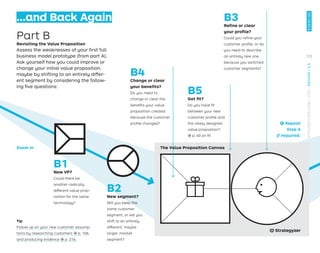
Proposition
Design
Cover image: Pilot Interactive
Cover design: Alan Smith and Trish Papadakos
This book is printed on acid-free paper. ∞
Copyright © 2014 by Alexander Osterwalder, Yves Pigneur, Alan Smith, Greg Bernarda, and Patricia Papadakos. All rights reserved.
Published by John Wiley & Sons, Inc., Hoboken, New Jersey.
Published simultaneously in Canada.
No part of this publication may be reproduced, stored in a retrieval system, or transmitted in any form or by any means, electronic, mechanical, photocopying,
recording, scanning, or otherwise, except as permitted under Section 107 or 108 of the 1976 United States Copyright Act, without either the prior written permis-
sion of the Publisher, or authorization through payment of the appropriate per-copy fee to the Copyright Clearance Center, 222 Rosewood Drive, Danvers, MA
01923, (978) 750-8400, fax (978) 646-8600, or on the web at www.copyright.com. Requests to the Publisher for permission should be addressed to the Permissions
Department, John Wiley & Sons, Inc., 111 River Street, Hoboken, NJ 07030, (201) 748-6011, fax (201) 748-6008, or online at www.wiley.com/go/permissions.
Limit of Liability/Disclaimer of Warranty: While the publisher and author have used their best efforts in preparing this book, they make no representations or
warranties with the respect to the accuracy or completeness of the contents of this book and specifically disclaim any implied warranties of merchantability
or fitness for a particular purpose. No warranty may be created or extended by sales representatives or written sales materials. The advice and strategies
contained herein may not be suitable for your situation. You should consult with a professional where appropriate. Neither the publisher nor the author shall be
liable for damages arising herefrom.
For general information about our other products and services, please contact our Customer Care Department within the United States at (800) 762-2974,
outside the United States at (317) 572-3993 or fax (317) 572-4002.
Wiley publishes in a variety of print and electronic formats and by print-on-demand. Some material included with standard print versions of this book may not
be included in e-books or in print-on-demand. If this book refers to media such as a CD or DVD that is not included in the version you purchased, you may
download this material at http://booksupport.wiley.com. For more information about Wiley products, visit www.wiley.com.
ISBN 978-1-118-96805-5 (paper); ISBN 978-1-118-96807-9 (ebk); ISBN 978-1-118-96806-2 (ebk); ISBN 978-1-118-97310-3 (ebk)
Printed in the United States of America
10 9 8 7 6 5 4 3 2 1
Value
Proposition
Design
strategyzer.com/vpd
Written by
Alex Osterwalder
Yves Pigneur
Greg Bernarda
Alan Smith
Designed by
Trish Papadakos
How to create products and
services customers want.
Get started with…
1. Canvas
1.1 Customer Profile 10
1.2 Value Map 26
1.3 Fit 40
2. Design
2.1 Prototyping Possibilities 74
2.2 Starting Points 86
2.3 Understanding Customers 104
2.4 Making Choices 120
2.5 Finding the Right Business Model 142
2.6 Designing in Established Organizations 158
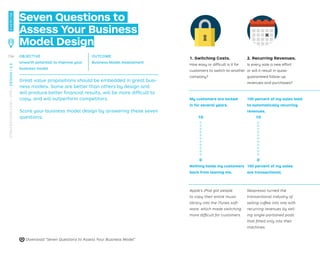
ASSESSMENT
OBSERVATION
PROTOTYPING
TO
TESTING
FAILED
FROM
TESTING
STARTING POINTS
BU
SIN
ESS MO
DE
L
7
Q
U
E
S
T
IO
N
S
3. Test
3.1 What to Test 188
3.2 Testing Step-by-Step 196
3.3 Experiment Library 214
3.4 Bringing It All Together 238
4. Evolve
Create Alignment 260
Measure & Monitor 262
Improve Relentlessly 264
Reinvent Yourself Constantly 266
Taobao: Reinventing (E-)Commerce 268
Glossary 276
Core Team 278
Prereaders 279
Bios 280
Index 282
G
D
S
U
C
C
E
S
S
HYPOTHESIS
Overwhelmed by the task of true
value creation
Sometimes you feel like…
ǃɲ There should be better tools available to help you create value
for your customers and your business.
ǃɲ You might be pursuing the wrong tasks and you feel insecure
about the next steps.
ǃɲ It’s difficult to learn what customers really want.
ǃɲ The information and data you get from (potential) customers is
overwhelming and you don’t know how to best organize it.
ǃɲ It’s challenging to go beyond products and features toward a
deep understanding of customer value creation.
ǃɲ You lack the big picture of how all the puzzle pieces fit
together.
Frustrated by unproductive
meetings and misaligned teams
You have experienced teams that…
ǃɲ Lacked a shared language and a shared understanding of
customer value creation.
ǃɲ Got bogged down by unproductive meetings with tons of
unstructured “blah blah blah” conversations.
ǃɲ Worked without clear processes and tools.
ǃɲ Were focused mainly on technologies, products, and features
rather than customers.
ǃɲ Conducted meetings that drained energy and ended without a
clear outcome.
ǃɲ Were misaligned.
BLAH
BL
AH
L
L
B
BL
LA
AH
H
H
BLAH,
BLAH
B
BLAH… LAH
You’ll love Value Proposition
Design if you’ve been…
STRATEGYZER.COM
/
VPD
/
INTRO
VI
Involved in bold shiny projects
that blew up
You have seen projects that…
ǃɲ Were big bold bets that failed and wasted a lot money.
ǃɲ Put energy into polishing and refining a business plan until it
perpetuated the illusion that it could actually work.
ǃɲ Spent a lot of time building detailed spreadsheets that were
completely made up and turned out to be wrong.
ǃɲ Spent more time developing and debating ideas rather than
testing them with customers and stakeholders.
ǃɲ Let opinions dominate over facts from the field.
ǃɲ Lacked clear processes and tools to minimize risk.
ǃɲ Used processes suited for running a business rather than ones
for developing new ideas.
Disappointed
by the failure
of a good idea.
STRATEGYZER.COM
/
VPD
/
INTRO
Get “From Failure to Success” poster
VII
Value Proposition Design
will help you successfully…
Understand the patterns
of value creation
Organize information about what customers want in a simple
way that makes the patterns of value creation easily visible. As
a result, you will more effectively design value propositions and
profitable business models that directly target your customers’
most pressing and important jobs, pains, and gains.
Gain clarity.
Leverage the experience and skills
of your team
Equip your team with a shared language to overcome “blah blah
blah,” conduct more strategic conversations, run creative exer-
cises, and get aligned. This will lead to more enjoyable meetings
that are full of energy and produce actionable outcomes beyond
a focus on technology, products, and features toward creating
value for your customers and your business.
Get your team aligned.
STRATEGYZER.COM
/
VPD
/
INTRO
VIII
Avoid wasting time with ideas that
won’t work
Relentlessly test the most important hypotheses underlying
your business ideas in order to reduce the risk of failure. This will
allow you to pursue big bold ideas without having to break the
bank. Your processes to shape new ideas will be fit for the task
and complement your existing processes that help you run your
business.
Minimize the risk of a flop.
Design, test,
and deliver what
customers want.
Get “From Failure to Success” poster
STRATEGYZER.COM
/
VPD
/
INTRO
IX
Value
Proposition
Design
gn
strategyzer.com/vpd
Written by
Alex Osterwalder
Yves Pigneur
Greg Bernarda
Alan Smith
Designed by
Trish Papadakos
How to create products and
services customers want.
Get started with…
Sequel to
Business Model Generation
International Bestseller
30+ Languages
Series
Our Value Proposition
to You
Web App + Online Courses
Go further with pro tools and courses
2 3
VPD Book
+
VPD Online Companion
The links you see on the
side of every page point
to resources in the online
companion.
Watch for the
Strategyzer logo
and follow the link to
online exercises,
tools/templates,
posters, and more.
Note: To gain access to these exclusive online portions of Value Proposition
Design, you'll need to prove you own the book. Keep the book near you to
help you answer the secret questions and verify your ownership!
STRATEGYZER.COM
/
VPD
/
INTRO
X
Succeed!
Learn
Apply
Minimizes risk
of (big) failure
Helps create
products and
services
people want
Helps
understand
what matters
to customers
Instructions
to get started
Engaging online
multimedia content
Practical, visual, +
enjoyable format
Integrated with the
Business Model Canvas
Access to advanced
material and knowledge
Enables practice + skills
(self-)assessment
Brief, clear,
and applicable
content avoids
confusion
Shared language
to communicate
and collaborate Share with and
learn from peers
Helps
shape ideas
Software-
supported
methodology
Integrates with
other business
methods
Proven and effective
suite of business tools
STRATEGYZER.COM
/
VPD
/
INTRO
XI
Canvas Design / Test
Search
Tools
The Tools and Process of
Value Proposition Design
Zoom out
Zoom in
STRATEGYZER.COM
/
VPD
/
INTRO
XII
Post search
Evolve
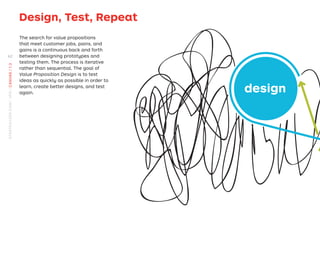
The heart of Value Proposition Design is about applying
Tools to the messy Search for value propositions that
customers want and then keeping them aligned with what
customers want in Post search.
Value Proposition Design shows you how to use the Value
Proposition Canvas to Design and Test great value propo-
sitions in an iterative search for what customers want. Value
proposition design is a never-ending process in which you
need to Evolve your value proposition(s) constantly to keep
it relevant to customers.
Manage the messy and nonlinear
process of value proposition design and
reduce risk by systematically applying
adequate tools and processes.
Progress
Design Squiggle adapted from Damien Newman, Central
STRATEGYZER.COM
/
VPD
/
INTRO
XIII
An Integrated
Suite of Tools
The Value Proposition Canvas is the
tool at the center of this book. It makes
value propositions visible and tangible
and thus easier to discuss and manage.
It perfectly integrates with the Business
Model Canvas and the Environment
Map, two tools that are discussed in
detail in Business Model Generation,*
the sister book to this one. Together,
they shape the foundation of a suite
of business tools.
The Value Proposition Canvas zooms
into the details of two of the building
blocks of the Business Model Canvas.
* Business Model Generation, Osterwalder and Pigneur, 2010.
Zoom out
Zoom in
STRATEGYZER.COM
/
VPD
/
INTRO
XIV
The
Business Model Canvas
helps you
create value for your business.
The
Value Proposition Canvas
helps you
create value for your customer.
The
Environment Map
helps you understand the context
in which you create.
STRATEGYZER.COM
/
VPD
/
INTRO
XV
Customer Segments
are the groups of people and/or orga-
nizations a company or organization
aims to reach and create value for
with a dedicated value proposition.
Value Propositions
are based on a bundle of products
and services that create value for a
customer segment.
Channels
describe how a value proposition is
communicated and delivered to a
customer segment through commu-
nication, distribution, and sales
channels.
Customer Relationships
outline what type of relationship is
established and maintained with
each customer segment, and they
explain how customers are acquired
and retained.
Revenue Streams
result from a value proposition
successfully offered to a customer
segment. It is how an organization
captures value with a price that
customers are willing to pay.
Key Resources
are the most important assets
required to offer and deliver the previ-
ously described elements.
Key Activities
are the most important activities an
organization needs to perform well.
Key Partnerships
shows the network of suppliers
and partners that bring in external
resources and activities.
Cost Structure
describes all costs incurred to oper-
ate a business model.
Profit
is calculated by subtracting the
total of all costs in the cost structure
from the total of all revenue streams.
Embed your value proposition in a
viable business model to capture value
for your organization. To do so, you
can use the Business Model Canvas, a
tool to describe how your organization
creates, delivers, and captures value.
The Business Model Canvas and Value
Proposition Canvas perfectly integrate,
with the latter being like a plug-in to
the former that allows you to zoom
into the details of how you are creating
value for customers.
The refresher of the Business Model
Canvas on this spread is sufficient to
work through this book and create
great value propositions. Go to the
online resources if you are interested
in more or get Business Model
Generation,*
the sister publication to
this book.
Refresher: The Business Model Canvas
* Business Model Generation, Osterwalder and Pigneur, 2010.
STRATEGYZER.COM
/
VPD
/
INTRO
XVI
The Business Model Canvas
Revenue Streams
Channels
Customer Segments
Value Propositions
Key Activities
Key Partners
Key Resources
Cost Structure
Customer Relationships
Designed by: Date: Version:
Designed for:
designed by: Business Model Foundry AG
The makers of Business Model Generation and Strategyzer
This work is licensed under the Creative Commons Attribution-Share Alike 3.0 Unported License. To view a copy of this license, visit:
http://creativecommons.org/licenses/by-sa/3.0/ or send a letter to Creative Commons, 171 Second Street, Suite 300, San Francisco, California, 94105, USA. strategyzer.com
STRATEGYZER.COM
/
VPD
/
INTRO
Download detailed Business Model Canvas Explanation and the Business Model Canvas pdf
XVII
Value Proposition
Design works for…
Main opportunities
ǃɲ Use speedy decision making and
agility to your advantage.
ǃɲ Leverage the motivation of owner-
ship as a driver for success.
Main challenges
ǃɲ Produce proof that your ideas can
work on a limited budget.
ǃɲ Manage involvement of investors
(if you scale your ideas).
ǃɲ Risk running out of money before
finding the right value proposition
and business model.
New Ventures
Individuals or teams setting out to
create a great value proposition
and business model from scratch
A start-up entrepreneur deals with different constraints than a project
leader for a new venture within an existing organization. The tools presented
in this book apply to both contexts. Depending on your starting point you will
execute them in a different way to leverage different strengths and overcome
different obstacles.
Are you creating something from scratch on your own or
are you part of an existing organization? Some things will
be easier and some harder depending on your strategic
playground.
STRATEGYZER.COM
/
VPD
/
INTRO
XVIII
Unit A
Unit B
Unit C
Process
Established
Organizations
Teams within existing companies
setting out to improve or invent value
propositions and business models Main challenges
ǃɲ Get buy-in from top
management.
ǃɲ Get access to existing resources.
ǃɲ Manage cannibalization.
ǃɲ Overcome risk aversion.
ǃɲ Overcome rigid and slow
processes.
ǃɲ Produce big wins to move the
needle.
ǃɲ Manage career risk of innovators.
Main opportunities
ǃɲ Build on existing value proposi-
tions and business models.
ǃɲ Leverage existing assets (sales,
channels, brand, etc.).
ǃɲ Build portfolios of business
models and value propositions.
STRATEGYZER.COM
/
VPD
/
INTRO
Get “Innovating in Established
Organizations” poster
XIX
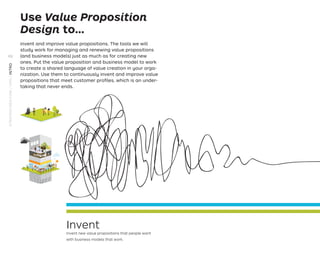
Use Value Proposition
Design to…
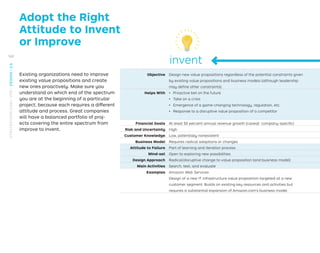
invent and improve value propositions. The tools we will
study work for managing and renewing value propositions
(and business models) just as much as for creating new
ones. Put the value proposition and business model to work
to create a shared language of value creation in your orga-
nization. Use them to continuously invent and improve value
propositions that meet customer profiles, which is an under-
taking that never ends.
Invent
Invent new value propositions that people want
with business models that work.
Unit
A
Unit
B
Unit
C
Process
STRATEGYZER.COM
/
VPD
/
INTRO
XX
Improve
Manage, measure, challenge, improve, and renew
existing value propositions and business models.
STRATEGYZER.COM
/
VPD
/
INTRO
XXI
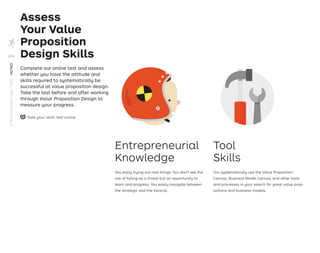
Assess
Your Value
Proposition
Design Skills
Complete our online test and assess
whether you have the attitude and
skills required to systematically be
successful at value proposition design.
Take the test before and after working
through Value Proposition Design to
measure your progress.
Entrepreneurial
Knowledge
You enjoy trying out new things. You don’t see the
risk of failing as a threat but an opportunity to
learn and progress. You easily navigate between
the strategic and the tactical.
Tool
Skills
You systematically use the Value Proposition
Canvas, Business Model Canvas, and other tools
and processes in your search for great value prop-
ositions and business models.
Take your skills test online
XXII
STRATEGYZER.COM
/
VPD
/
INTRO
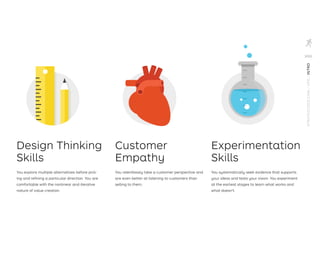
Design Thinking
Skills
You explore multiple alternatives before pick-
ing and refining a particular direction. You are
comfortable with the nonlinear and iterative
nature of value creation.
Customer
Empathy
You relentlessly take a customer perspective and
are even better at listening to customers than
selling to them.
Experimentation
Skills
You systematically seek evidence that supports
your ideas and tests your vision. You experiment
at the earliest stages to learn what works and
what doesn’t.
XXIII
STRATEGYZER.COM
/
VPD
/
INTRO
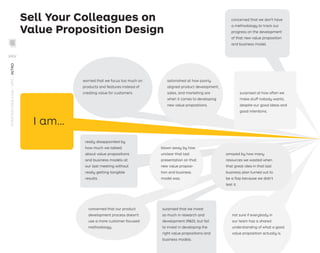
worried that we focus too much on
products and features instead of
creating value for customers.
not sure if everybody in
our team has a shared
understanding of what a good
value proposition actually is.
really disappointed by
how much we talked
about value propositions
and business models at
our last meeting without
really getting tangible
results.
surprised that we invest
so much in research and
development (R&D), but fail
to invest in developing the
right value propositions and
business models.
blown away by how
unclear that last
presentation on that
new value proposi-
tion and business
model was.
concerned that we don’t have
a methodology to track our
progress on the development
of that new value proposition
and business model.
amazed by how many
resources we wasted when
that great idea in that last
business plan turned out to
be a flop because we didn’t
test it.
concerned that our product
development process doesn’t
use a more customer-focused
methodology.
astonished at how poorly
aligned product development,
sales, and marketing are
when it comes to developing
new value propositions.
Sell Your Colleagues on
Value Proposition Design
surprised at how often we
make stuff nobody wants,
despite our good ideas and
good intentions.
I am…
STRATEGYZER.COM
/
VPD
/
INTRO
XXIV
The Business Model Canvas
Revenue Streams
Channels
Customer Segments
Value Propositions
Key Activities
Key Partners
Key Resources
Cost Structure
Customer Relationships
Designed by:
Date: Version:
Designed for:
designed by: Business Model Foundry AG
The makers of Business Model Generation and Strategyzer
This work is licensed under the Creative Commons Attribution-Share Alike 3.0 Unported License. To view a copy of this license, visit:
http://creativecommons.org/licenses/by-sa/3.0/
or send a letter to Creative Commons, 171 Second Street, Suite 300, San Francisco, California, 94105, USA.
strategyzer.com
So, what if
we tried out the
Value Proposition
Canvas (and Business
Model Canvas) in our
next project?
strategyzer.com
Gain Creators
Pain Relievers
Pains
Gains
Products
& Services
Customer
Job(s)
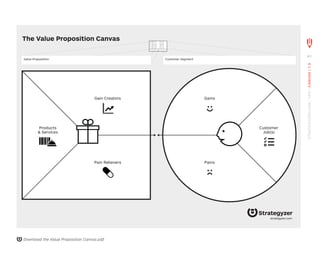
The Value Proposition Canvas
Value Proposition
Customer Segment
The makers of Business Model Generation and Strategyzer
Copyright Business Model Foundry AG
STRATEGYZER.COM
/
VPD
/
INTRO
Get a slide deck with 10 arguments to use with the Value Proposition and Business Model Canvases
XXV
can
vas
1
The Value Proposition Canvas has two sides.
With the Customer Profile p. 10
you clarify
your customer understanding. With the
Value Map p. 26
you describe how you intend
to create value for that customer. You
achieve Fit p. 40
between the two when one
meets the other.
The set of value proposition benefits that you design to attract customers.
Create Value
DEF·I·NI·TION
VALUE PROPOSITION
Describes the benefits customers can
expect from your products and services.
F
STRATEGYZER.COM
/
VPD
/
CANVAS
/
1.0
6
Observe Customers
The set of customer characteristics that you assume, observe, and verify in the market.
it
STRATEGYZER.COM
/
VPD
/
CANVAS
/
1.0
7
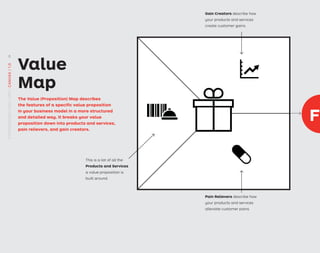
The Value (Proposition) Map describes
the features of a specific value proposition
in your business model in a more structured
and detailed way. It breaks your value
proposition down into products and services,
pain relievers, and gain creators.
Value
Map
Gain Creators describe how
your products and services
create customer gains.
Pain Relievers describe how
your products and services
alleviate customer pains.
Fit
This is a list of all the
Products and Services
a value proposition is
built around.
8
STRATEGYZER.COM
/
VPD
/
CANVAS
/
1.0
The Customer (Segment) Profile describes
a specific customer segment in your
business model in a more structured
and detailed way. It breaks the customer
down into its jobs, pains, and gains.
Fit
You achieve Fit when your value map meets your
customer profile—when your products and services
produce pain relievers and gain creators that match
one or more of the jobs, pains, and gains that are
important to your customer.
Customer
Profile
Gains describe the outcomes
customers want to achieve or
the concrete benefits they are
seeking.
Pains describe bad outcomes,
risks, and obstacles related to
customer jobs.
Customer Jobs describe
what customers are trying
to get done in their work and
in their lives, as expressed in
their own words.
9
STRATEGYZER.COM
/
VPD
/
CANVAS
/
1.0
.
Customer
Profile
10
Customer Jobs
Jobs describe the things your customers are
trying to get done in their work or in their life.
A customer job could be the tasks they are trying
to perform and complete, the problems they
are trying to solve, or the needs they are trying
to satisfy. Make sure you take the customer’s
perspective when investigating jobs. What you
think of as important from your perspective might
not be a job customers are actually trying to get
done.*
Distinguish between three main types of
customer jobs to be done and supporting jobs:
Functional jobs
When your customers try to perform or complete
a specific task or solve a specific problem,
for example, mow the lawn, eat healthy as a
consumer, write a report, or help clients as
a professional.
Social jobs
When your customers want to look good or gain
power or status. These jobs describe how custom-
ers want to be perceived by others, for example,
look trendy as a consumer or be perceived as
competent as a professional.
Personal/emotional jobs
When your customers seek a specific emotional
state, such as feeling good or secure, for example,
seeking peace of mind regarding one’s invest-
ments as a consumer or achieving the feeling of
job security at one’s workplace.
Supporting jobs
Customers also perform supporting jobs in the
context of purchasing and consuming value either
as consumers or as professionals. These jobs arise
from three different roles:
ǃɲ BUYER OF VALUE: jobs related to buying
value, such as comparing offers, deciding which
products to buy, standing in a checkout line,
completing a purchase, or taking delivery of
a product or service.
ǃɲ COCREATOR OF VALUE: jobs related to
cocreating value with your organization, such
as posting product reviews and feedback or
even participating in the design of a product
or service.
ǃɲ TRANSFERRER OF VALUE: jobs related to the
end of a value proposition’s life cycle, such as
canceling a subscription, disposing of a product,
transferring it to others, or reselling it.
* The jobs to be done concept was developed independently
by several business thinkers including Anthony Ulwick of the
consulting firm Strategyn, consultants Rick Pedi and Bob
Moesta, and Professor Denise Nitterhouse of DePaul University.
It was popularized by Clay Christensen and his consulting firm
Innosight and Anthony Ulwick’s Strategyn.
12
STRATEGYZER.COM
/
VPD
/
CANVAS
/
1.1
Job context
Customer jobs often depend on the specific
context in which they are performed. The context
may impose certain constraints or limitations.
For example, calling somebody on the fly is
different when you are traveling on a train than
when you are driving a car. Likewise, going to the
movies with your kids is different than going with
your partner.
+
-
Important
Insignificant
Job importance
It is important to acknowledge
that not all jobs have the same
importance to your customer. Some
matter more in a customer’s work
or life because failing to get them
done could have serious ramifi-
cations. Some are insignificant
because the customer cares about other things
more. Sometimes a customer will deem a job
crucial because it occurs frequently or because
it will result in a desired or unwanted outcome.
Download trigger questions to help find customer jobs
13
STRATEGYZER.COM
/
VPD
/
CANVAS
/
1.1
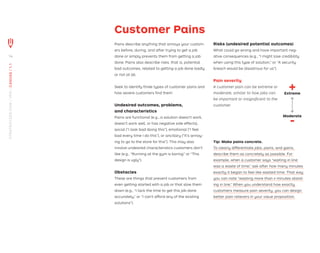
Customer Pains
Pains describe anything that annoys your custom-
ers before, during, and after trying to get a job
done or simply prevents them from getting a job
done. Pains also describe risks, that is, potential
bad outcomes, related to getting a job done badly
or not at all.
Seek to identify three types of customer pains and
how severe customers find them:
Undesired outcomes, problems,
and characteristics
Pains are functional (e.g., a solution doesn’t work,
doesn’t work well, or has negative side effects),
social (“I look bad doing this”), emotional (“I feel
bad every time I do this”), or ancillary (“It’s annoy-
ing to go to the store for this”). This may also
involve undesired characteristics customers don’t
like (e.g., “Running at the gym is boring,” or “This
design is ugly”).
Obstacles
These are things that prevent customers from
even getting started with a job or that slow them
down (e.g., “I lack the time to get this job done
accurately,” or “I can’t afford any of the existing
solutions”).
Risks (undesired potential outcomes)
What could go wrong and have important neg-
ative consequences (e.g., “I might lose credibility
when using this type of solution,” or “A security
breach would be disastrous for us”).
Tip: Make pains concrete.
To clearly differentiate jobs, pains, and gains,
describe them as concretely as possible. For
example, when a customer says “waiting in line
was a waste of time,” ask after how many minutes
exactly it began to feel like wasted time. That way
you can note “wasting more than x minutes stand-
ing in line.” When you understand how exactly
customers measure pain severity, you can design
better pain relievers in your value proposition.
+
-
Extreme
Moderate
Pain severity
A customer pain can be extreme or
moderate, similar to how jobs can
be important or insignificant to the
customer.
14
STRATEGYZER.COM
/
VPD
/
CANVAS
/
1.1
The following list of trigger questions
can help you think of different potential
customer pains:
ǃɲ How do your customers define too costly?
Takes a lot of time, costs too much money,
or requires substantial efforts?
ǃɲ What makes your customers feel bad? What
are their frustrations, annoyances, or things
that give them a headache?
ǃɲ How are current value propositions underper-
forming for your customers? Which features
are they missing? Are there performance issues
that annoy them or malfunctions they cite?
ǃɲ What are the main difficulties and challenges
your customers encounter? Do they understand
how things work, have difficulties getting certain
things done, or resist particular jobs for specific
reasons?
ǃɲ What negative social consequences do your
customers encounter or fear? Are they afraid of
a loss of face, power, trust, or status?
ǃɲ What risks do your customers fear? Are they
afraid of financial, social, or technical risks, or are
they asking themselves what could go wrong?
ǃɲ What’s keeping your customers awake at night?
What are their big issues, concerns, and worries?
ǃɲ What common mistakes do your customers
make? Are they using a solution the wrong way?
ǃɲ What barriers are keeping your customers from
adopting a value proposition? Are there upfront
investment costs, a steep learning curve, or
other obstacles preventing adoption?
Download trigger questions
15
STRATEGYZER.COM
/
VPD
/
CANVAS
/
1.1
Gains describe the outcomes and benefits your
customers want. Some gains are required,
expected, or desired by customers, and some
would surprise them. Gains include functional
utility, social gains, positive emotions, and cost
savings.
Seek to identify four types of customer gains in
terms of outcomes and benefits:
Required gains
These are gains without which a solution wouldn’t
work. For example, the most basic expectation
that we have from a smartphone is that we can
make a call with it.
Expected gains
These are relatively basic gains that we expect
from a solution, even if it could work without them.
For example, since Apple launched the iPhone, we
expect phones to be well-designed and look good.
Desired gains
These are gains that go beyond what we expect
from a solution but would love to have if we could.
These are usually gains that customers would
come up with if you asked them. For example, we
desire smartphones to be seamlessly integrated
with our other devices.
Unexpected gains
These are gains that go beyond customer expec-
tations and desires. They wouldn’t even come
up with them if you asked them. Before Apple
brought touch screens and the App Store to the
mainstream, nobody really thought of them as
part of a phone.
Customer Gains
Tip: Make gains concrete.
As with pains, it’s better to describe gains as
concretely as possible to clearly differentiate
jobs, pains, and gains from one another. Ask how
much they’d expect or dream of when a customer
indicates “better performance” as a desired gain.
That way you can note “would love an increased
performance of more than x.” When you under-
stand how exactly customers measure gains (i.e.,
outcomes and benefits), you can design better
gain creators in your value proposition.
+
-
Essential
Nice to have
Gain relevance
A customer gain can feel essential
or nice to have, just like pains can
feel extreme or moderate to them.
16
STRATEGYZER.COM
/
VPD
/
CANVAS
/
1.1
The following list of trigger questions
can help you think of different potential
customer gains:
ǃɲ Which savings would make your customers
happy? Which savings in terms of time, money,
and effort would they value?
ǃɲ What quality levels do they expect, and what
would they wish for more or less of?
ǃɲ How do current value propositions delight your
customers? Which specific features do they
enjoy? What performance and quality do they
expect?
ǃɲ What would make your customers’ jobs or lives
easier? Could there be a flatter learning curve,
more services, or lower costs of ownership?
ǃɲ What positive social consequences do your
customers desire? What makes them look good?
What increases their power or their status?
ǃɲ What are customers looking for most? Are they
searching for good design, guarantees, specific
or more features?
ǃɲ What do customers dream about? What do
they aspire to achieve, or what would be a big
relief to them?
ǃɲ How do your customers measure success and
failure? How do they gauge performance or cost?
ǃɲ What would increase your customers’ likelihood
of adopting a value proposition? Do they desire
lower cost, less investment, lower risk, or better
quality?
Download trigger questions
17
STRATEGYZER.COM
/
VPD
/
CANVAS
/
1.1
Profile of a
“Business Book Reader”
We chose to use potential readers of this book to illustrate
the customer profile. We deliberately went beyond jobs,
pains, and gains merely related to reading books, since we
intended to design an innovative and more holistic value
proposition for businesspeople in general.
The customer profile sketched out on the right is informed by several inter-
views we conducted and thousands of interactions we had with workshop
participants. However, it is not mandatory to start with preexisting customer
knowledge. You may begin exploring ideas by sketching out a profile based
on what you believe your potential customers look like. This is an excellent
starting point to prepare customer interviews and tests regarding your
assumptions about customer jobs, pains, and gains.
Gains are benefits, results, and
characteristics that custom-
ers require or desire. They are
outcomes of jobs or wanted char-
acteristics of a value proposition
that help customers get a job
done well.
The more tangible and specific
you make pains and gains, the
better. For example, “examples
from my industry” is more
concrete than “relevant to my
context.” Ask customers how they
measure gains and pains. Inves-
tigate how they measure success
or failure of a job they want to
get done.
Make sure you deeply under-
stand your customer. If you have
only a few sticky notes on your
profile, that probably indicates a
lack of customer understanding.
Unearth as many jobs, pains, and
gains as you can. Search beyond
those directly related to your
value proposition.
18
STRATEGYZER.COM
/
VPD
/
CANVAS
/
1.1
You should know your customers’
social and emotional jobs in addi-
tion to their functional jobs, which
are usually easier to identify.
Make sure you go beyond a
superficial understanding of jobs.
Why do customers want to “learn
new knowledge”? It might be that
they want to bring new methods
into their organization. Ask “why”
several times to get to the most
important jobs.
Make sure you don’t just consider
jobs, pains, and gains related to
a value proposition or product in
mind. Identify those (e.g., “Busi-
ness books are too long”) as well
as other extreme pains (e.g., “lack
of time” or “get boss’s attention”).
concrete
tips (e.g., to
reduce risk)
home run
value
propositions
helps with
promotion or
pay raise
help when
stuck
buy-in from
leadership
+ team
connect with
like-minded
people
leads to
better
collaboration
make things
people want
collaborate
with others
or help them
convince
others about
preferred
methods
communicate
+ sell ideas
management
“not
getting it”
no clear path
to applying
method
getting stuck
in career or
jeopardizing
it
boring
content that's
hard to work
through
wasting time
with ideas
that don't
work
clear
indicators
to measure
progress
biz book
reader
(generic)
find, learn,
+ apply
methods
look good
with
colleagues,
boss, clients
run
“day job”
well
“translating”
methods to
own context
assess +
reduce risk
making
things
nobody
wants
too much
theory
dealing
with risk +
uncertainty
lack of time
lack of
sufficient
budget
easy to
understand
leads to
results
(ideally quick
wins)
get
recognized
by team
applicable
ideas
can apply
with
confidence
improve skill
set + advance
career
improve
or build
a business
make
decisions
with
confidence
going down
wrong path
helps me
communicate
my ideas
clearly
stay
up to date
being
associated
with a big
failure
19
STRATEGYZER.COM
/
VPD
/
CANVAS
/
1.1
Ranking Jobs,
Pains, and Gains
Although individual customer preferences vary, you need to
get a sense of customer priorities. Investigate which jobs the
majority consider important or insignificant. Find out which
pains they find extreme versus merely moderate. Learn which
gains they find essential and which are simply nice to have.
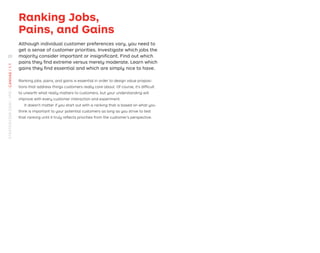
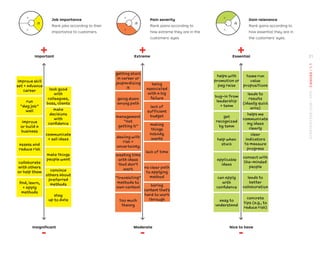
Ranking jobs, pains, and gains is essential in order to design value proposi-
tions that address things customers really care about. Of course, it’s difficult
to unearth what really matters to customers, but your understanding will
improve with every customer interaction and experiment.
It doesn’t matter if you start out with a ranking that is based on what you
think is important to your potential customers as long as you strive to test
that ranking until it truly reflects priorities from the customer’s perspective.
20
STRATEGYZER.COM
/
VPD
/
CANVAS
/
1.1
+ + +
- - -
Extreme Essential
Important
Moderate Nice to have
Insignificant
Pain severity
Rank pains according to
how extreme they are in the
customers’ eyes.
Gain relevance
Rank gains according to
how essential they are in
the customers’ eyes.
Job importance
Rank jobs according to their
importance to customers.
improve skill
set + advance
career
run
“day job”
well
improve
or build a
business
assess and
reduce risk
collaborate
with others
or help them
find, learn,
+ apply
methods
make
decisions
with
confidence
communicate
+ sell ideas
make things
people want
convince
others about
preferred
methods
stay
up to date
look good
with
colleagues,
boss, clients
getting stuck
in career or
jeopardizing
it
going down
wrong path
management
“not
getting it”
dealing with
risk +
uncertainty
wasting time
with ideas
that don't
work
“translating”
methods to
own context
too much
theory
lack of
sufficient
budget
making
things
nobody
wants
lack of time
no clear path
to applying
method
boring
content that's
hard to work
through
being
associated
with a big
failure
helps with
promotion or
pay raise
buy-in from
leadership
+ team
get
recognized
by team
help when
stuck
applicable
ideas
can apply
with
confidence
easy to
understand
leads to
results
(ideally quick
wins)
helps me
communicate
my ideas
clearly
clear
indicators
to measure
progress
leads to
better
collaboration
concrete
tips (e.g., to
reduce risk)
home run
value
propositions
connect with
like-minded
people
21
STRATEGYZER.COM
/
VPD
/
CANVAS
/
1.1
Step into Your
Customers’ Shoes
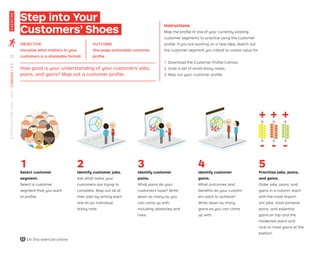
Instructions
Map the profile of one of your currently existing
customer segments to practice using the customer
profile. If you are working on a new idea, sketch out
the customer segment you intend to create value for.
1. Download the Customer Profile Canvas.
2. Grab a set of small sticky notes.
3. Map out your customer profile.
1
Select customer
segment.
Select a customer
segment that you want
to profile.
2
Identify customer jobs.
Ask what tasks your
customers are trying to
complete. Map out all of
their jobs by writing each
one on an individual
sticky note.
3
Identify customer
pains.
What pains do your
customers have? Write
down as many as you
can come up with,
including obstacles and
risks.
4
Identify customer
gains.
What outcomes and
benefits do your custom-
ers want to achieve?
Write down as many
gains as you can come
up with.
5
Prioritize jobs, pains,
and gains.
Order jobs, pains, and
gains in a column, each
with the most import-
ant jobs, most extreme
pains, and essential
gains on top and the
moderate pains and
nice-to-have gains at the
bottom.
+
-
+
-
+
-
How good is your understanding of your customers’ jobs,
pains, and gains? Map out a customer profile.
OBJECTIVE
Visualize what matters to your
customers in a shareable format
OUTCOME
One page actionable customer
profile
Do this exercise online
22
STRATEGYZER.COM
/
VPD
/
CANVAS
/
1.1
EXERCISE
Customer Profile
Copyright Business Model Foundry AG
The makers of Business Model Generation and Strategyzer Download the Customer Profile pdf
23
STRATEGYZER.COM
/
VPD
/
CANVAS
/
1.1
EXERCISE
Best Practices for Mapping
Jobs, Pains, and Gains
Avoid frequently committed mistakes
when profiling a customer, and instead
follow these best practices.
Common Mistakes
Mixing several
customer segments
into one profile.
Mixing jobs and
outcomes.
Focusing on functional
jobs only and forgetting
social and emotional
jobs.
Listing jobs, pains, and
gains with your value
proposition in mind.
Identifying too few jobs,
pains, and gains.
Being too vague in
descriptions of pains
and gains.
Best Practices
Make a Value
Proposition Canvas for
every different customer
segment. If you sell to
companies, ask yourself
if you have different
types of customers
within each company
(e.g., users, buyers).
Jobs are the tasks
customers are trying to
perform, the problems
they are trying to solve,
or the needs they are
trying to satisfy, whereas
gains are the concrete
outcomes they want to
achieve—or avoid and
eliminate in the case of
pains.
Sometimes social or
emotional jobs are even
more important than the
“visible” functional jobs.
“Looking good in front of
others” might be more
important than finding a
great technical solution
that helps complete the
job effectively.
When you map your
customer, you should
proceed like an anthro-
pologist and “forget”
what you are offering.
For example, a business
publisher should not
map jobs, pains, and
gains merely related to
books, because a reader
has the choice between
business books, consul-
tants, YouTube videos, or
even completing an MBA
program or training. Go
beyond the jobs, pains,
and gains you intend
or hope to address with
your value proposition.
A good customer profile
is full of sticky notes,
because most customers
have a lot of pains and
expect or desire a lot of
gains. Map out all your
(potential) customers’
important jobs, extreme
pains, and essential
gains.
Make pains and gains
tangible and concrete.
Rather than just writing
“salary increase” in
gains, specify how
much of an increase a
customer is seeking.
Rather than writing
“takes too long” in
pains, indicate how long
“too long” actually is.
This will allow you to
understand how exactly
customers measure
success and failure.
×
√
24
STRATEGYZER.COM
/
VPD
/
CANVAS
/
1.1
Pains vs. Gains
When you get started with the customer profile,
you might simply put the same ideas in pains and
gains as opposites of each other. For example,
if one of the customers’ jobs to be done is “earn
more money,” you might start by adding “salary
increase” to gains and “salary decrease” to pains.
Here’s a better way to do it:
ǃɲ Find out precisely how much more money the
customer expects to earn so it feels like a gain
and investigate what decrease would feel like
a pain.
ǃɲ In the pains, add the barriers that prevent or
make it difficult to get a job done. In our exam-
ple the pain might be “my employer doesn’t
give raises.”
ǃɲ In the pains, add the risks related to not getting
the job done. In our example the pain could be
“might not be able to afford my child’s future
college tuition.”
Ask “why” several times until you
really understand your customers’
jobs to be done.
Another issue when you get started with the
customer profile is that you might settle with
a superficial understanding of your customer’s
jobs. To avoid this, you need to ask yourself why
a customer wants to perform a certain job to dig
deeper toward the real motivations.
For example, why might a customer want to
learn a foreign language? Maybe because the
“real” customer job to be done is to improve his
CV. Why does he want to improve his CV? Maybe
because he wants to earn more money.
Don’t settle until you really understand the
underlying jobs to be done that really drive
customers.
25
STRATEGYZER.COM
/
VPD
/
CANVAS
/
1.1
.2
Value Map
26
28
STRATEGYZER.COM
/
VPD
/
CANVAS
/
1.2
Products
and Services
This is simply a list of what you offer.
Think of it as all the items your cus-
tomers can see in your shop window
—metaphorically speaking. It’s an
enumeration of all the products and
services your value proposition builds
on. This bundle of products and services
helps your customers complete either
functional, social, or emotional jobs or
helps them satisfy basic needs. It is
crucial to acknowledge that products
and services don’t create value alone—
only in relationship to a specific cus-
tomer segment and their jobs, pains,
and gains.
Your list of products and services may
also include supporting ones that
help your customers perform the roles
of buyer (those that help customers
compare offers, decide, and buy),
co-creator (those that help custom-
ers co-design value propositions), and
transferrer (those that help customers
dispose of a product).
Your value proposition is likely to be composed
of various types of products and services:
Physical/tangible
Goods, such as manufactured products.
Intangible
Products such as copyrights or services such
as after-sales assistance.
Digital
Products such as music downloads or services
such as online recommendations.
Financial
Products such as investment funds and
insurances or services such as the financing
of a purchase.
+
-
Essential
Relevance
It is essential to acknowledge that
not all products and services have
the same relevance to your custom-
ers. Some products and services are
essential to your value proposition;
some are merely nice to have.
Nice to have
29
STRATEGYZER.COM
/
VPD
/
CANVAS
/
1.2
STRATEGYZER.COM
/
VPD
/
CANVAS
/
1.2
30
Pain Relievers
Pain relievers describe how exactly
your products and services alleviate
specific customer pains. They explicitly
outline how you intend to eliminate or
reduce some of the things that annoy
your customers before, during, or after
they are trying to complete a job or
that prevent them from doing so.
Great value propositions focus on pains
that matter to customers, in particular
extreme pains. You don’t need to come
up with a pain reliever for every pain
you’ve identified in the customer
profile—no value proposition can do
this. Great value propositions often
focus only on few pains that they
alleviate extremely well.
The following list of trigger questions can help you
think of different ways your products and services
may help your customers alleviate pains.
Ask yourself: Could your products and services…
ǃɲ produce savings? In terms of time, money, or
efforts.
ǃɲ make your customers feel better? By killing frus-
trations, annoyances, and other things that give
customers a headache.
ǃɲ fix underperforming solutions? By introducing new
features, better performance, or enhanced quality.
ǃɲ put an end to difficulties and challenges your
customers encounter? By making things easier or
eliminating obstacles.
ǃɲ wipe out negative social consequences your
customers encounter or fear? In terms of loss of
face or lost power, trust, or status.
ǃɲ eliminate risks your customers fear? In terms of
financial, social, technical risks, or things that
could potentially go wrong.
ǃɲ help your customers better sleep at night?
By addressing significant issues, diminishing
concerns, or eliminating worries.
ǃɲ limit or eradicate common mistakes customers
make? By helping them use a solution the right
way.
ǃɲ eliminate barriers that are keeping your customer
from adopting value propositions? Introducing
lower or no upfront investment costs, a flatter
learning curve, or eliminating other obstacles
preventing adoption.
+
-
Essential
Relevance
A pain reliever can be more or less
valuable to the customer. Make sure
you differentiate between essential
pain relievers and ones that are
nice to have. The former relieve
extreme issues, often in a radical
way, and create a lot of value. The
latter merely relieve moderate pains.
Nice to have
Download trigger questions
31
STRATEGYZER.COM
/
VPD
/
CANVAS
/
1.2
32
STRATEGYZER.COM
/
VPD
/
CANVAS
/
1.2
Gain Creators
Gain creators describe how your prod-
ucts and services create customer
gains. They explicitly outline how
you intend to produce outcomes and
benefits that your customer expects,
desires, or would be surprised by,
including functional utility, social gains,
positive emotions, and cost savings.
As with pain relievers, gain creators
don’t need to address every gain
identified in the customer profile.
Focus on those that are relevant to
customers and where your products
and services can make a difference.
The following list of trigger questions can help
you think of different ways your products and
services may help your customers obtain
required, expected, desired, or unexpected
outcomes and benefits.
Ask yourself: Could your products and services…
ǃɲ create savings that please your customers?
In terms of time, money, and effort.
ǃɲ produce outcomes your customers expect or
that exceed their expectations? By offering
quality levels, more of something, or less of
something.
ǃɲ outperform current value propositions and
delight your customers? Regarding specific
features, performance, or quality.
ǃɲ make your customers’ work or life easier? Via
better usability, accessibility, more services,
or lower cost of ownership.
ǃɲ create positive social consequences? By
making them look good or producing an
increase in power or status.
ǃɲ do something specific that customers are
looking for? In terms of good design, guaran-
tees, or specific or more features.
ǃɲ fulfill a desire customers dream about? By
helping them achieve their aspirations or
getting relief from a hardship?
ǃɲ produce positive outcomes matching your
customers’ success and failure criteria? In
terms of better performance or lower cost.
+
-
Essential
Relevance
A gain creator can produce more or
less relevant outcomes and benefits
for the customer just like we have
seen for pain relievers. Make sure
you differentiate between essential
and nice to have gain creators. Nice to have
ǃɲ help make adoption easier? Through lower cost,
fewer investments, lower risk, better quality,
improved performance, or better design.
Download trigger questions
33
STRATEGYZER.COM
/
VPD
/
CANVAS
/
1.2
value
proposition
design
helps shape
ideas
Value
Proposition
Canvas
Book
step-by-step
instructions
to get
started
exclusive
online
companion
enables
practice +
skills (self-)
assessment
online exer-
cises, tools,
templates,
community
online course
(upsell)
Web app
(upsell)
engaging
online
multimedia
content
helps create
products
+ services
people want
helps under-
stand what
matters to
customers
proven +
effective
suite of busi-
ness tools
access to
advanced
material +
knowlege
software-
supported
methodology
shared
language to
communicate
+ collaborate
share with
and learn
from peers
minimizes
risk of (big)
failure
practical,
visual, +
enjoyable
format
integrates
with other
business
methods
brief, clear,
+ applicable
content
integrated
with
Business
Model Canvas
Mapping the
Value Proposition
of Value
Proposition
Design
“Naked” list of the products
and services that your value
proposition builds on to
target a specific customer
segment.
It’s okay to aggregate several
value propositions into one.
Pain relievers outline how exactly your
products and services kill customer
pains. Each pain reliever addresses at
least one or more pains or gains. Don’t
add products or services here.
Remarkable value propositions focus
on jobs, pains, and gains that mat-
ter to customers and achieve those
exceedingly well. Again,you should not
try to address all customer pains and
gains. Focus on those that will make a
difference for your customer.
34
STRATEGYZER.COM
/
VPD
/
CANVAS
/
1.2
Formal Map
of how we believe
the products and
services around this
book create value
for customers
Gain creators highlight how exactly
your products and services help
customers achieve gains. Each gain
creator addresses at least one or
more pains or gains. Don’t add prod-
ucts or services here.
35
STRATEGYZER.COM
/
VPD
/
CANVAS
/
1.2
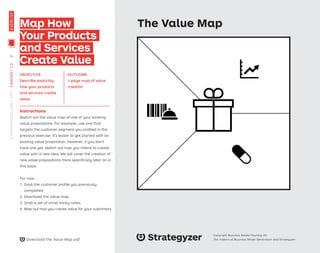
The Value Map
Map How
Your Products
and Services
Create Value
Copyright Business Model Foundry AG
The makers of Business Model Generation and Strategyzer
Instructions
Sketch out the value map of one of your existing
value propositions. For example, use one that
targets the customer segment you profiled in the
previous exercise. It’s easier to get started with an
existing value proposition. However, if you don’t
have one yet, sketch out how you intend to create
value with a new idea. We will cover the creation of
new value propositions more specifically later on in
this book.
OBJECTIVE
Describe explicitly
how your products
and services create
value
OUTCOME
1 page map of value
creation
For now:
1. Grab the customer profile you previously
completed.
2. Download the value map.
3. Grab a set of small sticky notes.
4. Map out how you create value for your customers.
Download the Value Map pdf
36
STRATEGYZER.COM
/
VPD
/
CANVAS
/
1.2
EXERCISE
+
-
+
-
+
-
1
List products and services.
List all the products and services of
your existing value proposition.
2
Outline pain relievers.
Outline how your products and
services currently help customers alle-
viate pains by eliminating undesired
outcomes, obstacles, or risks. Use one
sticky note per pain reliever.
3
Outline gain creators.
Explain how your products and
services currently create expected
or desired outcomes and benefits for
customers. Use one sticky note per
gain creator.
4
Rank by order of importance.
Rank products and services, pain
relievers, and gain creators accord-
ing to how essential they are to
customers.
Do this exercise online
EXERCISE
37
STRATEGYZER.COM
/
VPD
/
CANVAS
/
1.2
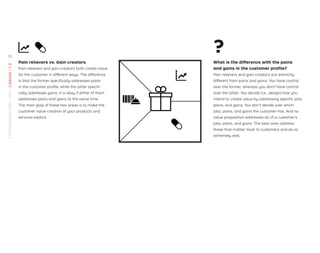
Pain relievers vs. Gain creators
Pain relievers and gain creators both create value
for the customer in different ways. The difference
is that the former specifically addresses pains
in the customer profile, while the latter specifi-
cally addresses gains. It is okay if either of them
addresses pains and gains at the same time.
The main goal of these two areas is to make the
customer value creation of your products and
services explicit.
What is the difference with the pains
and gains in the customer profile?
Pain relievers and gain creators are distinctly
different from pains and gains. You have control
over the former, whereas you don’t have control
over the latter. You decide (i.e., design) how you
intend to create value by addressing specific jobs,
pains, and gains. You don’t decide over which
jobs, pains, and gains the customer has. And no
value proposition addresses all of a customer’s
jobs, pains, and gains. The best ones address
those that matter most to customers and do so
extremely well.
?
38
STRATEGYZER.COM
/
VPD
/
CANVAS
/
1.2
Common Mistakes
List all your products and services
rather than just those targeted at a
specific segment.
Add products and services to the pain
reliever and gain creator fields.
Offer pain relievers and gain creators
that have nothing to do with the pains
and gains in the customer profile.
Make the unrealistic attempt to
address all customer pains and
gains.
Best Practices
Products and services create value
only in relationship to a specific
customer segment. List only the
bundle of products and services that
jointly form a value proposition for a
specific customer segment.
Pain relievers and gain creators are
explanations or characteristics that
make the value creation of your
products and services explicit. Exam-
ples include “helps save time” and
“well-designed.”
Remember that products and services
don’t create value in absolute terms.
It is always relative to customers’ jobs,
pains, and gains.
Realize that great value propositions
are about making choices regard-
ing which jobs, pains, and gains to
address and which to forgo. No value
proposition addresses all of them.
If your value map indicates so, it’s
probably because you’re not honest
about all the jobs, pains, and gains
that should be in your customer
profile.
Best Practices for
Mapping Value Creation
×
√
39
STRATEGYZER.COM
/
VPD
/
CANVAS
/
1.2
.3
Fit
40
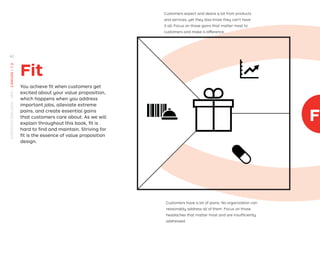
Fit
You achieve fit when customers get
excited about your value proposition,
which happens when you address
important jobs, alleviate extreme
pains, and create essential gains
that customers care about. As we will
explain throughout this book, fit is
hard to find and maintain. Striving for
fit is the essence of value proposition
design.
Customers expect and desire a lot from products
and services, yet they also know they can’t have
it all. Focus on those gains that matter most to
customers and make a difference.
Customers have a lot of pains. No organization can
reasonably address all of them. Focus on those
headaches that matter most and are insufficiently
addressed.
Fit
42
STRATEGYZER.COM
/
VPD
/
CANVAS
/
1.3
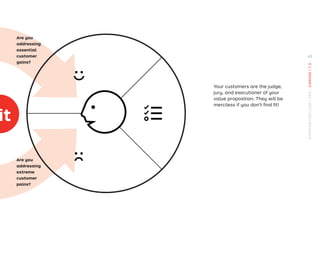
Your customers are the judge,
jury, and executioner of your
value proposition. They will be
merciless if you don’t find fit!
Are you
addressing
essential
customer
gains?
Are you
addressing
extreme
customer
pains?
Fit
43
STRATEGYZER.COM
/
VPD
/
CANVAS
/
1.3
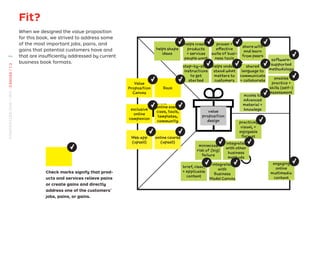
Fit?
When we designed the value proposition
for this book, we strived to address some
of the most important jobs, pains, and
gains that potential customers have and
that are insufficiently addressed by current
business book formats.
Check marks signify that prod-
ucts and services relieve pains
or create gains and directly
address one of the customersˇ
jobs, pains, or gains.
value
proposition
design
helps shape
ideas
Value
Proposition
Canvas
Book
step-by-step
instructions
to get
started
exclusive
online
companion
enables
practice +
skills (self-)
assessment
online exer-
cises, tools,
templates,
community
online course
(upsell)
Web app
(upsell)
engaging
online
multimedia
content
helps create
products
+ services
people want
helps under-
stand what
matters to
customers
proven +
effective
suite of busi-
ness tools
access to
advanced
material +
knowlege
software-
supported
methodology
shared
language to
communicate
+ collaborate
share with
and learn
from peers
minimizes
risk of (big)
failure
practical,
visual, +
enjoyable
format
integrates
with other
business
methods
brief, clear,
+ applicable
content
integrated
with
Business
Model Canvas
√ √
√
√
√
√
√ √
√
√
√
√
√
√
√
√
√
√
√
√ √ √
√
44
STRATEGYZER.COM
/
VPD
/
CANVAS
/
1.3
concrete
tips (e.g. to
reduce risk)
home run
value
propositions
helps with
promotion or
pay raise
help when
stuck
buy-in from
leadership +
team
connect with
like-minded
people
leads to
better
collaboration
make things
people want
collaborate
with others
or help them
find, learn,
apply
methods
communicate
+ sell ideas
management
“not
getting it”
no clear path
to applying
method
getting stuck
in career or
jeopardizing
it
“translating”
methods to
own context
wasting time
with ideas
that don't
work
leads to
results
(ideally quick
wins)
biz book
reader
(generic)
convince
others about
preferred
methods
look good
with
colleagues,
boss, clients
run
“day job”
well
boring
content that's
hard to work
through
assess +
reduce risk
making
things
nobody
wants
too much
theory
dealing
with risk +
uncertainty
lack of time
lack of
sufficient
budget
easy to
understand
leads to
results
(ideally quick
wins)
get
recognized
by team
clear
indicators
to measure
progress
applicable
ideas
can apply
with
confidence
improve skill
set + advance
career
improve
or build
a business
make
decisions
with
confidence
going down
wrong path
Xs show which jobs, pains,
and gains the value proposition
does not address.
helps me
communicate
my ideas
clearly
stay
up to date
×
×
×
√
√ √
√
√
√
√
√
√
√ √
√
√
√
√
√
√
√
√
√
√
√
√ √
√
×
×
×
×
×
×
×
×
×
×
×
√
45
STRATEGYZER.COM
/
VPD
/
CANVAS
/
1.3
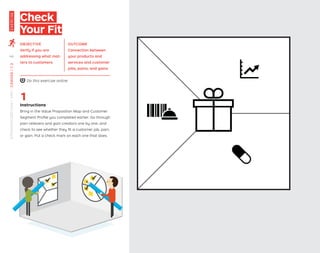
Check
Your Fit
1
Instructions
Bring in the Value Proposition Map and Customer
Segment Profile you completed earlier. Go through
pain relievers and gain creators one by one, and
check to see whether they fit a customer job, pain,
or gain. Put a check mark on each one that does.
OBJECTIVE
Verify if you are
addressing what mat-
ters to customers
OUTCOME
Connection between
your products and
services and customer
jobs, pains, and gains
Do this exercise online
EXERCISE
46
STRATEGYZER.COM
/
VPD
/
CANVAS
/
1.3
2
Outcome
If a pain reliever or gain creator doesn’t fit
anything, it may not be creating customer value.
Don’t worry if you haven’t checked all pains/
gains—you can’t satisfy them all. Ask yourself,
how well does your value proposition really fit
your customer?
Download the Value Proposition Canvas pdf
47
STRATEGYZER.COM
/
VPD
/
CANVAS
/
1.3
EXERCISE
Searching for Fit is the process of
designing value propositions around
products and services that meet jobs,
pains, and gains that customers really
care about. Fit between what a com-
pany offers and what customers want
is the number one requirement of a
successful value proposition.
Fit happens in three stages. The first
occurs when you identify relevant
customer jobs, pains, and gains you
believe you can address with your
value proposition. The second occurs
when customers positively react to
your value proposition and it gets
traction in the market. The start-up
movement calls these problem-
solution fit and product-market fit,
respectively. The third occurs when
you find a business model that is
scalable and profitable.
Three Kinds of Fit
1
Problem-Solution Fit
2
Product-Market Fit
3
Business Model Fit
Get “Fit” poster
48
STRATEGYZER.COM
/
VPD
/
CANVAS
/
1.3
On Paper
1. Problem-Solution Fit
Problem-solution fit takes place when you
ǃɲ Have evidence that customers care about
certain jobs, pains, and gains.
ǃɲ Designed a value proposition that addresses
those jobs, pains, and gains.
At this stage you don’t yet have evidence that
customers actually care about your value
proposition.
This is when you strive to identify the jobs,
pains, and gains that are most relevant to
customers and design value propositions accord-
ingly. You prototype multiple alternative value
propositions to come up with the ones that
produce the best fit. The fit you achieve is not
yet proven and exists mainly on paper. Your next
steps are to provide evidence that customers care
about your value proposition or start over with
designing a new one.
In the Market
2. Product-Market Fit
Product-market fit takes place when you
ǃɲ Have evidence that your products and services,
pain relievers, and gain creators are actually
creating customer value and getting traction in
the market.
During this second phase, you strive to validate or
invalidate the assumptions underlying your value
proposition. You will inevitably learn that many
of your early ideas simply don’t create customer
value (i.e., customers don’t care) and will have to
design new value propositions. Finding this second
type of fit is a long and iterative process; it doesn’t
happen overnight.
In the Bank
3. Business Model Fit
Business model fit takes place when you
ǃɲ Have evidence that your value proposition
can be embedded in a profitable and scal-
able business model.
A great value proposition without a great
business model may mean suboptimal financial
success or even lead to failure. No value prop-
osition—however great—can survive without a
sound business model.
The search for business model fit entails a
laborious back and forth between designing a
value proposition that creates value for custom-
ers and a business model that creates value
for your organization. You don’t have business
model fit until you can generate more revenues
with your value proposition than you incur costs
to create and deliver it (or “them” in the case of
platform models with more than one interde-
pendent value propositions).
49
STRATEGYZER.COM
/
VPD
/
CANVAS
/
1.3
Customer
Profiles in B2B
Value propositions in business-to-
business (B2B) transactions typically
involve several stakeholders in the
search, evaluation, purchase, and
use of a product or service. Each one
has a different profile with different
jobs, pains, and gains. Stakeholders
can tilt the purchasing decision in one
direction or another. Identify the most
important ones and sketch out a Value
Proposition Canvas for each one of
them.
Profiles vary according to the sector
and size of organization, but they
typically include the following roles:
Adapted from Steve Blank, The Four Steps to the Epiphany, 2006.
Aggregated
+Unbundled
Value propositions to stakeholders within the business
Value Proposition Business Segment
Influencers Recommenders Economic buyers Decision makers Saboteurs
End users
Organizations are
customers that are
composed of different
stakeholders who all
have different jobs,
pains, and gains.
Consider making a
Value Proposition
Canvas for each one.
50
STRATEGYZER.COM
/
VPD
/
CANVAS
/
1.3
Influencers
Individuals or groups whose opinions might count
and whom the decision maker might listen to,
even in an informal way.
Recommenders
The people carrying out the search and evalua-
tion process and who make a formal recommen-
dation for or against a purchase.
Economic Buyers
The individual or group who controls the budget
and who makes the actual purchase. Their
concerns are typically about financial perfor-
mance and budgetary efficiency.
In some cases, the economic buyer may sit
outside an organization, such as a government
paying for the basic medical supply in nursing
homes for elderly citizens.
Decision Makers
The person or group ultimately responsible for the
choice of a product/service and for ordering the
purchase decision. Decision makers usually have
ultimate authority over the budget.
End Users
The ultimate beneficiaries of a product or service.
For a business customer, end users can either
be within their own organization (a manufacturer
buying software for its designers), or they can be
external customers (a device manufacturer buying
chips for the smartphones it sells to consumers).
End users may be passive or active, depending
on how much say they have in the decision and
purchase process.
Saboteurs
The people and groups who can obstruct or derail
the process of searching, evaluating, and purchas-
ing a product or a service.
Decision makers typically sit inside the customer’s
organization, whereas Influencers, recommenders,
economic buyers, end users, and saboteurs can
sit inside or outside the organization.
Unbundling
the Family
Value propositions to the consumer may also
involve several stakeholders in the search, evalu-
ation, purchase, and use of a product or service.
For example, consider a family that intends to
buy a game console. In this situation, there is
also a difference between the economic buyer,
the influencer, the decision maker, the users,
and the saboteurs. It therefore makes sense to
sketch out a different Value Proposition Canvas
for each stakeholder.
51
STRATEGYZER.COM
/
VPD
/
CANVAS
/
1.3
Haier
Multiple Fits
Some business models work only
with a combination of several value
propositions and customer segments.
In these situations, you require fit
between each value proposition and its
respective customer segment for the
business model to work.
Two common illustrations of multiple
fits are intermediary and platform
business models.
Intermediary
When a business sells a product or service
through an intermediary, it effectively needs to
cater to two customers: the end customer and
the intermediary itself. Without a clear value
proposition to the intermediary, the offer might
not reach the end customer at all, or at least not
with the same impact.
Haier has a value proposition to their interme-
diary customer, the retailers, who are also the
main channel for the end customer.
Haier has a value proposition to
the end customer, households.
Chinese firm Haier sells home appliances and
electronics to households globally. It does this
largely through retailers such as Carrefour,
Walmart, and others. To be successful, Haier
needs to craft an appealing value proposition
both to households (the end customer) and to
intermediary distributors.
52
STRATEGYZER.COM
/
VPD
/
CANVAS
/
1.3
Airbnb
Platforms
Platforms function only when two or more actors
interact and draw value within the same inter-
dependent business model. Platforms are called
double-sided when there are two such actors
and multisided when there are more than two.
A platform exists only when all sides are present
in the model.
Airbnb is an example of a double-sided platform.
It is a website that connects local residents with
extra space to rent out and travelers looking for
alternatives to hotels as a place to stay. In such a
case, the business model needs to hold two value
propositions, one for local residents (called hosts)
and one for travelers.
Stay Rent
53
STRATEGYZER.COM
/
VPD
/
CANVAS
/
1.3
Going to the Movies
Let us walk through the concepts of the Value Proposition
Canvas with another simple example. Imagine the owner of
a movie theater chain wants to design new value proposi-
tions for his customers.
What drives the moviegoer?
comfortable
haven't spent
much money
friends'
reviews not having
missed
something
feeling
included in
the story
organized
everything in
advance
share with
someone relax
escape real
life
long
commute
get
entertained
learn from
another
place
expensive
crowded,
long queues
story too
complex bad parking
no convenient
show times
hurts my
eyes
waste of
time
limited
options
not able
to get
babysitter
Tip: A (potential)
customer exists
independently of
your value proposition.
When you sketch out
your customer’s profile,
don’t just focus on
jobs, pains, and gains
related to your value
proposition. Keep it
broad to understand
what really drives your
customers.
What should the new value
proposition look like?
He could start with the value proposition’s fea-
tures and get excited about the latest generation
of big screens, state-of-the-art display technol-
ogies, tasty snacks, social happenings, urban
experiences, and so on. But, of course, those only
really matter if customers care about them. So he
sets out to better understand what his customers
truly want.
Traditionally he’d sketch out psychodemo-
graphic profiles of his customer segments. But
this time he decides to complement this type of
segmentation with customer profiles that highlight
a customer’s jobs, pains, and gains.
?
54
STRATEGYZER.COM
/
VPD
/
CANVAS
/
1.3
Cost Structure
Key Partnerships
Key Resources Channels
Key Activities Value Propositions Customer
Relationships
Customer
Segments
Revenue Streams
A Movie Theater’s Business Model
Movie
distributors Run facilities
Immersive
storytelling
experience
Mass market
Theaters
Online
ticketing
Ticket sales
Food  drinks
(margins)
Moviegoers
Display
equipment
Staff
Rent
Food
distributors
Theaters
(good
location)
Movie rights
Food 
drinks
The traditional approach:
psychodemographic profiles
Traditional psychodemographic profiles group
consumers into categories that have the same
socioeconomic characteristics.
Source
movies
The new approach: focusing on the jobs,
pains, and gains that drive customers
By sketching out a customer profile, you aim to
uncover what really drives people, rather than just
describing their socioeconomic characteristics.
You investigate what they’re trying to achieve,
their underlying motives, their objectives, and
what’s holding them back. Doing so will broaden
your horizon and likely uncover new or better
opportunities to satisfy customers.
JANE MOVIEGOER
20-30 years old
Upper middle class
Earns $100K/year
Married, 2 children
Movie Behavior:
ǃɲ Prefers action movies
ǃɲ Likes popcorn and soda
ǃɲ Does not like waiting in
line
ǃɲ Buys tickets online
ǃɲ Goes once a month
55
STRATEGYZER.COM
/
VPD
/
CANVAS
/
1.3
Same Customer,
Different Contexts
In our example, the context
in which our moviegoer finds
herself will influence which jobs
matter more or less to her.
Add contextual elements to your
customer profiles if necessary.
They might serve as constraints for
designing value propositions later on.
Priorities change depending on a cus-
tomer’s context. Taking this context into
account before you think of a value
proposition for that customer is crucial.
With the jobs-to-be-done approach, you uncover
the motivations of different customer segments.
Yet, depending on the context, some jobs will
become more important or matter less than
others.
In fact, the context in which a person finds
himself or herself often changes the nature of the
jobs that the person aims to accomplish.
For example, the clientele of a restaurant is
likely to use very different criteria to evaluate
their dining experience at lunch versus at dinner.
Likewise a mobile phone user will have different
job requirements when using the phone in a car,
in a meeting, or at home. Hence, the features of
your value proposition will be different depending
on which context(s) you are focusing.
56
STRATEGYZER.COM
/
VPD
/
CANVAS
/
1.3
The kids’ afternoon off Date night
affordable
for group
2 hr = right
length of
time
kids are
happy and
calm
safe
environment
both enjoyed
moment
leads to
great
conversation
noise in the
room
manage kids'
attention
not all kids
are happy
waiting in line
not able
to get
babysitter
not intimate
enough
occupy kids
share
moment of
fun
connect with
each other
relax
during busy
weekend
When? Wednesday afternoon
Where? Leaving from home
With whom? Kids and maybe their friends
Constraints? After school, before dinner time
When? Saturday evening
Where? Leaving from home
With whom? Partner
Constraints? Kids taken care of (if parents)
When? Any time
Where? Leaving from home
With whom? Alone
Constraints? Needs to be able to take notes
Personal research
visual story
is easy to
remember
can consult
Internet for
more info
lack of light
to take notes
can't capture
and share
can't control
speed
too shallow
for serious
learning
deepen
expertise
show off
knowledge
with friends
accurate
story
57
STRATEGYZER.COM
/
VPD
/
CANVAS
/
1.3
Same Customer,
Different Solutions
In today’s hypercompetitive world, customers are
surrounded by an ocean of tempting value propo-
sitions that all compete for the same limited slots
of attention.
Very different value propositions may address
similar jobs, pains, and gains. For example, our
movie theater chain competes for customer atten-
tion not only with other movie theaters but also
with a broad range of alternative options: renting
a movie at home, going out to dinner, visiting a
spa, or maybe even attending an online virtual art
exhibit with 3D glasses.
Strive to understand what your customers
really care about. Investigate their jobs, pains,
and gains beyond what your own value proposi-
tion directly addresses in order to imagine totally
new or substantially improved ones.
Understand your customers beyond
your solution. Unearth the jobs, pains,
and gains that matter to them in order
to understand how to improve your
value proposition or invent new ones.
58
STRATEGYZER.COM
/
VPD
/
CANVAS
/
1.3
movie
website
big screen
 surround
sound
ideal for
conversation
ideal for
conversation
home
comfort
intellectually
stimulating
instant
access
no babysitter
needed
intimate
setting
choose time
to go
stress relief
duo seats
advanced
online
booking
home
comfort
largest
library
instant
access
movies on big
screen movie home
rentals
dinner in
town
spa for
couples
online visual
art exhibit
Open slot for which
potentially very different
value propositions are
competing
both enjoyed
moment
leads to
great
conversation
waiting in line
not able
to get
babysitter not intimate
enough
share
moment of
fun
connect with
each other
control of
experience
59
STRATEGYZER.COM
/
VPD
/
CANVAS
/
1.3
Customer Profile
Use the customer profile to visualize
what matters to customers. Specify
their jobs, pains, and gains. Communi-
cate the profile across your organiza-
tion as a one-page actionable
document that creates a shared
customer understanding. Apply it as
a “scoreboard” to track if assumed
customer jobs, pains, and gains exist
when you talk to real customers.
Value Map
Use the value map to make explicit
how you believe your products and
services will ease pains and create
gains. Communicate the map across
your organization as a one-page
document that creates a shared
understanding of how you intend to
create value. Apply it as a “score-
board” to track if your products actu-
ally ease pains and gains when you
test them with customers.
Fit
Problem-solution fit: Evidence that
customers care about the jobs, pains,
and gains you intend to address with
your value proposition. Product-market
fit: Evidence that customers want your
value proposition. Business model fit:
Evidence that the business model for
your value proposition is scalable and
profitable.
Lessons Learned
60
STRATEGYZER.COM
/
VPD
/
CANVAS
/
1.3
strategyzer.com
Gain Creators
Pain Relievers Pains
Gains
Products
 Services
Customer
Job(s)
The Value Proposition Canvas
Value Proposition Customer Segment
Download the Value Proposition Canvas pdf
61
STRATEGYZER.COM
/
VPD
/
CANVAS
/
1.3
Design, Test, Repeat
The search for value propositions
that meet customer jobs, pains, and
gains is a continuous back and forth
between designing prototypes and
testing them. The process is iterative
rather than sequential. The goal of
Value Proposition Design is to test
ideas as quickly as possible in order to
learn, create better designs, and test
again. design
62
STRATEGYZER.COM
/
VPD
/
CANVAS
/
1.3
test
63
STRATEGYZER.COM
/
VPD
/
CANVAS
/
1.3
des
sign
2
Kick-start value proposition design with
Prototyping Possibilities p. 74
for one of
your Starting Points p. 86
. Shape your value
propositions by Understanding Customers
p. 104
, then select which ones you want
to further explore by Making Choices p. 120
and Finding the Right Business Model p. 142
.
If you are an existing company, discover
the particularities of Designing in
Established Organizations p. 158
.
OBSERVATION
P
FROM
TESTING
STARTING POINTS
ASSESSMENT
PROTOTYPING
TO
TESTING
FAILED
BUSINESS MODEL
7
Q
U
E
S
T
I
O
N
S
Shaping Your Ideas
Design is the activity of turning your ideas into value prop-
osition prototypes. It is a continuous cycle of prototyping,
researching customers, and reshaping your ideas. Design
may start with prototyping or with customer discovery. The
design activity feeds into the testing activity that we explore
in the next chapter (see section 3. Test, → p. 172).
Ideas, Starting Points,
and Insights
→ p. 86
Starting points for new or improved value
propositions may come from anywhere. It could
be from your customer insights → p. 116, from
exploration of prototypes → p. 76, or from many
other sources → p. 88. Be sure not to fall in love
with your early ideas, because they are certain
to transform radically during prototyping → p. 76,
customer research → p. 104, and testing → p. 172.
Prototype Possibilities
→ p. 74
Shape your ideas with quick, cheap, and rough
prototypes. Make them tangible with napkin
sketches → p. 80, ad-libs → p. 82, and Value
Proposition Canvases → p. 84. Don’t get attached
to a prototype too early. Keep your prototypes
light so you can explore possibilities, easily
throw them away again, and then find the best
ones that survive a rigorous testing process with
customers → p. 240.
Understand Customers
→ p. 104
Inform your ideas and prototypes with early
customer research. Plough through available data
→ p. 108, talk to customers → p. 110, and immerse
yourself in their world → p. 114. Don’t show
customers your value proposition prototypes too
early. Use early research to deeply understand
your customers’ jobs, pains, and gains. Unearth
what really matters to them to prototype value
propositions that are likely to survive rigorous
testing with customers → p. 172.
70
STRATEGYZER.COM
/
VPD
/
DESIGN
/
2.0
Ideas and Starting Points Understanding Customers
Prototyping Possibilities
71
STRATEGYZER.COM
/
VPD
/
DESIGN
/
2.0
10 Characteristics of
Great Value Propositions
Are embedded in great
business models
Focus on the jobs, pains,
and gains that matter
most to customers
Focus on unsatisfied
jobs, unresolved pains,
and unrealized gains
Target few jobs, pains,
and gains, but do so
extremely well
Go beyond functional
jobs and address emo-
tional and social jobs
Stop for an instant and reflect on the characteristics of great
value propositions before reading about how to design them
in this chapter. We offer 10 characteristics to get you started.
Don’t hesitate to add your own. Great Value Propositions….
1 2 3 4 5
Get “10 Characteristics of Great Value Propositions” poster
72
STRATEGYZER.COM
/
VPD
/
DESIGN
/
2.0
SCORE
Align with how custom-
ers measure success
Focus on jobs, pains,
and gains that a lot
of people have or that
some will pay a lot of
money for
Differentiate from
competition on jobs,
pains, and gains that
customers care about
Outperform competition
substantially on at
least one dimension
Are difficult to copy
6 7 8 9 10
73
STRATEGYZER.COM
/
VPD
/
DESIGN
/
2.0
2.
Prototyping
Possibilities
74
PROTOTYPING
What’s Prototyping?
Use the activity of making quick and rough study models of
your idea to explore alternatives, shape your value proposi-
tion, and find the best opportunities. Prototyping is common
in the design professions for physical artifacts. We apply
it to the concept of value propositions to rapidly explore
possibilities before testing and building real products and
services.
DEF·I·NI·TION
Prototyping
The practice of building quick,
inexpensive, and rough study
models to learn about the desir-
ability, feasibility, and viability
of alternative value propositions
and business models.
Quickly explore radically
different directions for the
same idea with the following
prototyping techniques before
refining one in particular.
Napkin Sketches
→ p. 80
Make alternatives tangible with napkin
sketches. Use a single sketch for every
potential direction your idea could
take.
Ad-libs
→ p. 82
Pinpoint how different alternatives
create value by filling in the blanks in
short ad-libs.
Our ______ help(s) ______ who
want to _______ by _______ and
_______ . ( unlike _______ )
76
STRATEGYZER.COM
/
VPD
/
DESIGN
/
2.1
Tips
ǃɲ Spend a maximum of 5 to 15 minutes on
sketching out your early prototypes.
ǃɲ Always use a visible timer and stick to a
predefined time frame.
ǃɲ Don’t discuss too long which one of several
possible directions to prototype. Prototype
several of them quickly and then compare.
ǃɲ Remember constantly that prototyping is
an exploratory tool. Don’t spend time on the
details of a prototype that is likely to change
radically anyway.
Value Proposition Canvases
→ p. 84
Flesh out possible directions with the
Value Proposition Canvas. Understand
which jobs, pains, and gains each
alternative is addressing.
Representation of
a Value Proposition
→ p. 234
Help customers and partners under-
stand potential value propositions by
bringing them to life without building
them.
Minimum Viable Product
→ p. 222
Build a minimum feature set that
brings your value proposition to life
and allows testing it with customers
and partners.
More in section 3. Test, → p. 172
77
STRATEGYZER.COM
/
VPD
/
DESIGN
/
2.1
10 Prototyping Principles
Make it visual
and tangible.
These kinds of prototypes
spark conversations and
learning. Don’t regress into
the land of blah blah blah.
Embrace a
beginner’s mind.
Prototype “what can’t be
done.” Explore with a fresh
mind-set. Don’t let existing
knowledge get in the way
of exploration.
Don’t fall in love
with first ideas—
create alternatives.
Refining your idea(s) too
early prevents you from
creating and exploring alter-
natives. Don’t fall in love too
quickly.
Feel comfortable
in a “liquid state.”
Early in the process the right
direction is unclear. It’s a
liquid state. Don’t panic and
solidify things too early.
Start with low fidelity,
iterate, and refine.
Refined prototypes are hard
to throw away. Keep them
rough, quick, and cheap.
Refine with increasing knowl-
edge about what works and
what doesn’t.
1 2 3 4 5
Unlock the power of prototyping. Resist the temptation
of spending time and energy refining one direction only.
Rather, use the principles described here to explore multiple
directions with the same amount of time and energy. You
will learn more and discover better value propositions.
Get “10 Prototyping Principles” poster
78
STRATEGYZER.COM
/
VPD
/
DESIGN
/
2.1
Expose your work early
—seek criticism.
Seek feedback early and
often before refining. Don’t
take negative feedback
personally. It’s worth gold to
improve your prototype.
Learn faster by failing
early, often, and
cheaply.
Fear of failure holds people
back from exploring. Over-
come that with a culture of
rough and quick prototyping
that keeps failure cheap and
leads to faster learning.
Use creativity
techniques.
Use creativity techniques
to explore groundbreaking
prototypes. Dare to break
out of how things are usually
done in your company or
industry.
Create “Shrek models.”
Shrek models are extreme or
outrageous prototypes that
you are unlikely to build. Use
them to spark debate and
learning.
Track learnings,
insights, and progress.
Keep track of all your alter-
native prototypes, learnings,
and insights. You might use
earlier ideas and insights
later in the process.
6 7 8 9 10
79
STRATEGYZER.COM
/
VPD
/
DESIGN
/
2.1
The Private Bank of ____
every one of our clients has a personal
advisor who offers tailor-made advice
and services
What is a napkin sketch?
Napkin sketches are a cheap way to make your
ideas more tangible and shareable. They avoid
going into the details of how an idea works to steer
clear of getting hung up with implementation issues.
What is it used for?
Use napkin sketches to quickly share and eval-
uate ideas during the early value proposition
design process. Their roughness is deliberate so
you can throw ideas away without regret and
explore alternatives. You may also use them to
gather early feedback from customers.
Caveat
Make sure people understand that napkin
sketches are an exploratory tool. You will kill or
transform many of the sketched out ideas during
the prototyping and testing process.
The best napkin
sketches…
Contain only one core idea or direction
(ideas can be merged later).
Explain what an idea is about, not how
it will work (no processes or business
models yet!).
Keep things simple enough to get it in
a glance (details are for more refined
prototypes later on).
Can be pitched in 10 to 30 seconds.
Make Ideas Visible
with Napkin Sketches
The Self-Service
Shop of _________
our clients get individual components
from our shop and assemble the
product later on themselves
Napkin sketches are a rough representation of a value prop-
osition or business model and highlight only the core idea,
not how it works. They are rough enough to fit on the back of
a napkin and still communicate the idea. Use them early in
your prototyping process to explore and discuss alternatives.
OBJECTIVE
Quickly visualize ideas for value
propositions
OUTCOME
Alternative prototypes in the form
of napkin sketches
PROCESS
STRATEGYZER.COM
/
VPD
/
DESIGN
/
2.1
80
Brainstorm · 15–20 min
Use different brainstorming techniques, such as
trigger questions → p. 15, 17, 31, 33 or “what if”
questions to generate a large quantity of possi-
ble directions for interesting value propositions.
Don’t worry about choice at this stage. Quantity
is better than quality. These are quick and dirty
prototypes that will change inevitably.
Display
All napkin sketches are exposed in a sort of
gallery on the wall. You should now have a nice
diversity of alternative directions.
Draw · 12–15 min
Participants split into break-out groups, and each
group quickly picks three ideas for three alterna-
tive value propositions. They draw a napkin sketch
for each one on a flip chart. Making two or three
sketches increases diversity and reduces the risk
of endless discussions.
Dotmocracy · 10–15 min (ideally over a
break)
Participants get 10 stickers to vote for their favor-
ite ideas. They can give all votes to one idea or
distribute them among several napkin sketches.
This is not a decision-making mechanism. It is a
process that highlights the ideas that participants
are most excited about. → p. 138
Pitch · 30 sec per group
One team member of each break-out group takes
the stage and pitches the (large) napkin sketches.
Each pitch should be no longer than 30 seconds—
just enough to outline what the idea is about,
not to explain how it works! Make sure there is
sufficient diversity across the groups or else send
everybody back to the drawing board.
Prototype
Break-out groups continue by sketching out a
value proposition canvas for the one napkin
sketch out of their three that got most votes.
Potentially redistribute the napkin sketches that
got most votes among the different groups.
1
2
3
4
5
6
81
STRATEGYZER.COM
/
VPD
/
DESIGN
/
2.1
PROCESS
Create Possibilities
Quickly with Ad-Libs
Our ______ help(s) ______ who
want to _______ by _______ and
_______ . (
Ad-libs are a great way to quickly shape alternative direc-
tions for your value proposition. They force you to pinpoint
how exactly you are going to create value. Prototype
three to five different directions by filling out the blanks in
the ad-lib below.
products and services
jobs to be done your own verb (e.g., reducing, avoiding)
Tip
Add at the beginning
or end of sentence:
your own verb (e.g., increasing, enabling) competing value proposition
customer segment
unlike _______ )
OBJECTIVE
Quickly shape potential value
proposition directions
OUTCOME
Alternative prototypes in the form
of “pitchable” sentences
Download the template
82
STRATEGYZER.COM
/
VPD
/
DESIGN
/
2.1
EXERCISE
Our ____ help(s) ____ who
want to ____ by ______ and
______ .
book
business
professionals
improve
or build
a business
making stuff
nobody
wants
clear
indicators
to measure
progress
avoiding
creating
83
EXERCISE
STRATEGYZER.COM
/
VPD
/
DESIGN
/
2.1
Flesh out Ideas with
Value Proposition
Canvases
Use the Value Proposition Canvas to
sketch out quick alternative proto-
types, just like you would with napkin
sketches or ad-libs. Don’t just work
with the canvas to refine final ideas,
but use it as an exploratory tool until
you find the right direction.
OBJECTIVE
Sketch explicitly how
different ideas create
customer value
OUTCOME
Alternative prototypes
in the form of Value
Proposition Canvases
84
STRATEGYZER.COM
/
VPD
/
DESIGN
/
2.1
PROCESS
Use a visible timer to constrain the time
you spend working on a specific proto-
type. Keep early prototypes short.
Don't be afraid to prototype radical direc-
tions, even if you know you are unlikely to
pursue them. Explore and learn.
85
STRATEGYZER.COM
/
VPD
/
DESIGN
/
2.1
PROCESS
2.2
Starting Points
86
STARTING POINTS
Where to Start
Contrary to popular belief, great new
value propositions don’t always have
to start with the customer. They do,
however, always have to end with
addressing jobs, pains, or gains that
customers care about.
On this spread we offer 16 trigger areas to get
started with new or improved value propositions.
They start from either the customer, your existing
value propositions, your business models, your
environment, or business models and value propo-
sitions from other industries and sectors.
Could you…
Zoom out
Zoom in
Imitate and “import” a pioneering
model from another sector or industry?
Create value based on a new technol-
ogy trend or turn a new regulation to
your advantage?
Come up with a new value proposition
that your competitors can’t copy?
Come up with a new value proposition
based on a new partnership?
Build on your existing activities and
resources, including patents, infra-
structure, skills, user base?
Dramatically alter your cost structure
to lower your prices substantially?
Imagine a new product or service?
Create a new pain reliever for a given
customer profile?
Create a new gain creator for a given
customer profile?
Get “Innovation Starting Points” poster
88
STRATEGYZER.COM
/
VPD
/
DESIGN
/
2.2
Your Current Business Model(s)
Your Business Model Environment
Your Value Proposition(s)
Adapt your value proposition to a
new or underserved segment such as
the rising middle class in emerging
markets?
Design a value proposition for a
new macroeconomic trend such as
rising healthcare costs in the Western
hemisphere?
Leverage your existing relationships
and channels to offer customers a new
value proposition?
Give away your core product for free
or increase your prices by a multiple?
Uncover a new unsatisfied job?
Solve your customers' most extreme
unresolved pain?
Focus on your customers’ most
essential unrealized gain?
89
STRATEGYZER.COM
/
VPD
/
DESIGN
/
2.2
Spark Ideas with
Design Constraints
Use design constraints to force people to think about
innovative value propositions embedded in great business
models. We outline five constraints of businesses whose
value proposition and business model you can copy into
your own arena. Don’t hesitate to come up with other ones.
Servitization
Constraint: Transform from selling a product-
based value proposition to a service-based one
that generates revenues from a subscription
model.
Hilti shifted from selling machine tools to build-
ers to leasing fleet management services to
managers at construction companies.
Razor Blade
Constraint: Create a value proposition composed
of a base product and a consumable product that
generates recurring revenues.
Nespresso transformed the sales of espresso
from a transactional business to one with recur-
ring revenues based on consumable pods for its
espresso machine.
Trendsetter
Constraint: Transform a technology (innovation)
into a fashionable trend.
Swatch conquered the world by turning a
plastic watch that could be made cheaply due
to a reduced number of pieces and innovative
production technology into a global fashion
trend.
Service
+
Activity
+Subscrip-
tion
Revenues
+Service
Recurring
Revenues
Trend-
setting
activities
Brand
Base
Product +
Consum-
able
Product
Trend-
setting
Fashion
conscious
+Innovative
product
OBJECTIVE
Force yourself to think outside
of the box
OUTCOME
Ideas that differ from your “usual”
value propositions and business
models
90
STRATEGYZER.COM
/
VPD
/
DESIGN
/
2.2
PROCESS
Low-Cost
Constraint: Reduce the core value proposition to
its basic features, target an unserved or under-
served customer segment with a low price and sell
everything else as an additional value proposition.
Southwest became the largest low-cost airline
by stripping down the value proposition to its
bare minimum, travel from point A to point B,
and offering low prices. They opened up flying to
a new segment.
Tips
ǃɲ Assign different constraints to differ-
ent working groups if you have the
opportunity to do so. It allows you to
explore alternatives in parallel.
ǃɲ Use constraints that represent the
challenges in your arena, such as
free value propositions, decreasing
margins, and so on.
Low-cost
VP
Upsell VP
New cost-
Conscious
Customer
Cost
Reduced
cost
structure
Platform
Constraint: Build a platform model that connects
several actors with a specific value proposition for
each.
Airbnb made private homes around the world
accessible to travelers by connecting them with
people who seek to rent out their apartments
short term.
VP A
VP B
Platform
Customer A
Customer B
+Platform
Download Constraint Cards
91
STRATEGYZER.COM
/
VPD
/
DESIGN
/
2.2
PROCESS
Use best-selling books and magazines
to generate fresh ideas for new and
innovative value propositions and busi-
ness models. It’s a quick and effective
way to immerse yourself in various
relevant and popular topics and build
on current trends.
1
Select books.
Prepare a series of books
and magazines repre-
senting a trend, import-
ant topic, or big idea
on a large table. Ask
workshop participants to
pick up a book each.
Bringing books into a workshop is like inviting the
world’s best thinkers to brainstorm. This way you
can afford a lot more of them at the same time.
2
Browse and extract.
Participants browse
their book and capture
the best ideas on sticky
notes. (45 min)
Meet and
exceed the
basic needs
of every
human being
on the planet
Mass-collab.
changes
how value
is created
E-retailers
grow in
power
How the digital
generation ticks
differently
Rise of the
“sharing
economy”
Climate change
awareness affects
consumer behavior
Surge of the
maker movement
Invite Big Ideas to
the Table with Books
and Magazines
OBJECTIVE
Broaden horizon and
generate fresh ideas
OUTCOME
Ideas that build on
relevant topics and
integrate latest trends
92
STRATEGYZER.COM
/
VPD
/
DESIGN
/
2.2
PROCESS
4
Brainstorm
possibilities.
Each group generates
three new value proposi-
tion ideas based on their
discussions. (30 min)
5
Pitch.
Each group shares their
alternative value prop-
ositions with the other
groups.
Tips
ǃɲ Select books about society, tech-
nology, and environment that push
participants outside of their comfort
zone.
ǃɲ Avoid complicated business theories
or methods.
ǃɲ Mix in YouTube videos of keynote
talks by the authors.
ǃɲ Use napkin sketches to share your
value proposition ideas.
3
Share and discuss.
Participants share their
highlights in groups of
four or five people and
capture their insights on
a board. (20 min)
Download “Big Idea Book List”
93
STRATEGYZER.COM
/
VPD
/
DESIGN
/
2.2
PROCESS
Cost Structure
Key Partnerships
Key Resources
Key Activities Value Proposit
Technology
1. Solution
(invention, innovation, technology)
2. Value
proposition
prototype
3. Customer
insights
build
measure
learn
FIND A
PROBLEM
jobs, pains, gains
Push vs. Pull
The push versus pull debate is a common one. Push indi-
cates that you’re starting the design of your value proposi-
tion from a technology or innovation you possess, whereas
pull means you’re beginning with a manifest customer job,
pain, or gain. These are two common starting points, many
of which we outlined previously → p. 88. Consider both as
viable options depending on your preferences and context.
Technology Push
Start from an invention, innovation, or (technological) resource for which you
develop a value proposition that addresses a customer job, pain, and gain.
In simple terms, this is a solution in search of a problem.
Explore value proposition prototypes that are based on your invention,
innovation, or technological resource with potentially interested customer
segments. Design a dedicated value map for each segment until you find
problem-solution fit. Read more about the build, measure, learn cycle on
→ p. 186.
technological
resources
94
STRATEGYZER.COM
/
VPD
/
DESIGN
/
2.2
positions
Channels
Customer
Relationships
Customer
Segments
Revenue Streams
Market
1. Problem
(jobs, pains, gains)
2. Value
proposition
prototype
3. Adjust
technology
(and resource)
needs
FIND A
SOLUTION
build
measure
learn
Market Pull
Start from a manifest customer job, pain, or gain for which you design a
value proposition. In simple terms, this is a problem in search of a solution.
Learn what technologies and other resources are required for each value
proposition prototype designed to address manifest customer jobs, pains,
and gains. Redesign your value map and adjust resources until you find a
viable solution to address customer jobs, pains, and gains. More about the
build, measure, learn cycle on → p. 186.
95
STRATEGYZER.COM
/
VPD
/
DESIGN
/
2.2
The Business Model Canvas
Push: Technology
in Search of Jobs,
Pains, and Gains
This push exercise starts
with the solution
Key Partnerships
Key Resources
Key Activities Value Propositions Customer
Segments
Cost Structure
compressed
air energy
storage
1
Design.
Design a value proposition based on
the technology outlined in the press
excerpt from the Swiss Federal
Institute of Technology in Lausanne
(EPFL) by targeting a customer seg-
ment that might be interested in
adopting this technology.
“Solar and aeolian sources are great candi-
dates for the electricity generation of the
future… However, solar and wind sources’
peak availability takes place at times that do
not usually correspond to peak demand hours.
Therefore, a way must be devised to store and
later reuse the energy generated.
EPFL has worked for over ten years on an orig-
inal storage system: compressed air. The use
of a hydraulic piston delivers the best system
performance… The obtained high pressure
air can be safely stored in bottles without losses
until it is necessary to generate new electricity
by expanding the gas in the cylinder. One of the
advantages of our system is that it does not
require rare materials.
A spin-off has been created to develop this
principle and create ‘turnkey’ electrical energy
storage and retrieval units. In 2014, a 25 kW pilot
will be installed at a photovoltaic park in Jura.…
In the future, there will be 250 kW installations at
first and 2,500 kW ones afterwards.”
? ?
Revenue Streams
Channels
Customer
Relationships
2
Ideate.
Come up with an idea for a
value proposition using the
compressed air energy storage.
3
Segment.
Select a customer segment that could be
interested in this value proposition and
would be ready to pay for it.
OBJECTIVE
Practice the
technology-driven
approach with no risk
OUTCOME
Improved skills
96
STRATEGYZER.COM
/
VPD
/
DESIGN
/
2.2
EXERCISE
The Value Proposition Canvas
Zoom in
4
Profile.
Sketch out the
customer’s profile.
Make assumptions
about jobs to be done,
pains, and gains.
5
Sketch.
Refine the value prop-
osition by sketching
out how it will kill
customer pains and
create gains.
?
?
?
?
?
?
Continued on → p. 152
6
Assess.
Assess the fit between
the customer profile
and the designed
value proposition.
Tips
ǃɲ Add design constraints to technol-
ogy push exercises. Your organi-
zation might not want to address
certain customer segments (e.g.,
B2B, business-to-consumer [B2C],
specific regions, etc.). Or you might
prefer certain strategic directions,
for example, licensing rather than
building solutions.
ǃɲ Follow up on your customer
assumptions by researching
customers → p. 104 and produc-
ing evidence → p. 172 once you’ve
selected a potentially interested
segment.
97
EXERCISE
STRATEGYZER.COM
/
VPD
/
DESIGN
/
2.2
Pull: Identify
High-Value Jobs
Great value proposition creators master
the art of focusing on the jobs, pains,
and gains that matter. How will you
know which of these jobs, pains, and
gains to focus on? Identify high-value
jobs by asking if they are important,
tangible, unsatisfied, and lucrative.
Important
When the customer’s success or failure to get
the job done leads to essential gains or extreme
pains, respectively.
ǃɲ Does failing the job lead to extreme pains?
ǃɲ Does failing the job lead to missing out on
essential gains?
Tangible
When the pains or gains related to a job can be
felt or experienced immediately or often, not just
days or weeks later.
ǃɲ Can you feel the pain?
ǃɲ Can you see the gain?
High-value jobs are
characterized by pains
and gains that are…
+ +
98
STRATEGYZER.COM
/
VPD
/
DESIGN
/
2.2
Based on initial work by consultancy, Innosight.
Unsatisfied
When current value propositions don’t help relieve
pains or create desired gains in a satisfying way
or simply don’t exist.
ǃɲ Are there unresolved pains?
ǃɲ Are there unrealized gains?
Lucrative
When many people have the job with related
pains and gains or a small number of customers
are willing to pay a premium.
ǃɲ Are there many with this job, pain, or gain?
ǃɲ Are there few willing to pay a lot?
High-value jobs
Focus on the highest-value jobs
and related pains and gains.
+ =
99
STRATEGYZER.COM
/
VPD
/
DESIGN
/
2.2
Customer Profile
Synthesized customer profile of a CIO
Pull: Job
Selection
assure
compliance
manage staff satisfy users
create
value for
corporation
manage
budget
design IT
strategy
integrated
platforms
(mobile,
cloud, etc.)
happy users
contribution
to revenue
growth
security
breach
getting fired
budget cuts
infrastruc-
ture
downtime
antiquated
legacy
systems
budget
overruns of
+5 percent
updating
software
compliance
breach
mobile
gadgets of
employees
complex IT
infrastruc-
ture
staying
up to date
with trends
overflowing
requests of
IT projects
unified
purchasing
projects on
time and
on budget
seat at
the top
management
table
ability to
provide busi-
ness-critical
information
fully
integrated
systems
ability to
invest in new
systems
support
innovation
employees
following IT
policy
manage
security
manage
legacy
systems
This pull exercise starts with
the customer.
Imagine your customers are chief
information officers (CIOs) and you
have to understand which jobs matter
most to them. Do this exercise to
prioritize their jobs or apply it to one
of your own customer profiles.
Tips
ǃɲ This exercise helps you prioritize jobs from the
customer’s perspective. It doesn’t mean you
have to mandatorily address the most important
ones in your value proposition; those might be
outside your scope. However, make sure your
value proposition does address jobs that are
highly relevant to customers.
ǃɲ Great value proposition creators often focus
on only few jobs, pains, and gains, but do that
extremely well.
ǃɲ Complement this exercise with getting customer
insights from the field → p. 106 and experiments
that produce evidence → p. 216.
Copyright Business Model Foundry AG
The makers of Business Model Generation and Strategyzer
OBJECTIVE
Identify high-value
customer jobs that
you could focus on
OUTCOME
Ranking of customer
jobs from your
perspective
100
STRATEGYZER.COM
/
VPD
/
DESIGN
/
2.2
EXERCISE
Jobs Important Tangible Unsatisfied Lucrative High-value jobs
ššš š ššš šš = 9
šš š šš šš = 7
create
value for
corporation
design IT
strategy
Scoring scale: š (low) to šššš (high)
ǃɲ Does failing the job
lead to extreme pains?
ǃɲ Does failing the job
lead to missing out on
essential gains?
ǃɲ Can you feel the pain?
ǃɲ Can you see the gain?
ǃɲ Are there unresolved
pains?
ǃɲ Are there unrealized
gains?
ǃɲ Are there many with
this job, pain, or gain?
ǃɲ Are there few willing
to pay a lot?
Focus on the highest
value jobs and related
pains and gains.
Based on initial work by consultancy, Innosight.
101
EXERCISE
STRATEGYZER.COM
/
VPD
/
DESIGN
/
2.2
Six Ways to Innovate
from the Customer Profile
You’ve mapped your customer profile. What to do from here?
Here are six ways to trigger your next value proposition move.
Can you…
Address more jobs?
Address a more complete set of jobs, including
related and ancillary jobs.
With the iPhone, Apple not only reinvented the
mobile phone but enabled us to store and play
music and browse the web on one device.
Switch to a more
important job?
Help customers do a job that is different from
what most value propositions currently focus on.
Hilti, the machine tool manufacturer, understood
that construction managers needed to keep
schedules to avoid penalties, not only drill holes.
Their fleet management solution addressed the
former in addition to the latter.
Look beyond functional jobs and create new
value by fulfilling important social and emotional
jobs.
Mini Cooper created a car that became as
much a means of transport as a statement of
identity.
Go beyond functional jobs?
Download trigger questions
102
STRATEGYZER.COM
/
VPD
/
DESIGN
/
2.2
Help more people do a job that was otherwise too
complex or too expensive.
High-end web data storage and computing
power used to be reserved to big companies with
large IT budgets. Amazon.com made it avail-
able to companies of any size and budget with
Amazon Web Services.
Get a job done
incrementally better?
Help customers better do a job by making a
series of microimprovements to an existing value
proposition.
German engineering and electronics multi-
national Bosch improved on a wide range of
features of its circular saw that really mattered
to customers and outperformed competition.
Help a customer get a
job done radically better?
This is the stuff of new market creation, when
a new value proposition dramatically outper-
forms older ways of helping a customer get a
job done.
The first spreadsheet called VisiCalc not only
introduced a new market for such tools but
also ushered a whole new realm of possibili-
ties across industries powered by easy, visual
calculations.
Help a lot more customers
get a job done?
103
STRATEGYZER.COM
/
VPD
/
DESIGN
/
2.2
2.3
Understanding
Customers
104
OBSERVATION
Six Techniques to
Gain Customer Insights
Understanding the customer’s perspective is crucial to
designing great value propositions. Here are six techniques
that will get you started. Make sure you use a good mix of
these techniques to understand your customers deeply.
The Data Detective
Build on existing work with (desk) research. Sec-
ondary research reports and customer data you
might already have provide a great foundation
for getting started. Look also at data outside
your industry and study analogs, opposites, or
adjacencies.
Difficulty level: ★
Strength: great foundation for further research
Weakness: static data from a different context
→ p. 108 for more
The Anthropologist
Observe (potential) customers in the real world
to get good insights into how they really be-
have. Study which jobs they focus on and how
they get them done. Note which pains upset
them and which gains they aim to achieve.
Difficulty level: ★★★
Strength: data provide unbiased view and allow
discovering real-world behavior
Weakness: difficult to gain customer insights
related to new ideas
→ p. 114 for more
The Journalist
Talk to (potential) customers as an easy way to
gain customer insights. It’s a well-established
practice. However, customers might tell you one
thing in an interview but behave differently in the
real world.
Difficulty level: ★★
Strength: quick and cheap to get started with first
learnings and insights
Weakness: customers don’t always know what
they want and actual behavior differs from inter-
view answers
→ p. 110 for more
106
STRATEGYZER.COM
/
VPD
/
DESIGN
/
2.3
The Impersonator
“Be your customer” and actively use products and
services. Spend a day or more in your customer’s
shoes. Draw from your experience as an (unsatis-
fied) customer.
Difficulty level: ★★
Strength: firsthand experience of jobs, pains, and
gains
Weakness: not always representative of your real
customer or possible to apply
The Cocreator
Integrate customers into the process of value
creation to learn with them. Work with customers
to explore and develop new ideas.
Difficulty level: ★★★★★
Strength: the proximity with customers can help
you gain deep insights
Weakness: may not be generalized to all custom-
ers and segments
The Scientist
Get customers to participate (knowingly or
unknowingly) in an experiment. Learn from the
outcome.
Difficulty level: ★★★★
Strength: provides fact-based insights on
real-world behavior; works particularly well for
new ideas
Weakness: can be hard to apply in existing
organizations because of strict (customer) poli-
cies and guidelines
→ p. 216 for more
107
STRATEGYZER.COM
/
VPD
/
DESIGN
/
2.3
Never before have creators had more access to readily
available information and data inside and outside their
companies before even getting started with designing value.
Use available data sources as a launching pad to getting
started with customer insights.
Google Keyword Planner
Learn what’s popular with potential
customers by finding the top five
search terms related to your idea.
How often are they searched for?
Google Trends
Compare three search terms repre-
senting three different trends related
to your idea.
Third-Party Research Reports
Identify three readily available
research reports that can serve you
as a starting point to prepare your
own customer and value proposition
research.
Government Census Data,
World Bank, IMF, and more
Identify the (government) data that
are relevant to your idea and at your
fingertips via the web.
The Data Detective:
Get Started with
Existing Information
108
STRATEGYZER.COM
/
VPD
/
DESIGN
/
2.3
Social Media Analytics
Existing companies and brands should:
ǃɲ Identify the shakers and movers
related to their brand on social
media?
ǃɲ Spot the 10 most frequently
mentioned positive and negative
things said about them on social
media.
Customer Relationship
Management (CRM)
ǃɲ List the top three questions,
complaints, and requests that you
are getting from your daily interac-
tions with customers (e.g., support).
Tracking Customers on Your Website
ǃɲ List the top three ways customers reach
your site (e.g., search, referrals).
ǃɲ Find the 10 most and least popular
destinations on your website.
Data Mining
Existing company should mine their
data to:
ǃɲ Identify three patterns that could be
useful to their new idea.
Source: Siegel  Davenport, Predictive Analytics: The Power to Predict Who Will Click, Buy, Lie, or Die, 2013.
109
STRATEGYZER.COM
/
VPD
/
DESIGN
/
2.3
Create a
customer profile.
Sketch out the jobs,
pains, and gains you
believe characterize
the customer you are
targeting. Rank jobs,
pains, and gains in
order of importance.
Create an
interview outline.
Ask yourself what
you want to learn.
Derive the interview
questions from your
customer profile.
Ask about the most
important jobs, pains,
and gains.
10
1
2
Review the interview.
Assess if you need to
review the interview
questions based on
what you learned.
5
OBJECTIVE
Gain a better customer
understanding
OUTCOME
First lightly validated customer
profile(s)
Talk to customers to gain insights relevant to your context.
Use the Value Proposition Canvas to prepare interviews and
organize the chaotic mass of information that will be coming
at you during the interview process.
The Journalist:
Interview Your Customers
EXERCISE
STRATEGYZER.COM
/
VPD
/
DESIGN
/
2.3
110
x
Conduct the interview.
Conduct the inter-
view by following the
interview ground rules
outlined on the next
page.
Tip
Capture your biggest
insights from all the
interviews.
Capture.
Map out the jobs,
pains, and gains you
learned about in the
interview on an empty
customer profile.
Make sure you also
capture business
model learnings.
Write down your most
important insights.
Search for patterns.
Can you discover
similar jobs, pains,
and gains? What
stands out? What is
similar or different
among interviewees?
Why are they similar
or different? Can
you detect specific
(recurring) contexts
that influence jobs,
pains, and gains?
3
4
Synthesize.
Make a separate
synthesized customer
profile for every
customer segment
that emerges from
all your interviews.
Write down your most
important insights on
sticky notes.
6
7
111
EXERCISE
STRATEGYZER.COM
/
VPD
/
DESIGN
/
2.3
Rule 1
Adopt a beginner’s mind.
Listen with a “fresh pair of ears” and avoid inter-
pretation. Explore unexpected jobs, pains, and
gains in particular.
Rule 2
Listen more than you talk.
Your goal is to listen and learn, not to inform,
impress, or convince your customer of anything.
Avoid wasting time talking about your own beliefs,
because it’s at the expense of learning about your
customer.
Rule 3
Get facts, not opinions.
Don’t ask, “Would you…?”
Ask, “When is the last time you have…?”
Rule 4
Ask “why” to get real motivations.
Ask, “Why do you need to do…?”
Ask, “Why is___important to you?”
Ask, “Why is___such a pain?”
Ground Rules
for Interviewing
It is an art to conduct good interviews
that provide relevant insights for value
proposition design. Make sure you
focus on unearthing what matters to
(potential) customers rather than try-
ing to pitch them solutions. Follow the
rules on this spread to conduct great
interviews.
Get “Ground Rules for Interviewing” poster
112
STRATEGYZER.COM
/
VPD
/
DESIGN
/
2.3
Rule 5
The goal of customer insight interviews
is not selling (even if a sale is involved);
it’s about learning.
Don’t ask, “Would you buy our solution?” Ask
“what are your decision criteria when you make a
purchase of…?”
Rule 6
Don’t mention solutions (i.e., your prototype
value proposition) too early.
Don’t explain, “Our solution does…”
Ask, “What are the most important things you are
struggling with?”
Rule 7
Follow up.
Get permission to keep your interviewee’s contact
information to come back for more questions and
answers or testing prototypes.
Rule 8
Always open doors at the end.
Ask, “Who else should I talk to?”
Fitzpatrick, The Mom Test, 2013.
Tips
ǃɲ Interviews are an excellent starting point to
learn from customers, but typically they don’t
provide enough or sufficiently reliable insights
for making critical decisions. Complement your
interviews with other research, just like a good
journalist does further research to find the real
story behind what people tell. Add real-world
observations of customers and experiments
that produce hard data to your research mix.
ǃɲ Conduct interviews in teams of two people.
Decide in advance who will lead the interview
and who will take notes. Use a recording device
(photo, video, or other) if possible, but be aware
that interviewees might not answer the same
way with a recording device on the table.
113
STRATEGYZER.COM
/
VPD
/
DESIGN
/
2.3
The Anthropologist:
Dive into Your
Customer’s World
Dive deep into your (potential) customers’ worlds to gain
insights about their jobs, pains, and gains. What customers
do on a daily basis in their real settings often differs from
what they believe they do or what they will tell you in an
interview, survey, or focus group.
B2C: Stay with the family.
Stay at one of your potential customers’ home for
several days and live with the family. Participate in
daily routines. Learn about what drives that person.
B2B: Work alongside/consult.
Spend time working with or alongside a (poten-
tial) customer (e.g., in a consulting engagement).
Observe. What keeps the person up at night?
B2C: Observe shopping behavior.
Go to a store where your (potential) customers
shop and observe people for 10 hours. Watch.
Can you detect any patterns?
B2C: Shadow your customer for a day.
Be your (potential) customer’s shadow and follow him
or her for a day. Write down all the jobs, pains, and
gains you observe. Time stamp them. Synthesize.
Learn.
B2B/B2C?
How could you immerse yourself in your (potential)
customer’s life? Be creative! Go beyond the usual
boundaries.
114
STRATEGYZER.COM
/
VPD
/
DESIGN
/
2.3
Tips
ǃɲ Observe and take notes. Hold
back with interpretation based
on your own experience. Stay
nonjudgmental! Work like an
anthropologist and watch with
“fresh” eyes and an open
mind-set.
ǃɲ Pay attention to both what you
see and what you don't see.
ǃɲ Capture not only what you can
observe but also what is not
talked about such as feelings or
emotions.
ǃɲ Develop customer empathy as
a critical mind-set to perform
this type of contextual inquiry
effectively.
A Day in
the Life
Worksheet
Time Activity (what I see) Notes (what I think)
7 pm brush kid's teeth before bed parents annoyed by water splashing everywhere
Capture the most important
jobs, pains, and gains of the
customer you shadowed.
OBJECTIVE
Understand your customer’s world
in more detail
OUTCOME
Map of your customer's day
Download “A Day in the Life” worksheet
115
EXERCISE
STRATEGYZER.COM
/
VPD
/
DESIGN
/
2.3
OBJECTIVE
Crystallize your customer
OUTCOME
Synthesized Customer Profile(s)
Identify Patterns in
Customer Research
Display.
Display all the customer
profiles from your
research on a large wall.
Group and segment.
Group similar customer
profiles in to one or more
separate segments if you
can identify patterns in
the jobs, pains, and gains.
Synthesize.
Synthesize the profiles
from each segment
into a single master
profile. Identify the most
common jobs, pains, and
gains and use separate
labels to describe them
in the master profile.
Design.
Get started with proto-
typing value propositions
after finishing your first
attempt at customer
segmentation. Design
one or more value prop-
osition prototypes with
confidence, based on the
newly identified patterns
in the master profile.
1
2
3
4
Analyze your data and try to detect patterns once you
have a good amount of customer research gathered.
Search for customers with similar jobs, pains, or gains or
customers that care about the same jobs, pains, or gains
and make separate customer profiles.
116
STRATEGYZER.COM
/
VPD
/
DESIGN
/
2.3
PROCESS
Synthesis Example: Master profile of
a business professional/book reader
To establish a master profile of book readers, we looked at the jobs, pains, and
gains of the different customer profiles from our interviews. We synthesized the
most frequent ones into the master profile by using representative labels.
open source
online icon
library
grow
business
create new
business line
renovate
our business
increase
our product
portfolio
grow by
5 percent
annually
lack of time
because
of job
limited
amount
of time
no time
takes a lot
of time
to learn
Mentioned several times
Tips
ǃɲ Pay special attention to outlier
profiles. They might be irrelevant,
but they could represent a special
learning opportunity. Sometimes the
best discoveries lie at the edges.
ǃɲ Ask yourself if an outlier might be
a bellwether and a sign of things to
come that you should pay attention
to. Or maybe an outlier is different
by positive deviance. It may simply
be a better solution to jobs, pains,
and gains than peers offer.
lack of time
improve
or build
a business
Outlier not retained
in master profile
117
STRATEGYZER.COM
/
VPD
/
DESIGN
/
2.3
PROCESS
Pay attention to earlyvangelists when
researching potential customers and
looking for patterns. The term was
coined by Steve Blank*
to describe
customers who are willing and able to
take a risk on a new product or service.
Use earlyvangelists to build a foothold
market and shape your value proposi-
tions via experimentation and learning.
1
Has a problem or need.
In other words, there is a job
to be done.
5
Has or can acquire a budget.
The customer has committed or
can quickly acquire a budget to
purchase a solution.
2
Is aware of having a problem.
The customer understands that
there is a problem or job.
3
Is actively looking for a solution.
The customer is searching for a solu-
tion and has a timetable for finding it.
4
Has put together solution
out of piece parts.
The job is so important that the
customer has cobbled together
an interim solution.
HELP!
HELP!
Find Your
Earlyvangelist
118
STRATEGYZER.COM
/
VPD
/
DESIGN
/
2.3
Steve Blank, Bob Dorf, The Start-up Owner's Manual, 2012.
119
STRATEGYZER.COM
/
VPD
/
DESIGN
/
2.3
2.4
Making
Choices
120
ASSESSMENT
TO
TESTING
FAILED
7
Q
U
E
S
T
I
O
N
S
BUSINESS MODEL
Is it embedded in a
great business model?
Does it focus on the
most important jobs,
most extreme pains,
and most essential
gains?
Does it focus on unsat-
isfied jobs, unresolved
pains, and unrealized
gains?
Does it concentrate on
only a few pain reliev-
ers and gain creators
but does those
extremely well?
Does it address func-
tional, emotional, and
social jobs all together?
10 Questions to Assess
Your Value Proposition
1 2 3 4 5
Use the 10 questions of great value propositions we pre-
sented previously to constantly assess the design of your
value propositions. Draw on them to integrate your cus-
tomer insights. Integrate them when you decide which
prototypes to explore further and test with customers.
OBJECTIVE
Unearth potential to improve your
value proposition
OUTCOME
Value proposition assessment
Do this exercise online
122
STRATEGYZER.COM
/
VPD
/
DESIGN
/
2.4
EXERCISE
Does it align with how
customers measure
success?
Does it focus on jobs,
pains, or gains that a
large number of cus-
tomers have or for
which a small number
are willing to pay a lot
of money?
Does it differentiate
from competition in a
meaningful way?
Does it outperform
competition substan-
tially on at least one
dimension?
Is it difficult to copy?
6 7 8 9 10
123
EXERCISE
STRATEGYZER.COM
/
VPD
/
DESIGN
/
2.4
Simulate the Voice
of the Customer
Two workshop partic-
ipants engage in a
role-playing game
in which one person
plays a company
sales rep and the
other, a stakeholder,
for example, the
customer. A third
person takes notes.
The salesperson
Tips
ǃɲ Make sure you choose the person who plays
the stakeholder wisely. Who best represents
the voice of the customer? Is it sales, customer
support, field engineering, or somebody else
who is close to the buyer?
ǃɲ Role-plays don’t replace testing your value
propositions in the real world with customers
and stakeholders, but they help evolve your
ideas by taking a stakeholder’s perspective
into consideration.
ǃɲ Role-plays can be an effective way to bring in
the voice of the customer after you intensively
analyzed customer behavior.
OBJECTIVE
Stress-test your value proposition
“in the meeting room”
OUTCOME
More robust value proposition
before validating it “in the market”
Use role-playing to bring the voice of the customer and other
stakeholder perspectives “into the room” long before you
test your value propositions in the real world.
The success of your value proposition typically depends on a number of key
stakeholders. Customers are the obvious one, but there are many others
(e.g., stakeholders inside your company). Pick the most important ones, and
organize role-plays to stress test your value proposition from the perspective
of these stakeholders.
124
STRATEGYZER.COM
/
VPD
/
DESIGN
/
2.4
PROCESS
The (critical) customer
The note taker
Quickly evaluate your ideas
with role-playing by simulating
the voices of key players.
Customers
Take the customers’ point of view and
focus on customer jobs, pains, and
gains and competing value proposi-
tions. In a B2B context think of end
users, influencers, economic buyers,
decision makers, and saboteurs.
Chief executive officer (CEO),
senior leaders, and board
members
Take the company leadership’s point
of view (e.g., CEO, chief financial
officer [CFO], chief operations officer
[COO]). Give feedback from the
perspective of the company’s vision,
direction, and strategy.
Other internal stakeholders
Who else's buy-in in the company do
you need for your idea to succeed?
Does production play a role? Do you
need to convince sales or marketing?
Strategic partners
Your value proposition may rely
on the collaboration with strategic
partners. Are you offering them
value?
Government officials
What role does the government
play? Is it an enabler or a barrier?
Investors/shareholders
Will they support or resist your
ideas?
Local community
Are they affected by your ideas?
The planet!
What effect does your value proposi-
tion have on the environment?
125
STRATEGYZER.COM
/
VPD
/
DESIGN
/
2.4
PROCESS
Participatory TV
Imagine you are a player in the movie
industry. So far, you have been making
movies and TV series with leading
actors for cinema and home viewers
globally. But you’d like to explore new
avenues.
There is one idea that your inno-
vation teams want to explore more
closely: participatory TV—enabling
viewers to crowdsource the plot of a
TV series.
Understand
the Context
Value propositions and business mod-
els are always designed in a context.
Zoom out from your models to map the
environment in which you are design-
ing and making choices about the
prototypes to pursue. The environment
is made up of competition, technology
change, legal constraints, changing
customer desires, and other elements.
Learn more with the illustration on this
spread or read more in Business Model
Generation.
Zoom out
Zoom in
Key Trends
Key trends shaping your space, such
as technology innovations, regulatory
constraints, social trends, and more
Market Forces
Key customer issues in your space,
such as growing segments; customer
switching costs; changing jobs, pains,
and gains; and more
Industry Forces
Key actors in your space, such as
competitors, value chain actors,
technology providers, and more
Macroeconomic Forces
Macro trends, such as global market
conditions, access to resources,
commodities prices, and more
Osterwalder  Pigneur, Business Model Generation, 2010.
126
STRATEGYZER.COM
/
VPD
/
DESIGN
/
2.4
Democra-
tization of
distribution
Democra-
tization of
production
Gaming
industry
Cost of
star talent
Subscription
pricing
Web
generation
Platform
fidelity
Piracy
Connected
TV + www
It is difficult to
get viewers to
leave established
platforms such as
Netflix or Apple.
Actors in the gaming
industry might be
better equipped to
succeed with a partici-
patory value
proposition.
User-led content
can be a disruptor
to professionally
produced content.
Size doesn’t matter
anymore—anybody
can get access to
millions of users. Piracy is on the rise.
Web tools make it
easier for anyone to
participate.
Cost of talent
is dropping.
Social media is a
powerful marketing
channel for passionate
viewers. Integration of TV
and web will enable
high-engagement
experiences.
User-generated
content is less prone
to piracy.
The generation of
users who grew up
with the Internet
participates online on
a daily basis.
Pricing models that
produce recurring
revenues (subscription)
fit well with a commu-
nity of cocreators.
+
+ +
+
+
+
+
-
-
-
-
-
Illustration:
Participatory TV
Sketch out your environment and
ask which elements look like…
ǃɲ an opportunity that strengthens the case
for your value proposition (in green)
ǃɲ a threat or a constraint that undermines
or limits it (in red)
STRATEGYZER.COM
/
VPD
/
DESIGN
/
2.4
127
Value Proposition
Design vs. Competitors
Value Proposition (VP) Design
Exec Ed MOOCs
integrates
with other
business
methods
practical,
visual, +
enjoyable
format
minimizes
risk of (big)
failure
networking
live practice
reputation/
brand
large choice
easy nav/
search
video =
edutainment
free
online
curriculum
certificates
exec ed
classroom
course
material
book
Value
Proposition
Canvas
exclusive
online
companion
Select the most important features from your VP to use on the
Strategy Canvas as factors of competition.
Let’s focus on one element of your design and decision
making environment: your competitors. Assess how your
value proposition performs against those of your competi-
tion by comparing them on a Strategy Canvas, a graphical
tool from the Blue Ocean Strategy book. This is a simple but
powerful way to visualize and compare how the “benefits”
of your value proposition perform.
On this spread we compare the performance of Value
Proposition Design to the performance of executive educa-
tion and massive open online courses (so-called MOOCs).
We do so by drawing a Strategy Canvas with a number
of competitive factors on the x-axis and then plot how the
different competitors perform on each one of these factors.
We selected the competitive factors from our value map and
complemented them with elements from our competitors’
value maps.
Kim  Mauborgne, Blue Ocean Strategy, 2005.
online exer-
cises, tools,
templates,
community
helps create
products
+ services
people want
helps under-
stand what
matters to
customers
shared
language to
communicate
+ collaborate
128
STRATEGYZER.COM
/
VPD
/
DESIGN
/
2.4
Factors of competition
helps under-
stand what
matters to
customers
helps create
products
+ services
people want
creates
shared
language to
communicate
minimizes
risk of (big)
failure
reputation/
brand
integrates
with other
business
methods
practical,
visual, +
enjoyable
format
free
Strategy Canvas
Value proposition of this book vs. executive education vs. MOOCs
as compared with each other
VP Design compares
well to MOOCs and
executive education.
129
STRATEGYZER.COM
/
VPD
/
DESIGN
/
2.4
Compare Your
Value Proposition
with Competitors
Use the Strategy Canvas from the
Blue Ocean Strategy book to plot the
performance of your value proposition
against those of your competitors.
Then compare the curves to assess
how you are differentiating.
1
Select a value
proposition.
Select the value
proposition (prototype)
you want to compare.
2
Select factors of competition.
Draw a horizontal axis (x-axis). Pick
the pain relievers and gain creators
you want to compare with competi-
tion. Place them on the axis. These
are the factors of competition of your
Strategy Canvas.
Tip
You can also add pains and gains
if you feel like they better describe
important factors of competition.
3
Score your value proposition.
Draw a vertical axis (y-axis) to repre-
sent the performance of a value prop-
osition. Add a scale from low to high
or from 0 to 10. Plot how your value
proposition performs on each factor of
competition on the x-axis (i.e., the pain
relievers and gain creators you chose).
Instructions
Draw a Strategy Canvas step by step and
compare your value proposition with those of your
competitors.
1. Prepare or pick a value map for this exercise.
2. Grab a big sheet of paper or use a whiteboard.
3. Follow the steps.
OBJECTIVE
Understand how you
are performing com-
pared to others
OUTCOME
Visual comparison
with competitors
130
STRATEGYZER.COM
/
VPD
/
DESIGN
/
2.4
EXERCISE
4
Add competing value propositions.
Add competing value propositions to
the Strategy Canvas. Choose those that
are most representative of the compe-
tition out there. Add pain relievers and
gain creators from their value proposi-
tion to the factors of competition on the
x-axis if necessary.
Tip
Consider competing value propositions
beyond traditional industry boundaries.
Don’t just compare value propositions
based on products and services that
are similar to yours.
5
Score competing value
propositions.
Plot how competing value propositions
perform, just as you did for your own.
Tip
Use this tool to compare the perfor-
mance of alternative value propositions
you might be considering.
6
Analyze your sweet spot.
Analyze the curves and uncover
opportunities. Ask yourself if and
how you are differentiating from
competitors with your value
proposition.
Tip
Make sure the factors of competi-
tion that you compare align with
the top jobs, pains, and gains in
the customer profile. Normally that
should be the case, because pain
relievers and gain creators are
designed to match relevant jobs,
pains, and gains.
131
EXERCISE
STRATEGYZER.COM
/
VPD
/
DESIGN
/
2.4
Present your value proposition to others to gather feedback, get buy-in, and
complement the more “analytical assessment” that we looked at up to this
point and the experiments we will study in the testing chapter.
Make sure you get the best from presenting your ideas by explaining them
with disarming simplicity and coherence. It would be a waste of time and
resources to put all your energy into designing remarkable value propositions
only to fail to present them in a convincing way when it matters.
Presenting your ideas and canvases in a clear and tangible way is critical
throughout the design process. Present early and rough prototypes before
refining to get buy-in from different stakeholders. Only work on more refined
presentations later in the design process.
One of the most important aspects of presenting value propositions is to
convey messages with customer jobs, pains, and gains in mind. Never just
pitch features; instead, think about how your value proposition helps get
important jobs done, kills extreme pains, and creates essential gains.
√ DOS × DON’TS
Simple Complex
Tangible Abstract
Presenting only what matters Presenting all you know
Customer-centric Feature-centric
1 piece of info after the other All information at once
The right media support No visual support
Storyline Random flow of information
Use low-fidelity
prototypes to
make your ideas
tangible.
Always refer back
to customer jobs,
pains, and gains in
your presentation.
Best Practices for Presenters
Avoid Cognitive Murder
to Get Better Feedback
132
STRATEGYZER.COM
/
VPD
/
DESIGN
/
2.4
1. Start with an empty canvas.
Make sure listeners were
given at least a short
introduction to the canvas.
2. Begin your presentation
wherever it makes most
sense. You can start with
products or with jobs.
3. Put up one sticky note after
the other progressively to
explain your value proposition
so your audience doesn’t
experience cognitive murder.
Synchronize what you say
and what you put up. Tell a
story of value creation by
connecting products and
services with customer jobs,
pains, and gains.
What to present and when
Present different types of prototypes
depending on how far you are into the
design and testing process.
Canvases to be
implemented
High-fidelity prototypes
Testing data
Customer interviews
and videos
Tested Canvases
Untested Canvases
Low-fidelity prototypes
(e.g., product box)
Napkin sketches
133
STRATEGYZER.COM
/
VPD
/
DESIGN
/
2.4
134
STRATEGYZER.COM
/
VPD
/
DESIGN
/
2.4
Practice the art of feedback to help ideas evolve rather than stall. This goes
for feedback receivers who present ideas, as well as for feedback providers
who give input on ideas.
Learn from the design professions, where people are trained to present
ideas early and feedback providers are trained to provide effective design
critiques. This contrasts with feedback providers in business who are often
leaders in steering boards or advisory committees. They are trained to decide
rather than to give feedback. If they cannot get to decisions fast, they often
get nervous or become unsatisfied.
Teach feedback providers how to help ideas evolve (rather than to decide
on them). Get them to understand that value proposition prototypes are still
rough and evolving during the design and testing phase. Prototypes may
radically change, in particular based on market facts that matter more than
the opinion of feedback providers.
Teach feedback receivers that feedback providers are not as important as
customers, however powerful they might be. Listening to feedback providers
more than to customers and market facts only postpones failure.
Distinguish between Three Types of Feedback + -
OPINION “If we added ___I believe we’d have a better chance to make it work.” Logical reasoning can help
improve ideas.
It can lead to pursuing pet
ideas of people with more
power.
EXPERIENCE “When we did___in our last project, we learned that…” Past experiences provide
valuable learning that can
help prevent costly mistakes.
Failing to realize that
different contexts lead to
different results.
(MARKET) FACTS “We interviewed people about this and learned that___percent
struggled with…”
This provides input that
reduces uncertainty and
(market) risk.
Measuring the wrong data
or simply bad data can lead
to missing out on a big
opportunity.
Present early.
In a great
feedback
culture…
People feel
comfortable
presenting (bold)
new ideas early,
knowing that they
will evolve sub-
stantially, maybe
into something
very different.
Master the Art of Critique
Get “Master the Art of Critique” poster
135
STRATEGYZER.COM
/
VPD
/
DESIGN
/
2.4
Don’t Shoot people
down for
presenting new
(bold) ideas.
Present only
refined ideas to
leadership and
decision makers.
Have long,
unstructured,
free-flowing,
time-consuming
discussions.
Allow for prolif-
eration of pure
opinion.
Create a
context that
enables politics
and personal
agendas to
supersede value
creation.
Create nega-
tive vibes that
destroy positive
creative energy.
Foster culture in
which feedback
destroys big
ideas because
they’re hard to
implement.
Just ask
“why?”
Do Create a safe
environment in
which people
feel comfortable
to present (bold)
ideas.
Foster a culture
of early feed-
back on rapidly
evolving ideas.
Run facilitated,
structured feed-
back processes.
Provide feed-
back based on
experience or
(market) facts.
Encourage
a customer-
centered
feedback culture
that neutralizes
politics.
Bring in fun and
productive feed-
back processes.
Draw a distinc-
tion between
hard to do and
worth doing.
Ask, “Why
not?” “What
if?” and “What
else?”
×
√
Don’t judge. Evolve ideas.
Leaders and decision
makers are trained
to give feedback on
early ideas to help
them evolve. They
know their opinion
can be trumped by
market facts and
they’re comfortable
with that.
Listen.
× √ √
OBJECTIVE
Collect feedback effectively and
avoid lengthy discussions
OUTCOME
Understanding of what’s good or
bad about ideas and how they can
be improved
Collect Efficient Feedback
with de Bono’s Thinking Hats
Pitch
3–15 min depending on stage of idea
The design team presents their idea and value
proposition and/or Business Model Canvas.
Black hat
Difficulties, weaknesses, dangers; spotting the risks
1 min to write down
Participants write down
why it’s a bad idea on
a sticky note.
The facilitator rapidly
collects one feedback
after the other on a flip
chart, while partici-
pants read it out loud.
White hat
Information and data; neutral and objective
2–5 min depending on stage of idea
“Audience” members ask clarifying questions to
fully understand the idea.
1 2 3a 3b
3 min to collect feedback
Collect feedback on ideas, value propositions, and business
models using Edward de Bono’s thinking hats. This method
is very effective—especially in large groups—and helps you
avoid losing time in endless discussions.
Workshop participants put on a metaphorical colored hat that symbolizes a
certain type of thinking. This technique allows you to quickly collect different
types of feedback and avoid having an idea shot down for purely political
reasons. Use four of de Bono’s six thinking hats to gather feedback.
136
STRATEGYZER.COM
/
VPD
/
DESIGN
/
2.4
PROCESS
Edward de Bono, Six Thinking Hats,1985.
1 min to write down
Participants write down
why it’s a good idea on
a sticky note.
The facilitator rapidly
collects one feedback
after the other on a flip
chart, while partici-
pants read it out loud.
Green hat
Ideas, alternative, possibilities;
solutions to black hat problems
5–15 min of open discussion
The floor is opened to discussion. Participants
bring in suggestions regarding how to evolve the
ideas that were presented.
Yellow hat
Positives, plus points; why an idea is useful
Evolve
The presenting team evolves their idea equipped with
the white, black, yellow, and green hat feedback.
4a 5 6
4b
3 min to collect feedback
Tips
ǃɲ This exercise requires strong facilitation skills.
Make sure people don’t voice opinions when it’s
time for the white hat to ask clarifying questions.
ǃɲ Make sure that regardless of whether people
hate or love an idea, everybody puts on all
hats, white, black, yellow, and green.
ǃɲ Use the black hat before the yellow hat to
neutralize extremely negative people. Once
they voiced their feedback, they might even
think positively.
ǃɲ De Bono’s Thinking Hats also works well in small
groups or individually to help people come up
with all the reasons why an idea might fail or
succeed.
137
STRATEGYZER.COM
/
VPD
/
DESIGN
/
2.4
PROCESS
OBJECTIVE
Visualize the preferences of a group
and avoid lengthy discussions
OUTCOME
Quick selection of ideas
Vote Visually
with Dotmocracy
3
Criteria.
The voting criteria are
defined. For example,
participants may be
instructed to place a
sticker on their favorite
ideas.
5
Count.
Stickers are counted,
and preferred ideas
are highlighted.
2
Stickers.
Each workshop partic-
ipant gets the same
number of stickers (e.g.,
10), and each sticker
counts as one vote.
4
Vote.
Participants can put
all their stickers on one
idea or distribute them
across several ideas.
1
Idea gallery.
Ideas or canvases are
exposed on a wall as a
gallery of options.
Use Dotmocracy to quickly visualize the preferences of
a group, in particular in large workshop settings. This is a
simple and speedy technique to prioritize among different
value propositions and business model options. It helps to
prevent lengthy discussions.
138
STRATEGYZER.COM
/
VPD
/
DESIGN
/
2.4
PROCESS
Value Propositions
Free
Partnership
with Supplier
Emerging
Markets Push
Sustainability
Focused
IDEAS GROWTH RISK
Multicriteria
Use a table when you want to use several criteria
to select among alternative value propositions
and business models.
Dotmocracy is used to select ideas based on
internal criteria, such as growth potential, risk, and
differentiation potential. Apply this technique
during the design process to choose among
several alternatives before you test them in the
real world.
139
STRATEGYZER.COM
/
VPD
/
DESIGN
/
2.4
PROCESS
Define Criteria and
Select Prototypes
Decide which criteria are most important to you and your
organization and select value propositions and business
models accordingly during the design process. You need to
prioritize among (hopefully attractive) alternatives, even if
your customer is the final judge of your ideas later on in
the process.
1
Brainstorm criteria.
Come up with as many
criteria as you can to
assess the attractive-
ness of your prototypes.
Important
job
Strong
customer
evidence
No good
solution
exists
Visible and
tangible pain
Aligns with
strategy
Can replace
outdated
business
models
Good timing
Fits with
desired risk
level
Time to
market
Do we have
right team
and skills
Access
to target
customers
Cost to build
Technology
risk
Implementa-
tion risk
Risk of
management
resistance
Fit with
brand
Disrupts
current cash
cows
Fits current
business
model
Builds on
strengths
Plugs
weaknesses
Market size
Revenue
potential
Market
growth
Margins
Fit with Strategy
How the idea fits with the overall direction
of the company
Fit with Customer Insights
How the idea relates to the first customer
insights gained during first market research
Provides
competitive
advantage
Fits with tech
and other
trends
Allows
differentia-
tion
Competition and Environment
How the idea allows the company to position
itself related to the competition
Relation to Current Business Model
How the idea builds or doesn't build on the
current business model
Financials and Growth
What potential each idea has related to
growth and financials
A
B C
D
A
B
C
D
Implementation Criteria
How difficult it is to implement the idea from
design to market
Use the following themes and criteria as
an input for your own selection criteria.
OBJECTIVE
Select among a range of alternatives
OUTCOME
Ranking of prototypes
140
STRATEGYZER.COM
/
VPD
/
DESIGN
/
2.4
PROCESS
2
Select criteria.
Select the criteria that
are most important for
your team and
organization.
3
Score prototypes
(0 [low]–10 [high]).
Score each idea on
the criteria you chose.
4
Evolve prototype
and explore with
market.
Evolve your prototype
(e.g., based on the
scores it got), and test it
in the market to learn if
it really has potential.
Criteria Prototype A: 36 Prototype B: 32 Prototype C: 12 Prototype D: 42
Builds on
strengths
Allows
differentia-
tion
A
B C
D
D
A
B
C
D
A
B C
D
A
B
C
D
A
B C
D
Market
growth
141
STRATEGYZER.COM
/
VPD
/
DESIGN
/
2.4
PROCESS
2.5
Finding the Right
Business Model
142
ASSESSMENT
TO
TESTING
FAILED
7
Q
U
E
S
T
I
O
N
S
BUSINESS MODEL
PROTOTYPING
Create Value for
Your Customer
and Your Business
A business that generates fewer revenues than it
incurs costs will inevitably disappear, even with
the most successful value proposition. This sec-
tion shows how getting both the business model
and the value proposition right is a process of
back and forth until you nail it.
To create value for your
business, you need to
create value for your
customer.
To sustainably create
value for your customer,
you need to create value
for your business.
144
STRATEGYZER.COM
/
VPD
/
DESIGN
/
2.5
?
?
?
?
? ?
?
+Zoom
-Zoom
Zoom out to the
bigger picture to
analyze if you can
profitably create,
deliver, and capture
value around this
particular customer
value proposition.
Zoom in to the
detailed picture to
investigate if the
customer value
proposition in your
business model
really creates value
for your customer.
Are you creating value for your business?
The Business Model Canvas makes explicit how you
are creating and capturing value for your business.
Are you creating value for your customer?
The Value Proposition Canvas makes explicit how
you are creating value for your customers.
145
STRATEGYZER.COM
/
VPD
/
DESIGN
/
2.5
1.6 billion people in the world still
live without electricity. Could innova-
tive value propositions and business
models around new technology offer
answers?
Simon Bransfield-Garth founded Eight19 based
on a printed plastic technology originating from
Cambridge University. The technology is designed
to deliver low-cost solar cells. In 2012 Eight19
launched Azuri to commercialize the technology
and bring electricity to off-grid customers in rural
emerging markets.
Finding the right value propositions and
business models in such a context is not easy. We
illustrate how it is a continuous back and forth
between both on the following pages.
Case adopted in accordance with Azuri.
Cost Structure
Key Partnerships
Key Resources Channels
Key Activities Value Propositions Customer
Relationships
Customer
Segments
Revenue Streams
1
Initial idea
An opportunity.
Developing low-cost solar
technology and providing
low-income people with
access to electricity.
help people
light their home
cheaply using
solar power
Cambridge
University
rural African
consumer
printed plas-
tic technology
designed to
deliver low-cost
solar cells
Azuri Business Model: version 0
Azuri (Eight19):
Turning a Solar Technology
into a Viable Business
146
STRATEGYZER.COM
/
VPD
/
DESIGN
/
2.5
2
Observe
The Cost Barrier.
“A rural farmer on
$3 per day struggles
to afford a $70 solar
power system.”
3
Design
What If?
Give the solar installa-
tions away for free to
eliminate the hurdle of
upfront investment.
Azuri Value Proposition: version 0 Rural African consumer
cheap
solar-based
electricity
lighting the
house
buying
installation
upfront
investment
lighting 
charging
safe  easy
installation
lease the
installation
*An alternative for lighting is burning oil, which is dangerous and expensive.
Zoom in 0
7
$
FREE
charging a
cell phone
danger of
oil-based
lighting*
147
STRATEGYZER.COM
/
VPD
/
DESIGN
/
2.5
4
Iteration 2
Idea for
Business Model.
Lease the solar instal-
lations and collect
regular subscription fees;
it works just fine with
conventional panels; get
resources and partner-
ships for financing the
installations.
Zoom out
Cost Structure
Key Partnerships
Key Resources Channels
Key Activities Value Propositions Customer
Relationships
Customer
Segments
Revenue Streams
Azuri Business Model: version 1
Cambridge
University
manufactur-
ing partner
installation
cost
manufactur-
ing cost
license to
use patented
technology
distribution
+ installation
development
+ manufac-
turing
cheap solar
installation
local vendors
solar energy
installations
rent
regular
payments
solar aid
(NGO)
rural African
consumer
148
STRATEGYZER.COM
/
VPD
/
DESIGN
/
2.5
Zoom in
5
Observe
The no-banking
barrier.
How can regular
payments be
recovered without
any efficient
banking system?
6
Design
Low-tech solution.
Combine mobile phone
and solar technology
with scratch cards to
access electricity over
a period of time.
Azuri Value Proposition: version 1
cheap
solar-based
electricity
lighting the
house
buying
installation
lighting 
charging
safe  easy
installation
lease the
installation
scratch card
09 –6 35–926208
09 6
09 6
Rural African consumer
upfront
investment
charging a
cell phone
danger of
oil-based
lighting
easy
payment
(without
bank)
149
STRATEGYZER.COM
/
VPD
/
DESIGN
/
2.5
Zoom out
Affordable scratch
cards make it possible
to slowly cover the
installation fees.
7
Iteration 3
Idea for the Azuri
Business Model.
Azuri provides solar-as-
a-service, with Indigo, a
pay-as-you-go lighting
and charging system
for which customers
purchase weekly scratch
cards: adapt the revenue
model accordingly.
Cost Structure
Key Partnerships
Key Resources Channels
Key Activities Value Propositions Customer
Relationships
Customer
Segments
Revenue Streams
Azuri Business Model: version 2
Cambridge
University
manufactur-
ing partner
installation
cost
manufactur-
ing cost
license to
use patented
technology
distribution
+ installation
development
+ manufac-
turing
cheap solar
installation
local vendors
solar energy
installations
Indigo kit
repetitive
scratch cards
($1)
1x indigo kit
deposit
($10)
solar aid
(NGO)
rural African
consumer
150
STRATEGYZER.COM
/
VPD
/
DESIGN
/
2.5
1 2 3
4 5 6
7 8 9
* 0 #
09 –6 35–926208
So…
How does the Indigo value proposition
look for a customer?
$10
Buy the Indigo kit
(solar panel, lamps, charger).
$1
Buy scratch cards, use SMS
from a mobile phone, enter
the resulting passcode into
the Indigo unit, and use the
installation for a period of
time (typically a week).
free
Own your box after 80 scratch
cards, or…
upgrade
Escalate to a larger system
and access more energy;
continue to buy scratch cards.
Time
151
STRATEGYZER.COM
/
VPD
/
DESIGN
/
2.5
From Value
Proposition to
Business Model…
Part A
Design the Full Business Model.
On page 96 you imagined a value
proposition to commercialize an inno-
vative compressed air energy storage
technology. Now map out the remain-
ing business model elements and
sketch out the rough numbers (part A).
← From p. 96
A2
Backstage.
Add the Key Resources, Key Activities, and
Partners required for the model to work and use
that to estimate the cost structure.
A3
Assessment.
Assess your prototype and detect possible weak-
nesses of the business model → p. 156.
A1
Front Stage.
Prototype a revenue model, select distribution
channels, and define the relationships that could
be adopted with customers.
OBJECTIVE
Practice the connec-
tion between value
proposition and
business model with
no risk
OUTCOME
Improved skills
Cost Structure
Key Partnerships
Key Resources Channels
Key Activities Value Propositions Customer
Relationships
Customer
Segments
Revenue Streams
Value Propositions Customer
Segments
?
Your idea
from page 96
Your Idea
from page 96
?
The Business Model Canvas
152
STRATEGYZER.COM
/
VPD
/
DESIGN
/
2.5
EXERCISE
…and Back Again
Part B
Revisiting the Value Proposition
Assess the weaknesses of your first full
business model prototype (from part A).
Ask yourself how you could improve or
change your initial value proposition,
maybe by shifting to an entirely differ-
ent segment by considering the follow-
ing five questions:
Tip
Follow up on your new customer assump-
tions by researching customers → p. 106
and producing evidence → p. 216.
← Repeat
Step A
if required.
B5
Got fit?
Do you have fit
between your new
customer profile and
the newly designed
value proposition?
→ p. 40 on fit
B4
Change or clear
your benefits?
Do you need to
change or clear the
benefits your value
proposition created
because the customer
profile changed?
B3
Refine or clear
your profile?
Could you refine your
customer profile, or do
you need to describe
an entirely new one
because you switched
customer segments?
B1
New VP?
Could there be
another radically
different value prop-
osition for the same
technology?
B2
New segment?
Will you keep the
same customer
segment, or will you
shift to an entirely
different, maybe
larger, market
segment?
The Value Proposition Canvas
Zoom in
153
EXERCISE
STRATEGYZER.COM
/
VPD
/
DESIGN
/
2.5
Stress Testing
with Numbers:
A MedTech
Illustration
A great value proposition without a
financially sound business model is not
going to get you very far. In the worst
case you will fail because your busi-
ness model incurs more costs than it
produces revenues. But even business
models that work can produce sub-
stantially different results.
Play with different business models and financial
assumptions to find the best one. We illustrate this
with the medical technology illustration on this
spread. We sketched out two models both starting
from the same technology that enables building a
cheap diagnostic device.
Prototype 1 generates $5.5 million in revenues
and a profit of $0.5 million. Prototype 2 starts from
the same technology but produces more than $30
million in revenues and a profit of $23 million with
a different value proposition and business model.
Only the market can judge if either model
could work, but you certainly want to explore and
test the best options.
Cost Structure
Key Partnerships
Key Resources Channels
Key Activities Value Propositions Customer
Relationships
Customer
Segments
Revenue Streams
Cost Structure
Key Partnerships
Key Resources Channels
Key Activities Value Propositions Customer
Relationships
Customer
Segments
Revenue Streams
Medtech Prototype 2
Medtech Prototype 1
OEMs
OEMs
equipment
equipment
W
i
n
n
e
r
!
device
production
device
production
intellectual
property
intellectual
property
sales 
marketing
sales 
marketing
medical
diagnostic
device
medical
diagnostic
device
testing strips
production
of strips
personal
assistance
personal
assistance
1x
transactional
sales
1x
transactional
sales
third-party
sales force
third-party
sales force
primary
care
doctors
primary
care
doctors
www
$2.8M
$5.5M
110K
$1M
$1M
$2.3M
110K
vs.
RD
sales 
marketing
manufactur-
ing
$1.2M
recurring
sales test
strips
$24.8M
$1.2M
RD
sales 
marketing
manufactur-
ing
$2.8M
$5.5M
154
STRATEGYZER.COM
/
VPD
/
DESIGN
/
2.5
Value Prop Model 1
Value Prop Model 2
Primary Care Doctor
test patient's
health risk
happy
patients
wait for
results
cleaning
diagnostic
devices
patients
calling in for
results
send to
laboratory
no need for
follow-up
with patients
medical
diagnostic
device
immediate
in-house
testing
patients
don't wait
for results
testing strips
increased
hygiene via
consumable
strips
$23M
Profit
The same technology
with a different busi-
ness model now yields
a much larger poten-
tial profit. Although
these numbers aren't
validated, it's clearly
the more interesting
prototype to take to
the testing stage.
Profit
A quick sketch of the
numbers provides us
with a sanity check
that this model is not
very profitable, so we
should go back and
explore changes to
the business model.
$0.5M
immediate
in-house
testing
patients
don't wait
for results
Model 1: Sales of Medical Diagnostic Device
ǃɲ 1× transactional sales of device to primary care
doctors in the United States for $1,000/device
ǃɲ 5 percent market share
ǃɲ Sales via third-party sales force -50 percent
commission
ǃɲ Variable production costs of $225/device
ǃɲ Fixed marketing expenses of $1 million
Model 2: Recurring Revenues from Consumable
Testing Strips
ǃɲ Each diagnosis requires a consumable
testing strip
ǃɲ Recurring revenues from selling an average
of 5 strips/month/device for $75 each
ǃɲ Variable production costs of testing strips
of $7/strip
Costs Revenues
Device Production, 1.2M Device Sales, 5.5M
Sale  Marketing, 1M
Sales Commission, 2.8M
Profit 0.5M
Costs Revenues
Device Production, 1.2M Device Sales, 5.5M
Sale  Marketing, 1M Testing Strip Sales, 24.8M
Sales Commission, 2.8M
Testing Strips Prod., 2.3M
Profit, 23M
medical
diagnostic
device
155
STRATEGYZER.COM
/
VPD
/
DESIGN
/
2.5
OBJECTIVE
Unearth potential to improve your
business model
OUTCOME
Business Model Assessment
Great value propositions should be embedded in great busi-
ness models. Some are better than others by design and
will produce better financial results, will be more difficult to
copy, and will outperform competitors.
Score your business model design by answering these seven
questions: 10
0
10
0
1. Switching Costs
How easy or difficult is it for
customers to switch to another
company?
2. Recurring Revenues
Is every sale a new effort or
will it result in quasi-guaran-
teed follow-up revenues and
purchases?
3. Earn Before Spending
Are you earning revenues
before you are incurring costs?
4. Game-changing
Cost Structure
Is your cost structure substan-
tially different and better than
those of your competitors?
5. Others Who do the Work
How much does your business
model get customers or third
parties to create value for you
for free?
6. Scalability
How easily can you grow
without facing roadblocks
(e.g., infrastructure, customer
support, hiring)?
7. Protection from
Competition
How much is your business
model protecting you from
your competition?
My customers are locked
in for several years.
100 percent of my sales lead
to automatically recurring
revenues.
I earn 100 percent of my reve-
nues before incurring costs of
goods  services sold (COGs).
My cost structure is at
least 30 percent lower than
my competitors.
All the value created in my
business model is created
for free by external parties.
My business model has
virtually no limits to growth.
My business model
provides substantial moats
that are hard to overcome.
Nothing holds my customers
back from leaving me.
100 percent of my sales
are transactional.
I incur 100 percent of my
costs of COGs before earning
revenues.
My cost structure is at
least 30 percent higher than
my competitors.
I incur costs for all the
value created in my
business model.
Growing my business
model requires substantial
resources and effort.
My business model has no
moats, and I’m vulnerable
to competition.
Apple’s iPod got people
to copy their entire music
library into the iTunes soft-
ware, which made switching
more difficult for customers.
Nespresso turned the
transactional industry of
selling coffee into one with
recurring revenues by sell-
ing single-portioned pods
that fitted only into their
machines.
Personal computers (PCs)
used to be produced well
ahead of selling them at the
risk of inventory depreciation
until Dell disrupted the indus-
try, sold directly to consum-
ers, and earned revenue
before assembling PCs.
Skype and WhatsApp
disrupted the telecom indus-
try by using the Internet as
a free infrastructure for calls
and messages, while tele-
coms incurred heavy capital
expenditures.
Most of the value in Face-
book’s business model comes
from content produced for
free by more than 1 billion
users. Similarly, merchants
and shoppers create value
for free for credit card
companies.
Licensing and franchising
are extremely scalable, as
are platforms like Facebook
or WhatsApp that serve
hundreds of millions of users
with few employees. Credit
card companies are also
an interesting example of
scalability.
Powerful business models
are often hard to compete
with. Ikea has found few
imitators. Similarly, platform
models like Apple with the
App Store provide powerful
moats.
Seven Questions to
Assess Your Business
Model Design
Download “Seven Questions to Assess Your Business Model”
1. Switching Costs.
How easy or difficult is it for
customers to switch to another
company?
2. Recurring Revenues.
Is every sale a new effort
or will it result in quasi-
guaranteed follow-up
revenues and purchases?
My customers are locked
in for several years.
100 percent of my sales lead
to automatically recurring
revenues.
Nothing holds my customers
back from leaving me.
100 percent of my sales
are transactional.
Apple’s iPod got people
to copy their entire music
library into the iTunes soft-
ware, which made switching
more difficult for customers.
Nespresso turned the
transactional industry of
selling coffee into one with
recurring revenues by sell-
ing single-portioned pods
that fitted only into their
machines.
156
STRATEGYZER.COM
/
VPD
/
DESIGN
/
2.5
EXERCISE
1. Switching Costs
How easy or difficult is it for
customers to switch to another
company?
2. Recurring Revenues
Is every sale a new effort or
will it result in quasi-guaran-
teed follow-up revenues and
purchases?
3. Earn Before Spending
Are you earning revenues
before you are incurring costs?
4. Game-changing
Cost Structure
Is your cost structure substan-
tially different and better than
those of your competitors?
5. Others Who do the Work
How much does your business
model get customers or third
parties to create value for you
for free?
6. Scalability
How easily can you grow
without facing roadblocks
(e.g., infrastructure, customer
support, hiring)?
7. Protection from
Competition
How much is your business
model protecting you from
your competition?
My customers are locked
in for several years.
100 percent of my sales lead
to automatically recurring
revenues.
I earn 100 percent of my reve-
nues before incurring costs of
goods  services sold (COGs).
My cost structure is at
least 30 percent lower than
my competitors.
All the value created in my
business model is created
for free by external parties.
My business model has
virtually no limits to growth.
My business model
provides substantial moats
that are hard to overcome.
Nothing holds my customers
back from leaving me.
100 percent of my sales
are transactional.
I incur 100 percent of my
costs of COGs before earning
revenues.
My cost structure is at
least 30 percent higher than
my competitors.
I incur costs for all the
value created in my
business model.
Growing my business
model requires substantial
resources and effort.
My business model has no
moats, and I’m vulnerable
to competition.
Apple’s iPod got people
to copy their entire music
library into the iTunes soft-
ware, which made switching
more difficult for customers.
Nespresso turned the
transactional industry of
selling coffee into one with
recurring revenues by sell-
ing single-portioned pods
that fitted only into their
machines.
Personal computers (PCs)
used to be produced well
ahead of selling them at the
risk of inventory depreciation
until Dell disrupted the indus-
try, sold directly to consum-
ers, and earned revenue
before assembling PCs.
Skype and WhatsApp
disrupted the telecom indus-
try by using the Internet as
a free infrastructure for calls
and messages, while tele-
coms incurred heavy capital
expenditures.
Most of the value in Face-
book’s business model comes
from content produced for
free by more than 1 billion
users. Similarly, merchants
and shoppers create value
for free for credit card
companies.
Licensing and franchising
are extremely scalable, as
are platforms like Facebook
or WhatsApp that serve
hundreds of millions of users
with few employees. Credit
card companies are also
an interesting example of
scalability.
Powerful business models
are often hard to compete
with. Ikea has found few
imitators. Similarly, platform
models like Apple with the
App Store provide powerful
moats.
10
0
10
0
10
0
10
0
10
0
3. Earnings vs. Spending.
Are you earning revenues
before you are incurring costs?
4. Game-changing
Cost Structure.
Is your cost structure substan-
tially different and better than
those of your competitors?
5. Others Who Do the Work.
How much does your business
model get customers or third
parties to create value for you
for free?
6. Scalability.
How easily can you grow
without facing roadblocks
(e.g., infrastructure, customer
support, hiring)?
7. Protection from
Competition.
How much is your business
model protecting you from
your competition?
I earn 100 percent of my reve-
nues before incurring costs of
goods  services sold (COGs).
My cost structure is at
least 30 percent lower than
my competitors.
All the value created in my
business model is created
for free by external parties.
My business model has
virtually no limits to
growth.
My business model
provides substantial moats
that are hard to overcome.
I incur 100 percent of my
costs of COGs before earning
revenues.
My cost structure is at
least 30 percent higher than
my competitors.
I incur costs for all the
value created in my
business model.
Growing my business
model requires substantial
resources and effort.
My business model has no
moats, and I’m vulnerable
to competition.
Personal computers (PCs)
used to be produced well
ahead of selling them at the
risk of inventory depreciation
until Dell disrupted the indus-
try, sold directly to consum-
ers, and earned revenue
before assembling PCs.
Skype and WhatsApp
disrupted the telecom indus-
try by using the Internet as
a free infrastructure for calls
and messages, while tele-
coms incurred heavy capital
expenditures.
Most of the value in
Facebook’s business model
comes from content produced
for free by more than 1 billion
users. Similarly, merchants
and shoppers create value
for free for credit card
companies.
Licensing and franchising
are extremely scalable, as
are platforms like Facebook
or WhatsApp that serve
hundreds of millions of users
with few employees. Credit
card companies are also
an interesting example of
scalability.
Powerful business models
are often hard to compete
with. Ikea has found few
imitators. Similarly, platform
models like Apple with the
App Store provide powerful
moats.
157
EXERCISE
STRATEGYZER.COM
/
VPD
/
DESIGN
/
2.5
2.6
Designing in
Established
Organizations
FROM
TESTING
STARTING POINTS
158
ASSESSMENT
OBSERVATION
PROTOTYPING
TO
TESTING
FAILED
S
BUSINESS MODEL
7
Q
U
E
S
T
I
O
N
S
Adopt the Right
Attitude to Invent
or Improve
Existing organizations need to improve
existing value propositions and create
new ones proactively. Make sure you
understand on which end of the spectrum
you are at the beginning of a particular
project, because each requires a different
attitude and process. Great companies
will have a balanced portfolio of proj-
ects covering the entire spectrum from
improve to invent.
Objective Design new value propositions regardless of the potential constraints given
by existing value propositions and business models (although leadership
may define other constraints).
Improve your existing value proposition(s) without radically changing
or affecting the underlying business model(s).
Helps With ǃɲ Proactive bet on the future
ǃɲ Take on a crisis
ǃɲ Emergence of a game-changing technology, regulation, etc.
ǃɲ Response to a disruptive value proposition of a competitor
ǃɲ Renew outdated products and services.
ǃɲ Ensure or maintain fit.
ǃɲ Improve profit potential or cost structure.
ǃɲ Keep growth going.
ǃɲ Address customer complaints.
Financial Goals At least 50 percent annual revenue growth (caveat: company-specific) 0 to15 percent annual revenue increase or more (caveat: company-specific)
Risk and Uncertainty High Low
Customer Knowledge Low, potentially nonexistent High
Business Model Requires radical adaptions or changes Little change
Attitude to Failure Part of learning and iteration process Not an option
Mindset Open to exploring new possibilities Focused on making one or several aspects better
Design Approach Radical/disruptive change to value proposition (and business model) Incremental change and tweaks to existing value proposition
Main Activities Search, test, and evaluate Refine, plan, and execute
Examples Amazon Web Services
Design of a new IT infrastructure value proposition targeted at a new
customer segment. Builds on existing key resources and activities but
requires a substantial expansion of Amazon.com's business model.
Amazon Prime
Introduce a membership with special benefits targeted at frequent users
of Amazon.com.
invent
Objective Design new value propositions regardless of the potential constraints given
by existing value propositions and business models (although leadership
may define other constraints).
Helps With ǃɲ Proactive bet on the future
ǃɲ Take on a crisis
ǃɲ Emergence of a game-changing technology, regulation, etc.
ǃɲ Response to a disruptive value proposition of a competitor
Financial Goals At least 50 percent annual revenue growth (caveat: company-specific)
Risk and Uncertainty High
Customer Knowledge Low, potentially nonexistent
Business Model Requires radical adaptions or changes
Attitude to Failure Part of learning and iteration process
Mind-set Open to exploring new possibilities
Design Approach Radical/disruptive change to value proposition (and business model)
Main Activities Search, test, and evaluate
Examples Amazon Web Services
Design of a new IT infrastructure value proposition targeted at a new
customer segment. Builds on existing key resources and activities but
requires a substantial expansion of Amazon.com's business model.
160
STRATEGYZER.COM
/
VPD
/
DESIGN
/
2.6
Objective Design new value propositions regardless of the potential constraints given
by existing value propositions and business models (although leadership
may define other constraints).
Improve your existing value proposition(s) without radically changing
or affecting the underlying business model(s).
Helps With ǃɲ Proactive bet on the future
ǃɲ Take on a crisis
ǃɲ Emergence of a game-changing technology, regulation, etc.
ǃɲ Response to a disruptive value proposition of a competitor
ǃɲ Renew outdated products and services.
ǃɲ Ensure or maintain fit.
ǃɲ Improve profit potential or cost structure.
ǃɲ Keep growth going.
ǃɲ Address customer complaints.
Financial Goals At least 50 percent annual revenue growth (caveat: company-specific) 0 to15 percent annual revenue increase or more (caveat: company-specific)
Risk and Uncertainty High Low
Customer Knowledge Low, potentially nonexistent High
Business Model Requires radical adaptions or changes Little change
Attitude to Failure Part of learning and iteration process Not an option
Mindset Open to exploring new possibilities Focused on making one or several aspects better
Design Approach Radical/disruptive change to value proposition (and business model) Incremental change and tweaks to existing value proposition
Main Activities Search, test, and evaluate Refine, plan, and execute
Examples Amazon Web Services
Design of a new IT infrastructure value proposition targeted at a new
customer segment. Builds on existing key resources and activities but
requires a substantial expansion of Amazon.com's business model.
Amazon Prime
Introduce a membership with special benefits targeted at frequent users
of Amazon.com.
In between: Extend
A common situation in the Improve-
Invent spectrum is the need to find
new growth engines without investing
in substantial changes to the existing
business model. This is often required
to monetize investments in existing
models and platforms.
The objective is to search for new value prop-
ositions that substantially extend the existing
underlying business model, without modifying too
many aspects of it.
For example, with the introduction of the
Kindle, Amazon created a new channel to extend
its digital offering to Amazon.com customers.
Although this presents a great new value proposi-
tion to its customers, it remains to a large extent
within the parameters of its successfully estab-
lished and well-mastered e-commerce business
model.
Tip
Great companies manage a portfolio of value
propositions and business models that cover the
entire invent-improve spectrum and make syner-
gies and competitive conflicts explicit. They are
proactive and invent while they are still successful,
rather than wait for a crisis.
improve
Improve your existing value proposition(s) without radically changing
or affecting the underlying business model(s).
ǃɲ Renew outdated products and services.
ǃɲ Ensure or maintain fit.
ǃɲ Improve profit potential or cost structure.
ǃɲ Keep growth going.
ǃɲ Address customer complaints.
0 to15 percent annual revenue increase or more (caveat: company-specific)
Low
High
Little change
Not an option
Focused on making one or several aspects better
Incremental change and tweaks to existing value proposition
Refine, plan, and execute
Amazon Prime
Introduce a membership with special benefits targeted at frequent users
of Amazon.com.
161
STRATEGYZER.COM
/
VPD
/
DESIGN
/
2.6
The Business Book
of the Future
consulting
call center
service
hourly
charge
attract
experts
IT
community
Imagine if you were a business book publisher. How could
you improve your present offering and invent the business
book of the future, which might not even be a book anymore?
We sketched out three ideas along the invent-improve
spectrum.
An additional
service capabil-
ity adds a layer
to the business
model but doesn’t
transform it.
This concept
requires an
entirely different
business model
and makes the
original one
obsolete.
The 1-800-Business-Book hotline
A hotline number extending physical business
books and offering on-demand answers. This
would build on the existing business model but
require an extension from a sales to a service
model.
The YouTube of business education
An online platform matching videos from business
experts with customers who are looking for answers
to their problems. This would require a substantial
extension or reinvention of the business model of
publishing books.
online
answers
online
videos
access 24/7
progress at
own pace
sharable
content
low pay-per-
use
infrastruc-
ture
community
management
percent on
matchmaking
Web
physical
book
consulting
hotline
customized
answers to
problems
minimizes
risk of wast-
ing time
invent
162
STRATEGYZER.COM
/
VPD
/
DESIGN
/
2.6
The practical business book
Improve business books by making them more
visual and applicable without altering the core
business model behind it substantially.
Improvements
add to the value
proposition and
require only minor
tweaks to the
business model.
The more you move toward the invent
end of the spectrum, the more your
new value proposition will differ from
your existing ones. Inventing new
value propositions provides an oppor-
tunity to more closely address jobs
that really matter to customers (in
this case, getting answers to business
questions).
Our three-tier value proposition
consists of a physical book, sharable
practical content online, and advanced
learning through our online course. It is
our attempt to push the boundaries of
business learning and doing.
The value proposition of this book
combined with online exercises and
material on Strategyzer.com is our
attempt to more closely address the
jobs we believe matter to our readers.
physical
book
links to Web
how-to guide
easy-to-
understand
language
fewer pages
Web design
more visuals
improve
163
STRATEGYZER.COM
/
VPD
/
DESIGN
/
2.6
Cost Structure
Key Partnerships
Key Resources Channels
Key Activities Value Propositions Customer
Relationships
Customer
Segments
Revenue Streams
Reinvent by Shifting
from Products…
Read more about Hilti in Johnson, Seizing the Whitespace, 2010.
Construction equipment manufacturer
Hilti reinvented its value proposition
and business model by shifting from
products to services. Its move from
selling branded machine tools to
guaranteeing timely access to them
required a substantial overhaul not
just of their value proposition but also
of their business model. Let’s learn
how Hilti did it.
Many organizations aspire to regain
a competitive advantage by trans-
forming from a product manufacturer
into a service provider. This requires
a substantial reinvention.
An Expired Model
Hilti’s old model focused mainly on selling high-
quality machine tools directly to builders. They
were known for breaking less often, lasting longer,
and overall being less costly by minimizing time
loss. Hilti tools also have a reputation for being
particularly safe and enjoyable to work with.
Unfortunately, this old model was one of
decreasing margins and subject to competition
from lower-cost competitors.
Old
Rev
Manufacturing
g
B
r
a
n
d
Builders
safe
employees
work
enjoyment
expensive
time lost in
maintenance
get
construction
done
ergonomic,
holds in hand
quality tools
robustness
means less
maintenance
long life
makes overall
cost cheaper
over lifetime
safety trig-
gers against
mishandling
164
STRATEGYZER.COM
/
VPD
/
DESIGN
/
2.6
Cost Structure
Key Partnerships
Key Resources Channels
Key Activities Value Propositions Customer
Relationships
Customer
Segments
Revenue Streams
…to Services
Hilti focused on a new job to be done
after discovering that its tools were
related to a more important customer
job: that of delivering projects on time
to avoid financial penalties. They
learned that broken, malfunctioning,
or stolen tools could lead to major
delays and penalties. From there, Hilti
moved toward a new value proposition,
offering services around machine tools.
A Fresh Start
Hilti used its new service-based value proposition
to create more value for construction companies
by ensuring that they had the right tools at the
right place at the right time. This would help
construction companies achieve a much more
predictable cost management and keep operations
profitable.
Impact on the Business Model
Moving from products to services sounds like an
easy and obvious value proposition shift, but it
requires substantially reengineering the business
model. Hilti had to add substantial new service
resources and activities in addition to manufactur-
ing. But it was worth it. With their new value propo-
sition, Hilti achieves higher margins, recurring
revenues, and better differentiation.
New
Reve
Boss
Bo
Manufacturing
g
B
r
a
n
d
Service
New service created:
monthly subscriptions to
fleet management utility
“New” customer, more important
job identified: delivering on time!
Managers
get
construction
done
meet
planning
schedule
work
enjoyment
theft
broken tools
time lost in
maintenance
delays financial
penalties
upfront
investment
safe
employees
100 percent
uptime
profitability
under
control
right tool,
right place,
right time
immediate
tool
replacement
convenient
tool
procurement
latest
technology
subscription
based fleet
management
no cost for
repair and
replacement
predictable
costs
165
STRATEGYZER.COM
/
VPD
/
DESIGN
/
2.6
The Perfect
Workshop Setting
Workshops are an important part of
value proposition design in established
organizations. Great workshops can
make a big difference in the design
process and lead to better results. The
questions below will help you create
the perfect setting.
What tools and materials are needed?
Prepare a self-service area with canvas posters,
sticky notes, paper, blue tack, markers, and other
tools so participants can help themselves with
what they need.
Use wall-sized posters
to sketch out big ideas.
Who should join?
Invite people with different backgrounds, espe-
cially when you know there will be a substantial
effect on the business model. Their buy-in is crucial.
Get customer-facing staff to participate to lever-
age their knowledge. Customers or partners may
also be a good addition to help evaluate value
propositions.
What should the format be?
As a rule of thumb, more viewpoints are generally
better than fewer at the early stages of value
proposition design. With 10 participants or more,
you can explore several alternatives in parallel
by working in groups of five. Smaller teams need
to explore alternatives sequentially. At the later
stages of developing and refining value proposi-
tions, fewer participants are usually better.
How can space be used as an instrument?
Great workshop spaces are an often-overlooked
instrument to create outstanding workshops with
exceptional outcomes. Choose a space that is
sufficiently large and offers large walls or working
areas. Set up the space to support creation,
collaboration, and productivity. For breakthrough
results, choose an unusual and inspiring venue.
Use sticky notes to move
ideas around—ideally
in several colors for
color-coding.
Use thick markers so ideas
are visible from afar.
Check readily available workshop material
166
STRATEGYZER.COM
/
VPD
/
DESIGN
/
2.6
Sit
Stand
Venue Size, Look, and Feel
As a rule of thumb, calculate
50m2
per 10 participants.
Favor inspiring venues over
boring hotel meeting rooms.
Projector and Screen
This is used to show slides or
customer videos. It should be
easily viewable by all.
Room Control
This space should
be set aside for the
facilitator and team
to access computer,
sound system, Wi-Fi,
and maybe a printer.
Plenary Space
Everyone can meet here for
plenary presentations and
discussions. It can be set up
with or without tables.
Work-in-Progress Gallery/Inspiration Wall
Set up an area where you can expose canvases
and other work in progress. Add an “inspiration
wall” with content that participants can draw
from, such as reference models, examples, and
models of competitors.
Walls
Large vertical surfaces are
indispensable, whether
movable or part of the build-
ing. Make sure you can stick
large posters, sticky notes,
and flip chart paper on them.
Small Group Areas
This is where work
gets done. Four or
five people per group
is best. Do not use
chairs or tables unless
required for specific
work. Keep working
groups in the same
room rather than a
break-out room to
retain high energy
levels throughout the
workshop.
167
STRATEGYZER.COM
/
VPD
/
DESIGN
/
2.6
Compose
Your Workshop
A great workshop produces tangible
and actionable outcomes. Use the
tools and processes from this book
to start designing a draft workshop
outline that leads to great results.
Design Principles for a Great Workshop
ǃɲ Create a workshop agenda with a clear
thread that shows participants how the new
or improved value proposition(s) or business
model(s) will emerge.
ǃɲ Take participants on a journey of many steps
by focusing on one simple task (module) at
a time.
ǃɲ Avoid “blah blah blah” and favor structured
interactions with tools like the canvases or
processes like the thinking hats.
ǃɲ Alternate between work in small groups (4–6
people) and plenary sessions for presentations
and integration.
ǃɲ Strictly manage time for each module, in
particular for prototyping. Use a timer visible
to all participants.
ǃɲ Design the agenda as a series of iterations for
the same value proposition (or business model).
Design, critique, iterate, and pivot.
ǃɲ Avoid slow activities after lunch.
Day 1
9 AM
10 AM
11 AM
12 PM
1 PM
2 PM
3 PM
4 PM
5 PM
Day 2
9 AM
10 AM
11 AM
12 PM
1 PM
2 PM
3 PM
4 PM
5 PM
168
STRATEGYZER.COM
/
VPD
/
DESIGN
/
2.6
Before Your Workshop
Do your homework and gather
customer insights → p. 106.
After Your Workshop
Get going with testing your
value propositions and busi-
ness models in the real world
→ p. 172.
Get Online For:
ǃɲ sample agendas
ǃɲ templates and instructions
ǃɲ all-in-one material package
Prototype Possibilities
Trigger Questions — → p. 15, 17, 31, 33
CS Mapping — → p. 22
VP Mapping — → p. 36
Napkin Sketches — → p. 80
Ad libs — → p. 82
Flesh out Ideas with VPC — → p. 84
Constraints — → p. 90
New Ideas with Books — → p. 92
Push / Pull Exercise — → p. 94
Six Ways to Innovate — → p. 102
Making Choices
Rank Jobs, Pains, and Gains — → p. 20
Check Your Fit — → p. 94
‘Job’ Selection — → p. 100
10 Questions — → p. 122
Voice of Customer — → p. 124
Assess against Environment — → p. 126
Differentiate from Competition — → p. 128
De Bono's Hats — → p. 136
Dotmocracy — → p. 138
Selecting Prototype — → p. 140
Back and Forth with Business Model
Back and Forth Iteration — → p. 152
Numbers Projections — → p. 154
7 BM Questions — → p. 156
Breaks
Lunch
Coffee and snacks
Preparing Tests
Extracting Hypotheses — → p. 200
Prioritizing Hypotheses — → p. 202
Test Design — → p. 204
Choose a Mix of Experiments — → p. 216
Test Road Map — → p. 242–245
Use the modules below as
a menu of options to draft
a workshop agenda.
169
STRATEGYZER.COM
/
VPD
/
DESIGN
/
2.6
Prototyping Possibilities
Rapidly prototype alternative value
propositions and business models.
Don’t fall in love with your first ideas.
Keep your early models rough enough
to throw away without regret so that
they can evolve and improve.
Lessons Learned
Understanding Customers
Imagine, observe, and understand
your customers. Put yourself in their
shoes. Learn what they are trying to
get done in their work and in their lives.
Understand what prevents them from
getting this done well. Unearth which
outcomes they are looking for.
Finding the Right
Business Model
Search for the right value proposition
embedded in the right business model,
because every product, service, and
technology can have many different
models. Even the best value proposi-
tions can fail without a sound business
model. The right business model can
be the difference between success
and failure.
170
STRATEGYZER.COM
/
VPD
/
DESIGN
/
2.6
171
STRATEGYZER.COM
/
VPD
/
DESIGN
/
2.6
te
st
3
Reduce the risk and uncertainty of your
ideas for new and improved value propo-
sitions by deciding What to Test p. 188
. Then,
get started with Testing Step-by-Step p. 196
and drawing from the Experiment Library
p. 214
before Bringing It All Together p. 238
and
measuring your progress.
HYPOTHESIS
S
U
C
C
E
S
S
Start Experimenting
to Reduce Risk
When you start exploring new ideas, you are usually in a
space of maximum uncertainty. You don’t know if your ideas
will work. Refining them in a business plan won’t make them
more likely to succeed. You are better off testing your ideas
with cheap experiments to learn and systematically reduce
uncertainty. Then increase spending on experiments, proto-
types, and pilots with growing certainty. Test all aspects of
your Value Proposition and Business Model Canvases, all the
way from customers to partners (e.g., channel partners).
Execute
Search
Uncertainty
Progress
$
$
$
$
$
$
$
Spending
We know Attitude Our customers and partners know
Business plan Tools Business Model and Value Proposition Canvas
Planning Process Customer development and lean start-up
Inside the building Where Outside the building
Execution of a plan Focus Experimentation and learning
Historical facts from past success Decision-basis Facts and insights from experiments
Not addressed adequately Risk Minimized via learnings
Avoided Failure Embraced as means to learn and improve
Masked via detailed plan Uncertainty Acknowledged and reduced via experiments
Granular documents and spreadsheets Detail Dependent on level of evidence from experiments
Assumptions Numbers Evidence-based
178
STRATEGYZER.COM
/
VPD
/
TEST
/
3.0
Business Plans vs.
Experimentation Processes
The first step in any venture used to be writing
a business plan. We now know better. Business
plans are great execution documents in a known
environment with sufficient certainty. Unfortu-
nately, new ventures often take place under high
uncertainty. Therefore, systematically testing
We know Attitude Our customers and partners know
Business plan Tools Business Model and Value Proposition Canvas
Planning Process Customer development and lean start-up
Inside the building Where Outside the building
Execution of a plan Focus Experimentation and learning
Historical facts from past success Decision-basis Facts and insights from experiments
Not addressed adequately Risk Minimized via learnings
Avoided Failure Embraced as means to learn and improve
Masked via detailed plan Uncertainty Acknowledged and reduced via experiments
Granular documents and spreadsheets Detail Dependent on level of evidence from experiments
Assumptions Numbers Evidence-based
Business Planning Experimentation
ideas to learn what works and what doesn’t is
a far better approach than writing a plan. One
might even argue that plans maximize risk. Their
refined and polished nature gives the illusion that
with great execution little can go wrong. Yet ideas
dramatically change from inception to market
readiness and often die along the way. You need
to experiment, learn, and adapt to manage this
change and progressively reduce risk and uncer-
tainty. This process of experimentation, which we
will explore on the following pages, is known as
customer development and lean start-up.
Applied to New Ventures
We know Attitude Our customers and partners know
Business plan Tools Business Model and Value Proposition Canvas
Planning Process Customer development and lean start-up
Inside the building Where Outside the building
Execution of a plan Focus Experimentation and learning
Historical facts from past success Decision basis Facts and insights from experiments
Not addressed adequately Risk Minimized via learnings
Avoided Failure Embraced as means to learn and improve
Masked via detailed plan Uncertainty Acknowledged and reduced via experiments
Granular documents and spreadsheets Detail Dependent on level of evidence from experiments
Assumptions Numbers Evidence-based
179
STRATEGYZER.COM
/
VPD
/
TEST
/
3.0
10 Testing Principles
1 2 3 4 5
Apply these 10 principles when you start testing your value
proposition ideas with a series of experiments. A good
experimentation process produces evidence of what works
and what doesn’t. It also will enable you to adapt and
change your value propositions and business models and
systematically reduce risk and uncertainty.
Realize that evidence
trumps opinion.
Whatever you, your boss,
your investors, or anybody
else thinks is trumped by
(market) evidence.
Learn faster and
reduce risk by
embracing failure.
Testing ideas comes with
failure. Yet failing cheaply
and quickly leads to more
learning, which reduces risk.
Test early; refine later.
Gather insights with early
and cheap experiments
before thinking through or
describing your ideas in
detail.
Experiments ≠ reality.
Remember that experiments
are a lens through which you
try to understand reality.
They are a great indicator,
but they differ from reality.
Balance learnings
and vision.
Integrate test outcomes
without turning your back
on your vision.
Get “10 Testing Principles” poster
180
STRATEGYZER.COM
/
VPD
/
TEST
/
3.0
6 7 8 9 10
Identify idea killers.
Begin with testing the most
important assumptions:
those that could blow up
your idea.
Understand
customers first.
Test customer jobs, pains,
and gains before testing
what you could offer them.
Make it measurable.
Good tests lead to measur-
able learning that gives you
actionable insights.
Accept that not all
facts are equal.
Interviewees might tell you
one thing and do another.
Consider the reliability of
your evidence.
Test irreversible
decisions twice as much.
Make sure that decisions that
have an irreversible impact
are particularly well informed.
181
STRATEGYZER.COM
/
VPD
/
TEST
/
3.0
Introducing
the Customer
Development
Process
Customer development is a four-step
process invented by Steve Blank,
serial entrepreneur turned author and
educator. The basic premise is that
there are no facts in the building, so
you need to test your ideas with cus-
tomers and stakeholders (e.g., channel
partners or other key partners) before
you implement them. In this book we
use the customer development process
to test the assumptions underlying
Value Proposition and Business Model
Canvases.
Customer Discovery
Get out of the building to learn about
your customers’ jobs, pains, and gains.
Investigate what you could offer them
to kill pains and create gains.
Customer Validation
Run experiments to test if customers
value how your products and services
intend to alleviate pains and create
gains.
Search
Pivot
182
STRATEGYZER.COM
/
VPD
/
TEST
/
3.0
Search vs. Execute
The goal of the search phase is to
experiment and learn which value
propositions might sell and which
business models could work. Your
canvases will radically change and
constantly evolve during this phase
while you test every critical hypoth-
esis. Only when you have validated
your ideas do you get into the execu-
tion mode and scale. At the early
stages of the process, your canvases
change rapidly; they will stabilize
with increasing knowledge from your
experiments.
Customer Creation
Start building end user demand. Drive
customers to your sales channels and
begin scaling the business.
Execute
Company Building
Transition from a temporary orga-
nization designed to search and
experiment to a structure focused on
executing a validated model.
Blank  Dorf ,The Startup Owner's Manual, 2012.
Tip
Capture every hypothesis, every-
thing you tested, and everything you
learned. Use the Value Proposition
and Business Model Canvases to
track your progress from initial idea
and starting point toward a viable
value proposition and business model.
Keeping track of your progress and
evidence produced along the way
allows you to refer back to it if
necessary.
183
STRATEGYZER.COM
/
VPD
/
TEST
/
3.0
Customer Discovery Customer Validation Customer Creation Company Building
Integrating Lean
Start-up Principles
Eric Ries launched the Lean Startup movement based on
Steve Blank’s customer development process. The idea is
to eliminate slack and uncertainty from product develop-
ment by continuously building, testing, and learning in an
iterative process. Here we apply the three steps in com-
bination with the canvases and customer development to
test ideas, assumptions, and so-called minimum viable
product (MVPs).
Execute
Search
Zoom in
Pivot
184
STRATEGYZER.COM
/
VPD
/
TEST
/
3.0
1. Design/build.
Design or build an artifact specifically
conceived to test your hypotheses,
gain insights, and learn. This could be a
conceptual prototype, an experiment,
or simply a basic prototype (MVP) of the
products and services you intend to offer.
0. Generate a hypothesis.
Start with the Value Proposition and
Business Model Canvases to define
the critical hypotheses underlying
your ideas in order to design the right
experiments.
2. Measure.
Measure the performance of the
artifact you designed or built.
3. Learn.
Analyze the performance of the arti-
fact, compare to your initial hypothe-
ses, and derive insights. Ask what you
thought would happen. Describe what
actually happened. Then outline what
you will change and how you will do so.
Ries, The Lean Startup, 2011.
185
STRATEGYZER.COM
/
VPD
/
TEST
/
3.0
186
STRATEGYZER.COM
/
VPD
/
TEST
/
3.0
Apply Build, Measure, Learn
Conceptual
Prototypes
Design rapid conceptual prototypes
to shape your ideas, figure out
what could work, and identify which
hypotheses need to be true to
succeed. Use these prototypes as
a tangible way to clearly map,
track, iterate, and share your ideas
and hypotheses.
Hypotheses
Design and build experiments to
test the hypotheses that need to be
true for your idea to succeed. Start
with the most critical hypotheses
that could kill your idea.
Products
and services
Build so-called MVPs to test your
value propositions. These are pro-
totypes with a minimum feature set
specifically designed to learn rather
than to sell.
Apply the Lean Startup circle to more than just products and services.
Use the same three steps of designing/building, testing/measuring,
and learning with all the artifacts you create in Value Proposition
Design. Apply design/build, test/measure, learn to your…
187
STRATEGYZER.COM
/
VPD
/
TEST
/
3.0
Design/Build Measure Learn
Business Model and/
or Value Proposition
Canvases to shape
your ideas throughout
the process
Performance of
conceptual prototype:
fit between customer
profile and value map,
ballpark figures, design
assessment with 7 busi-
ness model questions
If and why you need to
adapt your conceptual
prototypes
Assumed financial
performance of your
business model
Assumed fit
Which hypotheses
you need to test
Interviews, obser-
vations, and exper-
iments to test initial
value proposition
and business model
assumptions derived
from conceptual
prototyping
What actually happens
in your experiments
compared with what
you thought would
happen (i.e., your
hypotheses)
If and why you need
to change any of the
building blocks of
your Business Model
or Value Proposition
Canvas
MVPs with the bene-
fits and features you
want to test
If your products and
service actually relieve
pains and create gains
for customers
If and why you need
to change the prod-
ucts and services in
your value proposition
Which pain relievers
and gain creators
work and which ones
don’t
There are no facts in the
building…So get the hell out
and talk to customers.
Steve Blank, Entrepreneur  Educator
I present Shrek models,
that’s a Yiddish expression
for making people nervous.
Frank Gehry, Architect
Fail early to succeed sooner.
David Kelley, Designer
3.
What to Test
188
Testing
the Circle
Prove which jobs, pains, and gains
matter to customer most by conducting
experiments that produce evidence
beyond your initial customer research.
Only after this has been done should
you get started with your value propo-
sition. This will prevent you from wast-
ing time with products and services
customers don’t care about.
Provide evidence showing what
customers care about (the circle)
before focusing on how to help
them (the square).
Start with jobs, pains, and gains
In the design section we looked at a series of
techniques to better understand customers. In
this chapter we go a step further. The objective
of “testing the circle” is to confirm with evidence
that our profile sketches, our initial research, our
observations, and our insights from interviews
were correct. We aim to know with more certainty
which jobs, pains, and gains customers really care
about.
Possessing evidence about customer jobs, pains,
and gains before you focus on your value propo-
sition is very powerful. If you start by testing your
value proposition, you never know if customers
are rejecting your value proposition or if you are
simply addressing irrelevant jobs, pains, or gains.
This is less likely to happen if you have evidence
about which jobs, pains, and gains matter to
customers.
Of course, this means you need to find creative
ways to test customer preferences without
already drawing on the use of minimum viable
products (MVPs). We show how to do so with the
tools in the testing library → p. 214.
190
STRATEGYZER.COM
/
VPD
/
TEST
/
3.1
ǃɲ Which pains matter to your customers?
ǃɲ Which ones are most extreme?
ǃɲ Which gains matter to your customers?
ǃɲ Which ones are most essential?
ǃɲ Which jobs matter to your customers?
ǃɲ Which ones matter most?
Do you
have evidence
showing…
191
STRATEGYZER.COM
/
VPD
/
TEST
/
3.1
Testing the
Square
Test if and how much your customers
care about how you intend to help
them. Design experiments that pro-
duce evidence showing that your prod-
ucts and services kill pains and create
gains that matter to customers.
ǃɲ Which one of your products and
services customers really want?
ǃɲ Which ones they want most?
ǃɲ Which one of your pain relievers
helps your customers with their
headaches?
ǃɲ Which ones they long for most?
ǃɲ Which one of your gain creators
customers really need or desire?
ǃɲ Which ones they crave most?
Do you
have evidence
showing…
192
STRATEGYZER.COM
/
VPD
/
TEST
/
3.1
Provide evidence showing that
your customers care about how
your products and services kill
pains and create gains.
The Art of Testing Value Propositions
It is an art to test how much your customers care
about your value proposition because the goal
is to do so as cheaply and quickly as possible
without implementing the value proposition in its
entirety.
You need to test your customers’ taste for your
products and services one pain reliever and gain
creator at a time by designing experiments that
are measurable, provide insights, and allow you to
learn and improve → p. 214.
Make sure your experiments allow you to
understand which aspects of your products and
services customers appreciate, so that you can
avoid offering anything unnecessary. In other
words, remove any features or efforts that don’t
contribute directly to the learning you seek.
Always make sure you aim to find the simplest,
quickest, and cheapest way to test a pain reliever
or gain creator before you start prototyping prod-
ucts and services.
193
STRATEGYZER.COM
/
VPD
/
TEST
/
3.1
Testing the
Rectangle
Test the most critical assumptions
underlying the business model your
value proposition is embedded in.
Remember, even great value proposi-
tions can fail without a sound business
model. Provide evidence showing that
your business model is likely to work,
will generate more revenue than costs,
and will create value not only for your
customers but for your business.
Provide evidence showing that the
way you intend to create, deliver,
and capture value is likely to work.
Don’t neglect testing your business model
You can fail even with a successful value proposi-
tion if your business model generates less revenue
than it incurs costs. Many creators are so focused
on designing and testing products and services
that they sometimes neglect this obvious equation
(profit = revenues - costs) resulting from the build-
ing blocks of the Business Model Canvas.
A value proposition that customers want is
worth little if you don’t have the channels to reach
customers in a way they want to be reached.
Likewise, a business model that spends more
money on acquiring customers than it will earn
from revenue from those same customers won’t
survive over the long term. Similarly, a company
will obviously go out of business if resources and
activities required to create value are more costly
than the value they capture. In some markets you
might need access to key partners who might not
be interested in working with you.
Design experiments that address the most
important things that have to be true for your
business model to work. Testing such critical
assumptions will prevent you from failing with a
great value proposition that customers actually
want.
194
STRATEGYZER.COM
/
VPD
/
TEST
/
3.1
Cost Structure
Key Partnerships
Key Resources Channels
Key Activities Value Propositions Customer
Relationships
Customer
Segments
Revenue Streams
ǃɲ Through which channels
will you be able to reach
customers?
ǃɲ How you will succeed in
acquiring and retaining
customers?
ǃɲ How you will generate
revenues from customers?
ǃɲ That you will have access
to the resources required
to create value?
ǃɲ That you can generate
more revenue than costs
incurred?
ǃɲ That you will be able to
perform the activities
required to create value?
ǃɲ That you will have access
to the partners required
for your model to work?
Do you have
evidence
showing…
195
STRATEGYZER.COM
/
VPD
/
TEST
/
3.1
3.2
Testing
Step-by-Step
196
HYPOTHESIS
Overview of the
Testing Process
Test Card
+
-
Extract Hypotheses
→ p. 200
Prioritize Hypotheses
→ p. 202
Design Tests
→ p. 204
Design Testing
198
STRATEGYZER.COM
/
VPD
/
TEST
/
3.2
Learning Card
+
!
-
Prioritize Tests
→ p. 205
Run Tests
→ p. 205
Capture Learnings
→ p. 206
Make Progress
→ p. 242–245
Get “Testing Process Overview” poster
199
STRATEGYZER.COM
/
VPD
/
TEST
/
3.2
Extract Your Hypotheses:
What Needs to Be True
for Your Idea to Work?
Cost Structure
Key Partnerships
Key Resources Channels
Key Activities Value Propositions Customer
Relationships
Customer
Segments
Revenue Streams
readers
sign up for
free online
content
we can
produce a
best seller
Wiley is
the right
publishing
partner
Wiley
content
creation book
online
Web app
our dev team
can handle
the challenge
platform
IT
content percent
royalties
course fee
app
subscription
Wiley
retail
reader
retail
strategyzer
.com
cost struc-
ture can be
supported by
revenues
people will
buy our book
some people
convert to
paid services
we can
attract a
top-tier
publisher
retailers
will acquire,
stock, and
display book
people will
find our book
people are
interested in
this topic
Use the Value Proposition and Business
Model Canvases to identify what to
test before you “get out of the building.”
Define the most important things that
must be true for your idea to work.
To succeed, ask
yourself what needs
to be true about… …your business model?
Do the exercise online
200
STRATEGYZER.COM
/
VPD
/
TEST
/
3.2
people want
the Value
Proposition
Canvas
some people
need services
to go deeper
people need
to produce
quick results
people value
applicability
value
propositions
are a real
challenge
people look
for methods
to help with
challenges
people think
business
books are
broken
people fear
making bad
decisions
people still
buy business
books
readers
sign up for
free online
content
people like
our book
format
people
already use
Business
Model Canvas
Value
Proposition
Canvas
access to
advanced
material
software-
supported
methodology
leads to
results
(ideally quick
wins)
applicable
ideas
make things
people want
improve
or build a
business
boring
content that's
hard to work
through
too much
theory
make things
nobody
wants
going down
wrong path
book
online exer-
cises, tools,
templates,
community
exclusive
online
companion
Web app
(upsell)
practical,
visual, +
enjoyable
format
brief, clear,
+ applicable
content
integrated
with
Business
Model Canvas
find, learn,
+ apply
methods
…your value proposition? …your customer?
Hypotheses
run
“day job”
well
online course
(upsell)
DEF·I·NI·TION
Business Hypothesis
Something that needs to be true
for your idea to work partially
or fully but that hasn't been
validated yet.
201
STRATEGYZER.COM
/
VPD
/
TEST
/
3.2
Not all hypotheses are equally critical. Some can kill your
business, whereas others matter only once you get the most
important hypotheses right. Start prioritizing what’s critical
to survival.
Identify the business killers. These are the
hypotheses that are critical to the survival
of your idea. Test them first!
Prioritize Your Hypotheses:
What Could Kill Your Business
202
STRATEGYZER.COM
/
VPD
/
TEST
/
3.2
+
-
Critical to survival
Less critical to survival
people fear
making bad
decisions
value
propositions
are a real
challenge
People are
interested in
this topic
people still
buy business
books
people like
our book
format
retailers
will acquire,
stock, and
display book
people will
buy our book
some people
convert to
paid services
...
people want
the Value
Proposition
Canvas
we can
produce a
best seller
we can
attract a top
tier publisher
people will
find our book
readers
sign up for
free online
content
cost struc-
ture can be
supported by
revenues
people look
for methods
to help with
challenges
There is no basis for our idea if people
aren’t making or don’t fear making
bad business decisions (in particular
regarding products and services) or if
they aren’t looking for methods to help
them with such issues.
There is no foundation for our idea
if people don’t buy business books
anymore and we can’t produce a
best seller in a format they like.
It’s critical that people like or love our
book, but that’s only the start. If they
can’t find it or don’t know about it, they
won’t be able to buy it even if they
potentially would have liked it.
It’s critical that we can get people to
use strategyzer.com so we can upsell
to those interested in more services.
duplicate hypothesis—
eliminate one sticky note
Rank all your hypotheses in order of how critical
they are for your idea to survive and thrive:
If people don’t struggle with value
propositions and if they don’t see the
Value Proposition Canvas as a helpful
tool, there is no opportunity for our
ideas.
What priorities
matter most?
203
STRATEGYZER.COM
/
VPD
/
TEST
/
3.2
Test Card
We believe that
step 1: hypothesis
And measure
step 3: metric
To verify that, we will
step 2: test
We are right if
step 4: criteria
The makers of Business Model Generation and Strategyzer
Copyright Business Model Foundry AG
Test Cost: Data Reliability:
Critical:
Time Required:
AdWords campaign May 1, 2014
Natasha Hanshaw
businesspeople are looking for methods
launch a Google AdWords
2 weeks
how the advertising campaign performs
we can achieve a click-through rate (CTR)
to help them design better value propositions.
campaign around the search term “value proposition.”
of at least 2 percent (number of clicks divided by total impressions
of ad).
in terms of clicks.
Design Your
Experiments
with the
Test Card
Structure all of your experiments with
this simple Test Card. Start by testing
the most critical hypotheses.
Describe the hypothesis
that you want to test.
Outline the experiment
you are going to design
to verify if the hypothesis
is correct or needs to be
rejected and revised.
Define what data you
are going to measure.
Define a target
threshold to validate
or invalidate the tested
hypothesis.
Caveat: Consider
following up with addi-
tional experiments to
increase certainty.
Indicate how critical
this hypothesis is
for the entire idea to
work.
Name the test, set a
due date, and list the
person responsible.
Indicate how reliable
the measured data
are.
Indicate how costly
this test will be to
execute.
Indicate how long it
takes until this test
produces results.
How will
I learn?
1
Design an experiment.
Download the Test Card and do the exercise online
204
STRATEGYZER.COM
/
VPD
/
TEST
/
3.2
3
Rank Test Cards.
Prioritize your Test Cards. Rank the
most critical hypotheses highest, but
prioritize cheap and quick tests to be
done early in the process, when uncer-
tainty is at its maximum. Increase your
spending on experiments that produce
more reliable evidence and insights
with growing certainty.
4
Run experiments.
Start performing the experiments at
the top of your list.
Caveat: If your first experiments inval-
idate your initial hypotheses, you
might have to go back to the drawing
board and rethink your ideas. This
might render the remaining Test
Cards in your list irrelevant.
Test Card
We believe that
Test Name
Assigned to
Deadline
Duration
And measure
To verify that, we will
We are right if
The makers of Business Model Generation and Strategyzer
Copyright Business Model Foundry AG
Test Cost: Data Reliability:
Critical:
Time Required:
Test Card
We believe that
Test Name
Assigned to
Deadline
Duration
And measure
To verify that, we will
We are right if
The makers of Business Model Generation and Strategyzer
Copyright Business Model Foundry AG
Test Cost: Data Reliability:
Critical:
Time Required:
Test Card
We believe that
Test Name
Assigned to
Deadline
Duration
And measure
To verify that, we will
We are right if
The
mak
ers of Busines
s Mod
el Gen
erat
ion and
Stra
tegy
zer
Cop
yright Busines
s Mod
el Foundry
AG
Test Cost:
Data Reliability:
Critical:
Time Required:
Test Card
We believe that
Test Name
Assigned to
Deadline
Duration
And measure
To verify that, we will
We are right if
The makers of Business Model Generation and Strategyzer
Copyright Business Model Foundry AG
Test Cost: Data Reliability:
Critical:
Time Required:
Test Card
We believe that
Test Name
Assigned to
Deadline
Duration
And measure
To verify that, we will
We are right if
The makers of Business Model Generation and Strategyzer
Copyright Business Model Foundry AG
Test Cost: Data Reliability:
Critical:
Time Required:
Test Card
We believe that
Test Name
Assigned to
Deadline
Duration
And measure
To verify that, we will
We are right if
The makers of Business Model Generation and Strategyzer
Copyright Business Model Foundry AG
Test Cost: Data Reliability:
Critical:
Time Required:
Test Card
We believe that
Test Name
Assigned to
Deadline
Duration
And measure
To verify that, we will
We are right if
The makers of Business Model Generation and Strategyzer
Copyright Business Model Foundry AG
Test Cost: Data Reliability:
Critical:
Time Required:
Test Card
We believe that
Test Name
Assigned to
Deadline
Duration
And measure
To verify that, we will
We are right if
The makers of Business Model Generation and Strategyzer
Copyright Business Model Foundry AG
Test Cost: Data Reliability:
Critical:
Time Required:
Test Card
We believe that
Test Name
Assigned to
Deadline
Duration
And measure
To verify that, we will
We are right if
The makers of Business Model Generation and Strategyzer
Copyright Business Model Foundry AG
Test Cost: Data Reliability:
Critical:
Time Required:
Test Card
We believe that
Test Name
Assigned to
Deadline
Duration
And measure
To verify that, we will
We are right if
The makers of Business Model Generation and Strategyzer
Copyright Business Model Foundry AG
Test Cost: Data Reliability:
Critical:
Time Required:
Test Card
We believe that
Test Name
Assigned to
Deadline
Duration
And measure
To verify that, we will
We are right if
The makers of Business Model Generation and Strategyzer
Copyright Business Model Foundry AG
Test Cost: Data Reliability:
Critical:
Time Required:
Test Card
We believe that
Test Name
Assigned to
Deadline
Duration
And measure
To verify that, we will
We are right if
The makers of Business Model Generation and Strategy
zer
Copyrigh
t Business
Model Foundry
AG
Test Cost:
Data Reliability:
Critical:
Time Required:
Test Card
We believe that
Test Name
Assigned to
Deadline
Duration
And measure
To verify that, we will
We are right if
The makers of Business Model Generation and Strategyzer
Copyright Business Model Foundry AG
Test Cost: Data Reliability:
Critical:
Time Required:
Test Card
We believe that
Test Name
Assigned to
Deadline
Duration
And measure
To verify that, we will
We are right if
The makers of Business Model Generation and Strategyzer
Copyright Business Model Foundry AG
Test Cost: Data Reliability:
Critical:
Time Required:
Test Card
We believe that
Test Name
Assigned to
Deadline
Duration
And measure
To verify that, we will
We are right if
The makers of Business Model Generation and Strategyzer
Copyright Business Model Foundry AG
Test Cost: Data Reliability:
Critical:
Time Required:
Test Card
We believe that
Test Name
Assigned to
Deadline
Duration
And measure
To verify that, we will
We are right if
The makers of Business Model Generation and Strategy
zer
Copyrigh
t Business
Model Foundry
AG
Test Cost:
Data Reliability:
Critical:
Time Required:
2
Design a series of experiments
for the most critical hypotheses.
Tip
Consider testing the most critical hypoth-
eses with several experiments. Start with
cheap and quick tests. Then follow up
with more elaborate and reliable tests if
necessary. Thus, you may create several
Test Cards for the same hypotheses.
+
-
Critical to survival
Less critical to survival
Where can I get the most
learning the fastest?
Repeat.
205
STRATEGYZER.COM
/
VPD
/
TEST
/
3.2
Capture Your
Insights with
the Learning
Card
Structure all of your insights with
this simple Learning Card.
Learning Card
We believed that
step 1: hypothesis
From that we learned that
step 3: learnings and insights
We observed
step 2: observation
Therefore, we will
step 4: decisions and actions
The makers of Business Model Generation and Strategyzer
Copyright Business Model Foundry AG
Data Reliability:
Action Required:
Demand for VP method May 1, 2014
Natasha Hanshaw
businesspeople are looking for methods
a strong demand during workshops and a
there is a sufficiently
launch a LinkedIn campaign to explore
to help them design better value propositions.
2.5 percent CTR in our Google AdWords campaign.
interest by segment (e.g., product managers).
strong interest for the topic.
Describe the hypothesis
that you tested.
Outline the outcomes
of your experiment(s)
in terms of data and
results. A Learning
Card may aggregate
the observations from
several Test Cards.
Explain what conclu-
sions and insights you
derived from the test
results.
Describe what actions
you will take based on
your insights.
Note how reliable the
data measured are.
Highlight how
dramatic the actions
required are based on
what you learned.
Name the insight, the
date of learning, and
the person responsible.
Download the Learning Card
206
STRATEGYZER.COM
/
VPD
/
TEST
/
3.2
You experimented
and learned.
Now what?
Seek confirmation.
Design and conduct further tests
when quick and early experiments
based on a small amount of data
indicate the need for drastic actions.
For example, if interviews with
potential customers show a strong
interest for a service that requires
heavy investments to launch, follow
up with research and experiments
that produce more reliable data
validating customer interest.
Deepen your understanding.
Design and conduct further tests to
understand why a trend is taking
place once you discovered that it is
taking place.
For example, if the quantitative
data of an experiment show that
potential customers are not inter-
ested, follow up with qualitative
interviews to understand why they
are uninterested.
Expand to next building block.
Move on to test your next important
hypothesis when you are satisfied
with your insights and the data
reliability.
For example, when you have vali-
dated customer interest for a prod-
uct, follow up with experiments that
validate the willingness of channel
partners to stock and promote your
product.
Get back to the drawing
board: pivot.
Find new alternative segments, value
propositions, or business models to
make your ideas work when your
tests invalidate your first attempts.
For example, when you have inval-
idated customer interest for your
value proposition around a novel
technology, search for new poten-
tial customers, value propositions,
and business models.
Execute.
When you are satisfied with the qual-
ity of your insights and the reliability
of the data, you may directly start
executing based on your findings.
For example, when you have learned
and validated exactly what it takes
to get channel partners interested
in reselling your value proposition,
start scaling up sales efforts
by hiring salespeople or designing
dedicated marketing material.
Invalidated
Learn more
Validated
207
STRATEGYZER.COM
/
VPD
/
TEST
/
3.2
The only thing standing between you
and finding out what customers and
partners really want is the consistency
and speed with which you and your
team can propel yourself through the
design/build, measure, learn cycle.
This is called cycle time.
Quickly shape your ideas to share, challenge, or
iterate them and to generate hypotheses to test.
Quickly gain first market insights. Keep the effort
in-house so learnings remain fresh and relevant
and so you can move fast and act upon insights.
Use the whole range of experiments from the
experiment library → p. 214. Start with quick
ones when uncertainty is high. Continue with
more reliable, slower ones, when you have
evidence about the right direction.
Business plans are more refined documents and
usually more static. Write one only when you
have clear evidence and are approaching the
execution phase.
Market studies are often costly and slow.
They are not an optimal search tool because
they don’t allow you to adapt to circumstances
rapidly. They make most sense in the context
of incremental changes to a value proposition.
A pilot study is often the default way to test
an idea inside a corporation. However, they
should be preceded by quicker and cheaper
learning tools, because most pilots are based
on relatively refined value propositions that
involve substantial time and cost.
Napkin sketches
Interviewing
customers, partners,
and stakeholders
Library of
experiments
Business plan
Outsourced
market studies
Pilot study
ULTRA FAST
FAST
SLOW
VERY SLOW
VERY SLOW
+
-
Quick learning
Slow learning
Learning Instruments
The speed at which you learn is crucial, especially
during the early phases of value proposition
design. When you start out, uncertainty is at its
maximum. You don’t know if customers care
about the jobs, pains, and gains you intend to
address, let alone if they’re interested in your
value proposition.
Therefore, it is critical that your early experi-
ments be extremely fast and produce a maximum
of learning so you can adapt rapidly. This is why
writing a business plan or conducting a large third-
party market study is the wrong thing to start with,
although it can make sense later in the process.
How Quickly Are
You Learning?
BM  VP Canvases
208
STRATEGYZER.COM
/
VPD
/
TEST
/
3.2
Risk
Time
Time
Uncertainty
Uncertainty
1 2 3
1 2 3 4 5 6
Six rapid iteration cycles based on quick experiments produce more learning than three
long iteration cycles based on slower experiments. The faster approach will produce knowl-
edge more quickly and thus reduce risk and uncertainty more substantially than the latter.
Risk
Don’t waste your time!
Imagine spending a week, a month,
or more on refining and perfecting
your idea. Imagine spending all that
time thinking hard about what you’d
need to do to produce great growth
numbers only to find out that your
customers and partners don’t really
care. That’s wasted time!
The faster
you iterate,
the more
you learn
and the
faster you
succeed.
209
STRATEGYZER.COM
/
VPD
/
TEST
/
3.2
Five Data
Traps to Avoid
Avoid failure by thinking critically
about your data. Experiments produce
valuable evidence that can be used
to reduce risk and uncertainty, but
they can’t predict future success with
100 percent accuracy. Also, you might
simply draw the wrong conclusions
from your data. Avoid the following five
traps to ensure you successfully test
your ideas.
False-
Positive
Trap
Risk: Seeing things that are not there.
Occurs: When your testing data
mislead you to conclude, for example,
that your customer has a pain when in
fact it is not true.
Tips
ǃɲ Test the circle before you test the
square. Understand what’s relevant
to customers to avoid being misled
by positive signals for irrelevant
value propositions.
ǃɲ Design different experiments for the
same hypothesis before making
important decisions.
False-
Negative
Trap
Risk: Not seeing things that are there.
Occurs: When your experiment fails to
detect, for example, a customer job it
was designed to unearth.
Tips
Make sure your test is adequate.
Dropbox, a file hosting service, initially
tested customer interest with Google
AdWords. They invalidated their
hypotheses, because the ads didn’t
perform. But the reason people didn’t
search was because it was a new
market, not because there was a lack
of interest.
You’re pregnant!
You’re not
pregnant.
True False
True
REALITY
MEASURED/PERCEIVED
False
Accurate
Measurements
Accurate
Measurements
210
STRATEGYZER.COM
/
VPD
/
TEST
/
3.2
The “Local
Maximum”
Trap
The “Exhausted
Maximum” Trap
Risk: Overlooking limitations (e.g., of a market).
Occurs: When you think an opportunity is larger
than it is in reality. For example, when you think
you are testing with a sample of a large population
but the sample is actually the entire population.
Tip
Design tests that prove the potential beyond the
immediately addressed test subjects.
The Wrong
Data Trap
Risk: Searching in the wrong place.
Occurs: When you abandon an opportunity
because you are looking at the wrong data. For
example, you might drop an idea because the
customers you are testing with are not interested
and you don’t realize that there are people who
are interested.
Tip
Go back to designing other alternatives before
you give up.
a
B
Risk: Missing out on the real potential.
Occurs: When you conduct experiments that opti-
mize around a local maximum while ignoring the
larger opportunity. For example, positive testing
feedback might result in you sticking with a much
less profitable model when a more profitable one
exists.
Tip
Focus on learning rather than optimizing. Don’t
hesitate to go back to designing better alter-
natives if the testing data are positive but the
numbers feel like they should be better (e.g.,
larger market, more revenues, better profit).
211
STRATEGYZER.COM
/
VPD
/
TEST
/
3.2
Test Card
We believe that
step 1: hypothesis
Test Name
Assigned to
Deadline
Duration
And measure
step 3: metric
To verify that, we will
step 2: test
We are right if
step 4: criteria
The makers of Business Model Generation and Strategyzer
Copyright Business Model Foundry AG
Test Cost: Data Reliability:
Critical:
Time Required:
Download the Test Card
212
STRATEGYZER.COM
/
VPD
/
TEST
/
3.2
Learning Card
We believed that
step 1: hypothesis
Insight Name
Person Responsible
Date of Learning
From that we learned that
step 3: learnings and insights
We observed
step 2: observation
Therefore, we will
step 4: decisions and actions
The makers of Business Model Generation and Strategyzer
Copyright Business Model Foundry AG
Data Reliability:
Action Required:
Download the Learning Card
213
STRATEGYZER.COM
/
VPD
/
TEST
/
3.2
3.3
Experiment
Library
214
S
U
C
C
E
S
S
Choose a Mix
of Experiments
Every experiment has strengths and weaknesses. Some are
quick and cheap but produce less reliable evidence. Some
produce more reliable evidence but require more time and
money to execute.
Consider cost, data reliability, and time required when you
design your mix of experiments. As a rule of thumb, start
cheap when uncertainty is high and increase your spending
on experiments with increasing certainty.
Select a series of tests by drawing from our
experiment library or by using your imagination
to invent new experiments. Keep two things in
mind when you compose your mix:
What customers say and do are two
different things.
Use experiments that provide verbal evidence
from customers as a starting point. Get customers
to perform actions and engage them (e.g., interact
with a prototype) to produce stronger evidence
based on what they do, not what they say.
Customers behave differently when you
are there or when you are not.
During direct personal contact with customers,
you can learn why they do or say something and
get their input on how to improve your value prop-
osition. However, your presence might lead them
to behave differently than if you weren’t there.
In an indirect observation of customers (on
the web, for example) you are closer to a real-life
situation that isn’t biased by your interaction with
customers. You can collect numerical data and
track how many customers performed an action
you induced.
DEF·I·NI·TION
Experiment
A procedure to validate or
invalidate a value proposition
or business model hypothesis
that produces evidence.
216
STRATEGYZER.COM
/
VPD
/
TEST
/
3.3
Inspired by the work in user experience by Christian Rohner (NN).
DIRECT CONTACT with customers
Learn why and how to improve
INDIRECT OBSERVATION of customers
Learn how many and how much
Lab studies
ǃɲ Learning prototype/MVP → p. 222
ǃɲ Life-size prototypes → p. 226
ǃɲ Wizard of Oz → p. 223
Anthropologist → p. 114
For field studies
Sale actions
ǃɲ Mock sales → p. 236
ǃɲ Presales → p. 237
ǃɲ Crowdfunding → p. 237
Tracking actions
ǃɲ Ad and link tracking → p. 220
ǃɲ Landing page → p. 228
ǃɲ Split testing → p. 230
Participatory design
and evaluation
ǃɲ Illustrations, storyboards,
and scenarios → p. 224
ǃɲ Speedboat → p. 233
ǃɲ Product box → p. 234
ǃɲ Buy a feature → p. 235
Journalist → p. 110
For interviews
Detective → p. 108
For data analysis
Tip
Use these techniques to verify whether
customers really mean what they say.
Produce evidence that the jobs, pains,
and gains they mention are real and
that they are seriously interested in
your products and services.
Tip
Use these techniques to understand
how customers interact with your
prototypes. Investments are usually
higher but produce concrete and
actionable feedback.
Tip
Use these techniques at the early
stages of the design process, because
investment is low and they produce
quick insights.
WHAT
CUSTOMERS
DO
Observe
their
behaviors
WHAT
CUSTOMERS
SAY
Observe
their
attitudes
217
STRATEGYZER.COM
/
VPD
/
TEST
/
3.3
Produce
Evidence with
a Call to Action
Use experiments to test if customers
are interested, what preferences they
have, and if they are willing to pay for
what you have to offer. Get them to
perform a call to action (CTA) as much
as possible in order to engage them
and produce evidence of what works
and what doesn’t.
The more a customer (test subject) has to invest
to perform a CTA, the stronger the evidence that
he or she is really interested. Clicking a button,
answering a survey, providing a personal e-mail,
or making a prepurchase are different levels of
investments. Select your experiments accordingly.
CTAs with a low level of investment are
appropriate at the beginning of value proposition
design. Those requiring a high level of investment
make more sense later in the process.
DEF·I·NI·TION
Call to Action (CTA)
Prompts a subject to perform
an action; used in an exper-
iment in order to test one or
more hypotheses.
218
STRATEGYZER.COM
/
VPD
/
TEST
/
3.3
Use experiments to test…
interest and relevance
Prove that potential customers and partners are
genuinely interested and don’t just tell you so.
Show that your ideas are relevant enough to them
to get them to perform actions that go beyond lip
service (e.g., e-mail sign-ups, meetings with decision
makers and budget holders, letters of intent, and more).
priorities and preferences
Show which jobs, pains, and gains your potential
customers and partners value most and which ones
they value least. Provide evidence that indicates which
features of your value proposition they prefer. Prove
what really matters to them and what doesn’t.
willingness to pay
Provide evidence that potential customers are
interested enough in the features of your value prop-
osition to pay. Deliver facts that show they will put
their money where their mouth is.
219
STRATEGYZER.COM
/
VPD
/
TEST
/
3.3
Ad Tracking
Use ad tracking to explore your potential customers’ jobs,
pains, gains, and interest—or lack of it—for a new value
proposition. Ad tracking is an established technique used
by advertisers to measure the effectiveness of ad spending.
You can use the same technique to explore customer interest
even before a value proposition exists.
Where to apply?
Test interest early in the process
to learn about the existence of
customer jobs, pains, gains, and
interest for a particular value
proposition.
Google
Test customer interest
with Google AdWords
We use Google AdWords to illustrate this
technique because it’s particularly well suited
for testing based on its use of search terms for
advertising (other services such as LinkedIn
and Facebook also work well).
1. Select search terms.
Select search terms that best represent
what you want to test (e.g., the existence of
a customer job, pain, or gain or the interest
for a value proposition).
2. Design your ad/test.
Design your test ad with a headline, link
to a landing page, and blurb. Make sure it
represents what you want to test.
3. Launch your campaign.
Define a budget for your ad/testing campaign
and launch it. Pay only for clicks on your ad,
which represent interest.
4. Measure clicks.
Learn how many people click on your ad.
No clicks may indicate a lack of interest.
220
STRATEGYZER.COM
/
VPD
/
TEST
/
3.3
Unique Link
Tracking
Set up unique link tracking to verify
potential customers’ or partners’
interest beyond what they might tell
you in a meeting, interview, or call.
It’s an extremely simple way to
measure genuine interest.
0 0 0
0 0
1
“Fabricate” a unique link.
Make a unique and trackable link to more detailed
information about your ideas (e.g., a download,
landing page) with a service such as goo.gl.
2
Pitch and track.
Explain your idea to a potential customer or part-
ner. During or after the meeting (via e-mail), give
the person the unique link and mention it points to
more detailed information. 3
Learn about genuine interest.
Track if the customer used the link or not. If the
link wasn’t used, it may indicate lack of interest
or more important jobs, pains, and gains than
those that your idea addresses.
Where to apply?
This works anywhere but
is particularly interesting
in industries where building
MVPs is difficult, such as in
industrial goods and medical
devices.
221
STRATEGYZER.COM
/
VPD
/
TEST
/
3.3
MVP Catalog
MVP stands for minimum viable product, a concept
popularized by the lean start-up movement to efficiently
test the interest in a product before building it entirely.
Rather than coining a new term we stick to this established
one and adapt it to testing value propositions.
What’s an MVP in this book?
A representation or prototype of a value
proposition designed specifically to test
the validity of one or more hypotheses/
assumptions.
The goal is to do so as quickly, cheaply,
and efficiently as possible. MVPs are
mainly used to explore potential customer
and partner interest.
Data Sheet
Specs of your imagined
value proposition
Requirements:
Word processor
Use the following techniques to make your
value propositions feel real and tangible before
implementing anything when you test them with
potential customers and partners.
Brochure
Mocked-up brochure
of your imagined value
proposition
Requirements:
Word processor
and design skills
Storyboard
Illustration of a customer
scenario showcasing your
imagined value proposition
Requirements:
Sketch artist
Make it “real” with
a representation of
a value proposition.
Tip
Start cheaply, even
in large companies
with big budgets. For
example, use your
smartphone to make
and test reactions to
a video before you
bring in a video crew
to “professionalize”
videos and expand
testing.
222
STRATEGYZER.COM
/
VPD
/
TEST
/
3.3
My Product
Learning Prototype
Functioning prototype of
your value proposition with
the most basic feature set
required for learning
Requirements:
Product development
Wizard of Oz
Set up a front that looks
like a real working value
proposition and manually
carry out the tasks of a
normally automated prod-
uct or service
Requirements:
Getting your hands dirty
Learn with
Functional MVPs
Use prototypes designed specifically to learn from
experiments with potential customers and partners.
Product Box
Prototype packaging
of your imagined value
proposition
Requirements:
Packaging designer and
prototype implementation
Video
Video showcasing your
imagined value proposition
or explaining how it works
Requirements:
Video crew
Landing Page
Website outlining your
imagined value proposition
(mostly with a CTA).
Requirements:
Web designer
223
STRATEGYZER.COM
/
VPD
/
TEST
/
3.3
Share illustrations, storyboards, and
scenarios related to your value prop-
osition ideas with your potential cus-
tomers to learn what really matters
to them. These types of Illustrations
are quick and cheap to produce and
make even the most complex value
propositions tangible.
1
Prototype alternative value propositions.
Come up with several alternative prototypes for
the same customer segment. Go for diversity (i.e.,
8-12 radically different value propositions) and
variations (i.e., slightly different alternatives).
2
Define scenarios.
Sketch out scenarios and storyboards that
describe how a customer will experience each
value proposition in a real-world setting.
3
Create compelling visuals.
Use an illustrator to consolidate your sketches
into compelling visuals that make the customer
experience clear and tangible. Use single illus-
trations for each value proposition or entire story
boards.
Tips
ǃɲ In a business-to-business (B2B) context think of
value propositions for each important customer
segment, such as users, budget owners, deci-
sion makers, and so on.
ǃɲ For existing organizations, make sure to
include customer-facing staff in the process,
notably to get buy-in and gain access to
customers to present the illustrations.
ǃɲ Complement the illustrations with mock data
sheets, brochures, or videos to make your
ideas even more tangible.
ǃɲ Run A/B tests with slightly different scenarios
to capture which variations get most traction.
ǃɲ Four or five meetings per customer segment
are typically sufficient to generate meaningful
feedback.
ǃɲ Leverage the customer relationship and
repeat the process later on with more sophis-
ticated prototypes.
Process adapted from Christian Doll, bicdo.de.
Illustrations,
Storyboards,
and Scenarios
224
STRATEGYZER.COM
/
VPD
/
TEST
/
3.3
4
Test with customers.
Meet customers and present the different illus-
trations, scenarios, and storyboards to start a
conversation, provoke reactions, and learn what
matters to them. Get customers to rank value
propositions from most valuable to least helpful.
5
Debrief and adapt.
Use the insights from your meetings with custom-
ers. Decide which value propositions you will
continue exploring, which ones you will abandon,
and which ones you will adapt.
Questions to
ask customers:
Which value propositions really create
value for you?
Which ones should we keep and move
forward with, and which ones should we
abandon?
Dig deeper for each value proposition;
pay attention to jobs, pains, and gains;
and inquire:
· What is missing?
· What should be left aside?
· What should be added?
· What should be reduced?
· Always ask why to capture
qualitative feedback.
225
STRATEGYZER.COM
/
VPD
/
TEST
/
3.3
Life-Size Experiments
Get your customers to interact with life-size prototypes
and real-world replicas of service experiences. Stick to
the principles of rapid, quick, and low-cost prototyping to
gather customer insights despite the more sophisticated
set-up. Add a CTA to validate interest.
Concept Cars and Life-Size Prototypes
These are cars made to showcase new designs
and technologies. Their purpose is get reactions
from customers rather than to go into mass
production directly.
Lit Motors used lean start-up principles to
prototype and test a fully electric, gyroscopi-
cally stabilized two-wheel drive with custom-
ers. Because this type of vehicle represents a
completely new concept, it was essential for Lit
Motors to understand customer perception and
acceptance from the very beginning.
In addition, Lit Motors added a CTA to
validate customer interest beyond initial
interactions with the prototype. Customers can
prereserve a vehicle with a deposit ranging
from $250 to $10,000. Deposits go into a holding
account until vehicles are ready, with higher
deposits moving customers to the front of the
waiting list.
226
STRATEGYZER.COM
/
VPD
/
TEST
/
3.3
Prototype Spaces
These are spaces to cocreate products and
service experiences with customers and/or
observe their behavior to gain new insights.
Invite potential customers to create their own
perfect experience. Include industry experts to
help build and test new concepts and ideas.
Hotel chain Marriott built a prototyping
space in its headquarters’ basement called the
Underground. Guests and experts are invited
to create the hotel experience of the future
by cocreating hotel rooms and other spaces.
Guests are invited to add furniture, electricity
outlets, electronic gadgets, and more, to hotel
room replicas that can easily be reconfigured.
Tips
ǃɲ Make sure you validate life-size prototypes
and service experiences with a CTA. Custom-
ers will always be tempted to create the
perfect experience in a prototype setting,
whereas they might not be willing to pay for it
in real life.
ǃɲ Use quicker and cheaper validation methods
before you draw on life-size prototypes and
real-world replicas of service experiences.
ǃɲ Don’t let the costs for this type of prototyp-
ing get out of hand. Stick to the principles
of rapid, quick, and low-cost prototyping as
much as possible, while offering a close-to-life
experience to test subjects.
227
STRATEGYZER.COM
/
VPD
/
TEST
/
3.3
Landing Page
The typical landing page MVP is a single web page or
simple website that describes a value proposition or some
aspects of it. The website visitor is invited to perform a CTA
that allows the tester to validate one or more hypotheses.
The main learning instrument of a landing page MVP is the
conversion rate from the number of people visiting the site
to visitors performing the CTA (e.g., e-mail sign-up, simu-
lated purchase).
“The goal of a landing
page MVP is to validate
one or more hypotheses,
not to collect e-mails
or sell, which is a nice
by-product of the
experiment.”
When?
Test early to learn if the jobs, pains, and gains
you intend to address and/or your value propo-
sition are sufficiently important to your customer
for them to perform an action.
Variations
Combine with split testing to investigate pref-
erences or alternatives that work better than
others. Measure click activity with so-called heat
maps to learn where visitors click on your page.
Design your landing page, traffic
generation, and CTA based on your
learning goals.
Use your value map to craft the
headline and text that describes
your value proposition on the
landing page.
Test Card
We believe that
Test Name
Assigned to
Deadline
Duration
And measure
To verify that, we will
We are right if
The makers of Business Model Generation and Strategyzer
Copyright Business Model Foundry AG
Test Cost: Data Reliability:
Critical:
Time Required:
Traffic
Generate traffic to your landing page
MVP with ads, social media, or your
existing channels. Make sure you
address the target customers you
want to learn about, not just anybody.
Headline
Craft a headline that speaks to your
potential customers and introduces
the value proposition.
Value Proposition
Use the previously described tech-
niques to make your value proposi-
tion clear and tangible to potential
customers.
Call to Action
Get website visitors to perform an
action that you can learn from (e.g.,
e-mail sign-up, surveys, fake purchase,
prepurchase). Limit your CTAs to
optimize learning.
Outreach
Reach out to people who performed
your CTA and investigate why they
were motivated enough to perform the
action. Learn about their jobs, pains,
and gains. Of course, this requires
collecting contact information during
the CTA.
228
STRATEGYZER.COM
/
VPD
/
TEST
/
3.3
Total audience addressed
Visitors to website
Visitors who
performed action
Visitors who
are willing to
talk to you
What percentage
of people were inter-
ested enough to visit
your page?
What percentage
of people were inter-
ested to perform the
action?
What percentage
of people were willing
to invest time to talk
to you?
My Product
Tips
ǃɲ Consider building a landing page MVP that
gives the illusion that a value proposition
exists even if doesn’t yet. Your insights from
a CTA closer to reality (e.g., simulated sales)
will provide more realistic evidence than, for
example, the e-mail sign-up to a planned value
proposition or a prepurchase of it.
ǃɲ Be transparent with your test subjects after a
concluded experiment if you, for instance, “fake”
the existence of a value proposition. Consider
offering them a reward for participating in the
experiment.
ǃɲ A landing page MVP can be set up as a stand-
alone web page or within an existing website.
229
STRATEGYZER.COM
/
VPD
/
TEST
/
3.3
Split Testing
Split testing, also known as A/B test-
ing, is a technique to compare the
performance of two or more options.
In this book we apply the technique
to compare the performance of alter-
native value propositions with custom-
ers or to learn more about jobs, pains,
and gains.
Call to Action
How many of the test subjects perform the CTA?
ǃɲ Purchase
ǃɲ E-mail sign-up
ǃɲ Click on button
ǃɲ Survey
ǃɲ Completion of any other task
What to Test?
Here are some elements that you can easily test
with A/B testing
ǃɲ Alternative features
ǃɲ Pricing
ǃɲ Discounts
ǃɲ Copy text
ǃɲ Packaging
ǃɲ Website variations
ǃɲ ...
Conducting Split Tests
The most common form of split test is to test
two or more variations of a web page or a
purpose-built landing page (e.g., the variations
may have design tweaks or outline slightly
or entirely different value propositions). This
technique was popularized by companies
such as Google and LinkedIn, as well as the
2008 Obama campaign. Split tests can also be
conducted in the physical world. The main learn-
ing instrument is to compare if conversion rates
regarding a specific call to action differ between
competing alternatives.
Control
8%
20%
Challenge
Compare how each
option performs
regarding your CTA.
Send the same
amount of people to
the different options
you want to test.
230
STRATEGYZER.COM
/
VPD
/
TEST
/
3.3
Split testing the
title of this book
For this book we performed several split tests.
For example, we redirected traffic from
businessmodelgeneration.com to test three differ-
ent book titles. We tested the titles with more than
120,000 people over a period of 5 weeks.
There were several CTAs. The first one was
to simply click on a button labeled “learn more.”
Then people could sign up with their e-mail for the
launch of the book. In the last CTA, we asked them
to fill out a survey to learn more about their jobs,
pains, and gains. As a small reward we showed
people a video explaining the Value Proposition
Canvas.
Value
Proposition
Design
From the team behind
Business Model Generation,
the global bestseller of over
1 million copies in 30+ languages
You’re holding more than a book,
it’s the first step to design, test and deliver
what really matters for your customers.
By Alex Osterwalder, Yves Pigneur,
Greg Bernarda,  Alan Smith
Designed by Trish Papadakos
Value
Proposition
Toolkit
From the team behind
Business Model Generation,
the global bestseller of over
1 million copies in 30+ languages
You’re holding more than a book, its one
part of everything you need to make what
your customers want. You’re holding the…
By Alex Osterwalder, Yves Pigneur,
Greg Bernarda,  Alan Smith
Designed by Trish Papadakos
Customer
Stampede
From the team behind
Business Model Generation,
the global bestseller of over
1 million copies in 30+ languages
You’re holding more than a book, it’s a
toolkit for how to create compelling value
propositions. So go ahead, start a...
By Alex Osterwalder, Yves Pigneur,
Greg Bernarda,  Alan Smith
Designed by Trish Papadakos
Conversion rates: 8.51 percent 6.62 percent 8.21 percent
Tips
ǃɲ Test a single variation in the challenging option
if you want to clearly identify what leads to a
better performance.
ǃɲ Use so-called multivariate testing to test
several combined elements to figure out which
combination creates the highest impact.
ǃɲ Use Google AdWords or other options to attract
test subjects.
ǃɲ Make sure you reach a statistical significance of
greater than 95 percent
ǃɲ Use tools such as Google Website Optimizer,
Optimizely, or others to easily perform split
tests.
231
STRATEGYZER.COM
/
VPD
/
TEST
/
3.3
Innovation Games®
Innovation Games is a methodology popularized by Luke
Hohmann to help you design better value propositions by
using collaborative play with your (potential) customers.
The games can be played online or in person. We present
three of them.
All three Innovation Games we present can be
used in various ways. We outline three specific
tasks they can help us with when it comes to
the Value Proposition Canvas and related
hypotheses.
Hohmann, Innovation Games, 2006.
Buy a Feature
Task: Prioritize which
features customers
want most.
Product Box
Task: Understand your
customers’ jobs, pains,
and gains and the value
propositions they’d like.
Speed Boat
Task: Identify the most
extreme pains holding
customers back from
completing their jobs to
be done.
232
STRATEGYZER.COM
/
VPD
/
TEST
/
3.3
Speed Boat
This is a simple but powerful game to help you verify your
understanding of customer pains. Get your customers to
explicitly state the problems, obstacles, and risks that are
holding them back from successfully performing their jobs
to be done by using the analogy of a speed boat held back
by anchors.
1
Set-up.
Prepare a large poster with a speed-
boat floating at sea.
2
Identify pains.
Invite customers to identify the
problems, obstacles, and risks that
are preventing them from success-
fully performing their jobs. Each issue
should go on a large sticky note. Ask
them to place each sticky as anchors
to the boat—the lower the anchor,
the more extreme the pain.
3
Analysis.
Compare the outcomes of this exercise
with your previous understanding of
what is holding customers back from
performing their jobs to be done.
Tips
ǃɲ This exercise can be used during the
design phase to identify customer
pains or during testing to verify your
existing understanding.
ǃɲ Use a sailing boat with anchors and
sails if you want to work on pains
and gains simultaneously. The sails
allow you to ask, “What makes the
boat faster,” in addition to using the
anchors to symbolize what holds
people back.
233
STRATEGYZER.COM
/
VPD
/
TEST
/
3.3
Product Box
In this game, you ask customers to design a product box
that represents the value proposition they’d want to buy
from you. You’ll learn what matters to customers and
which features they get excited about.
1
Design.
Invite customers to a workshop.
Give them a cardboard box and ask
them to literally design a product
box that they would buy. The box
should feature the key marketing
messages, main features, and key
benefits that they would expect
from your value proposition.
2
Pitch.
Ask your customers to imagine they’re
selling your product at a tradeshow.
Pretend you’re a skeptical prospect
and get your customer to pitch the
box to you.
3
Capture.
Observe and note which messages,
features, and benefits customers
mention on the box and which partic-
ular aspects they highlight during the
pitch. Identify their jobs, pains, and
gains.
234
STRATEGYZER.COM
/
VPD
/
TEST
/
3.3
$35
Buy a Feature
This is a sophisticated game to get customers to priori-
tize among a list of predefined (but not yet existing) value
proposition features. Customers get a limited budget of
play money to buy their preferred features, which you price
based on real-world factors.
Features Price Total Required Bought?
$35 20 0 10 -5 No
$50 5 0 0 -45 No
$70 10 35 25 0 Yes
1
Select and price features.
Select the features for which you
want to test customer preferences.
Price each one based on develop-
ment cost, market price, or other
factors that are important to you.
2
Define the budget.
Participants buy features as a group,
but each participant gets a personal
budget that he or she can allocate
individually. Make sure the personal
budget forces participants to pool
resources, and the overall budget
forces them to make hard choices
among the features they want.
3
Have the participants buy.
Invite participants to allocate their
budget among the features they
want. Instruct them to collaborate
with others to get more features.
4
Analyze outcomes.
Analyze which features get most
traction and are bought and which
ones are not.
$35 $35
235
STRATEGYZER.COM
/
VPD
/
TEST
/
3.3
»
Mock Sales
A great way to test sincere customer interest is to set up
a mock sale before your value proposition even exists. The
goal is make your customers believe they are completing
a real purchase. This is easily done in an online context
but can also be done in a physical one.
Online
Test different levels of customer commitment with
these three experiments:
Physical World
Mock sales are not limited to online. Here’s what
retailers do to test customer interest and pricing
in the real world:
Sell a product in one
retail location only for
a limited amount of time
(different from a pilot,
which typically covers
an entire market).
Introduce products
that don’t exist yet in a
limited number of (mail
order) catalogs.
Learn about customer interest by measuring how
many people click on a simple “buy now” button.
Learn how pricing influences customer interest.
Combine with A/B testing (see p. 230) to learn more
about demand elasticity and the optimal price point.
BUY NOW »
Get hard data by simulating a transaction with
the customer’s credit card information. This is
the strongest evidence of customer demand (see
tips to manage customer perception, p. 237).
$
Enter credit card number
»
236
STRATEGYZER.COM
/
VPD
/
TEST
/
3.3
»
X
Presales
The main objective of this type of presales is to explore
customer interest; it is not to sell. Customers make a purchase
commitment and are aware of the fact that your value propo-
sition does not yet fully exist. In case of a lack of interest, the
sale is canceled and the customer reimbursed.
Online
Platforms such as Kickstarter made preselling
popular. They allow you to advertise a project,
and if customers like it, they can pledge money.
Projects receive funds only if they reach their
predefined funding goals. If you are up for building
the required infrastructure you can also set up
your own presales process.
Physical World
Pledges, letters of intent, and signatures, even if
not legally binding, are a powerful technique to
test potential customers’ willingness to buy. This is
also easier to apply in a B2B context.
Tips
Don’t fear that mock sales might
alienate customers and negatively
affect your brand. Manage customer
perception well, and mock sales can
be turned into an advantage. Build on
these best practices:
ǃɲ Explain that you were performing a
test after the customer completes
the mock purchase.
ǃɲ Be transparent about which infor-
mation you keep or erase.
ǃɲ Always erase credit card informa-
tion in a fake purchase.
ǃɲ Offer a reward for participating in
the test (e.g. goodies, discounts).
You will turn test subjects into advo-
cates for your brand rather than alien-
ate them if you manage customer
perception well.
Attention
Remember that successful presales
are only an indicator. Ouya, an
Android-based video game console,
raised millions on Kickstarter but
later failed to attract a large base
of customers or design a scalable
business model.
237
STRATEGYZER.COM
/
VPD
/
TEST
/
3.3
3.4
Bringing It
All Together
ASSESSMENT
OBSERVATION
PROTOTYPING
TO
TESTING
FAILED
FROM
TESTING
STARTING POINTS
BUSINESS MODEL
7
Q
U
E
S
T
I
O
N
S
238
S
U
C
C
E
S
S
HYPOTHESIS
The Testing Process
Use all the tools you learned about to describe what you
need to test and how you will do so in order to turn your
idea into reality.
What to Test
How to Test
Whatˇs Next
With the Value Proposition and Business Model
Canvases, you map out how you believe your idea
could become a success. This foundation allows
you to easily make the hypotheses explicit that
need to be true for your idea to work. Start by
testing the most important ones with a series of
experiments.
With the testing card, you describe how exactly
you will verify your most important hypotheses
and what you will measure. After one or more
completed experiments, you use the learning card
to capture your insights and indicate whether you
need to learn more, iterate, pivot, or move on to
test the next important hypothesis.
Keep your eyes on the prize, and make sure you
are progressing. Track whether you are advanc-
ing from your initial idea toward a profitable and
scalable business via problem-solution fit,
product-market fit, and business model fit.
240
STRATEGYZER.COM
/
VPD
/
TEST
/
3.4
3
Design
your
tests.
4
Enter the
learning loop.
5
Capture
learnings
and next
actions.
6
Measure
progress.
Learn
Customer
Discovery
Customer
Validation
Customer
Creation
Company
Building
5A
INVALIDATED
iterate or pivot
Pivot
5B
UNCERTAIN
test more
5C
VALIDATED
progress toward
next element
Measure
Build
2
Extract
your
hypotheses.
1
(re)Shape
your ideas.
(6)
Test Card
Learning Card
241
STRATEGYZER.COM
/
VPD
/
TEST
/
3.4
Measure Your
Progress
The testing process allows you to con-
tinuously reduce uncertainty and gets
you closer to turning your idea into a
real business. Measure your progress
toward this goal by tracking the activi-
ties you’ve done and the results you’ve
achieved. We designed this spread
that allows you to understand if you’re
progressing based on Steve Blank’s
Investment Readiness Thermometer.
Blank, Investment Readiness Thermometer, 2013,
http://steveblank.com/2013/11/25/its-time-to-play-moneyball-
the-investment-readiness-level/.
Idea Designed Customer Assumptions Validated
Problem-Solution Fit
Business Model and
Value Proposition
Prototyped
Assessed with
Competitors
Customer
Discovery
Download Progress Indicators
242
STRATEGYZER.COM
/
VPD
/
TEST
/
3.4
Value Proposition Validated
Product-Market Fit
Interest
Validated
Preference
Validated
Willingness to
Pay Validated
Business Model
Validated
Business Model Fit
Business
Model
Monitoring
Customer
Validation
Customer
Creation
Company
Building
243
STRATEGYZER.COM
/
VPD
/
TEST
/
3.4
What did
I test
already?
What am
I testing,
and what
did I learn?
How much
progress did
I make?
Use the Value Proposition and Business Model
Canvases to track which elements you have
tested, validated, or invalidated.
Track the tests you are planning, building, measur-
ing, and digesting to learn and make your insights
and follow-up actions explicit.
Keep score of how much progress you are making.
The Progress Board
Use the progress board to manage and monitor your
tests and assess how much progress you are making
toward success.
Get Progress Board poster
244
STRATEGYZER.COM
/
VPD
/
TEST
/
3.4
Test Card
We believe that
Test Name
Assigned to
Deadline
Duration
And measure
To verify that, we will
We are right if
The makers of Business Model Generation and Strategyzer
Copyright Business Model Foundry AG
Test Cost: Data Reliability:
Critical:
Time Required:
Test Card
We believe that
Test Name
Assigned to
Deadline
Duration
And measure
To verify that, we will
We are right if
The makers of Business Model Generation and Strategyzer
Copyright Business Model Foundry AG
Test Cost: Data Reliability:
Critical:
Time Required:
Test Card
We believe that
Test Name
Assigned to
Deadline
Duration
And measure
To verify that, we will
We are right if
The makers of Business Model Generation and Strategyzer
Copyright Business Model Foundry AG
Test Cost: Data Reliability:
Critical:
Time Required:
5A
INVALIDATED
backlog build measure learn done
5B
LEARN MORE
5C
VALIDATED
back to the drawing
board: iterate or pivot
your design
advance to next step:
move on in your quest to
turn your idea into reality
4
Tests
Test Card
Learning
Card
Learning
Card
Learning
Card
Learning
Card
Learning
Card
Learning
Card
Learning
Card
Test Card
Test Card
Test Card
Test Card
Test Card
Test Card
Test Card
Test Card
Test Card
5
Insights
and Actions
6
Measure progress.
2
Extract your
hypotheses.
3
Design your tests.
1
(re)Shape
your ideas.
(6)
245
STRATEGYZER.COM
/
VPD
/
TEST
/
3.4
Owlet: Constant
Progress with
Systematic
Design and
Testing
Wireless monitoring of babies’ blood
oxygen, heart rate, and sleep data.*
*
Case adopted in accordance with Owlet. Owlet was the winner
of the 2013 International Business Model Competition.
Cost Structure
Key Partnerships
Key Resources Channels
Key Activities Value Propositions Customer
Relationships
Customer
Segments
Revenue Streams
Owlet Business Model: version 0
hospitals
sales force
hospitals
nurses
pulse
oximetry
monitor
1
Initial idea
An opportunity
Monitoring pulse oximetry
could be easier without the
cord between the device
and the monitor display.
Watch Owlet presentation online
246
STRATEGYZER.COM
/
VPD
/
TEST
/
3.4
ankle-worn
tracking
wireless
shortest
time
pulse
oximetry
monitor
monitoring
patients
cord between
device and
monitor
display
Test 1A: Nurse Interviews
HYPOTHESIS: Wireless pulse oximetry is more
convenient
METRIC: Percentage of positive feedback
TEST: Interview nurses
DATA: Of 58 nurses interviewed, 93 percent prefer
the wireless monitoring.
Validated: 1 week, $0
Test 1B: Hospital Administrator
Interviews
HYPOTHESIS: Wireless pulse oximetry is more
convenient.
METRIC: Percentage of positive feedback
TEST: Interview hospital administrators
DATA: 0 percent ready to pay more for wireless
“ease of use is not a pain, if not cost-effective.”
Unvalidated: 1 week, $0
Pivot:
change the
customer
segment
wireless
pulse
oximetry
monitor
buying
materials
managing
budgets
cost
Hospital administrators
Nurses
Test Card
Test Card
247
STRATEGYZER.COM
/
VPD
/
TEST
/
3.4
Pivot:
Change the customer
segment from nurses
and hospitals to worried
parents.
Cost Structure
Key Partnerships
Key Resources Channels
Key Activities Value Propositions Customer
Relationships
Customer
Segments
Revenue Streams
Owlet Business Model: version 2
baby stores
$200 price
parents
baby alarm
2
Iteration
Peace of mind for parents
A wireless monitor that collects the baby’s heart
rate, oxygen level, and sleep pattern and sends
them via Bluetooth to the parents’ smartphone
with alerts; distributed by baby stores.
DATA: Sudden infant death syndrome (SIDS)
is the leading cause of infant deaths.
a first pivot after one week
248
STRATEGYZER.COM
/
VPD
/
TEST
/
3.4
Test 2: Parent interviews
HYPOTHESIS: Parents are ready to adopt
and buy a wireless baby alarm.
METRIC: Percentage of adopting parents
TEST: Interview mothers
DATA: Of 105 mothers interviewed, 96 percent
adopt the wireless monitoring.
“Awesome. I want to buy now!”
Validated
Test 3: MVP Landing page
HYPOTHESIS: A smart bootie is convenient and
easy to use for monitoring.
METRIC: Number of positive comments
TEST: An MVP, with a video on a website
DATA: 17,000 views, 5,500 shares of Facebook,
500 positive comments by parents, distributors,
and research organizations
Validated, 2 weeks, $220
Test 4: A/B Price test
HYPOTHESIS: Rental versus sale at $200+
sale price
METRIC: Percentage for a sale price
TEST: A/B testing, 3 rounds, on the website
DATA: 1,170 people tested, $299 the best price
Validated, 8 weeks, $30
smart bootie
mobile app
wireless
monitoring
baby alarm
peace of
mind
convenience
pulse
oximetry
monitor
taking care
of babies
sudden
infant death
syndrome
(SIDS)
Parents
seems to be
a promising
business
but…
Test Card
Test Card
Test Card
249
STRATEGYZER.COM
/
VPD
/
TEST
/
3.4
Cost Structure
Key Partnerships
Key Resources Channels
Key Activities Value Propositions Customer
Relationships
Customer
Segments
Revenue Streams
Running lean
based on experts, a Food and
Drug Administration (FDA)
clearance for a baby alarm is
one year, $120,000–$200,000
Owlet Business Model: version 3
baby stores
baby stores
less worried
parents
worried
parents
baby alarm
FDA
clearance
infant health
tracker
$200 price
Need to be revalidated…
130
13
3
Iteration
Peace of mind, but for less worried parents
With a more minimal, less risky product, an infant
health tracker (heart rate, oxygen levels, and
sleep patterns), but without alarm, for another
customer segment: the less worried parents.
after 24 weeks, and $1,150
for the tests, including a
technical proof of concept
250
STRATEGYZER.COM
/
VPD
/
TEST
/
3.4
Test 5: Interview/Proposition:
“Owlet Challenge”
HYPOTHESIS: Less worried parents are ready to
adopt and buy a wireless baby health tracker,
without alarm.
METRIC: Percentage of parents adopting the
no-alarm tracker
TEST: Interview at retail locations, having to
choose between the Owlet tracker and other
similar systems (video, sound, and movement)
DATA: Of 81 people interviewed, 20 percent
adopted the Owlet tracker.
Validated, 3 weeks, $0
Owlet decided to start first with
the baby health tracker and to
come later with the baby alarm,
after FDA clearance.
smart bootie
mobile app
wireless
monitoring
baby alarm
peace of
mind
convenience
pulse
oximetry
monitor
taking care
of babies
a slight
anxiety for
baby sleep
Less worried parents
Test Card
251
STRATEGYZER.COM
/
VPD
/
TEST
/
3.4
Testing Step-by-Step
Your customers are the judge, jury, and
executioner of your value proposition,
so get outside of the building and test
your ideas with the customer develop-
ment and lean start-up process. Make
sure you start with quick and cheap
experiments to test the assumptions
underlying your ideas when uncertainty
is at its maximum.
Lessons Learned
Experiment Library
What your customers say might wildly
differ from what they do in reality.
Go beyond talking to customers and
conduct a series of experiments. Get
them to perform actions that provide
evidence of their interest, their prefer-
ences, and their willingness to pay.
Bringing It All Together
Launching ideas without testing is
wishful thinking. Testing ideas without
launching is just a pastime. Launching
tested ideas can change your life as
an entrepreneur. Measure your progress
from idea to real business step by step.
Professions (excluding non-responses):
data from 1119 responses
252
STRATEGYZER.COM
/
VPD
/
TEST
/
3.4
253
STRATEGYZER.COM
/
VPD
/
TEST
/
3.4
evo
olve
4
Use the Value Proposition and Business
Model Canvas as a shared language
to Create Alignment p. 260
throughout
every part of your organization while it
continuously evolves. Make sure you
constantly Measure and Monitor p. 262
your
value propositions and business models
in order to Improve Relentlessly p. 264
and Reinvent Yourself Constantly p. 266
.
Hello,
?
Create
Alignment
The Value Proposition Canvas is an
excellent alignment tool. It helps you
communicate to different stakeholders
which customer jobs, pains, and gains
you are focusing on and explains how
exactly your products and services
relieve pains and create gains.
Craft aligned
messages.
Sales Scripts
20 4
Explainer Videos
Slide Decks
Advertising
Packaging
260
STRATEGYZER.COM
/
VPD
/
EVOLVE
Align internal
and external
stakeholders.
Sales
Help sales understand which segments to target
and what customers’ jobs, pains, and gains are.
Highlight which attributes of your value proposi-
tion are most likely to sell by relieving pains and
creating gains. Align sales scripts and pitch decks.
Marketing
Craft marketing messages based on the jobs, pains,
and gains your products and services are helping
with. Align customer-facing messaging all the way
from advertising to package design. Point out
which pain relievers and gain creators to focus on.
(Channel) Partners
Bring (channel) partners on board, and explain
your value proposition. Help them understand why
customers will love your products and services by
highlighting pain relievers and gain creators.
Employees
Help all employees understand which custom-
ers you are targeting and which jobs, pains,
and gains you are addressing, and outline how
exactly your products and services will create
value for customers. Explain how the value
proposition fits into the business model.
Shareholders
Explain to your shareholders how exactly you
intend to create value for your customers. Clarify
how the (new or improved) value proposition will
bolster your business model and create a compet-
itive advantage.
261
STRATEGYZER.COM
/
VPD
/
EVOLVE
Measure
and Monitor
Use the Value Proposition and Business
Model Canvases to create and monitor
performance indicators once your
value proposition is operational in the
market. Track the performance of your
business model, your value proposition,
and your customers’ satisfaction.
Indicator
Threshold
MONITOR
indicator/target
Δ
MEASURE
(continuously)
BUILD
indicators
Time
Performance
Investigate
Change
Track
Business Model
Performance
Value Proposition
Performance
(Quantitative Facts)
Customer
Satisfaction
(Perception)
262
STRATEGYZER.COM
/
VPD
/
EVOLVE
down-
loadable
templates,
and guides
engaging
multimedia
content
applicable
ideas
too much
theory
# workshop guide
downloads by readers
who signed up online
50%
rating on
Amazon.com
★★★★☆
# of readers who feel
theory/practice is
good
80% satisfied
with balance
conversion rate from
book to online sign-up
25%
Building Block
Indicator
Target
263
STRATEGYZER.COM
/
VPD
/
EVOLVE
Improve
Relentlessly
Learn
5C
INVALIDATED
no impact on
customer
satisfaction
5A
UNCERTAIN
test more
5B
VALIDATED
improved
customer
satisfaction
Measure
measure causal effect on
customer satisfaction
Build
Test Card
Learning Card
Customer
Satisfaction
Time
Performance
Value Proposition
Performance
(Quantitative Facts)
Customer
Satisfaction
(Perception)
Use the same tools and processes
from testing and monitoring to
improve your value proposition once
it’s in the market. Continuously test
“what if” improvement scenarios, and
measure their impact on customer
satisfaction.
264
STRATEGYZER.COM
/
VPD
/
EVOLVE
change
change
causes
causes
satisfaction
satisfaction
Test Card
We believe that
step 1: hypothesis
Test Name
Assigned to
Deadline
Duration
And measure
step 3: metric
To verify that, we will
step 2: test
We are right if
step 4: criteria
The makers of Business Model Generation and Strategyzer
Copyright Business Model Foundry AG
Test Cost: Data Reliability:
Critical:
Time Required:
Test Card
We believe that
step 1: hypothesis
Test Name
Assigned to
Deadline
Duration
And measure
step 3: metric
To verify that, we will
step 2: test
We are right if
step 4: criteria
The makers of Business Model Generation and Strategyzer
Copyright Business Model Foundry AG
Test Cost: Data Reliability:
Critical:
Time Required:
if we decrease the
response time to
replace broken tools, customers feel like
they are getting a better service.
if we increase the number
of “wizard” features,
more people will complete exercises.
customer satisfaction at
the beginning and the end
of the experiment.
if more people completed
that exercise than before.
customer satisfaction
increases by x%.
there is an increase of x%
decrease response
time for one client
by 25% on average.
add a wizard
feature to one
exercise.
subscription-
based fleet
management
online
exercises
decrease
replacement
response
time
add “wizard”
features for
online
exercises
feels like
better
service
completion
of exercise
increases
Hilti Construction Companies
Value Proposition Design Readers
265
STRATEGYZER.COM
/
VPD
/
EVOLVE
Reinvent
Yourself
Constantly
Successful companies create value
propositions that sell embedded
in business models that work. Out-
standing companies do so continu-
ously. They create new value proposi-
tions and business models while they
are successful.
Today’s enterprise must be agile and develop
what Columbia Business School Professor Rita
McGrath calls transient advantages in her book
The End of Competitive Advantage. She argues
that companies must develop the ability to
rapidly and continuously address new opportu-
nities, rather than search for increasingly unsus-
tainable long-term competitive advantages.
Use the tools and processes of Value
Proposition Design to continuously reinvent
yourself and create new value propositions
embedded in great business models.
Five things to remember when you build transient
advantages:
· Take the exploration of new value
propositions and business models
just as seriously as the execution of
existing ones.
· Invest in continuously experimenting
with new value propositions and busi-
ness models rather than making big
bold uncertain bets.
· Reinvent yourself while you are
successful; don’t wait for a crisis to
force you to.
· See new ideas and opportunities as
a means to energize and mobilize
employees and customers rather
than a risky endeavor.
· Use customer experiments as a yard-
stick to judge new ideas and oppor-
tunities rather than the opinions of
managers, strategists, or experts.
266
STRATEGYZER.COM
/
VPD
/
EVOLVE
What elements in your environment
are changing? What do market, tech-
nology, regulatory, macroeconomic,
or competitive changes mean for
your value propositions and business
models? Do those changes offer an
opportunity to explore new possibil-
ities or could they be a threat that
might disrupt you?
Is your business model expiring? Do
you need to add new resources or
activities? Do the existing ones offer an
opportunity to expand your business
model? Could you bolster your existing
business model or should you build
completely new ones? Is your business
model portfolio fit for the future?
Is your value proposition still compel-
ling to your customers? How are your
customer's jobs, pains, and gains
evolving? Can you build on your exist-
ing value proposition or do you need
to revisit it entirely? Is there a new
potential customer or a new segmen-
tation emerging? What is happening
in your business that creates the basis
for new value propositions to existing
or new customers?
Continuously
ask
yourself…
267
STRATEGYZER.COM
/
VPD
/
EVOLVE
Taobao:
Reinventing
(E-)Commerce
Taobao is the Chinese e-commerce
phenomenon, part of the Alibaba
Group. It is credited with ushering in
a new wave of commerce in China
by using the Internet to create an
ecosystem where trusted commercial
exchanges could take place. In
10 years it evolved its business models
three times. It proactively embraced
the changes taking place on its plat-
form and in the wider Chinese economy
and turned them into an opportunity. Retail sales
platform
Taobao.com
Chinese
speaking
sellers
Chinese
speaking
consumers
Web retail
with choice+
trust+ price/
quality
Climate of suspicion in
the Chinese economy:
high prices, low quality
and lack of trust.
Lack of infrastructure to
do business
Context
Taobao’s action
Introduction of a review
system creates trust
among buyers and sell-
ers that did not exist in
the physical economy
Launch of a payment
and logistics infrastruc-
ture with partners to
facilitate commercial
transactions and ship-
ment of goods
Creation of a new value
proposition for buyers
and sellers
Sell used and
new goods
Can't
process
payments
Poor access
to consumers
Find and
acquire
goods
High prices
Low quality
Lack of Trust
Check out the full Taobao case online
268
STRATEGYZER.COM
/
VPD
/
EVOLVE
PB
S
T
R
A
T
E
G
Y
Z
E
R
.
C
O
M
/
V
P
D
/
E
V
O
L
V
E
PB
S
T
R
A
T
E
G
Y
Z
E
R
.
C
O
M
/
V
P
D
/
E
V
O
L
V
E
Retail sales
Taobao.com
Chinese
speaking
sellers
Chinese
speaking
consumers
Web retail
with choice+
trust+ price/
quality
Climate of suspicion in
the Chinese economy:
high prices, low quality
and lack of trust.
Lack of infrastructure to
do business
Context
Taobao’s action
Introduction of a review
system creates trust
among buyers and sell-
ers that did not exist in
the physical economy
Launch of a payment
and logistics infrastruc-
ture with partners to
facilitate commercial
transactions and ship-
ment of goods
Creation of a new value
proposition for buyers
and sellers
Sell used and
new goods
Can't
process
payments
Poor access
to consumers
Find and
acquire
goods
High prices
Low quality
Lack of Trust
269
STRATEGYZER.COM
/
VPD
/
EVOLVE
Cost Structure
Key Partnerships
Key Resources Channels
Key Activities Value Propositions Customer
Relationships
Customer
Segments
Revenue Streams
A new Consumer-to-Consumer (C2C) Platform
2003
Retail sales
platform
Taobao.com
Online
customer
service
Developing
commerce
infrastruc-
ture
Two-way
review
system
Expert
Logistics
Banks
Alipay
(payment
system)
Chinese
speaking
sellers
Chinese
speaking
consumers
Web retail
with choice +
trust + price/
quality
Consumers discouraged by
high prices, low quality, and
lack of trust.
Creation of a new value prop-
osition for buyers and sellers
Sell used and
new goods
Can't
process
payments
Poor access
to consumers
Find and
acquire
goods
High prices
Low quality
Lack of trust
1
Obstacles to commerce
in the Chinese economy
Lack of infrastructure to do
business
2
Creation of a trusted
platform
Launch of a payment and
logistics infrastructure
with partners to facilitate
commercial transactions and
shipment of goods
Introduction of a review
system creates trust among
buyers and sellers that did
not exist in the physical
economy
PB
S
T
R
A
T
E
G
Y
Z
E
R
.
C
O
M
/
V
P
D
/
E
V
O
L
V
E
PB
S
T
R
A
T
E
G
Y
Z
E
R
.
C
O
M
/
V
P
D
/
E
V
O
L
V
E
270
STRATEGYZER.COM
/
VPD
/
EVOLVE
Cost Structure
Key Partnerships
Key Resources Channels
Key Activities Value Propositions Customer
Relationships
Customer
Segments
Revenue Streams
Taobao—Small Business-to-Consumer (B2C)
Grow
Business
Training and
Empower-
ment
Chinese
speaking
consumers
Web retail
with choice +
trust + price/
quality
2
Pivot toward micro-
entrepreneurs
Taobao shifts focus and
builds on this trend by cater-
ing to micro-entrepreneurs
Creation of the ‘Taobao
University’ to help entrepre-
neurs navigate the platform
and learn about business
Taobao.com
Online
customer
service
Developing
commerce
infrastruc-
ture
Two-way
review
system
Expert
Logistics
Banks
Alipay
(payment
system)
Premium for
advanced
shop
features
App Devs
+ Fashion
Models
Helping
businesses
succeed
Ads
2006
Chinese
speaking
sellers
Micro + Small
Businesses
Sell
products
Make a living
Fulfill a
passion
1
Birth of micro-
entrepreneurs
The Taobao platform
becomes so popular that
millions of sellers see an
opportunity to become
micro-entrepreneurs
Inclusion of third-party
service providers to
strengthen the value
proposition
Cost Structure
Key Partnerships
Key Resources Channels
Key Activities Value Propositions Customer
Relationships
Customer
Segments
Revenue Streams
Micro + Small
Businesses
Grow
Business
Training and
Empower-
ment
Chinese
speaking
consumers
Web retail
with choice +
trust + price/
quality
…for a new customer (big brands)…
…helping them reach Chinese
consumers much faster than
through the opening of physical
stores.
Creation of new
Revenue Streams
Taobao.com
Online
customer
service
Developing
commerce
infrastruc-
ture
2-way
review
system
Expert
Logistics
Banks
Alipay
(payment
system)
Premium for
advanced
shop
features Ads
App Devs
+ Fashion
Models
Helping
businesses
succeed
Membership
fees
2-5% Sales
commission
Tmall.com
One-stop
presence
Millions of
Chinese
consumers Big brands
Taobao—Big Business-to-Consumer (B2C)
2008
Reach
Chinese mass
consumers
Develop
brand loyalty
Grow sales
Returning
consumers
cost of
customer
acquisition
time to
establish
physical
presence
1
A new asset is revealed
Taobao realizes that its
business model possesses an
incredible asset: hundreds of
millions of Chinese consumers.
2
Launch of a new business
The “new” asset becomes the
basis of a new value proposition
Taobao went from a
simple e-commerce
platform to complex
ecosystem in 10 years.
It achieved this by
improving and reinvent-
ing its value propositions
and business models
on the way. With new
developments in mobile,
gaming, messaging, and
more, however, the
company can’t rest on
its laurels. Taobao is
constantly challenged to
continue its evolution.
Taobao— ?
?
2013
STRATEGYZER.COM
/
VPD
/
EVOLVE
271
Create Alignment
The Value Proposition and Business
Model Canvases are excellent align-
ment tools. Use them as a shared
language to create better collabora-
tion across the different parts of your
organization. Help every stakeholder
understand how exactly you intend to
create value for your customers and
your business.
Measure, Monitor, Improve
Track the performance of your value
propositions over time to make sure
you continue to create customer
value while market conditions change.
Use the same tools and processes to
improve your value propositions, which
you used to design them.
Reinvent While Successful
Don’t wait with reinventing your value
propositions and business models.
Do so before before market conditions
force you to, because it might be too
late. Create organizational structures
that allow you to improve existing
value propositions and business models
and invent new ones at the same time.
Lessons Learned
272
STRATEGYZER.COM
/
VPD
/
EVOLVE
after
word
Glossary
(Business) Hypothesis
Something that needs to be true for your idea to
work partially or fully but that hasn't been vali-
dated yet.
Business Model
Rationale of how an organization creates, delivers,
and captures value.
Business Model Canvas
Strategic management tool to design, test, build,
and manage (profitable and scalable) business
models.
Call to Action (CTA)
Prompts a subject to perform an action; used
in an experiment in order to test one or more
hypotheses.
Customer Development
Four-step process invented by Steve Blank to
reduce the risk and uncertainty in entrepreneur-
ship by continuously testing the hypotheses
underlying a business model with customers and
stakeholders.
Customer Gains
Outcomes and benefits customers must have,
expect, desire, or dream to achieve.
Customer Insight
Minor or major breakthrough in your customer
understanding helping you design better value
propositions and business models.
Customer Pains
Bad outcomes, risks, and obstacles that custom-
ers want to avoid, notably because they prevent
them from getting a job done (well).
Customer Profile
Business tool that constitutes the right-hand side
of the Value Proposition Canvas. Visualizes the
jobs, pains, and gains of a customer segment (or
stakeholder) you intend to create value for.
Environment Map
Strategic foresight tool to map the context in
which you design and manage value propositions
and business models.
Evidence
Proves or disproves a (business) hypothesis,
customer insight, or belief about a value proposi-
tion, business model, or the environment.
Experiment/Test
A procedure to validate or invalidate a value
proposition or business model hypothesis that
produces evidence.
STRATEGYZER.COM
/
VPD
/
AFTERWORD
276
Fit
When the elements of your value map meet
relevant jobs, pains, and gains of your customer
segment and a substantial number of customers
“hire” your value proposition to satisfy those jobs,
pains, and gains.
Gain Creators
Describes how products and services create gains
and help customers achieve the outcomes and
benefits they require, expect, desire, or dream of
by getting a job done (well).
Jobs to Be Done
What customers need, want, or desire to get done
in their work and in their lives.
Lean Start-up
Approach by Eric Ries based on the Customer
Development process to eliminate waste and
uncertainty from product development by continu-
ously building, testing, and learning in an iterative
fashion.
Learning Card
Strategic learning tool to capture insights from
research and experiments.
Minimum Viable Product (MVP)
A model of a value proposition designed specifically
to validate or invalidate one or more hypotheses.
Pain Relievers
Describes how products and services alleviate
customer pains by eliminating or reducing bad
outcomes, risks, and obstacles that prevent
customers from getting a job done (well).
Products and Services
The items that your value proposition is based
on that your customers can see in your shop
window—metaphorically speaking.
Progress Board
Strategic management tool to manage and
monitor the business model and value proposi-
tion design process and track progress toward a
successful value proposition and business model.
Prototyping (low/high fidelity)
The practice of building quick, inexpensive, and
rough study models to learn about the desirabil-
ity, feasibility, and viability of alternative value
propositions and business models.
Test Card
Strategic testing tool to design and structure your
research and experiments.
Value Map
Business tool that constitutes the left-hand side
of the Value Proposition Canvas. Makes explicit
how your products and services create value by
alleviating pains and creating gains.
Value Proposition
Describes the benefits customers can expect
from your products and services.
Value Proposition Canvas
Strategic management tool to design, test,
build, and manage products and services. Fully
integrates with the Business Model Canvas.
Value Proposition Design
The process of designing, testing, building, and
managing value propositions over their entire
lifecycle.
Get Glossary pdf
STRATEGYZER.COM
/
VPD
/
AFTERWORD
277
Core Team
Alex Osterwalder
Lead Author
Strategyzer Cofounder
Alan Smith
Author + Creative Director
Strategyzer Cofounder
Pilot Interactive
Illustration Team
Strategyzer Product Team
Dave Lougheed, Tom Phillip, Joannou Ng, Chris Hopkins,
Matt Bullock, Federico Galindo
Yves Pigneur
Supervising Author
Greg Bernarda
Author
Brandon Ainsley
Trish Papadakos
Designer
Matt Mancuso
Tegan Mierle Sarah Kim
Strategyzer Content Team
Benson Garner, Nabila Amarsy
278
Prereaders
We practice what we preach and tested our ideas before releasing them. More
than 100 selected people from around the world participated as prereaders to
scrutinize our raw creations. More than 60 actively contributed by reviewing ideas,
concepts, and spreads. They offered suggestions, meticulously proofread, and
pointed out flaws and inconsistencies without pity. We iterated the book title
several times with prereaders before testing various alternatives in the market.
Gabrielle Benefield
Phil Blake
Jasper Bouwsma
Frederic Briguet
Karl Burrow
Manuel Jose Carvajal
Pål Dahl
Christian Doll
Joseph Dougherty
Todd Dunn
Reinhard Ematinger
Sven Gakstatter
Jonas Giannini
Claus Gladyszak
Boris Golob
Dave Gray
Gaute Hagerup
Natasha Hanshaw
Chris Hill
Luke Hohmann
Jay Jayaraman
Shyam Jha
Greg Judelman
James King
Hans Kok
Ryuta Kono
Jens Korte
Jan Kyhnau
Michael Lachapelle
Ronna Lichtenberg
Justin Lokitz
Ranjan Malik
Deborah Mills-Scofield
Nathan Monk
Mario Morales
Fabio Nunes
Jan Ondrus
Aloys Osterwalder
Matty Paquay
Olivier Perez Kennedy
Johan Rapp
Christian Saclier
Andrea Schrick
Gregoire Serikoff
Aron Solomon
Peter Sonderegger
Lars Spicker Olesen
Matt Terrell
James Thomas
Paris Thomas
Patrick Van Der Pijl
Emanuela Vartolomei
Mauricio
Reiner Walter
Matt Wanat
Lu Wang
Marc Weber
Judith Wimmer
Shin Yamamoto
279
Alex Osterwalder
Dr. Alexander Osterwalder is the lead author
of the international bestseller Business Model
Generation, passionate entrepreneur, and
demanded speaker. He cofounded Strategyzer,
a software company specializing in tools and
content for strategic management and inno-
vation. Dr. Osterwalder invented the Business
Model Canvas, the strategic management tool to
design, test, build, and manage business models,
which is used by companies like Coca Cola, GE,
PG, Mastercard, Ericsson, LEGO, and 3M. He is a
frequent keynote speaker in leading organizations
and top universities around the world, including
Stanford, Berkeley, MIT, IESE, and IMD.
Follow him online @alexosterwalder.
Yves Pigneur
Dr. Yves Pigneur is coauthor of Business Model
Generation and a professor of management and
information systems at the University of Lausanne.
He has held visiting professorships in the United
States, Canada, and Singapore. Yves is a frequent
guest speaker on business models in universities,
large corporations, entrepreneurship events, and
international conferences.
Bios
280
Greg Bernarda
Greg Bernarda is a thinker, creator, and facilitator
who supports individuals, teams, and organiza-
tions with strategy and innovation. He works
with inspired leaders to (re)design a future which
employees, customers, and communities can
recognize as their own. His projects have been
with the likes of Colgate, Volkswagen, Harvard
Business School, and Capgemini. Greg is a
frequent speaker; he cofounded a series
of events on sustainability in Beijing; and is an
advisor at Utopies in Paris. Prior to that, he was
at the World Economic Forum for eight years
setting up initiatives for members to address
global issues. He holds an MBA (Oxford Saïd) and
is a Strategyzer certified business model coach.
Alan Smith
Alan is obsessed with design, business, and the
ways we do them. A design-trained entrepre-
neur, he has worked across film, television, print,
mobile, and web. Previously, he cofounded The
Movement, an international design agency with
offices in London, Toronto, and Geneva. He helped
create the Value Proposition Canvas with Alex
Osterwalder and Yves Pigneur, and the break-
through design for Business Model Generation.
He cofounded Strategyzer, where he builds
tools and content with an amazing team; helping
businesspeople make stuff customers want.
Follow him online @thinksmith.
Trish Papadakos
Trish is a designer, photographer, and entre-
preneur. She holds a Masters in Design from
Central St. Martins in London and Bachelor of
Design from the York Sheridan Joint Program in
Toronto. She teaches design at her alma mater,
has worked with award-winning agencies,
launched several businesses, and is collaborat-
ing for the third time with the Strategyzer team.
Follow her photography on Instagram
@trishpapadakos.
281
Index
A
A/B testing, 230–231
ad-libs, for Prototyping, 76, 82–83
Ad Tracking (Experiment Library), 220
AirBnB, 91
Alibaba Group, 268–271
alignment, creating, 260–261
Anthropologist, 106, 114–115, 217
Apple, 156, 157
App Store (Apple), 157
assessment
Business Model and, 156–157
of competitors, 128–129, 130–131
of skills for Value Proposition Design, xxii–xxiii
of Value Proposition, 122–123
Azuri, 146–151
B
best practices
for mapping customers’ jobs, pains, and gains, 24–25 (See also Customer
Gains; Customer Pains; Jobs to be Done)
for mapping value creation, 30
Blank, Steve, 118, 182–183
Blue Ocean Strategy, 130
books, as Starting Points, 92–93
brainstorming
defining criteria with, 140
possibilities for, 92–93
See also Starting Points
Bransfield-Garth, Simon, 146
brochures, creating, 222
Build, Measure, Learn Circle, 94, 95
Business Hypothesis
defined, 201
extracting, 200–201
Lean Startup and, 185, 186–187
prioritizing, 202–203
Business Model, 142–157
assessing, 156–157
Azuri example, 146–151
compressed air energy storage example, 152–153
creating value for customers and, 144–145
Fit and, 48–49, 52–53
platform Business Models, 52–53
stress testing, 154–155
testing, 194–195
Business Model Canvas
defined, xv
illustrated, xvii
Business Model Generation (Osterwalder), xiv, xvi
business plans, experimentation processes versus, 179
business-to-business (B2B) transactions, 50–51
Buy a Feature (Experiment Library), 235
Buyer of Value (customer role), 12
282
C
Call to Action (CTA), 218–219
Canvas
Customer Profile and, 3–5, 9, 10–25
Fit and, 3–5, 40–59
identifying stakeholders with, 50–51
moviegoing example, 54–55
observing customers, 7
summarized, 60
Value Map and, 3–5, 8, 26–39
Value Proposition, defined, 6
See also Business Model Canvas; Customer Profile; Fit; Value Map; Value
Proposition; Value Proposition Canvas
change. See Evolve
channels, defined, xvi
characteristics, of customers, 14–15
Choices, 120–141
competitors and, 128–129, 130–131
context and, 126–127
defining criteria and selecting prototypes, 140–141
feedback and, 132–133, 134–135, 136–137
role-playing and, 107, 124–125
tips for, 124, 131, 137
Value Proposition assessment, 122–123
visualization and, 138–139
Circle, Testing the, 190–191
Cocreator (for Customer Insight), 107
Cocreator of Value (customer role), 12
colleagues, Value Proposition Design for, xxiv–xxv
Company Building (Customer Development process), 183
competitors, assessing, 128–129, 130–131
compressed air energy storage example
Business Model, 152–153
Prototyping, 96–97
context
Jobs to be Done, 13
understanding, 126–127
cost structure, defined, xvi
Creation (Customer Development process), 183
criteria, defining, 140–141
Customer Development process, 182–183
Customer Gains
best practices for mapping, 24–25
checking Fit and, 46–47
defined, 16–17
psychodemographic profile approach versus, 54–55
ranking, 20–21
as Starting Point, 88–89
Testing the Circle objective, 190–191
See also Gain Creators
Customer Insight, 104–119
Anthropologist, 106, 114–115, 217
choosing mix of experiments for, 216–217 (See also Experiment Library)
Cocreator, 107
creating value for, 144–145 (See also Business Model)
customer relationship management (CRM), xvi, 109
Data Detective, 106, 108–109, 217
283
gaining, 106–107
identifying patterns in, 111, 116–119
Impersonator, 107, 124–125
Journalist, 106, 110–113, 217, 225
Scientist, 107
shaping ideas and, 70–71
tips for, 113, 115, 117
Customer Pains
best practices for mapping, 24–25
checking Fit and, 46–47
defined, 14–15
psychodemographic profile approach versus, 54–55
ranking, 20–21
as Starting Point, 88–89
Testing the Circle objective, 190–191
See also Pain Relievers
Customer Profile, 10–25
best practices for mapping jobs, pains, and gains, 24–25
business-to-business (B2B) transactions, 50–51
Customer Gains, defined, 16–17
Customer Pains, defined, 14–15
customer’s context and, 56–57
customer segments, xvi, 116
defined, 9
different solutions for same customers, 58–59
identifying high-value jobs, 100–101
innovating from, 102–103
jobs, pains, and gains as new approach, 54–55
Jobs to be Done, defined, 12–13
ranking jobs, pains, and gains, 20–21
sketching, 18–19
understanding customer perspective for, 22–23
use of, 60–61
See also Jobs to be Done; Starting Points
D
Data Detective, 106, 108–109, 217
data mining, 109
data sheets, creating, 222
data traps, avoiding, 210–211
Day in the Life, A (worksheet), 115–116
de Bono, Edward, 136–137
decision makers, 50–51
Dell, 157
Design, 64–170
characteristics of great Value Propositions, 72–73
constraints, 90–91
design/build (Lean Startup), 185, 186–187
in established organizations, 158–187 (See also established organizations)
finding the right Business Model, 142–157 (See also business model)
making choices for, 120–141 (See also Choices)
overview, 67
Prototyping possibilities, 70–71, 74–85 (See also Prototyping)
shaping ideas with, 70–71
Starting Points, 70–71, 86–103 (See also Starting Points)
summarized, 170
understanding customers, 70–71, 104–119 (See also Customer Insight)
discovery (Customer Development process), 182
Dotmocracy, 138–139
Dropbox, 210
284
E
Earlyvangelists, 118
economic buyers, 50–51
Eight19 (Azuri), 146–151
emotional jobs, of customers, 12
end users, 50–51. See also Customer Insight
Environment Map, v, xv
EPFL, 96–97
established organizations, 158–169
inventing and improving, 160–161, 162–163
reinventing, 164–165
Value Proposition Design for, xix
workshops for, 166–167, 168–169
Evidence
Call to Action (CTA) and, 218–219
need for, 190–195
producing, 97, 216
See also Test
Evolve, 254–272
creating alignment and, 260–261
improvement and, 264–265
measuring and monitoring, 262–263
overview, 257
reinventing and, 266–267, 268–271
summarized, 272
“exhausted maximum” trap, 211
experience, as feedback, 134
Experiment Library, 214–237
Ad Tracking, 220
Buy a Feature, 235
Call to Action (CTA), 218–219
choosing mix of experiments, 216–217
experiment, defined, 216
experiment design and, 204–205
experimenting to reduce risk, 178–179
Illustrations, Storyboards, and Scenarios, 222, 224–225
Innovation Games, 232
Landing Page MVP, 228–229
Life-Size Experiments, 226–227
Minimum Viable Product (MVP), 222–223, 228–229
Mock Sales, 236–237
Pre Sales, 237
Product Box, 234
Speed Boat, 233
Split Testing, 230–231
tips for, 217, 222, 224, 227, 229, 231, 233, 237
Unique Link Tracking, 221
See also Test
F
Facebook, 157
facts, as feedback, 134
false-negative/false-positive traps, 210
Federal Institute of Technology (Switzerland), 96–97
feedback, 132–133, 134–135, 136–137
financial issues
cost structure, defined, xvi
generating revenue, 144–145
profit, defined, xvi
285
revenue streams, defined, xvi
stress testing, 154–155
testing customers’ willingness to pay, 219
(See also Experiment Library)
See also Business Model
Fit, 40–59
addressing customers’ jobs, pains, and gains with, 44–45
checking for, 46–47
Customer Profile and customer context, 56–57
Customer Profile and Value Map as two sides of, 3–5
Customer Profile versus psychodemographic profile approach, 54–55
different solutions for same customers, 58–59
multiple Fit, 52–53
stages of, 48–49
striving for, 42–43
use of, 60–61
functional jobs, of customers, 12
G
Gain Creators
Fit and, 9, 47
Pain Relievers versus, 38
Products and Services as, 33
Value Map and, 33–34
gains. See Customer Gains
Google
AdWords, 220
searches, 108
government census data, 108
H
Hilti, 90
Hohmann, Luke, 232
hypothesis. See Business Hypothesis
I
Ikea, 157
Illustrations, Storyboards, and Scenarios (Experiment Library), 222, 224–225
Impersonator, 107
improvement
for established organizations, 160–161, 162–163
as relentless, 264–265
See also Evolve
Indigo, 150–151
influencers, 50–51
Innovation Games, 232
intermediary Fit, 52–53
interviewing, of customers, 106, 110–113, 217, 225
iPod (Apple), 156
J
Jobs to be Done
best practices for mapping, 24–25
defined, 12–13
identifying high-value jobs, 98–99, 100–101
psychodemographic profile approach versus, 54–55
286
ranking, 20–21
as Starting Point, 88–89
Testing the Circle objective, 190–191
Journalist, 106, 110–113, 217, 225
K
key activities, defined, xvi
key partnerships, defined, xvi
key resources, defined, xvi
L
Landing Page MVP (Experiment Library), 228–229
Lean Startup, 184–185, 186–187
Learning Cards, 206–207, 213
learning (Lean Startup), 185, 186–187
Life-Size Experiments (Experiment Library), 226–227
listening, 112
Lit Motors, 226
“local maximum” trap, 211
M
magazines, as Starting Points, 92–93
market pull, 95
Marriott, 227
measurement
Evolve and, 262–263
Lean Startup feature, 185, 186–187
See also Test
MedTech, 154–155
Minimum Viable Product (MVP)
Lean Start-up with, 184
Prototyping and, 77
testing with, 222–223, 228–229
Mock Sales (Experiment Library), 236–237
N
napkin sketch, for Prototyping, 76, 80–81
Nespresso, 90, 156
new ventures, Value Proposition Design for, xviii
O
observation, of customers, 106, 114–115, 216–217. See also Experiment
Library
obstacles, of customers, 14–15. See also Customer Pains
opinion, as feedback, 134
Osterwalder, Alexander, xiv, xvi
outcomes
Customer Gains as, 16–17
undesired, by customers, 14–15
Owlet, 246–251
287
P
Pain Relievers
Fit and, 9, 47
Gain Creators versus, 38
Products and Services as, 31–32
Value Map and, 33–34
“participatory tv,” for understanding context, 126, 127
patterns, identifying, 111, 116–119
personal jobs, of customers, 12
perspective, of customers, 22–23. See also Customer Insight
platform Business Models, 52–53
Pre Sales (Experiment Library), 237
prioritization, 202–203, 219.
See also Experiment Library
problems, of customers, 14–15.
See also Customer Pains
Problem-Solution Fit, 48–49
Product Box (Experiment Library), 234
Product-Market Fit, 48–49
Products and Services
meeting customer expectations with, 31–32
multiple Fit for, 52–53
Testing the Square objective, 192–193
types of, 29–30
value of, to customers, 31–32
profit, defined, xvi
Progress Board, 242–243, 244–245
Prototyping, 74–85
ad-libs for, 76, 82–83
defined, 76
napkin sketch for, 76, 80–81
packaging and, 223, 234
principles of, 78–79
selecting prototypes, 140–141
shaping ideas with, 70–71
spaces for, 227
tips for, 77
Value Proposition Canvas for, 77, 84–85
See also Experiment Library
psychodemographic profiles, as traditional approach, 54–55
push versus pull debate, 94–95, 96–97, 98–99, 100–101
R
ranking, for customer jobs/pains/gains, 20–21
recommenders, 50–51
Rectangle, Testing the, 194–195
reinventing, to Evolve, 266–267, 268–271
required gains, of customers, 16
research, about customers. See Customer Insight
revenue streams, defined, xvi
Ries, Eric, 184–185
risks, customers and, 14–15
role-playing, 107, 124–125
S
saboteurs, 50–51
Scientist, 107
288
segmentation, xvi, 116
services. See Products and Services
Skype, 157
social jobs, of customers, 12
social media analytics, 109
Southwest, 91
Speed Boat (Experiment Library), 233
Split Testing (Experiment Library), 230–231
Square, Testing the, 192–193
stakeholders
identifying, 50–51
role-playing and, 107, 124–125
Starting Points, 86–103
addressing customer concerns with, 88–89
books and magazines for, 92–93
design constraints and, 90–91
innovation with Customer Profile, 102–103
push versus pull debate, 94–95, 96–97, 98–99, 100–101
shaping ideas with, 70–71
tips for, 93, 97
start-ups, Value Proposition Design for, xviii
Step-by-Step Testing, 196–213
avoiding data traps, 210–211
extracting hypothesis, 200–201
Learning Cards for insight, 206–207, 213
learning speed and, 208–209
overview, 198–199
prioritizing hypothesis, 202–203
Test Cards for experiment design, 204–205, 212
tips for, 210
Strategy Canvas, 129, 130
Strategyzer logo, explained, x
stress testing, 154–155
supporting jobs, of customers, 12
Swatch, 90
synthesis, 116, 117
T
Taobao, 268–271
technology push, 94, 96–97
Test, 172–252
Customer Development process, 182–183
experimenting to reduce risk, 178–179
Experiment Library for, 214–237
(See also Experiment Library)
Lean Startup, applying, 186–187
Lean Startup movement, 184–185
principles, 180–181
Progress Board, 242–243, 244–245
step-by-step, 196–213
(See also Step-by-Step Testing)
systematic design and testing example, 246–251
testing process, summarized, 240–241, 252
Testing the Circle objective, 190–191
Testing the Rectangle objective, 194–195
Testing the Square objective, 192–193
tips for, 183
Test Cards, 204–205, 212
289
thinking hats (de Bono), 136–137
third-party research reports, 108
Transferrer of Value (customer role), 12
U
unique link tracking (Experiment Library), 221
V
validation (Customer Development process), 182
Value Map, 26–39
best practices for mapping value creation, 30
Gain Creators and, 33–34
mapping how products and services create value, 36–38
mapping value propositions, 34–35
Pain Relievers, 31–32
Products and Services, 29–30
use of, 60–61
Value Proposition
assessing competitors and, 128–129, 130–131
assessment, 122–123
Business Model connection to, 152–153
defined, vi, xvi, 6
See also Value Proposition Canvas; Value Proposition Design
Value Proposition Canvas
characteristics of great value propositions, 72–73 (See also Design)
for Prototyping, 77, 84–85
Value Proposition Design
book organization and online companion, x
Business Model Canvas, defined, xv (See also Business Model
Canvas)
competitors versus, 128–129
Environment Map and, v, xv
for established organizations, xix
to overcome problems, vi–vii
selling colleagues on, xxiv–xxv
skills needed for, xxii–xxiii
for start-ups, xviii
successful use of, viii, xi
tools and process of, xii–xiii (See also Canvas; Design; Evolve; Test)
uses of, xx–xxi
Value Proposition Canvas, defined, xiv, xv (See also Value Proposition
Canvas)
visualization, 138–139
W
website
tracking customers on, 109
Value Proposition Design Online Companion, explained, x
websites
landing pages of, 223, 228–229
WhatsApp, 157
workshops, for established organizations, 166–167, 168–169
290
Don't risk wasting
your time, energy,
and money working
on products and
services nobody
wants—
Flip the book over!
VPD_book_39.indd
294
9/22/2014
1:09:08
PM
WILEY END USER LICENSE AGREEMENT
Go to www.wiley.com/go/eula to access Wiley’s ebook EULA.

Value Proposition Design.pdf

  • 3.
  • 4.
    Cover image: PilotInteractive Cover design: Alan Smith and Trish Papadakos This book is printed on acid-free paper. ∞ Copyright © 2014 by Alexander Osterwalder, Yves Pigneur, Alan Smith, Greg Bernarda, and Patricia Papadakos. All rights reserved. Published by John Wiley & Sons, Inc., Hoboken, New Jersey. Published simultaneously in Canada. No part of this publication may be reproduced, stored in a retrieval system, or transmitted in any form or by any means, electronic, mechanical, photocopying, recording, scanning, or otherwise, except as permitted under Section 107 or 108 of the 1976 United States Copyright Act, without either the prior written permis- sion of the Publisher, or authorization through payment of the appropriate per-copy fee to the Copyright Clearance Center, 222 Rosewood Drive, Danvers, MA 01923, (978) 750-8400, fax (978) 646-8600, or on the web at www.copyright.com. Requests to the Publisher for permission should be addressed to the Permissions Department, John Wiley & Sons, Inc., 111 River Street, Hoboken, NJ 07030, (201) 748-6011, fax (201) 748-6008, or online at www.wiley.com/go/permissions. Limit of Liability/Disclaimer of Warranty: While the publisher and author have used their best efforts in preparing this book, they make no representations or warranties with the respect to the accuracy or completeness of the contents of this book and specifically disclaim any implied warranties of merchantability or fitness for a particular purpose. No warranty may be created or extended by sales representatives or written sales materials. The advice and strategies contained herein may not be suitable for your situation. You should consult with a professional where appropriate. Neither the publisher nor the author shall be liable for damages arising herefrom. For general information about our other products and services, please contact our Customer Care Department within the United States at (800) 762-2974, outside the United States at (317) 572-3993 or fax (317) 572-4002. Wiley publishes in a variety of print and electronic formats and by print-on-demand. Some material included with standard print versions of this book may not be included in e-books or in print-on-demand. If this book refers to media such as a CD or DVD that is not included in the version you purchased, you may download this material at http://booksupport.wiley.com. For more information about Wiley products, visit www.wiley.com. ISBN 978-1-118-96805-5 (paper); ISBN 978-1-118-96807-9 (ebk); ISBN 978-1-118-96806-2 (ebk); ISBN 978-1-118-97310-3 (ebk) Printed in the United States of America 10 9 8 7 6 5 4 3 2 1
  • 5.
    Value Proposition Design strategyzer.com/vpd Written by Alex Osterwalder YvesPigneur Greg Bernarda Alan Smith Designed by Trish Papadakos How to create products and services customers want. Get started with…
  • 6.
    1. Canvas 1.1 CustomerProfile 10 1.2 Value Map 26 1.3 Fit 40 2. Design 2.1 Prototyping Possibilities 74 2.2 Starting Points 86 2.3 Understanding Customers 104 2.4 Making Choices 120 2.5 Finding the Right Business Model 142 2.6 Designing in Established Organizations 158 ASSESSMENT OBSERVATION PROTOTYPING TO TESTING FAILED FROM TESTING STARTING POINTS BU SIN ESS MO DE L 7 Q U E S T IO N S
  • 7.
    3. Test 3.1 Whatto Test 188 3.2 Testing Step-by-Step 196 3.3 Experiment Library 214 3.4 Bringing It All Together 238 4. Evolve Create Alignment 260 Measure & Monitor 262 Improve Relentlessly 264 Reinvent Yourself Constantly 266 Taobao: Reinventing (E-)Commerce 268 Glossary 276 Core Team 278 Prereaders 279 Bios 280 Index 282 G D S U C C E S S HYPOTHESIS
  • 8.
    Overwhelmed by thetask of true value creation Sometimes you feel like… ǃɲ There should be better tools available to help you create value for your customers and your business. ǃɲ You might be pursuing the wrong tasks and you feel insecure about the next steps. ǃɲ It’s difficult to learn what customers really want. ǃɲ The information and data you get from (potential) customers is overwhelming and you don’t know how to best organize it. ǃɲ It’s challenging to go beyond products and features toward a deep understanding of customer value creation. ǃɲ You lack the big picture of how all the puzzle pieces fit together. Frustrated by unproductive meetings and misaligned teams You have experienced teams that… ǃɲ Lacked a shared language and a shared understanding of customer value creation. ǃɲ Got bogged down by unproductive meetings with tons of unstructured “blah blah blah” conversations. ǃɲ Worked without clear processes and tools. ǃɲ Were focused mainly on technologies, products, and features rather than customers. ǃɲ Conducted meetings that drained energy and ended without a clear outcome. ǃɲ Were misaligned. BLAH BL AH L L B BL LA AH H H BLAH, BLAH B BLAH… LAH You’ll love Value Proposition Design if you’ve been… STRATEGYZER.COM / VPD / INTRO VI
  • 9.
    Involved in boldshiny projects that blew up You have seen projects that… ǃɲ Were big bold bets that failed and wasted a lot money. ǃɲ Put energy into polishing and refining a business plan until it perpetuated the illusion that it could actually work. ǃɲ Spent a lot of time building detailed spreadsheets that were completely made up and turned out to be wrong. ǃɲ Spent more time developing and debating ideas rather than testing them with customers and stakeholders. ǃɲ Let opinions dominate over facts from the field. ǃɲ Lacked clear processes and tools to minimize risk. ǃɲ Used processes suited for running a business rather than ones for developing new ideas. Disappointed by the failure of a good idea. STRATEGYZER.COM / VPD / INTRO Get “From Failure to Success” poster VII
  • 10.
    Value Proposition Design willhelp you successfully… Understand the patterns of value creation Organize information about what customers want in a simple way that makes the patterns of value creation easily visible. As a result, you will more effectively design value propositions and profitable business models that directly target your customers’ most pressing and important jobs, pains, and gains. Gain clarity. Leverage the experience and skills of your team Equip your team with a shared language to overcome “blah blah blah,” conduct more strategic conversations, run creative exer- cises, and get aligned. This will lead to more enjoyable meetings that are full of energy and produce actionable outcomes beyond a focus on technology, products, and features toward creating value for your customers and your business. Get your team aligned. STRATEGYZER.COM / VPD / INTRO VIII
  • 11.
    Avoid wasting timewith ideas that won’t work Relentlessly test the most important hypotheses underlying your business ideas in order to reduce the risk of failure. This will allow you to pursue big bold ideas without having to break the bank. Your processes to shape new ideas will be fit for the task and complement your existing processes that help you run your business. Minimize the risk of a flop. Design, test, and deliver what customers want. Get “From Failure to Success” poster STRATEGYZER.COM / VPD / INTRO IX
  • 12.
    Value Proposition Design gn strategyzer.com/vpd Written by Alex Osterwalder YvesPigneur Greg Bernarda Alan Smith Designed by Trish Papadakos How to create products and services customers want. Get started with… Sequel to Business Model Generation International Bestseller 30+ Languages Series Our Value Proposition to You Web App + Online Courses Go further with pro tools and courses 2 3 VPD Book + VPD Online Companion The links you see on the side of every page point to resources in the online companion. Watch for the Strategyzer logo and follow the link to online exercises, tools/templates, posters, and more. Note: To gain access to these exclusive online portions of Value Proposition Design, you'll need to prove you own the book. Keep the book near you to help you answer the secret questions and verify your ownership! STRATEGYZER.COM / VPD / INTRO X
  • 13.
    Succeed! Learn Apply Minimizes risk of (big)failure Helps create products and services people want Helps understand what matters to customers Instructions to get started Engaging online multimedia content Practical, visual, + enjoyable format Integrated with the Business Model Canvas Access to advanced material and knowledge Enables practice + skills (self-)assessment Brief, clear, and applicable content avoids confusion Shared language to communicate and collaborate Share with and learn from peers Helps shape ideas Software- supported methodology Integrates with other business methods Proven and effective suite of business tools STRATEGYZER.COM / VPD / INTRO XI
  • 14.
    Canvas Design /Test Search Tools The Tools and Process of Value Proposition Design Zoom out Zoom in STRATEGYZER.COM / VPD / INTRO XII
  • 15.
    Post search Evolve The heartof Value Proposition Design is about applying Tools to the messy Search for value propositions that customers want and then keeping them aligned with what customers want in Post search. Value Proposition Design shows you how to use the Value Proposition Canvas to Design and Test great value propo- sitions in an iterative search for what customers want. Value proposition design is a never-ending process in which you need to Evolve your value proposition(s) constantly to keep it relevant to customers. Manage the messy and nonlinear process of value proposition design and reduce risk by systematically applying adequate tools and processes. Progress Design Squiggle adapted from Damien Newman, Central STRATEGYZER.COM / VPD / INTRO XIII
  • 16.
    An Integrated Suite ofTools The Value Proposition Canvas is the tool at the center of this book. It makes value propositions visible and tangible and thus easier to discuss and manage. It perfectly integrates with the Business Model Canvas and the Environment Map, two tools that are discussed in detail in Business Model Generation,* the sister book to this one. Together, they shape the foundation of a suite of business tools. The Value Proposition Canvas zooms into the details of two of the building blocks of the Business Model Canvas. * Business Model Generation, Osterwalder and Pigneur, 2010. Zoom out Zoom in STRATEGYZER.COM / VPD / INTRO XIV
  • 17.
    The Business Model Canvas helpsyou create value for your business. The Value Proposition Canvas helps you create value for your customer. The Environment Map helps you understand the context in which you create. STRATEGYZER.COM / VPD / INTRO XV
  • 18.
    Customer Segments are thegroups of people and/or orga- nizations a company or organization aims to reach and create value for with a dedicated value proposition. Value Propositions are based on a bundle of products and services that create value for a customer segment. Channels describe how a value proposition is communicated and delivered to a customer segment through commu- nication, distribution, and sales channels. Customer Relationships outline what type of relationship is established and maintained with each customer segment, and they explain how customers are acquired and retained. Revenue Streams result from a value proposition successfully offered to a customer segment. It is how an organization captures value with a price that customers are willing to pay. Key Resources are the most important assets required to offer and deliver the previ- ously described elements. Key Activities are the most important activities an organization needs to perform well. Key Partnerships shows the network of suppliers and partners that bring in external resources and activities. Cost Structure describes all costs incurred to oper- ate a business model. Profit is calculated by subtracting the total of all costs in the cost structure from the total of all revenue streams. Embed your value proposition in a viable business model to capture value for your organization. To do so, you can use the Business Model Canvas, a tool to describe how your organization creates, delivers, and captures value. The Business Model Canvas and Value Proposition Canvas perfectly integrate, with the latter being like a plug-in to the former that allows you to zoom into the details of how you are creating value for customers. The refresher of the Business Model Canvas on this spread is sufficient to work through this book and create great value propositions. Go to the online resources if you are interested in more or get Business Model Generation,* the sister publication to this book. Refresher: The Business Model Canvas * Business Model Generation, Osterwalder and Pigneur, 2010. STRATEGYZER.COM / VPD / INTRO XVI
  • 19.
    The Business ModelCanvas Revenue Streams Channels Customer Segments Value Propositions Key Activities Key Partners Key Resources Cost Structure Customer Relationships Designed by: Date: Version: Designed for: designed by: Business Model Foundry AG The makers of Business Model Generation and Strategyzer This work is licensed under the Creative Commons Attribution-Share Alike 3.0 Unported License. To view a copy of this license, visit: http://creativecommons.org/licenses/by-sa/3.0/ or send a letter to Creative Commons, 171 Second Street, Suite 300, San Francisco, California, 94105, USA. strategyzer.com STRATEGYZER.COM / VPD / INTRO Download detailed Business Model Canvas Explanation and the Business Model Canvas pdf XVII
  • 20.
    Value Proposition Design worksfor… Main opportunities ǃɲ Use speedy decision making and agility to your advantage. ǃɲ Leverage the motivation of owner- ship as a driver for success. Main challenges ǃɲ Produce proof that your ideas can work on a limited budget. ǃɲ Manage involvement of investors (if you scale your ideas). ǃɲ Risk running out of money before finding the right value proposition and business model. New Ventures Individuals or teams setting out to create a great value proposition and business model from scratch A start-up entrepreneur deals with different constraints than a project leader for a new venture within an existing organization. The tools presented in this book apply to both contexts. Depending on your starting point you will execute them in a different way to leverage different strengths and overcome different obstacles. Are you creating something from scratch on your own or are you part of an existing organization? Some things will be easier and some harder depending on your strategic playground. STRATEGYZER.COM / VPD / INTRO XVIII
  • 21.
    Unit A Unit B UnitC Process Established Organizations Teams within existing companies setting out to improve or invent value propositions and business models Main challenges ǃɲ Get buy-in from top management. ǃɲ Get access to existing resources. ǃɲ Manage cannibalization. ǃɲ Overcome risk aversion. ǃɲ Overcome rigid and slow processes. ǃɲ Produce big wins to move the needle. ǃɲ Manage career risk of innovators. Main opportunities ǃɲ Build on existing value proposi- tions and business models. ǃɲ Leverage existing assets (sales, channels, brand, etc.). ǃɲ Build portfolios of business models and value propositions. STRATEGYZER.COM / VPD / INTRO Get “Innovating in Established Organizations” poster XIX
  • 22.
    Use Value Proposition Designto… invent and improve value propositions. The tools we will study work for managing and renewing value propositions (and business models) just as much as for creating new ones. Put the value proposition and business model to work to create a shared language of value creation in your orga- nization. Use them to continuously invent and improve value propositions that meet customer profiles, which is an under- taking that never ends. Invent Invent new value propositions that people want with business models that work. Unit A Unit B Unit C Process STRATEGYZER.COM / VPD / INTRO XX
  • 23.
    Improve Manage, measure, challenge,improve, and renew existing value propositions and business models. STRATEGYZER.COM / VPD / INTRO XXI
  • 24.
    Assess Your Value Proposition Design Skills Completeour online test and assess whether you have the attitude and skills required to systematically be successful at value proposition design. Take the test before and after working through Value Proposition Design to measure your progress. Entrepreneurial Knowledge You enjoy trying out new things. You don’t see the risk of failing as a threat but an opportunity to learn and progress. You easily navigate between the strategic and the tactical. Tool Skills You systematically use the Value Proposition Canvas, Business Model Canvas, and other tools and processes in your search for great value prop- ositions and business models. Take your skills test online XXII STRATEGYZER.COM / VPD / INTRO
  • 25.
    Design Thinking Skills You exploremultiple alternatives before pick- ing and refining a particular direction. You are comfortable with the nonlinear and iterative nature of value creation. Customer Empathy You relentlessly take a customer perspective and are even better at listening to customers than selling to them. Experimentation Skills You systematically seek evidence that supports your ideas and tests your vision. You experiment at the earliest stages to learn what works and what doesn’t. XXIII STRATEGYZER.COM / VPD / INTRO
  • 26.
    worried that wefocus too much on products and features instead of creating value for customers. not sure if everybody in our team has a shared understanding of what a good value proposition actually is. really disappointed by how much we talked about value propositions and business models at our last meeting without really getting tangible results. surprised that we invest so much in research and development (R&D), but fail to invest in developing the right value propositions and business models. blown away by how unclear that last presentation on that new value proposi- tion and business model was. concerned that we don’t have a methodology to track our progress on the development of that new value proposition and business model. amazed by how many resources we wasted when that great idea in that last business plan turned out to be a flop because we didn’t test it. concerned that our product development process doesn’t use a more customer-focused methodology. astonished at how poorly aligned product development, sales, and marketing are when it comes to developing new value propositions. Sell Your Colleagues on Value Proposition Design surprised at how often we make stuff nobody wants, despite our good ideas and good intentions. I am… STRATEGYZER.COM / VPD / INTRO XXIV
  • 27.
    The Business ModelCanvas Revenue Streams Channels Customer Segments Value Propositions Key Activities Key Partners Key Resources Cost Structure Customer Relationships Designed by: Date: Version: Designed for: designed by: Business Model Foundry AG The makers of Business Model Generation and Strategyzer This work is licensed under the Creative Commons Attribution-Share Alike 3.0 Unported License. To view a copy of this license, visit: http://creativecommons.org/licenses/by-sa/3.0/ or send a letter to Creative Commons, 171 Second Street, Suite 300, San Francisco, California, 94105, USA. strategyzer.com So, what if we tried out the Value Proposition Canvas (and Business Model Canvas) in our next project? strategyzer.com Gain Creators Pain Relievers Pains Gains Products & Services Customer Job(s) The Value Proposition Canvas Value Proposition Customer Segment The makers of Business Model Generation and Strategyzer Copyright Business Model Foundry AG STRATEGYZER.COM / VPD / INTRO Get a slide deck with 10 arguments to use with the Value Proposition and Business Model Canvases XXV
  • 28.
  • 29.
  • 30.
  • 31.
    The Value PropositionCanvas has two sides. With the Customer Profile p. 10 you clarify your customer understanding. With the Value Map p. 26 you describe how you intend to create value for that customer. You achieve Fit p. 40 between the two when one meets the other.
  • 34.
    The set ofvalue proposition benefits that you design to attract customers. Create Value DEF·I·NI·TION VALUE PROPOSITION Describes the benefits customers can expect from your products and services. F STRATEGYZER.COM / VPD / CANVAS / 1.0 6
  • 35.
    Observe Customers The setof customer characteristics that you assume, observe, and verify in the market. it STRATEGYZER.COM / VPD / CANVAS / 1.0 7
  • 36.
    The Value (Proposition)Map describes the features of a specific value proposition in your business model in a more structured and detailed way. It breaks your value proposition down into products and services, pain relievers, and gain creators. Value Map Gain Creators describe how your products and services create customer gains. Pain Relievers describe how your products and services alleviate customer pains. Fit This is a list of all the Products and Services a value proposition is built around. 8 STRATEGYZER.COM / VPD / CANVAS / 1.0
  • 37.
    The Customer (Segment)Profile describes a specific customer segment in your business model in a more structured and detailed way. It breaks the customer down into its jobs, pains, and gains. Fit You achieve Fit when your value map meets your customer profile—when your products and services produce pain relievers and gain creators that match one or more of the jobs, pains, and gains that are important to your customer. Customer Profile Gains describe the outcomes customers want to achieve or the concrete benefits they are seeking. Pains describe bad outcomes, risks, and obstacles related to customer jobs. Customer Jobs describe what customers are trying to get done in their work and in their lives, as expressed in their own words. 9 STRATEGYZER.COM / VPD / CANVAS / 1.0
  • 38.
  • 40.
    Customer Jobs Jobs describethe things your customers are trying to get done in their work or in their life. A customer job could be the tasks they are trying to perform and complete, the problems they are trying to solve, or the needs they are trying to satisfy. Make sure you take the customer’s perspective when investigating jobs. What you think of as important from your perspective might not be a job customers are actually trying to get done.* Distinguish between three main types of customer jobs to be done and supporting jobs: Functional jobs When your customers try to perform or complete a specific task or solve a specific problem, for example, mow the lawn, eat healthy as a consumer, write a report, or help clients as a professional. Social jobs When your customers want to look good or gain power or status. These jobs describe how custom- ers want to be perceived by others, for example, look trendy as a consumer or be perceived as competent as a professional. Personal/emotional jobs When your customers seek a specific emotional state, such as feeling good or secure, for example, seeking peace of mind regarding one’s invest- ments as a consumer or achieving the feeling of job security at one’s workplace. Supporting jobs Customers also perform supporting jobs in the context of purchasing and consuming value either as consumers or as professionals. These jobs arise from three different roles: ǃɲ BUYER OF VALUE: jobs related to buying value, such as comparing offers, deciding which products to buy, standing in a checkout line, completing a purchase, or taking delivery of a product or service. ǃɲ COCREATOR OF VALUE: jobs related to cocreating value with your organization, such as posting product reviews and feedback or even participating in the design of a product or service. ǃɲ TRANSFERRER OF VALUE: jobs related to the end of a value proposition’s life cycle, such as canceling a subscription, disposing of a product, transferring it to others, or reselling it. * The jobs to be done concept was developed independently by several business thinkers including Anthony Ulwick of the consulting firm Strategyn, consultants Rick Pedi and Bob Moesta, and Professor Denise Nitterhouse of DePaul University. It was popularized by Clay Christensen and his consulting firm Innosight and Anthony Ulwick’s Strategyn. 12 STRATEGYZER.COM / VPD / CANVAS / 1.1
  • 41.
    Job context Customer jobsoften depend on the specific context in which they are performed. The context may impose certain constraints or limitations. For example, calling somebody on the fly is different when you are traveling on a train than when you are driving a car. Likewise, going to the movies with your kids is different than going with your partner. + - Important Insignificant Job importance It is important to acknowledge that not all jobs have the same importance to your customer. Some matter more in a customer’s work or life because failing to get them done could have serious ramifi- cations. Some are insignificant because the customer cares about other things more. Sometimes a customer will deem a job crucial because it occurs frequently or because it will result in a desired or unwanted outcome. Download trigger questions to help find customer jobs 13 STRATEGYZER.COM / VPD / CANVAS / 1.1
  • 42.
    Customer Pains Pains describeanything that annoys your custom- ers before, during, and after trying to get a job done or simply prevents them from getting a job done. Pains also describe risks, that is, potential bad outcomes, related to getting a job done badly or not at all. Seek to identify three types of customer pains and how severe customers find them: Undesired outcomes, problems, and characteristics Pains are functional (e.g., a solution doesn’t work, doesn’t work well, or has negative side effects), social (“I look bad doing this”), emotional (“I feel bad every time I do this”), or ancillary (“It’s annoy- ing to go to the store for this”). This may also involve undesired characteristics customers don’t like (e.g., “Running at the gym is boring,” or “This design is ugly”). Obstacles These are things that prevent customers from even getting started with a job or that slow them down (e.g., “I lack the time to get this job done accurately,” or “I can’t afford any of the existing solutions”). Risks (undesired potential outcomes) What could go wrong and have important neg- ative consequences (e.g., “I might lose credibility when using this type of solution,” or “A security breach would be disastrous for us”). Tip: Make pains concrete. To clearly differentiate jobs, pains, and gains, describe them as concretely as possible. For example, when a customer says “waiting in line was a waste of time,” ask after how many minutes exactly it began to feel like wasted time. That way you can note “wasting more than x minutes stand- ing in line.” When you understand how exactly customers measure pain severity, you can design better pain relievers in your value proposition. + - Extreme Moderate Pain severity A customer pain can be extreme or moderate, similar to how jobs can be important or insignificant to the customer. 14 STRATEGYZER.COM / VPD / CANVAS / 1.1
  • 43.
    The following listof trigger questions can help you think of different potential customer pains: ǃɲ How do your customers define too costly? Takes a lot of time, costs too much money, or requires substantial efforts? ǃɲ What makes your customers feel bad? What are their frustrations, annoyances, or things that give them a headache? ǃɲ How are current value propositions underper- forming for your customers? Which features are they missing? Are there performance issues that annoy them or malfunctions they cite? ǃɲ What are the main difficulties and challenges your customers encounter? Do they understand how things work, have difficulties getting certain things done, or resist particular jobs for specific reasons? ǃɲ What negative social consequences do your customers encounter or fear? Are they afraid of a loss of face, power, trust, or status? ǃɲ What risks do your customers fear? Are they afraid of financial, social, or technical risks, or are they asking themselves what could go wrong? ǃɲ What’s keeping your customers awake at night? What are their big issues, concerns, and worries? ǃɲ What common mistakes do your customers make? Are they using a solution the wrong way? ǃɲ What barriers are keeping your customers from adopting a value proposition? Are there upfront investment costs, a steep learning curve, or other obstacles preventing adoption? Download trigger questions 15 STRATEGYZER.COM / VPD / CANVAS / 1.1
  • 44.
    Gains describe theoutcomes and benefits your customers want. Some gains are required, expected, or desired by customers, and some would surprise them. Gains include functional utility, social gains, positive emotions, and cost savings. Seek to identify four types of customer gains in terms of outcomes and benefits: Required gains These are gains without which a solution wouldn’t work. For example, the most basic expectation that we have from a smartphone is that we can make a call with it. Expected gains These are relatively basic gains that we expect from a solution, even if it could work without them. For example, since Apple launched the iPhone, we expect phones to be well-designed and look good. Desired gains These are gains that go beyond what we expect from a solution but would love to have if we could. These are usually gains that customers would come up with if you asked them. For example, we desire smartphones to be seamlessly integrated with our other devices. Unexpected gains These are gains that go beyond customer expec- tations and desires. They wouldn’t even come up with them if you asked them. Before Apple brought touch screens and the App Store to the mainstream, nobody really thought of them as part of a phone. Customer Gains Tip: Make gains concrete. As with pains, it’s better to describe gains as concretely as possible to clearly differentiate jobs, pains, and gains from one another. Ask how much they’d expect or dream of when a customer indicates “better performance” as a desired gain. That way you can note “would love an increased performance of more than x.” When you under- stand how exactly customers measure gains (i.e., outcomes and benefits), you can design better gain creators in your value proposition. + - Essential Nice to have Gain relevance A customer gain can feel essential or nice to have, just like pains can feel extreme or moderate to them. 16 STRATEGYZER.COM / VPD / CANVAS / 1.1
  • 45.
    The following listof trigger questions can help you think of different potential customer gains: ǃɲ Which savings would make your customers happy? Which savings in terms of time, money, and effort would they value? ǃɲ What quality levels do they expect, and what would they wish for more or less of? ǃɲ How do current value propositions delight your customers? Which specific features do they enjoy? What performance and quality do they expect? ǃɲ What would make your customers’ jobs or lives easier? Could there be a flatter learning curve, more services, or lower costs of ownership? ǃɲ What positive social consequences do your customers desire? What makes them look good? What increases their power or their status? ǃɲ What are customers looking for most? Are they searching for good design, guarantees, specific or more features? ǃɲ What do customers dream about? What do they aspire to achieve, or what would be a big relief to them? ǃɲ How do your customers measure success and failure? How do they gauge performance or cost? ǃɲ What would increase your customers’ likelihood of adopting a value proposition? Do they desire lower cost, less investment, lower risk, or better quality? Download trigger questions 17 STRATEGYZER.COM / VPD / CANVAS / 1.1
  • 46.
    Profile of a “BusinessBook Reader” We chose to use potential readers of this book to illustrate the customer profile. We deliberately went beyond jobs, pains, and gains merely related to reading books, since we intended to design an innovative and more holistic value proposition for businesspeople in general. The customer profile sketched out on the right is informed by several inter- views we conducted and thousands of interactions we had with workshop participants. However, it is not mandatory to start with preexisting customer knowledge. You may begin exploring ideas by sketching out a profile based on what you believe your potential customers look like. This is an excellent starting point to prepare customer interviews and tests regarding your assumptions about customer jobs, pains, and gains. Gains are benefits, results, and characteristics that custom- ers require or desire. They are outcomes of jobs or wanted char- acteristics of a value proposition that help customers get a job done well. The more tangible and specific you make pains and gains, the better. For example, “examples from my industry” is more concrete than “relevant to my context.” Ask customers how they measure gains and pains. Inves- tigate how they measure success or failure of a job they want to get done. Make sure you deeply under- stand your customer. If you have only a few sticky notes on your profile, that probably indicates a lack of customer understanding. Unearth as many jobs, pains, and gains as you can. Search beyond those directly related to your value proposition. 18 STRATEGYZER.COM / VPD / CANVAS / 1.1
  • 47.
    You should knowyour customers’ social and emotional jobs in addi- tion to their functional jobs, which are usually easier to identify. Make sure you go beyond a superficial understanding of jobs. Why do customers want to “learn new knowledge”? It might be that they want to bring new methods into their organization. Ask “why” several times to get to the most important jobs. Make sure you don’t just consider jobs, pains, and gains related to a value proposition or product in mind. Identify those (e.g., “Busi- ness books are too long”) as well as other extreme pains (e.g., “lack of time” or “get boss’s attention”). concrete tips (e.g., to reduce risk) home run value propositions helps with promotion or pay raise help when stuck buy-in from leadership + team connect with like-minded people leads to better collaboration make things people want collaborate with others or help them convince others about preferred methods communicate + sell ideas management “not getting it” no clear path to applying method getting stuck in career or jeopardizing it boring content that's hard to work through wasting time with ideas that don't work clear indicators to measure progress biz book reader (generic) find, learn, + apply methods look good with colleagues, boss, clients run “day job” well “translating” methods to own context assess + reduce risk making things nobody wants too much theory dealing with risk + uncertainty lack of time lack of sufficient budget easy to understand leads to results (ideally quick wins) get recognized by team applicable ideas can apply with confidence improve skill set + advance career improve or build a business make decisions with confidence going down wrong path helps me communicate my ideas clearly stay up to date being associated with a big failure 19 STRATEGYZER.COM / VPD / CANVAS / 1.1
  • 48.
    Ranking Jobs, Pains, andGains Although individual customer preferences vary, you need to get a sense of customer priorities. Investigate which jobs the majority consider important or insignificant. Find out which pains they find extreme versus merely moderate. Learn which gains they find essential and which are simply nice to have. Ranking jobs, pains, and gains is essential in order to design value proposi- tions that address things customers really care about. Of course, it’s difficult to unearth what really matters to customers, but your understanding will improve with every customer interaction and experiment. It doesn’t matter if you start out with a ranking that is based on what you think is important to your potential customers as long as you strive to test that ranking until it truly reflects priorities from the customer’s perspective. 20 STRATEGYZER.COM / VPD / CANVAS / 1.1
  • 49.
    + + + -- - Extreme Essential Important Moderate Nice to have Insignificant Pain severity Rank pains according to how extreme they are in the customers’ eyes. Gain relevance Rank gains according to how essential they are in the customers’ eyes. Job importance Rank jobs according to their importance to customers. improve skill set + advance career run “day job” well improve or build a business assess and reduce risk collaborate with others or help them find, learn, + apply methods make decisions with confidence communicate + sell ideas make things people want convince others about preferred methods stay up to date look good with colleagues, boss, clients getting stuck in career or jeopardizing it going down wrong path management “not getting it” dealing with risk + uncertainty wasting time with ideas that don't work “translating” methods to own context too much theory lack of sufficient budget making things nobody wants lack of time no clear path to applying method boring content that's hard to work through being associated with a big failure helps with promotion or pay raise buy-in from leadership + team get recognized by team help when stuck applicable ideas can apply with confidence easy to understand leads to results (ideally quick wins) helps me communicate my ideas clearly clear indicators to measure progress leads to better collaboration concrete tips (e.g., to reduce risk) home run value propositions connect with like-minded people 21 STRATEGYZER.COM / VPD / CANVAS / 1.1
  • 50.
    Step into Your Customers’Shoes Instructions Map the profile of one of your currently existing customer segments to practice using the customer profile. If you are working on a new idea, sketch out the customer segment you intend to create value for. 1. Download the Customer Profile Canvas. 2. Grab a set of small sticky notes. 3. Map out your customer profile. 1 Select customer segment. Select a customer segment that you want to profile. 2 Identify customer jobs. Ask what tasks your customers are trying to complete. Map out all of their jobs by writing each one on an individual sticky note. 3 Identify customer pains. What pains do your customers have? Write down as many as you can come up with, including obstacles and risks. 4 Identify customer gains. What outcomes and benefits do your custom- ers want to achieve? Write down as many gains as you can come up with. 5 Prioritize jobs, pains, and gains. Order jobs, pains, and gains in a column, each with the most import- ant jobs, most extreme pains, and essential gains on top and the moderate pains and nice-to-have gains at the bottom. + - + - + - How good is your understanding of your customers’ jobs, pains, and gains? Map out a customer profile. OBJECTIVE Visualize what matters to your customers in a shareable format OUTCOME One page actionable customer profile Do this exercise online 22 STRATEGYZER.COM / VPD / CANVAS / 1.1 EXERCISE
  • 51.
    Customer Profile Copyright BusinessModel Foundry AG The makers of Business Model Generation and Strategyzer Download the Customer Profile pdf 23 STRATEGYZER.COM / VPD / CANVAS / 1.1 EXERCISE
  • 52.
    Best Practices forMapping Jobs, Pains, and Gains Avoid frequently committed mistakes when profiling a customer, and instead follow these best practices. Common Mistakes Mixing several customer segments into one profile. Mixing jobs and outcomes. Focusing on functional jobs only and forgetting social and emotional jobs. Listing jobs, pains, and gains with your value proposition in mind. Identifying too few jobs, pains, and gains. Being too vague in descriptions of pains and gains. Best Practices Make a Value Proposition Canvas for every different customer segment. If you sell to companies, ask yourself if you have different types of customers within each company (e.g., users, buyers). Jobs are the tasks customers are trying to perform, the problems they are trying to solve, or the needs they are trying to satisfy, whereas gains are the concrete outcomes they want to achieve—or avoid and eliminate in the case of pains. Sometimes social or emotional jobs are even more important than the “visible” functional jobs. “Looking good in front of others” might be more important than finding a great technical solution that helps complete the job effectively. When you map your customer, you should proceed like an anthro- pologist and “forget” what you are offering. For example, a business publisher should not map jobs, pains, and gains merely related to books, because a reader has the choice between business books, consul- tants, YouTube videos, or even completing an MBA program or training. Go beyond the jobs, pains, and gains you intend or hope to address with your value proposition. A good customer profile is full of sticky notes, because most customers have a lot of pains and expect or desire a lot of gains. Map out all your (potential) customers’ important jobs, extreme pains, and essential gains. Make pains and gains tangible and concrete. Rather than just writing “salary increase” in gains, specify how much of an increase a customer is seeking. Rather than writing “takes too long” in pains, indicate how long “too long” actually is. This will allow you to understand how exactly customers measure success and failure. × √ 24 STRATEGYZER.COM / VPD / CANVAS / 1.1
  • 53.
    Pains vs. Gains Whenyou get started with the customer profile, you might simply put the same ideas in pains and gains as opposites of each other. For example, if one of the customers’ jobs to be done is “earn more money,” you might start by adding “salary increase” to gains and “salary decrease” to pains. Here’s a better way to do it: ǃɲ Find out precisely how much more money the customer expects to earn so it feels like a gain and investigate what decrease would feel like a pain. ǃɲ In the pains, add the barriers that prevent or make it difficult to get a job done. In our exam- ple the pain might be “my employer doesn’t give raises.” ǃɲ In the pains, add the risks related to not getting the job done. In our example the pain could be “might not be able to afford my child’s future college tuition.” Ask “why” several times until you really understand your customers’ jobs to be done. Another issue when you get started with the customer profile is that you might settle with a superficial understanding of your customer’s jobs. To avoid this, you need to ask yourself why a customer wants to perform a certain job to dig deeper toward the real motivations. For example, why might a customer want to learn a foreign language? Maybe because the “real” customer job to be done is to improve his CV. Why does he want to improve his CV? Maybe because he wants to earn more money. Don’t settle until you really understand the underlying jobs to be done that really drive customers. 25 STRATEGYZER.COM / VPD / CANVAS / 1.1
  • 54.
  • 56.
  • 57.
    Products and Services This issimply a list of what you offer. Think of it as all the items your cus- tomers can see in your shop window —metaphorically speaking. It’s an enumeration of all the products and services your value proposition builds on. This bundle of products and services helps your customers complete either functional, social, or emotional jobs or helps them satisfy basic needs. It is crucial to acknowledge that products and services don’t create value alone— only in relationship to a specific cus- tomer segment and their jobs, pains, and gains. Your list of products and services may also include supporting ones that help your customers perform the roles of buyer (those that help customers compare offers, decide, and buy), co-creator (those that help custom- ers co-design value propositions), and transferrer (those that help customers dispose of a product). Your value proposition is likely to be composed of various types of products and services: Physical/tangible Goods, such as manufactured products. Intangible Products such as copyrights or services such as after-sales assistance. Digital Products such as music downloads or services such as online recommendations. Financial Products such as investment funds and insurances or services such as the financing of a purchase. + - Essential Relevance It is essential to acknowledge that not all products and services have the same relevance to your custom- ers. Some products and services are essential to your value proposition; some are merely nice to have. Nice to have 29 STRATEGYZER.COM / VPD / CANVAS / 1.2
  • 58.
  • 59.
    Pain Relievers Pain relieversdescribe how exactly your products and services alleviate specific customer pains. They explicitly outline how you intend to eliminate or reduce some of the things that annoy your customers before, during, or after they are trying to complete a job or that prevent them from doing so. Great value propositions focus on pains that matter to customers, in particular extreme pains. You don’t need to come up with a pain reliever for every pain you’ve identified in the customer profile—no value proposition can do this. Great value propositions often focus only on few pains that they alleviate extremely well. The following list of trigger questions can help you think of different ways your products and services may help your customers alleviate pains. Ask yourself: Could your products and services… ǃɲ produce savings? In terms of time, money, or efforts. ǃɲ make your customers feel better? By killing frus- trations, annoyances, and other things that give customers a headache. ǃɲ fix underperforming solutions? By introducing new features, better performance, or enhanced quality. ǃɲ put an end to difficulties and challenges your customers encounter? By making things easier or eliminating obstacles. ǃɲ wipe out negative social consequences your customers encounter or fear? In terms of loss of face or lost power, trust, or status. ǃɲ eliminate risks your customers fear? In terms of financial, social, technical risks, or things that could potentially go wrong. ǃɲ help your customers better sleep at night? By addressing significant issues, diminishing concerns, or eliminating worries. ǃɲ limit or eradicate common mistakes customers make? By helping them use a solution the right way. ǃɲ eliminate barriers that are keeping your customer from adopting value propositions? Introducing lower or no upfront investment costs, a flatter learning curve, or eliminating other obstacles preventing adoption. + - Essential Relevance A pain reliever can be more or less valuable to the customer. Make sure you differentiate between essential pain relievers and ones that are nice to have. The former relieve extreme issues, often in a radical way, and create a lot of value. The latter merely relieve moderate pains. Nice to have Download trigger questions 31 STRATEGYZER.COM / VPD / CANVAS / 1.2
  • 60.
  • 61.
    Gain Creators Gain creatorsdescribe how your prod- ucts and services create customer gains. They explicitly outline how you intend to produce outcomes and benefits that your customer expects, desires, or would be surprised by, including functional utility, social gains, positive emotions, and cost savings. As with pain relievers, gain creators don’t need to address every gain identified in the customer profile. Focus on those that are relevant to customers and where your products and services can make a difference. The following list of trigger questions can help you think of different ways your products and services may help your customers obtain required, expected, desired, or unexpected outcomes and benefits. Ask yourself: Could your products and services… ǃɲ create savings that please your customers? In terms of time, money, and effort. ǃɲ produce outcomes your customers expect or that exceed their expectations? By offering quality levels, more of something, or less of something. ǃɲ outperform current value propositions and delight your customers? Regarding specific features, performance, or quality. ǃɲ make your customers’ work or life easier? Via better usability, accessibility, more services, or lower cost of ownership. ǃɲ create positive social consequences? By making them look good or producing an increase in power or status. ǃɲ do something specific that customers are looking for? In terms of good design, guaran- tees, or specific or more features. ǃɲ fulfill a desire customers dream about? By helping them achieve their aspirations or getting relief from a hardship? ǃɲ produce positive outcomes matching your customers’ success and failure criteria? In terms of better performance or lower cost. + - Essential Relevance A gain creator can produce more or less relevant outcomes and benefits for the customer just like we have seen for pain relievers. Make sure you differentiate between essential and nice to have gain creators. Nice to have ǃɲ help make adoption easier? Through lower cost, fewer investments, lower risk, better quality, improved performance, or better design. Download trigger questions 33 STRATEGYZER.COM / VPD / CANVAS / 1.2
  • 62.
    value proposition design helps shape ideas Value Proposition Canvas Book step-by-step instructions to get started exclusive online companion enables practice+ skills (self-) assessment online exer- cises, tools, templates, community online course (upsell) Web app (upsell) engaging online multimedia content helps create products + services people want helps under- stand what matters to customers proven + effective suite of busi- ness tools access to advanced material + knowlege software- supported methodology shared language to communicate + collaborate share with and learn from peers minimizes risk of (big) failure practical, visual, + enjoyable format integrates with other business methods brief, clear, + applicable content integrated with Business Model Canvas Mapping the Value Proposition of Value Proposition Design “Naked” list of the products and services that your value proposition builds on to target a specific customer segment. It’s okay to aggregate several value propositions into one. Pain relievers outline how exactly your products and services kill customer pains. Each pain reliever addresses at least one or more pains or gains. Don’t add products or services here. Remarkable value propositions focus on jobs, pains, and gains that mat- ter to customers and achieve those exceedingly well. Again,you should not try to address all customer pains and gains. Focus on those that will make a difference for your customer. 34 STRATEGYZER.COM / VPD / CANVAS / 1.2
  • 63.
    Formal Map of howwe believe the products and services around this book create value for customers Gain creators highlight how exactly your products and services help customers achieve gains. Each gain creator addresses at least one or more pains or gains. Don’t add prod- ucts or services here. 35 STRATEGYZER.COM / VPD / CANVAS / 1.2
  • 64.
    The Value Map MapHow Your Products and Services Create Value Copyright Business Model Foundry AG The makers of Business Model Generation and Strategyzer Instructions Sketch out the value map of one of your existing value propositions. For example, use one that targets the customer segment you profiled in the previous exercise. It’s easier to get started with an existing value proposition. However, if you don’t have one yet, sketch out how you intend to create value with a new idea. We will cover the creation of new value propositions more specifically later on in this book. OBJECTIVE Describe explicitly how your products and services create value OUTCOME 1 page map of value creation For now: 1. Grab the customer profile you previously completed. 2. Download the value map. 3. Grab a set of small sticky notes. 4. Map out how you create value for your customers. Download the Value Map pdf 36 STRATEGYZER.COM / VPD / CANVAS / 1.2 EXERCISE
  • 65.
    + - + - + - 1 List products andservices. List all the products and services of your existing value proposition. 2 Outline pain relievers. Outline how your products and services currently help customers alle- viate pains by eliminating undesired outcomes, obstacles, or risks. Use one sticky note per pain reliever. 3 Outline gain creators. Explain how your products and services currently create expected or desired outcomes and benefits for customers. Use one sticky note per gain creator. 4 Rank by order of importance. Rank products and services, pain relievers, and gain creators accord- ing to how essential they are to customers. Do this exercise online EXERCISE 37 STRATEGYZER.COM / VPD / CANVAS / 1.2
  • 66.
    Pain relievers vs.Gain creators Pain relievers and gain creators both create value for the customer in different ways. The difference is that the former specifically addresses pains in the customer profile, while the latter specifi- cally addresses gains. It is okay if either of them addresses pains and gains at the same time. The main goal of these two areas is to make the customer value creation of your products and services explicit. What is the difference with the pains and gains in the customer profile? Pain relievers and gain creators are distinctly different from pains and gains. You have control over the former, whereas you don’t have control over the latter. You decide (i.e., design) how you intend to create value by addressing specific jobs, pains, and gains. You don’t decide over which jobs, pains, and gains the customer has. And no value proposition addresses all of a customer’s jobs, pains, and gains. The best ones address those that matter most to customers and do so extremely well. ? 38 STRATEGYZER.COM / VPD / CANVAS / 1.2
  • 67.
    Common Mistakes List allyour products and services rather than just those targeted at a specific segment. Add products and services to the pain reliever and gain creator fields. Offer pain relievers and gain creators that have nothing to do with the pains and gains in the customer profile. Make the unrealistic attempt to address all customer pains and gains. Best Practices Products and services create value only in relationship to a specific customer segment. List only the bundle of products and services that jointly form a value proposition for a specific customer segment. Pain relievers and gain creators are explanations or characteristics that make the value creation of your products and services explicit. Exam- ples include “helps save time” and “well-designed.” Remember that products and services don’t create value in absolute terms. It is always relative to customers’ jobs, pains, and gains. Realize that great value propositions are about making choices regard- ing which jobs, pains, and gains to address and which to forgo. No value proposition addresses all of them. If your value map indicates so, it’s probably because you’re not honest about all the jobs, pains, and gains that should be in your customer profile. Best Practices for Mapping Value Creation × √ 39 STRATEGYZER.COM / VPD / CANVAS / 1.2
  • 68.
  • 70.
    Fit You achieve fitwhen customers get excited about your value proposition, which happens when you address important jobs, alleviate extreme pains, and create essential gains that customers care about. As we will explain throughout this book, fit is hard to find and maintain. Striving for fit is the essence of value proposition design. Customers expect and desire a lot from products and services, yet they also know they can’t have it all. Focus on those gains that matter most to customers and make a difference. Customers have a lot of pains. No organization can reasonably address all of them. Focus on those headaches that matter most and are insufficiently addressed. Fit 42 STRATEGYZER.COM / VPD / CANVAS / 1.3
  • 71.
    Your customers arethe judge, jury, and executioner of your value proposition. They will be merciless if you don’t find fit! Are you addressing essential customer gains? Are you addressing extreme customer pains? Fit 43 STRATEGYZER.COM / VPD / CANVAS / 1.3
  • 72.
    Fit? When we designedthe value proposition for this book, we strived to address some of the most important jobs, pains, and gains that potential customers have and that are insufficiently addressed by current business book formats. Check marks signify that prod- ucts and services relieve pains or create gains and directly address one of the customersˇ jobs, pains, or gains. value proposition design helps shape ideas Value Proposition Canvas Book step-by-step instructions to get started exclusive online companion enables practice + skills (self-) assessment online exer- cises, tools, templates, community online course (upsell) Web app (upsell) engaging online multimedia content helps create products + services people want helps under- stand what matters to customers proven + effective suite of busi- ness tools access to advanced material + knowlege software- supported methodology shared language to communicate + collaborate share with and learn from peers minimizes risk of (big) failure practical, visual, + enjoyable format integrates with other business methods brief, clear, + applicable content integrated with Business Model Canvas √ √ √ √ √ √ √ √ √ √ √ √ √ √ √ √ √ √ √ √ √ √ √ 44 STRATEGYZER.COM / VPD / CANVAS / 1.3
  • 73.
    concrete tips (e.g. to reducerisk) home run value propositions helps with promotion or pay raise help when stuck buy-in from leadership + team connect with like-minded people leads to better collaboration make things people want collaborate with others or help them find, learn, apply methods communicate + sell ideas management “not getting it” no clear path to applying method getting stuck in career or jeopardizing it “translating” methods to own context wasting time with ideas that don't work leads to results (ideally quick wins) biz book reader (generic) convince others about preferred methods look good with colleagues, boss, clients run “day job” well boring content that's hard to work through assess + reduce risk making things nobody wants too much theory dealing with risk + uncertainty lack of time lack of sufficient budget easy to understand leads to results (ideally quick wins) get recognized by team clear indicators to measure progress applicable ideas can apply with confidence improve skill set + advance career improve or build a business make decisions with confidence going down wrong path Xs show which jobs, pains, and gains the value proposition does not address. helps me communicate my ideas clearly stay up to date × × × √ √ √ √ √ √ √ √ √ √ √ √ √ √ √ √ √ √ √ √ √ √ √ √ √ × × × × × × × × × × × √ 45 STRATEGYZER.COM / VPD / CANVAS / 1.3
  • 74.
    Check Your Fit 1 Instructions Bring inthe Value Proposition Map and Customer Segment Profile you completed earlier. Go through pain relievers and gain creators one by one, and check to see whether they fit a customer job, pain, or gain. Put a check mark on each one that does. OBJECTIVE Verify if you are addressing what mat- ters to customers OUTCOME Connection between your products and services and customer jobs, pains, and gains Do this exercise online EXERCISE 46 STRATEGYZER.COM / VPD / CANVAS / 1.3
  • 75.
    2 Outcome If a painreliever or gain creator doesn’t fit anything, it may not be creating customer value. Don’t worry if you haven’t checked all pains/ gains—you can’t satisfy them all. Ask yourself, how well does your value proposition really fit your customer? Download the Value Proposition Canvas pdf 47 STRATEGYZER.COM / VPD / CANVAS / 1.3 EXERCISE
  • 76.
    Searching for Fitis the process of designing value propositions around products and services that meet jobs, pains, and gains that customers really care about. Fit between what a com- pany offers and what customers want is the number one requirement of a successful value proposition. Fit happens in three stages. The first occurs when you identify relevant customer jobs, pains, and gains you believe you can address with your value proposition. The second occurs when customers positively react to your value proposition and it gets traction in the market. The start-up movement calls these problem- solution fit and product-market fit, respectively. The third occurs when you find a business model that is scalable and profitable. Three Kinds of Fit 1 Problem-Solution Fit 2 Product-Market Fit 3 Business Model Fit Get “Fit” poster 48 STRATEGYZER.COM / VPD / CANVAS / 1.3
  • 77.
    On Paper 1. Problem-SolutionFit Problem-solution fit takes place when you ǃɲ Have evidence that customers care about certain jobs, pains, and gains. ǃɲ Designed a value proposition that addresses those jobs, pains, and gains. At this stage you don’t yet have evidence that customers actually care about your value proposition. This is when you strive to identify the jobs, pains, and gains that are most relevant to customers and design value propositions accord- ingly. You prototype multiple alternative value propositions to come up with the ones that produce the best fit. The fit you achieve is not yet proven and exists mainly on paper. Your next steps are to provide evidence that customers care about your value proposition or start over with designing a new one. In the Market 2. Product-Market Fit Product-market fit takes place when you ǃɲ Have evidence that your products and services, pain relievers, and gain creators are actually creating customer value and getting traction in the market. During this second phase, you strive to validate or invalidate the assumptions underlying your value proposition. You will inevitably learn that many of your early ideas simply don’t create customer value (i.e., customers don’t care) and will have to design new value propositions. Finding this second type of fit is a long and iterative process; it doesn’t happen overnight. In the Bank 3. Business Model Fit Business model fit takes place when you ǃɲ Have evidence that your value proposition can be embedded in a profitable and scal- able business model. A great value proposition without a great business model may mean suboptimal financial success or even lead to failure. No value prop- osition—however great—can survive without a sound business model. The search for business model fit entails a laborious back and forth between designing a value proposition that creates value for custom- ers and a business model that creates value for your organization. You don’t have business model fit until you can generate more revenues with your value proposition than you incur costs to create and deliver it (or “them” in the case of platform models with more than one interde- pendent value propositions). 49 STRATEGYZER.COM / VPD / CANVAS / 1.3
  • 78.
    Customer Profiles in B2B Valuepropositions in business-to- business (B2B) transactions typically involve several stakeholders in the search, evaluation, purchase, and use of a product or service. Each one has a different profile with different jobs, pains, and gains. Stakeholders can tilt the purchasing decision in one direction or another. Identify the most important ones and sketch out a Value Proposition Canvas for each one of them. Profiles vary according to the sector and size of organization, but they typically include the following roles: Adapted from Steve Blank, The Four Steps to the Epiphany, 2006. Aggregated +Unbundled Value propositions to stakeholders within the business Value Proposition Business Segment Influencers Recommenders Economic buyers Decision makers Saboteurs End users Organizations are customers that are composed of different stakeholders who all have different jobs, pains, and gains. Consider making a Value Proposition Canvas for each one. 50 STRATEGYZER.COM / VPD / CANVAS / 1.3
  • 79.
    Influencers Individuals or groupswhose opinions might count and whom the decision maker might listen to, even in an informal way. Recommenders The people carrying out the search and evalua- tion process and who make a formal recommen- dation for or against a purchase. Economic Buyers The individual or group who controls the budget and who makes the actual purchase. Their concerns are typically about financial perfor- mance and budgetary efficiency. In some cases, the economic buyer may sit outside an organization, such as a government paying for the basic medical supply in nursing homes for elderly citizens. Decision Makers The person or group ultimately responsible for the choice of a product/service and for ordering the purchase decision. Decision makers usually have ultimate authority over the budget. End Users The ultimate beneficiaries of a product or service. For a business customer, end users can either be within their own organization (a manufacturer buying software for its designers), or they can be external customers (a device manufacturer buying chips for the smartphones it sells to consumers). End users may be passive or active, depending on how much say they have in the decision and purchase process. Saboteurs The people and groups who can obstruct or derail the process of searching, evaluating, and purchas- ing a product or a service. Decision makers typically sit inside the customer’s organization, whereas Influencers, recommenders, economic buyers, end users, and saboteurs can sit inside or outside the organization. Unbundling the Family Value propositions to the consumer may also involve several stakeholders in the search, evalu- ation, purchase, and use of a product or service. For example, consider a family that intends to buy a game console. In this situation, there is also a difference between the economic buyer, the influencer, the decision maker, the users, and the saboteurs. It therefore makes sense to sketch out a different Value Proposition Canvas for each stakeholder. 51 STRATEGYZER.COM / VPD / CANVAS / 1.3
  • 80.
    Haier Multiple Fits Some businessmodels work only with a combination of several value propositions and customer segments. In these situations, you require fit between each value proposition and its respective customer segment for the business model to work. Two common illustrations of multiple fits are intermediary and platform business models. Intermediary When a business sells a product or service through an intermediary, it effectively needs to cater to two customers: the end customer and the intermediary itself. Without a clear value proposition to the intermediary, the offer might not reach the end customer at all, or at least not with the same impact. Haier has a value proposition to their interme- diary customer, the retailers, who are also the main channel for the end customer. Haier has a value proposition to the end customer, households. Chinese firm Haier sells home appliances and electronics to households globally. It does this largely through retailers such as Carrefour, Walmart, and others. To be successful, Haier needs to craft an appealing value proposition both to households (the end customer) and to intermediary distributors. 52 STRATEGYZER.COM / VPD / CANVAS / 1.3
  • 81.
    Airbnb Platforms Platforms function onlywhen two or more actors interact and draw value within the same inter- dependent business model. Platforms are called double-sided when there are two such actors and multisided when there are more than two. A platform exists only when all sides are present in the model. Airbnb is an example of a double-sided platform. It is a website that connects local residents with extra space to rent out and travelers looking for alternatives to hotels as a place to stay. In such a case, the business model needs to hold two value propositions, one for local residents (called hosts) and one for travelers. Stay Rent 53 STRATEGYZER.COM / VPD / CANVAS / 1.3
  • 82.
    Going to theMovies Let us walk through the concepts of the Value Proposition Canvas with another simple example. Imagine the owner of a movie theater chain wants to design new value proposi- tions for his customers. What drives the moviegoer? comfortable haven't spent much money friends' reviews not having missed something feeling included in the story organized everything in advance share with someone relax escape real life long commute get entertained learn from another place expensive crowded, long queues story too complex bad parking no convenient show times hurts my eyes waste of time limited options not able to get babysitter Tip: A (potential) customer exists independently of your value proposition. When you sketch out your customer’s profile, don’t just focus on jobs, pains, and gains related to your value proposition. Keep it broad to understand what really drives your customers. What should the new value proposition look like? He could start with the value proposition’s fea- tures and get excited about the latest generation of big screens, state-of-the-art display technol- ogies, tasty snacks, social happenings, urban experiences, and so on. But, of course, those only really matter if customers care about them. So he sets out to better understand what his customers truly want. Traditionally he’d sketch out psychodemo- graphic profiles of his customer segments. But this time he decides to complement this type of segmentation with customer profiles that highlight a customer’s jobs, pains, and gains. ? 54 STRATEGYZER.COM / VPD / CANVAS / 1.3
  • 83.
    Cost Structure Key Partnerships KeyResources Channels Key Activities Value Propositions Customer Relationships Customer Segments Revenue Streams A Movie Theater’s Business Model Movie distributors Run facilities Immersive storytelling experience Mass market Theaters Online ticketing Ticket sales Food drinks (margins) Moviegoers Display equipment Staff Rent Food distributors Theaters (good location) Movie rights Food drinks The traditional approach: psychodemographic profiles Traditional psychodemographic profiles group consumers into categories that have the same socioeconomic characteristics. Source movies The new approach: focusing on the jobs, pains, and gains that drive customers By sketching out a customer profile, you aim to uncover what really drives people, rather than just describing their socioeconomic characteristics. You investigate what they’re trying to achieve, their underlying motives, their objectives, and what’s holding them back. Doing so will broaden your horizon and likely uncover new or better opportunities to satisfy customers. JANE MOVIEGOER 20-30 years old Upper middle class Earns $100K/year Married, 2 children Movie Behavior: ǃɲ Prefers action movies ǃɲ Likes popcorn and soda ǃɲ Does not like waiting in line ǃɲ Buys tickets online ǃɲ Goes once a month 55 STRATEGYZER.COM / VPD / CANVAS / 1.3
  • 84.
    Same Customer, Different Contexts Inour example, the context in which our moviegoer finds herself will influence which jobs matter more or less to her. Add contextual elements to your customer profiles if necessary. They might serve as constraints for designing value propositions later on. Priorities change depending on a cus- tomer’s context. Taking this context into account before you think of a value proposition for that customer is crucial. With the jobs-to-be-done approach, you uncover the motivations of different customer segments. Yet, depending on the context, some jobs will become more important or matter less than others. In fact, the context in which a person finds himself or herself often changes the nature of the jobs that the person aims to accomplish. For example, the clientele of a restaurant is likely to use very different criteria to evaluate their dining experience at lunch versus at dinner. Likewise a mobile phone user will have different job requirements when using the phone in a car, in a meeting, or at home. Hence, the features of your value proposition will be different depending on which context(s) you are focusing. 56 STRATEGYZER.COM / VPD / CANVAS / 1.3
  • 85.
    The kids’ afternoonoff Date night affordable for group 2 hr = right length of time kids are happy and calm safe environment both enjoyed moment leads to great conversation noise in the room manage kids' attention not all kids are happy waiting in line not able to get babysitter not intimate enough occupy kids share moment of fun connect with each other relax during busy weekend When? Wednesday afternoon Where? Leaving from home With whom? Kids and maybe their friends Constraints? After school, before dinner time When? Saturday evening Where? Leaving from home With whom? Partner Constraints? Kids taken care of (if parents) When? Any time Where? Leaving from home With whom? Alone Constraints? Needs to be able to take notes Personal research visual story is easy to remember can consult Internet for more info lack of light to take notes can't capture and share can't control speed too shallow for serious learning deepen expertise show off knowledge with friends accurate story 57 STRATEGYZER.COM / VPD / CANVAS / 1.3
  • 86.
    Same Customer, Different Solutions Intoday’s hypercompetitive world, customers are surrounded by an ocean of tempting value propo- sitions that all compete for the same limited slots of attention. Very different value propositions may address similar jobs, pains, and gains. For example, our movie theater chain competes for customer atten- tion not only with other movie theaters but also with a broad range of alternative options: renting a movie at home, going out to dinner, visiting a spa, or maybe even attending an online virtual art exhibit with 3D glasses. Strive to understand what your customers really care about. Investigate their jobs, pains, and gains beyond what your own value proposi- tion directly addresses in order to imagine totally new or substantially improved ones. Understand your customers beyond your solution. Unearth the jobs, pains, and gains that matter to them in order to understand how to improve your value proposition or invent new ones. 58 STRATEGYZER.COM / VPD / CANVAS / 1.3
  • 87.
    movie website big screen surround sound idealfor conversation ideal for conversation home comfort intellectually stimulating instant access no babysitter needed intimate setting choose time to go stress relief duo seats advanced online booking home comfort largest library instant access movies on big screen movie home rentals dinner in town spa for couples online visual art exhibit Open slot for which potentially very different value propositions are competing both enjoyed moment leads to great conversation waiting in line not able to get babysitter not intimate enough share moment of fun connect with each other control of experience 59 STRATEGYZER.COM / VPD / CANVAS / 1.3
  • 88.
    Customer Profile Use thecustomer profile to visualize what matters to customers. Specify their jobs, pains, and gains. Communi- cate the profile across your organiza- tion as a one-page actionable document that creates a shared customer understanding. Apply it as a “scoreboard” to track if assumed customer jobs, pains, and gains exist when you talk to real customers. Value Map Use the value map to make explicit how you believe your products and services will ease pains and create gains. Communicate the map across your organization as a one-page document that creates a shared understanding of how you intend to create value. Apply it as a “score- board” to track if your products actu- ally ease pains and gains when you test them with customers. Fit Problem-solution fit: Evidence that customers care about the jobs, pains, and gains you intend to address with your value proposition. Product-market fit: Evidence that customers want your value proposition. Business model fit: Evidence that the business model for your value proposition is scalable and profitable. Lessons Learned 60 STRATEGYZER.COM / VPD / CANVAS / 1.3
  • 89.
    strategyzer.com Gain Creators Pain RelieversPains Gains Products Services Customer Job(s) The Value Proposition Canvas Value Proposition Customer Segment Download the Value Proposition Canvas pdf 61 STRATEGYZER.COM / VPD / CANVAS / 1.3
  • 90.
    Design, Test, Repeat Thesearch for value propositions that meet customer jobs, pains, and gains is a continuous back and forth between designing prototypes and testing them. The process is iterative rather than sequential. The goal of Value Proposition Design is to test ideas as quickly as possible in order to learn, create better designs, and test again. design 62 STRATEGYZER.COM / VPD / CANVAS / 1.3
  • 91.
  • 92.
  • 93.
  • 94.
  • 95.
    Kick-start value propositiondesign with Prototyping Possibilities p. 74 for one of your Starting Points p. 86 . Shape your value propositions by Understanding Customers p. 104 , then select which ones you want to further explore by Making Choices p. 120 and Finding the Right Business Model p. 142 . If you are an existing company, discover the particularities of Designing in Established Organizations p. 158 .
  • 96.
  • 97.
  • 98.
    Shaping Your Ideas Designis the activity of turning your ideas into value prop- osition prototypes. It is a continuous cycle of prototyping, researching customers, and reshaping your ideas. Design may start with prototyping or with customer discovery. The design activity feeds into the testing activity that we explore in the next chapter (see section 3. Test, → p. 172). Ideas, Starting Points, and Insights → p. 86 Starting points for new or improved value propositions may come from anywhere. It could be from your customer insights → p. 116, from exploration of prototypes → p. 76, or from many other sources → p. 88. Be sure not to fall in love with your early ideas, because they are certain to transform radically during prototyping → p. 76, customer research → p. 104, and testing → p. 172. Prototype Possibilities → p. 74 Shape your ideas with quick, cheap, and rough prototypes. Make them tangible with napkin sketches → p. 80, ad-libs → p. 82, and Value Proposition Canvases → p. 84. Don’t get attached to a prototype too early. Keep your prototypes light so you can explore possibilities, easily throw them away again, and then find the best ones that survive a rigorous testing process with customers → p. 240. Understand Customers → p. 104 Inform your ideas and prototypes with early customer research. Plough through available data → p. 108, talk to customers → p. 110, and immerse yourself in their world → p. 114. Don’t show customers your value proposition prototypes too early. Use early research to deeply understand your customers’ jobs, pains, and gains. Unearth what really matters to them to prototype value propositions that are likely to survive rigorous testing with customers → p. 172. 70 STRATEGYZER.COM / VPD / DESIGN / 2.0
  • 99.
    Ideas and StartingPoints Understanding Customers Prototyping Possibilities 71 STRATEGYZER.COM / VPD / DESIGN / 2.0
  • 100.
    10 Characteristics of GreatValue Propositions Are embedded in great business models Focus on the jobs, pains, and gains that matter most to customers Focus on unsatisfied jobs, unresolved pains, and unrealized gains Target few jobs, pains, and gains, but do so extremely well Go beyond functional jobs and address emo- tional and social jobs Stop for an instant and reflect on the characteristics of great value propositions before reading about how to design them in this chapter. We offer 10 characteristics to get you started. Don’t hesitate to add your own. Great Value Propositions…. 1 2 3 4 5 Get “10 Characteristics of Great Value Propositions” poster 72 STRATEGYZER.COM / VPD / DESIGN / 2.0
  • 101.
    SCORE Align with howcustom- ers measure success Focus on jobs, pains, and gains that a lot of people have or that some will pay a lot of money for Differentiate from competition on jobs, pains, and gains that customers care about Outperform competition substantially on at least one dimension Are difficult to copy 6 7 8 9 10 73 STRATEGYZER.COM / VPD / DESIGN / 2.0
  • 102.
  • 103.
  • 104.
    What’s Prototyping? Use theactivity of making quick and rough study models of your idea to explore alternatives, shape your value proposi- tion, and find the best opportunities. Prototyping is common in the design professions for physical artifacts. We apply it to the concept of value propositions to rapidly explore possibilities before testing and building real products and services. DEF·I·NI·TION Prototyping The practice of building quick, inexpensive, and rough study models to learn about the desir- ability, feasibility, and viability of alternative value propositions and business models. Quickly explore radically different directions for the same idea with the following prototyping techniques before refining one in particular. Napkin Sketches → p. 80 Make alternatives tangible with napkin sketches. Use a single sketch for every potential direction your idea could take. Ad-libs → p. 82 Pinpoint how different alternatives create value by filling in the blanks in short ad-libs. Our ______ help(s) ______ who want to _______ by _______ and _______ . ( unlike _______ ) 76 STRATEGYZER.COM / VPD / DESIGN / 2.1
  • 105.
    Tips ǃɲ Spend amaximum of 5 to 15 minutes on sketching out your early prototypes. ǃɲ Always use a visible timer and stick to a predefined time frame. ǃɲ Don’t discuss too long which one of several possible directions to prototype. Prototype several of them quickly and then compare. ǃɲ Remember constantly that prototyping is an exploratory tool. Don’t spend time on the details of a prototype that is likely to change radically anyway. Value Proposition Canvases → p. 84 Flesh out possible directions with the Value Proposition Canvas. Understand which jobs, pains, and gains each alternative is addressing. Representation of a Value Proposition → p. 234 Help customers and partners under- stand potential value propositions by bringing them to life without building them. Minimum Viable Product → p. 222 Build a minimum feature set that brings your value proposition to life and allows testing it with customers and partners. More in section 3. Test, → p. 172 77 STRATEGYZER.COM / VPD / DESIGN / 2.1
  • 106.
    10 Prototyping Principles Makeit visual and tangible. These kinds of prototypes spark conversations and learning. Don’t regress into the land of blah blah blah. Embrace a beginner’s mind. Prototype “what can’t be done.” Explore with a fresh mind-set. Don’t let existing knowledge get in the way of exploration. Don’t fall in love with first ideas— create alternatives. Refining your idea(s) too early prevents you from creating and exploring alter- natives. Don’t fall in love too quickly. Feel comfortable in a “liquid state.” Early in the process the right direction is unclear. It’s a liquid state. Don’t panic and solidify things too early. Start with low fidelity, iterate, and refine. Refined prototypes are hard to throw away. Keep them rough, quick, and cheap. Refine with increasing knowl- edge about what works and what doesn’t. 1 2 3 4 5 Unlock the power of prototyping. Resist the temptation of spending time and energy refining one direction only. Rather, use the principles described here to explore multiple directions with the same amount of time and energy. You will learn more and discover better value propositions. Get “10 Prototyping Principles” poster 78 STRATEGYZER.COM / VPD / DESIGN / 2.1
  • 107.
    Expose your workearly —seek criticism. Seek feedback early and often before refining. Don’t take negative feedback personally. It’s worth gold to improve your prototype. Learn faster by failing early, often, and cheaply. Fear of failure holds people back from exploring. Over- come that with a culture of rough and quick prototyping that keeps failure cheap and leads to faster learning. Use creativity techniques. Use creativity techniques to explore groundbreaking prototypes. Dare to break out of how things are usually done in your company or industry. Create “Shrek models.” Shrek models are extreme or outrageous prototypes that you are unlikely to build. Use them to spark debate and learning. Track learnings, insights, and progress. Keep track of all your alter- native prototypes, learnings, and insights. You might use earlier ideas and insights later in the process. 6 7 8 9 10 79 STRATEGYZER.COM / VPD / DESIGN / 2.1
  • 108.
    The Private Bankof ____ every one of our clients has a personal advisor who offers tailor-made advice and services What is a napkin sketch? Napkin sketches are a cheap way to make your ideas more tangible and shareable. They avoid going into the details of how an idea works to steer clear of getting hung up with implementation issues. What is it used for? Use napkin sketches to quickly share and eval- uate ideas during the early value proposition design process. Their roughness is deliberate so you can throw ideas away without regret and explore alternatives. You may also use them to gather early feedback from customers. Caveat Make sure people understand that napkin sketches are an exploratory tool. You will kill or transform many of the sketched out ideas during the prototyping and testing process. The best napkin sketches… Contain only one core idea or direction (ideas can be merged later). Explain what an idea is about, not how it will work (no processes or business models yet!). Keep things simple enough to get it in a glance (details are for more refined prototypes later on). Can be pitched in 10 to 30 seconds. Make Ideas Visible with Napkin Sketches The Self-Service Shop of _________ our clients get individual components from our shop and assemble the product later on themselves Napkin sketches are a rough representation of a value prop- osition or business model and highlight only the core idea, not how it works. They are rough enough to fit on the back of a napkin and still communicate the idea. Use them early in your prototyping process to explore and discuss alternatives. OBJECTIVE Quickly visualize ideas for value propositions OUTCOME Alternative prototypes in the form of napkin sketches PROCESS STRATEGYZER.COM / VPD / DESIGN / 2.1 80
  • 109.
    Brainstorm · 15–20min Use different brainstorming techniques, such as trigger questions → p. 15, 17, 31, 33 or “what if” questions to generate a large quantity of possi- ble directions for interesting value propositions. Don’t worry about choice at this stage. Quantity is better than quality. These are quick and dirty prototypes that will change inevitably. Display All napkin sketches are exposed in a sort of gallery on the wall. You should now have a nice diversity of alternative directions. Draw · 12–15 min Participants split into break-out groups, and each group quickly picks three ideas for three alterna- tive value propositions. They draw a napkin sketch for each one on a flip chart. Making two or three sketches increases diversity and reduces the risk of endless discussions. Dotmocracy · 10–15 min (ideally over a break) Participants get 10 stickers to vote for their favor- ite ideas. They can give all votes to one idea or distribute them among several napkin sketches. This is not a decision-making mechanism. It is a process that highlights the ideas that participants are most excited about. → p. 138 Pitch · 30 sec per group One team member of each break-out group takes the stage and pitches the (large) napkin sketches. Each pitch should be no longer than 30 seconds— just enough to outline what the idea is about, not to explain how it works! Make sure there is sufficient diversity across the groups or else send everybody back to the drawing board. Prototype Break-out groups continue by sketching out a value proposition canvas for the one napkin sketch out of their three that got most votes. Potentially redistribute the napkin sketches that got most votes among the different groups. 1 2 3 4 5 6 81 STRATEGYZER.COM / VPD / DESIGN / 2.1 PROCESS
  • 110.
    Create Possibilities Quickly withAd-Libs Our ______ help(s) ______ who want to _______ by _______ and _______ . ( Ad-libs are a great way to quickly shape alternative direc- tions for your value proposition. They force you to pinpoint how exactly you are going to create value. Prototype three to five different directions by filling out the blanks in the ad-lib below. products and services jobs to be done your own verb (e.g., reducing, avoiding) Tip Add at the beginning or end of sentence: your own verb (e.g., increasing, enabling) competing value proposition customer segment unlike _______ ) OBJECTIVE Quickly shape potential value proposition directions OUTCOME Alternative prototypes in the form of “pitchable” sentences Download the template 82 STRATEGYZER.COM / VPD / DESIGN / 2.1 EXERCISE
  • 111.
    Our ____ help(s)____ who want to ____ by ______ and ______ . book business professionals improve or build a business making stuff nobody wants clear indicators to measure progress avoiding creating 83 EXERCISE STRATEGYZER.COM / VPD / DESIGN / 2.1
  • 112.
    Flesh out Ideaswith Value Proposition Canvases Use the Value Proposition Canvas to sketch out quick alternative proto- types, just like you would with napkin sketches or ad-libs. Don’t just work with the canvas to refine final ideas, but use it as an exploratory tool until you find the right direction. OBJECTIVE Sketch explicitly how different ideas create customer value OUTCOME Alternative prototypes in the form of Value Proposition Canvases 84 STRATEGYZER.COM / VPD / DESIGN / 2.1 PROCESS
  • 113.
    Use a visibletimer to constrain the time you spend working on a specific proto- type. Keep early prototypes short. Don't be afraid to prototype radical direc- tions, even if you know you are unlikely to pursue them. Explore and learn. 85 STRATEGYZER.COM / VPD / DESIGN / 2.1 PROCESS
  • 114.
  • 115.
  • 116.
    Where to Start Contraryto popular belief, great new value propositions don’t always have to start with the customer. They do, however, always have to end with addressing jobs, pains, or gains that customers care about. On this spread we offer 16 trigger areas to get started with new or improved value propositions. They start from either the customer, your existing value propositions, your business models, your environment, or business models and value propo- sitions from other industries and sectors. Could you… Zoom out Zoom in Imitate and “import” a pioneering model from another sector or industry? Create value based on a new technol- ogy trend or turn a new regulation to your advantage? Come up with a new value proposition that your competitors can’t copy? Come up with a new value proposition based on a new partnership? Build on your existing activities and resources, including patents, infra- structure, skills, user base? Dramatically alter your cost structure to lower your prices substantially? Imagine a new product or service? Create a new pain reliever for a given customer profile? Create a new gain creator for a given customer profile? Get “Innovation Starting Points” poster 88 STRATEGYZER.COM / VPD / DESIGN / 2.2
  • 117.
    Your Current BusinessModel(s) Your Business Model Environment Your Value Proposition(s) Adapt your value proposition to a new or underserved segment such as the rising middle class in emerging markets? Design a value proposition for a new macroeconomic trend such as rising healthcare costs in the Western hemisphere? Leverage your existing relationships and channels to offer customers a new value proposition? Give away your core product for free or increase your prices by a multiple? Uncover a new unsatisfied job? Solve your customers' most extreme unresolved pain? Focus on your customers’ most essential unrealized gain? 89 STRATEGYZER.COM / VPD / DESIGN / 2.2
  • 118.
    Spark Ideas with DesignConstraints Use design constraints to force people to think about innovative value propositions embedded in great business models. We outline five constraints of businesses whose value proposition and business model you can copy into your own arena. Don’t hesitate to come up with other ones. Servitization Constraint: Transform from selling a product- based value proposition to a service-based one that generates revenues from a subscription model. Hilti shifted from selling machine tools to build- ers to leasing fleet management services to managers at construction companies. Razor Blade Constraint: Create a value proposition composed of a base product and a consumable product that generates recurring revenues. Nespresso transformed the sales of espresso from a transactional business to one with recur- ring revenues based on consumable pods for its espresso machine. Trendsetter Constraint: Transform a technology (innovation) into a fashionable trend. Swatch conquered the world by turning a plastic watch that could be made cheaply due to a reduced number of pieces and innovative production technology into a global fashion trend. Service + Activity +Subscrip- tion Revenues +Service Recurring Revenues Trend- setting activities Brand Base Product + Consum- able Product Trend- setting Fashion conscious +Innovative product OBJECTIVE Force yourself to think outside of the box OUTCOME Ideas that differ from your “usual” value propositions and business models 90 STRATEGYZER.COM / VPD / DESIGN / 2.2 PROCESS
  • 119.
    Low-Cost Constraint: Reduce thecore value proposition to its basic features, target an unserved or under- served customer segment with a low price and sell everything else as an additional value proposition. Southwest became the largest low-cost airline by stripping down the value proposition to its bare minimum, travel from point A to point B, and offering low prices. They opened up flying to a new segment. Tips ǃɲ Assign different constraints to differ- ent working groups if you have the opportunity to do so. It allows you to explore alternatives in parallel. ǃɲ Use constraints that represent the challenges in your arena, such as free value propositions, decreasing margins, and so on. Low-cost VP Upsell VP New cost- Conscious Customer Cost Reduced cost structure Platform Constraint: Build a platform model that connects several actors with a specific value proposition for each. Airbnb made private homes around the world accessible to travelers by connecting them with people who seek to rent out their apartments short term. VP A VP B Platform Customer A Customer B +Platform Download Constraint Cards 91 STRATEGYZER.COM / VPD / DESIGN / 2.2 PROCESS
  • 120.
    Use best-selling booksand magazines to generate fresh ideas for new and innovative value propositions and busi- ness models. It’s a quick and effective way to immerse yourself in various relevant and popular topics and build on current trends. 1 Select books. Prepare a series of books and magazines repre- senting a trend, import- ant topic, or big idea on a large table. Ask workshop participants to pick up a book each. Bringing books into a workshop is like inviting the world’s best thinkers to brainstorm. This way you can afford a lot more of them at the same time. 2 Browse and extract. Participants browse their book and capture the best ideas on sticky notes. (45 min) Meet and exceed the basic needs of every human being on the planet Mass-collab. changes how value is created E-retailers grow in power How the digital generation ticks differently Rise of the “sharing economy” Climate change awareness affects consumer behavior Surge of the maker movement Invite Big Ideas to the Table with Books and Magazines OBJECTIVE Broaden horizon and generate fresh ideas OUTCOME Ideas that build on relevant topics and integrate latest trends 92 STRATEGYZER.COM / VPD / DESIGN / 2.2 PROCESS
  • 121.
    4 Brainstorm possibilities. Each group generates threenew value proposi- tion ideas based on their discussions. (30 min) 5 Pitch. Each group shares their alternative value prop- ositions with the other groups. Tips ǃɲ Select books about society, tech- nology, and environment that push participants outside of their comfort zone. ǃɲ Avoid complicated business theories or methods. ǃɲ Mix in YouTube videos of keynote talks by the authors. ǃɲ Use napkin sketches to share your value proposition ideas. 3 Share and discuss. Participants share their highlights in groups of four or five people and capture their insights on a board. (20 min) Download “Big Idea Book List” 93 STRATEGYZER.COM / VPD / DESIGN / 2.2 PROCESS
  • 122.
    Cost Structure Key Partnerships KeyResources Key Activities Value Proposit Technology 1. Solution (invention, innovation, technology) 2. Value proposition prototype 3. Customer insights build measure learn FIND A PROBLEM jobs, pains, gains Push vs. Pull The push versus pull debate is a common one. Push indi- cates that you’re starting the design of your value proposi- tion from a technology or innovation you possess, whereas pull means you’re beginning with a manifest customer job, pain, or gain. These are two common starting points, many of which we outlined previously → p. 88. Consider both as viable options depending on your preferences and context. Technology Push Start from an invention, innovation, or (technological) resource for which you develop a value proposition that addresses a customer job, pain, and gain. In simple terms, this is a solution in search of a problem. Explore value proposition prototypes that are based on your invention, innovation, or technological resource with potentially interested customer segments. Design a dedicated value map for each segment until you find problem-solution fit. Read more about the build, measure, learn cycle on → p. 186. technological resources 94 STRATEGYZER.COM / VPD / DESIGN / 2.2
  • 123.
    positions Channels Customer Relationships Customer Segments Revenue Streams Market 1. Problem (jobs,pains, gains) 2. Value proposition prototype 3. Adjust technology (and resource) needs FIND A SOLUTION build measure learn Market Pull Start from a manifest customer job, pain, or gain for which you design a value proposition. In simple terms, this is a problem in search of a solution. Learn what technologies and other resources are required for each value proposition prototype designed to address manifest customer jobs, pains, and gains. Redesign your value map and adjust resources until you find a viable solution to address customer jobs, pains, and gains. More about the build, measure, learn cycle on → p. 186. 95 STRATEGYZER.COM / VPD / DESIGN / 2.2
  • 124.
    The Business ModelCanvas Push: Technology in Search of Jobs, Pains, and Gains This push exercise starts with the solution Key Partnerships Key Resources Key Activities Value Propositions Customer Segments Cost Structure compressed air energy storage 1 Design. Design a value proposition based on the technology outlined in the press excerpt from the Swiss Federal Institute of Technology in Lausanne (EPFL) by targeting a customer seg- ment that might be interested in adopting this technology. “Solar and aeolian sources are great candi- dates for the electricity generation of the future… However, solar and wind sources’ peak availability takes place at times that do not usually correspond to peak demand hours. Therefore, a way must be devised to store and later reuse the energy generated. EPFL has worked for over ten years on an orig- inal storage system: compressed air. The use of a hydraulic piston delivers the best system performance… The obtained high pressure air can be safely stored in bottles without losses until it is necessary to generate new electricity by expanding the gas in the cylinder. One of the advantages of our system is that it does not require rare materials. A spin-off has been created to develop this principle and create ‘turnkey’ electrical energy storage and retrieval units. In 2014, a 25 kW pilot will be installed at a photovoltaic park in Jura.… In the future, there will be 250 kW installations at first and 2,500 kW ones afterwards.” ? ? Revenue Streams Channels Customer Relationships 2 Ideate. Come up with an idea for a value proposition using the compressed air energy storage. 3 Segment. Select a customer segment that could be interested in this value proposition and would be ready to pay for it. OBJECTIVE Practice the technology-driven approach with no risk OUTCOME Improved skills 96 STRATEGYZER.COM / VPD / DESIGN / 2.2 EXERCISE
  • 125.
    The Value PropositionCanvas Zoom in 4 Profile. Sketch out the customer’s profile. Make assumptions about jobs to be done, pains, and gains. 5 Sketch. Refine the value prop- osition by sketching out how it will kill customer pains and create gains. ? ? ? ? ? ? Continued on → p. 152 6 Assess. Assess the fit between the customer profile and the designed value proposition. Tips ǃɲ Add design constraints to technol- ogy push exercises. Your organi- zation might not want to address certain customer segments (e.g., B2B, business-to-consumer [B2C], specific regions, etc.). Or you might prefer certain strategic directions, for example, licensing rather than building solutions. ǃɲ Follow up on your customer assumptions by researching customers → p. 104 and produc- ing evidence → p. 172 once you’ve selected a potentially interested segment. 97 EXERCISE STRATEGYZER.COM / VPD / DESIGN / 2.2
  • 126.
    Pull: Identify High-Value Jobs Greatvalue proposition creators master the art of focusing on the jobs, pains, and gains that matter. How will you know which of these jobs, pains, and gains to focus on? Identify high-value jobs by asking if they are important, tangible, unsatisfied, and lucrative. Important When the customer’s success or failure to get the job done leads to essential gains or extreme pains, respectively. ǃɲ Does failing the job lead to extreme pains? ǃɲ Does failing the job lead to missing out on essential gains? Tangible When the pains or gains related to a job can be felt or experienced immediately or often, not just days or weeks later. ǃɲ Can you feel the pain? ǃɲ Can you see the gain? High-value jobs are characterized by pains and gains that are… + + 98 STRATEGYZER.COM / VPD / DESIGN / 2.2
  • 127.
    Based on initialwork by consultancy, Innosight. Unsatisfied When current value propositions don’t help relieve pains or create desired gains in a satisfying way or simply don’t exist. ǃɲ Are there unresolved pains? ǃɲ Are there unrealized gains? Lucrative When many people have the job with related pains and gains or a small number of customers are willing to pay a premium. ǃɲ Are there many with this job, pain, or gain? ǃɲ Are there few willing to pay a lot? High-value jobs Focus on the highest-value jobs and related pains and gains. + = 99 STRATEGYZER.COM / VPD / DESIGN / 2.2
  • 128.
    Customer Profile Synthesized customerprofile of a CIO Pull: Job Selection assure compliance manage staff satisfy users create value for corporation manage budget design IT strategy integrated platforms (mobile, cloud, etc.) happy users contribution to revenue growth security breach getting fired budget cuts infrastruc- ture downtime antiquated legacy systems budget overruns of +5 percent updating software compliance breach mobile gadgets of employees complex IT infrastruc- ture staying up to date with trends overflowing requests of IT projects unified purchasing projects on time and on budget seat at the top management table ability to provide busi- ness-critical information fully integrated systems ability to invest in new systems support innovation employees following IT policy manage security manage legacy systems This pull exercise starts with the customer. Imagine your customers are chief information officers (CIOs) and you have to understand which jobs matter most to them. Do this exercise to prioritize their jobs or apply it to one of your own customer profiles. Tips ǃɲ This exercise helps you prioritize jobs from the customer’s perspective. It doesn’t mean you have to mandatorily address the most important ones in your value proposition; those might be outside your scope. However, make sure your value proposition does address jobs that are highly relevant to customers. ǃɲ Great value proposition creators often focus on only few jobs, pains, and gains, but do that extremely well. ǃɲ Complement this exercise with getting customer insights from the field → p. 106 and experiments that produce evidence → p. 216. Copyright Business Model Foundry AG The makers of Business Model Generation and Strategyzer OBJECTIVE Identify high-value customer jobs that you could focus on OUTCOME Ranking of customer jobs from your perspective 100 STRATEGYZER.COM / VPD / DESIGN / 2.2 EXERCISE
  • 129.
    Jobs Important TangibleUnsatisfied Lucrative High-value jobs ššš š ššš šš = 9 šš š šš šš = 7 create value for corporation design IT strategy Scoring scale: š (low) to šššš (high) ǃɲ Does failing the job lead to extreme pains? ǃɲ Does failing the job lead to missing out on essential gains? ǃɲ Can you feel the pain? ǃɲ Can you see the gain? ǃɲ Are there unresolved pains? ǃɲ Are there unrealized gains? ǃɲ Are there many with this job, pain, or gain? ǃɲ Are there few willing to pay a lot? Focus on the highest value jobs and related pains and gains. Based on initial work by consultancy, Innosight. 101 EXERCISE STRATEGYZER.COM / VPD / DESIGN / 2.2
  • 130.
    Six Ways toInnovate from the Customer Profile You’ve mapped your customer profile. What to do from here? Here are six ways to trigger your next value proposition move. Can you… Address more jobs? Address a more complete set of jobs, including related and ancillary jobs. With the iPhone, Apple not only reinvented the mobile phone but enabled us to store and play music and browse the web on one device. Switch to a more important job? Help customers do a job that is different from what most value propositions currently focus on. Hilti, the machine tool manufacturer, understood that construction managers needed to keep schedules to avoid penalties, not only drill holes. Their fleet management solution addressed the former in addition to the latter. Look beyond functional jobs and create new value by fulfilling important social and emotional jobs. Mini Cooper created a car that became as much a means of transport as a statement of identity. Go beyond functional jobs? Download trigger questions 102 STRATEGYZER.COM / VPD / DESIGN / 2.2
  • 131.
    Help more peopledo a job that was otherwise too complex or too expensive. High-end web data storage and computing power used to be reserved to big companies with large IT budgets. Amazon.com made it avail- able to companies of any size and budget with Amazon Web Services. Get a job done incrementally better? Help customers better do a job by making a series of microimprovements to an existing value proposition. German engineering and electronics multi- national Bosch improved on a wide range of features of its circular saw that really mattered to customers and outperformed competition. Help a customer get a job done radically better? This is the stuff of new market creation, when a new value proposition dramatically outper- forms older ways of helping a customer get a job done. The first spreadsheet called VisiCalc not only introduced a new market for such tools but also ushered a whole new realm of possibili- ties across industries powered by easy, visual calculations. Help a lot more customers get a job done? 103 STRATEGYZER.COM / VPD / DESIGN / 2.2
  • 132.
  • 133.
  • 134.
    Six Techniques to GainCustomer Insights Understanding the customer’s perspective is crucial to designing great value propositions. Here are six techniques that will get you started. Make sure you use a good mix of these techniques to understand your customers deeply. The Data Detective Build on existing work with (desk) research. Sec- ondary research reports and customer data you might already have provide a great foundation for getting started. Look also at data outside your industry and study analogs, opposites, or adjacencies. Difficulty level: ★ Strength: great foundation for further research Weakness: static data from a different context → p. 108 for more The Anthropologist Observe (potential) customers in the real world to get good insights into how they really be- have. Study which jobs they focus on and how they get them done. Note which pains upset them and which gains they aim to achieve. Difficulty level: ★★★ Strength: data provide unbiased view and allow discovering real-world behavior Weakness: difficult to gain customer insights related to new ideas → p. 114 for more The Journalist Talk to (potential) customers as an easy way to gain customer insights. It’s a well-established practice. However, customers might tell you one thing in an interview but behave differently in the real world. Difficulty level: ★★ Strength: quick and cheap to get started with first learnings and insights Weakness: customers don’t always know what they want and actual behavior differs from inter- view answers → p. 110 for more 106 STRATEGYZER.COM / VPD / DESIGN / 2.3
  • 135.
    The Impersonator “Be yourcustomer” and actively use products and services. Spend a day or more in your customer’s shoes. Draw from your experience as an (unsatis- fied) customer. Difficulty level: ★★ Strength: firsthand experience of jobs, pains, and gains Weakness: not always representative of your real customer or possible to apply The Cocreator Integrate customers into the process of value creation to learn with them. Work with customers to explore and develop new ideas. Difficulty level: ★★★★★ Strength: the proximity with customers can help you gain deep insights Weakness: may not be generalized to all custom- ers and segments The Scientist Get customers to participate (knowingly or unknowingly) in an experiment. Learn from the outcome. Difficulty level: ★★★★ Strength: provides fact-based insights on real-world behavior; works particularly well for new ideas Weakness: can be hard to apply in existing organizations because of strict (customer) poli- cies and guidelines → p. 216 for more 107 STRATEGYZER.COM / VPD / DESIGN / 2.3
  • 136.
    Never before havecreators had more access to readily available information and data inside and outside their companies before even getting started with designing value. Use available data sources as a launching pad to getting started with customer insights. Google Keyword Planner Learn what’s popular with potential customers by finding the top five search terms related to your idea. How often are they searched for? Google Trends Compare three search terms repre- senting three different trends related to your idea. Third-Party Research Reports Identify three readily available research reports that can serve you as a starting point to prepare your own customer and value proposition research. Government Census Data, World Bank, IMF, and more Identify the (government) data that are relevant to your idea and at your fingertips via the web. The Data Detective: Get Started with Existing Information 108 STRATEGYZER.COM / VPD / DESIGN / 2.3
  • 137.
    Social Media Analytics Existingcompanies and brands should: ǃɲ Identify the shakers and movers related to their brand on social media? ǃɲ Spot the 10 most frequently mentioned positive and negative things said about them on social media. Customer Relationship Management (CRM) ǃɲ List the top three questions, complaints, and requests that you are getting from your daily interac- tions with customers (e.g., support). Tracking Customers on Your Website ǃɲ List the top three ways customers reach your site (e.g., search, referrals). ǃɲ Find the 10 most and least popular destinations on your website. Data Mining Existing company should mine their data to: ǃɲ Identify three patterns that could be useful to their new idea. Source: Siegel Davenport, Predictive Analytics: The Power to Predict Who Will Click, Buy, Lie, or Die, 2013. 109 STRATEGYZER.COM / VPD / DESIGN / 2.3
  • 138.
    Create a customer profile. Sketchout the jobs, pains, and gains you believe characterize the customer you are targeting. Rank jobs, pains, and gains in order of importance. Create an interview outline. Ask yourself what you want to learn. Derive the interview questions from your customer profile. Ask about the most important jobs, pains, and gains. 10 1 2 Review the interview. Assess if you need to review the interview questions based on what you learned. 5 OBJECTIVE Gain a better customer understanding OUTCOME First lightly validated customer profile(s) Talk to customers to gain insights relevant to your context. Use the Value Proposition Canvas to prepare interviews and organize the chaotic mass of information that will be coming at you during the interview process. The Journalist: Interview Your Customers EXERCISE STRATEGYZER.COM / VPD / DESIGN / 2.3 110
  • 139.
    x Conduct the interview. Conductthe inter- view by following the interview ground rules outlined on the next page. Tip Capture your biggest insights from all the interviews. Capture. Map out the jobs, pains, and gains you learned about in the interview on an empty customer profile. Make sure you also capture business model learnings. Write down your most important insights. Search for patterns. Can you discover similar jobs, pains, and gains? What stands out? What is similar or different among interviewees? Why are they similar or different? Can you detect specific (recurring) contexts that influence jobs, pains, and gains? 3 4 Synthesize. Make a separate synthesized customer profile for every customer segment that emerges from all your interviews. Write down your most important insights on sticky notes. 6 7 111 EXERCISE STRATEGYZER.COM / VPD / DESIGN / 2.3
  • 140.
    Rule 1 Adopt abeginner’s mind. Listen with a “fresh pair of ears” and avoid inter- pretation. Explore unexpected jobs, pains, and gains in particular. Rule 2 Listen more than you talk. Your goal is to listen and learn, not to inform, impress, or convince your customer of anything. Avoid wasting time talking about your own beliefs, because it’s at the expense of learning about your customer. Rule 3 Get facts, not opinions. Don’t ask, “Would you…?” Ask, “When is the last time you have…?” Rule 4 Ask “why” to get real motivations. Ask, “Why do you need to do…?” Ask, “Why is___important to you?” Ask, “Why is___such a pain?” Ground Rules for Interviewing It is an art to conduct good interviews that provide relevant insights for value proposition design. Make sure you focus on unearthing what matters to (potential) customers rather than try- ing to pitch them solutions. Follow the rules on this spread to conduct great interviews. Get “Ground Rules for Interviewing” poster 112 STRATEGYZER.COM / VPD / DESIGN / 2.3
  • 141.
    Rule 5 The goalof customer insight interviews is not selling (even if a sale is involved); it’s about learning. Don’t ask, “Would you buy our solution?” Ask “what are your decision criteria when you make a purchase of…?” Rule 6 Don’t mention solutions (i.e., your prototype value proposition) too early. Don’t explain, “Our solution does…” Ask, “What are the most important things you are struggling with?” Rule 7 Follow up. Get permission to keep your interviewee’s contact information to come back for more questions and answers or testing prototypes. Rule 8 Always open doors at the end. Ask, “Who else should I talk to?” Fitzpatrick, The Mom Test, 2013. Tips ǃɲ Interviews are an excellent starting point to learn from customers, but typically they don’t provide enough or sufficiently reliable insights for making critical decisions. Complement your interviews with other research, just like a good journalist does further research to find the real story behind what people tell. Add real-world observations of customers and experiments that produce hard data to your research mix. ǃɲ Conduct interviews in teams of two people. Decide in advance who will lead the interview and who will take notes. Use a recording device (photo, video, or other) if possible, but be aware that interviewees might not answer the same way with a recording device on the table. 113 STRATEGYZER.COM / VPD / DESIGN / 2.3
  • 142.
    The Anthropologist: Dive intoYour Customer’s World Dive deep into your (potential) customers’ worlds to gain insights about their jobs, pains, and gains. What customers do on a daily basis in their real settings often differs from what they believe they do or what they will tell you in an interview, survey, or focus group. B2C: Stay with the family. Stay at one of your potential customers’ home for several days and live with the family. Participate in daily routines. Learn about what drives that person. B2B: Work alongside/consult. Spend time working with or alongside a (poten- tial) customer (e.g., in a consulting engagement). Observe. What keeps the person up at night? B2C: Observe shopping behavior. Go to a store where your (potential) customers shop and observe people for 10 hours. Watch. Can you detect any patterns? B2C: Shadow your customer for a day. Be your (potential) customer’s shadow and follow him or her for a day. Write down all the jobs, pains, and gains you observe. Time stamp them. Synthesize. Learn. B2B/B2C? How could you immerse yourself in your (potential) customer’s life? Be creative! Go beyond the usual boundaries. 114 STRATEGYZER.COM / VPD / DESIGN / 2.3
  • 143.
    Tips ǃɲ Observe andtake notes. Hold back with interpretation based on your own experience. Stay nonjudgmental! Work like an anthropologist and watch with “fresh” eyes and an open mind-set. ǃɲ Pay attention to both what you see and what you don't see. ǃɲ Capture not only what you can observe but also what is not talked about such as feelings or emotions. ǃɲ Develop customer empathy as a critical mind-set to perform this type of contextual inquiry effectively. A Day in the Life Worksheet Time Activity (what I see) Notes (what I think) 7 pm brush kid's teeth before bed parents annoyed by water splashing everywhere Capture the most important jobs, pains, and gains of the customer you shadowed. OBJECTIVE Understand your customer’s world in more detail OUTCOME Map of your customer's day Download “A Day in the Life” worksheet 115 EXERCISE STRATEGYZER.COM / VPD / DESIGN / 2.3
  • 144.
    OBJECTIVE Crystallize your customer OUTCOME SynthesizedCustomer Profile(s) Identify Patterns in Customer Research Display. Display all the customer profiles from your research on a large wall. Group and segment. Group similar customer profiles in to one or more separate segments if you can identify patterns in the jobs, pains, and gains. Synthesize. Synthesize the profiles from each segment into a single master profile. Identify the most common jobs, pains, and gains and use separate labels to describe them in the master profile. Design. Get started with proto- typing value propositions after finishing your first attempt at customer segmentation. Design one or more value prop- osition prototypes with confidence, based on the newly identified patterns in the master profile. 1 2 3 4 Analyze your data and try to detect patterns once you have a good amount of customer research gathered. Search for customers with similar jobs, pains, or gains or customers that care about the same jobs, pains, or gains and make separate customer profiles. 116 STRATEGYZER.COM / VPD / DESIGN / 2.3 PROCESS
  • 145.
    Synthesis Example: Masterprofile of a business professional/book reader To establish a master profile of book readers, we looked at the jobs, pains, and gains of the different customer profiles from our interviews. We synthesized the most frequent ones into the master profile by using representative labels. open source online icon library grow business create new business line renovate our business increase our product portfolio grow by 5 percent annually lack of time because of job limited amount of time no time takes a lot of time to learn Mentioned several times Tips ǃɲ Pay special attention to outlier profiles. They might be irrelevant, but they could represent a special learning opportunity. Sometimes the best discoveries lie at the edges. ǃɲ Ask yourself if an outlier might be a bellwether and a sign of things to come that you should pay attention to. Or maybe an outlier is different by positive deviance. It may simply be a better solution to jobs, pains, and gains than peers offer. lack of time improve or build a business Outlier not retained in master profile 117 STRATEGYZER.COM / VPD / DESIGN / 2.3 PROCESS
  • 146.
    Pay attention toearlyvangelists when researching potential customers and looking for patterns. The term was coined by Steve Blank* to describe customers who are willing and able to take a risk on a new product or service. Use earlyvangelists to build a foothold market and shape your value proposi- tions via experimentation and learning. 1 Has a problem or need. In other words, there is a job to be done. 5 Has or can acquire a budget. The customer has committed or can quickly acquire a budget to purchase a solution. 2 Is aware of having a problem. The customer understands that there is a problem or job. 3 Is actively looking for a solution. The customer is searching for a solu- tion and has a timetable for finding it. 4 Has put together solution out of piece parts. The job is so important that the customer has cobbled together an interim solution. HELP! HELP! Find Your Earlyvangelist 118 STRATEGYZER.COM / VPD / DESIGN / 2.3
  • 147.
    Steve Blank, BobDorf, The Start-up Owner's Manual, 2012. 119 STRATEGYZER.COM / VPD / DESIGN / 2.3
  • 148.
  • 149.
  • 150.
    Is it embeddedin a great business model? Does it focus on the most important jobs, most extreme pains, and most essential gains? Does it focus on unsat- isfied jobs, unresolved pains, and unrealized gains? Does it concentrate on only a few pain reliev- ers and gain creators but does those extremely well? Does it address func- tional, emotional, and social jobs all together? 10 Questions to Assess Your Value Proposition 1 2 3 4 5 Use the 10 questions of great value propositions we pre- sented previously to constantly assess the design of your value propositions. Draw on them to integrate your cus- tomer insights. Integrate them when you decide which prototypes to explore further and test with customers. OBJECTIVE Unearth potential to improve your value proposition OUTCOME Value proposition assessment Do this exercise online 122 STRATEGYZER.COM / VPD / DESIGN / 2.4 EXERCISE
  • 151.
    Does it alignwith how customers measure success? Does it focus on jobs, pains, or gains that a large number of cus- tomers have or for which a small number are willing to pay a lot of money? Does it differentiate from competition in a meaningful way? Does it outperform competition substan- tially on at least one dimension? Is it difficult to copy? 6 7 8 9 10 123 EXERCISE STRATEGYZER.COM / VPD / DESIGN / 2.4
  • 152.
    Simulate the Voice ofthe Customer Two workshop partic- ipants engage in a role-playing game in which one person plays a company sales rep and the other, a stakeholder, for example, the customer. A third person takes notes. The salesperson Tips ǃɲ Make sure you choose the person who plays the stakeholder wisely. Who best represents the voice of the customer? Is it sales, customer support, field engineering, or somebody else who is close to the buyer? ǃɲ Role-plays don’t replace testing your value propositions in the real world with customers and stakeholders, but they help evolve your ideas by taking a stakeholder’s perspective into consideration. ǃɲ Role-plays can be an effective way to bring in the voice of the customer after you intensively analyzed customer behavior. OBJECTIVE Stress-test your value proposition “in the meeting room” OUTCOME More robust value proposition before validating it “in the market” Use role-playing to bring the voice of the customer and other stakeholder perspectives “into the room” long before you test your value propositions in the real world. The success of your value proposition typically depends on a number of key stakeholders. Customers are the obvious one, but there are many others (e.g., stakeholders inside your company). Pick the most important ones, and organize role-plays to stress test your value proposition from the perspective of these stakeholders. 124 STRATEGYZER.COM / VPD / DESIGN / 2.4 PROCESS
  • 153.
    The (critical) customer Thenote taker Quickly evaluate your ideas with role-playing by simulating the voices of key players. Customers Take the customers’ point of view and focus on customer jobs, pains, and gains and competing value proposi- tions. In a B2B context think of end users, influencers, economic buyers, decision makers, and saboteurs. Chief executive officer (CEO), senior leaders, and board members Take the company leadership’s point of view (e.g., CEO, chief financial officer [CFO], chief operations officer [COO]). Give feedback from the perspective of the company’s vision, direction, and strategy. Other internal stakeholders Who else's buy-in in the company do you need for your idea to succeed? Does production play a role? Do you need to convince sales or marketing? Strategic partners Your value proposition may rely on the collaboration with strategic partners. Are you offering them value? Government officials What role does the government play? Is it an enabler or a barrier? Investors/shareholders Will they support or resist your ideas? Local community Are they affected by your ideas? The planet! What effect does your value proposi- tion have on the environment? 125 STRATEGYZER.COM / VPD / DESIGN / 2.4 PROCESS
  • 154.
    Participatory TV Imagine youare a player in the movie industry. So far, you have been making movies and TV series with leading actors for cinema and home viewers globally. But you’d like to explore new avenues. There is one idea that your inno- vation teams want to explore more closely: participatory TV—enabling viewers to crowdsource the plot of a TV series. Understand the Context Value propositions and business mod- els are always designed in a context. Zoom out from your models to map the environment in which you are design- ing and making choices about the prototypes to pursue. The environment is made up of competition, technology change, legal constraints, changing customer desires, and other elements. Learn more with the illustration on this spread or read more in Business Model Generation. Zoom out Zoom in Key Trends Key trends shaping your space, such as technology innovations, regulatory constraints, social trends, and more Market Forces Key customer issues in your space, such as growing segments; customer switching costs; changing jobs, pains, and gains; and more Industry Forces Key actors in your space, such as competitors, value chain actors, technology providers, and more Macroeconomic Forces Macro trends, such as global market conditions, access to resources, commodities prices, and more Osterwalder Pigneur, Business Model Generation, 2010. 126 STRATEGYZER.COM / VPD / DESIGN / 2.4
  • 155.
    Democra- tization of distribution Democra- tization of production Gaming industry Costof star talent Subscription pricing Web generation Platform fidelity Piracy Connected TV + www It is difficult to get viewers to leave established platforms such as Netflix or Apple. Actors in the gaming industry might be better equipped to succeed with a partici- patory value proposition. User-led content can be a disruptor to professionally produced content. Size doesn’t matter anymore—anybody can get access to millions of users. Piracy is on the rise. Web tools make it easier for anyone to participate. Cost of talent is dropping. Social media is a powerful marketing channel for passionate viewers. Integration of TV and web will enable high-engagement experiences. User-generated content is less prone to piracy. The generation of users who grew up with the Internet participates online on a daily basis. Pricing models that produce recurring revenues (subscription) fit well with a commu- nity of cocreators. + + + + + + + - - - - - Illustration: Participatory TV Sketch out your environment and ask which elements look like… ǃɲ an opportunity that strengthens the case for your value proposition (in green) ǃɲ a threat or a constraint that undermines or limits it (in red) STRATEGYZER.COM / VPD / DESIGN / 2.4 127
  • 156.
    Value Proposition Design vs.Competitors Value Proposition (VP) Design Exec Ed MOOCs integrates with other business methods practical, visual, + enjoyable format minimizes risk of (big) failure networking live practice reputation/ brand large choice easy nav/ search video = edutainment free online curriculum certificates exec ed classroom course material book Value Proposition Canvas exclusive online companion Select the most important features from your VP to use on the Strategy Canvas as factors of competition. Let’s focus on one element of your design and decision making environment: your competitors. Assess how your value proposition performs against those of your competi- tion by comparing them on a Strategy Canvas, a graphical tool from the Blue Ocean Strategy book. This is a simple but powerful way to visualize and compare how the “benefits” of your value proposition perform. On this spread we compare the performance of Value Proposition Design to the performance of executive educa- tion and massive open online courses (so-called MOOCs). We do so by drawing a Strategy Canvas with a number of competitive factors on the x-axis and then plot how the different competitors perform on each one of these factors. We selected the competitive factors from our value map and complemented them with elements from our competitors’ value maps. Kim Mauborgne, Blue Ocean Strategy, 2005. online exer- cises, tools, templates, community helps create products + services people want helps under- stand what matters to customers shared language to communicate + collaborate 128 STRATEGYZER.COM / VPD / DESIGN / 2.4
  • 157.
    Factors of competition helpsunder- stand what matters to customers helps create products + services people want creates shared language to communicate minimizes risk of (big) failure reputation/ brand integrates with other business methods practical, visual, + enjoyable format free Strategy Canvas Value proposition of this book vs. executive education vs. MOOCs as compared with each other VP Design compares well to MOOCs and executive education. 129 STRATEGYZER.COM / VPD / DESIGN / 2.4
  • 158.
    Compare Your Value Proposition withCompetitors Use the Strategy Canvas from the Blue Ocean Strategy book to plot the performance of your value proposition against those of your competitors. Then compare the curves to assess how you are differentiating. 1 Select a value proposition. Select the value proposition (prototype) you want to compare. 2 Select factors of competition. Draw a horizontal axis (x-axis). Pick the pain relievers and gain creators you want to compare with competi- tion. Place them on the axis. These are the factors of competition of your Strategy Canvas. Tip You can also add pains and gains if you feel like they better describe important factors of competition. 3 Score your value proposition. Draw a vertical axis (y-axis) to repre- sent the performance of a value prop- osition. Add a scale from low to high or from 0 to 10. Plot how your value proposition performs on each factor of competition on the x-axis (i.e., the pain relievers and gain creators you chose). Instructions Draw a Strategy Canvas step by step and compare your value proposition with those of your competitors. 1. Prepare or pick a value map for this exercise. 2. Grab a big sheet of paper or use a whiteboard. 3. Follow the steps. OBJECTIVE Understand how you are performing com- pared to others OUTCOME Visual comparison with competitors 130 STRATEGYZER.COM / VPD / DESIGN / 2.4 EXERCISE
  • 159.
    4 Add competing valuepropositions. Add competing value propositions to the Strategy Canvas. Choose those that are most representative of the compe- tition out there. Add pain relievers and gain creators from their value proposi- tion to the factors of competition on the x-axis if necessary. Tip Consider competing value propositions beyond traditional industry boundaries. Don’t just compare value propositions based on products and services that are similar to yours. 5 Score competing value propositions. Plot how competing value propositions perform, just as you did for your own. Tip Use this tool to compare the perfor- mance of alternative value propositions you might be considering. 6 Analyze your sweet spot. Analyze the curves and uncover opportunities. Ask yourself if and how you are differentiating from competitors with your value proposition. Tip Make sure the factors of competi- tion that you compare align with the top jobs, pains, and gains in the customer profile. Normally that should be the case, because pain relievers and gain creators are designed to match relevant jobs, pains, and gains. 131 EXERCISE STRATEGYZER.COM / VPD / DESIGN / 2.4
  • 160.
    Present your valueproposition to others to gather feedback, get buy-in, and complement the more “analytical assessment” that we looked at up to this point and the experiments we will study in the testing chapter. Make sure you get the best from presenting your ideas by explaining them with disarming simplicity and coherence. It would be a waste of time and resources to put all your energy into designing remarkable value propositions only to fail to present them in a convincing way when it matters. Presenting your ideas and canvases in a clear and tangible way is critical throughout the design process. Present early and rough prototypes before refining to get buy-in from different stakeholders. Only work on more refined presentations later in the design process. One of the most important aspects of presenting value propositions is to convey messages with customer jobs, pains, and gains in mind. Never just pitch features; instead, think about how your value proposition helps get important jobs done, kills extreme pains, and creates essential gains. √ DOS × DON’TS Simple Complex Tangible Abstract Presenting only what matters Presenting all you know Customer-centric Feature-centric 1 piece of info after the other All information at once The right media support No visual support Storyline Random flow of information Use low-fidelity prototypes to make your ideas tangible. Always refer back to customer jobs, pains, and gains in your presentation. Best Practices for Presenters Avoid Cognitive Murder to Get Better Feedback 132 STRATEGYZER.COM / VPD / DESIGN / 2.4
  • 161.
    1. Start withan empty canvas. Make sure listeners were given at least a short introduction to the canvas. 2. Begin your presentation wherever it makes most sense. You can start with products or with jobs. 3. Put up one sticky note after the other progressively to explain your value proposition so your audience doesn’t experience cognitive murder. Synchronize what you say and what you put up. Tell a story of value creation by connecting products and services with customer jobs, pains, and gains. What to present and when Present different types of prototypes depending on how far you are into the design and testing process. Canvases to be implemented High-fidelity prototypes Testing data Customer interviews and videos Tested Canvases Untested Canvases Low-fidelity prototypes (e.g., product box) Napkin sketches 133 STRATEGYZER.COM / VPD / DESIGN / 2.4
  • 162.
    134 STRATEGYZER.COM / VPD / DESIGN / 2.4 Practice the artof feedback to help ideas evolve rather than stall. This goes for feedback receivers who present ideas, as well as for feedback providers who give input on ideas. Learn from the design professions, where people are trained to present ideas early and feedback providers are trained to provide effective design critiques. This contrasts with feedback providers in business who are often leaders in steering boards or advisory committees. They are trained to decide rather than to give feedback. If they cannot get to decisions fast, they often get nervous or become unsatisfied. Teach feedback providers how to help ideas evolve (rather than to decide on them). Get them to understand that value proposition prototypes are still rough and evolving during the design and testing phase. Prototypes may radically change, in particular based on market facts that matter more than the opinion of feedback providers. Teach feedback receivers that feedback providers are not as important as customers, however powerful they might be. Listening to feedback providers more than to customers and market facts only postpones failure. Distinguish between Three Types of Feedback + - OPINION “If we added ___I believe we’d have a better chance to make it work.” Logical reasoning can help improve ideas. It can lead to pursuing pet ideas of people with more power. EXPERIENCE “When we did___in our last project, we learned that…” Past experiences provide valuable learning that can help prevent costly mistakes. Failing to realize that different contexts lead to different results. (MARKET) FACTS “We interviewed people about this and learned that___percent struggled with…” This provides input that reduces uncertainty and (market) risk. Measuring the wrong data or simply bad data can lead to missing out on a big opportunity. Present early. In a great feedback culture… People feel comfortable presenting (bold) new ideas early, knowing that they will evolve sub- stantially, maybe into something very different. Master the Art of Critique Get “Master the Art of Critique” poster
  • 163.
    135 STRATEGYZER.COM / VPD / DESIGN / 2.4 Don’t Shoot people downfor presenting new (bold) ideas. Present only refined ideas to leadership and decision makers. Have long, unstructured, free-flowing, time-consuming discussions. Allow for prolif- eration of pure opinion. Create a context that enables politics and personal agendas to supersede value creation. Create nega- tive vibes that destroy positive creative energy. Foster culture in which feedback destroys big ideas because they’re hard to implement. Just ask “why?” Do Create a safe environment in which people feel comfortable to present (bold) ideas. Foster a culture of early feed- back on rapidly evolving ideas. Run facilitated, structured feed- back processes. Provide feed- back based on experience or (market) facts. Encourage a customer- centered feedback culture that neutralizes politics. Bring in fun and productive feed- back processes. Draw a distinc- tion between hard to do and worth doing. Ask, “Why not?” “What if?” and “What else?” × √ Don’t judge. Evolve ideas. Leaders and decision makers are trained to give feedback on early ideas to help them evolve. They know their opinion can be trumped by market facts and they’re comfortable with that. Listen. × √ √
  • 164.
    OBJECTIVE Collect feedback effectivelyand avoid lengthy discussions OUTCOME Understanding of what’s good or bad about ideas and how they can be improved Collect Efficient Feedback with de Bono’s Thinking Hats Pitch 3–15 min depending on stage of idea The design team presents their idea and value proposition and/or Business Model Canvas. Black hat Difficulties, weaknesses, dangers; spotting the risks 1 min to write down Participants write down why it’s a bad idea on a sticky note. The facilitator rapidly collects one feedback after the other on a flip chart, while partici- pants read it out loud. White hat Information and data; neutral and objective 2–5 min depending on stage of idea “Audience” members ask clarifying questions to fully understand the idea. 1 2 3a 3b 3 min to collect feedback Collect feedback on ideas, value propositions, and business models using Edward de Bono’s thinking hats. This method is very effective—especially in large groups—and helps you avoid losing time in endless discussions. Workshop participants put on a metaphorical colored hat that symbolizes a certain type of thinking. This technique allows you to quickly collect different types of feedback and avoid having an idea shot down for purely political reasons. Use four of de Bono’s six thinking hats to gather feedback. 136 STRATEGYZER.COM / VPD / DESIGN / 2.4 PROCESS
  • 165.
    Edward de Bono,Six Thinking Hats,1985. 1 min to write down Participants write down why it’s a good idea on a sticky note. The facilitator rapidly collects one feedback after the other on a flip chart, while partici- pants read it out loud. Green hat Ideas, alternative, possibilities; solutions to black hat problems 5–15 min of open discussion The floor is opened to discussion. Participants bring in suggestions regarding how to evolve the ideas that were presented. Yellow hat Positives, plus points; why an idea is useful Evolve The presenting team evolves their idea equipped with the white, black, yellow, and green hat feedback. 4a 5 6 4b 3 min to collect feedback Tips ǃɲ This exercise requires strong facilitation skills. Make sure people don’t voice opinions when it’s time for the white hat to ask clarifying questions. ǃɲ Make sure that regardless of whether people hate or love an idea, everybody puts on all hats, white, black, yellow, and green. ǃɲ Use the black hat before the yellow hat to neutralize extremely negative people. Once they voiced their feedback, they might even think positively. ǃɲ De Bono’s Thinking Hats also works well in small groups or individually to help people come up with all the reasons why an idea might fail or succeed. 137 STRATEGYZER.COM / VPD / DESIGN / 2.4 PROCESS
  • 166.
    OBJECTIVE Visualize the preferencesof a group and avoid lengthy discussions OUTCOME Quick selection of ideas Vote Visually with Dotmocracy 3 Criteria. The voting criteria are defined. For example, participants may be instructed to place a sticker on their favorite ideas. 5 Count. Stickers are counted, and preferred ideas are highlighted. 2 Stickers. Each workshop partic- ipant gets the same number of stickers (e.g., 10), and each sticker counts as one vote. 4 Vote. Participants can put all their stickers on one idea or distribute them across several ideas. 1 Idea gallery. Ideas or canvases are exposed on a wall as a gallery of options. Use Dotmocracy to quickly visualize the preferences of a group, in particular in large workshop settings. This is a simple and speedy technique to prioritize among different value propositions and business model options. It helps to prevent lengthy discussions. 138 STRATEGYZER.COM / VPD / DESIGN / 2.4 PROCESS
  • 167.
    Value Propositions Free Partnership with Supplier Emerging MarketsPush Sustainability Focused IDEAS GROWTH RISK Multicriteria Use a table when you want to use several criteria to select among alternative value propositions and business models. Dotmocracy is used to select ideas based on internal criteria, such as growth potential, risk, and differentiation potential. Apply this technique during the design process to choose among several alternatives before you test them in the real world. 139 STRATEGYZER.COM / VPD / DESIGN / 2.4 PROCESS
  • 168.
    Define Criteria and SelectPrototypes Decide which criteria are most important to you and your organization and select value propositions and business models accordingly during the design process. You need to prioritize among (hopefully attractive) alternatives, even if your customer is the final judge of your ideas later on in the process. 1 Brainstorm criteria. Come up with as many criteria as you can to assess the attractive- ness of your prototypes. Important job Strong customer evidence No good solution exists Visible and tangible pain Aligns with strategy Can replace outdated business models Good timing Fits with desired risk level Time to market Do we have right team and skills Access to target customers Cost to build Technology risk Implementa- tion risk Risk of management resistance Fit with brand Disrupts current cash cows Fits current business model Builds on strengths Plugs weaknesses Market size Revenue potential Market growth Margins Fit with Strategy How the idea fits with the overall direction of the company Fit with Customer Insights How the idea relates to the first customer insights gained during first market research Provides competitive advantage Fits with tech and other trends Allows differentia- tion Competition and Environment How the idea allows the company to position itself related to the competition Relation to Current Business Model How the idea builds or doesn't build on the current business model Financials and Growth What potential each idea has related to growth and financials A B C D A B C D Implementation Criteria How difficult it is to implement the idea from design to market Use the following themes and criteria as an input for your own selection criteria. OBJECTIVE Select among a range of alternatives OUTCOME Ranking of prototypes 140 STRATEGYZER.COM / VPD / DESIGN / 2.4 PROCESS
  • 169.
    2 Select criteria. Select thecriteria that are most important for your team and organization. 3 Score prototypes (0 [low]–10 [high]). Score each idea on the criteria you chose. 4 Evolve prototype and explore with market. Evolve your prototype (e.g., based on the scores it got), and test it in the market to learn if it really has potential. Criteria Prototype A: 36 Prototype B: 32 Prototype C: 12 Prototype D: 42 Builds on strengths Allows differentia- tion A B C D D A B C D A B C D A B C D A B C D Market growth 141 STRATEGYZER.COM / VPD / DESIGN / 2.4 PROCESS
  • 170.
  • 171.
  • 172.
    Create Value for YourCustomer and Your Business A business that generates fewer revenues than it incurs costs will inevitably disappear, even with the most successful value proposition. This sec- tion shows how getting both the business model and the value proposition right is a process of back and forth until you nail it. To create value for your business, you need to create value for your customer. To sustainably create value for your customer, you need to create value for your business. 144 STRATEGYZER.COM / VPD / DESIGN / 2.5
  • 173.
    ? ? ? ? ? ? ? +Zoom -Zoom Zoom outto the bigger picture to analyze if you can profitably create, deliver, and capture value around this particular customer value proposition. Zoom in to the detailed picture to investigate if the customer value proposition in your business model really creates value for your customer. Are you creating value for your business? The Business Model Canvas makes explicit how you are creating and capturing value for your business. Are you creating value for your customer? The Value Proposition Canvas makes explicit how you are creating value for your customers. 145 STRATEGYZER.COM / VPD / DESIGN / 2.5
  • 174.
    1.6 billion peoplein the world still live without electricity. Could innova- tive value propositions and business models around new technology offer answers? Simon Bransfield-Garth founded Eight19 based on a printed plastic technology originating from Cambridge University. The technology is designed to deliver low-cost solar cells. In 2012 Eight19 launched Azuri to commercialize the technology and bring electricity to off-grid customers in rural emerging markets. Finding the right value propositions and business models in such a context is not easy. We illustrate how it is a continuous back and forth between both on the following pages. Case adopted in accordance with Azuri. Cost Structure Key Partnerships Key Resources Channels Key Activities Value Propositions Customer Relationships Customer Segments Revenue Streams 1 Initial idea An opportunity. Developing low-cost solar technology and providing low-income people with access to electricity. help people light their home cheaply using solar power Cambridge University rural African consumer printed plas- tic technology designed to deliver low-cost solar cells Azuri Business Model: version 0 Azuri (Eight19): Turning a Solar Technology into a Viable Business 146 STRATEGYZER.COM / VPD / DESIGN / 2.5
  • 175.
    2 Observe The Cost Barrier. “Arural farmer on $3 per day struggles to afford a $70 solar power system.” 3 Design What If? Give the solar installa- tions away for free to eliminate the hurdle of upfront investment. Azuri Value Proposition: version 0 Rural African consumer cheap solar-based electricity lighting the house buying installation upfront investment lighting charging safe easy installation lease the installation *An alternative for lighting is burning oil, which is dangerous and expensive. Zoom in 0 7 $ FREE charging a cell phone danger of oil-based lighting* 147 STRATEGYZER.COM / VPD / DESIGN / 2.5
  • 176.
    4 Iteration 2 Idea for BusinessModel. Lease the solar instal- lations and collect regular subscription fees; it works just fine with conventional panels; get resources and partner- ships for financing the installations. Zoom out Cost Structure Key Partnerships Key Resources Channels Key Activities Value Propositions Customer Relationships Customer Segments Revenue Streams Azuri Business Model: version 1 Cambridge University manufactur- ing partner installation cost manufactur- ing cost license to use patented technology distribution + installation development + manufac- turing cheap solar installation local vendors solar energy installations rent regular payments solar aid (NGO) rural African consumer 148 STRATEGYZER.COM / VPD / DESIGN / 2.5
  • 177.
    Zoom in 5 Observe The no-banking barrier. Howcan regular payments be recovered without any efficient banking system? 6 Design Low-tech solution. Combine mobile phone and solar technology with scratch cards to access electricity over a period of time. Azuri Value Proposition: version 1 cheap solar-based electricity lighting the house buying installation lighting charging safe easy installation lease the installation scratch card 09 –6 35–926208 09 6 09 6 Rural African consumer upfront investment charging a cell phone danger of oil-based lighting easy payment (without bank) 149 STRATEGYZER.COM / VPD / DESIGN / 2.5
  • 178.
    Zoom out Affordable scratch cardsmake it possible to slowly cover the installation fees. 7 Iteration 3 Idea for the Azuri Business Model. Azuri provides solar-as- a-service, with Indigo, a pay-as-you-go lighting and charging system for which customers purchase weekly scratch cards: adapt the revenue model accordingly. Cost Structure Key Partnerships Key Resources Channels Key Activities Value Propositions Customer Relationships Customer Segments Revenue Streams Azuri Business Model: version 2 Cambridge University manufactur- ing partner installation cost manufactur- ing cost license to use patented technology distribution + installation development + manufac- turing cheap solar installation local vendors solar energy installations Indigo kit repetitive scratch cards ($1) 1x indigo kit deposit ($10) solar aid (NGO) rural African consumer 150 STRATEGYZER.COM / VPD / DESIGN / 2.5
  • 179.
    1 2 3 45 6 7 8 9 * 0 # 09 –6 35–926208 So… How does the Indigo value proposition look for a customer? $10 Buy the Indigo kit (solar panel, lamps, charger). $1 Buy scratch cards, use SMS from a mobile phone, enter the resulting passcode into the Indigo unit, and use the installation for a period of time (typically a week). free Own your box after 80 scratch cards, or… upgrade Escalate to a larger system and access more energy; continue to buy scratch cards. Time 151 STRATEGYZER.COM / VPD / DESIGN / 2.5
  • 180.
    From Value Proposition to BusinessModel… Part A Design the Full Business Model. On page 96 you imagined a value proposition to commercialize an inno- vative compressed air energy storage technology. Now map out the remain- ing business model elements and sketch out the rough numbers (part A). ← From p. 96 A2 Backstage. Add the Key Resources, Key Activities, and Partners required for the model to work and use that to estimate the cost structure. A3 Assessment. Assess your prototype and detect possible weak- nesses of the business model → p. 156. A1 Front Stage. Prototype a revenue model, select distribution channels, and define the relationships that could be adopted with customers. OBJECTIVE Practice the connec- tion between value proposition and business model with no risk OUTCOME Improved skills Cost Structure Key Partnerships Key Resources Channels Key Activities Value Propositions Customer Relationships Customer Segments Revenue Streams Value Propositions Customer Segments ? Your idea from page 96 Your Idea from page 96 ? The Business Model Canvas 152 STRATEGYZER.COM / VPD / DESIGN / 2.5 EXERCISE
  • 181.
    …and Back Again PartB Revisiting the Value Proposition Assess the weaknesses of your first full business model prototype (from part A). Ask yourself how you could improve or change your initial value proposition, maybe by shifting to an entirely differ- ent segment by considering the follow- ing five questions: Tip Follow up on your new customer assump- tions by researching customers → p. 106 and producing evidence → p. 216. ← Repeat Step A if required. B5 Got fit? Do you have fit between your new customer profile and the newly designed value proposition? → p. 40 on fit B4 Change or clear your benefits? Do you need to change or clear the benefits your value proposition created because the customer profile changed? B3 Refine or clear your profile? Could you refine your customer profile, or do you need to describe an entirely new one because you switched customer segments? B1 New VP? Could there be another radically different value prop- osition for the same technology? B2 New segment? Will you keep the same customer segment, or will you shift to an entirely different, maybe larger, market segment? The Value Proposition Canvas Zoom in 153 EXERCISE STRATEGYZER.COM / VPD / DESIGN / 2.5
  • 182.
    Stress Testing with Numbers: AMedTech Illustration A great value proposition without a financially sound business model is not going to get you very far. In the worst case you will fail because your busi- ness model incurs more costs than it produces revenues. But even business models that work can produce sub- stantially different results. Play with different business models and financial assumptions to find the best one. We illustrate this with the medical technology illustration on this spread. We sketched out two models both starting from the same technology that enables building a cheap diagnostic device. Prototype 1 generates $5.5 million in revenues and a profit of $0.5 million. Prototype 2 starts from the same technology but produces more than $30 million in revenues and a profit of $23 million with a different value proposition and business model. Only the market can judge if either model could work, but you certainly want to explore and test the best options. Cost Structure Key Partnerships Key Resources Channels Key Activities Value Propositions Customer Relationships Customer Segments Revenue Streams Cost Structure Key Partnerships Key Resources Channels Key Activities Value Propositions Customer Relationships Customer Segments Revenue Streams Medtech Prototype 2 Medtech Prototype 1 OEMs OEMs equipment equipment W i n n e r ! device production device production intellectual property intellectual property sales marketing sales marketing medical diagnostic device medical diagnostic device testing strips production of strips personal assistance personal assistance 1x transactional sales 1x transactional sales third-party sales force third-party sales force primary care doctors primary care doctors www $2.8M $5.5M 110K $1M $1M $2.3M 110K vs. RD sales marketing manufactur- ing $1.2M recurring sales test strips $24.8M $1.2M RD sales marketing manufactur- ing $2.8M $5.5M 154 STRATEGYZER.COM / VPD / DESIGN / 2.5
  • 183.
    Value Prop Model1 Value Prop Model 2 Primary Care Doctor test patient's health risk happy patients wait for results cleaning diagnostic devices patients calling in for results send to laboratory no need for follow-up with patients medical diagnostic device immediate in-house testing patients don't wait for results testing strips increased hygiene via consumable strips $23M Profit The same technology with a different busi- ness model now yields a much larger poten- tial profit. Although these numbers aren't validated, it's clearly the more interesting prototype to take to the testing stage. Profit A quick sketch of the numbers provides us with a sanity check that this model is not very profitable, so we should go back and explore changes to the business model. $0.5M immediate in-house testing patients don't wait for results Model 1: Sales of Medical Diagnostic Device ǃɲ 1× transactional sales of device to primary care doctors in the United States for $1,000/device ǃɲ 5 percent market share ǃɲ Sales via third-party sales force -50 percent commission ǃɲ Variable production costs of $225/device ǃɲ Fixed marketing expenses of $1 million Model 2: Recurring Revenues from Consumable Testing Strips ǃɲ Each diagnosis requires a consumable testing strip ǃɲ Recurring revenues from selling an average of 5 strips/month/device for $75 each ǃɲ Variable production costs of testing strips of $7/strip Costs Revenues Device Production, 1.2M Device Sales, 5.5M Sale Marketing, 1M Sales Commission, 2.8M Profit 0.5M Costs Revenues Device Production, 1.2M Device Sales, 5.5M Sale Marketing, 1M Testing Strip Sales, 24.8M Sales Commission, 2.8M Testing Strips Prod., 2.3M Profit, 23M medical diagnostic device 155 STRATEGYZER.COM / VPD / DESIGN / 2.5
  • 184.
    OBJECTIVE Unearth potential toimprove your business model OUTCOME Business Model Assessment Great value propositions should be embedded in great busi- ness models. Some are better than others by design and will produce better financial results, will be more difficult to copy, and will outperform competitors. Score your business model design by answering these seven questions: 10 0 10 0 1. Switching Costs How easy or difficult is it for customers to switch to another company? 2. Recurring Revenues Is every sale a new effort or will it result in quasi-guaran- teed follow-up revenues and purchases? 3. Earn Before Spending Are you earning revenues before you are incurring costs? 4. Game-changing Cost Structure Is your cost structure substan- tially different and better than those of your competitors? 5. Others Who do the Work How much does your business model get customers or third parties to create value for you for free? 6. Scalability How easily can you grow without facing roadblocks (e.g., infrastructure, customer support, hiring)? 7. Protection from Competition How much is your business model protecting you from your competition? My customers are locked in for several years. 100 percent of my sales lead to automatically recurring revenues. I earn 100 percent of my reve- nues before incurring costs of goods services sold (COGs). My cost structure is at least 30 percent lower than my competitors. All the value created in my business model is created for free by external parties. My business model has virtually no limits to growth. My business model provides substantial moats that are hard to overcome. Nothing holds my customers back from leaving me. 100 percent of my sales are transactional. I incur 100 percent of my costs of COGs before earning revenues. My cost structure is at least 30 percent higher than my competitors. I incur costs for all the value created in my business model. Growing my business model requires substantial resources and effort. My business model has no moats, and I’m vulnerable to competition. Apple’s iPod got people to copy their entire music library into the iTunes soft- ware, which made switching more difficult for customers. Nespresso turned the transactional industry of selling coffee into one with recurring revenues by sell- ing single-portioned pods that fitted only into their machines. Personal computers (PCs) used to be produced well ahead of selling them at the risk of inventory depreciation until Dell disrupted the indus- try, sold directly to consum- ers, and earned revenue before assembling PCs. Skype and WhatsApp disrupted the telecom indus- try by using the Internet as a free infrastructure for calls and messages, while tele- coms incurred heavy capital expenditures. Most of the value in Face- book’s business model comes from content produced for free by more than 1 billion users. Similarly, merchants and shoppers create value for free for credit card companies. Licensing and franchising are extremely scalable, as are platforms like Facebook or WhatsApp that serve hundreds of millions of users with few employees. Credit card companies are also an interesting example of scalability. Powerful business models are often hard to compete with. Ikea has found few imitators. Similarly, platform models like Apple with the App Store provide powerful moats. Seven Questions to Assess Your Business Model Design Download “Seven Questions to Assess Your Business Model” 1. Switching Costs. How easy or difficult is it for customers to switch to another company? 2. Recurring Revenues. Is every sale a new effort or will it result in quasi- guaranteed follow-up revenues and purchases? My customers are locked in for several years. 100 percent of my sales lead to automatically recurring revenues. Nothing holds my customers back from leaving me. 100 percent of my sales are transactional. Apple’s iPod got people to copy their entire music library into the iTunes soft- ware, which made switching more difficult for customers. Nespresso turned the transactional industry of selling coffee into one with recurring revenues by sell- ing single-portioned pods that fitted only into their machines. 156 STRATEGYZER.COM / VPD / DESIGN / 2.5 EXERCISE
  • 185.
    1. Switching Costs Howeasy or difficult is it for customers to switch to another company? 2. Recurring Revenues Is every sale a new effort or will it result in quasi-guaran- teed follow-up revenues and purchases? 3. Earn Before Spending Are you earning revenues before you are incurring costs? 4. Game-changing Cost Structure Is your cost structure substan- tially different and better than those of your competitors? 5. Others Who do the Work How much does your business model get customers or third parties to create value for you for free? 6. Scalability How easily can you grow without facing roadblocks (e.g., infrastructure, customer support, hiring)? 7. Protection from Competition How much is your business model protecting you from your competition? My customers are locked in for several years. 100 percent of my sales lead to automatically recurring revenues. I earn 100 percent of my reve- nues before incurring costs of goods services sold (COGs). My cost structure is at least 30 percent lower than my competitors. All the value created in my business model is created for free by external parties. My business model has virtually no limits to growth. My business model provides substantial moats that are hard to overcome. Nothing holds my customers back from leaving me. 100 percent of my sales are transactional. I incur 100 percent of my costs of COGs before earning revenues. My cost structure is at least 30 percent higher than my competitors. I incur costs for all the value created in my business model. Growing my business model requires substantial resources and effort. My business model has no moats, and I’m vulnerable to competition. Apple’s iPod got people to copy their entire music library into the iTunes soft- ware, which made switching more difficult for customers. Nespresso turned the transactional industry of selling coffee into one with recurring revenues by sell- ing single-portioned pods that fitted only into their machines. Personal computers (PCs) used to be produced well ahead of selling them at the risk of inventory depreciation until Dell disrupted the indus- try, sold directly to consum- ers, and earned revenue before assembling PCs. Skype and WhatsApp disrupted the telecom indus- try by using the Internet as a free infrastructure for calls and messages, while tele- coms incurred heavy capital expenditures. Most of the value in Face- book’s business model comes from content produced for free by more than 1 billion users. Similarly, merchants and shoppers create value for free for credit card companies. Licensing and franchising are extremely scalable, as are platforms like Facebook or WhatsApp that serve hundreds of millions of users with few employees. Credit card companies are also an interesting example of scalability. Powerful business models are often hard to compete with. Ikea has found few imitators. Similarly, platform models like Apple with the App Store provide powerful moats. 10 0 10 0 10 0 10 0 10 0 3. Earnings vs. Spending. Are you earning revenues before you are incurring costs? 4. Game-changing Cost Structure. Is your cost structure substan- tially different and better than those of your competitors? 5. Others Who Do the Work. How much does your business model get customers or third parties to create value for you for free? 6. Scalability. How easily can you grow without facing roadblocks (e.g., infrastructure, customer support, hiring)? 7. Protection from Competition. How much is your business model protecting you from your competition? I earn 100 percent of my reve- nues before incurring costs of goods services sold (COGs). My cost structure is at least 30 percent lower than my competitors. All the value created in my business model is created for free by external parties. My business model has virtually no limits to growth. My business model provides substantial moats that are hard to overcome. I incur 100 percent of my costs of COGs before earning revenues. My cost structure is at least 30 percent higher than my competitors. I incur costs for all the value created in my business model. Growing my business model requires substantial resources and effort. My business model has no moats, and I’m vulnerable to competition. Personal computers (PCs) used to be produced well ahead of selling them at the risk of inventory depreciation until Dell disrupted the indus- try, sold directly to consum- ers, and earned revenue before assembling PCs. Skype and WhatsApp disrupted the telecom indus- try by using the Internet as a free infrastructure for calls and messages, while tele- coms incurred heavy capital expenditures. Most of the value in Facebook’s business model comes from content produced for free by more than 1 billion users. Similarly, merchants and shoppers create value for free for credit card companies. Licensing and franchising are extremely scalable, as are platforms like Facebook or WhatsApp that serve hundreds of millions of users with few employees. Credit card companies are also an interesting example of scalability. Powerful business models are often hard to compete with. Ikea has found few imitators. Similarly, platform models like Apple with the App Store provide powerful moats. 157 EXERCISE STRATEGYZER.COM / VPD / DESIGN / 2.5
  • 186.
  • 187.
  • 188.
    Adopt the Right Attitudeto Invent or Improve Existing organizations need to improve existing value propositions and create new ones proactively. Make sure you understand on which end of the spectrum you are at the beginning of a particular project, because each requires a different attitude and process. Great companies will have a balanced portfolio of proj- ects covering the entire spectrum from improve to invent. Objective Design new value propositions regardless of the potential constraints given by existing value propositions and business models (although leadership may define other constraints). Improve your existing value proposition(s) without radically changing or affecting the underlying business model(s). Helps With ǃɲ Proactive bet on the future ǃɲ Take on a crisis ǃɲ Emergence of a game-changing technology, regulation, etc. ǃɲ Response to a disruptive value proposition of a competitor ǃɲ Renew outdated products and services. ǃɲ Ensure or maintain fit. ǃɲ Improve profit potential or cost structure. ǃɲ Keep growth going. ǃɲ Address customer complaints. Financial Goals At least 50 percent annual revenue growth (caveat: company-specific) 0 to15 percent annual revenue increase or more (caveat: company-specific) Risk and Uncertainty High Low Customer Knowledge Low, potentially nonexistent High Business Model Requires radical adaptions or changes Little change Attitude to Failure Part of learning and iteration process Not an option Mindset Open to exploring new possibilities Focused on making one or several aspects better Design Approach Radical/disruptive change to value proposition (and business model) Incremental change and tweaks to existing value proposition Main Activities Search, test, and evaluate Refine, plan, and execute Examples Amazon Web Services Design of a new IT infrastructure value proposition targeted at a new customer segment. Builds on existing key resources and activities but requires a substantial expansion of Amazon.com's business model. Amazon Prime Introduce a membership with special benefits targeted at frequent users of Amazon.com. invent Objective Design new value propositions regardless of the potential constraints given by existing value propositions and business models (although leadership may define other constraints). Helps With ǃɲ Proactive bet on the future ǃɲ Take on a crisis ǃɲ Emergence of a game-changing technology, regulation, etc. ǃɲ Response to a disruptive value proposition of a competitor Financial Goals At least 50 percent annual revenue growth (caveat: company-specific) Risk and Uncertainty High Customer Knowledge Low, potentially nonexistent Business Model Requires radical adaptions or changes Attitude to Failure Part of learning and iteration process Mind-set Open to exploring new possibilities Design Approach Radical/disruptive change to value proposition (and business model) Main Activities Search, test, and evaluate Examples Amazon Web Services Design of a new IT infrastructure value proposition targeted at a new customer segment. Builds on existing key resources and activities but requires a substantial expansion of Amazon.com's business model. 160 STRATEGYZER.COM / VPD / DESIGN / 2.6
  • 189.
    Objective Design newvalue propositions regardless of the potential constraints given by existing value propositions and business models (although leadership may define other constraints). Improve your existing value proposition(s) without radically changing or affecting the underlying business model(s). Helps With ǃɲ Proactive bet on the future ǃɲ Take on a crisis ǃɲ Emergence of a game-changing technology, regulation, etc. ǃɲ Response to a disruptive value proposition of a competitor ǃɲ Renew outdated products and services. ǃɲ Ensure or maintain fit. ǃɲ Improve profit potential or cost structure. ǃɲ Keep growth going. ǃɲ Address customer complaints. Financial Goals At least 50 percent annual revenue growth (caveat: company-specific) 0 to15 percent annual revenue increase or more (caveat: company-specific) Risk and Uncertainty High Low Customer Knowledge Low, potentially nonexistent High Business Model Requires radical adaptions or changes Little change Attitude to Failure Part of learning and iteration process Not an option Mindset Open to exploring new possibilities Focused on making one or several aspects better Design Approach Radical/disruptive change to value proposition (and business model) Incremental change and tweaks to existing value proposition Main Activities Search, test, and evaluate Refine, plan, and execute Examples Amazon Web Services Design of a new IT infrastructure value proposition targeted at a new customer segment. Builds on existing key resources and activities but requires a substantial expansion of Amazon.com's business model. Amazon Prime Introduce a membership with special benefits targeted at frequent users of Amazon.com. In between: Extend A common situation in the Improve- Invent spectrum is the need to find new growth engines without investing in substantial changes to the existing business model. This is often required to monetize investments in existing models and platforms. The objective is to search for new value prop- ositions that substantially extend the existing underlying business model, without modifying too many aspects of it. For example, with the introduction of the Kindle, Amazon created a new channel to extend its digital offering to Amazon.com customers. Although this presents a great new value proposi- tion to its customers, it remains to a large extent within the parameters of its successfully estab- lished and well-mastered e-commerce business model. Tip Great companies manage a portfolio of value propositions and business models that cover the entire invent-improve spectrum and make syner- gies and competitive conflicts explicit. They are proactive and invent while they are still successful, rather than wait for a crisis. improve Improve your existing value proposition(s) without radically changing or affecting the underlying business model(s). ǃɲ Renew outdated products and services. ǃɲ Ensure or maintain fit. ǃɲ Improve profit potential or cost structure. ǃɲ Keep growth going. ǃɲ Address customer complaints. 0 to15 percent annual revenue increase or more (caveat: company-specific) Low High Little change Not an option Focused on making one or several aspects better Incremental change and tweaks to existing value proposition Refine, plan, and execute Amazon Prime Introduce a membership with special benefits targeted at frequent users of Amazon.com. 161 STRATEGYZER.COM / VPD / DESIGN / 2.6
  • 190.
    The Business Book ofthe Future consulting call center service hourly charge attract experts IT community Imagine if you were a business book publisher. How could you improve your present offering and invent the business book of the future, which might not even be a book anymore? We sketched out three ideas along the invent-improve spectrum. An additional service capabil- ity adds a layer to the business model but doesn’t transform it. This concept requires an entirely different business model and makes the original one obsolete. The 1-800-Business-Book hotline A hotline number extending physical business books and offering on-demand answers. This would build on the existing business model but require an extension from a sales to a service model. The YouTube of business education An online platform matching videos from business experts with customers who are looking for answers to their problems. This would require a substantial extension or reinvention of the business model of publishing books. online answers online videos access 24/7 progress at own pace sharable content low pay-per- use infrastruc- ture community management percent on matchmaking Web physical book consulting hotline customized answers to problems minimizes risk of wast- ing time invent 162 STRATEGYZER.COM / VPD / DESIGN / 2.6
  • 191.
    The practical businessbook Improve business books by making them more visual and applicable without altering the core business model behind it substantially. Improvements add to the value proposition and require only minor tweaks to the business model. The more you move toward the invent end of the spectrum, the more your new value proposition will differ from your existing ones. Inventing new value propositions provides an oppor- tunity to more closely address jobs that really matter to customers (in this case, getting answers to business questions). Our three-tier value proposition consists of a physical book, sharable practical content online, and advanced learning through our online course. It is our attempt to push the boundaries of business learning and doing. The value proposition of this book combined with online exercises and material on Strategyzer.com is our attempt to more closely address the jobs we believe matter to our readers. physical book links to Web how-to guide easy-to- understand language fewer pages Web design more visuals improve 163 STRATEGYZER.COM / VPD / DESIGN / 2.6
  • 192.
    Cost Structure Key Partnerships KeyResources Channels Key Activities Value Propositions Customer Relationships Customer Segments Revenue Streams Reinvent by Shifting from Products… Read more about Hilti in Johnson, Seizing the Whitespace, 2010. Construction equipment manufacturer Hilti reinvented its value proposition and business model by shifting from products to services. Its move from selling branded machine tools to guaranteeing timely access to them required a substantial overhaul not just of their value proposition but also of their business model. Let’s learn how Hilti did it. Many organizations aspire to regain a competitive advantage by trans- forming from a product manufacturer into a service provider. This requires a substantial reinvention. An Expired Model Hilti’s old model focused mainly on selling high- quality machine tools directly to builders. They were known for breaking less often, lasting longer, and overall being less costly by minimizing time loss. Hilti tools also have a reputation for being particularly safe and enjoyable to work with. Unfortunately, this old model was one of decreasing margins and subject to competition from lower-cost competitors. Old Rev Manufacturing g B r a n d Builders safe employees work enjoyment expensive time lost in maintenance get construction done ergonomic, holds in hand quality tools robustness means less maintenance long life makes overall cost cheaper over lifetime safety trig- gers against mishandling 164 STRATEGYZER.COM / VPD / DESIGN / 2.6
  • 193.
    Cost Structure Key Partnerships KeyResources Channels Key Activities Value Propositions Customer Relationships Customer Segments Revenue Streams …to Services Hilti focused on a new job to be done after discovering that its tools were related to a more important customer job: that of delivering projects on time to avoid financial penalties. They learned that broken, malfunctioning, or stolen tools could lead to major delays and penalties. From there, Hilti moved toward a new value proposition, offering services around machine tools. A Fresh Start Hilti used its new service-based value proposition to create more value for construction companies by ensuring that they had the right tools at the right place at the right time. This would help construction companies achieve a much more predictable cost management and keep operations profitable. Impact on the Business Model Moving from products to services sounds like an easy and obvious value proposition shift, but it requires substantially reengineering the business model. Hilti had to add substantial new service resources and activities in addition to manufactur- ing. But it was worth it. With their new value propo- sition, Hilti achieves higher margins, recurring revenues, and better differentiation. New Reve Boss Bo Manufacturing g B r a n d Service New service created: monthly subscriptions to fleet management utility “New” customer, more important job identified: delivering on time! Managers get construction done meet planning schedule work enjoyment theft broken tools time lost in maintenance delays financial penalties upfront investment safe employees 100 percent uptime profitability under control right tool, right place, right time immediate tool replacement convenient tool procurement latest technology subscription based fleet management no cost for repair and replacement predictable costs 165 STRATEGYZER.COM / VPD / DESIGN / 2.6
  • 194.
    The Perfect Workshop Setting Workshopsare an important part of value proposition design in established organizations. Great workshops can make a big difference in the design process and lead to better results. The questions below will help you create the perfect setting. What tools and materials are needed? Prepare a self-service area with canvas posters, sticky notes, paper, blue tack, markers, and other tools so participants can help themselves with what they need. Use wall-sized posters to sketch out big ideas. Who should join? Invite people with different backgrounds, espe- cially when you know there will be a substantial effect on the business model. Their buy-in is crucial. Get customer-facing staff to participate to lever- age their knowledge. Customers or partners may also be a good addition to help evaluate value propositions. What should the format be? As a rule of thumb, more viewpoints are generally better than fewer at the early stages of value proposition design. With 10 participants or more, you can explore several alternatives in parallel by working in groups of five. Smaller teams need to explore alternatives sequentially. At the later stages of developing and refining value proposi- tions, fewer participants are usually better. How can space be used as an instrument? Great workshop spaces are an often-overlooked instrument to create outstanding workshops with exceptional outcomes. Choose a space that is sufficiently large and offers large walls or working areas. Set up the space to support creation, collaboration, and productivity. For breakthrough results, choose an unusual and inspiring venue. Use sticky notes to move ideas around—ideally in several colors for color-coding. Use thick markers so ideas are visible from afar. Check readily available workshop material 166 STRATEGYZER.COM / VPD / DESIGN / 2.6
  • 195.
    Sit Stand Venue Size, Look,and Feel As a rule of thumb, calculate 50m2 per 10 participants. Favor inspiring venues over boring hotel meeting rooms. Projector and Screen This is used to show slides or customer videos. It should be easily viewable by all. Room Control This space should be set aside for the facilitator and team to access computer, sound system, Wi-Fi, and maybe a printer. Plenary Space Everyone can meet here for plenary presentations and discussions. It can be set up with or without tables. Work-in-Progress Gallery/Inspiration Wall Set up an area where you can expose canvases and other work in progress. Add an “inspiration wall” with content that participants can draw from, such as reference models, examples, and models of competitors. Walls Large vertical surfaces are indispensable, whether movable or part of the build- ing. Make sure you can stick large posters, sticky notes, and flip chart paper on them. Small Group Areas This is where work gets done. Four or five people per group is best. Do not use chairs or tables unless required for specific work. Keep working groups in the same room rather than a break-out room to retain high energy levels throughout the workshop. 167 STRATEGYZER.COM / VPD / DESIGN / 2.6
  • 196.
    Compose Your Workshop A greatworkshop produces tangible and actionable outcomes. Use the tools and processes from this book to start designing a draft workshop outline that leads to great results. Design Principles for a Great Workshop ǃɲ Create a workshop agenda with a clear thread that shows participants how the new or improved value proposition(s) or business model(s) will emerge. ǃɲ Take participants on a journey of many steps by focusing on one simple task (module) at a time. ǃɲ Avoid “blah blah blah” and favor structured interactions with tools like the canvases or processes like the thinking hats. ǃɲ Alternate between work in small groups (4–6 people) and plenary sessions for presentations and integration. ǃɲ Strictly manage time for each module, in particular for prototyping. Use a timer visible to all participants. ǃɲ Design the agenda as a series of iterations for the same value proposition (or business model). Design, critique, iterate, and pivot. ǃɲ Avoid slow activities after lunch. Day 1 9 AM 10 AM 11 AM 12 PM 1 PM 2 PM 3 PM 4 PM 5 PM Day 2 9 AM 10 AM 11 AM 12 PM 1 PM 2 PM 3 PM 4 PM 5 PM 168 STRATEGYZER.COM / VPD / DESIGN / 2.6
  • 197.
    Before Your Workshop Doyour homework and gather customer insights → p. 106. After Your Workshop Get going with testing your value propositions and busi- ness models in the real world → p. 172. Get Online For: ǃɲ sample agendas ǃɲ templates and instructions ǃɲ all-in-one material package Prototype Possibilities Trigger Questions — → p. 15, 17, 31, 33 CS Mapping — → p. 22 VP Mapping — → p. 36 Napkin Sketches — → p. 80 Ad libs — → p. 82 Flesh out Ideas with VPC — → p. 84 Constraints — → p. 90 New Ideas with Books — → p. 92 Push / Pull Exercise — → p. 94 Six Ways to Innovate — → p. 102 Making Choices Rank Jobs, Pains, and Gains — → p. 20 Check Your Fit — → p. 94 ‘Job’ Selection — → p. 100 10 Questions — → p. 122 Voice of Customer — → p. 124 Assess against Environment — → p. 126 Differentiate from Competition — → p. 128 De Bono's Hats — → p. 136 Dotmocracy — → p. 138 Selecting Prototype — → p. 140 Back and Forth with Business Model Back and Forth Iteration — → p. 152 Numbers Projections — → p. 154 7 BM Questions — → p. 156 Breaks Lunch Coffee and snacks Preparing Tests Extracting Hypotheses — → p. 200 Prioritizing Hypotheses — → p. 202 Test Design — → p. 204 Choose a Mix of Experiments — → p. 216 Test Road Map — → p. 242–245 Use the modules below as a menu of options to draft a workshop agenda. 169 STRATEGYZER.COM / VPD / DESIGN / 2.6
  • 198.
    Prototyping Possibilities Rapidly prototypealternative value propositions and business models. Don’t fall in love with your first ideas. Keep your early models rough enough to throw away without regret so that they can evolve and improve. Lessons Learned Understanding Customers Imagine, observe, and understand your customers. Put yourself in their shoes. Learn what they are trying to get done in their work and in their lives. Understand what prevents them from getting this done well. Unearth which outcomes they are looking for. Finding the Right Business Model Search for the right value proposition embedded in the right business model, because every product, service, and technology can have many different models. Even the best value proposi- tions can fail without a sound business model. The right business model can be the difference between success and failure. 170 STRATEGYZER.COM / VPD / DESIGN / 2.6
  • 199.
  • 200.
  • 201.
  • 202.
  • 203.
    Reduce the riskand uncertainty of your ideas for new and improved value propo- sitions by deciding What to Test p. 188 . Then, get started with Testing Step-by-Step p. 196 and drawing from the Experiment Library p. 214 before Bringing It All Together p. 238 and measuring your progress.
  • 204.
  • 205.
  • 206.
    Start Experimenting to ReduceRisk When you start exploring new ideas, you are usually in a space of maximum uncertainty. You don’t know if your ideas will work. Refining them in a business plan won’t make them more likely to succeed. You are better off testing your ideas with cheap experiments to learn and systematically reduce uncertainty. Then increase spending on experiments, proto- types, and pilots with growing certainty. Test all aspects of your Value Proposition and Business Model Canvases, all the way from customers to partners (e.g., channel partners). Execute Search Uncertainty Progress $ $ $ $ $ $ $ Spending We know Attitude Our customers and partners know Business plan Tools Business Model and Value Proposition Canvas Planning Process Customer development and lean start-up Inside the building Where Outside the building Execution of a plan Focus Experimentation and learning Historical facts from past success Decision-basis Facts and insights from experiments Not addressed adequately Risk Minimized via learnings Avoided Failure Embraced as means to learn and improve Masked via detailed plan Uncertainty Acknowledged and reduced via experiments Granular documents and spreadsheets Detail Dependent on level of evidence from experiments Assumptions Numbers Evidence-based 178 STRATEGYZER.COM / VPD / TEST / 3.0
  • 207.
    Business Plans vs. ExperimentationProcesses The first step in any venture used to be writing a business plan. We now know better. Business plans are great execution documents in a known environment with sufficient certainty. Unfortu- nately, new ventures often take place under high uncertainty. Therefore, systematically testing We know Attitude Our customers and partners know Business plan Tools Business Model and Value Proposition Canvas Planning Process Customer development and lean start-up Inside the building Where Outside the building Execution of a plan Focus Experimentation and learning Historical facts from past success Decision-basis Facts and insights from experiments Not addressed adequately Risk Minimized via learnings Avoided Failure Embraced as means to learn and improve Masked via detailed plan Uncertainty Acknowledged and reduced via experiments Granular documents and spreadsheets Detail Dependent on level of evidence from experiments Assumptions Numbers Evidence-based Business Planning Experimentation ideas to learn what works and what doesn’t is a far better approach than writing a plan. One might even argue that plans maximize risk. Their refined and polished nature gives the illusion that with great execution little can go wrong. Yet ideas dramatically change from inception to market readiness and often die along the way. You need to experiment, learn, and adapt to manage this change and progressively reduce risk and uncer- tainty. This process of experimentation, which we will explore on the following pages, is known as customer development and lean start-up. Applied to New Ventures We know Attitude Our customers and partners know Business plan Tools Business Model and Value Proposition Canvas Planning Process Customer development and lean start-up Inside the building Where Outside the building Execution of a plan Focus Experimentation and learning Historical facts from past success Decision basis Facts and insights from experiments Not addressed adequately Risk Minimized via learnings Avoided Failure Embraced as means to learn and improve Masked via detailed plan Uncertainty Acknowledged and reduced via experiments Granular documents and spreadsheets Detail Dependent on level of evidence from experiments Assumptions Numbers Evidence-based 179 STRATEGYZER.COM / VPD / TEST / 3.0
  • 208.
    10 Testing Principles 12 3 4 5 Apply these 10 principles when you start testing your value proposition ideas with a series of experiments. A good experimentation process produces evidence of what works and what doesn’t. It also will enable you to adapt and change your value propositions and business models and systematically reduce risk and uncertainty. Realize that evidence trumps opinion. Whatever you, your boss, your investors, or anybody else thinks is trumped by (market) evidence. Learn faster and reduce risk by embracing failure. Testing ideas comes with failure. Yet failing cheaply and quickly leads to more learning, which reduces risk. Test early; refine later. Gather insights with early and cheap experiments before thinking through or describing your ideas in detail. Experiments ≠ reality. Remember that experiments are a lens through which you try to understand reality. They are a great indicator, but they differ from reality. Balance learnings and vision. Integrate test outcomes without turning your back on your vision. Get “10 Testing Principles” poster 180 STRATEGYZER.COM / VPD / TEST / 3.0
  • 209.
    6 7 89 10 Identify idea killers. Begin with testing the most important assumptions: those that could blow up your idea. Understand customers first. Test customer jobs, pains, and gains before testing what you could offer them. Make it measurable. Good tests lead to measur- able learning that gives you actionable insights. Accept that not all facts are equal. Interviewees might tell you one thing and do another. Consider the reliability of your evidence. Test irreversible decisions twice as much. Make sure that decisions that have an irreversible impact are particularly well informed. 181 STRATEGYZER.COM / VPD / TEST / 3.0
  • 210.
    Introducing the Customer Development Process Customer developmentis a four-step process invented by Steve Blank, serial entrepreneur turned author and educator. The basic premise is that there are no facts in the building, so you need to test your ideas with cus- tomers and stakeholders (e.g., channel partners or other key partners) before you implement them. In this book we use the customer development process to test the assumptions underlying Value Proposition and Business Model Canvases. Customer Discovery Get out of the building to learn about your customers’ jobs, pains, and gains. Investigate what you could offer them to kill pains and create gains. Customer Validation Run experiments to test if customers value how your products and services intend to alleviate pains and create gains. Search Pivot 182 STRATEGYZER.COM / VPD / TEST / 3.0
  • 211.
    Search vs. Execute Thegoal of the search phase is to experiment and learn which value propositions might sell and which business models could work. Your canvases will radically change and constantly evolve during this phase while you test every critical hypoth- esis. Only when you have validated your ideas do you get into the execu- tion mode and scale. At the early stages of the process, your canvases change rapidly; they will stabilize with increasing knowledge from your experiments. Customer Creation Start building end user demand. Drive customers to your sales channels and begin scaling the business. Execute Company Building Transition from a temporary orga- nization designed to search and experiment to a structure focused on executing a validated model. Blank Dorf ,The Startup Owner's Manual, 2012. Tip Capture every hypothesis, every- thing you tested, and everything you learned. Use the Value Proposition and Business Model Canvases to track your progress from initial idea and starting point toward a viable value proposition and business model. Keeping track of your progress and evidence produced along the way allows you to refer back to it if necessary. 183 STRATEGYZER.COM / VPD / TEST / 3.0
  • 212.
    Customer Discovery CustomerValidation Customer Creation Company Building Integrating Lean Start-up Principles Eric Ries launched the Lean Startup movement based on Steve Blank’s customer development process. The idea is to eliminate slack and uncertainty from product develop- ment by continuously building, testing, and learning in an iterative process. Here we apply the three steps in com- bination with the canvases and customer development to test ideas, assumptions, and so-called minimum viable product (MVPs). Execute Search Zoom in Pivot 184 STRATEGYZER.COM / VPD / TEST / 3.0
  • 213.
    1. Design/build. Design orbuild an artifact specifically conceived to test your hypotheses, gain insights, and learn. This could be a conceptual prototype, an experiment, or simply a basic prototype (MVP) of the products and services you intend to offer. 0. Generate a hypothesis. Start with the Value Proposition and Business Model Canvases to define the critical hypotheses underlying your ideas in order to design the right experiments. 2. Measure. Measure the performance of the artifact you designed or built. 3. Learn. Analyze the performance of the arti- fact, compare to your initial hypothe- ses, and derive insights. Ask what you thought would happen. Describe what actually happened. Then outline what you will change and how you will do so. Ries, The Lean Startup, 2011. 185 STRATEGYZER.COM / VPD / TEST / 3.0
  • 214.
    186 STRATEGYZER.COM / VPD / TEST / 3.0 Apply Build, Measure,Learn Conceptual Prototypes Design rapid conceptual prototypes to shape your ideas, figure out what could work, and identify which hypotheses need to be true to succeed. Use these prototypes as a tangible way to clearly map, track, iterate, and share your ideas and hypotheses. Hypotheses Design and build experiments to test the hypotheses that need to be true for your idea to succeed. Start with the most critical hypotheses that could kill your idea. Products and services Build so-called MVPs to test your value propositions. These are pro- totypes with a minimum feature set specifically designed to learn rather than to sell. Apply the Lean Startup circle to more than just products and services. Use the same three steps of designing/building, testing/measuring, and learning with all the artifacts you create in Value Proposition Design. Apply design/build, test/measure, learn to your…
  • 215.
    187 STRATEGYZER.COM / VPD / TEST / 3.0 Design/Build Measure Learn BusinessModel and/ or Value Proposition Canvases to shape your ideas throughout the process Performance of conceptual prototype: fit between customer profile and value map, ballpark figures, design assessment with 7 busi- ness model questions If and why you need to adapt your conceptual prototypes Assumed financial performance of your business model Assumed fit Which hypotheses you need to test Interviews, obser- vations, and exper- iments to test initial value proposition and business model assumptions derived from conceptual prototyping What actually happens in your experiments compared with what you thought would happen (i.e., your hypotheses) If and why you need to change any of the building blocks of your Business Model or Value Proposition Canvas MVPs with the bene- fits and features you want to test If your products and service actually relieve pains and create gains for customers If and why you need to change the prod- ucts and services in your value proposition Which pain relievers and gain creators work and which ones don’t There are no facts in the building…So get the hell out and talk to customers. Steve Blank, Entrepreneur Educator I present Shrek models, that’s a Yiddish expression for making people nervous. Frank Gehry, Architect Fail early to succeed sooner. David Kelley, Designer
  • 216.
  • 218.
    Testing the Circle Prove whichjobs, pains, and gains matter to customer most by conducting experiments that produce evidence beyond your initial customer research. Only after this has been done should you get started with your value propo- sition. This will prevent you from wast- ing time with products and services customers don’t care about. Provide evidence showing what customers care about (the circle) before focusing on how to help them (the square). Start with jobs, pains, and gains In the design section we looked at a series of techniques to better understand customers. In this chapter we go a step further. The objective of “testing the circle” is to confirm with evidence that our profile sketches, our initial research, our observations, and our insights from interviews were correct. We aim to know with more certainty which jobs, pains, and gains customers really care about. Possessing evidence about customer jobs, pains, and gains before you focus on your value propo- sition is very powerful. If you start by testing your value proposition, you never know if customers are rejecting your value proposition or if you are simply addressing irrelevant jobs, pains, or gains. This is less likely to happen if you have evidence about which jobs, pains, and gains matter to customers. Of course, this means you need to find creative ways to test customer preferences without already drawing on the use of minimum viable products (MVPs). We show how to do so with the tools in the testing library → p. 214. 190 STRATEGYZER.COM / VPD / TEST / 3.1
  • 219.
    ǃɲ Which painsmatter to your customers? ǃɲ Which ones are most extreme? ǃɲ Which gains matter to your customers? ǃɲ Which ones are most essential? ǃɲ Which jobs matter to your customers? ǃɲ Which ones matter most? Do you have evidence showing… 191 STRATEGYZER.COM / VPD / TEST / 3.1
  • 220.
    Testing the Square Test ifand how much your customers care about how you intend to help them. Design experiments that pro- duce evidence showing that your prod- ucts and services kill pains and create gains that matter to customers. ǃɲ Which one of your products and services customers really want? ǃɲ Which ones they want most? ǃɲ Which one of your pain relievers helps your customers with their headaches? ǃɲ Which ones they long for most? ǃɲ Which one of your gain creators customers really need or desire? ǃɲ Which ones they crave most? Do you have evidence showing… 192 STRATEGYZER.COM / VPD / TEST / 3.1
  • 221.
    Provide evidence showingthat your customers care about how your products and services kill pains and create gains. The Art of Testing Value Propositions It is an art to test how much your customers care about your value proposition because the goal is to do so as cheaply and quickly as possible without implementing the value proposition in its entirety. You need to test your customers’ taste for your products and services one pain reliever and gain creator at a time by designing experiments that are measurable, provide insights, and allow you to learn and improve → p. 214. Make sure your experiments allow you to understand which aspects of your products and services customers appreciate, so that you can avoid offering anything unnecessary. In other words, remove any features or efforts that don’t contribute directly to the learning you seek. Always make sure you aim to find the simplest, quickest, and cheapest way to test a pain reliever or gain creator before you start prototyping prod- ucts and services. 193 STRATEGYZER.COM / VPD / TEST / 3.1
  • 222.
    Testing the Rectangle Test themost critical assumptions underlying the business model your value proposition is embedded in. Remember, even great value proposi- tions can fail without a sound business model. Provide evidence showing that your business model is likely to work, will generate more revenue than costs, and will create value not only for your customers but for your business. Provide evidence showing that the way you intend to create, deliver, and capture value is likely to work. Don’t neglect testing your business model You can fail even with a successful value proposi- tion if your business model generates less revenue than it incurs costs. Many creators are so focused on designing and testing products and services that they sometimes neglect this obvious equation (profit = revenues - costs) resulting from the build- ing blocks of the Business Model Canvas. A value proposition that customers want is worth little if you don’t have the channels to reach customers in a way they want to be reached. Likewise, a business model that spends more money on acquiring customers than it will earn from revenue from those same customers won’t survive over the long term. Similarly, a company will obviously go out of business if resources and activities required to create value are more costly than the value they capture. In some markets you might need access to key partners who might not be interested in working with you. Design experiments that address the most important things that have to be true for your business model to work. Testing such critical assumptions will prevent you from failing with a great value proposition that customers actually want. 194 STRATEGYZER.COM / VPD / TEST / 3.1
  • 223.
    Cost Structure Key Partnerships KeyResources Channels Key Activities Value Propositions Customer Relationships Customer Segments Revenue Streams ǃɲ Through which channels will you be able to reach customers? ǃɲ How you will succeed in acquiring and retaining customers? ǃɲ How you will generate revenues from customers? ǃɲ That you will have access to the resources required to create value? ǃɲ That you can generate more revenue than costs incurred? ǃɲ That you will be able to perform the activities required to create value? ǃɲ That you will have access to the partners required for your model to work? Do you have evidence showing… 195 STRATEGYZER.COM / VPD / TEST / 3.1
  • 224.
  • 225.
  • 226.
    Overview of the TestingProcess Test Card + - Extract Hypotheses → p. 200 Prioritize Hypotheses → p. 202 Design Tests → p. 204 Design Testing 198 STRATEGYZER.COM / VPD / TEST / 3.2
  • 227.
    Learning Card + ! - Prioritize Tests →p. 205 Run Tests → p. 205 Capture Learnings → p. 206 Make Progress → p. 242–245 Get “Testing Process Overview” poster 199 STRATEGYZER.COM / VPD / TEST / 3.2
  • 228.
    Extract Your Hypotheses: WhatNeeds to Be True for Your Idea to Work? Cost Structure Key Partnerships Key Resources Channels Key Activities Value Propositions Customer Relationships Customer Segments Revenue Streams readers sign up for free online content we can produce a best seller Wiley is the right publishing partner Wiley content creation book online Web app our dev team can handle the challenge platform IT content percent royalties course fee app subscription Wiley retail reader retail strategyzer .com cost struc- ture can be supported by revenues people will buy our book some people convert to paid services we can attract a top-tier publisher retailers will acquire, stock, and display book people will find our book people are interested in this topic Use the Value Proposition and Business Model Canvases to identify what to test before you “get out of the building.” Define the most important things that must be true for your idea to work. To succeed, ask yourself what needs to be true about… …your business model? Do the exercise online 200 STRATEGYZER.COM / VPD / TEST / 3.2
  • 229.
    people want the Value Proposition Canvas somepeople need services to go deeper people need to produce quick results people value applicability value propositions are a real challenge people look for methods to help with challenges people think business books are broken people fear making bad decisions people still buy business books readers sign up for free online content people like our book format people already use Business Model Canvas Value Proposition Canvas access to advanced material software- supported methodology leads to results (ideally quick wins) applicable ideas make things people want improve or build a business boring content that's hard to work through too much theory make things nobody wants going down wrong path book online exer- cises, tools, templates, community exclusive online companion Web app (upsell) practical, visual, + enjoyable format brief, clear, + applicable content integrated with Business Model Canvas find, learn, + apply methods …your value proposition? …your customer? Hypotheses run “day job” well online course (upsell) DEF·I·NI·TION Business Hypothesis Something that needs to be true for your idea to work partially or fully but that hasn't been validated yet. 201 STRATEGYZER.COM / VPD / TEST / 3.2
  • 230.
    Not all hypothesesare equally critical. Some can kill your business, whereas others matter only once you get the most important hypotheses right. Start prioritizing what’s critical to survival. Identify the business killers. These are the hypotheses that are critical to the survival of your idea. Test them first! Prioritize Your Hypotheses: What Could Kill Your Business 202 STRATEGYZER.COM / VPD / TEST / 3.2
  • 231.
    + - Critical to survival Lesscritical to survival people fear making bad decisions value propositions are a real challenge People are interested in this topic people still buy business books people like our book format retailers will acquire, stock, and display book people will buy our book some people convert to paid services ... people want the Value Proposition Canvas we can produce a best seller we can attract a top tier publisher people will find our book readers sign up for free online content cost struc- ture can be supported by revenues people look for methods to help with challenges There is no basis for our idea if people aren’t making or don’t fear making bad business decisions (in particular regarding products and services) or if they aren’t looking for methods to help them with such issues. There is no foundation for our idea if people don’t buy business books anymore and we can’t produce a best seller in a format they like. It’s critical that people like or love our book, but that’s only the start. If they can’t find it or don’t know about it, they won’t be able to buy it even if they potentially would have liked it. It’s critical that we can get people to use strategyzer.com so we can upsell to those interested in more services. duplicate hypothesis— eliminate one sticky note Rank all your hypotheses in order of how critical they are for your idea to survive and thrive: If people don’t struggle with value propositions and if they don’t see the Value Proposition Canvas as a helpful tool, there is no opportunity for our ideas. What priorities matter most? 203 STRATEGYZER.COM / VPD / TEST / 3.2
  • 232.
    Test Card We believethat step 1: hypothesis And measure step 3: metric To verify that, we will step 2: test We are right if step 4: criteria The makers of Business Model Generation and Strategyzer Copyright Business Model Foundry AG Test Cost: Data Reliability: Critical: Time Required: AdWords campaign May 1, 2014 Natasha Hanshaw businesspeople are looking for methods launch a Google AdWords 2 weeks how the advertising campaign performs we can achieve a click-through rate (CTR) to help them design better value propositions. campaign around the search term “value proposition.” of at least 2 percent (number of clicks divided by total impressions of ad). in terms of clicks. Design Your Experiments with the Test Card Structure all of your experiments with this simple Test Card. Start by testing the most critical hypotheses. Describe the hypothesis that you want to test. Outline the experiment you are going to design to verify if the hypothesis is correct or needs to be rejected and revised. Define what data you are going to measure. Define a target threshold to validate or invalidate the tested hypothesis. Caveat: Consider following up with addi- tional experiments to increase certainty. Indicate how critical this hypothesis is for the entire idea to work. Name the test, set a due date, and list the person responsible. Indicate how reliable the measured data are. Indicate how costly this test will be to execute. Indicate how long it takes until this test produces results. How will I learn? 1 Design an experiment. Download the Test Card and do the exercise online 204 STRATEGYZER.COM / VPD / TEST / 3.2
  • 233.
    3 Rank Test Cards. Prioritizeyour Test Cards. Rank the most critical hypotheses highest, but prioritize cheap and quick tests to be done early in the process, when uncer- tainty is at its maximum. Increase your spending on experiments that produce more reliable evidence and insights with growing certainty. 4 Run experiments. Start performing the experiments at the top of your list. Caveat: If your first experiments inval- idate your initial hypotheses, you might have to go back to the drawing board and rethink your ideas. This might render the remaining Test Cards in your list irrelevant. Test Card We believe that Test Name Assigned to Deadline Duration And measure To verify that, we will We are right if The makers of Business Model Generation and Strategyzer Copyright Business Model Foundry AG Test Cost: Data Reliability: Critical: Time Required: Test Card We believe that Test Name Assigned to Deadline Duration And measure To verify that, we will We are right if The makers of Business Model Generation and Strategyzer Copyright Business Model Foundry AG Test Cost: Data Reliability: Critical: Time Required: Test Card We believe that Test Name Assigned to Deadline Duration And measure To verify that, we will We are right if The mak ers of Busines s Mod el Gen erat ion and Stra tegy zer Cop yright Busines s Mod el Foundry AG Test Cost: Data Reliability: Critical: Time Required: Test Card We believe that Test Name Assigned to Deadline Duration And measure To verify that, we will We are right if The makers of Business Model Generation and Strategyzer Copyright Business Model Foundry AG Test Cost: Data Reliability: Critical: Time Required: Test Card We believe that Test Name Assigned to Deadline Duration And measure To verify that, we will We are right if The makers of Business Model Generation and Strategyzer Copyright Business Model Foundry AG Test Cost: Data Reliability: Critical: Time Required: Test Card We believe that Test Name Assigned to Deadline Duration And measure To verify that, we will We are right if The makers of Business Model Generation and Strategyzer Copyright Business Model Foundry AG Test Cost: Data Reliability: Critical: Time Required: Test Card We believe that Test Name Assigned to Deadline Duration And measure To verify that, we will We are right if The makers of Business Model Generation and Strategyzer Copyright Business Model Foundry AG Test Cost: Data Reliability: Critical: Time Required: Test Card We believe that Test Name Assigned to Deadline Duration And measure To verify that, we will We are right if The makers of Business Model Generation and Strategyzer Copyright Business Model Foundry AG Test Cost: Data Reliability: Critical: Time Required: Test Card We believe that Test Name Assigned to Deadline Duration And measure To verify that, we will We are right if The makers of Business Model Generation and Strategyzer Copyright Business Model Foundry AG Test Cost: Data Reliability: Critical: Time Required: Test Card We believe that Test Name Assigned to Deadline Duration And measure To verify that, we will We are right if The makers of Business Model Generation and Strategyzer Copyright Business Model Foundry AG Test Cost: Data Reliability: Critical: Time Required: Test Card We believe that Test Name Assigned to Deadline Duration And measure To verify that, we will We are right if The makers of Business Model Generation and Strategyzer Copyright Business Model Foundry AG Test Cost: Data Reliability: Critical: Time Required: Test Card We believe that Test Name Assigned to Deadline Duration And measure To verify that, we will We are right if The makers of Business Model Generation and Strategy zer Copyrigh t Business Model Foundry AG Test Cost: Data Reliability: Critical: Time Required: Test Card We believe that Test Name Assigned to Deadline Duration And measure To verify that, we will We are right if The makers of Business Model Generation and Strategyzer Copyright Business Model Foundry AG Test Cost: Data Reliability: Critical: Time Required: Test Card We believe that Test Name Assigned to Deadline Duration And measure To verify that, we will We are right if The makers of Business Model Generation and Strategyzer Copyright Business Model Foundry AG Test Cost: Data Reliability: Critical: Time Required: Test Card We believe that Test Name Assigned to Deadline Duration And measure To verify that, we will We are right if The makers of Business Model Generation and Strategyzer Copyright Business Model Foundry AG Test Cost: Data Reliability: Critical: Time Required: Test Card We believe that Test Name Assigned to Deadline Duration And measure To verify that, we will We are right if The makers of Business Model Generation and Strategy zer Copyrigh t Business Model Foundry AG Test Cost: Data Reliability: Critical: Time Required: 2 Design a series of experiments for the most critical hypotheses. Tip Consider testing the most critical hypoth- eses with several experiments. Start with cheap and quick tests. Then follow up with more elaborate and reliable tests if necessary. Thus, you may create several Test Cards for the same hypotheses. + - Critical to survival Less critical to survival Where can I get the most learning the fastest? Repeat. 205 STRATEGYZER.COM / VPD / TEST / 3.2
  • 234.
    Capture Your Insights with theLearning Card Structure all of your insights with this simple Learning Card. Learning Card We believed that step 1: hypothesis From that we learned that step 3: learnings and insights We observed step 2: observation Therefore, we will step 4: decisions and actions The makers of Business Model Generation and Strategyzer Copyright Business Model Foundry AG Data Reliability: Action Required: Demand for VP method May 1, 2014 Natasha Hanshaw businesspeople are looking for methods a strong demand during workshops and a there is a sufficiently launch a LinkedIn campaign to explore to help them design better value propositions. 2.5 percent CTR in our Google AdWords campaign. interest by segment (e.g., product managers). strong interest for the topic. Describe the hypothesis that you tested. Outline the outcomes of your experiment(s) in terms of data and results. A Learning Card may aggregate the observations from several Test Cards. Explain what conclu- sions and insights you derived from the test results. Describe what actions you will take based on your insights. Note how reliable the data measured are. Highlight how dramatic the actions required are based on what you learned. Name the insight, the date of learning, and the person responsible. Download the Learning Card 206 STRATEGYZER.COM / VPD / TEST / 3.2
  • 235.
    You experimented and learned. Nowwhat? Seek confirmation. Design and conduct further tests when quick and early experiments based on a small amount of data indicate the need for drastic actions. For example, if interviews with potential customers show a strong interest for a service that requires heavy investments to launch, follow up with research and experiments that produce more reliable data validating customer interest. Deepen your understanding. Design and conduct further tests to understand why a trend is taking place once you discovered that it is taking place. For example, if the quantitative data of an experiment show that potential customers are not inter- ested, follow up with qualitative interviews to understand why they are uninterested. Expand to next building block. Move on to test your next important hypothesis when you are satisfied with your insights and the data reliability. For example, when you have vali- dated customer interest for a prod- uct, follow up with experiments that validate the willingness of channel partners to stock and promote your product. Get back to the drawing board: pivot. Find new alternative segments, value propositions, or business models to make your ideas work when your tests invalidate your first attempts. For example, when you have inval- idated customer interest for your value proposition around a novel technology, search for new poten- tial customers, value propositions, and business models. Execute. When you are satisfied with the qual- ity of your insights and the reliability of the data, you may directly start executing based on your findings. For example, when you have learned and validated exactly what it takes to get channel partners interested in reselling your value proposition, start scaling up sales efforts by hiring salespeople or designing dedicated marketing material. Invalidated Learn more Validated 207 STRATEGYZER.COM / VPD / TEST / 3.2
  • 236.
    The only thingstanding between you and finding out what customers and partners really want is the consistency and speed with which you and your team can propel yourself through the design/build, measure, learn cycle. This is called cycle time. Quickly shape your ideas to share, challenge, or iterate them and to generate hypotheses to test. Quickly gain first market insights. Keep the effort in-house so learnings remain fresh and relevant and so you can move fast and act upon insights. Use the whole range of experiments from the experiment library → p. 214. Start with quick ones when uncertainty is high. Continue with more reliable, slower ones, when you have evidence about the right direction. Business plans are more refined documents and usually more static. Write one only when you have clear evidence and are approaching the execution phase. Market studies are often costly and slow. They are not an optimal search tool because they don’t allow you to adapt to circumstances rapidly. They make most sense in the context of incremental changes to a value proposition. A pilot study is often the default way to test an idea inside a corporation. However, they should be preceded by quicker and cheaper learning tools, because most pilots are based on relatively refined value propositions that involve substantial time and cost. Napkin sketches Interviewing customers, partners, and stakeholders Library of experiments Business plan Outsourced market studies Pilot study ULTRA FAST FAST SLOW VERY SLOW VERY SLOW + - Quick learning Slow learning Learning Instruments The speed at which you learn is crucial, especially during the early phases of value proposition design. When you start out, uncertainty is at its maximum. You don’t know if customers care about the jobs, pains, and gains you intend to address, let alone if they’re interested in your value proposition. Therefore, it is critical that your early experi- ments be extremely fast and produce a maximum of learning so you can adapt rapidly. This is why writing a business plan or conducting a large third- party market study is the wrong thing to start with, although it can make sense later in the process. How Quickly Are You Learning? BM VP Canvases 208 STRATEGYZER.COM / VPD / TEST / 3.2
  • 237.
    Risk Time Time Uncertainty Uncertainty 1 2 3 12 3 4 5 6 Six rapid iteration cycles based on quick experiments produce more learning than three long iteration cycles based on slower experiments. The faster approach will produce knowl- edge more quickly and thus reduce risk and uncertainty more substantially than the latter. Risk Don’t waste your time! Imagine spending a week, a month, or more on refining and perfecting your idea. Imagine spending all that time thinking hard about what you’d need to do to produce great growth numbers only to find out that your customers and partners don’t really care. That’s wasted time! The faster you iterate, the more you learn and the faster you succeed. 209 STRATEGYZER.COM / VPD / TEST / 3.2
  • 238.
    Five Data Traps toAvoid Avoid failure by thinking critically about your data. Experiments produce valuable evidence that can be used to reduce risk and uncertainty, but they can’t predict future success with 100 percent accuracy. Also, you might simply draw the wrong conclusions from your data. Avoid the following five traps to ensure you successfully test your ideas. False- Positive Trap Risk: Seeing things that are not there. Occurs: When your testing data mislead you to conclude, for example, that your customer has a pain when in fact it is not true. Tips ǃɲ Test the circle before you test the square. Understand what’s relevant to customers to avoid being misled by positive signals for irrelevant value propositions. ǃɲ Design different experiments for the same hypothesis before making important decisions. False- Negative Trap Risk: Not seeing things that are there. Occurs: When your experiment fails to detect, for example, a customer job it was designed to unearth. Tips Make sure your test is adequate. Dropbox, a file hosting service, initially tested customer interest with Google AdWords. They invalidated their hypotheses, because the ads didn’t perform. But the reason people didn’t search was because it was a new market, not because there was a lack of interest. You’re pregnant! You’re not pregnant. True False True REALITY MEASURED/PERCEIVED False Accurate Measurements Accurate Measurements 210 STRATEGYZER.COM / VPD / TEST / 3.2
  • 239.
    The “Local Maximum” Trap The “Exhausted Maximum”Trap Risk: Overlooking limitations (e.g., of a market). Occurs: When you think an opportunity is larger than it is in reality. For example, when you think you are testing with a sample of a large population but the sample is actually the entire population. Tip Design tests that prove the potential beyond the immediately addressed test subjects. The Wrong Data Trap Risk: Searching in the wrong place. Occurs: When you abandon an opportunity because you are looking at the wrong data. For example, you might drop an idea because the customers you are testing with are not interested and you don’t realize that there are people who are interested. Tip Go back to designing other alternatives before you give up. a B Risk: Missing out on the real potential. Occurs: When you conduct experiments that opti- mize around a local maximum while ignoring the larger opportunity. For example, positive testing feedback might result in you sticking with a much less profitable model when a more profitable one exists. Tip Focus on learning rather than optimizing. Don’t hesitate to go back to designing better alter- natives if the testing data are positive but the numbers feel like they should be better (e.g., larger market, more revenues, better profit). 211 STRATEGYZER.COM / VPD / TEST / 3.2
  • 240.
    Test Card We believethat step 1: hypothesis Test Name Assigned to Deadline Duration And measure step 3: metric To verify that, we will step 2: test We are right if step 4: criteria The makers of Business Model Generation and Strategyzer Copyright Business Model Foundry AG Test Cost: Data Reliability: Critical: Time Required: Download the Test Card 212 STRATEGYZER.COM / VPD / TEST / 3.2
  • 241.
    Learning Card We believedthat step 1: hypothesis Insight Name Person Responsible Date of Learning From that we learned that step 3: learnings and insights We observed step 2: observation Therefore, we will step 4: decisions and actions The makers of Business Model Generation and Strategyzer Copyright Business Model Foundry AG Data Reliability: Action Required: Download the Learning Card 213 STRATEGYZER.COM / VPD / TEST / 3.2
  • 242.
  • 243.
  • 244.
    Choose a Mix ofExperiments Every experiment has strengths and weaknesses. Some are quick and cheap but produce less reliable evidence. Some produce more reliable evidence but require more time and money to execute. Consider cost, data reliability, and time required when you design your mix of experiments. As a rule of thumb, start cheap when uncertainty is high and increase your spending on experiments with increasing certainty. Select a series of tests by drawing from our experiment library or by using your imagination to invent new experiments. Keep two things in mind when you compose your mix: What customers say and do are two different things. Use experiments that provide verbal evidence from customers as a starting point. Get customers to perform actions and engage them (e.g., interact with a prototype) to produce stronger evidence based on what they do, not what they say. Customers behave differently when you are there or when you are not. During direct personal contact with customers, you can learn why they do or say something and get their input on how to improve your value prop- osition. However, your presence might lead them to behave differently than if you weren’t there. In an indirect observation of customers (on the web, for example) you are closer to a real-life situation that isn’t biased by your interaction with customers. You can collect numerical data and track how many customers performed an action you induced. DEF·I·NI·TION Experiment A procedure to validate or invalidate a value proposition or business model hypothesis that produces evidence. 216 STRATEGYZER.COM / VPD / TEST / 3.3
  • 245.
    Inspired by thework in user experience by Christian Rohner (NN). DIRECT CONTACT with customers Learn why and how to improve INDIRECT OBSERVATION of customers Learn how many and how much Lab studies ǃɲ Learning prototype/MVP → p. 222 ǃɲ Life-size prototypes → p. 226 ǃɲ Wizard of Oz → p. 223 Anthropologist → p. 114 For field studies Sale actions ǃɲ Mock sales → p. 236 ǃɲ Presales → p. 237 ǃɲ Crowdfunding → p. 237 Tracking actions ǃɲ Ad and link tracking → p. 220 ǃɲ Landing page → p. 228 ǃɲ Split testing → p. 230 Participatory design and evaluation ǃɲ Illustrations, storyboards, and scenarios → p. 224 ǃɲ Speedboat → p. 233 ǃɲ Product box → p. 234 ǃɲ Buy a feature → p. 235 Journalist → p. 110 For interviews Detective → p. 108 For data analysis Tip Use these techniques to verify whether customers really mean what they say. Produce evidence that the jobs, pains, and gains they mention are real and that they are seriously interested in your products and services. Tip Use these techniques to understand how customers interact with your prototypes. Investments are usually higher but produce concrete and actionable feedback. Tip Use these techniques at the early stages of the design process, because investment is low and they produce quick insights. WHAT CUSTOMERS DO Observe their behaviors WHAT CUSTOMERS SAY Observe their attitudes 217 STRATEGYZER.COM / VPD / TEST / 3.3
  • 246.
    Produce Evidence with a Callto Action Use experiments to test if customers are interested, what preferences they have, and if they are willing to pay for what you have to offer. Get them to perform a call to action (CTA) as much as possible in order to engage them and produce evidence of what works and what doesn’t. The more a customer (test subject) has to invest to perform a CTA, the stronger the evidence that he or she is really interested. Clicking a button, answering a survey, providing a personal e-mail, or making a prepurchase are different levels of investments. Select your experiments accordingly. CTAs with a low level of investment are appropriate at the beginning of value proposition design. Those requiring a high level of investment make more sense later in the process. DEF·I·NI·TION Call to Action (CTA) Prompts a subject to perform an action; used in an exper- iment in order to test one or more hypotheses. 218 STRATEGYZER.COM / VPD / TEST / 3.3
  • 247.
    Use experiments totest… interest and relevance Prove that potential customers and partners are genuinely interested and don’t just tell you so. Show that your ideas are relevant enough to them to get them to perform actions that go beyond lip service (e.g., e-mail sign-ups, meetings with decision makers and budget holders, letters of intent, and more). priorities and preferences Show which jobs, pains, and gains your potential customers and partners value most and which ones they value least. Provide evidence that indicates which features of your value proposition they prefer. Prove what really matters to them and what doesn’t. willingness to pay Provide evidence that potential customers are interested enough in the features of your value prop- osition to pay. Deliver facts that show they will put their money where their mouth is. 219 STRATEGYZER.COM / VPD / TEST / 3.3
  • 248.
    Ad Tracking Use adtracking to explore your potential customers’ jobs, pains, gains, and interest—or lack of it—for a new value proposition. Ad tracking is an established technique used by advertisers to measure the effectiveness of ad spending. You can use the same technique to explore customer interest even before a value proposition exists. Where to apply? Test interest early in the process to learn about the existence of customer jobs, pains, gains, and interest for a particular value proposition. Google Test customer interest with Google AdWords We use Google AdWords to illustrate this technique because it’s particularly well suited for testing based on its use of search terms for advertising (other services such as LinkedIn and Facebook also work well). 1. Select search terms. Select search terms that best represent what you want to test (e.g., the existence of a customer job, pain, or gain or the interest for a value proposition). 2. Design your ad/test. Design your test ad with a headline, link to a landing page, and blurb. Make sure it represents what you want to test. 3. Launch your campaign. Define a budget for your ad/testing campaign and launch it. Pay only for clicks on your ad, which represent interest. 4. Measure clicks. Learn how many people click on your ad. No clicks may indicate a lack of interest. 220 STRATEGYZER.COM / VPD / TEST / 3.3
  • 249.
    Unique Link Tracking Set upunique link tracking to verify potential customers’ or partners’ interest beyond what they might tell you in a meeting, interview, or call. It’s an extremely simple way to measure genuine interest. 0 0 0 0 0 1 “Fabricate” a unique link. Make a unique and trackable link to more detailed information about your ideas (e.g., a download, landing page) with a service such as goo.gl. 2 Pitch and track. Explain your idea to a potential customer or part- ner. During or after the meeting (via e-mail), give the person the unique link and mention it points to more detailed information. 3 Learn about genuine interest. Track if the customer used the link or not. If the link wasn’t used, it may indicate lack of interest or more important jobs, pains, and gains than those that your idea addresses. Where to apply? This works anywhere but is particularly interesting in industries where building MVPs is difficult, such as in industrial goods and medical devices. 221 STRATEGYZER.COM / VPD / TEST / 3.3
  • 250.
    MVP Catalog MVP standsfor minimum viable product, a concept popularized by the lean start-up movement to efficiently test the interest in a product before building it entirely. Rather than coining a new term we stick to this established one and adapt it to testing value propositions. What’s an MVP in this book? A representation or prototype of a value proposition designed specifically to test the validity of one or more hypotheses/ assumptions. The goal is to do so as quickly, cheaply, and efficiently as possible. MVPs are mainly used to explore potential customer and partner interest. Data Sheet Specs of your imagined value proposition Requirements: Word processor Use the following techniques to make your value propositions feel real and tangible before implementing anything when you test them with potential customers and partners. Brochure Mocked-up brochure of your imagined value proposition Requirements: Word processor and design skills Storyboard Illustration of a customer scenario showcasing your imagined value proposition Requirements: Sketch artist Make it “real” with a representation of a value proposition. Tip Start cheaply, even in large companies with big budgets. For example, use your smartphone to make and test reactions to a video before you bring in a video crew to “professionalize” videos and expand testing. 222 STRATEGYZER.COM / VPD / TEST / 3.3
  • 251.
    My Product Learning Prototype Functioningprototype of your value proposition with the most basic feature set required for learning Requirements: Product development Wizard of Oz Set up a front that looks like a real working value proposition and manually carry out the tasks of a normally automated prod- uct or service Requirements: Getting your hands dirty Learn with Functional MVPs Use prototypes designed specifically to learn from experiments with potential customers and partners. Product Box Prototype packaging of your imagined value proposition Requirements: Packaging designer and prototype implementation Video Video showcasing your imagined value proposition or explaining how it works Requirements: Video crew Landing Page Website outlining your imagined value proposition (mostly with a CTA). Requirements: Web designer 223 STRATEGYZER.COM / VPD / TEST / 3.3
  • 252.
    Share illustrations, storyboards,and scenarios related to your value prop- osition ideas with your potential cus- tomers to learn what really matters to them. These types of Illustrations are quick and cheap to produce and make even the most complex value propositions tangible. 1 Prototype alternative value propositions. Come up with several alternative prototypes for the same customer segment. Go for diversity (i.e., 8-12 radically different value propositions) and variations (i.e., slightly different alternatives). 2 Define scenarios. Sketch out scenarios and storyboards that describe how a customer will experience each value proposition in a real-world setting. 3 Create compelling visuals. Use an illustrator to consolidate your sketches into compelling visuals that make the customer experience clear and tangible. Use single illus- trations for each value proposition or entire story boards. Tips ǃɲ In a business-to-business (B2B) context think of value propositions for each important customer segment, such as users, budget owners, deci- sion makers, and so on. ǃɲ For existing organizations, make sure to include customer-facing staff in the process, notably to get buy-in and gain access to customers to present the illustrations. ǃɲ Complement the illustrations with mock data sheets, brochures, or videos to make your ideas even more tangible. ǃɲ Run A/B tests with slightly different scenarios to capture which variations get most traction. ǃɲ Four or five meetings per customer segment are typically sufficient to generate meaningful feedback. ǃɲ Leverage the customer relationship and repeat the process later on with more sophis- ticated prototypes. Process adapted from Christian Doll, bicdo.de. Illustrations, Storyboards, and Scenarios 224 STRATEGYZER.COM / VPD / TEST / 3.3
  • 253.
    4 Test with customers. Meetcustomers and present the different illus- trations, scenarios, and storyboards to start a conversation, provoke reactions, and learn what matters to them. Get customers to rank value propositions from most valuable to least helpful. 5 Debrief and adapt. Use the insights from your meetings with custom- ers. Decide which value propositions you will continue exploring, which ones you will abandon, and which ones you will adapt. Questions to ask customers: Which value propositions really create value for you? Which ones should we keep and move forward with, and which ones should we abandon? Dig deeper for each value proposition; pay attention to jobs, pains, and gains; and inquire: · What is missing? · What should be left aside? · What should be added? · What should be reduced? · Always ask why to capture qualitative feedback. 225 STRATEGYZER.COM / VPD / TEST / 3.3
  • 254.
    Life-Size Experiments Get yourcustomers to interact with life-size prototypes and real-world replicas of service experiences. Stick to the principles of rapid, quick, and low-cost prototyping to gather customer insights despite the more sophisticated set-up. Add a CTA to validate interest. Concept Cars and Life-Size Prototypes These are cars made to showcase new designs and technologies. Their purpose is get reactions from customers rather than to go into mass production directly. Lit Motors used lean start-up principles to prototype and test a fully electric, gyroscopi- cally stabilized two-wheel drive with custom- ers. Because this type of vehicle represents a completely new concept, it was essential for Lit Motors to understand customer perception and acceptance from the very beginning. In addition, Lit Motors added a CTA to validate customer interest beyond initial interactions with the prototype. Customers can prereserve a vehicle with a deposit ranging from $250 to $10,000. Deposits go into a holding account until vehicles are ready, with higher deposits moving customers to the front of the waiting list. 226 STRATEGYZER.COM / VPD / TEST / 3.3
  • 255.
    Prototype Spaces These arespaces to cocreate products and service experiences with customers and/or observe their behavior to gain new insights. Invite potential customers to create their own perfect experience. Include industry experts to help build and test new concepts and ideas. Hotel chain Marriott built a prototyping space in its headquarters’ basement called the Underground. Guests and experts are invited to create the hotel experience of the future by cocreating hotel rooms and other spaces. Guests are invited to add furniture, electricity outlets, electronic gadgets, and more, to hotel room replicas that can easily be reconfigured. Tips ǃɲ Make sure you validate life-size prototypes and service experiences with a CTA. Custom- ers will always be tempted to create the perfect experience in a prototype setting, whereas they might not be willing to pay for it in real life. ǃɲ Use quicker and cheaper validation methods before you draw on life-size prototypes and real-world replicas of service experiences. ǃɲ Don’t let the costs for this type of prototyp- ing get out of hand. Stick to the principles of rapid, quick, and low-cost prototyping as much as possible, while offering a close-to-life experience to test subjects. 227 STRATEGYZER.COM / VPD / TEST / 3.3
  • 256.
    Landing Page The typicallanding page MVP is a single web page or simple website that describes a value proposition or some aspects of it. The website visitor is invited to perform a CTA that allows the tester to validate one or more hypotheses. The main learning instrument of a landing page MVP is the conversion rate from the number of people visiting the site to visitors performing the CTA (e.g., e-mail sign-up, simu- lated purchase). “The goal of a landing page MVP is to validate one or more hypotheses, not to collect e-mails or sell, which is a nice by-product of the experiment.” When? Test early to learn if the jobs, pains, and gains you intend to address and/or your value propo- sition are sufficiently important to your customer for them to perform an action. Variations Combine with split testing to investigate pref- erences or alternatives that work better than others. Measure click activity with so-called heat maps to learn where visitors click on your page. Design your landing page, traffic generation, and CTA based on your learning goals. Use your value map to craft the headline and text that describes your value proposition on the landing page. Test Card We believe that Test Name Assigned to Deadline Duration And measure To verify that, we will We are right if The makers of Business Model Generation and Strategyzer Copyright Business Model Foundry AG Test Cost: Data Reliability: Critical: Time Required: Traffic Generate traffic to your landing page MVP with ads, social media, or your existing channels. Make sure you address the target customers you want to learn about, not just anybody. Headline Craft a headline that speaks to your potential customers and introduces the value proposition. Value Proposition Use the previously described tech- niques to make your value proposi- tion clear and tangible to potential customers. Call to Action Get website visitors to perform an action that you can learn from (e.g., e-mail sign-up, surveys, fake purchase, prepurchase). Limit your CTAs to optimize learning. Outreach Reach out to people who performed your CTA and investigate why they were motivated enough to perform the action. Learn about their jobs, pains, and gains. Of course, this requires collecting contact information during the CTA. 228 STRATEGYZER.COM / VPD / TEST / 3.3
  • 257.
    Total audience addressed Visitorsto website Visitors who performed action Visitors who are willing to talk to you What percentage of people were inter- ested enough to visit your page? What percentage of people were inter- ested to perform the action? What percentage of people were willing to invest time to talk to you? My Product Tips ǃɲ Consider building a landing page MVP that gives the illusion that a value proposition exists even if doesn’t yet. Your insights from a CTA closer to reality (e.g., simulated sales) will provide more realistic evidence than, for example, the e-mail sign-up to a planned value proposition or a prepurchase of it. ǃɲ Be transparent with your test subjects after a concluded experiment if you, for instance, “fake” the existence of a value proposition. Consider offering them a reward for participating in the experiment. ǃɲ A landing page MVP can be set up as a stand- alone web page or within an existing website. 229 STRATEGYZER.COM / VPD / TEST / 3.3
  • 258.
    Split Testing Split testing,also known as A/B test- ing, is a technique to compare the performance of two or more options. In this book we apply the technique to compare the performance of alter- native value propositions with custom- ers or to learn more about jobs, pains, and gains. Call to Action How many of the test subjects perform the CTA? ǃɲ Purchase ǃɲ E-mail sign-up ǃɲ Click on button ǃɲ Survey ǃɲ Completion of any other task What to Test? Here are some elements that you can easily test with A/B testing ǃɲ Alternative features ǃɲ Pricing ǃɲ Discounts ǃɲ Copy text ǃɲ Packaging ǃɲ Website variations ǃɲ ... Conducting Split Tests The most common form of split test is to test two or more variations of a web page or a purpose-built landing page (e.g., the variations may have design tweaks or outline slightly or entirely different value propositions). This technique was popularized by companies such as Google and LinkedIn, as well as the 2008 Obama campaign. Split tests can also be conducted in the physical world. The main learn- ing instrument is to compare if conversion rates regarding a specific call to action differ between competing alternatives. Control 8% 20% Challenge Compare how each option performs regarding your CTA. Send the same amount of people to the different options you want to test. 230 STRATEGYZER.COM / VPD / TEST / 3.3
  • 259.
    Split testing the titleof this book For this book we performed several split tests. For example, we redirected traffic from businessmodelgeneration.com to test three differ- ent book titles. We tested the titles with more than 120,000 people over a period of 5 weeks. There were several CTAs. The first one was to simply click on a button labeled “learn more.” Then people could sign up with their e-mail for the launch of the book. In the last CTA, we asked them to fill out a survey to learn more about their jobs, pains, and gains. As a small reward we showed people a video explaining the Value Proposition Canvas. Value Proposition Design From the team behind Business Model Generation, the global bestseller of over 1 million copies in 30+ languages You’re holding more than a book, it’s the first step to design, test and deliver what really matters for your customers. By Alex Osterwalder, Yves Pigneur, Greg Bernarda, Alan Smith Designed by Trish Papadakos Value Proposition Toolkit From the team behind Business Model Generation, the global bestseller of over 1 million copies in 30+ languages You’re holding more than a book, its one part of everything you need to make what your customers want. You’re holding the… By Alex Osterwalder, Yves Pigneur, Greg Bernarda, Alan Smith Designed by Trish Papadakos Customer Stampede From the team behind Business Model Generation, the global bestseller of over 1 million copies in 30+ languages You’re holding more than a book, it’s a toolkit for how to create compelling value propositions. So go ahead, start a... By Alex Osterwalder, Yves Pigneur, Greg Bernarda, Alan Smith Designed by Trish Papadakos Conversion rates: 8.51 percent 6.62 percent 8.21 percent Tips ǃɲ Test a single variation in the challenging option if you want to clearly identify what leads to a better performance. ǃɲ Use so-called multivariate testing to test several combined elements to figure out which combination creates the highest impact. ǃɲ Use Google AdWords or other options to attract test subjects. ǃɲ Make sure you reach a statistical significance of greater than 95 percent ǃɲ Use tools such as Google Website Optimizer, Optimizely, or others to easily perform split tests. 231 STRATEGYZER.COM / VPD / TEST / 3.3
  • 260.
    Innovation Games® Innovation Gamesis a methodology popularized by Luke Hohmann to help you design better value propositions by using collaborative play with your (potential) customers. The games can be played online or in person. We present three of them. All three Innovation Games we present can be used in various ways. We outline three specific tasks they can help us with when it comes to the Value Proposition Canvas and related hypotheses. Hohmann, Innovation Games, 2006. Buy a Feature Task: Prioritize which features customers want most. Product Box Task: Understand your customers’ jobs, pains, and gains and the value propositions they’d like. Speed Boat Task: Identify the most extreme pains holding customers back from completing their jobs to be done. 232 STRATEGYZER.COM / VPD / TEST / 3.3
  • 261.
    Speed Boat This isa simple but powerful game to help you verify your understanding of customer pains. Get your customers to explicitly state the problems, obstacles, and risks that are holding them back from successfully performing their jobs to be done by using the analogy of a speed boat held back by anchors. 1 Set-up. Prepare a large poster with a speed- boat floating at sea. 2 Identify pains. Invite customers to identify the problems, obstacles, and risks that are preventing them from success- fully performing their jobs. Each issue should go on a large sticky note. Ask them to place each sticky as anchors to the boat—the lower the anchor, the more extreme the pain. 3 Analysis. Compare the outcomes of this exercise with your previous understanding of what is holding customers back from performing their jobs to be done. Tips ǃɲ This exercise can be used during the design phase to identify customer pains or during testing to verify your existing understanding. ǃɲ Use a sailing boat with anchors and sails if you want to work on pains and gains simultaneously. The sails allow you to ask, “What makes the boat faster,” in addition to using the anchors to symbolize what holds people back. 233 STRATEGYZER.COM / VPD / TEST / 3.3
  • 262.
    Product Box In thisgame, you ask customers to design a product box that represents the value proposition they’d want to buy from you. You’ll learn what matters to customers and which features they get excited about. 1 Design. Invite customers to a workshop. Give them a cardboard box and ask them to literally design a product box that they would buy. The box should feature the key marketing messages, main features, and key benefits that they would expect from your value proposition. 2 Pitch. Ask your customers to imagine they’re selling your product at a tradeshow. Pretend you’re a skeptical prospect and get your customer to pitch the box to you. 3 Capture. Observe and note which messages, features, and benefits customers mention on the box and which partic- ular aspects they highlight during the pitch. Identify their jobs, pains, and gains. 234 STRATEGYZER.COM / VPD / TEST / 3.3
  • 263.
    $35 Buy a Feature Thisis a sophisticated game to get customers to priori- tize among a list of predefined (but not yet existing) value proposition features. Customers get a limited budget of play money to buy their preferred features, which you price based on real-world factors. Features Price Total Required Bought? $35 20 0 10 -5 No $50 5 0 0 -45 No $70 10 35 25 0 Yes 1 Select and price features. Select the features for which you want to test customer preferences. Price each one based on develop- ment cost, market price, or other factors that are important to you. 2 Define the budget. Participants buy features as a group, but each participant gets a personal budget that he or she can allocate individually. Make sure the personal budget forces participants to pool resources, and the overall budget forces them to make hard choices among the features they want. 3 Have the participants buy. Invite participants to allocate their budget among the features they want. Instruct them to collaborate with others to get more features. 4 Analyze outcomes. Analyze which features get most traction and are bought and which ones are not. $35 $35 235 STRATEGYZER.COM / VPD / TEST / 3.3
  • 264.
    » Mock Sales A greatway to test sincere customer interest is to set up a mock sale before your value proposition even exists. The goal is make your customers believe they are completing a real purchase. This is easily done in an online context but can also be done in a physical one. Online Test different levels of customer commitment with these three experiments: Physical World Mock sales are not limited to online. Here’s what retailers do to test customer interest and pricing in the real world: Sell a product in one retail location only for a limited amount of time (different from a pilot, which typically covers an entire market). Introduce products that don’t exist yet in a limited number of (mail order) catalogs. Learn about customer interest by measuring how many people click on a simple “buy now” button. Learn how pricing influences customer interest. Combine with A/B testing (see p. 230) to learn more about demand elasticity and the optimal price point. BUY NOW » Get hard data by simulating a transaction with the customer’s credit card information. This is the strongest evidence of customer demand (see tips to manage customer perception, p. 237). $ Enter credit card number » 236 STRATEGYZER.COM / VPD / TEST / 3.3
  • 265.
    » X Presales The main objectiveof this type of presales is to explore customer interest; it is not to sell. Customers make a purchase commitment and are aware of the fact that your value propo- sition does not yet fully exist. In case of a lack of interest, the sale is canceled and the customer reimbursed. Online Platforms such as Kickstarter made preselling popular. They allow you to advertise a project, and if customers like it, they can pledge money. Projects receive funds only if they reach their predefined funding goals. If you are up for building the required infrastructure you can also set up your own presales process. Physical World Pledges, letters of intent, and signatures, even if not legally binding, are a powerful technique to test potential customers’ willingness to buy. This is also easier to apply in a B2B context. Tips Don’t fear that mock sales might alienate customers and negatively affect your brand. Manage customer perception well, and mock sales can be turned into an advantage. Build on these best practices: ǃɲ Explain that you were performing a test after the customer completes the mock purchase. ǃɲ Be transparent about which infor- mation you keep or erase. ǃɲ Always erase credit card informa- tion in a fake purchase. ǃɲ Offer a reward for participating in the test (e.g. goodies, discounts). You will turn test subjects into advo- cates for your brand rather than alien- ate them if you manage customer perception well. Attention Remember that successful presales are only an indicator. Ouya, an Android-based video game console, raised millions on Kickstarter but later failed to attract a large base of customers or design a scalable business model. 237 STRATEGYZER.COM / VPD / TEST / 3.3
  • 266.
  • 267.
  • 268.
    The Testing Process Useall the tools you learned about to describe what you need to test and how you will do so in order to turn your idea into reality. What to Test How to Test Whatˇs Next With the Value Proposition and Business Model Canvases, you map out how you believe your idea could become a success. This foundation allows you to easily make the hypotheses explicit that need to be true for your idea to work. Start by testing the most important ones with a series of experiments. With the testing card, you describe how exactly you will verify your most important hypotheses and what you will measure. After one or more completed experiments, you use the learning card to capture your insights and indicate whether you need to learn more, iterate, pivot, or move on to test the next important hypothesis. Keep your eyes on the prize, and make sure you are progressing. Track whether you are advanc- ing from your initial idea toward a profitable and scalable business via problem-solution fit, product-market fit, and business model fit. 240 STRATEGYZER.COM / VPD / TEST / 3.4
  • 269.
    3 Design your tests. 4 Enter the learning loop. 5 Capture learnings andnext actions. 6 Measure progress. Learn Customer Discovery Customer Validation Customer Creation Company Building 5A INVALIDATED iterate or pivot Pivot 5B UNCERTAIN test more 5C VALIDATED progress toward next element Measure Build 2 Extract your hypotheses. 1 (re)Shape your ideas. (6) Test Card Learning Card 241 STRATEGYZER.COM / VPD / TEST / 3.4
  • 270.
    Measure Your Progress The testingprocess allows you to con- tinuously reduce uncertainty and gets you closer to turning your idea into a real business. Measure your progress toward this goal by tracking the activi- ties you’ve done and the results you’ve achieved. We designed this spread that allows you to understand if you’re progressing based on Steve Blank’s Investment Readiness Thermometer. Blank, Investment Readiness Thermometer, 2013, http://steveblank.com/2013/11/25/its-time-to-play-moneyball- the-investment-readiness-level/. Idea Designed Customer Assumptions Validated Problem-Solution Fit Business Model and Value Proposition Prototyped Assessed with Competitors Customer Discovery Download Progress Indicators 242 STRATEGYZER.COM / VPD / TEST / 3.4
  • 271.
    Value Proposition Validated Product-MarketFit Interest Validated Preference Validated Willingness to Pay Validated Business Model Validated Business Model Fit Business Model Monitoring Customer Validation Customer Creation Company Building 243 STRATEGYZER.COM / VPD / TEST / 3.4
  • 272.
    What did I test already? Whatam I testing, and what did I learn? How much progress did I make? Use the Value Proposition and Business Model Canvases to track which elements you have tested, validated, or invalidated. Track the tests you are planning, building, measur- ing, and digesting to learn and make your insights and follow-up actions explicit. Keep score of how much progress you are making. The Progress Board Use the progress board to manage and monitor your tests and assess how much progress you are making toward success. Get Progress Board poster 244 STRATEGYZER.COM / VPD / TEST / 3.4
  • 273.
    Test Card We believethat Test Name Assigned to Deadline Duration And measure To verify that, we will We are right if The makers of Business Model Generation and Strategyzer Copyright Business Model Foundry AG Test Cost: Data Reliability: Critical: Time Required: Test Card We believe that Test Name Assigned to Deadline Duration And measure To verify that, we will We are right if The makers of Business Model Generation and Strategyzer Copyright Business Model Foundry AG Test Cost: Data Reliability: Critical: Time Required: Test Card We believe that Test Name Assigned to Deadline Duration And measure To verify that, we will We are right if The makers of Business Model Generation and Strategyzer Copyright Business Model Foundry AG Test Cost: Data Reliability: Critical: Time Required: 5A INVALIDATED backlog build measure learn done 5B LEARN MORE 5C VALIDATED back to the drawing board: iterate or pivot your design advance to next step: move on in your quest to turn your idea into reality 4 Tests Test Card Learning Card Learning Card Learning Card Learning Card Learning Card Learning Card Learning Card Test Card Test Card Test Card Test Card Test Card Test Card Test Card Test Card Test Card 5 Insights and Actions 6 Measure progress. 2 Extract your hypotheses. 3 Design your tests. 1 (re)Shape your ideas. (6) 245 STRATEGYZER.COM / VPD / TEST / 3.4
  • 274.
    Owlet: Constant Progress with Systematic Designand Testing Wireless monitoring of babies’ blood oxygen, heart rate, and sleep data.* * Case adopted in accordance with Owlet. Owlet was the winner of the 2013 International Business Model Competition. Cost Structure Key Partnerships Key Resources Channels Key Activities Value Propositions Customer Relationships Customer Segments Revenue Streams Owlet Business Model: version 0 hospitals sales force hospitals nurses pulse oximetry monitor 1 Initial idea An opportunity Monitoring pulse oximetry could be easier without the cord between the device and the monitor display. Watch Owlet presentation online 246 STRATEGYZER.COM / VPD / TEST / 3.4
  • 275.
    ankle-worn tracking wireless shortest time pulse oximetry monitor monitoring patients cord between device and monitor display Test1A: Nurse Interviews HYPOTHESIS: Wireless pulse oximetry is more convenient METRIC: Percentage of positive feedback TEST: Interview nurses DATA: Of 58 nurses interviewed, 93 percent prefer the wireless monitoring. Validated: 1 week, $0 Test 1B: Hospital Administrator Interviews HYPOTHESIS: Wireless pulse oximetry is more convenient. METRIC: Percentage of positive feedback TEST: Interview hospital administrators DATA: 0 percent ready to pay more for wireless “ease of use is not a pain, if not cost-effective.” Unvalidated: 1 week, $0 Pivot: change the customer segment wireless pulse oximetry monitor buying materials managing budgets cost Hospital administrators Nurses Test Card Test Card 247 STRATEGYZER.COM / VPD / TEST / 3.4
  • 276.
    Pivot: Change the customer segmentfrom nurses and hospitals to worried parents. Cost Structure Key Partnerships Key Resources Channels Key Activities Value Propositions Customer Relationships Customer Segments Revenue Streams Owlet Business Model: version 2 baby stores $200 price parents baby alarm 2 Iteration Peace of mind for parents A wireless monitor that collects the baby’s heart rate, oxygen level, and sleep pattern and sends them via Bluetooth to the parents’ smartphone with alerts; distributed by baby stores. DATA: Sudden infant death syndrome (SIDS) is the leading cause of infant deaths. a first pivot after one week 248 STRATEGYZER.COM / VPD / TEST / 3.4
  • 277.
    Test 2: Parentinterviews HYPOTHESIS: Parents are ready to adopt and buy a wireless baby alarm. METRIC: Percentage of adopting parents TEST: Interview mothers DATA: Of 105 mothers interviewed, 96 percent adopt the wireless monitoring. “Awesome. I want to buy now!” Validated Test 3: MVP Landing page HYPOTHESIS: A smart bootie is convenient and easy to use for monitoring. METRIC: Number of positive comments TEST: An MVP, with a video on a website DATA: 17,000 views, 5,500 shares of Facebook, 500 positive comments by parents, distributors, and research organizations Validated, 2 weeks, $220 Test 4: A/B Price test HYPOTHESIS: Rental versus sale at $200+ sale price METRIC: Percentage for a sale price TEST: A/B testing, 3 rounds, on the website DATA: 1,170 people tested, $299 the best price Validated, 8 weeks, $30 smart bootie mobile app wireless monitoring baby alarm peace of mind convenience pulse oximetry monitor taking care of babies sudden infant death syndrome (SIDS) Parents seems to be a promising business but… Test Card Test Card Test Card 249 STRATEGYZER.COM / VPD / TEST / 3.4
  • 278.
    Cost Structure Key Partnerships KeyResources Channels Key Activities Value Propositions Customer Relationships Customer Segments Revenue Streams Running lean based on experts, a Food and Drug Administration (FDA) clearance for a baby alarm is one year, $120,000–$200,000 Owlet Business Model: version 3 baby stores baby stores less worried parents worried parents baby alarm FDA clearance infant health tracker $200 price Need to be revalidated… 130 13 3 Iteration Peace of mind, but for less worried parents With a more minimal, less risky product, an infant health tracker (heart rate, oxygen levels, and sleep patterns), but without alarm, for another customer segment: the less worried parents. after 24 weeks, and $1,150 for the tests, including a technical proof of concept 250 STRATEGYZER.COM / VPD / TEST / 3.4
  • 279.
    Test 5: Interview/Proposition: “OwletChallenge” HYPOTHESIS: Less worried parents are ready to adopt and buy a wireless baby health tracker, without alarm. METRIC: Percentage of parents adopting the no-alarm tracker TEST: Interview at retail locations, having to choose between the Owlet tracker and other similar systems (video, sound, and movement) DATA: Of 81 people interviewed, 20 percent adopted the Owlet tracker. Validated, 3 weeks, $0 Owlet decided to start first with the baby health tracker and to come later with the baby alarm, after FDA clearance. smart bootie mobile app wireless monitoring baby alarm peace of mind convenience pulse oximetry monitor taking care of babies a slight anxiety for baby sleep Less worried parents Test Card 251 STRATEGYZER.COM / VPD / TEST / 3.4
  • 280.
    Testing Step-by-Step Your customersare the judge, jury, and executioner of your value proposition, so get outside of the building and test your ideas with the customer develop- ment and lean start-up process. Make sure you start with quick and cheap experiments to test the assumptions underlying your ideas when uncertainty is at its maximum. Lessons Learned Experiment Library What your customers say might wildly differ from what they do in reality. Go beyond talking to customers and conduct a series of experiments. Get them to perform actions that provide evidence of their interest, their prefer- ences, and their willingness to pay. Bringing It All Together Launching ideas without testing is wishful thinking. Testing ideas without launching is just a pastime. Launching tested ideas can change your life as an entrepreneur. Measure your progress from idea to real business step by step. Professions (excluding non-responses): data from 1119 responses 252 STRATEGYZER.COM / VPD / TEST / 3.4
  • 281.
  • 282.
  • 283.
  • 284.
  • 285.
    Use the ValueProposition and Business Model Canvas as a shared language to Create Alignment p. 260 throughout every part of your organization while it continuously evolves. Make sure you constantly Measure and Monitor p. 262 your value propositions and business models in order to Improve Relentlessly p. 264 and Reinvent Yourself Constantly p. 266 .
  • 288.
    Hello, ? Create Alignment The Value PropositionCanvas is an excellent alignment tool. It helps you communicate to different stakeholders which customer jobs, pains, and gains you are focusing on and explains how exactly your products and services relieve pains and create gains. Craft aligned messages. Sales Scripts 20 4 Explainer Videos Slide Decks Advertising Packaging 260 STRATEGYZER.COM / VPD / EVOLVE
  • 289.
    Align internal and external stakeholders. Sales Helpsales understand which segments to target and what customers’ jobs, pains, and gains are. Highlight which attributes of your value proposi- tion are most likely to sell by relieving pains and creating gains. Align sales scripts and pitch decks. Marketing Craft marketing messages based on the jobs, pains, and gains your products and services are helping with. Align customer-facing messaging all the way from advertising to package design. Point out which pain relievers and gain creators to focus on. (Channel) Partners Bring (channel) partners on board, and explain your value proposition. Help them understand why customers will love your products and services by highlighting pain relievers and gain creators. Employees Help all employees understand which custom- ers you are targeting and which jobs, pains, and gains you are addressing, and outline how exactly your products and services will create value for customers. Explain how the value proposition fits into the business model. Shareholders Explain to your shareholders how exactly you intend to create value for your customers. Clarify how the (new or improved) value proposition will bolster your business model and create a compet- itive advantage. 261 STRATEGYZER.COM / VPD / EVOLVE
  • 290.
    Measure and Monitor Use theValue Proposition and Business Model Canvases to create and monitor performance indicators once your value proposition is operational in the market. Track the performance of your business model, your value proposition, and your customers’ satisfaction. Indicator Threshold MONITOR indicator/target Δ MEASURE (continuously) BUILD indicators Time Performance Investigate Change Track Business Model Performance Value Proposition Performance (Quantitative Facts) Customer Satisfaction (Perception) 262 STRATEGYZER.COM / VPD / EVOLVE
  • 291.
    down- loadable templates, and guides engaging multimedia content applicable ideas too much theory #workshop guide downloads by readers who signed up online 50% rating on Amazon.com ★★★★☆ # of readers who feel theory/practice is good 80% satisfied with balance conversion rate from book to online sign-up 25% Building Block Indicator Target 263 STRATEGYZER.COM / VPD / EVOLVE
  • 292.
    Improve Relentlessly Learn 5C INVALIDATED no impact on customer satisfaction 5A UNCERTAIN testmore 5B VALIDATED improved customer satisfaction Measure measure causal effect on customer satisfaction Build Test Card Learning Card Customer Satisfaction Time Performance Value Proposition Performance (Quantitative Facts) Customer Satisfaction (Perception) Use the same tools and processes from testing and monitoring to improve your value proposition once it’s in the market. Continuously test “what if” improvement scenarios, and measure their impact on customer satisfaction. 264 STRATEGYZER.COM / VPD / EVOLVE
  • 293.
    change change causes causes satisfaction satisfaction Test Card We believethat step 1: hypothesis Test Name Assigned to Deadline Duration And measure step 3: metric To verify that, we will step 2: test We are right if step 4: criteria The makers of Business Model Generation and Strategyzer Copyright Business Model Foundry AG Test Cost: Data Reliability: Critical: Time Required: Test Card We believe that step 1: hypothesis Test Name Assigned to Deadline Duration And measure step 3: metric To verify that, we will step 2: test We are right if step 4: criteria The makers of Business Model Generation and Strategyzer Copyright Business Model Foundry AG Test Cost: Data Reliability: Critical: Time Required: if we decrease the response time to replace broken tools, customers feel like they are getting a better service. if we increase the number of “wizard” features, more people will complete exercises. customer satisfaction at the beginning and the end of the experiment. if more people completed that exercise than before. customer satisfaction increases by x%. there is an increase of x% decrease response time for one client by 25% on average. add a wizard feature to one exercise. subscription- based fleet management online exercises decrease replacement response time add “wizard” features for online exercises feels like better service completion of exercise increases Hilti Construction Companies Value Proposition Design Readers 265 STRATEGYZER.COM / VPD / EVOLVE
  • 294.
    Reinvent Yourself Constantly Successful companies createvalue propositions that sell embedded in business models that work. Out- standing companies do so continu- ously. They create new value proposi- tions and business models while they are successful. Today’s enterprise must be agile and develop what Columbia Business School Professor Rita McGrath calls transient advantages in her book The End of Competitive Advantage. She argues that companies must develop the ability to rapidly and continuously address new opportu- nities, rather than search for increasingly unsus- tainable long-term competitive advantages. Use the tools and processes of Value Proposition Design to continuously reinvent yourself and create new value propositions embedded in great business models. Five things to remember when you build transient advantages: · Take the exploration of new value propositions and business models just as seriously as the execution of existing ones. · Invest in continuously experimenting with new value propositions and busi- ness models rather than making big bold uncertain bets. · Reinvent yourself while you are successful; don’t wait for a crisis to force you to. · See new ideas and opportunities as a means to energize and mobilize employees and customers rather than a risky endeavor. · Use customer experiments as a yard- stick to judge new ideas and oppor- tunities rather than the opinions of managers, strategists, or experts. 266 STRATEGYZER.COM / VPD / EVOLVE
  • 295.
    What elements inyour environment are changing? What do market, tech- nology, regulatory, macroeconomic, or competitive changes mean for your value propositions and business models? Do those changes offer an opportunity to explore new possibil- ities or could they be a threat that might disrupt you? Is your business model expiring? Do you need to add new resources or activities? Do the existing ones offer an opportunity to expand your business model? Could you bolster your existing business model or should you build completely new ones? Is your business model portfolio fit for the future? Is your value proposition still compel- ling to your customers? How are your customer's jobs, pains, and gains evolving? Can you build on your exist- ing value proposition or do you need to revisit it entirely? Is there a new potential customer or a new segmen- tation emerging? What is happening in your business that creates the basis for new value propositions to existing or new customers? Continuously ask yourself… 267 STRATEGYZER.COM / VPD / EVOLVE
  • 296.
    Taobao: Reinventing (E-)Commerce Taobao is theChinese e-commerce phenomenon, part of the Alibaba Group. It is credited with ushering in a new wave of commerce in China by using the Internet to create an ecosystem where trusted commercial exchanges could take place. In 10 years it evolved its business models three times. It proactively embraced the changes taking place on its plat- form and in the wider Chinese economy and turned them into an opportunity. Retail sales platform Taobao.com Chinese speaking sellers Chinese speaking consumers Web retail with choice+ trust+ price/ quality Climate of suspicion in the Chinese economy: high prices, low quality and lack of trust. Lack of infrastructure to do business Context Taobao’s action Introduction of a review system creates trust among buyers and sell- ers that did not exist in the physical economy Launch of a payment and logistics infrastruc- ture with partners to facilitate commercial transactions and ship- ment of goods Creation of a new value proposition for buyers and sellers Sell used and new goods Can't process payments Poor access to consumers Find and acquire goods High prices Low quality Lack of Trust Check out the full Taobao case online 268 STRATEGYZER.COM / VPD / EVOLVE PB S T R A T E G Y Z E R . C O M / V P D / E V O L V E PB S T R A T E G Y Z E R . C O M / V P D / E V O L V E
  • 297.
    Retail sales Taobao.com Chinese speaking sellers Chinese speaking consumers Web retail withchoice+ trust+ price/ quality Climate of suspicion in the Chinese economy: high prices, low quality and lack of trust. Lack of infrastructure to do business Context Taobao’s action Introduction of a review system creates trust among buyers and sell- ers that did not exist in the physical economy Launch of a payment and logistics infrastruc- ture with partners to facilitate commercial transactions and ship- ment of goods Creation of a new value proposition for buyers and sellers Sell used and new goods Can't process payments Poor access to consumers Find and acquire goods High prices Low quality Lack of Trust 269 STRATEGYZER.COM / VPD / EVOLVE Cost Structure Key Partnerships Key Resources Channels Key Activities Value Propositions Customer Relationships Customer Segments Revenue Streams A new Consumer-to-Consumer (C2C) Platform 2003 Retail sales platform Taobao.com Online customer service Developing commerce infrastruc- ture Two-way review system Expert Logistics Banks Alipay (payment system) Chinese speaking sellers Chinese speaking consumers Web retail with choice + trust + price/ quality Consumers discouraged by high prices, low quality, and lack of trust. Creation of a new value prop- osition for buyers and sellers Sell used and new goods Can't process payments Poor access to consumers Find and acquire goods High prices Low quality Lack of trust 1 Obstacles to commerce in the Chinese economy Lack of infrastructure to do business 2 Creation of a trusted platform Launch of a payment and logistics infrastructure with partners to facilitate commercial transactions and shipment of goods Introduction of a review system creates trust among buyers and sellers that did not exist in the physical economy PB S T R A T E G Y Z E R . C O M / V P D / E V O L V E PB S T R A T E G Y Z E R . C O M / V P D / E V O L V E
  • 298.
    270 STRATEGYZER.COM / VPD / EVOLVE Cost Structure Key Partnerships KeyResources Channels Key Activities Value Propositions Customer Relationships Customer Segments Revenue Streams Taobao—Small Business-to-Consumer (B2C) Grow Business Training and Empower- ment Chinese speaking consumers Web retail with choice + trust + price/ quality 2 Pivot toward micro- entrepreneurs Taobao shifts focus and builds on this trend by cater- ing to micro-entrepreneurs Creation of the ‘Taobao University’ to help entrepre- neurs navigate the platform and learn about business Taobao.com Online customer service Developing commerce infrastruc- ture Two-way review system Expert Logistics Banks Alipay (payment system) Premium for advanced shop features App Devs + Fashion Models Helping businesses succeed Ads 2006 Chinese speaking sellers Micro + Small Businesses Sell products Make a living Fulfill a passion 1 Birth of micro- entrepreneurs The Taobao platform becomes so popular that millions of sellers see an opportunity to become micro-entrepreneurs Inclusion of third-party service providers to strengthen the value proposition
  • 299.
    Cost Structure Key Partnerships KeyResources Channels Key Activities Value Propositions Customer Relationships Customer Segments Revenue Streams Micro + Small Businesses Grow Business Training and Empower- ment Chinese speaking consumers Web retail with choice + trust + price/ quality …for a new customer (big brands)… …helping them reach Chinese consumers much faster than through the opening of physical stores. Creation of new Revenue Streams Taobao.com Online customer service Developing commerce infrastruc- ture 2-way review system Expert Logistics Banks Alipay (payment system) Premium for advanced shop features Ads App Devs + Fashion Models Helping businesses succeed Membership fees 2-5% Sales commission Tmall.com One-stop presence Millions of Chinese consumers Big brands Taobao—Big Business-to-Consumer (B2C) 2008 Reach Chinese mass consumers Develop brand loyalty Grow sales Returning consumers cost of customer acquisition time to establish physical presence 1 A new asset is revealed Taobao realizes that its business model possesses an incredible asset: hundreds of millions of Chinese consumers. 2 Launch of a new business The “new” asset becomes the basis of a new value proposition Taobao went from a simple e-commerce platform to complex ecosystem in 10 years. It achieved this by improving and reinvent- ing its value propositions and business models on the way. With new developments in mobile, gaming, messaging, and more, however, the company can’t rest on its laurels. Taobao is constantly challenged to continue its evolution. Taobao— ? ? 2013 STRATEGYZER.COM / VPD / EVOLVE 271
  • 300.
    Create Alignment The ValueProposition and Business Model Canvases are excellent align- ment tools. Use them as a shared language to create better collabora- tion across the different parts of your organization. Help every stakeholder understand how exactly you intend to create value for your customers and your business. Measure, Monitor, Improve Track the performance of your value propositions over time to make sure you continue to create customer value while market conditions change. Use the same tools and processes to improve your value propositions, which you used to design them. Reinvent While Successful Don’t wait with reinventing your value propositions and business models. Do so before before market conditions force you to, because it might be too late. Create organizational structures that allow you to improve existing value propositions and business models and invent new ones at the same time. Lessons Learned 272 STRATEGYZER.COM / VPD / EVOLVE
  • 302.
  • 303.
  • 304.
    Glossary (Business) Hypothesis Something thatneeds to be true for your idea to work partially or fully but that hasn't been vali- dated yet. Business Model Rationale of how an organization creates, delivers, and captures value. Business Model Canvas Strategic management tool to design, test, build, and manage (profitable and scalable) business models. Call to Action (CTA) Prompts a subject to perform an action; used in an experiment in order to test one or more hypotheses. Customer Development Four-step process invented by Steve Blank to reduce the risk and uncertainty in entrepreneur- ship by continuously testing the hypotheses underlying a business model with customers and stakeholders. Customer Gains Outcomes and benefits customers must have, expect, desire, or dream to achieve. Customer Insight Minor or major breakthrough in your customer understanding helping you design better value propositions and business models. Customer Pains Bad outcomes, risks, and obstacles that custom- ers want to avoid, notably because they prevent them from getting a job done (well). Customer Profile Business tool that constitutes the right-hand side of the Value Proposition Canvas. Visualizes the jobs, pains, and gains of a customer segment (or stakeholder) you intend to create value for. Environment Map Strategic foresight tool to map the context in which you design and manage value propositions and business models. Evidence Proves or disproves a (business) hypothesis, customer insight, or belief about a value proposi- tion, business model, or the environment. Experiment/Test A procedure to validate or invalidate a value proposition or business model hypothesis that produces evidence. STRATEGYZER.COM / VPD / AFTERWORD 276
  • 305.
    Fit When the elementsof your value map meet relevant jobs, pains, and gains of your customer segment and a substantial number of customers “hire” your value proposition to satisfy those jobs, pains, and gains. Gain Creators Describes how products and services create gains and help customers achieve the outcomes and benefits they require, expect, desire, or dream of by getting a job done (well). Jobs to Be Done What customers need, want, or desire to get done in their work and in their lives. Lean Start-up Approach by Eric Ries based on the Customer Development process to eliminate waste and uncertainty from product development by continu- ously building, testing, and learning in an iterative fashion. Learning Card Strategic learning tool to capture insights from research and experiments. Minimum Viable Product (MVP) A model of a value proposition designed specifically to validate or invalidate one or more hypotheses. Pain Relievers Describes how products and services alleviate customer pains by eliminating or reducing bad outcomes, risks, and obstacles that prevent customers from getting a job done (well). Products and Services The items that your value proposition is based on that your customers can see in your shop window—metaphorically speaking. Progress Board Strategic management tool to manage and monitor the business model and value proposi- tion design process and track progress toward a successful value proposition and business model. Prototyping (low/high fidelity) The practice of building quick, inexpensive, and rough study models to learn about the desirabil- ity, feasibility, and viability of alternative value propositions and business models. Test Card Strategic testing tool to design and structure your research and experiments. Value Map Business tool that constitutes the left-hand side of the Value Proposition Canvas. Makes explicit how your products and services create value by alleviating pains and creating gains. Value Proposition Describes the benefits customers can expect from your products and services. Value Proposition Canvas Strategic management tool to design, test, build, and manage products and services. Fully integrates with the Business Model Canvas. Value Proposition Design The process of designing, testing, building, and managing value propositions over their entire lifecycle. Get Glossary pdf STRATEGYZER.COM / VPD / AFTERWORD 277
  • 306.
    Core Team Alex Osterwalder LeadAuthor Strategyzer Cofounder Alan Smith Author + Creative Director Strategyzer Cofounder Pilot Interactive Illustration Team Strategyzer Product Team Dave Lougheed, Tom Phillip, Joannou Ng, Chris Hopkins, Matt Bullock, Federico Galindo Yves Pigneur Supervising Author Greg Bernarda Author Brandon Ainsley Trish Papadakos Designer Matt Mancuso Tegan Mierle Sarah Kim Strategyzer Content Team Benson Garner, Nabila Amarsy 278
  • 307.
    Prereaders We practice whatwe preach and tested our ideas before releasing them. More than 100 selected people from around the world participated as prereaders to scrutinize our raw creations. More than 60 actively contributed by reviewing ideas, concepts, and spreads. They offered suggestions, meticulously proofread, and pointed out flaws and inconsistencies without pity. We iterated the book title several times with prereaders before testing various alternatives in the market. Gabrielle Benefield Phil Blake Jasper Bouwsma Frederic Briguet Karl Burrow Manuel Jose Carvajal Pål Dahl Christian Doll Joseph Dougherty Todd Dunn Reinhard Ematinger Sven Gakstatter Jonas Giannini Claus Gladyszak Boris Golob Dave Gray Gaute Hagerup Natasha Hanshaw Chris Hill Luke Hohmann Jay Jayaraman Shyam Jha Greg Judelman James King Hans Kok Ryuta Kono Jens Korte Jan Kyhnau Michael Lachapelle Ronna Lichtenberg Justin Lokitz Ranjan Malik Deborah Mills-Scofield Nathan Monk Mario Morales Fabio Nunes Jan Ondrus Aloys Osterwalder Matty Paquay Olivier Perez Kennedy Johan Rapp Christian Saclier Andrea Schrick Gregoire Serikoff Aron Solomon Peter Sonderegger Lars Spicker Olesen Matt Terrell James Thomas Paris Thomas Patrick Van Der Pijl Emanuela Vartolomei Mauricio Reiner Walter Matt Wanat Lu Wang Marc Weber Judith Wimmer Shin Yamamoto 279
  • 308.
    Alex Osterwalder Dr. AlexanderOsterwalder is the lead author of the international bestseller Business Model Generation, passionate entrepreneur, and demanded speaker. He cofounded Strategyzer, a software company specializing in tools and content for strategic management and inno- vation. Dr. Osterwalder invented the Business Model Canvas, the strategic management tool to design, test, build, and manage business models, which is used by companies like Coca Cola, GE, PG, Mastercard, Ericsson, LEGO, and 3M. He is a frequent keynote speaker in leading organizations and top universities around the world, including Stanford, Berkeley, MIT, IESE, and IMD. Follow him online @alexosterwalder. Yves Pigneur Dr. Yves Pigneur is coauthor of Business Model Generation and a professor of management and information systems at the University of Lausanne. He has held visiting professorships in the United States, Canada, and Singapore. Yves is a frequent guest speaker on business models in universities, large corporations, entrepreneurship events, and international conferences. Bios 280
  • 309.
    Greg Bernarda Greg Bernardais a thinker, creator, and facilitator who supports individuals, teams, and organiza- tions with strategy and innovation. He works with inspired leaders to (re)design a future which employees, customers, and communities can recognize as their own. His projects have been with the likes of Colgate, Volkswagen, Harvard Business School, and Capgemini. Greg is a frequent speaker; he cofounded a series of events on sustainability in Beijing; and is an advisor at Utopies in Paris. Prior to that, he was at the World Economic Forum for eight years setting up initiatives for members to address global issues. He holds an MBA (Oxford Saïd) and is a Strategyzer certified business model coach. Alan Smith Alan is obsessed with design, business, and the ways we do them. A design-trained entrepre- neur, he has worked across film, television, print, mobile, and web. Previously, he cofounded The Movement, an international design agency with offices in London, Toronto, and Geneva. He helped create the Value Proposition Canvas with Alex Osterwalder and Yves Pigneur, and the break- through design for Business Model Generation. He cofounded Strategyzer, where he builds tools and content with an amazing team; helping businesspeople make stuff customers want. Follow him online @thinksmith. Trish Papadakos Trish is a designer, photographer, and entre- preneur. She holds a Masters in Design from Central St. Martins in London and Bachelor of Design from the York Sheridan Joint Program in Toronto. She teaches design at her alma mater, has worked with award-winning agencies, launched several businesses, and is collaborat- ing for the third time with the Strategyzer team. Follow her photography on Instagram @trishpapadakos. 281
  • 310.
    Index A A/B testing, 230–231 ad-libs,for Prototyping, 76, 82–83 Ad Tracking (Experiment Library), 220 AirBnB, 91 Alibaba Group, 268–271 alignment, creating, 260–261 Anthropologist, 106, 114–115, 217 Apple, 156, 157 App Store (Apple), 157 assessment Business Model and, 156–157 of competitors, 128–129, 130–131 of skills for Value Proposition Design, xxii–xxiii of Value Proposition, 122–123 Azuri, 146–151 B best practices for mapping customers’ jobs, pains, and gains, 24–25 (See also Customer Gains; Customer Pains; Jobs to be Done) for mapping value creation, 30 Blank, Steve, 118, 182–183 Blue Ocean Strategy, 130 books, as Starting Points, 92–93 brainstorming defining criteria with, 140 possibilities for, 92–93 See also Starting Points Bransfield-Garth, Simon, 146 brochures, creating, 222 Build, Measure, Learn Circle, 94, 95 Business Hypothesis defined, 201 extracting, 200–201 Lean Startup and, 185, 186–187 prioritizing, 202–203 Business Model, 142–157 assessing, 156–157 Azuri example, 146–151 compressed air energy storage example, 152–153 creating value for customers and, 144–145 Fit and, 48–49, 52–53 platform Business Models, 52–53 stress testing, 154–155 testing, 194–195 Business Model Canvas defined, xv illustrated, xvii Business Model Generation (Osterwalder), xiv, xvi business plans, experimentation processes versus, 179 business-to-business (B2B) transactions, 50–51 Buy a Feature (Experiment Library), 235 Buyer of Value (customer role), 12 282
  • 311.
    C Call to Action(CTA), 218–219 Canvas Customer Profile and, 3–5, 9, 10–25 Fit and, 3–5, 40–59 identifying stakeholders with, 50–51 moviegoing example, 54–55 observing customers, 7 summarized, 60 Value Map and, 3–5, 8, 26–39 Value Proposition, defined, 6 See also Business Model Canvas; Customer Profile; Fit; Value Map; Value Proposition; Value Proposition Canvas change. See Evolve channels, defined, xvi characteristics, of customers, 14–15 Choices, 120–141 competitors and, 128–129, 130–131 context and, 126–127 defining criteria and selecting prototypes, 140–141 feedback and, 132–133, 134–135, 136–137 role-playing and, 107, 124–125 tips for, 124, 131, 137 Value Proposition assessment, 122–123 visualization and, 138–139 Circle, Testing the, 190–191 Cocreator (for Customer Insight), 107 Cocreator of Value (customer role), 12 colleagues, Value Proposition Design for, xxiv–xxv Company Building (Customer Development process), 183 competitors, assessing, 128–129, 130–131 compressed air energy storage example Business Model, 152–153 Prototyping, 96–97 context Jobs to be Done, 13 understanding, 126–127 cost structure, defined, xvi Creation (Customer Development process), 183 criteria, defining, 140–141 Customer Development process, 182–183 Customer Gains best practices for mapping, 24–25 checking Fit and, 46–47 defined, 16–17 psychodemographic profile approach versus, 54–55 ranking, 20–21 as Starting Point, 88–89 Testing the Circle objective, 190–191 See also Gain Creators Customer Insight, 104–119 Anthropologist, 106, 114–115, 217 choosing mix of experiments for, 216–217 (See also Experiment Library) Cocreator, 107 creating value for, 144–145 (See also Business Model) customer relationship management (CRM), xvi, 109 Data Detective, 106, 108–109, 217 283
  • 312.
    gaining, 106–107 identifying patternsin, 111, 116–119 Impersonator, 107, 124–125 Journalist, 106, 110–113, 217, 225 Scientist, 107 shaping ideas and, 70–71 tips for, 113, 115, 117 Customer Pains best practices for mapping, 24–25 checking Fit and, 46–47 defined, 14–15 psychodemographic profile approach versus, 54–55 ranking, 20–21 as Starting Point, 88–89 Testing the Circle objective, 190–191 See also Pain Relievers Customer Profile, 10–25 best practices for mapping jobs, pains, and gains, 24–25 business-to-business (B2B) transactions, 50–51 Customer Gains, defined, 16–17 Customer Pains, defined, 14–15 customer’s context and, 56–57 customer segments, xvi, 116 defined, 9 different solutions for same customers, 58–59 identifying high-value jobs, 100–101 innovating from, 102–103 jobs, pains, and gains as new approach, 54–55 Jobs to be Done, defined, 12–13 ranking jobs, pains, and gains, 20–21 sketching, 18–19 understanding customer perspective for, 22–23 use of, 60–61 See also Jobs to be Done; Starting Points D Data Detective, 106, 108–109, 217 data mining, 109 data sheets, creating, 222 data traps, avoiding, 210–211 Day in the Life, A (worksheet), 115–116 de Bono, Edward, 136–137 decision makers, 50–51 Dell, 157 Design, 64–170 characteristics of great Value Propositions, 72–73 constraints, 90–91 design/build (Lean Startup), 185, 186–187 in established organizations, 158–187 (See also established organizations) finding the right Business Model, 142–157 (See also business model) making choices for, 120–141 (See also Choices) overview, 67 Prototyping possibilities, 70–71, 74–85 (See also Prototyping) shaping ideas with, 70–71 Starting Points, 70–71, 86–103 (See also Starting Points) summarized, 170 understanding customers, 70–71, 104–119 (See also Customer Insight) discovery (Customer Development process), 182 Dotmocracy, 138–139 Dropbox, 210 284
  • 313.
    E Earlyvangelists, 118 economic buyers,50–51 Eight19 (Azuri), 146–151 emotional jobs, of customers, 12 end users, 50–51. See also Customer Insight Environment Map, v, xv EPFL, 96–97 established organizations, 158–169 inventing and improving, 160–161, 162–163 reinventing, 164–165 Value Proposition Design for, xix workshops for, 166–167, 168–169 Evidence Call to Action (CTA) and, 218–219 need for, 190–195 producing, 97, 216 See also Test Evolve, 254–272 creating alignment and, 260–261 improvement and, 264–265 measuring and monitoring, 262–263 overview, 257 reinventing and, 266–267, 268–271 summarized, 272 “exhausted maximum” trap, 211 experience, as feedback, 134 Experiment Library, 214–237 Ad Tracking, 220 Buy a Feature, 235 Call to Action (CTA), 218–219 choosing mix of experiments, 216–217 experiment, defined, 216 experiment design and, 204–205 experimenting to reduce risk, 178–179 Illustrations, Storyboards, and Scenarios, 222, 224–225 Innovation Games, 232 Landing Page MVP, 228–229 Life-Size Experiments, 226–227 Minimum Viable Product (MVP), 222–223, 228–229 Mock Sales, 236–237 Pre Sales, 237 Product Box, 234 Speed Boat, 233 Split Testing, 230–231 tips for, 217, 222, 224, 227, 229, 231, 233, 237 Unique Link Tracking, 221 See also Test F Facebook, 157 facts, as feedback, 134 false-negative/false-positive traps, 210 Federal Institute of Technology (Switzerland), 96–97 feedback, 132–133, 134–135, 136–137 financial issues cost structure, defined, xvi generating revenue, 144–145 profit, defined, xvi 285
  • 314.
    revenue streams, defined,xvi stress testing, 154–155 testing customers’ willingness to pay, 219 (See also Experiment Library) See also Business Model Fit, 40–59 addressing customers’ jobs, pains, and gains with, 44–45 checking for, 46–47 Customer Profile and customer context, 56–57 Customer Profile and Value Map as two sides of, 3–5 Customer Profile versus psychodemographic profile approach, 54–55 different solutions for same customers, 58–59 multiple Fit, 52–53 stages of, 48–49 striving for, 42–43 use of, 60–61 functional jobs, of customers, 12 G Gain Creators Fit and, 9, 47 Pain Relievers versus, 38 Products and Services as, 33 Value Map and, 33–34 gains. See Customer Gains Google AdWords, 220 searches, 108 government census data, 108 H Hilti, 90 Hohmann, Luke, 232 hypothesis. See Business Hypothesis I Ikea, 157 Illustrations, Storyboards, and Scenarios (Experiment Library), 222, 224–225 Impersonator, 107 improvement for established organizations, 160–161, 162–163 as relentless, 264–265 See also Evolve Indigo, 150–151 influencers, 50–51 Innovation Games, 232 intermediary Fit, 52–53 interviewing, of customers, 106, 110–113, 217, 225 iPod (Apple), 156 J Jobs to be Done best practices for mapping, 24–25 defined, 12–13 identifying high-value jobs, 98–99, 100–101 psychodemographic profile approach versus, 54–55 286
  • 315.
    ranking, 20–21 as StartingPoint, 88–89 Testing the Circle objective, 190–191 Journalist, 106, 110–113, 217, 225 K key activities, defined, xvi key partnerships, defined, xvi key resources, defined, xvi L Landing Page MVP (Experiment Library), 228–229 Lean Startup, 184–185, 186–187 Learning Cards, 206–207, 213 learning (Lean Startup), 185, 186–187 Life-Size Experiments (Experiment Library), 226–227 listening, 112 Lit Motors, 226 “local maximum” trap, 211 M magazines, as Starting Points, 92–93 market pull, 95 Marriott, 227 measurement Evolve and, 262–263 Lean Startup feature, 185, 186–187 See also Test MedTech, 154–155 Minimum Viable Product (MVP) Lean Start-up with, 184 Prototyping and, 77 testing with, 222–223, 228–229 Mock Sales (Experiment Library), 236–237 N napkin sketch, for Prototyping, 76, 80–81 Nespresso, 90, 156 new ventures, Value Proposition Design for, xviii O observation, of customers, 106, 114–115, 216–217. See also Experiment Library obstacles, of customers, 14–15. See also Customer Pains opinion, as feedback, 134 Osterwalder, Alexander, xiv, xvi outcomes Customer Gains as, 16–17 undesired, by customers, 14–15 Owlet, 246–251 287
  • 316.
    P Pain Relievers Fit and,9, 47 Gain Creators versus, 38 Products and Services as, 31–32 Value Map and, 33–34 “participatory tv,” for understanding context, 126, 127 patterns, identifying, 111, 116–119 personal jobs, of customers, 12 perspective, of customers, 22–23. See also Customer Insight platform Business Models, 52–53 Pre Sales (Experiment Library), 237 prioritization, 202–203, 219. See also Experiment Library problems, of customers, 14–15. See also Customer Pains Problem-Solution Fit, 48–49 Product Box (Experiment Library), 234 Product-Market Fit, 48–49 Products and Services meeting customer expectations with, 31–32 multiple Fit for, 52–53 Testing the Square objective, 192–193 types of, 29–30 value of, to customers, 31–32 profit, defined, xvi Progress Board, 242–243, 244–245 Prototyping, 74–85 ad-libs for, 76, 82–83 defined, 76 napkin sketch for, 76, 80–81 packaging and, 223, 234 principles of, 78–79 selecting prototypes, 140–141 shaping ideas with, 70–71 spaces for, 227 tips for, 77 Value Proposition Canvas for, 77, 84–85 See also Experiment Library psychodemographic profiles, as traditional approach, 54–55 push versus pull debate, 94–95, 96–97, 98–99, 100–101 R ranking, for customer jobs/pains/gains, 20–21 recommenders, 50–51 Rectangle, Testing the, 194–195 reinventing, to Evolve, 266–267, 268–271 required gains, of customers, 16 research, about customers. See Customer Insight revenue streams, defined, xvi Ries, Eric, 184–185 risks, customers and, 14–15 role-playing, 107, 124–125 S saboteurs, 50–51 Scientist, 107 288
  • 317.
    segmentation, xvi, 116 services.See Products and Services Skype, 157 social jobs, of customers, 12 social media analytics, 109 Southwest, 91 Speed Boat (Experiment Library), 233 Split Testing (Experiment Library), 230–231 Square, Testing the, 192–193 stakeholders identifying, 50–51 role-playing and, 107, 124–125 Starting Points, 86–103 addressing customer concerns with, 88–89 books and magazines for, 92–93 design constraints and, 90–91 innovation with Customer Profile, 102–103 push versus pull debate, 94–95, 96–97, 98–99, 100–101 shaping ideas with, 70–71 tips for, 93, 97 start-ups, Value Proposition Design for, xviii Step-by-Step Testing, 196–213 avoiding data traps, 210–211 extracting hypothesis, 200–201 Learning Cards for insight, 206–207, 213 learning speed and, 208–209 overview, 198–199 prioritizing hypothesis, 202–203 Test Cards for experiment design, 204–205, 212 tips for, 210 Strategy Canvas, 129, 130 Strategyzer logo, explained, x stress testing, 154–155 supporting jobs, of customers, 12 Swatch, 90 synthesis, 116, 117 T Taobao, 268–271 technology push, 94, 96–97 Test, 172–252 Customer Development process, 182–183 experimenting to reduce risk, 178–179 Experiment Library for, 214–237 (See also Experiment Library) Lean Startup, applying, 186–187 Lean Startup movement, 184–185 principles, 180–181 Progress Board, 242–243, 244–245 step-by-step, 196–213 (See also Step-by-Step Testing) systematic design and testing example, 246–251 testing process, summarized, 240–241, 252 Testing the Circle objective, 190–191 Testing the Rectangle objective, 194–195 Testing the Square objective, 192–193 tips for, 183 Test Cards, 204–205, 212 289
  • 318.
    thinking hats (deBono), 136–137 third-party research reports, 108 Transferrer of Value (customer role), 12 U unique link tracking (Experiment Library), 221 V validation (Customer Development process), 182 Value Map, 26–39 best practices for mapping value creation, 30 Gain Creators and, 33–34 mapping how products and services create value, 36–38 mapping value propositions, 34–35 Pain Relievers, 31–32 Products and Services, 29–30 use of, 60–61 Value Proposition assessing competitors and, 128–129, 130–131 assessment, 122–123 Business Model connection to, 152–153 defined, vi, xvi, 6 See also Value Proposition Canvas; Value Proposition Design Value Proposition Canvas characteristics of great value propositions, 72–73 (See also Design) for Prototyping, 77, 84–85 Value Proposition Design book organization and online companion, x Business Model Canvas, defined, xv (See also Business Model Canvas) competitors versus, 128–129 Environment Map and, v, xv for established organizations, xix to overcome problems, vi–vii selling colleagues on, xxiv–xxv skills needed for, xxii–xxiii for start-ups, xviii successful use of, viii, xi tools and process of, xii–xiii (See also Canvas; Design; Evolve; Test) uses of, xx–xxi Value Proposition Canvas, defined, xiv, xv (See also Value Proposition Canvas) visualization, 138–139 W website tracking customers on, 109 Value Proposition Design Online Companion, explained, x websites landing pages of, 223, 228–229 WhatsApp, 157 workshops, for established organizations, 166–167, 168–169 290
  • 322.
    Don't risk wasting yourtime, energy, and money working on products and services nobody wants— Flip the book over! VPD_book_39.indd 294 9/22/2014 1:09:08 PM
  • 323.
    WILEY END USERLICENSE AGREEMENT Go to www.wiley.com/go/eula to access Wiley’s ebook EULA.