

1


     VALUE EQUATION


By MANISHA VAGHELA
2


     FLOW OF PRESENTATION

•   Introduction of value analysis
•   What is value?
•   Definition of value analysis, value equation
•   What is value equation?
•   Example of value equation
•   Conclusion
•   Review of the topic
•   Bibliography
3


INTRODUCTION
• In dealing with the technique of value analysis
  first of all it is very important to understand the
  meaning of the term ‘Value’.
• Value means a measures of satisfaction one gets
  from the acquisition of an item or service.
4


Cont…
• Value analysis is an important technique in the
  hands of business and industrial management in
  modern times. It is often talked about in context
  of materials management and purchasing
  research. Quite often the name of LAWERENCE
  D. MILES of USA is associated with this
  technique for he was the first to develop it
  during second world war and as such he is
  known as the father of Value Analysis technique.
5


Cont….
• Value analysis is a study of character-wise cost of an
    item such as quality, design, methods of manufacture,
    consumption aspect etc. with a view to reducing the
    ultimate cost of the item. Value analysis also refers to
    the determination of the value of items proposed to be
    brought so as to examine the worth to be spent in buying
    those items.
•        Purchasing research helps in this direction by
    supplying requisite data directly for the purpose. Value
    analysis takes into consideration the quality of the
    material in relation to its functional value and price.
6


   Cont…..
  Also, value analysis helps in taking decision about what is
actually required and what should be paid so as to derive the
maximum benefit but pay the minimum for the same function.
This reduces the cost of purchases and enhances the profits of
the organization which is of course the goal of any value
analysis system.

    Moreover, as applied to industry, VA involves a continuous
supervision of value at each stage namely design, purchase,
manufacture, packing, transportation and so on with a view
7


   Cont……
to reduce the overall cost with the increase in the worth of the
product.
  Let us see few examples of value analysis:
 A boy wants to purchase a bike. On receiving information, a 2
stroke bike costs Rs.30000 where as a 4 stroke bike costs
Rs.35000.at the same time average of 2 stroke bike is 36km/lt
whereas the average of 4 stroke bike is 70km/lt. A value analysis,
thus, reveals that the second one initially costlier but it gives better
value for the money. Hence the 4 stroke bike is recommended.
8


   Cont…..
For plastic filament industry, to cut the filament there are
various types of blades available in the market. Bharat blade is
one of them which is inferior in quality and is 70 paisa per blade.
Another one is 7’0 clock blade which is superior in quality
costing Rs.2 per blade. The functional values of both the blades
are the same. Also there is a possibility of fewer changes in the
durability of both the blade. Both the superior and inferior quality
blades will serve the same purpose without much variance in the
services. The inferior quality may be recommended because of
the almost same functional value and cheaper in price in
comparison of both the blades.
9


What is Value?
 Based on these classifications, value is defined as “the
 minimum money which has to be expended in purchasing or
 manufacturing a product to create the appropriate use or
 esteem factors.”

 We could now define value analysis as “ an organised
 creative approach which has as its objective- the achievement
 of the value of the product.” value analysis aims at reducing
 the cost value to the value of the product.
10
11


Definition
Value analysis:
     A systematic and analytical technique used
 to examine all the functions of the existing item,
 product, product system or activity in order to
 determine if a cost item can be reduced, while
 maintaining or improving the functional
 requirement.
12


Definition
• Value equation
             A mathematical statement used to evaluate a value.
 An equation can use any combination of mathematical
 operations, including addition, subtraction, division, or
 multiplication. An equation can be already established due to
 the properties of numbers (2 + 2 = 4), or can be filled solely
 with variables which can be replaced with numerical values to
 get a resulting value. For example, the equation to calculate
 return on sales is: Net income ÷ Sales revenue = Return on
 Sales. When the values for net income and sales revenue are
 plugged into the equation, you are able to calculate the value
 of return on sales.
13
Value equation
The use of a value equation is intended to help the purchaser of health
care service make an informed decision regarding the value of the
services. While value may be calculated in a number of different ways,
one method that is well suited to behavioral healthcare is to define value
as the magnitude of improvement (as measured by an outcome
questionnaire) divided by the cost of care. Employers have a particular
interest in estimating the value of services because the employee's
improvement in symptoms and functioning that potentially results from
mental heath and/or substance abuse treatment services have a direct
impact on the employer's bottom line in the form of improved worker
productivity. The value of behavioral healthcare services can vary due to
a number of factors, including the type of treatment and cost of the
services. However, the value of the services also vary due to differences
in the effectiveness of individual clinicians, since all treatment effects
are
to some degree mediated by clinician effcts.
                                                                    14
15
16
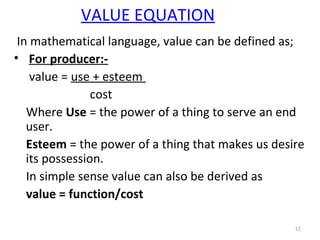
VALUE EQUATION
 In mathematical language, value can be defined as;
• For producer:-
    value = use + esteem
                cost
   Where Use = the power of a thing to serve an end
   user.
   Esteem = the power of a thing that makes us desire
   its possession.
   In simple sense value can also be derived as
   value = function/cost

                                                   17
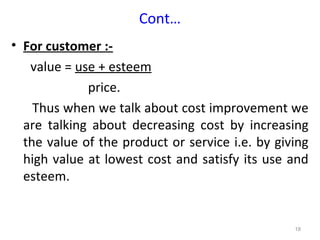
Cont…
• For customer :-
   value = use + esteem
             price.
    Thus when we talk about cost improvement we
  are talking about decreasing cost by increasing
  the value of the product or service i.e. by giving
  high value at lowest cost and satisfy its use and
  esteem.


                                                 18
19


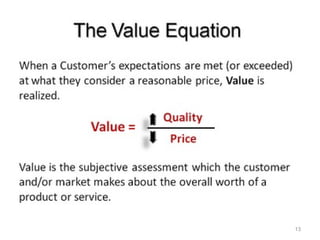
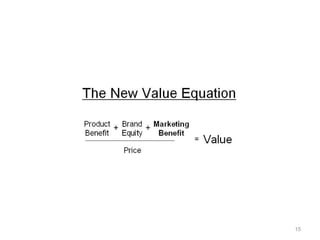
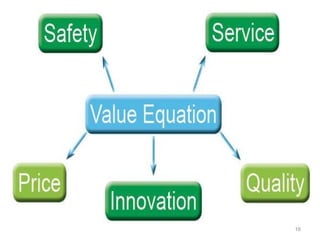
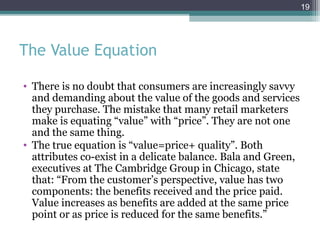
The Value Equation

• There is no doubt that consumers are increasingly savvy
  and demanding about the value of the goods and services
  they purchase. The mistake that many retail marketers
  make is equating “value” with “price”. They are not one
  and the same thing.
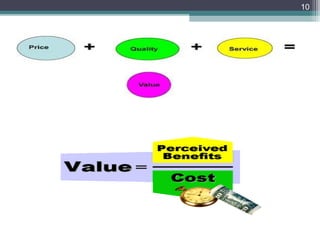
• The true equation is “value=price+ quality”. Both
  attributes co-exist in a delicate balance. Bala and Green,
  executives at The Cambridge Group in Chicago, state
  that: “From the customer’s perspective, value has two
  components: the benefits received and the price paid.
  Value increases as benefits are added at the same price
  point or as price is reduced for the same benefits.”
20
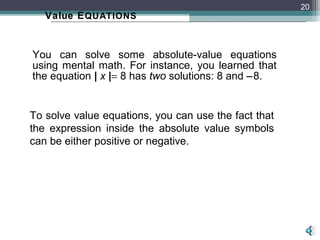
   Value E QUATIONS


You can solve some absolute-value equations
using mental math. For instance, you learned that
the equation | x |= 8 has two solutions: 8 and −8.


To solve value equations, you can use the fact that
the expression inside the absolute value symbols
can be either positive or negative.
21
  Solving Value Equation

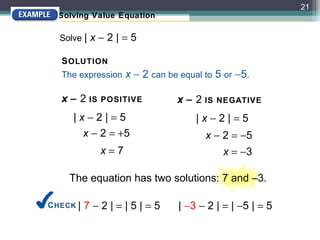
  Solve | x − 2 | = 5

   S OLUTION
   The expression x − 2 can be equal to 5 or −5.

   x − 2 IS POSITIVE
         IS POSITIVE          x − 2 IS NEGATIVE
      |x−2|=5                      |x−2|=5
       x − 2 = +5
               +5                    x − 2 = −5
                                     x − 2 = −5
             x=7
             x=7                         x = −3

     The equation has two solutions: 7 and –3.

C HECK |   7−2|=|5|=5          | −3 − 2 | = | −5 | = 5
22
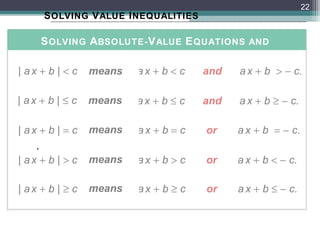
        S OLVING V ALUE I NEQUALITIES

        S OLVING ABSOLUTE- V ALUE E QUATIONS AND
                     I NEQUALITIES
| ax + b | < c   means   ax + b < c     and   a x + b > − c.

| ax + b | ≤ c   means   ax + b ≤ c     and   a x + b ≥ − c.

| ax + b | = c   means   ax + b = c     or    a x + b = − c.
    .
| ax + b | > c   means   ax + b > c     or    a x + b < − c.

| ax + b | ≥ c   means   ax + b ≥ c     or    a x + b ≤ − c.
23


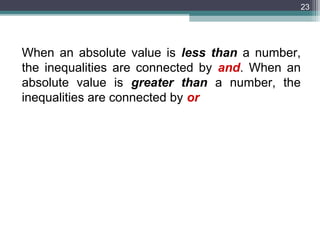
When an absolute value is less than a number,
the inequalities are connected by and. When an
absolute value is greater than a number, the
inequalities are connected by or
24


conclusion
25


Review of the topic
•   Introduction of value analysis
•   What is value?
•   Definition of value analysis, value equation
•   What is value equation?
•   Example of value equation
•   Conclusion
BIBLIOGRAPHY.
    An Introduction to Operation Research
                         - C.R. KOTHARI
   Production and Operation management
                         - DR.CHUNAWALLA
                          - DR. PATEL
   Production and Operation management
                         - N.G.NAIR
   Materials Management
                         - M.M.VARMA
   Production and Operation management
                         - R. PANEERSELVAM

                                             26
 Production management in developing countries
                    - V.S.RAUT.
   Production and Operation management.
                    -K.ASHWATHAPPA
   Purchasing and material management.
                     - WILBUR
                  B.ENGLAND
                      - MICHEIL R.
                  LEENDERS
   INTERNET


                                                  27
28

Value equation

  • 1.
    1 VALUE EQUATION By MANISHA VAGHELA
  • 2.
    2 FLOW OF PRESENTATION • Introduction of value analysis • What is value? • Definition of value analysis, value equation • What is value equation? • Example of value equation • Conclusion • Review of the topic • Bibliography
  • 3.
    3 INTRODUCTION • In dealingwith the technique of value analysis first of all it is very important to understand the meaning of the term ‘Value’. • Value means a measures of satisfaction one gets from the acquisition of an item or service.
  • 4.
    4 Cont… • Value analysisis an important technique in the hands of business and industrial management in modern times. It is often talked about in context of materials management and purchasing research. Quite often the name of LAWERENCE D. MILES of USA is associated with this technique for he was the first to develop it during second world war and as such he is known as the father of Value Analysis technique.
  • 5.
    5 Cont…. • Value analysisis a study of character-wise cost of an item such as quality, design, methods of manufacture, consumption aspect etc. with a view to reducing the ultimate cost of the item. Value analysis also refers to the determination of the value of items proposed to be brought so as to examine the worth to be spent in buying those items. • Purchasing research helps in this direction by supplying requisite data directly for the purpose. Value analysis takes into consideration the quality of the material in relation to its functional value and price.
  • 6.
    6 Cont….. Also, value analysis helps in taking decision about what is actually required and what should be paid so as to derive the maximum benefit but pay the minimum for the same function. This reduces the cost of purchases and enhances the profits of the organization which is of course the goal of any value analysis system. Moreover, as applied to industry, VA involves a continuous supervision of value at each stage namely design, purchase, manufacture, packing, transportation and so on with a view
  • 7.
    7 Cont…… to reduce the overall cost with the increase in the worth of the product. Let us see few examples of value analysis:  A boy wants to purchase a bike. On receiving information, a 2 stroke bike costs Rs.30000 where as a 4 stroke bike costs Rs.35000.at the same time average of 2 stroke bike is 36km/lt whereas the average of 4 stroke bike is 70km/lt. A value analysis, thus, reveals that the second one initially costlier but it gives better value for the money. Hence the 4 stroke bike is recommended.
  • 8.
    8 Cont….. For plastic filament industry, to cut the filament there are various types of blades available in the market. Bharat blade is one of them which is inferior in quality and is 70 paisa per blade. Another one is 7’0 clock blade which is superior in quality costing Rs.2 per blade. The functional values of both the blades are the same. Also there is a possibility of fewer changes in the durability of both the blade. Both the superior and inferior quality blades will serve the same purpose without much variance in the services. The inferior quality may be recommended because of the almost same functional value and cheaper in price in comparison of both the blades.
  • 9.
    9 What is Value? Based on these classifications, value is defined as “the minimum money which has to be expended in purchasing or manufacturing a product to create the appropriate use or esteem factors.”  We could now define value analysis as “ an organised creative approach which has as its objective- the achievement of the value of the product.” value analysis aims at reducing the cost value to the value of the product.
  • 10.
  • 11.
    11 Definition Value analysis: A systematic and analytical technique used to examine all the functions of the existing item, product, product system or activity in order to determine if a cost item can be reduced, while maintaining or improving the functional requirement.
  • 12.
    12 Definition • Value equation A mathematical statement used to evaluate a value. An equation can use any combination of mathematical operations, including addition, subtraction, division, or multiplication. An equation can be already established due to the properties of numbers (2 + 2 = 4), or can be filled solely with variables which can be replaced with numerical values to get a resulting value. For example, the equation to calculate return on sales is: Net income ÷ Sales revenue = Return on Sales. When the values for net income and sales revenue are plugged into the equation, you are able to calculate the value of return on sales.
  • 13.
  • 14.
    Value equation The useof a value equation is intended to help the purchaser of health care service make an informed decision regarding the value of the services. While value may be calculated in a number of different ways, one method that is well suited to behavioral healthcare is to define value as the magnitude of improvement (as measured by an outcome questionnaire) divided by the cost of care. Employers have a particular interest in estimating the value of services because the employee's improvement in symptoms and functioning that potentially results from mental heath and/or substance abuse treatment services have a direct impact on the employer's bottom line in the form of improved worker productivity. The value of behavioral healthcare services can vary due to a number of factors, including the type of treatment and cost of the services. However, the value of the services also vary due to differences in the effectiveness of individual clinicians, since all treatment effects are to some degree mediated by clinician effcts. 14
  • 15.
  • 16.
  • 17.
    VALUE EQUATION Inmathematical language, value can be defined as; • For producer:- value = use + esteem cost Where Use = the power of a thing to serve an end user. Esteem = the power of a thing that makes us desire its possession. In simple sense value can also be derived as value = function/cost 17
  • 18.
    Cont… • For customer:- value = use + esteem price. Thus when we talk about cost improvement we are talking about decreasing cost by increasing the value of the product or service i.e. by giving high value at lowest cost and satisfy its use and esteem. 18
  • 19.
    19 The Value Equation •There is no doubt that consumers are increasingly savvy and demanding about the value of the goods and services they purchase. The mistake that many retail marketers make is equating “value” with “price”. They are not one and the same thing. • The true equation is “value=price+ quality”. Both attributes co-exist in a delicate balance. Bala and Green, executives at The Cambridge Group in Chicago, state that: “From the customer’s perspective, value has two components: the benefits received and the price paid. Value increases as benefits are added at the same price point or as price is reduced for the same benefits.”
  • 20.
    20 Value E QUATIONS You can solve some absolute-value equations using mental math. For instance, you learned that the equation | x |= 8 has two solutions: 8 and −8. To solve value equations, you can use the fact that the expression inside the absolute value symbols can be either positive or negative.
  • 21.
    21 SolvingValue Equation Solve | x − 2 | = 5 S OLUTION The expression x − 2 can be equal to 5 or −5. x − 2 IS POSITIVE IS POSITIVE x − 2 IS NEGATIVE |x−2|=5 |x−2|=5 x − 2 = +5 +5 x − 2 = −5 x − 2 = −5 x=7 x=7 x = −3 The equation has two solutions: 7 and –3. C HECK | 7−2|=|5|=5 | −3 − 2 | = | −5 | = 5
  • 22.
    22 S OLVING V ALUE I NEQUALITIES S OLVING ABSOLUTE- V ALUE E QUATIONS AND I NEQUALITIES | ax + b | < c means ax + b < c and a x + b > − c. | ax + b | ≤ c means ax + b ≤ c and a x + b ≥ − c. | ax + b | = c means ax + b = c or a x + b = − c. . | ax + b | > c means ax + b > c or a x + b < − c. | ax + b | ≥ c means ax + b ≥ c or a x + b ≤ − c.
  • 23.
    23 When an absolutevalue is less than a number, the inequalities are connected by and. When an absolute value is greater than a number, the inequalities are connected by or
  • 24.
  • 25.
    25 Review of thetopic • Introduction of value analysis • What is value? • Definition of value analysis, value equation • What is value equation? • Example of value equation • Conclusion
  • 26.
    BIBLIOGRAPHY.  An Introduction to Operation Research - C.R. KOTHARI  Production and Operation management - DR.CHUNAWALLA - DR. PATEL  Production and Operation management - N.G.NAIR  Materials Management - M.M.VARMA  Production and Operation management - R. PANEERSELVAM 26
  • 27.
     Production managementin developing countries - V.S.RAUT.  Production and Operation management. -K.ASHWATHAPPA  Purchasing and material management. - WILBUR B.ENGLAND - MICHEIL R. LEENDERS  INTERNET 27
  • 28.