Value Driven
Delivery
Value
Value could be defined in terms of monetary benefit, compliance adherence, an answer to the competition in the market etc.
The term value can differ for each client based on what the client is expecting the product/software to accomplish.
The end product of a project is a value to the customer.
Requirements are prioritized based on what adds more value to customer delivery.
For projects with monetary benefits, value is commonly calculated using methods such as return on investment (ROI), internal rate of return (IRR),
and net present value (NPV).
Value Driven Delivery
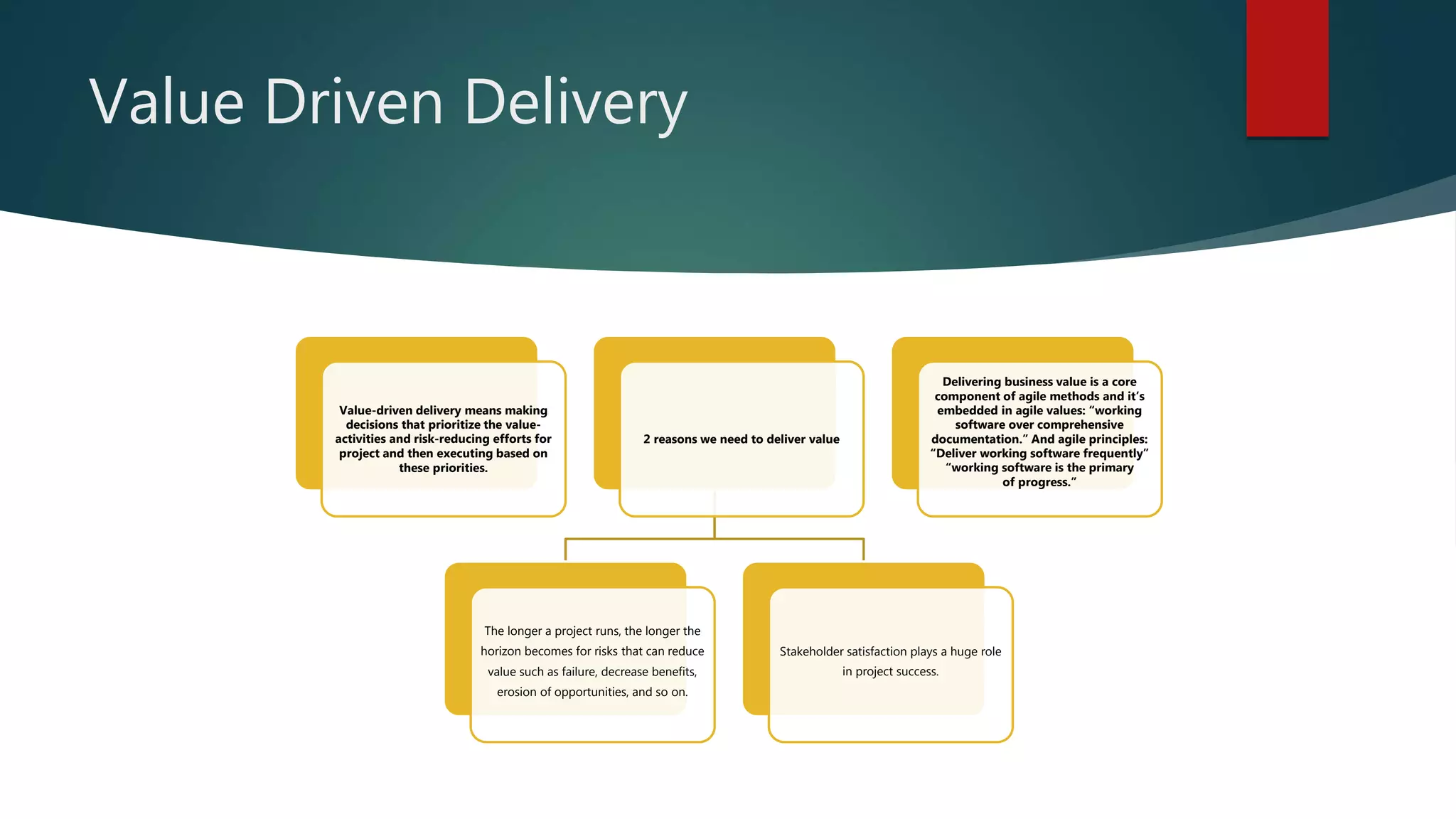
Value-driven delivery means making
decisions that prioritize the value-
activities and risk-reducing efforts for
project and then executing based on
these priorities.
2 reasons we need to deliver value
The longer a project runs, the longer the
horizon becomes for risks that can reduce
value such as failure, decrease benefits,
erosion of opportunities, and so on.
Stakeholder satisfaction plays a huge role
in project success.
Delivering business value is a core
component of agile methods and it’s
embedded in agile values: “working
software over comprehensive
documentation.” And agile principles:
“Deliver working software frequently”
“working software is the primary
of progress.”
Minimize Waste
PARTIALLY DONE
WORK
EXTRA PROCESSES EXTRA FEATURES TASK SWITCHING WAITING MOTION DEFECTS
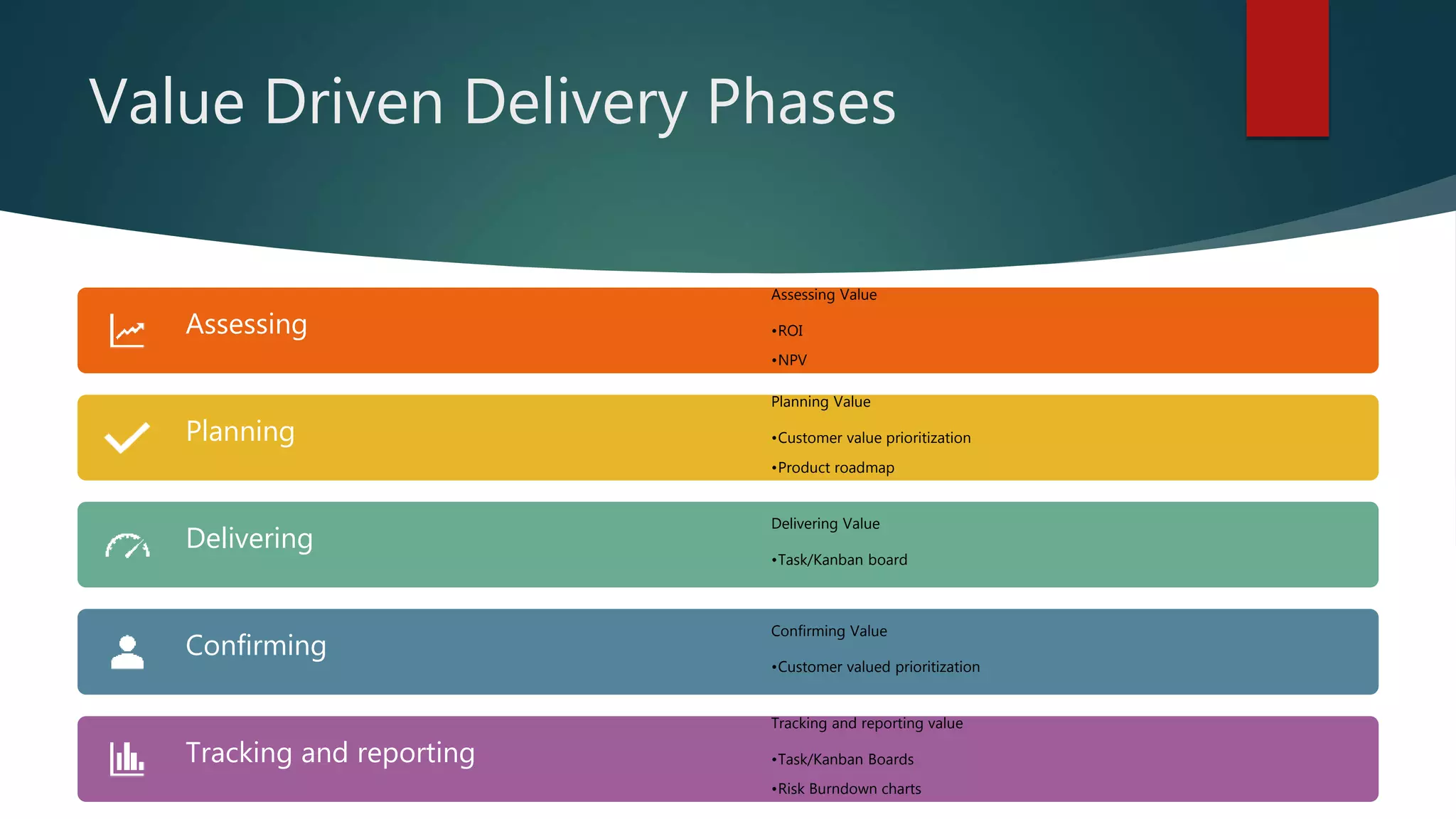
Value Driven Delivery Phases
Assessing
Assessing Value
•ROI
•NPV
Planning
Planning Value
•Customer value prioritization
•Product roadmap
Delivering
Delivering Value
•Task/Kanban board
Confirming
Confirming Value
•Customer valued prioritization
Tracking and reporting
Tracking and reporting value
•Task/Kanban Boards
•Risk Burndown charts
Value driven delivery flow
Collaboration with
stake holders for
identifying what
adds more value
Identity value e.g.
monetary value,
competitive value
Identify risks Prioritize the
requirements
Deliver the value
to the customer
iteratively for rapid
return on
investment (ROI)
Work on feedback Deliver the value
to the customer
iteratively for rapid
return on
investment (ROI)
Identify Minimum
Marketable
Features (MMFs)
to increase the
value delivered to
the customer.
Best Practices Value-driven Delivery
Review what is being delivered in each iteration. The project requirements, the environment around it keep changing. We need to have an eye on what is changing, re-look at
look at priorities, and re-order them.
Whenever there is a new requirement, it has to be compared with the whole priority list so that we don’t divert in our objective of providing highest value to the customer. If
the new requirement adds more value to the deliverable then that should move to priority list.
Decrease uncertainty and constantly address risks that can potentially decrease value if they materialize. Also work closely with project stakeholders showing them product
increments at the end of each Sprint, enabling effective management of changes.
Experiment early so that we fail fast and rethink on our approach very early in the development stage
Create Deliverables based on the priorities determined by producing potentially shippable product increments during each Sprint so that customers start realizing value early
on in the project.

Value driven delivery

  • 1.
  • 2.
    Value Value could bedefined in terms of monetary benefit, compliance adherence, an answer to the competition in the market etc. The term value can differ for each client based on what the client is expecting the product/software to accomplish. The end product of a project is a value to the customer. Requirements are prioritized based on what adds more value to customer delivery. For projects with monetary benefits, value is commonly calculated using methods such as return on investment (ROI), internal rate of return (IRR), and net present value (NPV).
  • 3.
    Value Driven Delivery Value-drivendelivery means making decisions that prioritize the value- activities and risk-reducing efforts for project and then executing based on these priorities. 2 reasons we need to deliver value The longer a project runs, the longer the horizon becomes for risks that can reduce value such as failure, decrease benefits, erosion of opportunities, and so on. Stakeholder satisfaction plays a huge role in project success. Delivering business value is a core component of agile methods and it’s embedded in agile values: “working software over comprehensive documentation.” And agile principles: “Deliver working software frequently” “working software is the primary of progress.”
  • 4.
    Minimize Waste PARTIALLY DONE WORK EXTRAPROCESSES EXTRA FEATURES TASK SWITCHING WAITING MOTION DEFECTS
  • 5.
    Value Driven DeliveryPhases Assessing Assessing Value •ROI •NPV Planning Planning Value •Customer value prioritization •Product roadmap Delivering Delivering Value •Task/Kanban board Confirming Confirming Value •Customer valued prioritization Tracking and reporting Tracking and reporting value •Task/Kanban Boards •Risk Burndown charts
  • 6.
    Value driven deliveryflow Collaboration with stake holders for identifying what adds more value Identity value e.g. monetary value, competitive value Identify risks Prioritize the requirements Deliver the value to the customer iteratively for rapid return on investment (ROI) Work on feedback Deliver the value to the customer iteratively for rapid return on investment (ROI) Identify Minimum Marketable Features (MMFs) to increase the value delivered to the customer.
  • 7.
    Best Practices Value-drivenDelivery Review what is being delivered in each iteration. The project requirements, the environment around it keep changing. We need to have an eye on what is changing, re-look at look at priorities, and re-order them. Whenever there is a new requirement, it has to be compared with the whole priority list so that we don’t divert in our objective of providing highest value to the customer. If the new requirement adds more value to the deliverable then that should move to priority list. Decrease uncertainty and constantly address risks that can potentially decrease value if they materialize. Also work closely with project stakeholders showing them product increments at the end of each Sprint, enabling effective management of changes. Experiment early so that we fail fast and rethink on our approach very early in the development stage Create Deliverables based on the priorities determined by producing potentially shippable product increments during each Sprint so that customers start realizing value early on in the project.