DSV SU + IbisSoft
Agile Research in Information
Systems Field
Analysis from Knowledge Transformation
Perspective
1
Ilia Bider
8th IADIS International
Conference on
Information Systems 2015
DSV SU + IbisSoft
Motivation – personal perspective
• Personal background – relevant practice
– Software development - (requirements engineering,
programming, management, introducing IT in organizations)
– Business process & BPS support systems development
(process modeling, system development, introduction in
practice)
• Personal background – relevant research
– Analysis of Traditional vs Agile from knowledge
transformation perspective for both software development and
business process development
2
DSV SU + IbisSoft
Motivation – personal perspective
• A seminar on agile research at our department -
Autumn 2014 by Michael Twidale
• An idea to try the same approach to analysis of the
notion of agile research as we used for agile system
and business process development
• The results of application of this idea is what I want to
present today
3
DSV SU + IbisSoft
Goal
Answer the questions
1. Is it possible to define a notion of “agile research”,
more specifically a notion of “agile research
project”?
2. If yes how it differs from non-agile research
(project)?
3. Is there any existing types of research projects
that can be called agile?
4
DSV SU + IbisSoft
Plan of presentation
1. Showing how knowledge transformation perspective
can be used for analysis agile vs non-agile project in
other domains.
2. Analysis of previous attempts to define agile research
3. Defining analogous of working software for research
4. Applying approach from 1 to the research world
5. Discussing already existing types of research projects
that can be considered as agile
5
DSV SU + IbisSoft
Background: SECI Model
SECI model of knowledge transformation of Nonaka:
6
Nonaka, I., 1994. A dynamic theory of
organizational knowledge creation.
Organization science, 5(1), pp.14-37..
Two types of knowledge:
– Explicit
– Tacit
Tacit
Explicit
Externalization
Explicit
CombinationInternalization
Socialization
Tacit
ExplicitExplicit
Tacit
Tacit
Tacit
Tacit
Externalization
Tacit
Combination
Internalization Socialization
Explicit
ExplicitExplicit
Explicit
Tacit
DSV SU + IbisSoft
Knowledge transformation: TSD
ECEA - a model of Traditional Software Development (TSD)
7
Additional type of knowledge:
Embedded knowledge
Each model is a simplification
Tacit
Explicit
Externalization
Explicit
CombinationInternalization
Socialization
Tacit
ExplicitExplicit
Tacit
Tacit
DSV SU + IbisSoft
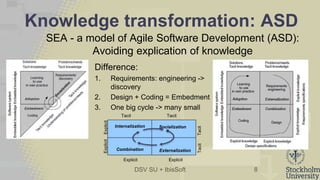
Knowledge transformation: ASD
SEA - a model of Agile Software Development (ASD):
Avoiding explication of knowledge
8
Difference:
1. Requirements: engineering ->
discovery
2. Design + Coding = Embedment
3. One big cycle -> many small
Tacit
Tacit
Externalization
Tacit
Combination
Internalization Socialization
Explicit
ExplicitExplicit
Explicit
Tacit
DSV SU + IbisSoft
Usability of the Models
• Analysis of advantages, drawbacks, and risks for each
type of SD
• Areas of applicability for ASD (and TSD)
Both without going into details, e.g. XP, SCRUM, etc.
References:
Bider I. Analysis of Agile Software Development from the Knowledge Transformation Perspective.
In: Proceedings of BIR 2014, LNBIP 194, Springer 2014, pp. 143-157.
Extended version as a chapter in a coming book: Software Engineering in the Systems Context.
Edited by Ivar Jacobson and Harold “Bud” Lawson. College Publishing, Systems series, 2015
9
DSV SU + IbisSoft
Plan of presentation
1. Showing how knowledge transformation perspective
can be used for analysis agile vs non-agile project in
other domains.
2. Analysis of previous attempts to define agile research
3. Defining analogous of working software for research
4. Applying approach from 1 to the research world
5. Discussing already existing types of research projects
that can be considered as agile
10
DSV SU + IbisSoft
Analysis of previous attempts
• Rewriting agile manifesto http://agilemanifesto.org,
examples:
– http://xavier.amatriain.net/AgileResearch/
– http://www.infoq.com/articles/agile-academic-research
• Superficial and fail to define “working software” in
Value working software over
comprehensive documentation
Examples: “real-world working solutions over comprehensive theories”
document, such as research project report, a paper, or a PhD thesis
11
DSV SU + IbisSoft
Plan of presentation
1. Showing how knowledge transformation perspective
can be used for analysis agile vs non-agile project in
other domains.
2. Analysis of previous attempts to define agile research
3. Defining analogous of working software for research
4. Applying approach from 1 to the research world
5. Discussing already existing types of research projects
that can be considered as agile
12
DSV SU + IbisSoft
Defining “working software”
• In software world:
1. The software is functioning and is free from the major bugs
2. The software is actually used in the context for which it was
intended
• In IS research world:
– Software = scientific knowledge, e.g. a theory, that exists in
an explicit form
– Usage: to explain, to describe, to predict, to analyze and to
design or take action, … (Gregor, S., 2006. The Nature of Theory in
Information Systems. MIS Quarterly, 30(3), pp.611-42.)
13
DSV SU + IbisSoft
Defining “working software”
• Working scientific knowledge:
1. The knowledge in its explicit form has no contradictions
2. There is at least one individual for whom this knowledge
became tacit and he/she has successfully used it for some
purpose
• Based on
– In the end all knowledge needs to become personal and tacit
(Polanyi, M.S., 1969. Knowing and Being. Chicago: University of Chicago.)
– Essentially all models are wrong, but some of them are useful
(Box, G. E. P., and Draper, N. R., (1987), Empirical Model Building and Response
Surfaces, John Wiley & Sons, New York, NY)
14
DSV SU + IbisSoft
Plan of presentation
1. Showing how knowledge transformation perspective
can be used for analysis agile vs non-agile project in
other domains.
2. Analysis of previous attempts to define agile research
3. Defining analogous of working software for research
4. Applying approach from 1 to the research world
5. Discussing already existing types of research projects
that can be considered as agile
15
DSV SU + IbisSoft
Knowledge transformation: TR
ECCI - a model of Traditional Research (TR)
16
Embedded knowledge:
1. Systems artifacts, e.g. documents, IT systems
2. Tacit knowledge of human participants
Tacit
Explicit
Externalization
Explicit
CombinationInternalization
Socialization
Tacit
ExplicitExplicit
Tacit
Tacit
DSV SU + IbisSoft
Advantages & Risks with TR
17
+ Higher status: rigor
- Long cycle, sensitive to the right
decision taken at the first stages:
instability
- Formulated in a way that prevents
adoption: lack of relevance
- Could be applied only to existing
Information System: limitation
DSV SU + IbisSoft
Knowledge transformation: AR
AEI - a model of Agile Research (AR):
Postponing explication of knowledge
18
Involvement:
1. Socialization
2. Being part of the system
3. Being part of the intervention
project
Tacit
Tacit
Externalization
Tacit
Combination
Internalization Socialization
Explicit
ExplicitExplicit
Explicit
Tacit
DSV SU + IbisSoft
Advantages & drawbacks of AR
19
Mitigating the TR risks
+ Instability & Lack of relevance are mitigated by
smaller cycles
+ Could be applied to innovative Information System
through disruptive intervention projects
Drawbacks
- Lack of rigor on the first cycles
Requirements on researcher (limitations)
• Capability to be involved
• Capability to reflect
Different skills set than for a traditional research
DSV SU + IbisSoft
Plan of presentation
1. Showing how knowledge transformation perspective
can be used for analysis agile vs non-agile project in
other domains.
2. Analysis of previous attempts to define agile research
3. Defining analogous of working software for research
4. Applying approach from 1 to the research world
5. Discussing already existing types of research projects
that can be considered as agile
20
DSV SU + IbisSoft
Agile research projects type
1. Action research (Lewin, K., 1952. Field theory in social science: Selected
theoretical papers by Kurt Lewin. London: Tavistock)
2. Design science (Hevner, A.R., March, S.T. & and, P.J., 2004. Design
Science in Information Systems Research. MIS Quarterly, 28(1), pp.75-105)
3. Reflective theory building (Mott, V., 1996. Knowledge comes from
practice: Reflective theory building in practice. In R.W. Rowden, ed. Workplace
learning: Debating five critical questions of theory and practice. San Francisco,
CA: Jossey-Bass. pp.57-63)
21
DSV SU + IbisSoft
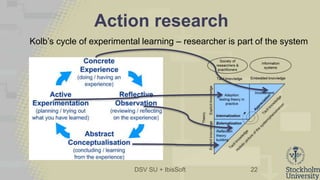
Action research
22
Kolb’s cycle of experimental learning – researcher is part of the system
DSV SU + IbisSoft
Goal reached
Answer the questions
1. Is it possible to define a notion of “agile research”?
Yes, through a model of knowledge transformation
2. If yes how it differs from non-agile research?
Yes, through comparing the agile model with the
traditional one
3. Is there any existing types of research projects that can be
called agile?
Yes, action research, design science, reflective theory
building
23
DSV SU + IbisSoft
Potential usability
Of the presented agile research (reflections on my
research experience)
1. Analysis of successful and unsuccessful past
research projects (learning from success and failures)
2. Decision making (to use TR or AR)
3. Project planning for AR
4. Research education.
Needs testing
24
DSV SU + IbisSoft
Q & A
Thank you for your patience
Questions and comments
Please
Contact: ilia@{dsv.su|ibissoft}.se
25

Agile Research in Information Systems Field: Analysis from Knowledge Transformation Perspective

  • 1.
    DSV SU +IbisSoft Agile Research in Information Systems Field Analysis from Knowledge Transformation Perspective 1 Ilia Bider 8th IADIS International Conference on Information Systems 2015
  • 2.
    DSV SU +IbisSoft Motivation – personal perspective • Personal background – relevant practice – Software development - (requirements engineering, programming, management, introducing IT in organizations) – Business process & BPS support systems development (process modeling, system development, introduction in practice) • Personal background – relevant research – Analysis of Traditional vs Agile from knowledge transformation perspective for both software development and business process development 2
  • 3.
    DSV SU +IbisSoft Motivation – personal perspective • A seminar on agile research at our department - Autumn 2014 by Michael Twidale • An idea to try the same approach to analysis of the notion of agile research as we used for agile system and business process development • The results of application of this idea is what I want to present today 3
  • 4.
    DSV SU +IbisSoft Goal Answer the questions 1. Is it possible to define a notion of “agile research”, more specifically a notion of “agile research project”? 2. If yes how it differs from non-agile research (project)? 3. Is there any existing types of research projects that can be called agile? 4
  • 5.
    DSV SU +IbisSoft Plan of presentation 1. Showing how knowledge transformation perspective can be used for analysis agile vs non-agile project in other domains. 2. Analysis of previous attempts to define agile research 3. Defining analogous of working software for research 4. Applying approach from 1 to the research world 5. Discussing already existing types of research projects that can be considered as agile 5
  • 6.
    DSV SU +IbisSoft Background: SECI Model SECI model of knowledge transformation of Nonaka: 6 Nonaka, I., 1994. A dynamic theory of organizational knowledge creation. Organization science, 5(1), pp.14-37.. Two types of knowledge: – Explicit – Tacit Tacit Explicit Externalization Explicit CombinationInternalization Socialization Tacit ExplicitExplicit Tacit Tacit Tacit Tacit Externalization Tacit Combination Internalization Socialization Explicit ExplicitExplicit Explicit Tacit
  • 7.
    DSV SU +IbisSoft Knowledge transformation: TSD ECEA - a model of Traditional Software Development (TSD) 7 Additional type of knowledge: Embedded knowledge Each model is a simplification Tacit Explicit Externalization Explicit CombinationInternalization Socialization Tacit ExplicitExplicit Tacit Tacit
  • 8.
    DSV SU +IbisSoft Knowledge transformation: ASD SEA - a model of Agile Software Development (ASD): Avoiding explication of knowledge 8 Difference: 1. Requirements: engineering -> discovery 2. Design + Coding = Embedment 3. One big cycle -> many small Tacit Tacit Externalization Tacit Combination Internalization Socialization Explicit ExplicitExplicit Explicit Tacit
  • 9.
    DSV SU +IbisSoft Usability of the Models • Analysis of advantages, drawbacks, and risks for each type of SD • Areas of applicability for ASD (and TSD) Both without going into details, e.g. XP, SCRUM, etc. References: Bider I. Analysis of Agile Software Development from the Knowledge Transformation Perspective. In: Proceedings of BIR 2014, LNBIP 194, Springer 2014, pp. 143-157. Extended version as a chapter in a coming book: Software Engineering in the Systems Context. Edited by Ivar Jacobson and Harold “Bud” Lawson. College Publishing, Systems series, 2015 9
  • 10.
    DSV SU +IbisSoft Plan of presentation 1. Showing how knowledge transformation perspective can be used for analysis agile vs non-agile project in other domains. 2. Analysis of previous attempts to define agile research 3. Defining analogous of working software for research 4. Applying approach from 1 to the research world 5. Discussing already existing types of research projects that can be considered as agile 10
  • 11.
    DSV SU +IbisSoft Analysis of previous attempts • Rewriting agile manifesto http://agilemanifesto.org, examples: – http://xavier.amatriain.net/AgileResearch/ – http://www.infoq.com/articles/agile-academic-research • Superficial and fail to define “working software” in Value working software over comprehensive documentation Examples: “real-world working solutions over comprehensive theories” document, such as research project report, a paper, or a PhD thesis 11
  • 12.
    DSV SU +IbisSoft Plan of presentation 1. Showing how knowledge transformation perspective can be used for analysis agile vs non-agile project in other domains. 2. Analysis of previous attempts to define agile research 3. Defining analogous of working software for research 4. Applying approach from 1 to the research world 5. Discussing already existing types of research projects that can be considered as agile 12
  • 13.
    DSV SU +IbisSoft Defining “working software” • In software world: 1. The software is functioning and is free from the major bugs 2. The software is actually used in the context for which it was intended • In IS research world: – Software = scientific knowledge, e.g. a theory, that exists in an explicit form – Usage: to explain, to describe, to predict, to analyze and to design or take action, … (Gregor, S., 2006. The Nature of Theory in Information Systems. MIS Quarterly, 30(3), pp.611-42.) 13
  • 14.
    DSV SU +IbisSoft Defining “working software” • Working scientific knowledge: 1. The knowledge in its explicit form has no contradictions 2. There is at least one individual for whom this knowledge became tacit and he/she has successfully used it for some purpose • Based on – In the end all knowledge needs to become personal and tacit (Polanyi, M.S., 1969. Knowing and Being. Chicago: University of Chicago.) – Essentially all models are wrong, but some of them are useful (Box, G. E. P., and Draper, N. R., (1987), Empirical Model Building and Response Surfaces, John Wiley & Sons, New York, NY) 14
  • 15.
    DSV SU +IbisSoft Plan of presentation 1. Showing how knowledge transformation perspective can be used for analysis agile vs non-agile project in other domains. 2. Analysis of previous attempts to define agile research 3. Defining analogous of working software for research 4. Applying approach from 1 to the research world 5. Discussing already existing types of research projects that can be considered as agile 15
  • 16.
    DSV SU +IbisSoft Knowledge transformation: TR ECCI - a model of Traditional Research (TR) 16 Embedded knowledge: 1. Systems artifacts, e.g. documents, IT systems 2. Tacit knowledge of human participants Tacit Explicit Externalization Explicit CombinationInternalization Socialization Tacit ExplicitExplicit Tacit Tacit
  • 17.
    DSV SU +IbisSoft Advantages & Risks with TR 17 + Higher status: rigor - Long cycle, sensitive to the right decision taken at the first stages: instability - Formulated in a way that prevents adoption: lack of relevance - Could be applied only to existing Information System: limitation
  • 18.
    DSV SU +IbisSoft Knowledge transformation: AR AEI - a model of Agile Research (AR): Postponing explication of knowledge 18 Involvement: 1. Socialization 2. Being part of the system 3. Being part of the intervention project Tacit Tacit Externalization Tacit Combination Internalization Socialization Explicit ExplicitExplicit Explicit Tacit
  • 19.
    DSV SU +IbisSoft Advantages & drawbacks of AR 19 Mitigating the TR risks + Instability & Lack of relevance are mitigated by smaller cycles + Could be applied to innovative Information System through disruptive intervention projects Drawbacks - Lack of rigor on the first cycles Requirements on researcher (limitations) • Capability to be involved • Capability to reflect Different skills set than for a traditional research
  • 20.
    DSV SU +IbisSoft Plan of presentation 1. Showing how knowledge transformation perspective can be used for analysis agile vs non-agile project in other domains. 2. Analysis of previous attempts to define agile research 3. Defining analogous of working software for research 4. Applying approach from 1 to the research world 5. Discussing already existing types of research projects that can be considered as agile 20
  • 21.
    DSV SU +IbisSoft Agile research projects type 1. Action research (Lewin, K., 1952. Field theory in social science: Selected theoretical papers by Kurt Lewin. London: Tavistock) 2. Design science (Hevner, A.R., March, S.T. & and, P.J., 2004. Design Science in Information Systems Research. MIS Quarterly, 28(1), pp.75-105) 3. Reflective theory building (Mott, V., 1996. Knowledge comes from practice: Reflective theory building in practice. In R.W. Rowden, ed. Workplace learning: Debating five critical questions of theory and practice. San Francisco, CA: Jossey-Bass. pp.57-63) 21
  • 22.
    DSV SU +IbisSoft Action research 22 Kolb’s cycle of experimental learning – researcher is part of the system
  • 23.
    DSV SU +IbisSoft Goal reached Answer the questions 1. Is it possible to define a notion of “agile research”? Yes, through a model of knowledge transformation 2. If yes how it differs from non-agile research? Yes, through comparing the agile model with the traditional one 3. Is there any existing types of research projects that can be called agile? Yes, action research, design science, reflective theory building 23
  • 24.
    DSV SU +IbisSoft Potential usability Of the presented agile research (reflections on my research experience) 1. Analysis of successful and unsuccessful past research projects (learning from success and failures) 2. Decision making (to use TR or AR) 3. Project planning for AR 4. Research education. Needs testing 24
  • 25.
    DSV SU +IbisSoft Q & A Thank you for your patience Questions and comments Please Contact: ilia@{dsv.su|ibissoft}.se 25