Modern Competitive Strategy 4th Edition Walker Solutions Manual
1.
Download the fullversion and explore a variety of test banks
or solution manuals at https://testbankdeal.com
Modern Competitive Strategy 4th Edition Walker
Solutions Manual
_____ Follow the link below to get your download now _____
https://testbankdeal.com/product/modern-competitive-
strategy-4th-edition-walker-solutions-manual/
Access testbankdeal.com now to download high-quality
test banks or solution manuals
2.
We have selectedsome products that you may be interested in
Click the link to download now or visit testbankdeal.com
for more options!.
Modern Competitive Strategy 4th Edition Walker Test Bank
https://testbankdeal.com/product/modern-competitive-strategy-4th-
edition-walker-test-bank/
Physics 4th Edition Walker Solutions Manual
https://testbankdeal.com/product/physics-4th-edition-walker-solutions-
manual/
Marketing Strategy A Decision-Focused Approach 8th Edition
Walker Solutions Manual
https://testbankdeal.com/product/marketing-strategy-a-decision-
focused-approach-8th-edition-walker-solutions-manual/
Numerical Methods for Engineers 7th Edition Chapra
Solutions Manual
https://testbankdeal.com/product/numerical-methods-for-engineers-7th-
edition-chapra-solutions-manual/
3.
Sensation and Perception9th Edition Goldstein Test Bank
https://testbankdeal.com/product/sensation-and-perception-9th-edition-
goldstein-test-bank/
Living Democracy Brief National Edition 1st Edition Shea
Test Bank
https://testbankdeal.com/product/living-democracy-brief-national-
edition-1st-edition-shea-test-bank/
Fundamentals of Investments Valuation and Management 8th
Edition Jordan Solutions Manual
https://testbankdeal.com/product/fundamentals-of-investments-
valuation-and-management-8th-edition-jordan-solutions-manual/
Principles of Marketing An Asian Perspective 3rd Edition
Kotler Test Bank
https://testbankdeal.com/product/principles-of-marketing-an-asian-
perspective-3rd-edition-kotler-test-bank/
Labor Economics 7th Edition George Borjas Test Bank
https://testbankdeal.com/product/labor-economics-7th-edition-george-
borjas-test-bank/
4.
Income Tax Fundamentals2017 35th Edition Whittenburg Test
Bank
https://testbankdeal.com/product/income-tax-fundamentals-2017-35th-
edition-whittenburg-test-bank/
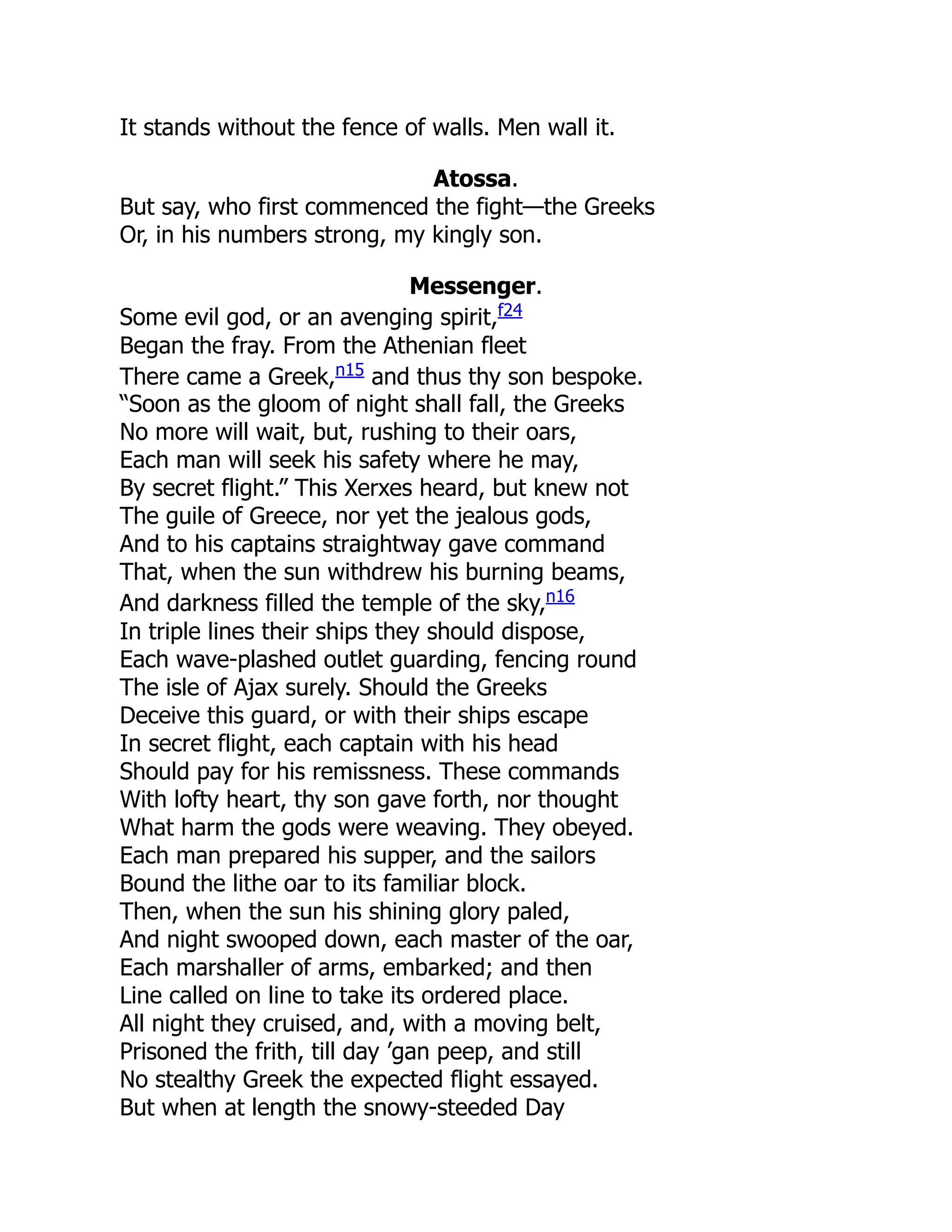
It stands withoutthe fence of walls. Men wall it.
Atossa.
But say, who first commenced the fight—the Greeks
Or, in his numbers strong, my kingly son.
Messenger.
Some evil god, or an avenging spirit,f24
Began the fray. From the Athenian fleet
There came a Greek,n15
and thus thy son bespoke.
“Soon as the gloom of night shall fall, the Greeks
No more will wait, but, rushing to their oars,
Each man will seek his safety where he may,
By secret flight.” This Xerxes heard, but knew not
The guile of Greece, nor yet the jealous gods,
And to his captains straightway gave command
That, when the sun withdrew his burning beams,
And darkness filled the temple of the sky,n16
In triple lines their ships they should dispose,
Each wave-plashed outlet guarding, fencing round
The isle of Ajax surely. Should the Greeks
Deceive this guard, or with their ships escape
In secret flight, each captain with his head
Should pay for his remissness. These commands
With lofty heart, thy son gave forth, nor thought
What harm the gods were weaving. They obeyed.
Each man prepared his supper, and the sailors
Bound the lithe oar to its familiar block.
Then, when the sun his shining glory paled,
And night swooped down, each master of the oar,
Each marshaller of arms, embarked; and then
Line called on line to take its ordered place.
All night they cruised, and, with a moving belt,
Prisoned the frith, till day ’gan peep, and still
No stealthy Greek the expected flight essayed.
But when at length the snowy-steeded Day
13.
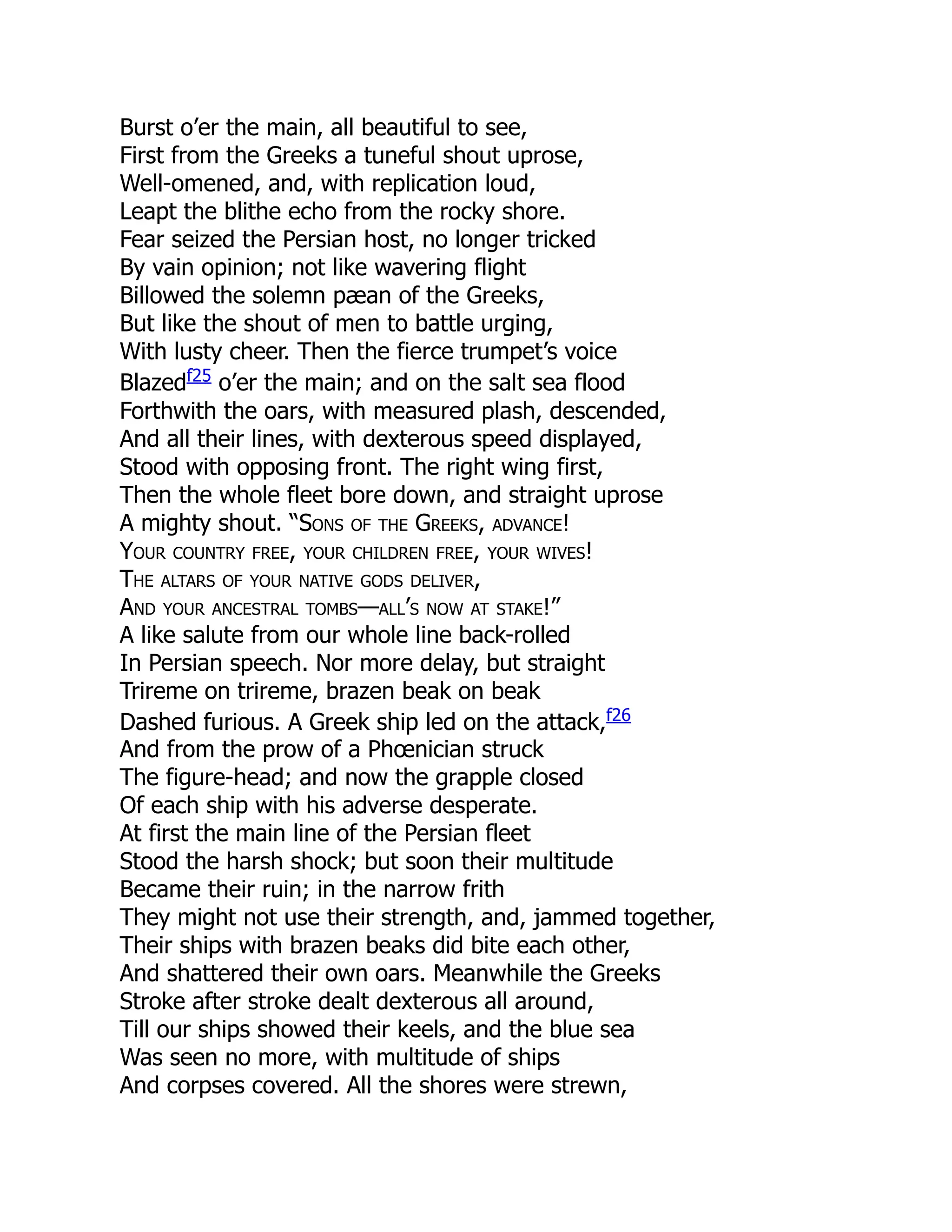
Burst o’er themain, all beautiful to see,
First from the Greeks a tuneful shout uprose,
Well-omened, and, with replication loud,
Leapt the blithe echo from the rocky shore.
Fear seized the Persian host, no longer tricked
By vain opinion; not like wavering flight
Billowed the solemn pæan of the Greeks,
But like the shout of men to battle urging,
With lusty cheer. Then the fierce trumpet’s voice
Blazedf25
o’er the main; and on the salt sea flood
Forthwith the oars, with measured plash, descended,
And all their lines, with dexterous speed displayed,
Stood with opposing front. The right wing first,
Then the whole fleet bore down, and straight uprose
A mighty shout. “Sons of the Greeks, advance!
Your country free, your children free, your wives!
The altars of your native gods deliver,
And your ancestral tombs—all’s now at stake!”
A like salute from our whole line back-rolled
In Persian speech. Nor more delay, but straight
Trireme on trireme, brazen beak on beak
Dashed furious. A Greek ship led on the attack,f26
And from the prow of a Phœnician struck
The figure-head; and now the grapple closed
Of each ship with his adverse desperate.
At first the main line of the Persian fleet
Stood the harsh shock; but soon their multitude
Became their ruin; in the narrow frith
They might not use their strength, and, jammed together,
Their ships with brazen beaks did bite each other,
And shattered their own oars. Meanwhile the Greeks
Stroke after stroke dealt dexterous all around,
Till our ships showed their keels, and the blue sea
Was seen no more, with multitude of ships
And corpses covered. All the shores were strewn,
14.
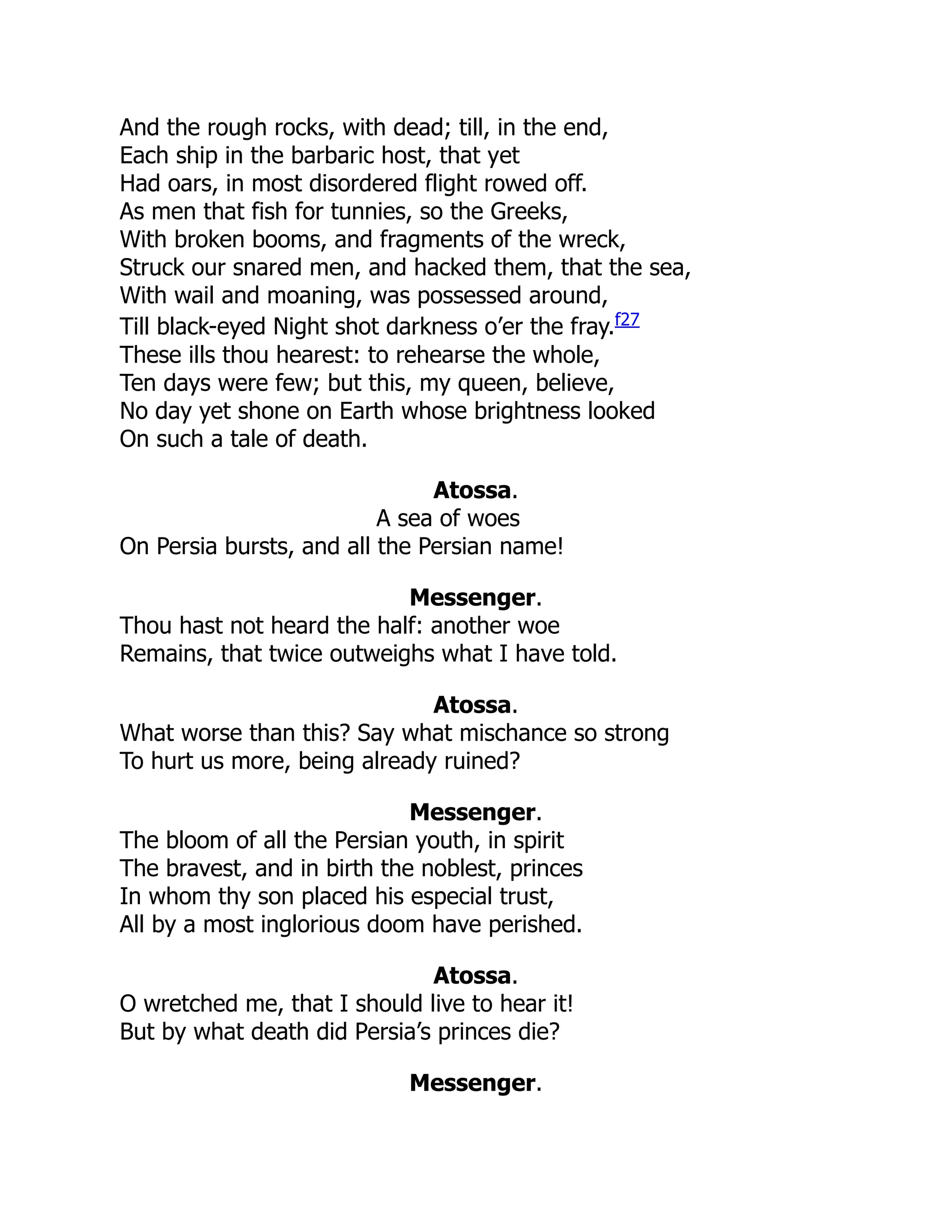
And the roughrocks, with dead; till, in the end,
Each ship in the barbaric host, that yet
Had oars, in most disordered flight rowed off.
As men that fish for tunnies, so the Greeks,
With broken booms, and fragments of the wreck,
Struck our snared men, and hacked them, that the sea,
With wail and moaning, was possessed around,
Till black-eyed Night shot darkness o’er the fray.f27
These ills thou hearest: to rehearse the whole,
Ten days were few; but this, my queen, believe,
No day yet shone on Earth whose brightness looked
On such a tale of death.
Atossa.
A sea of woes
On Persia bursts, and all the Persian name!
Messenger.
Thou hast not heard the half: another woe
Remains, that twice outweighs what I have told.
Atossa.
What worse than this? Say what mischance so strong
To hurt us more, being already ruined?
Messenger.
The bloom of all the Persian youth, in spirit
The bravest, and in birth the noblest, princes
In whom thy son placed his especial trust,
All by a most inglorious doom have perished.
Atossa.
O wretched me, that I should live to hear it!
But by what death did Persia’s princes die?
Messenger.
15.
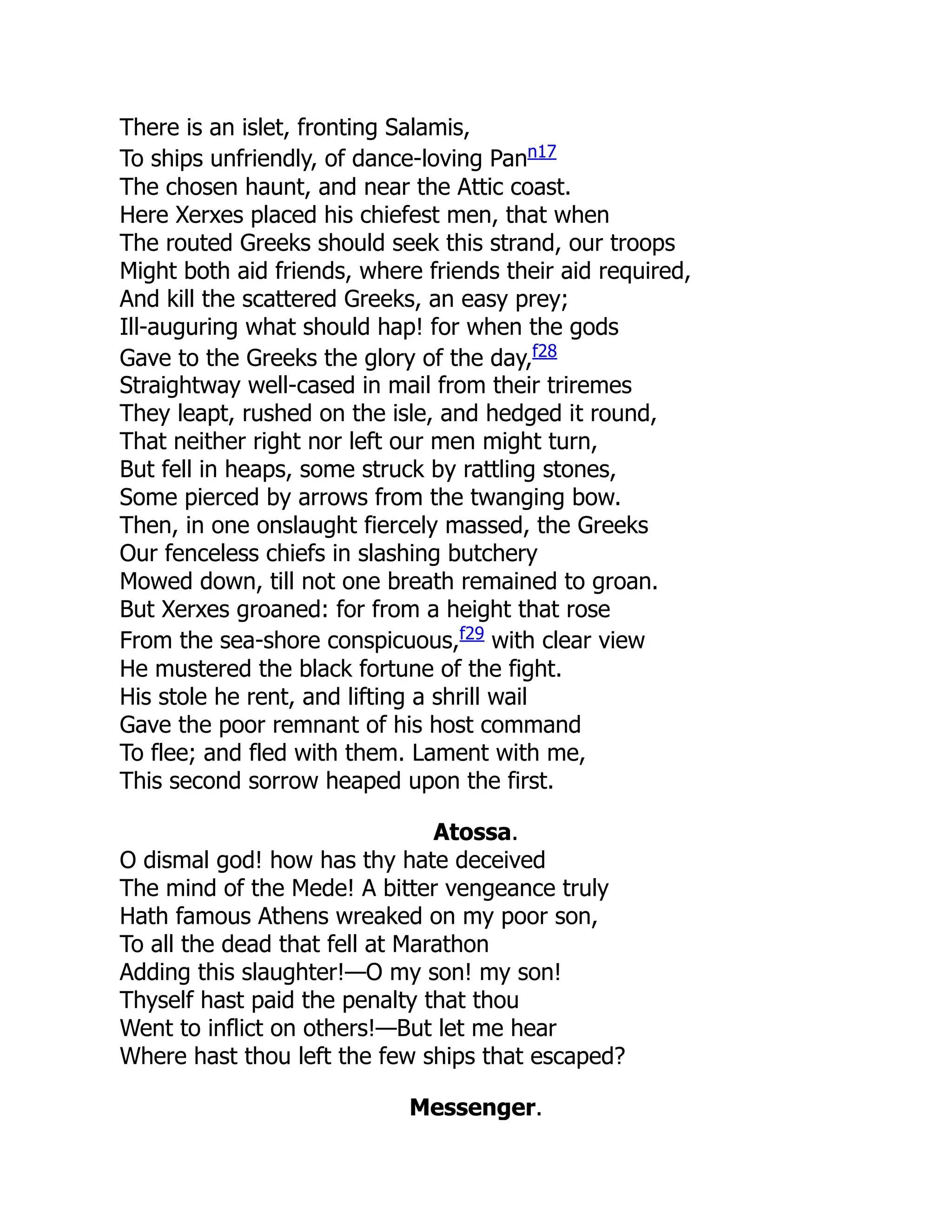
There is anislet, fronting Salamis,
To ships unfriendly, of dance-loving Pann17
The chosen haunt, and near the Attic coast.
Here Xerxes placed his chiefest men, that when
The routed Greeks should seek this strand, our troops
Might both aid friends, where friends their aid required,
And kill the scattered Greeks, an easy prey;
Ill-auguring what should hap! for when the gods
Gave to the Greeks the glory of the day,f28
Straightway well-cased in mail from their triremes
They leapt, rushed on the isle, and hedged it round,
That neither right nor left our men might turn,
But fell in heaps, some struck by rattling stones,
Some pierced by arrows from the twanging bow.
Then, in one onslaught fiercely massed, the Greeks
Our fenceless chiefs in slashing butchery
Mowed down, till not one breath remained to groan.
But Xerxes groaned: for from a height that rose
From the sea-shore conspicuous,f29
with clear view
He mustered the black fortune of the fight.
His stole he rent, and lifting a shrill wail
Gave the poor remnant of his host command
To flee; and fled with them. Lament with me,
This second sorrow heaped upon the first.
Atossa.
O dismal god! how has thy hate deceived
The mind of the Mede! A bitter vengeance truly
Hath famous Athens wreaked on my poor son,
To all the dead that fell at Marathon
Adding this slaughter!—O my son! my son!
Thyself hast paid the penalty that thou
Went to inflict on others!—But let me hear
Where hast thou left the few ships that escaped?
Messenger.
16.
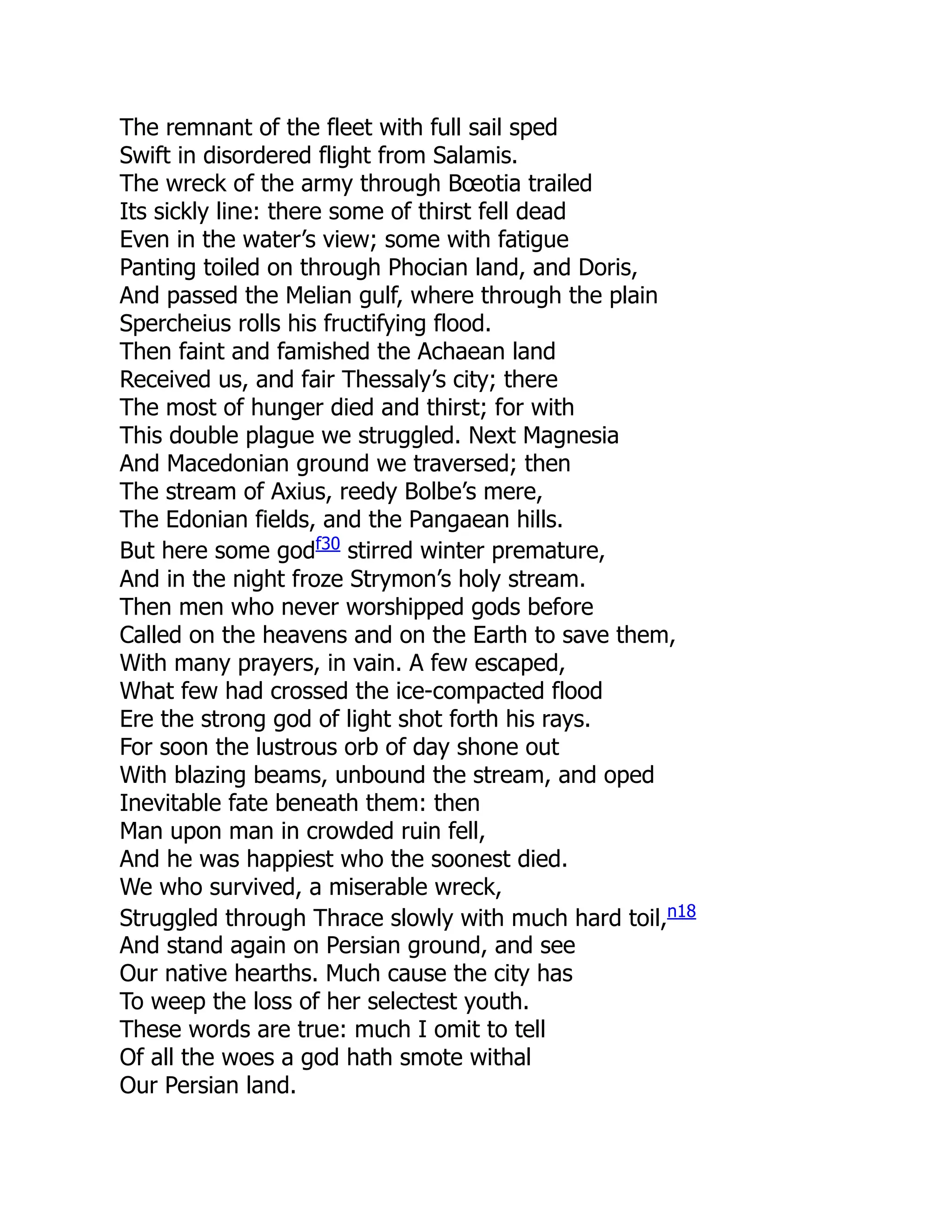
The remnant ofthe fleet with full sail sped
Swift in disordered flight from Salamis.
The wreck of the army through Bœotia trailed
Its sickly line: there some of thirst fell dead
Even in the water’s view; some with fatigue
Panting toiled on through Phocian land, and Doris,
And passed the Melian gulf, where through the plain
Spercheius rolls his fructifying flood.
Then faint and famished the Achaean land
Received us, and fair Thessaly’s city; there
The most of hunger died and thirst; for with
This double plague we struggled. Next Magnesia
And Macedonian ground we traversed; then
The stream of Axius, reedy Bolbe’s mere,
The Edonian fields, and the Pangaean hills.
But here some godf30
stirred winter premature,
And in the night froze Strymon’s holy stream.
Then men who never worshipped gods before
Called on the heavens and on the Earth to save them,
With many prayers, in vain. A few escaped,
What few had crossed the ice-compacted flood
Ere the strong god of light shot forth his rays.
For soon the lustrous orb of day shone out
With blazing beams, unbound the stream, and oped
Inevitable fate beneath them: then
Man upon man in crowded ruin fell,
And he was happiest who the soonest died.
We who survived, a miserable wreck,
Struggled through Thrace slowly with much hard toil,n18
And stand again on Persian ground, and see
Our native hearths. Much cause the city has
To weep the loss of her selectest youth.
These words are true: much I omit to tell
Of all the woes a god hath smote withal
Our Persian land.
17.
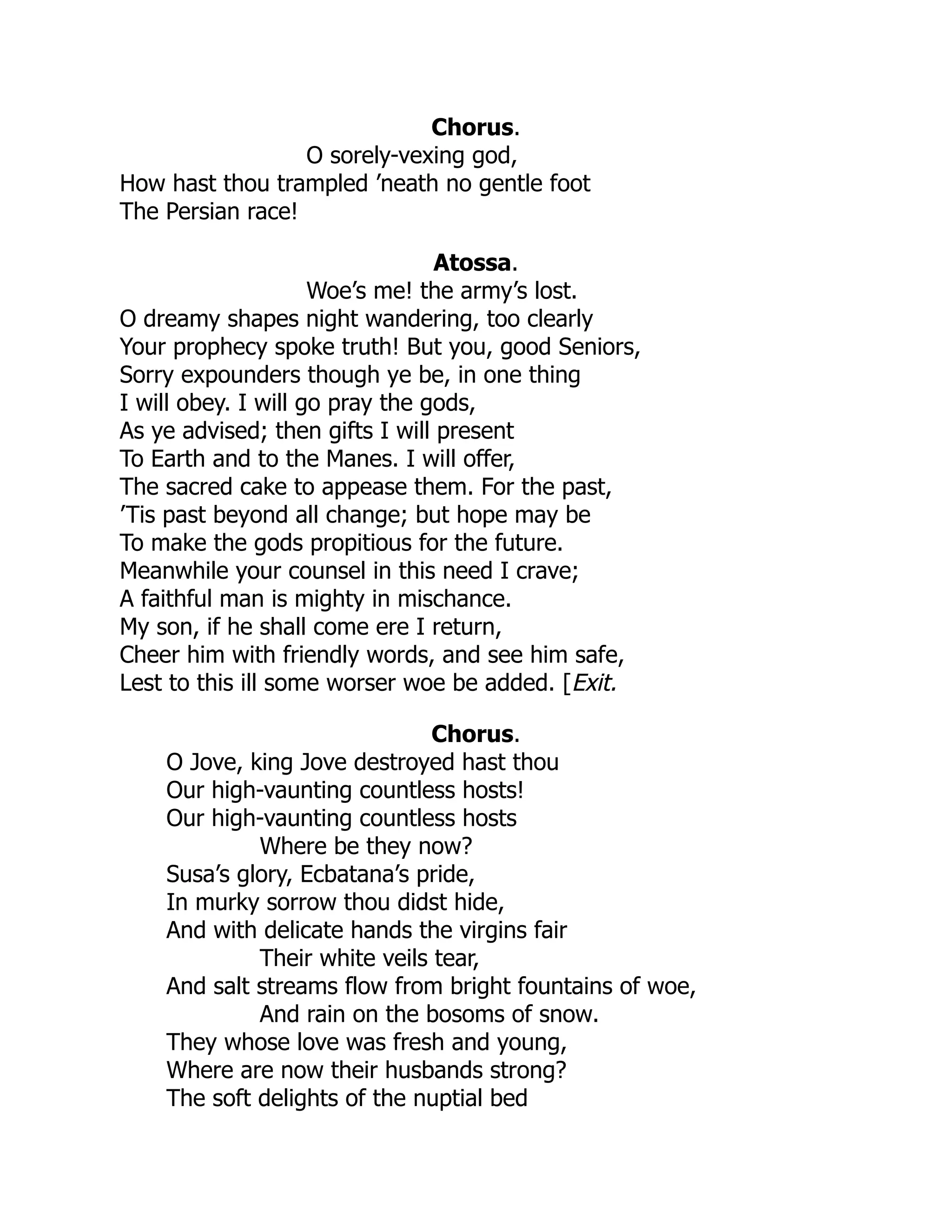
Chorus.
O sorely-vexing god,
Howhast thou trampled ’neath no gentle foot
The Persian race!
Atossa.
Woe’s me! the army’s lost.
O dreamy shapes night wandering, too clearly
Your prophecy spoke truth! But you, good Seniors,
Sorry expounders though ye be, in one thing
I will obey. I will go pray the gods,
As ye advised; then gifts I will present
To Earth and to the Manes. I will offer,
The sacred cake to appease them. For the past,
’Tis past beyond all change; but hope may be
To make the gods propitious for the future.
Meanwhile your counsel in this need I crave;
A faithful man is mighty in mischance.
My son, if he shall come ere I return,
Cheer him with friendly words, and see him safe,
Lest to this ill some worser woe be added. [Exit.
Chorus.
O Jove, king Jove destroyed hast thou
Our high-vaunting countless hosts!
Our high-vaunting countless hosts
Where be they now?
Susa’s glory, Ecbatana’s pride,
In murky sorrow thou didst hide,
And with delicate hands the virgins fair
Their white veils tear,
And salt streams flow from bright fountains of woe,
And rain on the bosoms of snow.
They whose love was fresh and young,
Where are now their husbands strong?
The soft delights of the nuptial bed
18.
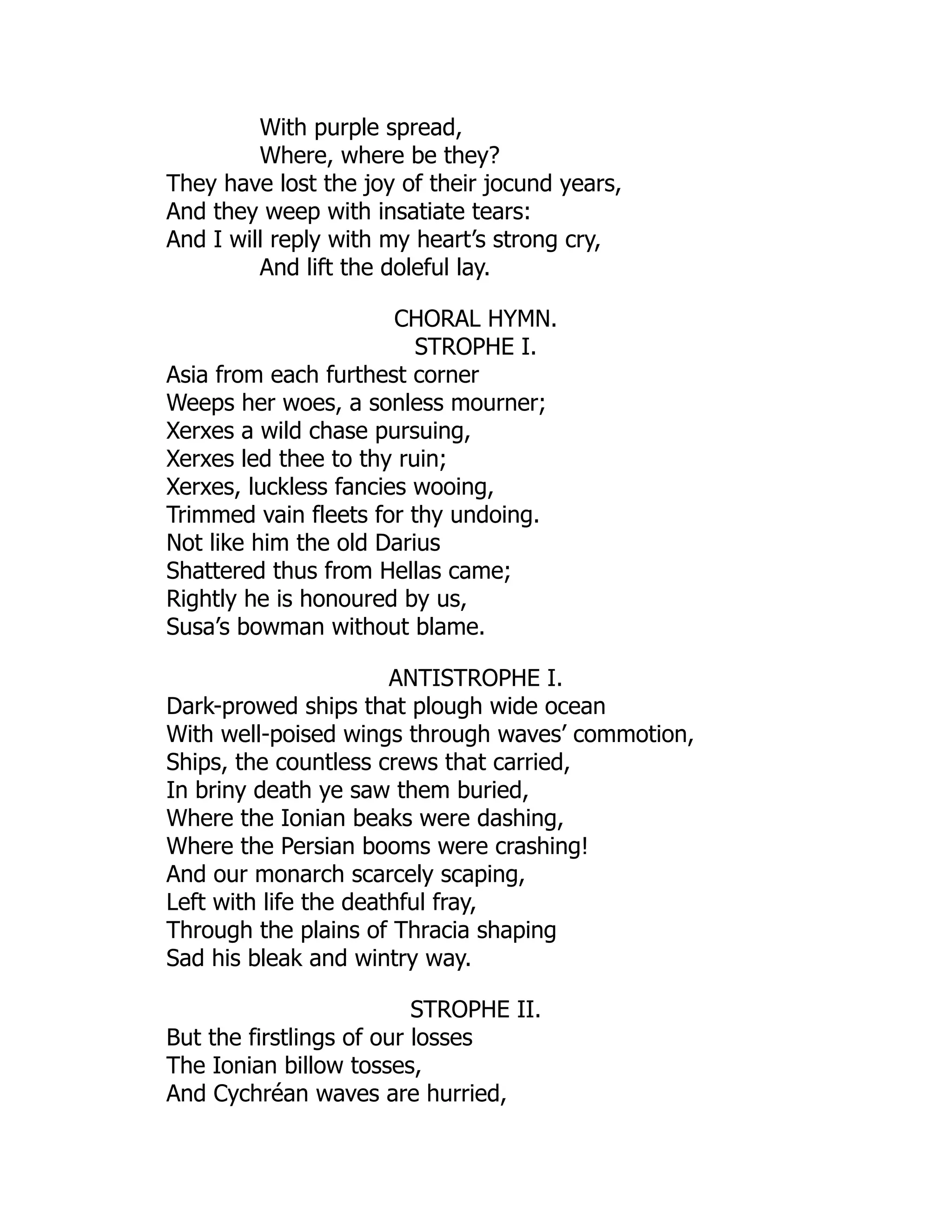
With purple spread,
Where,where be they?
They have lost the joy of their jocund years,
And they weep with insatiate tears:
And I will reply with my heart’s strong cry,
And lift the doleful lay.
CHORAL HYMN.
STROPHE I.
Asia from each furthest corner
Weeps her woes, a sonless mourner;
Xerxes a wild chase pursuing,
Xerxes led thee to thy ruin;
Xerxes, luckless fancies wooing,
Trimmed vain fleets for thy undoing.
Not like him the old Darius
Shattered thus from Hellas came;
Rightly he is honoured by us,
Susa’s bowman without blame.
ANTISTROPHE I.
Dark-prowed ships that plough wide ocean
With well-poised wings through waves’ commotion,
Ships, the countless crews that carried,
In briny death ye saw them buried,
Where the Ionian beaks were dashing,
Where the Persian booms were crashing!
And our monarch scarcely scaping,
Left with life the deathful fray,
Through the plains of Thracia shaping
Sad his bleak and wintry way.
STROPHE II.
But the firstlings of our losses
The Ionian billow tosses,
And Cychréan waves are hurried,
19.
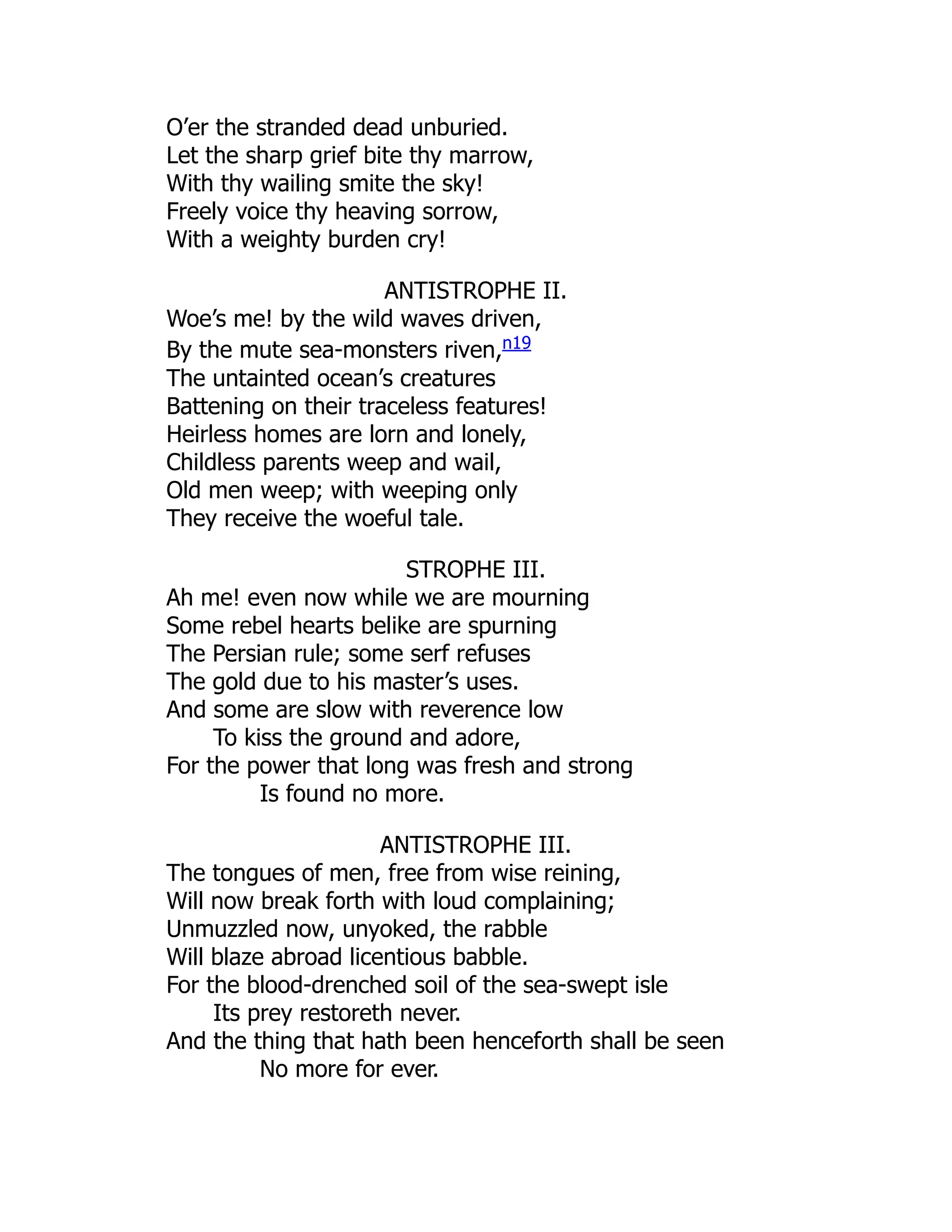
O’er the strandeddead unburied.
Let the sharp grief bite thy marrow,
With thy wailing smite the sky!
Freely voice thy heaving sorrow,
With a weighty burden cry!
ANTISTROPHE II.
Woe’s me! by the wild waves driven,
By the mute sea-monsters riven,n19
The untainted ocean’s creatures
Battening on their traceless features!
Heirless homes are lorn and lonely,
Childless parents weep and wail,
Old men weep; with weeping only
They receive the woeful tale.
STROPHE III.
Ah me! even now while we are mourning
Some rebel hearts belike are spurning
The Persian rule; some serf refuses
The gold due to his master’s uses.
And some are slow with reverence low
To kiss the ground and adore,
For the power that long was fresh and strong
Is found no more.
ANTISTROPHE III.
The tongues of men, free from wise reining,
Will now break forth with loud complaining;
Unmuzzled now, unyoked, the rabble
Will blaze abroad licentious babble.
For the blood-drenched soil of the sea-swept isle
Its prey restoreth never.
And the thing that hath been henceforth shall be seen
No more for ever.
20.
Enter Atossa.
Atossa.
Good friends,whoso hath knowledge of mishap,
Knows this, that men, when swelling ills surge o’er them,
Brood o’er the harm till all things catch the hue
Of apprehension; but, when Fortune’s stream
Runs smooth, the same, with confidence elate,
Hope the boon god will blow fair breezes ever.
Thus to my soul all things are full of fear,
The adverse gods from all sides strike my eye,
And in my ear, with ominous-ringing peal,
Fate prophesies. Such terror scares my wits.
No royal car to-day, no queenly pomp
Is mine; the broidered stole would ill become
My present mission, bringing as thou see’st,
These simple offerings to appease the Shades;
From the chaste cow, this white and healthful milk,
This clearest juice, by the flower-working bee
Distilled, this pure wave from the virgin spring,
This draught of joyaunce from the unmingled grape,
Of a wild mother born; this fragrant fruit
Of the pale green olive, ever leafy-fair,n20
And these wreathed flowers, of all-producing Earth
Fair children. But, my dear lov’d friends, I pray you,
With pious supplication, now invoke,
The god Dariusn21
while on the earth I pour
These pure libations to the honour’d dead.
Chorus.
O queen, much-revered of the Persian nation,
To the chambers below pour thou the libation,
While we shall uplift the holy hymn,
That the gods who reign in the regions dim,
May graciously hear when we pray.
O holy powers that darkly sway
21.
In the subterraneannight,
O Earth, and Hermes, and thou who art king
Of the Shades that float on bodiless wing,
Send, O send him back to the light!
For, if remedy be to our burden of woes,
He surely knows.
CHORAL HYMN.
STROPHE I.
And dost thou hear me, blessed Shade, imploring
Thy aid divine, and freely pouring
Of plaintive grief
The various flow?
I will cry out, till Persia’s godlike chief
Shall hear below.
ANTISTROPHE I.
O Earth, and ye that rule the shadowy homes,
Send from your sunless domes
The mighty god
Of Susan birth,
Than whom no greater yet was pressed by the sod
Of Persian earth.
STROPHE II.
O dear-loved man! dear tomb! and dearer dust
That in thee lies!
O Aïdóneus, thy charge release,n22
O stern Aïdóneus, and, in peace,
Let king Darius rise!
ANTISTROPHE II.
He was a king no myriads vast he lost
In wars inglorious.
Persia, a counsellor was he,
A counsellor of god to thee,
22.
He with hishosts victorious.
STROPHE III.
Come, dread lord!n23
Appear! Appear!
O’er the sepulchre’s topmost tier;
The disc of thy regal tiara showing,n24
With thy sandals saffron-glowing,
Come, good father Darius, come!
ANTISTROPHE III.
Fresh and unstaunched woes to hear,
Lord of a mighty lord appear!
For the clouds of Stygian night o’ercome us,
And all our youth are perished from us,
Come, good father Darius, come!
EPODE.
O woe! and woe! and yet again
Woe, and misery, and pain!
Why should’st thou die, and leave the land
Thou master of the mighty hand?
Why should thy son with foolish venture
Shake thy sure Empire to its centre?n25
And why must we deplore
The countless triremes on the sea-swept shore
Triremes no more?n26
The Shade of Darius rises from the Tomb.
Darius.
O faithfullest of my faithful friends, compeers
Of my fair youth, elders of Persia, say
With what sore labour labours now the state?
Pierced is the Earth, and rent with sounds of woe!
And I my spouse beholding near the tomb
Am troubled, and her offerings I receive
23.
Propitious. Ye withher this cry have raised
Of shrill lament to bring the dead from Hades,
No easy climb; the gods beneath the ground
Are readier to receive than to dismiss;f31
But I was lord above them. I am come
To meet your questioning. Ask, while yet the time
Chides not my stay. What ill weighs Persia down?
STROPHE
Chorus.
I cannot speak before thee;
I tremble to behold thee;
The ancient awe subdues me.
Darius.
Not to hold a long discourse, but swift to grant a short reply,
I have left the homes of Hades, by your waitings deeply moved.
What thou hast to ask me, therefore ask, and throw all fear aside.
ANTISTROPHE.
Chorus.
I tremble to obey thee.
Such sorrows to unfold thee,
My powerless lips refuse me.
Darius.
Since the ancient reverence holds thee, and enchains thy mind, to
thee
I will speak, the aged partner of my bed, my high-born spouse.
Cease thy weepings and thy waitings; tell me what mischance hath
hapt.
’Tis most human that mischances come to mortal man, not few
Woes by seas, not few by land, if the Fates prolong his span.
Atossa.
O all men in bliss surpassing while thine eyes beheld the day,
24.
Of all Persiansenvied, living like a god on earth, no less
Happy wert thou in thy dying, ere thou didst behold the depth
Of this present woe, Darius. Thou, in short phrase shalt hear all.
Persia’s strength is gone: the army lost: all ruined. I have said.
Darius.
How? Did pestilence smite the city, or did foul sedition rise?
Atossa.
Neither. Near far Athens routed was the Persian host.
Darius.
Who marched?
Which of my children marched the host to Athens?
Atossa.
Thy impetuous son
Xerxes. Xerxes of her children drained wide Asia’s plains.
Darius.
On foot,
Or with triremes did he risk this foolish venture?
Atossa.
With two fronts,
One by sea, by land the other.
Darius.
But so vast an army how?
Atossa.
With rare bonds of wood and iron, Helle’s streaming frith they
crossed.
Darius.
Wood and iron! Could these fetter billowy Bosphorus in his flow?
25.
Atossa.
So it was.Some god had lent him wit to plan his own perdition.
Darius.
Alas! a mighty god full surely robbed him of his sober mind.
Atossa.
And the fruit of his great folly we behold in matchless woes.
Darius.
I have heard your wailings: tell me more exact the dismal chance.
Atossa.
First the whole sea host being ruined brought like ruin on the foot.
Darius.
By the hostile spear of Hellas they have perished one and all?
Atossa.
Ay. The citadel of Susa, emptied of her children, moans.
Darius.
Alas! the faithful army!
Atossa.
All the flower of Bactria’s youth are slain.
Darius.
Woe, my hapless son! What myriads of our faithful friends he ruined!
Atossa.
Xerxes, stripped of all his glory, with a straggling few they say—
Darius.
What of him? Speak! Speak! I pray thee; is there safety, is there
hope?
Atossa.
26.
Fainly comes, withlife scarce rescued, to the bridge that links the
lands.
Darius.
And has crossed to Asia?
Atossa.
Even so, most surely, ran the news.
Darius.
Ah! on wings how swift the issue of the ancient doom hath sped!
Thee, my son, great Jove hath smitten. Long-drawn years I hoped
would roll,
Ere fulfilment of the dread prophetic burden should be known.
But when man to run is eager, swift is the god to add a spur.n27
Opened flows a fount of sorrow to ourselves and to our friends.
This my son knew not: he acted with green youth’s presumptuous
daring,
Weening Helle’s sacred current, Bosphorus’ flood divine to bind
Like a slave with hammered fetters, damming its unconquered tide,
Forcing passage against Nature for a host unwisely great.
Being mortal with immortals, with Poseidon’s power he dared
To contend fool-hardy. Did not strong distemper hold the soul
Of my hapless son? The riches stored by me with mickle care
Now, I fear, will be the booty of the swiftest-seizing hand.
Atossa.
Converse with the sons of folly taught thy eager son to err,n28
Thou wert great they said, and mighty, winning riches with thy
spear,
He, unmanly, chamber-fighting, adding nothing to thy store.
With these taunts the ears assailing of thy warlike son, bad men
Planned at length the march to Hellas—planned his ruin and our
woe.
Darius.
27.
And, doing this,my son hath done a deed
Whose heavy memory shall not die. For never
Fell such mischance on Susa’s halls, since when
Jove gave his honor that one sceptre sways
Sheep-pasturing Asia. First the Mede was King
Of the vast host of people.n29
Him his son
Succeeded, ending well things well begun;
For wisdom still was rudder to his valour.
Cyrus, the third from him, a prosperous man,
Brought peace to all his friends. The Lydian people,
The Phrygians, the Ionians, he subdued:
With him no god was wroth; for he was wise.
The fourth was Cyrus’ son: he was a leader
Of mighty hosts. Him, the fifth, Mardus followed,
A blot to Persia, and the ancestral throne;
Whom in the palace slew Artaphrenes,
Sworn, with a chosen band of faithful friends,
To give him secret riddance. Maraphis next,
And seventh Artaphrenes: myself
Then won the lot I coveted. I marched
My hosts to many wars, but never brought
Mishap like this on Susa. My son, Xerxes,
Being young hath young conceits; and takes no note
Of my advisement. Ye, who were my friends,
And fellows in the government, can witness,
We suffered loss, but we preserved the state.
Chorus.
Liege lord Darius, to what issue tend
Thy words? With greedy ears we wait to hear
How Persia henceforth may her strength repair.
Darius.
Learn from your loss, and never march your armies
Again to Hellas, were they twice as strong.
Not man alone, the land fights for the foe.
28.
Chorus.
How mean’st thouthis? how fights the land for them?
Darius.
Our mighty multitudes their barren coast
Kills by sheer famine.
Chorus.
But with a moderate host?
Darius.
A moderate host remains; but, of that few,
Few shall see Persian land.
Chorus.
How? Shall the army
Not all from Europe cross by Helle’s frith?
Darius.
Few out of many; if the prophecies,
That are in part fulfilled by what we see,
(And the gods lie not) speak the future true.
It is an empty hope that bids him leave
A select force behind him: they remain,
Where with fat streams Asopus feeds the plain,
Themselves to feed it fatter: in Bœotia
Much woe awaits them justly, the fair price
Of their own godless pride, that did not fear
When first they entered Greece, to rob the altars
Of the eternal gods, to fire their temples,
Uproot the old foundations of their shrines,
And from their basements in commingled wreck
Dash down the images. Much harm they worked,
And much shall suffer. From no shallow bed
Their woes shall flow, but like a spring gush forth,
Still fresh enforced. With such gore-streaming death
29.
The Dorian spearshall daub Plataea’s soil;
And the piled dead to generations three
Speak this mute wisdom to the thoughtful eye—
Proud thoughts were never made for mortal man;
A haughty spiritf32
blossoming bears a crop
Of woe, and reaps a harvest of despair.
Look on these things, pride’s just avengement; think
On Athens and on Hellas; fear to slight
The present bounty of the gods, lest they
Rob you of much, while greed still gapes for more.
Jove is chastiser of high-vaunting thoughts,
And heavily falls his judgment on the proud;
Therefore, my foolish son, when he shall come,
With friendly warnings teach, that he may cease
From rash imaginings that offend the gods.
And thou, his aged mother, go within,
And bring a seemly robe with thee, to meet
Thy son withal: for thou shalt see him soon,
His broidered vestments torn in many a shred,
Griefs blazonry. Thou only with kind words
Canst soothe his sorrow, deaf to all beside.
But now I go hence to the gloom below.
Ye aged friends, farewell. Though ills surround,
Yet give your souls to joyaunce, while ye may,
For riches profit nothing to the dead.
[The Shade of Darius descends.
Chorus.
O many woes, both present and to come,
On the barbaric race I weep to hear!
Atossa.
O god, how many sorrows hast thou sent
To weigh me down: but this doth gnaw my heart,
That I should live to see my kingly son
30.
Come in griefstattered weeds to Susa’s halls;
But I will go and bring a seemly robe
To meet him, if I may. I will not leave
My dear-loved son unsolaced in his woe.
[Exit into the palace.
CHORAL HYMN.
STROPHE I.
O glorious and great was the Persian land!
To the cities of Susa that owned his command
How blest was the day!
Defeat came not nigh us when good old Darius
With invincible, godlike, victorious hand
Held fortunate sway.
ANTISTROPHE I.
Sure-fenced were his cities with law, and no fear
The Persian knew when his armies were near;
They came from the fight,
Not weary and worn, and of glory shorn,
But trophied with spoils, and with costliest gear
All proudly bedight.
STROPHE II.
What cities of splendour
To him did surrender,
Though he crossed not the border that Halys prescribes
To the Median tribes!
From Susa far
Thrace feared his war,
And the islanded cities of Strymon the river
Cowered at the clang of his sounding quiver.
ANTISTROPHE II.
And cities of power,
Girt with wall and with tower,
31.
Far inland awayfrom the frith and the bay,
Rejoiced in his sway;
The proud roofs that gleam
O’er Helle’s broad stream,
That fringe Propontis’ bosomed shores,
And where the mouth of hoarse Pontus roars.
STROPHE III.
And the sea-swept isles that like sentinels stand
Breasting the ports of the Asian land,
Lesbos and Chios, with bright wine glowing,
And Samos, where groves of green olive are growing,
Myconos, Paros, and Naxos together,
Studding the main like brother with brother,
And Andros that neighbourly lies in the sea,
Tenos to thee.
ANTISTROPHE III.
And Lemnos that looks with a doubtful face
Half to Asia, half to Thrace,
And where Daedalean Icarus fell,
And Rhodes and Cnidos of him can tell,
And the cities of Cyprus great and small,
Paphos and Soli obeyed his call,
And the mother whose name the daughter borrows,
That caused our sorrows.f33
EPODE.
And the towns of the Greeks, well peopled and wealthy,
He swayed with counsels wise and healthy;
And the mustered strength of the East stood by us,
A harnessed array,
Many-mingled were they,
Made one at the call of the mighty Darius.
But now the tide hath turned indeed,
The gods have worked our woe,
32.
By the spear,and the glaive,
And the fierce-lashing wave
Low lies the might of the Mede!
Enter Xerxes.
Xerxes.
Ah wretched me! even so, even so;
Suddenly, suddenly came the blow,
And strong was the rod of the merciless god
That struck the Persian low!
Ah me! Ah me!
My knees beneath me shake, to see
These seniors reverend and grey,
Gathered to meet me on such a day.
O would that I had been fated to die
With the brave where destiny found them,
When they stained with gore the stranger’s shore,
And the darkness of death came round them!
Chorus.
O king of the goodly army, for thee
We weep, and the princes that went with thee,
Of Persian nobles the glory and crown,
Whom a god with his scythe mowed down!
For the halls of Hades, dark and wide,
Xerxes hath plenished with Persia’s pride,
And the land laments her sons.
Hundreds have trodden the path of gloom,
Thousands of Asia’s choicest bloom;
Tens of thousands, that wielded the bow,
Are gone to the chambers of death below.
Ah me! ah me! these strong-limbed men,
Where be they now that were lusty then?
All Asia mourns, O King, with thee,
And bends the feeble knee.
33.
[Here commences, withmournful Oriental music, and with
violent gesticulations, a great National Wail over the
misfortunes of the Persian people.
STROPHE I.
Xerxes.
I am the man! I am the man!
The father of shame! the fount of disgrace!
Weep me! weep me! once a king,
Now to my country an evil thing,
A curse to my race!
Chorus.
To meet thy returning,
A voice of deep mourning,
A tune evil-aboding,
A cry spirit-goading,
Of a Maryandine wailer,n30
Thou shalt hear, thou shalt hear,
O King, with many a tear!
ANTISTROPHE I.
Xerxes.
Lift ye, lift ye, the piercing cry!
Tune ye, tune ye, the doleful lay!
For the ancient god of the Persian race,
That bless’d our fathers, hath turned his face
From Xerxes away!
Chorus.
A cry spirit-piercing,
The dark tale rehearsing,
Of ocean red-heaving,
The slaughtered receiving,
The cry of a city that wails for her children
Thou shalt hear, thou shalt hear,
34.
O King, withmany a tear!
STROPHE II.
Xerxes.
Ares was strong on the side of the foe,
The Ionian foe!
Bristling with ships he worked our woe.
His scythe did mow,
The sea, the land,
And laid us low
On the dismal strand.
Leader of Chorus.n31
Lift, O lift, the earnest cry!
Ask, and he will make reply.
Chorus.
Where is all thy troop of friends,
That marched with thee away, away?
Where is the might of Pharandaces,
Susas and Pelagon, where be they?
Where is Datamas, where Agdabatus,
Psammis, and Susiscánes, say?
All that marched from Ecbatana’s halls,
Where be they? where be they?
ANTISTROPHE II.
Xerxes.
From a Tyrian ship they leapt on shore,
To leap no more.
On the shore of Salamis drenched in gore,
The stony shore,
They made their bed,
To rise no more,
The dead! the dead!
35.
Leader of Chorus.
Lift,O lift the earnest cry,
Ask, and he will make reply!
Chorus.
Ah! say, where is Pharnúchus, where?
Cariomardus, where is he?
Where the chief Seualces, where
Aelæus of noble degree?
Memphis, Tharybis, and Masistris,
Hystæchmas, and Artembares, say?
All the brave that journeyed to Hellas,
Where be they? where be they?
STROPHE III.
Xerxes.
Ah me! ah me!
They looked on Ogygian Athens,f34
and straight
With one fell swoop down came the Fate,
And we left them there with gasp and groan,
On the shore of the stranger strewn.
Chorus.
Didst thou leave him there to lie,
Batanóchus’ son, thy faithful eye?f35
Him didst thou leave on Salamis’ shores
Who counted thy thousands by tens and by scores
The strong Oebáres and Parthus, were they
Left to be lashed by the hostile spray?
The Persian princes—woe! woe! woe!
Hast thou left to the flood and the foe?
ANTISTROPHE III.
Xerxes.
Ah me! ah me!
Balefully, balefully with sharp sorrow,
36.
Thou dost piercemy inmost marrow;
My heart, my heart cries out to hear thee
Name the lost friends I loved so dearly!
Chorus.
One other name compels my grief,
Xanthus, of Mardian men the chief;
Ancháres the warlike, and lords of the steed
Diaexis, Arsáces that ride with speed?
Lythimnas, Kygdabatas, where be they,
And Tolmos eager for the fray?
Not, I wis, where they wont to be,
Behind the tented car with thee.
STROPHE IV.
Xerxes.
They are gone, the generals, gone for ever!
Chorus.
Lost, and to be heard of never!
Xerxes.
Woe worth the day!
Chorus.
Ye gods! on a public place of woe
Ye set us high;
And Até on the sorrowful show
Doth feast her eye.
ANTISTROPHE IV.
Xerxes.
We are stricken, beyond redemption stricken!
Chorus.
Stricken of Heaven! with vengeance stricken!
37.
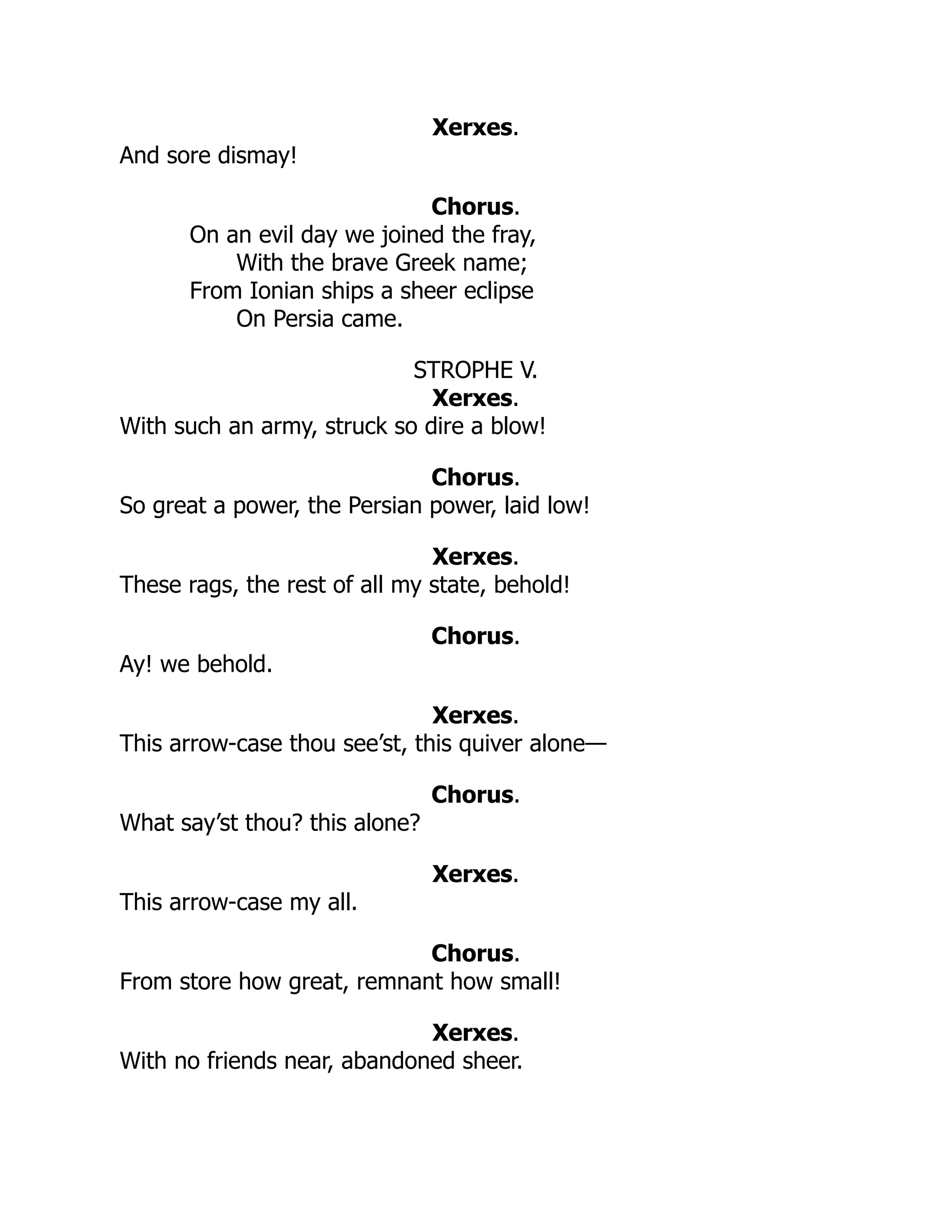
Xerxes.
And sore dismay!
Chorus.
Onan evil day we joined the fray,
With the brave Greek name;
From Ionian ships a sheer eclipse
On Persia came.
STROPHE V.
Xerxes.
With such an army, struck so dire a blow!
Chorus.
So great a power, the Persian power, laid low!
Xerxes.
These rags, the rest of all my state, behold!
Chorus.
Ay! we behold.
Xerxes.
This arrow-case thou see’st, this quiver alone—
Chorus.
What say’st thou? this alone?
Xerxes.
This arrow-case my all.
Chorus.
From store how great, remnant how small!
Xerxes.
With no friends near, abandoned sheer.
38.
Chorus.
The Ionian peopleshrinks not from the spear.
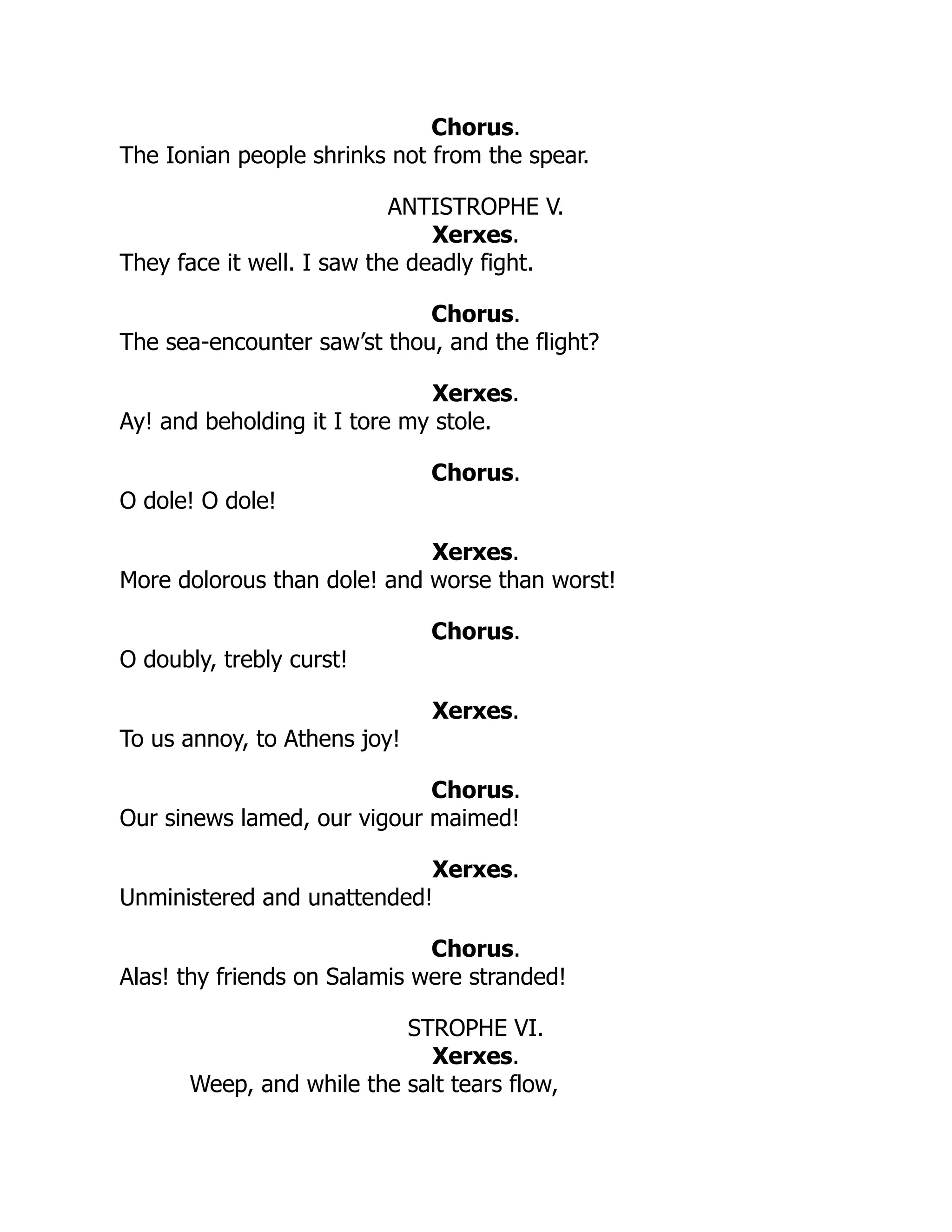
ANTISTROPHE V.
Xerxes.
They face it well. I saw the deadly fight.
Chorus.
The sea-encounter saw’st thou, and the flight?
Xerxes.
Ay! and beholding it I tore my stole.
Chorus.
O dole! O dole!
Xerxes.
More dolorous than dole! and worse than worst!
Chorus.
O doubly, trebly curst!
Xerxes.
To us annoy, to Athens joy!
Chorus.
Our sinews lamed, our vigour maimed!
Xerxes.
Unministered and unattended!
Chorus.
Alas! thy friends on Salamis were stranded!
STROPHE VI.
Xerxes.
Weep, and while the salt tears flow,
39.
To the palacelet us go!
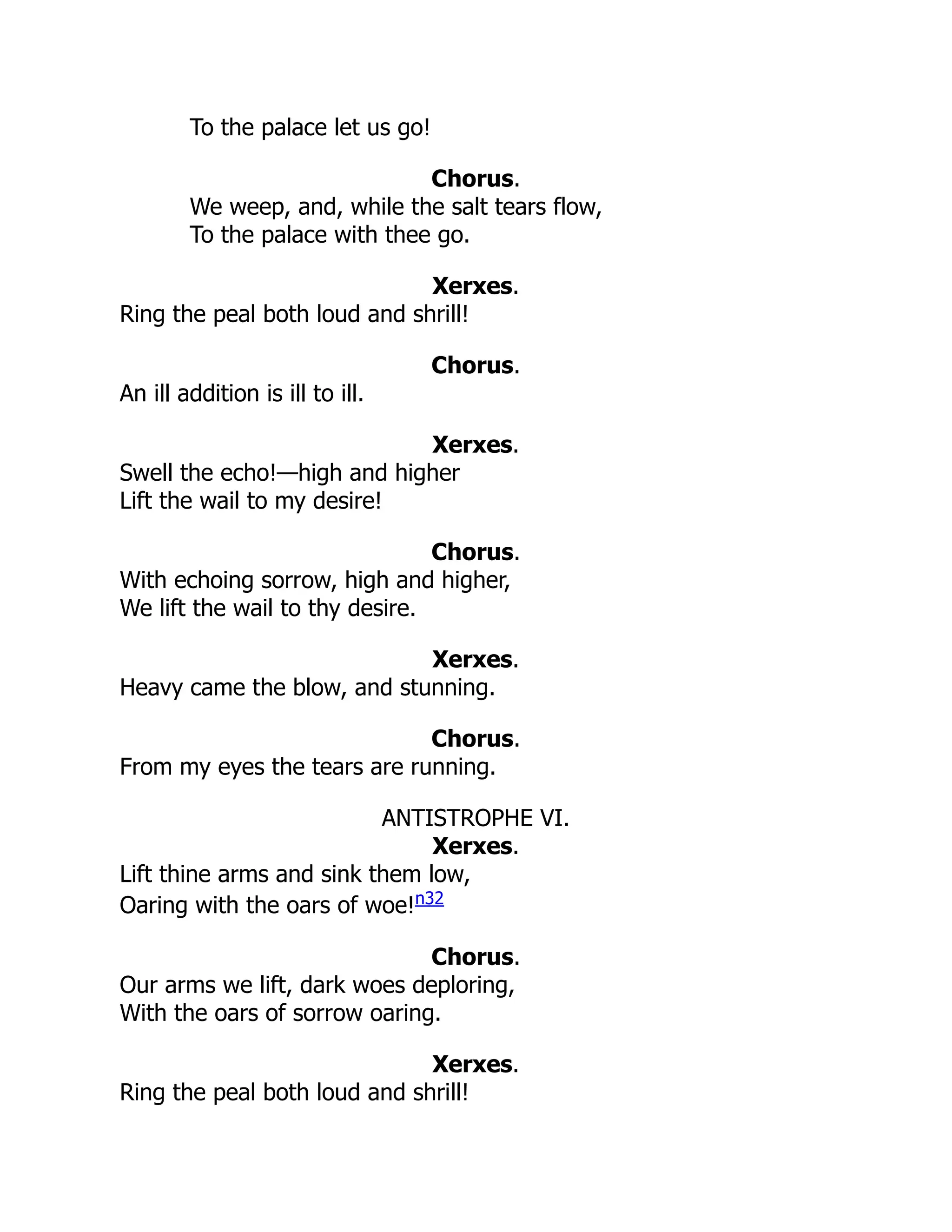
Chorus.
We weep, and, while the salt tears flow,
To the palace with thee go.
Xerxes.
Ring the peal both loud and shrill!
Chorus.
An ill addition is ill to ill.
Xerxes.
Swell the echo!—high and higher
Lift the wail to my desire!
Chorus.
With echoing sorrow, high and higher,
We lift the wail to thy desire.
Xerxes.
Heavy came the blow, and stunning.
Chorus.
From my eyes the tears are running.
ANTISTROPHE VI.
Xerxes.
Lift thine arms and sink them low,
Oaring with the oars of woe!n32
Chorus.
Our arms we lift, dark woes deploring,
With the oars of sorrow oaring.
Xerxes.
Ring the peal both loud and shrill!
40.
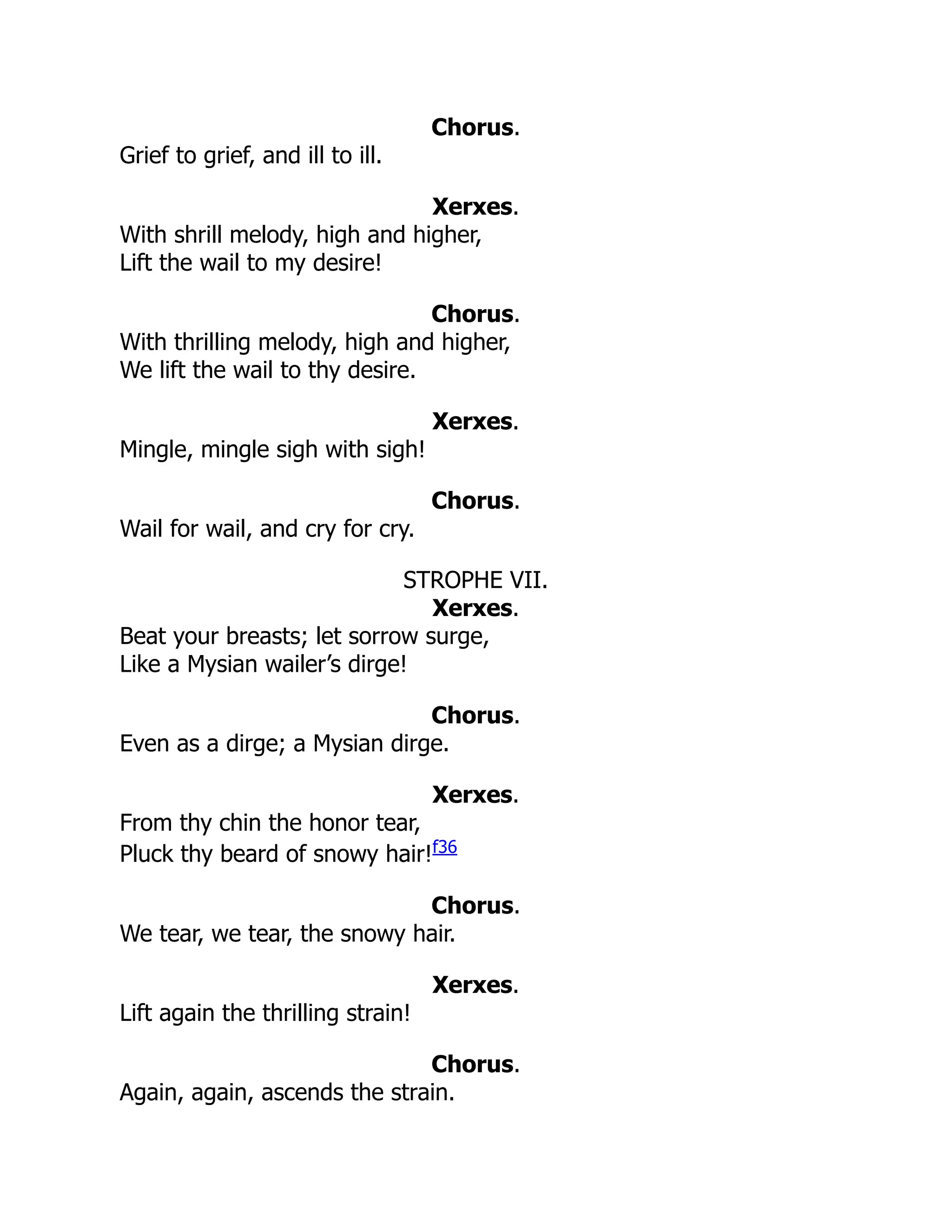
Chorus.
Grief to grief,and ill to ill.
Xerxes.
With shrill melody, high and higher,
Lift the wail to my desire!
Chorus.
With thrilling melody, high and higher,
We lift the wail to thy desire.
Xerxes.
Mingle, mingle sigh with sigh!
Chorus.
Wail for wail, and cry for cry.
STROPHE VII.
Xerxes.
Beat your breasts; let sorrow surge,
Like a Mysian wailer’s dirge!
Chorus.
Even as a dirge; a Mysian dirge.
Xerxes.
From thy chin the honor tear,
Pluck thy beard of snowy hair!f36
Chorus.
We tear, we tear, the snowy hair.
Xerxes.
Lift again the thrilling strain!
Chorus.
Again, again, ascends the strain.
41.
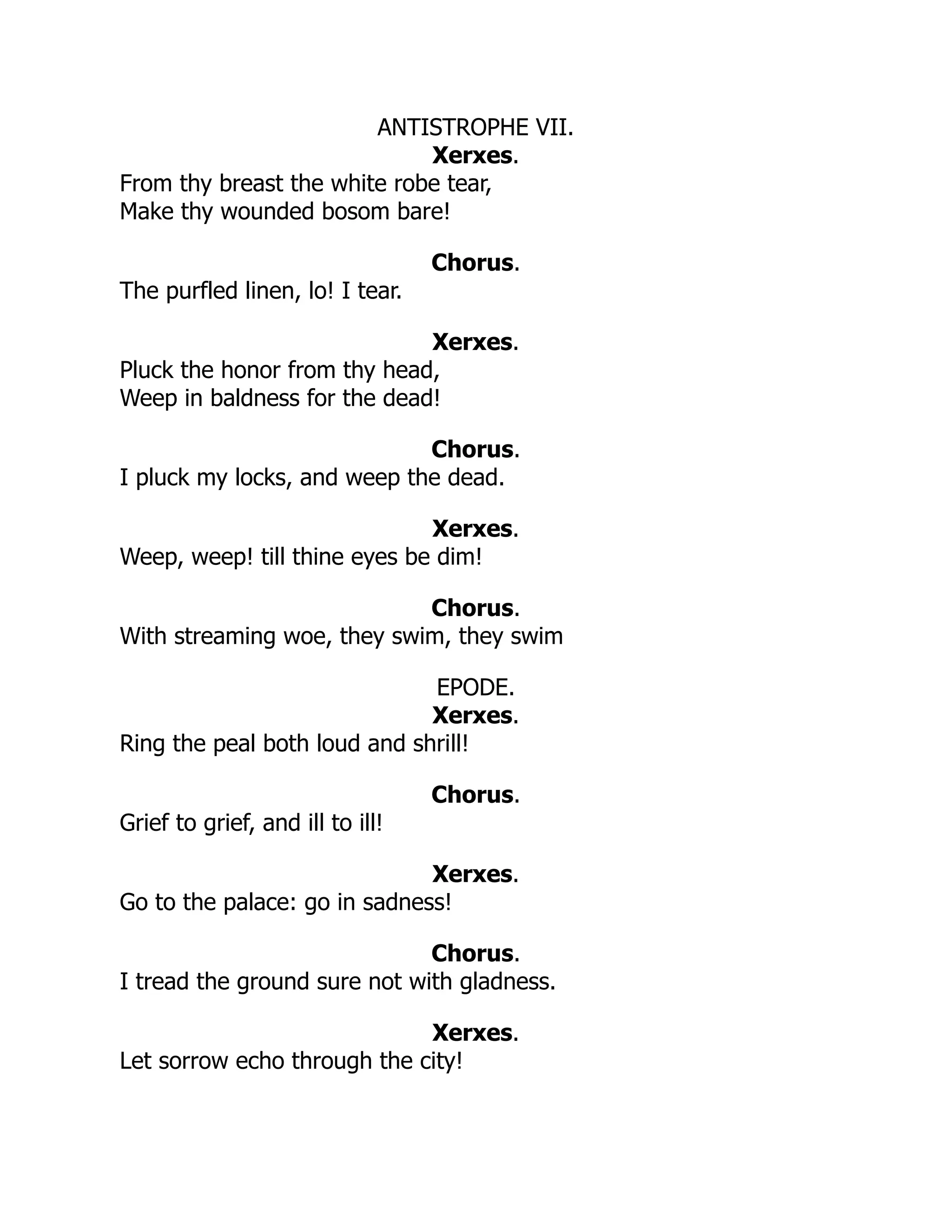
ANTISTROPHE VII.
Xerxes.
From thybreast the white robe tear,
Make thy wounded bosom bare!
Chorus.
The purfled linen, lo! I tear.
Xerxes.
Pluck the honor from thy head,
Weep in baldness for the dead!
Chorus.
I pluck my locks, and weep the dead.
Xerxes.
Weep, weep! till thine eyes be dim!
Chorus.
With streaming woe, they swim, they swim
EPODE.
Xerxes.
Ring the peal both loud and shrill!
Chorus.
Grief to grief, and ill to ill!
Xerxes.
Go to the palace: go in sadness!
Chorus.
I tread the ground sure not with gladness.
Xerxes.
Let sorrow echo through the city!
42.
Chorus.
From street tostreet the wailing ditty.
Xerxes.
Sons of Susa, with delicate feet,n33
Gently, gently tread the street!
Chorus.
Gently we tread the grief-sown soil.
Xerxes.
The ships, the ships by Ajax isle,
The triremes worked our ruin sheer.
Chorus.
Go. Thy convoy be a tear.
[Exeunt.
[The End]
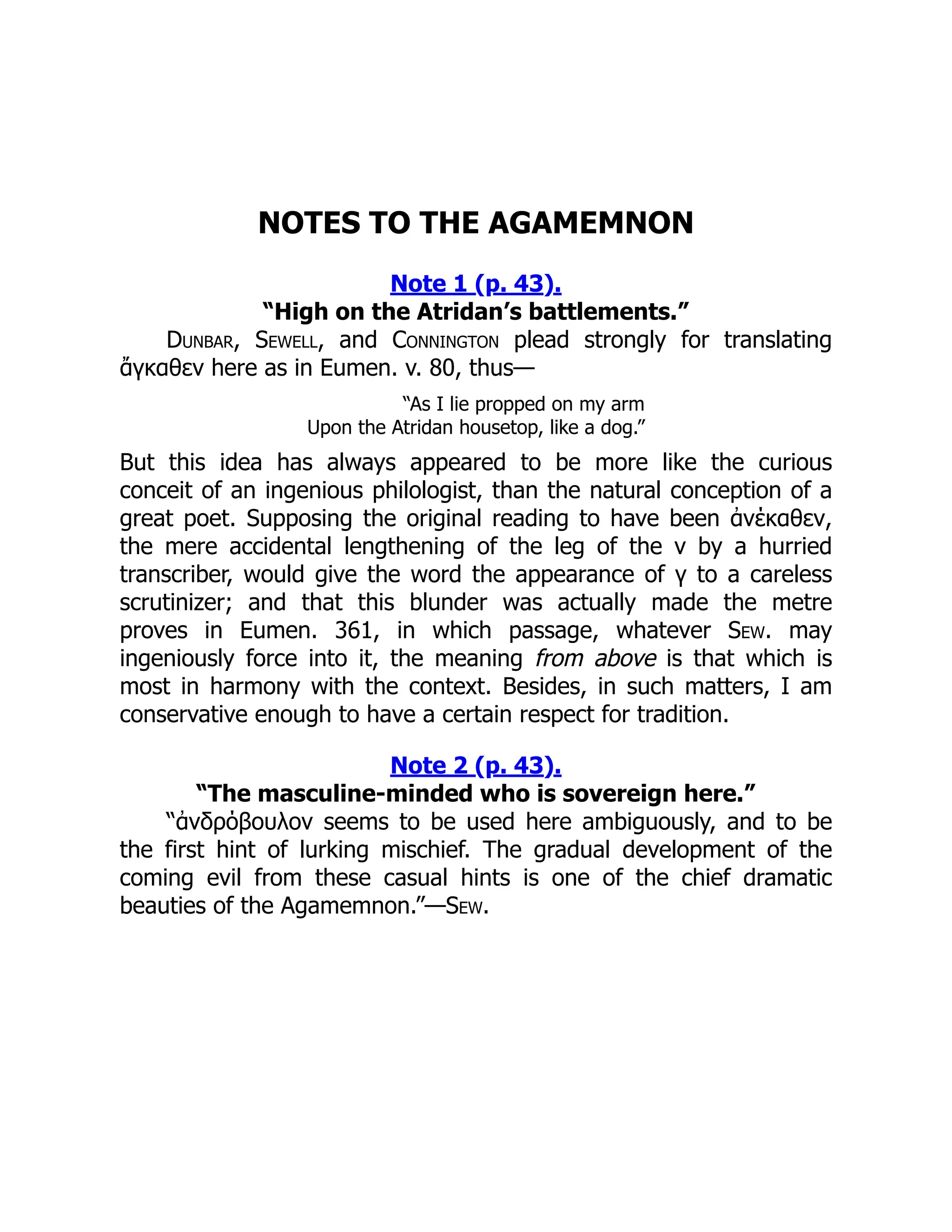
NOTES TO THEAGAMEMNON
Note 1 (p. 43).
“High on the Atridan’s battlements.”
Dunbar, Sewell, and Connington plead strongly for translating
ἄγκαθεν here as in Eumen. v. 80, thus—
“As I lie propped on my arm
Upon the Atridan housetop, like a dog.”
But this idea has always appeared to be more like the curious
conceit of an ingenious philologist, than the natural conception of a
great poet. Supposing the original reading to have been ἀνέκαθεν,
the mere accidental lengthening of the leg of the ν by a hurried
transcriber, would give the word the appearance of γ to a careless
scrutinizer; and that this blunder was actually made the metre
proves in Eumen. 361, in which passage, whatever Sew. may
ingeniously force into it, the meaning from above is that which is
most in harmony with the context. Besides, in such matters, I am
conservative enough to have a certain respect for tradition.
Note 2 (p. 43).
“The masculine-minded who is sovereign here.”
“ἀνδρόβουλον seems to be used here ambiguously, and to be
the first hint of lurking mischief. The gradual development of the
coming evil from these casual hints is one of the chief dramatic
beauties of the Agamemnon.”—Sew.
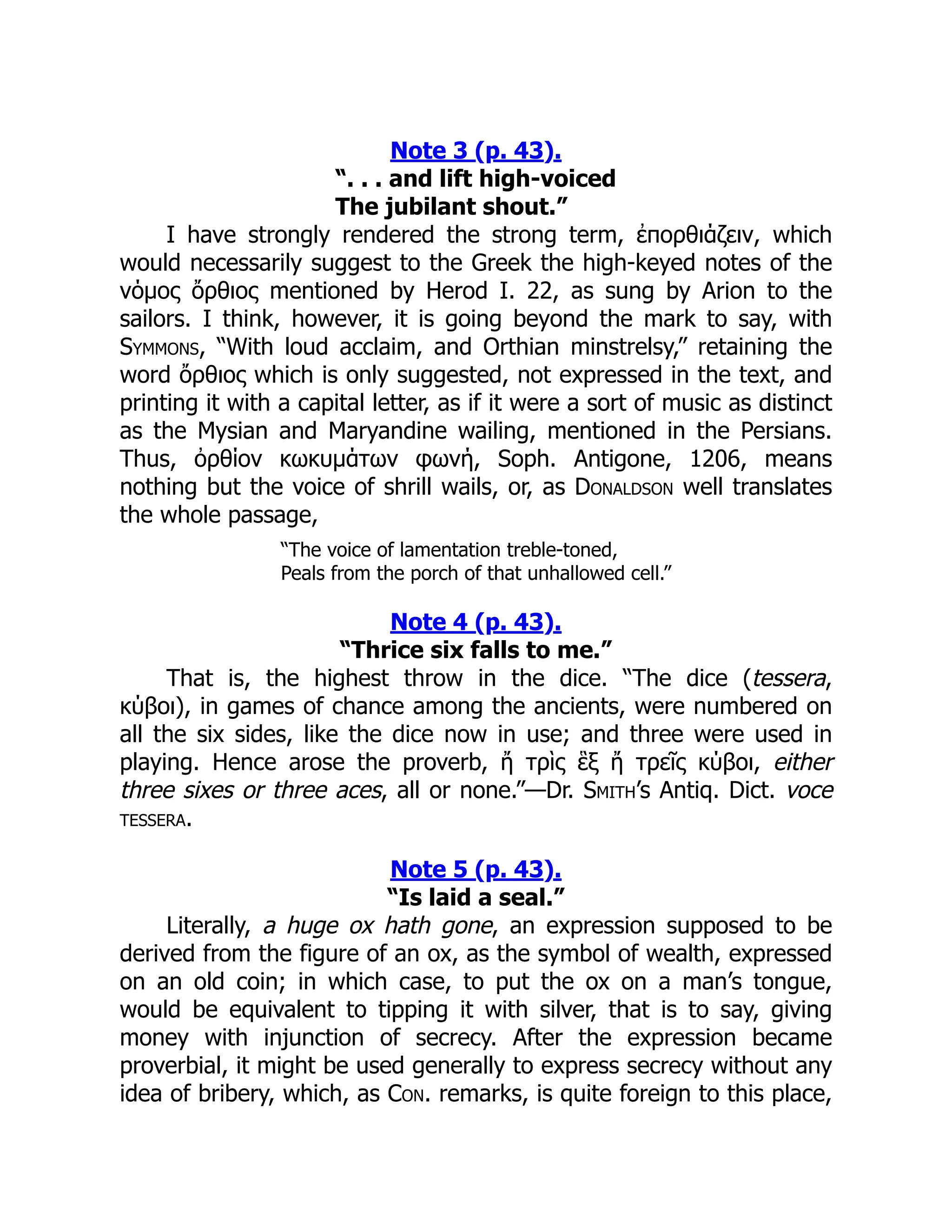
45.
Note 3 (p.43).
“. . . and lift high-voiced
The jubilant shout.”
I have strongly rendered the strong term, ἐπορθιάζειν, which
would necessarily suggest to the Greek the high-keyed notes of the
νόμος ὄρθιος mentioned by Herod I. 22, as sung by Arion to the
sailors. I think, however, it is going beyond the mark to say, with
Symmons, “With loud acclaim, and Orthian minstrelsy,” retaining the
word ὄρθιος which is only suggested, not expressed in the text, and
printing it with a capital letter, as if it were a sort of music as distinct
as the Mysian and Maryandine wailing, mentioned in the Persians.
Thus, ὀρθίον κωκυμάτων φωνή, Soph. Antigone, 1206, means
nothing but the voice of shrill wails, or, as Donaldson well translates
the whole passage,
“The voice of lamentation treble-toned,
Peals from the porch of that unhallowed cell.”
Note 4 (p. 43).
“Thrice six falls to me.”
That is, the highest throw in the dice. “The dice (tessera,
κύβοι), in games of chance among the ancients, were numbered on
all the six sides, like the dice now in use; and three were used in
playing. Hence arose the proverb, ἤ τρὶς ἓξ ἤ τρεῖς κύβοι, either
three sixes or three aces, all or none.”—Dr. Smith’s Antiq. Dict. voce
tessera.
Note 5 (p. 43).
“Is laid a seal.”
Literally, a huge ox hath gone, an expression supposed to be
derived from the figure of an ox, as the symbol of wealth, expressed
on an old coin; in which case, to put the ox on a man’s tongue,
would be equivalent to tipping it with silver, that is to say, giving
money with injunction of secrecy. After the expression became
proverbial, it might be used generally to express secrecy without any
idea of bribery, which, as Con. remarks, is quite foreign to this place,
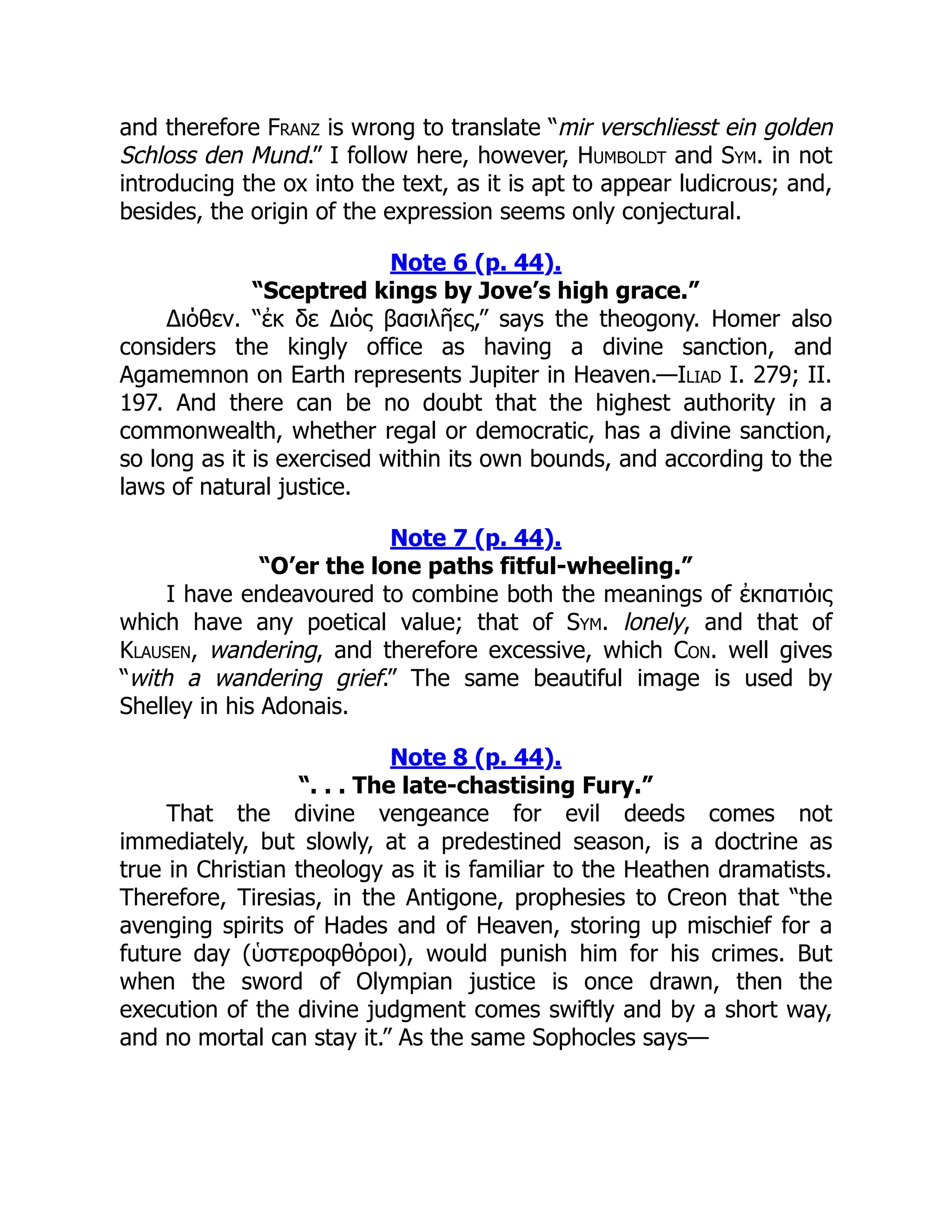
46.
and therefore Franzis wrong to translate “mir verschliesst ein golden
Schloss den Mund.” I follow here, however, Humboldt and Sym. in not
introducing the ox into the text, as it is apt to appear ludicrous; and,
besides, the origin of the expression seems only conjectural.
Note 6 (p. 44).
“Sceptred kings by Jove’s high grace.”
Διόθεν. “ἐκ δε Διός βασιλῆες,” says the theogony. Homer also
considers the kingly office as having a divine sanction, and
Agamemnon on Earth represents Jupiter in Heaven.—Iliad I. 279; II.
197. And there can be no doubt that the highest authority in a
commonwealth, whether regal or democratic, has a divine sanction,
so long as it is exercised within its own bounds, and according to the
laws of natural justice.
Note 7 (p. 44).
“O’er the lone paths fitful-wheeling.”
I have endeavoured to combine both the meanings of ἐκπατιόις
which have any poetical value; that of Sym. lonely, and that of
Klausen, wandering, and therefore excessive, which Con. well gives
“with a wandering grief.” The same beautiful image is used by
Shelley in his Adonais.
Note 8 (p. 44).
“. . . The late-chastising Fury.”
That the divine vengeance for evil deeds comes not
immediately, but slowly, at a predestined season, is a doctrine as
true in Christian theology as it is familiar to the Heathen dramatists.
Therefore, Tiresias, in the Antigone, prophesies to Creon that “the
avenging spirits of Hades and of Heaven, storing up mischief for a
future day (ὑστεροφθόροι), would punish him for his crimes. But
when the sword of Olympian justice is once drawn, then the
execution of the divine judgment comes swiftly and by a short way,
and no mortal can stay it.” As the same Sophocles says—
47.
Welcome to ourwebsite – the perfect destination for book lovers and
knowledge seekers. We believe that every book holds a new world,
offering opportunities for learning, discovery, and personal growth.
That’s why we are dedicated to bringing you a diverse collection of
books, ranging from classic literature and specialized publications to
self-development guides and children's books.
More than just a book-buying platform, we strive to be a bridge
connecting you with timeless cultural and intellectual values. With an
elegant, user-friendly interface and a smart search system, you can
quickly find the books that best suit your interests. Additionally,
our special promotions and home delivery services help you save time
and fully enjoy the joy of reading.
Join us on a journey of knowledge exploration, passion nurturing, and
personal growth every day!
testbankdeal.com







![Chorus.
From street to street the wailing ditty.
Xerxes.
Sons of Susa, with delicate feet,n33
Gently, gently tread the street!
Chorus.
Gently we tread the grief-sown soil.
Xerxes.
The ships, the ships by Ajax isle,
The triremes worked our ruin sheer.
Chorus.
Go. Thy convoy be a tear.
[Exeunt.
[The End]](https://image.slidesharecdn.com/17880-250319000831-472e685f/75/Modern-Competitive-Strategy-4th-Edition-Walker-Solutions-Manual-42-2048.jpg)