Managing change in organizations 4th ed Edition C A Carnall
Managing change in organizations 4th ed Edition C A Carnall
Managing change in organizations 4th ed Edition C A Carnall
Managing change in organizations 4th ed Edition C A Carnall
Managing change in organizations 4th ed Edition C A Carnall
1.
Visit https://ebookultra.com todownload the full version and
explore more ebooks or textbooks
Managing change in organizations 4th ed Edition C
A Carnall
_____ Click the link below to download _____
https://ebookultra.com/download/managing-change-in-
organizations-4th-ed-edition-c-a-carnall/
Explore and download more ebooks or textbooks at ebookultra.com
2.
Here are somerecommended products that we believe you will be
interested in. You can click the link to download.
Understanding and managing public organizations 4th ed
Edition Hal G. Rainey
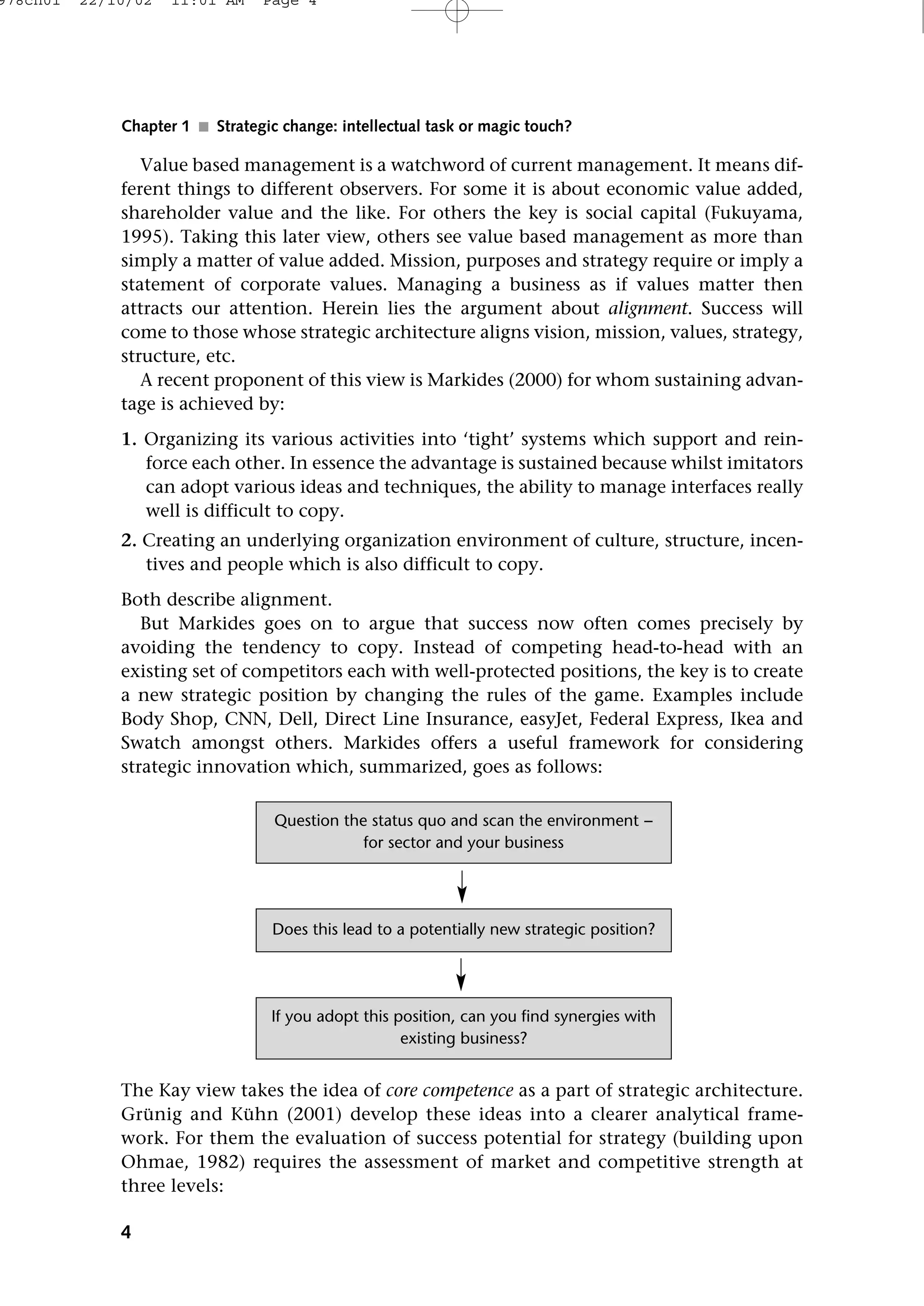
https://ebookultra.com/download/understanding-and-managing-public-
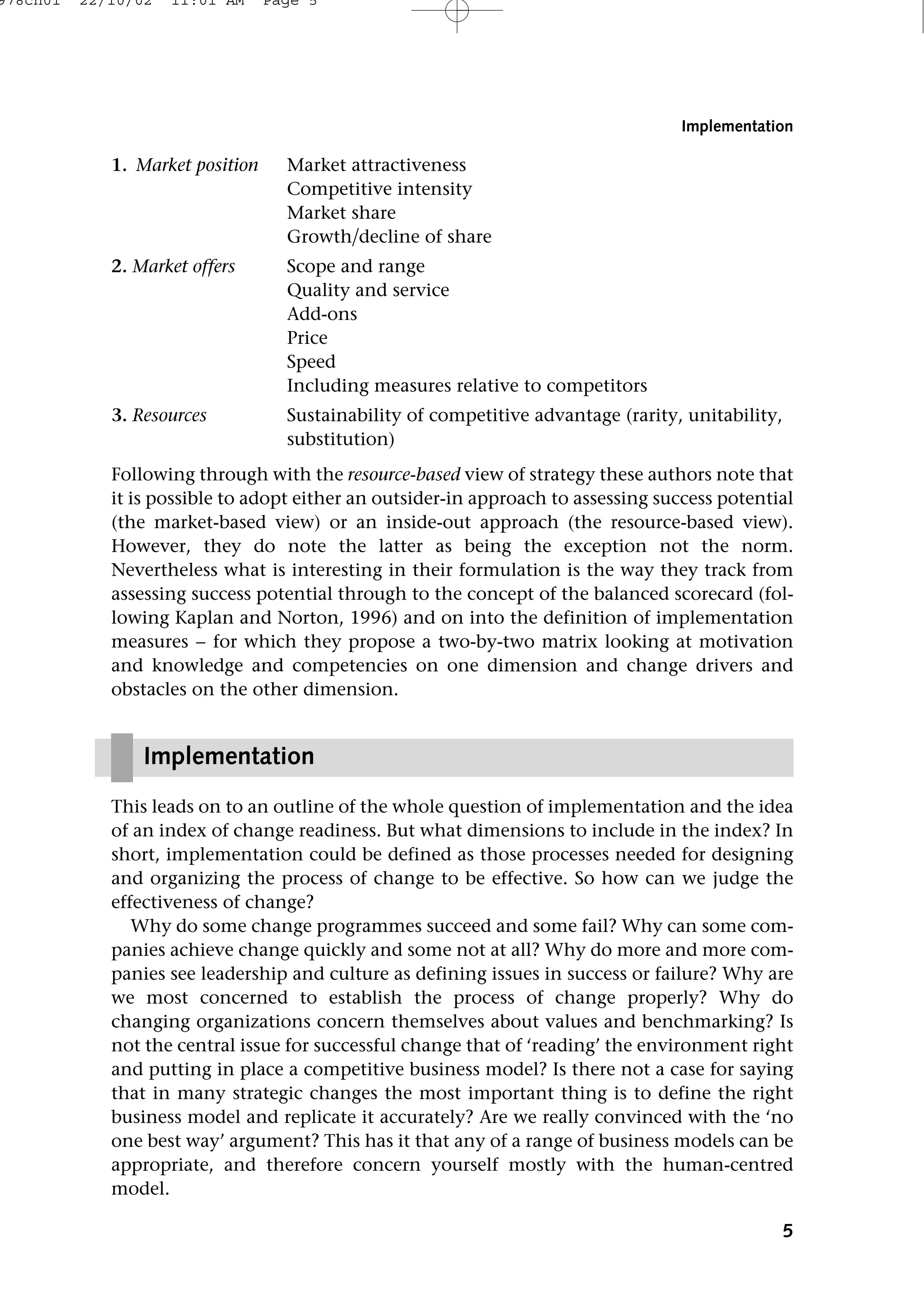
organizations-4th-ed-edition-hal-g-rainey/
Managing nonprofit organizations 1st Edition Bielefeld
https://ebookultra.com/download/managing-nonprofit-organizations-1st-
edition-bielefeld/
Managing in a Time of Great Change 1st Edition Peter
Ferdinand Drucker
https://ebookultra.com/download/managing-in-a-time-of-great-
change-1st-edition-peter-ferdinand-drucker/
Climate Change In A Nutshell 4th Edition Blair Henry
https://ebookultra.com/download/climate-change-in-a-nutshell-4th-
edition-blair-henry/
3.
C 4 0in a Nutshell the Definitive Reference 4th ed
Edition Joseph Albahari
https://ebookultra.com/download/c-4-0-in-a-nutshell-the-definitive-
reference-4th-ed-edition-joseph-albahari/
Complexity Organizations and Change Elizabeth M. Mcmillan
https://ebookultra.com/download/complexity-organizations-and-change-
elizabeth-m-mcmillan/
Managing Very Large It Projects in Businesses and
Organizations 1st Edition Matthew Guah
https://ebookultra.com/download/managing-very-large-it-projects-in-
businesses-and-organizations-1st-edition-matthew-guah/
Human Challenge The Managing Yourself and Others in
Organizations 7th Edition Mary Tucker
https://ebookultra.com/download/human-challenge-the-managing-yourself-
and-others-in-organizations-7th-edition-mary-tucker/
Managing Change and People in Libraries 1st Edition Tinker
Massey (Auth.)
https://ebookultra.com/download/managing-change-and-people-in-
libraries-1st-edition-tinker-massey-auth/
5.
Managing change inorganizations 4th ed Edition C A
Carnall Digital Instant Download
Author(s): C ACarnall
ISBN(s): 9786610600366, 6610600368
Edition: 4th ed
File Details: PDF, 1.57 MB
Year: 2003
Language: english
We work withleading authors to develop the
strongest educational materials in management,
bringing cutting-edge thinking and best learning
practice to a global market.
Under a range of well-known imprints, including
Financial Times Prentice Hall, we craft high quality
print and electronic publications which help readers
to understand and apply their content, whether
studying or at work.
To find out more about the complete range of our
publishing please visit us on the World Wide Web at:
www.pearsoneduc.com
0 0
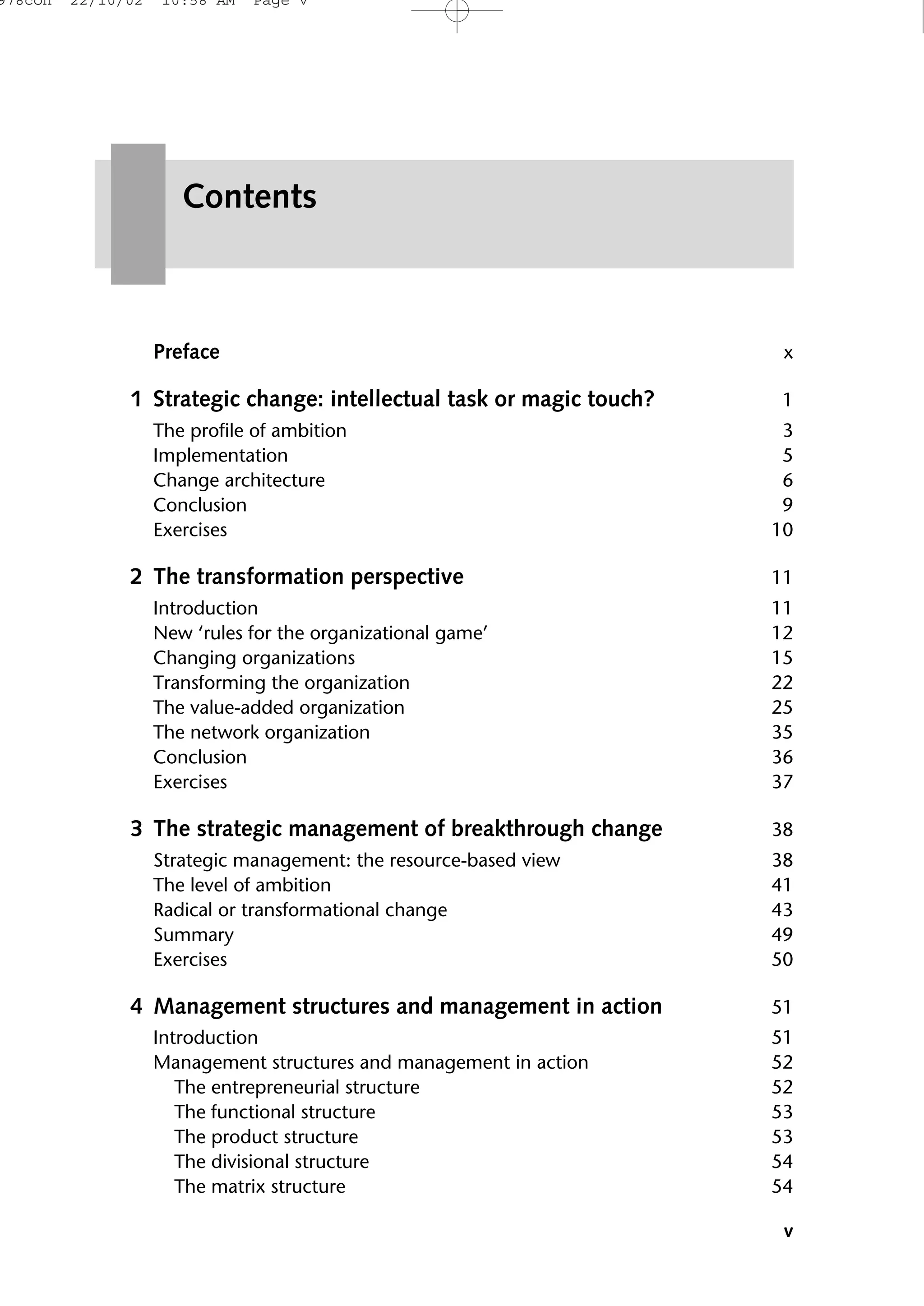
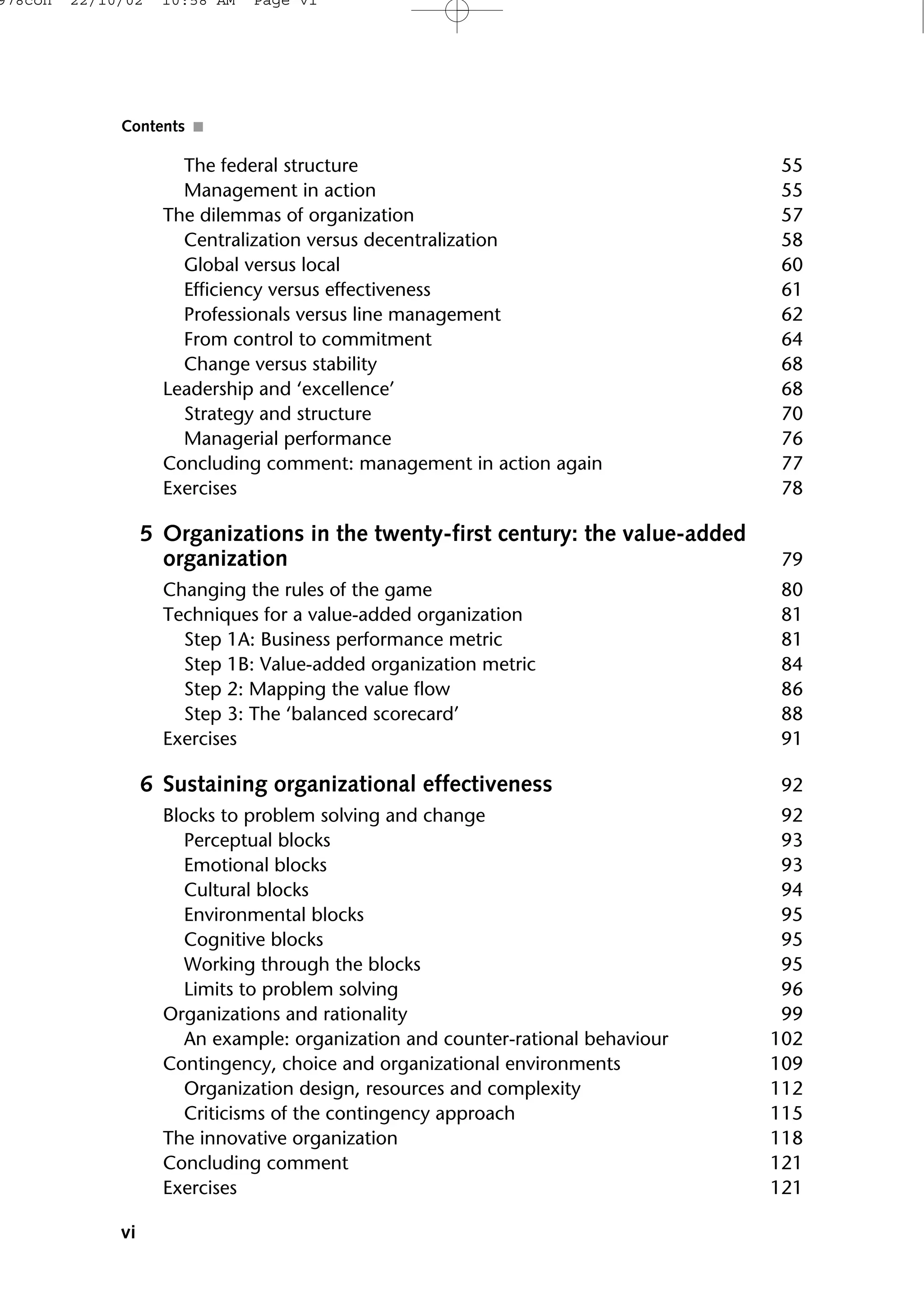
Preface x
1 Strategicchange: intellectual task or magic touch? 1
The profile of ambition 3
Implementation 5
Change architecture 6
Conclusion 9
Exercises 10
2 The transformation perspective 11
Introduction 11
New ‘rules for the organizational game’ 12
Changing organizations 15
Transforming the organization 22
The value-added organization 25
The network organization 35
Conclusion 36
Exercises 37
3 The strategic management of breakthrough change 38
Strategic management: the resource-based view 38
The level of ambition 41
Radical or transformational change 43
Summary 49
Exercises 50
4 Management structures and management in action 51
Introduction 51
Management structures and management in action 52
The entrepreneurial structure 52
The functional structure 53
The product structure 53
The divisional structure 54
The matrix structure 54
v
Contents
978con 22/10/02 10:58 AM Page v
11.
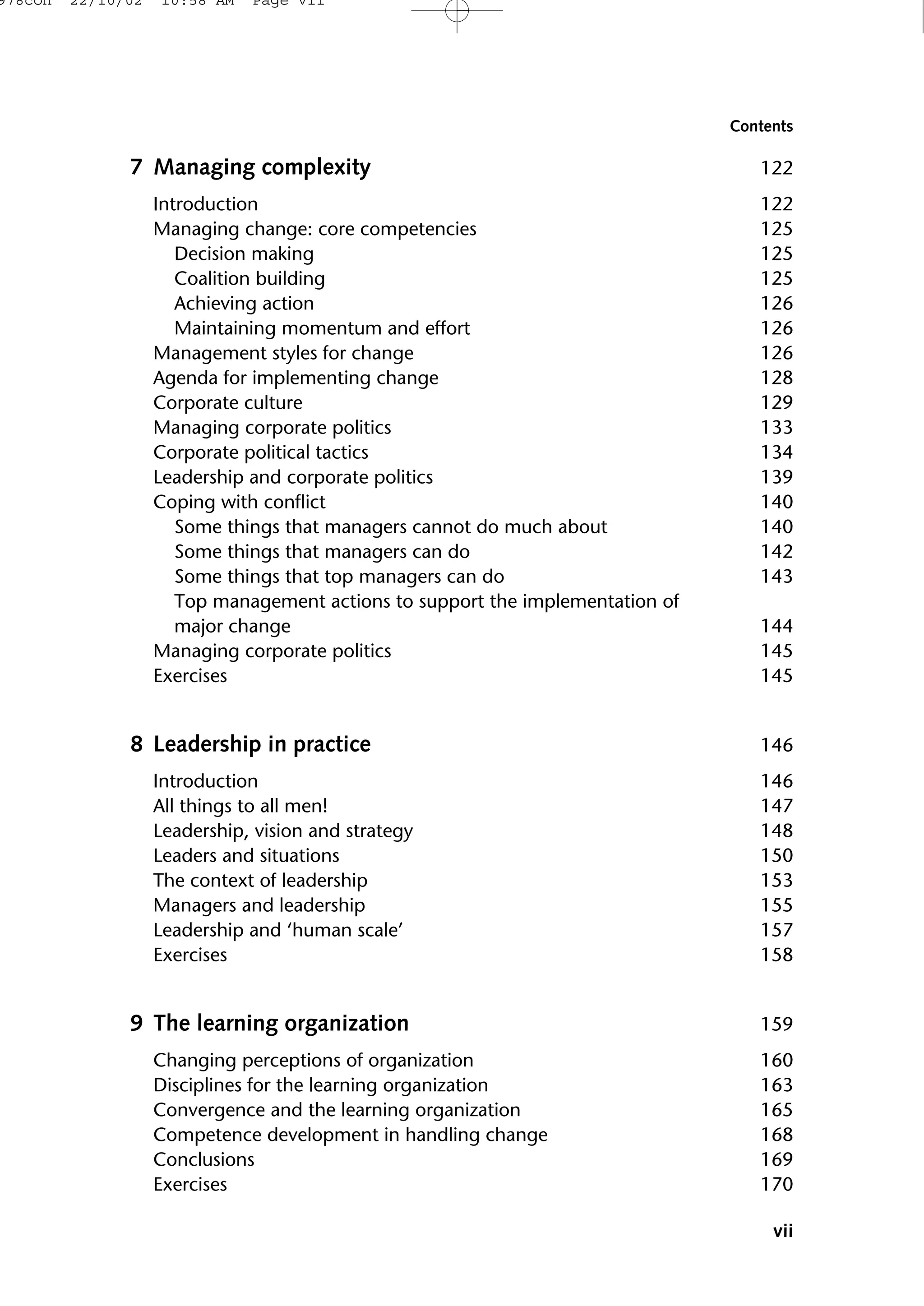
The federal structure55
Management in action 55
The dilemmas of organization 57
Centralization versus decentralization 58
Global versus local 60
Efficiency versus effectiveness 61
Professionals versus line management 62
From control to commitment 64
Change versus stability 68
Leadership and ‘excellence’ 68
Strategy and structure 70
Managerial performance 76
Concluding comment: management in action again 77
Exercises 78
5 Organizations in the twenty-first century: the value-added
organization 79
Changing the rules of the game 80
Techniques for a value-added organization 81
Step 1A: Business performance metric 81
Step 1B: Value-added organization metric 84
Step 2: Mapping the value flow 86
Step 3: The ‘balanced scorecard’ 88
Exercises 91
6 Sustaining organizational effectiveness 92
Blocks to problem solving and change 92
Perceptual blocks 93
Emotional blocks 93
Cultural blocks 94
Environmental blocks 95
Cognitive blocks 95
Working through the blocks 95
Limits to problem solving 96
Organizations and rationality 99
An example: organization and counter-rational behaviour 102
Contingency, choice and organizational environments 109
Organization design, resources and complexity 112
Criticisms of the contingency approach 115
The innovative organization 118
Concluding comment 121
Exercises 121
vi
Contents ■
978con 22/10/02 10:58 AM Page vi
12.
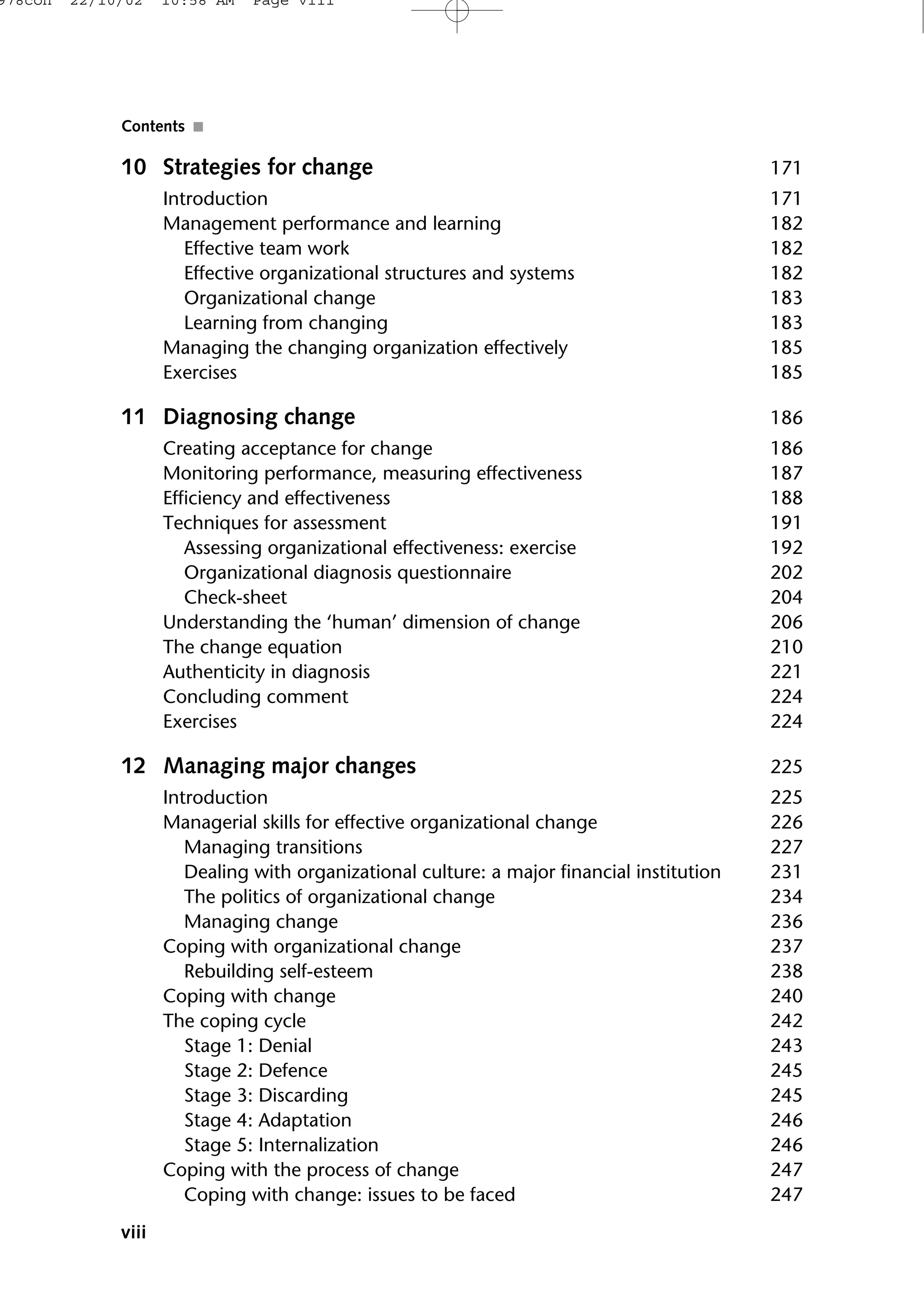
7 Managing complexity122
Introduction 122
Managing change: core competencies 125
Decision making 125
Coalition building 125
Achieving action 126
Maintaining momentum and effort 126
Management styles for change 126
Agenda for implementing change 128
Corporate culture 129
Managing corporate politics 133
Corporate political tactics 134
Leadership and corporate politics 139
Coping with conflict 140
Some things that managers cannot do much about 140
Some things that managers can do 142
Some things that top managers can do 143
Top management actions to support the implementation of
major change 144
Managing corporate politics 145
Exercises 145
8 Leadership in practice 146
Introduction 146
All things to all men! 147
Leadership, vision and strategy 148
Leaders and situations 150
The context of leadership 153
Managers and leadership 155
Leadership and ‘human scale’ 157
Exercises 158
9 The learning organization 159
Changing perceptions of organization 160
Disciplines for the learning organization 163
Convergence and the learning organization 165
Competence development in handling change 168
Conclusions 169
Exercises 170
vii
Contents
978con 22/10/02 10:58 AM Page vii
13.
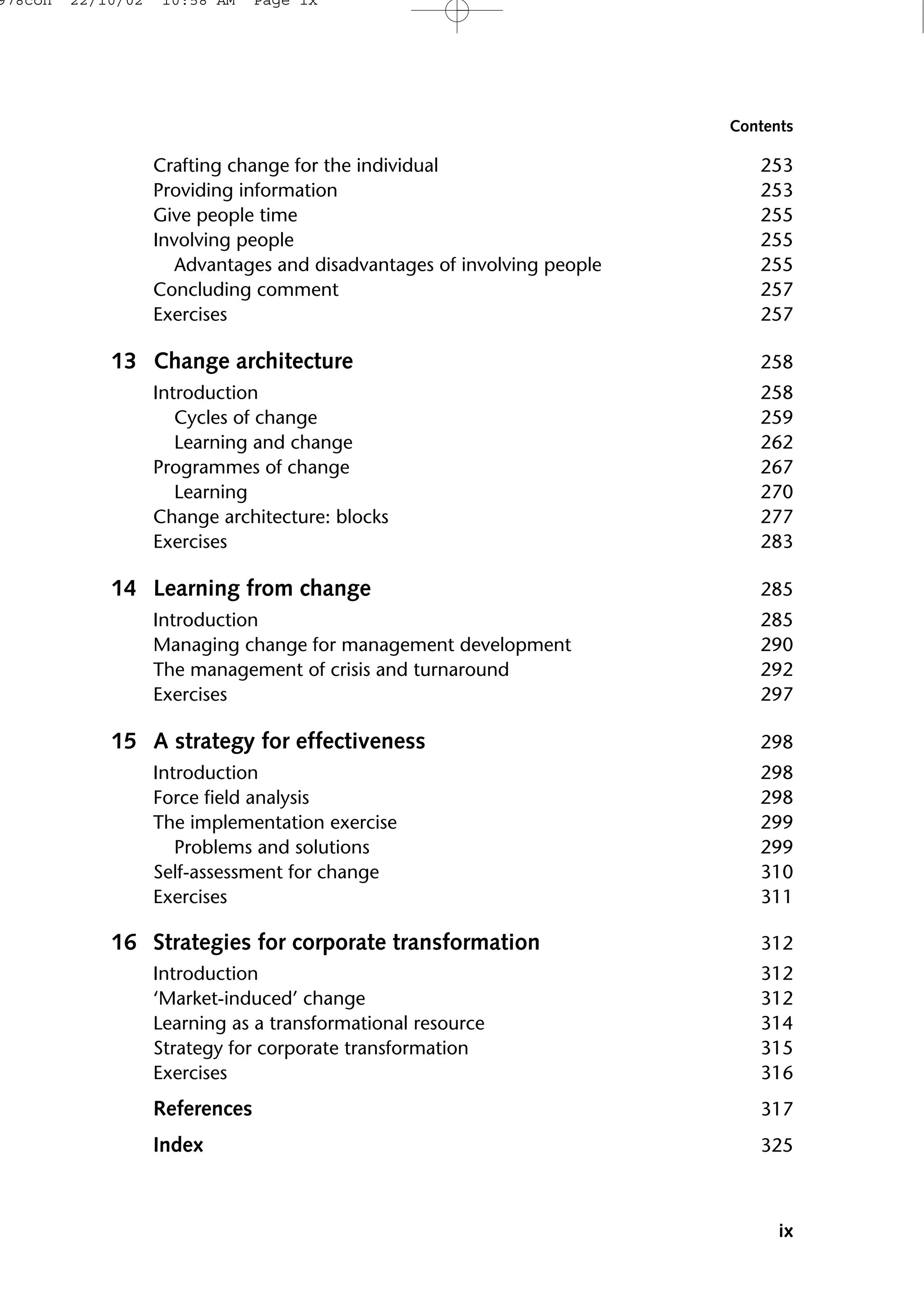
10 Strategies forchange 171
Introduction 171
Management performance and learning 182
Effective team work 182
Effective organizational structures and systems 182
Organizational change 183
Learning from changing 183
Managing the changing organization effectively 185
Exercises 185
11 Diagnosing change 186
Creating acceptance for change 186
Monitoring performance, measuring effectiveness 187
Efficiency and effectiveness 188
Techniques for assessment 191
Assessing organizational effectiveness: exercise 192
Organizational diagnosis questionnaire 202
Check-sheet 204
Understanding the ‘human’ dimension of change 206
The change equation 210
Authenticity in diagnosis 221
Concluding comment 224
Exercises 224
12 Managing major changes 225
Introduction 225
Managerial skills for effective organizational change 226
Managing transitions 227
Dealing with organizational culture: a major financial institution 231
The politics of organizational change 234
Managing change 236
Coping with organizational change 237
Rebuilding self-esteem 238
Coping with change 240
The coping cycle 242
Stage 1: Denial 243
Stage 2: Defence 245
Stage 3: Discarding 245
Stage 4: Adaptation 246
Stage 5: Internalization 246
Coping with the process of change 247
Coping with change: issues to be faced 247
viii
Contents ■
978con 22/10/02 10:58 AM Page viii
14.
Crafting change forthe individual 253
Providing information 253
Give people time 255
Involving people 255
Advantages and disadvantages of involving people 255
Concluding comment 257
Exercises 257
13 Change architecture 258
Introduction 258
Cycles of change 259
Learning and change 262
Programmes of change 267
Learning 270
Change architecture: blocks 277
Exercises 283
14 Learning from change 285
Introduction 285
Managing change for management development 290
The management of crisis and turnaround 292
Exercises 297
15 A strategy for effectiveness 298
Introduction 298
Force field analysis 298
The implementation exercise 299
Problems and solutions 299
Self-assessment for change 310
Exercises 311
16 Strategies for corporate transformation 312
Introduction 312
‘Market-induced’ change 312
Learning as a transformational resource 314
Strategy for corporate transformation 315
Exercises 316
References 317
Index 325
ix
Contents
978con 22/10/02 10:58 AM Page ix
15.
x
This edition ofManaging Change in Organizations allows me to make a number of
improvements, and not least I have added what I hope readers will find to be
relevant and topical case illustrations. But the most important change relates to
the development of ideas and approaches to handle strategic change.
The concept of change architecture allows us to go beyond linear models of
change implementation. We can explore the characteristics of successful change
programmes and therefore begin to develop some principles of change pro-
gramme design. Many executives with whom I work find this of value. Not
because change management becomes like ‘painting by numbers’ but rather
because it helps them and others approach change in a constructive way.
I have also begun to examine the question of strategic ambition. To my mind
the level of risk is linked to the level of ambition. Thus it makes sense to look at
this in a book on change.
As ever I am most grateful to the executives and staff of the organizations,
public and private, with whom I have worked on change management pro-
grammes. They are not responsible for my errors but they certainly contribute to
the end result.
A new website including an Instructor’s Manual, PowerPoint slides, case
material and data scenarios is available for lecturers to download at
www.booksites.net/carnall.
Colin A. Carnall
Westerham
September 2002
Preface to the fourth edition
978pre 22/10/02 11:00 AM Page x
16.
Everyone says thatchange is difficult. Difficult to conceive because one must
inevitably deal with people issues and an uncertain future. The more so to imple-
ment because consequences can be difficult to predict, harder to track and there-
fore can create a dynamic all of their own. In particular everyone claims that
major change is hard because of the so-called ‘soft’ or people issues. Is this really
so? Does the reader know of any organization or institution which has not expe-
rienced change in the last decade or so? Would anyone seriously argue that we are
not living in a period of rapid change? Is it not true that we are also living in an
era through which dramatic changes of productivity, technology, brand, image
and reputation are common-place?
Some will say yes to these questions but then question the longer term conse-
quences. What kind of society are we creating? Do we devote enough attention
to the long-term consequences of what we do? Fair enough but that is to shift
the argument. The fact is that more and more change is being delivered.
Organizations are engaged in delivering higher productivity, higher levels of
activity and customer satisfaction and so on. This is not to say that all is well nor
that all are successful. Rather it is to note that organizations have grown
volumes, activity and profitability during a period in which ever more complex
demands (for customer satisfaction and business ethics) have been added in
the increasingly complex and diverse environments in which we operate. The
challenge facing the senior executive has grown and yet more change is being
achieved.
Thus we must be getting something right! It may be possible to see change as
demanding and tiring but not as necessarily inherently difficult. This argument
partly turns on the idea of ‘resistance to change’. Some argue that people are
inherently resistant to change. Whether for personal or institutional reasons,
strategic change can be beset by opposition from key stakeholders, whether key
professionals, other vested interests, unions and the like. And this is true and I
seek not to diminish the importance of this point. But it is a partial truth. Much
of what we refer to as ‘resistance to change’ is really ‘resistance to uncertainty’.
1
Strategic change: intellectual
task or magic touch?
1
978ch01 22/10/02 11:01 AM Page 1
17.
Thus the resistancederives from the process of handling and managing change,
not from the change as such.
If people understand what is to be achieved, why, how and by whom, this can
help. If they understand the impact on themselves, even more so. This is not to
argue that all resistance disappears. Indeed you can argue that more informa-
tion provided to those who do seek to obstruct change because their interests
are threatened may help them to do so. But that is a matter of stakeholder han-
dling, timing and tactics. My point is that the arguments of many behavioural
scientists writing about change are overwhelmingly partial and, at least in part,
misleading. Rapidly skating over the issue of what ought to be changed, much
of the writing I refer to deals in employee attitudes, satisfactions, beliefs and so
on. Not that this is unimportant − but it is not the whole story. Much of an
employee’s response to any proposal for change lies in its perceived relevance,
credibility and likely success. If someone argues that something should change
and presents a credible plan which I feel is likely to succeed, then I am more
likely to go along. But you will search the organization change literature in vain
for ways of measuring ‘implementability’. Nor will you find any attempt to
identify the ‘degree of ambition’ in any proposals for change. The literature
takes the content of change as a given − a ‘black box’. There is some material on
risk analysis which clearly is relevant but even so most of the literature ignores
even this material.
Thus this book seeks to depart from much of the existing literature by tackling
three problems in an integrated fashion:
1. What can we say about how to identify what should change and how to judge
how ambitious the change plans are.
2. What assessment can we make of the likelihood of these changes being capable
of implementation and what kinds of change architectures can be developed
to enhance the likelihood of implementation.
3. What are the people and organizational issues of strategic change and how can
they best be tackled.
The first two are inevitably linked. Part of the issue of how ambitious any set of
proposals are lies in how ready the organization is to adopt them andor whether
an effective change plan can be adopted. Thus risk analysis and a sense of how
capable of implementation in the given organization at the relevant moment in
its life and in the economic and competitive or other relevant context.
In seeking to get to grips with the first question we will examine ideas about
strategy formulation and new models of organization sufficiently to shape an
outline of how this question can be formulated and considered. Our purpose is
not to write a book on strategy formulation but rather to show how an under-
standing of that discipline can help us.
We then go on to look at the second question. To do so we will deploy
and examine concepts such as change architecture, learning organizations and
2
Chapter 1 ■ Strategic change: intellectual task or magic touch?
978ch01 22/10/02 11:01 AM Page 2
18.
knowledge management. Theseideas we will draw together to develop the
concept of a change readiness index − a measure of how likely a given set of
changes can be implemented. Our purpose here is to enable some analysis to be
brought to bear on the question of how ambitious we can and should be when
considering proposals for change.
Finally we will look at a range of individual, team and organizational issues
relevant to any understanding of change management. Here we will look at
change diagnosis, at leadership, at the change coping cycle model and much
more. We will also seek to show how the various issues covered under questions
1 and 2 form part of the context within people’s attitudes and how behaviour is
formed in any given change setting. Ultimately our objective is to show what we
understand of how to make change. We seek to go beyond the bounds of doubt
that we often see when practitioners discuss major changes. Here we seek to
focus upon what we know and on what we can reasonably infer from experience.
Much still remains uncertain and difficult to predict but our view is that we
should build upon what we know so we can make changes with greater confi-
dence sustained by the thought that we can learn more from the experience of
doing so.
How then can business leaders conceive ambitious strategic change? What does
ambition mean in this context? Clearly competitiveness is key, just as clearly
understanding the assets upon which competitiveness can be based is also impor-
tant. But we must also beware naıve assumptions. As Hampden-Turner (1996)
demonstrates, a focus on a single factor can bring immediate success and longer
term failure. But Kay (1993) probably lays the most appropriate foundation. For
him the differentiator upon which market power is based is known as ‘distinctive
capability’. In turn this is based upon the following:
■ Reputation: essentially the market perception of productservice offerings in
terms of tangible attributes − linked to brands.
■ Architecture: the relationship of resources including knowledge and flexibility −
i.e. internal, external and networks − which the firm can bring to bear.
■ Innovation: the capacity to change.
For distinctive capability to be a source of competitive advantage, however, it
must be sustainable. Here the truth is that nothing is ultimately sustainable as the
fortunes over time of many a major corporate demonstrates all too clearly. Scale
and market share help but Kay infers that the management of public policy might
be just as important (e.g. Microsoft). All of this points to the need to understand
how to create and maintain value added as the foundation of corporate success,
following Kay (1993) and pace Porter (1985).
3
The profile of ambition
The profile of ambition
978ch01 22/10/02 11:01 AM Page 3
19.
Value based managementis a watchword of current management. It means dif-
ferent things to different observers. For some it is about economic value added,
shareholder value and the like. For others the key is social capital (Fukuyama,
1995). Taking this later view, others see value based management as more than
simply a matter of value added. Mission, purposes and strategy require or imply a
statement of corporate values. Managing a business as if values matter then
attracts our attention. Herein lies the argument about alignment. Success will
come to those whose strategic architecture aligns vision, mission, values, strategy,
structure, etc.
A recent proponent of this view is Markides (2000) for whom sustaining advan-
tage is achieved by:
1. Organizing its various activities into ‘tight’ systems which support and rein-
force each other. In essence the advantage is sustained because whilst imitators
can adopt various ideas and techniques, the ability to manage interfaces really
well is difficult to copy.
2. Creating an underlying organization environment of culture, structure, incen-
tives and people which is also difficult to copy.
Both describe alignment.
But Markides goes on to argue that success now often comes precisely by
avoiding the tendency to copy. Instead of competing head-to-head with an
existing set of competitors each with well-protected positions, the key is to create
a new strategic position by changing the rules of the game. Examples include
Body Shop, CNN, Dell, Direct Line Insurance, easyJet, Federal Express, Ikea and
Swatch amongst others. Markides offers a useful framework for considering
strategic innovation which, summarized, goes as follows:
The Kay view takes the idea of core competence as a part of strategic architecture.
Grunig and Kuhn (2001) develop these ideas into a clearer analytical frame-
work. For them the evaluation of success potential for strategy (building upon
Ohmae, 1982) requires the assessment of market and competitive strength at
three levels:
4
Chapter 1 ■ Strategic change: intellectual task or magic touch?
Question the status quo and scan the environment −
for sector and your business
If you adopt this position, can you find synergies with
existing business?
Does this lead to a potentially new strategic position?
978ch01 22/10/02 11:01 AM Page 4
20.
1. Market positionMarket attractiveness
Competitive intensity
Market share
Growthdecline of share
2. Market offers Scope and range
Quality and service
Add-ons
Price
Speed
Including measures relative to competitors
3. Resources Sustainability of competitive advantage (rarity, unitability,
substitution)
Following through with the resource-based view of strategy these authors note that
it is possible to adopt either an outsider-in approach to assessing success potential
(the market-based view) or an inside-out approach (the resource-based view).
However, they do note the latter as being the exception not the norm.
Nevertheless what is interesting in their formulation is the way they track from
assessing success potential through to the concept of the balanced scorecard (fol-
lowing Kaplan and Norton, 1996) and on into the definition of implementation
measures − for which they propose a two-by-two matrix looking at motivation
and knowledge and competencies on one dimension and change drivers and
obstacles on the other dimension.
This leads on to an outline of the whole question of implementation and the idea
of an index of change readiness. But what dimensions to include in the index? In
short, implementation could be defined as those processes needed for designing
and organizing the process of change to be effective. So how can we judge the
effectiveness of change?
Why do some change programmes succeed and some fail? Why can some com-
panies achieve change quickly and some not at all? Why do more and more com-
panies see leadership and culture as defining issues in success or failure? Why are
we most concerned to establish the process of change properly? Why do
changing organizations concern themselves about values and benchmarking? Is
not the central issue for successful change that of ‘reading’ the environment right
and putting in place a competitive business model? Is there not a case for saying
that in many strategic changes the most important thing is to define the right
business model and replicate it accurately? Are we really convinced with the ‘no
one best way’ argument? This has it that any of a range of business models can be
appropriate, and therefore concern yourself mostly with the human-centred
model.
5
Implementation
Implementation
978ch01 22/10/02 11:01 AM Page 5
21.
Throughout my workingcareer in the business school world I have often met
this dilemma. Managers are often seen as unable or unwilling to take the human-
centred view seriously. Could it be that in reality some of this is about people
arguing for the adoption of the human-centred view not considering the ‘task-
centred’ view seriously enough? Might there not in fact be ‘one best way’ − or at
least only a few variants of ‘one best way’? If so, getting managers to focus only
on the so-called human issues is unlikely to be meaningful.
The socio-technical systems school was an early attempt to resolve this issue. It
held that joint optimization was the relevant goal but then principally focused
upon work group organization as a prime work organization design innovation.
Any examination of outcomes from change projects based upon this concept
demonstrates that the increased flexibility arising is often a source of significantly
enhanced performance. Employee satisfaction often also improves. And this leads
to a further dilemma. Why do academic observers and consultants so often per-
ceive attempts at change to be failures? Boonstra (2002) makes this very point. In
the USA by far the majority of attempts to redesign business processes fail. The
development of new strategies ‘runs aground’ in 75 per cent of cases. Research in
the Netherlands indicates that 70 per cent or more of change programmes lead to
‘insufficient results’.
And yet this perception surely flies in the face of the evidence. Industries and
sectors have been transformed in recent years. We re-engineer hospitals, govern-
ment itself and the great companies of the world. Ford was very different in the
year 2000 as compared with say the year 1960. Is anyone seriously arguing that
the privatized British Telecommunications plc of today’s world has not gone
through dramatic change since privatization? Or British Airways?
Pfeffer (1998) argues the case that you can ‘build profits by putting people first’,
as does Gratton (2000). In each case these authors cite evidence which appears to
show that strategic change is regularly achieved. The literature on lean manufac-
turing does much the same. However, from my own experience working with
organizations engaged in making major change, it is clear that many executives
see the process of change as problematic. It is difficult to engage stakeholders. The
human-centred approach is of value but not often used. Very little attempt is
made to learn from experience and so on.
Only recently have observers begun to examine how change programmes are
constructed. This may be called change architecture. And yet the principal
concern of the work published so far is that of participation and involvement.
This is an important but only partial approach. Nevertheless some interesting
work has been published.
Thus Emery and Purser (1996) discuss the role of ‘search conferences’ and
Bunker and Alban (1996) look at processes for engaging the ‘whole system’ for
6
Chapter 1 ■ Strategic change: intellectual task or magic touch?
Change architecture
978ch01 22/10/02 11:01 AM Page 6
22.
rapid change. Jacobs(1994) identifies three sequential processes as required to
achieve strategic change, as follows:
■ Building a common data-base
■ Discovering the future in diverse perspectives
■ Creating commitment to action plans
The first is particularly interesting. What does it mean? Is it what many often refer
to as the process of building acceptance of the need for change? No it is not.
Rather it is a process of building credible and valid measures of performance
focused upon understanding how well we are doing, how we compare to com-
petitors (benchmarking) and what else is changing in the environment. Thus the
key element of the first process is about measurement. Here balanced scorecards
(Kaplan and Norton), benchmarking (Watson, 1993) and ideas such as 360°
appraisal all play into this element. Not least the concern is about measurement,
accountability, transparency and access to outcome measures. Value added is a
key metaphor for this process. Increasingly we see a need to balance between
focus on issues such as cost and scale on the one hand with those of product
service development, customer service enhancement and growth on the other.
The second and third issues require dialogue, reflection and sharing and there-
fore processes are needed to engage key stakeholders. Sattelberger and Bruch
(2001), reporting work at Lufthansa, show how processes such as strategy forums,
open-space-events and learning maps utilizing data from the above but assessed
and discussed from various perspectives (of internal and external stakeholders)
can be utilized to build new ‘mental models’ for the business. Learning is a key
issue here and this requires ‘valid knowledge’ and processes for reflection and dia-
logue. Interestingly enough there is evidence emerging about the need to
combine dialogue with a focus upon action and follow-through. Thus Norlton
(1998) noted that workshop evaluations very early on show how those involved
seek closure, direction and future plans and targets − thus providing a vital
process in which people both engage in dialogue and in creating new plans − a
genuinely problem-oriented process. Much the same emerged in Greenley and
Carnall (2001).
All of this suggests that the statement so often articulated, ‘the most important
resource of this business is its people’, is increasingly meaningful not merely as
rhetoric but also in practice. If we depend more and more on fewer people and if
the loyalty of those people, particularly managers, can no longer be assumed, but
rather must be earned and retained, then clearly we need to be concerned about
how we utilize them, develop them and resource them and about the opportuni-
ties for rewards, promotion and success which we provide. If changes depend
upon the people who implement them then one must be concerned to ensure that
those people possess the necessary skills. If those same people are motivated by
challenge and opportunity then we must provide that as well. But if the latter will
only follow if changes are successful then the introduction of changes which our
people view as being credible, as likely to succeed, becomes a paramount issue.
7
Change architecture
978ch01 22/10/02 11:01 AM Page 7
23.
So ultimately whatdo we mean by change architecture? Not least we mean that
set of arrangements, systems, resources and processes through which we engage
people in ‘productive reasoning’ focused upon creating a new future. The princi-
ples through which the various techniques (strategy forum, communication cas-
cades, ‘town meetings’, ‘open-space events’, balanced scorecards and much more)
are designed together are as follows:
1. We seek to clarify governance and accountability for strategic change;
2. We seem to engage key stakeholders in appropriate ways;
3. We seek to secure alignment for all or at least a critical mass of key stakeholders
in ways supportive of success, however defined;
4. We seek effective, credible and accessible performance measures provided on a
relatively transparent basis;
5. That we need a balanced set of performance measures (i.e. covering finance,
activity, quality, adaptability, markets, customer and employee satisfaction,
etc.) presented on a common platform;
6. We seek to acquire or develop the new skills and capabilities and to mobilize
commitment and resources;
7. We seek to leverage knowledge of relevance to the future out of the way we
operate and capture the results of our use of the techniques we apply, i.e. we
seek to use strategic change as a learning process.
8
Chapter 1 ■ Strategic change: intellectual task or magic touch?
▼
KPMG
Thornbury (1999) relates how the global accounting and consulting firm KPMG
implemented a major culture change programme as part of its globalization
process. As it became global, KPMG utilized organization design and restructuring
approaches as a means of reconciling what is often ultimately problematic − the
issue of organizing around disciplines, functions, clients, regions, sectors and so on.
Creating a KPMG which looked and acted like a single global firm was a real chal-
lenge, not least because it was not so in terms of structure. Thornbury argued that
to achieve this aim, the organization needed ‘glue’ to hold it together. This was to
be sought via four initiatives:
■ creating a shared set of values;
■ aligning what was on offer to create a consistent core service offering;
■ developing common and consistent business processes;
■ creating common infrastructure.
At the heart of this, clearly, are the shared values but, arguably, the other initiatives
are vital to moving the organization in a common direction and they therefore play
a role in defining and then living up to shared values.
CASE
STUDY
978ch01 22/10/02 11:01 AM Page 8
24.
In this chapterwe have sought to introduce the themes of this book. We argue
strategic change is both an intellectual challenge and a process for handling people
and uncertainty. A recent book links these two as in effect the same challenge − that
9
Conclusion
For us the key issue relates to the strategy for change. It must deal with a number
of contextual factors:
■ the remnants of old structures;
■ the ‘not invented here’ syndrome;
■ the primacy of the client in the sense that those with good client track records are
often influential internationally over issues about which they know little or nothing;
■ a tradition of intellectualism which often means that changes are debated rather
than implemented!
To overcome these barriers, not least engagement of KPMG people had to be a key
element of the strategy.
A three-stage process was established:
Phase 1: (a) Diagnosis − researching the culture using surveys and focus groups
(b) Launching the values via an international council workshop (involving
the 35−40 leaders of the firm)
(c) Revision to the KPMG mission statement
Phase 2: (a) Defining the desired culture via a series of development programmes
and the 1997 KPMG international partners conference
(b) Refining the values at the Asia Pacific conference
(c) Finalizing the values statement at the March 1998 meeting of the inter-
national council
Phase 3: (a) Developing an implementation toolkit to be used in practices around
the world − guidelines, workbooks, questionnaires, workshop designs
and exercises which could be used by local ‘change agents’ −
including a board-game to be used by workshop participants, known
as the values game
(b) Built into the implementation toolkit is material on leadership align-
ment, personal and team development, communications, managing the
process as well as the culture change content listed above.
And a crucial piece of learning! A real key is the word integration. Whilst initially
you may run with the culture change concept as a separate activity, the more you
integrate with other initiatives and programmes, the better.
Source: Thornbury (1999)
Conclusion
978ch01 22/10/02 11:01 AM Page 9
25.
of finding evermore ingenious solutions to age-old problems of markets, competi-
tiveness, technology, etc. (Homer-Dixon, 2000). We think the challenge is to do
both well and propose to explore that point in the chapters which follow. Thus
making change successfully is indeed an intellectual task. It is much more than
about being ‘good with people’. It is capable of being understood more thoroughly
and should not be consigned to the ‘mystery’ surrounding behavioural science
theory and often attached to the use of psychometric tests. It is a challenge for man-
agement and leadership teams. It is not a task or set of tasks to be shunned or to be
passed on to the new ‘wizards’ of organization design. But the various professional
and academic disciplines can and do help − our task is to better understand how.
10
Chapter 1 ■ Strategic change: intellectual task or magic touch?
EXERCISES
1. What change architecture can you identify in the KPMG case study?
2. What mechanisms have you seen used to ensure that learning and development
forms part of a change programme?
3. How might we seek to learn from a failure in organization change?
978ch01 22/10/02 11:01 AM Page 10
As young birdfrom its nest,
At morn, floats upward—onward—and away;
And when the night brings down its shadows grey.
Returns unto its rest,
Ev'n thus the youthful mind
Goes forward to the world; partakes its cares
And fleeting joys,—is tempted by its snares;
But can no refuge find:
The freshness of his home
Goes with him, guidingly, where'er he wends;
A star-like light upon his steps attends—
A ray from Heaven's bright dome!
In all his toil and fret,
The quiet fields and gentle streams he knew,
When youth clothed all around in fairest hue,
His soul can ne'er forget:
For still their memories come,
Like poetry, to his spirit;—as a tone
Of music's echo on the waters thrown,
And heard 'mid evening's gloom.
In brumal age, the dreams
Of home refresh the soul, as purples pied
Peep up from out the snows, and smile beside
Winter's deserted streams;
As violets on a rock
They cheer the solitude,—their promise dawns
Upon the mind, like moonlight o'er the lawns—
Or joy to one grief-broke.
Home of our youth, what spot
On earth is like thee? Scenes of early days,
Oh! where upon your equals can we gaze?
28.
What palace likethe cot
Where childhood first its eyes
Oped to the day, and marvelled what could be
The world around it? Is there aught we see
Can be compared to skies
Like those which earliest shone
Upon our path, and like a sunray bright,
Brought with it, freshly, dawnings of the light
That ne'er can be forgone?
Landscapes of other climes,
Though bountiful in beauty, what are ye
To the fair scenes of home, where'er it be?
Sacred as churchward chimes.
High may the mountains tower
Into the heavens, and grandeur fill the scene,
The valleys and the pastures may be green,
The hill-sides still in flower,
Of other lands, where stray
The exile's feet; but none are e'er so fair
Unto his soul, as the blest landscapes where
His visions fly away.
Those sordid cares beside,
That cloud the mind, 'mong earth-born woes and ills.
Come soothing thoughts of home, as 'tween far hills
The gentle streamlets glide!
A small volumeof poems, entitled Poetical Aspirations, was
published by me, my first adventure, in 1830, and was favourably
received. That volume was dedicated to Mrs Robertson of Ednam
House, Kelso, a lady whose many virtues are universally
acknowledged wherever she is known, and whose kindness to me it
will always be my pride to remember. A second edition, with
additional poems, appeared in 1833. From the latter volume I have
selected the following pieces, the remainder, bearing evident marks
of inexperience and juvenility of taste, not being deemed worthy of
further reprint.
Sunset is streamingo'er the snow-clad crown
Of the high Alps, while darkness settles down
Through all their countless valleys and defiles,
Mixing with shade, where sunlight never smiles:
Ere from the topmost peak, its latest ray
Has, with its wing of glory, sped away,
The mountain shepherd's horn has sounded there,
Like the Muezzin's evening call to prayer;
Praise God the Lord! and hark! from all around
A thousand voices answer to the sound:
From every clift, and crag, and ledge, and linn,
The notes of worship and of praise begin.
Praise God the Lord! the echoes catch the strain,
And far and near repeat the sound again;
They wake it in the wild and in the wood,
Through all the shades of that far solitude:
Bearing it on, o'er valley and ravine,
Where, till this hour, such sound has never been;
Then, in the distance, fainter grown the lay,
The lingering notes at length dissolve away.
When all is silent, on the mountain sod
The humble shepherds bend the knee to God;
They kneel in darkness and in peace, to share
The sweet and social intercourse of prayer:
With gleams of manly thought, their prayers arise,
Like incense from the altar, to the skies.
Their temple is the mountain and the mist,
And theirs the shrine where minister the blest;
They kneel before the Spirit of the world,
He who this universe of mountains hurled
Together with a word, and chaos spread
Mid majesty and grandeur, dark and dread.
Prostrate in presence of the Great First Cause,
They own his power, while they obey his laws:
Their thoughts are deeper than th' abyss beneath,
34.
Their thoughts aredeeper than th abyss beneath,
Yet while their humble orisons they breathe,
Their souls are soaring far beyond each height
On which the stars are clustering, with the night;
And while they view, with soul-admiring glance,
The world of fancy, nature, and romance,
That circles round their native rocks, they deem
The glories of the earth an empty dream.
But hark! that horn again resounds aloud,
Like sudden music bursting from a cloud:
Good night! Good night! along the mountain breaks,
Good night! Good night! again each echo wakes;
And all the scene, below, around, above,
Teems with Good night! the evening pledge of love.
The eagle, soaring, waits upon the wing,
Charmed with the notes the syren echoes sing;
The startled chamois bounds along the hill,
Yet, half-enraptured, turns to listen still;
From mount to valley, and from wold to wild,
The sounds are borne along, till, faint and mild,
Good night, shall linger in the echoes' song,
When all to silence and to sleep belong.
One day—the sunbeamsdanced along the glade
As lovers dance upon their bridal eve—
I wandered to the wood, where all was bloom;
The earth breathed fresh with fragrance, and the trees
Dropped, as it were, the dew of silent joy.
I loved to listen to the song of birds,
Whose music wild, yet sweet, came o'er the ear,
Telling of ecstasy; and, more than all,
I loved to view the flowers, those stars of earth,
As stars are flowers of heaven, those glimpses bright
Of a far higher, purer, lovelier world;
Those day dreams of Creation, blooming wild,
Scattered on earth, like angel-smiles in heaven.
Oh! I was happy then, for all above,
And all below, was fair, and pure, and bright;
And then I thought that happier still I'd be
If my freed soul could fleet, as dew from grass,
When the glad morning sun is shining forth,
Passing so silently away from earth;
If that were all—if death itself were death—
But after death comes life, more true than this.
I lay and listened to a wild bird's song,
A little shining, singing, flutt'ring thing:
Its song was full of sweetness and of love:
When, lo! it fell before me on the ground,
And found its grave among a bank of flowers—
Who would not die, to find a grave so sweet?
I ran and lifted it—'twas cold and stiff,
And in its little heart an arrow sought
Unsanctified admittance, quivering there,
Like an unwelcome messenger of fate.
The spoiler came—I drew his arrow out,
And threw it on the earth—he trod it down,
As he passed onward in his careless path.
37.
And this isdeath! How sudden, and how strong!
His harvest ne'er begins nor ends, for still
His scythe is ready ere the corn is ripe,
We cannot shun the stroke; but if prepared
To meet it when it falls, its sting is gone!
Yet death itself is never terrible,
But 'tis the thought of what comes after death
That wakes the coward in the soul of man—
Of man carnal and unregenerate.
In the lone grave the body soon is clothed
In vileness, and this most delicate frame
Becomes the food of worms, the gorging feast
Of those vile particles of putresence
We loathe in life to look at—which we spurn
And trample on with horror. Pride, bend low!
And meditate on this, that slimy worms,
Gnome-like and insatiate epicures,
Must feed on us to fulness, as on dainties,
When we, like they themselves, become corruption!
This is the pang, the poison, that makes dark
The brightest joys, and chills the warmest hopes
Of all who look no farther than the grave,—
That calms the laughing thought within the heart:
This is the weapon that affrights the bold,
Makes foolishness of wisdom, and creates
The fear of death, because it terminates
But in corruption and the feast of worms.
To go into the grave—if that were all,
No one would shrink from it; but that the thought
That this fair form should formless be, the shape
Be shapeless, decomposed, and fall to nought,
Preys on the mind, and hinders it from rest.
And few there are who seek the saving peace
That here can reconcile us to our doom.
The soul remains entire, though in the grave
38.
, g g
Thebody lies, and slowly wastes away.
Then let us strive to find, through God's good grace,
That faith by which alone the soul becomes
One perfect Chrysolite, and in Christ's blood,
Relieved from stain of guilt, is rendered fit
To stand, approved, before a holy God.
Through the wood,through the wood,
Warbles the merle!
Through the wood, through the wood,
Gallops the earl!
Yet he heeds not its song
As it sinks on his ear,
For he lists to a voice
Than its music more dear.
Through the wood, through the wood,
Once and away,
The castle is gained,
And the lady is gay:
When her smile waxes sad,
And her eyes become dim;
Her bosom is glad,
If she gazes on him!
Through the wood, through the wood,
Over the wold,
Rides onward a band
Of true warriors bold;
They stop not for forest,
They halt not for water;
Their chieftain in sorrow
Is seeking his daughter.
Through the wood, through the wood,
Warbles the merle;
Through the wood, through the wood,
Prances the earl;
And on a gay palfrey
Comes pacing his bride;
While an old man sits smiling,
In joy, by her side.
Banished for ever!
Fromthe scene of my birth,
For ever! for ever!
From all I loved dearest, and cherished on earth,
From the smile of my friends, and the home of their hearth,
To come again never!
Banished for ever!
From hope and from home,
For ever! for ever!
Away in the desert of distance to roam,
Like a ship tempest-tost on the wild sea-wave's foam,
To land again never!
Banished for ever!
When all have gone by,
For ever! for ever!
The gladness of earth, and the brightness of sky,
There's no fear but to live, and no hope but to die—
To feel again never!
Banished for ever!
'Tis madness to me,
For ever! for ever!
To think of the land I shall ne'er again see,
Of the days that have been, and the days that shall be—
That thought leaves me never!
Banished for ever!
Be this my adieu—
For ever! for ever!
Let me roam where I will, ne'er again shall I view,
Scenes so cherished and fair, friends so kind and so true;
Oh, never! oh, never!
Banished for ever!
Dear land of my birth,
W ! !
44.
We sever! wesever!
An exile from all I love dearest on earth,
From the smile of my friends, from the home of their hearth—
For ever! for ever!
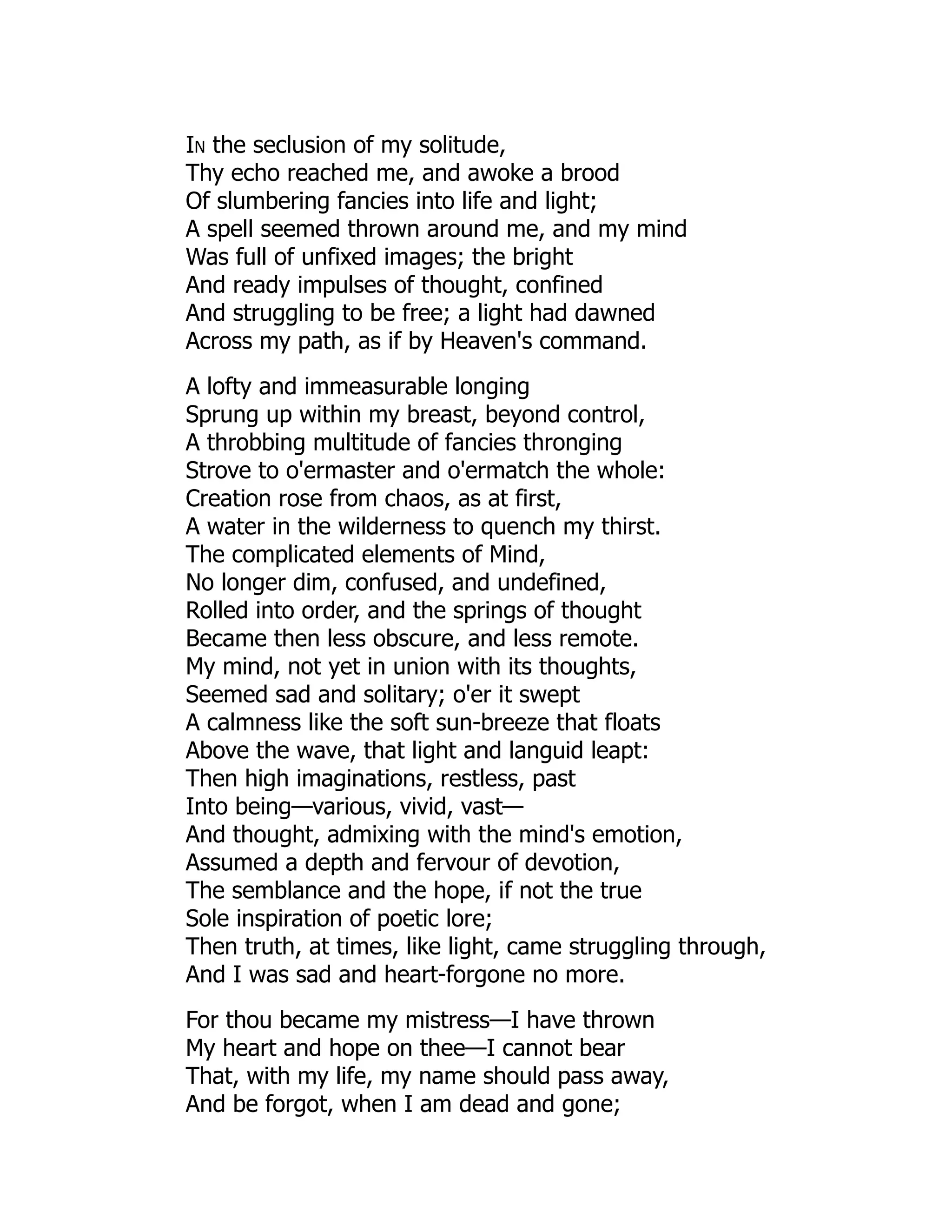
In the seclusionof my solitude,
Thy echo reached me, and awoke a brood
Of slumbering fancies into life and light;
A spell seemed thrown around me, and my mind
Was full of unfixed images; the bright
And ready impulses of thought, confined
And struggling to be free; a light had dawned
Across my path, as if by Heaven's command.
A lofty and immeasurable longing
Sprung up within my breast, beyond control,
A throbbing multitude of fancies thronging
Strove to o'ermaster and o'ermatch the whole:
Creation rose from chaos, as at first,
A water in the wilderness to quench my thirst.
The complicated elements of Mind,
No longer dim, confused, and undefined,
Rolled into order, and the springs of thought
Became then less obscure, and less remote.
My mind, not yet in union with its thoughts,
Seemed sad and solitary; o'er it swept
A calmness like the soft sun-breeze that floats
Above the wave, that light and languid leapt:
Then high imaginations, restless, past
Into being—various, vivid, vast—
And thought, admixing with the mind's emotion,
Assumed a depth and fervour of devotion,
The semblance and the hope, if not the true
Sole inspiration of poetic lore;
Then truth, at times, like light, came struggling through,
And I was sad and heart-forgone no more.
For thou became my mistress—I have thrown
My heart and hope on thee—I cannot bear
That, with my life, my name should pass away,
And be forgot, when I am dead and gone;
47.
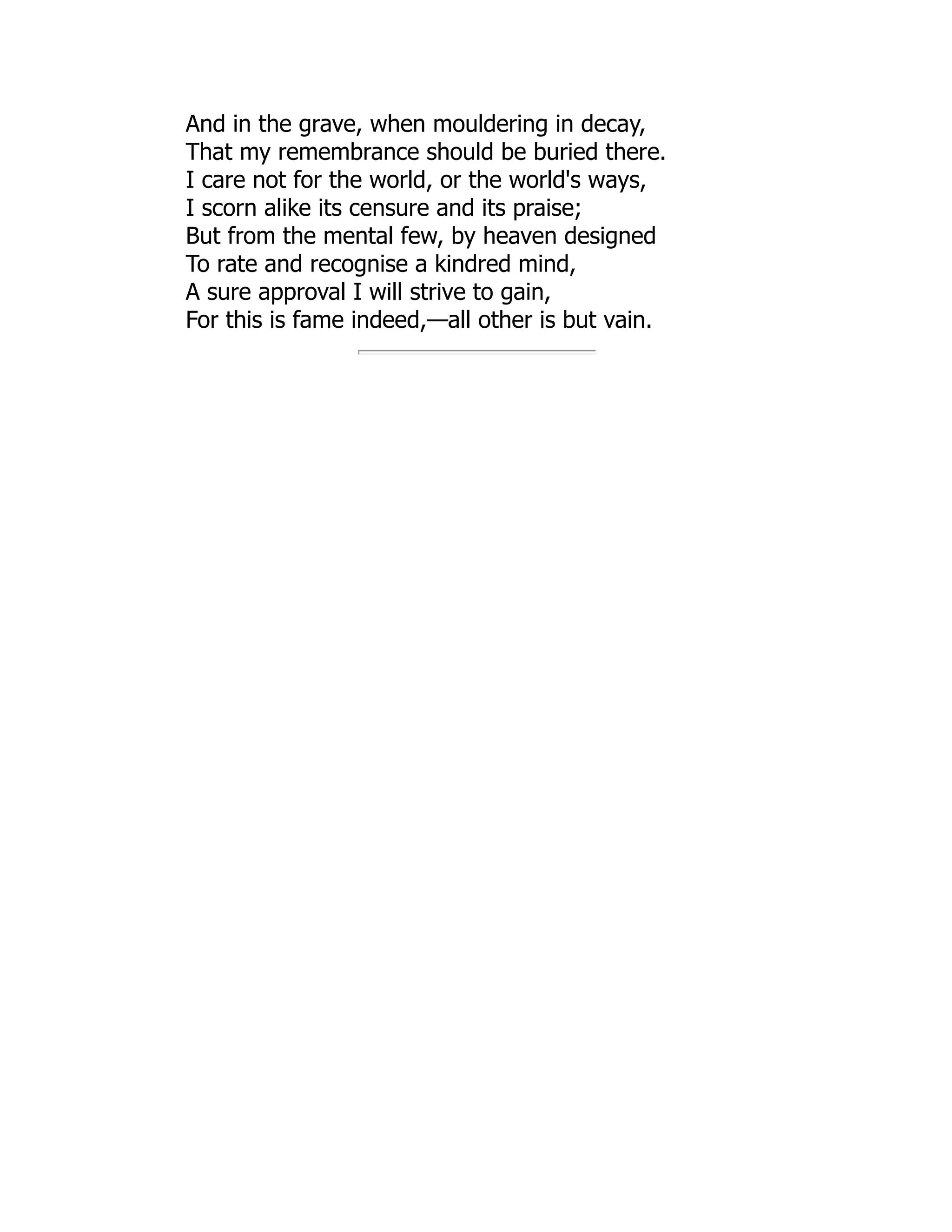
And in thegrave, when mouldering in decay,
That my remembrance should be buried there.
I care not for the world, or the world's ways,
I scorn alike its censure and its praise;
But from the mental few, by heaven designed
To rate and recognise a kindred mind,
A sure approval I will strive to gain,
For this is fame indeed,—all other is but vain.
Welcome to ourwebsite – the ideal destination for book lovers and
knowledge seekers. With a mission to inspire endlessly, we offer a
vast collection of books, ranging from classic literary works to
specialized publications, self-development books, and children's
literature. Each book is a new journey of discovery, expanding
knowledge and enriching the soul of the reade
Our website is not just a platform for buying books, but a bridge
connecting readers to the timeless values of culture and wisdom. With
an elegant, user-friendly interface and an intelligent search system,
we are committed to providing a quick and convenient shopping
experience. Additionally, our special promotions and home delivery
services ensure that you save time and fully enjoy the joy of reading.
Let us accompany you on the journey of exploring knowledge and
personal growth!
ebookultra.com