Valuing Physician Practices
December 6, 2016
Phone: 813.289.2588
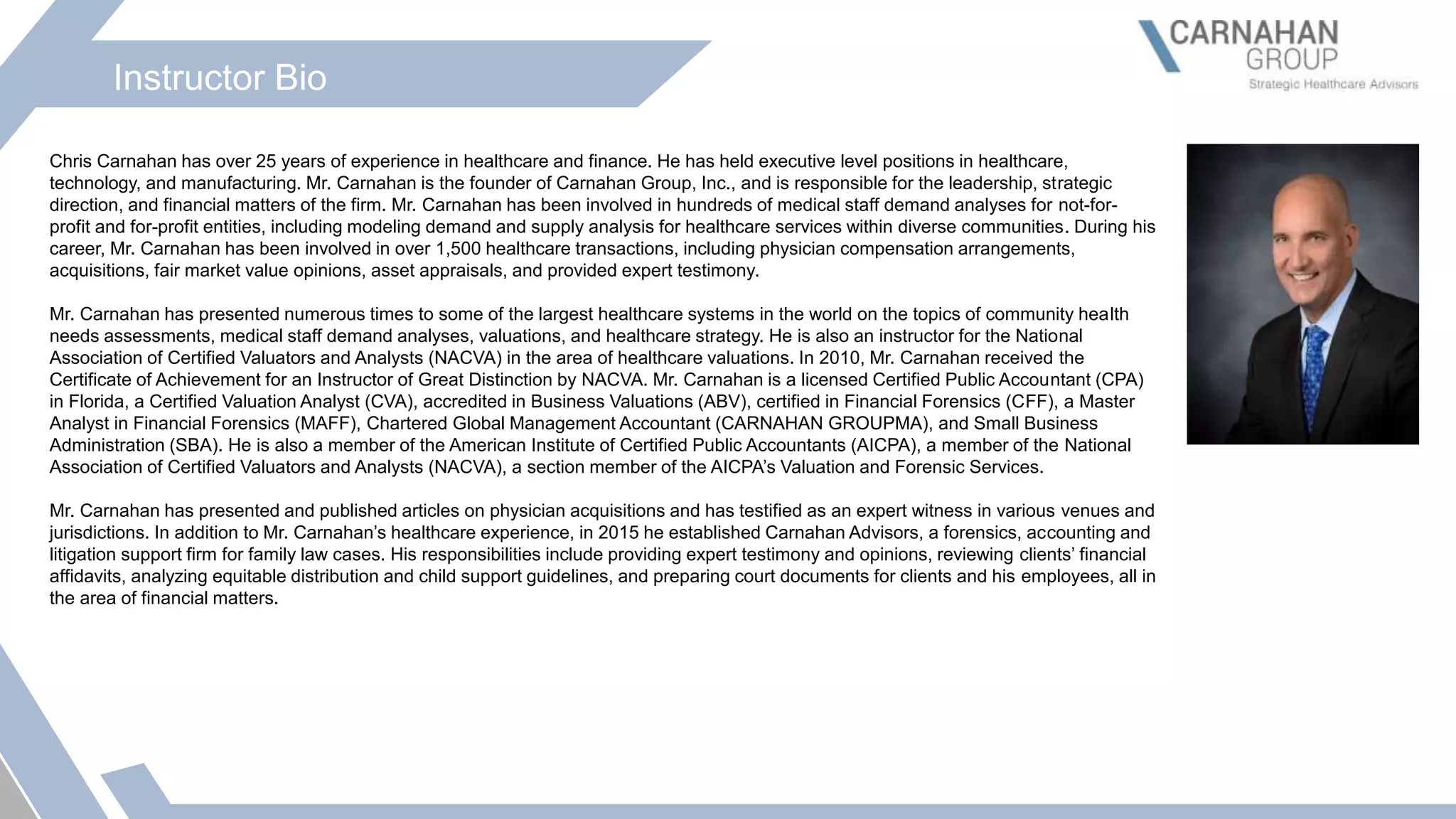
Instructor Bio
Chris Carnahan has over 25 years of experience in healthcare and finance. He has held executive level positions in healthcare,
technology, and manufacturing. Mr. Carnahan is the founder of Carnahan Group, Inc., and is responsible for the leadership, strategic
direction, and financial matters of the firm. Mr. Carnahan has been involved in hundreds of medical staff demand analyses for not-for-
profit and for-profit entities, including modeling demand and supply analysis for healthcare services within diverse communities. During his
career, Mr. Carnahan has been involved in over 1,500 healthcare transactions, including physician compensation arrangements,
acquisitions, fair market value opinions, asset appraisals, and provided expert testimony.
Mr. Carnahan has presented numerous times to some of the largest healthcare systems in the world on the topics of community health
needs assessments, medical staff demand analyses, valuations, and healthcare strategy. He is also an instructor for the National
Association of Certified Valuators and Analysts (NACVA) in the area of healthcare valuations. In 2010, Mr. Carnahan received the
Certificate of Achievement for an Instructor of Great Distinction by NACVA. Mr. Carnahan is a licensed Certified Public Accountant (CPA)
in Florida, a Certified Valuation Analyst (CVA), accredited in Business Valuations (ABV), certified in Financial Forensics (CFF), a Master
Analyst in Financial Forensics (MAFF), Chartered Global Management Accountant (CARNAHAN GROUPMA), and Small Business
Administration (SBA). He is also a member of the American Institute of Certified Public Accountants (AICPA), a member of the National
Association of Certified Valuators and Analysts (NACVA), a section member of the AICPA’s Valuation and Forensic Services.
Mr. Carnahan has presented and published articles on physician acquisitions and has testified as an expert witness in various venues and
jurisdictions. In addition to Mr. Carnahan’s healthcare experience, in 2015 he established Carnahan Advisors, a forensics, accounting and
litigation support firm for family law cases. His responsibilities include providing expert testimony and opinions, reviewing clients’ financial
affidavits, analyzing equitable distribution and child support guidelines, and preparing court documents for clients and his employees, all in
the area of financial matters.
Agenda
• FMV in Healthcare
• Regulation
• Current Trends and Marketplace
• Medical Practice Valuation and Related Issues
• Selecting the Right Approach
• Income, Market, and Asset Approach
• Physician Compensation
• Issues in Valuing Physician Compensation
FMV in Healthcare
Why are FMV standards needed in Healthcare?
• “To protect patients and the federal health care programs from
fraud and abuse by curtailing the corrupting influence of
money on health care decisions.”
Governing bodies:
• Office of the Inspector General (OIG)
• Department of Health and Human Services (HHS)
Standards:
• Anti-Kickback Statute
• Stark law
• IRS’s regulations
Stark Law
Stark law: generally prohibits physicians from making designated
health service referrals to organizations with which those physicians
(or an immediate family member) have a financial relationship,
unless an exception under the law applies. This includes physician
referrals to his/her own medical practice where the following
circumstances are present:
• A physician delivers services through the medical practice;
• The medical practice furnishes designated health services that
may be payable by Medicare making the medical practice a
Designated Health Services (DHS) entity;
• The physician has a financial relationship with the medical
practice; and
• The physician makes referrals to the medical practice for the
furnishing of DHS.
In-Office Ancillary Exception
Physicians and medical practices rely on the Stark law’s in-office
ancillary services exception and physician services exceptions to
allow "within-practice" DHS referrals. Of these, the in-office ancillary
services exception is used most frequently as it allows physicians in
medical practices to:
• Make referrals for certain DHS within the medical practice;
• Furnish those DHS to practice patients;
• Bill Medicare and Medicaid for the services; and
• Retain and use the revenues earned from providing the
services within the group for payment of practice expenses
and physician compensation.
These exceptions are therefore of significant importance to a
medical practice’s internal activities.
Anti-Kickback Statute
Criminal statute that prohibits the exchange (or offer to exchange),
of anything of value, in an effort to induce (or reward) the referral of
federal health care program business.
• Anyone who “knowingly and willfully offers, pays, solicits, or
receives remuneration in order to induce business reimbursed
under the Medicare or Medicaid programs.”
• Charges and payments are not based on value or volume of
referrals or other business generated by the parties that is
covered by Medicare or Medicaid.
• Issued by OIG, although originally enacted by SSA in 1972.
Anti-Kickback Statute, Cont’d
Safe harbor regulations: payment and business practices that,
although potentially implicating the statute, are not treated as
offenses under the statute:
• Investment interest: 40% rule
• Space and equipment rental – FMV-based
• Personal services and management contracts
• Sale of practice
• Referral services
• Warranties
• Discounts
• Employees, etc.
Patient Protection and Affordable Care Act
Patient Protection and Affordable Care Act (PPACA) – healthcare
reform legislation; passed by the 111th Congress and signed into
law by President Barack Obama in March 2010. Key provisions:
• Extends coverage to millions uninsured people – provides
affordable healthcare with no-cost preventive services;
• Implements measures to lower healthcare costs while
improving efficiencies;
• Eliminates some of the previous industry practices, such as
rescission of insurance policies and denial of coverage due to
pre-existing conditions;
• Eliminates annual and lifetime limits on coverage and benefits
• Make insurance companies responsible for keeping
administrative costs down; and
• Shared responsibility for patients (avoiding minimum coverage
will result in penalties).
Current Trends in Healthcare
Physicians are concerned and evaluating whether to remain
independent, align themselves with a major hospital or system, or
sell their practice and become employed.
• Raising costs to run the practices – supplies, technology,
employees
• Meaningful Use – incentives end and working capital is
required
• Uncertainty around PPACA – payments, delivery system
• Networks are becoming narrow – hospital alignment can help
• Concerns regarding aging population, physician shortages
• Volume-based reimbursement and productivity-based
compensation will be succeeded by value based/bundled
payments
Physicians initiate majority of acquisitions.
Current Trends in Healthcare, Cont’d
Hospitals acquire mostly primary care practices, followed by
cardiology, orthopedics, general surgery, endocrinology,
gastroenterology, urology and oncology practices.
What motivates hospitals?
• Increase service area and market share
• Expand current capabilities in certain specialty areas
• Meet community need
• Insurance-driven motives
• Increase efficiencies and alignment
Hospitals are not the only ones involved in M&A’s; recently
insurance companies and managed-care organizations are getting
involved.
Current Trends in Healthcare, Cont’d
January through May 2015: acquisition volume reached $241 billion
Shift toward:
• Vertical acquisitions (non-acute-care facilities – clinics,
physician practices); 74% of total provider acquisitions volume
and are expected to climb to 84% in 2018
• Digital acquisitions (buying companies focused on sensors,
mobility, analytics/cloud capabilities) – projected to reach 8%
in 2018
Hospital acquisitions are on the decline – 32% in 2006 to 21% in
2014. Expected to drop to 6% in 2018.
Current Trends in Healthcare, Cont’d
Management Services Organization (MSO) model – physician
remains independent while MSO owns the assets and provides key
management services (staff, billing and collections, accounting,
equipment)
Accountable Care Organizations (ACO) - groups of doctors,
hospitals, and other health care providers, who come together
voluntarily to give coordinated high quality care to their Medicare
patients.
• The goal of coordinated care is to ensure that patients,
especially the chronically ill, get the right care at the right time,
while avoiding unnecessary duplication of services and
preventing medical errors.
• When an ACO succeeds both in delivering high-quality care
and spending health care dollars more wisely, it will share in
the savings it achieves for the Medicare program.
Market Place Trends
637
752
560
580
600
620
640
660
680
700
720
740
760
780
2013 2014
Healthcare M&A deals
2013 v. 2014
52.7
62
48
50
52
54
56
58
60
62
64
2013 2014
Value (billions)
2015 Health Care Services Acquisition Report
Integrated Issues after M&A
Although the intent of the merger is increasing quality of care while
using efficiencies to decrease costs, quality often does not improve.
• Cost of care typically increases
• Integration-often external, but not internal
• Random collection of hospital and physician groups
• Lack of metrics to evaluate successful integration
• Risk of violating anti-trust laws
• Culture clash
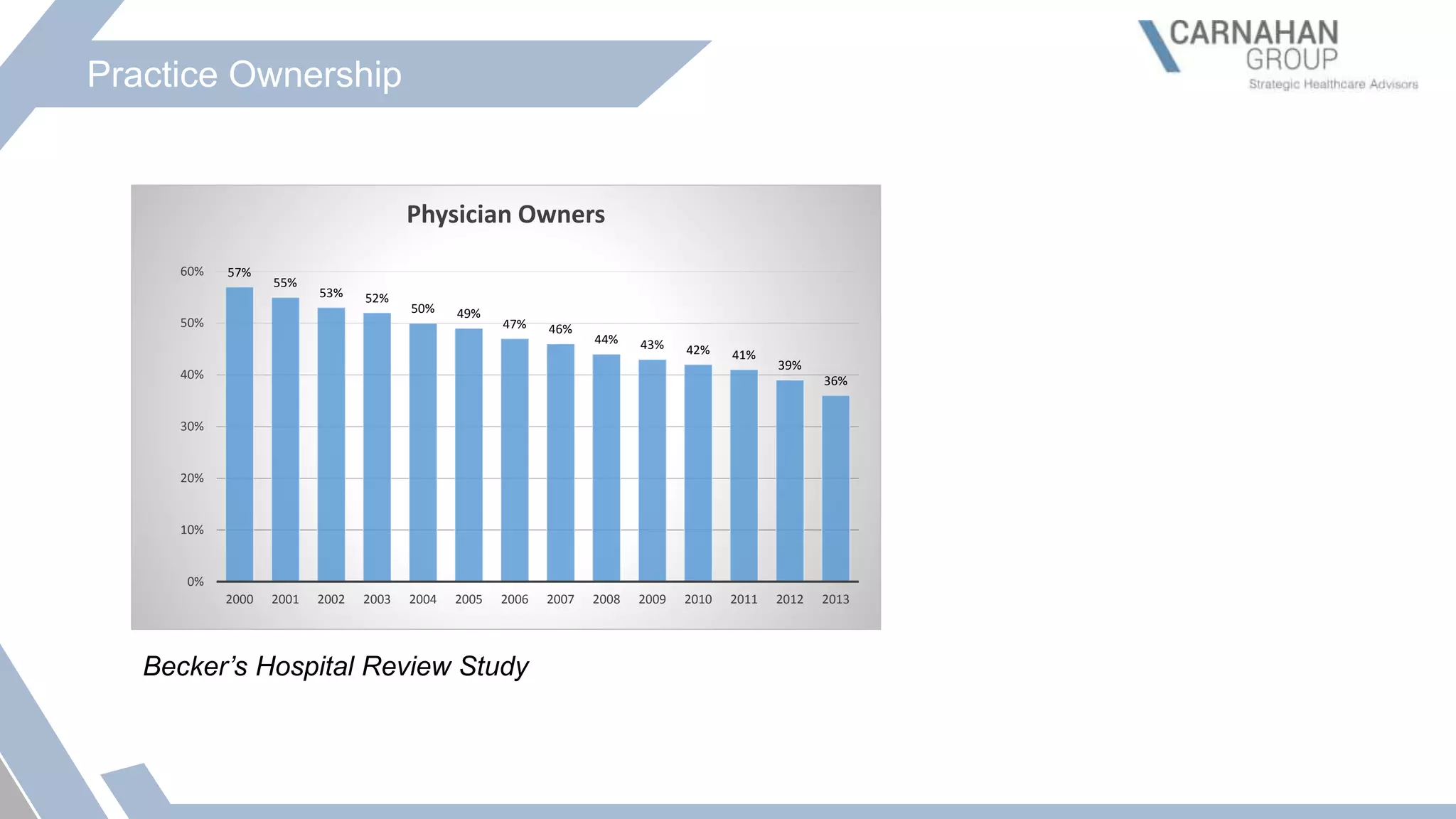
Practice Ownership
57%
55%
53% 52%
50% 49%
47% 46%
44% 43% 42% 41%
39%
36%
0%
10%
20%
30%
40%
50%
60%
2000 2001 2002 2003 2004 2005 2006 2007 2008 2009 2010 2011 2012 2013
Physician Owners
Becker’s Hospital Review Study
Practice Ownership, Cont’d
• 81% physicians overextended
• 44% plan on reducing workload (part-time, retire, only accept
establish patients)
62%
38%
25%
49%
44%
17%
35%
53%
0%
10%
20%
30%
40%
50%
60%
70%
SOLO PRACTICE INDEPENDENT PRACTICE
OWNER
EMPLOYEE OF
HOSPITAL/MEDICAL GROUP
2008
2012
2014
2014 Survey of America’s Physicians: Practice Patterns
and Perspectives
Future of the Physicians
59.7%
16.9%
7.5%
7.4%
4.3%
4.0%
3.3%
3.2%
2.9%
2.4%
1.7%
CONTINUE PRACTICING AS THEY DO NOW
RETIRE
MOVE TO A DIFFERENT PRACTICE
TRANSITION TO A DIRECT-PAY PRACTICE
JOIN AN ACCOUNTABLE CARE ORGANIZATION
MERGE WITH OTHER PRIVATE PRACTICES
BECOME A PATIENT-CENTERED MEDICAL HOME
CLOSE THEIR PRACTICE
LEAVE THEIR PRACTICE TO BECOME HOSPITAL EMPLOYED
GO INTO SOLO PRACTICE
SELL THEIR PRACTICE AND BECOME AN HOSPITAL EMPLOYEE
Independent Physicians' Plans
Physicians Practice’s 2015 Great American Physician Survey
Top Mergers in 2015
Hospitals and Systems:
• Care New England and Southcoast Health – creating
8-hospital system
• Prime Healthcare paying $62 million to acquire Saint
Michael’s Medical Center in Newark, NJ
• AtlantiCare joins the Geisinger Health System
• Tenet Healthcare sells Central Carolina Hospital and
Frye Regional Medical Center to Duke LifePoint; five
Atlanta market facilities to WellStar
• HCA takes over 14 urgent care centers in Las Vegas
• Joint venture between Tenet Healthcare’s Brookwood
Medical Center and four (4) Baptist Health System
hospitals in Alabama
• Baptist Health South Florida to merge with Bethesda
Health by 2017
Top Mergers in 2015, Cont’d
Pharmacy:
• Pfizer and Allergan are talking about merging to rival
Johnson & Johnson and Novartis. Pfizer already bought
Hospira this year. Allergan merged with Actavis in March
2015
Drug stores:
• Walgreens buying Rite Aid for $17 billion – leaving only CVS
and Walgreens on the market. Rite Aid bought EnvisionRx
this year. CVS bought Omnicare
Insurance and finance market:
• Currently UnitedHealth is the biggest one: Cigna-Anthem
merger may surpass UH
• Aetna and Humana are planning on merging as well ($37
billion), which would leave only 3 big players
• Capital One took over GE Capital healthcare finance unit
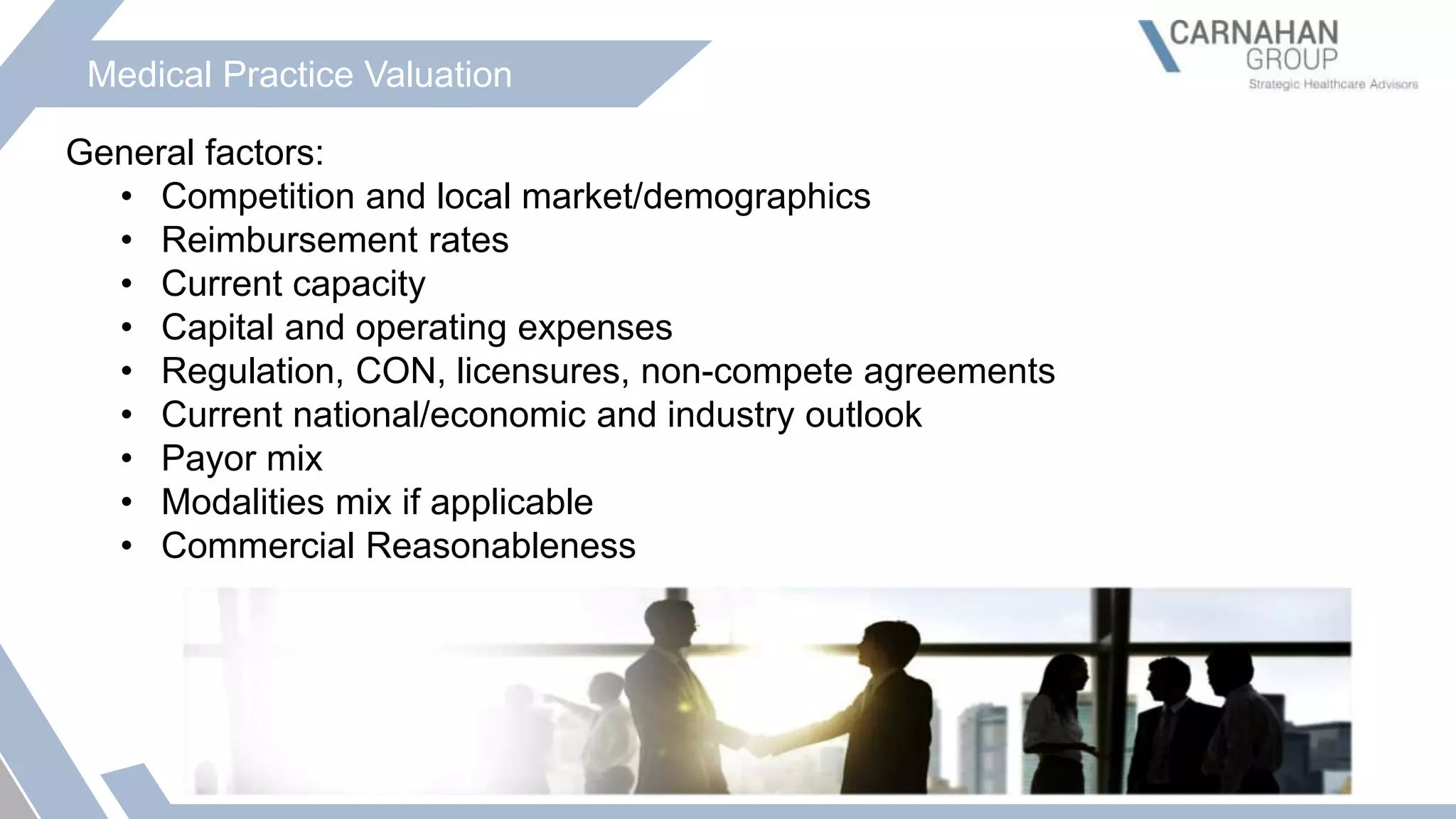
Medical Practice Valuation
General factors:
• Competition and local market/demographics
• Reimbursement rates
• Current capacity
• Capital and operating expenses
• Regulation, CON, licensures, non-compete agreements
• Current national/economic and industry outlook
• Payor mix
• Modalities mix if applicable
• Commercial Reasonableness
Issues in Medical Practice Valuation
• Can’t take in consideration volume or value of referrals
• What parts of the practice are part of the transaction?
• Full practice?
• Or just ancillaries?
• Post-acquisition employment/compensation must be
considered:
• Under PSA
• Under employment model
• Derby vs. Commissioner
Selecting Valuation Approach
Valuations typically use:
• Historical information (the Market Approach) and
projections (the Income Approach);
• Both are forward-looking approaches to value
The multiples applied should also reflect expectations for the
company in comparison with expectations for the market.
However, overall over 95% transactions are done based on an
Asset Approach.
Income Approach
Income Approach estimates the future cash flows based on
historical financial information, with expectations for changes in
reimbursement or volume included in the projections of future
cash flows.
• While the true fair market value of the facility can be
determined only by actual arm's length negotiations,
absent such negotiations, the Income Approach is
considered a reasonable and commonly used approach
by appraisers of medical practices
Discounted Cash-Flow methodology: projected cash flows of
the business, discounted back to present value at the discount
rate.
• Cash flow equals net income plus depreciation and
amortization, minus capital expenditures and incremental
working capital
Income Approach, Cont’d
Other commonly used methodology - Capitalized Earnings Method
• Evaluates the present value of the future economic benefits
that accrue to the investors in a business; however, these
benefits, or future cash flows, are capitalized at a rate of
return that is commensurate with the company’s risk
• This present value determines the fair market value of a
business.
• The capitalization of earnings method determines value
based on three factors: a risk adjusted rate of interest,
typically the company’s cost of equity, a terminal growth rate
and a normalized level of earnings.
• The normalized level of earnings is multiplied by the
capitalization factor, defined as the inverse of the cost of
equity less the terminal growth rate, resulting in the indication
of value.
Income Approach, Cont’d
Cost of Equity: Ke = Rf + (β * RPm) + RPi + RPh + RPs + RPu
Rf = Rate of return on a risk-free security
β = Industry Beta
RPm = Risk premium for the market
RPi = Risk premium for the industry
RPh = Risk premium for healthcare facilities
RPs = Risk premium for small stocks over and above
RPm (small capitalization stock risk premium)
RPu = Risk premium for unsystematic risk attributable to
the specific company (company specific risk premium)
Income Approach, Cont’d
Weighted Average Cost of Capital:
• Calculate tax-adjusted cost of debt: pre-tax rate * (1 – income
tax rate)
• Calculated cost of equity
• Obtain current or projected/estimated capital structure between
equity and debt
Calculate weighted average: (cost of debt * % capital structure) + (cost
of equity * % capital structure)
• Commonly used for financed projects
• Cost of financing the capital = price tag of the investment
Income Approach, Cont’d
General Assumptions:
• Effective federal tax rate - the blended state and federal income
tax rate applicable to businesses operating in a particular state
• Discount rate – most often equity cost of capital or WACC
• Constant growth rate (for perpetuity) - the rate that operating
revenues and expenses are expected to grow after Year 5 of the
projections and into perpetuity
• Capital expenditures annually/projected growth rate
• Inflation rate – the estimated rate of inflation as reported by CPI
• Pre-compensation earnings percentage
Income Approach, Cont’d
Revenue Assumptions:
• Projected revenues based on volume, productivity, and
reimbursement/collections
Expense Assumptions:
• Employee salaries, plus taxes, and benefits
• Occupancy costs
• Medical supplies
• All other variable and fixed expenses (i.e. insurance, G&A, etc.)
• Provider compensation, taxes, and benefits – VERY IMPORTANT
• Capital expenditures and depreciation/amortization
• Working capital projections
Ancillary Services
Ancillary services:
• Auxiliary or supplemental services used to support diagnosis
and treatment of a patient’s condition. Billed separately, but often
directly related to the provision of professional services
(technical component – TC) – meant to cover the use of
physician’s/hospital’s equipment, supplies, and facilities when
treating a patient.
• Some of the most common ancillary services include:
• Diagnostic Laboratory
• Nuclear Medicine (imaging)
• Radiology (x-rays and imaging – CT, MRI, PET)
• Radiation Oncology (cancer care)
Value of Ancillary Services
Determining the value of ancillary services:
• Revenue considerations and trends
• Cost inputs
• Net earnings levels
How should the net earnings from ancillary services be treated in
compensation and business valuation?
• Element of physician compensation?
• Business owner compensation or return on investment?
• Other positions?
Market Approach
Market Approach computes value by comparing the value of similar
businesses that trade in the open market.
• In the market approach, estimates of value are established using:
• Guideline publicly traded company method: an indication of
value is developed by comparing the financial condition and
operating performance of the company being appraised with
those of other companies in the same or similar lines of business
and/or thought to be subject to similar economic risks and
environmental and political factors.
• Guideline transaction method: used to estimate the value of the
subject company if sufficient information regarding sales of
whole companies that are similar in nature to the company
appraised can be compiled.
Market Approach, Cont’d
Market value is then adjusted for:
• Qualitative and quantitative differences
• MVIC/EBITDA most commonly used
The ideal application of the Transaction Method would be to obtain
information regarding an exact contract relating to the sale of a
practice between unrelated parties. Unfortunately, obtaining such
information is typically quite difficult as these transactions are often
private as most facilities are not willing to (or are legally bound not to)
divulge information regarding their contracts.
Market Approach, Cont’d
Other issues to consider when using Market Approach:
• Stark Regulation - the prices involved in M&A transactions are
generally at an investment level, which is specific to a particular
buyer. If enough information is not available in the transaction to
determine FMV, which considers the price to a “hypothetical”
buyer, investment value cannot be ruled out. Consequently,
discounting the “synergistic” premium is highly speculative and
controversial
• The database transaction price may involve purchasing some
other non-cash consideration. When the FMV standard is
required, cash or cash-equivalent value is required. Appropriate
adjustments have to be made to the transaction (obtain sufficient
database descriptions of each individual transaction or sufficient
numbers to apply a statistical measure).
Asset Approach
Asset/Cost Approach identifies the cost to replicate a business or to
accumulate, and place in service, the assets necessary to operate a
business.
• The Asset or underlying Cost Approach is based on the economic
principal of substitution in that any willing buyer would be willing to
pay no more for an asset than the price that would be necessary to
obtain, such an asset elsewhere in the market place.
• Only used if Income and Market Approach both yield lower value -
the indicative value usually presents a floor, or minimum value, but
may still include intangible assets, such as certificates of need, etc.
Asset Approach, Cont’d
The Cost Approach is based on a comparison between the cost to
develop the assets and the value of the existing assets. As a result,
consideration of which premise of value to apply to the valuation should
be applied. This decision is made upon the determination of the highest
and best use of the asset subject to the valuation.
• Premises of value for consideration include:
• Value in Continued Use, as Part of a Going Concern – assumes that
the assets are sold in an assemblage of assets and as part of an
income producing business enterprise.
• The premise of continued use contemplates the mutually
synergistic relationships of (1) the company’s tangible assets to the
intangible assets and (2) the company’s intangible assets to the
tangible assets.
Asset Approach, Cont’d
Value in Place, as part of a Mass Assemblage of Assets – assumes that
the assets are sold as a mass assemblage and are capable of being, but
are not operating, as an income producing business enterprise.
• The premise of value in place contemplates some of the mutual
contributory value of (1) the company’s tangible assets to the
intangible assets and (2) the company’s intangible assets to the
tangible assets. However, a component of the value in place is that
this premise may exclude some of the contributory value of
intangible including trained and assembled workforce, going
concern value and goodwill.
Asset Approach, Cont’d
• Value in Exchange, in an Orderly Disposition – assumes that the assets
are sold piecemeal, and not as part of a mass assemblage, and that
the assets are given an adequate level of exposure in their normal
secondary market. The premise of value in exchange does not
contemplate any contributory value effect of the subject tangible assets
on the intangible assets.
• Value in Exchange, Forced Liquidation – assumes that the assets are
sold piecemeal and not part of a mass assemblage. Also assumes the
assets are not allowed a normal level of exposure to their normal
secondary market. Due to the forced liquidation market transaction, this
premise assumes no contributory value from the subject tangible
assets to the intangible assets, or vice versa.
Asset Approach, Cont’d
Within the Cost Approach there are several related methods which include
(1) reproduction cost and (2) replacement costs that should be
considered. The costs below should include direct and indirect costs as
well as any form of obsolescence.
• Reproduction Cost – Contemplates total cost construction of the
exact replica of the subject assets using current prices.
• Replacement Cost – Contemplates the cost to recreate the
functionality or utility of the subject assets.
Factors for asset approach:
• Components of the transaction (tangible vs. intangible assets)
• Lease (operating or capital) or direct buy-out, etc.
• MSO model
Asset Approach, Cont’d
Components of the transaction involve certain tangible and intangible
assets:
• Fixed assets
• Inventory/supplies
• Accounts receivable
• Assembled workforce
• Medical charts (paper or electronic format)
• Trade name
• Phone number or website
• Other intellectual property
Physician Compensation
Physician’s compensation:
• Salary/draw – non-owner and owner physicians
• Profit/distribution – owner physicians only; includes return on
tangible and intangible assets:
• Net working capital
• Fixed assets
• Trained workforce
• TC component for ancillary services (in excess of fixed asset
return)
• Contract rights
• Goodwill
• Patient charts
Issues in Compensation Valuations
Compensation of physicians based on PSA or employment:
• Can we apply the same structure?
• Employed physician not permitted to be compensated for ancillaries
• If compensating based on productivity, do we use wRVUs?
Collections? Or shifting towards quality incentives, value based or
bundled payment models?
• Value or volume of referrals cannot be considered
• Is this a part of acquisition? Compensation after transaction must be
applied to income approach: Debry vs. Commissioner
Issues in Compensation Valuations, Cont’d
Market survey data:
• Should the data be adjusted? If so, how?
Per 2015 MGMA report, certain specialties showed total compensation
well above the mean due to inclusion of ancillary services income.
• Compensation Level of Ancillary Revenue for all practices: non-
invasive cardiology, ophthalmology, general orthopedic surgery + all
subspecialties, ENT, pulmonary medicine, diagnostic radiology, and
neurosurgery
• Compensation Level of Ancillary Revenue for physician-owned
practices: invasive-interventional cardiology, non-invasive
cardiology, hematology/oncology, ophthalmology, general
orthopedic surgery + certain subspecialties, ENT, pulmonary
medicine, pyschiatry, diagnostic radiology, and neurosurgery
Issues in Compensation Valuations, Cont’d
• Commercial Reasonableness – departure from strict FMV
• Investment value in transactions
• Tainted market values (i.e., lithotripsy)
• Opportunity cost for physicians – not a viable methodology
• Per-click arrangements
• National versus local market rates
Questions?
Valuing Physician Practices

Valuing Physician Practices

  • 1.
    Valuing Physician Practices December6, 2016 Phone: 813.289.2588
  • 2.
    Instructor Bio Chris Carnahanhas over 25 years of experience in healthcare and finance. He has held executive level positions in healthcare, technology, and manufacturing. Mr. Carnahan is the founder of Carnahan Group, Inc., and is responsible for the leadership, strategic direction, and financial matters of the firm. Mr. Carnahan has been involved in hundreds of medical staff demand analyses for not-for- profit and for-profit entities, including modeling demand and supply analysis for healthcare services within diverse communities. During his career, Mr. Carnahan has been involved in over 1,500 healthcare transactions, including physician compensation arrangements, acquisitions, fair market value opinions, asset appraisals, and provided expert testimony. Mr. Carnahan has presented numerous times to some of the largest healthcare systems in the world on the topics of community health needs assessments, medical staff demand analyses, valuations, and healthcare strategy. He is also an instructor for the National Association of Certified Valuators and Analysts (NACVA) in the area of healthcare valuations. In 2010, Mr. Carnahan received the Certificate of Achievement for an Instructor of Great Distinction by NACVA. Mr. Carnahan is a licensed Certified Public Accountant (CPA) in Florida, a Certified Valuation Analyst (CVA), accredited in Business Valuations (ABV), certified in Financial Forensics (CFF), a Master Analyst in Financial Forensics (MAFF), Chartered Global Management Accountant (CARNAHAN GROUPMA), and Small Business Administration (SBA). He is also a member of the American Institute of Certified Public Accountants (AICPA), a member of the National Association of Certified Valuators and Analysts (NACVA), a section member of the AICPA’s Valuation and Forensic Services. Mr. Carnahan has presented and published articles on physician acquisitions and has testified as an expert witness in various venues and jurisdictions. In addition to Mr. Carnahan’s healthcare experience, in 2015 he established Carnahan Advisors, a forensics, accounting and litigation support firm for family law cases. His responsibilities include providing expert testimony and opinions, reviewing clients’ financial affidavits, analyzing equitable distribution and child support guidelines, and preparing court documents for clients and his employees, all in the area of financial matters.
  • 3.
    Agenda • FMV inHealthcare • Regulation • Current Trends and Marketplace • Medical Practice Valuation and Related Issues • Selecting the Right Approach • Income, Market, and Asset Approach • Physician Compensation • Issues in Valuing Physician Compensation
  • 4.
    FMV in Healthcare Whyare FMV standards needed in Healthcare? • “To protect patients and the federal health care programs from fraud and abuse by curtailing the corrupting influence of money on health care decisions.” Governing bodies: • Office of the Inspector General (OIG) • Department of Health and Human Services (HHS) Standards: • Anti-Kickback Statute • Stark law • IRS’s regulations
  • 5.
    Stark Law Stark law:generally prohibits physicians from making designated health service referrals to organizations with which those physicians (or an immediate family member) have a financial relationship, unless an exception under the law applies. This includes physician referrals to his/her own medical practice where the following circumstances are present: • A physician delivers services through the medical practice; • The medical practice furnishes designated health services that may be payable by Medicare making the medical practice a Designated Health Services (DHS) entity; • The physician has a financial relationship with the medical practice; and • The physician makes referrals to the medical practice for the furnishing of DHS.
  • 6.
    In-Office Ancillary Exception Physiciansand medical practices rely on the Stark law’s in-office ancillary services exception and physician services exceptions to allow "within-practice" DHS referrals. Of these, the in-office ancillary services exception is used most frequently as it allows physicians in medical practices to: • Make referrals for certain DHS within the medical practice; • Furnish those DHS to practice patients; • Bill Medicare and Medicaid for the services; and • Retain and use the revenues earned from providing the services within the group for payment of practice expenses and physician compensation. These exceptions are therefore of significant importance to a medical practice’s internal activities.
  • 7.
    Anti-Kickback Statute Criminal statutethat prohibits the exchange (or offer to exchange), of anything of value, in an effort to induce (or reward) the referral of federal health care program business. • Anyone who “knowingly and willfully offers, pays, solicits, or receives remuneration in order to induce business reimbursed under the Medicare or Medicaid programs.” • Charges and payments are not based on value or volume of referrals or other business generated by the parties that is covered by Medicare or Medicaid. • Issued by OIG, although originally enacted by SSA in 1972.
  • 8.
    Anti-Kickback Statute, Cont’d Safeharbor regulations: payment and business practices that, although potentially implicating the statute, are not treated as offenses under the statute: • Investment interest: 40% rule • Space and equipment rental – FMV-based • Personal services and management contracts • Sale of practice • Referral services • Warranties • Discounts • Employees, etc.
  • 9.
    Patient Protection andAffordable Care Act Patient Protection and Affordable Care Act (PPACA) – healthcare reform legislation; passed by the 111th Congress and signed into law by President Barack Obama in March 2010. Key provisions: • Extends coverage to millions uninsured people – provides affordable healthcare with no-cost preventive services; • Implements measures to lower healthcare costs while improving efficiencies; • Eliminates some of the previous industry practices, such as rescission of insurance policies and denial of coverage due to pre-existing conditions; • Eliminates annual and lifetime limits on coverage and benefits • Make insurance companies responsible for keeping administrative costs down; and • Shared responsibility for patients (avoiding minimum coverage will result in penalties).
  • 10.
    Current Trends inHealthcare Physicians are concerned and evaluating whether to remain independent, align themselves with a major hospital or system, or sell their practice and become employed. • Raising costs to run the practices – supplies, technology, employees • Meaningful Use – incentives end and working capital is required • Uncertainty around PPACA – payments, delivery system • Networks are becoming narrow – hospital alignment can help • Concerns regarding aging population, physician shortages • Volume-based reimbursement and productivity-based compensation will be succeeded by value based/bundled payments Physicians initiate majority of acquisitions.
  • 11.
    Current Trends inHealthcare, Cont’d Hospitals acquire mostly primary care practices, followed by cardiology, orthopedics, general surgery, endocrinology, gastroenterology, urology and oncology practices. What motivates hospitals? • Increase service area and market share • Expand current capabilities in certain specialty areas • Meet community need • Insurance-driven motives • Increase efficiencies and alignment Hospitals are not the only ones involved in M&A’s; recently insurance companies and managed-care organizations are getting involved.
  • 12.
    Current Trends inHealthcare, Cont’d January through May 2015: acquisition volume reached $241 billion Shift toward: • Vertical acquisitions (non-acute-care facilities – clinics, physician practices); 74% of total provider acquisitions volume and are expected to climb to 84% in 2018 • Digital acquisitions (buying companies focused on sensors, mobility, analytics/cloud capabilities) – projected to reach 8% in 2018 Hospital acquisitions are on the decline – 32% in 2006 to 21% in 2014. Expected to drop to 6% in 2018.
  • 13.
    Current Trends inHealthcare, Cont’d Management Services Organization (MSO) model – physician remains independent while MSO owns the assets and provides key management services (staff, billing and collections, accounting, equipment) Accountable Care Organizations (ACO) - groups of doctors, hospitals, and other health care providers, who come together voluntarily to give coordinated high quality care to their Medicare patients. • The goal of coordinated care is to ensure that patients, especially the chronically ill, get the right care at the right time, while avoiding unnecessary duplication of services and preventing medical errors. • When an ACO succeeds both in delivering high-quality care and spending health care dollars more wisely, it will share in the savings it achieves for the Medicare program.
  • 14.
    Market Place Trends 637 752 560 580 600 620 640 660 680 700 720 740 760 780 20132014 Healthcare M&A deals 2013 v. 2014 52.7 62 48 50 52 54 56 58 60 62 64 2013 2014 Value (billions) 2015 Health Care Services Acquisition Report
  • 15.
    Integrated Issues afterM&A Although the intent of the merger is increasing quality of care while using efficiencies to decrease costs, quality often does not improve. • Cost of care typically increases • Integration-often external, but not internal • Random collection of hospital and physician groups • Lack of metrics to evaluate successful integration • Risk of violating anti-trust laws • Culture clash
  • 16.
    Practice Ownership 57% 55% 53% 52% 50%49% 47% 46% 44% 43% 42% 41% 39% 36% 0% 10% 20% 30% 40% 50% 60% 2000 2001 2002 2003 2004 2005 2006 2007 2008 2009 2010 2011 2012 2013 Physician Owners Becker’s Hospital Review Study
  • 17.
    Practice Ownership, Cont’d •81% physicians overextended • 44% plan on reducing workload (part-time, retire, only accept establish patients) 62% 38% 25% 49% 44% 17% 35% 53% 0% 10% 20% 30% 40% 50% 60% 70% SOLO PRACTICE INDEPENDENT PRACTICE OWNER EMPLOYEE OF HOSPITAL/MEDICAL GROUP 2008 2012 2014 2014 Survey of America’s Physicians: Practice Patterns and Perspectives
  • 18.
    Future of thePhysicians 59.7% 16.9% 7.5% 7.4% 4.3% 4.0% 3.3% 3.2% 2.9% 2.4% 1.7% CONTINUE PRACTICING AS THEY DO NOW RETIRE MOVE TO A DIFFERENT PRACTICE TRANSITION TO A DIRECT-PAY PRACTICE JOIN AN ACCOUNTABLE CARE ORGANIZATION MERGE WITH OTHER PRIVATE PRACTICES BECOME A PATIENT-CENTERED MEDICAL HOME CLOSE THEIR PRACTICE LEAVE THEIR PRACTICE TO BECOME HOSPITAL EMPLOYED GO INTO SOLO PRACTICE SELL THEIR PRACTICE AND BECOME AN HOSPITAL EMPLOYEE Independent Physicians' Plans Physicians Practice’s 2015 Great American Physician Survey
  • 19.
    Top Mergers in2015 Hospitals and Systems: • Care New England and Southcoast Health – creating 8-hospital system • Prime Healthcare paying $62 million to acquire Saint Michael’s Medical Center in Newark, NJ • AtlantiCare joins the Geisinger Health System • Tenet Healthcare sells Central Carolina Hospital and Frye Regional Medical Center to Duke LifePoint; five Atlanta market facilities to WellStar • HCA takes over 14 urgent care centers in Las Vegas • Joint venture between Tenet Healthcare’s Brookwood Medical Center and four (4) Baptist Health System hospitals in Alabama • Baptist Health South Florida to merge with Bethesda Health by 2017
  • 20.
    Top Mergers in2015, Cont’d Pharmacy: • Pfizer and Allergan are talking about merging to rival Johnson & Johnson and Novartis. Pfizer already bought Hospira this year. Allergan merged with Actavis in March 2015 Drug stores: • Walgreens buying Rite Aid for $17 billion – leaving only CVS and Walgreens on the market. Rite Aid bought EnvisionRx this year. CVS bought Omnicare Insurance and finance market: • Currently UnitedHealth is the biggest one: Cigna-Anthem merger may surpass UH • Aetna and Humana are planning on merging as well ($37 billion), which would leave only 3 big players • Capital One took over GE Capital healthcare finance unit
  • 21.
    Medical Practice Valuation Generalfactors: • Competition and local market/demographics • Reimbursement rates • Current capacity • Capital and operating expenses • Regulation, CON, licensures, non-compete agreements • Current national/economic and industry outlook • Payor mix • Modalities mix if applicable • Commercial Reasonableness
  • 22.
    Issues in MedicalPractice Valuation • Can’t take in consideration volume or value of referrals • What parts of the practice are part of the transaction? • Full practice? • Or just ancillaries? • Post-acquisition employment/compensation must be considered: • Under PSA • Under employment model • Derby vs. Commissioner
  • 23.
    Selecting Valuation Approach Valuationstypically use: • Historical information (the Market Approach) and projections (the Income Approach); • Both are forward-looking approaches to value The multiples applied should also reflect expectations for the company in comparison with expectations for the market. However, overall over 95% transactions are done based on an Asset Approach.
  • 24.
    Income Approach Income Approachestimates the future cash flows based on historical financial information, with expectations for changes in reimbursement or volume included in the projections of future cash flows. • While the true fair market value of the facility can be determined only by actual arm's length negotiations, absent such negotiations, the Income Approach is considered a reasonable and commonly used approach by appraisers of medical practices Discounted Cash-Flow methodology: projected cash flows of the business, discounted back to present value at the discount rate. • Cash flow equals net income plus depreciation and amortization, minus capital expenditures and incremental working capital
  • 25.
    Income Approach, Cont’d Othercommonly used methodology - Capitalized Earnings Method • Evaluates the present value of the future economic benefits that accrue to the investors in a business; however, these benefits, or future cash flows, are capitalized at a rate of return that is commensurate with the company’s risk • This present value determines the fair market value of a business. • The capitalization of earnings method determines value based on three factors: a risk adjusted rate of interest, typically the company’s cost of equity, a terminal growth rate and a normalized level of earnings. • The normalized level of earnings is multiplied by the capitalization factor, defined as the inverse of the cost of equity less the terminal growth rate, resulting in the indication of value.
  • 26.
    Income Approach, Cont’d Costof Equity: Ke = Rf + (β * RPm) + RPi + RPh + RPs + RPu Rf = Rate of return on a risk-free security β = Industry Beta RPm = Risk premium for the market RPi = Risk premium for the industry RPh = Risk premium for healthcare facilities RPs = Risk premium for small stocks over and above RPm (small capitalization stock risk premium) RPu = Risk premium for unsystematic risk attributable to the specific company (company specific risk premium)
  • 27.
    Income Approach, Cont’d WeightedAverage Cost of Capital: • Calculate tax-adjusted cost of debt: pre-tax rate * (1 – income tax rate) • Calculated cost of equity • Obtain current or projected/estimated capital structure between equity and debt Calculate weighted average: (cost of debt * % capital structure) + (cost of equity * % capital structure) • Commonly used for financed projects • Cost of financing the capital = price tag of the investment
  • 28.
    Income Approach, Cont’d GeneralAssumptions: • Effective federal tax rate - the blended state and federal income tax rate applicable to businesses operating in a particular state • Discount rate – most often equity cost of capital or WACC • Constant growth rate (for perpetuity) - the rate that operating revenues and expenses are expected to grow after Year 5 of the projections and into perpetuity • Capital expenditures annually/projected growth rate • Inflation rate – the estimated rate of inflation as reported by CPI • Pre-compensation earnings percentage
  • 29.
    Income Approach, Cont’d RevenueAssumptions: • Projected revenues based on volume, productivity, and reimbursement/collections Expense Assumptions: • Employee salaries, plus taxes, and benefits • Occupancy costs • Medical supplies • All other variable and fixed expenses (i.e. insurance, G&A, etc.) • Provider compensation, taxes, and benefits – VERY IMPORTANT • Capital expenditures and depreciation/amortization • Working capital projections
  • 30.
    Ancillary Services Ancillary services: •Auxiliary or supplemental services used to support diagnosis and treatment of a patient’s condition. Billed separately, but often directly related to the provision of professional services (technical component – TC) – meant to cover the use of physician’s/hospital’s equipment, supplies, and facilities when treating a patient. • Some of the most common ancillary services include: • Diagnostic Laboratory • Nuclear Medicine (imaging) • Radiology (x-rays and imaging – CT, MRI, PET) • Radiation Oncology (cancer care)
  • 31.
    Value of AncillaryServices Determining the value of ancillary services: • Revenue considerations and trends • Cost inputs • Net earnings levels How should the net earnings from ancillary services be treated in compensation and business valuation? • Element of physician compensation? • Business owner compensation or return on investment? • Other positions?
  • 32.
    Market Approach Market Approachcomputes value by comparing the value of similar businesses that trade in the open market. • In the market approach, estimates of value are established using: • Guideline publicly traded company method: an indication of value is developed by comparing the financial condition and operating performance of the company being appraised with those of other companies in the same or similar lines of business and/or thought to be subject to similar economic risks and environmental and political factors. • Guideline transaction method: used to estimate the value of the subject company if sufficient information regarding sales of whole companies that are similar in nature to the company appraised can be compiled.
  • 33.
    Market Approach, Cont’d Marketvalue is then adjusted for: • Qualitative and quantitative differences • MVIC/EBITDA most commonly used The ideal application of the Transaction Method would be to obtain information regarding an exact contract relating to the sale of a practice between unrelated parties. Unfortunately, obtaining such information is typically quite difficult as these transactions are often private as most facilities are not willing to (or are legally bound not to) divulge information regarding their contracts.
  • 34.
    Market Approach, Cont’d Otherissues to consider when using Market Approach: • Stark Regulation - the prices involved in M&A transactions are generally at an investment level, which is specific to a particular buyer. If enough information is not available in the transaction to determine FMV, which considers the price to a “hypothetical” buyer, investment value cannot be ruled out. Consequently, discounting the “synergistic” premium is highly speculative and controversial • The database transaction price may involve purchasing some other non-cash consideration. When the FMV standard is required, cash or cash-equivalent value is required. Appropriate adjustments have to be made to the transaction (obtain sufficient database descriptions of each individual transaction or sufficient numbers to apply a statistical measure).
  • 35.
    Asset Approach Asset/Cost Approachidentifies the cost to replicate a business or to accumulate, and place in service, the assets necessary to operate a business. • The Asset or underlying Cost Approach is based on the economic principal of substitution in that any willing buyer would be willing to pay no more for an asset than the price that would be necessary to obtain, such an asset elsewhere in the market place. • Only used if Income and Market Approach both yield lower value - the indicative value usually presents a floor, or minimum value, but may still include intangible assets, such as certificates of need, etc.
  • 36.
    Asset Approach, Cont’d TheCost Approach is based on a comparison between the cost to develop the assets and the value of the existing assets. As a result, consideration of which premise of value to apply to the valuation should be applied. This decision is made upon the determination of the highest and best use of the asset subject to the valuation. • Premises of value for consideration include: • Value in Continued Use, as Part of a Going Concern – assumes that the assets are sold in an assemblage of assets and as part of an income producing business enterprise. • The premise of continued use contemplates the mutually synergistic relationships of (1) the company’s tangible assets to the intangible assets and (2) the company’s intangible assets to the tangible assets.
  • 37.
    Asset Approach, Cont’d Valuein Place, as part of a Mass Assemblage of Assets – assumes that the assets are sold as a mass assemblage and are capable of being, but are not operating, as an income producing business enterprise. • The premise of value in place contemplates some of the mutual contributory value of (1) the company’s tangible assets to the intangible assets and (2) the company’s intangible assets to the tangible assets. However, a component of the value in place is that this premise may exclude some of the contributory value of intangible including trained and assembled workforce, going concern value and goodwill.
  • 38.
    Asset Approach, Cont’d •Value in Exchange, in an Orderly Disposition – assumes that the assets are sold piecemeal, and not as part of a mass assemblage, and that the assets are given an adequate level of exposure in their normal secondary market. The premise of value in exchange does not contemplate any contributory value effect of the subject tangible assets on the intangible assets. • Value in Exchange, Forced Liquidation – assumes that the assets are sold piecemeal and not part of a mass assemblage. Also assumes the assets are not allowed a normal level of exposure to their normal secondary market. Due to the forced liquidation market transaction, this premise assumes no contributory value from the subject tangible assets to the intangible assets, or vice versa.
  • 39.
    Asset Approach, Cont’d Withinthe Cost Approach there are several related methods which include (1) reproduction cost and (2) replacement costs that should be considered. The costs below should include direct and indirect costs as well as any form of obsolescence. • Reproduction Cost – Contemplates total cost construction of the exact replica of the subject assets using current prices. • Replacement Cost – Contemplates the cost to recreate the functionality or utility of the subject assets. Factors for asset approach: • Components of the transaction (tangible vs. intangible assets) • Lease (operating or capital) or direct buy-out, etc. • MSO model
  • 40.
    Asset Approach, Cont’d Componentsof the transaction involve certain tangible and intangible assets: • Fixed assets • Inventory/supplies • Accounts receivable • Assembled workforce • Medical charts (paper or electronic format) • Trade name • Phone number or website • Other intellectual property
  • 41.
    Physician Compensation Physician’s compensation: •Salary/draw – non-owner and owner physicians • Profit/distribution – owner physicians only; includes return on tangible and intangible assets: • Net working capital • Fixed assets • Trained workforce • TC component for ancillary services (in excess of fixed asset return) • Contract rights • Goodwill • Patient charts
  • 42.
    Issues in CompensationValuations Compensation of physicians based on PSA or employment: • Can we apply the same structure? • Employed physician not permitted to be compensated for ancillaries • If compensating based on productivity, do we use wRVUs? Collections? Or shifting towards quality incentives, value based or bundled payment models? • Value or volume of referrals cannot be considered • Is this a part of acquisition? Compensation after transaction must be applied to income approach: Debry vs. Commissioner
  • 43.
    Issues in CompensationValuations, Cont’d Market survey data: • Should the data be adjusted? If so, how? Per 2015 MGMA report, certain specialties showed total compensation well above the mean due to inclusion of ancillary services income. • Compensation Level of Ancillary Revenue for all practices: non- invasive cardiology, ophthalmology, general orthopedic surgery + all subspecialties, ENT, pulmonary medicine, diagnostic radiology, and neurosurgery • Compensation Level of Ancillary Revenue for physician-owned practices: invasive-interventional cardiology, non-invasive cardiology, hematology/oncology, ophthalmology, general orthopedic surgery + certain subspecialties, ENT, pulmonary medicine, pyschiatry, diagnostic radiology, and neurosurgery
  • 44.
    Issues in CompensationValuations, Cont’d • Commercial Reasonableness – departure from strict FMV • Investment value in transactions • Tainted market values (i.e., lithotripsy) • Opportunity cost for physicians – not a viable methodology • Per-click arrangements • National versus local market rates
  • 45.

Editor's Notes

  • #6 http://www.mwe.com/info/pubs/Fair%20Market%20Value%20%20Appraisal%20Practice%20in%20an%20Evolving%20Legal%20Framework.pdf
  • #7 http://www.starkcompliance.com/index.aspx?id=658
  • #8 http://www.starkcompliance.com/index.aspx?id=658
  • #9 http://oig.hhs.gov/compliance/safe-harbor-regulations/
  • #10 https://www.healthinsurance.org/glossary/patient-protection-and-affordable-care-act-ppaca/; https://www.dpc.senate.gov/healthreformbill/healthbill52.pdf
  • #11 http://blog.hornellp.com/healthcare/trends-in-hospital-acquisition-of-physician-practices; http://www.jacksonhealthcare.com/physician-trends/other-articles/2015-report-on-physician-practice-acquisitions/
  • #12 http://www.jacksonhealthcare.com/physician-trends/other-articles/2015-report-on-physician-practice-acquisitions/
  • #13 http://www.beckersspine.com/orthopedic-spine-practices-improving-profits/item/27202-hospitals-turning-to-physician-practice-acquisitions-for-growth-5-key-trends.html; http://media.straffordpub.com/products/structuring-hospital-acquisitions-of-physician-practices-2015-01-29/presentation.pdf
  • #14 http://www.beckersspine.com/orthopedic-spine-practices-improving-profits/item/27202-hospitals-turning-to-physician-practice-acquisitions-for-growth-5-key-trends.html; http://media.straffordpub.com/products/structuring-hospital-acquisitions-of-physician-practices-2015-01-29/presentation.pdf; https://www.cms.gov/Medicare/Medicare-Fee-for-Service-Payment/ACO/index.html?redirect=/Aco
  • #15 http://www.businesswire.com/news/home/20150331006369/en/Newly-Published-Report-2014-Health-Care-Services#.VRv4s-FKZsZ
  • #16 http://www.fiercehealthcare.com/story/are-hospital-mergers-destined-fail/2014-05-05 http://www.fiercehealthcare.com/story/do-healthcare-systems-truly-integrate-after-physician-practice-acquisition/2014-06-10
  • #17 http://www.beckershospitalreview.com/hospital-physician-relationships/42-statistics-on-independent-physicians-from-2000-to-2013.html http://thehealthcareblog.com/blog/2015/04/01/will-independent-physicians-go-extinct/
  • #18 http://www.physiciansfoundation.org/news/survey-of-20000-u.s.-physicians-shows-80-of-doctors-are-over-extended-or-at/
  • #19 http://www.beckersspine.com/orthopedic-spine-practices-improving-profits/item/27172-physician-futures-what-are-physicians-plans-in-the-coming-3-years-11-statistics.html
  • #20 http://money.cnn.com/2015/10/29/investing/health-care-mergers-pfizer-allergan/; http://www.modernhealthcare.com/article/20151201/NEWS/151209987?utm_source=modernhealthcare&utm_medium=email&utm_content=20151201-NEWS-151209987&utm_campaign=am
  • #21 http://money.cnn.com/2015/10/29/investing/health-care-mergers-pfizer-allergan/; http://www.modernhealthcare.com/article/20151201/NEWS/151209987?utm_source=modernhealthcare&utm_medium=email&utm_content=20151201-NEWS-151209987&utm_campaign=am
  • #22 https://www.bvresources.com/pdfs/HC052014/BVR%20-%20HC5.pdf
  • #24 Imaging Center FMV (our webinar) http://www.bvresources.com/pdfs/WB070915/BVR_0709_Physician_Practice.pdf
  • #25 Our FMV Report
  • #26 Our FMV Report
  • #27 Our FMV Report
  • #28 Our FMV Report http://www.wallstreetoasis.com/finance-dictionary/what-is-weighted-average-cost-of-capital-WACC
  • #29 Our FMV Report http://www.wallstreetoasis.com/finance-dictionary/what-is-weighted-average-cost-of-capital-WACC
  • #30 Our FMV Report
  • #31 Definition: http://www.hcsc.com/glossary.html; https://www.bvresources.com/pdfs/HC052014/BVR%20-%20HC5.pdf Types: http://www.va.gov/healthbenefits/access/ancillary_services.asp
  • #32 Anderson/Dietrich/Lloyd: the FMV Problems with Ancillary Services in Valuations of Physician Compensation and Medical Practices (CTI webinar slides)
  • #33 Imaging Center FMV (our webinar)
  • #34 Imaging Center FMV (our webinar) Our FMV Report
  • #35 Our FMV report
  • #36 Imaging Center FMV (our webinar)
  • #37 Valuing a Business: the analysis and appraisal of closely held companies. Pratt, Reilly and Schweihs. 4th Edition. 2000.
  • #38 Valuing a Business: the analysis and appraisal of closely held companies. Pratt, Reilly and Schweihs. 4th Edition. 2000.
  • #39 Valuing a Business: the analysis and appraisal of closely held companies. Pratt, Reilly and Schweihs. 4th Edition. 2000.
  • #40 Valuing a Business: the analysis and appraisal of closely held companies. Pratt, Reilly and Schweihs. 4th Edition. 2000.
  • #41 http://www.bvresources.com/pdfs/WB070915/BVR_0709_Physician_Practice.pdf
  • #42 Anderson/Dietrich/Lloyd: the FMV Problems with Ancillary Services in Valuations of Physician Compensation and Medical Practices (CTI webinar slides)
  • #43 Anderson/Dietrich/Lloyd: the FMV Problems with Ancillary Services in Valuations of Physician Compensation and Medical Practices (CTI webinar slides)
  • #44 Anderson/Dietrich/Lloyd: the FMV Problems with Ancillary Services in Valuations of Physician Compensation and Medical Practices (CTI webinar slides)
  • #45 http://slideplayer.com/slide/241171/
  • #46 http://slideplayer.com/slide/241171/