Valuing Dr. Exit
Valuing a Practice when a Physician Leaves
October 26, 2016
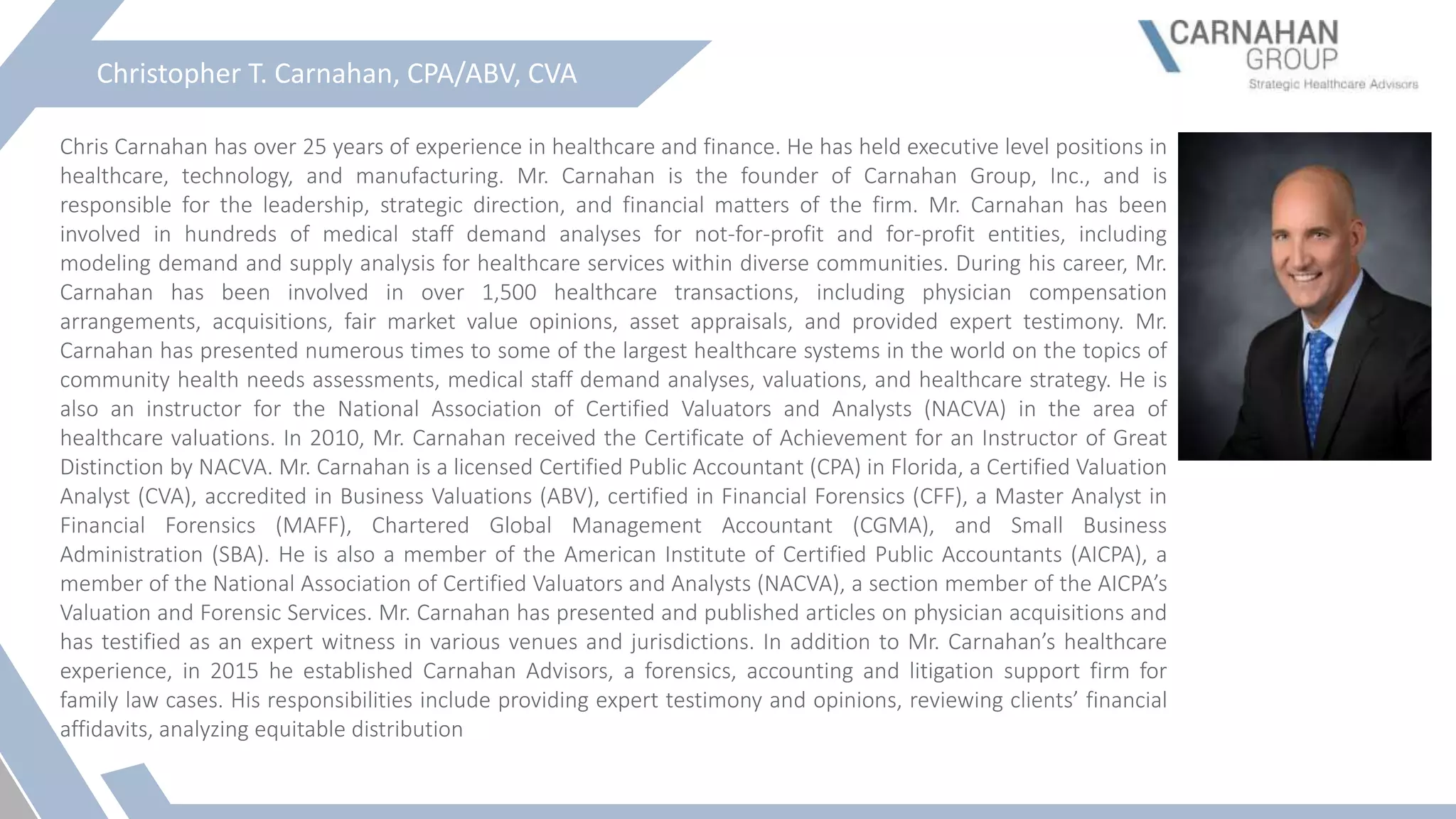
Christopher T. Carnahan, CPA/ABV, CVA
Chris Carnahan has over 25 years of experience in healthcare and finance. He has held executive level positions in
healthcare, technology, and manufacturing. Mr. Carnahan is the founder of Carnahan Group, Inc., and is
responsible for the leadership, strategic direction, and financial matters of the firm. Mr. Carnahan has been
involved in hundreds of medical staff demand analyses for not-for-profit and for-profit entities, including
modeling demand and supply analysis for healthcare services within diverse communities. During his career, Mr.
Carnahan has been involved in over 1,500 healthcare transactions, including physician compensation
arrangements, acquisitions, fair market value opinions, asset appraisals, and provided expert testimony. Mr.
Carnahan has presented numerous times to some of the largest healthcare systems in the world on the topics of
community health needs assessments, medical staff demand analyses, valuations, and healthcare strategy. He is
also an instructor for the National Association of Certified Valuators and Analysts (NACVA) in the area of
healthcare valuations. In 2010, Mr. Carnahan received the Certificate of Achievement for an Instructor of Great
Distinction by NACVA. Mr. Carnahan is a licensed Certified Public Accountant (CPA) in Florida, a Certified Valuation
Analyst (CVA), accredited in Business Valuations (ABV), certified in Financial Forensics (CFF), a Master Analyst in
Financial Forensics (MAFF), Chartered Global Management Accountant (CGMA), and Small Business
Administration (SBA). He is also a member of the American Institute of Certified Public Accountants (AICPA), a
member of the National Association of Certified Valuators and Analysts (NACVA), a section member of the AICPA’s
Valuation and Forensic Services. Mr. Carnahan has presented and published articles on physician acquisitions and
has testified as an expert witness in various venues and jurisdictions. In addition to Mr. Carnahan’s healthcare
experience, in 2015 he established Carnahan Advisors, a forensics, accounting and litigation support firm for
family law cases. His responsibilities include providing expert testimony and opinions, reviewing clients’ financial
affidavits, analyzing equitable distribution
Agenda
• FMV in healthcare
• Regulation
• Current trends and marketplace
• Medical practice valuation and related issues
• Selecting the right approach
• Income, Market, and Asset approach
• Physician compensation
• Issues in valuing physician compensation
FMV in Healthcare
Why are FMV standards needed in Healthcare?
“To protect patients and the federal health care programs from fraud and
abuse by curtailing the corrupting influence of money on health care
decisions.”
Governing bodies:
• Office of the Inspector General (OIG) Department of Health and
Human Services (HHS)
Standards:
• Anti-Kickback Statute
• Stark law
• IRS’s regulations
What is FMV?
Fair market value is generally defined as:
“The price, expressed in terms of cash equivalents, at which property would
change hands between a hypothetical willing and able buyer and a
hypothetical willing and able seller, acting at arm’s length in an open and
unrestricted market, when neither is under compulsion to buy or sell and
when both have reasonable knowledge of the relevant facts.”
International Glossary of Business Valuation Terms, 2001
What is FMV? - Cont’d
• The standard of value is fair market value, defined in: Federal Register /
Vol. 69, No. 59 p. 16128 March 26, 2004 / Rules and Regulations (Stark II
Phase II) as the value in arm’s length transactions, consistent with the
general market value.
• This fair market value definition is also applicable to the Stark II Phase III
Regulation that was published on September 5, 2007 and made effective
December 4, 2007. According to the background section of the Phase III
Regulation, “Phases I, II, and III of this rulemaking are intended to be
read together as a unified whole.”
• This definition is also applicable to and consistent with other applicable
Federal rulemakings such as the Inpatient Prospective Payment System
Final Rules effective October 1, 2009.
What is FMV? - Cont’d
The Federal Register / Vol. 69, No. 59 p. 16128 further states that:
“general market value” means the price that an asset would bring as the result of bona fide
bargaining between well-informed buyer and sellers who are not otherwise in a position to
generate business for the other party, or the compensation that would be included in a
service agreement as the result of a bona fide bargaining between well-informed parties to
the agreement who are not otherwise in a position to generate business for the other party,
on the date of acquisition of the asset or at the time of the service agreement. Usually, the
fair market price is the price at which bona fide sales have been consummated for assets of
like type, quality, and quantity in a particular market at the time of acquisition, or the
compensation that has been included in bona fide service agreements with comparable
terms at the time of the agreement, where the price or compensation has not been
determined in any manner that takes into account the volume or value of anticipated or
actual referrals.
What is FMV? - Cont’d
Under Stark II Phase II, CMS included in the definition of fair market value a
safe harbor for an hourly payment for a physician’s personal services (that
is, services performed by the physician personally).
Please note, however, that Stark II Phase III (effective December 4, 2007),
CMS eliminated this safe harbor. CMS deleted this safe harbor because it
may be impractical to obtain competitor information regarding emergency
room physician hourly rates. In addition, several of the identified surveys
are no longer available (or may not be readily available).
Commercial Reasonableness
• In 1998, CMS (then HCFA) in the proposed Stark rule defined “commercially
reasonable” to mean that “an arrangement appears to be a sensible, prudent business
agreement, from the perspective of the particular parties involved, even in the absence
of any particular referrals.”
• Later, CMS wrote, an arrangement “will be considered ‘commercially reasonable’ in the
absence of referral if the arrangement would make commercial sense if entered into by
a reasonable entity of similar type and size of a reasonable physician of similar scope
and specialty, even if there were no potential DHS referrals.” 69 Fed. Reg. 16093
Commercial Reasonableness, Cont’d
OIG – Office of Inspector General of the United States Department of Health and Human
Services (HHS) stated:
• “In order to meet the threshold of commercial reasonableness, compensation
arrangements with physicians should be reasonable and necessary.”
Commercially reasonable arrangements would therefore:
• Bona fide agreement
• Business purpose/based on prudent decisions
• Contract disregards any referrals
• Services are necessary and reasonable
Commercial Reasonableness, Cont’d
Commercial Reasonableness (CR) in the eyes of the IRS:
• Physician’s training and experience
• Nature and time spent performing duties and assigned responsibilities
• Organization size
• Who determines compensation physician agreements – are they
independent?
• Is the proposed compensation reasonable based on comparable
physicians and organizations?
• Is the compensation a payment for a business or assets?
• National and local market
• Physician’s contribution to entity’s profits
Conclusion: The physician must perform the required duties as per his/her
agreement, otherwise the arrangement is not commercially reasonable.
Commercial Reasonableness, Cont’d
Typical questions that are asked by valuators in order to assess CR (all physicians):
1. Necessity of the contract/arrangement:
• Please provide a summary of the necessity of this contract from the facility’s
perspective.
• Can you describe a few of the primary benefits to the facility of having this
arrangement?
• Are the duties being completed under this agreement necessary?
2. Negotiation/basis of compensation terms:
• What is the current and/or proposed compensation amount and how was it
determined?
• Was the rate negotiated?
• Is this rate cost effective given the fact that some duties may be able to be
completed using other resources?
• Would you have been able to procure the services at a lower rate?
Commercial Reasonableness, Cont’d
Typical questions that are asked by valuators in order to assess CR – cont’d:
• Was the contract bid out?
• Was the negotiation for the contract conducted at arm’s length?
3. Market comparison reference points:
• Do you have any information (word of mouth or otherwise) for the local market
concerning other agreements that are consistent with the financial terms of this
agreement?
• Please provide the specialty and any important attributes of the physician’s skill
set that are integral to performing the services in the agreement. What is the
specialty or training of the physician? Are there any attributes of the physician’s
skill set that uniquely qualify him/her for this position?
Commercial Reasonableness, Cont’d
Additional common questions that are asked by valuators in order to assess CR (medical
directors):
• What is the size of the facility, number of patients, patient acuity levels and patient
needs?
• Describe the quality, activities and involvement of the medical staff and the need
for medical direction.
• What is the number of regular committees and meetings that require physician
involvement?
• Describe the quality of hospital management and the need for policies,
procedures, protocols, and interdisciplinary coordination of patient services.
• Are the stated responsibilities under the proposed agreement part of a physician’s
duties as a treating physician or required responsibilities of all physicians outlined
in the hospital’s medical staff bylaws?
• Are the duties contemplated under this agreement required by CMS, JCAHO, or
other accreditation service?
Commercial Reasonableness, Cont’d
Additional common questions that are asked by valuators in order to assess CR (medical
directors) – cont’d:
• Do you expect the physician to complete other duties in addition to those specified
in the contract?
• What duties for the medical director contract will require the most time from the
physician?
• Can you estimate the amount of weekly/monthly time for the regular duties
performed?
• Will the facility administration perform regular validation and review of the actual
duties performed by the medical directors to determine effectiveness and whether
the duties are needed going forward?
• What is the basis for the maximum number of compensated hours?
• Are there any estimates of the costs for performing these duties using other
resources?
• Would it be more cost effective to hire a full-time person with the money that is
being paid for this contract?
Commercial Reasonableness, Cont’d
Additional common questions that are asked by valuators in order to assess CR (medical
directors) – cont’d:
• Please provide the specialty and any important attributes of the physician’s skill set
that are integral to performing the services in the agreement.
• What is the specialty or training of the physician?
• Are there any attributes of the physician’s skill set that uniquely qualify
him/her for this position?
• Please list any competing facilities (including contact information, if available) that
may provide or contract for this same service.
• Do you have any information (word of mouth or otherwise) for the local market
concerning other agreements that are consistent with the financial terms of this
agreement?
Commercial Reasonableness, Cont’d
• Equipment, space, or services to be used to further business objectives
• The lease context presents the most tangible examples of ‘commercial
unreasonableness’
• It is not commercially reasonable for a hospital to lease from a
potential referral source more space than needed
• Physician compensation:
• Can a neurosurgeon mow your lawn?
• But should you hire him?
• How much would you pay him/her?
• Is it at all reasonable to pay a physician his/her regular rate?
Commercial Reasonableness, Cont’d
• Does the facility need a medical director for the inpatient psychiatric
program?
• How many directors should be hired?
• Are the proper contracts in place (with outlined compensation,
duties that do not overlap with other positions/directors, etc.)?
• How are these physicians paid (hourly or monthly)?
• Is the compensation based on actual hours performed?
• Are these hours tracked, documented and verified before
disbursement of funds?
Commercial reasonableness = qualitative factors
FMV vs. CR
Usually considered separately and sequentially:
• Transaction can be consistent with FMV but not necessarily commercially
reasonable (i.e. multiple medical directors at a small facility)
• If FMV fails, CR fails as well
FMV and CR are not identical!
Stark Law
Generally prohibits physicians from making designated health service
referrals to organizations with which those physicians (or an immediate
family member) have a financial relationship, unless an exception under the
law applies. This includes physician referrals to his/her own medical practice
where the following circumstances are present:
• A physician delivers services through the medical practice;
• The medical practice furnishes designated health services that may be
payable by Medicare making the medical practice a Designated Health
Services (DHS) entity;
• The physician has a financial relationship with the medical practice; and
• The physician makes referrals to the medical practice for the furnishing
of DHS.
In-Office Ancillary Exception
Physicians and medical practices rely on the Stark law’s in-office ancillary
services exception and physician services exceptions to allow "within-
practice" DHS referrals. Of these, the in-office ancillary services exception is
used most frequently as it allows physicians in medical practices to:
• Make referrals for certain DHS within the medical practice;
• Furnish those DHS to practice patients;
• Bill Medicare and Medicaid for the services; and
• Retain and use the revenues earned from providing the services within
the group for payment of practice expenses and physician compensation.
These exceptions are therefore of significant importance to a medical
practice’s internal activities.
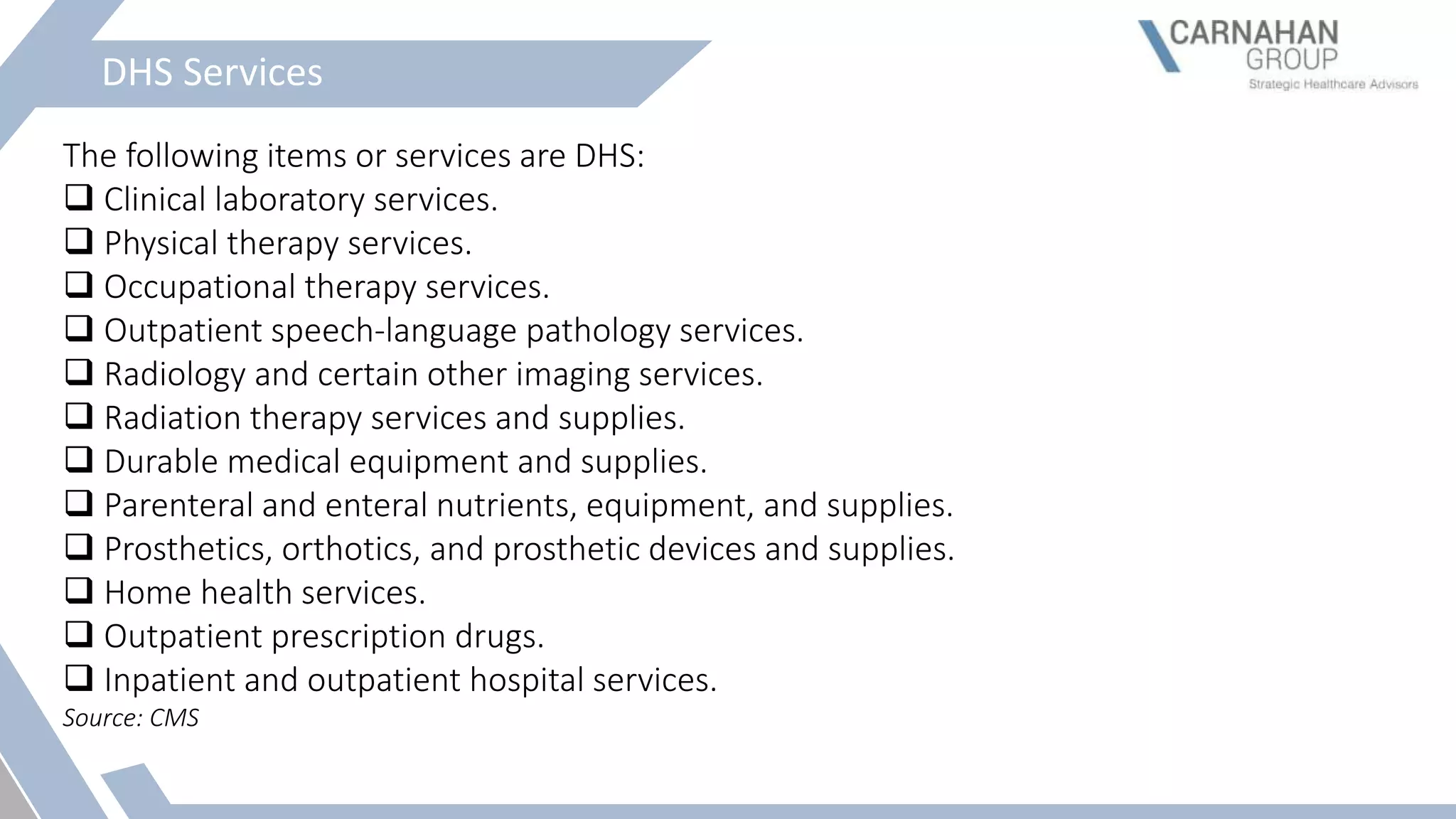
DHS Services
The following items or services are DHS:
 Clinical laboratory services.
 Physical therapy services.
 Occupational therapy services.
 Outpatient speech-language pathology services.
 Radiology and certain other imaging services.
 Radiation therapy services and supplies.
 Durable medical equipment and supplies.
 Parenteral and enteral nutrients, equipment, and supplies.
 Prosthetics, orthotics, and prosthetic devices and supplies.
 Home health services.
 Outpatient prescription drugs.
 Inpatient and outpatient hospital services.
Source: CMS
Anti-Kickback Statute
• Criminal statute that prohibits the exchange (or offer to exchange), of
anything of value, in an effort to induce (or reward) the referral of federal
health care program business.
• Anyone who “knowingly and willfully offers, pays, solicits, or receives
remuneration in order to induce business reimbursed under the
Medicare or Medicaid programs.”
• Charges and payments are not based on value or volume of referrals or
other business generated by the parties that is covered by Medicare or
Medicaid.
• Issued by OIG, although originally enacted by SSA in 1972.
Anti-Kickback Statute, Cont’d
• Safe harbor regulations: payment and business practices that, although
potentially implicating the statute, are not treated as offenses under the
statute:
• Investment interest: 40% rule
• Space and equipment rental – FMV-based
• Personal services and management contracts
• Sale of practice
• Referral services
• Warranties
• Discounts
• Employees, etc.
False Claims Act
Any person who:
• Knowingly presents, or causes to be presented, a false or fraudulent
claim for payment or approval;
• Knowingly makes, uses, or causes to be made or used, a false record or
statement material to a false or fraudulent claim;
• Conspires to commit a violation of the above.
Claim:
• Any request or demand, whether under a contract or otherwise, for
money or property and whether or not the United States has title to the
money or property, that is presented to an officer, employee, or agent of
the United States.
False Claims Act, Cont’d
• Is made to a contractor, grantee, or other recipient, if the money or
property is to be spent or used on the Government’s behalf or to
advance a Government program or interest, and if the United States
Government
• Provides or has provided any portion of the money or property
requested or demanded; or
• Will reimburse such contractor, grantee, or other recipient for
any portion of the money or property which is requested or
demanded; and
• Does not include requests or demands for money or property
that the Government has paid to an individual as compensation
for Federal employment or as an income subsidy with no
restrictions on that individual’s use of the money or property.
Private Inurement
• Only applicable to not-for profit/tax-exempt hospital falling under section
501 (c)(3) of the IRS Code
• This code provides tax exemption for organizations operating exclusively
for religious, educational and charitable purposes
• Can’t provide unjust enrichment to an individual party
• FVM therefore needed to prevent sale of the entity at the excess price or
paying physicians compensation that is above the FMV
• Violations: subject to revocation of its tax-exempt status
Penalties
Stark Law:
• Civil sanctions (denial of payment of a claim, refunds of amounts collected in
violation of the statute); and
• Monetary penalties (up to $15,000 for each claim in violation of the statute).
Anti-Kickback Statute:
• Up to $25,000 per violation; and/or
• Felony conviction punishable by imprisonment of up to 5 years; and
• Possible exclusion from participation in Federal Healthcare Programs.
False Claims Act – per claim:
• Civil penalties of not less than $5,000 or more than $10,000 plus
• Potential treble damages.
Source: UCLA Health
Qui Tam Lawsuits
• On the rise
• Initiators include current or past employees, management/executives, consultants,
physicians etc.
• FY 2015 – Department of Justice recovered over $3.5 billion from False Claims Act
settlement
• Fourth year in a row with exceeding 3.5 billion in cases, total since 2009: $26.4
billion
• Mintz Levin Qui Tam Updates (issued April 2016 and August 2016):
• 73 cases unsealed between December 2015 and August 2016
• Majority filed before 2015 (59) – long extensions of the seal
• Most commonly filed in California, New York and Florida
• Federal government decline to intervene in 56 cases
• 42 involved federal and state government
• 22 cases involved kickback violations, of these, 14 also violated Stark Law
Sources: DoJ, Mintz Levin
Lawsuits
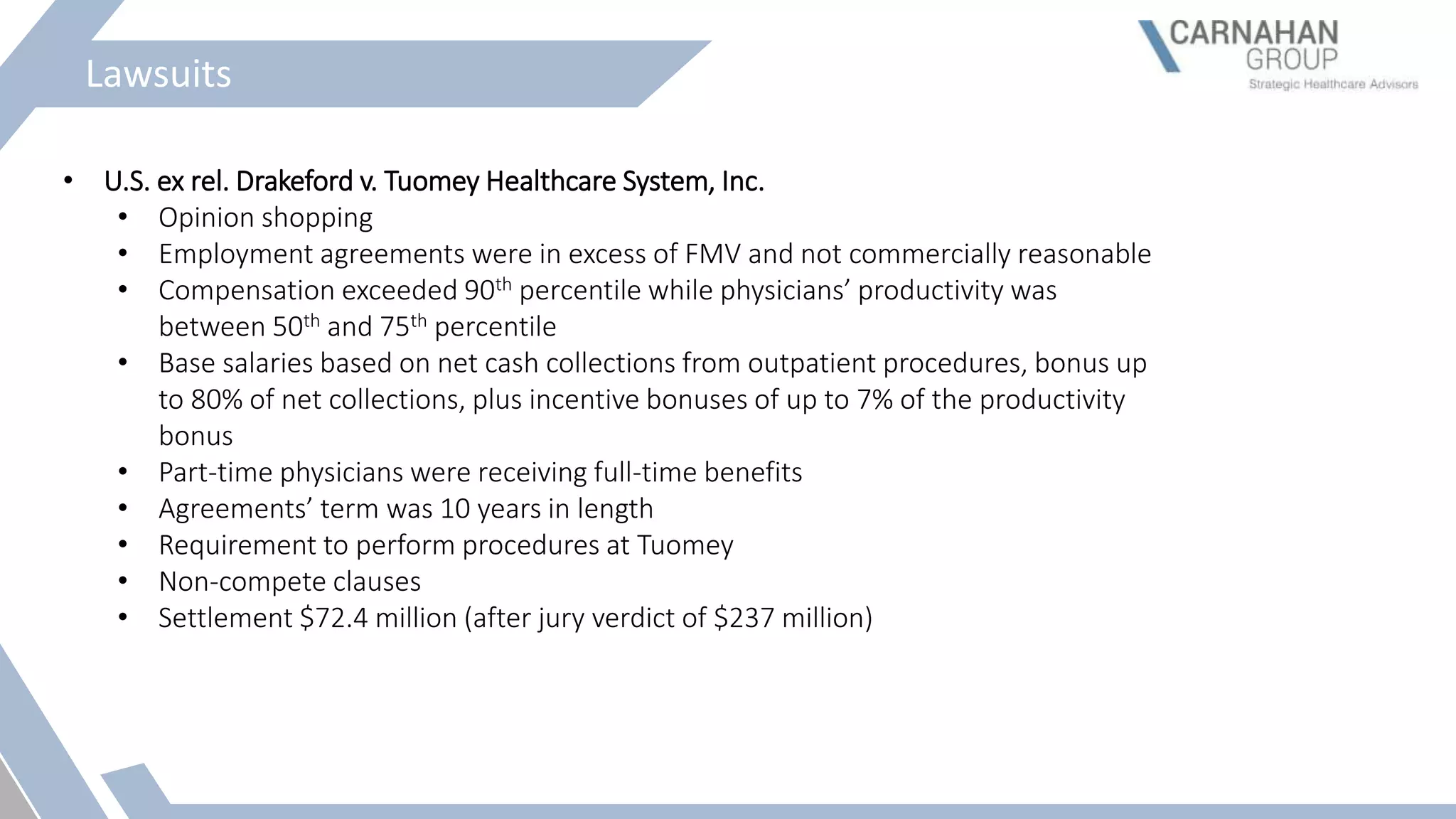
• U.S. ex rel. Drakeford v. Tuomey Healthcare System, Inc.
• Opinion shopping
• Employment agreements were in excess of FMV and not commercially reasonable
• Compensation exceeded 90th percentile while physicians’ productivity was
between 50th and 75th percentile
• Base salaries based on net cash collections from outpatient procedures, bonus up
to 80% of net collections, plus incentive bonuses of up to 7% of the productivity
bonus
• Part-time physicians were receiving full-time benefits
• Agreements’ term was 10 years in length
• Requirement to perform procedures at Tuomey
• Non-compete clauses
• Settlement $72.4 million (after jury verdict of $237 million)
Lawsuits, Cont’d
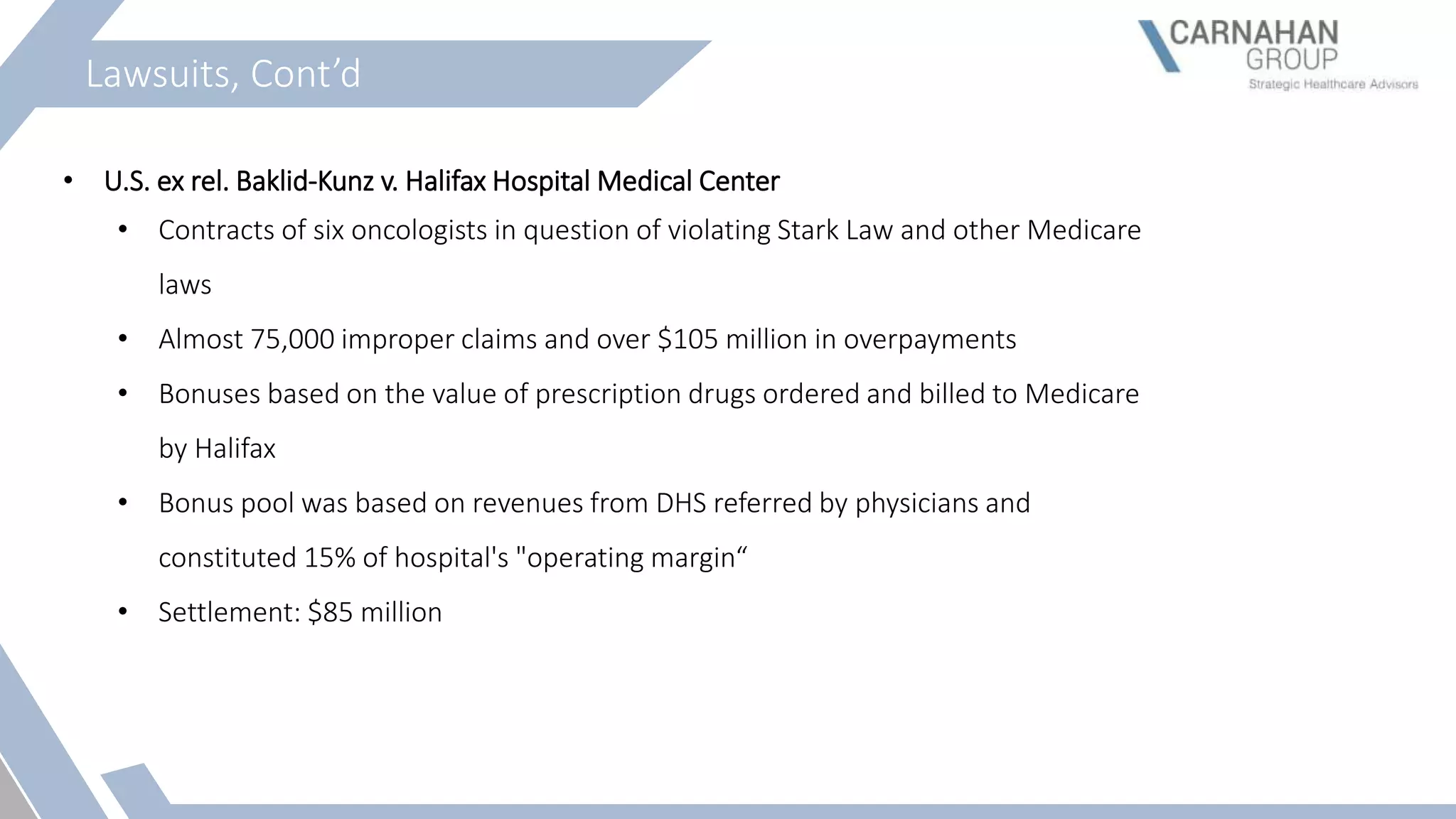
• U.S. ex rel. Baklid-Kunz v. Halifax Hospital Medical Center
• Contracts of six oncologists in question of violating Stark Law and other Medicare
laws
• Almost 75,000 improper claims and over $105 million in overpayments
• Bonuses based on the value of prescription drugs ordered and billed to Medicare
by Halifax
• Bonus pool was based on revenues from DHS referred by physicians and
constituted 15% of hospital's "operating margin“
• Settlement: $85 million
Lawsuits, Cont’d
• U.S. ex rel. Reilly v. North Broward Hospital District, et al.
• Excessive and not commercially reasonable compensation (above 90th percentile
MGMA)
• Practice generated major losses for Broward (almost $800,000)
• Broward took into consideration margins from inpatient and outpatient
contributions = referrals
• Limiting physicians’ charity care and pressure for in-house referrals
• Largest Stark Law settlement without litigation ($69.5 millions)
Lawsuits, Cont’d
• U.S. ex rel. Parikh v. Citizens Medical Center, et al.
• Emergency room physicians paid for referring patients to the chest pain center
• Above-market guaranteed salaries
• Discounted office space lease in exchange for referrals of Medicaid and Medicare
patients
• Bonuses for gastroenterologists working in hospital’s colonoscopy screening
programs - based on patient referrals to the hospital
• Additional medical director per diem fees of $1,000 for no extra work performed
Lawsuits, Cont’d
• TU.S. ex rel. Barker v. Tidwell
• Outdated equipment in question:
• False claims
• Sale of clinic at above FMV, without appraisal for $10 million Dollars
• Verdict: violations of Stark Law, but no AKB statute
• Columbus Regional to pay $25 million, plus up to $10 million in contingent
payments ($35 million max)
Lawsuits, Cont’d
• Adventist Health System
• Compensation based on value or volume of referrals
• Caps on compensation in place but not enforced (often well above the 90th
percentile of MGMA)
• Productivity often below the median
• Physicians receiving bonus for professional charges and facility fees (unofficially)
• Bonuses based on patient visits
• Between Payne and Dorsey cases, settlement amounted to $118.7 million
Patient Protection & Affordable Care Act
Patient Protection and Affordable Care Act (PPACA) – healthcare reform
legislation; passed by the 111th Congress and signed into law by President
Barack Obama in March 2010. Key provisions:
• Extends coverage to millions uninsured people – provides affordable
healthcare with no-cost preventive services
• Implements measures to lower healthcare costs while improving
efficiencies
• Eliminates some of the previous industry practices, such as rescission of
insurance policies and denial of coverage due to pre-existing conditions
• Eliminates annual and lifetime limits on coverage and benefits
• Make insurance companies responsible for keeping administrative costs
down
• Shared responsibility for patients (avoiding minimum coverage will result
in penalties)
Current Trends in Healthcare
Physicians are concerned and evaluating whether to remain independent,
align themselves with a major hospital or system, or sell their practice and
become employed.
• Raising costs to run the practices – supplies, technology, employees
• Meaningful Use – incentives end and working capital is required
• Uncertainty around PPACA – payments, delivery system
• Networks are becoming narrow – hospital alignment can help
• Concerns regarding aging population, physician shortages
• Volume-based reimbursement and productivity based compensation will
be succeeded by value based/bundled payments
• Physicians initiate majority of acquisitions
Current Trends in Healthcare, Cont’d
What motivates physicians?
Physicians are faced with increasingly complex environment:
• Flat or decreased compensation
• Complex regulatory requirements
• Bundled payments and the uncertainty that comes with revised payment
models
• Capital requirements for new equipment
• Rapidly changing technology
• Hiring and firing personnel
• Increased consumer expectations
• I just want to practice medicine!
Current Trends in Healthcare, Cont’d
Hospitals acquire mostly primary care practices, followed by cardiology,
orthopedics, general surgery, endocrinology, gastroenterology, urology and
oncology practices.
What motivates hospitals?
• Increase service area and market share
• Expand current capabilities in certain specialty areas
• Meet community need
• Insurance-driven motives
• Increase efficiencies and alignment
• Hospitals are not the only ones involved in M&A’s, recently insurance
companies and managed care organizations are getting involved
Current Trends in Healthcare, Cont’d
Hospitals are just one of the many buying physician practices:
• Private equity companies are consolidating specialties into mega
companies
• ED, Hospitalists, Anesthesiologists, Radiologists all being acquired by
non-hospital companies
• Private equity does not have the same constraints for compliance, so can
pay more for the practice and under the contracts
• Payors also buying practices to vertically integrate
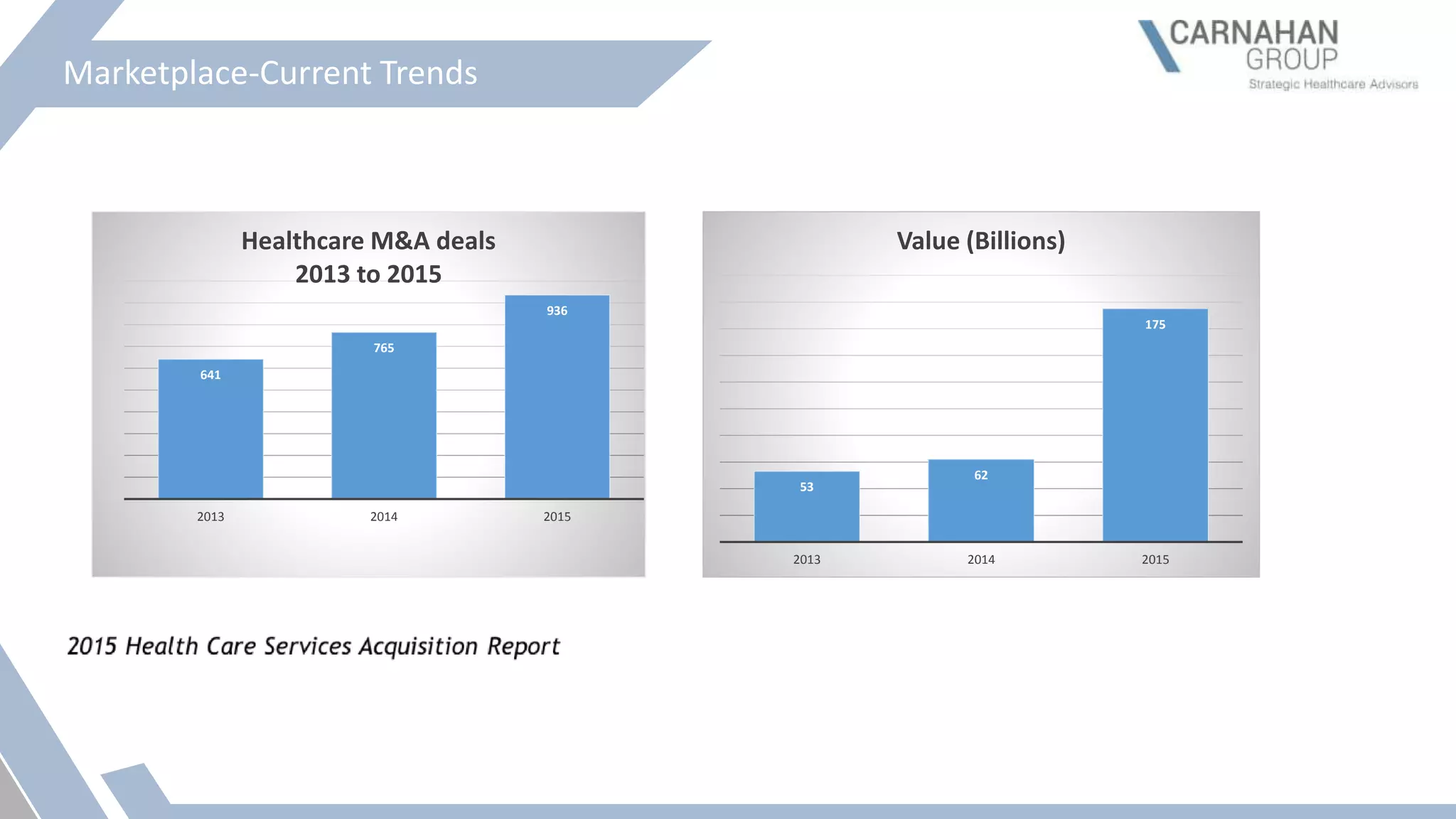
Marketplace-Current Trends
641
765
936
2013 2014 2015
Healthcare M&A deals
2013 to 2015
53
62
175
2013 2014 2015
Value (Billions)
Current Trends in Healthcare, Cont’d
In 2015, the healthcare acquisition volume reached $175 billion.
Shift toward:
• Vertical acquisitions (non-acute-care facilities – clinics, physician
practices); 74% of total provider acquisitions volume and are expected to
climb to 84% in 2018.
• Digital acquisitions (buying companies focused on sensors, mobility,
analytics/cloud capabilities) – projected to reach 8% in 2018.
• Hospital acquisitions are on the decline – 32% in 2006 to 21% in 2014.
Expected to drop to 6% in 2018.
Current Trends in Healthcare, Cont’d
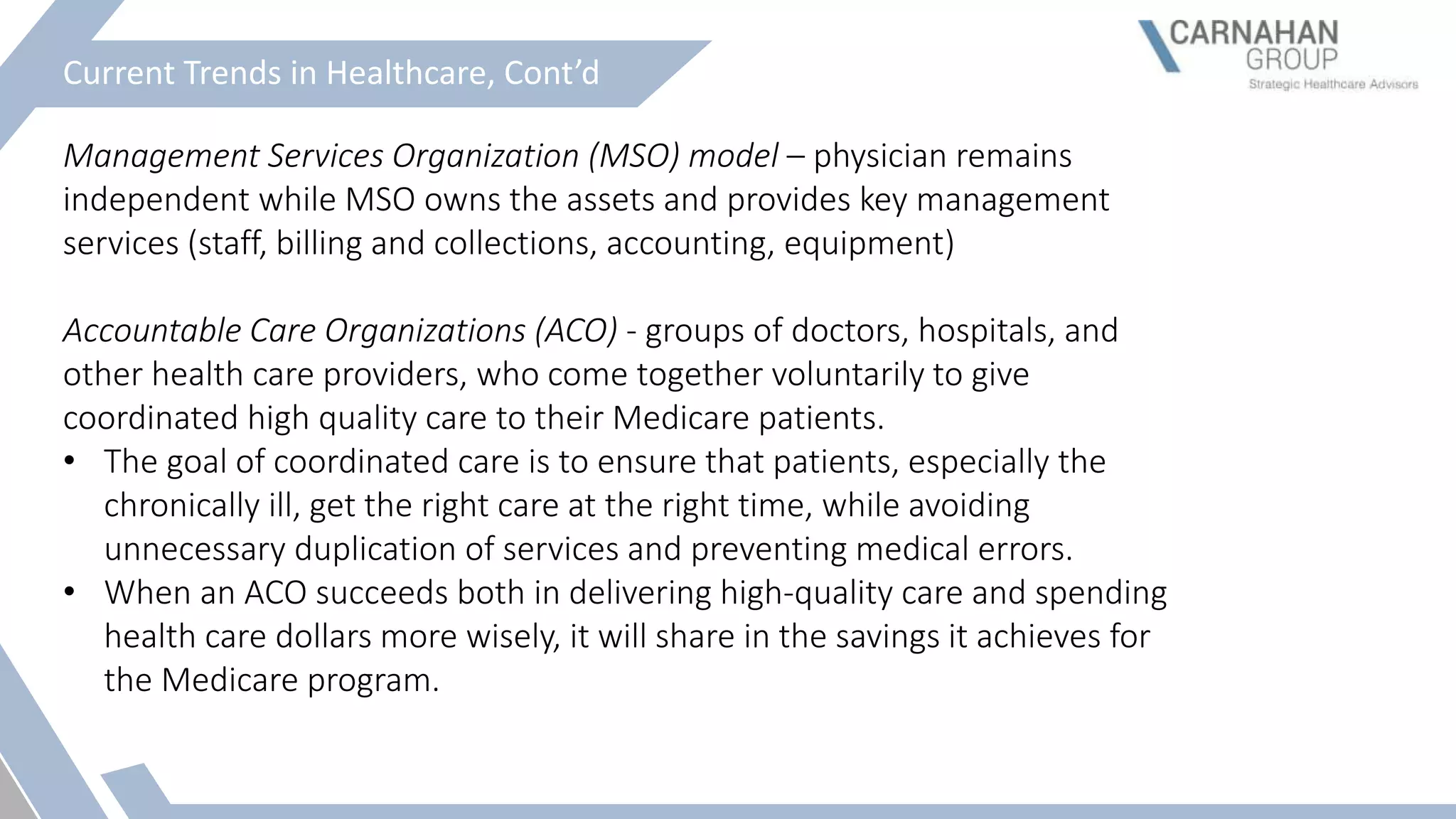
Management Services Organization (MSO) model – physician remains
independent while MSO owns the assets and provides key management
services (staff, billing and collections, accounting, equipment)
Accountable Care Organizations (ACO) - groups of doctors, hospitals, and
other health care providers, who come together voluntarily to give
coordinated high quality care to their Medicare patients.
• The goal of coordinated care is to ensure that patients, especially the
chronically ill, get the right care at the right time, while avoiding
unnecessary duplication of services and preventing medical errors.
• When an ACO succeeds both in delivering high-quality care and spending
health care dollars more wisely, it will share in the savings it achieves for
the Medicare program.
Factors Driving Alignment
• Shift away from fee-for-service to value-based propositions
• Bundled and value-based payments will accelerate pace of integration
• Accountable care organizations are being driven by payers including the
Medicare program
• Costs associated with technology and innovation
Integration Issues
• Although the intent of the merger is increasing quality of care while
using efficiencies to decrease costs, quality often does not improve.
• Cost of care typically increases as well
• Integration often external but not internal; random collection of hospital
and physician groups
• Lack of metrics to evaluate successful integration
• Risk of violating anti-trust laws
• Culture clash
Practice Ownership
57%
55%
53% 52%
50% 49%
47% 46%
44% 43% 42% 41%
39%
36%
0%
10%
20%
30%
40%
50%
60%
2000 2001 2002 2003 2004 2005 2006 2007 2008 2009 2010 2011 2012 2013
Physician Owners
Becker’s Hospital Review Study
Practice Ownership, Cont’d
• 80% physicians overextended
• 48% plan on reducing workload (part-time, retire, only accept establish patients)
2016 Survey of America’s Physicians: Practice Patterns and
Perspectives
24.9%
43.7%
17.2%
52.8%
16.8%
57.9%
SOLO PRACTICE EMPLOYEE OF HOSPITAL/MEDICAL GROUP
2012 2014 2016
Physician Practice Trends
• From July 2012 to July 2015, the percentage of hospital-employed
physicians increased by nearly 50 percent.
• During the same period, the number of physician practices employed by
hospitals grew by 31,000 practices — an increase of 86 percent.
• In 2012, hospitals owned one of every seven physician practices.
• By 2015, more than 25 percent of physician practices were owned by
hospitals.
Source: “Physician Practice Acquisition Study: National and Regional Employment Changes”
Physicians Advocacy Institute, September 2016
Latest in Top Mergers (2016)
Hospitals and Systems:
• Kindred Healthcare sell off 12 hospitals
• Umass Memorial Health to merge Clinton, HealthAlliance hospitals
• RCCH HealthCare acquires Ascension hospitals in Washington (state), Ohio
• Community Health Systems sell off 4 rural hospitals of Curae Health
• CRH Healthcare buys Patient’s First urgent care network
• Acadia Healthcare will buy Highland
Pharma:
• Pfizer buys Medivation
Other:
• Press Ganey sold to EQT
• GE acquires Biosafe Group
• McKesson buys HealthQX for value-based payment tools, McKesson’s healthcare information
unit merged with Change Healthcare (revenue cycle company)
Source: Healthcare Finance
Best Practices in Acquisitions
• Pay only FMV as supported by an independent valuation or a purchase price
determined in accordance with an approved valuation calculation.
• Gather documentation to support commercially reasonable transaction - why
does this transaction make sense?
• Improving quality
• Improving access to certain specialties
• Lowering costs
• Succession planning
• Decreased risk in reimbursement
Best Practices in Acquisitions
• Questions to ask:
• Is there a genuine need for the service or property?
• For the amount purchased?
• Does the referral source have the training, experience, skill and time to
perform the service as well as a non-referral source?
• Is the hospital actually negotiating?
• Advise clients of risks associated with inappropriate reasons for transaction
• Lock up the market to prevent competition
• Increased compensation
• Both sides represented by counsel
• LOI to cover the structure, payments, employment or other post-closing
arrangements
Medical Practice Valuation
Need for valuation:
• Sale of the practice – to another physician, hospital, medical group etc.
• Physician is retiring
• Divorce
• Merger
• New owner buy-in
• Litigation
Medical Practice Val., Cont’d
General factors:
• Current national/economic and industry outlook
• Reimbursement rates/CMS Fee Schedule (current and future)
• Regulation
• CON
• Licensures
Medical Practice Val., Cont’d
ractice Valuation
Specific factors:
• Competition and local market
• Medical specialty
• Demographics
• Current and potential capacity
• Productivity
• Reputation
• Active patient base
• Capital and operating expenses (in comparison to surveys)
• Non-compete agreement
• Payor mix/negotiated rates with payors
• Modalities/service mix, if applicable
Issues in Medical Practice Val.
The Volume and Value of Referrals:
• When does an acquisition or compensation relationship
“take into account the volume or value of referrals”?
• Regulations not clear
• Recent case law has confused “take into account volume or value of
referrals” and “varies with volume or value of referrals”
• Plain language indicate “varies with” is merely correlative; “takes into
account” some causal relationship
Issues in Medical Practice Val., Cont’d
• Cannot take in consideration volume or value of referrals
• What parts of the practice are part of the transaction?
• Full practice?
• Or just ancillaries?
• Post-acquisition employment/compensation must be considered:
• Under PSA
• Under employment model
• Derby vs. Commissioner
Valuator’s Role
Perform actual FMV by:
• Consider the fair market value of the proposed transaction
• Evaluate commercial reasonableness of the deal
Typically, the valuator will draw his/her conclusions with the help of:
• Regulations
• Valuation theory and accepted principles
• Knowledge and experience
• Accessible data
Valuator serves as a an independent third party, NOT AN ADVOCATE.
Attorney’s Role
Attorneys can’t determine FMV
• But they can read an appraisal
• Verify assumptions
• Disposition of assets and revenue streams
• Do not seek to change values
• Review final report before agreement signed
Future of Physicians
Physicians Practice’s 2016 Great American Physician Survey
2.1%
2.1%
2.4%
3.7%
3.7%
4.0%
4.0%
4.9%
6.1%
8.2%
14.6%
16.3%
55.7%
0.0% 10.0% 20.0% 30.0% 40.0% 50.0% 60.0%
GO INTO SOLO PRACTICE
LEAVE MY PRACTICE TO BECOME HOSPITAL EMPLOYED
SELL MY PRACTICE AND BECOME HOSPITAL EMPLOYED
BECOME A PATIENT-CENTERED MEDICAL HOME
TRANSITION TO A CONCIERGE PRACTICE
JOIN AN ACCOUNTABLE CARE ORGANIZATION (ACO)
CLOSE MY PRACTICE
MERGE WITH OTHER PRIVATE PRACTICES
TRANSITION TO A DIRECT-PAY PRACTICE
MOVE TO A DIFFERENT PRACTICE
OTHER
RETIRE
CONTINUE PRACTICING AS THEY DO NOW
Independent Physicians' Plans
Selecting Valuation Approach
Physician departure and issues
What is the physician-owner’s plan/situation?
• Employment by the hospital or another group (stay in the current practice)
• Retirement – sell the practice to another individual or entity
• Death – the practice belongs to the estate/family
• Purchase of/establishment/move into another practice
• Transition time: sudden or over time
Selecting Valuation Approach, Cont’d
Physician departure and issues
How would the practice operations and income stream change?
• For the employed physician:
• Would the new reimbursement rates be affected? Positively or negatively?
(Beware of investment value instead of FMV).
• What about the operating expenses? Physician salary?
• Deceased physician:
• Will the estate/family members take over the practice after a physician’s
death?
• Are they experienced?
Selecting Valuation Approach, Cont’d
Physician departure and issues
• Purchase by another individual or entity:
• Who is the new owner?
• Is it a physician?
• Currently in practice or unknown to patients?
• Has the practice been basically operated by other physicians or mid-level
providers? Would patients notice the owner’s departure?
• Purchase of/establishment/move into another practice:
• Is it a local move?
• Is there a non-compete in place? Is it enforceable?
Selecting Valuation Approach, Cont’d
Valuations typically use:
• Historical information (the Market Approach) and
• Projections (the Income Approach);
• Both are forward-looking approaches to value
• The multiples applied should also reflect expectations for the company in
comparison with expectations for the market
• Overall over 95% transactions are done based on the Asset Approach.
Income Approach
Income Approach
• Estimates the future cash flows based on historical financial information, with
expectations for changes in reimbursement or volume included in the
projections of future cash flows.
• While the true fair market value of the facility can be determined only by actual
arm's length negotiations, absent such negotiations, the Income Approach is
considered a reasonable and commonly used approach by appraisers of medical
practices.
Income Approach
Discounted Cash-Flow methodology:
• Projected cash flows of the business, discounted back to present value at the
discount rate.
• Cash flow equals net income plus depreciation and amortization, minus capital
expenditures and incremental working capital.
Income Approach, Cont’d
Capitalized Earnings Method: other commonly used methodology
• Evaluates the present value of the future economic benefits that accrue to the
investors in a business.
• However, these benefits, or future cash flows, are capitalized at a rate of return
that is commensurate with the company’s risk.
• This present value determines the fair market value of a business.
• The capitalization of earnings method determines value based on three factors:
- Risk adjusted rate of interest, typically the company’s cost of equity;
- Terminal growth rate; and
- Normalized level of earnings.
• The normalized level of earnings is multiplied by the capitalization factor,
defined as the inverse of the cost of equity less the terminal growth rate,
resulting in the indication of value.
Income Approach, Cont’d
Cost of Equity:
Ke = Rf + (β * RPm) + RPi + RPh + RPs + Rpu
• Rf = Rate of return on a risk-free security
• β = Industry Beta
• RPm = Risk premium for the market
• RPi = Risk premium for the industry
• RPh = Risk premium for healthcare facilities
• RPs = Risk premium for small stocks over and above RPm (small capitalization
stock risk premium)
• RPu = Risk premium for unsystematic risk attributable to the specific company
(company specific risk premium)
Income Approach, Cont’d
Weighted Average Cost of Capital:
• Calculate tax-adjusted cost of debt: pre-tax rate * (1 – income tax rate)
• Calculated cost of equity
• Obtain current or projected/estimated capital structure between equity and
debt
• Calculate weighted average: (cost of debt * % capital structure) + (cost of
equity * % capital structure)
• Commonly used for financed projects
• Cost of financing the capital = price tag of the investment
Income Approach, Cont’d
General Assumptions:
• Effective federal tax rate - the blended state and federal income tax rate
applicable to businesses operating in a particular state
• Discount rate – most often equity cost of capital or WACC
• Constant growth rate (for perpetuity) - the rate that operating revenues and
expenses are expected to grow after Year 5 of the projections and into
perpetuity
• Capital expenditures annually/projected growth rate
• Inflation rate – the estimated rate of inflation as reported by CPI
• Pre-compensation earnings percentage
Income Approach, Cont’d
• Revenue Assumptions:
• Projected revenues based on volume, productivity and
reimbursement/collections
• Expense Assumptions:
• Employee salaries, plus taxes and benefits
• Occupancy costs
• Medical supplies
• All other variable and fixed expenses (i.e. insurance, G&A etc.)
• Provider compensation, taxes and benefits – VERY IMPORTANT
• Capital expenditures and depreciation/amortization
• Working capital projections
Ancillary Services
• Ancillary services: auxiliary or supplemental services used to support diagnosis
and treatment of a patient’s condition. Billed separately, but often directly
related to the provision of professional services (technical component – TC) –
meant to cover the use pf physician’s/hospital’s equipment, supplies and
facilities when treating a patient.
• Some of the most common ancillary services include:
• Diagnostic Laboratory
• Nuclear Medicine (imaging)
• Radiology (x-rays and imaging – CT, MRI, PET)
• Radiation Oncology (cancer care)
Value of Ancillary Services
• Determining the value of ancillary services:
• Revenue considerations and trends
• Cost inputs
• Net earnings levels
• How should the net earnings from ancillary services be treated in compensation
and business valuation?
• Element of physician compensation?
• Business owner compensation or return on investment?
• Other positions?
Market Approach
• Computes value by comparing the value of similar businesses that trade in the
open market.
• Estimates of value are established using:
• Guideline publicly traded company method: an indication of value is
developed by comparing the financial condition and operating performance
of the company being appraised with those of other companies in the same
or similar lines of business and/or thought to be subject to similar economic
risks and environmental and political factors.
• Guideline transaction method: used to estimate the value of the subject
company if sufficient information regarding sales of whole companies that
are similar in nature to the company appraised can be compiled.
Market Approach, Cont’d
• Market value is then adjusted for:
• Qualitative and
• Quantitative differences
• MVIC/EBITDA most commonly used
• The ideal application of the Transaction Method would be to obtain information
regarding an exact contract relating to the sale of a practice between unrelated
parties. Unfortunately, obtaining such information is typically quite difficult as
these transactions are often private as most facilities are not willing to (or are
legally bound not to) divulge information regarding their contracts.
Market Approach, Cont’d
Other issues to consider when using Market Approach:
• Stark Regulation - the prices involved in M&A transactions are generally at an
investment level, which is specific to a particular buyer. If enough information is
not available in the transaction to determine FMV, which considers the price to
a “hypothetical” buyer, investment value cannot be ruled out. Consequently,
discounting the “synergistic” premium is highly speculative and controversial.
• The database transaction price may involve purchasing some other non-cash
consideration. When the FMV standard is required, cash or cash-equivalent
value is required. Appropriate adjustments have to be made to the transaction
(obtain sufficient database descriptions of each individual transaction or
sufficient numbers to apply a statistical measure).
Asset Approach
• Asset/Cost Approach identifies the cost to replicate a business or to accumulate,
and place in service, the assets necessary to operate a business.
• The asset, or underlying cost, approach is based on the economic principal of
substitution in that that any willing buyer would be willing to pay no more for an
asset than the price that would be necessary to obtain such an asset elsewhere
in the market place.
• Only used if Income and Market Approach both yield lower value - the
indicative value usually presents a floor, or minimum value, but may still include
intangible assets, such as certificates of need etc.
Asset Approach, Cont’d
• The cost approach is based on a comparison between the cost to develop the
assets and the value of the existing assets. As a result, consideration of which
premise of value to apply to the valuation should be applied. This decision is
made upon the determination of the highest and best use of the asset subject
to the valuation.
Premises of value for consideration include:
• Value in Continued Use, as Part of a Going Concern – assumes that the assets
are sold in an assemblage of assets and as part of an income producing business
enterprise. The premise of continued use contemplates the mutually synergistic
relationships of (1) the company’s tangible assets to the intangible assets and
(2) the company’s intangible assets to the tangible assets.
Asset Approach, Cont’d
• Value in Place, as Part of a Mass Assemblage of Assets – assumes that the assets
are sold as a mass assemblage and are capable of being, but are not operating,
as an income producing business enterprise.
• The premise of value in place contemplates some of the mutual contributory
value of (1) the company’s tangible assets to the intangible assets and (2) the
company’s intangible assets to the tangible assets. However, a component of
the value in place is that this premise may exclude some of the contributory
value of intangible including trained and assembled workforce, going concern
value and goodwill.
Asset Approach, Cont’d
• Value in Exchange, in an Orderly Disposition – assumes that the assets are sold
piecemeal and not as part of a mass assemblage and that the assets are given
an adequate level of exposure in their normal secondary market. The premise of
value in exchange does not contemplate any contributory value effect of the
subject tangible assets on the intangible assets.
• Value in Exchange, Forced Liquidation – assumes that the assets are sold
piecemeal and not part of a mass assemblage. Also assumes the assets are not
allowed a normal level of exposure to their normal secondary market. Due to
the forced liquidation market transaction, this premise assumes no contributory
value from the subject tangible assets to the intangible assets, or vice versa.
Asset Approach, Cont’d
• Within the Cost Approach there are several related methods which include (1)
reproduction cost and (2) replacement costs that should be considered. The
costs below should include direct and indirect costs as well as any form of
obsolescence.
• Reproduction Cost – Contemplates total cost construction of the exact
replica of the subject assets using current prices.
• Replacement Cost – Contemplates the cost to recreate the functionality or
utility of the subject assets.
• Factors for asset approach:
• Components of the transaction (tangible vs. intangible assets)
• Lease (operating or capital) or direct buy-out, etc.
• MSO model
Assets a Hospital Can Buy
Per OIG Letters
• From Mac Thornton dated December 22, 1992 to T.J. Sullivan
• OIG advised that when a hospital purchases a physician practice,
it is suspect to value intangibles such as Goodwill, Patient lists,
Non-competes
• OIG letter from Mac Thornton to John E. Steiner, Jr. of the American Hospital
Association, dated Nov. 2, 1993 clarified earlier letter
• OIG said that it wasn’t saying that it is illegal to value intangibles,
only that it could be suspect
• Will look at context and intent of the parties
• These letters are viewed by some as old news but they provide insight of the
government’s perspective.
Assets a Hospital Can Buy
• Bradford Case
• Hospital lease of a nuclear camera from referring physician
• Non-compete included
• Valuation report that said lease payments were “reasonable” in part
because of the revenue expected from lessor physicians’ referrals
• Court held lease violated Stark because not FMV
• OIG Advisory Opinion 09-07
• Surgeons and Hospital combined their respective ASCs into one huge ASC
• Valuation attributed value to only hard assets, not intangibles.
• OIG gave favorable opinion, but said that its conclusion might be different if
the valuation of the respective contributions of the investors included
intangible assets, such as an income valuation approach
Assets a Hospital Can Buy
Preamble to Stark I Regs. (66 Fed. Reg. at page 877, Jan. 4, 2001)
• In response to a commenter’s question, said that the value of self-generated
DHS could be included in the value of the purchase of a physician practice as
long as the purchase was not contingent on future referrals. However, CMS
also said that, depending on the identity of
the purchaser, the inclusion of ancillary revenues value could implicate the
AKS
Assets a Hospital Can Buy
• Reasonable conclusion may be that a purchase of a physician owned DHS
business could still fit Stark isolated transaction exception, but still need to do
detailed AKS analysis to access the risk
• Preamble to AKS Physician Practice Acquisition Safe Harbor
(64 Fed. Reg. at page 63550) ( Nov. 19, 1999)
• “We remain of the opinion that payment for intangible can easily be
disguised as payments for referrals…..we are unwilling to provide safe harbor
protection for any particular valuation methodology.”
Asset Approach, Cont’d
• Typical transaction involves certain tangible and intangible assets:
• Fixed assets
• Inventory/supplies
• Accounts receivable
• Trained and assembled workforce
• Medical charts (paper or electronic format) and EMR systems
• Trade name
• Non-compete agreements
• Payor contracts
• Certificate of Need
• Phone number or website
• Other intellectual property
Physician Compensation
• Physician’s compensation:
• Salary/draw – non-owner and owner physicians
• Profit/distribution – owner physicians only; includes return on tangible and
intangible assets:
• Net working capital
• Fixed assets
• Trained workforce
• TC component for ancillary services (in excess of fixed asset return)
• Contract rights
• Goodwill
• Patient charts
Valuing Physician Compensation
• Compensation of physicians based on PSA or employment:
• Can we apply the same structure?
• Employed physician not permitted to be compensated for ancillaries
• If compensating based on productivity, do we use wRVUs? Collections? Or
shifting towards quality incentives, value based or bundled payment
models?
• Value or volume of referrals cannot be considered
• Is this a part of acquisition? Compensation after transaction must be applied
to income approach: Debry vs. Commissioner
Valuing Physician Compensation, Cont’d
Common market surveys:
• MGMA data modules:
• Provider Compensation
• Medical Director, On-Call, Physician etc.
• Management/Staff Compensation
• Academic Management
• Cost and Revenue
• AMGA Compensation and Productivity Survey
• Sullivan Cotter:
• Physician Compensation and Productivity Survey
• Physician On-Call Pay Survey
Issues in Compensation Valuation
Market survey data:
• Should the data be adjusted? If so, how?
• Per 2015 MGMA report, certain specialties showed total compensation well
above the mean due to inclusion of ancillary services income:
• Compensation Level of Ancillary Revenue for all practices: non-invasive
cardiology, ophthalmology, general orthopedic surgery + all subspecialties,
ENT, pulmonary medicine, diagnostic radiology and neurosurgery
• Compensation Level of Ancillary Revenue for physician-owned practices:
invasive-interventional cardiology, non-invasive cardiology,
hematology/oncology, ophthalmology, general orthopedic surgery + certain
subspecialties, ENT, pulmonary medicine, physiatry, diagnostic radiology and
neurosurgery
Issues in Compensation Val., Cont’d
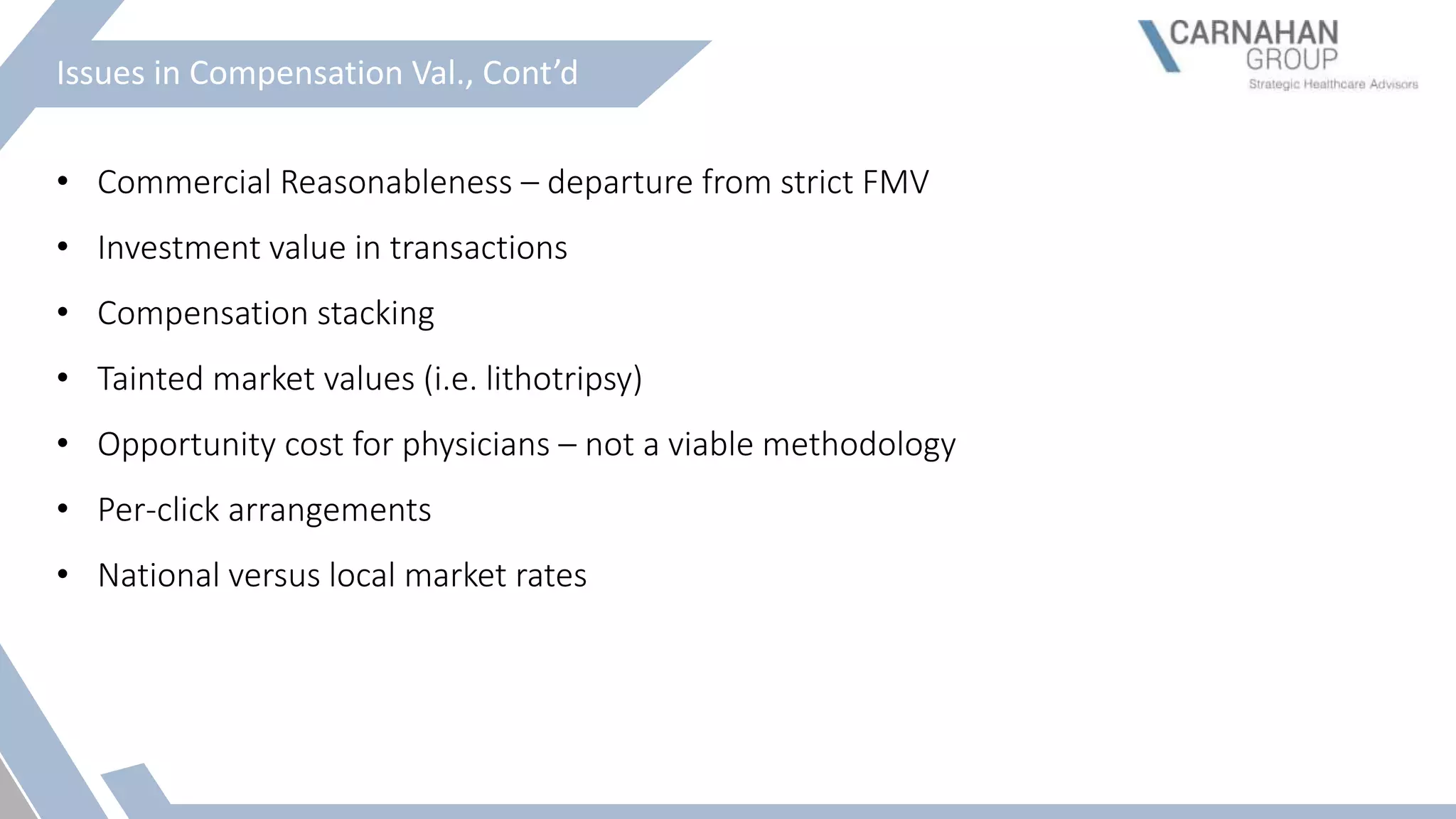
• Commercial Reasonableness – departure from strict FMV
• Investment value in transactions
• Compensation stacking
• Tainted market values (i.e. lithotripsy)
• Opportunity cost for physicians – not a viable methodology
• Per-click arrangements
• National versus local market rates
Questions
Valuing Dr. Exit

Valuing Dr. Exit

  • 1.
    Valuing Dr. Exit Valuinga Practice when a Physician Leaves October 26, 2016
  • 2.
    Christopher T. Carnahan,CPA/ABV, CVA Chris Carnahan has over 25 years of experience in healthcare and finance. He has held executive level positions in healthcare, technology, and manufacturing. Mr. Carnahan is the founder of Carnahan Group, Inc., and is responsible for the leadership, strategic direction, and financial matters of the firm. Mr. Carnahan has been involved in hundreds of medical staff demand analyses for not-for-profit and for-profit entities, including modeling demand and supply analysis for healthcare services within diverse communities. During his career, Mr. Carnahan has been involved in over 1,500 healthcare transactions, including physician compensation arrangements, acquisitions, fair market value opinions, asset appraisals, and provided expert testimony. Mr. Carnahan has presented numerous times to some of the largest healthcare systems in the world on the topics of community health needs assessments, medical staff demand analyses, valuations, and healthcare strategy. He is also an instructor for the National Association of Certified Valuators and Analysts (NACVA) in the area of healthcare valuations. In 2010, Mr. Carnahan received the Certificate of Achievement for an Instructor of Great Distinction by NACVA. Mr. Carnahan is a licensed Certified Public Accountant (CPA) in Florida, a Certified Valuation Analyst (CVA), accredited in Business Valuations (ABV), certified in Financial Forensics (CFF), a Master Analyst in Financial Forensics (MAFF), Chartered Global Management Accountant (CGMA), and Small Business Administration (SBA). He is also a member of the American Institute of Certified Public Accountants (AICPA), a member of the National Association of Certified Valuators and Analysts (NACVA), a section member of the AICPA’s Valuation and Forensic Services. Mr. Carnahan has presented and published articles on physician acquisitions and has testified as an expert witness in various venues and jurisdictions. In addition to Mr. Carnahan’s healthcare experience, in 2015 he established Carnahan Advisors, a forensics, accounting and litigation support firm for family law cases. His responsibilities include providing expert testimony and opinions, reviewing clients’ financial affidavits, analyzing equitable distribution
  • 3.
    Agenda • FMV inhealthcare • Regulation • Current trends and marketplace • Medical practice valuation and related issues • Selecting the right approach • Income, Market, and Asset approach • Physician compensation • Issues in valuing physician compensation
  • 4.
    FMV in Healthcare Whyare FMV standards needed in Healthcare? “To protect patients and the federal health care programs from fraud and abuse by curtailing the corrupting influence of money on health care decisions.” Governing bodies: • Office of the Inspector General (OIG) Department of Health and Human Services (HHS) Standards: • Anti-Kickback Statute • Stark law • IRS’s regulations
  • 5.
    What is FMV? Fairmarket value is generally defined as: “The price, expressed in terms of cash equivalents, at which property would change hands between a hypothetical willing and able buyer and a hypothetical willing and able seller, acting at arm’s length in an open and unrestricted market, when neither is under compulsion to buy or sell and when both have reasonable knowledge of the relevant facts.” International Glossary of Business Valuation Terms, 2001
  • 6.
    What is FMV?- Cont’d • The standard of value is fair market value, defined in: Federal Register / Vol. 69, No. 59 p. 16128 March 26, 2004 / Rules and Regulations (Stark II Phase II) as the value in arm’s length transactions, consistent with the general market value. • This fair market value definition is also applicable to the Stark II Phase III Regulation that was published on September 5, 2007 and made effective December 4, 2007. According to the background section of the Phase III Regulation, “Phases I, II, and III of this rulemaking are intended to be read together as a unified whole.” • This definition is also applicable to and consistent with other applicable Federal rulemakings such as the Inpatient Prospective Payment System Final Rules effective October 1, 2009.
  • 7.
    What is FMV?- Cont’d The Federal Register / Vol. 69, No. 59 p. 16128 further states that: “general market value” means the price that an asset would bring as the result of bona fide bargaining between well-informed buyer and sellers who are not otherwise in a position to generate business for the other party, or the compensation that would be included in a service agreement as the result of a bona fide bargaining between well-informed parties to the agreement who are not otherwise in a position to generate business for the other party, on the date of acquisition of the asset or at the time of the service agreement. Usually, the fair market price is the price at which bona fide sales have been consummated for assets of like type, quality, and quantity in a particular market at the time of acquisition, or the compensation that has been included in bona fide service agreements with comparable terms at the time of the agreement, where the price or compensation has not been determined in any manner that takes into account the volume or value of anticipated or actual referrals.
  • 8.
    What is FMV?- Cont’d Under Stark II Phase II, CMS included in the definition of fair market value a safe harbor for an hourly payment for a physician’s personal services (that is, services performed by the physician personally). Please note, however, that Stark II Phase III (effective December 4, 2007), CMS eliminated this safe harbor. CMS deleted this safe harbor because it may be impractical to obtain competitor information regarding emergency room physician hourly rates. In addition, several of the identified surveys are no longer available (or may not be readily available).
  • 9.
    Commercial Reasonableness • In1998, CMS (then HCFA) in the proposed Stark rule defined “commercially reasonable” to mean that “an arrangement appears to be a sensible, prudent business agreement, from the perspective of the particular parties involved, even in the absence of any particular referrals.” • Later, CMS wrote, an arrangement “will be considered ‘commercially reasonable’ in the absence of referral if the arrangement would make commercial sense if entered into by a reasonable entity of similar type and size of a reasonable physician of similar scope and specialty, even if there were no potential DHS referrals.” 69 Fed. Reg. 16093
  • 10.
    Commercial Reasonableness, Cont’d OIG– Office of Inspector General of the United States Department of Health and Human Services (HHS) stated: • “In order to meet the threshold of commercial reasonableness, compensation arrangements with physicians should be reasonable and necessary.” Commercially reasonable arrangements would therefore: • Bona fide agreement • Business purpose/based on prudent decisions • Contract disregards any referrals • Services are necessary and reasonable
  • 11.
    Commercial Reasonableness, Cont’d CommercialReasonableness (CR) in the eyes of the IRS: • Physician’s training and experience • Nature and time spent performing duties and assigned responsibilities • Organization size • Who determines compensation physician agreements – are they independent? • Is the proposed compensation reasonable based on comparable physicians and organizations? • Is the compensation a payment for a business or assets? • National and local market • Physician’s contribution to entity’s profits Conclusion: The physician must perform the required duties as per his/her agreement, otherwise the arrangement is not commercially reasonable.
  • 12.
    Commercial Reasonableness, Cont’d Typicalquestions that are asked by valuators in order to assess CR (all physicians): 1. Necessity of the contract/arrangement: • Please provide a summary of the necessity of this contract from the facility’s perspective. • Can you describe a few of the primary benefits to the facility of having this arrangement? • Are the duties being completed under this agreement necessary? 2. Negotiation/basis of compensation terms: • What is the current and/or proposed compensation amount and how was it determined? • Was the rate negotiated? • Is this rate cost effective given the fact that some duties may be able to be completed using other resources? • Would you have been able to procure the services at a lower rate?
  • 13.
    Commercial Reasonableness, Cont’d Typicalquestions that are asked by valuators in order to assess CR – cont’d: • Was the contract bid out? • Was the negotiation for the contract conducted at arm’s length? 3. Market comparison reference points: • Do you have any information (word of mouth or otherwise) for the local market concerning other agreements that are consistent with the financial terms of this agreement? • Please provide the specialty and any important attributes of the physician’s skill set that are integral to performing the services in the agreement. What is the specialty or training of the physician? Are there any attributes of the physician’s skill set that uniquely qualify him/her for this position?
  • 14.
    Commercial Reasonableness, Cont’d Additionalcommon questions that are asked by valuators in order to assess CR (medical directors): • What is the size of the facility, number of patients, patient acuity levels and patient needs? • Describe the quality, activities and involvement of the medical staff and the need for medical direction. • What is the number of regular committees and meetings that require physician involvement? • Describe the quality of hospital management and the need for policies, procedures, protocols, and interdisciplinary coordination of patient services. • Are the stated responsibilities under the proposed agreement part of a physician’s duties as a treating physician or required responsibilities of all physicians outlined in the hospital’s medical staff bylaws? • Are the duties contemplated under this agreement required by CMS, JCAHO, or other accreditation service?
  • 15.
    Commercial Reasonableness, Cont’d Additionalcommon questions that are asked by valuators in order to assess CR (medical directors) – cont’d: • Do you expect the physician to complete other duties in addition to those specified in the contract? • What duties for the medical director contract will require the most time from the physician? • Can you estimate the amount of weekly/monthly time for the regular duties performed? • Will the facility administration perform regular validation and review of the actual duties performed by the medical directors to determine effectiveness and whether the duties are needed going forward? • What is the basis for the maximum number of compensated hours? • Are there any estimates of the costs for performing these duties using other resources? • Would it be more cost effective to hire a full-time person with the money that is being paid for this contract?
  • 16.
    Commercial Reasonableness, Cont’d Additionalcommon questions that are asked by valuators in order to assess CR (medical directors) – cont’d: • Please provide the specialty and any important attributes of the physician’s skill set that are integral to performing the services in the agreement. • What is the specialty or training of the physician? • Are there any attributes of the physician’s skill set that uniquely qualify him/her for this position? • Please list any competing facilities (including contact information, if available) that may provide or contract for this same service. • Do you have any information (word of mouth or otherwise) for the local market concerning other agreements that are consistent with the financial terms of this agreement?
  • 17.
    Commercial Reasonableness, Cont’d •Equipment, space, or services to be used to further business objectives • The lease context presents the most tangible examples of ‘commercial unreasonableness’ • It is not commercially reasonable for a hospital to lease from a potential referral source more space than needed • Physician compensation: • Can a neurosurgeon mow your lawn? • But should you hire him? • How much would you pay him/her? • Is it at all reasonable to pay a physician his/her regular rate?
  • 18.
    Commercial Reasonableness, Cont’d •Does the facility need a medical director for the inpatient psychiatric program? • How many directors should be hired? • Are the proper contracts in place (with outlined compensation, duties that do not overlap with other positions/directors, etc.)? • How are these physicians paid (hourly or monthly)? • Is the compensation based on actual hours performed? • Are these hours tracked, documented and verified before disbursement of funds? Commercial reasonableness = qualitative factors
  • 19.
    FMV vs. CR Usuallyconsidered separately and sequentially: • Transaction can be consistent with FMV but not necessarily commercially reasonable (i.e. multiple medical directors at a small facility) • If FMV fails, CR fails as well FMV and CR are not identical!
  • 20.
    Stark Law Generally prohibitsphysicians from making designated health service referrals to organizations with which those physicians (or an immediate family member) have a financial relationship, unless an exception under the law applies. This includes physician referrals to his/her own medical practice where the following circumstances are present: • A physician delivers services through the medical practice; • The medical practice furnishes designated health services that may be payable by Medicare making the medical practice a Designated Health Services (DHS) entity; • The physician has a financial relationship with the medical practice; and • The physician makes referrals to the medical practice for the furnishing of DHS.
  • 21.
    In-Office Ancillary Exception Physiciansand medical practices rely on the Stark law’s in-office ancillary services exception and physician services exceptions to allow "within- practice" DHS referrals. Of these, the in-office ancillary services exception is used most frequently as it allows physicians in medical practices to: • Make referrals for certain DHS within the medical practice; • Furnish those DHS to practice patients; • Bill Medicare and Medicaid for the services; and • Retain and use the revenues earned from providing the services within the group for payment of practice expenses and physician compensation. These exceptions are therefore of significant importance to a medical practice’s internal activities.
  • 22.
    DHS Services The followingitems or services are DHS:  Clinical laboratory services.  Physical therapy services.  Occupational therapy services.  Outpatient speech-language pathology services.  Radiology and certain other imaging services.  Radiation therapy services and supplies.  Durable medical equipment and supplies.  Parenteral and enteral nutrients, equipment, and supplies.  Prosthetics, orthotics, and prosthetic devices and supplies.  Home health services.  Outpatient prescription drugs.  Inpatient and outpatient hospital services. Source: CMS
  • 23.
    Anti-Kickback Statute • Criminalstatute that prohibits the exchange (or offer to exchange), of anything of value, in an effort to induce (or reward) the referral of federal health care program business. • Anyone who “knowingly and willfully offers, pays, solicits, or receives remuneration in order to induce business reimbursed under the Medicare or Medicaid programs.” • Charges and payments are not based on value or volume of referrals or other business generated by the parties that is covered by Medicare or Medicaid. • Issued by OIG, although originally enacted by SSA in 1972.
  • 24.
    Anti-Kickback Statute, Cont’d •Safe harbor regulations: payment and business practices that, although potentially implicating the statute, are not treated as offenses under the statute: • Investment interest: 40% rule • Space and equipment rental – FMV-based • Personal services and management contracts • Sale of practice • Referral services • Warranties • Discounts • Employees, etc.
  • 25.
    False Claims Act Anyperson who: • Knowingly presents, or causes to be presented, a false or fraudulent claim for payment or approval; • Knowingly makes, uses, or causes to be made or used, a false record or statement material to a false or fraudulent claim; • Conspires to commit a violation of the above. Claim: • Any request or demand, whether under a contract or otherwise, for money or property and whether or not the United States has title to the money or property, that is presented to an officer, employee, or agent of the United States.
  • 26.
    False Claims Act,Cont’d • Is made to a contractor, grantee, or other recipient, if the money or property is to be spent or used on the Government’s behalf or to advance a Government program or interest, and if the United States Government • Provides or has provided any portion of the money or property requested or demanded; or • Will reimburse such contractor, grantee, or other recipient for any portion of the money or property which is requested or demanded; and • Does not include requests or demands for money or property that the Government has paid to an individual as compensation for Federal employment or as an income subsidy with no restrictions on that individual’s use of the money or property.
  • 27.
    Private Inurement • Onlyapplicable to not-for profit/tax-exempt hospital falling under section 501 (c)(3) of the IRS Code • This code provides tax exemption for organizations operating exclusively for religious, educational and charitable purposes • Can’t provide unjust enrichment to an individual party • FVM therefore needed to prevent sale of the entity at the excess price or paying physicians compensation that is above the FMV • Violations: subject to revocation of its tax-exempt status
  • 28.
    Penalties Stark Law: • Civilsanctions (denial of payment of a claim, refunds of amounts collected in violation of the statute); and • Monetary penalties (up to $15,000 for each claim in violation of the statute). Anti-Kickback Statute: • Up to $25,000 per violation; and/or • Felony conviction punishable by imprisonment of up to 5 years; and • Possible exclusion from participation in Federal Healthcare Programs. False Claims Act – per claim: • Civil penalties of not less than $5,000 or more than $10,000 plus • Potential treble damages. Source: UCLA Health
  • 29.
    Qui Tam Lawsuits •On the rise • Initiators include current or past employees, management/executives, consultants, physicians etc. • FY 2015 – Department of Justice recovered over $3.5 billion from False Claims Act settlement • Fourth year in a row with exceeding 3.5 billion in cases, total since 2009: $26.4 billion • Mintz Levin Qui Tam Updates (issued April 2016 and August 2016): • 73 cases unsealed between December 2015 and August 2016 • Majority filed before 2015 (59) – long extensions of the seal • Most commonly filed in California, New York and Florida • Federal government decline to intervene in 56 cases • 42 involved federal and state government • 22 cases involved kickback violations, of these, 14 also violated Stark Law Sources: DoJ, Mintz Levin
  • 30.
    Lawsuits • U.S. exrel. Drakeford v. Tuomey Healthcare System, Inc. • Opinion shopping • Employment agreements were in excess of FMV and not commercially reasonable • Compensation exceeded 90th percentile while physicians’ productivity was between 50th and 75th percentile • Base salaries based on net cash collections from outpatient procedures, bonus up to 80% of net collections, plus incentive bonuses of up to 7% of the productivity bonus • Part-time physicians were receiving full-time benefits • Agreements’ term was 10 years in length • Requirement to perform procedures at Tuomey • Non-compete clauses • Settlement $72.4 million (after jury verdict of $237 million)
  • 31.
    Lawsuits, Cont’d • U.S.ex rel. Baklid-Kunz v. Halifax Hospital Medical Center • Contracts of six oncologists in question of violating Stark Law and other Medicare laws • Almost 75,000 improper claims and over $105 million in overpayments • Bonuses based on the value of prescription drugs ordered and billed to Medicare by Halifax • Bonus pool was based on revenues from DHS referred by physicians and constituted 15% of hospital's "operating margin“ • Settlement: $85 million
  • 32.
    Lawsuits, Cont’d • U.S.ex rel. Reilly v. North Broward Hospital District, et al. • Excessive and not commercially reasonable compensation (above 90th percentile MGMA) • Practice generated major losses for Broward (almost $800,000) • Broward took into consideration margins from inpatient and outpatient contributions = referrals • Limiting physicians’ charity care and pressure for in-house referrals • Largest Stark Law settlement without litigation ($69.5 millions)
  • 33.
    Lawsuits, Cont’d • U.S.ex rel. Parikh v. Citizens Medical Center, et al. • Emergency room physicians paid for referring patients to the chest pain center • Above-market guaranteed salaries • Discounted office space lease in exchange for referrals of Medicaid and Medicare patients • Bonuses for gastroenterologists working in hospital’s colonoscopy screening programs - based on patient referrals to the hospital • Additional medical director per diem fees of $1,000 for no extra work performed
  • 34.
    Lawsuits, Cont’d • TU.S.ex rel. Barker v. Tidwell • Outdated equipment in question: • False claims • Sale of clinic at above FMV, without appraisal for $10 million Dollars • Verdict: violations of Stark Law, but no AKB statute • Columbus Regional to pay $25 million, plus up to $10 million in contingent payments ($35 million max)
  • 35.
    Lawsuits, Cont’d • AdventistHealth System • Compensation based on value or volume of referrals • Caps on compensation in place but not enforced (often well above the 90th percentile of MGMA) • Productivity often below the median • Physicians receiving bonus for professional charges and facility fees (unofficially) • Bonuses based on patient visits • Between Payne and Dorsey cases, settlement amounted to $118.7 million
  • 36.
    Patient Protection &Affordable Care Act Patient Protection and Affordable Care Act (PPACA) – healthcare reform legislation; passed by the 111th Congress and signed into law by President Barack Obama in March 2010. Key provisions: • Extends coverage to millions uninsured people – provides affordable healthcare with no-cost preventive services • Implements measures to lower healthcare costs while improving efficiencies • Eliminates some of the previous industry practices, such as rescission of insurance policies and denial of coverage due to pre-existing conditions • Eliminates annual and lifetime limits on coverage and benefits • Make insurance companies responsible for keeping administrative costs down • Shared responsibility for patients (avoiding minimum coverage will result in penalties)
  • 37.
    Current Trends inHealthcare Physicians are concerned and evaluating whether to remain independent, align themselves with a major hospital or system, or sell their practice and become employed. • Raising costs to run the practices – supplies, technology, employees • Meaningful Use – incentives end and working capital is required • Uncertainty around PPACA – payments, delivery system • Networks are becoming narrow – hospital alignment can help • Concerns regarding aging population, physician shortages • Volume-based reimbursement and productivity based compensation will be succeeded by value based/bundled payments • Physicians initiate majority of acquisitions
  • 38.
    Current Trends inHealthcare, Cont’d What motivates physicians? Physicians are faced with increasingly complex environment: • Flat or decreased compensation • Complex regulatory requirements • Bundled payments and the uncertainty that comes with revised payment models • Capital requirements for new equipment • Rapidly changing technology • Hiring and firing personnel • Increased consumer expectations • I just want to practice medicine!
  • 39.
    Current Trends inHealthcare, Cont’d Hospitals acquire mostly primary care practices, followed by cardiology, orthopedics, general surgery, endocrinology, gastroenterology, urology and oncology practices. What motivates hospitals? • Increase service area and market share • Expand current capabilities in certain specialty areas • Meet community need • Insurance-driven motives • Increase efficiencies and alignment • Hospitals are not the only ones involved in M&A’s, recently insurance companies and managed care organizations are getting involved
  • 40.
    Current Trends inHealthcare, Cont’d Hospitals are just one of the many buying physician practices: • Private equity companies are consolidating specialties into mega companies • ED, Hospitalists, Anesthesiologists, Radiologists all being acquired by non-hospital companies • Private equity does not have the same constraints for compliance, so can pay more for the practice and under the contracts • Payors also buying practices to vertically integrate
  • 41.
    Marketplace-Current Trends 641 765 936 2013 20142015 Healthcare M&A deals 2013 to 2015 53 62 175 2013 2014 2015 Value (Billions)
  • 42.
    Current Trends inHealthcare, Cont’d In 2015, the healthcare acquisition volume reached $175 billion. Shift toward: • Vertical acquisitions (non-acute-care facilities – clinics, physician practices); 74% of total provider acquisitions volume and are expected to climb to 84% in 2018. • Digital acquisitions (buying companies focused on sensors, mobility, analytics/cloud capabilities) – projected to reach 8% in 2018. • Hospital acquisitions are on the decline – 32% in 2006 to 21% in 2014. Expected to drop to 6% in 2018.
  • 43.
    Current Trends inHealthcare, Cont’d Management Services Organization (MSO) model – physician remains independent while MSO owns the assets and provides key management services (staff, billing and collections, accounting, equipment) Accountable Care Organizations (ACO) - groups of doctors, hospitals, and other health care providers, who come together voluntarily to give coordinated high quality care to their Medicare patients. • The goal of coordinated care is to ensure that patients, especially the chronically ill, get the right care at the right time, while avoiding unnecessary duplication of services and preventing medical errors. • When an ACO succeeds both in delivering high-quality care and spending health care dollars more wisely, it will share in the savings it achieves for the Medicare program.
  • 44.
    Factors Driving Alignment •Shift away from fee-for-service to value-based propositions • Bundled and value-based payments will accelerate pace of integration • Accountable care organizations are being driven by payers including the Medicare program • Costs associated with technology and innovation
  • 45.
    Integration Issues • Althoughthe intent of the merger is increasing quality of care while using efficiencies to decrease costs, quality often does not improve. • Cost of care typically increases as well • Integration often external but not internal; random collection of hospital and physician groups • Lack of metrics to evaluate successful integration • Risk of violating anti-trust laws • Culture clash
  • 46.
    Practice Ownership 57% 55% 53% 52% 50%49% 47% 46% 44% 43% 42% 41% 39% 36% 0% 10% 20% 30% 40% 50% 60% 2000 2001 2002 2003 2004 2005 2006 2007 2008 2009 2010 2011 2012 2013 Physician Owners Becker’s Hospital Review Study
  • 47.
    Practice Ownership, Cont’d •80% physicians overextended • 48% plan on reducing workload (part-time, retire, only accept establish patients) 2016 Survey of America’s Physicians: Practice Patterns and Perspectives 24.9% 43.7% 17.2% 52.8% 16.8% 57.9% SOLO PRACTICE EMPLOYEE OF HOSPITAL/MEDICAL GROUP 2012 2014 2016
  • 48.
    Physician Practice Trends •From July 2012 to July 2015, the percentage of hospital-employed physicians increased by nearly 50 percent. • During the same period, the number of physician practices employed by hospitals grew by 31,000 practices — an increase of 86 percent. • In 2012, hospitals owned one of every seven physician practices. • By 2015, more than 25 percent of physician practices were owned by hospitals. Source: “Physician Practice Acquisition Study: National and Regional Employment Changes” Physicians Advocacy Institute, September 2016
  • 49.
    Latest in TopMergers (2016) Hospitals and Systems: • Kindred Healthcare sell off 12 hospitals • Umass Memorial Health to merge Clinton, HealthAlliance hospitals • RCCH HealthCare acquires Ascension hospitals in Washington (state), Ohio • Community Health Systems sell off 4 rural hospitals of Curae Health • CRH Healthcare buys Patient’s First urgent care network • Acadia Healthcare will buy Highland Pharma: • Pfizer buys Medivation Other: • Press Ganey sold to EQT • GE acquires Biosafe Group • McKesson buys HealthQX for value-based payment tools, McKesson’s healthcare information unit merged with Change Healthcare (revenue cycle company) Source: Healthcare Finance
  • 50.
    Best Practices inAcquisitions • Pay only FMV as supported by an independent valuation or a purchase price determined in accordance with an approved valuation calculation. • Gather documentation to support commercially reasonable transaction - why does this transaction make sense? • Improving quality • Improving access to certain specialties • Lowering costs • Succession planning • Decreased risk in reimbursement
  • 51.
    Best Practices inAcquisitions • Questions to ask: • Is there a genuine need for the service or property? • For the amount purchased? • Does the referral source have the training, experience, skill and time to perform the service as well as a non-referral source? • Is the hospital actually negotiating? • Advise clients of risks associated with inappropriate reasons for transaction • Lock up the market to prevent competition • Increased compensation • Both sides represented by counsel • LOI to cover the structure, payments, employment or other post-closing arrangements
  • 52.
    Medical Practice Valuation Needfor valuation: • Sale of the practice – to another physician, hospital, medical group etc. • Physician is retiring • Divorce • Merger • New owner buy-in • Litigation
  • 53.
    Medical Practice Val.,Cont’d General factors: • Current national/economic and industry outlook • Reimbursement rates/CMS Fee Schedule (current and future) • Regulation • CON • Licensures
  • 54.
    Medical Practice Val.,Cont’d ractice Valuation Specific factors: • Competition and local market • Medical specialty • Demographics • Current and potential capacity • Productivity • Reputation • Active patient base • Capital and operating expenses (in comparison to surveys) • Non-compete agreement • Payor mix/negotiated rates with payors • Modalities/service mix, if applicable
  • 55.
    Issues in MedicalPractice Val. The Volume and Value of Referrals: • When does an acquisition or compensation relationship “take into account the volume or value of referrals”? • Regulations not clear • Recent case law has confused “take into account volume or value of referrals” and “varies with volume or value of referrals” • Plain language indicate “varies with” is merely correlative; “takes into account” some causal relationship
  • 56.
    Issues in MedicalPractice Val., Cont’d • Cannot take in consideration volume or value of referrals • What parts of the practice are part of the transaction? • Full practice? • Or just ancillaries? • Post-acquisition employment/compensation must be considered: • Under PSA • Under employment model • Derby vs. Commissioner
  • 57.
    Valuator’s Role Perform actualFMV by: • Consider the fair market value of the proposed transaction • Evaluate commercial reasonableness of the deal Typically, the valuator will draw his/her conclusions with the help of: • Regulations • Valuation theory and accepted principles • Knowledge and experience • Accessible data Valuator serves as a an independent third party, NOT AN ADVOCATE.
  • 58.
    Attorney’s Role Attorneys can’tdetermine FMV • But they can read an appraisal • Verify assumptions • Disposition of assets and revenue streams • Do not seek to change values • Review final report before agreement signed
  • 59.
    Future of Physicians PhysiciansPractice’s 2016 Great American Physician Survey 2.1% 2.1% 2.4% 3.7% 3.7% 4.0% 4.0% 4.9% 6.1% 8.2% 14.6% 16.3% 55.7% 0.0% 10.0% 20.0% 30.0% 40.0% 50.0% 60.0% GO INTO SOLO PRACTICE LEAVE MY PRACTICE TO BECOME HOSPITAL EMPLOYED SELL MY PRACTICE AND BECOME HOSPITAL EMPLOYED BECOME A PATIENT-CENTERED MEDICAL HOME TRANSITION TO A CONCIERGE PRACTICE JOIN AN ACCOUNTABLE CARE ORGANIZATION (ACO) CLOSE MY PRACTICE MERGE WITH OTHER PRIVATE PRACTICES TRANSITION TO A DIRECT-PAY PRACTICE MOVE TO A DIFFERENT PRACTICE OTHER RETIRE CONTINUE PRACTICING AS THEY DO NOW Independent Physicians' Plans
  • 60.
    Selecting Valuation Approach Physiciandeparture and issues What is the physician-owner’s plan/situation? • Employment by the hospital or another group (stay in the current practice) • Retirement – sell the practice to another individual or entity • Death – the practice belongs to the estate/family • Purchase of/establishment/move into another practice • Transition time: sudden or over time
  • 61.
    Selecting Valuation Approach,Cont’d Physician departure and issues How would the practice operations and income stream change? • For the employed physician: • Would the new reimbursement rates be affected? Positively or negatively? (Beware of investment value instead of FMV). • What about the operating expenses? Physician salary? • Deceased physician: • Will the estate/family members take over the practice after a physician’s death? • Are they experienced?
  • 62.
    Selecting Valuation Approach,Cont’d Physician departure and issues • Purchase by another individual or entity: • Who is the new owner? • Is it a physician? • Currently in practice or unknown to patients? • Has the practice been basically operated by other physicians or mid-level providers? Would patients notice the owner’s departure? • Purchase of/establishment/move into another practice: • Is it a local move? • Is there a non-compete in place? Is it enforceable?
  • 63.
    Selecting Valuation Approach,Cont’d Valuations typically use: • Historical information (the Market Approach) and • Projections (the Income Approach); • Both are forward-looking approaches to value • The multiples applied should also reflect expectations for the company in comparison with expectations for the market • Overall over 95% transactions are done based on the Asset Approach.
  • 64.
    Income Approach Income Approach •Estimates the future cash flows based on historical financial information, with expectations for changes in reimbursement or volume included in the projections of future cash flows. • While the true fair market value of the facility can be determined only by actual arm's length negotiations, absent such negotiations, the Income Approach is considered a reasonable and commonly used approach by appraisers of medical practices.
  • 65.
    Income Approach Discounted Cash-Flowmethodology: • Projected cash flows of the business, discounted back to present value at the discount rate. • Cash flow equals net income plus depreciation and amortization, minus capital expenditures and incremental working capital.
  • 66.
    Income Approach, Cont’d CapitalizedEarnings Method: other commonly used methodology • Evaluates the present value of the future economic benefits that accrue to the investors in a business. • However, these benefits, or future cash flows, are capitalized at a rate of return that is commensurate with the company’s risk. • This present value determines the fair market value of a business. • The capitalization of earnings method determines value based on three factors: - Risk adjusted rate of interest, typically the company’s cost of equity; - Terminal growth rate; and - Normalized level of earnings. • The normalized level of earnings is multiplied by the capitalization factor, defined as the inverse of the cost of equity less the terminal growth rate, resulting in the indication of value.
  • 67.
    Income Approach, Cont’d Costof Equity: Ke = Rf + (β * RPm) + RPi + RPh + RPs + Rpu • Rf = Rate of return on a risk-free security • β = Industry Beta • RPm = Risk premium for the market • RPi = Risk premium for the industry • RPh = Risk premium for healthcare facilities • RPs = Risk premium for small stocks over and above RPm (small capitalization stock risk premium) • RPu = Risk premium for unsystematic risk attributable to the specific company (company specific risk premium)
  • 68.
    Income Approach, Cont’d WeightedAverage Cost of Capital: • Calculate tax-adjusted cost of debt: pre-tax rate * (1 – income tax rate) • Calculated cost of equity • Obtain current or projected/estimated capital structure between equity and debt • Calculate weighted average: (cost of debt * % capital structure) + (cost of equity * % capital structure) • Commonly used for financed projects • Cost of financing the capital = price tag of the investment
  • 69.
    Income Approach, Cont’d GeneralAssumptions: • Effective federal tax rate - the blended state and federal income tax rate applicable to businesses operating in a particular state • Discount rate – most often equity cost of capital or WACC • Constant growth rate (for perpetuity) - the rate that operating revenues and expenses are expected to grow after Year 5 of the projections and into perpetuity • Capital expenditures annually/projected growth rate • Inflation rate – the estimated rate of inflation as reported by CPI • Pre-compensation earnings percentage
  • 70.
    Income Approach, Cont’d •Revenue Assumptions: • Projected revenues based on volume, productivity and reimbursement/collections • Expense Assumptions: • Employee salaries, plus taxes and benefits • Occupancy costs • Medical supplies • All other variable and fixed expenses (i.e. insurance, G&A etc.) • Provider compensation, taxes and benefits – VERY IMPORTANT • Capital expenditures and depreciation/amortization • Working capital projections
  • 71.
    Ancillary Services • Ancillaryservices: auxiliary or supplemental services used to support diagnosis and treatment of a patient’s condition. Billed separately, but often directly related to the provision of professional services (technical component – TC) – meant to cover the use pf physician’s/hospital’s equipment, supplies and facilities when treating a patient. • Some of the most common ancillary services include: • Diagnostic Laboratory • Nuclear Medicine (imaging) • Radiology (x-rays and imaging – CT, MRI, PET) • Radiation Oncology (cancer care)
  • 72.
    Value of AncillaryServices • Determining the value of ancillary services: • Revenue considerations and trends • Cost inputs • Net earnings levels • How should the net earnings from ancillary services be treated in compensation and business valuation? • Element of physician compensation? • Business owner compensation or return on investment? • Other positions?
  • 73.
    Market Approach • Computesvalue by comparing the value of similar businesses that trade in the open market. • Estimates of value are established using: • Guideline publicly traded company method: an indication of value is developed by comparing the financial condition and operating performance of the company being appraised with those of other companies in the same or similar lines of business and/or thought to be subject to similar economic risks and environmental and political factors. • Guideline transaction method: used to estimate the value of the subject company if sufficient information regarding sales of whole companies that are similar in nature to the company appraised can be compiled.
  • 74.
    Market Approach, Cont’d •Market value is then adjusted for: • Qualitative and • Quantitative differences • MVIC/EBITDA most commonly used • The ideal application of the Transaction Method would be to obtain information regarding an exact contract relating to the sale of a practice between unrelated parties. Unfortunately, obtaining such information is typically quite difficult as these transactions are often private as most facilities are not willing to (or are legally bound not to) divulge information regarding their contracts.
  • 75.
    Market Approach, Cont’d Otherissues to consider when using Market Approach: • Stark Regulation - the prices involved in M&A transactions are generally at an investment level, which is specific to a particular buyer. If enough information is not available in the transaction to determine FMV, which considers the price to a “hypothetical” buyer, investment value cannot be ruled out. Consequently, discounting the “synergistic” premium is highly speculative and controversial. • The database transaction price may involve purchasing some other non-cash consideration. When the FMV standard is required, cash or cash-equivalent value is required. Appropriate adjustments have to be made to the transaction (obtain sufficient database descriptions of each individual transaction or sufficient numbers to apply a statistical measure).
  • 76.
    Asset Approach • Asset/CostApproach identifies the cost to replicate a business or to accumulate, and place in service, the assets necessary to operate a business. • The asset, or underlying cost, approach is based on the economic principal of substitution in that that any willing buyer would be willing to pay no more for an asset than the price that would be necessary to obtain such an asset elsewhere in the market place. • Only used if Income and Market Approach both yield lower value - the indicative value usually presents a floor, or minimum value, but may still include intangible assets, such as certificates of need etc.
  • 77.
    Asset Approach, Cont’d •The cost approach is based on a comparison between the cost to develop the assets and the value of the existing assets. As a result, consideration of which premise of value to apply to the valuation should be applied. This decision is made upon the determination of the highest and best use of the asset subject to the valuation. Premises of value for consideration include: • Value in Continued Use, as Part of a Going Concern – assumes that the assets are sold in an assemblage of assets and as part of an income producing business enterprise. The premise of continued use contemplates the mutually synergistic relationships of (1) the company’s tangible assets to the intangible assets and (2) the company’s intangible assets to the tangible assets.
  • 78.
    Asset Approach, Cont’d •Value in Place, as Part of a Mass Assemblage of Assets – assumes that the assets are sold as a mass assemblage and are capable of being, but are not operating, as an income producing business enterprise. • The premise of value in place contemplates some of the mutual contributory value of (1) the company’s tangible assets to the intangible assets and (2) the company’s intangible assets to the tangible assets. However, a component of the value in place is that this premise may exclude some of the contributory value of intangible including trained and assembled workforce, going concern value and goodwill.
  • 79.
    Asset Approach, Cont’d •Value in Exchange, in an Orderly Disposition – assumes that the assets are sold piecemeal and not as part of a mass assemblage and that the assets are given an adequate level of exposure in their normal secondary market. The premise of value in exchange does not contemplate any contributory value effect of the subject tangible assets on the intangible assets. • Value in Exchange, Forced Liquidation – assumes that the assets are sold piecemeal and not part of a mass assemblage. Also assumes the assets are not allowed a normal level of exposure to their normal secondary market. Due to the forced liquidation market transaction, this premise assumes no contributory value from the subject tangible assets to the intangible assets, or vice versa.
  • 80.
    Asset Approach, Cont’d •Within the Cost Approach there are several related methods which include (1) reproduction cost and (2) replacement costs that should be considered. The costs below should include direct and indirect costs as well as any form of obsolescence. • Reproduction Cost – Contemplates total cost construction of the exact replica of the subject assets using current prices. • Replacement Cost – Contemplates the cost to recreate the functionality or utility of the subject assets. • Factors for asset approach: • Components of the transaction (tangible vs. intangible assets) • Lease (operating or capital) or direct buy-out, etc. • MSO model
  • 81.
    Assets a HospitalCan Buy Per OIG Letters • From Mac Thornton dated December 22, 1992 to T.J. Sullivan • OIG advised that when a hospital purchases a physician practice, it is suspect to value intangibles such as Goodwill, Patient lists, Non-competes • OIG letter from Mac Thornton to John E. Steiner, Jr. of the American Hospital Association, dated Nov. 2, 1993 clarified earlier letter • OIG said that it wasn’t saying that it is illegal to value intangibles, only that it could be suspect • Will look at context and intent of the parties • These letters are viewed by some as old news but they provide insight of the government’s perspective.
  • 82.
    Assets a HospitalCan Buy • Bradford Case • Hospital lease of a nuclear camera from referring physician • Non-compete included • Valuation report that said lease payments were “reasonable” in part because of the revenue expected from lessor physicians’ referrals • Court held lease violated Stark because not FMV • OIG Advisory Opinion 09-07 • Surgeons and Hospital combined their respective ASCs into one huge ASC • Valuation attributed value to only hard assets, not intangibles. • OIG gave favorable opinion, but said that its conclusion might be different if the valuation of the respective contributions of the investors included intangible assets, such as an income valuation approach
  • 83.
    Assets a HospitalCan Buy Preamble to Stark I Regs. (66 Fed. Reg. at page 877, Jan. 4, 2001) • In response to a commenter’s question, said that the value of self-generated DHS could be included in the value of the purchase of a physician practice as long as the purchase was not contingent on future referrals. However, CMS also said that, depending on the identity of the purchaser, the inclusion of ancillary revenues value could implicate the AKS
  • 84.
    Assets a HospitalCan Buy • Reasonable conclusion may be that a purchase of a physician owned DHS business could still fit Stark isolated transaction exception, but still need to do detailed AKS analysis to access the risk • Preamble to AKS Physician Practice Acquisition Safe Harbor (64 Fed. Reg. at page 63550) ( Nov. 19, 1999) • “We remain of the opinion that payment for intangible can easily be disguised as payments for referrals…..we are unwilling to provide safe harbor protection for any particular valuation methodology.”
  • 85.
    Asset Approach, Cont’d •Typical transaction involves certain tangible and intangible assets: • Fixed assets • Inventory/supplies • Accounts receivable • Trained and assembled workforce • Medical charts (paper or electronic format) and EMR systems • Trade name • Non-compete agreements • Payor contracts • Certificate of Need • Phone number or website • Other intellectual property
  • 86.
    Physician Compensation • Physician’scompensation: • Salary/draw – non-owner and owner physicians • Profit/distribution – owner physicians only; includes return on tangible and intangible assets: • Net working capital • Fixed assets • Trained workforce • TC component for ancillary services (in excess of fixed asset return) • Contract rights • Goodwill • Patient charts
  • 87.
    Valuing Physician Compensation •Compensation of physicians based on PSA or employment: • Can we apply the same structure? • Employed physician not permitted to be compensated for ancillaries • If compensating based on productivity, do we use wRVUs? Collections? Or shifting towards quality incentives, value based or bundled payment models? • Value or volume of referrals cannot be considered • Is this a part of acquisition? Compensation after transaction must be applied to income approach: Debry vs. Commissioner
  • 88.
    Valuing Physician Compensation,Cont’d Common market surveys: • MGMA data modules: • Provider Compensation • Medical Director, On-Call, Physician etc. • Management/Staff Compensation • Academic Management • Cost and Revenue • AMGA Compensation and Productivity Survey • Sullivan Cotter: • Physician Compensation and Productivity Survey • Physician On-Call Pay Survey
  • 89.
    Issues in CompensationValuation Market survey data: • Should the data be adjusted? If so, how? • Per 2015 MGMA report, certain specialties showed total compensation well above the mean due to inclusion of ancillary services income: • Compensation Level of Ancillary Revenue for all practices: non-invasive cardiology, ophthalmology, general orthopedic surgery + all subspecialties, ENT, pulmonary medicine, diagnostic radiology and neurosurgery • Compensation Level of Ancillary Revenue for physician-owned practices: invasive-interventional cardiology, non-invasive cardiology, hematology/oncology, ophthalmology, general orthopedic surgery + certain subspecialties, ENT, pulmonary medicine, physiatry, diagnostic radiology and neurosurgery
  • 90.
    Issues in CompensationVal., Cont’d • Commercial Reasonableness – departure from strict FMV • Investment value in transactions • Compensation stacking • Tainted market values (i.e. lithotripsy) • Opportunity cost for physicians – not a viable methodology • Per-click arrangements • National versus local market rates
  • 91.

Editor's Notes

  • #11 http://info.pyapc.com/hubfs/White-Papers/Commercial-Reasonableness-White-Paper-PYA.pdf
  • #12 http://www.hcca-info.org/Portals/0/PDFs/Resources/Conference_Handouts/Compliance_Institute/2013/POST/POSTAM17print1.pdf
  • #13 http://info.pyapc.com/hubfs/White-Papers/Commercial-Reasonableness-White-Paper-PYA.pdf
  • #14 http://info.pyapc.com/hubfs/White-Papers/Commercial-Reasonableness-White-Paper-PYA.pdf
  • #15 http://info.pyapc.com/hubfs/White-Papers/Commercial-Reasonableness-White-Paper-PYA.pdf
  • #16 http://info.pyapc.com/hubfs/White-Papers/Commercial-Reasonableness-White-Paper-PYA.pdf
  • #17 http://info.pyapc.com/hubfs/White-Papers/Commercial-Reasonableness-White-Paper-PYA.pdf
  • #23 https://www.cms.gov/Medicare/Fraud-and-Abuse/PhysicianSelfReferral/index.html?redirect=/Physicianselfreferral/
  • #29 http://legal.uclahealth.org/body.cfm?id=26
  • #39 https://www.justice.gov/opa/pr/justice-department-recovers-over-35-billion-false-claims-act-cases-fiscal-year-2015 http://www.natlawreview.com/article/health-care-qui-tam-update-and-recently-unsealed-whistleblower-cases
  • #40 https://www.justice.gov/opa/pr/justice-department-recovers-over-35-billion-false-claims-act-cases-fiscal-year-2015 http://www.natlawreview.com/article/health-care-qui-tam-update-and-recently-unsealed-whistleblower-cases
  • #41 https://www.justice.gov/opa/pr/justice-department-recovers-over-35-billion-false-claims-act-cases-fiscal-year-2015 http://www.natlawreview.com/article/health-care-qui-tam-update-and-recently-unsealed-whistleblower-cases
  • #49 http://www.physiciansadvocacyinstitute.org/Portals/0/PAI-Physician-Employment-Study.pdf
  • #53 http://www.rtacpa.com/wp-content/uploads/2011/06/Valuation-of-a-Medical-Practice.pdf
  • #58 http://www.hcca-info.org/Portals/0/PDFs/Resources/Conference_Handouts/Compliance_Institute/2013/POST/POSTAM17print1.pdf https://www.foley.com/files/Event/a88f49fc-d709-438f-b863-fcfdd9444720/Presentation/EventAttachment/5267866a-6952-445c-bd79-02903f2f1a37/BuyingSelling.pdf